
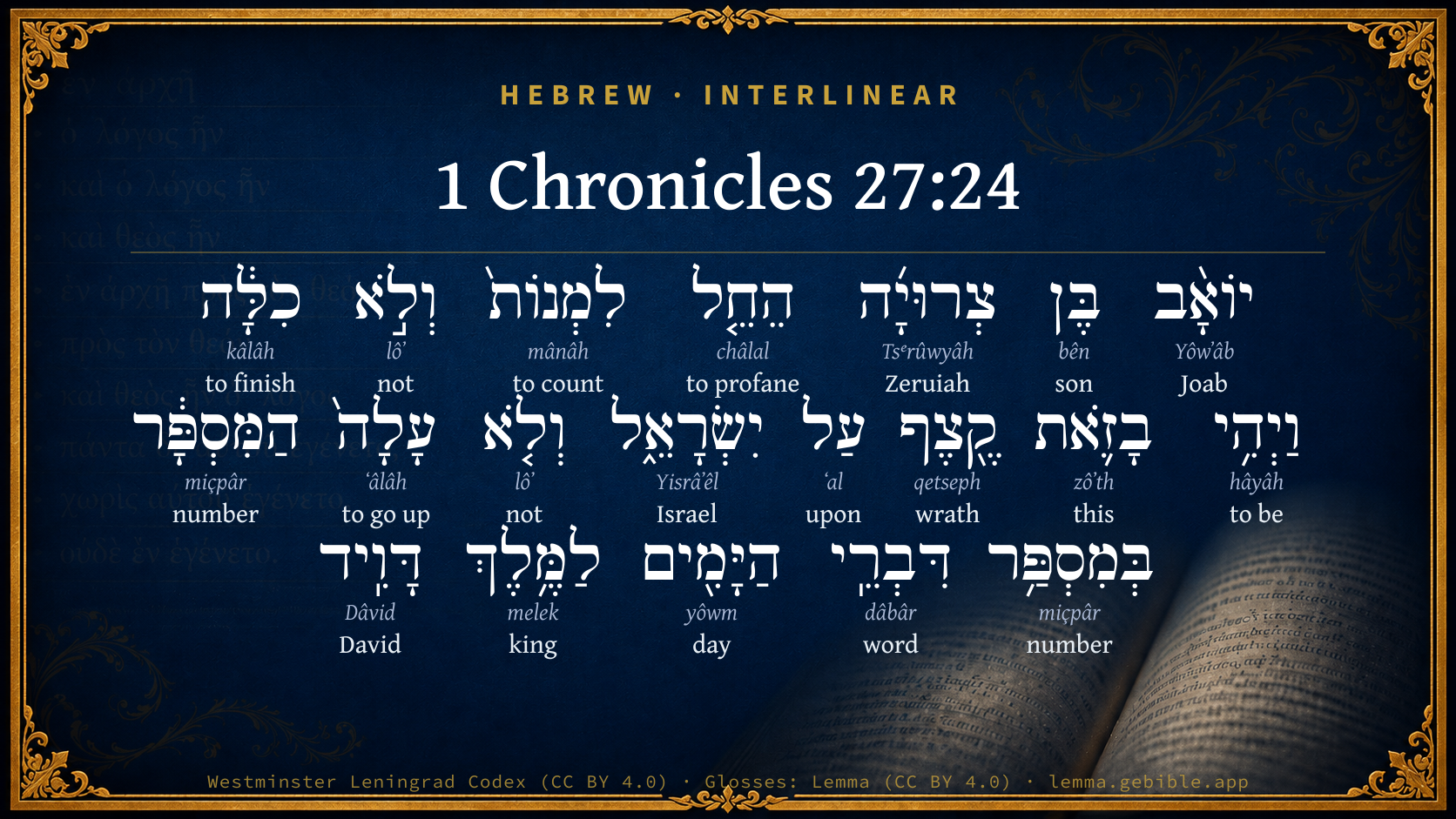
1 Chronicles 27:24

Hebrew (Westminster Leningrad Codex) 1 Chronicles 27:24 appears in the Hebrew Old Testament. The text above is from the Westminster Leningrad Codex. Each word links to its Strong’s number, a concise gloss, and parsing drawn from the Open Scriptures Hebrew Bible morphology. Click any word for its full Brown-Driver-Briggs (BDB) entry.
Download image
Cite this verse

1 Chronicles 27:24 (World English Bible). Public Domain. Lemma interlinear Bible study tool, https://lemma.gebible.app/v/1-chronicles/27/24.

Show BibTeX & RIS
BibTeX
RIS
English Translation
Joab the son of Zeruiah began to number, but didn't finish; and there came wrath for this on Israel; neither was the number put into the account in the chronicles of king David.
World English Bible · Public Domain
Download a study sheet

One document with this verse’s original text, its word-by-word gloss line, the meaning frame, cross-references with their text, attributed commentary, and full source and license credits — printable, and it pastes into notes with its structure intact.

This verse Autodidact and up

Study sheet (.html) Plain text (.txt)

A passage Seminary Student

Up to 50 verses in one chapter. A passage sheet keeps up to 6 commentary sources and 12 cross-references per verse, in the order this page ranks them, and says so on the sheet whenever that leaves anything out. Ask for a single verse and you get the Autodidact verse sheet above.

Everything on this page stays free to read, with no account — the sheet is a download of what is already on screen, not access to it.

Want to remove ads? Support Godless Engineer
Compare translations 3

The same verse in 3 English versions, stacked beneath the original-language interlinear above. Click any original word for its lexicon entry.

Each is an independent rendering of the whole verse — the interlinear is not word-aligned to these translations.

Highlighted words mark where these versions differ — a whole-verse word diff, not a word-by-word alignment.

  • World English Bible Public Domain
    Joab the son of Zeruiah began to number, but didn't finish; and there came wrath for this on Israel; neither was the number put into the account in the chronicles of king David.
  • King James Version Public Domain
    Joab the son of Zeruiah began to number, but he finished not, because there fell wrath for it against Israel; neither was the number put in the account of the chronicles of king David.
  • unfoldingWord Literal Text CC BY-SA 4.0
    Joab, the son of Zeruiah, began to count, but he did not finish. For because of this, wrath was upon Israel. And the number did not go up among the number of the matters of the days of King David.

unfoldingWord Literal Text — © unfoldingWord, licensed CC BY-SA 4.0. Word-aligned USFM3 via Door43 (git.door43.org/unfoldingWord/en_ult).

Versions to compare (up to 4)

3 of 4 selected

Show all 18 translations

Every available English version of this verse, each an independent rendering of the whole verse.

  • World English Bible Public Domain
    Joab the son of Zeruiah began to number, but didn't finish; and there came wrath for this on Israel; neither was the number put into the account in the chronicles of king David.
  • Berean Standard Bible Public Domain
    Joab son of Zeruiah began to count the men but did not finish. For because of this census wrath came upon Israel, and the number was not entered in the Book of the Chronicles of King David.
  • Majority Standard Bible Public Domain
    Joab son of Zeruiah began to count the men but did not finish. For because of this census wrath came upon Israel, and the number was not entered in the Book of the Chronicles of King David.
  • King James Version Public Domain
    Joab the son of Zeruiah began to number, but he finished not, because there fell wrath for it against Israel; neither was the number put in the account of the chronicles of king David.
  • American Standard Version (1901) Public Domain
    Joab the son of Zeruiah began to number, but finished not; and there came wrath for this upon Israel; neither was the number put into the account in the chronicles of king David.
  • Revised Version (1885) Public Domain
    Joab the son of Zeruiah began to number, but finished not; and there came wrath for this upon Israel; neither was the number put into the account in the chronicles of king David;
  • Geneva Bible (1599) Public Domain
    And Ioab the sonne of Zeruiah beganne to nomber: but hee finished it not, because there came wrath for it against Israel, neither was the nomber put into the Chronicles of King Dauid.
  • Douay-Rheims (1899) Public Domain
    Joab the son of Sarvia began to number, but he finished not: because upon this there fell wrath upon Israel: and therefore the number of them that were numbered, was not registered in the chronicles of king David.
  • Young's Literal Translation Public Domain
    Joab son of Zeruiah hath begun to number -- and hath not finished -- and there is for this wrath against Israel, and the number hath not gone up in the account of the Chronicles of king David.
  • Literal Standard Version CC BY-SA 4.0
    Joab son of Zeruiah has begun to number, but has not finished; and there is wrath against Israel for this, and the number has not gone up in the account of the Chronicles of King David.
  • Unlocked Literal Bible CC BY-SA 4.0
    Joab son of Zeruiah began to count the men, but did not finish. Wrath fell on Israel for this. This number was not written down in the Chronicles of King David.
  • unfoldingWord Literal Text CC BY-SA 4.0
    Joab, the son of Zeruiah, began to count, but he did not finish. For because of this, wrath was upon Israel. And the number did not go up among the number of the matters of the days of King David.
  • Darby Bible Public Domain
    Joab the son of Zeruiah began to number, but he did not finish; and there fell wrath for it upon Israel; and the number was not put in the account of the chronicles of king David.
  • World Messianic Bible Public Domain
    Joab the son of Zeruiah began to take a census, but didn’t finish; and wrath came on Israel for this. The number wasn’t put into the account in the chronicles of King David.
  • Webster's Bible Public Domain
    Joab the son of Zeruiah began to number, but he finished not, because there fell wrath for it against Israel; neither was the number put in the account of the chronicles of king David.
  • Free Bible Version CC BY-SA 4.0
    Joab, son of Zeruiah, had begun the census but did not finish it. Israel was punished because of this census, and the results were not recorded in the official account of King David.
  • Bible in Basic English Public Domain
    The numbering was started by Joab, the son of Zeruiah, but he did not go on to the end; and because of it, wrath came on Israel and the number was not recorded in the history of King David.
  • JPS Tanakh (1917) Public Domain
    Joab the son of Zeruiah began to number, but finished not; and there came wrath for this upon Israel; neither was the number put into the account in the chronicles of king David.

Literal Standard Version (2020), Covenant Press — licensed CC BY-SA 4.0. Text via the HelloAO Bible API (eBible.org). Unlocked Literal Bible (unfoldingWord) — licensed CC BY-SA 4.0. Text via the HelloAO Bible API (eBible.org). unfoldingWord Literal Text — © unfoldingWord, licensed CC BY-SA 4.0. Word-aligned USFM3 via Door43 (git.door43.org/unfoldingWord/en_ult). Free Bible Version, Dr. Jonathan Gallagher — licensed CC BY-SA 4.0. Text via the HelloAO Bible API (eBible.org).

Word by word

More ways to search: Search by grammar → Find every occurrence → Compare this word →

Practice this passage: Drill this verse → Learn its vocabulary →

צְרוּיָ֜ה
Tsᵉrûwyâh
H6870
“Zeruiah”
Noun, Proper
Part of Speech
Noun
Type
Proper
Full BDB Definition

Origin: pass part from the same as H6875

TWOT: None

Zeruiah = "balsam" - sister of David and mother of the 3 leading heroes of David's army - Abishai, Joab, and Asahel
  1. יוֹאָ֨ב Yôwʼâb H3097 “Joab” Noun, Proper
  2. בֶּן bên H1121 “son of” Noun, Common, Masculine, Singular, Construct
  3. הֵחֵ֤ל châlal H2490 “to profane” Verb, Hiphil, Perfect, 3rd Person, Masculine, Singular
  4. לִמְנוֹת֙ mânâh H4487 “to count” Preposition + Verb, Qal, Infinitive Construct
  5. וְלֹ֣א lôʼ H3808 “and · not” Conjunction + Particle, Negative
  6. כִלָּ֔ה kâlâh H3615 “to finish” Verb, Piel, Perfect, 3rd Person, Masculine, Singular
  7. וַיְהִ֥י hâyâh H1961 “and · to be” Conjunction + Verb, Qal, Sequential Imperfect, 3rd Person, Masculine, Singular
  8. בָזֹ֛את zôʼth H2063 “in/at · this” Preposition + Pronoun, Demonstrative, Feminine, Singular
  9. קֶ֖צֶף qetseph H7110 “wrath” Noun, Common, Masculine, Singular, Absolute
  10. עַל ʻal H5921 “upon” Preposition
  11. יִשְׂרָאֵ֑ל Yisrâʼêl H3478 “Israel” Noun, Proper
  12. וְלֹ֤א lôʼ H3808 “and · not” Conjunction + Particle, Negative
  13. עָלָה֙ ʻâlâh H5927 “to go up” Verb, Qal, Perfect, 3rd Person, Masculine, Singular
  14. הַמִּסְפָּ֔ר miçpâr H4557 “the · number” Particle, Definite Article + Noun, Common, Masculine, Singular, Absolute
  15. בְּמִסְפַּ֥ר miçpâr H4557 “in/at · number of” Preposition + Noun, Common, Masculine, Singular, Construct
  16. דִּבְרֵֽי dâbâr H1697 “words of” Noun, Common, Masculine, Plural, Construct
  17. הַיָּמִ֖ים yôwm H3117 “the · days” Particle, Definite Article + Noun, Common, Masculine, Plural, Absolute
  18. לַמֶּ֥לֶךְ melek H4428 “to/for the · king” Preposition, Determined + Noun, Common, Masculine, Singular, Absolute
  19. דָּוִֽיד Dâvid H1732 “David” Noun, Proper

About this verse

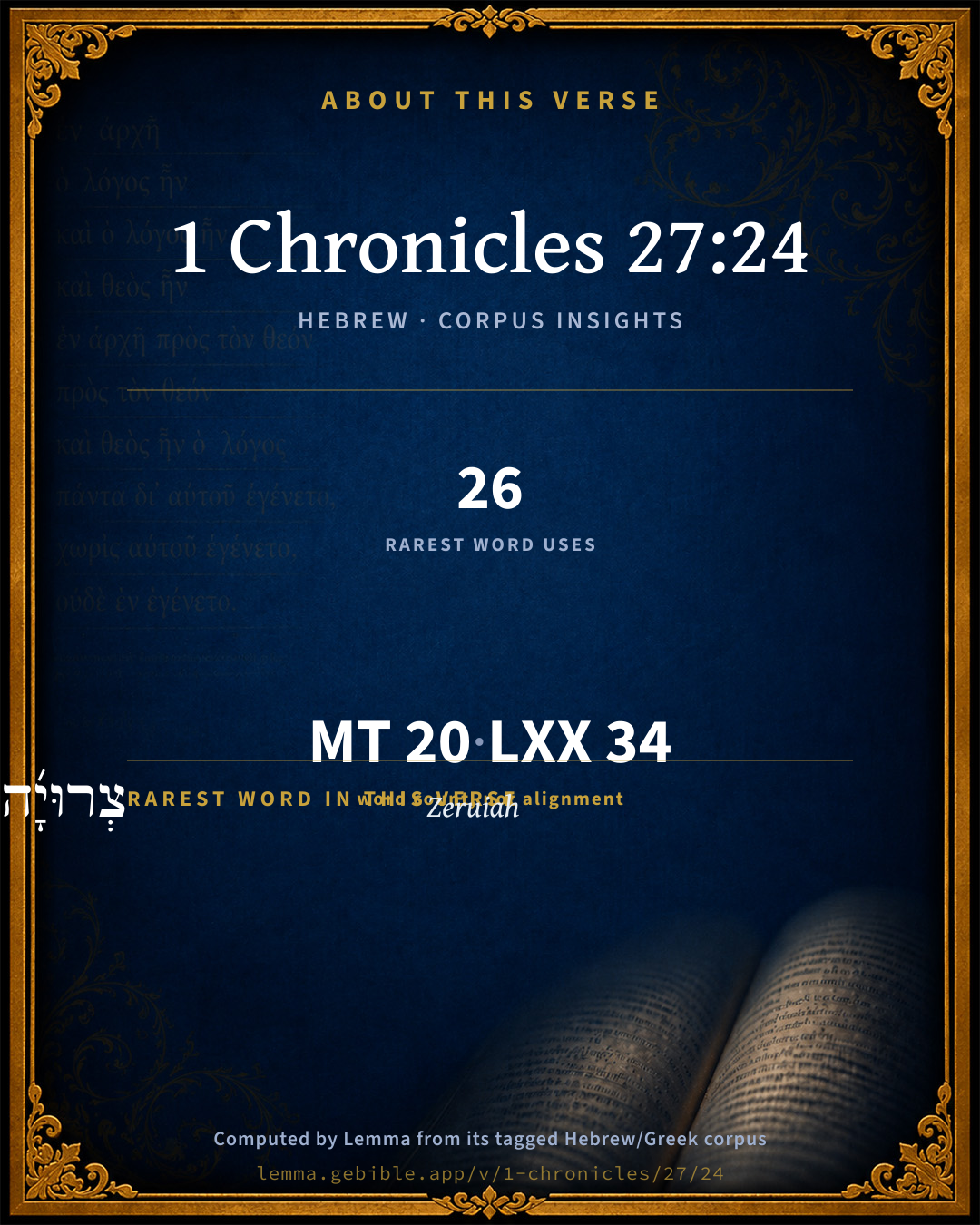
These counts appear in no published source. They are computed here, from the morphology-tagged text and Lemma’s own curated glosses. What Lemma adds →

20
words
18
distinct lemmas
Historical
section

Shared distinctive vocabulary

צְרוּיָ֜ה Zeruiah H6870 occurs in 25 verses of the Hebrew Bible. Also found in:

Grammatical profile

  • 5 verbs
  • 11 nouns
  • 1 pronoun
  • 1 preposition
  • 2 particles

Verb forms

  • הֵחֵ֤ל Hiphil · Perfect
  • לִמְנוֹת֙ Qal · Infinitive Construct
  • כִלָּ֔ה Piel · Perfect
  • וַיְהִ֥י Qal · Sequential Imperfect
  • עָלָה֙ Qal · Perfect

Repetition

Words recur within this verse — often emphatic in Hebrew:

  • הַמִּסְפָּ֔ר number H4557 ×2
  • וְלֹ֣א not H3808 ×2

Hebrew & Septuagint length

In English translation the verse runs 33 words from the Hebrew and 39 from the Septuagint (LXX English) — closely comparable.

A rough comparison of the two English renderings, which tokenize alike — not a word-level alignment.

Word counts can differ between the Hebrew and the Greek without any difference in meaning — e.g. the Hebrew direct-object marker אֵת has no separate Greek word, and Greek often adds the article ὁ.

In the original languages it is 20 Hebrew tokens and 34 Greek tokens — but the two are counted differently (Hebrew bundles its prefixes and suffixes into one token; the Greek is in lemma form), so that isn’t a like-for-like length.

Cross-references

2

Topical passages linked to 1 Chronicles 27:24 in the Treasury of Scripture Knowledge — connected by theme and wording, ordered by reader-vote popularity; previews shown in the World English Bible.

  • 2 Samuel 24:1–15 Again the anger of Yahweh was kindled against Israel, and he moved David against them, saying, Go, number Israel and Judah.
  • 1 Chronicles 21:1–17 Satan stood up against Israel, and moved David to number Israel.

Cross-references courtesy of OpenBible.info (CC BY 4.0).

Hebrew and Greek witnesses Masoretic Hebrew ↔ Greek Septuagint

The same verse in the two great witnesses to the Old Testament, shown verse-for-verse.

These are two independent witnesses, not word-aligned to each other, and the Septuagint is shown in lemma (dictionary) form.

Hebrew 1 Chronicles 27:24 Masoretic · Westminster Leningrad Codex

יוֹאָ֨ב בֶּן צְרוּיָ֜ה הֵחֵ֤ל לִמְנוֹת֙ וְלֹ֣א כִלָּ֔ה וַיְהִ֥י בָזֹ֛את קֶ֖צֶף עַל יִשְׂרָאֵ֑ל וְלֹ֤א עָלָה֙ הַמִּסְפָּ֔ר בְּמִסְפַּ֥ר דִּבְרֵֽי הַיָּמִ֖ים לַמֶּ֥לֶךְ דָּוִֽיד

Joab the son of Zeruiah began to number, but didn't finish; and there came wrath for this on Israel; neither was the number put into the account in the chronicles of king David.

World English Bible · Public Domain

Greek LXX 1 Chronicles 27:24 Septuagint · lemma form

καί ιωαβ ὁ ὁ σαρουια ἄρχω ἀριθμέω ἐν ὁ λαός καί οὐ συντελέω καί γίγνομαι ἐν οὗτος ὀργή ἐπί ὁ ἰσραήλ καί οὐ καταχωρίζω ὁ ἀριθμός ἐν βιβλίον λόγος ὁ ἡμέρα ὁ βασιλεύς δαυίδ

And Joab the son of Saruia began to number the people, and did not finish the work, for there was hereupon wrath on Israel; and the number was not recorded in the book of the chronicles of king David.

LXX2012 (modern English Septuagint) · Public Domain

Hebrew: Westminster Leningrad Codex (CC BY 4.0). Greek: Septuagint (public domain); English from LXX2012 (modern English Septuagint) (Public Domain). How the Septuagint differs from the Hebrew →

Commentary

Notes on 1 Chronicles 27:24 from classic Christian and Jewish commentators (each source and its license shown beneath its notes). The classic Christian expositions comment on the surrounding passage and are grouped to its opening verse, so a note may address several verses; the Jewish commentaries on the Tanakh (Rashi and others) are per-verse, so they appear only where the commentator wrote on this verse.

Lemma curates 59 commentaries, every one of them public domain or Creative Commons licensed, each selected and text-cleaned for this edition rather than reprinted as found. About our sources →

Trapp's Complete Commentary

John Trapp

1Ch 27:24 Joab the son of Zeruiah began to number, but he finished not, because there fell wrath for it against Israel; neither was the number put in the account of the chronicles of king David.

Ver. 24. Neither was the number of the account put into the chronicles of king David.] Utpote qui ipse iam factum suum abominabatur, because he detested his own act, as well he might; especially if he had commanded the people to be numbered below the age appointed by the Lord, as some hold he had.

John Trapp, A Commentary or Exposition upon All the Books of the Old and New Testament (1647–1656) — public domain. Text from a community e-Sword module.

Joseph Benson's Commentary

1Ch 27:24. Joab began to number — Namely, all from twenty years old and upward, as David commanded him. But he finished not — For Levi and Benjamin he counted not, 1Ch 21:6. Because there fell wrath for it against Israel — While he was doing the work, which was one reason that made him desist. The Hebrew however is, And there fell, &c. Though David numbered them with caution and limitation, as was observed before, yet this did not hinder God’s wrath from falling upon Israel for this sin. Neither was the number put in the chronicles of King David — An account of the number, as far as he went, was given by Joab to the king; but the king, being sensible of his error, would not have it recorded in the public registers of the kingdom, as other things of daily occurrence were. Yet the memory of it is preserved in these books, to teach all posterity not to put their trust in the arm of flesh.

Joseph Benson's Commentary on the Old and New Testaments (1811–1818) — public domain. Text from a community e-Sword module.

Geneva Bible (1599)

Geneva Bible translators

And the commandment of the King was abominable to Joab, 1 Chron. 21:6.

The Hebrews make both these books of Chronicles but one, and at this verse make the midst of the book as touching the number of verses.

Geneva Bible (1599) marginal notes — public domain. Text via Bolls.life.

Jamieson, Fausset & Brown

Robert Jamieson, A. R. Fausset & David Brown

neither was the number put in the account of the chronicles of King David--either because the undertaking was not completed, Levi and Benjamin not having been numbered (Ch1 21:6), or the full details in the hands of the enumerating officers were not reported to David, and, consequently, not registered in the public archives.

the chronicles--were the daily records or annals of the king's reign. No notice was taken of this census in the historical register, as from the public calamity with which it was associated it would have stood as a painful record of the divine judgment against the king and the nation.

Jamieson, Fausset & Brown — Commentary Critical and Explanatory on the Whole Bible (1871) — public domain (CC PDM 1.0). Text via the HelloAO Bible API.

Adam Clarke's Commentary

Verse 24. Neither was the number put in the account] Joab did not return the whole number; probably the plague began before he had finished: or, he did not choose to give it in, as he had entered on this work with extreme reluctance; and he did not choose to tell the king how numerous they were.

Adam Clarke's Commentary on the Bible (1810–1826) — public domain. Text from a community e-Sword/MySword module.

Ellicott's Commentary for English Readers

(24) Joab the son of Zeruiah began.—Or, had begun. This clearly refers to 1Ch_21:6. Joab omitted to number Levi and Benjamin.

Because there fell wrath for it.—The same phrase recurs in 2Ch_19:10; 2Ch_24:18. (Comp. for the fact, 1Ch_21:7, seq.) The sense of the Hebrew may be brought out better thus: “Joab son of Zeruiah had begun to number, without finishing; and there fell,” &c.

Neither was the number put in the account of the chronicles of king David.—Literally, and the number came not up (‘âlâh), was not entered. (Comp. 1Ki_9:21; 2Ch_20:34.) The number which Joab ascertained was not recorded, as might have been expected, in the official annals of the reign, here designated as “the account of the chronicles of king David” (mispar dibrê ha-yâmîm). It is implied that the chronicler had these annals before him in some form or other, probably as a section of the “History of the Kings of Judah and Israel,” and that he found the lists of this chapter in that source. Those of 1 Chronicles 23-26 may have been derived from the same authority. In 2Ki_12:20; 2Ki_13:8; 2Ki_13:12, and all similar instances, the phrase for “book of the Chronicles” is not mispar, but sçpher dibrê ha-yâmîm. Some suppose that the text here should be altered accordingly; others would render mispar dibrê ha-yâmîm, “the statistical section of the annals.” But mispar in Jdg_7:15 means the telling or relation of a dream, and the transition from such a sense to that of written relation is easy. The phrase rendered “Chronicles” is the same as the Hebrew title of these books.

A Bible Commentary for English Readers, edited by Charles John Ellicott (1878–1897) — public domain. Text from a community e-Sword module.

The Cambridge Bible for Schools and Colleges

gen. ed. J. J. S. Perowne

24. he finished not] Cp. 1Ch_21:6.

because there fell wrath for it against Israel] R.V. and there came wrath for this upon Israel.

in the account of] R.V. into the account in. A summary of the numbers of David’s census is given in 1Ch_21:5 and also (with divergences) in 2Sa_24:9. The Chronicler probably means in the present passage that the details of the census were not entered in the official records.

the chronicles] Lit. the acts of the days; cp. Introduction, § 1.

The Cambridge Bible for Schools and Colleges (gen. ed. J. J. S. Perowne; Cambridge University Press, 1878–1918) — public domain. Text from a community e-Sword module.

John Gill's Exposition

Joab the son of Zeruiah began to number,.... By the order of David, but entirely against his own will, see Ch1 21:2,

but he finished not; the two tribes of Benjamin and Levi not being counted by him, Ch1 21:6.

because there fell wrath for it against Israel; the plague being broke forth before he had done numbering, which put a stop to it, Ch1 21:14.

neither was the number put in the account of the chronicles of David; that which was brought in by Joab, though imperfect, was not entered into the diary, journal, or annals which David ordered to be written of all memorable events and transactions in his reign; and which were afterwards carried on by the kings of Judah, often referred to in the preceding books; and this was done, not because of the imperfection of the account, but because David did not choose this sin of his should be transmitted to posterity, though it has been, notwithstanding this precaution of his.

John Gill's Exposition of the Whole Bible (1746–1763) — public domain (CC PDM 1.0). Text via the HelloAO Bible API.

Albert Barnes' Notes on the Bible

Because there fell wrath - literally, “And there fell wrath.” The falling of God’s wrath was not the cause of Joab’s ceasing. His motive is clearly stated in 1Ch 21:6. See also the marginal references.

Neither was the number ... - The meaning is, that in the portion of the chronicles of King David which treated of numbers - the number of the standing army, of the Levitical and priestly courses, the singers, etc. - the return of the number of the people made by Joab was not entered. The disastrous circumstances which followed on the taking of the census perhaps produced a feeling that God might he further provoked by its being put on record in the state archives. The numbers which have come down to us must therefore have been derived from private sources.

Albert Barnes' Notes on the Bible (1834–1885) — public domain. Text from a community e-Sword/MySword module.

Haydock's Catholic Bible Commentary

Number, those above 20; but he acted with reluctance, (Tirinus) and the wrath of heaven prevented the entire completion of the king’s order, chap. xxi. 6., and 2 Kings xxiv. 9. --- David. It would hence appear that the list was perfected, but not delivered to the king. The commissioners retained some of the lists; and, perhaps from these, Esdras has inserted what relates to Benjamin, (chap. vii. 6.) as the account was not given in chap. xxi. 6. (Calmet) --- This list may, however, have been made at another time; as we are informed that Benjamin and Levi were not numbered. (Haydock) --- The Book of Kings, where we find it, is therefore a different work. (Du Hamel)

George Leo Haydock (1774–1849), Haydock's Catholic Family Bible and Commentary, 1859 edition — public domain. Excludes Psalms (Douay-Rheims chapter numbering differs from Protestant) and Deuterocanonical books (Catholic canon only).

Matthew Poole's English Annotations

Began to number, to wit, all from twenty years old and upward, as David commanded him.

He finished not; for Levi and Benjamin he counted not, 1Ch 21:6. Because there fell wrath for it against Israel, whilst he was doing the work; which was one reason which made him to cease. Heb. And there fell, &c. Though David numbered them with caution and limitation, as was noted before, yet this did not hinder God’s wrath from falling upon Israel for this sin.

Neither was the number put in the account of the chronicles of king David: the sense is either,

1. That the full number was not registered, because Levi and Benjamin were not counted by Joab. Or rather,

2. That David being sensible of and smarting for his sin, would not have the number brought in by Joab to him put into the public register, though God would have it recorded in Scripture for the instruction of succeeding ages. For he speaks not here of the account given in to the king, which was done, and was Joab’s act; but of the putting of the account into the public records, which was not done, and which could not be done but by David’s command or permission.

Matthew Poole's English Annotations on the Holy Bible (1683–1685) — public domain. Text from a community e-Sword/MySword module.

Whedon's Commentary on the Bible

Daniel D. Whedon

24. Began to number, but he finished not — Here we find that the census was interrupted by the pestilence. Comp. note on chap. 1Ch_21:6.

Neither was the number put in the account of the Chronicles of king David — “We can easily understand that the disastrous circumstances which followed on the taking of the census produced a feeling that God might be further provoked by its being put on record in the state archives. It was consequently omitted; and the accounts of the numbers which have come down to us must have been derived from some comparatively private sources.” — Rawlinson.

Daniel D. Whedon (gen. ed.), Commentary on the Old and New Testaments (1874–1909) — public domain. Text from a community e-Sword module.

The Pulpit Commentary

It seems a little surprising to read of Joab, fixed on the page of history as the person who began to number, but finished not, when we have been already particularly told that it was he to whom King David"s command to number was "abominable". (1Ch_21:6) However differently enough from the method of either nature or mankind, the antidote has here preceded the evil. For because there fell wrath for it, read the Hebrew, and there was for this wrath upon Israel. The last sentence of the verse purports to say that such numbering as had been done before the point at which Joab stopped was not honoured by a place, where other numbers were found, in the register of the chronicles of King David.

The Pulpit Commentary (1880–1919), ed. H.D.M. Spence-Jones & Joseph S. Exell — public domain. Text from a community e-Sword module.

Keil & Delitzsch

C. F. Keil & F. Delitzsch

Joab the son of Zeruiah began to number,.... By the order of David, but entirely against his own will, see Ch1 21:2,

but he finished not; the two tribes of Benjamin and Levi not being counted by him, Ch1 21:6.

because there fell wrath for it against Israel; the plague being broke forth before he had done numbering, which put a stop to it, Ch1 21:14.

neither was the number put in the account of the chronicles of David; that which was brought in by Joab, though imperfect, was not entered into the diary, journal, or annals which David ordered to be written of all memorable events and transactions in his reign; and which were afterwards carried on by the kings of Judah, often referred to in the preceding books; and this was done, not because of the imperfection of the account, but because David did not choose this sin of his should be transmitted to posterity, though it has been, notwithstanding this precaution of his.

Keil & Delitzsch — Biblical Commentary on the Old Testament (1861–1891) — public domain (CC PDM 1.0). Text via the HelloAO Bible API. (Old Testament only.)

Rashi

Rabbi Shlomo Yitzchaki (Rashi)

but did not finish The meaning is: And moreover, I say to you: Did not Joab commence on another occasion to count the people above twenty and not finish?

and there was wrath upon Israel because of this Because of the small segment that he counted, there was wrath upon Israel, because it entered his mind to count all Israel and to transgress the verse (Gen. 13:16): “...so that if anyone can count the dust of the earth, etc.” and to transgress the verse (ibid. 15:5): “Look, please, toward heaven, etc.”

and the number did not come up to The meaning is: Although I say, “commenced to count but did not finish,” he counted only a small segment, for the number of the counted ones in the Book of Samuel did not come up to the number in Chronicles, (21:5) for that number that he counted he did not write in Samuel, but a little of the number, and here, because of David’s honor, even if the number were more, he would have stated it, because it implies that not for nought was there wrath on Israel because he already counted many of Israel, and moreover, because of his honor, that they were all his servants, like one man.

Rashi on the Tanakh — English translations: “The Judaica Press complete Tanach with Rashi, translated by A. J. Rosenberg” (CC BY 4.0); “Pentateuch with Rashi's commentary by M. Rosenbaum and A.M. Silbermann, 1929-1934” (public domain); “The Metsudah Tanach series, Lakewood, N.J” (CC BY 4.0); and “The Book of Joshua, Metsudah Publications, 1997” (CC BY 4.0). Text via Sefaria.

Lesson kit

Teaching starters — assembled from the data on this page, not authored interpretation. Every prompt links to the verse data it draws on. Edit before teaching.

1 Chronicles, in the Historical, opens this verse with 20 words (18 distinct Hebrew lemmas). Its most distinctive word is Tsᵉrûwyâh (“Zeruiah”). A historical commentator’s framing appears above. Read the whole chapter for the surrounding context.

Discussion questions

  1. How does “Zeruiah” (Tsᵉrûwyâh) shape what this verse is saying?
  2. 1 Samuel 26:6 shares the word «Zeruiah» with this verse. How do the two illuminate each other?
  3. “number” occurs 2× in this one verse. What is the effect of the repetition?
  4. These translations render this verse differently. What is at stake in choosing one wording over another?
  5. The verb «הֵחֵ֤ל» is Hiphil Perfect. How does its form color the action?
  6. Reading how Trapp's Complete Commentary and Joseph Benson's Commentary read this verse, where do the two commentators agree and where do they part?

Things to notice

Reading settings

Reading text

Shown beneath each verse's original-language words.

Old Testament
Old Testament edition

Read the OT as the Masoretic Hebrew (MT) or the Greek Septuagint (LXX).

English shown for the Greek Septuagint (in the Hebrew ↔ Greek comparison).

Comparing translations? Open the Compare panel on any verse page to stack up to four side by side.