
2 Chronicles 22:8

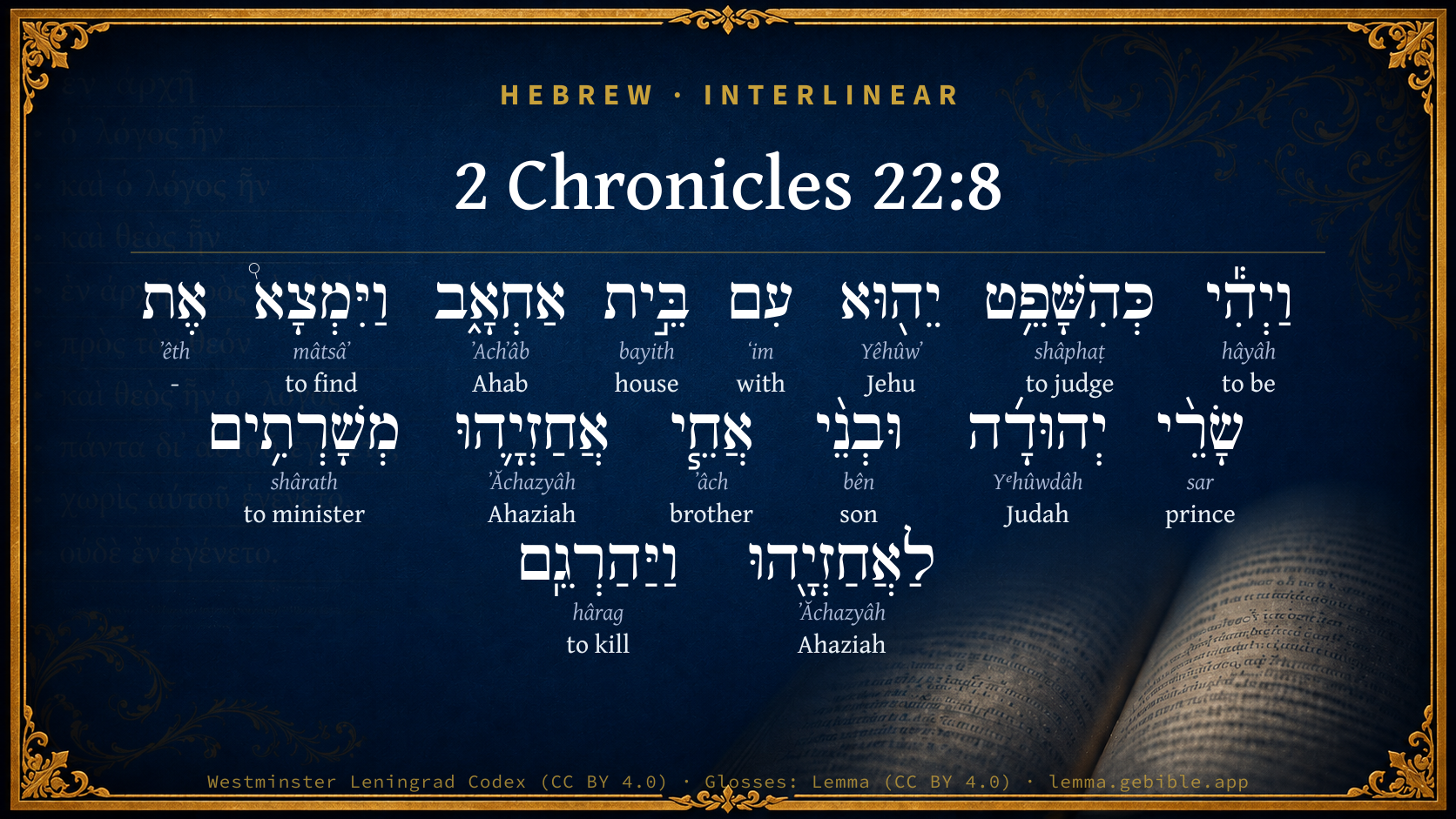
Hebrew (Westminster Leningrad Codex) 2 Chronicles 22:8 appears in the Hebrew Old Testament. The text above is from the Westminster Leningrad Codex. Each word links to its Strong’s number, a concise gloss, and parsing drawn from the Open Scriptures Hebrew Bible morphology. Click any word for its full Brown-Driver-Briggs (BDB) entry.
Download image
Cite this verse

2 Chronicles 22:8 (World English Bible). Public Domain. Lemma interlinear Bible study tool, https://lemma.gebible.app/v/2-chronicles/22/8.

Show BibTeX & RIS
BibTeX
RIS
English Translation
It happened, when Jehu was executing judgment on the house of Ahab, that he found the princes of Judah, and the sons of the brothers of Ahaziah, ministering to Ahaziah, and killed them.
World English Bible · Public Domain
Download a study sheet

One document with this verse’s original text, its word-by-word gloss line, the meaning frame, cross-references with their text, attributed commentary, and full source and license credits — printable, and it pastes into notes with its structure intact.

This verse Autodidact and up

Study sheet (.html) Plain text (.txt)

A passage Seminary Student

Up to 50 verses in one chapter. A passage sheet keeps up to 6 commentary sources and 12 cross-references per verse, in the order this page ranks them, and says so on the sheet whenever that leaves anything out. Ask for a single verse and you get the Autodidact verse sheet above.

Everything on this page stays free to read, with no account — the sheet is a download of what is already on screen, not access to it.

Want to remove ads? Support Godless Engineer
Compare translations 3

The same verse in 3 English versions, stacked beneath the original-language interlinear above. Click any original word for its lexicon entry.

Each is an independent rendering of the whole verse — the interlinear is not word-aligned to these translations.

Highlighted words mark where these versions differ — a whole-verse word diff, not a word-by-word alignment.

  • World English Bible Public Domain
    It happened, when Jehu was executing judgment on the house of Ahab, that he found the princes of Judah, and the sons of the brothers of Ahaziah, ministering to Ahaziah, and killed them.
  • King James Version Public Domain
    And it came to pass, that, when Jehu was executing judgment upon the house of Ahab, and found the princes of Judah, and the sons of the brethren of Ahaziah, that ministered to Ahaziah, he slew them.
  • unfoldingWord Literal Text CC BY-SA 4.0
    And it happened when Jehu was judging on the house of Ahab, and he found the chiefs of Judah and the sons of the brothers of Ahaziah, ones ministering to Ahaziah, and he killed them.

unfoldingWord Literal Text — © unfoldingWord, licensed CC BY-SA 4.0. Word-aligned USFM3 via Door43 (git.door43.org/unfoldingWord/en_ult).

Versions to compare (up to 4)

3 of 4 selected

Show all 18 translations

Every available English version of this verse, each an independent rendering of the whole verse.

  • World English Bible Public Domain
    It happened, when Jehu was executing judgment on the house of Ahab, that he found the princes of Judah, and the sons of the brothers of Ahaziah, ministering to Ahaziah, and killed them.
  • Berean Standard Bible Public Domain
    So while Jehu was executing judgment on the house of Ahab, he found the rulers of Judah and the sons of Ahaziah’s brothers who were serving Ahaziah, and he killed them.
  • Majority Standard Bible Public Domain
    So while Jehu was executing judgment on the house of Ahab, he found the rulers of Judah and the sons of Ahaziah’s brothers who were serving Ahaziah, and he killed them.
  • King James Version Public Domain
    And it came to pass, that, when Jehu was executing judgment upon the house of Ahab, and found the princes of Judah, and the sons of the brethren of Ahaziah, that ministered to Ahaziah, he slew them.
  • American Standard Version (1901) Public Domain
    And it came to pass, when Jehu was executing judgment upon the house of Ahab, that he found the princes of Judah, and the sons of the brethren of Ahaziah, ministering to Ahaziah, and slew them.
  • Revised Version (1885) Public Domain
    And it came to pass, when Jehu was executing judgment upon the house of Ahab, that he found the princes of Judah, and the sons of the brethren of Ahaziah, ministering to Ahaziah, and slew them.
  • Geneva Bible (1599) Public Domain
    Therefore when Iehu executed iudgement vpon the house of Ahab, and found the princes of Iudah and the sonnes of the brethren of Ahaziah that waited on Ahaziah, he slew them also.
  • Douay-Rheims (1899) Public Domain
    So when Jehu was rooting out the house of Achab, he found the princes of Juda, and the sons of the brethren of Ochozias, who served him, and he slew them.
  • Young's Literal Translation Public Domain
    And it cometh to pass, in Jehu's executing judgment with the house of Ahab, that he findeth the heads of Judah and sons of the brethren of Ahaziah, ministers of Ahaziah, and slayeth them.
  • Literal Standard Version CC BY-SA 4.0
    And it comes to pass, in Jehu’s executing judgment with the house of Ahab, that he finds the heads of Judah and sons of the brothers of Ahaziah, ministers of Ahaziah, and slays them.
  • Unlocked Literal Bible CC BY-SA 4.0
    It came about, when Jehu was carrying out God's judgment on the house of Ahab, that he found the leaders of Judah and the sons of Ahaziah's brothers serving Ahaziah. Jehu killed them.
  • unfoldingWord Literal Text CC BY-SA 4.0
    And it happened when Jehu was judging on the house of Ahab, and he found the chiefs of Judah and the sons of the brothers of Ahaziah, ones ministering to Ahaziah, and he killed them.
  • Darby Bible Public Domain
    And it came to pass when Jehu was executing judgment upon the house of Ahab, that he found the princes of Judah, and the sons of the brethren of Ahaziah, that attended upon Ahaziah, and he slew them.
  • World Messianic Bible Public Domain
    When Jehu was executing judgment on Ahab’s house, he found the princes of Judah and the sons of the brothers of Ahaziah serving Ahaziah, and killed them.
  • Webster's Bible Public Domain
    And it came to pass, that when Jehu was executing judgment upon the house of Ahab, and found the princes of Judah, and the sons of the brethren of Ahaziah, that ministered to Ahaziah, he slew them.
  • Free Bible Version CC BY-SA 4.0
    While Jehu was carrying out judgment on the family of Ahab, he came across the leaders of Judah and Ahaziah's relatives who were assisting Ahaziah, and he killed them.
  • Bible in Basic English Public Domain
    Now when Jehu was effecting the punishment of the family of Ahab, he came to the princes of Judah and the sons of Ahaziah's brothers, the servants of Ahaziah, and put them to death.
  • JPS Tanakh (1917) Public Domain
    And it came to pass, when Jehu was executing judgment upon the house of Ahab, that he found the princes of Judah, and the sons of the brethren of Ahaziah, ministering to Ahaziah, and slew them.

Literal Standard Version (2020), Covenant Press — licensed CC BY-SA 4.0. Text via the HelloAO Bible API (eBible.org). Unlocked Literal Bible (unfoldingWord) — licensed CC BY-SA 4.0. Text via the HelloAO Bible API (eBible.org). unfoldingWord Literal Text — © unfoldingWord, licensed CC BY-SA 4.0. Word-aligned USFM3 via Door43 (git.door43.org/unfoldingWord/en_ult). Free Bible Version, Dr. Jonathan Gallagher — licensed CC BY-SA 4.0. Text via the HelloAO Bible API (eBible.org).

Word by word

More ways to search: Search by grammar → Find every occurrence → Compare this word →

Practice this passage: Drill this verse → Learn its vocabulary →

אֲחַזְיָ֛הוּ
ʼĂchazyâh
H274
“Ahaziah”
Noun, Proper
Part of Speech
Noun
Type
Proper
Full BDB Definition

Origin: from H270 and H3050

TWOT: None

Ahaziah = "Jehovah (Yahu) holds (possesses)" - ruler of Israel, son of Ahab - ruler of Judah, son of Jehoram (Joram)
  1. וַיְהִ֕י hâyâh H1961 “and · to be” Conjunction + Verb, Qal, Sequential Imperfect, 3rd Person, Masculine, Singular
  2. כְּהִשָּׁפֵ֥ט shâphaṭ H8199 “like/as · to judge” Preposition + Verb, Niphal, Infinitive Construct
  3. יֵה֖וּא Yêhûwʼ H3058 “Jehu” Noun, Proper
  4. עִם ʻim H5973 “with” Preposition
  5. בֵּ֣ית bayith H1004 “house of” Noun, Common, Masculine, Singular, Construct
  6. אַחְאָ֑ב ʼAchʼâb H256 “Ahab” Noun, Proper
  7. וַיִּמְצָא֩ mâtsâʼ H4672 “and · to find” Conjunction + Verb, Qal, Sequential Imperfect, 3rd Person, Masculine, Singular
  8. אֶת ʼêth H853 “-” Particle, Direct Object
  9. שָׂרֵ֨י sar H8269 “princes of” Noun, Common, Masculine, Plural, Construct
  10. יְהוּדָ֜ה Yᵉhûwdâh H3063 “Judah” Noun, Proper
  11. וּבְנֵ֨י bên H1121 “and · sons of” Conjunction + Noun, Common, Masculine, Plural, Construct
  12. אֲחֵ֧י ʼâch H251 “brothers of” Noun, Common, Masculine, Plural, Construct
  13. מְשָׁרְתִ֥ים shârath H8334 “ministering” Verb, Piel, Participle Active, Masculine, Plural, Absolute
  14. לַאֲחַזְיָ֖הוּ ʼĂchazyâh H274 “to/for · Ahaziah” Preposition + Noun, Proper
  15. וַיַּהַרְגֵֽם hârag H2026 “and · to kill · them” Conjunction + Verb, Qal, Sequential Imperfect, 3rd Person, Masculine, Singular + Suffix, Personal, 3rd Person, Masculine, Plural

About this verse

These counts appear in no published source. They are computed here, from the morphology-tagged text and Lemma’s own curated glosses. What Lemma adds →

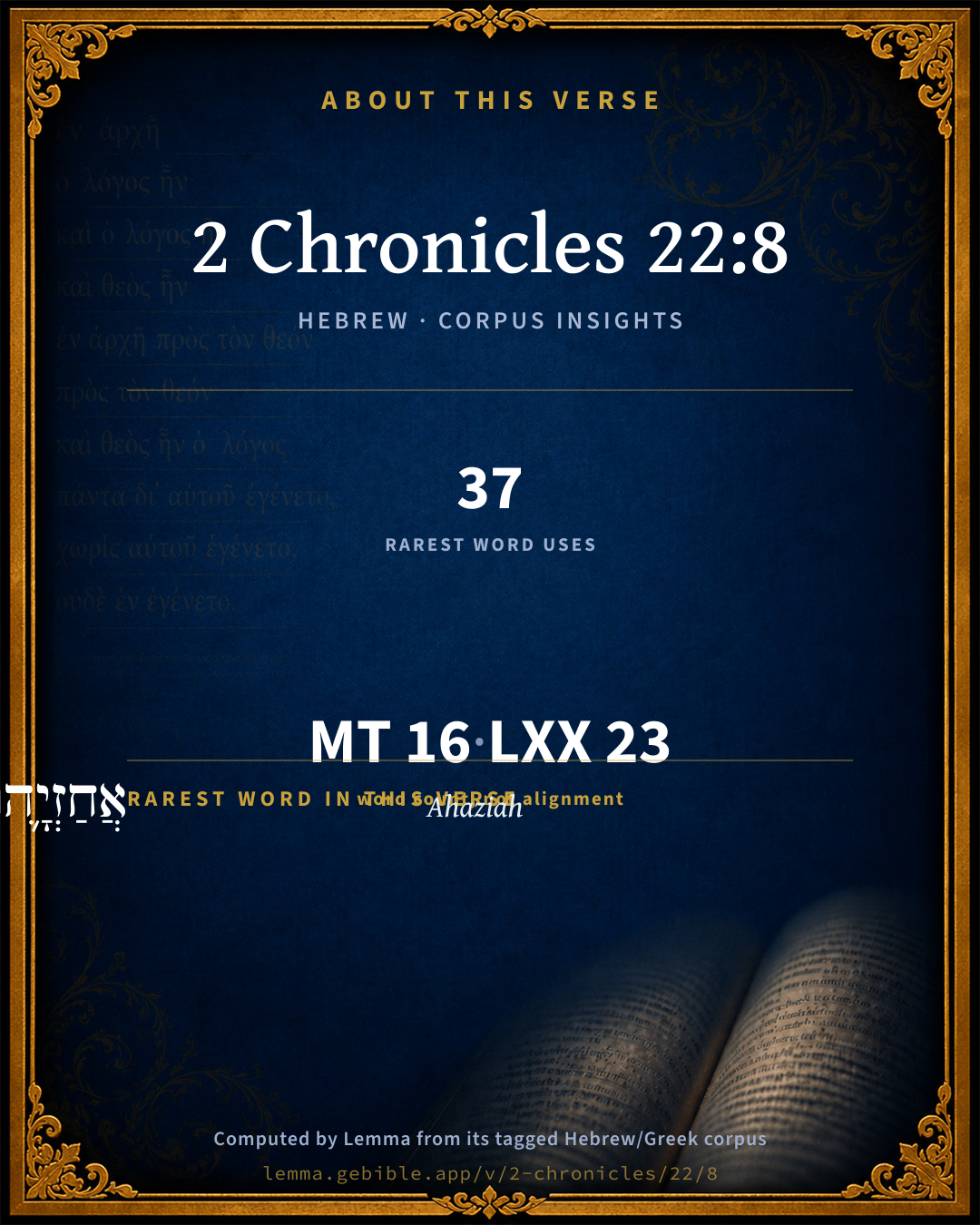
16
words
15
distinct lemmas
Historical
section

Shared distinctive vocabulary

אֲחַזְיָ֛הוּ Ahaziah H274 occurs in 30 verses of the Hebrew Bible. Also found in:

Grammatical profile

  • 5 verbs
  • 9 nouns
  • 1 preposition
  • 1 particle

Verb forms

  • וַיְהִ֕י Qal · Sequential Imperfect
  • כְּהִשָּׁפֵ֥ט Niphal · Infinitive Construct
  • וַיִּמְצָא֩ Qal · Sequential Imperfect
  • מְשָׁרְתִ֥ים Piel · Participle Active
  • וַיַּהַרְגֵֽם Qal · Sequential Imperfect

Repetition

A word recurs within this verse — often emphatic in Hebrew:

  • אֲחַזְיָ֛הוּ Ahaziah H274 ×2

Hebrew & Septuagint length

In English translation the verse runs 33 words from the Hebrew and 34 from the Septuagint (LXX English) — closely comparable.

A rough comparison of the two English renderings, which tokenize alike — not a word-level alignment.

Word counts can differ between the Hebrew and the Greek without any difference in meaning — e.g. the Hebrew direct-object marker אֵת has no separate Greek word, and Greek often adds the article ὁ.

In the original languages it is 16 Hebrew tokens and 23 Greek tokens — but the two are counted differently (Hebrew bundles its prefixes and suffixes into one token; the Greek is in lemma form), so that isn’t a like-for-like length.

Cross-references

1

Topical passages linked to 2 Chronicles 22:8 in the Treasury of Scripture Knowledge — connected by theme and wording, ordered by reader-vote popularity; previews shown in the World English Bible.

  • 2 Kings 10:10–14 Know now that there shall fall to the earth nothing of the word of Yahweh, which Yahweh spoke concerning the house of Ahab: for Yahweh has done that which he spoke by his servant Elijah.

Cross-references courtesy of OpenBible.info (CC BY 4.0).

Hebrew and Greek witnesses Masoretic Hebrew ↔ Greek Septuagint

The same verse in the two great witnesses to the Old Testament, shown verse-for-verse.

These are two independent witnesses, not word-aligned to each other, and the Septuagint is shown in lemma (dictionary) form.

Hebrew 2 Chronicles 22:8 Masoretic · Westminster Leningrad Codex

וַיְהִ֕י כְּהִשָּׁפֵ֥ט יֵה֖וּא עִם בֵּ֣ית אַחְאָ֑ב וַיִּמְצָא֩ אֶת שָׂרֵ֨י יְהוּדָ֜ה וּבְנֵ֨י אֲחֵ֧י אֲחַזְיָ֛הוּ מְשָׁרְתִ֥ים לַאֲחַזְיָ֖הוּ וַיַּהַרְגֵֽם

It happened, when Jehu was executing judgment on the house of Ahab, that he found the princes of Judah, and the sons of the brothers of Ahaziah, ministering to Ahaziah, and killed them.

World English Bible · Public Domain

Greek LXX 2 Chronicles 22:8 Septuagint · lemma form

καί γίγνομαι ὡς ἐκδικέω ιου ὁ οἶκος αχααβ καί εὑρίσκω ὁ ἄρχων ἰουδά καί ὁ ἀδελφός οχοζιας λειτουργέω ὁ οχοζιας καί ἀποκτείνω αὐτός

And it came to pass, when Jeu was taking vengeance on the house of Achaab, that he found the princes of Juda and the brethren of Ochozias ministering to Ochozias, and he killed them.

LXX2012 (modern English Septuagint) · Public Domain

On this verse, Ellicott's Commentary for English Readers discusses the Septuagint’s reading. Read the note in Commentary ↓

Hebrew: Westminster Leningrad Codex (CC BY 4.0). Greek: Septuagint (public domain); English from LXX2012 (modern English Septuagint) (Public Domain). How the Septuagint differs from the Hebrew →

Commentary

Notes on 2 Chronicles 22:8 from classic Christian and Jewish commentators (each source and its license shown beneath its notes). The classic Christian expositions comment on the surrounding passage and are grouped to its opening verse, so a note may address several verses; the Jewish commentaries on the Tanakh (Rashi and others) are per-verse, so they appear only where the commentator wrote on this verse.

Lemma curates 59 commentaries, every one of them public domain or Creative Commons licensed, each selected and text-cleaned for this edition rather than reprinted as found. About our sources →

Trapp's Complete Commentary

John Trapp

2Ch 22:8 And it came to pass, that, when Jehu was executing judgment upon the house of Ahab, and found the princes of Judah, and the sons of the brethren of Ahaziah, that ministered to Ahaziah, he slew them.

Ver. 8. When Jehu was executing.] 2Ki 9:22, &c.

And the sons of the brethren.] 2Ki 10:13-14.

John Trapp, A Commentary or Exposition upon All the Books of the Old and New Testament (1647–1656) — public domain. Text from a community e-Sword module.

Matthew Poole's English Annotations

The sons of the brethren of Ahaziah; either properly so called; or the sons of his cousins or near kinsmen, who are oft called

brethren; for his brethren were slain, 2Ch 22:8.

That ministered to Ahaziah; that came thither to wait upon their king Ahaziah, as is here implied, and withal to visit Joram and his children, as is noted, 2Ki 10:13.

Matthew Poole's English Annotations on the Holy Bible (1683–1685) — public domain. Text from a community e-Sword/MySword module.

The Biblical Illustrator

Joseph S. Exell

2Ch_22:8

For his mother was his counsellor to do wickedly.

A mothers influence

Every first thing continues for ever with the child; the first colour, the first music, the first flower paint the foreground of life. Every new educator effects less than his predecessor, until at last, if we regard all life as an educational institute, a circumnavigator of the world is less influenced by all the nations he has seen than by his nurse. (W. Richter.)

A mothers influence

Mothers, ye are the sculptors of the souls of the coming men; queens of the cradle, humble or high, ye are the queens of the future. In your hands lie the destinies of men. I am not speaking poetry, but plain fact, which history proves. Neros mother was a murderess; Nero was a murderer, on a gigantic scale. Byrons mother was proud, ill-tempered, and violent; Byron was proud, ill-tempered, and violent. Washingtons mother was noble and pure; Washington was noble and pure. Scotts mother loved poetry and painting; you know what Walter Scott was. Carlyles mother was stern, and full of reverence; Carlyle very much so. Wesleys mother was a God-like woman; Wesley was a God-like man. The prison chaplain will tell you that the last thing forgotten, in all the recklessness of dissolute profligacy, is the prayer or hymn taught by a mothers lips, or uttered at a fathers knee. Yes, when all other roads are closed, there is one road open to the heart of the desperate man--the memory of his mother. (Great Thoughts.)

An unnatural mother

For his mother was his counsellor to do wickedly. There must be a mistranslation! All nature is offended by this tremendous affront. Can we not.find some other word for mother? Any other word will do better, even father would not be so objectionable. The one word that cannot be tolerated here is the word that is found, namely, mother! We might close the Bible here, and say the book that contains this statement was never inspired. But we cannot do so. Then the word counsellor is so full of plan, premeditation, arrangement; the mother was a schoolmistress, with one pupil, and she suggested, invented, culminated ends, whispered, threw out hints, advised bad policies; told him when he was halting because the course was evil to go on! Napoleon said, They that rock the cradle rule the world. To have a cradle rocked by such a mother as Athaliah surely were enough to be foredoomed to endless misery! How sweetly the text would have read had it proceeded on the lines of nature!--for his mother was his counsellor to do bravely. Surely the word wickedly is a misprint, traceable to some careless copyist!--his mother was his counsellor to do wisely, patiently, hopefully,--these would have been womanly words, words most motherly, the very words with which we build home and Church and heaven. But the word is wickedly, and we must regard it in its literal significance. What are mothers doing now? They could be Gods foremost ministers. No man can pray like a woman; no man has the art of eloquence as a woman has it; no one can come into life so silently, quietly, blessingly as woman, mother, sister. If women would preach surely the world would listen. They ought to preach; they know the secret of love, they have the answer to the Cross, they can solve in some degree the enigma of sacrifice. This is the very reason of the horribleness of the text. If woman had been otherwise, then the word wickedly would not have read with such a sense of irony and moral collision as it does in this instance. It is because woman can be so heavenly that she can be so low, and wicked, and bad; it is because she can be so like a saviour that she can be such an engine and agent of ruin. (J. Parker, D. D.)

The Biblical Illustrator, edited by Joseph S. Exell (c. 1880s–1900s) — public domain. Text from a community e-Sword module.

Geneva Bible (1599)

Geneva Bible translators

Or, took vengeance.

Geneva Bible (1599) marginal notes — public domain. Text via Bolls.life.

Ellicott's Commentary for English Readers

(8) When Jehu was executing judgment upon the house of Ahab.—The Hebrew phrase strictly means to plead with, or argue a cause with. (Comp. 1Sa_12:7.) When God is said to plead with men, the notion of judicial punishment is often involved, as in Joe_3:2; Isa_66:16; and such is the meaning here. Jehu was an instrument of Divine vengeance, even when fulfilling the projects of his own ambition, as were the savage Assyrian conquerors (Isa_10:5-7).

And found.—Rather, he found.

The sons of the brethren of Ahaziah.—Comp. 2Ki_10:12-14, where the details are given. The persons whom Jehu slew are there called Ahaziah’s “brethren”—i.e., kinsmen (a common use; so LXX. here), and are said to have been forty-two in number. The Hebrew term is wide enough to include cousins and grandsons as well as nephews of the king. The “princes of Judah” who accompanied them would naturally be members of the court in charge of them, and are perhaps to be included in the total of forty-two persons. Thenius, indeed, in his note on 2Ki_10:13, alleges that we must understand the real brothers of Ahaziah, whom the chronicler gets rid of (!) on an earlier occasion (i.e., 2Ch_21:17; 2Ch_22:1), because he required a Divine judgment in the lifetime of Jehoram. buch arbitrary criticism hardly deserves refutation; we may, however, remark that Thenius relies on the untenable assumption that Jehoram could not have begotten any children before Ahaziah, whom he begot in his eighteenth or nineteenth year.

That ministered to Ahaziah.—In attendance on Ahaziah—i.e., attached to the retinue of Ahaziah as pages, &c.

He slew them.—And slew them.

A Bible Commentary for English Readers, edited by Charles John Ellicott (1878–1897) — public domain. Text from a community e-Sword module.

The Cambridge Bible for Schools and Colleges

gen. ed. J. J. S. Perowne

8. And it came to pass, that when … and found … that ministered to Ahaziah, he slew them] R.V. And it came to pass, when … that he found … ministering to Ahaziah, and slew them.

the sons of the brethren of Ahaziah] In 2Ki_10:13, “the brethren (i.e. kinsmen) of Ahaziah.” The brethren (in the strict sense of the word) of Ahaziah had already been killed (2Ch_22:1).

that ministered] R.V. ministering. According to 2 Kin. they were going to “salute the children of the king and the children of the queen” (probably a courtly expression for “salute the king and the queen”).

The Cambridge Bible for Schools and Colleges (gen. ed. J. J. S. Perowne; Cambridge University Press, 1878–1918) — public domain. Text from a community e-Sword module.

John Gill's Exposition

And he sought Ahaziah,.... Who fled on Joram's being wounded by Jehu:

and they caught him; the soldiers of Jehu, who were sent after him, and bid to smite him:

for he was hid in Samaria; either in some part of the kingdom of Samaria, or in the city itself, whither he fled:

and brought him to Jehu: who was at Jezreel; see Gill on Kg2 9:27,

and when they had slain him they buried him; not at Jezreel, but delivered him to his servants to carry him to Jerusalem, and there bury him in the sepulchres of his fathers, Kg2 9:28,

because, said they, he is the son of Jehoshaphat, who sought the Lord with all his heart; a grandson of his, and therefore out of respect to the memory of his name, these being religious men, ordered his burial there:

so the house of Ahaziah had no power to keep still the kingdom; his brethren and their sons being slain, and his own children being young fell into the hands of Athaliah, who murdered them all, but one, hid by his aunt, and so got the government into her own hands, as may be observed in the following verses, Ch2 22:10.

Next: 2 Chronicles Chapter 23

John Gill's Exposition of the Whole Bible (1746–1763) — public domain (CC PDM 1.0). Text via the HelloAO Bible API.

Haydock's Catholic Bible Commentary

Out. Heb. "exercising judgment with." --- Brethren, who had been themselves slain by the rovers. Ochozias employed his nephews at court, and they expected that he would make some stay at Jezrahel.

George Leo Haydock (1774–1849), Haydock's Catholic Family Bible and Commentary, 1859 edition — public domain. Excludes Psalms (Douay-Rheims chapter numbering differs from Protestant) and Deuterocanonical books (Catholic canon only).

The Pulpit Commentary

Executing judgment upon the house of Ahab. The description of all this is sufficiently graphically scattered along the verses of 2Ki 9:24-11:20. And found the princes of Judah (see especially. (2Ki_10:7, 11 11:13-20) And the sons of the brethren of Ahaziah. This both explains and is explained by 2Ki_10:12-14. That ministered to Ahaziah. Even this enigmatical little clause receives its probable explanation from the last clause of ver. 13 in last quotation foregoing.

The Pulpit Commentary (1880–1919), ed. H.D.M. Spence-Jones & Joseph S. Exell — public domain. Text from a community e-Sword module.

Rashi

Rabbi Shlomo Yitzchaki (Rashi)

and the sons of Ahaziah’s brothers He does not mention Ahaziah’s brothers because they were slain in the days of Joram their father, as it is written (above 21:17): “And they marched upon Judah and split it, etc., and no son was left to him except Jehoahaz, the youngest of his sons.”

Rashi on the Tanakh — English translations: “The Judaica Press complete Tanach with Rashi, translated by A. J. Rosenberg” (CC BY 4.0); “Pentateuch with Rashi's commentary by M. Rosenbaum and A.M. Silbermann, 1929-1934” (public domain); “The Metsudah Tanach series, Lakewood, N.J” (CC BY 4.0); and “The Book of Joshua, Metsudah Publications, 1997” (CC BY 4.0). Text via Sefaria.

Lesson kit

Teaching starters — assembled from the data on this page, not authored interpretation. Every prompt links to the verse data it draws on. Edit before teaching.

2 Chronicles, in the Historical, opens this verse with 16 words (15 distinct Hebrew lemmas). Its most distinctive word is ʼĂchazyâh (“Ahaziah”). A historical commentator’s framing appears above. Read the whole chapter for the surrounding context.

Discussion questions

  1. How does “Ahaziah” (ʼĂchazyâh) shape what this verse is saying?
  2. 1 Kings 22:40 shares the word «Ahaziah» with this verse. How do the two illuminate each other?
  3. “Ahaziah” occurs 2× in this one verse. What is the effect of the repetition?
  4. The translations on this page render this verse differently — a whole-verse word diff, not a word-by-word alignment. What might account for the different wordings?
  5. The verb «וַיְהִ֕י» is Qal Sequential Imperfect. How does its form color the action?
  6. Reading how Trapp's Complete Commentary and Matthew Poole's English Annotations read this verse, where do the two commentators agree and where do they part?

Things to notice

Reading settings

Reading text

Shown beneath each verse's original-language words.

Old Testament
Old Testament edition

Read the OT as the Masoretic Hebrew (MT) or the Greek Septuagint (LXX).

English shown for the Greek Septuagint (in the Hebrew ↔ Greek comparison).

Comparing translations? Open the Compare panel on any verse page to stack up to four side by side.