
2 Chronicles 12:7

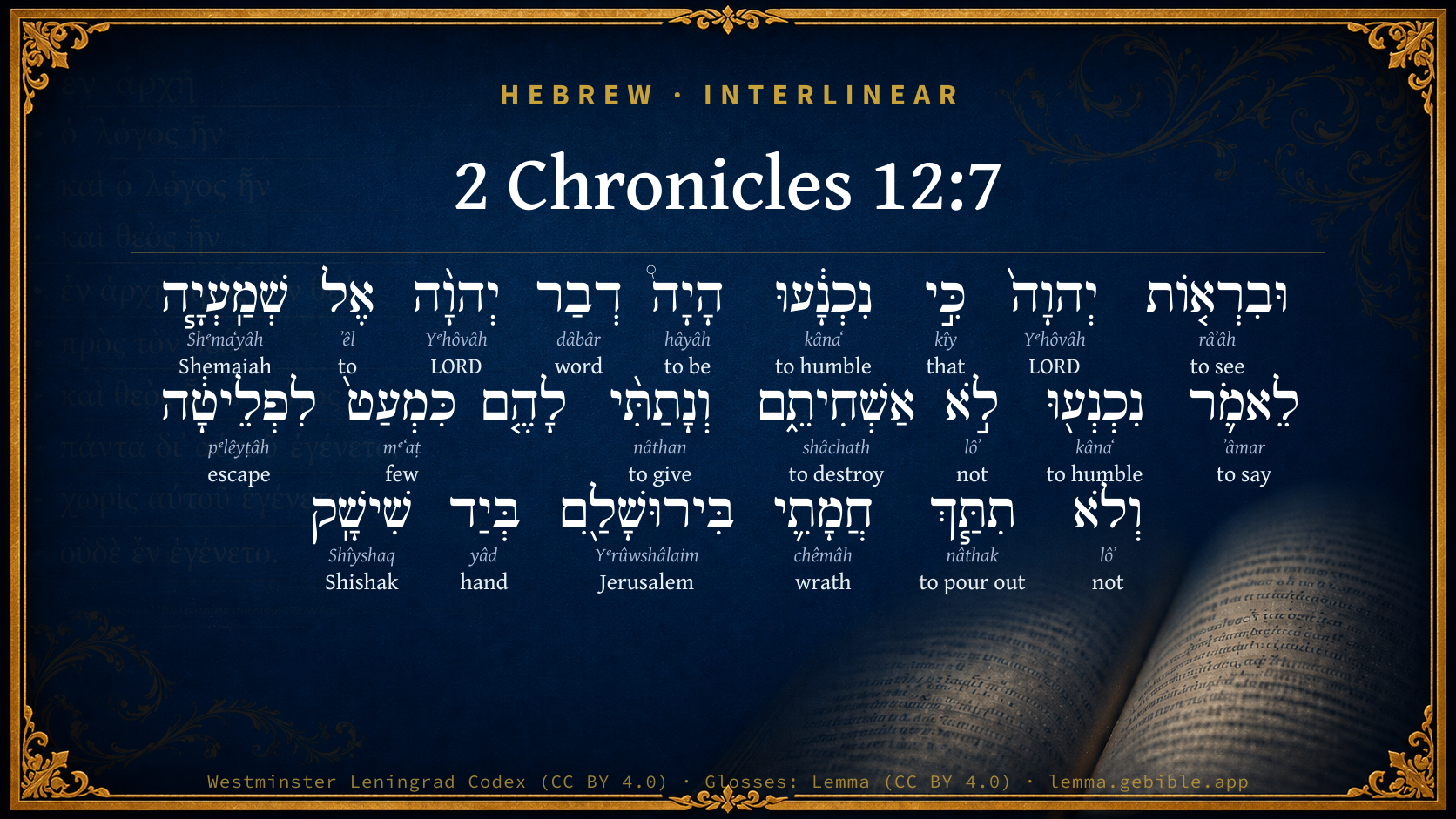
Hebrew (Westminster Leningrad Codex) 2 Chronicles 12:7 appears in the Hebrew Old Testament. The text above is from the Westminster Leningrad Codex. Each word links to its Strong’s number, a concise gloss, and parsing drawn from the Open Scriptures Hebrew Bible morphology. Click any word for its full Brown-Driver-Briggs (BDB) entry.
Download image
Cite this verse

2 Chronicles 12:7 (World English Bible). Public Domain. Lemma interlinear Bible study tool, https://lemma.gebible.app/v/2-chronicles/12/7.

Show BibTeX & RIS
BibTeX
RIS
English Translation
When Yahweh saw that they humbled themselves, the word of Yahweh came to Shemaiah, saying, They have humbled themselves: I will not destroy them; but I will grant them some deliverance, and my wrath shall not be poured out on Jerusalem by the hand of Shishak.
World English Bible · Public Domain
Download a study sheet

One document with this verse’s original text, its word-by-word gloss line, the meaning frame, cross-references with their text, attributed commentary, and full source and license credits — printable, and it pastes into notes with its structure intact.

This verse Autodidact and up

Study sheet (.html) Plain text (.txt)

A passage Seminary Student

Up to 50 verses in one chapter. A passage sheet keeps up to 6 commentary sources and 12 cross-references per verse, in the order this page ranks them, and says so on the sheet whenever that leaves anything out. Ask for a single verse and you get the Autodidact verse sheet above.

Everything on this page stays free to read, with no account — the sheet is a download of what is already on screen, not access to it.

Want to remove ads? Support Godless Engineer
Compare translations 3

The same verse in 3 English versions, stacked beneath the original-language interlinear above. Click any original word for its lexicon entry.

Each is an independent rendering of the whole verse — the interlinear is not word-aligned to these translations.

Highlighted words mark where these versions differ — a whole-verse word diff, not a word-by-word alignment.

  • World English Bible Public Domain
    When Yahweh saw that they humbled themselves, the word of Yahweh came to Shemaiah, saying, They have humbled themselves: I will not destroy them; but I will grant them some deliverance, and my wrath shall not be poured out on Jerusalem by the hand of Shishak.
  • King James Version Public Domain
    And when the LORD saw that they humbled themselves, the word of the LORD came to Shemaiah, saying, They have humbled themselves; therefore I will not destroy them, but I will grant them some deliverance; and my wrath shall not be poured out upon Jerusalem by the hand of Shishak.
  • unfoldingWord Literal Text CC BY-SA 4.0
    And when Yahweh saw that they had humbled themselves, the word of Yahweh was to Shemaiah, saying, “They have humbled themselves. I will not destroy them; and I will give to them like a little for escape, and my rage will not pour out on Jerusalem by the hand of Shishak.

unfoldingWord Literal Text — © unfoldingWord, licensed CC BY-SA 4.0. Word-aligned USFM3 via Door43 (git.door43.org/unfoldingWord/en_ult).

Versions to compare (up to 4)

3 of 4 selected

Show all 18 translations

Every available English version of this verse, each an independent rendering of the whole verse.

  • World English Bible Public Domain
    When Yahweh saw that they humbled themselves, the word of Yahweh came to Shemaiah, saying, They have humbled themselves: I will not destroy them; but I will grant them some deliverance, and my wrath shall not be poured out on Jerusalem by the hand of Shishak.
  • Berean Standard Bible Public Domain
    When the LORD saw that they had humbled themselves, the word of the LORD came to Shemaiah, saying, “They have humbled themselves; I will not destroy them, but will soon grant them deliverance. My wrath will not be poured out on Jerusalem through Shishak.
  • Majority Standard Bible Public Domain
    When the LORD saw that they had humbled themselves, the word of the LORD came to Shemaiah, saying, “They have humbled themselves; I will not destroy them, but will soon grant them deliverance. My wrath will not be poured out on Jerusalem through Shishak.
  • King James Version Public Domain
    And when the LORD saw that they humbled themselves, the word of the LORD came to Shemaiah, saying, They have humbled themselves; therefore I will not destroy them, but I will grant them some deliverance; and my wrath shall not be poured out upon Jerusalem by the hand of Shishak.
  • American Standard Version (1901) Public Domain
    And when Jehovah saw that they humbled themselves, the word of Jehovah came to Shemaiah, saying, They have humbled themselves: I will not destroy them; but I will grant them some deliverance, and my wrath shall not be poured out upon Jerusalem by the hand of Shishak.
  • Revised Version (1885) Public Domain
    And when the LORD saw that they humbled themselves, the word of the LORD came to Shemaiah, saying, They have humbled themselves; I will not destroy them: but I will grant them some deliverance, and my wrath shall not be poured out upon Jerusalem by the hand of Shishak.
  • Geneva Bible (1599) Public Domain
    And when the Lord sawe that they humbled themselues, the worde of the Lord came to Shemaiah, saying, They haue humbled theselues, therefore I will not destroy them, but I will sende them deliuerance shortly, and my wrath shall not bee powred out vpon Ierusalem by the hand of Shishak.
  • Douay-Rheims (1899) Public Domain
    And when the Lord saw that they were humbled, the word of the Lord came to Semeias, saying: Because they are humbled, I will not destroy them, and I will give them a little help, and my wrath shall not fall upon Jerusalem by the hand of Sesac.
  • Young's Literal Translation Public Domain
    And when Jehovah seeth that they have been humbled, a word of Jehovah hath been unto Shemaiah, saying, `They have been humbled; I do not destroy them, and I have given to them as a little thing for an escape, and I pour not out My fury in Jerusalem by the hand of Shishak;
  • Literal Standard Version CC BY-SA 4.0
    And when YHWH sees that they have been humbled, a word of YHWH has been [sent] to Shemaiah, saying, “They have been humbled; I do not destroy them, and I have given to them as a little thing for an escape, and I do not pour out My fury in Jerusalem by the hand of Shishak;
  • Unlocked Literal Bible CC BY-SA 4.0
    When Yahweh saw that they had humbled themselves, the word of Yahweh came to Shemaiah, saying, “They have humbled themselves. I will not ruin them; I will rescue them to some extent, and my anger will not pour out on Jerusalem by means of Shishak's hand.
  • unfoldingWord Literal Text CC BY-SA 4.0
    And when Yahweh saw that they had humbled themselves, the word of Yahweh was to Shemaiah, saying, “They have humbled themselves. I will not destroy them; and I will give to them like a little for escape, and my rage will not pour out on Jerusalem by the hand of Shishak.
  • Darby Bible Public Domain
    And when Jehovah saw that they humbled themselves, the word of Jehovah came to Shemaiah, saying, They have humbled themselves: I will not destroy them, but I will grant them a little deliverance; and my wrath shall not be poured out upon Jerusalem by the hand of Shishak.
  • World Messianic Bible Public Domain
    When the LORD saw that they humbled themselves, the LORD’s word came to Shemaiah, saying, “They have humbled themselves. I will not destroy them, but I will grant them some deliverance, and my wrath won’t be poured out on Jerusalem by the hand of Shishak.
  • Webster's Bible Public Domain
    And when the LORD saw that they humbled themselves, the word of the LORD came to Shemaiah, saying, They have humbled themselves; therefore I will not destroy them, but I will grant them some deliverance; and my wrath shall not be poured out upon Jerusalem by the hand of Shishak.
  • Free Bible Version CC BY-SA 4.0
    When the Lord saw that they had repented, he sent a message to Shemaiah, saying, “They have repented. I won't destroy them, and I will soon save them. My anger won't be poured out on Jerusalem through Shishak.
  • Bible in Basic English Public Domain
    And the Lord, seeing that they had made themselves low, said to Shemaiah, They have made themselves low: I will not send destruction on them, but in a short time I will give them salvation, and will not let loose my wrath on Jerusalem by the hand of Shishak.
  • JPS Tanakh (1917) Public Domain
    And when the LORD saw that they humbled themselves, the word of the LORD came to Shemaiah, saying: 'They have humbled themselves; I will not destroy them; but I will grant them some deliverance, and My wrath shall not be poured out upon Jerusalem by the hand of Shishak.

Literal Standard Version (2020), Covenant Press — licensed CC BY-SA 4.0. Text via the HelloAO Bible API (eBible.org). Unlocked Literal Bible (unfoldingWord) — licensed CC BY-SA 4.0. Text via the HelloAO Bible API (eBible.org). unfoldingWord Literal Text — © unfoldingWord, licensed CC BY-SA 4.0. Word-aligned USFM3 via Door43 (git.door43.org/unfoldingWord/en_ult). Free Bible Version, Dr. Jonathan Gallagher — licensed CC BY-SA 4.0. Text via the HelloAO Bible API (eBible.org).

Word by word

More ways to search: Search by grammar → Find every occurrence → Compare this word →

Practice this passage: Drill this verse → Learn its vocabulary →

שִׁישָֽׁק
Shîyshaq
H7895
“Shishak”
Noun, Proper
Part of Speech
Noun
Type
Proper
Full BDB Definition

Origin: of Egyptian derivation

TWOT: None

Shishak = "greedy of fine linen" - king of Egypt, Sheshonk I, 1st king of the Bubastite 22nd dynasty; ruled in Egypt during the reigns of Solomon and Rehoboam and attacked the southern kingdom under Rehoboam and apparently made it tributary
  1. וּבִרְא֤וֹת râʼâh H7200 “and · in/at · to see” Conjunction + Preposition + Verb, Qal, Infinitive Construct
  2. יְהוָה֙ Yᵉhôvâh H3068 “LORD” Noun, Proper
  3. כִּ֣י kîy H3588 “that” Conjunction
  4. נִכְנָ֔עוּ kânaʻ H3665 “to humble” Verb, Niphal, Perfect, 3rd Person, Common, Plural
  5. הָיָה֩ hâyâh H1961 “to be” Verb, Qal, Perfect, 3rd Person, Masculine, Singular
  6. דְבַר dâbâr H1697 “word of” Noun, Common, Masculine, Singular, Construct
  7. יְהוָ֨ה Yᵉhôvâh H3068 “LORD” Noun, Proper
  8. אֶל ʼêl H413 “to” Preposition
  9. שְׁמַֽעְיָ֧ה Shᵉmaʻyâh H8098 “Shemaiah” Noun, Proper
  10. לֵאמֹ֛ר ʼâmar H559 “to say” Preposition + Verb, Qal, Infinitive Construct
  11. נִכְנְע֖וּ kânaʻ H3665 “to humble” Verb, Niphal, Perfect, 3rd Person, Common, Plural
  12. לֹ֣א lôʼ H3808 “not” Particle, Negative
  13. אַשְׁחִיתֵ֑ם shâchath H7843 “to destroy · them” Verb, Hiphil, Imperfect, 1st Person, Common, Singular + Suffix, Personal, 3rd Person, Masculine, Plural
  14. וְנָתַתִּ֨י nâthan H5414 “and · to give” Conjunction + Verb, Qal, Sequential Perfect, 1st Person, Common, Singular
  15. כִּמְעַט֙ mᵉʻaṭ H4592 “like/as · few” Preposition + Noun, Common, Masculine, Singular, Absolute
  16. לִפְלֵיטָ֔ה pᵉlêyṭâh H6413 “to/for · escape” Preposition + Noun, Common, Feminine, Singular, Absolute
  17. וְלֹא lôʼ H3808 “and · not” Conjunction + Particle, Negative
  18. תִתַּ֧ךְ nâthak H5413 “to pour out” Verb, Qal, Imperfect, 3rd Person, Feminine, Singular
  19. חֲמָתִ֛י chêmâh H2534 “wrath · my” Noun, Common, Feminine, Singular, Construct + Suffix, Personal, 1st Person, Common, Singular
  20. בִּירוּשָׁלִַ֖ם Yᵉrûwshâlaim H3389 “in/at · Jerusalem” Preposition + Noun, Proper
  21. בְּיַד yâd H3027 “in/at · hand of” Preposition + Noun, Common, Both, Singular, Construct

About this verse

These counts appear in no published source. They are computed here, from the morphology-tagged text and Lemma’s own curated glosses. What Lemma adds →

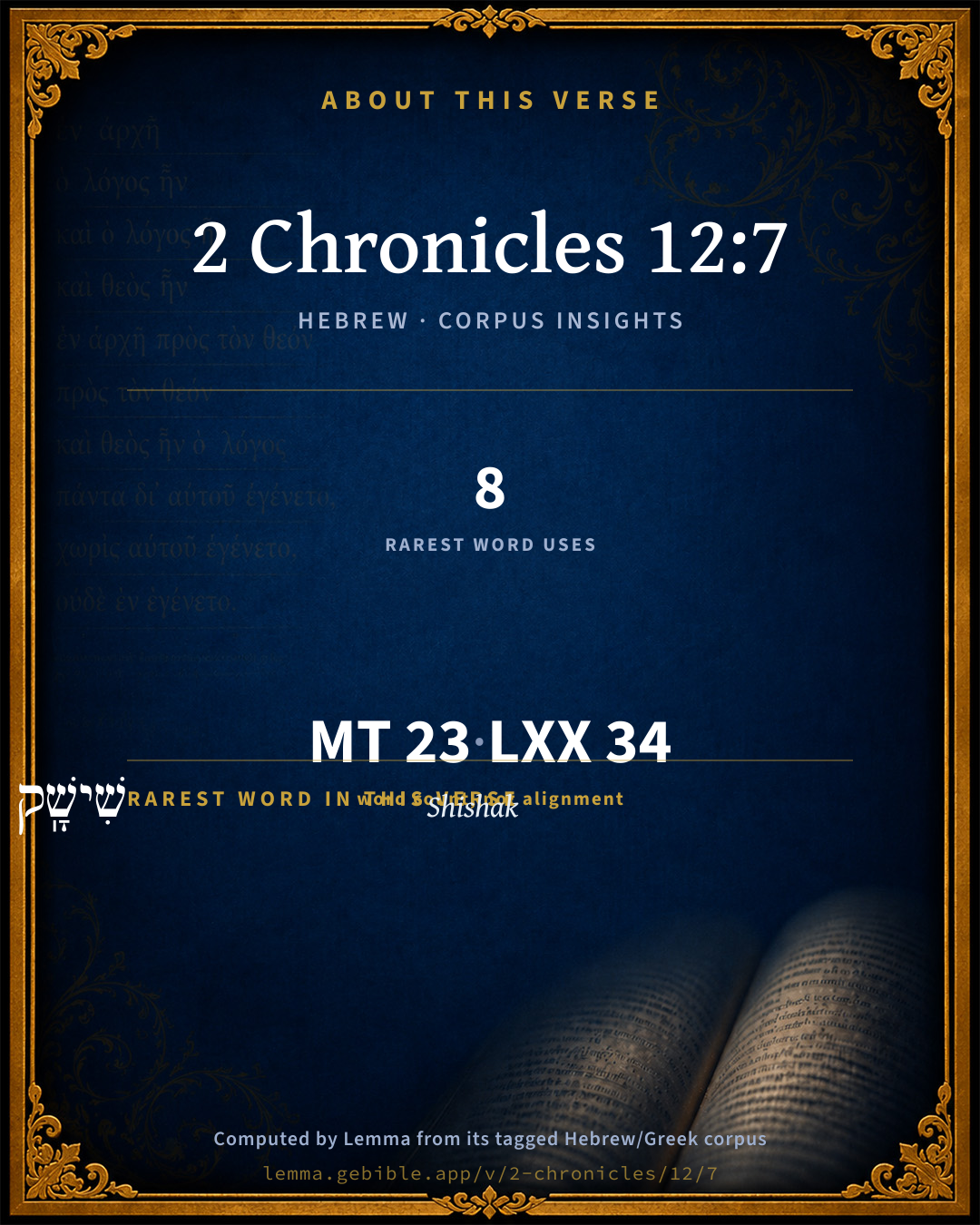
23
words
19
distinct lemmas
Historical
section

Notable vocabulary

The rarest word here is שִׁישָֽׁק Shishak H7895 — appearing just 8 times in the whole Hebrew Bible.

Shared distinctive vocabulary

שִׁישָֽׁק Shishak H7895 occurs in 6 verses of the Hebrew Bible. Also found in:

Grammatical profile

  • 8 verbs
  • 10 nouns
  • 2 prepositions
  • 1 conjunction
  • 2 particles

Verb forms

  • וּבִרְא֤וֹת Qal · Infinitive Construct
  • נִכְנָ֔עוּ Niphal · Perfect
  • הָיָה֩ Qal · Perfect
  • לֵאמֹ֛ר Qal · Infinitive Construct
  • נִכְנְע֖וּ Niphal · Perfect
  • אַשְׁחִיתֵ֑ם Hiphil · Imperfect
  • וְנָתַתִּ֨י Qal · Sequential Perfect
  • תִתַּ֧ךְ Qal · Imperfect

Repetition

Words recur within this verse — often emphatic in Hebrew:

  • יְהוָה֙ LORD H3068 ×2
  • נִכְנָ֔עוּ to humble H3665 ×2
  • לֹ֣א not H3808 ×2

Hebrew & Septuagint length

In English translation the verse runs 46 words from the Hebrew and 47 from the Septuagint (LXX English) — closely comparable.

A rough comparison of the two English renderings, which tokenize alike — not a word-level alignment.

Word counts can differ between the Hebrew and the Greek without any difference in meaning — e.g. the Hebrew direct-object marker אֵת has no separate Greek word, and Greek often adds the article ὁ.

In the original languages it is 23 Hebrew tokens and 34 Greek tokens — but the two are counted differently (Hebrew bundles its prefixes and suffixes into one token; the Greek is in lemma form), so that isn’t a like-for-like length.

Cross-references

16

Topical passages linked to 2 Chronicles 12:7 in the Treasury of Scripture Knowledge — connected by theme and wording, ordered by reader-vote popularity; previews shown in the World English Bible.

  • 2 Chronicles 34:25 Because they have forsaken me, and have burned incense to other gods, that they might provoke me to anger with all the works of their hands; therefore is my wrath poured out on this place, and it shall not be quenched.
  • 1 Kings 21:28–29 The word of Yahweh came to Elijah the Tishbite, saying,
  • Isaiah 42:25 Therefore he poured on him the fierceness of his anger, and the strength of battle; and it set him on fire round about, yet he didn't know; and it burned him, yet he didn't lay it to heart.
  • Leviticus 26:41–42 I also walked contrary to them, and brought them into the land of their enemies: if then their uncircumcised heart is humbled, and they then accept the punishment of their iniquity;
  • Judges 10:15–16 The children of Israel said to Yahweh, We have sinned: do you to us whatever seems good to you; only deliver us, we pray you, this day.
  • 2 Kings 13:4–7 Jehoahaz begged Yahweh, and Yahweh listened to him; for he saw the oppression of Israel, how that the king of Syria oppressed them.
  • 2 Kings 13:23 But Yahweh was gracious to them, and had compassion on them, and had respect to them, because of his covenant with Abraham, Isaac, and Jacob, and would not destroy them, neither cast he them from his presence as yet.
  • 2 Chronicles 34:21 Go you, inquire of Yahweh for me, and for those who are left in Israel and in Judah, concerning the words of the book that is found; for great is the wrath of Yahweh that is poured out on us, because our fathers have not kept the word of Yahweh, to do according to all that is written in this book.
  • Psalms 78:38 But he, being merciful, forgave iniquity, and didn't destroy them. Yes, many times he turned his anger away, And didn't stir up all his wrath.
  • Psalms 79:6 Pour out your wrath on the nations that don't know you; On the kingdoms that don't call on your name;
  • Jeremiah 3:13 Only acknowledge your iniquity, that you have transgressed against Yahweh your God, and have scattered your ways to the strangers under every green tree, and you have not obeyed my voice, says Yahweh.
  • Jeremiah 7:20 Therefore thus says the Lord Yahweh: Behold, my anger and my wrath shall be poured out on this place, on man, and on animal, and on the trees of the field, and on the fruit of the ground; and it shall burn, and shall not be quenched.
  • Amos 7:6–8 Yahweh relented concerning this. "This also shall not be," says the Lord Yahweh.
  • Luke 15:18–21 I will get up and go to my father, and will tell him, "Father, I have sinned against heaven, and in your sight.
  • Revelation 14:10 he also will drink of the wine of the wrath of God, which is prepared unmixed in the cup of his anger. He will be tormented with fire and sulfur in the presence of the holy angels, and in the presence of the Lamb.
  • Revelation 16:2–17 The first went, and poured out his bowl into the earth, and it became a harmful and evil sore on the people who had the mark of the beast, and who worshiped his image.

Cross-references courtesy of OpenBible.info (CC BY 4.0).

Hebrew and Greek witnesses Masoretic Hebrew ↔ Greek Septuagint

The same verse in the two great witnesses to the Old Testament, shown verse-for-verse.

These are two independent witnesses, not word-aligned to each other, and the Septuagint is shown in lemma (dictionary) form.

Hebrew 2 Chronicles 12:7 Masoretic · Westminster Leningrad Codex

וּבִרְא֤וֹת יְהוָה֙ כִּ֣י נִכְנָ֔עוּ הָיָה֩ דְבַר יְהוָ֨ה אֶל שְׁמַֽעְיָ֧ה לֵאמֹ֛ר נִכְנְע֖וּ לֹ֣א אַשְׁחִיתֵ֑ם וְנָתַתִּ֨י לָהֶ֤ם כִּמְעַט֙ לִפְלֵיטָ֔ה וְלֹא תִתַּ֧ךְ חֲמָתִ֛י בִּירוּשָׁלִַ֖ם בְּיַד שִׁישָֽׁק

When Yahweh saw that they humbled themselves, the word of Yahweh came to Shemaiah, saying, They have humbled themselves: I will not destroy them; but I will grant them some deliverance, and my wrath shall not be poured out on Jerusalem by the hand of Shishak.

World English Bible · Public Domain

Greek LXX 2 Chronicles 12:7 Septuagint · lemma form

καί ἐν ὁ ὁράω κύριος ὅτι ἐντρέπω καί γίγνομαι λόγος κύριος πρός σαμαιας λέγω ἐντρέπω οὐ καταφθείρω αὐτός καί δίδωμι αὐτός ὡς μικρός εἰς σωτηρία καί οὐ μή στάζω ὁ θυμός ἐγώ ἐν ἰερουσαλήμ

And when the Lord saw that they repented, then came the word of the Lord to Samaias, saying, They have repented; I will not destroy them, but I will set them in safety for a little while, and my wrath shall not be poured out on Jerusalem.

LXX2012 (modern English Septuagint) · Public Domain

Hebrew: Westminster Leningrad Codex (CC BY 4.0). Greek: Septuagint (public domain); English from LXX2012 (modern English Septuagint) (Public Domain). How the Septuagint differs from the Hebrew →

Commentary

Notes on 2 Chronicles 12:7 from classic Christian and Jewish commentators (each source and its license shown beneath its notes). The classic Christian expositions comment on the surrounding passage and are grouped to its opening verse, so a note may address several verses; the Jewish commentaries on the Tanakh (Rashi and others) are per-verse, so they appear only where the commentator wrote on this verse.

Lemma curates 59 commentaries, every one of them public domain or Creative Commons licensed, each selected and text-cleaned for this edition rather than reprinted as found. About our sources →

Trapp's Complete Commentary

John Trapp

2Ch 12:7 And when the LORD saw that they humbled themselves, the word of the LORD came to Shemaiah, saying, They have humbled themselves; [therefore] I will not destroy them, but I will grant them some deliverance; and my wrath shall not be poured out upon Jerusalem by the hand of Shishak.

Ver. 7. They have humbled themselves, &c.] After a sort they had. Now if the leaves of this tree of humiliation be so sovereign, what are the fruits? If the shadow so effectual, what the substance?

But I will grant them some deliverance.] Or, A little deliverance. So gracious is the Lord, and liberal to all.

And my wrath shall not be poured out.] See on 2Ch 12:5. "In the midst of judgment he remembereth mercy": and suffereth not his whole wrath to arise against sinners, lest they should be utterly taken away by that tempest.

John Trapp, A Commentary or Exposition upon All the Books of the Old and New Testament (1647–1656) — public domain. Text from a community e-Sword module.

Joseph Benson's Commentary

2Ch 12:7. They have humbled themselves — Which though they did by constraint and with reluctance, yet God was pleased so far to regard it, as to mitigate their calamity. I will not destroy them — Such a vast, and now victorious army as Shishak had, having made themselves masters of all the fenced cities, what else could be expected, but that the whole country; and even Jerusalem itself, would in a little time be theirs? But when God says, Here shall the proud waves be stayed, the most threatening force strangely dwindles, and becomes impotent. I will grant them some deliverance — I will give some stop to the course of my wrath, which was ready to be poured forth upon them to their utter destruction. Those who acknowledge God is righteous in afflicting them, shall find him gracious. They that humble themselves before him, shall find favour with him. So ready is the God of mercy to take the first occasion to show mercy. Reader, if thy heart be humbled, and made contrite under humbling and distressing providences, the affliction has done its work, and it shall either be removed, or the property of it altered.

Joseph Benson's Commentary on the Old and New Testaments (1811–1818) — public domain. Text from a community e-Sword module.

Geneva Bible (1599)

Geneva Bible translators

Hebrew, drop down.

Geneva Bible (1599) marginal notes — public domain. Text via Bolls.life.

Jamieson, Fausset & Brown

Robert Jamieson, A. R. Fausset & David Brown

when the Lord saw that they humbled themselves--Their repentance and contrition was followed by the best effects; for Shemaiah was commissioned to announce that the phial of divine judgment would not be fully poured out on them--that the entire overthrow of the kingdom of Judah would not take place at that time, nor through the agency of Shishak; and yet, although it should enjoy a respite from total subversion, [Judah] should become a tributary province of Egypt in order that the people might learn how much lighter and better is the service of God than that of idolatrous foreign despots.

Jamieson, Fausset & Brown — Commentary Critical and Explanatory on the Whole Bible (1871) — public domain (CC PDM 1.0). Text via the HelloAO Bible API.

Ellicott's Commentary for English Readers

(7) But I will grant them some deliverance.—Rather, and I will give them a few for a remnant. (Comp. 2Ch_12:12, “that he would not destroy him altogether.”) For the phrase “to give a remnant,” see Ezr_9:13. The word rendered “few” is kim‘at. (Comp. 1Ch_16:19 : Isa_1:9.) The pointing kim‘ât is peculiar to this passage.

My wrath shall not be poured out.—Or, pour itself out, wreak itself. The phrase denotes a judgment of extermination. (Comp. its use in 2Ch_34:25.)

By the hand of Shishak.—The destruction of Jerusalem was reserved for the hand of Nebuchadnezzar.

A Bible Commentary for English Readers, edited by Charles John Ellicott (1878–1897) — public domain. Text from a community e-Sword module.

The Cambridge Bible for Schools and Colleges

gen. ed. J. J. S. Perowne

7. some deliverance] Rather (as R.V. mg.), deliverance within a little while.

The Cambridge Bible for Schools and Colleges (gen. ed. J. J. S. Perowne; Cambridge University Press, 1878–1918) — public domain. Text from a community e-Sword module.

John Gill's Exposition

And when the Lord saw that they humbled themselves,.... Though but externally; the Lord takes notice of external humiliation, as he did of Ahab's, Kg1 21:29,

the word of the Lord came to Shemaiah, saying, they have humbled themselves, therefore I will not destroy them; not now, at least not altogether, Ch2 12:12,

but I will grant them some deliverance; yet not a complete one, for they were brought into servitude by Shishak, Ch2 12:8, or only for a short time:

and my wrath shall not be poured out against Jerusalem by the hand of Shishak; that is, to the uttermost; that was reserved to another time, and to be done by another hand, Nebuchadnezzar king of Babylon.

John Gill's Exposition of the Whole Bible (1746–1763) — public domain (CC PDM 1.0). Text via the HelloAO Bible API.

Albert Barnes' Notes on the Bible

Compare the repentance of Ahab (marginal reference) and that of the Ninevites Jon 3:5-10 which produced similar revocations of divine decrees that had been pronounced by the mouth of a prophet.

Some deliverance - Rather, “deliverance for a short space” (see the margin). Because of the repentance, the threat cf immediate destruction was withdrawn; but the menace was still left impending, that the people might be the more moved to contrition and amendment.

Albert Barnes' Notes on the Bible (1834–1885) — public domain. Text from a community e-Sword/MySword module.

Haydock's Catholic Bible Commentary

A little help. I will not suffer them to be quite destroyed. Hebrew also signifies, "shortly." (Calmet) --- Fall, (stillabit) like drops of water, even to the last. (Haydock) --- How soon is God appeased! (Tirinus) --- Even when he punishes, he does not let the whole flood of his indignation fall upon the guilty. (Menochius)

George Leo Haydock (1774–1849), Haydock's Catholic Family Bible and Commentary, 1859 edition — public domain. Excludes Psalms (Douay-Rheims chapter numbering differs from Protestant) and Deuterocanonical books (Catholic canon only).

Matthew Poole's English Annotations

They humbled themselves; which though they did but forcedly, yet God was pleased so far to regard it, as to mitigate their calamity.

My wrath shall not be poured out; I will give some stop to the course of my wrath, which was ready to be poured forth upon them to their utter destruction.

Matthew Poole's English Annotations on the Holy Bible (1683–1685) — public domain. Text from a community e-Sword/MySword module.

The Pulpit Commentary

Some deliverance. The Hebrew for "some" here is f"mKi. There is plain authority (Rth_2:7; Psa_38:10) for translating this word as of time, and the rendering "a little while" of the margin, will, therefore, seem preferable. But see next note, and the" altogether" of ver. 12. It has often been most justly remarked what grateful note should betaken of the fact that God always is recorded as turning such a wistful, loving eye to any symptom of repentance (1Ki_21:27-29; Jon_2:5-9) Who can estimate the loss of men, that the symptoms have been so frequent, so comparatively easily found as compared with the reality of lastingness?

The Pulpit Commentary (1880–1919), ed. H.D.M. Spence-Jones & Joseph S. Exell — public domain. Text from a community e-Sword module.

John Wesley's Explanatory Notes

Some deliverance - I will give some stop to the course of my wrath, which was ready to be poured forth upon them to their utter destruction. Those who acknowledge God is righteous in afflicting them, shall find him gracious.

John Wesley, Explanatory Notes Upon the Whole Bible (1754–1765) — public domain. Text via the GEBible commentary corpus.

unfoldingWord translationNotes

Door43 World Missions Community

they had humbled themselves

"the princes of Israel and the king had humbled themselves"

the word of Yahweh came ... saying

This is an idiom that is used to introduce something that God told his prophets or his people. AT: "Yahweh spoke this message ... and he said" or "Yahweh spoke these words ... and he said" (See: Idiom)

I will rescue them to some extent

Possible meanings are 1) Yahweh will permit Shishak to attack Jerusalem and cause trouble for the people, but he will rescue them from total destruction or 2) the words "to some extent" can be translated as soon, meaning that Yahweh will rescue the people of Jerusalem before Shishak can completely destroy the city.

my anger will not pour out on Jerusalem

Yahweh speaks of his anger as if it were a liquid, and of expressing his anger as if he were to pour out that liquid. AT: "I will not express my anger against Jerusalem" or "Jerusalem will not suffer the effects of my anger" (See: Metaphor)

by means of Shishak's hand

Here the word "hand" represents Shishak himself. AT: "by means of Shishak" (See: Synecdoche)

translationWords

word of God

ruin

anger

hand

servant

servant

rule

unfoldingWord translationNotes — © Distant Shores Media and the Door43 World Missions Community, licensed CC BY-SA 4.0. Source: git.door43.org/Door43/en_tn.

Rashi

Rabbi Shlomo Yitzchaki (Rashi)

They have humbled themselves; I shall not destroy them A similar instance is found below (14: 6): “The land is still before us for we have sought, etc. we have sought.” So is the custom of the Scriptures, that when it interrupts in the middle, it repeats the word. An example is (Num. 10:32): “And it will be, if you go with us, it will be that the good, etc.”

Rashi on the Tanakh — English translations: “The Judaica Press complete Tanach with Rashi, translated by A. J. Rosenberg” (CC BY 4.0); “Pentateuch with Rashi's commentary by M. Rosenbaum and A.M. Silbermann, 1929-1934” (public domain); “The Metsudah Tanach series, Lakewood, N.J” (CC BY 4.0); and “The Book of Joshua, Metsudah Publications, 1997” (CC BY 4.0). Text via Sefaria.

Lesson kit

Teaching starters — assembled from the data on this page, not authored interpretation. Every prompt links to the verse data it draws on. Edit before teaching.

2 Chronicles, in the Historical, opens this verse with 23 words (19 distinct Hebrew lemmas). Its most distinctive word is Shîyshaq (“Shishak”). A historical commentator’s framing appears above. Read the whole chapter for the surrounding context.

Discussion questions

  1. How does “Shishak” (Shîyshaq) shape what this verse is saying?
  2. 1 Kings 11:40 shares the word «Shishak» with this verse. How do the two illuminate each other?
  3. “LORD” occurs 2× in this one verse. What is the effect of the repetition?
  4. The translations on this page render this verse differently — a whole-verse word diff, not a word-by-word alignment. What might account for the different wordings?
  5. The verb «וּבִרְא֤וֹת» is Qal Infinitive Construct. How does its form color the action?
  6. Reading how Trapp's Complete Commentary and Joseph Benson's Commentary read this verse, where do the two commentators agree and where do they part?

Things to notice

Reading settings

Reading text

Shown beneath each verse's original-language words.

Old Testament
Old Testament edition

Read the OT as the Masoretic Hebrew (MT) or the Greek Septuagint (LXX).

English shown for the Greek Septuagint (in the Hebrew ↔ Greek comparison).

Comparing translations? Open the Compare panel on any verse page to stack up to four side by side.