Genesis 1:2

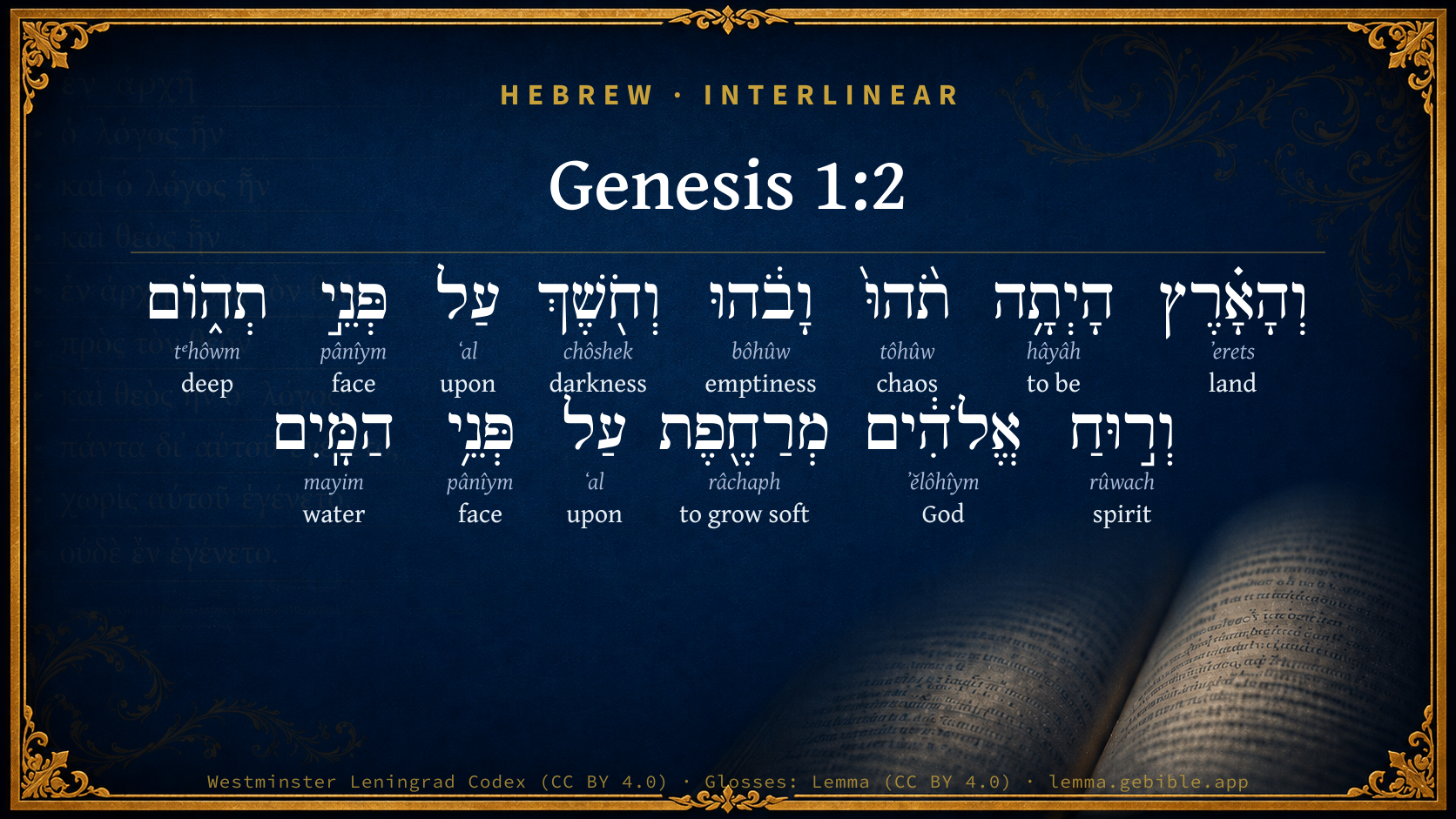
Hebrew (Westminster Leningrad Codex) Genesis 1:2 appears in the Hebrew Old Testament. The text above is from the Westminster Leningrad Codex. Each word links to its Strong’s number, a concise gloss, and parsing drawn from the Open Scriptures Hebrew Bible morphology. Click any word for its full Brown-Driver-Briggs (BDB) entry.
Download image
Cite this verse

Genesis 1:2 (World English Bible). Public Domain. Lemma interlinear Bible study tool, https://lemma.gebible.app/v/genesis/1/2.

Show BibTeX & RIS
BibTeX
RIS
English Translation
Now the earth was formless and empty. Darkness was on the surface of the deep. God's Spirit was hovering over the surface of the waters.
World English Bible · Public Domain
Highlights
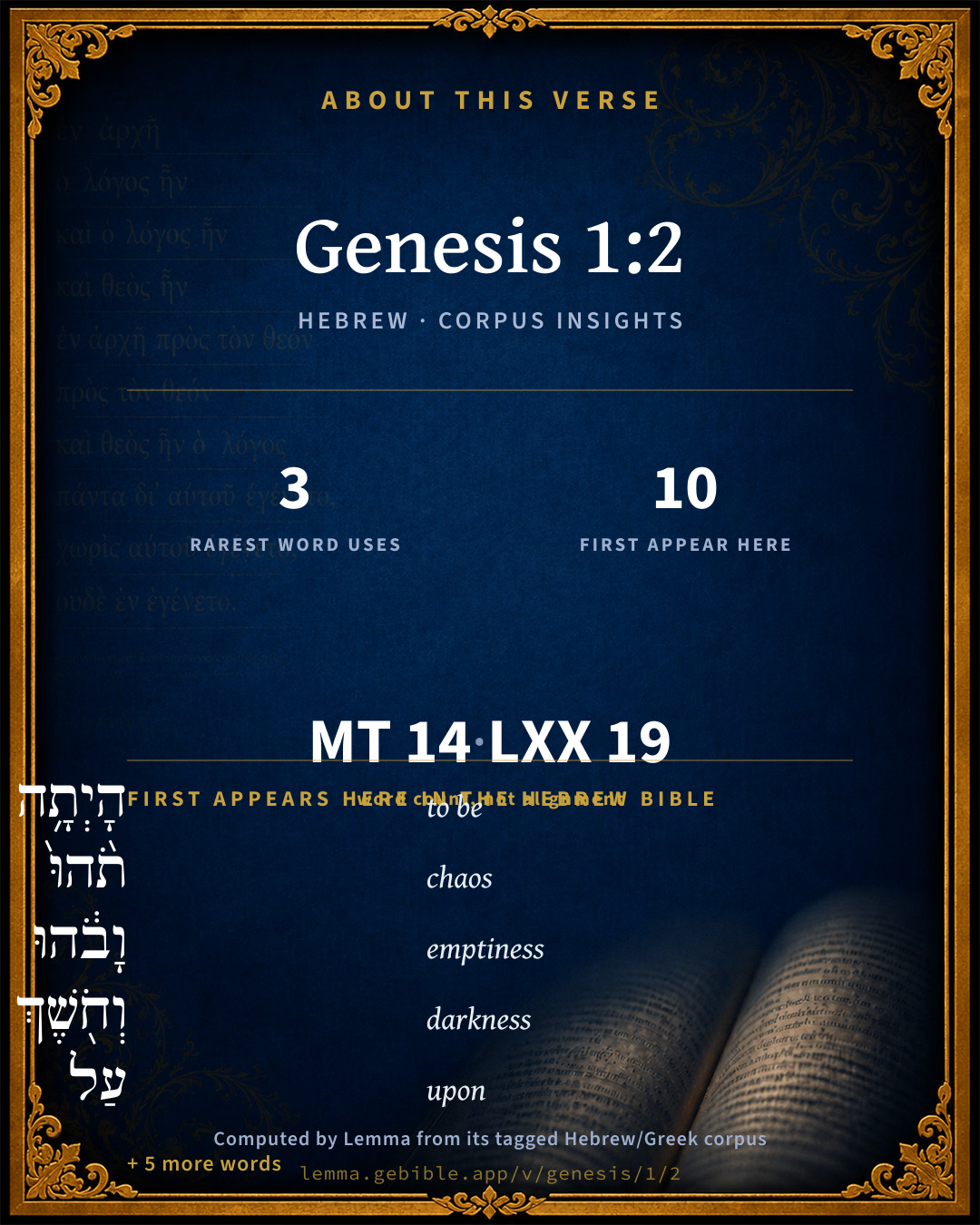
  • 10 first appearances in the Hebrew Bible
Full analysis ↓
Download a study sheet

One document with this verse’s original text, its word-by-word gloss line, the meaning frame, cross-references with their text, attributed commentary, and full source and license credits — printable, and it pastes into notes with its structure intact.

This verse Autodidact and up

Study sheet (.html) Plain text (.txt)

A passage Seminary Student

Up to 50 verses in one chapter. A passage sheet keeps up to 6 commentary sources and 12 cross-references per verse, in the order this page ranks them, and says so on the sheet whenever that leaves anything out. Ask for a single verse and you get the Autodidact verse sheet above.

Everything on this page stays free to read, with no account — the sheet is a download of what is already on screen, not access to it.

Want to remove ads? Support Godless Engineer
Compare translations 3

The same verse in 3 English versions, stacked beneath the original-language interlinear above. Click any original word for its lexicon entry.

Each is an independent rendering of the whole verse — the interlinear is not word-aligned to these translations.

Highlighted words mark where these versions differ — a whole-verse word diff, not a word-by-word alignment.

  • World English Bible Public Domain
    Now the earth was formless and empty. Darkness was on the surface of the deep. God's Spirit was hovering over the surface of the waters.
  • King James Version Public Domain
    And the earth was without form, and void; and darkness was upon the face of the deep. And the Spirit of God moved upon the face of the waters.
  • unfoldingWord Literal Text CC BY-SA 4.0
    Now the earth was formless and empty, and darkness over the surface of the deep, and the Spirit of God was hovering over the surface of the waters.

unfoldingWord Literal Text — © unfoldingWord, licensed CC BY-SA 4.0. Word-aligned USFM3 via Door43 (git.door43.org/unfoldingWord/en_ult).

Versions to compare (up to 4)

3 of 4 selected

Show all 18 translations

Every available English version of this verse, each an independent rendering of the whole verse.

  • World English Bible Public Domain
    Now the earth was formless and empty. Darkness was on the surface of the deep. God's Spirit was hovering over the surface of the waters.
  • Berean Standard Bible Public Domain
    Now the earth was formless and void, and darkness was over the surface of the deep. And the Spirit of God was hovering over the surface of the waters.
  • Majority Standard Bible Public Domain
    Now the earth was formless and void, and darkness was over the surface of the deep. And the Spirit of God was hovering over the surface of the waters.
  • King James Version Public Domain
    And the earth was without form, and void; and darkness was upon the face of the deep. And the Spirit of God moved upon the face of the waters.
  • American Standard Version (1901) Public Domain
    And the earth was waste and void; and darkness was upon the face of the deep: and the Spirit of God moved upon the face of the waters.
  • Revised Version (1885) Public Domain
    And the earth was waste and void; and darkness was upon the face of the deep: and the spirit of God moved upon the face of the waters.
  • Geneva Bible (1599) Public Domain
    And the earth was without forme and void, and darkenesse was vpon the deepe, and the Spirit of God mooued vpon the waters.
  • Douay-Rheims (1899) Public Domain
    And the earth was void and empty, and darkness was upon the face of the deep; and the spirit of God moved over the waters.
  • Young's Literal Translation Public Domain
    the earth hath existed waste and void, and darkness `is' on the face of the deep, and the Spirit of God fluttering on the face of the waters,
  • Literal Standard Version CC BY-SA 4.0
    and the earth was formless and void, and darkness [was] on the face of the deep, and the Spirit of God [was] fluttering on the face of the waters,
  • Unlocked Literal Bible CC BY-SA 4.0
    The earth was without form and empty. Darkness was upon the surface of the deep. The Spirit of God was moving above the surface of the waters.
  • unfoldingWord Literal Text CC BY-SA 4.0
    Now the earth was formless and empty, and darkness over the surface of the deep, and the Spirit of God was hovering over the surface of the waters.
  • Darby Bible Public Domain
    And the earth was waste and empty, and darkness was on the face of the deep, and the Spirit of God was hovering over the face of the waters.
  • World Messianic Bible Public Domain
    The earth was formless and empty. Darkness was on the surface of the deep and God’s Spirit was hovering over the surface of the waters.
  • Webster's Bible Public Domain
    And the earth was without form, and void; and darkness was upon the face of the deep: and the Spirit of God moved upon the face of the waters.
  • Free Bible Version CC BY-SA 4.0
    The earth was formless and empty, and darkness covered the surface of the deep. The Spirit of God moved over the surface of the waters.
  • Bible in Basic English Public Domain
    And the earth was waste and without form; and it was dark on the face of the deep: and the Spirit of God was moving on the face of the waters.
  • JPS Tanakh (1917) Public Domain
    Now the earth was unformed and void, and darkness was upon the face of the deep; and the spirit of God hovered over the face of the waters.

Literal Standard Version (2020), Covenant Press — licensed CC BY-SA 4.0. Text via the HelloAO Bible API (eBible.org). Unlocked Literal Bible (unfoldingWord) — licensed CC BY-SA 4.0. Text via the HelloAO Bible API (eBible.org). unfoldingWord Literal Text — © unfoldingWord, licensed CC BY-SA 4.0. Word-aligned USFM3 via Door43 (git.door43.org/unfoldingWord/en_ult). Free Bible Version, Dr. Jonathan Gallagher — licensed CC BY-SA 4.0. Text via the HelloAO Bible API (eBible.org).

Word by word

More ways to search: Search by grammar → Find every occurrence → Compare this word →

Practice this passage: Drill this verse → Learn its vocabulary →

וָבֹ֔הוּ
bôhûw
H922
“and · emptiness”
Conjunction + Noun, Common, Masculine, Singular, Absolute
Part of Speech
Conjunction + Noun
Type
Common
Gender
Masculine
Number
Singular
State
Absolute
Full BDB Definition

Origin: from an unused root (meaning to be empty)

TWOT: 205a

emptiness, void, waste
  1. וְהָאָ֗רֶץ ʼerets H776 “and · the · land” Conjunction + Particle, Definite Article + Noun, Common, Both, Singular, Absolute
  2. הָיְתָ֥ה hâyâh H1961 “to be” Verb, Qal, Perfect, 3rd Person, Feminine, Singular
  3. תֹ֨הוּ֙ tôhûw H8414 “chaos” Noun, Common, Masculine, Singular, Absolute
  4. וְחֹ֖שֶׁךְ chôshek H2822 “and · darkness” Conjunction + Noun, Common, Masculine, Singular, Absolute
  5. עַל ʻal H5921 “upon” Preposition
  6. פְּנֵ֣י pânîym H6440 “face(s) of” Noun, Common, Both, Plural, Construct
  7. תְה֑וֹם tᵉhôwm H8415 “deep” Noun, Common, Both, Singular, Absolute
  8. וְר֣וּחַ rûwach H7307 “and · spirit of” Conjunction + Noun, Common, Both, Singular, Construct
  9. אֱלֹהִ֔ים ʼĕlôhîym H430 “God(s)” Noun, Common, Masculine, Plural, Absolute
  10. מְרַחֶ֖פֶת râchaph H7363 “growing soft” Verb, Piel, Participle Active, Feminine, Singular, Absolute
  11. עַל ʻal H5921 “upon” Preposition
  12. פְּנֵ֥י pânîym H6440 “face(s) of” Noun, Common, Both, Plural, Construct
  13. הַמָּֽיִם mayim H4325 “the · water(s)” Particle, Definite Article + Noun, Common, Masculine, Plural, Absolute

About this verse

These counts appear in no published source. They are computed here, from the morphology-tagged text and Lemma’s own curated glosses. What Lemma adds →

14
words
12
distinct lemmas
Pentateuch
section

Notable vocabulary

The rarest word here is וָבֹ֔הוּ emptiness H922 — appearing just 3 times in the whole Hebrew Bible.

First appearance in Scripture

These words make their first canonical appearance in the Hebrew Bible here (10 in total — showing 8):

  • הָיְתָ֥ה to be H1961
  • תֹ֨הוּ֙ chaos H8414
  • וָבֹ֔הוּ emptiness H922
  • וְחֹ֖שֶׁךְ darkness H2822
  • עַל upon H5921
  • פְּנֵ֣י face H6440
  • תְה֑וֹם deep H8415
  • וְר֣וּחַ spirit H7307

Shared distinctive vocabulary

וָבֹ֔הוּ emptiness H922 occurs in 3 verses of the Hebrew Bible. Also found in:

Grammatical profile

  • 2 verbs
  • 10 nouns
  • 2 prepositions

Verb forms

  • הָיְתָ֥ה Qal · Perfect
  • מְרַחֶ֖פֶת Piel · Participle Active

Repetition

Words recur within this verse — often emphatic in Hebrew:

  • עַל upon H5921 ×2
  • פְּנֵ֣י face H6440 ×2

Hebrew & Septuagint length

In English translation the verse runs 25 words from the Hebrew and 22 from the Septuagint (LXX English) — closely comparable.

A rough comparison of the two English renderings, which tokenize alike — not a word-level alignment.

Word counts can differ between the Hebrew and the Greek without any difference in meaning — e.g. the Hebrew direct-object marker אֵת has no separate Greek word, and Greek often adds the article ὁ.

In the original languages it is 14 Hebrew tokens and 19 Greek tokens — but the two are counted differently (Hebrew bundles its prefixes and suffixes into one token; the Greek is in lemma form), so that isn’t a like-for-like length.

Cross-references

7

Topical passages linked to Genesis 1:2 in the Treasury of Scripture Knowledge — connected by theme and wording, ordered by reader-vote popularity; previews shown in the World English Bible.

  • Jeremiah 4:23 I saw the earth, and, behold, it was waste and void; and the heavens, and they had no light.
  • Psalms 104:30 You send forth your Spirit: they are created. You renew the face of the ground.
  • Isaiah 45:18 For thus says Yahweh who created the heavens, the God who formed the earth and made it, who established it and didn't create it a waste, who formed it to be inhabited: I am Yahweh; and there is no one else.
  • Psalms 33:6 By Yahweh's word the heavens were made; All their host by the breath of his mouth.
  • Job 26:7 He stretches out the north over empty space, And hangs the earth on nothing.
  • Isaiah 40:12–14 Who has measured the waters in the hollow of his hand, and meted out the sky with the span, and comprehended the dust of the earth in a measure, and weighed the mountains in scales, and the hills in a balance?
  • Job 26:14 Behold, these are but the outskirts of his ways. How small a whisper do we hear of him! But the thunder of his power who can understand?"

Cross-references courtesy of OpenBible.info (CC BY 4.0).

Hebrew and Greek witnesses Masoretic Hebrew ↔ Greek Septuagint

The same verse in the two great witnesses to the Old Testament, shown verse-for-verse.

These are two independent witnesses, not word-aligned to each other, and the Septuagint is shown in lemma (dictionary) form.

Hebrew Genesis 1:2 Masoretic · Westminster Leningrad Codex

וְהָאָ֗רֶץ הָיְתָ֥ה תֹ֨הוּ֙ וָבֹ֔הוּ וְחֹ֖שֶׁךְ עַל פְּנֵ֣י תְה֑וֹם וְר֣וּחַ אֱלֹהִ֔ים מְרַחֶ֖פֶת עַל פְּנֵ֥י הַמָּֽיִם

Now the earth was formless and empty. Darkness was on the surface of the deep. God's Spirit was hovering over the surface of the waters.

World English Bible · Public Domain

Greek LXX Genesis 1:2 Septuagint · lemma form

ὁ δέ γῆ εἰμί ἀόρατος καί ἀκατασκεύαστος καί σκότος ἐπάνω ὁ ἄβυσσος καί πνεῦμα θεός ἐπιφέρω ἐπάνω ὁ ὕδωρ

But the earth was unsightly and unfurnished, and darkness was over the deep, and the Spirit of God moved over the water.

LXX2012 (modern English Septuagint) · Public Domain

On this verse, Keil & Delitzsch discusses the Septuagint’s reading. Read the note in Commentary ↓

Hebrew: Westminster Leningrad Codex (CC BY 4.0). Greek: Septuagint (public domain); English from LXX2012 (modern English Septuagint) (Public Domain). How the Septuagint differs from the Hebrew →

Targum (Aramaic paraphrase)

2

The Targum is the ancient Jewish Aramaic paraphrase of the Hebrew Scriptures — an interpretive translation, not the Hebrew text itself. Onkelos (literal) and Pseudo-Jonathan (expansive) render the Torah, and Jonathan the Prophets. Coverage is partial: where no permissively-licensed English translation exists for a verse, only the Aramaic is shown. This is verse-level text, not a word-by-word alignment to the Hebrew.

  1. Targum Onkelos Torah (Genesis–Deuteronomy)
    וְאַרְעָא הֲוַת צָדְיָא וְרֵיקַנְיָא וַחֲשׁוֹכָא פָּרַשׂ עַל אַפֵּי תְהוֹמָא וְרוּחָא מִן קֳדָם יְיָ מְנַשְּׁבָא עַל אַפֵּי מַיָּא

    (no public-domain English translation for this verse)

    Targum Onkelos — Aramaic: “Onkelos Genesis” (public domain); “Onkelos Exodus” (public domain); “Onkelos Leviticus” (public domain); “Onkelos Numbers” (public domain); “Onkelos Deuteronomy” (public domain). English: “Sefaria Community Translation” (CC0 1.0 (public-domain dedication)); “J.W. Etheridge. The Targums of Onkelos and Jonathan Ben Uzziel on the Pentateuch. London: Longmans, Green, 1862” (public domain). Text via Sefaria.

  2. Targum Pseudo-Jonathan Torah (Genesis–Deuteronomy)
    וְאַרְעָא הֲוַת תַּהֲיָיא וּבַהֲיָיא צַדְיָא מִבְּנֵי נַשׁ וְרֵיקַנְיָא מִן כָּל בְּעִיר וַחֲשׁוֹכָא עַל אַפֵּי תְהוֹמָא וְרוּחַ רַחֲמִין מִן קֳדָם יְיָ מְנַתְבָא עַל אַנְפֵּי מַיָא

    And the earth was vacancy and desolation, solitary of the sons of men, and void of every animal; and darkness was upon the face of the abyss, and the Spirit of mercies from before the Lord breathed upon the face of the waters.

    Targum Pseudo-Jonathan — Aramaic: “Targum Jonathan on Genesis” (public domain); “Targum Jonathan on Exodus” (public domain); “Targum Jonathan on Leviticus” (public domain); “Targum Jonathan on Numbers” (public domain); “Targum Jonathan on Deuteronomy” (public domain). English: “The Targum of Jonathan ben Uzziel, trans. J. W. Etheridge, London, 1862” (public domain). Text via Sefaria.

Commentary

Notes on Genesis 1:2 from classic Christian and Jewish commentators (each source and its license shown beneath its notes). The classic Christian expositions comment on the surrounding passage and are grouped to its opening verse, so a note may address several verses; the Jewish commentaries on the Tanakh (Rashi and others) are per-verse, so they appear only where the commentator wrote on this verse.

Lemma curates 59 commentaries, every one of them public domain or Creative Commons licensed, each selected and text-cleaned for this edition rather than reprinted as found. About our sources →

Trapp's Complete Commentary

John Trapp

Gen 1:2 And the earth was without form, and void; and darkness [was] upon the face of the deep. And the Spirit of God moved upon the face of the waters.

Ver. 2. And the earth was without form and void,] that is, as yet it had neither essential nor accidental perfection. The Lord afterward did form it into light, the firmament, the water, and the earth; so beginning above, and building downwards (in the new creature he doth otherwise); and in three days laying the parts of the world, and in other three days adorning them. The Rabbins tell us that Tohu and Bohu do properly import Materia prima and privatio; { a} and others of Tohu, derive Chaos, whence the ancient Latins called the world Chobus, and borrowed their word Inchoo (εγχυω), &c.

And darkness was upon the face of the deep,] that is, not of hell, as Origen expounds it, but of the deep waters (αβυσσος, see the like, Luk 8:31), which "as a garment covered the earth, and stood above the mountains." {Psa 104:6} This darkness God created not, for it was but the want of light. And to say that God dwelt in darkness till he had created light, was a devilish sarcasm of the Manichees, as if God were not light itself, {1Jn 1:5} and "the Father of lights"; {Jas 1:17} or, as if God had not ever been a heaven to Himself, "Ere ever he had formed the earth and the heavens." {Psa 90:2} What he did, or how he employed himself before the creation, is a sea over which no ship hath sailed, a mine into which no spade hath delved, an abyss into which no bucket hath dived. Our sight is too tender to behold this sun. A thousand years, saith a great divine, {b} are to God but as one day, &c. And who knoweth what the Lord hath done? Indeed, he made but one world to our knowledge; but who knoweth what he did before, and what he will do after? Thus he. As for St Augustine:

“The bishop Lybicus was shaping the underworld according to these verses, he said these ideas which he helps to be examined by means of such a mind.” {c}

Excellently another, {d} who wanted not wit: As in the element of fire, saith he, there is a faculty of heating and enlightening; whence proceedeth heat and light unto the external near bodies; and besides this faculty, there is also in it a natural power to go upward; which, when it cometh into act, is received into no other subject, but the fire itself: so that if fire could, by abstractive imagination, be conceived of as wanting those two transient operations, yet could we not justly say it had no action, forasmuch as it might move upward, which is an immanent and inward action. So, and much more so, though we grant that there was no external work of the Godhead, until the making of the world, yet can there be no necessary illation [inference] of idleness, seeing it might have (as indeed it had) actions immanent, included in the circle of the Trinity. This is an answer to such as ask, What God did before he made the world? God, saith Plotinus the Platonist, {e} not working at all, but resting in himself, doeth and performeth very great things.

And the Spirit of God moved, &c.] Or hovered over, {f} and hatched out the creature, as the hen doth her chickens; or as the eagle fluttereth over her young, to provoke them to flight. {Deu 32:11} Or as by a like operation, this same Holy Spirit formed the child Jesus in the Virgin’s womb, in that wonderful "overshadowing" {Luk 1:35}. The Chaldee here hath it, "The Spirit breathed"; and David saith the same. {Psa 33:6} He became, to that rude dead mass, a quickening, comforting Spirit. He kept it together, which else would have shattered. And so he doth still, or else all would soon fall asunder, {Heb 1:3 Psa 104:29} were not his conserving mercy still over, or upon, all his works. {Psa 145:9}

{a} Ahlsted., Lexic. Theol., p. 111.

{b} Dr. Preston, Of God’s Attributes, p. 34. [Rather, 2Pe 3:8 - ED.]

{c} Praesul ad haec Lybicus, fabricabat Tartara, dixit, His, quos scrutari talia mente iuvat.

Sabin, Poet.

{d} Cuff’s Differ. of Ages, p. 22.

{e} Ferebatur super aquas non pervagatione, sed potestate, non per spatium locorum, ut sol super terram, sed pepotentiam sublimitatis suae. - Eucherius

{f} Dei Dicere est Efficere, "of God, to say is to accomplish"

John Trapp, A Commentary or Exposition upon All the Books of the Old and New Testament (1647–1656) — public domain. Text from a community e-Sword module.

The Biblical Illustrator

Joseph S. Exell

Gen_1:2

And the earth was without form and void; and darkness was upon the face of the deep

Genesis of order

I.

EXPLANATION OF THE PASSAGE.

1. The primeval chaos.

(1) Origin of chaos. The direct issue of the Creative Will. God created the atoms of the universe, starting with them in a chaotic state.

(2) Picture of chaos. All the elements which now exist were doubtless there; but all were out of relation.

(3) Confirmation of science. If the magnificent nebular hypothesis of the astronomers--first propounded by Swedenborg, adopted by Kant, elaborated by Laplace and Herschel, and maintained with modifications by such scientists as Cuvier, Humboldt, Arago, Dana, and Guyot--be true, there has been a time when the earth, and indeed the whole universe, was in a state of nebula, or chaotic gaseous fluid. As such, the earth was indeed without form and void, and darkness was on the face of the deep. Being in a gaseous state, it was without form and void; being as yet in an inactive state, it was dark; being in a state of indefinite expansion, it was a deep.

2. The organizing energy.

(1) The breath of God.

(2) Moved over the face of the fluids.

II. And now let us attend to THE MORAL MEANING OF THE STORY.

1. And, first: all life begins chaotically. It is true of physical life. Look at this bioplast; the most powerful microscope fails to detect in it much sign of system, or structure: the most that it detects is a tiny grouping of seemingly unarranged, chaotic material; in fact, so structureless does it seem, that the microscope declines to prophesy whether it will unfold into a cedar, an elephant, or a man. Again, it is true of intellectual life. Look at this newborn infant: how nebulous and chaotic its conceptions! Your little one may grow into a Shakespeare; but at present, and intellectually surveyed--forgive me, fond mother, for saying it--your little one is scarcely more than a little animal. Do we not apply indiscriminately to infants and animals the impersonal pronoun it? Once more: it is true of moral life. That is not first which is spiritual, but that which is natural: then that which is spiritual. Look at humanity as a whole, and through the ages, ancient, mediaeval, modern, How vast but abortive its endeavours! How besmeared its history with idolatries, barbarisms, wars, butcheries, oppressions, crimes, blasphemies! Verily, humanity, compared with its latent, transcendent possibilities, is indeed a chaos, without form, and void, and darkness is over its deep. And what is so sadly true of humanity as a whole, is as sadly true of each member of humanity, at least in his natural, or rather unnatural, denatured state. For each man is a microcosm, a miniature world of his own. And each man, compared with what is conceivable concerning him, is a chaos.

2. Is there any hope here? Thank God, there is. That same breath of God which moved over the face of those ancient fluids, is moving today over the soul of humanity. Ah, this is the blessed energy by which the chaos of our moral nature is being organized into order and beauty. Observe: as, in shaping the material earth out of the old chaos, the Spirit of God added no new elements, but simply fashioned into order the old; so, in organizing the spiritual chaos, He adds no new faculties, but simply quickens and organizes the old. What man needs is not creation, but re-creation; not generation, but regeneration. And this it is which the Holy Ghost is achieving. Brooding, incubating as Gods Holy Dove over the chaos of humanity, He is quickening its latent forces, arranging its elements, assorting its capacities, organizing its functions, apportioning its gifts, perfecting its potentialities: in short, completing, fulfilling consummating man in the sphere of Jesus Christ. (G. D. Boardman.)

An emblem of unrenewed man

I. EMPTINESS OF GOOD. Chaos was absolutely unproductive. Not a single tree, bush, or flower. Not even the seeds of any useful herbs. So is man as a spiritual being till Gods Spirit begins to work on his fallen nature. In me, that is, in my flesh, dwelleth no good thing.

II. DARKNESS. A meet covering for such an unsightly spectacle. The wicked man is said to walk in darkness (1Jn_1:6); darkness blindeth his eyes (1Jn_2:11); his understanding is darkened Eph_4:18); his foolish heart is darkened (Rom_1:21); he loves darkness rather than light (1Jn_3:21); he knows not nor understands, but walks on in darkness (Psa_82:5); and if he repent not he shall be cast into outer darkness (Mat_25:30). The children of God were at one time darkness, but now are light in the Lord; they walk as children of light (Eph_5:8); they are called out of darkness into marvellous light (1Pe_2:9); they are delivered from the power of darkness (Col_1:13); they cast off the works of darkness, and walk honestly as in the day (Rom_13:12-13).

III. CONFUSION. The chaos was a hideous mixture of all discordant materials--earth and water; mud and rock; vegetable and mineral; mire, slime, lees, scum, clay, marl, crag, and pool. This is but a faint image of the turmoil, struggle, and strife that go on continually in the heart of a man who is under the dominion of lusts and passions that war against the soul. Was there a visible form? If so it may have been some white cloud like the Shechinah. But if cloud there were, there was no vitality in that; it was only a symbol made use of by the vitalizing Agent to intimate that He was present. This power was--

1. Silent in its operation.

2. Efficacious.

3. Instantaneous.

In one word, the chaotic state of mans soul before God can only be restored to light, warmth, order, beauty, and life by the working of the Divine Spirit, through applying the truth as it is in Christ Jesus as the means. This work is done silently and gently. Zaccheus was thus awakened Luk_19:5-8); Nathanael (Joh_1:47-49); the woman of Samaria Joh_4:9-29).

The teaching of chaos

I. THAT THE MOST ELEMENTARY AND RUDE CONDITIONS OF THINGS ARE NOT TO BE REJECTED OR OVERLOOKED. And the earth was without form and void.

1. This may be true of the world of matter.

2. This may be true of the world of mind. Desolate. Not peopled with great thoughts. Not animated by great and noble convictions.

3. This may be true of the world of the soul. The soul life of many lacks architecture.

II. THAT THE MOST RUDE AND ELEMENTARY CONDITIONS OF THINGS, UNDER THE CULTURE OF THE DIVINE SPIRIT, ARE CAPABLE OF THE HIGHEST UTILITY AND BEAUTY.

1. This is true of the material world. The earth was without form and void; but now it is everywhere resplendent with all that is esteemed useful and beautiful. It manifests a fertility most welcome to the husbandman. Whence this transition? It was the gift of God. It was the result of the Spirits hovering over the darkness of Nature. The world is under a Divine ministry.

2. This is true of the world of mind. The chaos of the human mind is turned into order, light, and intellectual completion, by the agency of the Divine Spirit.

3. This is true of the world of soul. The chaos of the soul of man can only be restored by the creative ministry of the Holy Spirit. He will cause all the nobler faculties of the soul to shine out with their intended splendour. He will make the soul a fit world for the habitation of all that is heavenly. (J. S.Exell, M. A.)

Without form and void

1. A type of many souls.

2. A type of many lives.

3. A type of many books.

4. A type of many sermons.

5. A type of many societies. (J. S. Exell, M. A.)

On looking back to original condition

The best way to judge of things aright is to consider them in their first original.

1. To bring down our pride.

2. To quicken our endeavours.

3. To fill our mouths with praises to Him that made us what we are, and might have continued, without His free and infinite mercy. (J. White.)

The chaos

The text is easily divided into two parts: first, the earth was without form, and void, and darkness was upon the face of the deep: second, the Spirit of God moved upon the face of the waters.

I. The first subject then for our consideration is THE STATE OF THE WORLD IN THE BEGINNING OF TIME. The earth was without form, and void; and darkness was upon the face of the deep: that is, the earth lay a hideous, barren, and desolate heap; as a waste, howling wilderness, earth and sea mingled together. How short and wretched must have been the existence of creatures, if God had doomed any to dwell in such a state!--how utterly impossible would it have been for them to fix a comfortable habitation, or to remedy one even of the existing evils! Where should we have made our pleasant homes and warm firesides? Could we have commanded the morning, and caused the day spring to know its place? Could we have driven away the darkness, or have shut up the sea with doors?

1. Here, then, we are led to reflect, first, upon the wisdom and goodness of God manifested in His gracious design in the creation. God had no design to form creatures for misery, but for happiness, as the apostle declares when speaking of the Christian dispensation: God hath not appointed us to wrath, but to obtain mercy by Jesus Christ. So here He had determined to make man; but to make him, not a child of sorrow, but a comfortable and happy creature: He therefore first begins, with infinite goodness, to prepare him a pleasant and goodly dwelling place. But which among the angels would have supposed that He would form it from this gloomy chaos, this miserable and barren spot we have been considering? They had no such power themselves, not the mightiest of them; and it is probable they did not yet know the almighty power of God, or, at least, that they had not seen it so marvellously displayed. When, therefore, He fixed the foundation of the earth, and formed the world, He tells Job that then the morning stars sung together, and all the sons of god shouted for joy: they sung of the mighty power and glory of God: they shouted for joy at the goodness and wisdom of their everlasting Father, here displayed so gloriously. Thus, when we consider the works of the Holy Spirit, how lovely does He himself appear to us!--how worthy of our highest adoration and gratitude! But, further, the word here translated moved, literally means settled or brooded, and it is understood by some to express that act of the Holy Spirit by which He imparted life and activity. This is the peculiar office of the Holy Spirit, it is the Spirit that quickeneth, saith our Saviour: the Spirit giveth life, says St. Paul: it was the Spirit that raised Jesus from the dead: it is the Spirit that shall breathe upon our dry bones, that they may live; for in like manner it was the Spirit of God that entered Adam, and man became a living soul. To this Holy Spirit of God then we are indebted, not only for our own life and preservation from day to day and from year to year, but for all those living creatures which increase and multiply to supply us with food and clothing, and many other comforts. As often, therefore, as we use them, should not our hearts be grateful to Him who is the author of them, and take heed not to abuse them? Now, we have considered the state of this world before the Word of God and the Spirit of God began their operations upon it. You have seen its disorder and confusion, its barren, empty, and useless condition, and the utter darkness in which it was buried. You have seen, then, an exact representation of the fallen state of man, and what the Word and Spirit of God, and these only, can do for him. The whole soul and body of man without these is without form, and void: his heart is a misshapen, hideous, and disordered mass of empty, unprofitable, and good-for-nothing matter; and, when the Holy Spirit of God enters it, He finds it lifeless, dark, and barren, and, like the unrestrained and troubled waters, all ruinous and in wild disorder, as in chaos. This is the state of man, and therefore he is fit for nothing else but destruction, except he is rendered fit for a habitation of God through the Spirit. There is, as in chaos, a continued strife of elements within us, a continual war and confusion among our lusts, which war in our members: we are full of uncleanness, ungodliness, intemperance, and sin: while the ungoverned waters struggle for a vent, and rage and swell, the earth is rent and torn asunder, and at last overwhelmed; and thus, while one desire, one lust, one inclination in our frame rages, and is indulged, another part of us is convulsed and disordered, and at last perhaps sudden destruction comes upon us. Here, then, we see the free mercy of God towards us, in His willingness to rescue us from this chaotic state. It is plain, then, that a change must be wrought in us if we would be saved: for think not that God will pollute His heavens with such creatures: think not that He will suffer the holiness and harmony of heaven to be interrupted by unsubdued, deformed man. This change, then, from darkness to light, from barrenness to fruitfulness, from confusion to peace, from sin to holiness and loveliness, and happiness, in short from the power of Satan unto God, this change is needed in all, and none can be saved without it; and it is the work of the Word and Spirit of God: none other can do it; none other has any part in it. I say it is the work of the Word and Spirit: not the Word alone, nor the Spirit alone; but it is the work of the two conjointly. (J. Matthews, M. A.)

The inability of chaos apart from God to evolve order

It would be unphilosophical to hold that chaos evolved from herself the order that everywhere appears. Can I believe that the pile of rubbish that marks the site of Babylon will ever produce a city so beautiful and magnificent as that which witnessed nightly the revels of the Chaldean Monarchs? Shall I see, as if by magic, street after street arise, square after square occupy its ancient position, temple after temple point its glittering canopy to heaven; shall I see the city enclosed by walls, filled with a busy, trading, pleasure-seeking population, and be told that all this order, and magnificence, and life, has come of the pile of ruins? (G. Wight.)

The chaos of the earth illustrated by the chaotic condition of the moon

Of such a condition of the earth, a definite idea may be formed by an examination of the moons surface--a very chaos of explosive action. Thousands of small pits are there, and, as certainly, immense chasms, whose flattened interiors rival a congeries of English counties, while stupendous ridges and peaks encompass them, standing out like the Apennines and Pyrenees, and sometimes transcending the loftiest eminences of the Alps. He who has traversed the Great Schiedegg and the Wengun Alp, beneath the shadow of the almost vertical steeps of the Wetterhorn and the Eiger, has been awe-struck by summits so towering, and descents so profound; and yet feeble is their image of the heights and depths of the moons Himalayas. What evidences are these of volcanic agency, while other elevations, due possibly to the same mighty power, astound him who steadily contemplates them, by their rectilinear extent.

Yet, amidst these cindery plains, no river makes a path, no stream meanders; down those precipices neither silver thread of water winds its way, nor is there the gushing, the tumbling, and foaming of some huge cascade; and hence the great desert of Africa resembles the naked and arid wastes, where no life springs forth to relieve, much less to cheer, this immense scene of unmitigated desolation. As, then, the moon is, so was this earth of ours, when Moses described not its contents, of which he knew nothing, but its surface, as without form and void. (C. Williams.)

And the Spirit of God moved upon the face of the waters:--

The work of the Holy Spirit

It is a significant, suggestive fact, that the work of the Holy Spirit is historically coeval with the work of creation. The Divine Being who inspired the Bible appears upon its first page, a mystic centre of light and beauty in the midst of an universe of darkness. And St. Paul tells us that God the Holy Spirit, who first illumined the dark world of matter, still illuminates the dark world of mind. All is midnight in the heart, mind, and soul of a sinner, until He, the Light of Life, saith, Let there be light.

I. The work of the Spirit in the NATURAL man. The force of Pauls allusion to the creation in Genesis implies that mans original earth, in its perennial darkness, waste, and submersion, is a type of mans heart, as nature moulds it, and sin corrupts it. The earth was without form and void; and the heart is without grace, or capacity of spiritual discernment, till the Spirit of God moves in His creative, enlightening energy, upon both the one and the other. This is equally true of every man, for who maketh thee to differ? and what hast thou, O man, that thou didst not receive? It is our part to preach Christ, but it is the Spirits office to convince of sin, righteousness, and judgment. The Spirit Himself is the foundation of all spirituality. It is the Spirit that quickeneth, and the Spirit giveth life: the words that I speak unto you, they are Spirit, because He spake in the Spirit, lived in the Spirit, and commanded His disciples to wait for the Spirit, before they commenced their ministry, that they might be endued with power from on high. That is the only power still to convert souls. The most powerful ministry is simply that which is the most spiritual, which most prays in the Spirit, preaches in the Spirit, lives in the Spirit, and most constantly insists upon congregations seeking the Spirit, and resting on His gifts and graces as their only source and secret of edification.

II. The work of the Spirit in the REGENERATE man. The path of the just is as a shining light, that shineth more and more unto the perfect day, for He who gives the first convicting and converting impulse, giveth more grace. As the original motion of the Spirit of life and light was followed by the creation of the sun, the moon, and the stars, each in their appointed orbits, fulfilling their Creators munificent purposes of love and goodness; so the work of the quickening Spirit in individual regeneration is succeeded by ampler revelations of Christ as the Sun of Righteousness, the centre of His redeeming system; of the Church, as His satellite, fair as the moon, borrowing all her light and influence upon many waters from the Lord, whose fainter image she is, a light shining in dark places: and of Christs ministers and sacraments, as stars in His right hand, by whose lesser lights He deigns to carry on His gracious offices of mercy to a world lying in darkness, and in the power of the wicked. But it is the Spirit which gives the weight and efficacy to all these means of grace, and channels of edification, by which the child of God is built up in his most holy faith, and rendered more and more conformed to the image of Gods dear Son. At every step there is the scriptural impress of the Spirit, from first to last. (J. B. Owen, M. A.)

The Spirit of God considered as the chief agent in the work of the new creation

In fulfilment of this process of new creation, the Spirit of God descends upon the benighted surface of the human soul.

1. In order to dissipate the darkness in which it is naturally involved. The mind of man, as disordered, corrupted, and clouded by sin, may well be compared to that confused and rayless obscurity which rested over the face of the abyss. It is enveloped in a thick, impenetrable mantle of ignorance, prejudice, and unconcern. And it is only when the Spirit of God begins to move upon the stagnant waters of his cold and damp indifference, that light breaks in upon his mind.

2. Another function equally necessary and important, which the Spirit of God performs in the new creation of the soul, is that of purification. The mind of each one of us, by nature, is full of all impurity and pollution. In this condition we are utterly unfit for the service of God here, and the presence of God hereafter--unfit for communion with God by prayer and devout meditation--unfit for the suitable and acceptable discharge of any one of the duties of Gods worship--unfit for life--unfit for death. Under these circumstances it becomes a question of supreme and paramount importance, whether a renovating process has been commenced upon us--whether, under the influence of the salutary motions of the Spirit of God, we have made it our endeavour to cleanse ourselves from all impurity of flesh and spirit, and to perfect holiness in the fear of God--whether the various streams of thought, feeling, and conduct, are gradually purifying from their drossy and turbid aspect, and whether our whole character from day to day becomes more thoroughly assimilated to the Divine image, and assumes more of the complexion and the hue of heaven.

3. In connection with the effects already specified, the human soul requires to be reduced to order, and to be harmonized in its various principles and habits. By the fatal shock which it received in Eden, the whole system has been disorganized. In relation to the character and attributes of Jehovah--to His revealed will and the whole range of His service--to the objects and pursuits connected with a spiritual and eternal world, it is altogether out of joint. By the original apostasy from God, in fact, the whole nature of man went to wreck. The various elements of his being forsook their proper combination and position in the system, and entered into new and most destructive relations. The wild and tumultuous anarchy of his affections is like the troubled sea when it cannot rest, whose waters cast up mire and dirt. The scene of chaos, in which heaven and earth, fire and water, were commingled together into one vast ocean of jarring elements, was not more replete with confusion than is the mind, when let loose unto itself, and freed from the soothing restraints, and the controlling and regulating impulses, of that Spirit which moved upon the face of the waters. It is this Spirit alone, who can rectify the deep disorders of our nature. It is He alone who can separate, direct, soothe, and harmonize the warring elements of our carnal and unsubdued mind, and reduce every faculty and affection into the cheerful and meek obedience of the faith. It is He alone who can restrain the aberrations of the judgment--who can check the wanderings of the imagination--who can curb the impetuosity of the passions, and attemper the whole soul and spirit into one harmonious and well-balanced scheme of Christian character and conduct. Other means may be used, indeed, and ought to be used. The Bible should be read--the ordinances of religion should be attended--the duties of prayer, and devout meditation and reflection, should be solemnly and uninterruptedly discharged; but other means, without the accompanying and moving energies of the Spirit, will be found ineffectual.

4. Nor is the Spirit merely the author of light, purity, and order, in the formation of the new creature, but life itself: that which is essential to the exercise and enjoyment of all other endowments in His special gift. While He moved upon the face of the waters, the command went forth, and they were at once seen to teem with animated existence. Impregnated with His vital energies, the great deep became instinct with life and motion. The various forms of vegetable and organized existence--the tenants of the ]and, and those that wing their flight through the regions of air, were seen to burst forth from its capacious bosom, until every quarter of the universe became peopled with its appropriate inhabitants. The great Spirit, who was thus the primary agent in kindling material nature into life, is also the author of that higher life which pervades the new creation. (J. Davies, B. D.)

The creation

I. THE SPIRIT OF GOD BROUGHT ORDER AND DEVELOPMENT TO THE MATERIAL WORLD. How did that shapeless mass become such a world as this? What account of the transition does science give? It says, Change succeeded to change, in strict accordance with physical law, very slowly but surely, with no sudden transitions, till, step by step, the one condition passed into the other. Those regular changes were all that appeared; and they are all which appear now, though the same changes are still going on. We cannot see the intelligence, the mind, which directs the works of nature; but it is equally true that we cannot see them in the works of man. Yet the mind of man is at work, though invisible, animating his body; and it is truer to speak of his mind as planning the house he builds, and the steam engine he sets to work, than to say that the materials came together into their right places, though that is all that we see. And so it is truer to say that the Invisible Mind, the unseen Spirit of God, moved upon the formless earth, and brought it to its present ordered form, than to say it happened so. Science mentions only what appeared; but Genesis tells the deeper truth, that the informing mind accomplished all--Genesis, which was written centuries before science was born. There is special fitness in the words employed, The Spirit of God moved upon the face of the waters. It indicates the quiet untiring ways in which God works in the heavens and the earth.

II. THE SPIRIT OF GOD MUST BRING ORDER AND DEVELOPMENT TO THE SPIRITUAL WORLD. The moral and spiritual nature of man forms quite another world from the material universe, and yet how closely the two are linked in the human body and soul! Look at the moral and spiritual nature of men. How high they can rise! so high that there is fitness in speaking of Gods image in them as a real kinship of nature with God. What noble examples there have been among men, of righteousness, faithfulness, and love--the very attributes of God--yet we feel man has not realized the greatness and goodness that he may. But how low men can sink! to what extremes of wrong, and treachery, and selfishness, and cruelty! We cannot picture it all; to do so would be to have present to the mind what human society has been and is--the crimes, the woes, the degradation, and shame, of generations of human lives and hearts. To picture human society as it is--I mean especially its evils--would be more, not only than imagery could realize, but more than any feeling heart could bear. The material chaos is but a faint image of this deeper spiritual chaos; but taking it as such, we may ask, Does God leave the world in this chaos of degradation and woe? Turn to another Bible picture: I beheld, and, lo, a great multitude, which no man could number, of all nations, and kindreds, and people, and tongues, stood before the throne, and before the Lamb, clothed in white robes (emblems of purity), and palms in their hands (emblems of victory). (T. M. Herbert, M. A.)

The Biblical Illustrator, edited by Joseph S. Exell (c. 1880s–1900s) — public domain. Text from a community e-Sword module.

Joseph Benson's Commentary

Gen 1:2. The earth — When first called into existence, was without form and void: confusion and emptiness, as the same original words are rendered, Isa 34:11. It was without order, beauty, or even use, in its present state, and was surrounded on all sides with thick darkness, through the gloom of which there was not one ray of light to penetrate not even so much as to render the darkness visible.

The Spirit of God moved, &c. — To cherish, quicken, and dispose them to the production of the things afterward mentioned. The Hebrew word here rendered moved, is used, Deu 32:11, of the eagle fluttering over her young, and of fowls brooding over their eggs and young ones, to warm and cherish them: but, we must remember, that the expression, as here used, is purely metaphorical, and must not be considered as conveying any ideas that are unworthy of the infinite and spiritual nature of the Holy Ghost.

Joseph Benson's Commentary on the Old and New Testaments (1811–1818) — public domain. Text from a community e-Sword module.

Whedon's Commentary on the Bible

Daniel D. Whedon

2. And the earth was without form and void — Having stated in the first verse the great fact of the creation, the writer now proceeds to unfold the manner and order of that creation. Here we must differ from those critics who understand Gen_1:1 of the primordial matter of the universe, and the following verses of a subsequent series of growths. The analogy of the entire Book of Genesis confirms the view of those who regard Gen_1:1 as a heading or general statement of the substance of the whole following section, which the succeeding verses go on to elaborate in detail. So Gen_2:4; Gen_5:1; Gen_10:1; Gen_11:10; Gen_11:27, etc., are respectively the headings of so many sections of this ancient Book of the Beginning and Generations of human history. In every instance, after first positing a general statement of his subject, the writer proceeds to narrate the details which his statement involves. The words used in the first verse needed an explanation, which the rest of the chapter at once supplies. The statement, so often made, that the conjunction and (ו) at the beginning of Gen_1:2 forbids the supposition that Gen_1:1 is a summary of the whole chapter, is seen to be futile by a comparison of the immediate sequence of other headings of sections named above. The words תהו ובהוare rendered by Onkelos waste and empty; by Aquila, emptiness and nothing; by Vulgate, empty and void; and by the Sept., invisible and unformed. The words appear in the same form again in Jer_4:23. They here describe the land as waste and empty, and the context shows that it was as yet covered with waters, so as to form a part and condition of the deep, over the surface or face of which there was darkness. Whether light had ever beamed upon that deep, or how the land and the waters came to be so intermixed, are questions on which the writer utters no sentiment.

The Spirit of God moved (מרחפת, brooding, comp. Deu_32:11) upon the face of the waters — The Divine Spirit hovered down upon the deep, as the mighty Agent by whose power the darkness will be made to vanish, and beauty and order arise out of desolation and emptiness. Observe, here is no broad statement that darkness prevailed through the entire universe of God; nor is the deep or the waters to be identified with the entire surface of the globe. FIRST DAY — LIGHT, 3-5.

Daniel D. Whedon (gen. ed.), Commentary on the Old and New Testaments (1874–1909) — public domain. Text from a community e-Sword module.

Keil & Delitzsch

C. F. Keil & F. Delitzsch

The First Day. - Though treating of the creation of the heaven and the earth, the writer, both here and in what follows, describes with minuteness the original condition and progressive formation of the earth alone, and says nothing more respecting the heaven than is actually requisite in order to show its connection with the earth. He is writing for inhabitants of the earth, and for religious ends; not to gratify curiosity, but to strengthen faith in God, the Creator of the universe. What is said in Gen 1:2 of the chaotic condition of the earth, is equally applicable to the heaven, "for the heaven proceeds from the same chaos as the earth."

"And the earth was (not became) waste and void." The alliterative nouns tohu vabohu, the etymology of which is lost, signify waste and empty (barren), but not laying waste and desolating. Whenever they are used together in other places (Isa 34:11; Jer 4:23), they are taken from this passage; but tohu alone is frequently employed as synonymous with איך, non-existence, and הבל, nothingness (Isa 40:17, Isa 40:23; Isa 49:4). The coming earth was at first waste and desolate, a formless, lifeless mass, rudis indigestaque moles, ὕληἄμορφος (Wis. 11:17) or χάος.

"And darkness was upon the face of the deep." תּהום, from הוּם, to roar, to rage, denotes the raging waters, the roaring waves (Psa 42:7) or flood (Exo 15:5; Deu 8:7); and hence the depths of the sea (Job 28:14; Job 38:16), and even the abyss of the earth (Psa 71:20). As an old traditional word, it is construed like a proper name without an article (Ewald, Gramm.). The chaotic mass in which the earth and the firmament were still undistinguished, unformed, and as it were unborn, was a heaving deep, an abyss of waters (ἄβυσσος, lxx), and this deep was wrapped in darkness. But it was in process of formation, for the Spirit of God moved upon the waters, רוּח (breath) denotes wind and spirit, like πνεῦνα from πνέω. Ruach Elohim is not a breath of wind caused by God (Theodoret, etc.), for the verb does not suit this meaning, but the creative Spirit of God, the principle of all life (Psa 33:6; Psa 104:30), which worked upon the formless, lifeless mass, separating, quickening, and preparing the living forms, which were called into being by the creative words that followed. רחף in the Piel is applied to the hovering and brooding of a bird over its young, to warm them, and develop their vital powers (Deu 32:11). In such a way as this the Spirit of God moved upon the deep, which had received at its creation the germs of all life, to fill them with vital energy by His breath of life. The three statements in our verse are parallel; the substantive and participial construction of the second and third clauses rests upon the והיחה of the first. All three describe the condition of the earth immediately after the creation of the universe. This suffices to prove that the theosophic speculation of those who "make a gap between the first two verses, and fill it with a wild horde of evil spirits and their demoniacal works, is an arbitrary interpolation" (Ziegler).

Gen 1:3

The word of God then went forth to the primary material of the world, now filled with creative powers of vitality, to call into being, out of the germs of organization and life which it contained, and in the order pre-ordained by His wisdom, those creatures of the world, which proclaim, as they live and move, the glory of their Creator (Psa 8:1-9). The work of creation commences with the words, "and God said." The words which God speaks are existing things. "He speaks, and it is done; He commands, and it stands fast." These words are deeds of the essential Word, the λόγος, by which "all things were made." Speaking is the revelation of thought; the creation, the realization of the thoughts of God, a freely accomplished act of the absolute Spirit, and not an emanation of creatures from the divine essence. The first thing created by the divine Word was "light," the elementary light, or light-material, in distinction from the "lights," or light-bearers, bodies of light, as the sun, moon, and stars, created on the fourth day, are called. It is now a generally accepted truth of natural science, that the light does not spring from the sun and stars, but that the sun itself is a dark body, and the light proceeds from an atmosphere which surrounds it. Light was the first thing called forth, and separated from the dark chaos by the creative mandate, "Let there be," - the first radiation of the life breathed into it by the Spirit of God, inasmuch as it is the fundamental condition of all organic life in the world, and without light and the warmth which flows from it no plant or animal could thrive.

Gen 1:4

The expression in Gen 1:4, "God saw the light that it was good," for "God saw that the light was good," according to a frequently recurring antiptosis (cf. Gen 6:2; Gen 12:14; Gen 13:10), is not an anthropomorphism at variance with enlightened thoughts of God; for man's seeing has its type in God's, and God's seeing is not a mere expression of the delight of the eye or of pleasure in His work, but is of the deepest significance to every created thing, being the seal of the perfection which God has impressed upon it, and by which its continuance before God and through God is determined. The creation of light, however, was no annihilation of darkness, no transformation of the dark material of the world into pure light, but a separation of the light from the primary matter, a separation which established and determined that interchange of light and darkness, which produces the distinction between day and night.

Gen 1:5

Hence it is said in Gen 1:5, "God called the light Day, and the darkness Night;" for, as Augustine observes, "all light is not day, nor all darkness night; but light and darkness alternating in a regular order constitute day and night." None but superficial thinkers can take offence at the idea of created things receiving names from God. The name of a thing is the expression of its nature. If the name be given by man, it fixes in a word the impression which it makes upon the human mind; but when given by God, it expresses the reality, what the thing is in God's creation, and the place assigned it there by the side of other things.

"Thus evening was and morning was one day." אחד (one), like εἷς and unus, is used at the commencement of a numerical series for the ordinal primus (cf. Gen 2:11; Gen 4:19; Gen 8:5, Gen 8:15). Like the numbers of the days which follow, it is without the article, to show that the different days arose from the constant recurrence of evening and morning. It is not till the sixth and last day that the article is employed (Gen 1:31), to indicate the termination of the work of creation upon that day. It is to be observed, that the days of creation are bounded by the coming of evening and morning. The first day did not consist of the primeval darkness and the origination of light, but was formed after the creation of the light by the first interchange of evening and morning. The first evening was not the gloom, which possibly preceded the full burst of light as it came forth from the primary darkness, and intervened between the darkness and full, broad daylight. It was not till after the light had been created, and the separation of the light from the darkness had taken place, that evening came, and after the evening the morning; and this coming of evening (lit., the obscure) and morning (the breaking) formed one, or the first day. It follows from this, that the days of creation are not reckoned from evening to evening, but from morning to morning. The first day does not fully terminate till the light returns after the darkness of night; it is not till the break of the new morning that the first interchange of light and darkness is completed, and a ἡερονύκτιον has passed. The rendering, "out of evening and morning there came one day," is at variance with grammar, as well as with the actual fact. With grammar, because such a thought would require 'echaad אחד ליום; and with fact, because the time from evening to morning does not constitute a day, but the close of a day. The first day commenced at the moment when God caused the light to break forth from the darkness; but this light did not become a day, until the evening had come, and the darkness which set in with the evening had given place the next morning to the break of day. Again, neither the words ערב ויהי בקר ויהי, nor the expression בקר ערב, evening-morning (= day), in Dan 8:14, corresponds to the Greek νυχθη̈́̀ερον, for morning is not equivalent to day, nor evening to night. The reckoning of days from evening to evening in the Mosaic law (Lev 23:32), and by many ancient tribes (the pre-Mohammedan Arabs, the Athenians, Gauls, and Germans), arose not from the days of creation, but from the custom of regulating seasons by the changes of the moon. But if the days of creation are regulated by the recurring interchange of light and darkness, they must be regarded not as periods of time of incalculable duration, of years or thousands of years, but as simple earthly days. It is true the morning and evening of the first three days were not produced by the rising and setting of the sun, since the sun was not yet created; but the constantly recurring interchange of light and darkness, which produced day and night upon the earth, cannot for a moment be understood as denoting that the light called forth from the darkness of chaos returned to that darkness again, and thus periodically burst forth and disappeared. The only way in which we can represent it to ourselves, is by supposing that the light called forth by the creative mandate, "Let there be," was separated from the dark mass of the earth, and concentrated outside or above the globe, so that the interchange of light and darkness took place as soon as the dark chaotic mass began to rotate, and to assume in the process of creation the form of a spherical body. The time occupied in the first rotations of the earth upon its axis cannot, indeed, be measured by our hour-glass; but even if they were slower at first, and did not attain their present velocity till the completion of our solar system, this would make no essential difference between the first three days and the last three, which were regulated by the rising and setting of the sun.

(Note: Exegesis must insist upon this, and not allow itself to alter the plain sense of the words of the Bible, from irrelevant and untimely regard to the so-called certain inductions of natural science. Irrelevant we call such considerations, as make interpretation dependent upon natural science, because the creation lies outside the limits of empirical and speculative research, and, as an act of the omnipotent God, belongs rather to the sphere of miracles and mysteries, which can only be received by faith (Heb 11:3); and untimely, because natural science has supplied no certain conclusions as to the origin of the earth, and geology especially, even at the present time, is in a chaotic state of fermentation, the issue of which it is impossible to foresee.)

Keil & Delitzsch — Biblical Commentary on the Old Testament (1861–1891) — public domain (CC PDM 1.0). Text via the HelloAO Bible API. (Old Testament only.)

Tyndale Open Study Notes

Tyndale Open Resources

1:2 This verse gives the background for the summary in 1:1 and the detailed description in 1:3–2:3. God’s creative utterances bring order to the chaotic state of the universe. • formless . . . empty (Hebrew tohu . . . bohu): This terse idiom means something like “wild and waste.” It sets a stark contrast to the final ordered state of the heavens and the earth (1:1). • deep waters (Hebrew tehom): Some scholars say this alludes to the Mesopotamian goddess Tiamat (representing chaos), but Genesis views tehom as inhospitable chaos, not as a deity or goddess that God engaged in cosmic battle. • the Spirit of God: God directly superintended the creation process.

Tyndale Open Study Notes — © Tyndale Open Resources, licensed CC BY-SA 4.0. Text via the HelloAO Bible API.

Geneva Bible (1599)

Geneva Bible translators

Hebrew, face of the waters.

Darkness covered the deep waters, for as yet the light was not created.

Hebrew, face of the deep.

He maintained this confused heap by his secret power.

As a rude lump and without any creature in it: for the waters covered all.

Or, waste.

Geneva Bible (1599) marginal notes — public domain. Text via Bolls.life.

Jamieson, Fausset & Brown

Robert Jamieson, A. R. Fausset & David Brown

the earth was without form and void--or in "confusion and emptiness," as the words are rendered in Isa 34:11. This globe, at some undescribed period, having been convulsed and broken up, was a dark and watery waste for ages perhaps, till out of this chaotic state, the present fabric of the world was made to arise.

the Spirit of God moved--literally, continued brooding over it, as a fowl does, when hatching eggs. The immediate agency of the Spirit, by working on the dead and discordant elements, combined, arranged, and ripened them into a state adapted for being the scene of a new creation. The account of this new creation properly begins at the end of this second verse; and the details of the process are described in the natural way an onlooker would have done, who beheld the changes that successively took place.

Jamieson, Fausset & Brown — Commentary Critical and Explanatory on the Whole Bible (1871) — public domain (CC PDM 1.0). Text via the HelloAO Bible API.

Adam Clarke's Commentary

Verse 2. The earth was without form and void] The original term תהו tohu and בהו bohu, which we translate without form and void, are of uncertain etymology; but in this place, and wherever else they are used, they convey the idea of confusion and disorder. From these terms it is probable that the ancient Syrians and Egyptians borrowed their gods, Theuth and Bau, and the Greeks their Chaos. God seems at first to have created the elementary principles of all things; and this formed the grand mass of matter, which in this state must be without arrangement, or any distinction of parts: a vast collection of indescribably confused materials, of nameless entities strangely mixed; and wonderfully well expressed by an ancient heathen poet: -

Ante mare et terras, et, quod tegit omnia, caelum,

Unus erat toto naturae vultus in orbe,

Quem dixere Chaos; rudis indigestaque moles,

Nec quicquam nisi pondus iners; congestaque eodem

Non bene junctarum discordia semina rerum.

OVID.

Before the seas and this terrestrial ball,

And heaven's high canopy that covers all,

One was the face of nature, if a face;

Rather, a rude and indigested mass;

A lifeless lump, unfashion'd and unframed,

Of jarring seeds, and justly Chaos named.

DRYDEN.

The most ancient of the Greeks have spoken nearly in the same way of this crude, indigested state of the primitive chaotic mass.

When this congeries of elementary principles was brought together, God was pleased to spend six days in assimilating, assorting, and arranging the materials, out of which he built up, not only the earth, but the whole of the solar system.

The spirit of God] This has been variously and strangely understood. Some think a violent wind is meant, because , ruach often signifies wind, as well as spirit, as πνευμα, does in Greek; and the term God is connected with it merely, as they think, to express the superlative degree. Others understand by it an elementary fire. Others, the sun, penetrating and drying up the earth with his rays. Others, the angels, who were supposed to have been employed as agents in creation. Others, a certain occult principle, termed the anima mundi or soul of the world. Others, a magnetic attraction, by which all things were caused to gravitate to a common centre. But it is sufficiently evident from the use of the word in other places, that the Holy Spirit of God is intended; which our blessed Lord represents under the notion of wind, Joh 3:8; and which, as a mighty rushing wind on the day of pentecost, filled the house where the disciples were sitting, Ac 2:2, which was immediately followed by their speaking with other tongues, because they were filled with the Holy Ghost, Ac 2:4. These scriptures sufficiently ascertain the sense in which the word is used by Moses.

Moved] מרחפת merachepheth, was brooding over; for the word expresses that tremulous motion made by the hen while either hatching her eggs or fostering her young. It here probably signifies the communicating a vital or prolific principle to the waters. As the idea of incubation, or hatching an egg, is implied in the original word, hence probably the notion, which prevailed among the ancients, that the world was generated from an egg.

Adam Clarke's Commentary on the Bible (1810–1826) — public domain. Text from a community e-Sword/MySword module.

John Calvin's Commentaries

2. And the earth was without form and void. I shall not be very solicitous about the exposition of these two epithets, תוהו, (tohu,) and בוהו, (bohu.) The Hebrews use them when they designate anything empty and confused, or vain, and nothing worth. Undoubtedly Moses placed them both in opposition to all those created objects which pertain to the form, the ornament and the perfection of the world. Were we now to take away, I say, from the earth all that God added after the time here alluded to, then we should have this rude and unpolished, or rather shapeless chaos. Therefore I regard what he immediately subjoins that “darkness was upon the face of the abyss,” as a part of that confused emptiness: because the light began to give some external appearance to the world. For the same reason he calls it the abyss and waters, since in that mass of matter nothing was solid or stable, nothing distinct.

And the Spirit of God Interpreters have wrested this passage in various ways. The opinion of some that it means the wind, is too frigid to require refutation. They who understand by it the Eternal Spirit of God, do rightly; yet all do not attain the meaning of Moses in the connection of his discourse; hence arise the various interpretations of the participle מרחפת, (merachepeth.) I will, in the first place, state what (in my judgment) Moses intended. We have already heard that before God had perfected the world it was an undigested mass; he now teaches that the power of the Spirit was necessary in order to sustain it. For this doubt might occur to the mind, how such a disorderly heap could stand; seeing that we now behold the world preserved by government, or order. He therefore asserts that this mass, however confused it might be, was rendered stable, for the time, by the secret efficacy of the Spirit. Now there are two significations of the Hebrew word which suit the present place; either that the spirit moved and agitated itself over the waters, for the sake of putting forth vigor; or that He brooded over them to cherish them. Inasmuch as it makes little difference in the result, whichever of these explanations is preferred, let the reader’s judgment be left free. But if that chaos required the secret inspiration of God to prevent its speedy dissolution; how could this order, so fair and distinct, subsist by itself, unless it derived strength elsewhere? Therefore, that Scripture must be fulfilled,

‘Send forth thy Spirit, and they shall be created, and thou shalt renew the face of the earth,’ (Psalm 104:30;)

so, on the other hand, as soon as the Lord takes away his Spirit, all things return to their dust and vanish away, (Psalm 104:29.)

John Calvin's Commentaries (1540-1563) — public domain. Text from the Calvin Translation Society English edition (1840s-50s) via the Christian Classics Ethereal Library (ccel.org). Calvin's coverage is partial (roughly two-thirds of the Bible); uncommented books and verses are honest gaps, never fabricated. The 19th-century editor's footnotes and remarks are omitted so the notes are faithfully Calvin's own voice.

Ellicott's Commentary for English Readers

(2) And the earth.—The conjunction “and” negatives the well-meant attempt to harmonise geology and Scripture by taking Gen_1:1 as a mere heading; the two verses go together, and form a general summary of creation, which is afterwards divided into its several stages.

Was is not the copula, but the substantive verb existed, and expresses duration of time. After creation, the earth existed as a shapeless and empty waste.

Without form, and void.—Literally, tohu and bohu, which words are both substantives, and signify wasteness and emptiness. The similarity of their forms, joined with the harshness of their sound, made them pass almost into a proverb for everything that was dreary and desolate (Isa_34:11; Jer_4:23). It expresses here the state of primæval matter immediately after creation, when as yet there was no cohesion between the separate particles.

Darkness.—As light is the result either of the condensation of matter or of vibrations caused by chemical action, this exactly agrees with the previous representation of the chaos out of which the earth was to be shaped. It existed at present only as an incoherent waste of emptiness.

The deep.—Tĕhôm. This word, from a root signifying confusion or disturbance, is poetically applied to the ocean, as in Psa_42:7, from the restless motion of its waves, but is used here to describe the chaos as a surging mass of shapeless matter. In the Babylonian legend, Tiàmat, the Hebrew tĕhôm, is represented as overcome by Merodach, who out of the primæval anarchy brings order and beauty (Sayce, Chaldean Genesis, pp. 59, 109, 113).

The Spirit of God.—Heb., a wind of God, i.e., a mighty wind, as rendered by the Targum and most Jewish interpreters. (See Note on Gen_23:6.) So the wind of Jehovah makes the grass wither (Isa_40:7); and so God makes the winds His messengers (Psa_104:4). The argument that no wind at present existed because the atmosphere had not been created is baseless, for if water existed, so did air. But this unseen material force, wind (Joh_3:8), has ever suggested to the human mind the thought of the Divine agency, which, equally unseen, is even mightier in its working. When, then, creation is ascribed to the wind (Job_26:13; Psa_104:30), we justly see, not the mere instrumental force employed, but rather that Divine operative energy which resides especially in the Third Person of the Holy Trinity. But we must be upon our guard against the common error of commentators, who read into the text of these most ancient documents perfect doctrines which were not revealed in their fulness until the Gospel was given. It is a marvellous fact that Genesis does contain the germ of well-nigh every evangelical truth, but it contains it in a suggestive and not a completed form. So here this mighty energising wind suggests to us the thought of the Holy Ghost, and is far more eloquent in its original simplicity than when we read into it a doctrine not made known until revelation was perfected in Christ (Joh_7:39).

Moved.—Heb., fluttered lovingly. (See Deu_32:11.) This word also would lead the mind up to the thought of the agency of a Person. In Syriac the verb is a very common one for the incubation of birds; and, in allusion to this place, it is metaphorically employed, both of the waving of the hand of the priest over the cup in consecrating the wine for the Eucharist, and of that of the patriarch over the head of a bishop at his consecration. Two points must here be noticed: the first, that the motion was not self-originated, but was external to the chaos; the second, that it was a gentle and loving energy, which tenderly and gradually, with fostering care, called forth the latent possibilities of a nascent world.

A Bible Commentary for English Readers, edited by Charles John Ellicott (1878–1897) — public domain. Text from a community e-Sword module.

The Cambridge Bible for Schools and Colleges

gen. ed. J. J. S. Perowne

2. And the earth, &c.] Notice, in the present verse, (1) that “darkness” exists which God is not said to have made: (2) that “waters” exist before the formation of the seas: (3) that “the spirit of God” is mentioned, without explanation of its nature or origin, as “brooding upon the face of the waters.” The whole picture is vague and obscure, because the touches, by which it is conveyed, are left unexplained. The old monstrous and grotesque figures with which primitive Semitic, and possibly primitive Hebrew, imagination sought to fill up the void of the unimaginable past, have been left out. The gap which they filled is not wholly supplied. The description is brief and condensed. But, even making allowance for the brevity of the narrative, we are conscious of the presence of features in it, which represent the dim and cancelled outlines of an earlier mythological story. The thought of the Israelite reader is elevated to a higher religious plane in this simple and stately account.

the earth] i.e. the materials out of which the universe is formed. We are not told what the origin of these materials was, or whether God had created them. God is not here spoken of as creating the universe out of nothing, but rather as creating it out of a watery chaos: cf. Wis_11:18. That which is affirmed in Heb_11:3, i.e. that God did not make “that which is seen out of things which do appear,” is not asserted in this verse, though it is implied in the general representation of God’s omnipotence and His solitary personal action.

was] The simplest description of what “existed” before the first day of Creation. To translate “became,” or “came into being,” in order to import into the verse an allusion to the nebular hypothesis for the origin of the solar system, is an expedient not to be entertained by any scholarly interpreter. It has, however, found favour in some quarters. Apologists have been known to appeal to this verse as demonstrating that the Bible contains anticipations of the latest discoveries in Natural Science, as if the Hebrew auxiliary denoted the process of gradual evolution out of nebulous gas.

The theory, however, would never have been thought of except for the well-meaning, but mistaken, purpose of defending the honour of Holy Scripture on the supposition that it must contain perfection of instruction upon all matters of scientific knowledge.

It is sufficient to remind the reader that the ancients were entirely ignorant of the Copernican theory of the solar system; and, ex hypothesi, could not have comprehended Laplace’s nebular theory.

It violates every canon of interpretation to assume that simple words, like “earth,” “darkness,” “water,” &c., were intended to convey to the Israelite reader not the meanings which the Hebrew equivalents everywhere else conveyed, but those which could only be understood after the scientific discoveries of the nineteenth century had transformed men’s conception of the universe.

Equally arbitrary is the explanation of this verse, that it is intended to summarize the period, or periods, of catastrophe which, according to some writers, preceded the present geological condition of our planet. Geology is a modern science. The view which regarded the geological history of the globe as a succession of gigantic catastrophes is now very generally abandoned. The theory, that the earth has reached its present condition through gradual changes which have taken place during an enormous span of time (the uniformitarian theory), has now received the general adherence of geologists. (Cf. Sir Arch. Geikie, Art. “Geology,” Encyc. Brit.)

On the other hand, the Hebrew conception of the Creation in this chapter is in agreement with a fundamental principle of scientific thought. It recognizes in Nature an orderly progress from the simple into the complex, from the lower into the higher. Evolution, in the modern acceptance of the word, would have been unintelligible. But the ideas of order and progress, which it endorses and illustrates, are dominant in the present description. See Special Note, pp. 45 f.

waste and void] A.V. “without form and void.” The Heb. tôhû va-bhôhû is untranslateable. The LXX, ἀόρατος καὶ ἀκατασκεύαστος, “invisible and unformed,” fails to give the meaning. The Latin, inanis et vacua, is closer to the original. The alliteration of the Heb. words cannot be reproduced in English: “void and vacancy” would partially represent the sense and the sound.

tôhû in Isa_45:18, where there is a reference to the Creation Narrative, seems to denote “waste” or “vacancy”; while bôhû = “emptiness,” “void,” occurs elsewhere only in Isa_34:11, Jer_4:23, with a reference to the present passage. Conceivably, the words may contain some similarity to primitive names, which had become obsolete, but which had been used to personify the conditions of chaos out of which the universe was formed. We may, at least, in connexion with this suggestion, compare the Phoenician Βαύυ = Night, the Mother of Chaos, and the Gnostic technical terms Βύθος and Χαός, designating primaeval matter.

darkness] The existence of “darkness” is here assumed. It is not said to have been created. “Light,” not “darkness,” has its origin in the creative act of God.

For another conception, cf. Isa_45:7, “I form the light, and create darkness.”

the deep] Heb. t’hôm, LXX ἀβύσσου, Lat. abyssi. This word is generally used in the O.T. for the “Ocean,” which, according to Hebrew ideas, both encircled the world, and occupied the vast hollows beneath the earth: cf. Gen_49:25. It is used like a proper name, without the article; and is very probably Babylonian in origin. In the present verse it denotes the chaotic watery waste destined on the Second Day to be confined within certain definite limits. It is conceivable that in primitive Hebrew mythology this t’hôm, or “abyss,” fulfilled the same part as the somewhat similar Babylonian Tiamtu, or Tiamath, “the Goddess of the Great Deep,” with a dragon’s body, whose destruction preceded the creative deeds of the Babylonian Supreme God, Marduk, or Merodach. Marduk slew the dragon, clave its body in two parts, and made the heaven of one portion, and the earth of the other. See Appendix A.

The Hebrew notion that, before the Creation, the universe was enveloped in the waters of the great deep is possibly referred to in Psa_104:6, “Thou coveredst it [the earth] with the deep as with a vesture,” cf. Psa_33:7.

the spirit of God] Nothing could more effectually distinguish the Hebrew Narrative of the Creation from the representations of primitive mythology than the use of this simple and lofty expression for the mysterious, unseen, and irresistible presence and operation of the Divine Being. It is the “breath” of God which alone imparts light to darkness and the principle of life to inert matter.

The student should be warned against identifying this expression with the Holy Spirit in the Christian doctrine of the Blessed Trinity. We must not look for the distinctive teaching of the Christian Revelation in the pages of the O.T.

The word for “wind,” Heb. ruaḥ, Gr. πνεῦμα, Lat. spiritus, was accepted as the most suitable term to express the invisible agency of God. In consequence, it is sometimes difficult to decide whether the word is used literally in its meaning of “wind” or “breath,” or metaphorically in its meaning of “spirit” as the symbol of the invisible operation and influence of the Almighty. An instance of this ambiguity occurs in our Lord’s words in Joh_3:8, “The wind (πνεῦμα) bloweth (marg. ‘The Spirit breatheth’) where it listeth, &c.… so is every one that is born of the Spirit (πνεῦμα).” Similarly, whereas the Targum of Onkelos probably rendered our clause by “wind from the Lord blew upon the face of the waters,” the Targum of Palestine renders “the Spirit of mercies from the Lord breathed upon the face of the waters.”

moved upon the face of the waters] The rendering of the margin, was brooding upon, furnishes the picture of a bird spreading its wings over its nest; it also reproduces the meaning of the participle of the Hebrew verb, which implies continuousness in the action. For the use of the same unusual Hebrew word, cf. Deu_32:11. “As an eagle that stirreth up her nest, That fluttereth over her young, He spread abroad his wings, He took them, He bare them on his pinions.”

By the selection of this word the writer conveys the thought that the continuous, fostering care of the Almighty was given to the welter of primaeval chaos no less than to the orderly successive phenomena of the universe.

Milton employs this metaphor in two well-known passages.

Thou from the first

Wast present, and, with mighty wings outspread,

Dove-like sat’st brooding on the vast Abyss,

And mad’st it pregnant …

—Par. Lost, i. 19.

… Matter unformed and void. Darkness profound

Covered the Abyss; but on the watery calm

His brooding wings the Spirit of God outspread,

And vital virtue infused, and vital warmth,

Throughout the fluid mass.…

—vii. 234.

It may, indeed, be questioned whether, if the word is intended to denote the action of a bird, it should not be rendered “was fluttering,” or “was hovering,” rather than “was brooding.” Motion seems to be implied: and the simile is not so much that of a bird sitting upon its nest as that of a bird hovering with outstretched wings over the young ones in the nest. The choice of the word, with its allusion to bird life, has been thought to contain an intentional reference to primitive mythologies, e.g. Phoenician, Egyptian, according to which the universe was hatched by a female deity out of the primaeval egg of Chaos.

The Cambridge Bible for Schools and Colleges (gen. ed. J. J. S. Perowne; Cambridge University Press, 1878–1918) — public domain. Text from a community e-Sword module.

John Gill's Exposition

And the earth was without form, and void,.... It was not in the form it now is, otherwise it must have a form, as all matter has; it was a fluid matter, the watery parts were not separated from the earthy ones; it was not put into the form of a terraqueous globe it is now, the sea apart, and the earth by itself, but were mixed and blended together; it was, as both the Targums of Jonathan and Jerusalem paraphrase it, a waste and desert, empty and destitute of both men and beasts; and it may be added, of fishes and fowls, and also of trees, herbs, and plants. It was, as Ovid (k) calls it, a chaos and an indigested mass of matter; and Hesiod (l) makes a chaos first to exist, and then the wide extended earth, and so Orpheus (m), and others; and this is agreeably to the notion of various nations. The Chinese make a chaos to be the beginning of all things, out of which the immaterial being (God) made all things that consist of matter, which they distinguish into parts they call Yin and Yang, the one signifying hidden or imperfect, the other open or perfect (n): and so the Egyptians, according to Diodorus Siculus (o), whose opinion he is supposed to give, thought the system of the universe had but one form; the heaven and earth, and the nature of them, being mixed and blended together, until by degrees they separated and obtained the form they now have: and the Phoenicians, as Sanchoniatho (p) relates, supposed the principle of the universe to be a dark and windy air, or the blast of a dark air, and a turbid chaos surrounded with darkness, as follows,

and darkness was upon the face of the deep: the whole fluid mass of earth and water mixed together. This abyss is explained by waters in the next clause, which seem to be uppermost; and this was all a dark turbid chaos, as before expressed, without any light or motion, till an agitation was made by the Spirit, as is next observed:

and the Spirit of God moved upon the face of the waters, which covered the earth, Psa 104:6 the earthy particles being heaviest sunk lower, and the waters being lighter rose up above the others: hence Thales (q) the philosopher makes water to be the beginning of all things, as do the Indian Brahmans (r): and Aristotle (s) himself owns that this was the most ancient opinion concerning the origin of the universe, and observes, that it was not only the opinion of Thales, but of those that were the most remote from the then present generation in which he lived, and of those that first wrote on divine things; and it is frequent in Hesiod and Homer to make Oceanus, or the ocean, with Tethys, to be the parents of generation: and so the Scriptures represent the original earth as standing out of the water, and consisting of it, Pe2 3:5 and upon the surface of these waters, before they were drained off the earth, "the Spirit of God moved"; which is to be understood not of a wind, as Onkelos, Aben Ezra, and many Jewish writers, as well as Christians, interpret it; since the air, which the wind is a motion of, was not made until the second day. The Targums of Jonathan and Jerusalem call it the spirit of mercies; and by it is meant the Spirit of the Messiah, as many Jewish writers (t) call him; that is, the third Person in the blessed Trinity, who was concerned in the creation of all things, as in the garnishing of the heavens, so in bringing the confused matter of the earth and water into form and order; see Job 26:13. This same Spirit "moved" or brooded (u) upon the face of the waters, to impregnate them, as an hen upon eggs to hatch them, so he to separate the parts which were mixed together, and give them a quickening virtue to produce living creatures in them. This sense and idea of the word are finely expressed by our poet (w). Some traces of this appear in the or mind of Anaxagoras, which when all things were mixed together came and set them in order (x); and the "mens" of Thales he calls God, which formed all things out of water (y); and the "spiritus intus alit", &c. of Virgil; and with this agrees what Hermes says, that there was an infinite darkness in the abyss or deep, and water, and a small intelligent spirit, endued with a divine power, were in the chaos (z): and perhaps from hence is the mundane egg, or egg of Orpheus (a): or the firstborn or first laid egg, out of which all things were formed; and which he borrowed from the Egyptians and Phoenicians, and they perhaps from the Jews, and which was reckoned by them a resemblance of the world. The Egyptians had a deity they called Cneph, out of whose mouth went forth an egg, which they interpreted of the world (b): and the Zophasemin of the Phoenicians, which were heavenly birds, were, according to Sanchoniatho (c), of the form of an egg; and in the rites of Bacchus they worshipped an egg, as being an image of the world, as Macrobius (d) says; and therefore he thought the question, whether an hen or an egg was oldest, was of some moment, and deserved consideration: and the Chinese say (e), that the first man was produced out of the chaos as from an egg, the shell of which formed the heavens, the white the air, and the yolk the earth; and to this incubation of the spirit, or wind, as some would have it, is owing the windy egg of Aristophanes (f). (Thomas Chamlers (1780-1847) in 1814 was the first to purpose that there is a gap between verse 1 and 2. Into this gap he places a pre-Adamic age, about which the scriptures say nothing. Some great catastrophe took place, which left the earth "without form and void" or ruined, in which state it remained for as many years as the geologist required. (g) This speculation has been popularised by the 1917 Scofield Reference Bible. However, the numerous rock layers that are the supposed proof for these ages, were mainly laid down by Noah's flood. In Exo 20:11 we read of a literal six day creation. No gaps, not even for one minute, otherwise these would not be six normal days. Also, in Rom 5:12 we read that death is the result of Adam's sin. Because the rock layers display death on a grand scale, they could not have existed before the fall of Adam. There is no direct evidence that the earth is much older than six thousand years. However, we have the direct eyewitness report of God himself that he made everything in six days. Tracing back through the biblical genealogies we can determine the age of the universe to be about six thousand years with an error of not more than two per cent.

(k) "Quem dixere chaos, rudis indigestaque moles", Ovid Metamorph. l. 1. Fab. 1. (l) &c. Hesiodi Theogonia. (m) Orphei Argonautica, ver. 12. (n) Martin. Sinic. Hist. l. 1. p. 5. (o) Bibliothec. l. 1. p. 7. (p) Apud Euseb. Praepar. Evangel. l. 2. c. 10. p. 33. (q) Laert. in Vita Thaletis, p. 18. Cicero do Natura Deorum, l. 1. (r) Strabo. Geograph. l. 15. p. 491. (s) Metaphysic. l. 1. c. 3. (t) Zohar in Gen. fol. 107. 3. and fol. 128. 3. Bereshit Rabba, fol. 2. 4. and 6. 3. Vajikra Rabba, sect. 14. fol. 156. 4. Baal Hatturim in loc. Caphtor Uperah, fol. 113. 2. (u) "incubabat", Junius, Tremellius, Piscator, "as a dove on her young", T. Bab. Chagigah, fol. 15. 1. (w) ----and, with mighty wings outspread, Dovelike satst brooding on the vast abyss, And mad'st it pregnant.---- Milton's Paradise Lost, B. 1. l. 20, 21, 22. The same sentiment is in B. 7. l. 234, 235. (x) Laert. in Vita Anaxagor. p. 91. Euseb. Evangel. Praepar. l. 10. c. 14. p. 504. (y) Cicero de Nat. Deorum, l. 1. Lactant, de falsa Relig. l. 1. c. 5. (z) Apud Drusium in loc. (a) Hymn. ver. 1, 2. (b) Euseb. Praepar. Evangel. l. 3. c. 11. p. 115. (c) Apud Ib. l. 2. c. 10. p. 33. (d) Saturnal. l. 7. c. 16. (e) Martin. Sinic. Hist. l. 1. p. 3, 4. (f) In Avibus. (g) Ian Taylor, p. 363, 364, "In the Minds of Men", 1984, TEF Publishing, P.O. Box 5015, Stn. F, Toronto, Canada.

John Gill's Exposition of the Whole Bible (1746–1763) — public domain (CC PDM 1.0). Text via the HelloAO Bible API.

Albert Barnes' Notes on the Bible

- II. The Land

היה hāyah, “be.” It is to be noted, however, that the word has three meanings, two of which now scarcely belong to our English “be.”

1. “Be, as an event, start into being, begin to be, come to pass.” This may be understood of a thing beginning to be, אור יהי yehiy 'ôr, “be light” Gen 1:3; or of an event taking place, ימים מקץ ויהי vayehı̂y mı̂qēts yāmı̂ym, “and it came to pass from the end of days.”

2. “Be,” as a change of state, “become.” This is applied to what had a previous existence, but undergoes some change in its properties or relations; as מלח גציב ותהי vatehı̂y netsı̂yb melach, “and she became” a pillar of salt Gen 19:26.

3. “Be,” as a state. This is the ultimate meaning to which the verb tends in all languages. In all its meanings, especially in the first and second, the Hebrew speaker presumes an onlooker, to whom the object in question appears coming into being, becoming or being, as the case may be. Hence, it means to be manifestly, so that eye-witnesses may observe the signs of existence.

ובהוּ תהוּ tohû vābohû, “a waste and a void.” The two terms denote kindred ideas, and their combination marks emphasis. Besides the present passage בהוּ bohû occurs in only two others Isa 34:11; Jer 4:23, and always in conjunction with תהוּ tohû. If we may distinguish the two words, בהוּ bohû refers to the matter, and תהוּ tohû refers to the form, and therefore the phrase combining the two denotes a state of utter confusion and desolation, an absence of all that can furnish or people the land.

השׁך choshek, “darkness, the absence of light.”

פגים pānı̂ym, “face, surface.” פנה panah, “face, look, turn toward.”

תהום tehôm, “roaring deep, billow.” הוּם hûm, “hum, roar, fret.”

רוּח rûach, “breath, wind, soul, spirit.”

רחף rāchaph, “be soft, tremble.” Piel, “brood, flutter.”

והארץ vehā'ārets, “and the earth.” Here the conjunction attaches the noun, and not the verb, to the preceding statement. This is therefore a connection of objects in space, and not of events in time. The present sentence, accordingly, may not stand closely conjoined in point of time with the preceding one. To intimate sequence in time the conjunction would have been prefixed to the verb in the form ותהי vatehı̂y, “then was.”

ארץ 'erets means not only “earth,” but “country, land,” a portion of the earth’s surface defined by natural, national, or civil boundaries; as, “the land of” Egypt, “thy land” Exo 23:9-10.

Before proceeding to translate this verse, it is to be observed that the state of an event may be described either definitely or indefinitely. It is described definitely by the three states of the Hebrew verb - the perfect, the current, and the imperfect. The latter two may be designated in common the imperfect state. A completed event is expressed by the former of the two states, or, as they are commonly called, tenses of the Hebrew verb; a current event, by the imperfect participle; an incipient event, by the second state or tense. An event is described indefinitely when there is neither verb nor participle in the sentence to determine its state. The first sentence of this verse is an example of the perfect state of an event, the second of the indefinite, and the third of the imperfect or continuous state.

After the undefined lapse of time from the first grand act of creation, the present verse describes the state of things on the land immediately antecedent to the creation of a new system of vegetable and animal life, and, in particular, of man, the intelligent inhabitant, for whom this fair scene was now to be prepared and replenished.

Here “the earth” is put first in the order of words, and therefore, according to the genius of the Hebrew language, set forth prominently as the subject of the sentence; whence we conclude that the subsequent narrative refers to the land - the skies from this time forward coming in only incidentally, as they bear upon its history. The disorder and desolation, we are to remember, are limited in their range to the land, and do not extend to the skies; and the scene of the creation now remaining to be described is confined to the land, and its superincumbent matter in point of space, and to its present geological condition in point of time.

We have further to bear in mind that the land among the antediluvians, and down far below the time of Moses, meant so much of the surface of our globe as was known by observation, along with an unknown and undetermined region beyond; and observation was not then so extensive as to enable people to ascertain its spherical form or even the curvature of its surface. To their eye it presented merely an irregular surface bounded by the horizon. Hence, it appears that, so far as the current significance of this leading term is concerned, the scene of the six days’ creation cannot be affirmed on scriptural authority alone to have extended beyond the surface known to man. Nothing can be inferred from the mere words of Scripture concerning America, Australia, the islands of the Pacific, or even the remote parts of Asia, Africa, or Europe, that were yet unexplored by the race of man. We are going beyond the warrant of the sacred narrative, on a flight of imagination, whenever we advance a single step beyond the sober limits of the usage of the day in which it was written.

Along with the sky and its conspicuous objects the land then known to the primeval man formed the sum total of the observable universe. It was as competent to him with his limited information, as it is to us with our more extensive but still limited knowledge, to express the all by a periphrasis consisting of two terms that have not even yet arrived at their full complement of meaning: and it was not the object or the effect of divine revelation to anticipate science on these points.

Passing now from the subject to the verb in this sentence, we observe it is in the perfect state, and therefore denotes that the condition of confusion and emptiness was not in progress, but had run its course and become a settled thing, at least at the time of the next recorded event. If the verb had been absent in Hebrew, the sentence would have been still complete, and the meaning as follows: “And the land was waste and void.” With the verb present, therefore, it must denote something more. The verb היה hāyâh “be” has here, we conceive, the meaning “become;” and the import of the sentence is this: “And the land had become waste and void.” This affords the presumption that the part at least of the surface of our globe which fell within the cognizance of primeval man, and first received the name of land, may not have been always a scene of desolation or a sea of turbid waters, but may have met with some catastrophe by which its order and fruitfulness had been marred or prevented.

This sentence, therefore, does not necessarily describe the state of the land when first created, but merely intimates a change that may have taken place since it was called into existence. What its previous condition was, or what interval of time elapsed, between the absolute creation and the present state of things, is not revealed. How many transformations it may have undergone, and what purpose it may have heretofore served, are questions that did not essentially concern the moral well-being of man, and are therefore to be asked of some other interpreter of nature than the written word.

This state of things is finished in reference to the event about to be narrated. Hence, the settled condition of the land, expressed by the predicates “a waste and a void,” is in studied contrast with the order and fullness which are about to be introduced. The present verse is therefore to be regarded as a statement of the needs that have to be supplied in order to render the land a region of beauty and life.

The second clause of the verse points out another striking characteristic of the scene. “And darkness was upon the face of the deep”: Here again the conjunction is connected with the noun. The time is the indefinite past, and the circumstance recorded is merely appended to that contained in the previous clause. The darkness, therefore, is connected with the disorder and solitude which then prevailed on the land. It forms a part of the physical derangement which had taken place on this part at least of the surface of our globe.

It is further to be noted that the darkness is described to be on the face of the deep. Nothing is said about any other region throughout the bounds of existing things. The presumption is, so far as this clause determines, that it is a local darkness confined to the face of the deep. And the clause itself stands between two others which refer to the land, and not to any other part of occupied space. It cannot therefore be intended to describe anything beyond this definite region.

The deep, the roaring abyss, is another feature in the pre-Adamic scene. It is not now a region of land and water, but a chaotic mass of turbid waters, floating over, it may be, and partly laden with, the ruins of a past order of things; at all events not at present possessing the order of vegetable and animal life.

The last clause introduces a new and unexpected clement into scene of desolation. The sentence is, as heretofore, coupled to preceding one by the noun or subject. This indicates still a conjunction of things, and not a series of events. The phrase אלהים רוּח rûach 'ĕlohı̂ym means “the spirit of God,” as it is elsewhere uniformly applied to spirit, and as רחף rı̂chēp, “brooded,” does not describe the action of wind. The verbal form employed is the imperfect participle, and therefore denotes a work in the actual process of accomplishment. The brooding of the spirit of God is evidently the originating cause of the reorganization of things on the land, by the creative work which is successively described in the following passage.

It is here intimated that God is a spirit. For “the spirit of God” is equivalent to “God who is a spirit.” This is that essential characteristic of the Everlasting which makes creation possible. Many philosophers, ancient and modern, have felt the difficulty of proceeding from the one to the many; in other words, of evolving the actual multiplicity of things out of the absolutely one. And no wonder. For the absolutely one, the pure monad that has no internal relation, no complexity of quality or faculty, is barren, and must remain alone. It is, in fact, nothing; not merely no “thing,” but absolutely naught. The simplest possible existent must have being, and text to which this being belongs, and, moreover, some specific or definite character by which it is what it is. This character seldom consists of one quality; usually, if not universally, of more than one. Hence, in the Eternal One may and must be that character which is the concentration of all the causative antecedents of a universe of things. The first of these is will. Without free choice there can be no beginning of things. Hence, matter cannot be a creator. But will needs, cannot be without, wisdom to plan and power to execute what is to be willed. These are the three essential attributes of spirit. The manifold wisdom of the Eternal Spirit, combined with His equally manifold power, is adequate to the creation of a manifold system of things. Let the free behest be given, and the universe starts into being.

It would be rash and out of place to speculate on the nature of the brooding here mentioned further than it is explained by the event. We could not see any use of a mere wind blowing over the water, as it would be productive of none of the subsequent effects. At the same time, we may conceive the spirit of God to manifest its energy in some outward effect, which may bear a fair analogy to the natural figure by which it is represented. Chemical forces, as the prime agents, are not to be thought of here, as they are totally inadequate to the production of the results in question. Nothing but a creative or absolutely initiative power could give rise to a change so great and fundamental as the construction of an Adamic abode out of the luminous, aerial, aqueous, and terrene materials of the preexistent earth, and the production of the new vegetable and animal species with which it was now to be replenished.

Such is the intimation that we gather from the text, when it declares that “the spirit of God was brooding upon the face of the waters.” It means something more than the ordinary power put forth by the Great Being for the natural sustenance and development of the universe which he has called into existence. It indicates a new and special display of omnipotence for the present exigencies of this part of the realm of creation. Such an occasional, and, for ought we know, ordinary though supernatural interposition, is quite in harmony with the perfect freedom of the Most High in the changing conditions of a particular region, while the absolute impossibility of its occurrence would be totally at variance with this essential attribute of a spiritual nature.

In addition to this, we cannot see how a universe of moral beings can be governed on any other principle; while, on the other hand, the principle itself is perfectly compatible with the administration of the whole according to a predetermined plan, and does not involve any vacillation of purpose on the part of the Great Designer.

We observe, also, that this creative power is put forth on the face of the waters, and is therefore confined to the land mentioned in the previous part of the verse and its superincumbent atmosphere.

Thus, this primeval document proceeds, in an orderly way, to portray to us in a single verse the state of the land antecedent to its being prepared anew as a meet dwelling-place for man.

Albert Barnes' Notes on the Bible (1834–1885) — public domain. Text from a community e-Sword/MySword module.

Haydock's Catholic Bible Commentary

Spirit of God, giving life, vigour, and motion to things, and preparing the waters for the sacred office of baptism, in which, by the institution of Jesus Christ, we must be born again; and, like spiritual fishes, swim amid the tempestuous billows of this world. (v. Tert.[Tertullian?], &c.) (Worthington) (Haydock)---This Spirit is what the Pagan philosophers styled the Soul of the World. (Calmet) --- If we compare their writings with the books of Moses and the prophets, we shall find that they agree in many points. See Grotius. (Haydock)

George Leo Haydock (1774–1849), Haydock's Catholic Family Bible and Commentary, 1859 edition — public domain. Excludes Psalms (Douay-Rheims chapter numbering differs from Protestant) and Deuterocanonical books (Catholic canon only).

Matthew Poole's English Annotations

The same confused mass or heap is here called both

earth, from its most solid and substantial part; and the

deep, from its vast bulk and depth; and waters, from its outward face and covering. See Psa 104:6; 2Pe 3:5.

Without form and void; without order and beauty, and without furniture and use.

Upon the face, the surface or uppermost part of it, upon which the light afterward shone. Thus not the earth only, but also the heaven above it, was without light, as is manifest from the following verses.

The Spirit of God; not the wind, which was not yet created, as is manifest, because the air, the matter or subject of it, was not yet produced; but the Third Person of the glorious Trinity, called the Holy Ghost, to whom the work of creation is attributed, Job 26:13, as it is ascribed to the Second Person, the Son, Joh 1:3; Col 1:16-17; Heb 1:3, and to the First Person, the Father, every where.

Upon the face of the waters, i.e. upon the waters, to cherish, quicken, and dispose them to the production of the things after mentioned. It is a metaphor from birds hovering and fluttering over, and sitting upon their eggs and young ones, to cherish, warm, and quicken them.

Matthew Poole's English Annotations on the Holy Bible (1683–1685) — public domain. Text from a community e-Sword/MySword module.

The Pulpit Commentary

And the earth. Clearly the earth referred to in the preceding verse, the present terrestrial globe with its atmospheric firmament, and not simply "the land" as opposed to "the skies" (Murphy); certainly not "the heavens" of ver. 1 as well as the earth (Delitzsch); and least of all "a section of the dry land in Central Asia" (Buckland, Pye Smith). It is a sound principle of exegesis that a word shall retain the meaning it at first possesses till either intimation is made by the writer of a change in its significance, or such change is imperatively demanded by the necessities of the context, neither of which is the case here. Was. Not "had become." Without form and void. Literally, wasteness and emptiness, tohu vabohu. The words are employed in Isa_34:11 and. Jer_4:23 to depict the desolation and desertion of a ruined and depopulated land, and by many have been pressed into service to support the idea of a preceding cosmos, of which the chaotic condition of our planet was the wreck (Murphy, Wordsworth, Bush, &c) Delitzsch argues, on the ground that ;tohu vabohu implies the ruin of a previous cosmos, that ver. 2 does not state specifically that God created the earth in this desolate and waste condition; and that death, which is inconceivable out of connection with sin, was in the world prior to the fall; that ver. 2 presupposes the fall of the angels, and adduces in support of his view Job_38:4-7 ("Bib. Psychology," sect. 1, p. 76; Clark"s "For. Theol. Lib.") a notion which Kalisch contemptuously classes among "the aberrations of profound minds," and "the endless reveries" of "far-sighted thinkers." Bush is confident that Isa_45:18, in which Jehovah declares that he created not the earth roan, is conclusive against a primeval chaos. The parallel clause, however, shows that not the original state, but the ultimate design of the globe, was contemplated in Jehovah"s language: He created it not tohu, he formed it to be inhabited;" i.e. the Creator did not intend the earth to be a desolate region, but an inhabited planet. There can scarcely be a doubt, then, that the expression portrays the condition in which the new-created earth was, not innumerable ages, but very shortly, after it was summoned into existence. It was formless and lifeless; a huge, shapeless, objectless, tenantless mass of matter, the gaseous and solid elements commingled, in which neither organized structure, nor animated form, nor even distinctly-traced outline of any kind appeared. And darkness (was) upon the face of the deep. The "deep," from a root signifying to disturb, is frequently applied to the sea, (Psa_42:8) and here probably intimates that the primordial matter of our globe existed in a fluid, or liquid, or molten form. Dawson distinguishes between "the deep" and the "waters," making the latter refer to the liquid condition of the globe, and the former apply to "the atmospheric waters," i.e. the vaporous or aeriform mass mantling the surface of our nascent planet, and containing the materials out of which the atmosphere was afterwards elaborated ("Origin of the World," p. 105). As yet the whole was shrouded in the thick folds of Cimmerian gloom, giving not the slightest promise of that fair world of light, order, and life into which it was about to be transformed. Only one spark of hope might have been detected in the circumstance that the Spirit of God moved (literally, brooding) upon the face of the waters. That the Ruach Elohim, or breath of God, was not "a great wind," or "a wind of God," is determined by the non-existence of the air at this particular stage in the earth"s development. In accordance with Biblical usage generally, it must be regarded as a designation not simply "of the Divine power, which, like the wind and the breath, cannot be perceived" (Gesenius), but of the Holy Spirit, who is uniformly represented as the source or formative cause of all life and order in the world, whether physical, intellectual, or spiritual (Job_26:13 Job_27:3; Psa_33:6 Psa_104:29 Psa_143:10; Isa_34:16 Isa_61:1 Isa_63:11) As it were, the mention of the Ruach Elohim is the first out-blossoming of the latent fullness of the Divine personality, the initial movement in that sublime revelation of the nature of the Godhead, which, advancing slowly, and at the best but indistinctly, throughout Old Testament times, culminated in the clear and ample disclosures of the gospel The special form of this Divine agent"s activity is described as that of" brooding" (merachepheth, from raehaph, to be tremulous, as with love; hence, in Piel, to cherish young (Deu_32:11) or fluttering over the liquid elements of the shapeless and tenantless globe, communicating to them, doubtless, those formative powers of life and order which were to burst forth into operation in answer to the six words of the six ensuing days. As might have been anticipated, traces of this primeval chaos are to be detected in various heathen cosmogonies, as the following brief extracts will show:

1. The Chaldean legend, deciphered from the creation tablet discovered in the palace of Assurbanipal, King of Assyria, 2. c. 885, depicts the desolate and void condition of the earth thus:

When above were not raised the heavens, And below on the earth a plant had not grown up; The abyss also had not broken up their boundaries;

The chaos (or water) tiamat (the sea) was the producing-mother of the whole of them," &c. ("Chaldean Genesis," p. 62.);

1. The Babylonian cosmogony, according to Berosus (B.C. 330-260), commences with a time "in which there existed nothing but darkness" and

2. an abyss of waters, wherein resided most hideous beings, which were produced of a twofold principle... The person who presided over them was a woman named Omoroea, which in the Chaldean language is Thalatth, in Greek Thalassa, the sea, but which might equally be interpreted the moon" ("Chaldean Genesis," pp. 40, 41).

3. The Egyptian account of the origin of the universe, as given by Diodorus Siculus, represents the heaven and earth as blended together, till afterwards the elements began to separate and the air to move. According to another idea, there was a vast abyss enveloped in boundless darkness, with a subtle spirit, intellectual in power, existing in the chaos (Macdonald, "Creation and the Fall," p. 49).

4. The Phoenician cosmogony says, "The first principle of the universe was a dark windy air and an eternal dark chaos. Through the love of the Spirit to its own principles a mixture arose, and a connection called desire, the beginning of all things. From this connection of the Spirit was begotten mot, which, according to some, signifies mud, according to others, a corruption of a watery mixture, but is probably a feminine form of too, water. From this were developed creatures in the shape of an egg, called zophasemin (Macdonald, p. 50).

5. The Indian mythology is very striking in its resemblance to the Mosaic narrative." The institutes of Menu affirm" that at first all was dark, the world still resting in the purpose of the Eternal, whose first thought created water, and in it the seed of life. This became an egg, from which issued Brahma, the creative power, who divided his own substance and became male and female. The waters were called nara, as being the production of Nara, or the Spirit of God, who, on account of these being his first ayana, or place of motion, is named Naray-na, or moving on the waters. A remarkable hymn from the Rig Veda, translated by Dr. Max Muller, also closely approximates to the Scriptural account:

Nor aught nor naught existed; yon bright sky Was not, nor heaven"s broad woof out-stretched above. The only one breathed breathless by itself; Other than it there nothing since hath been. Darkness there was, and all at first was veiled In gloom profound an ocean without light. (Vid. Macdonald"s Creation," &c., p. 51. ;)

6. The description of chaos given by Ovid is too appropriate to be overlooked:

Ante mare et tellus, et, quod tegit omnia, caelum, Unus erat toto naturae vultus in orbe, Quem dixere chaos; rudis indigestaque moles quia corpere in uno Frigida pugnabant calidis, humentia siccis, Mollia cum duris, sine Pendere habentia pondus". ("Metamor.," lib, 1:1)

Yet not more remarkable are these indirect confirmations of the truthfulness of the Biblical cosmogony than the direct corroborations it derives from the discoveries of modern science.

(1) The nebular hypothesis of Laplace, which, though only a hypothesis, must vet be admitted to possess a high degree of probability, strikingly attests its authenticity. That eminent astronomer demonstrated that a huge chaotic mass of nebulous matter, revolving in space on its own axis with a sufficient velocity, and gradually condensing from a high degree of heat, would eventually, by throwing off successive rings from the parent body, develop all the celestial orbs that presently compose our planetary system. Though for a long time regarded with suspicion by Biblical scholars, and at the first only tentatively thrown out by its author, Kant, yet so exactly does it account for the phenomena of our solar system as disclosed by the telescope, that it may now be said to have vindicated its claim to be accepted as the best solution science has to give of the formation of the universe; while further and more dispassionate reflection has convinced theologians generally, that so far from conflicting with the utterances of inspiration, it rather surprisingly endorses them.

(2) The researches of physical philosophy in connection with hydrodynamics have successfully established that the present form of our earth, that of (the solid of revolution called) an oblate spheroid, is such as it must necessarily have assumed had its original condition been that of a liquid mass revolving round its own axis.

(3) Geological science likewise contributes its quota to the constantly accumulating weight of evidence in support of the Mosaic narrative, by announcing, as the result of its investigations in connection with the earth"s crust, that below a certain point, called "the stratum of invariable temperature," the heat of the interior mass becomes greater in proportion to the depth beneath the surface, thus leading not unnaturally to the inference that "the earth has assumed its present state by cooling down from an intensely heated, or gaseous, or fluid state" (Green"s "Geology," p. 487.).

Chaos an emblem of the unrenewed soul.

I WITHOUT ORDER: existing in a state of spiritual ruin, and requiting a special process of rearrangement to evolve symmetry and beauty from its confusion. (2Co_5:16)

II WITHOUT LIFE: being dead in trespasses and sins; (Eph_2:1) absolutely "void" in the sense of being untenanted by lofty thoughts, pure emotions, holy volitions, spiritual imaginations, such as are the inmates of sinless and, in great part also, of renewed souls.

III WITHOUT LIGHT: shrouded in darkness; (Eph_4:18) walking, perhaps, in the sparks that its own fire has kindled, (Isa_1:11) but devoid of that true light which is from heaven. (Joh_1:9)

IV Yet NOT WITHOUT GOD. As the Spirit brooded over chaos, so does God"s Holy Spirit hover over fallen souls, waiting, as it were, for the forthcoming and insounding of the commanding word to introduce light, order, life.

The Pulpit Commentary (1880–1919), ed. H.D.M. Spence-Jones & Joseph S. Exell — public domain. Text from a community e-Sword module.

John Wesley's Explanatory Notes

The Spirit of God was the first Mover; He moved upon the face of the waters - He moved upon the face of the deep, as the hen gathereth her chicken under her wings, and hovers over them, to warm and cherish them, Matt. xxiii, 37 as the eagle stirs up her nest, and fluttereth over her young, ('tis the same word that is here used) Deut. xxxii, 11.

John Wesley, Explanatory Notes Upon the Whole Bible (1754–1765) — public domain. Text via the GEBible commentary corpus.

Scofield Reference Notes

C. I. Scofield

without form and void

Jer 4:23-27; Isa 24:1; Isa 45:18 clearly indicate that the earth had undergone a cataclysmic change as the result of divine judgment. The face of the earth bears everywhere the marks of such a catastrophe. There are not wanting imitations which connect it with a previous testing and fall of angels.

See Eze 28:12-15; Isa 14:9-14 which certainly go beyond the kings of Tyre and Babylon.

The Scofield Reference Bible (1917 edition), notes by C. I. Scofield — public domain. Text from a community e-Sword module.

Rashi

Rabbi Shlomo Yitzchaki (Rashi)

תהו ובהו DESOLATE AND VOID — The word תהו signifies astonishment and amazement, for a person would have been astonished and amazed at its emptiness.

תהו is estordison in old French.

בהו VOID — The word signifies emptiness and empty space.

על פני תהום ON THE FACE OF THE DEEP — i. e. the waters which were upon the earth.

ורוח אלהים מרחפת AND THE SPIRIT OF GOD WAS HOVERING — The throne of Divine Glory was standing in space, hovering over the face of the waters by the breath of the mouth of the Holy One, blessed be He, and by His command, even as a dove hovers over its nest. In old French acoveter.

Rashi on the Tanakh — English translations: “The Judaica Press complete Tanach with Rashi, translated by A. J. Rosenberg” (CC BY 4.0); “Pentateuch with Rashi's commentary by M. Rosenbaum and A.M. Silbermann, 1929-1934” (public domain); “The Metsudah Tanach series, Lakewood, N.J” (CC BY 4.0); and “The Book of Joshua, Metsudah Publications, 1997” (CC BY 4.0). Text via Sefaria.

Radak

Rabbi David Kimhi (Radak)

והארץ היתה תהו ובהו וחשך על פני תהום ורוח אלוקים מרחפת על פני המים. Having first mentioned in verse 1 that G’d had created heaven and earth, and that the word ארץ included the 4 basic elements which earth consists of, the Torah now says that the creation of the earth had originally been lumped together with the creation of the heaven, seeing both were created in their final complete state. All the 9 planets were called into existence at one and the same moment. The author views the “9” planets, גלגלים, “orbiting planets” as consisting of the 7 fixed stars whose orbit was well known to astronomers in antiquity; he views as the 8th “planet” the stars in the sky known as the signs of the zodiac, the mazzalot, as well as other celestial phenomena. The 9th is considered by him as a kind of “super-star” which provides the impetus for the motion of all the other phenomena in the celestial regions. This super-star is presumed to orbit earth once every 24 hours. In its original state the earth was not complete, i.e. there was chaos, seeing that the earth was completely submerged in water. Whereas heaven had been created in a perfected state, symbolising life, earth, in its original state, being chaotic, symbolised death, as pointed out by Bereshit Rabbah, 2,2 describing heaven as “life,” death being unknown in those regions, whereas “earth” is described as תהו ובהו, meaning that “death” is a basic phenomenon in these “lower regions.” According to our author, we learn from this Midrash that the four basic elements of which earth consists are basically “dead, inert” substances. They possess no will or intelligence of their own as distinct from the creatures in the celestial regions. They have been equipped with certain natural functions and they cannot vary them. If any one of them for some reason left its natural place in the universe it will be returned there in due course.

וחשך על פני תהום, “darkness prevailed over the deep.” The word תהום refers to a place in which there is an abundance of water extending to a great depth. The atmosphere above the waters was dark, seeing the light from the celestial sources was not able to penetrate this atmosphere and to provide light for it. This “atmosphere” had not yet been equipped with the ability to absorb and diffuse such light. In any area where there is no light there is absolute darkness. If there was darkness prevailing above the deep waters, it is clear that the deep waters were completely shrouded in darkness. The reason that G’d did not create earth in its completed state as He had done with the heaven, is to show the intelligent people on earth that earth had not always existed but had been created by G’d. Most people are intelligent enough to believe this, i.e. that He Who had created the laws of nature also had created the universe itself. It follows that He Who created it all, also has the power to change any of it at will. The appearance of light in the celestial regions, creation of the sky itself, the dry land becoming visible, are all phenomena which were not in evidence at the beginning of the creation. The people who do not believe in the universe having been created are a small minority [in the author’s time, late 12th and early 13th century. Ed.] The very appearance of the dry land on the globe is a powerful argument against their belief, something they cannot defend with sound arguments. If everything in this universe were to proceed according to “natural law,” i.e. without a Creator having set firm limits to the manner in which the oceans can flood the earth, there would hardly be a place on earth which would not be submerged in water. After all, earth has had a higher specific gravity assigned to it by the Creator than water, as a result of which it ought to sink below the water. Seeing, however that it is both cold and dry, it remains cohesive, particles sticking to one another, so that it can maintain its position without moving from its location. Job already refers to this phenomenon in Job 38,38 “whereupon the earth melts into a mass, and its clods stick together.” At this point the author comments on statements in the second chapter of the ספר יצירה the most ancient kabbalistic text, in which three basic phenomena of our earth, i.e. שלוש אמת, “three mothers,” are described, the word being an acronym of the words אש, מים, שלום, fire, water, peace. Fire and water are considered as irreconcilable opposites, so that they can coexist only through the good offices of שלום, a peacemaker, the latter being “air.” It is considered as such as it shares some attribute with water and another with fire. The author’s basic point is that without some Divine intervention fire and water could not coexist in the physical universe. G’d had to intervene in a similar manner to ensure that the waters would not flood the earth completely. This is meant by the author of the ספר יצירה describing air, רוח, as a sort of “wall” restraining the natural impulse of water to flood the earth. [I have paraphrased the author’s words in this paragraph. Ed.]

ורוח אלוקים, the word רוח here is in the construct mode, to indicate that it functioned as an agent of its Creator, of G’d. Its assignment had been to provide the necessary motion over the waters and to help dry them out in a manner of speaking, as explained by Ibn Ezra. It is also possible that the reason it appears in this mode is because it is such a powerful agent of G’d that it sometimes appears to have Divine force. It is quite common in our use of language that when we want to stress the power of someone or something, we somehow associate it with the name of G’d. In the Book of Jonah the city of Nineveh is thus described as עיר גדולה לאלוקים, (Jonah 3,3) and Psalms 36,7 uses the expression כהררי א-ל, in order to describe towering mountains. [The author quotes more such examples].

מרחפת, we have a parallel to this in Deut. 32,11 על גוזליו ירחף, “carrying him (Israel) along on His pinions.”

על פני המים, seeing that we have “upper water” and lower water” as will be spelled out in the report of the creative activities of the second day, the word always appears in the plural. Is to keep us aware of the fact that the upper waters contain elements of the lower waters and vice versa. They have not been completely separated.

The scholar known as Rabbi Yitzchok ben Shlomoh, popularly known as Yisraeli, explained that the meaning of the words תהו ובהו implies the air in a state of repose prior to it becoming imbued with movement at the behest of the Creator. As a result of the air being stationary, its moisture content distilled into water, which due to its higher specific weight sank to the bottom. The author of the Kuzari, Rabbi Yehudah haLevi, explained the meaning of the words תהו ובהו as the primordial matter, prior to its coalescing into something of definable substance. As long as such primordial matter possesses no quality it is described as “tohu vavohu.” This “tohu vavohu” is alternately referred to by the Torah as “water,” hence in this verse the רוח אלוקים is described as “hovering” over the “waters” instead of as “hovering over the tohu vavohu.” The verse would be describing that at this point G’d wanted to imbue this tohu vavohu with some quality, useful meaning, hence G’d’s spirit moved above it in order to inspire such a change. When something assumes definitive, solid dimensions, it has become qualitatively superior to water which slips through one’s fingers, cannot be held in one’s hand. This mass which has thickened out of a primordial murky liquid something is the earth. Basically, the difference between earth and water lies also in its malleability when one tries to work it. Whereas nature comprises all manner of substances, liquid, solid, gaseous, earth comprises only solids, and when worked only a small segment of the forces of nature are involved In the ספר יצירה, as well as in the Talmud Chagigah 12 tohu is described as a green line surrounding the universe, whereas vohu is described as a number of water-soaked stones which give off their water (based on Isaiah 34,11). Rav Saadyah gaon explains that what is described as a “green line” in the Talmud is nothing other than the darkness, i.e. the phenomenon from which darkness emanated. It is the intense darkness experienced immediately before the beginning of dawn. Maimonides in the second section of his Moreh, views the word והארץ at the beginning of our verse as meaning the same as the word הארץ at the end of the preceding verse. He says further that in verse two the foundations of the earth are listed in the order of their natural appearance, i.e. earth below the water. Once the Torah mentioned the waters it is clear that earth is below, supporting the waters. The air cleaves to the waters beneath, else what is holding up the waters? Fire, (its habitat) is above the air. When fire combines with air the result is the darkness described as covering the waters. The darkness mentioned in this verse is none other than the fire; the reason fire is described here as darkness is that it did not give off any light, but was transparent. (Moreh 2,30) If this primordial fire would give off light we would be able to see at nighttime. The night would appear to us as if it were aflame. Maimonides therefore did not interpret the words תהו ובהו as something visible to our eyes. Perhaps his opinion in this matter coincides with that of other commentators inasmuch as he and they agree that none of the four elements comprising the physical universe is visible in its pure form, not amalgamated with any of the other elements. He writes further that that the words על פני המים refer only to waters other than the oceans. Only one of the four basic elements appears in three guises in close conjunction with the other elements, i.e. the “upper waters,” the “lower waters,” i.e. the ones above the sky, below the sky, and the oceans.

Radak on the Tanakh — English translations: “Sefaria Community Translation” (CC0 1.0 (public-domain dedication)); “Eliyahu Munk, HaChut Hameshulash” (CC BY 4.0); “Rabbi Mike Feuer, Jerusalem Anthology” (CC BY 4.0); and “R. David Kimhi on the first book of Psalms, Translated by R.G. Finch, London, 1919” (public domain). Text via Sefaria.

Lesson kit

Teaching starters — assembled from the data on this page, not authored interpretation. Every prompt links to the verse data it draws on. Edit before teaching.

Genesis, in the Pentateuch, opens this verse with 14 words (12 distinct Hebrew lemmas). Its most distinctive word is bôhûw (“emptiness”). A historical commentator’s framing appears above. Read the whole chapter for the surrounding context.

Discussion questions

  1. How does “emptiness” (bôhûw) shape what this verse is saying?
  2. 10 words make their first appearance in Scripture here. What does this debut establish?
  3. How does Isaiah 34:11, which shares the word «emptiness», read alongside this verse?
  4. What does the repetition of “upon” (2× in this one verse) do in this verse?
  5. These translations render this verse differently; the difference is in the English rendering, not the original. What questions does that raise?
  6. «הָיְתָ֥ה» is a Qal Perfect verb. How does that grammatical form shape the action described?
  7. Compare how Trapp's Complete Commentary and The Biblical Illustrator read this verse. Where do they agree or differ?

Things to notice

Reading settings

Reading text

Shown beneath each verse's original-language words.

Old Testament
Old Testament edition

Read the OT as the Masoretic Hebrew (MT) or the Greek Septuagint (LXX).

English shown for the Greek Septuagint (in the Hebrew ↔ Greek comparison).

Comparing translations? Open the Compare panel on any verse page to stack up to four side by side.