
Deuteronomy 2:16

Hebrew (Westminster Leningrad Codex) Deuteronomy 2:16 appears in the Hebrew Old Testament. The text above is from the Westminster Leningrad Codex. Each word links to its Strong’s number, a concise gloss, and parsing drawn from the Open Scriptures Hebrew Bible morphology. Click any word for its full Brown-Driver-Briggs (BDB) entry.
Download image
Cite this verse

Deuteronomy 2:16 (World English Bible). Public Domain. Lemma interlinear Bible study tool, https://lemma.gebible.app/v/deuteronomy/2/16.

Show BibTeX & RIS
BibTeX
RIS
English Translation
So it happened, when all the men of war were consumed and dead from among the people,
World English Bible · Public Domain
Download a study sheet

One document with this verse’s original text, its word-by-word gloss line, the meaning frame, cross-references with their text, attributed commentary, and full source and license credits — printable, and it pastes into notes with its structure intact.

This verse Autodidact and up

Study sheet (.html) Plain text (.txt)

A passage Seminary Student

Up to 50 verses in one chapter. A passage sheet keeps up to 6 commentary sources and 12 cross-references per verse, in the order this page ranks them, and says so on the sheet whenever that leaves anything out. Ask for a single verse and you get the Autodidact verse sheet above.

Everything on this page stays free to read, with no account — the sheet is a download of what is already on screen, not access to it.

Want to remove ads? Support Godless Engineer
Compare translations 3

The same verse in 3 English versions, stacked beneath the original-language interlinear above. Click any original word for its lexicon entry.

Each is an independent rendering of the whole verse — the interlinear is not word-aligned to these translations.

Highlighted words mark where these versions differ — a whole-verse word diff, not a word-by-word alignment.

  • World English Bible Public Domain
    So it happened, when all the men of war were consumed and dead from among the people,
  • King James Version Public Domain
    So it came to pass, when all the men of war were consumed and dead from among the people,
  • unfoldingWord Literal Text CC BY-SA 4.0
    And it happened, when all the men of war came to an end, dying from among the people,

unfoldingWord Literal Text — © unfoldingWord, licensed CC BY-SA 4.0. Word-aligned USFM3 via Door43 (git.door43.org/unfoldingWord/en_ult).

Versions to compare (up to 4)

3 of 4 selected

Show all 18 translations

Every available English version of this verse, each an independent rendering of the whole verse.

  • World English Bible Public Domain
    So it happened, when all the men of war were consumed and dead from among the people,
  • Berean Standard Bible Public Domain
    Now when all the fighting men among the people had died,
  • Majority Standard Bible Public Domain
    Now when all the fighting men among the people had died,
  • King James Version Public Domain
    So it came to pass, when all the men of war were consumed and dead from among the people,
  • American Standard Version (1901) Public Domain
    So it came to pass, when all the men of war were consumed and dead from among the people,
  • Revised Version (1885) Public Domain
    So it came to pass, when all the men of war were consumed and dead from among the people,
  • Geneva Bible (1599) Public Domain
    So when all the men of warre were consumed and dead from among the people:
  • Douay-Rheims (1899) Public Domain
    And after all the fighting men were dead,
  • Young's Literal Translation Public Domain
    `And it cometh to pass, when all the men of battle have finished dying from the midst of the people,
  • Literal Standard Version CC BY-SA 4.0
    And it comes to pass, when all the men of battle have finished dying from the midst of the people,
  • Unlocked Literal Bible CC BY-SA 4.0
    So it happened, when all the men fit for fighting were dead and gone from among the people,
  • unfoldingWord Literal Text CC BY-SA 4.0
    And it happened, when all the men of war came to an end, dying from among the people,
  • Darby Bible Public Domain
    And it came to pass when all the men of war were consumed, having died off from among the people,
  • World Messianic Bible Public Domain
    So, when all the men of war were consumed and dead from among the people,
  • Webster's Bible Public Domain
    So it came to pass, when all the men of war were consumed and dead from among the people,
  • Free Bible Version CC BY-SA 4.0
    Once the people's warriors had died,
  • Bible in Basic English Public Domain
    So when death had overtaken all the men of war among the people,
  • JPS Tanakh (1917) Public Domain
    So it came to pass, when all the men of war were consumed and dead from among the people,

Literal Standard Version (2020), Covenant Press — licensed CC BY-SA 4.0. Text via the HelloAO Bible API (eBible.org). Unlocked Literal Bible (unfoldingWord) — licensed CC BY-SA 4.0. Text via the HelloAO Bible API (eBible.org). unfoldingWord Literal Text — © unfoldingWord, licensed CC BY-SA 4.0. Word-aligned USFM3 via Door43 (git.door43.org/unfoldingWord/en_ult). Free Bible Version, Dr. Jonathan Gallagher — licensed CC BY-SA 4.0. Text via the HelloAO Bible API (eBible.org).

Word by word

More ways to search: Search by grammar → Find every occurrence → Compare this word →

Practice this passage: Drill this verse → Learn its vocabulary →

תַּ֜מּוּ
tâmam
H8552
“to be complete”
Verb, Qal, Perfect, 3rd Person, Common, Plural
Part of Speech
Verb
Stem
Qal
Form
Perfect
Person
3rd Person
Gender
Common
Number
Plural
Full BDB Definition

Origin: a primitive root

TWOT: 2522

to be complete, be finished, be at an end - (Qal) - to be finished, be completed - completely, wholly, entirely (as auxiliary with verb) - to be finished, come to an end, cease - to be complete (of number) - to be consumed, be exhausted, be spent - to be finished, be consumed, be destroyed - to be complete, be sound, be unimpaired, be upright - to complete, finish - to be completely crossed over - (Niphal) to be consumed - (Hiphil) - to finish, complete, perfect - to finish, cease doing, leave off doing - to complete, sum up, make whole - to destroy (uncleanness) - to make sound - (Hithpael) to deal in integrity, act uprightly
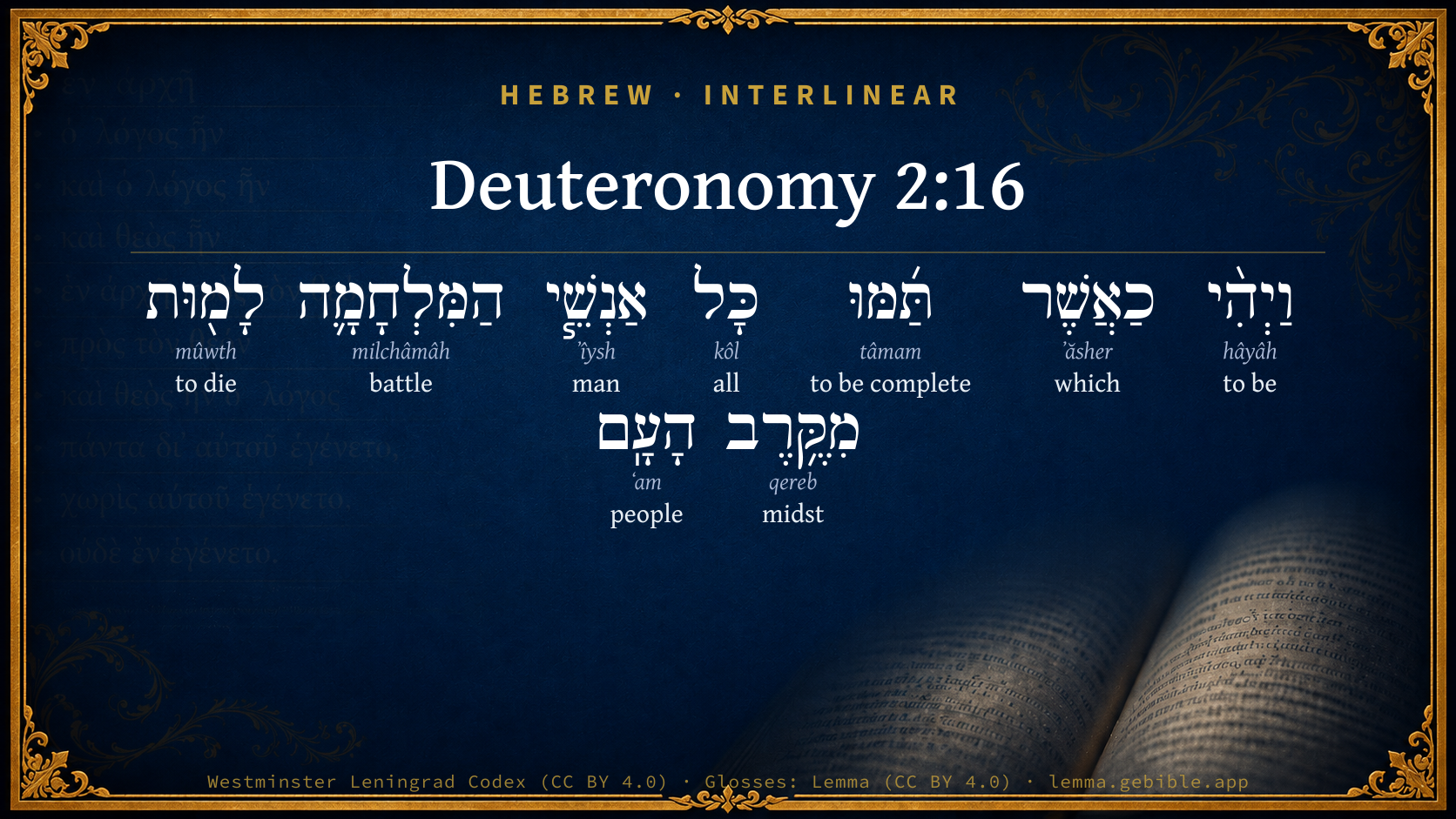
  1. וַיְהִ֨י hâyâh H1961 “and · to be” Conjunction + Verb, Qal, Sequential Imperfect, 3rd Person, Masculine, Singular
  2. כַאֲשֶׁר ʼăsher H834 “like/as · which” Preposition + Particle, Relative
  3. כָּל kôl H3605 “all of” Noun, Common, Masculine, Singular, Construct
  4. אַנְשֵׁ֧י ʼîysh H376 “men of” Noun, Common, Masculine, Plural, Construct
  5. הַמִּלְחָמָ֛ה milchâmâh H4421 “the · battle” Particle, Definite Article + Noun, Common, Feminine, Singular, Absolute
  6. לָמ֖וּת mûwth H4191 “to die” Preposition + Verb, Qal, Infinitive Construct
  7. מִקֶּ֥רֶב qereb H7130 “from · midst of” Preposition + Noun, Common, Masculine, Singular, Construct
  8. הָעָֽם ʻam H5971 “the · people” Particle, Definite Article + Noun, Common, Masculine, Singular, Absolute

About this verse

These counts appear in no published source. They are computed here, from the morphology-tagged text and Lemma’s own curated glosses. What Lemma adds →

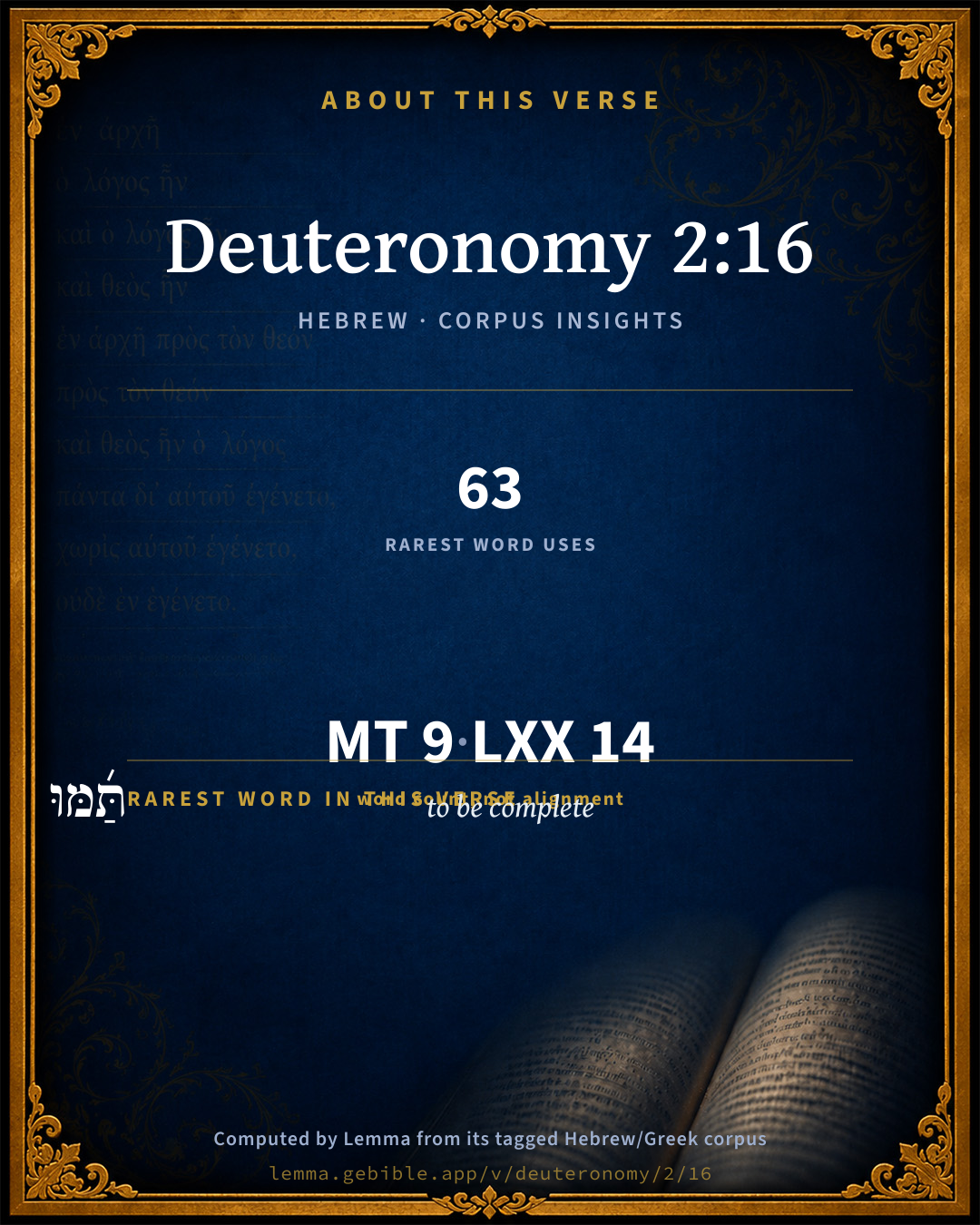
9
words
9
distinct lemmas
Pentateuch
section

Grammatical profile

  • 3 verbs
  • 5 nouns
  • 1 particle

Verb forms

  • וַיְהִ֨י Qal · Sequential Imperfect
  • תַּ֜מּוּ Qal · Perfect
  • לָמ֖וּת Qal · Infinitive Construct

Hebrew & Septuagint length

In English translation the verse runs 17 words from the Hebrew and 21 from the Septuagint (LXX English) — closely comparable.

A rough comparison of the two English renderings, which tokenize alike — not a word-level alignment.

Word counts can differ between the Hebrew and the Greek without any difference in meaning — e.g. the Hebrew direct-object marker אֵת has no separate Greek word, and Greek often adds the article ὁ.

In the original languages it is 9 Hebrew tokens and 14 Greek tokens — but the two are counted differently (Hebrew bundles its prefixes and suffixes into one token; the Greek is in lemma form), so that isn’t a like-for-like length.

Hebrew and Greek witnesses Masoretic Hebrew ↔ Greek Septuagint

The same verse in the two great witnesses to the Old Testament, shown verse-for-verse.

These are two independent witnesses, not word-aligned to each other, and the Septuagint is shown in lemma (dictionary) form.

Hebrew Deuteronomy 2:16 Masoretic · Westminster Leningrad Codex

וַיְהִ֨י כַאֲשֶׁר תַּ֜מּוּ כָּל אַנְשֵׁ֧י הַמִּלְחָמָ֛ה לָמ֖וּת מִקֶּ֥רֶב הָעָֽם

So it happened, when all the men of war were consumed and dead from among the people,

World English Bible · Public Domain

Greek LXX Deuteronomy 2:16 Septuagint · lemma form

καί γίγνομαι ἐπεί διαπίπτω πᾶς ὁ ἀνήρ ὁ πολεμιστής ἀποθνήσκω ἐκ μέσος ὁ λαός

And it came to pass when all the men of war dying out of the midst of the people had fallen,

LXX2012 (modern English Septuagint) · Public Domain

Hebrew: Westminster Leningrad Codex (CC BY 4.0). Greek: Septuagint (public domain); English from LXX2012 (modern English Septuagint) (Public Domain). How the Septuagint differs from the Hebrew →

Targum (Aramaic paraphrase)

2

The Targum is the ancient Jewish Aramaic paraphrase of the Hebrew Scriptures — an interpretive translation, not the Hebrew text itself. Onkelos (literal) and Pseudo-Jonathan (expansive) render the Torah, and Jonathan the Prophets. Coverage is partial: where no permissively-licensed English translation exists for a verse, only the Aramaic is shown. This is verse-level text, not a word-by-word alignment to the Hebrew.

  1. Targum Onkelos Torah (Genesis–Deuteronomy)
    וַהֲוָה כַּד שְׁלִימוּ כָּל גֻבְרֵי מְגִיחֵי קְרָבָא לִמְמַת מִגוֹ עַמָא

    (no public-domain English translation for this verse)

    Targum Onkelos — Aramaic: “Onkelos Genesis” (public domain); “Onkelos Exodus” (public domain); “Onkelos Leviticus” (public domain); “Onkelos Numbers” (public domain); “Onkelos Deuteronomy” (public domain). English: “Sefaria Community Translation” (CC0 1.0 (public-domain dedication)); “J.W. Etheridge. The Targums of Onkelos and Jonathan Ben Uzziel on the Pentateuch. London: Longmans, Green, 1862” (public domain). Text via Sefaria.

  2. Targum Pseudo-Jonathan Torah (Genesis–Deuteronomy)
    וַהֲוָה כַּד פָּסְקָן כָּל גַּבְרֵי מַגִּיחֵי קְרָב עָבְרֵי בִּימָתָא לִמְמַת מִגּוֹ מַשְׁרִיתָא

    And when all the men of war, the makers of the high places, were consumed by dying out of the host,

    Targum Pseudo-Jonathan — Aramaic: “Targum Jonathan on Genesis” (public domain); “Targum Jonathan on Exodus” (public domain); “Targum Jonathan on Leviticus” (public domain); “Targum Jonathan on Numbers” (public domain); “Targum Jonathan on Deuteronomy” (public domain). English: “The Targum of Jonathan ben Uzziel, trans. J. W. Etheridge, London, 1862” (public domain). Text via Sefaria.

Commentary

Notes on Deuteronomy 2:16 from classic Christian and Jewish commentators (each source and its license shown beneath its notes). The classic Christian expositions comment on the surrounding passage and are grouped to its opening verse, so a note may address several verses; the Jewish commentaries on the Tanakh (Rashi and others) are per-verse, so they appear only where the commentator wrote on this verse.

Lemma curates 59 commentaries, every one of them public domain or Creative Commons licensed, each selected and text-cleaned for this edition rather than reprinted as found. About our sources →

The Cambridge Bible for Schools and Colleges

gen. ed. J. J. S. Perowne

16–25. Approach to the ‘Ammonites and Amorites

The adult generation having died out (Deu_2:16), Jehovah charged Moses that, being about to pass the border or cross the territory of Mo’ab (Deu_2:17 f.) and to approach ‘Ammôn, Israel (Sg. address) must not fight the latter, for Jehovah gave that land to the sons of Lot (Deu_2:19). Follows an archaeological note on the predecessors of ‘Ammôn (Deu_2:20-23); and then the command, in the Pl. address, to cross the Arnon (Deu_2:24 a); then, in the Sg., an assurance that Sîḥôn should be given into Israel’s hands, they must fight him (Deu_2:24 b); for the dread of Israel would Jehovah put on all peoples at the mere report of Israel’s approach (Deu_2:25).

This section is perplexing, because of the apparently proleptic mention of ‘Ammôn, the use of the Pl. address only in Deu_2:24 a, and the discrepancy between Deu_2:24 b, Deu_2:25 and the next section, especially Deu_2:27-30. On these grounds, combined with the fact that there are no parallels in JE, on which document the rest of this discourse is based, there is a strong case for the opinion that this section is for the most part from another hand than the rest of the discourse. Steuern. indeed takes only Deu_2:16-17; Deu_2:24 a as original. For details see notes.

The Cambridge Bible for Schools and Colleges (gen. ed. J. J. S. Perowne; Cambridge University Press, 1878–1918) — public domain. Text from a community e-Sword module.

Joseph Benson's Commentary

Deu 2:16-17. When all the men of war were consumed — Israel is not called to march against and attack the Canaanites till the men most fit for war, and who probably had learned the art of it in Egypt, and had been used to hardship, were all wasted and dead from among the people, and only a host of new raised men, trained up in a wilderness, were left, in whom, as being possessed of little knowledge, experience, or natural fortitude, no great dependance could be placed. Thus it became more fully manifest that the excellency of the power which subdued the warlike Canaanites, was of God and not of man. On the same principle, and with the same design, long after this, were the following words spoken by the Lord to Gideon: The people that are with thee are too many for me to give the Midianites into their hands, lest Israel vaunt themselves against me, saying, Mine own hand hath saved me. And thus, to subdue the enemies of God’s church, and bring sinners to the obedience of the faith, he hath chosen the weak things of the world, and things that are despised, and things that are not, to bring to naught the things that are, that no flesh may glory in his presence.

Joseph Benson's Commentary on the Old and New Testaments (1811–1818) — public domain. Text from a community e-Sword module.

Jamieson, Fausset & Brown

Robert Jamieson, A. R. Fausset & David Brown

all the men of war were consumed and dead from among the people--The outbreak at Kadesh on the false report of the spies had been the occasion of the fatal decree by which God doomed the whole grown-up population to die in the wilderness [Num 14:29]; but that outbreak only filled up the measure of their iniquities. For that generation, though not universally abandoned to heathenish and idolatrous practices, yet had all along displayed a fearful amount of ungodliness in the desert, which this history only hints at obscurely, but which is expressly asserted elsewhere (Eze 20:25-26; Amo 5:25, Amo 5:27; Act 7:42-43).

Jamieson, Fausset & Brown — Commentary Critical and Explanatory on the Whole Bible (1871) — public domain (CC PDM 1.0). Text via the HelloAO Bible API.

John Gill's Exposition

So it came to pass, when all the men of war were consumed,.... By wasting diseases and judgments of one kind or another:

and dead from among the people; the rising and surviving generation.

John Gill's Exposition of the Whole Bible (1746–1763) — public domain (CC PDM 1.0). Text via the HelloAO Bible API.

Whedon's Commentary on the Bible

Daniel D. Whedon

16-19. Men of war were consumed — The generation that rebelled had died in their wandering. The people are now to cross over the boundary of Moab and advance into the neighbourhood of the Ammonites. In Deu_2:20-23 some particulars concerning the ancient inhabitants of these regions are introduced.

Daniel D. Whedon (gen. ed.), Commentary on the Old and New Testaments (1874–1909) — public domain. Text from a community e-Sword module.

The Pulpit Commentary

Vers. 16-19. The generation that sinned having quite died out, the people were now to cross the border of Moab and advance to the conquest of the Promised Land. To the east of Moab was the country of the Ammonites; these, also, the Israelites were to leave unassailed, for the Lord had given to them their land for a possession (cf. ver. 9).

The Pulpit Commentary (1880–1919), ed. H.D.M. Spence-Jones & Joseph S. Exell — public domain. Text from a community e-Sword module.

Kretzmann's Popular Commentary

Paul E. Kretzmann

The Defeat of Sihon

v. 16. So it came to pass, when all the men of war were consumed and dead from among the people, the punishment of God having struck them according to His word,

v. 17. that the Lord spake unto me, saying,

v. 18. Thou art to pass over through Ar, the coast of Moab, this day;

v. 19. and when thou comest nigh over against the children of Ammon, whose territory was chiefly east and northeast of that of the Amorites, distress them not, nor meddle with them, assume no hostile attitude nor make a show of attacking them; for I will not give thee of the land of the children of Ammon any possession; because I have given it unto the children of Lot for a possession, for the Ammonites were descendants of Lot, Gen 19:38.

v. 20. (That also was accounted a land of giants before its occupation by the children of Ammon; giants dwelt therein in old time; and the Ammonites call them Zamzummim, literally, "a humming, noisy people," possibly the same as the Zusim, Gen 14:5, or related to them;

v. 21. a people great, and many, and tall, as the Anakim. But the Lord destroyed them before them, the Ammonites, His object being to lead the latter to repentance, to cause them to seek the true God, the tradition of whom was handed down to them from their fathers, and they succeeded them and dwelt in their stead,

v. 22. as He did to the children of Esau, which dwelt in Seir when He destroyed the Horims from before them; and they succeeded them, and dwelt in their stead even unto this day;

v. 23. and the Avims, which dwelt in Hazerim, even unto Azzah, in the southwestern corner of Canaan, the Caphtorim, which came forth out of Caphtor, and bore the name of their progenitor, Gen 10:14, destroyed them, and dwelt in their stead. ) This notice having been inserted for the sake of orientation, Moses continues his address proper.

v. 24. Rise ye up, take your journey, and pass over the river Arnon, the southern boundary of the land of the Amorites; behold, I have given in to thine hand Sihon, the Amorite, king of Heshbon, and his land; begin to possess it, in modern English, go ahead and take it, and contend with him in battle.

v. 25. This day will I begin to put the dread of thee and the fear of thee upon the nations that are under the whole heaven, not only the Canaanites, but all the other nations whom the news of their advance would reach, who shall hear report of thee, and shall tremble, and be in anguish because of thee.

v. 26. And I sent messengers out of the Wilderness of Kedemoth, on the southeastern boundary of the Amorite territory, where there was an easy passage over the Arnon, unto Sihon, king of Heshbon, with words of peace, in order to give him an opportunity to decide for himself and to avoid an offense against Jehovah, saying,

v. 27. Let me pass through thy land. I will go along by the highway; I will neither turn unto the right hand nor to the left. Cf Num 21:21-22.

v. 28. Thou shalt sell me meat, food, for money, that I may eat, and give me water for money, that I may drink; only I will pass through on my feet, without any delay,

v. 29. (as the children of Esau which dwell in Seir, and the Moabites which dwell in Ar, did unto me,) until I shall pass over Jordan into the land which the Lord, our God, giveth us.

v. 30. But Sihon, king of Heshbon, would not let us pass by him, through his land; for the Lord, thy God, hardened his spirit, and made his heart obstinate, that He might deliver him into thy hand, as appeareth this day. All obduracy on the part of man is as much a deed of man’s freedom, of his own willful transgression, as it is a punishment of God. When man continues to harden his heart to the influence of God, then God, in turn, hardens the sinner until he becomes altogether callous toward all efforts of the Spirit.

v. 31. And the Lord said unto me, Behold, I have begun to give Sihon and his land before thee; begin to possess that thou mayest inherit his land.

v. 32. Then Sihon came out against us, he and all his people, to fight at Jahaz, Num 21:23.

v. 33. And the Lord, our God, delivered him before us; and we smote him and his sons and all his people, Num 21:24.

v. 34. And we took all his cities at that time, and utterly destroyed the men and the women and the little ones of every city; we left none to remain, for it was a war of extermination;

v. 35. only the cattle we took for a prey unto ourselves, and the spoil of the cities which we took.

v. 36. From Aroer, which is by the brink of the river of Arnon, in the extreme southern part of the territory, and from the city that is by the river, Ar or Areopolis, even unto Gilead, the southern boundary of which, generally speaking, was the Jabbok, there was not one city too strong for us, literally, "too high," too powerful to overcome; the Lord, our God, delivered all unto us;

v. 37. only unto the land of the children of Ammon thou camest not, nor unto any place of the river Jabbok, toward the east and north, nor unto the cities in the mountains, the mountainous district of Ammonitis, nor unto whatsoever the Lord, our God, forbade us. Note that the Lord spared the Edomites, the Moabites, and the Ammonites, nations related to Israel, since He wanted to give them time and opportunity for repentance. In the very midst of the unbelievers and His professed enemies the Lord has His elect, whom He intends to lead to repentance by the glorious manifestations of His kindness and mercy.

Paul E. Kretzmann, Popular Commentary of the Bible (1921–1924) — public domain. Text from a community e-Sword module.

unfoldingWord translationNotes

Door43 World Missions Community

General Information:

Moses continues reminding the people of Israel of what happened in the past.

You are ... you come ... do not trouble ... give you

Moses speaks to the Israelites as if they were one man, so all instances of "you" and the command "do not trouble" are singular. (See: Forms of You)

pass over Ar

This is the name of a city in Moab. See how you translated "Ar" in Deuteronomy 2:9. (See: How to Translate Names)

to the descendants of Lot

The people of Israel were related to the descendants of Ammon. Ammon was the son of Lot. Lot was the nephew of Abraham. (See: Assumed Knowledge and Implicit Information)

translationWords

die

Yahweh

Moab

Ammon

possess

descend

Lot

unfoldingWord translationNotes — © Distant Shores Media and the Door43 World Missions Community, licensed CC BY-SA 4.0. Source: git.door43.org/Door43/en_tn.

Rashi

Rabbi Shlomo Yitzchaki (Rashi)

ויהי כאשר תמו וגו׳ וידבר ה' אלי וגו׳ SO IT CAME TO PASS WHEN [ALL THE MEN OF WAR] HAD COME TO AN END … THAT THE LORD SPOKE TO ME etc. — But from when the spies were sent forth until now, the word וידבר is not mentioned in this section, but ויאמר, to teach you that during these entire thirty eight years during which the Israelites were lying under God’s censure, the Divine speech was not directed towards him in an expression of affection, face to face, and with tranquility of mind — to teach you that the Shechinah rests upon the prophets only for Israel’s sake (Sifra, Vayikra Dibbura d'Nedavah, Chapter 2 13; Mekhilta; cf. Rashi on Leviticus 1:1 towards end).

אנשי המלחמה THE MEN OF WAR — men from twenty years old and upwards, who went to war (cf. Numbers 14:29 and Rashi thereon).

Rashi on the Tanakh — English translations: “The Judaica Press complete Tanach with Rashi, translated by A. J. Rosenberg” (CC BY 4.0); “Pentateuch with Rashi's commentary by M. Rosenbaum and A.M. Silbermann, 1929-1934” (public domain); “The Metsudah Tanach series, Lakewood, N.J” (CC BY 4.0); and “The Book of Joshua, Metsudah Publications, 1997” (CC BY 4.0). Text via Sefaria.

Lesson kit

Teaching starters — assembled from the data on this page, not authored interpretation. Every prompt links to the verse data it draws on. Edit before teaching.

Deuteronomy, in the Pentateuch, opens this verse with 9 words (9 distinct Hebrew lemmas). Its most distinctive word is tâmam (“to be complete”). A historical commentator’s framing appears above. Read the whole chapter for the surrounding context.

Discussion questions

  1. The word tâmam carries the sense “to be complete.” How does it shape the verse?
  2. These translations render this verse differently; the difference is in the English rendering, not the original. What questions does that raise?
  3. The verb «וַיְהִ֨י» is Qal Sequential Imperfect. How does its form color the action?
  4. Reading how The Cambridge Bible for Schools and Colleges and Joseph Benson's Commentary read this verse, where do the two commentators agree and where do they part?

Things to notice

Reading settings

Reading text

Shown beneath each verse's original-language words.

Old Testament
Old Testament edition

Read the OT as the Masoretic Hebrew (MT) or the Greek Septuagint (LXX).

English shown for the Greek Septuagint (in the Hebrew ↔ Greek comparison).

Comparing translations? Open the Compare panel on any verse page to stack up to four side by side.