Daniel 8:15

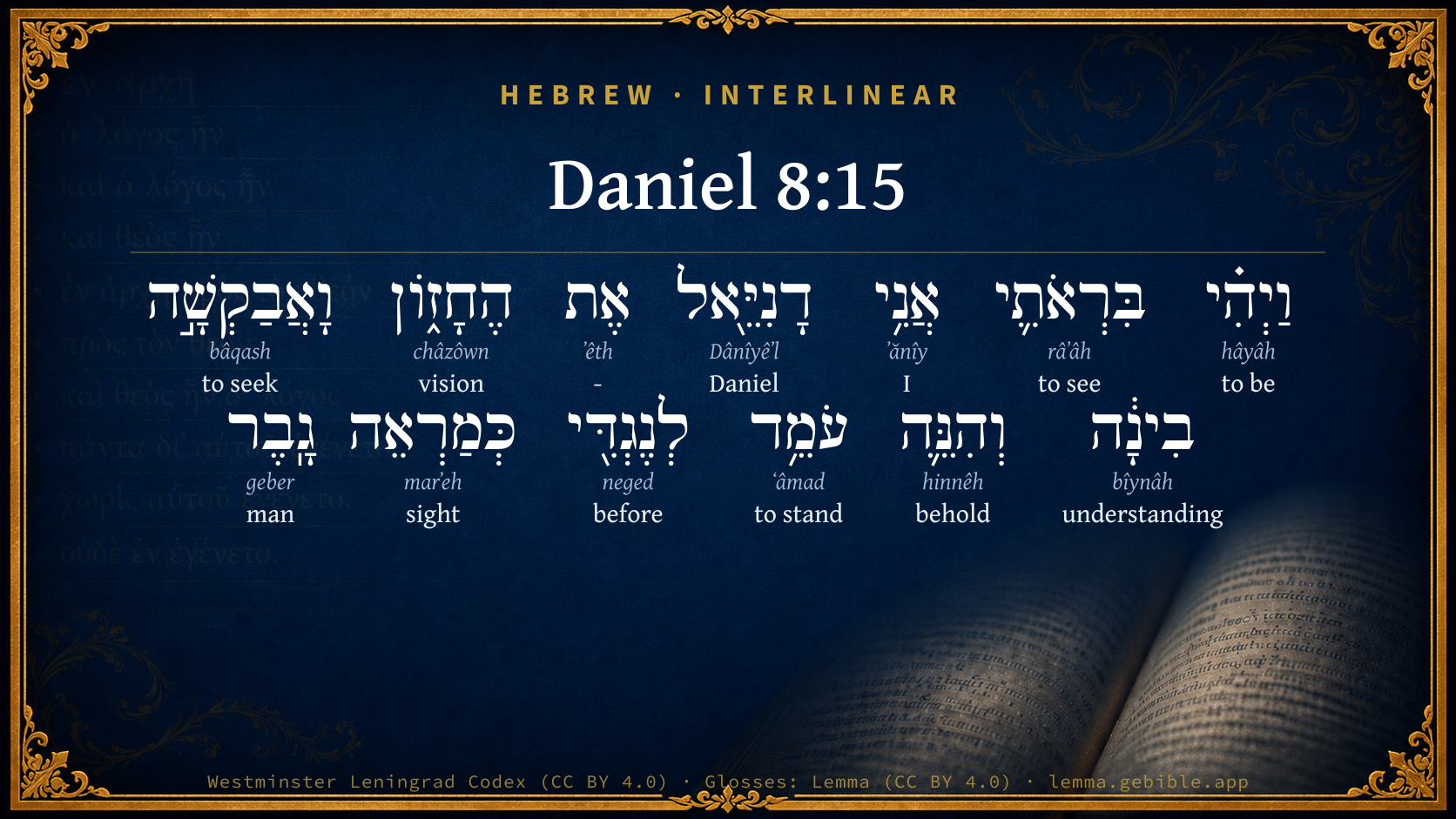
Hebrew (Westminster Leningrad Codex) Daniel 8:15 appears in the Hebrew Old Testament. The text above is from the Westminster Leningrad Codex. Each word links to its Strong’s number, a concise gloss, and parsing drawn from the Open Scriptures Hebrew Bible morphology. Click any word for its full Brown-Driver-Briggs (BDB) entry.
Download image
Cite this verse

Daniel 8:15 (World English Bible). Public Domain. Lemma interlinear Bible study tool, https://lemma.gebible.app/v/daniel/8/15.

Show BibTeX & RIS
BibTeX
RIS
English Translation
It happened, when I, even I Daniel, had seen the vision, that I sought to understand it; and, behold, there stood before me as the appearance of a man.
World English Bible · Public Domain
Download a study sheet

One document with this verse’s original text, its word-by-word gloss line, the meaning frame, cross-references with their text, attributed commentary, and full source and license credits — printable, and it pastes into notes with its structure intact.

This verse Autodidact and up

Study sheet (.html) Plain text (.txt)

A passage Seminary Student

Up to 50 verses in one chapter. A passage sheet keeps up to 6 commentary sources and 12 cross-references per verse, in the order this page ranks them, and says so on the sheet whenever that leaves anything out. Ask for a single verse and you get the Autodidact verse sheet above.

Everything on this page stays free to read, with no account — the sheet is a download of what is already on screen, not access to it.

Want to remove ads? Support Godless Engineer
Compare translations 3

The same verse in 3 English versions, stacked beneath the original-language interlinear above. Click any original word for its lexicon entry.

Each is an independent rendering of the whole verse — the interlinear is not word-aligned to these translations.

Highlighted words mark where these versions differ — a whole-verse word diff, not a word-by-word alignment.

  • World English Bible Public Domain
    It happened, when I, even I Daniel, had seen the vision, that I sought to understand it; and, behold, there stood before me as the appearance of a man.
  • King James Version Public Domain
    And it came to pass, when I, even I Daniel, had seen the vision, and sought for the meaning, then, behold, there stood before me as the appearance of a man.
  • unfoldingWord Literal Text CC BY-SA 4.0
    When I, Daniel, had seen the vision, I sought to understand it. And behold, standing before me was one having the appearance of a man.

unfoldingWord Literal Text — © unfoldingWord, licensed CC BY-SA 4.0. Word-aligned USFM3 via Door43 (git.door43.org/unfoldingWord/en_ult).

Versions to compare (up to 4)

3 of 4 selected

Show all 18 translations

Every available English version of this verse, each an independent rendering of the whole verse.

  • World English Bible Public Domain
    It happened, when I, even I Daniel, had seen the vision, that I sought to understand it; and, behold, there stood before me as the appearance of a man.
  • Berean Standard Bible Public Domain
    While I, Daniel, was watching the vision and trying to understand it, there stood before me one having the appearance of a man.
  • Majority Standard Bible Public Domain
    While I, Daniel, was watching the vision and trying to understand it, there stood before me one having the appearance of a man.
  • King James Version Public Domain
    And it came to pass, when I, even I Daniel, had seen the vision, and sought for the meaning, then, behold, there stood before me as the appearance of a man.
  • American Standard Version (1901) Public Domain
    And it came to pass, when I, even I Daniel, had seen the vision, that I sought to understand it; and, behold, there stood before me as the appearance of a man.
  • Revised Version (1885) Public Domain
    And it came to pass, when I, even I Daniel, had seen the vision, that I sought to understand it; and, behold, there stood before me as the appearance of a man.
  • Geneva Bible (1599) Public Domain
    Nowe when I Daniel had seene the vision, and sought for the meaning, beholde, there stoode before me like the similitude of a man.
  • Douay-Rheims (1899) Public Domain
    And it came to pass when I Daniel saw the vision, and sought the meaning, that behold there stood before me as it were the appearance of a man.
  • Young's Literal Translation Public Domain
    `And it cometh to pass in my seeing -- I, Daniel -- the vision, that I require understanding, and lo, standing over-against me `is' as the appearance of a mighty one.
  • Literal Standard Version CC BY-SA 4.0
    And it comes to pass in my seeing—I, Daniel—the vision, that I require understanding, and behold, standing before me [is] as the appearance of a mighty one.
  • Unlocked Literal Bible CC BY-SA 4.0
    When I, Daniel, had seen the vision, I tried to understand it. Then there stood before me one who looked like a man.
  • unfoldingWord Literal Text CC BY-SA 4.0
    When I, Daniel, had seen the vision, I sought to understand it. And behold, standing before me was one having the appearance of a man.
  • Darby Bible Public Domain
    And it came to pass, when I Daniel had seen the vision, I sought for the understanding of it, and behold, there stood before me as the appearance of a man.
  • World Messianic Bible Public Domain
    When I, even I Daniel, had seen the vision, I sought to understand it. Then behold, there stood before me someone with the appearance of a man.
  • Webster's Bible Public Domain
    And it came to pass, when I, even I Daniel, had seen the vision, and sought for the meaning, then behold, there stood before me as the appearance of a man.
  • Free Bible Version CC BY-SA 4.0
    As I, Daniel, tried to work out what this vision meant suddenly I saw someone who looked like a man standing in front of me.
  • Bible in Basic English Public Domain
    And it came about that when I, Daniel, had seen this vision, I had a desire for the sense of it to be unfolded; and I saw one before me in the form of a man.
  • JPS Tanakh (1917) Public Domain
    And it came to pass, when I, even I Daniel, had seen the vision, that I sought to understand it; and, behold, there stood before me as the appearance of a man.

Literal Standard Version (2020), Covenant Press — licensed CC BY-SA 4.0. Text via the HelloAO Bible API (eBible.org). Unlocked Literal Bible (unfoldingWord) — licensed CC BY-SA 4.0. Text via the HelloAO Bible API (eBible.org). unfoldingWord Literal Text — © unfoldingWord, licensed CC BY-SA 4.0. Word-aligned USFM3 via Door43 (git.door43.org/unfoldingWord/en_ult). Free Bible Version, Dr. Jonathan Gallagher — licensed CC BY-SA 4.0. Text via the HelloAO Bible API (eBible.org).

Word by word

More ways to search: Search by grammar → Find every occurrence → Compare this word →

Practice this passage: Drill this verse → Learn its vocabulary →

דָנִיֵּ֖אל
Dânîyêʼl
H1840
“Daniel”
Noun, Proper
Part of Speech
Noun
Type
Proper
Full BDB Definition

Origin: from H1835 and H410

TWOT: None

Daniel = "God is my judge" - the 2nd son of David, by Abigail the Carmelitess - the 4th of the greater prophets, taken as hostage in the first deportation to Babylon, because of the gift of God of the interpretation of dreams, he became the 2nd in command of the Babylon empire and lasted through the end of the Babylonian empire and into the Persian empire. His prophecies are the key to the understanding of end time events. Noted for his purity and holiness by contemporary prophet, Ezekiel - a priest of the line of Ithamar who sealed the covenant with Nehemiah
  1. וַיְהִ֗י hâyâh H1961 “and · to be” Conjunction + Verb, Qal, Sequential Imperfect, 3rd Person, Masculine, Singular
  2. בִּרְאֹתִ֛י râʼâh H7200 “in/at · to see · me” Preposition + Verb, Qal, Infinitive Construct + Suffix, Personal, 1st Person, Common, Singular
  3. אֲנִ֥י ʼănîy H589 “I” Pronoun, Personal, 1st Person, Common, Singular
  4. אֶת ʼêth H853 “-” Particle, Direct Object
  5. הֶחָז֑וֹן châzôwn H2377 “the · vision” Particle, Definite Article + Noun, Common, Masculine, Singular, Absolute
  6. וָאֲבַקְשָׁ֣ה bâqash H1245 “and · to seek” Conjunction + Verb, Piel, Sequential Imperfect, 1st Person, Common, Singular + Suffix, h
  7. בִינָ֔ה bîynâh H998 “understanding” Noun, Common, Feminine, Singular, Absolute
  8. וְהִנֵּ֛ה hinnêh H2009 “and · behold” Conjunction + Particle, Demonstrative
  9. עֹמֵ֥ד ʻâmad H5975 “standing” Verb, Qal, Participle Active, Masculine, Singular, Absolute
  10. לְנֶגְדִּ֖י neged H5048 “to/for · before · me” Preposition + Preposition + Suffix, Personal, 1st Person, Common, Singular
  11. כְּמַרְאֵה marʼeh H4758 “like/as · sight of” Preposition + Noun, Common, Masculine, Singular, Construct
  12. גָֽבֶר geber H1397 “man” Noun, Common, Masculine, Singular, Absolute

About this verse

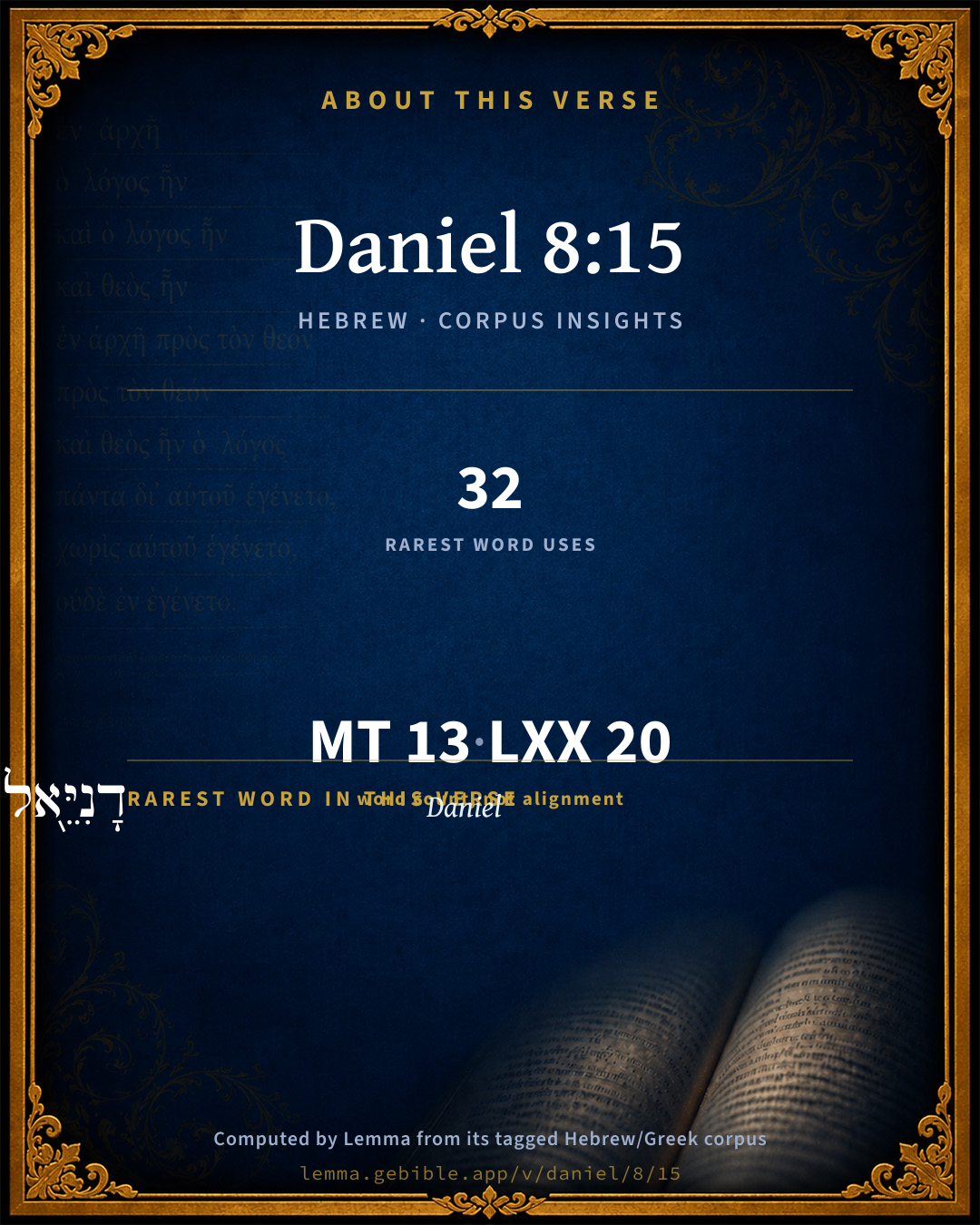
These counts appear in no published source. They are computed here, from the morphology-tagged text and Lemma’s own curated glosses. What Lemma adds →

13
words
13
distinct lemmas
Prophets
section

Shared distinctive vocabulary

דָנִיֵּ֖אל Daniel H1840 occurs in 28 verses of the Hebrew Bible. Also found in:

Grammatical profile

  • 4 verbs
  • 5 nouns
  • 1 pronoun
  • 1 preposition
  • 2 particles

Verb forms

  • וַיְהִ֗י Qal · Sequential Imperfect
  • בִּרְאֹתִ֛י Qal · Infinitive Construct
  • וָאֲבַקְשָׁ֣ה Piel · Sequential Imperfect
  • עֹמֵ֥ד Qal · Participle Active

Hebrew & Septuagint length

In English translation the verse runs 29 words from the Hebrew and 30 from the Septuagint (LXX English) — closely comparable.

A rough comparison of the two English renderings, which tokenize alike — not a word-level alignment.

Word counts can differ between the Hebrew and the Greek without any difference in meaning — e.g. the Hebrew direct-object marker אֵת has no separate Greek word, and Greek often adds the article ὁ.

In the original languages it is 13 Hebrew tokens and 20 Greek tokens — but the two are counted differently (Hebrew bundles its prefixes and suffixes into one token; the Greek is in lemma form), so that isn’t a like-for-like length.

Cross-references

18

Topical passages linked to Daniel 8:15 in the Treasury of Scripture Knowledge — connected by theme and wording, ordered by reader-vote popularity; previews shown in the World English Bible.

  • Daniel 10:16 Behold, one in the likeness of the sons of men touched my lips: then I opened my mouth, and spoke and said to him who stood before me, my lord, by reason of the vision my sorrows are turned on me, and I retain no strength.
  • Daniel 10:18 Then there touched me again one like the appearance of a man, and he strengthened me.
  • 1 Peter 1:10–11 Concerning this salvation, the prophets sought and searched diligently, who prophesied of the grace that would come to you,
  • Revelation 1:13 And among the lampstands was one like a son of man, clothed with a robe reaching down to his feet, and with a golden sash around his chest.
  • Joshua 5:14 He said, No; but [as] prince of the host of Yahweh am I now come. Joshua fell on his face to the earth, and did worship, and said to him, What says my lord to his servant?
  • Isaiah 9:6 For to us a child is born, to us a son is given; and the government shall be on his shoulder: and his name shall be called Wonderful, Counselor, Mighty God, Everlasting Father, Prince of Peace.
  • Ezekiel 1:26–28 Above the expanse that was over their heads was the likeness of a throne, as the appearance of a sapphire stone; and on the likeness of the throne was a likeness as the appearance of a man on it above.
  • Daniel 7:13 I saw in the night-visions, and, behold, there came with the clouds of the sky one like a son of man, and he came even to the ancient of days, and they brought him near before him.
  • Daniel 7:16–19 I came near to one of those who stood by, and asked him the truth concerning all this. So he told me, and made me know the interpretation of the things.
  • Daniel 7:28–8:1 Here is the end of the matter. As for me, Daniel, my thoughts much troubled me, and my face was changed in me: but I kept the matter in my heart.
  • Daniel 10:5 I lifted up my eyes, and looked, and, behold, a man clothed in linen, whose loins were girded with pure gold of Uphaz:
  • Daniel 12:8 I heard, but I didn't understand: then said I, my lord, what shall be the issue of these things?
  • Matthew 13:36 Then Jesus sent the multitudes away, and went into the house. His disciples came to him, saying, "Explain to us the parable of the darnel of the field."
  • Matthew 24:15 "When, therefore, you see the abomination of desolation, which was spoken of through Daniel the prophet, standing in the holy place (let the reader understand),
  • Matthew 24:30 and then the sign of the Son of Man will appear in the sky. Then all the tribes of the earth will mourn, and they will see the Son of Man coming on the clouds of the sky with power and great glory.
  • Mark 4:12 that 'seeing they may see, and not perceive; and hearing they may hear, and not understand; lest perhaps they should turn again, and their sins should be forgiven them.'"
  • Mark 13:14 But when you see the abomination of desolation, spoken of by Daniel the prophet, standing where it ought not (let the reader understand), then let those who are in Judea flee to the mountains,
  • Revelation 13:18 Here is wisdom. He who has understanding, let him calculate the number of the beast, for it is the number of a man. His number is six hundred sixty-six.

Cross-references courtesy of OpenBible.info (CC BY 4.0).

Hebrew and Greek witnesses Masoretic Hebrew ↔ Greek Septuagint

The same verse in the two great witnesses to the Old Testament, shown verse-for-verse.

These are two independent witnesses, not word-aligned to each other, and the Septuagint is shown in lemma (dictionary) form.

Hebrew Daniel 8:15 Masoretic · Westminster Leningrad Codex

וַיְהִ֗י בִּרְאֹתִ֛י אֲנִ֥י דָנִיֵּ֖אל אֶת הֶחָז֑וֹן וָאֲבַקְשָׁ֣ה בִינָ֔ה וְהִנֵּ֛ה עֹמֵ֥ד לְנֶגְדִּ֖י כְּמַרְאֵה גָֽבֶר

It happened, when I, even I Daniel, had seen the vision, that I sought to understand it; and, behold, there stood before me as the appearance of a man.

World English Bible · Public Domain

Greek LXX Daniel 8:15 Septuagint · lemma form

καί γίγνομαι ἐν ὁ θεωρέω ἐγώ ἐγώ δανιηλ ὁ ὅραμα ζητέω διανοέομαι καί ἰδού ἵστημι κατεναντίον ἐγώ ὡς ὅρασις ἄνθρωπος

And it came to pass, as I, even I Daniel, saw the vision, and sought to understand it, that, behold, there stood before me as the appearance of a man.

LXX2012 (modern English Septuagint) · Public Domain

Hebrew: Westminster Leningrad Codex (CC BY 4.0). Greek: Septuagint (public domain); English from LXX2012 (modern English Septuagint) (Public Domain). How the Septuagint differs from the Hebrew →

Commentary

Notes on Daniel 8:15 from classic Christian and Jewish commentators (each source and its license shown beneath its notes). The classic Christian expositions comment on the surrounding passage and are grouped to its opening verse, so a note may address several verses; the Jewish commentaries on the Tanakh (Rashi and others) are per-verse, so they appear only where the commentator wrote on this verse.

Lemma curates 59 commentaries, every one of them public domain or Creative Commons licensed, each selected and text-cleaned for this edition rather than reprinted as found. About our sources →

Matthew Henry's Commentary

Here we have,

I. Daniel's earnest desire to have this vision explained to him (Dan 8:15): I sought the meaning. Note, Those that rightly know the things of God cannot but desire to know more and more of them, and to be led further into the mystery of them; and those that would find the meaning of what they have seen or heard from God must seek it, and seek it diligently. Seek and you shall find. Daniel considered the thing, compared it with the former discoveries, to try if he could understand it; but especially he sought by prayer (as he had done Dan 2:18), and he did not seek in vain.

II. Orders given to the angel Gabriel to inform him concerning this vision. One in the appearance of a man (who, some think, was Christ himself, for who besides could command angels?) orders Gabriel to make Daniel understand this vision. Sometimes God is pleased to make use of the ministration of angels, not only to protect his children, but to instruct them, to serve the kind intentions, not only of his providence, but of his grace.

III. The consternation that Daniel was in upon the approach of his instructor (Dan 8:17): When he came near I was afraid. Though Daniel was a man of great prudence and courage, and had been conversant with the visions of the Almighty, yet the approach of an extraordinary messenger from heaven put him into this fright. He fell upon his face, not to worship the angel, but because he could no longer bear the dazzling lustre of his glory. Nay, being prostrate upon the ground, he fell into a deep sleep, (Dan 8:18), which came not from any neglect of the vision, or indifference towards it, but was an effect of his faintness and the oppression of spirit he was under, through the abundance of revelations. The disciples in the garden slept for sorrow; and, as there, so here, the spirit was willing, but the flesh was weak. Daniel would have kept awake, and could not.

IV. The relief which the angel gave to Daniel, with great encouragement to him to expect a satisfactory discovery of the meaning of this vision. 1. He touched him, and set him upon his feet, Dan 8:18. Thus when John, in a similar case, was in similar consternation, Christ laid his right hand upon him, Rev 1:17. It was a gentle touch that the angel here gave to Daniel, to show that he came not to hurt him, not to plead against him with his great power, or with a hand heavy upon him, but to help him, to put strength into him (Job 23:6), which God can do with a touch. When we are slumbering and grovelling on this earth we are very unfit to hear from God, and to converse with him. But, if God design instruction for us, he will be his grace awaken us out of our slumber, raise us from things below, and set us upright. 2. He promised to inform him: "Understand, O son of man! Dan 8:17. Thou shalt understand, if thou wilt but apply thy mind to understand." He calls him son of man to intimate that he would consider his frame, and would deal tenderly with him, accommodating himself to his capacity as a man. Or thus he preaches humility to him; though he be admitted to converse with angels, he must not be puffed up with it, but must remember that he is a son of man. Or perhaps this title puts honour upon him: the Messiah was lately called the Son of man (Dan 7:13), and Daniel is akin to him, and is a figure of him as a prophet and one greatly beloved. He assures him that he shall be made to know what shall be in the last end of the indignation, Dan 8:19. Let it be laid up for a comfort to those who shall live to see these calamitous times that there shall be an end of them; the indignation shall cease (Isa 10:25); it shall be overpast, Isa 26:20. It may intermit and return again, but the last end shall be glorious; good will follow it, nay, and good will be brought out of it. He tells him (Dan 8:17), "At the time of the end shall be the vision; when the last end of the indignation comes, when the course of this providence is completed, then the vision shall be made plain and intelligible by the event, as the event shall be made plain and intelligible by the vision." Or, "At the time of the end of the Jewish church, in the latter days of it, shall this vision be accomplished, 300 or 400 years hence; understand it therefore, that thou mayest leave it on record for the generations to come." But is he ask more particularly, "When is the time of the end? And how long will it be before it arrive?" let this answer suffice (Dan 8:19): At the time appointed the end shall be; it is fixed in the divine counsel, which cannot be altered and which must not be pried into.

V. The exposition which he gave him of the vision.

1. Concerning the two monarchies of Persia and Greece, Dan 8:20-22. The ram signified the succession of the kings of Media and Persia; the rough goat signified the kings of Greece; the great horn was Alexander; the four horns that rose in his room were the four kingdoms into which his conquests were cantoned, of which before, Dan 8:8. They are said to stand up out of the nations, but not in his power; none of them ever made the figure that Alexander did. Josephus relates that when Alexander had taken Tyre, and subdued Palestine, and was upon his march to Jerusalem, Jaddas, who was them high priest (Nehemiah mentions one of his name, Neh 12:11), fearing his rage, had recourse to God by prayer and sacrifice for the common safety, and was by him warned in a dream that upon Alexander's approach he should throw open the gates of the city, and that he and the rest of the priests should go forth to meet him in their habits, and all the people in white. Alexander, seeing this company at a distance, went himself alone to the high priest, and, having prostrated himself before that God whose name was engraven in the golden plate of his mitre, he first saluted him; and, being asked by one of his own captains why he did so, he said that while he was yet in Macedon, musing on the conquest of Asia, there appeared to him a man like unto this, and thus attired, who invited him into Asia, and assured him of success in the conquest of it. The priests led him to the temple, where he offered sacrifice to the God of Israel as they directed him; and there they showed him this book of the prophet Daniel, that it was there foretold that a Grecian should come and destroy the Persians, which animated him very much in the expedition he was now meditating against Darius. Hereupon he took the Jews and their religion under his protection, promised to be kind to those of their religion in Babylon and Media, whither he was now marching, and in honour of him all the priests that had sons born that year called them Alexander. Joseph. lib. 11.

2. Concerning Antiochus, and his oppression of the Jews. This is said to be in the latter time of the kingdom of the Greeks, when the transgressors are come to the full (Dan 8:23); that is, when the degenerate Jews have filled up the measure of their iniquity, and are ripe for this destruction, so that God cannot in honour bear with them any longer then shall stand up this king, to be flagellum Dei - the rod in God's hand for the chastising of the Jews. Now observe here, (1.) His character: He shall be a king of fierce countenance, insolent and furious, neither fearing God nor regarding man, understanding dark sentences, or (rather) versed in dark practices, the hidden things of dishonesty; he was master of all the arts of dissimulation and deceit, and knew the depths of Satan as well as any man. He was wise to do evil. (2.) His success. He shall make dreadful havoc of the nations about him: His power shall be mighty, bear down all before it, but not by his own power (Dan 8:24), but partly by the assistance of his allies, Eumenes and Attalus, partly by the baseness and treachery of many of the Jews, even of the priests that came into his interests, and especially by the divine permission. it was not by his own power, but by a power given him from above, that he destroyed wonderfully, and thought he made himself a great man by being a great destroyer. He destroys wonderfully indeed, for he destroys, [1.] The mighty people, and they cannot resist him by their power. The princes of Egypt cannot stand before him with all their forces, but he practises against them and prospers. Note, The mighty ones of the earth commonly meet with those at length that are too hard for them, that are more mighty than they. Let not the strong man then glory in his strength, be it ever so great, unless he could be sure that there were none stronger than he. [2.] He destroys the holy people, or the people of the holy ones; and their sacred character does neither deter him from destroying them nor defend them from being destroyed. All things come alike to all, and there is one event to the mighty and to the holy in this world. [3.] The methods by which he will gain this success, not by true courage, wisdom, or justice, but by his policy and craft (Dan 8:25), by fraud and deceit, and serpentine subtlety: He shall cause craft to prosper; so cunningly shall he carry on his projects that he shall gain his point by the art of wheedling. By peace he shall destroy many, as others do by war; under the pretence of treaties, leagues, and alliances, with them, he shall encroach on their rights, and trick them into a subjection to him. Thus sometimes what a nation truly brave has gained in a righteous war a nation truly base has regained in a treacherous peace, and craft has been caused to prosper. [4.] The mischief that he shall do to religion: He shall magnify himself in his heart, and think himself fit to prescribe and give law to every body, so that he shall stand up against the Prince of princes, that is, against God himself. He will profane his temple and altar, prohibit his worship, and persecute his worshippers. See what a height of impudence some men's impiety brings them to; they openly bid defiance to God himself though he is the Kings of kings. [5.] The ruin that he shall be brought to at last: He shall be broken without hand, that is, without the hand of man. He shall not be slain in war, nor shall he be assassinated, as tyrants commonly were, but he shall fall into the hand of the living God and die by an immediate stroke of his vengeance. He, hearing that the Jews had cast the image of Jupiter Olympius out of the temple, where he had placed it, was so enraged at the Jews that he vowed he would make Jerusalem a common burial-place, and determined to march thither immediately; but no sooner had he spoken these proud words than he was struck with an incurable plague in his bowels; worms bred so fast in his body that whole flakes of flesh sometimes dropped from him; his torments were violent, and the stench of his disease such that none could endure to come near him. He continued in this misery very long. At first he persisted in his menaces against the Jews; but at length, despairing of his recovery, he called his friends together, and acknowledged all those miseries to have fallen upon him for the injuries he had done to the Jews and his profaning the temple at Jerusalem. Then he wrote courteous letters to the Jews, and vowed that if he recovered he would let them have the free exercise of their religion. But, finding his disease grow upon him, when he could no longer endure his own smell, he said, It is meet to submit to God, and for man who is mortal not to set himself in competition with God, and so died miserably in a strange land, on the mountains of Pacata near Babylon: so Ussher's Annals, A.M. 3840, about 160 years before the birth of Christ.

3. As to the time fixed for the continuance of the cessation of the daily sacrifice, it is not explained here, but only confirmed (Dan 8:26). That vision of the evening and morning is true, in the proper sense of the words, and needs no explication. How unlikely soever it might be that God should suffer his own sanctuary to be thus profaned, yet it is true, it is too true, so it shall be.

VI. Here is the conclusion of this vision, and here, 1. The charge given to Daniel to keep it private for the present: Shut thou up the vision; let it not be publicly know among the Chaldeans, lest the Persians, who were now shortly to possess the kingdom, should be incensed against the Jews by it, because the downfall of their kingdom was foretold by it, which would be unseasonable now that the edict for their release was expected from the king of Persia. Shut it up, for it shall be for many days. It was about 300 years from the time of this vision to the time of the accomplishment of it; therefore he must shut it up for the present, even from the people of the Jews, lest it should amaze and perplex them, but let it be kept safely for the generations to come, that should live about the time of the accomplishment of it, for to them it would be both most intelligible and most serviceable. Note, What we know of the things of God should be carefully laid up, that hereafter, when there is occasion, it may be faithfully laid out; and what we have not now any use for, yet we may have another time. Divine truths should be sealed up among our treasures, that we may find them again after many days. 2. The care he took to keep it private, having received such a charge, Dan 8:27. He fainted, and was sick, with the multitude of his thoughts within him occasioned by this vision, which oppressed and overwhelmed him the more because he was forbidden to publish what he had seen, so that his belly was as wine which has no vent, he was ready to burst like new bottles, Job 32:19. However, he kept it to himself, stifled and smothered the concern he was in; so that those he conversed with could not perceive it, but he did the king's business according to the duty of his place, whatever it was. Note, As long as we live in this world we must have something to do in it; and even those whom God has most dignified with his favours must not think themselves above their business; nor must the pleasure of communion with God take us off from the duties of our particular callings, but still we must in them abide with God. Those especially that are entrusted with public business must see to it that they conscientiously discharge their trust.

Matthew Henry's Commentary on the Whole Bible (1708–1710) — public domain (CC PDM 1.0). Text via the HelloAO Bible API.

Trapp's Complete Commentary

John Trapp

Dan 8:15 And it came to pass, when I, [even] I Daniel, had seen the vision, and sought for the meaning, then, behold, there stood before me as the appearance of a man.

Ver. 15. And it came to pass, when I, even I Daniel.] Not another, as that black-mouthed Porphyry {a} slanderously affirmed, that not the prophet Daniel saw and uttered these prophecies so long before they happened, but another who lived after the reign of Antiochus wrote a history of things past, and entitled it falsely to Daniel, as a prophecy of things to come. Os durum! Harsh mouth.

Then, behold, there stood before me.] They who seriously and sedulously seek after divine knowledge, shall find means to attain unto it. {Rev 13:1}

{a} Porphyry, Cont. Christian, lib. xii.; Jerome.

John Trapp, A Commentary or Exposition upon All the Books of the Old and New Testament (1647–1656) — public domain. Text from a community e-Sword module.

Joseph Benson's Commentary

Dan 8:15-16. When I had seen the vision, and sought for the meaning — Here we are informed of Daniel’s earnest desire to have the vision explained to him. For those that rightly know the things of God, cannot but desire to be led still further into the mystery of them. And those who desire to know the meaning of what they have seen or heard from God, must seek it, and that diligently, namely, by earnest prayer and close meditation. Then there stood before me as the appearance of a man — The Scriptures frequently represent the angels as appearing in human forms, which it is likely they do, because, perhaps, there is nothing visible to us that so much resembles what they really are, as the human form does. And I heard a man’s voice between the banks of Ulai — That is, between me and the river Ulai. Which said, Gabriel, make this man understand the vision — Explain it more clearly to him, if there be any thing in it which he does not perfectly understand. He who spake this seems to be the same angel who is spoken of Dan 8:13, and called there that certain saint, by way of distinction; for he here speaks as one that had authority over the angel Gabriel.

Joseph Benson's Commentary on the Old and New Testaments (1811–1818) — public domain. Text from a community e-Sword module.

Keil & Delitzsch

C. F. Keil & F. Delitzsch

The interpretation of the vision - The interpretation of Daniel's vision, as given by the angel, falls within the vision itself. When Daniel sought to understand the vision, viz., in his mind, not by prayer or by asking a question, he saw before him, according to Dan 8:17, one standing at some distance, who had the appearance of a man, but was not a man, but a supernatural being in human likeness. This person resembling a man is (Dan 8:16) named by the angel, Gabriel, i.e., man of God. The voice of another, whom Daniel did not see, hearing only a human voice proceeding from the Ulai, commanded this person to explain the vision to the prophet (להלּז, i.e., to Daniel). Nothing further is indicated of the person from whom the voice proceeded than what may be conjectured from אוּלי בּין (between the Ulai), whence the voice sounded. These words do not mean "hither from Ulai" (Bertholdt), but "between the two banks of the Ulai" (Chr. B. Mich., Hv., etc.); according to which, the being whose voice Daniel heard appears as if hovering over the waters of the river Ulai. This conjecture is confirmed by Dan 12:6-7, where Daniel sees a man hovering over the waters of the river of Ulai, who by the majesty of his appearance and his words shows himself to be a divine being, and is more minutely described according to the majesty of his appearance in Dan 10:5. The question, who this man might be, is first answered in Daniel Dan 10:5. Gabriel is not a nomen proprium but appellativum. The angel who was described as an appearance like a גּבר (man) is named, for Daniel, Gabriel ("man of God"), that on subsequent occasions (e.g., Dan 9:21) he might recognise him again as the same (Hgst., Hofm., Kliefoth). As to his relation to other angels and archangels, the Scripture gives no information. If Lengerke and Maurer regard him, after the book of Enoch, along with Michael, and Raphael, and Uriel whose name does not occur in Scripture, as one of the four angels that stand before the throne of God, the Scripture affords no support for it; nor does it countenance the supposition of Hitzig, that the two angels in Dan 8:15, Dan 8:16 are identical with those in Dan 8:13, Dan 8:14 - that Gabriel who spake, and the unknown angel, was the angel of the "rivers and fountains of waters," Rev 16:4.

(Note: Altogether groundless, also, is the identification of them with the Persian Amschaspands, since neither the doctrine of angels nor the names of angels of the O.T. are derived from Parsism. The most recent attempt by Dr. Al. Kohut, in his researches regarding Jewish angelology and demonology in their dependence on Parsism (Abhand. fr die Kunde des Morgen. iv. Bc., Nr. 3), to establish this connection, is extremely poor and superficial. The proof adduced in the first ten pages of his treatise is confined to these points: that in the writings of the O.T. after the Exile or during the Exile the appearance of the angels is altogether different from that presented in the portions written before the Exile. It is said that, as a rule, the angels in the period first named take the human form, and bear names corresponding to their properties - Michael, Dan 10:13, Dan 10:21; Dan 12:1; Gabriel, Dan 8:16; Dan 9:21; and in the book of Tobit, 12:15, not much later in date (?), Raphael; - now also, in contrast to the period before the Exile, there is an order in rank among the angels; Michael, Dan 10:12, is designated as one of the first angel-princes, and, Dan 12:1, as the greatest angel-prince; moreover, the number of שׂרים (angel-princes) is spoken of as seven, corresponding to the Persian Amesha-pentas (Tob. 12:15, and Book of Enoch 90:21). But does this distinction between the pre-exilian and post-exilian doctrine of angels, even though it were allowed to be as great as Kohut supposes, furnish a proof for the derivation of the latter from Parsism? or does this derivation follow from the fact that the Jews in exile came into intercourse with the Persians and the Medes, and that about this time the Zend worship flourished? And do the angels in the post-exilian writings for the first time indeed assume the human form? Kohut seems to know nothing of the appearance of angels in Gen 19:1., Jdg 6:11., Jdg 13:9. Then does the agreement, not of the doctrine of the O.T., but of the later Jewish apocryphal writings, Tobit and the Book of Enoch, with regard to the number of angel-princes and of the Amesha-penta, furnish a sufficient proof of this derivation? Dr. Kohut does not himself appear to think so, since he regards it as necessary, in addition to this, which is "perhaps purely accidental," to furnish an etymological argument. Amesha-penta means "non connivens sanctus = the holy one not sleeping;" "thus," he says, "it is a mere Chaldee rendering of the word Amesha-penta, when in Dan 4:10,Dan 4:14, Dan 4:20; Dan 8:13, the Jewish angel-princes are called עירין קדּשׁין = holy watchers." But was, then, the Chaldean king Nebuchadnezzar, to whom in a dream a "holy watcher" appeared, a Jew? and in what edition of the Bible has Dr. Kohut found in Dan 8:13 the angel name עיר? Nor is it any better proof that the demonology of the O.T. is a foreign production, resulting from the contact of the Jews with the Persians and Medes during the exile, because in Zac 3:1., Psa 48:1-14 :49; Ch1 21:1, and especially in Job 1:6., Dan 2:1, Satan "is depicted as a plague-spirit, altogether corresponding to the Persian Agromainjus, the killing spirit." Such silly talk needs no refutation.)

Dan 8:16-18

As commanded, the angel goes to the place where Daniel stands. On his approach Daniel is so filled with terror that he falls on his face, because as a sinful and mortal man he could not bear the holiness of God which appeared before him in the pure heavenly being. At the appearance of God he fears that he must die. Cf. remarks at Gen 16:13 and Exo 33:20. But the angel, in order to mitigate his alarm, calls him to take heed, for the vision relates to the time of the end. The address (Dan 8:17), "son of man," stands in contrast to "man of God" (= Gabriel), and is designed to remind Daniel of his human weakness (cf. Psa 8:5), not that he may be humbled (Hvernick), without any occasion for that, but to inform him that, notwithstanding this, he was deemed worthy of receiving high divine revelations (Kliefoth). The foundation of the summons to give heed, "for the vision relates to the time of the end," is variously interpreted. Auberlen (p. 87) and Zndel (p. 105ff.) understand עת־קץ not of the time of the end of all history, but of a nearer relative end of the prophecy. "Time of the end" is the general prophetic expression for the time which, as the period of fulfilment, lies at the end of the existing prophetic horizon - in the present case the time of Antiochus. Bleek (Jahrb.f. D. Theol. v. p. 57) remarks, on the contrary, that if the seer was exhorted to special attention because the vision related to the time of the end, then קץ here, as in Dan 8:19; Dan 11:35, Dan 11:40; Dan 12:4, also Dan 9:26, without doubt is to be interpreted of the end of the time of trial and sorrow of the people, and at the same time of the beginning of the new time of deliverance vouchsafed by God to His people; and herein lay the intimation, "that the beginning of the deliverance destined by God for His people (i.e., the Messianic time) would connect itself immediately with the cessation of the suppression of the worship of Jehovah by Antiochus Epiphanes, and with the destruction of that ruler." From the passages referred to, Dan 11:40 and Dan 12:4, it is certainly proved that עתקץ denotes the time of all suffering, and the completion of the kingdom of God by the Messiah. It does not, however, follow, either that these words "are to be understood of the absolute end of all things, of the time when the Messiah will come to set up His regum gloriae, and of the time of the last tribulation going before this coming of the Lord" (Klief.); or that the prophet cherished the idea, that immediately after the downfall of Antiochus, thus at the close of the 2300 days, the Messiah would appear, bring the world to an end, and erect the kingdom of eternity (v. Leng., Hitz., Maur., etc.). The latter conclusion is not, it is true, refuted by the remark, that the words do not say that the vision has the time of the end directly for its subject, that the prophecy will find its fulfilment in the time of the end, but only that the vision has a relation, a reference, to the time of the end, that there is a parallelism between the time of Antiochus and the time of Antichrist, that "that which will happen to Javan and Antiochus shall repeat itself in, shall be a type of, that which will happen in the time of the end with the last world-kingdom and the Antichrist arising out of it" (Kliefoth). For this idea does not lie in the words. That is shown by the parallel passage, Dan 10:14, which Kliefoth thus understands - "The vision extends to the days which are before named הימים אחרית (latter days); it goes over the same events which will then happen." Accordingly the angel can also here (Dan 8:17) only say, "Give heed, for the vision relates to the end-time; it gives information of that which shall happen in the end of time."

Dan 8:19

The justice of this exposition is placed beyond a doubt by this verse. Here the angel says in distinct words, "I will show thee what will happen הזּעם בּאחרית (in the last time of the indignation), for it relates to the appointed time of the end." Kliefoth indeed thinks that what the angel, Dan 8:19, says to the prophet for his comfort is not the same that he had said to him in Dan 8:17, and which cast him down, and that Dan 8:19 does not contain anything so weighty and so overwhelming as Dan 8:17, but something more cheering and consoling; that it gives to the vision another aspect, which relieves Daniel of the sorrow which it had brought upon him on account of its import with reference to the end. From this view of the contents of Dan 8:19 Kliefoth concludes that Daniel, after he had recovered from his terror in the presence of the heavenly messenger, and had turned his mind to the contents of the vision, was thrown to the ground by the thought presented to him by the angel, that the vision had reference to the end of all things, and that, in order to raise him up, the angel said something else to him more comforting of the vision. But this conclusion has no foundation in the text. The circumstance that Daniel was not again cast to the ground by the communication of the angel in Dan 8:19, is not to be accounted for by supposing that the angel now made known to him something more consoling; but it has its foundation in this, that the angel touched the prophet, who had fallen dismayed to the earth, and placed him again on his feet (Dan 8:18), and by means of this touch communicated to him the strength to hear his words. But the explanation which Kliefoth gives of Dan 8:19 the words do not bear. "The last end of the indignation" must denote the time which will follow after the expiration of the זעם, i.e., the period of anger of the Babylonian Exile. But אחרית means, when space is spoken of, that which is farthest (cf. Psa 139:9), and when time is spoken of, the last, the end, the opposite of רשׁית, the end over against the beginning. If הימים אחרית does not denote such a time was follows an otherwise fixed termination, but the last time, the end-time (see under Dan 2:28), so also, since זעם is here the time of the revelation of the divine wrath, הזּעם אחרית ה can only denote the last time, or the end-time, of the revelation of the divine wrath. This explanation of the words, the only one which the terms admit of, is also required by the closing words of Dan 8:19, קץ למועד כּי (for at the time appointed the end). According to the example of the Vulg., quoniam habet tempus finem suum, and Luther's version, "for the end has its appointed time," Kliefoth translates the words, "for the firmly-ordained, definite time has its end," and refers this to the time of the Babylonish Exile, which indeed, as Daniel knew (Dan 9:2), was fixed by God to seventy years. But that in the Babylonish Exile will have its fixed end, will come to an end with the seventy years, the angel needed not to announce to the prophet, for he did not doubt it, and the putting him in remembrance of that fact would have afforded him but very poor consolation regarding the time of the future wrath. This conception of the words depends on the inaccurate interpretation of the words הזּעם אחרית, and will consequently fall to the ground along with it. If למועד (to the appointment) were separated from קץ, and were to be taken by itself, and to be understood of the time of the זעם, then it ought to have the article, as in Dan 11:27, Dan 11:35. Without the article, as here, it must be connected with קץ, and them, with החזון supplied as the subject from the context (Dan 8:17), is to be translated, as it is by almost all modern interpreters: for the vision relates to the appointed time of the end. But עתקץ, the time of the end, and קץ מועד, the appointed time of the end, is not the absolute end of all things, the time of the setting up of the regnum gloriae, and the time of the tribulation preceding the return of our Lord; but the time of the judgment of the world-kingdom and the setting up of the everlasting kingdom of God by the appearance of the Messiah, the end of αἰὼν οὕτος and the commencement of the αἰὼν μέλλων, the time of the הימים אחרית (Dan 10:14), which the apostle calls (Co1 10:11) τὰ τέλη τῶν αἰώνων, and speaks of as having then already come.

Dan 8:20-22

Since, from the explanation given by the angel in this verse, the vision relates to the Medo-Persian and the Javanic world-kingdoms, and to the persecuting kingdom of Antiochus which arose out of the latter, so it cannot be disputed that here, in prophetic perspective, the time of the end is seen together with the period of the oppression of the people of God by Antiochus, and the first appearance of the Messiah with His return in glory to the final judgment, as the latter is the case also in Dan 2:34., 44f., and Dan 7:13, Dan 7:25. If Kliefoth objects: The coming of the Messiah may certainly be conceived of as bound up with the end of all things, and this is done, since both events stand in intimate causal relation to each other, not seldom in those O.T. prophets who yet do not distinguish the times; but they also know well that this intimate causal connection does not include contemporaneousness, that the coming of the Messiah in the flesh will certainly bring about the end of all things, but not as an immediate consequence, but after a somewhat lengthened intervening space, that thus, after the coming of the Messiah, a course of historical events will further unfold themselves before the end comes (which Daniel also knew, as Daniel 9 shows), and where the supposition is this, as in Daniel, there the time before the appearance of Christ in the flesh cannot be called the time of the end: - then the inference drawn in these last passages is not confirmed by the contents of the book of Daniel. For in the last vision (Daniel 10-12) which Daniel saw, not only the time of oppression of Antiochus and that of the last enemy are contemplated together as one, but also the whole contents of this one vision are, Dan 10:14, transferred to the "end of the days;" for the divine messenger says to Daniel, "I am come to make thee understand what shall befall thy people in the end of the days, for the vision yet relates to the days." And not only this, but also in Dan 11:35 it is said of the tribulation brought upon the people of God by Antiochus, that in it many would fall, to cleanse them and to purify them to the time of the end, for it is yet for the appointed time. Here, beyond doubt, the time of the persecution by Antiochus is placed in intimate union with the time of the end, but, as is to be particularly observed, not so that the two are spoken of as synchronous. This point is of importance for the right exposition of the verse before us. If, in Dan 11:35, Dan 11:40, it is twice said laמועד קץ עוד כּי (the end is yet for the appointed time), and thus does not begin with the oppression of the people of God by Antiochus, so we may not conclude from these verses - and in this Kliefoth is perfectly justified - that Daniel expected the erection of the Messianic kingdom and the end of all history with the overthrow of Antiochus. If, however, on the whole, the intimate causal connection of the two periods of tribulation placed together in Daniel 11 in one vision neither demands nor even permits us to regard the two as synchronous, so this erroneous conclusion drawn from these verses before us, in connection with an incorrect interpretation of Dan 11:36-45, is sufficiently obviated, both by Daniel 2 and 7, according to which the fourth world-kingdom shall precede the erection of the everlasting kingdom of God and the manifestation of the Son of man, as also by Dan 9:24-27, where - as our exposition will show - the coming of the Messiah and the perfecting of the kingdom of God by the overthrow of the last enemy are dependent on one another in point of time - the coming of the Messiah after seven weeks, the perfecting of the kingdom of God will follow, but not trill after the lapse of seventy weeks.

This passage is to be understood according to these distinct revelations and statements, and not that because in them, according to prophetic perspective, the oppression of the people of the saints by Antiochus, the little horn, is seen in one vision with the tribulation of the end-time, therefore the synchronism or identity of the two is to be concluded, and the erection of the regnum gloriae and the end of the world to be placed at the destruction of this little horn. The words, "the vision relates to the time of the end," thus only declare that the prophecy has a reference to Messianic times. As to the nature of this reference, the angel gives some intimation when, having touched the prophet, who had fallen in amazement to the ground, he raised him up and enabled him to listen to his words (Dan 8:18), the intimation that he would make known to him what would happen in the last time of violence (Dan 8:19). הזּעם is the wrath of God against Israel, the punishment which God hung over them on account of their sins, as in Isa 10:5; Jer 25:17; Eze 22:24, etc., and here the sufferings of punishment and discipline which the little horn shall bring over Israel. The time of this revelation of divine wrath is called אחרית because it belongs to the הימים אחרית, prepares the Messianic future, and with its conclusion begins the last age of the world, of which, however, nothing more particular is here said, for the prophecy breaks off with the destruction of the little horn. The vision of the eleventh chapter first supplies more particular disclosures on this point. In that chapter the great enemy of the saints of God, arising out of the third world-kingdom, is set forth and represented as the prefiguration or type of their last enemy at the end of the days. Under the words יהיה אשׁר (which shall be) the angel understands all that the vision of this chapter contains, from the rising up of the Medo-Persian world-kingdom to the time of the destruction of Antiochus Epiphanes, as Dan 8:20-25 show. But when he adds הזּעם אחרית, he immediately makes prominent that which is the most important matter in the whole vision, the severe oppression which awaits the people of Israel in the future for their purification, and repeats, in justification of that which is said, the conclusion from Dan 8:17, in which he only exchanges עת for מועד is the definite time in its duration; קץ מועד thus denotes the end-time as to its duration. This expression is here chosen with regard to the circumstance that in Dan 8:14 the end of the oppression was accurately defined by the declaration of its continuance. The object of these words also is variously viewed by interpreters. The meaning is not that the angel wished to console Daniel with the thought that the judgment of the vision was not yet so near at hand (Zndel); for, according to Dan 8:17, Daniel was not terrified by the contents of the vision, but by the approach of the heavenly being; and if, according to Dan 8:18, the words of the angel so increased his terror that he fell down confounded to the earth, and the angel had to raise him by touching him, yet it is not at the same time said that the words of the angel of the end-time had so confounded him, and that the subsequent fuller explanation was somewhat less overwhelming than the words, Dan 8:17, something lighter or more comforting. Even though the statement about the time of the end contributed to the increase of the terror, yet the contents of Dan 8:19 were not fitted to raise up the prophet, but the whole discourse of the angel was for Daniel so oppressive that after hearing it, he was for some days sick, Dan 8:27. From Daniel's astonishment we are not to conclude that the angel in Dan 8:17 spoke of the absolute end of all things, and in Dan 8:19, on the contrary, of the end of the oppression of the people of Israel by Antiochus. By the words, "the vision relates to the appointed end-time," the angel wished only to point to the importance of his announcement, and to add emphasis to his call to the prophet to give heed.

Dan 8:20-26

After the introductory words, we have now in these verses the explanation of the chief points of the vision.

Dan 8:20-22 explain Dan 8:3-8. "The kings of Media and Persia" are the whole number of the Medo-Persian kings as they succeed each other, i.e., the Medo-Persian monarchy in the whole of its historical development. To הצּפיר the epithet השּׂעיר, hairy, shaggy, is added to characterize the animal as an he-goat. The king of Javan (Greece) is the founder and representative of the Macedo-Grecian world-kingdom, or rather the royalty of this kingdom, since the great horn of the ram is forthwith interpreted of Alexander the Great, the first king of this kingdom. The words והנּשׁבּרת to תּחתּיה (Dan 8:22) form an absolute subject-sentence, in which, however, ותּעמדנה is not to be taken ἐκβατικῶς, it broke in pieces, so that ... (Kran.); for "the statement of the principal passage may not appear here in the subordinate relative passage" (Hitzig); but to the statement beginning with the participle the further definition in the verb. in. with וconsec. is added, without the relative אשׁר, as is frequently the case (cf. Ewald's Lehr. 351), which we cannot give with so much brevity, but must express thus: "as concerning the horn, that it was broken in pieces, and then four stood up in its place, (this signifies) that four kingdoms shall arise from the people." מגּוי without the article does not signify from the people of Javan, for in this case the article would not have been omitted; nor does it signify from the heathen world, because a direct contrast to Israel does not lie before us; but indefinitely, from the territory of the people, or the world of the people, since the prophecy conceives of the whole world of the people (Vklerwelt) as united under the sceptre of the king of Javan. יעמדנה is a revived archaism; cf. Gen 30:38; Sa1 6:12; Ewald, 191; Gesen. Gramm. 47. - בכוחו ולא, but not in his power, not armed with the strength of the first king, cf. Dan 11:4.

Dan 8:23-24

Dan 8:23-26 give the interpretation of the vision of the little horn (Dan 8:9-12), with a more special definition of certain elements not made prominent in the vision. The horn signifies a king who will arise "in the last time of their kingdom." The suffix to מלכוּתם (of their kingdom) relates to the idea contained in מלכיּות ni deniat (kings). הפּשׁעים כּהתם, when the transgressors have made full, scil. the transgression or measure of the sins. The object wanting to התם is seen from the conception of the subject. הפּשׁעים, the rebellious, are not the heathen, for פּשׁע denotes the apostasy from God which is only said of the Israelites, but not of the heathen; and the word points back to בּפשׁע in Dan 8:12. The king that rises up is Antiochus Epiphanes (cf. 1 Macc. 1:10ff.). עז־פּנים, hard of countenance, i.e., impudent, unashamed in trampling down, without fear of God or man; cf. Deu 28:50. חידות מבין, understanding mysteries; here sensu malo, concealing his purpose behind ambiguous words, using dissimulation, forming an artifice, interpreted in Dan 8:25 by מרמה, cf. Dan 11:21. The unfolding of these qualities is presented in Dan 8:24, Dan 8:25; in Dan 8:24 of the עז־פּנים. By virtue of the audacity of his conduct his power will be strengthened, בכחו ולא, but not by his own might. The contrast here is not: by the power or permission of God (Ephr., Theodrt., Hv., Hitz., Kran.), reference being made to תּנּתן (was given) in Dan 8:12, and to תּת (to give) in Dan 8:13. This contrast is foreign to the passage. The context much rather relates to the audacity and the cunning by which, more than by his power, Antiochus raised himself to might. The strengthening of the power is limited neither to his reaching the throne by the overthrow of other pretenders to it (Berth. and others), nor to the to the following statements, he developed as king against Israel, as well as against other kingdoms. נפּלאות (wonderful works) is used adverbially, as in Job 37:5 : in an astonishing, wonderful way, he will work destruction. But from this word it does not follow that the expression בכחו ולא is to be referred to the power of God, for it does not necessarily mean deeds or things supernaturally originating from God; and even though it had only this meaning, yet here they could not be thought of as deeds accomplished in God's strength, but only as deeds performed by demoniacal strength, because ישׁחית (shall destroy) cannot be predicated of God in the sense determined by the context. This destructive work he shall direct against the mighty and against the people of the saints. עצוּמים does not here signify many, numerous, many individual Israelites (v. Leng., Maur., Kliefoth), partly because in Dan 8:25 רבּים stands for that, partly because of the קדשׁים עם, by which we are to understand the people of Israel, not merely the insignificant and weak, or pious (Kran.). Hence עצוּמים cannot mean the elders of Israel, much less merely foreign kings (Berth., Dereser), but the mighty generally, under which perhaps we are specially to think of heathen rulers.

Dan 8:25

In Dan 8:25 the cunning and craftiness of his action and demeanour are depicted. שׂכלו על (through his craft) is placed first. שׂכל, sagacity, here sensu malo, cunning. On the ground of this cunning his deceit will be successful. מרמה without the article means "all kinds of deceit which he designs" (Hitzig). On that account his heart is raised in haughtiness, so that not only does he destroy many unexpectedly, but also raises himself against God. In the רבּים (many) are comprehended "the mighty and the holy people" (Dan 8:24). בּשׁלוה does not mean in deep peace, but in careless security, and thus unexpectedly. An historical proof of this is found in 1 Macc. 1:10. שׂרים שׂר (Prince of princes) corresponds with אדני האדנים (Lord of lords) in Psa 136:3. It is God; cf. Dan 8:11. But the angel adds, "he shall be destroyed without hands," i.e., he shall be destroyed not by the hand of man, but by God.

Dan 8:26

In Dan 8:26 there follows, in conclusion, the confirmation of the truth of what is said of the duration of this oppression for the people of God. Because the time of it was not seen by Daniel, but was revealed to him in words, נאמר אשׁר is here used in reference to that which was, or of which it was, said. But we need not connect this relative sentence with the genitive והבּקר הערב (the evening and the morning), although this were admissible, but can make it depend on מראה (vision), since the world-revelation of the evenings and mornings forms an integral part of the "vision." והבּקר הערב are to be taken collectively. The confirmation of the truth of this revelation does not betray the purpose to make the book falsely appear as if it were old (v. Leng., Hitzig); it much more is fitted to serve the purpose of strengthening the weakness of the faithful, and giving them consolation in the hour of trial. For in the statement of the duration of the afflictions lies not only the fact that they will come to an end, but at the same time also that this end is determined beforehand by God; cf. Dan 12:7. In other places this confirmation serves only to meet doubts, arising from the weakness of the flesh, as to the realization of revelations of such weighty import; cf. Dan 10:1; Dan 12:1; Rev 19:9; Rev 21:5; Rev 22:6.

But Daniel must close the prophecy, because it extends into a long time. סתן is not equivalent to חתם, to seal up, but it means to stop, to conclude, to hide (cf. Kg2 3:19; Eze 28:3), but not in the sense of keeping secret, or because it would be incomprehensible for the nearest times; for to seal or to shut up has nothing in common with incomprehensibility, but is used in the sense of keeping. "A document is sealed up in the original text, and laid up in archives (shut up), that it may remain preserved for remote times, but not that it may remain secret, while copies of it remain in public use" (Kliefoth). The meaning of the command, then, is simply this: "Preserve the revelation, not because it is not yet to be understood, also not for the purpose of keeping it secret, but that it may remain preserved for distant times" (Kliefoth). The reason assigned for the command only agrees with this interpretation. רבּים לימים (to many days) is not to be identified with לעת־קץ in Dan 8:17, but designates only a long time; and this indefinite expression is here used because it was not intended to give exactly again the termination according to Dan 8:17, Dan 8:19, but only to say that the time of the end was not near.

Dan 8:27

In Dan 8:27 the influence of this vision on Daniel is mentioned (cf. Dan 7:28). It so deeply agitated the prophet that he was sick certain days, and not till after he had recovered from this sickness could he attend to the king's business. The contents of the vision remained fixed in his mind; the scene filled him with amazement, and no one understood it. Maurer, Hitzig, and Kranichfeld interpret מבין אין (I understood it not,) supplying the pronoun of the first person from the connection. But even though the construction of the words should admit of this supplement, for which a valid proof is not adduced, yet it would be here unsuitable, and is derived merely from giving to סתן (Dan 8:26) the false interpretation of to conceal. If Daniel had been required to keep the prophecy secret according to the command in Dan 8:26, then the remark "no one understood it" would have been altogether superfluous. But if he was required only to preserve the prophecy, and it deeply moved him, then those around him must have had knowledge of it, and the amazement of Daniel would become the greater when not only he but all others failed to understand it. To refer מבין אין only to Daniel is forbidden by the comparison with אבין ולא in Dan 12:8. The fulfilment of this vision can alone lead to its full understanding.

Keil & Delitzsch — Biblical Commentary on the Old Testament (1861–1891) — public domain (CC PDM 1.0). Text via the HelloAO Bible API. (Old Testament only.)

Tyndale Open Study Notes

Tyndale Open Resources

8:15-16 The name Gabriel means “man of God”; he appeared like a man to Daniel (see also 9:21; Luke 1:19, 26).

Tyndale Open Study Notes — © Tyndale Open Resources, licensed CC BY-SA 4.0. Text via the HelloAO Bible API.

Geneva Bible (1599)

Geneva Bible translators

Which was Christ who in this manner declared himself to the old fathers, how he would be God manifest in flesh.

Geneva Bible (1599) marginal notes — public domain. Text via Bolls.life.

Adam Clarke's Commentary

Verse 15. As the appearance of a man.] Supposed to be the Messiah.

Adam Clarke's Commentary on the Bible (1810–1826) — public domain. Text from a community e-Sword/MySword module.

John Calvin's Commentaries

Daniel again confirms his original statement. But before he descends to the interpretation, he makes a preface concerning the faithfulness and certainty of the oracle, lest the Church should hesitate to embrace his utterance as really proceeding from God. In doing this, he uses no artifice as rhetoricians do; but God wished to stir up both him and all the pious to meditate upon this prophecy, the knowledge of which was then so peculiarly necessary and useful. He says, therefore, when he sought the understanding of this vision, there appeared to him a form like that of a man Now God had anticipated this desire of the Prophet, by the answer which the angel received from Christ, who in reply had partly explained the sense of this vision. Now Daniel, finding himself anticipated by God who did not wait for his inquiry, gathers courage, and trusting in God’s readiness to furnish an answer, he wishes to learn the matter more clearly; not that he was altogether ignorant of the subject, but he did not yet perceive with sufficient clearness what was useful to himself and the whole Church. We see then, how the answer of Christ only afforded him a taste of the vision, and only urged him forwards towards the full comprehension of it. Many are immediately satisfied with but moderate information, and as soon as they understand a portion of any subject, they reject every addition, and many too often settle down at the first elements, and their obstinacy prevents that complete knowledge which is necessary. Daniel therefore shews himself to be far distant from such fastidiousness, as he was rendered more attentive by hearing from Christ’ lips the rea1 object of the vision. When I was attentive 1 sought to understand it, says he, behold! there stood before my face (or near it) like the aspect of a man We ought probably to interpret this passage of Christ, who is now called like a man, as formerly. (Daniel 7:13.) For he had not yet put on our flesh, so as to be properly entitled to the name of a man; but he was here like a man, because he wished to allow the holy fathers a taste from which they might understand his future coming as Mediator, when he should put on human nature as God manifest in flesh:. (1 Timothy 3:16.) Thus Daniel speaks suitably as before when he says, Christ appeared to him under the aspect of a man But this adds to the same purpose, —

John Calvin's Commentaries (1540-1563) — public domain. Text from the Calvin Translation Society English edition (1840s-50s) via the Christian Classics Ethereal Library (ccel.org). Calvin's coverage is partial (roughly two-thirds of the Bible); uncommented books and verses are honest gaps, never fabricated. The 19th-century editor's footnotes and remarks are omitted so the notes are faithfully Calvin's own voice.

Ellicott's Commentary for English Readers

(15) Appearance of a man.—From Dan_8:16 it appears that this was the angel Gabriel. The “man’s voice” mentioned in Dan_8:16 proceeded from Him Who alone has authority to command angels. (Comp. Dan_12:6-7.)

A Bible Commentary for English Readers, edited by Charles John Ellicott (1878–1897) — public domain. Text from a community e-Sword module.

The Cambridge Bible for Schools and Colleges

gen. ed. J. J. S. Perowne

15–27. Daniel seeks to know the meaning of the vision, which is imparted to him, as in Dan_7:16 ff., by an angel.

15 that I sought to understand (it), and, behold, &c.] cf. Dan_7:19.

there was standing in front of me] appearing suddenly, some little way off (see Dan_8:17, ‘came near’).

as the appearance of a man] The expression ‘as the appearance of’ is borrowed from Ez. (Eze_1:13-14; Eze_1:26-28, Eze_8:2, Dan_10:1, Eze_40:3, Eze_42:11), and recurs below, Dan_10:6; Dan_10:18. The word for man (geber)—different from that in Dan_10:18—is evidently chosen with allusion to the name ‘Gabriel,’ ‘man of God’ [not the word used in the common phrase, ‘man of God,’ for a prophet].

The Cambridge Bible for Schools and Colleges (gen. ed. J. J. S. Perowne; Cambridge University Press, 1878–1918) — public domain. Text from a community e-Sword module.

John Gill's Exposition

And it came to pass, when I, even I Daniel, had seen the vision,.... The whole of the preceding vision, concerning the ram, he goat, and little horn, and what were done by them; the prophet not only affirms he saw this vision, but repeats the affirmation, expressing his own name, partly for the sake of emphasis, and partly for the greater confirmation of his words; wherefore it was a most impudent thing Porphyry to say, that the true Daniel never saw this vision; but what is here related was written after Antiochus's reign, and falsely ascribed to him. It being so clear a prophecy concerning Alexander, and the destruction of the Persian empire by him, this acute spiteful Heathen had no other way of evading the evidence of it in favour of true religion but by this false and lying assertion:

and I sought for the meaning; that is, of the vision; for a more perfect, clear, and explicit meaning of it; something he had learnt concerning the latter part of it, relating to the desolation of the temple, and the continuance of it, from what passed between the two saints or angels; but he was desirous of knowing more; which he either signified by making application to the angel that stood near him; or rather by secret ejaculations in prayer to God; and he, who is afterwards described as a man, though the eternal God that knows all things, knew the secret desires of his soul, and immediately took care they should be answered:

then, behold, there stood before me as the appearance of a man: not really a man, but in form and appearance; not Gabriel, or any created angel in human form, in which angels sometimes appeared but the eternal Son of God, who was to be incarnate, and was often seen in the form of a man before his incarnation; in like manner he was now seen by Daniel, right

over against (k) whom he stood; this is the same with the speaking saint, or Paimoni the wonderful One, in Dan 8:13. Jacchiades says, this is the holy blessed God; as it is indeed the Immanuel, God that was to be manifested in the flesh.

(k) "ex adverso mei", Michaelis.

John Gill's Exposition of the Whole Bible (1746–1763) — public domain (CC PDM 1.0). Text via the HelloAO Bible API.

Albert Barnes' Notes on the Bible

And it came to pass ... - Daniel saw the vision, but was unable to explain it.

And sought for the meaning - Evidently by meditating on it, or endeavoring in his own mind to make it out.

There stood before me as the appearance of a man - One having the appearance of a man. This was evidently Gabriel Dan 8:16, who now assumed a human form, and who was addressed by the voice from between the banks of the Ulai, and commenced to make known the meaning of the vision.

Albert Barnes' Notes on the Bible (1834–1885) — public domain. Text from a community e-Sword/MySword module.

Matthew Poole's English Annotations

Having obtained the favour of knowing something, he longed for a more clear discovery of those things; and he had his desire granted.

As the appearance of a man; either the angel Gabriel or Michael, who appeared often in the shape of men, and are the messengers of God in the great things concerning his church, Heb 1:14; others will have this angel to be Christ.

Matthew Poole's English Annotations on the Holy Bible (1683–1685) — public domain. Text from a community e-Sword/MySword module.

Whedon's Commentary on the Bible

Daniel D. Whedon

15, 16. This is the first time in Scripture that an angel is given a name. This one, having the appearance of a man (Dan_7:13; Eze_1:26), is called Gabriel — “Man of God,” or “Hero of God.” He appears again Dan_9:21, and probably Dan_10:18. He is always in Scripture the bearer of good news to prayerful hearts. (Compare Luk_1:11; Luk_1:26.) He ever appears as God’s representative and mediatorial revelation of divine wisdom and comfort. The connection of this “archangel” with any of the seven amshaspands of Zoroastrianism, the seven Babylonian planets, or the seven counselors at the Persian court (Ezr_7:14) has not been made out (see article “Gabriel” in Hastings’s Dictionary of the Bible, 2:1899). It was formerly supposed that at least the names of these angels came from Babylon, but the cuneiform texts so far offer no confirmation of this theory. In the Zend-Avesta angels are supposed to be spoken of as symbols of God’s attributes, while the archangels are merely the Good Mind’s “thoughts and beneficent intentions” (Sacred Books of the East, vol. xxxi). In the Scripture they appear as personal messengers of Jehovah. After considering the whole question of the angelology of Daniel, Behrmann reaches the conclusion that “we meet here no conception which had not been intimated or begun in earlier or contemporary biblical books.” (See also Dan_10:13.)

Daniel D. Whedon (gen. ed.), Commentary on the Old and New Testaments (1874–1909) — public domain. Text from a community e-Sword module.

The Pulpit Commentary

And it came to pass, when I, even I Daniel, had seen the vision, and sought for the meaning, then, behold, there stood before me as the appearance of a man. The versions here are unimportant. Daniel desires to understand the meaning of this vision. From this we see that, at the time when this book was written, it was understood that prophets might be ignorant of the meaning of the revelations made to them. This is at variance with the assumption of even believing critics, that if a prophecy were given to a prophet, he must have understood the reference of the message. On the accuracy of this assumption, they found the rejection of any interpretation of a prophecy which sees more in it than the prophet could have seen. This latest critical date of Daniel is separated by approximately two centuries and a half from prophecy in actual existence in Malachi. The tradition of the conditions of the phenomenon would still be vital. The phrase before us probably means that Daniel applied the various Babylonian formulae to the dream, to find the interpretation, but, suspicious of them, he still continued his search. In answer to Daniel"s search, there stood before him one having "the appearance of a man (gaber) an angelic being in human form. The H,.brew word translated "man" is gaber, which suggests the name given to the angel, "Gabriel."

The Pulpit Commentary (1880–1919), ed. H.D.M. Spence-Jones & Joseph S. Exell — public domain. Text from a community e-Sword module.

John Wesley's Explanatory Notes

The meaning - A more clear discovery of those things. The appearance of a man - Probably Gabriel.

John Wesley, Explanatory Notes Upon the Whole Bible (1754–1765) — public domain. Text via the GEBible commentary corpus.

Scofield Reference Notes

C. I. Scofield

a man

The theophanies. Dan 10:6; Dan 10:10; Dan 10:18; Eze 40:3; Gen 12:7; Rev 1:9.

The Scofield Reference Bible (1917 edition), notes by C. I. Scofield — public domain. Text from a community e-Sword module.

Kretzmann's Popular Commentary

Paul E. Kretzmann

The Explanation of the Vision

v. 15. And it came to pass when I, even I, Daniel, had seen the vision and sought for the meaning, pondering over it, viewing it from every angle, then, behold, there stood before me as the appearance of a man, the apparition coming with startling suddenness.

v. 16. And I heard a man’s voice, the speaker being invisible to Daniel, between the banks of Ulai, coming from between the two branches of the Eulaeus River, which called and said, Gabriel, make this man to understand the vision. So the being who appeared to Daniel in the aspect of a man, was one of the Lord’s angel princes. Cf Luk 1:19.

v. 17. So he came near where I stood; and when he came, I was afraid, the close proximity of a holy being filled him with fear, and fell upon my face; but he said unto me, Understand, O son of man, the address reminding Daniel of his human weakness, without, however, humiliating him; for at the time of the end shall be the vision, that is, it gives information concerning occurrences at the end of time, the final period of the earth’s history.

v. 18. Now, as he was speaking with me, I was in a deep sleep on my face toward the ground, in a state of numbness or ecstasy, which shut off his senses from earthly things; but he touched me and set me upright, strengthening him for the time being, that he might witness the rest of the vision.

v. 19. And he said; Behold, I will make thee know what shall be in the last end of the indignation, when the wrath of God would be poured out upon the godless world; for at the time appointed the end shall be, or, "it [the vision] pertains to the period of time of the end. " It is indicated, even at this point, that the tribulation suffered by the Jews at the time of the Maccabees, especially by the tyranny of Antiochus Epiphanes, is symbolical of the afflictions to be expected at the end of the Messianic era.

v. 20. The ram which thou sawest having two horns are the kings of Media and Persia, the Medo-Persian monarchy in its entire historical development. This empire subdued, under Persian leadership: toward the west, Babylon, Mesopotamia, Syria, and the countries of Asia Minor; toward the north, Colchis, Armenia, Iberia, and the states along the Caspian Sea; toward the south, Judea, Egypt, Ethiopia, and India.

v. 21. And the rough goat, moving eastward across Asia Minor in victorious advance, is the king of Grecia, literally, "of Javan," Macedonia, Greece, and the Ionian colonies being included in the term; and the great horn that is between his eyes is the first king, Alexander the Great, the founder of this world-power.

v. 22. Now, that being broken, whereas four stood up for it, or, "concerning the horn, that it was broken, and that four then took its place," this is the meaning: four kingdoms shall stand up out of the nation, out of the world of nations united under the rule of the first king, but not in his power, not equal to the founder, neither singly nor all taken together. These four are the dynasties of the Diadochi, of whom indeed five, Antigonus, Antipater, Ptolemeus, Cassander, and Lysimachus, adopted the title of king; but Antigonus was soon defeated in battle, so that there were really four monarchies, Lysimachus taking Thrace and Bithynia, Cassander Macedonia and Greece, Seleucus Syria, Babylonia, and the eastern countries, and Ptolemeus Egypt, Palestine, and Arabia Petraea. Antipater had meanwhile died.

v. 23. And in the latter time of their kingdom, that is, after these dynasties had been in existence for some time, when the transgressors are come to the full, when the apostate Jews would once more have fulfilled the measure of their wickedness, a king of fierce countenance, shameless, without the slightest regard for God and men, and understanding dark sentences, hiding his true purposes behind ambiguous statements, shall stand up, coming into power as the ruler of that section of the Greek Empire.

v. 24. And his power shall be mighty, but not by his own power, rather on account of his cunning dissimulation, with the permission of God; and he shall destroy wonderfully, so that men would be astonished at his activities in this respect, and shall prosper and practice and shall destroy the mighty and the holy people, venting his spite both upon the warlike enemies opposing him and upon the congregation of the Lord’s saints.

v. 25. And through his policy also he shall cause craft to prosper in his hand, that is, in accordance with his cunning he would succeed in his deception, in various hypocritical plans which he had decided upon; and he shall magnify himself in his heart, becoming proud by reason of these successful maneuvers, and by peace shall destroy many, while they were living in care-free security, the suddenness of the attack causing them to yield without a struggle; he shall also stand up against the Prince of princes, presuming to set himself even against God. But he shall be broken without hand, God Himself taking his punishment in hand.

v. 26. And the vision of the evening and the morning which was told, concerning the length of the time of the affliction, is true; wherefore shut thou up the vision, to preserve it for such later day, for it shall be for many days, the vision, being concerned with things of the distant future, would retain its prophetic value and should therefore not be revealed generally at this time.

v. 27. And I, Daniel, overcome by the startling and overwhelming character of the revelation, fainted and was sick certain days. Afterward I rose up and did the king’s business, attending to the duties of his office as before; and I was astonished at the vision, he kept his counsel concerning it, but none understood it, for the full significance of the revelation he received would be possible only with its fulfillment. Antiochus Epiphanes is rightly regarded in history as a type of Antichrist, the papacy of Rome, for he made every effort to drive out the worship of the true God in the Holy Land and to substitute instead a veneration of himself.

Paul E. Kretzmann, Popular Commentary of the Bible (1921–1924) — public domain. Text from a community e-Sword module.

unfoldingWord translationNotes

Door43 World Missions Community

a man's voice calling between the banks of the Ulai Canal

Here a man is being referred to by his voice. AT: "a man calling from the Ulai Canal" (See: Synecdoche)

Ulai Canal

A canal is a narrow man-made waterway. See how you translated this name in Daniel 8:2.

prostrated myself on the ground

This is an act of worship in which someone lies flat on the ground. (See: Symbolic Action)

the time of the end

"the final days" or "the end of the world." This does not refer to the final moment in time, but rather to the events that will happen immediately before the end.

translationWords

Daniel

vision

Gabriel

Son of Man

time

unfoldingWord translationNotes — © Distant Shores Media and the Door43 World Missions Community, licensed CC BY-SA 4.0. Source: git.door43.org/Door43/en_tn.

Rashi

Rabbi Shlomo Yitzchaki (Rashi)

that I sought understanding I was longing that they should enable me to understand [the vision] from heaven.

Rashi on the Tanakh — English translations: “The Judaica Press complete Tanach with Rashi, translated by A. J. Rosenberg” (CC BY 4.0); “Pentateuch with Rashi's commentary by M. Rosenbaum and A.M. Silbermann, 1929-1934” (public domain); “The Metsudah Tanach series, Lakewood, N.J” (CC BY 4.0); and “The Book of Joshua, Metsudah Publications, 1997” (CC BY 4.0). Text via Sefaria.

Lesson kit

Teaching starters — assembled from the data on this page, not authored interpretation. Every prompt links to the verse data it draws on. Edit before teaching.

Daniel, in the Prophets, opens this verse with 13 words (13 distinct Hebrew lemmas). Its most distinctive word is Dânîyêʼl (“Daniel”). A historical commentator’s framing appears above. Read the whole chapter for the surrounding context.

Discussion questions

  1. What does “Daniel” (Dânîyêʼl) contribute to the verse as a whole?
  2. How does 1 Chronicles 3:1, which shares the word «Daniel», read alongside this verse?
  3. These translations render this verse differently. What is at stake in choosing one wording over another?
  4. «וַיְהִ֗י» is a Qal Sequential Imperfect verb. How does that grammatical form shape the action described?
  5. Compare how Matthew Henry's Commentary and Trapp's Complete Commentary read this verse. Where do they agree or differ?

Things to notice

Reading settings

Reading text

Shown beneath each verse's original-language words.

Old Testament
Old Testament edition

Read the OT as the Masoretic Hebrew (MT) or the Greek Septuagint (LXX).

English shown for the Greek Septuagint (in the Hebrew ↔ Greek comparison).

Comparing translations? Open the Compare panel on any verse page to stack up to four side by side.