
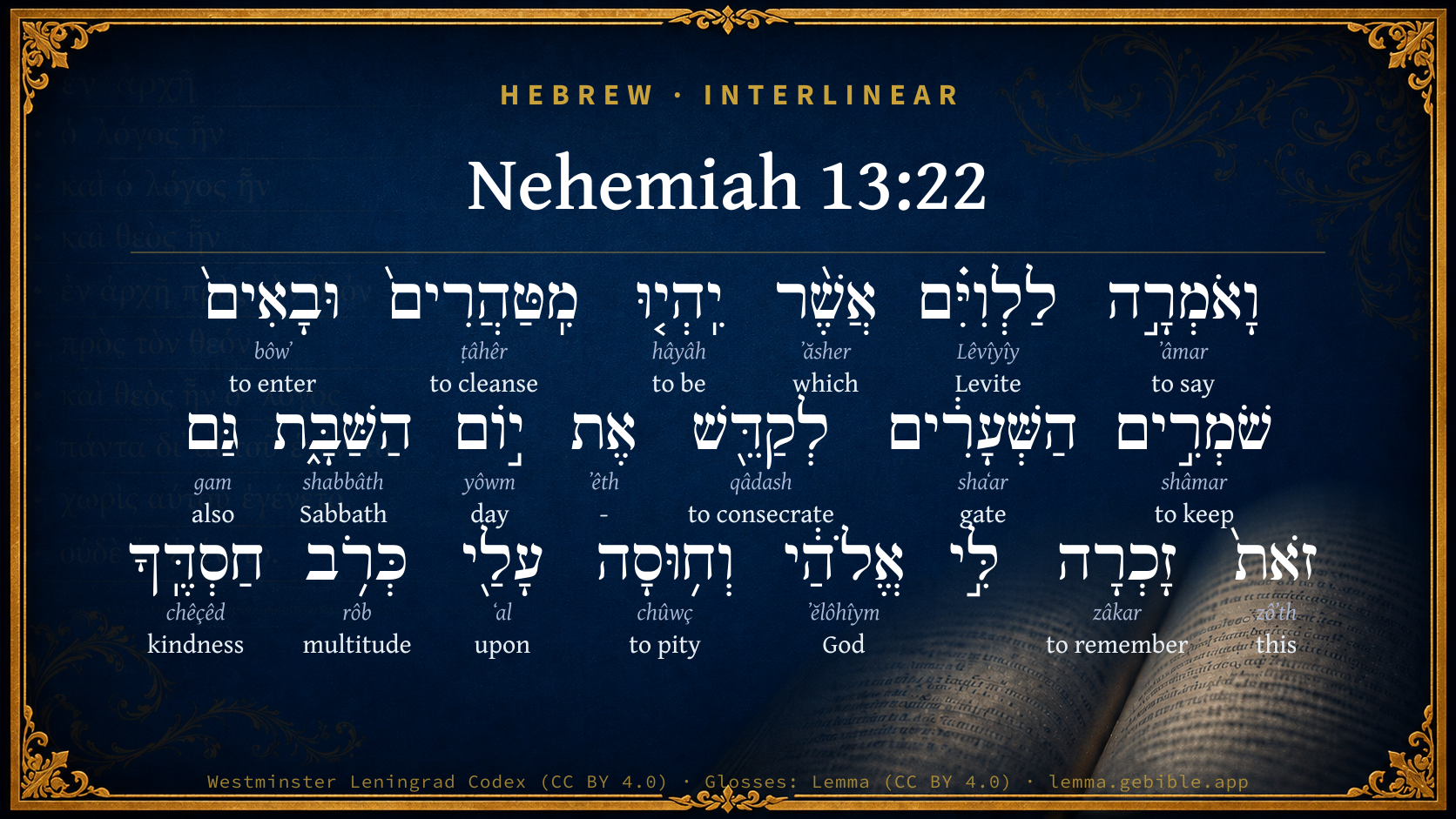
Nehemiah 13:22

Hebrew (Westminster Leningrad Codex) Nehemiah 13:22 appears in the Hebrew Old Testament. The text above is from the Westminster Leningrad Codex. Each word links to its Strong’s number, a concise gloss, and parsing drawn from the Open Scriptures Hebrew Bible morphology. Click any word for its full Brown-Driver-Briggs (BDB) entry.
Download image
Cite this verse

Nehemiah 13:22 (World English Bible). Public Domain. Lemma interlinear Bible study tool, https://lemma.gebible.app/v/nehemiah/13/22.

Show BibTeX & RIS
BibTeX
RIS
English Translation
I commanded the Levites that they should purify themselves, and that they should come and keep the gates, to sanctify the Sabbath day. Remember to me, my God, this also, and spare me according to the greatness of your loving kindness.
World English Bible · Public Domain
Download a study sheet

One document with this verse’s original text, its word-by-word gloss line, the meaning frame, cross-references with their text, attributed commentary, and full source and license credits — printable, and it pastes into notes with its structure intact.

This verse Autodidact and up

Study sheet (.html) Plain text (.txt)

A passage Seminary Student

Up to 50 verses in one chapter. A passage sheet keeps up to 6 commentary sources and 12 cross-references per verse, in the order this page ranks them, and says so on the sheet whenever that leaves anything out. Ask for a single verse and you get the Autodidact verse sheet above.

Everything on this page stays free to read, with no account — the sheet is a download of what is already on screen, not access to it.

Want to remove ads? Support Godless Engineer
Compare translations 3

The same verse in 3 English versions, stacked beneath the original-language interlinear above. Click any original word for its lexicon entry.

Each is an independent rendering of the whole verse — the interlinear is not word-aligned to these translations.

Highlighted words mark where these versions differ — a whole-verse word diff, not a word-by-word alignment.

  • World English Bible Public Domain
    I commanded the Levites that they should purify themselves, and that they should come and keep the gates, to sanctify the Sabbath day. Remember to me, my God, this also, and spare me according to the greatness of your loving kindness.
  • King James Version Public Domain
    And I commanded the Levites that they should cleanse themselves, and that they should come and keep the gates, to sanctify the sabbath day. Remember me, O my God, concerning this also, and spare me according to the greatness of thy mercy.
  • unfoldingWord Literal Text CC BY-SA 4.0
    And I said to the Levites that they should purify themselves and come keep the gates to consecrate the day of the sabbath. Remember me concerning this also, my God, and have pity on me according to the greatness of your covenant faithfulness.

unfoldingWord Literal Text — © unfoldingWord, licensed CC BY-SA 4.0. Word-aligned USFM3 via Door43 (git.door43.org/unfoldingWord/en_ult).

Versions to compare (up to 4)

3 of 4 selected

Show all 18 translations

Every available English version of this verse, each an independent rendering of the whole verse.

  • World English Bible Public Domain
    I commanded the Levites that they should purify themselves, and that they should come and keep the gates, to sanctify the Sabbath day. Remember to me, my God, this also, and spare me according to the greatness of your loving kindness.
  • Berean Standard Bible Public Domain
    Then I instructed the Levites to purify themselves and guard the gates in order to keep the Sabbath day holy. Remember me for this as well, O my God, and show me mercy according to Your abundant loving devotion.
  • Majority Standard Bible Public Domain
    Then I instructed the Levites to purify themselves and guard the gates in order to keep the Sabbath day holy. Remember me for this as well, O my God, and show me mercy according to Your abundant loving devotion.
  • King James Version Public Domain
    And I commanded the Levites that they should cleanse themselves, and that they should come and keep the gates, to sanctify the sabbath day. Remember me, O my God, concerning this also, and spare me according to the greatness of thy mercy.
  • American Standard Version (1901) Public Domain
    And I commanded the Levites that they should purify themselves, and that they should come and keep the gates, to sanctify the sabbath day. Remember unto me, O my God, this also, and spare me according to the greatness of thy lovingkindness.
  • Revised Version (1885) Public Domain
    And I commanded the Levites that they should purify themselves, and that they should come and keep the gates, to sanctify the sabbath day. Remember unto me, O my God, this also, and spare me according to the greatness of thy mercy.
  • Geneva Bible (1599) Public Domain
    And I sayde vnto the Leuites, that they should clense themselues, and that they shoulde come and keepe the gates, to sanctifie the Sabbath day. Remember me, O my God, concerning this, and pardon me according to thy great mercy.
  • Douay-Rheims (1899) Public Domain
    I spoke also to the Levites that they should be purified, and should come to keep the gates, and to sanctify the sabbath day: for this also remember me, O my God, and spare me according to the multitude of thy tender mercies.
  • Young's Literal Translation Public Domain
    And I say to the Levites, that they be cleansed, and, coming in, keeping the gates, to sanctify the sabbath-day. Also, this, remember for me, O my God, and have pity on me, according to the abundance of Thy kindness.
  • Literal Standard Version CC BY-SA 4.0
    And I command to the Levites that they be cleansed, and coming in, keeping the gates, to sanctify the Sabbath day. Also, this, remember for me, O my God, and have pity on me, according to the abundance of Your kindness.
  • Unlocked Literal Bible CC BY-SA 4.0
    Then I commanded the Levites to purify themselves, and come and guard the gates, to sanctify the Sabbath day. Call me to mind for this also, my God, and have mercy on me because of the covenant loyalty you have toward me.
  • unfoldingWord Literal Text CC BY-SA 4.0
    And I said to the Levites that they should purify themselves and come keep the gates to consecrate the day of the sabbath. Remember me concerning this also, my God, and have pity on me according to the greatness of your covenant faithfulness.
  • Darby Bible Public Domain
    And I commanded the Levites that they should purify themselves, and that they should come and keep the gates, to hallow the sabbath day. Remember this also for me, my God, and spare me according to thy great loving-kindness!
  • World Messianic Bible Public Domain
    I commanded the Levites that they should purify themselves, and that they should come and keep the gates, to sanctify the Sabbath day. Remember me for this also, my God, and spare me according to the greatness of your loving kindness.
  • Webster's Bible Public Domain
    And I commanded the Levites, that they should cleanse themselves, and that they should come and keep the gates, to sanctify the sabbath day. Remember me, O my God, concerning this also, and spare me according to the greatness of thy mercy.
  • Free Bible Version CC BY-SA 4.0
    Then I told the Levites to purify themselves and to come and guard the gates to keep the Sabbath day holy. My God, please also remember me for doing this, and be merciful to me because of your trustworthy love.
  • Bible in Basic English Public Domain
    And I gave the Levites orders to make themselves clean and come and keep the doors and make the Sabbath holy. Keep this in mind to my credit, O my God, and have mercy on me, for great is your mercy.
  • JPS Tanakh (1917) Public Domain
    And I commanded the Levites that they should purify themselves, and that they should come and keep the gates, to sanctify the sabbath day. Remember unto me, O my God, this also, and spare me according to the greatness of Thy mercy.

Literal Standard Version (2020), Covenant Press — licensed CC BY-SA 4.0. Text via the HelloAO Bible API (eBible.org). Unlocked Literal Bible (unfoldingWord) — licensed CC BY-SA 4.0. Text via the HelloAO Bible API (eBible.org). unfoldingWord Literal Text — © unfoldingWord, licensed CC BY-SA 4.0. Word-aligned USFM3 via Door43 (git.door43.org/unfoldingWord/en_ult). Free Bible Version, Dr. Jonathan Gallagher — licensed CC BY-SA 4.0. Text via the HelloAO Bible API (eBible.org).

Word by word

More ways to search: Search by grammar → Find every occurrence → Compare this word →

Practice this passage: Drill this verse → Learn its vocabulary →

וְח֥וּסָה
chûwç
H2347
“and · pity”
Conjunction + Verb, Qal, Imperative, 2nd Person, Masculine, Singular + Suffix, h
Part of Speech
Conjunction + Verb
Stem
Qal
Form
Imperative
Person
2nd Person
Gender
Masculine
Number
Singular
Full BDB Definition

Origin: a primitive root

TWOT: 626

(Qal) to pity, have compassion, spare, look upon with compassion
  1. וָאֹמְרָ֣ה ʼâmar H559 “and · to say” Conjunction + Verb, Qal, Sequential Imperfect, 1st Person, Common, Singular + Suffix, h
  2. לַלְוִיִּ֗ם Lêvîyîy H3881 “to/for the · Levites” Preposition, Determined + Noun, Gentilic, Masculine, Plural, Absolute
  3. אֲשֶׁ֨ר ʼăsher H834 “which” Particle, Relative
  4. יִֽהְי֤וּ hâyâh H1961 “to be” Verb, Qal, Imperfect, 3rd Person, Masculine, Plural
  5. מִֽטַּהֲרִים֙ ṭâhêr H2891 “cleansing” Verb, Hithpael, Participle Active, Masculine, Plural, Absolute
  6. וּבָאִים֙ bôwʼ H935 “and · entering” Conjunction + Verb, Qal, Participle Active, Masculine, Plural, Absolute
  7. שֹׁמְרִ֣ים shâmar H8104 “keeping” Verb, Qal, Participle Active, Masculine, Plural, Absolute
  8. הַשְּׁעָרִ֔ים shaʻar H8179 “the · gates” Particle, Definite Article + Noun, Common, Masculine, Plural, Absolute
  9. לְקַדֵּ֖שׁ qâdash H6942 “to consecrate” Preposition + Verb, Piel, Infinitive Construct
  10. אֶת ʼêth H853 “-” Particle, Direct Object
  11. י֣וֹם yôwm H3117 “day of” Noun, Common, Masculine, Singular, Construct
  12. הַשַּׁבָּ֑ת shabbâth H7676 “the · Sabbath” Particle, Definite Article + Noun, Common, Both, Singular, Absolute
  13. גַּם gam H1571 “also” Particle, Accusative
  14. זֹאת֙ zôʼth H2063 “this” Pronoun, Demonstrative, Feminine, Singular
  15. זָכְרָה zâkar H2142 “remember” Verb, Qal, Imperative, 2nd Person, Masculine, Singular + Suffix, h
  16. אֱלֹהַ֔י ʼĕlôhîym H430 “God(s) · my” Noun, Common, Masculine, Plural, Construct + Suffix, Personal, 1st Person, Common, Singular
  17. עָלַ֖י ʻal H5921 “upon · me” Preposition + Suffix, Personal, 1st Person, Common, Singular
  18. כְּרֹ֥ב rôb H7230 “like/as · multitude of” Preposition + Noun, Common, Both, Singular, Construct
  19. חַסְדֶּֽךָ chêçêd H2617 “kindness · your” Noun, Common, Masculine, Singular, Construct + Suffix, Personal, 2nd Person, Masculine, Singular

About this verse

These counts appear in no published source. They are computed here, from the morphology-tagged text and Lemma’s own curated glosses. What Lemma adds →

21
words
20
distinct lemmas
Historical
section

Notable vocabulary

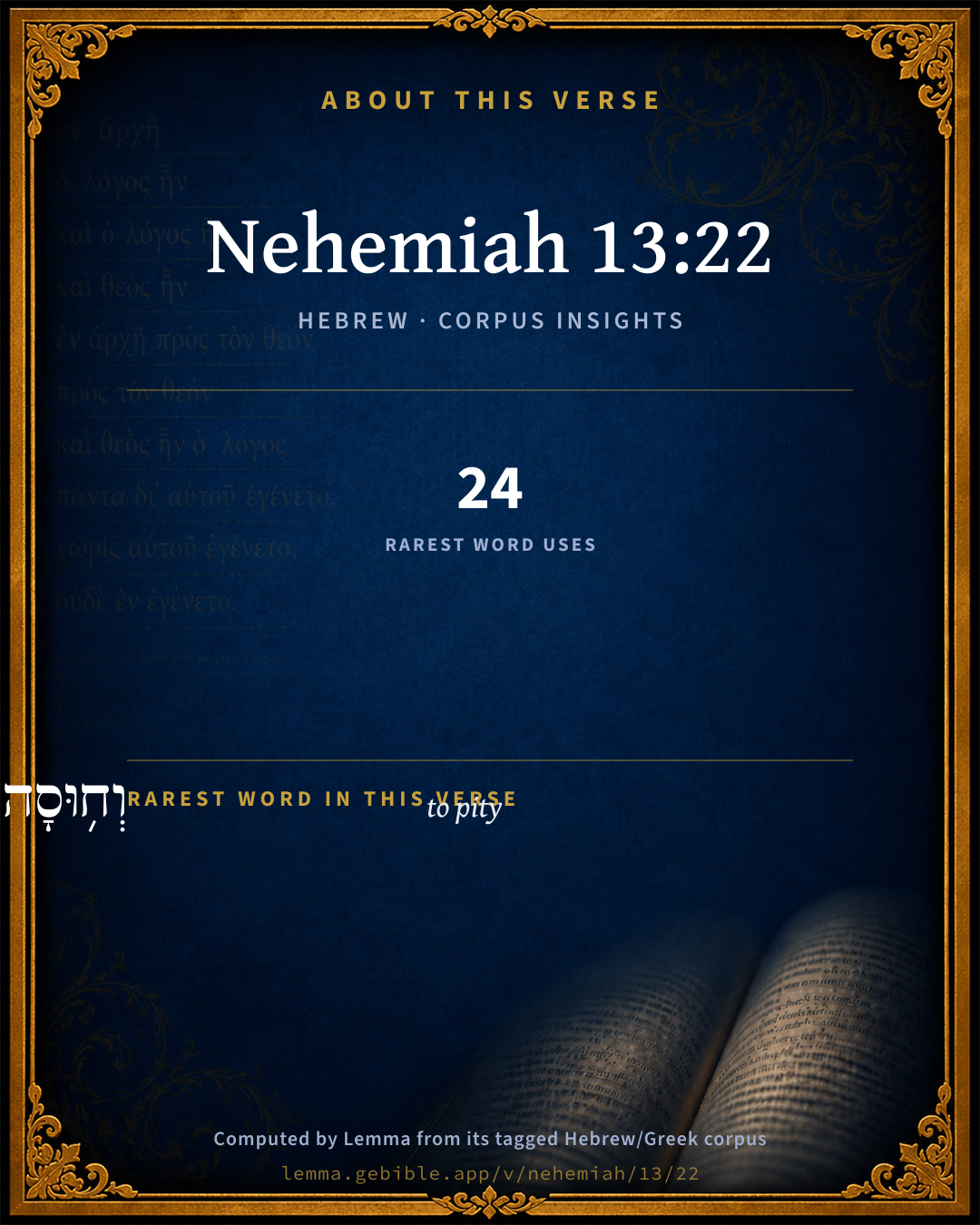
The rarest word here is וְח֥וּסָה to pity H2347 — appearing just 24 times in the whole Hebrew Bible.

Shared distinctive vocabulary

וְח֥וּסָה to pity H2347 occurs in 24 verses of the Hebrew Bible. Also found in:

Grammatical profile

  • 8 verbs
  • 7 nouns
  • 1 pronoun
  • 2 prepositions
  • 3 particles

Verb forms

  • וָאֹמְרָ֣ה Qal · Sequential Imperfect
  • יִֽהְי֤וּ Qal · Imperfect
  • מִֽטַּהֲרִים֙ Hithpael · Participle Active
  • וּבָאִים֙ Qal · Participle Active
  • שֹׁמְרִ֣ים Qal · Participle Active
  • לְקַדֵּ֖שׁ Piel · Infinitive Construct
  • זָכְרָה Qal · Imperative
  • וְח֥וּסָה Qal · Imperative

Cross-references

25

Topical passages linked to Nehemiah 13:22 in the Treasury of Scripture Knowledge — connected by theme and wording, ordered by reader-vote popularity; previews shown in the World English Bible.

  • Nehemiah 12:30 The priests and the Levites purified themselves; and they purified the people, and the gates, and the wall.
  • Nehemiah 13:14 Remember me, my God, concerning this, and don't wipe out my good deeds that I have done for the house of my God, and for the observances of it.
  • Nehemiah 13:31 and for the wood-offering, at times appointed, and for the first fruits. Remember me, my God, for good.
  • Deuteronomy 5:12 "Observe the Sabbath day, to keep it holy, as Yahweh your God commanded you.
  • 2 Kings 23:4 The king commanded Hilkiah the high priest, and the priests of the second order, and the keepers of the threshold, to bring forth out of the temple of Yahweh all the vessels that were made for Baal, and for the Asherah, and for all the host of the sky, and he burned them outside of Jerusalem in the fields of the Kidron, and carried the ashes of them to Bethel.
  • 1 Chronicles 15:12–14 and said to them, You are the heads of the fathers' [houses] of the Levites: sanctify yourselves, both you and your brothers, that you may bring up the ark of Yahweh, the God of Israel, to [the place] that I have prepared for it.
  • 2 Chronicles 29:4–5 He brought in the priests and the Levites, and gathered them together into the broad place on the east,
  • 2 Chronicles 29:24 and the priests killed them, and they made a sin-offering with their blood on the altar, to make atonement for all Israel; for the king commanded [that] the burnt offering and the sin-offering [should be made] for all Israel.
  • 2 Chronicles 29:27 Hezekiah commanded to offer the burnt offering on the altar. When the burnt offering began, the song of Yahweh began also, and the trumpets, together with the instruments of David king of Israel.
  • 2 Chronicles 29:30 Moreover Hezekiah the king and the princes commanded the Levites to sing praises to Yahweh with the words of David, and of Asaph the seer. They sang praises with gladness, and they bowed their heads and worshiped.
  • Nehemiah 5:19 Remember to me, my God, for good, all that I have done for this people.
  • Nehemiah 7:64–65 These sought their register [among] those who were reckoned by genealogy, but it was not found: therefore were they deemed polluted and put from the priesthood.
  • Nehemiah 12:10 Jeshua became the father of Joiakim, and Joiakim became the father of Eliashib, and Eliashib became the father of Joiada,
  • Psalms 5:7 But as for me, in the abundance of your loving kindness I will come into your house: I will bow toward your holy temple in reverence of you.
  • Psalms 25:6–7 Yahweh, remember your tender mercies and your loving kindness, For they are from old times.
  • Psalms 51:1 Have mercy on me, God, according to your loving kindness. According to the multitude of your tender mercies, blot out my transgressions.
  • Psalms 130:3–4 If you, Yah, kept a record of sins, Lord, who could stand?
  • Psalms 130:7 Israel, hope in Yahweh, For with Yahweh there is loving kindness. With him is abundant redemption.
  • Psalms 132:1–5 Yahweh, remember David and all his affliction,
  • Psalms 143:1–2 Hear my prayer, Yahweh. Listen to my petitions. In your faithfulness and righteousness, relieve me.
  • Isaiah 38:3 and said, Remember now, Yahweh, I beg you, how I have walked before you in truth and with a perfect heart, and have done that which is good in your sight. Hezekiah wept sore.
  • Isaiah 49:23 Kings shall be your nursing fathers, and their queens your nursing mothers: they shall bow down to you with their faces to the earth, and lick the dust of your feet; and you shall know that I am Yahweh; and those who wait for me shall not be disappointed.
  • Isaiah 55:7 let the wicked forsake his way, and the unrighteous man his thoughts; and let him return to Yahweh, and he will have mercy on him; and to our God, for he will abundantly pardon.
  • 2 Corinthians 1:12 For our boasting is this: the testimony of our conscience, that in holiness and sincerity of God, not in fleshly wisdom but in the grace of God we behaved ourselves in the world, and more abundantly toward you.
  • 2 Timothy 4:7–8 I have fought the good fight. I have finished the course. I have kept the faith.

Cross-references courtesy of OpenBible.info (CC BY 4.0).

Hebrew and Greek witnesses Masoretic Hebrew ↔ Greek Septuagint

The same verse in the two great witnesses to the Old Testament, shown verse-for-verse.

These are two independent witnesses, not word-aligned to each other, and the Septuagint is shown in lemma (dictionary) form.

Hebrew Nehemiah 13:22 Masoretic · Westminster Leningrad Codex

וָאֹמְרָ֣ה לַלְוִיִּ֗ם אֲשֶׁ֨ר יִֽהְי֤וּ מִֽטַּהֲרִים֙ וּבָאִים֙ שֹׁמְרִ֣ים הַשְּׁעָרִ֔ים לְקַדֵּ֖שׁ אֶת י֣וֹם הַשַּׁבָּ֑ת גַּם זֹאת֙ זָכְרָה לִּ֣י אֱלֹהַ֔י וְח֥וּסָה עָלַ֖י כְּרֹ֥ב חַסְדֶּֽךָ

I commanded the Levites that they should purify themselves, and that they should come and keep the gates, to sanctify the Sabbath day. Remember to me, my God, this also, and spare me according to the greatness of your loving kindness.

World English Bible · Public Domain

Greek LXX Structure differs

The Septuagint has no separate book of Nehemiah. Its Greek text is the second half of Esdras B (2 Esdras), chapters 11–23; Ezra is the first half (1–10).

A verse-for-verse comparison isn’t shown here because the chapters and verses don’t line up. Switch to the LXX edition with the MT / LXX toggle above to read the Greek directly.

On this verse, The Cambridge Bible for Schools and Colleges discusses the Septuagint’s reading. Read the note in Commentary ↓

Hebrew: Westminster Leningrad Codex (CC BY 4.0). Greek: Septuagint (public domain); English from a public-domain English Septuagint. How the Septuagint differs from the Hebrew →

Commentary

Notes on Nehemiah 13:22 from classic Christian and Jewish commentators (each source and its license shown beneath its notes). The classic Christian expositions comment on the surrounding passage and are grouped to its opening verse, so a note may address several verses; the Jewish commentaries on the Tanakh (Rashi and others) are per-verse, so they appear only where the commentator wrote on this verse.

Lemma curates 59 commentaries, every one of them public domain or Creative Commons licensed, each selected and text-cleaned for this edition rather than reprinted as found. About our sources →

Trapp's Complete Commentary

John Trapp

Neh 13:22 And I commanded the Levites that they should cleanse themselves, and [that] they should come [and] keep the gates, to sanctify the sabbath day. Remember me, O my God, [concerning] this also, and spare me according to the greatness of thy mercy.

Ver. 22. And I commanded the Levites] He might do it, as their governor. How then can Popish priests exempt themselves from the power of the civil magistrate? and say, as those shavelings did to our Henry II, when they lashed him on the bare till the blood followed, Domine, noli minari; nos enim de tali curia sumus, quae consuevit imperare regibus, et imperatoribus; that is, Sir, spare your threats; for we are of that high court of Rome which is wont to lord it over kings and emperors? Might he not have well replied, Ye take too much upon you, ye sons of Levi; or rather, ye limbs of Antichrist?

Come and keep the gates] The temple gates, with - Procul hinc, procul este profani. Far off fro here, far off is to be the profane. In Greece the priest, at their solemn sacrifices, was wont to ask, τις τηδε, Who’s there? and the people were to answer, πολλοι τ αγαθοι τε παρεισι, Here are many, and those also good men.

To sanctify the sabbath day] By severing the precious from the vile; and seeing that all things were rightly carried by themselves and the rest.

Remember me, &c.] See Neh 13:14.

And spare me] Meritum meum est misericordia Domini. Horreo quicquid de meo est, ut sim meus My service is the mercy of God. I shutter at whatever is from me, that is mine. (Bernard). Thomas Aquinas, lying on his death bed, and being about to receive the Lord’s supper, besought the Lord with tears that he would spare him according to his abundant goodness; and snatching up the Bible, he hugged it, and said, I believe all the contents of this blessed book. The like is reported of William Wickham, founder of New College, Oxon, and of Charles V, emperor, and some other wiser Papists.

John Trapp, A Commentary or Exposition upon All the Books of the Old and New Testament (1647–1656) — public domain. Text from a community e-Sword module.

The Biblical Illustrator

Joseph S. Exell

Neh_13:22

Spare me according to the greatness of Thy mercy.

Nehemiahs appeal to Gods mercy

The bird which soars the highest builds the lowest nest. The more a man is lifted up in communion with Heaven the deeper is his abasement in his own eyes. The holiest are the humblest. Those who bear most fruit have least confidence in the flesh. How interesting to observe that, though the conceptions of believers under the old dispensation respecting the exact mode of salvation were dim, yet they themselves clung as earnestly to the mercy of the Lord as more privileged believers do now! (Hugh Stowell, M. A.)

Increasing holiness means increasing sensitiveness to the need of mercy

The more holy a mans spirit becomes, the more sensitive will it become; and the more sensitive his spirit, the deeper and livelier will be his sense of sinfulness. Shut up an individual in a dark room, hung round with cobwebs and defiled with dust, and he will be insensible to its condition; then admit a little light, and he will begin to suspect its state, and the more clearly the fight shines, the more clearly will he discern the impurities which were hidden before. (Hugh Stowell, M. A.)

Nehemiah

Here is--

I. An appeal to Gods approbation. Nehemiah often makes appeals of this kind. This was an appeal to God--

1. From mans judgment. He had engaged in an undertaking which was likely enough to appear contemptible in the eyes of his Persian acquaintance. But what then? It was for Gods honour, and therefore he despises this shame, casting himself upon the approbation of God. This principle it was that influenced Noah, Abraham, Moses, David, Paul. It is the principle of faith rendering an unseen God visible. Such men look for a future recompense of reward promised by Him who cannot lie.

2. From mans enmity. While one party satisfied themselves with despising, there was another party in Jerusalem itself who hated and opposed his proceedings. It is in reference to their enmity that the appeal of the text is made. Modern enmity.

3. From mans ingratitude. It was here that he found his greatest trial. How painful, when the very persons whom in Gods name he sought to benefit were cold, reluctant, unfeeling! Nehemiahs was no solitary ease. You find in connection with this appeal--

II. A contrite prayer for gods forgiveness.

1. After all he has done for Gods service, Nehemiah cannot forget that there is a load of original and actual sin, recorded against him for which no subsequent obedience can make satisfaction.

2. He finds even his religious actions so stained with sin that though he may appeal from man, he cannot make them a plea for merit before God.

3. He casts himself, with a steadfast faith, on the free grace and covenanted mercies of the Lord. Application: If the despised believer may thus appeal from man to God, what hope can there be for those who compel him so to do? (Joseph Jowett, M. A.)

The Biblical Illustrator, edited by Joseph S. Exell (c. 1880s–1900s) — public domain. Text from a community e-Sword module.

Joseph Benson's Commentary

Neh 13:22. I commanded the Levites that they should cleanse themselves — Because the work they now were set upon, though common in its nature, yet was holy in the design of it, and had respect unto the sabbath: and, because the day in which they were to do this was the sabbath day, for the observation whereof they were obliged to purify themselves; that they should come and keep the gates — The gates of the city: not daring to trust the common porters, and thinking that the Levites, by virtue of their character, would be more reverenced, and meet with more deference and respect than his domestic servants, he therefore appointed them to this office of keeping the gates on the sabbath, that all traffic might be prevented, and the day not fail to be sanctified, as it ought to be. O my God, spare me according to the greatness of thy mercy — By this he intimates, that though he mentioned his good works as things wherewith God was well pleased, and which he had promised to reward, yet he neither did, nor durst, trust to their merit, or his own worthiness, but, when he had done all, he judged himself an unprofitable servant, and one that needed God’s infinite mercy to pardon all his sins, and particularly those infirmities and corruptions which adhered to his good deeds.

Joseph Benson's Commentary on the Old and New Testaments (1811–1818) — public domain. Text from a community e-Sword module.

Tyndale Open Study Notes

Tyndale Open Resources

13:22 Have compassion on me: Nehemiah’s prayer implies that he felt the pressure of this unpopular decision. He knew that God’s unfailing love, not his own popularity, would sustain him.

Tyndale Open Study Notes — © Tyndale Open Resources, licensed CC BY-SA 4.0. Text via the HelloAO Bible API.

Geneva Bible (1599)

Geneva Bible translators

Meaning, of the Temple, that none that was unclean, should enter.

Geneva Bible (1599) marginal notes — public domain. Text via Bolls.life.

Adam Clarke's Commentary

Verse 22. Spare me according to the greatness of thy mercy.] By some Nehemiah has been thought to deal with God too much on the principle of merit. That he wished God to remember him for good, is sufficiently evident; and who does not wish the same? But that he expected heaven because of his good deeds, does not appear. Indeed, the concluding clause of this verse proves the contrary, and shows that he expected nothing from God but through the greatness of his mercy. Shame on those who, with this evidence before them, brand this good man with the epithet of workmonger! a man who, in inward holiness, outward usefulness, and genuine love to God and man, was worth ten score of such self-called believers.

Adam Clarke's Commentary on the Bible (1810–1826) — public domain. Text from a community e-Sword/MySword module.

Ellicott's Commentary for English Readers

(22) Cleanse themselves.—As for a sacred duty, not without reference to their past neglect, which required to be forgiven. This was a high tribute to the Sabbath ordinance, and as such in harmony with all the details of this episode.

Remember me.—In this prayer also Nehemiah commits his fidelity to the merciful estimate of God. But something in connection with the Sabbath, or with his retrospect of his own conduct, gives the passing prayer a peculiar pathos of humility.

A Bible Commentary for English Readers, edited by Charles John Ellicott (1878–1897) — public domain. Text from a community e-Sword module.

The Cambridge Bible for Schools and Colleges

gen. ed. J. J. S. Perowne

22. And I commanded the Levites] The verse contains an additional precaution taken by Nehemiah to secure the observance of the Sabbath. Its exact character however is somewhat obscure.

Nehemiah delivers to the Levites a special commission to take over the watch of the city gates on the Sabbaths. For this purpose they are to cleanse themselves; the duty was a sacred one, since upon it depended the nation’s fidelity to the Sabbath. We are not told whether these Levites were appointed to serve in addition to, or as substitutes for, the regular watchmen; or whether they were intended to continue the duties temporarily entrusted by Nehemiah to his servants (Neh_13:19).

come and keep the gates] The copula is wanting in the Hebrew; and thus has given occasion to a proposal for the rendering, ‘And that they should come to the keepers of the gates’ &c. i.e. that the Levites should on the Sabbath eve go the rounds to the various gates for the purpose of solemnly announcing the advent of the holy day. Even if the grammatical construction, which this translation supposes, be admissible, the sense does not carry with it the ring of probability.

The versions supply the copula. LXX. εἶπα τοῖς Λευίταις οἳ ἦσαν καθαριζόμενοι καὶ ἐρχόμενοι φυλάσσοντες τὰς πύλας ἁγιάζειν τὴν ἡμέραν. Vulg. ‘ut mundarentur et venirent ad custodiendas portas.’

Remember me … concerning this also] R.V. Remember unto me … this also. Cf. Neh_13:15.

The Cambridge Bible for Schools and Colleges (gen. ed. J. J. S. Perowne; Cambridge University Press, 1878–1918) — public domain. Text from a community e-Sword module.

John Gill's Exposition

And I contended with them,.... Argued with them, faithfully admonished them, and sharply reproved them:

and cursed them; assuring them that the curse of God would come upon them, unless they repented. Aben Ezra interprets it of excommunicating them, either with "Cherem" or "Niddui", which were two sorts of excommunication among the Jews; but it is a question whether as yet those were used by them:

and smote certain of them; ordered them to be beaten with rods or scourges, as transgressors of the law:

and plucked off their hair; or ordered it to be plucked off by the executioner that smote them; which sort of punishment, as it was painful, it was disgraceful and ignominious, see Isa 1:6,

and made them swear by God, saying, ye shall not give your daughters unto their sons, nor take their daughters unto your sons, or for yourselves; not intermarry with them; this they had sworn to before, Neh 10:29.

John Gill's Exposition of the Whole Bible (1746–1763) — public domain (CC PDM 1.0). Text via the HelloAO Bible API.

Albert Barnes' Notes on the Bible

I commanded the Levites - At first Nehemiah had employed his own retinue Neh 13:19 in the work of keeping the gates. He now assigned the duty to the Levites, as one which properly belonged to them, since the object of the regulation was the due observance of the Sabbath.

Albert Barnes' Notes on the Bible (1834–1885) — public domain. Text from a community e-Sword/MySword module.

Haydock's Catholic Bible Commentary

Gates. The Levites would more conscientiously discharge their duty, (Menochius) and restrain the people, so that they might keep the day holy. (Haydock)

George Leo Haydock (1774–1849), Haydock's Catholic Family Bible and Commentary, 1859 edition — public domain. Excludes Psalms (Douay-Rheims chapter numbering differs from Protestant) and Deuterocanonical books (Catholic canon only).

Matthew Poole's English Annotations

That they should cleanse themselves; partly because the work they were now set upon, though common in its nature, yet was holy in design of it, and had respect unto the sabbath; and partly because the day in which they were to do this was the sabbath day, for the observation whereof they were obliged to prepare and purify themselves.

Keep the gates; either,

1. The gates of the temple. But a particular command was superfluous in that case, because it was their constant work and charge to do this, both sabbath days and every day. Or rather,

2. The gates of the city; for of them he spake last, Neh 13:19; and not daring to trust the common porters of these gates, not being able always to employ his men in that work, he committeth the charge of them for the present season, and upon the sabbath days, to the Levites, to whom the care of sanctifying the sabbath did properly belong.

According to the greatness of thy mercy; whereby he intimates, that though he mentioned his good works as things wherewith God was well pleased, and which he had promised to reward, yet he neither did nor durst trust to their merit or his own worthiness; but when he had done all, he judged himself an unprofitable servant, and one that needed God’s infinite mercy and indulgence to pardon all his sins, and particularly those infirmities and corruptions which adhered to his good deeds.

Matthew Poole's English Annotations on the Holy Bible (1683–1685) — public domain. Text from a community e-Sword/MySword module.

Whedon's Commentary on the Bible

Daniel D. Whedon

22. The Levites… should cleanse themselves — By certain ceremonies, as in Neh_12:30.

Come and keep the gates — Literally, coming keeping the gates. The meaning is, that in addition to the ordinary gate keepers, certain Levites were detailed to see that the gates of the city were properly guarded during the Sabbath. A reason for this may have been the moral influence which the sacred character of the Levites would be supposed to exert.

To sanctify the sabbath day — That is, to secure its sanctity by preventing further profanation, like that mentioned in Neh_13:15-16.

Daniel D. Whedon (gen. ed.), Commentary on the Old and New Testaments (1874–1909) — public domain. Text from a community e-Sword module.

The Pulpit Commentary

And I commanded the Levites... that they should come and keep the gates. Assigning the duty to his servants was probably a temporary arrangement. The permanent charge was committed to the Levites, who had been intrusted with the duty when the gates were first set up. (Neh_7:1) They were to "cleanse," or purify, themselves, because the charge was considered a sacred one. Remember me, O my God, concerning this also. Compare ver. 14. And spare me. It is worthy of notice that Nehemiah does not regard his good deeds as sufficient for his justification, but throws himself unreservedly on God"s mercy.

The Pulpit Commentary (1880–1919), ed. H.D.M. Spence-Jones & Joseph S. Exell — public domain. Text from a community e-Sword module.

John Wesley's Explanatory Notes

Cleanse - Because the work they now were set upon, though common in its nature, yet was holy in design of it, and had respect unto the sabbath: and, because the day in which they were to do this was the sabbath-day, for the observation whereof they were obliged to purify themselves. Gates - The gates of the city; not daring to trust the common porters, he commits the charge of them upon the sabbath-days, to the Levites, to whom the care of sanctifying the sabbath did properly belong. Mercy - Whereby he intimates, that though he mentioned his good-works, as things wherewith God was well-pleased, and which he had promised to reward, yet he neither did, nor durst trust to their merit, or his own worthiness, but, when he had done all, he judged himself an unprofitable servant, and one that needed God's infinite mercy to pardon all his sins, and particularly those infirmities and corruptions which adhered to his good deeds.

John Wesley, Explanatory Notes Upon the Whole Bible (1754–1765) — public domain. Text via the GEBible commentary corpus.

Lesson kit

Teaching starters — assembled from the data on this page, not authored interpretation. Every prompt links to the verse data it draws on. Edit before teaching.

Nehemiah, in the Historical, opens this verse with 21 words (20 distinct Hebrew lemmas). Its most distinctive word is chûwç (“to pity”). A historical commentator’s framing appears above. Read the whole chapter for the surrounding context.

Discussion questions

  1. How does “to pity” (chûwç) shape what this verse is saying?
  2. How does Genesis 45:20, which shares the word «to pity», read alongside this verse?
  3. The translations on this page render this verse differently — a whole-verse word diff, not a word-by-word alignment. What might account for the different wordings?
  4. «וָאֹמְרָ֣ה» is a Qal Sequential Imperfect verb. How does that grammatical form shape the action described?
  5. Compare how Trapp's Complete Commentary and The Biblical Illustrator read this verse. Where do they agree or differ?

Things to notice

Reading settings

Reading text

Shown beneath each verse's original-language words.

Old Testament
Old Testament edition

Read the OT as the Masoretic Hebrew (MT) or the Greek Septuagint (LXX).

English shown for the Greek Septuagint (in the Hebrew ↔ Greek comparison).

Comparing translations? Open the Compare panel on any verse page to stack up to four side by side.