
2 Chronicles 18:31

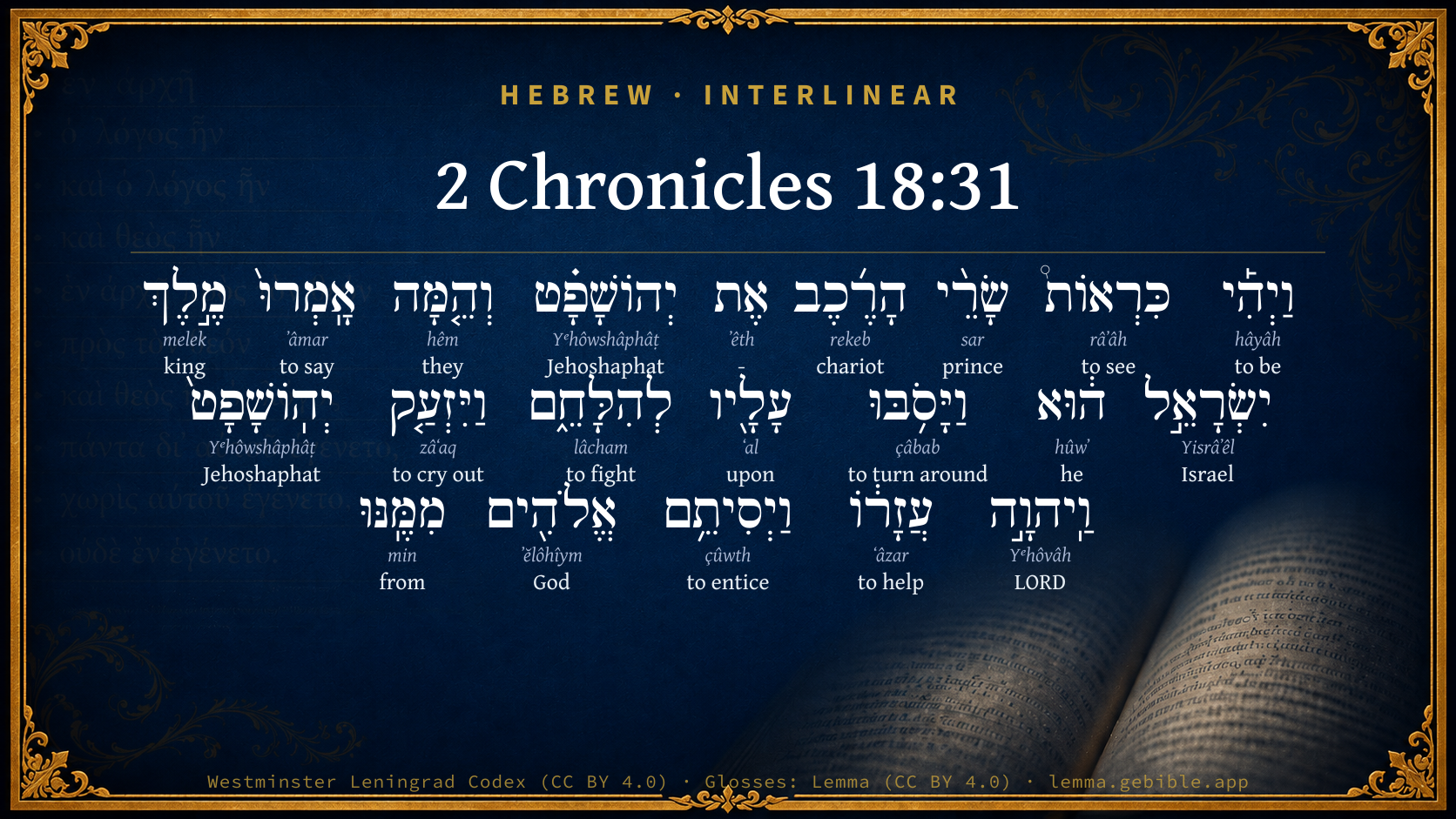
Hebrew (Westminster Leningrad Codex) 2 Chronicles 18:31 appears in the Hebrew Old Testament. The text above is from the Westminster Leningrad Codex. Each word links to its Strong’s number, a concise gloss, and parsing drawn from the Open Scriptures Hebrew Bible morphology. Click any word for its full Brown-Driver-Briggs (BDB) entry.
Download image
Cite this verse

2 Chronicles 18:31 (World English Bible). Public Domain. Lemma interlinear Bible study tool, https://lemma.gebible.app/v/2-chronicles/18/31.

Show BibTeX & RIS
BibTeX
RIS
English Translation
It happened, when the captains of the chariots saw Jehoshaphat, that they said, It is the king of Israel. Therefore they turned about to fight against him: but Jehoshaphat cried out, and Yahweh helped him; and God moved them [to depart] from him.
World English Bible · Public Domain
Download a study sheet

One document with this verse’s original text, its word-by-word gloss line, the meaning frame, cross-references with their text, attributed commentary, and full source and license credits — printable, and it pastes into notes with its structure intact.

This verse Autodidact and up

Study sheet (.html) Plain text (.txt)

A passage Seminary Student

Up to 50 verses in one chapter. A passage sheet keeps up to 6 commentary sources and 12 cross-references per verse, in the order this page ranks them, and says so on the sheet whenever that leaves anything out. Ask for a single verse and you get the Autodidact verse sheet above.

Everything on this page stays free to read, with no account — the sheet is a download of what is already on screen, not access to it.

Want to remove ads? Support Godless Engineer
Compare translations 3

The same verse in 3 English versions, stacked beneath the original-language interlinear above. Click any original word for its lexicon entry.

Each is an independent rendering of the whole verse — the interlinear is not word-aligned to these translations.

Highlighted words mark where these versions differ — a whole-verse word diff, not a word-by-word alignment.

  • World English Bible Public Domain
    It happened, when the captains of the chariots saw Jehoshaphat, that they said, It is the king of Israel. Therefore they turned about to fight against him: but Jehoshaphat cried out, and Yahweh helped him; and God moved them [to depart] from him.
  • King James Version Public Domain
    And it came to pass, when the captains of the chariots saw Jehoshaphat, that they said, It is the king of Israel. Therefore they compassed about him to fight: but Jehoshaphat cried out, and the LORD helped him; and God moved them to depart from him.
  • unfoldingWord Literal Text CC BY-SA 4.0
    And it happened when the chiefs of the chariots saw Jehoshaphat, and they said, “It is the king of Israel.” And they turned against him to fight. And Jehoshaphat cried out, and Yahweh helped him, and God incited them from him.

unfoldingWord Literal Text — © unfoldingWord, licensed CC BY-SA 4.0. Word-aligned USFM3 via Door43 (git.door43.org/unfoldingWord/en_ult).

Versions to compare (up to 4)

3 of 4 selected

Show all 18 translations

Every available English version of this verse, each an independent rendering of the whole verse.

  • World English Bible Public Domain
    It happened, when the captains of the chariots saw Jehoshaphat, that they said, It is the king of Israel. Therefore they turned about to fight against him: but Jehoshaphat cried out, and Yahweh helped him; and God moved them [to depart] from him.
  • Berean Standard Bible Public Domain
    When the chariot commanders saw Jehoshaphat, they said, “This is the king of Israel!” So they turned to fight against him, but Jehoshaphat cried out, and the LORD helped him. God drew them away from him.
  • Majority Standard Bible Public Domain
    When the chariot commanders saw Jehoshaphat, they said, “This is the king of Israel!” So they turned to fight against him, but Jehoshaphat cried out, and the LORD helped him. God drew them away from him.
  • King James Version Public Domain
    And it came to pass, when the captains of the chariots saw Jehoshaphat, that they said, It is the king of Israel. Therefore they compassed about him to fight: but Jehoshaphat cried out, and the LORD helped him; and God moved them to depart from him.
  • American Standard Version (1901) Public Domain
    And it came to pass, when the captains of the chariots saw Jehoshaphat, that they said, It is the king of Israel. Therefore they turned about to fight against him: but Jehoshaphat cried out, and Jehovah helped him; and God moved them `to depart' from him.
  • Revised Version (1885) Public Domain
    And it came to pass, when the captains of the chariots saw Jehoshaphat, that they said, It is the king of Israel. Therefore they turned about to fight against him: but Jehoshaphat cried out, and the LORD helped him; and God moved them to depart from him.
  • Geneva Bible (1599) Public Domain
    And when the captaines of the charets saw Iehoshaphat, they sayde, It is the King of Israel: and they compassed about him to fight. But Iehoshaphat cryed, and the Lord helped him and moued them to depart from him.
  • Douay-Rheims (1899) Public Domain
    So when the captains of the cavalry saw Josaphat, they said: This is the king of Israel. And they surrounded him to attack him: but he cried to the Lord, and he helped him, and turned them away from him.
  • Young's Literal Translation Public Domain
    And it cometh to pass at the heads of the charioteers seeing Jehoshaphat, that they have said, `The king of Israel he is,' and they turn round against him to fight, and Jehoshaphat crieth out, and Jehovah hath helped him, and God enticeth them from him,
  • Literal Standard Version CC BY-SA 4.0
    And it comes to pass at the heads of the charioteers seeing Jehoshaphat, that they have said, “He is the king of Israel,” and they turn around against him to fight, and Jehoshaphat cries out, and YHWH has helped him, and God entices them from him;
  • Unlocked Literal Bible CC BY-SA 4.0
    It came about that when the captains of the chariots saw Jehoshaphat they said, “That is the king of Israel.” They turned around to attack him, but Jehoshaphat cried out, and Yahweh helped him. God turned them away from him.
  • unfoldingWord Literal Text CC BY-SA 4.0
    And it happened when the chiefs of the chariots saw Jehoshaphat, and they said, “It is the king of Israel.” And they turned against him to fight. And Jehoshaphat cried out, and Yahweh helped him, and God incited them from him.
  • Darby Bible Public Domain
    And it came to pass when the captains of the chariots saw Jehoshaphat, that they said, That is the king of Israel; and they surrounded him to fight; and Jehoshaphat cried out, and Jehovah helped him; and God diverted them from him.
  • World Messianic Bible Public Domain
    When the captains of the chariots saw Jehoshaphat, they said, “It is the king of Israel!” Therefore they turned around to fight against him. But Jehoshaphat cried out, and the LORD helped him; and God moved them to depart from him.
  • Webster's Bible Public Domain
    And it came to pass, when the captains of the chariots saw Jehoshaphat, that they said, It is the king of Israel. Therefore they compassed about him to fight: but Jehoshaphat cried out, and the LORD helped him; and God moved them to depart from him.
  • Free Bible Version CC BY-SA 4.0
    So when the chariot commanders saw Jehoshaphat, they shouted, “There's the king of Israel!” So they turned to attack him, but Jehoshaphat called out for help, and the Lord did help him. God redirected them away from him,
  • Bible in Basic English Public Domain
    So when the captains of the war-carriages saw Jehoshaphat, they said, It is the king of Israel. And turning about, they came round him, but Jehoshaphat gave a cry, and the Lord came to his help, and God sent them away from him.
  • JPS Tanakh (1917) Public Domain
    And it came to pass, when the captains of the chariots saw Jehoshaphat, that they said: 'It is the king of Israel.' Therefore they turned about to fight against him; but Jehoshaphat cried out, and the LORD helped him; and God moved them to depart from him.

Literal Standard Version (2020), Covenant Press — licensed CC BY-SA 4.0. Text via the HelloAO Bible API (eBible.org). Unlocked Literal Bible (unfoldingWord) — licensed CC BY-SA 4.0. Text via the HelloAO Bible API (eBible.org). unfoldingWord Literal Text — © unfoldingWord, licensed CC BY-SA 4.0. Word-aligned USFM3 via Door43 (git.door43.org/unfoldingWord/en_ult). Free Bible Version, Dr. Jonathan Gallagher — licensed CC BY-SA 4.0. Text via the HelloAO Bible API (eBible.org).

Word by word

More ways to search: Search by grammar → Find every occurrence → Compare this word →

Practice this passage: Drill this verse → Learn its vocabulary →

וַיְסִיתֵ֥ם
çûwth
H5496
“and · to entice · them”
Conjunction + Verb, Hiphil, Sequential Imperfect, 3rd Person, Masculine, Singular + Suffix, Personal, 3rd Person, Masculine, Plural
Part of Speech
Conjunction + Verb
Stem
Hiphil
Form
Sequential Imperfect
Person
3rd Person
Gender
Masculine
Number
Singular
Full BDB Definition

Origin: perhaps denominative from H7898

TWOT: 1481

to incite, allure, instigate, entice - (Hiphil) - to incite (to a request) - to allure, lure - to instigate (bad sense)
  1. וַיְהִ֡י hâyâh H1961 “and · to be” Conjunction + Verb, Qal, Sequential Imperfect, 3rd Person, Masculine, Singular
  2. כִּרְאוֹת֩ râʼâh H7200 “like/as · to see” Preposition + Verb, Qal, Infinitive Construct
  3. שָׂרֵ֨י sar H8269 “princes of” Noun, Common, Masculine, Plural, Construct
  4. הָרֶ֜כֶב rekeb H7393 “the · chariot” Particle, Definite Article + Noun, Common, Masculine, Singular, Absolute
  5. אֶת ʼêth H853 “-” Particle, Direct Object
  6. יְהוֹשָׁפָ֗ט Yᵉhôwshâphâṭ H3092 “Jehoshaphat” Noun, Proper
  7. וְהֵ֤מָּה hêm H1992 “and · they” Conjunction + Pronoun, Personal, 3rd Person, Masculine, Plural
  8. אָֽמְרוּ֙ ʼâmar H559 “to say” Verb, Qal, Perfect, 3rd Person, Common, Plural
  9. מֶ֣לֶךְ melek H4428 “king of” Noun, Common, Masculine, Singular, Construct
  10. יִשְׂרָאֵ֣ל Yisrâʼêl H3478 “Israel” Noun, Proper
  11. ה֔וּא hûwʼ H1931 “he” Pronoun, Personal, 3rd Person, Masculine, Singular
  12. וַיָּסֹ֥בּוּ çâbab H5437 “and · to turn around” Conjunction + Verb, Qal, Sequential Imperfect, 3rd Person, Masculine, Plural
  13. עָלָ֖יו ʻal H5921 “upon · him” Preposition + Suffix, Personal, 3rd Person, Masculine, Singular
  14. לְהִלָּחֵ֑ם lâcham H3898 “to fight” Preposition + Verb, Niphal, Infinitive Construct
  15. וַיִּזְעַ֤ק zâʻaq H2199 “and · to cry out” Conjunction + Verb, Qal, Sequential Imperfect, 3rd Person, Masculine, Singular
  16. יְהֽוֹשָׁפָט֙ Yᵉhôwshâphâṭ H3092 “Jehoshaphat” Noun, Proper
  17. וַֽיהוָ֣ה Yᵉhôvâh H3068 “and · LORD” Conjunction + Noun, Proper
  18. עֲזָר֔וֹ ʻâzar H5826 “to help · him” Verb, Qal, Perfect, 3rd Person, Masculine, Singular + Suffix, Personal, 3rd Person, Masculine, Singular
  19. אֱלֹהִ֖ים ʼĕlôhîym H430 “God(s)” Noun, Common, Masculine, Plural, Absolute
  20. מִמֶּֽנּוּ min H4480 “from · him” Preposition + Suffix, Personal, 3rd Person, Masculine, Singular

About this verse

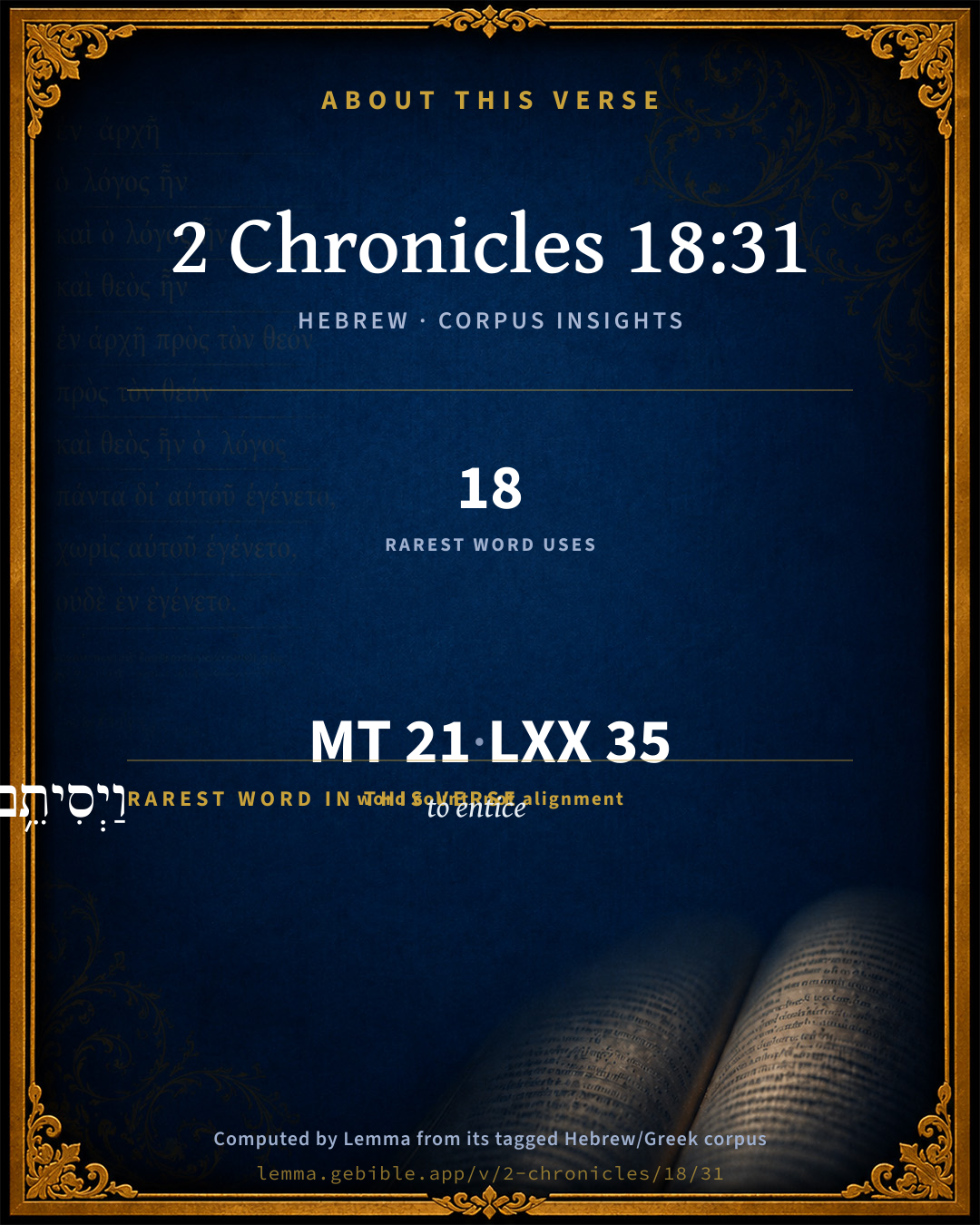
These counts appear in no published source. They are computed here, from the morphology-tagged text and Lemma’s own curated glosses. What Lemma adds →

21
words
20
distinct lemmas
Historical
section

Notable vocabulary

The rarest word here is וַיְסִיתֵ֥ם to entice H5496 — appearing just 18 times in the whole Hebrew Bible.

Shared distinctive vocabulary

וַיְסִיתֵ֥ם to entice H5496 occurs in 18 verses of the Hebrew Bible. Also found in:

Grammatical profile

  • 8 verbs
  • 8 nouns
  • 2 pronouns
  • 2 prepositions
  • 1 particle

Verb forms

  • וַיְהִ֡י Qal · Sequential Imperfect
  • כִּרְאוֹת֩ Qal · Infinitive Construct
  • אָֽמְרוּ֙ Qal · Perfect
  • וַיָּסֹ֥בּוּ Qal · Sequential Imperfect
  • לְהִלָּחֵ֑ם Niphal · Infinitive Construct
  • וַיִּזְעַ֤ק Qal · Sequential Imperfect
  • עֲזָר֔וֹ Qal · Perfect
  • וַיְסִיתֵ֥ם Hiphil · Sequential Imperfect

Repetition

A word recurs within this verse — often emphatic in Hebrew:

  • יְהוֹשָׁפָ֗ט Jehoshaphat H3092 ×2

Hebrew & Septuagint length

In English translation the verse runs 43 words from the Hebrew and 47 from the Septuagint (LXX English) — closely comparable.

A rough comparison of the two English renderings, which tokenize alike — not a word-level alignment.

Word counts can differ between the Hebrew and the Greek without any difference in meaning — e.g. the Hebrew direct-object marker אֵת has no separate Greek word, and Greek often adds the article ὁ.

In the original languages it is 21 Hebrew tokens and 35 Greek tokens — but the two are counted differently (Hebrew bundles its prefixes and suffixes into one token; the Greek is in lemma form), so that isn’t a like-for-like length.

Cross-references

16

Topical passages linked to 2 Chronicles 18:31 in the Treasury of Scripture Knowledge — connected by theme and wording, ordered by reader-vote popularity; previews shown in the World English Bible.

  • 2 Chronicles 13:14 When Judah looked back, behold, the battle was before and behind them; and they cried to Yahweh, and the priests sounded with the trumpets.
  • Psalms 118:13 You pushed me back hard, to make me fall, But Yahweh helped me.
  • Nehemiah 1:11 Lord, I beg you, let now your ear be attentive to the prayer of your servant, and to the prayer of your servants, who delight to fear your name; and please prosper your servant this day, and grant him mercy in the sight of this man. Now I was cup bearer to the king.
  • Psalms 34:7 The angel of Yahweh encamps round about those who fear him, And delivers them.
  • Psalms 46:1 God is our refuge and strength, A very present help in trouble.
  • Psalms 46:11 Yahweh of Hosts is with us. The God of Jacob is our refuge. Selah.
  • Psalms 94:17 Unless Yahweh had been my help, My soul would have soon lived in silence.
  • Psalms 116:1–2 I love Yahweh, because he listens to my voice, And my cries for mercy.
  • Proverbs 16:7 When a man's ways please Yahweh, He makes even his enemies to be at peace with him.
  • Proverbs 21:1 The king's heart is in Yahweh's hand like the watercourses. He turns it wherever he desires.
  • 2 Corinthians 1:9–10 Yes, we ourselves have had the sentence of death within ourselves, that we should not trust in ourselves, but in God who raises the dead,
  • Exodus 14:10 When Pharaoh drew near, the children of Israel lifted up their eyes, and behold, the Egyptians were marching after them; and they were very afraid. The children of Israel cried out to Yahweh.
  • 2 Chronicles 14:11 Asa cried to Yahweh his God, and said, Yahweh, there is none besides you to help, between the mighty and him who has no strength: help us, Yahweh our God; for we rely on you, and in your name are we come against this multitude. Yahweh, you are our God; don't let man prevail against you.
  • 2 Chronicles 26:7 God helped him against the Philistines, and against the Arabians who lived in Gur Baal, and the Meunim.
  • Ezra 1:1 Now in the first year of Cyrus king of Persia, that the word of Yahweh by the mouth of Jeremiah might be accomplished, Yahweh stirred up the spirit of Cyrus king of Persia, so that he made a proclamation throughout all his kingdom, and [put it] also in writing, saying,
  • Ezra 7:27 Blessed be Yahweh, the God of our fathers, who has put such a thing as this in the king's heart, to beautify the house of Yahweh which is in Jerusalem;

Cross-references courtesy of OpenBible.info (CC BY 4.0).

Hebrew and Greek witnesses Masoretic Hebrew ↔ Greek Septuagint

The same verse in the two great witnesses to the Old Testament, shown verse-for-verse.

These are two independent witnesses, not word-aligned to each other, and the Septuagint is shown in lemma (dictionary) form.

Hebrew 2 Chronicles 18:31 Masoretic · Westminster Leningrad Codex

וַיְהִ֡י כִּרְאוֹת֩ שָׂרֵ֨י הָרֶ֜כֶב אֶת יְהוֹשָׁפָ֗ט וְהֵ֤מָּה אָֽמְרוּ֙ מֶ֣לֶךְ יִשְׂרָאֵ֣ל ה֔וּא וַיָּסֹ֥בּוּ עָלָ֖יו לְהִלָּחֵ֑ם וַיִּזְעַ֤ק יְהֽוֹשָׁפָט֙ וַֽיהוָ֣ה עֲזָר֔וֹ וַיְסִיתֵ֥ם אֱלֹהִ֖ים מִמֶּֽנּוּ

It happened, when the captains of the chariots saw Jehoshaphat, that they said, It is the king of Israel. Therefore they turned about to fight against him: but Jehoshaphat cried out, and Yahweh helped him; and God moved them [to depart] from him.

World English Bible · Public Domain

Greek LXX 2 Chronicles 18:31 Septuagint · lemma form

καί γίγνομαι ὡς ὁράω ὁ ἄρχων ὁ ἅρμα ὁ ιωσαφατ καί αὐτός εἶπον βασιλεύς ἰσραήλ εἰμί καί κυκλόω αὐτός ὁ πολεμέω καί βοάω ιωσαφατ καί κύριος σώζω αὐτός καί ἀποστρέφω αὐτός ὁ θεός ἀπό αὐτός

And it came to pass, when the captains of the chariots saw Josaphat, that they said, It is the king of Israel: and they compassed him about to fight against him: and Josaphat cried out, and the Lord delivered him; and God turned them away from him.

LXX2012 (modern English Septuagint) · Public Domain

Hebrew: Westminster Leningrad Codex (CC BY 4.0). Greek: Septuagint (public domain); English from LXX2012 (modern English Septuagint) (Public Domain). How the Septuagint differs from the Hebrew →

Commentary

Notes on 2 Chronicles 18:31 from classic Christian and Jewish commentators (each source and its license shown beneath its notes). The classic Christian expositions comment on the surrounding passage and are grouped to its opening verse, so a note may address several verses; the Jewish commentaries on the Tanakh (Rashi and others) are per-verse, so they appear only where the commentator wrote on this verse.

Lemma curates 59 commentaries, every one of them public domain or Creative Commons licensed, each selected and text-cleaned for this edition rather than reprinted as found. About our sources →

Trapp's Complete Commentary

John Trapp

2Ch 18:31 And it came to pass, when the captains of the chariots saw Jehoshaphat, that they said, It [is] the king of Israel. Therefore they compassed about him to fight: but Jehoshaphat cried out, and the LORD helped him; and God moved them [to depart] from him.

Ver. 31. Therefore they compassed about him.] This great strait Jehoshaphat cast himseff into; as likewise the valiant Hunniades did, at the battle of Varna, where he was worsted, and afterwards taken prisoner by Dracula, for joining with that perjured Popish king of Hungary.

And the Lord helped him.] See 1Ki 22:32, where yet this precious passage is not; but is here added by the penman of this book, who relateth things formerly set down, but oft with usury.

John Trapp, A Commentary or Exposition upon All the Books of the Old and New Testament (1647–1656) — public domain. Text from a community e-Sword module.

Geneva Bible (1599)

Geneva Bible translators

He cried to the Lord by acknowledging his fault in going with this wicked king to war against the word of the Lord by his Prophet, and also by desiring mercy for the same.

Geneva Bible (1599) marginal notes — public domain. Text via Bolls.life.

Adam Clarke's Commentary

Verse 31. But Jehoshaphat cried out] "Jehoshaphat cried, and the WORD of the Lord brought him assistance." - Targum.

Adam Clarke's Commentary on the Bible (1810–1826) — public domain. Text from a community e-Sword/MySword module.

The Cambridge Bible for Schools and Colleges

gen. ed. J. J. S. Perowne

31. saw Jehoshaphat … to fight] Render, saw Jehoshaphat, (now they said, It is the king of Israel!) that they turned about against him to fight. The captains of the chariots obeying the orders given them made a circuit in order to reach the rear of the Israelite army where Jehoshaphat was stationed. The same fact is described in 1 Kin. by the phrase, they turned aside. The A.V. of Chronicles they compassed about him (i.e. “surrounded him”; cp. 2Ch_21:9) is a possible, but less probable, interpretation.

and God moved them to depart from him] These words anticipate 2Ch_18:32 and are not found in 1 Kin. Probably a panic fell on the Syrian charioteers when they found themselves far from the rest of the Syrian army and yet not near the king of Israel.

The Cambridge Bible for Schools and Colleges (gen. ed. J. J. S. Perowne; Cambridge University Press, 1878–1918) — public domain. Text from a community e-Sword module.

Albert Barnes' Notes on the Bible

And the Lord helped him ... - There is nothing correspondent to this passage in Kings. It is a pious reflection on the part of the author, who traces all deliverance to its real divine source.

Albert Barnes' Notes on the Bible (1834–1885) — public domain. Text from a community e-Sword/MySword module.

Haydock's Catholic Bible Commentary

Turned. Heb. "moved them from him." They felt that he was under God’s protection; and discovered that he was not the king of Israel. H.

George Leo Haydock (1774–1849), Haydock's Catholic Family Bible and Commentary, 1859 edition — public domain. Excludes Psalms (Douay-Rheims chapter numbering differs from Protestant) and Deuterocanonical books (Catholic canon only).

The Pulpit Commentary

Comparing this and following verse minutely with the parallel, (1Ki_22:32, 1Ki_22:33) the exact correspondence of the latter of each pair of verses only the more clearly points the significance belonging to the two clauses of foreign matter interposed so characteristically by the writer of Chronicles for his own unvarying special objects, viz. the Lord helped him; and God moved them. What the cry of Jehoshaphat was remains uncertain; whether a cry to his own bodyguard and soldiers, or a cry to those who were beginning to compass him about as bees," to let them know at any rate that he was not the king they sought, or whether most improbably, a cry to the Lord is meant. The cry fulfilled its purpose, and if Jehoshaphat had a sneaking love for Ahab (see the significant "love them," etc., of Jehu in second verse of next chapter), he evidently had not any idea of needlessly dying for him. The happy distinction of perceiving in next verse, as compared with seeing in this verse, is not warranted by the Hebrew text (in both cases twOarKi), though it is by the gist of the connection and English idiom,

The Pulpit Commentary (1880–1919), ed. H.D.M. Spence-Jones & Joseph S. Exell — public domain. Text from a community e-Sword module.

John Wesley's Explanatory Notes

Cried out - He cried out, either to his friends to help, or to his enemies, to let them know, he was not the king of Israel: or to God, and not in vain; for he moved the captains to depart from him. Many are moved in a manner unaccountable both to themselves and others; but an invisible power moves them.

John Wesley, Explanatory Notes Upon the Whole Bible (1754–1765) — public domain. Text via the GEBible commentary corpus.

unfoldingWord translationNotes

Door43 World Missions Community

That is the king of Israel

Jehoshaphat was wrongly identified as the king of Israel because Ahab had insisted that he wear kingly robes.

God turned them away from him

"God caused them to stop pursuing him"

It came about that

This phrase is used here to mark an important event in the story. If your language has a way for doing this, you could consider using it here.

translationWords

Yahweh

unfoldingWord translationNotes — © Distant Shores Media and the Door43 World Missions Community, licensed CC BY-SA 4.0. Source: git.door43.org/Door43/en_tn.

Rashi

Rabbi Shlomo Yitzchaki (Rashi)

and Jehoshaphat cried out He called to his troop and his armies to come to his aid, [using] the sign of the lion on his banner or the banner of the sons of Judah. And so is the custom when two troops engage in battle: each troop gives a name to the insignia of its division for the troop that is with it, so that if they separate from each other or if the troops mingle with one another, each troop shouts the name of its insignia, and they recognize the insignia and all gather together and become one group as originally. He did not, however, cry out to his God, as is proven from I Kings (22:32), for there it does not say, “and the Lord helped him, and God enticed them away from him,” but it is written, And it was when the officers of the chariots saw that he was not the king of Israel for they immediately recognized and understood when he cried out the insignia of his division, as was explained. As soon as they recognized him, they turned away from him in accordance with the order of the king of Aram, and it was from the Lord that they recognized him.

Rashi on the Tanakh — English translations: “The Judaica Press complete Tanach with Rashi, translated by A. J. Rosenberg” (CC BY 4.0); “Pentateuch with Rashi's commentary by M. Rosenbaum and A.M. Silbermann, 1929-1934” (public domain); “The Metsudah Tanach series, Lakewood, N.J” (CC BY 4.0); and “The Book of Joshua, Metsudah Publications, 1997” (CC BY 4.0). Text via Sefaria.

Lesson kit

Teaching starters — assembled from the data on this page, not authored interpretation. Every prompt links to the verse data it draws on. Edit before teaching.

2 Chronicles, in the Historical, opens this verse with 21 words (20 distinct Hebrew lemmas). Its most distinctive word is çûwth (“to entice”). A historical commentator’s framing appears above. Read the whole chapter for the surrounding context.

Discussion questions

  1. What does “to entice” (çûwth) contribute to the verse as a whole?
  2. How does Deuteronomy 13:6, which shares the word «to entice», read alongside this verse?
  3. What does the repetition of “Jehoshaphat” (2× in this one verse) do in this verse?
  4. These translations render this verse differently. What is at stake in choosing one wording over another?
  5. «וַיְהִ֡י» is a Qal Sequential Imperfect verb. How does that grammatical form shape the action described?
  6. Compare how Trapp's Complete Commentary and Geneva Bible (1599) read this verse. Where do they agree or differ?

Things to notice

Reading settings

Reading text

Shown beneath each verse's original-language words.

Old Testament
Old Testament edition

Read the OT as the Masoretic Hebrew (MT) or the Greek Septuagint (LXX).

English shown for the Greek Septuagint (in the Hebrew ↔ Greek comparison).

Comparing translations? Open the Compare panel on any verse page to stack up to four side by side.