Exodus 15:2

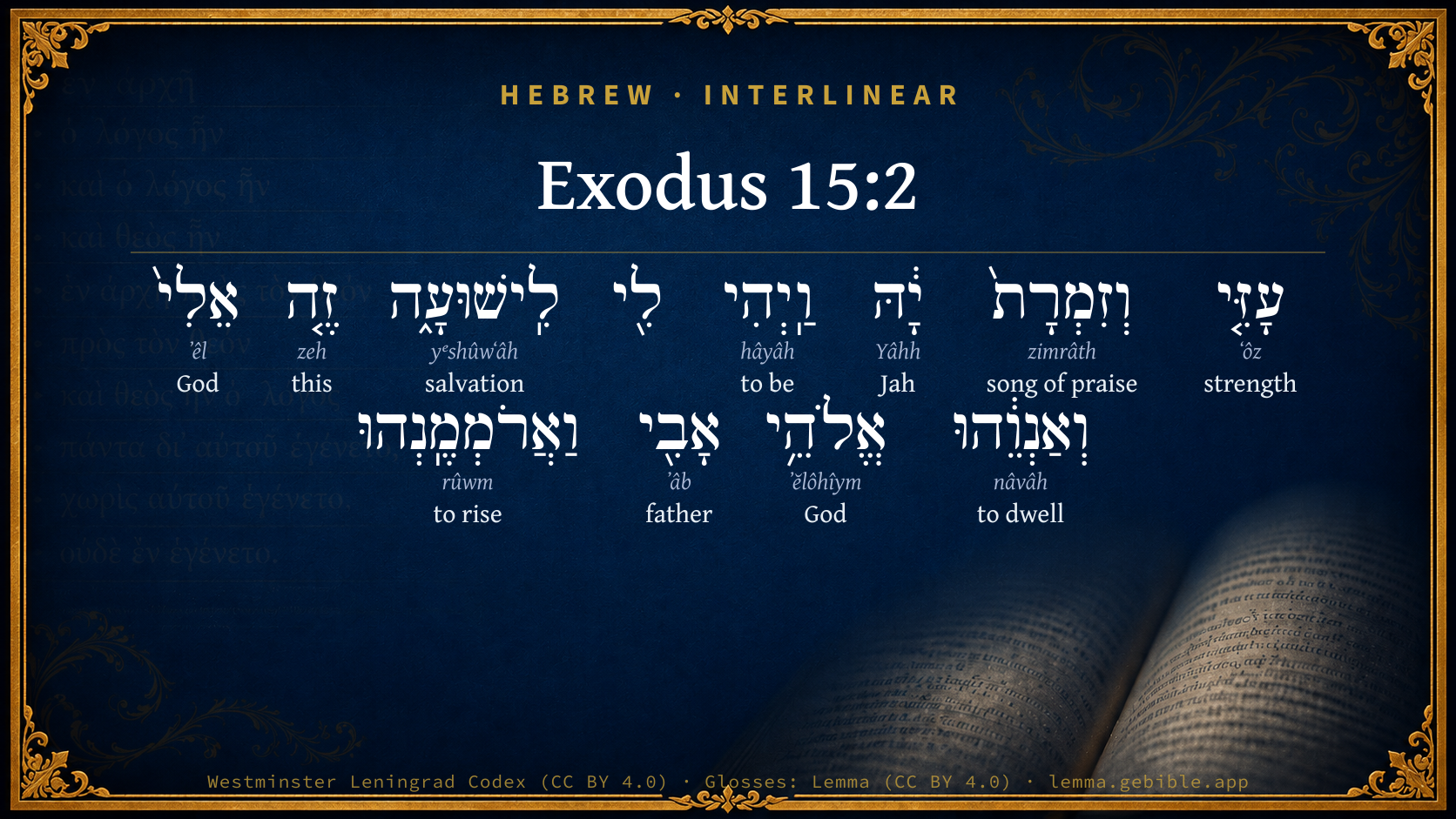
Hebrew (Westminster Leningrad Codex) Exodus 15:2 appears in the Hebrew Old Testament. The text above is from the Westminster Leningrad Codex. Each word links to its Strong’s number, a concise gloss, and parsing drawn from the Open Scriptures Hebrew Bible morphology. Click any word for its full Brown-Driver-Briggs (BDB) entry.
Download image
Cite this verse

Exodus 15:2 (World English Bible). Public Domain. Lemma interlinear Bible study tool, https://lemma.gebible.app/v/exodus/15/2.

Show BibTeX & RIS
BibTeX
RIS
English Translation
Yah is my strength and song, He has become my salvation: This is my God, and I will praise him; My father's God, and I will exalt him.
World English Bible · Public Domain
Highlights
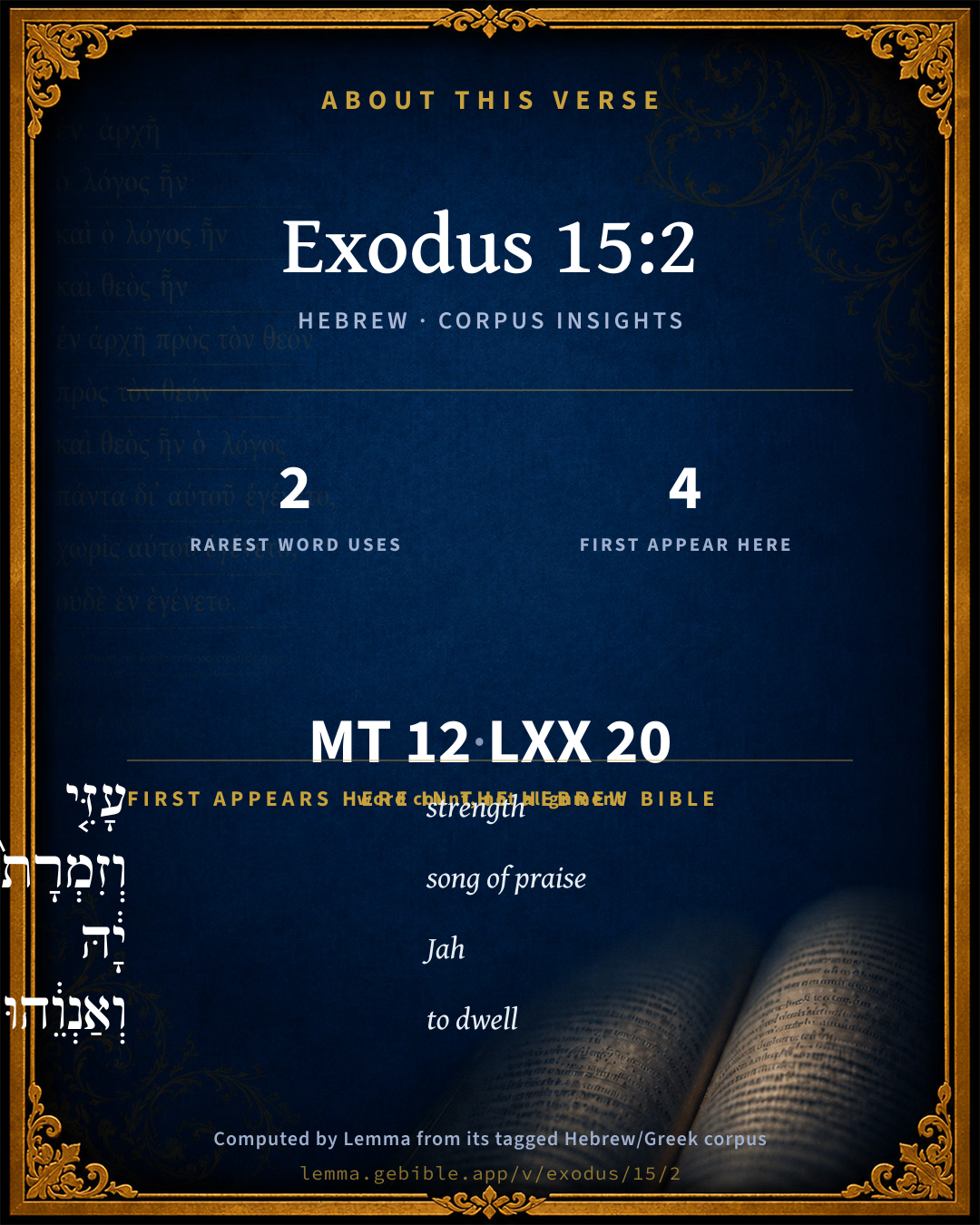
  • 4 first appearances in the Hebrew Bible
Full analysis ↓
Download a study sheet

One document with this verse’s original text, its word-by-word gloss line, the meaning frame, cross-references with their text, attributed commentary, and full source and license credits — printable, and it pastes into notes with its structure intact.

This verse Autodidact and up

Study sheet (.html) Plain text (.txt)

A passage Seminary Student

Up to 50 verses in one chapter. A passage sheet keeps up to 6 commentary sources and 12 cross-references per verse, in the order this page ranks them, and says so on the sheet whenever that leaves anything out. Ask for a single verse and you get the Autodidact verse sheet above.

Everything on this page stays free to read, with no account — the sheet is a download of what is already on screen, not access to it.

Want to remove ads? Support Godless Engineer
Compare translations 3

The same verse in 3 English versions, stacked beneath the original-language interlinear above. Click any original word for its lexicon entry.

Each is an independent rendering of the whole verse — the interlinear is not word-aligned to these translations.

Highlighted words mark where these versions differ — a whole-verse word diff, not a word-by-word alignment.

  • World English Bible Public Domain
    Yah is my strength and song, He has become my salvation: This is my God, and I will praise him; My father's God, and I will exalt him.
  • King James Version Public Domain
    The LORD is my strength and song, and he is become my salvation: he is my God, and I will prepare him an habitation; my father's God, and I will exalt him.
  • unfoldingWord Literal Text CC BY-SA 4.0
    Yah is my strength and my song, and he has become my salvation. This is my God, and I will glorify him, the God of my father, and I will exalt him.

unfoldingWord Literal Text — © unfoldingWord, licensed CC BY-SA 4.0. Word-aligned USFM3 via Door43 (git.door43.org/unfoldingWord/en_ult).

Versions to compare (up to 4)

3 of 4 selected

Show all 18 translations

Every available English version of this verse, each an independent rendering of the whole verse.

  • World English Bible Public Domain
    Yah is my strength and song, He has become my salvation: This is my God, and I will praise him; My father's God, and I will exalt him.
  • Berean Standard Bible Public Domain
    The LORD is my strength and my song, and He has become my salvation. He is my God, and I will praise Him, my father’s God, and I will exalt Him.
  • Majority Standard Bible Public Domain
    The LORD is my strength and my song, and He has become my salvation. He is my God, and I will praise Him, my father’s God, and I will exalt Him.
  • King James Version Public Domain
    The LORD is my strength and song, and he is become my salvation: he is my God, and I will prepare him an habitation; my father's God, and I will exalt him.
  • American Standard Version (1901) Public Domain
    Jehovah is my strength and song, And he is become my salvation: This is my God, and I will praise him; My father's God, and I will exalt him.
  • Revised Version (1885) Public Domain
    The LORD is my strength and song, And he is become my salvation: This is my God, and I will praise him; My father’s God, and I will exalt him.
  • Geneva Bible (1599) Public Domain
    The Lord is my strength and praise, and he is become my saluation. He is my God, and I will prepare him a tabernacle. he is my fathers God, and I will exalt him.
  • Douay-Rheims (1899) Public Domain
    The Lord is my strength and my praise, and he is become salvation to me: he is my God and I will glorify him: the God of my father, and I will exalt him.
  • Young's Literal Translation Public Domain
    My strength and song is JAH, And He is become my salvation: This `is' my God, and I glorify Him; God of my father, and I exalt Him.
  • Literal Standard Version CC BY-SA 4.0
    My strength and song is YAH, || And He is become my salvation: This [is] my God, and I glorify Him; God of my father, and I exalt Him.
  • Unlocked Literal Bible CC BY-SA 4.0
    Yahweh is my strength and song, and he has become my salvation. This is my God, and I will praise him, my father's God, and I will exalt him.
  • unfoldingWord Literal Text CC BY-SA 4.0
    Yah is my strength and my song, and he has become my salvation. This is my God, and I will glorify him, the God of my father, and I will exalt him.
  • Darby Bible Public Domain
    My strength and song is Jah, and he is become my salvation: This is my ùGod, and I will glorify him; My father's God, and I will extol him.
  • World Messianic Bible Public Domain
    The LORD is my strength and song. He has become my salvation [yeshu`ah]. This is my God, and I will praise him; my father’s God, and I will exalt him.
  • Webster's Bible Public Domain
    The LORD is my strength and song, and he is become my salvation: he is my God, and I will prepare him a habitation; my father's God, and I will exalt him.
  • Free Bible Version CC BY-SA 4.0
    The Lord gives me strength. He is the theme of my song. He saves me. He is my God, and I will praise him. He is my father's God, and I will honor him.
  • Bible in Basic English Public Domain
    The Lord is my strength and my strong helper, he has become my salvation: he is my God and I will give him praise; my father's God and I will give him glory.
  • JPS Tanakh (1917) Public Domain
    The LORD is my strength and song, and He is become my salvation; this is my God, and I will glorify Him; my father's God, and I will exalt Him.

Literal Standard Version (2020), Covenant Press — licensed CC BY-SA 4.0. Text via the HelloAO Bible API (eBible.org). Unlocked Literal Bible (unfoldingWord) — licensed CC BY-SA 4.0. Text via the HelloAO Bible API (eBible.org). unfoldingWord Literal Text — © unfoldingWord, licensed CC BY-SA 4.0. Word-aligned USFM3 via Door43 (git.door43.org/unfoldingWord/en_ult). Free Bible Version, Dr. Jonathan Gallagher — licensed CC BY-SA 4.0. Text via the HelloAO Bible API (eBible.org).

Word by word

More ways to search: Search by grammar → Find every occurrence → Compare this word →

Practice this passage: Drill this verse → Learn its vocabulary →

וְאַנְוֵ֔הוּ
nâvâh
H5115
“and · to dwell · him”
Conjunction + Verb, Hiphil, Imperfect, 1st Person, Common, Singular + Suffix, Personal, 3rd Person, Masculine, Singular
Part of Speech
Conjunction + Verb
Stem
Hiphil
Form
Imperfect
Person
1st Person
Gender
Common
Number
Singular
Full BDB Definition

Origin: a primitive root

TWOT: 1321 , 1322

to beautify - (Hiphil) to beautify, adorn - to dwell - (Qal) to dwell, abide, keep at home - (Hophal) rest
  1. עָזִּ֤י ʻôz H5797 “strength · my” Noun, Common, Masculine, Singular, Construct + Suffix, Personal, 1st Person, Common, Singular
  2. וְזִמְרָת֙ zimrâth H2176 “and · song of praise” Conjunction + Noun, Common, Feminine, Singular, Absolute
  3. יָ֔הּ Yâhh H3050 “Jah” Noun, Proper
  4. וַֽיְהִי hâyâh H1961 “and · to be” Conjunction + Verb, Qal, Sequential Imperfect, 3rd Person, Masculine, Singular
  5. לִֽישׁוּעָ֑ה yᵉshûwʻâh H3444 “to/for · salvation” Preposition + Noun, Common, Feminine, Singular, Absolute
  6. זֶ֤ה zeh H2088 “this” Pronoun, Demonstrative, Masculine, Singular
  7. אֵלִי֙ ʼêl H410 “God · my” Noun, Common, Masculine, Singular, Construct + Suffix, Personal, 1st Person, Common, Singular
  8. אֱלֹהֵ֥י ʼĕlôhîym H430 “God(s) of” Noun, Common, Masculine, Plural, Construct
  9. אָבִ֖י ʼâb H1 “father · my” Noun, Common, Masculine, Singular, Construct + Suffix, Personal, 1st Person, Common, Singular
  10. וַאֲרֹמְמֶֽנְהוּ rûwm H7311 “and · to rise · him” Conjunction + Verb, Polel, Imperfect, 1st Person, Common, Singular + Suffix, Personal, 3rd Person, Masculine, Singular

About this verse

These counts appear in no published source. They are computed here, from the morphology-tagged text and Lemma’s own curated glosses. What Lemma adds →

12
words
11
distinct lemmas
Pentateuch
section

Notable vocabulary

The rarest word here is וְאַנְוֵ֔הוּ to dwell H5115 — appearing just 2 times in the whole Hebrew Bible.

First appearance in Scripture

These words make their first canonical appearance in the Hebrew Bible here:

  • עָזִּ֤י strength H5797
  • וְזִמְרָת֙ song of praise H2176
  • יָ֔הּ Jah H3050
  • וְאַנְוֵ֔הוּ to dwell H5115

Shared distinctive vocabulary

וְאַנְוֵ֔הוּ to dwell H5115 occurs in 2 verses of the Hebrew Bible. Also found in:

Grammatical profile

  • 3 verbs
  • 7 nouns
  • 1 pronoun
  • 1 preposition

Verb forms

  • וַֽיְהִי Qal · Sequential Imperfect
  • וְאַנְוֵ֔הוּ Hiphil · Imperfect
  • וַאֲרֹמְמֶֽנְהוּ Polel · Imperfect

Hebrew & Septuagint length

In English translation the verse runs 28 words from the Hebrew and 27 from the Septuagint (LXX English) — closely comparable.

A rough comparison of the two English renderings, which tokenize alike — not a word-level alignment.

Word counts can differ between the Hebrew and the Greek without any difference in meaning — e.g. the Hebrew direct-object marker אֵת has no separate Greek word, and Greek often adds the article ὁ.

In the original languages it is 12 Hebrew tokens and 20 Greek tokens — but the two are counted differently (Hebrew bundles its prefixes and suffixes into one token; the Greek is in lemma form), so that isn’t a like-for-like length.

Cross-references

54

Topical passages linked to Exodus 15:2 in the Treasury of Scripture Knowledge — connected by theme and wording, ordered by reader-vote popularity; previews shown in the World English Bible.

  • Isaiah 12:2 Behold, God is my salvation. I will trust, and will not be afraid; for Yah, Yahweh, is my strength and song; and he has become my salvation."
  • Psalms 118:14 Yah is my strength and song. He has become my salvation.
  • Psalms 18:46 Yahweh lives; and blessed be my rock. Exalted be the God of my salvation,
  • Psalms 59:17 To you, my strength, I will sing praises. For God is my high tower, the God of my mercy.
  • Isaiah 25:1 Yahweh, you are my God; I will exalt you, I will praise your name; for you have done wonderful things, [even] counsels of old, in faithfulness [and] truth.
  • Psalms 18:1–2 I love you, Yahweh, my strength.
  • Psalms 140:7 Yahweh, the Lord, the strength of my salvation, You have covered my head in the day of battle.
  • Psalms 99:9 Exalt Yahweh, our God. Worship at his holy hill, For Yahweh, our God, is holy!
  • Psalms 145:1 I will exalt you, my God, the King. I will praise your name forever and ever.
  • Psalms 30:1 I will extol you, Yahweh, for you have raised me up, And have not made my foes to rejoice over me.
  • Isaiah 45:17 [But] Israel shall be saved by Yahweh with an everlasting salvation: you shall not be disappointed nor confounded world without end.
  • Philippians 4:13 I can do all things through Christ, who strengthens me.
  • Exodus 3:15–16 God said moreover to Moses, "You shall tell the children of Israel this, 'Yahweh, the God of your fathers, the God of Abraham, the God of Isaac, and the God of Jacob, has sent me to you.' This is my name forever, and this is my memorial to all generations.
  • Psalms 99:5 Exalt Yahweh our God. Worship at his footstool. He is Holy!
  • Psalms 118:28 You are my God, and I will give thanks to you. You are my God, I will exalt you.
  • 2 Corinthians 5:19 namely, that God was in Christ reconciling the world to himself, not reckoning to them their trespasses, and having committed to us the word of reconciliation.
  • Philippians 2:11 and that every tongue should confess that Jesus Christ is Lord, to the glory of God the Father.
  • Revelation 5:9–14 They sang a new song, saying, "You are worthy to take the book, And to open its seals: For you were killed, And bought us for God with your blood, Out of every tribe, language, people, and nation,
  • Exodus 3:6 Moreover he said, "I am the God of your father, the God of Abraham, the God of Isaac, and the God of Jacob." Moses hid his face; for he was afraid to look at God.
  • Exodus 40:34 Then the cloud covered the tent of meeting, and the glory of Yahweh filled the tent.
  • Psalms 27:1 Yahweh is my light and my salvation. Whom shall I fear? Yahweh is the strength of my life. Of whom shall I be afraid?
  • Psalms 34:3 Oh magnify Yahweh with me. Let us exalt his name together.
  • Ephesians 2:22 in whom you also are built together for a habitation of God in the Spirit.
  • Revelation 15:3 They sang the song of Moses, the servant of God, and the song of the Lamb, saying, "Great and marvelous are your works, Lord God, the Almighty; Righteous and true are your ways, you King of the nations.
  • Genesis 28:21–22 so that I come again to my father's house in peace, and Yahweh will be my God,
  • Exodus 4:22 You shall tell Pharaoh, 'Thus says Yahweh, Israel is my son, my firstborn,
  • Exodus 14:13 Moses said to the people, "Don't be afraid. Stand still, and see the salvation of Yahweh, which he will work for you today: for the Egyptians whom you have seen today, you shall never see them again.
  • Deuteronomy 10:21 He is your praise, and he is your God, who has done for you these great and awesome things, which your eyes have seen.
  • 2 Samuel 22:47 Yahweh lives; Blessed be my rock; Exalted be God, the rock of my salvation,
  • 1 Kings 8:27 But will God in very deed dwell on the earth? behold, heaven and the heaven of heavens can't contain you; how much less this house that I have built!
  • Psalms 22:3 But you are holy, You who inhabit the praises of Israel.
  • Psalms 22:10 I was thrown on you from my mother's womb. You are my God since my mother bore me.
  • Habakkuk 3:17–19 For though the fig tree doesn't flourish, Nor fruit be in the vines; The labor of the olive fails, The fields yield no food; The flocks are cut off from the fold, And there is no herd in the stalls:
  • Luke 1:77 To give knowledge of salvation to his people by the remission of their sins,
  • John 5:23 that all may honor the Son, even as they honor the Father. He who doesn't honor the Son doesn't honor the Father who sent him.
  • Acts 4:12 There is salvation in none other, for neither is there any other name under heaven, that is given among men, by which we must be saved!"
  • Psalms 109:1 God of my praise, don't remain silent,
  • Isaiah 49:6 yes, he says, It is too light a thing that you should be my servant to raise up the tribes of Jacob, and to restore the preserved of Israel: I will also give you for a light to the Gentiles, that you may be my salvation to the end of the earth.
  • Jeremiah 31:33 But this is the covenant that I will make with the house of Israel after those days, says Yahweh: I will put my law in their inward parts, and in their heart will I write it; and I will be their God, and they shall be my people:
  • Genesis 17:7 I will establish my covenant between me and you and your seed after you throughout their generations for an everlasting covenant, to be a God to you and to your seed after you.
  • 2 Samuel 7:5 Go and tell my servant David, Thus says Yahweh, Shall you build me a house for me to dwell in?
  • 2 Samuel 22:51 Great deliverance gives he to his king, Shows loving kindness to his anointed, To David and to his seed, forevermore.
  • 1 Kings 8:13 I have surely built you a house of habitation, a place for you to dwell in forever.
  • Psalms 28:8 Yahweh is their strength. He is a stronghold of salvation to his anointed.
  • Psalms 62:6–7 He alone is my rock and my salvation, my fortress. I will not be shaken.
  • Psalms 68:20 God is to us a God of deliverance. To Yahweh, the Lord, belongs escape from death.
  • Psalms 132:5 Until I find out a place for Yahweh, A dwelling for the Mighty One of Jacob."
  • Isaiah 66:1 Thus says Yahweh, heaven is my throne, and the earth is my footstool: what manner of house will you build to me? and what place shall be my rest?
  • Jeremiah 3:23 Truly in vain is [the help that is looked for] from the hills, the tumult on the mountains: truly in Yahweh our God is the salvation of Israel.
  • Jeremiah 32:38 and they shall be my people, and I will be their God:
  • Zechariah 13:9 I will bring the third part into the fire, And will refine them as silver is refined, And will test them like gold is tested. They will call on my name, and I will hear them. I will say, 'It is my people;' And they will say, 'Yahweh is my God.'"
  • Luke 2:30 For my eyes have seen your salvation,
  • John 4:22 You worship that which you don't know. We worship that which we know; for salvation is from the Jews.
  • Revelation 19:1 After these things I heard something like a loud voice of a great multitude in heaven, saying, "Hallelujah! Salvation, power, and glory belong to our God:

Cross-references courtesy of OpenBible.info (CC BY 4.0).

Hebrew and Greek witnesses Masoretic Hebrew ↔ Greek Septuagint

The same verse in the two great witnesses to the Old Testament, shown verse-for-verse.

These are two independent witnesses, not word-aligned to each other, and the Septuagint is shown in lemma (dictionary) form.

Hebrew Exodus 15:2 Masoretic · Westminster Leningrad Codex

עָזִּ֤י וְזִמְרָת֙ יָ֔הּ וַֽיְהִי לִ֖י לִֽישׁוּעָ֑ה זֶ֤ה אֵלִי֙ וְאַנְוֵ֔הוּ אֱלֹהֵ֥י אָבִ֖י וַאֲרֹמְמֶֽנְהוּ

Yah is my strength and song, He has become my salvation: This is my God, and I will praise him; My father's God, and I will exalt him.

World English Bible · Public Domain

Greek LXX Exodus 15:2 Septuagint · lemma form

βοηθός καί σκεπαστής γίγνομαι ἐγώ εἰς σωτηρία οὗτος ἐγώ θεός καί δοξάζω αὐτός θεός ὁ πατήρ ἐγώ καί ὑψόω αὐτός

He was to me a helper and protector for salvation: this is my God and I will glorify him; my father's God, and I will exalt him.

LXX2012 (modern English Septuagint) · Public Domain

On this verse, Ellicott's Commentary for English Readers discusses the Septuagint’s reading. Read the note in Commentary ↓

Hebrew: Westminster Leningrad Codex (CC BY 4.0). Greek: Septuagint (public domain); English from LXX2012 (modern English Septuagint) (Public Domain). How the Septuagint differs from the Hebrew →

Targum (Aramaic paraphrase)

2

The Targum is the ancient Jewish Aramaic paraphrase of the Hebrew Scriptures — an interpretive translation, not the Hebrew text itself. Onkelos (literal) and Pseudo-Jonathan (expansive) render the Torah, and Jonathan the Prophets. Coverage is partial: where no permissively-licensed English translation exists for a verse, only the Aramaic is shown. This is verse-level text, not a word-by-word alignment to the Hebrew.

  1. Targum Onkelos Torah (Genesis–Deuteronomy)
    תָּקְפִּי וְתִשְׁבַּחְתִּי דְחִילָא יְיָ וַאֲמַר בְּמֵימְרֵהּ וַהֲוָה לִי לְפָרָק דֵין אֱלָהַי וְאֶבְנֵי לֵהּ מַקְדְשָׁא אֱלָהָא דַאֲבָהָתַי וְאֶפְלַח קֳדָמוֹהִי:

    (no public-domain English translation for this verse)

    Targum Onkelos — Aramaic: “Onkelos Genesis” (public domain); “Onkelos Exodus” (public domain); “Onkelos Leviticus” (public domain); “Onkelos Numbers” (public domain); “Onkelos Deuteronomy” (public domain). English: “Sefaria Community Translation” (CC0 1.0 (public-domain dedication)); “J.W. Etheridge. The Targums of Onkelos and Jonathan Ben Uzziel on the Pentateuch. London: Longmans, Green, 1862” (public domain). Text via Sefaria.

  2. Targum Pseudo-Jonathan Torah (Genesis–Deuteronomy)
    תּוּקְפַן וְרוֹב תּוּשְׁבָּחָתָן דְּחֵיל עַל כָּל עָלְמַיָא יְיָ אָמַר בְּמֵימְרֵיהּ וַהֲוָה לִי אֱלָהָא פְּרוֹק מִן חַדְיֵי אִמְהוֹן הֲווֹן יַנְקַיָא מְחַוָון בְּאֶצְבָּעַתְהוֹן לְאַבְהַתְהוֹן וְאָמְרִין דֵּין הוּא אֱלָהָן דַּהֲוָה מוֹנִיק לָן דּוּבְשָׁא מִן כֵּיפָא וּמְשַׁח מִן שָׁמִיר טִינְרָא בְּעִידַן דְּאִימַן נַפְקַן לְאַנְפֵּי בָּרָא וִילֵדַן וְשַׁבְקַן יָתָן תַּמָּן וּתְשַׁדַר מַלְאָכָא וּמַסְחֵי יָתָן וּמְלַפֵּף יָתָן וּכְדוּן נַשְׁבְּחִינֵיהּ אֱלָהָא דְּאַבְהָתָן וּנְרוֹמְמִינֵיהּ

    The Lord is Mighty, and greatly to be feared over all the world. He spake in His Word, and became to me a God of salvation. From their mothers' breasts even the children have given signs with their fingers to their fathers, and said This is our God, who nourished us with honey from the rock, and with oil from the stone of clay, at the time when our mothers went forth upon the face of the field to give us birth, and leave us there; and He sent an angel who washed us and enwrapped us; and now will we praise Him: He is the God of our fathers, and we will exalt Him.

    Targum Pseudo-Jonathan — Aramaic: “Targum Jonathan on Genesis” (public domain); “Targum Jonathan on Exodus” (public domain); “Targum Jonathan on Leviticus” (public domain); “Targum Jonathan on Numbers” (public domain); “Targum Jonathan on Deuteronomy” (public domain). English: “The Targum of Jonathan ben Uzziel, trans. J. W. Etheridge, London, 1862” (public domain). Text via Sefaria.

Commentary

Notes on Exodus 15:2 from classic Christian and Jewish commentators (each source and its license shown beneath its notes). The classic Christian expositions comment on the surrounding passage and are grouped to its opening verse, so a note may address several verses; the Jewish commentaries on the Tanakh (Rashi and others) are per-verse, so they appear only where the commentator wrote on this verse.

Lemma curates 59 commentaries, every one of them public domain or Creative Commons licensed, each selected and text-cleaned for this edition rather than reprinted as found. About our sources →

Ellicott's Commentary for English Readers

(2) The Lord is my strength and song.—Heb., My strength and song is Jah. The contracted form of Jehovah, Jah, is here used for the first time; but its existence in the current speech has already been indicated by the name Moriah, which occurs in Gen_22:1. It is here used on account of the rhythm.

He is become my salvation.—Heb,, he has been to me for salvation: i.e., “he has saved me out of the hand of Pharaoh.” The beauty and force of the passage causes Isaiah to adopt it into one of his most glorious poems, the “joyful thanksgiving of the faithful for the mercies of God,” contained in his twelfth chapter. (See Exo_15:2.)

I will prepare him an habitation.—So Onkelos and Aben-Ezra; but Jarchi, the Targums of Jerusalem and Jonathan, the LXX., and Vulg., with most moderns, translate, “I will glorify him.” It is a strong objection to the rendering of the Authorised Version that Moses is not likely to have had the idea of preparing God a habitation until the revelation of God’s will on the subject was made to him on Sinai (Exodus 25-27). The law of parallelism also requires such a meaning as “glorify” to correspond with the “exalt” of the next clause.

My father’s God.—“Father” here, by a common Hebrew idiom, stands for “forefathers” generally. (Comp. Note on Exo_3:6.)

A Bible Commentary for English Readers, edited by Charles John Ellicott (1878–1897) — public domain. Text from a community e-Sword module.

Trapp's Complete Commentary

John Trapp

Exo 15:2 The LORD [is] my strength and song, and he is become my salvation: he [is] my God, and I will prepare him an habitation; my father’s God, and I will exalt him.

Ver. 2. I will prepare him a habitation.] Or, I will adorn him i I will give him ornaments and trimmings. Such God accounts our poor praises.

John Trapp, A Commentary or Exposition upon All the Books of the Old and New Testament (1647–1656) — public domain. Text from a community e-Sword module.

Joseph Benson's Commentary

Exo 15:2. Israel rejoiceth in God, as their strength, song, and salvation — Happy, therefore, the people whose God is the Lord: they are weak in themselves, but he strengthens them; his grace is their strength: they are oft in sorrow, but in him they have comfort; he is their song: sin and death threaten them, but he is, and will be their salvation. He is their fathers’ God — This they take notice of, because, being conscious of their own unworthiness, they had reason to think that what God had now done for them was for their fathers’ sake, Deu 4:37. I will prepare him a habitation — This version is countenanced by the Chaldee, Extruam ei sanctuarium, I will build him a sanctuary, referring probably to the tabernacles soon to be built, to which there seems also to be an allusion in Exo 15:13. Rab. Salom., however, considers the Hebrew word here used as being derived from נוי, נוהand נאה, and translates it, I will declare his beauty and his praise. To the same purpose the Seventy, δοξασω, and the Vulgate, glorificabo, I will glorify him.

Joseph Benson's Commentary on the Old and New Testaments (1811–1818) — public domain. Text from a community e-Sword module.

MacLaren's Expositions of Holy Scripture

Alexander MacLaren

Exodus

‘MY STRENGTH AND SONG’

Exo 15:2.

These words occur three times in the Bible: here, in Isa 12:2, and in Psa 18:14.

I. The lessons from the various instances of their occurrence. The first and second teach that the Mosaic deliverance is a picture-prophecy of the redemption in Christ. The third {Psa 18:14}, long after, and the utterance of some private person, teaches that each age and each soul has the same mighty Hand working for it. ‘As we have heard, so have we seen.’

II. The lessons from the words themselves.

{a} True faith appropriates God’s universal mercy as a personal possession. ‘My Lord and my God!’ ‘He loved me, and gave Himself for me.’

{b} Each single act of mercy should reveal God more clearly as ‘My strength.’ The ‘and’ in the second clause is substantially equivalent to ‘for.’ It assigns the reason for the assurance expressed in the first. Because of the experienced deliverance and God’s manifestation of Himself in it as the author of ‘salvation,’ my faith wins happy increase of confidence that He ‘is the strength of my heart.’ Blessed they who bring that treasure out of all the sorrows of life!

{c} The end of His deliverances is ‘praise.’ ‘He is my song.’ This is true for earth and for heaven. The ‘Song of Moses and the Lamb.’

Alexander MacLaren, Expositions of Holy Scripture (1904–1910) — public domain. Text from a community e-Sword module.

Tyndale Open Study Notes

Tyndale Open Resources

15:2 This statement is quoted in two other places, Ps 118:14 and Isa 12:2, which shows its importance. The “God of your father” (Exod 3:6) had become my God. The Israelites now knew God for themselves and not just as a historical memory.

Tyndale Open Study Notes — © Tyndale Open Resources, licensed CC BY-SA 4.0. Text via the HelloAO Bible API.

Geneva Bible (1599)

Geneva Bible translators

Or, the occasion of my song of praise.

To worship him therein.

Geneva Bible (1599) marginal notes — public domain. Text via Bolls.life.

Adam Clarke's Commentary

Verse 2. The Lord is my strength and song] How judiciously are the members of this sentence arranged! He who has God for his strength, will have him for his song; and he to whom Jehovah is become salvation, will exalt his name. Miserably and untunably, in the ears of God, does that man sing praises, who is not saved by the grace of Christ, nor strengthened by the power of his might.

It is worthy of observation that the word which we translate LORD here, is not יהוה JEHOVAH in the original, but יה JAH; "as if by abbreviation," says Mr. Parkhurst, "for יהיה yeheieh or יהי yehi. It signifies the Essence οων, He who IS, simply, absolutely, and independently. The relation between יה Jah and the verb היה to subsist, exist, be, is intimated to us the first time יה Jah is used in Scripture, (Ex 15:2:) 'My strength and my song is יה JAH, and he is become ( vajehi) to me salvation.'" See Ps 68:5; Ps 89:6; Ps 94:7; Ps 115:17-18; Ps 118:17.

JAH יה is several times joined with the name Jehovah יהוה so that we may be sure that it is not, as some have supposed, a mere abbreviation of that word. See Isa 12:2; Isa 26:4. Our blessed Lord solemnly claims to himself what is intended in this Divine name יה JAH, Joh 8:58: "Before Abraham was, (γενεσθαι, was born,) εγω ειμι, I AM," not I was, but I am, plainly intimating his Divine eternal existence. Compare Isa 43:13. And the Jews appear to have well understood him, for then took they up stones to cast at him as a blasphemer. Compare Col 1:16-17, where the Apostle Paul, after asserting that all things that are in heaven and that are in earth, visible and invisible, were created, εκτισται, by and for Christ, adds And HE IS (αυτος εστι, not ην, was) before all things, and by him all things συνεστηκε, have subsisted, and still subsist. See Parkhurst.

From this Divine name יה Jah the ancient Greeks had their Ιη, Ιη, in their invocations of the gods, particularly of Apollo (the uncompounded ONE) the light; and hence EI, written after the oriental manner from right to left, afterwards IE, was inscribed over the great door of the temple at Delphi! See Clarke on Ex 3:14, and the concluding observations there.

I will prepare him a habitation] ואנוהו veanvehu. It has been supposed that Moses, by this expression, intended the building of the tabernacle; but it seems to come in very strangely in this place. Most of the ancient versions understood the original in a very different sense.

The Vulgate has et glorificabo eum; the Septuagint δοξασω αυτον, I will GLORIFY him; with which the Syriac, Coptic, the Targum of Jonathan, and the Jerusalem Targum, agree. From the Targum of Onkelos the present translation seems to have been originally derived; he has translated the place ואבני לה מקדש veebnei leh makdash, "And I will build him a sanctuary," which not one of the other versions, the Persian excepted, acknowledges. Our own old translations are generally different from the present: Coverdale, "This my God, I will magnify him;" Matthew's, Cranmer's, and the Bishops' Bible, render it glorify, and the sense of the place seems to require it. Calmet, Houbigant, Kennicott, and other critics, contend for this translation.

My father's God] I believe Houbigant to be right, who translates the original, אלהי אבי Elohey abi, Deus meus, pater meus est, "My God is my Father." Every man may call the Divine Being his GOD; but only those who are his children by adoption through grace can call him their FATHER. This is a privilege which God has given to none but his children. See Ga 4:6.

Adam Clarke's Commentary on the Bible (1810–1826) — public domain. Text from a community e-Sword/MySword module.

The Cambridge Bible for Schools and Colleges

gen. ed. J. J. S. Perowne

2. Yah is my strength and a song] i.e. the source of my strength and the theme of my song. Yah, the abbreviated form of Yahweh, occurs otherwise in Exo_17:16, Isa_12:2 (in a citation of the present verse), Exo_26:4 (post-exilic), Exo_38:12 (Hezekiah’s song), Son_8:6; otherwise only in late Psalms (40 times, mostly in ‘Hallelu-yah’).

my … I] The poet speaks, as Hebrew poets often do (e.g. Isa_61:10; Psa_44:4; Psa_44:6; Psa_118:5-21; Psa_118:28), in the name, and as the representative, of the nation.

is become my salvation] lit. is become to me a salvation, i.e. a source of deliverance (‘salvation,’ as Exo_14:13): cf. exactly the same Heb. in 2Sa_10:11 ‘then thou shalt be to me for salvation,’ EVV. ‘thou shalt help me.’ This and the last line are cited in Isa_12:2 b, and Psa_118:14.

praise] The Heb. word occurs only here. If correct, it would seem to mean beautify or adorn (viz. with praises). But this is a great deal to supply; and probably, by a slight change, we should read acknowledge or thank (Psa_9:1, &c.; and especially Psa_118:28 a). AV. prepare him an habitation follows the Targ. and Rabbis in treating hinwâh, improbably, as a denominative from nâweh, ‘habitation’ (v. 13).

My father’s God] my ancestral God; cf. on Exo_3:6.

I will exalt him] Psa_30:1; and especially Psa_118:28 b.

2–5. Jehovah is the object of the poet’s praise, Jehovah, the potent and irresistible ‘man of war,’ who has overwhelmed His enemies in the sea.

The Cambridge Bible for Schools and Colleges (gen. ed. J. J. S. Perowne; Cambridge University Press, 1878–1918) — public domain. Text from a community e-Sword module.

John Gill's Exposition

The Lord is my strength and song,..... The strength of Moses and the children of Israel against the fears of the Egyptians, and of entrance into the Red sea; who inspired them with courage, and strengthened their faith, neither to fear being destroyed by the one, or drowned in the other; and so in the glory of his nature, and of his divine perfections, of his justice, holiness, faithfulness, truth, and goodness, he was the subject matter of their song. As Christ is the strength of his spiritual Israel, the author and giver of strength unto them, the strength of their lives, their hearts, and graces; and who strengthens them to do his will and work, to exercise every grace, withstand corruptions, resist temptations, bear afflictions, and overcome every enemy; and who on the account of the glory of his person, the beauty, fitness, and fulness of it, and because of his offices of Mediator, Saviour, prophet, priest, and King, as well as by reason of what he has done for them, the righteousness he has brought in, and the salvation he has wrought out, is the sum and substance of their song of praise:

and he is become my salvation; the salvation of Israel in a temporal sense, having saved them out of the hands of the Egyptians their enemies; and the salvation or Saviour of his spiritual Israel, who are saved by him with an everlasting salvation; he is not only their Saviour, but salvation itself; being not only the author of it, and that being in him for them, but made that itself unto them, even their all in all; their righteousness, atonement, peace, light, life, food, health, comfort, and joy; all their grace being in him, and from him, as well as their eternal glory and happiness: and this he is to them now, he is their salvation by impetration having obtained it by his obedience, sufferings, and death; and by application, they being convinced of their need of salvation by him, and the suitableness of it to them, seek to him for it, desire that and no other, which is brought nigh unto them by the Spirit of God, and witnessed to by him as theirs; so that they are already saved by grace, through faith and hope in Christ; and of their particular interest in it, they have knowledge by the same Spirit, which fills them with joy unspeakable and full of glory. This and the preceding clause are words so very expressive, and contain such fulness of matter, and such interesting things, that both the psalmist David, and the church, in the times of the evangelic prophet Isaiah, have borrowed them to express their sense of the great things the Lord was to them, and had done for them, Psa 118:14.

he is my God, and I will prepare him an habitation; Christ is God, truly God, as appears from the names given him, particularly Jehovah; from the perfections ascribed to him, from the works done by him, and from the worship of him both by angels and men; and he is his people's God, their Immanuel, God in their nature, the God in whom they believe, and in whom they have an interest; he is the God of their salvation, the Lord their righteousness; their Lord, head, and King; their husband, beloved, Father, brother, friend; their God and guide, even unto death; their portion and exceeding great reward, now and hereafter: wherefore Moses, or the people of Israel, or both, determine to "prepare" him an "habitation", being concerned that he had no better dwelling place among them than he had; and seem to have some respect unto, and knowledge of an habitation hereafter to be built, the tabernacle and temple; which were typical of the human nature of Christ, and of his church; but then they were both of God's preparing, and not men's; wherefore an habitation in the hearts of, his people may be chiefly designed; the preparation of which, though it is principally and efficaciously of the Spirit of God, yet in some sense may be said to be prepared by the saints, when they show a concern for grace to be in exercise; to have duty regularly and constantly performed in a manner acceptable to him, and that no disturbance be given to occasion his departure from them. The Septuagint version is, "I will glorify him"; with soul and body, which are both his; and so much to the same purpose other versions, "I will decorate or beautify" (t) him; declare his beauty and glory, and speak in praise of it: "my father's God, and I will exalt him"; Christ was not only the God of Amram, the father of Moses, who was a good man; but the God of Abraham, Isaac, and Jacob, as he declared himself to be, Exo 3:6, the ancestors not only of Moses, but of all the children of Israel. This shows the antiquity of Christ, that he was their fathers' God, and that he is to be trusted and depended on, as he was by their fathers, and to be regarded, and highly valued and esteemed, having been their fathers' friend, and is a reason why he should be exalted by them; for though he cannot be raised higher than he is, being the Son of the Highest, God over all, blessed for ever, whose kingdom ruleth over all, and is now as man ascended on high, and is highly exalted by his Father, and at his right hand, and glorified by him with himself; yet he may be said to be exalted and lifted up by us, when we celebrate and set forth the height of his glory and excellency, by asserting his proper deity, ascribing the same perfections, worlds, and worship to him, as to his Father, by attributing distinct divine personality to him, confessing his eternal sonship, owning him in all his offices, and giving him the glory due unto him on account of them, and for salvation wrought out by him; the whole honour and praise of it belong to him: he may and should be exalted in the hearts of his people, in their thoughts and affections, and with their lips in songs of praise; and in the house of God, and the ordinances of it, where everyone should speak of his glory; the reasons are, because he is above all in his person and perfections, is the only Mediator, Saviour, and Redeemer, and to exalt him is the way to be exalted, Pro 4:8.

(t) Sept. "glorificabo eum", V. L. "laudabo eume", Syr. Samar. "hunc decorabo", Tigurine version; "condecorabo eum", Piscator.

John Gill's Exposition of the Whole Bible (1746–1763) — public domain (CC PDM 1.0). Text via the HelloAO Bible API.

Haydock's Catholic Bible Commentary

Praise. The printed Hebrew is here irregular, but some manuscripts agree with the Vulgate, Chaldean, and Arabic. (Kennicott, i. p. 400.) --- To him my praise is due on all titles. (Haydock) --- God. Hebrew el, "the strong one." (Menochius)

George Leo Haydock (1774–1849), Haydock's Catholic Family Bible and Commentary, 1859 edition — public domain. Excludes Psalms (Douay-Rheims chapter numbering differs from Protestant) and Deuterocanonical books (Catholic canon only).

Matthew Poole's English Annotations

My strength and song; the matter or subject of the present song of praise.

An habitation; a place for his service and worship, where he will dwell by his special presence.

Matthew Poole's English Annotations on the Holy Bible (1683–1685) — public domain. Text from a community e-Sword/MySword module.

Whedon's Commentary on the Bible

Daniel D. Whedon

2-5. First strain.

JAH — A poetic abbreviation of JAHVEH, restricted in use to the higher kinds of poetry, and found often in compound names, as Yirm’jah, (Jeremiah;) also in certain formulas, as Hallelu-jah, (Praise ye Jah.)

This is my God — A gesture here directs the hearer heavenward.

The God of my father — Father is taken collectively, bringing up to view the patriarchs, the covenants made with Abraham, Isaac, and Jacob. It was as their God that Jehovah spoke to Moses from the burning bramble. This is a double strain, of two quatrains, or four-line stanzas. Parallelisms of thought and expression, such as are described in the Introduction, will be noticed in the first three lines of the first quatrain, the fourth line proclaiming in simple grandeur JEHOVAH as the hero of this victory. So in the second quatrain the lines of the first couplet are parallel with each other, and then those of the second also, in both instances rising in climax. Similar parallels are readily traced throughout the ode.

Daniel D. Whedon (gen. ed.), Commentary on the Old and New Testaments (1874–1909) — public domain. Text from a community e-Sword module.

The Pulpit Commentary

The Lord is my strength and song. Literally, "My strength and song is Jah." The name Jah had not previously been used. It is commonly regarded as an abbreviated form of Jehovah, and was the form generally used in the termination of names, as Abijah, Ahaziah, Hezekiah, Zedekiah, Mount Moriah, etc. It takes the place of "Jehovah" here, probably on account of the rhythm. He is become my salvation. Literally, "He has been to me for salvation," i.e. , "He has delivered me out of the hand of Pharaoh and his host, and so saved me from destruction." I will prepare him a habitation. This translation seems to have come originally from the Targum of Onkelos, who paraphrases the single word of the text by the phrase "I will build him a sanctuary." The meaning is a possible one: but most modern commentators prefer to connect the verb used with a root meaning "beautiful," and translate "I will glorify him." (So Gesenius. Rosenmuller, Knobel, Kalisch, Cook. The LXX have doxasw. The Vulgate has glorificabo. The Syrian and Coptic versions agree, as do also the Targums of Jonathan and of Jerusalem.) The God of my father. See the comment on Exo_3:6.

The Pulpit Commentary (1880–1919), ed. H.D.M. Spence-Jones & Joseph S. Exell — public domain. Text from a community e-Sword module.

John Wesley's Explanatory Notes

Israel rejoiceth in God, as their strength, song, and salvation - Happy therefore the people whole God is the Lord: They are weak themselves, but he strengthens them, his grace is their strength: they are oft in sorrow, but in him they have comfort, he is their song: sin and death threaten them, but he is, and will be, their salvation. He is their fathers God - This they take notice of, because being conscious of their own unworthiness, they had reason to think that what God had now done for them was for their fathers sake, Deut. iv, 37.

John Wesley, Explanatory Notes Upon the Whole Bible (1754–1765) — public domain. Text via the GEBible commentary corpus.

unfoldingWord translationNotes

Door43 World Missions Community

Yahweh is my strength

Possible meanings are 1) "Yahweh is the one who gives me strength" or 2) "Yahweh is the strong one who protects me." (See: Metonymy)

song

Moses calls Yahweh his song because Yahweh is the one he sings about. AT: "the one I sing about" (See: Metonymy)

he has become my salvation

Moses calls God his salvation because God saved him. AT: "he has saved me" or "he is the one who saves me" (See: Metonymy)

Yahweh is a warrior

Moses calls God a warrior because God powerfully fought against the Egyptians and won. AT: "Yahweh is like a warrior" (See: Metaphor)

translationWords

save

God

praise

ancestor

exalt

name

unfoldingWord translationNotes — © Distant Shores Media and the Door43 World Missions Community, licensed CC BY-SA 4.0. Source: git.door43.org/Door43/en_tn.

Rashi

Rabbi Shlomo Yitzchaki (Rashi)

עזי וזמרת יה — Onkelos translated this by “my might and my praise”, taking עָזִּי the same as עֻזִּי, and וְזִמְרָת the same as וְזִמְרָתִי. But I wonder at the wording of the text if this translation is correct, for you will find no similar example of its punctuation (i. e. of עָזִּי) in the Scriptures except in three passages where it is, in each case, followed by וזמרת. In all other passages it is punctuated with שורק (i. e. our Kibbutz); e. g., (Jeremiah 16:19) ה' עֻזִּי ומעזי (Psalms 59:10) עֻזּו אליך אשמרה So, too, every word of two letters that is punctuated with a Melopum (our חולם) when it is lengthened by the addition of a third letter (i. e. when it has a pronominal suffix as in the examples given below), and the second has not a Sheva (חטף), the first is punctuated with a שורק (Kibbuts) — as, for instance, עֹז and עֻזִּי; ‎רֹק and ‎רֻקִי; ‎חֹק and ‎חֻקִי; ‎עֹל and עֻלִי as in (Isaiah 14:25) “then shall his yoke (עֻלּוֹ, from עֹל) depart from him”; — כֹּל and כֻּלּוֹ, as in (Exodus 14:7) “and captains over each of them (כֻּלּוֹ) — from כֹּל. But these three examples of עָזִּי וְזִּמְרָת, viz., that occuring here and that in Isaiah (12:2) and that in Psalms (118:14), are punctuated with short Kametz, whereas the translation of Onkelos would require עֻזִּי and not עָזִּי. Then further, in not one of them (these three passages) is it written וזמרתי, as Onkelos translates, but וזמרת and remarkably enough all of them are immediately followed by ויהי לי לישועה. — Therefore I say in explanation of the wording of the text that עָזִּי is not the same as עֻזִּי and וְזִמְרָת is not the same as וְזִמְרָתִי, but עָזִּי is a noun without a suffix of any kind, as we find in (Psalms 123:1) “The one who sits (הַיֹּשְׁבִי) in heaven”; (Obadiah 3:3) “The one who dwells (שֹׁכְנִי) in the cleft of the rock”; (Deuteronomy 33:16) “He that dwelleth (שֹׁכְנִי) in the bush” (where the syllable at the end of the word is part of the noun and is not the pronominal suffix denoting “my”). The praise, therefore, proclaimed in these words is this: The עז and the זִמְרָת of God, this was to me as a help. The word וזמרת is a noun in the construct state to the word which expressess the Divine Name (יָהּ), in the same sense as (Judges 5:23) “to the help of (לעזרַת — const.) the Lord”; (Isaiah 9:18) “through the wrath of (בעברת — constr.) the Lord”; (Ecc. 3:18) “because of (דברַת — const.) the sons of man”. The expression וזמרת has the meaning of the root which we find in (Leviticus 25:4) “thou shalt not prune (תזמר)” and in (Isaiah 25:5) “the cutting down (זמיר) of the terrible ones”, both of which have the meaning “lopping off” and “cutting down”. Thus the verse signifies: “The strength and vengeance of our God has become to us a help”. Do not be puzzled by the expression ויהי — that it does not state היה — for we have other verses also that use this idiom, and the following is an example of such a construction: (1 Kings 6:5) “round about the wall of the house, both of the temple and the most holy place, he made (ויעש) a side structure”, and it should have said (instead of ויעש etc.) עשה לו צלעות סביב. Similarly in Chronicles, (2 10:17) “But as for the children of Israel who dwelt in the cities of Judah, Rehoboam reigned (וימלך) over them”, where it should have said מלך עליהם. Other examples are: (Numbers 14:16) “Because the Lord was unable etc…. He slaughtered them (וישחטם)”, where it should have said שחטם; (Numbers 14:36, 37) “And the men whom Moses sent … they died (וימתו)”, where it should have said מתו; (Exodus 9:21) “And he that regarded not the word of the Lord left (ויעזב) his cattle, etc.”, where it should have said עזב‎.

זה אלי THIS IS MY GOD — In His glory did He reveal Himself to them and they pointed to Him — as it were — with the finger exclaiming “This is my God!” (Shir HaShirim Rabbah 3:15) A maid servant beheld at the Red Sea what even the prophets never saw (Mekhilta).

ואנוהו Onkelos translates this in the sense of a dwelling (viz., I will build Him a temple) as in (Isaiah 33:20) “a peaceful habitation (נוה)” and in (Isaiah 65:10) “a dwelling (נוה) for flocks”. Another explanation of ואנוהו is that it has the sense of נוי, “beauty”, and the meaning is: I will relate His splendour and praiseworthiness to the inhabitants of the world as, for example, was actually done by Israel: (Song 5:9, 10) The nations of the world ask, “What is thy beloved more than another beloved?” … and Israel replies, “My beloved is white and ruddy”, and thus you will find it in that whole section (cf. Mekhilta).

אלהי אבי MY FATHER’S GOD is this וארממנהו AND I WILL EXALT HIM. אלהי אבי He is not merely my God but He was MY FATHER’S GOD also — I am not the beginning of the sanctity (i. e. I am not the first to hallow Him by proclaiming Him God), this hallowing of Him and the proclamation of His Godship over me is something that has been held by me and has remained mine since the days of my fathers.

Rashi on the Tanakh — English translations: “The Judaica Press complete Tanach with Rashi, translated by A. J. Rosenberg” (CC BY 4.0); “Pentateuch with Rashi's commentary by M. Rosenbaum and A.M. Silbermann, 1929-1934” (public domain); “The Metsudah Tanach series, Lakewood, N.J” (CC BY 4.0); and “The Book of Joshua, Metsudah Publications, 1997” (CC BY 4.0). Text via Sefaria.

Ramban (Nachmanides)

Rabbi Moshe ben Nachman (Ramban / Nachmanides)

THE ETERNAL IS MY STRENGTH AND SONG. Rabbi Abraham ibn Ezra explained that the word ozi (my strength) is connected with the following word [v’zimrath — and song], thus rendering its sense: “my strength and the song of my strength is the Eternal.” This is my G-d ‘v’anveihu': I will make Him a habitation, [from the root naveh (habitation)]. This is my father’s G-d, and I will exalt Him, i.e., by recounting His greatness.Now this is surely the plain meaning of the verse. But [it should be noted that] Moses does not mention here the full Divine Name, [i.e., the Tetragrammaton, which consists of four letters], but instead mentions only the first two letters. In the entire Torah, it is the manner of Moses our teacher to mention the entire Great Name which He communicated to him, as it is said, This is My Name for ever, and this is My memorial unto all generations. And the Rabbis have already explained the verse, The hand is upon the throne of Y-ah, and is quoted by Rashi at the end of this Seder. to mean that “the Holy One, blessed be He, swore that His throne will not be perfect nor will His Name be complete until the seed of Amalek will be entirely blotted out.” [The question then arises: why is the full Divine Name not written here?]By way of the Truth, [that is, the mystic lore of the Cabala], the whole deliverance at the sea came through the angel of G-d — the one of whom it is written, for My Name is in him — just as it is said, and Israel saw the great hand. The “hand” alludes to the attribute of justice, which is the great hand that executes the vengeance. It is by this attribute that the sea was divided, as the prophet explained, Awake, awake, put on strength, O arm of the Eternal… Art thou not it that dried up the sea, the waters of the great deep? and as I have written above. which is the attribute of justice… became revealed to them.” It is for this reason that Moses said that his strength and his song are this Name, [i.e., the first two letters of the Tetragrammaton, which allude to the attribute of justice], For in Y-ah the Eternal is an everlasting Rock. And so did [the psalmist] explain: What aileth thee, O thou sea, that thou fleest?… At the presence of the G-d of Jacob. alludes here to the attribute of justice. And so the Rabbis have said in the Mechilta: “When Israel went into the sea, the Shechinah (Divine presence) was with them, as it is said, And the angel of G-d journeyed.” And in Eileh Shemoth Rabbah, it is said: “The word oz (strength) [or ozi, “my strength,” as is mentioned in this verse], alludes only to judgment, as it is said, ‘v’oz’ (And the strength) of a king is he who loveth justice.” This is My G-d ‘v’anveihu.’ “I will elevate [the Great Name, i.e., the Tetragrammaton], to the G-d of the most high naveh (abode), this being the G-d of my fathers, to whom He had appeared as E-il Sha-dai. And now I shall exalt Him by the complete Name, for henceforth the Name will be ish milchamah, [literally, “man of war,” but here alluding to the attribute of justice]. And His Name will be the Eternal, [meaning that the Name comprises justice with mercy], to mean that Israel will henceforth exalt Him both in His aspect of justice and of mercy. I have followed Abusaula’s interpretation of Ramban’s text. similar in meaning to the verse, Now will I be exalted; now will I lift Myself up. It is possible that the word ‘zeh’ (this) alludes to the seven emanations in wisdom, this being associated with the verse, ‘zeh’ (this) is My Name for ever, ‘v’zeh’ (and this) is My memorial. And in the Mechilta we read: “My G-d. He dealt with me according to the attribute of mercy, while with my fathers he dealt according to the attribute of justice. And whence do we know that my G-d signifies the attribute of mercy? Because it is said, My G-d, my G-d, why hast Thou forsaken me? Heal her now, O G-d, I beseech thee? The Eternal is ‘E-il’ (G-d), and He hath given us light.” If so, Scripture here says ‘zeh E-ili’ (this is my G-d), meaning that “with me He is E-il [G-d in His aspect of mercy] in this matter, since He was exalted with mercy to be compassionate in His justice.”

Ramban (Nachmanides) on the Tanakh — English translation: “Commentary on the Torah by Ramban (Nachmanides). Translated and annotated by Charles B. Chavel. New York, Shilo Pub. House, 1971-1976” (CC BY 4.0). Text via Sefaria.

Lesson kit

Teaching starters — assembled from the data on this page, not authored interpretation. Every prompt links to the verse data it draws on. Edit before teaching.

Exodus, in the Pentateuch, opens this verse with 12 words (11 distinct Hebrew lemmas). Its most distinctive word is nâvâh (“to dwell”). A historical commentator’s framing appears above. Read the whole chapter for the surrounding context.

Discussion questions

  1. The word nâvâh carries the sense “to dwell.” How does it shape the verse?
  2. 4 words here appear for the first time in Scripture. What is being introduced at this debut?
  3. Habakkuk 2:5 shares the word «to dwell» with this verse. How do the two illuminate each other?
  4. These translations render this verse differently. What is at stake in choosing one wording over another?
  5. The verb «וַֽיְהִי» is Qal Sequential Imperfect. How does its form color the action?
  6. Reading how Ellicott's Commentary for English Readers and Trapp's Complete Commentary read this verse, where do the two commentators agree and where do they part?

Things to notice

Reading settings

Reading text

Shown beneath each verse's original-language words.

Old Testament
Old Testament edition

Read the OT as the Masoretic Hebrew (MT) or the Greek Septuagint (LXX).

English shown for the Greek Septuagint (in the Hebrew ↔ Greek comparison).

Comparing translations? Open the Compare panel on any verse page to stack up to four side by side.