
Nehemiah 4:22

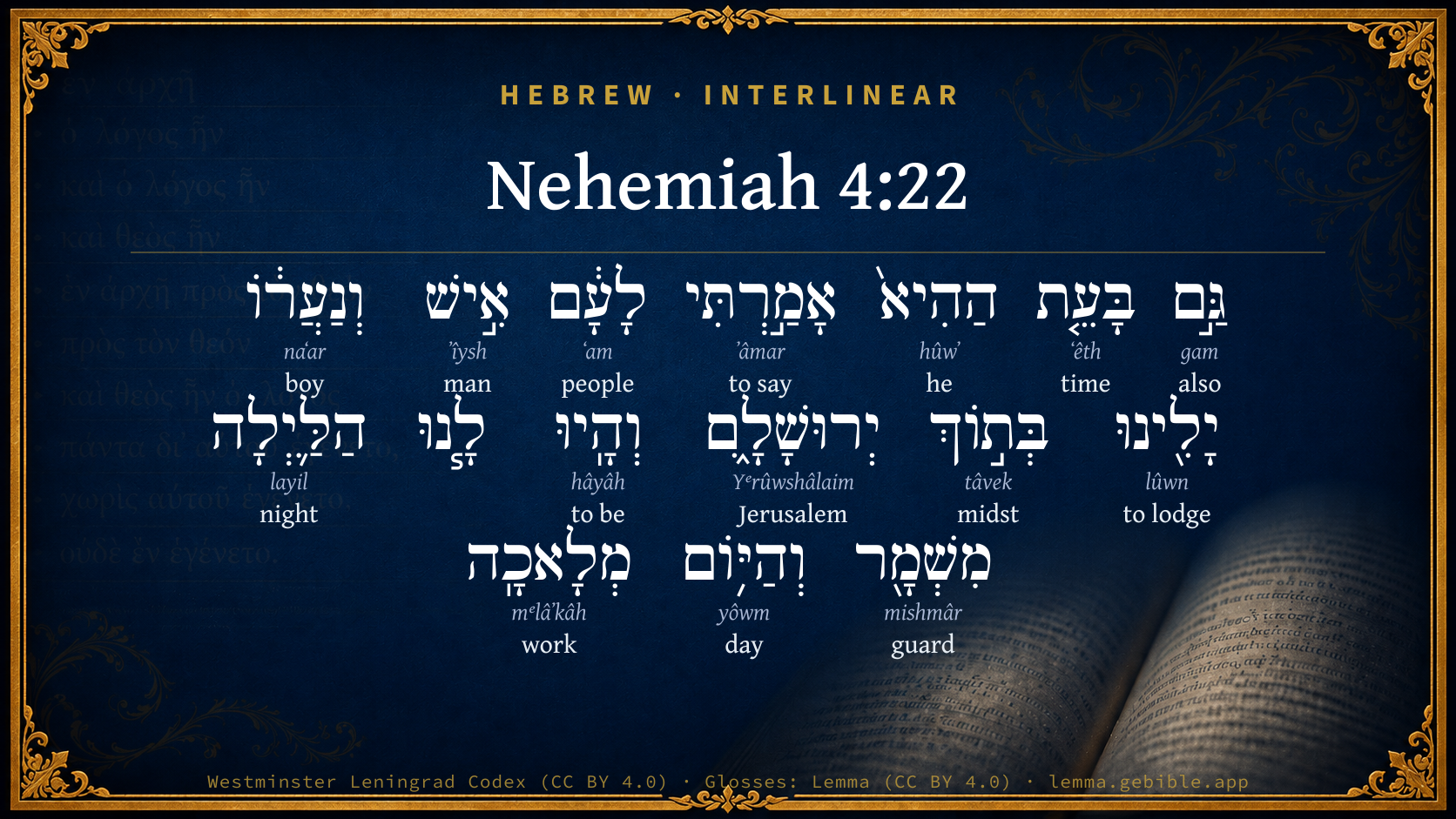
Hebrew (Westminster Leningrad Codex) Nehemiah 4:22 appears in the Hebrew Old Testament. The text above is from the Westminster Leningrad Codex. Each word links to its Strong’s number, a concise gloss, and parsing drawn from the Open Scriptures Hebrew Bible morphology. Click any word for its full Brown-Driver-Briggs (BDB) entry.
Download image
Cite this verse

Nehemiah 4:22 (World English Bible). Public Domain. Lemma interlinear Bible study tool, https://lemma.gebible.app/v/nehemiah/4/22.

Show BibTeX & RIS
BibTeX
RIS
English Translation
Likewise at the same time said I to the people, Let everyone with his servant lodge within Jerusalem, that in the night they may be a guard to us, and may labor in the day.
World English Bible · Public Domain
Download a study sheet

One document with this verse’s original text, its word-by-word gloss line, the meaning frame, cross-references with their text, attributed commentary, and full source and license credits — printable, and it pastes into notes with its structure intact.

This verse Autodidact and up

Study sheet (.html) Plain text (.txt)

A passage Seminary Student

Up to 50 verses in one chapter. A passage sheet keeps up to 6 commentary sources and 12 cross-references per verse, in the order this page ranks them, and says so on the sheet whenever that leaves anything out. Ask for a single verse and you get the Autodidact verse sheet above.

Everything on this page stays free to read, with no account — the sheet is a download of what is already on screen, not access to it.

Want to remove ads? Support Godless Engineer
Compare translations 3

The same verse in 3 English versions, stacked beneath the original-language interlinear above. Click any original word for its lexicon entry.

Each is an independent rendering of the whole verse — the interlinear is not word-aligned to these translations.

Highlighted words mark where these versions differ — a whole-verse word diff, not a word-by-word alignment.

  • World English Bible Public Domain
    Likewise at the same time said I to the people, Let everyone with his servant lodge within Jerusalem, that in the night they may be a guard to us, and may labor in the day.
  • King James Version Public Domain
    Likewise at the same time said I unto the people, Let every one with his servant lodge within Jerusalem, that in the night they may be a guard to us, and labour on the day.
  • unfoldingWord Literal Text CC BY-SA 4.0
    Also, at that time I said to the people, “Let a man and his young man lodge the night in the midst of Jerusalem, and they will be for us by night a guard and by day a worker.”

unfoldingWord Literal Text — © unfoldingWord, licensed CC BY-SA 4.0. Word-aligned USFM3 via Door43 (git.door43.org/unfoldingWord/en_ult).

Versions to compare (up to 4)

3 of 4 selected

Show all 18 translations

Every available English version of this verse, each an independent rendering of the whole verse.

  • World English Bible Public Domain
    Likewise at the same time said I to the people, Let everyone with his servant lodge within Jerusalem, that in the night they may be a guard to us, and may labor in the day.
  • Berean Standard Bible Public Domain
    At that time I also said to the people, “Let every man and his servant spend the night inside Jerusalem, so that they can stand guard by night and work by day.”
  • Majority Standard Bible Public Domain
    At that time I also said to the people, “Let every man and his servant spend the night inside Jerusalem, so that they can stand guard by night and work by day.”
  • King James Version Public Domain
    Likewise at the same time said I unto the people, Let every one with his servant lodge within Jerusalem, that in the night they may be a guard to us, and labour on the day.
  • American Standard Version (1901) Public Domain
    Likewise at the same time said I unto the people, Let every one with his servant lodge within Jerusalem, that in the night they may be a guard to us, and may labor in the day.
  • Revised Version (1885) Public Domain
    Likewise at the same time said I unto the people, Let every one with his servant lodge within Jerusalem, that in the night they may be a guard to us, and may labour in the day.
  • Geneva Bible (1599) Public Domain
    And at the same time said I vnto the people, Let euery one with his seruant lodge within Ierusalem, that they may be a watch for vs in the night, and labour in the day.
  • Douay-Rheims (1899) Public Domain
    At that time also I said to the people: Let every one with his servant stay in the midst of Jerusalem, and let us take our turns in the night, and by day, to work.
  • Young's Literal Translation Public Domain
    Also, at that time I said to the people, `Let each with his servant lodge in the midst of Jerusalem, and they have been to us by night a guard, and by day `for' the work:'
  • Literal Standard Version CC BY-SA 4.0
    Also, at that time I said to the people, “Let each lodge with his servant in the midst of Jerusalem, and they have been a watch for us by night, and [for] the work by day”:
  • Unlocked Literal Bible CC BY-SA 4.0
    I also said to the people at that time, “Let every man and his servant spend the night in the middle of Jerusalem, so they may be for us a guard during the night and a worker in the day.”
  • unfoldingWord Literal Text CC BY-SA 4.0
    Also, at that time I said to the people, “Let a man and his young man lodge the night in the midst of Jerusalem, and they will be for us by night a guard and by day a worker.”
  • Darby Bible Public Domain
    Likewise at the same time I said to the people, Let every one with his servant lodge within Jerusalem, that in the night they may be a guard to us, and [be for] labour in the day.
  • World Messianic Bible Public Domain
    Likewise at the same time I said to the people, “Let everyone with his servant lodge within Jerusalem, that in the night they may be a guard to us, and may labor in the day.”
  • Webster's Bible Public Domain
    Likewise at the same time said I to the people, Let every one with his servant lodge within Jerusalem, that in the night they may be a guard to us, and labor in the day.
  • Free Bible Version CC BY-SA 4.0
    I also told the people, “Everyone including servants must spend the night inside Jerusalem, so they can be on guard duty at night and work during the day.”
  • Bible in Basic English Public Domain
    And at the same time I said to the people, Let everyone with his servant come inside Jerusalem for the night, so that at night they may keep watch for us, and go on working by day.
  • JPS Tanakh (1917) Public Domain
    (4-16) Likewise at the same time said I unto the people: 'Let every one with his servant lodge within Jerusalem, that in the night they may be a guard to us, and may labour in the day.'

Literal Standard Version (2020), Covenant Press — licensed CC BY-SA 4.0. Text via the HelloAO Bible API (eBible.org). Unlocked Literal Bible (unfoldingWord) — licensed CC BY-SA 4.0. Text via the HelloAO Bible API (eBible.org). unfoldingWord Literal Text — © unfoldingWord, licensed CC BY-SA 4.0. Word-aligned USFM3 via Door43 (git.door43.org/unfoldingWord/en_ult). Free Bible Version, Dr. Jonathan Gallagher — licensed CC BY-SA 4.0. Text via the HelloAO Bible API (eBible.org).

Word by word

More ways to search: Search by grammar → Find every occurrence → Compare this word →

Practice this passage: Drill this verse → Learn its vocabulary →

מִשְׁמָ֖ר
mishmâr
H4929
“guard”
Noun, Common, Masculine, Singular, Absolute
Part of Speech
Noun
Type
Common
Gender
Masculine
Number
Singular
State
Absolute
Full BDB Definition

Origin: from H8104

TWOT: 2414f

place of confinement, prison, guard, jail, guard post, watch, observance - jail, prison, guard-house - guard, guard post, act of guarding - observances
  1. גַּ֣ם gam H1571 “also” Particle, Accusative
  2. בָּעֵ֤ת ʻêth H6256 “in/at the · time” Preposition, Determined + Noun, Common, Both, Singular, Absolute
  3. הַהִיא֙ hûwʼ H1931 “the · he” Particle, Definite Article + Pronoun, Personal, 3rd Person, Feminine, Singular
  4. אָמַ֣רְתִּי ʼâmar H559 “to say” Verb, Qal, Perfect, 1st Person, Common, Singular
  5. לָעָ֔ם ʻam H5971 “to/for the · people” Preposition, Determined + Noun, Common, Masculine, Singular, Absolute
  6. אִ֣ישׁ ʼîysh H376 “man” Noun, Common, Masculine, Singular, Absolute
  7. וְנַעֲר֔וֹ naʻar H5288 “and · boy · his” Conjunction + Noun, Common, Masculine, Singular, Construct + Suffix, Personal, 3rd Person, Masculine, Singular
  8. יָלִ֖ינוּ lûwn H3885 “to lodge” Verb, Qal, Imperfect, 3rd Person, Masculine, Plural
  9. בְּת֣וֹךְ tâvek H8432 “in/at · midst of” Preposition + Noun, Common, Masculine, Singular, Construct
  10. יְרוּשָׁלִָ֑ם Yᵉrûwshâlaim H3389 “Jerusalem” Noun, Proper
  11. וְהָֽיוּ hâyâh H1961 “and · to be” Conjunction + Verb, Qal, Sequential Perfect, 3rd Person, Common, Plural
  12. הַלַּ֛יְלָה layil H3915 “the · night” Particle, Definite Article + Noun, Common, Masculine, Singular, Absolute
  13. וְהַיּ֥וֹם yôwm H3117 “and · the · day” Conjunction + Particle, Definite Article + Noun, Common, Masculine, Singular, Absolute
  14. מְלָאכָֽה mᵉlâʼkâh H4399 “work” Noun, Common, Feminine, Singular, Absolute

About this verse

These counts appear in no published source. They are computed here, from the morphology-tagged text and Lemma’s own curated glosses. What Lemma adds →

16
words
15
distinct lemmas
Historical
section

Notable vocabulary

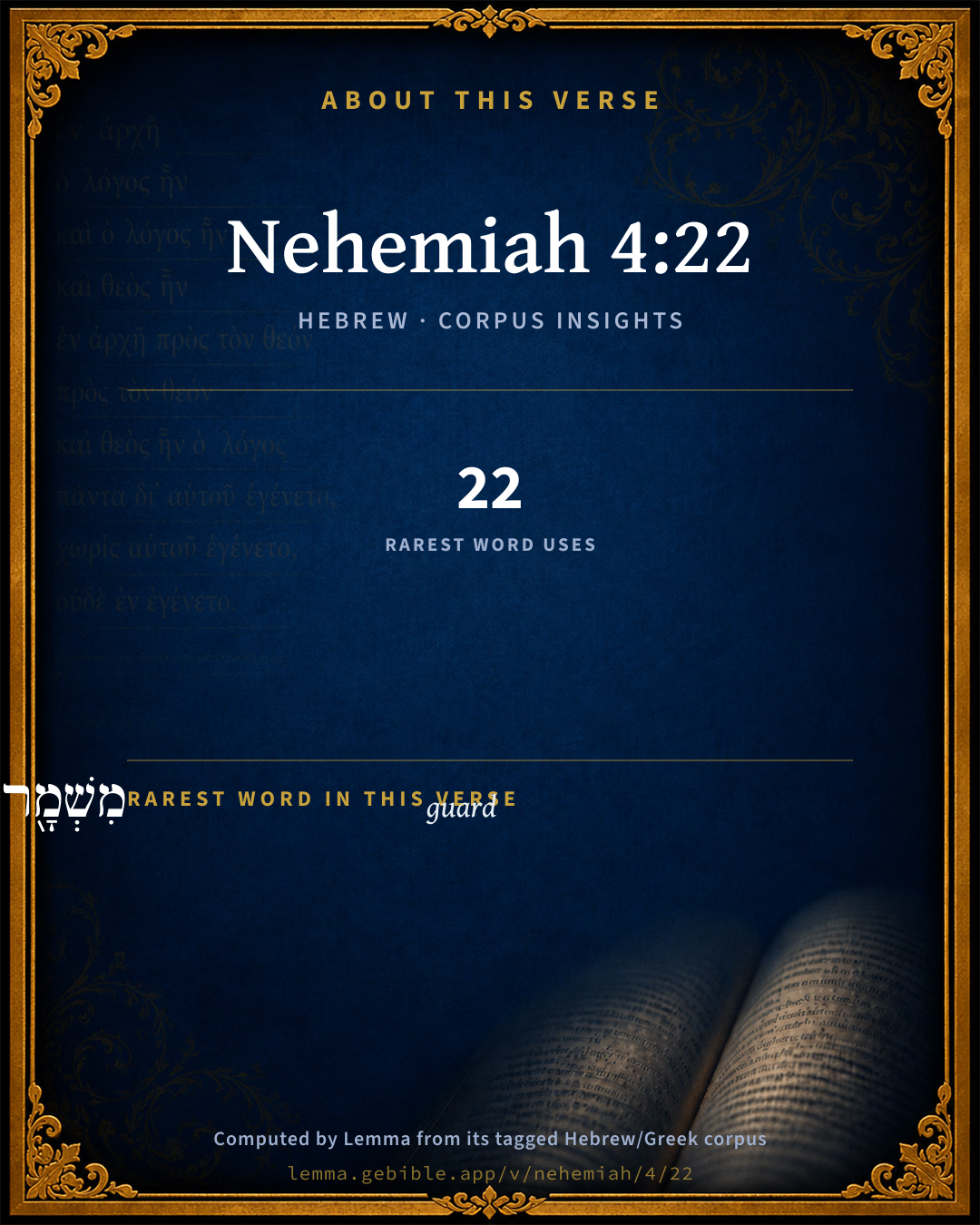
The rarest word here is מִשְׁמָ֖ר guard H4929 — appearing just 22 times in the whole Hebrew Bible.

Shared distinctive vocabulary

מִשְׁמָ֖ר guard H4929 occurs in 20 verses of the Hebrew Bible. Also found in:

Grammatical profile

  • 3 verbs
  • 10 nouns
  • 1 pronoun
  • 1 preposition
  • 1 particle

Verb forms

  • אָמַ֣רְתִּי Qal · Perfect
  • יָלִ֖ינוּ Qal · Imperfect
  • וְהָֽיוּ Qal · Sequential Perfect

Cross-references

1

Topical passages linked to Nehemiah 4:22 in the Treasury of Scripture Knowledge — connected by theme and wording, ordered by reader-vote popularity; previews shown in the World English Bible.

  • Nehemiah 11:1–2 The princes of the people lived in Jerusalem: the rest of the people also cast lots, to bring one of ten to dwell in Jerusalem the holy city, and nine parts in the [other] cities.

Cross-references courtesy of OpenBible.info (CC BY 4.0).

Hebrew and Greek witnesses Masoretic Hebrew ↔ Greek Septuagint

The same verse in the two great witnesses to the Old Testament, shown verse-for-verse.

These are two independent witnesses, not word-aligned to each other, and the Septuagint is shown in lemma (dictionary) form.

Hebrew Nehemiah 4:22 Masoretic · Westminster Leningrad Codex

גַּ֣ם בָּעֵ֤ת הַהִיא֙ אָמַ֣רְתִּי לָעָ֔ם אִ֣ישׁ וְנַעֲר֔וֹ יָלִ֖ינוּ בְּת֣וֹךְ יְרוּשָׁלִָ֑ם וְהָֽיוּ לָ֧נוּ הַלַּ֛יְלָה מִשְׁמָ֖ר וְהַיּ֥וֹם מְלָאכָֽה

Likewise at the same time said I to the people, Let everyone with his servant lodge within Jerusalem, that in the night they may be a guard to us, and may labor in the day.

World English Bible · Public Domain

Greek LXX Structure differs

The Septuagint has no separate book of Nehemiah. Its Greek text is the second half of Esdras B (2 Esdras), chapters 11–23; Ezra is the first half (1–10).

A verse-for-verse comparison isn’t shown here because the chapters and verses don’t line up. Switch to the LXX edition with the MT / LXX toggle above to read the Greek directly.

Hebrew: Westminster Leningrad Codex (CC BY 4.0). Greek: Septuagint (public domain); English from a public-domain English Septuagint. How the Septuagint differs from the Hebrew →

Commentary

Notes on Nehemiah 4:22 from classic Christian and Jewish commentators (each source and its license shown beneath its notes). The classic Christian expositions comment on the surrounding passage and are grouped to its opening verse, so a note may address several verses; the Jewish commentaries on the Tanakh (Rashi and others) are per-verse, so they appear only where the commentator wrote on this verse.

Lemma curates 59 commentaries, every one of them public domain or Creative Commons licensed, each selected and text-cleaned for this edition rather than reprinted as found. About our sources →

Trapp's Complete Commentary

John Trapp

Neh 4:22 Likewise at the same time said I unto the people, Let every one with his servant lodge within Jerusalem, that in the night they may be a guard to us, and labour on the day.

Ver. 22. Likewise at the same time I said unto the people] He had a saying to every one; and having ordered the work of the day, he appointeth a watch for the night season also; for they had many false friends within themselves too. Caesar’s vigilancy did ever equal his valour; so did Nehemiah’s.

John Trapp, A Commentary or Exposition upon All the Books of the Old and New Testament (1647–1656) — public domain. Text from a community e-Sword module.

Adam Clarke's Commentary

Verse 22. Let every one with his servant lodge within Jerusalem] The country people were accustomed, after their day's labour, to return to their families; now being so formidably threatened, he obliged them all to sleep in Jerusalem, that they might be ready, in case of attack, to help their brethren. All this man's arrangements were wise and judicious.

Adam Clarke's Commentary on the Bible (1810–1826) — public domain. Text from a community e-Sword/MySword module.

The Cambridge Bible for Schools and Colleges

gen. ed. J. J. S. Perowne

22. Likewise … said I unto the people] Another prudent regulation is enacted by Nehemiah. He addresses ‘the people,’ namely the common people capable of bearing arms, as distinguished from the nobles on the one hand and Nehemiah’s servants on the other. The object of the fresh enactment is to secure that during the nights the city should be garrisoned with its full strength.

Let every one with his servant lodge within Jerusalem] From this we gather that numbers of the people were employed during the day in the vicinity of Jerusalem in farming and other occupations, or, being employed upon the walls by day, wandered forth and slept outside the gates. If they lodged (i.e. passed the night) outside the walls, they were liable to be surprised in detail and murdered by the enemy. For the defence of such extensive and unfinished works, Jerusalem could not afford to lose a man unnecessarily. Nehemiah therefore required that all, whatever their employment, should sleep in the city. At the time when the exhausted builders took their rest, the greatest possible number of inhabitants were in this way retained within the gates. The disaffected also were deprived of opportunities for intriguing by night with the enemy. ‘every one with his servant,’ literally ‘his young man.’ Some would restrict this expression to the ‘warriors,’ each of whom had his attendant, much as a Mediæval knight had his squire. But it is preferable to attach to the words a more general sense, i.e. ‘everyone, master and servant alike.’ Those who employed labourers would be responsible for seeing that their ‘hands’ did not disobey this edict.

a guard to us] i.e. to Nehemiah and his bodyguard. These additional inmates of the city increased the strength of the defence by night.

and labour on the day] R.V. and may labour in the day. Literally ‘and in the day a labour.’ Those who were compelled to lodge within the walls would not be able to elude their employers and officers. They would be better under control for the systematic work needful for the building. They could not wander far from the city. Work could be recommenced in the early morning without delay; whether engaged on the walls or in other ways, all were thus placed under surveillance.

The Cambridge Bible for Schools and Colleges (gen. ed. J. J. S. Perowne; Cambridge University Press, 1878–1918) — public domain. Text from a community e-Sword module.

John Gill's Exposition

Likewise at the same time said I unto the people,.... That were at work upon the wall:

let everyone with his servant lodge within Jerusalem; every builder had a servant, or a lad, as the word signifies, to wait upon him, to bring mortar or stone, or what he wanted; and some of these builders, with their lads, came out of the country towns and villages in the morning, and returned at night; now Nehemiah proposed, for the safety of the city and its walls, that for the present they would lodge in Jerusalem:

that in the night they may be a guard unto us, and labour on the day; might help to protect them in the night, should they be surprised with the enemy, and be ready for their work in the daytime.

John Gill's Exposition of the Whole Bible (1746–1763) — public domain (CC PDM 1.0). Text via the HelloAO Bible API.

Albert Barnes' Notes on the Bible

Let every one ... lodge within Jerusalem - i. e. Let none return to his own village or city at night, but let all take their rest in Jerusalem.”

Albert Barnes' Notes on the Bible (1834–1885) — public domain. Text from a community e-Sword/MySword module.

Haydock's Catholic Bible Commentary

Midst. Before they had gone home. (Calmet) --- Let us. Protestants, "that in the night they may be a guard to us, and labour on the day." (Haydock)

George Leo Haydock (1774–1849), Haydock's Catholic Family Bible and Commentary, 1859 edition — public domain. Excludes Psalms (Douay-Rheims chapter numbering differs from Protestant) and Deuterocanonical books (Catholic canon only).

Matthew Poole's English Annotations

Within Jerusalem; not in the suburbs, or adjoining villages, as probably many of them did, returning thence to their work in the morning.

Matthew Poole's English Annotations on the Holy Bible (1683–1685) — public domain. Text from a community e-Sword/MySword module.

Whedon's Commentary on the Bible

Daniel D. Whedon

22. Every one — Every leading man, or head of a family.

With his servant — Rather, and his servant. As Nehemiah, being head of the entire community, might have called all the people his servants, (Neh_4:16,) so every leading man had also those under him whom he commanded. But each leading man of the Jews may also have had his own private servants. Some of the more wealthy had brought their own brethren of the Jews virtually into bondage to them. Neh_5:5; Neh_5:8.

Lodge within Jerusalem — And not in the neighbouring villages, as some of them had been accustomed to do.

They may be a guard — Namely, the men and the servants just named. They were to stay and do their share in guarding the city, as well as in labouring on its walls. But as the next verse shows, they were not the only ones that thus watched and laboured. It was necessary to the safety of Jerusalem that a large and strong watch be maintained night and day, and it was too much for Nehemiah and the rest, whose homes were in the city, to do all this. Hence the justice of requiring those whose homes were in neighbouring towns to abide for the present in the city, and do a proper share of guarding the great common interests of all.

To us — Nehemiah and all who dwelt in the city.

Daniel D. Whedon (gen. ed.), Commentary on the Old and New Testaments (1874–1909) — public domain. Text from a community e-Sword module.

The Pulpit Commentary

Every one, with his servant. The material condition of the people had much improved since the return under Zerubbabel. Then there was only one slave to every six Israelites; (Ezr_2:64, Ezr_2:65) now every Israelite had his slave, and many no doubt a large number. Lodge within Jerusalem. i.e. "sleep" or "pass the night" there, instead of returning to their several villages or towns. That in the night they may be a guard to us . The very fact that they were in Jerusalem, and known to be there, would tend to prevent an attack; and if the enemy assaulted by night, they would be at hand, and able to take their part in guarding the work.

The Pulpit Commentary (1880–1919), ed. H.D.M. Spence-Jones & Joseph S. Exell — public domain. Text from a community e-Sword module.

Lesson kit

Teaching starters — assembled from the data on this page, not authored interpretation. Every prompt links to the verse data it draws on. Edit before teaching.

Nehemiah, in the Historical, opens this verse with 16 words (15 distinct Hebrew lemmas). Its most distinctive word is mishmâr (“guard”). A historical commentator’s framing appears above. Read the whole chapter for the surrounding context.

Discussion questions

  1. The word mishmâr carries the sense “guard.” How does it shape the verse?
  2. How does Genesis 40:3, which shares the word «guard», read alongside this verse?
  3. These translations render this verse differently. What is at stake in choosing one wording over another?
  4. «אָמַ֣רְתִּי» is a Qal Perfect verb. How does that grammatical form shape the action described?
  5. Compare how Trapp's Complete Commentary and Adam Clarke's Commentary read this verse. Where do they agree or differ?

Things to notice

Reading settings

Reading text

Shown beneath each verse's original-language words.

Old Testament
Old Testament edition

Read the OT as the Masoretic Hebrew (MT) or the Greek Septuagint (LXX).

English shown for the Greek Septuagint (in the Hebrew ↔ Greek comparison).

Comparing translations? Open the Compare panel on any verse page to stack up to four side by side.