
2 Chronicles 28:9

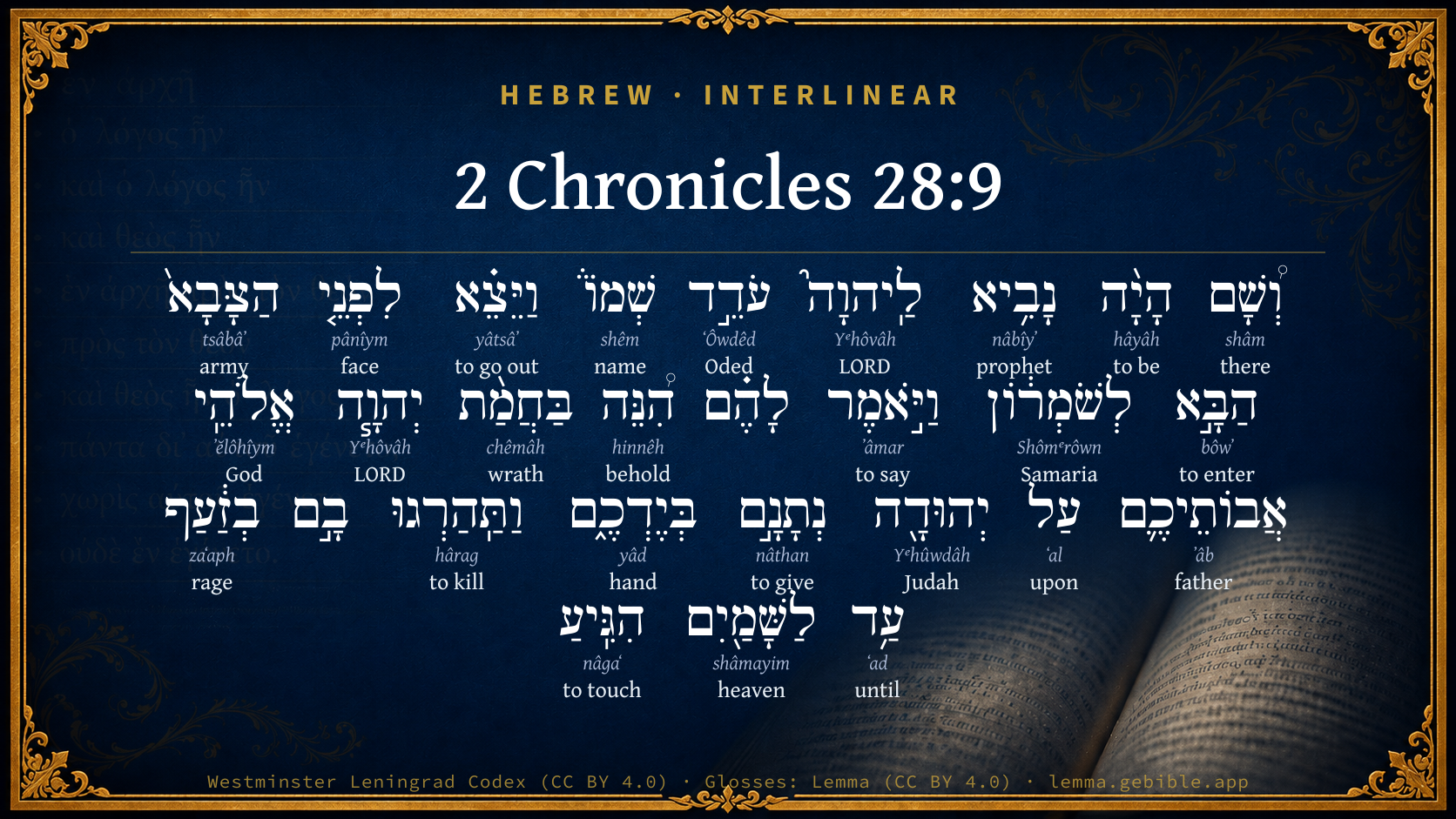
Hebrew (Westminster Leningrad Codex) 2 Chronicles 28:9 appears in the Hebrew Old Testament. The text above is from the Westminster Leningrad Codex. Each word links to its Strong’s number, a concise gloss, and parsing drawn from the Open Scriptures Hebrew Bible morphology. Click any word for its full Brown-Driver-Briggs (BDB) entry.
Download image
Cite this verse

2 Chronicles 28:9 (World English Bible). Public Domain. Lemma interlinear Bible study tool, https://lemma.gebible.app/v/2-chronicles/28/9.

Show BibTeX & RIS
BibTeX
RIS
English Translation
But a prophet of Yahweh was there, whose name was Oded: and he went out to meet the host that came to Samaria, and said to them, Behold, because Yahweh, the God of your fathers, was angry with Judah, he has delivered them into your hand, and you have slain them in a rage which has reached up to heaven.
World English Bible · Public Domain
Download a study sheet

One document with this verse’s original text, its word-by-word gloss line, the meaning frame, cross-references with their text, attributed commentary, and full source and license credits — printable, and it pastes into notes with its structure intact.

This verse Autodidact and up

Study sheet (.html) Plain text (.txt)

A passage Seminary Student

Up to 50 verses in one chapter. A passage sheet keeps up to 6 commentary sources and 12 cross-references per verse, in the order this page ranks them, and says so on the sheet whenever that leaves anything out. Ask for a single verse and you get the Autodidact verse sheet above.

Everything on this page stays free to read, with no account — the sheet is a download of what is already on screen, not access to it.

Want to remove ads? Support Godless Engineer
Compare translations 3

The same verse in 3 English versions, stacked beneath the original-language interlinear above. Click any original word for its lexicon entry.

Each is an independent rendering of the whole verse — the interlinear is not word-aligned to these translations.

Highlighted words mark where these versions differ — a whole-verse word diff, not a word-by-word alignment.

  • World English Bible Public Domain
    But a prophet of Yahweh was there, whose name was Oded: and he went out to meet the host that came to Samaria, and said to them, Behold, because Yahweh, the God of your fathers, was angry with Judah, he has delivered them into your hand, and you have slain them in a rage which has reached up to heaven.
  • King James Version Public Domain
    But a prophet of the LORD was there, whose name was Oded: and he went out before the host that came to Samaria, and said unto them, Behold, because the LORD God of your fathers was wroth with Judah, he hath delivered them into your hand, and ye have slain them in a rage that reacheth up unto heaven.
  • unfoldingWord Literal Text CC BY-SA 4.0
    And there, a prophet of Yahweh was, Oded his name. And he went out before the army coming to Samaria. And he said to them, “Behold, in wrath, Yahweh, the God of your fathers was against Judah; he gave them into your hand. But you all killed them in rage; up to the heavens it reached.

unfoldingWord Literal Text — © unfoldingWord, licensed CC BY-SA 4.0. Word-aligned USFM3 via Door43 (git.door43.org/unfoldingWord/en_ult).

Versions to compare (up to 4)

3 of 4 selected

Show all 18 translations

Every available English version of this verse, each an independent rendering of the whole verse.

  • World English Bible Public Domain
    But a prophet of Yahweh was there, whose name was Oded: and he went out to meet the host that came to Samaria, and said to them, Behold, because Yahweh, the God of your fathers, was angry with Judah, he has delivered them into your hand, and you have slain them in a rage which has reached up to heaven.
  • Berean Standard Bible Public Domain
    But a prophet of the LORD named Oded was there, and he went out to meet the army that returned to Samaria. “Look,” he said to them, “because of His wrath against Judah, the LORD, the God of your fathers, has delivered them into your hand. But you have slaughtered them in a rage that reaches up to heaven.
  • Majority Standard Bible Public Domain
    But a prophet of the LORD named Oded was there, and he went out to meet the army that returned to Samaria. “Look,” he said to them, “because of His wrath against Judah, the LORD, the God of your fathers, has delivered them into your hand. But you have slaughtered them in a rage that reaches up to heaven.
  • King James Version Public Domain
    But a prophet of the LORD was there, whose name was Oded: and he went out before the host that came to Samaria, and said unto them, Behold, because the LORD God of your fathers was wroth with Judah, he hath delivered them into your hand, and ye have slain them in a rage that reacheth up unto heaven.
  • American Standard Version (1901) Public Domain
    But a prophet of Jehovah was there, whose name was Oded: and he went out to meet the host that came to Samaria, and said unto them, Behold, because Jehovah, the God of your fathers, was wroth with Judah, he hath delivered them into your hand, and ye have slain them in a rage which hath reached up to heaven.
  • Revised Version (1885) Public Domain
    But a prophet of the LORD was there, whose name was Oded: and he went out to meet the host that came to Samaria, and said unto them, Behold, because the LORD, the God of your fathers, was wroth with Judah, he hath delivered them into your hand, and ye have slain them in a rage which hath reached up unto heaven.
  • Geneva Bible (1599) Public Domain
    But there was a Prophet of the Lordes, (whose name was Oded) and he went out before the hoste that came to Samaria, and said vnto them, Behold, because the Lord God of your fathers is wroth with Iudah, he hath deliuered them into your hand, and ye haue slaine them in a rage, that reacheth vp to heauen.
  • Douay-Rheims (1899) Public Domain
    At that time there was a prophet of the Lord there, whose name was Oded: and he went out to meet the army that came to Samaria, and said to them: Be- hold the Lord the God of your fathers being angry with Juda, hath delivered them into your hands, and you have butchered them cruelly, so that your cruelty hath reached up to heaven.
  • Young's Literal Translation Public Domain
    And there hath been there a prophet of Jehovah (Oded `is' his name), and he goeth out before the host that hath come in to Samaria, and saith to them, `Lo, in the fury of Jehovah God of your fathers against Judah, He hath given them into your hand, and ye slay among them in rage -- unto the heavens it hath come;
  • Literal Standard Version CC BY-SA 4.0
    And there has been a prophet of YHWH there (Oded [is] his name), and he goes out before the host that has come to Samaria, and says to them, “Behold, in the fury of YHWH, God of your fathers, against Judah, He has given them into your hand, and you slay among them in rage—it has come to the heavens;
  • Unlocked Literal Bible CC BY-SA 4.0
    But a prophet of Yahweh was there, his name was Oded. He went out to meet the army coming into Samaria. He said to them, “Because Yahweh, the God of your ancestors, was angry with Judah, he gave them into your hand. But you have slaughtered them in a rage that reached up to heaven.
  • unfoldingWord Literal Text CC BY-SA 4.0
    And there, a prophet of Yahweh was, Oded his name. And he went out before the army coming to Samaria. And he said to them, “Behold, in wrath, Yahweh, the God of your fathers was against Judah; he gave them into your hand. But you all killed them in rage; up to the heavens it reached.
  • Darby Bible Public Domain
    But a prophet of Jehovah was there, whose name was Oded; and he went out before the host that came to Samaria, and said unto them, Behold, because Jehovah the God of your fathers was wroth with Judah, he gave them into your hand, and ye have slain them in a rage that reaches up to heaven.
  • World Messianic Bible Public Domain
    But a prophet of the LORD was there, whose name was Oded; and he went out to meet the army that came to Samaria, and said to them, “Behold, because the LORD, the God of your fathers, was angry with Judah, he has delivered them into your hand, and you have slain them in a rage which has reached up to heaven.
  • Webster's Bible Public Domain
    But a prophet of the LORD was there, whose name was Oded: and he went out before the army that came to Samaria, and said to them, Behold, because the LORD God of your fathers was wroth with Judah, he hath delivered them into your hand, and ye have slain them in a rage that reacheth to heaven.
  • Free Bible Version CC BY-SA 4.0
    But a prophet of the Lord named Oded was there in Samaria, and he went out to meet the returning army. He told them, “It was because the Lord, the God of your fathers, was angry with Judah that he allowed you to defeat them. But you have killed them with such fury that it has upset heaven.
  • Bible in Basic English Public Domain
    But a prophet of the Lord was there, named Oded; and he went out in front of the army which was coming into Samaria and said to them, Truly, because the Lord, the God of your fathers, was angry with Judah, he gave them up into your hands, and you have put them to death in an outburst of wrath stretching up to heaven.
  • JPS Tanakh (1917) Public Domain
    But a prophet of the LORD was there, whose name was Oded; and he went out to meet the host that came to Samaria, and said unto them: 'Behold, because the LORD, the God of your fathers, was wroth with Judah, He hath delivered them into your hand, and ye have slain them in a rage which hath reached up unto heaven.

Literal Standard Version (2020), Covenant Press — licensed CC BY-SA 4.0. Text via the HelloAO Bible API (eBible.org). Unlocked Literal Bible (unfoldingWord) — licensed CC BY-SA 4.0. Text via the HelloAO Bible API (eBible.org). unfoldingWord Literal Text — © unfoldingWord, licensed CC BY-SA 4.0. Word-aligned USFM3 via Door43 (git.door43.org/unfoldingWord/en_ult). Free Bible Version, Dr. Jonathan Gallagher — licensed CC BY-SA 4.0. Text via the HelloAO Bible API (eBible.org).

Word by word

More ways to search: Search by grammar → Find every occurrence → Compare this word →

Practice this passage: Drill this verse → Learn its vocabulary →

עֹדֵ֣ד
ʻÔwdêd
H5752
“Oded”
Noun, Proper
Part of Speech
Noun
Type
Proper
Full BDB Definition

Origin: from H5749

TWOT: None

Oded = "restorer" - father of Azariah the prophet in the reign of king Asa of Judah - a prophet of Jehovah in Samaria at the time of Pekah's invasion of Judah
  1. וְ֠שָׁם shâm H8033 “and · there” Conjunction + Adverb
  2. הָיָ֨ה hâyâh H1961 “to be” Verb, Qal, Perfect, 3rd Person, Masculine, Singular
  3. נָבִ֥יא nâbîyʼ H5030 “prophet” Noun, Common, Masculine, Singular, Absolute
  4. לַֽיהוָה֮ Yᵉhôvâh H3068 “to/for · LORD” Preposition + Noun, Proper
  5. שְׁמוֹ֒ shêm H8034 “name · his” Noun, Common, Masculine, Singular, Construct + Suffix, Personal, 3rd Person, Masculine, Singular
  6. וַיֵּצֵ֗א yâtsâʼ H3318 “and · to go out” Conjunction + Verb, Qal, Sequential Imperfect, 3rd Person, Masculine, Singular
  7. לִפְנֵ֤י pânîym H6440 “to/for · face(s) of” Preposition + Noun, Common, Both, Plural, Construct
  8. הַצָּבָא֙ tsâbâʼ H6635 “the · army” Particle, Definite Article + Noun, Common, Both, Singular, Absolute
  9. הַבָּ֣א bôwʼ H935 “the · entering” Particle, Definite Article + Verb, Qal, Participle Active, Masculine, Singular, Absolute
  10. לְשֹׁמְר֔וֹן Shômᵉrôwn H8111 “to/for · Samaria” Preposition + Noun, Proper
  11. וַיֹּ֣אמֶר ʼâmar H559 “and · to say” Conjunction + Verb, Qal, Sequential Imperfect, 3rd Person, Masculine, Singular
  12. הִ֠נֵּה hinnêh H2009 “behold” Particle, Demonstrative
  13. בַּחֲמַ֨ת chêmâh H2534 “in/at · wrath of” Preposition + Noun, Common, Feminine, Singular, Construct
  14. יְהוָ֧ה Yᵉhôvâh H3068 “LORD” Noun, Proper
  15. אֱלֹהֵֽי ʼĕlôhîym H430 “God(s) of” Noun, Common, Masculine, Plural, Construct
  16. אֲבוֹתֵיכֶ֛ם ʼâb H1 “fathers · your” Noun, Common, Masculine, Plural, Construct + Suffix, Personal, 2nd Person, Masculine, Plural
  17. עַל ʻal H5921 “upon” Preposition
  18. יְהוּדָ֖ה Yᵉhûwdâh H3063 “Judah” Noun, Proper
  19. נְתָנָ֣ם nâthan H5414 “to give · them” Verb, Qal, Perfect, 3rd Person, Masculine, Singular + Suffix, Personal, 3rd Person, Masculine, Plural
  20. בְּיֶדְכֶ֑ם yâd H3027 “in/at · hand · your” Preposition + Noun, Common, Both, Singular, Construct + Suffix, Personal, 2nd Person, Masculine, Plural
  21. וַתַּֽהַרְגוּ hârag H2026 “and · to kill” Conjunction + Verb, Qal, Sequential Imperfect, 2nd Person, Masculine, Plural
  22. בְזַ֔עַף zaʻaph H2197 “in/at · rage” Preposition + Noun, Common, Masculine, Singular, Absolute
  23. עַ֥ד ʻad H5704 “until” Preposition
  24. לַשָּׁמַ֖יִם shâmayim H8064 “to/for the · heaven(s)” Preposition, Determined + Noun, Common, Masculine, Plural, Absolute
  25. הִגִּֽיעַ nâgaʻ H5060 “to touch” Verb, Hiphil, Perfect, 3rd Person, Masculine, Singular

About this verse

These counts appear in no published source. They are computed here, from the morphology-tagged text and Lemma’s own curated glosses. What Lemma adds →

28
words
25
distinct lemmas
Historical
section

Notable vocabulary

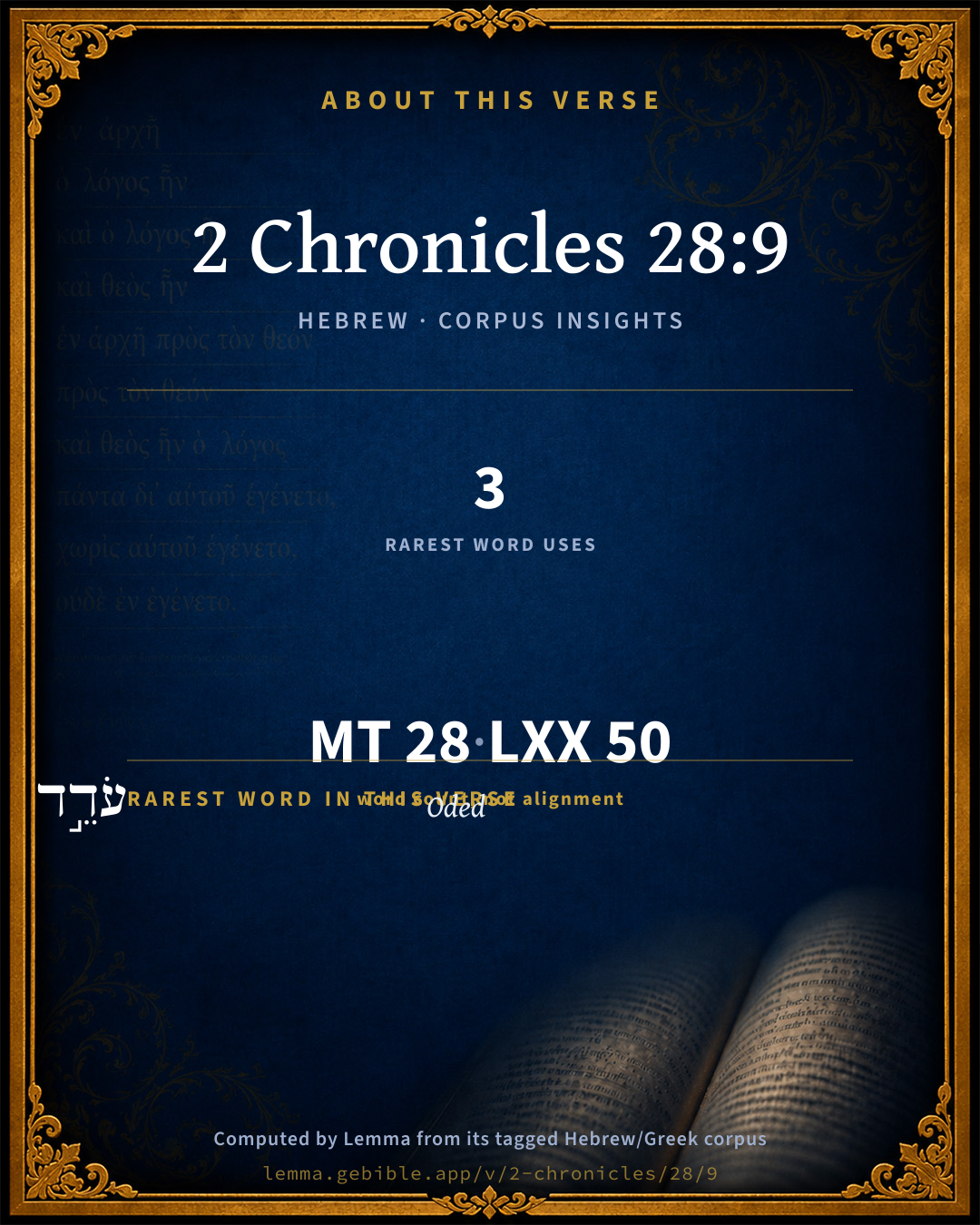
The rarest word here is עֹדֵ֣ד Oded H5752 — appearing just 3 times in the whole Hebrew Bible.

Shared distinctive vocabulary

עֹדֵ֣ד Oded H5752 occurs in 3 verses of the Hebrew Bible. Also found in:

Grammatical profile

  • 7 verbs
  • 15 nouns
  • 4 prepositions
  • 1 adverb
  • 1 particle

Verb forms

  • הָיָ֨ה Qal · Perfect
  • וַיֵּצֵ֗א Qal · Sequential Imperfect
  • הַבָּ֣א Qal · Participle Active
  • וַיֹּ֣אמֶר Qal · Sequential Imperfect
  • נְתָנָ֣ם Qal · Perfect
  • וַתַּֽהַרְגוּ Qal · Sequential Imperfect
  • הִגִּֽיעַ Hiphil · Perfect

Repetition

A word recurs within this verse — often emphatic in Hebrew:

  • לַֽיהוָה֮ LORD H3068 ×2

Hebrew & Septuagint length

In English translation the verse runs 60 words from the Hebrew and 65 from the Septuagint (LXX English) — closely comparable.

A rough comparison of the two English renderings, which tokenize alike — not a word-level alignment.

Word counts can differ between the Hebrew and the Greek without any difference in meaning — e.g. the Hebrew direct-object marker אֵת has no separate Greek word, and Greek often adds the article ὁ.

In the original languages it is 28 Hebrew tokens and 50 Greek tokens — but the two are counted differently (Hebrew bundles its prefixes and suffixes into one token; the Greek is in lemma form), so that isn’t a like-for-like length.

Cross-references

20

Topical passages linked to 2 Chronicles 28:9 in the Treasury of Scripture Knowledge — connected by theme and wording, ordered by reader-vote popularity; previews shown in the World English Bible.

  • Ezra 9:6 and I said, my God, I am ashamed and blush to lift up my face to you, my God; for our iniquities are increased over our head, and our guiltiness is grown up to the heavens.
  • Isaiah 47:6 I was angry with my people, I profaned my inheritance, and gave them into your hand: you did show them no mercy; on the aged have you very heavily laid your yoke.
  • Revelation 18:5 for her sins have reached to the sky, and God has remembered her iniquities.
  • Zechariah 1:15 I am very angry with the nations that are at ease; for I was but a little displeased, but they added to the calamity."
  • Genesis 4:10 Yahweh said, "What have you done? The voice of your brother's blood cries to me from the ground.
  • Genesis 11:4 They said, "Come, let's build us a city, and a tower, whose top reaches to the sky, and let's make us a name; lest we be scattered abroad on the surface of the whole earth."
  • Judges 3:8 Therefore the anger of Yahweh was kindled against Israel, and he sold them into the hand of Cushan Rishathaim king of Mesopotamia: and the children of Israel served Cushan Rishathaim eight years.
  • 1 Kings 20:13 Behold, a prophet came near to Ahab king of Israel, and said, Thus says Yahweh, Have you seen all this great multitude? behold, I will deliver it into your hand this day; and you shall know that I am Yahweh.
  • 1 Kings 20:22 The prophet came near to the king of Israel, and said to him, Go, strengthen yourself, and mark, and see what you do; for at the return of the year the king of Syria will come up against you.
  • 1 Kings 20:42 He said to him, Thus says Yahweh, Because you have let go out of your hand the man whom I had devoted to destruction, therefore your life shall go for his life, and your people for his people.
  • 2 Kings 20:14–15 Then came Isaiah the prophet to king Hezekiah, and said to him, What said these men? and from whence came they to you? Hezekiah said, They are come from a far country, even from Babylon.
  • 2 Chronicles 19:1–2 Jehoshaphat the king of Judah returned to his house in peace to Jerusalem.
  • 2 Chronicles 25:15–16 Therefore the anger of Yahweh was kindled against Amaziah, and he sent to him a prophet, who said to him, Why have you sought after the gods of the people, which have not delivered their own people out of your hand?
  • 2 Chronicles 28:5 Therefore Yahweh his God delivered him into the hand of the king of Syria; and they struck him, and carried away of his a great multitude of captives, and brought them to Damascus. He was also delivered into the hand of the king of Israel, who struck him with a great slaughter.
  • Psalms 69:26 For they persecute him whom you have wounded. They tell of the sorrow of those whom you have hurt.
  • Isaiah 10:5–7 Ho Assyrian, the rod of my anger, the staff in whose hand is my indignation!
  • Jeremiah 15:17–18 I didn't sit in the assembly of those who make merry, nor rejoiced; I sat alone because of your hand; for you have filled me with indignation.
  • Ezekiel 25:12–17 Thus says the Lord Yahweh: Because Edom has dealt against the house of Judah by taking vengeance, and has greatly offended, and revenged himself on them;
  • Ezekiel 26:2–3 Son of man, because Tyre has said against Jerusalem, Aha, she is broken: the gate of the peoples; she is turned to me; I shall be replenished, now that she is laid waste:
  • Obadiah 1:10–16 For the violence done to your brother Jacob, shame will cover you, and you will be cut off forever.

Cross-references courtesy of OpenBible.info (CC BY 4.0).

Hebrew and Greek witnesses Masoretic Hebrew ↔ Greek Septuagint

The same verse in the two great witnesses to the Old Testament, shown verse-for-verse.

These are two independent witnesses, not word-aligned to each other, and the Septuagint is shown in lemma (dictionary) form.

Hebrew 2 Chronicles 28:9 Masoretic · Westminster Leningrad Codex

וְ֠שָׁם הָיָ֨ה נָבִ֥יא לַֽיהוָה֮ עֹדֵ֣ד שְׁמוֹ֒ וַיֵּצֵ֗א לִפְנֵ֤י הַצָּבָא֙ הַבָּ֣א לְשֹׁמְר֔וֹן וַיֹּ֣אמֶר לָהֶ֗ם הִ֠נֵּה בַּחֲמַ֨ת יְהוָ֧ה אֱלֹהֵֽי אֲבוֹתֵיכֶ֛ם עַל יְהוּדָ֖ה נְתָנָ֣ם בְּיֶדְכֶ֑ם וַתַּֽהַרְגוּ בָ֣ם בְזַ֔עַף עַ֥ד לַשָּׁמַ֖יִם הִגִּֽיעַ

But a prophet of Yahweh was there, whose name was Oded: and he went out to meet the host that came to Samaria, and said to them, Behold, because Yahweh, the God of your fathers, was angry with Judah, he has delivered them into your hand, and you have slain them in a rage which has reached up to heaven.

World English Bible · Public Domain

Greek LXX 2 Chronicles 28:9 Septuagint · lemma form

καί ἐκεῖ εἰμί ὁ προφήτης ὁ κύριος ωδηδ ὄνομα αὐτός καί ἐκἔρχομαι εἰς ἀπάντησις ὁ δύναμις ὁ ἔρχομαι εἰς σαμαρεία καί εἶπον αὐτός ἰδού ὀργή κύριος θεός ὁ πατήρ σύ ἐπί ὁ ἰούδας καί παραδίδωμι αὐτός εἰς ὁ χείρ σύ καί ἀποκτείνω ἐν αὐτός ἐν ὀργή ἕως ὁ οὐρανός φθάνω

And there was there a prophet of the Lord, his name was Oded: and he went out to meet the host that were coming to Samaria, and said to them, Behold, the wrath of the Lord God of your fathers is upon Juda, and he has delivered them into your hands, and you⌃ have slain them in wrath, and it has reached even to heaven.

LXX2012 (modern English Septuagint) · Public Domain

Hebrew: Westminster Leningrad Codex (CC BY 4.0). Greek: Septuagint (public domain); English from LXX2012 (modern English Septuagint) (Public Domain). How the Septuagint differs from the Hebrew →

Commentary

Notes on 2 Chronicles 28:9 from classic Christian and Jewish commentators (each source and its license shown beneath its notes). The classic Christian expositions comment on the surrounding passage and are grouped to its opening verse, so a note may address several verses; the Jewish commentaries on the Tanakh (Rashi and others) are per-verse, so they appear only where the commentator wrote on this verse.

Lemma curates 59 commentaries, every one of them public domain or Creative Commons licensed, each selected and text-cleaned for this edition rather than reprinted as found. About our sources →

Ellicott's Commentary for English Readers

THE PROPHET ODED PROTESTS AGAINST RETENTION OF THE JEWISH CAPTIVES, AND THEY ARE SENT HOME (2Ch_28:9-15).

(9) But a prophet of the Lord.—This whole section is peculiar to the chronicler. The author has told the story in his own way; and perhaps the words of the prophet and the chiefs are mainly his. But there is no ground for doubting the general truth of the narrative.

Was there.—In Samaria. It is remarkable that neither here nor in the parallel narrative is any mention made of the great prophet Hosea ben Beeri, who must have been active at this epoch in the northern kingdom. Of Oded nothing further is known. He was a “prophet of Jehovah,” not of the Baals.

He went out before.—To meet the hosts, like Azariah ben Oded (2Ch_15:2).

That came.—Was coming in.

Because the Lord . . . was wroth.—Literally, in the wrath of Jehovah . . . against Judah he gave them into your hand. Your victory was due to the punitive wrath of Jehovah, not to your own valour or intrinsic superiority. You ought to have considered this, and shown compassion to the victims of divine displeasure; but you have, on the contrary, given full rein to the savage dictates of furious hatred.

Slain them.—Slain among them.

In a rage.—2Ch_26:19 (za’af).

That reacheth up unto heaven.—Gen_28:12; Isa_8:8. Literally, which even to the heavens did reach; i.e., a guilty excess of rage, calling to heaven for vengeance, like the blood of Abel (Gen_4:10), or the wickedness of Sodom (Gen_18:21). (Comp. also Ezr_9:6.)

A Bible Commentary for English Readers, edited by Charles John Ellicott (1878–1897) — public domain. Text from a community e-Sword module.

Trapp's Complete Commentary

John Trapp

2Ch 28:9 But a prophet of the LORD was there, whose name [was] Oded: and he went out before the host that came to Samaria, and said unto them, Behold, because the LORD God of your fathers was wroth with Judah, he hath delivered them into your hand, and ye have slain them in a rage [that] reacheth up unto heaven.

Ver. 9. And he went before the host.] He put his life in his hand, and met them in the face. This was a bold attempt: and God, of whom it was, succeeded it. Prophets have ever been reverenced; poets were among the Greeks, as Tyrtaeus and others; the Bard; a kind of priests, were here in Albion by the greatest commanders. Zedekiah, a king, is here taxed for not humbling himself before Jeremiah, a poor prophet. {2Ch 36:12}

And ye have slain them with a rage.] Which is the worst counsellor, as knowing neither mean nor measure.

That reacheth unto heaven.] That thing must needs be very great, one end whereof reacheth as high as heaven.

John Trapp, A Commentary or Exposition upon All the Books of the Old and New Testament (1647–1656) — public domain. Text from a community e-Sword module.

The Biblical Illustrator

Joseph S. Exell

2Ch_28:9

A prophet of the Lord was there, whose name was Oded.

The story of the prophet Oded

Probably few will recognise this name. It is associated with no book of perpetual instruction, with no course of heroic action. No mighty deeds like those of Elijah or Elisha adorn his story; no length of stately service like that of Daniel is rendered by him. He is a man of one achievement; his prophecy only an argument to brotherly kindness and affection, and yet few men have ever rendered a nobler service to their fellow men than that recorded of him. It exhibits the possibility of finest usefulness as lying more near and within our reach than we had thought. The circumstances are soon told. Already the shadow of the great Assyrian monarchy had fallen on more western lands, and Damascus, Israel, Judah were threatened by it. Their policy would have been union for mutual defence; national contrition and development of those virtues which would have engaged the approval of God. Unfortunately, instead of uniting with each other, Damascus, Samaria, Jerusalem alike forget the impending danger which ultimately overtakes them; and, as if there was no foe to be feared, by their conflicts with each other destroy their power of saving themselves. One campaign had just ended. Israel and Damascus had united, and between them had inflicted a crushing blow on Judah. A hundred and twenty thousand slain is the enormous register of Judahs loss, and in addition Israel has taken captive of women and children two hundred thousand more. With the bitterness that belongs to a feud between kinsmen, no compunction enfeebles the elation of their victory. It has not entered any mind that any other course should be pursued but simply to use or sell the captives as slaves. They will indulge their lust, they will increase their wealth. With such purposes they bring all their spoil and all their captives to Samaria. When as they are about to enter in unbrotherly triumph, a prophet of the Lord went out to them; of no great importance, as men generally would have judged; single-handed, with none to back him. He goes forth, and addressing not the chiefs alone with whispers of policy, but the host great and small, calls on them to forego their pleasure and their wealth, and as brethren to abstain from reducing to slavery their brethren whom the fortune of war had put into their power. His argument is striking. There is no mention of Assyria, as there might have been, and of the importance of a united front; no flattery or appeal to desire for generous fame. Solemnly he points out that Judahs defeat is the penalty of Judahs sin. That in the slaughter of such multitudes as they put to death they have already committed crimes enough. That to enslave their brethren would be to provoke the anger of their Father God still more, and therefore they should liberate those whom they intended to enslave. The single voice avails. Alone in making the suggestion, he is not long left alone. Certain heads of the children of Ephraim stand up stoutly against the more violent that oppose the prophets word. Ye shall not bring in the captives hither, they say, with the courage of their nobler mood. When lo! with that openness to generous and noble appeals that sometimes marks a multitude, the whole host suddenly catch the glow of nobler feeling, and at once the resolve to set the captives free is framed and put in execution. The treasure of the spoil is taken to relieve their wants. An incident of a kind too rare, but one which yet indicates to us how much of noble service might be rendered if all did their part towards making the world a little brighter and better than it is.

I. The responsibility of leaders. A prophet worthy of his calling, and the chief men of Israel having the courage of their position, together sway the whole people with a generous impulse. No greater mercy comes from the Father of lights than leaders whose worth adorns their eminence. The tendencies to good and evil hang on so fine a balance, that let the leaders appeal to the nobler part, and it will respond. Let them appeal to the baser, and it will respond, unchecked by any scruple. If you are in any position of leadership in Church, or world, or lowly home, minister or layman, remember grand things are possible if you are faithful. Do not fall into sin of rulers, assuming a waywardness in the people which you thenceforth do nothing to control. Give those around you a clear keynote of noble duty or generous wisdom, and you will always find some to back you, and sometimes sufficient backing to achieve a grand success. An heroic leader in war will infuse his courage into feeblest followers. A generous leader in peace may win victories no less noble. Let leaders study Oded, till they learn, like him, to forego all flattery and all care for popular acceptance, and find the stately courage which can urge the worthy course upon their fellow men.

II. The importance of individual action. How utterly hopeless must it have seemed to dream of turning the people from their purpose. Their blood was heated with their triumph, their passions all inflamed, their self-interest involved. What could one man do to stem such forces? But let him stand alone, or find plentiful support; let his testimony be resented with contempt or accepted with humility, Oded feels his business is to utter what seems to him to be the will of God. And uttering it, lo, he is not long alone. His generosity infects others. Try to count up the service then rendered. Two hundred thousand captives set free, and their dismal fears changed into restful gratitude. His nation saved from the guilt of a great crime. His people ennobled by a generous deed. One man did this, or rather was the occasion of its being done. One man set the bail a-rolling. Learn hence that there is no limit to what, God inspiring and using him, one man may do. Athanasius, Augustine, Luther, Knox, Wesley, their lives are but variations of this story. The conviction of the one to-day becomes that of the many to-morrow.

III. The importance of presence of heart. So many, when the occasion of rendering great service rises, finding themselves with confused feelings, with heart unequal to the demand made on it. There were other saints in Samaria, doubtless, grieved over this civil war, and shrinking equally with him from idea of their brethren being made their slaves. But Oded was not confused, perplexed, overawed by concurrence of a vast multitude in a great wrong. Nor did he need a week to think what it would be best to do or say. There and then, in all calmness and self-possession, he saw what it was best to do and say, and he did and said it. That calmness comes not because the nerve is cool; it has a higher origin. It comes from walking with God and talking with Him; the sight of His throne, the knowledge of His providence; the habit of asking instructions and waiting for them, and acting when they come. (Richard Glover.)

The Biblical Illustrator, edited by Joseph S. Exell (c. 1880s–1900s) — public domain. Text from a community e-Sword module.

Joseph Benson's Commentary

2Ch 28:9. A prophet of the Lord was there — By this it appears God continued his prophets among the Israelites, idolatrous as they were, that he might bring them to repentance, if they would hearken to their admonitions. This prophet meets the victorious army of Israel, not to applaud their valour or congratulate their victory; though they returned laden with spoils and triumphs; but in God’s name to tell them of their faults, and warn them of the judgments of God. And said unto them, Behold, because the Lord was wroth with Judah — He exhorts them not to be lifted up with their victory; which he assures them was not to be ascribed so much to their own valour, as to the anger of God against Judah, to chastise whom, he had used them as the rod of his indignation. And ye have slain them in a rage that reacheth up to heaven — An unbounded rage, which cries to God for vengeance against such bloody men.

Joseph Benson's Commentary on the Old and New Testaments (1811–1818) — public domain. Text from a community e-Sword module.

Keil & Delitzsch

C. F. Keil & F. Delitzsch

The liberation of the prisoners. - In Samaria there was a prophet of the Lord (i.e., not of the Jahve there worshipped in the calf images, but of the true God, like Hosea, who also at that time laboured in the kingdom of the ten tribes), Oded by name. He went forth to meet the army returning with the prisoners and the booty, as Azariha-ben-Oded (Ch2 15:2) once went to meet Asa; pointed out to the warriors the cruelty of their treatment of their brethren, and the guilt, calling to Heaven for vengeance, which they thereby incurred; and exhorted them to turn away the anger of God which was upon them, by sending back the prisoners. To soften the hearts of the rude warriors, and to gain them for his purpose, he tells them (Ch2 28:9), "Because the Lord God of your fathers was wroth, He gave them (the men of Judah) into your hand:" your victory over them is consequently not the fruit of your power and valour, but the work of the God of your fathers, whose wrath Judah has drawn upon itself by its defection from Him. This you should have considered, and so have had pity upon those smitten by the wrath of God; "but he have slaughtered among them with a rage which reacheth up to heaven," i.e., not merely with a rage beyond all measure, but a rage which calls to God for vengeance; cf. Ezr 9:6.

Ch2 28:10

"And now the sons of Judah and Jerusalem ye purpose to subject to yourselves for bondmen and bondwomen!" יהוּדה בּני is accus., and precedes as being emphatic; i.e., your brethren, whom the wrath of God has smitten, you purpose to keep in subjection. אתּם also is emphatically placed, and then is again emphasized at the end of the sentence by the suffix in לכם: "Are there not, only concerning you, with you, sins with Jahve your God?" i.e., Have you, to regard only you, not also burdened yourselves with many sins against the Lord? The question הלא, is a lively way of expressing assurance as to a matter which is not at all doubtful.

Ch2 28:11

After thus quickening the conscience, he calls upon them to send back the prisoners which they had carried away from among their brethren, because the anger of Jahve was upon them. Already in their pitiless butchery of their brethren they had committed a sin which cried to heaven, which challenged God's anger and His punishments; but by the carrying away of the women and children from their brethren they had filled up the measure of their sin, so that God's anger and rage must fall upon them.

Ch2 28:12-13

This speech made a deep impression. Four of the heads of the Ephraimites, here mentioned by name, - according to Ch2 28:12, four princes at the head of the assembled people, - came before those coming from the army (על קוּם, to come forward before one, to meet one), and said, Ch2 28:13, "Bring not the captives hither; for in order that a sin of Jahve come upon us, do you purpose (do you intend) to add to our sins and to our guilt?" i.e., to increase our sins and our guilt by making these prisoners slaves; "for great is our guilt, and fierce wrath upon Israel."

Ch2 28:14

Then the armed men (החלוּץ, cf. Ch1 12:23) who had escorted the prisoners to Samaria left the prisoners and the booty before the princes and the whole assembly.

Ch2 28:15

Keil & Delitzsch — Biblical Commentary on the Old Testament (1861–1891) — public domain (CC PDM 1.0). Text via the HelloAO Bible API. (Old Testament only.)

Tyndale Open Study Notes

Tyndale Open Resources

28:9-10 you have gone too far: Although the Lord was using Israel as a means of punishment toward Judah, the covenant prohibited the enslavement and murder of fellow Israelites (28:10; Lev 25:39-55).

Tyndale Open Study Notes — © Tyndale Open Resources, licensed CC BY-SA 4.0. Text via the HelloAO Bible API.

Geneva Bible (1599)

Geneva Bible translators

For they thought they had overcome them by their own valiantness, and did not consider that God had delivered them into their hands, because Judah had offended him.

Geneva Bible (1599) marginal notes — public domain. Text via Bolls.life.

Adam Clarke's Commentary

Verse 9. But a prophet of the Lord - whose name was Oded] To this beautiful speech nothing can be added by the best comment; it is simple, humane, pious, and overwhelmingly convincing: no wonder it produced the effect mentioned here. That there was much of humanity in the heads of the children of Ephraim who joined with the prophet on this occasion, the fifteenth verse sufficiently proves. They did not barely dismiss these most unfortunate captives, but they took that very spoil which their victorious army had brought away; and they clothed, fed, shod, and anointed, these distressed people, set the feeblest of them upon asses, and escorted them safely to Jericho. We can scarcely find a parallel to this in the universal history of the wars which savage man has carried on against his fellows, from the foundation of the world.

Adam Clarke's Commentary on the Bible (1810–1826) — public domain. Text from a community e-Sword/MySword module.

The Cambridge Bible for Schools and Colleges

gen. ed. J. J. S. Perowne

9. a prophet of the Lord was there] Nothing further is known of Oded, but this may have been the only occasion on which be appeared as a prophet.

he went out before] R.V. he went out to meet.

that reacheth up] R.V. which hath reached up. Cp. Gen_4:10.

heaven] There is a tendency in some later books of the Bible to write “heaven” for “God”; cp. 2Ch_32:20, “prayed and cried to heaven.” From a similar feeling of reverence the Chronicler is sparing in his use of the name “Jehovah”; cp. 2Ch_17:4 (note).

The Cambridge Bible for Schools and Colleges (gen. ed. J. J. S. Perowne; Cambridge University Press, 1878–1918) — public domain. Text from a community e-Sword module.

John Gill's Exposition

But a prophet of the Lord was there, whose name was Oded,.... Not the same that was in the time of Asa, Ch2 15:1,

and he went out before the host that came to Samaria; that was coming thither; he went out of Samaria to meet them:

and said unto them, behold, because the Lord God of your fathers was wroth with Judah, he hath delivered them into your hand; he let them know it was not owing to their wisdom and conduct, their prowess and courage, that they had got the victory over them, but because the Lord was displeased with them for their sins, and therefore gave them up into their hands:

and ye have slain them in a rage that reaches up unto heaven; that is, with an exceeding great rage and fury, and the cry of which reached to heaven also, and was displeasing to God; he suggests to them, that they had exceeded all bounds, and had not shown that compassion to their brethren, when fallen into their hands, they ought to have done, and which therefore was resented by the God of heaven, see Zac 1:15.

John Gill's Exposition of the Whole Bible (1746–1763) — public domain (CC PDM 1.0). Text via the HelloAO Bible API.

Albert Barnes' Notes on the Bible

Nothing more is known of this Oded. Compare 2Ch 15:1.

He went out before the host - Rather, “He went out to meet the host,” as the same phrase is translated in 2Ch 15:2.

A rage that reacheth up to heaven - i. e. not merely an exceedingly great and violent rage, but one that has displeased God.

Albert Barnes' Notes on the Bible (1834–1885) — public domain. Text from a community e-Sword/MySword module.

Haydock's Catholic Bible Commentary

Heaven, and cries for vengeance against you. Though God designed to punish his people, your cruelty will not be excused. H. --- The effect of this remonstrance, shews that all the kingdom of Israel was not devoid (C.) of feeling and religion. H. --- They set a noble example for Christian princes to follow after a victory. D.

George Leo Haydock (1774–1849), Haydock's Catholic Family Bible and Commentary, 1859 edition — public domain. Excludes Psalms (Douay-Rheims chapter numbering differs from Protestant) and Deuterocanonical books (Catholic canon only).

Matthew Poole's English Annotations

i.e. In a most high and fierce manner. A usual hyperbole, withal signifying that their rage did cry aloud, and was heard to heaven, from whence it would pull down vengeance upon them.

Matthew Poole's English Annotations on the Holy Bible (1683–1685) — public domain. Text from a community e-Sword/MySword module.

The Pulpit Commentary

The very interesting contents of this and the following six verses are not found in the parallel. A prophet of the Lord Oded. We do not know any particulars of this prophet; for his name and its possible identity with the name Iddo, see notes on 2Ch_9:29 2Ch_15:1, 2Ch_15:8. The growingly frequent references to the interposition of the prophets is much to be noticed, and their dignity, courage, fidelity, are brought into grand relief. They are very typical of the moral presence of which no national history, a.s centuries solemnly flow on, gives the slightest symptom of a slackening need. The very same may be said alike of the truth and those qualified and commissioned to bear it, of the message and the messenger. Before the host; i.e. in very face of the host, somewhat too mildly rendered "to meet" the host, in 2Ch_15:2, etc. In a rage that reacheth up unto heaven. To the wonderful life of this figure, that must strike every reader, must be added the force that comes of its moral rather than merely material suggestion a moral suggestion that reminds us of that of the sentence of far greater antiquity, and from the sacred lip of the Inspirer of all prophets, "The voice of thy brother"s blood crieth unto me from the ground." The rage had not been that on which the sun did not go down; it had been so fierce that upon it the sun ought never to hare been required to look. See for interesting particulars and then more general references, Jer_51:9; Ezr_9:6; Psa_38:4; Gen_18:21 Gen_28:12; Job_20:6. The expression of the text, however, "reacheth," or "toucheth," cannot be understood to reproduce as a perfect equivalent the older above-quoted one of "crieth." In other words, the magnitude of the rage is the first thing set forth, and the particular language in which it is set forth well postulates the inference of its abominableness in God"s sight.

Vers. 9-15.

Divine and human pity.

A very striking and a most unusual incident is here related; it has very few parallels in the page of ancient history. The hand that struck down the enemy very rarely failed to strike him when he was down. Here we have a refreshing picture of human relenting; of men who had just presented the cup of woe putting to the lips of the suffering a cup of mercy. But first we have a picture of

I DIVINE PITY IN THE MIDST OF DIVINE PENALTY. It is clear that the people of Judah owed their defeat entirely to the fact that they had grievously sinned against the Lord (see ver. 9). But there was a point beyond which justice did not demand that penalty should go. And at that point Divine pity might appear. There it did appear, and it arrested the hand of the cruel smiter. God sends judgment, but in wrath he "remembers mercy". (Hab_3:2) He sends the serious sickness which brings pain and weakness, but at a certain point he sends the remedy and restoration. He brings down upon the guilty the strong indignation of their kind, but he raises up the compassionate and the considerate who visit the prisoner or the lonely with words of friendly sympathy and cheer. He brings the strong but rebellious kingdom to defeat and humiliation, but he causes it to grow up again to competence and power. He bruises, but he does not shatter; he lays low, but he raises up.

II OFFICIAL FAITHFULNESS. Oded had a difficult and dangerous part to play on this occasion, but he bore himself right nobly (vers. 9-11). He did not flinch from words of energetic condemnation (vers. 9, 10), or from words of unpalatable advice (ver. 11). If God puts us into any responsible position, whether in the family, or in the Church, or in the city, or in the councils of the nation, we are most sacredly bound to play our part courageously. No man is fitted to occupy a post of trust and honour unless he is prepared, at times, to say and do that which is likely to be resented. Though we may not be called upon to face a triumphant army with words of remonstrance and command, as Oded did now, yet we are sure to be under obligation to say that which is unacceptable and to confront the dislike and disapproval of men. If we are not prepared to do that, we had better stand down at once, and take a lower place. Certainly we are not qualified to speak for God.

III HUMAN INFLUENCE. We have two instances of human influence being exercised with remarkable success. The outspoken prophet persuades the princes, and they in their turn persuade the soldiers to release the captives and to abandon the spoil which they had taken. This was a truly remarkable success. To induce men who are flushed with victory to forego the advantages they have won with the sword is to accomplish a great feat. It shows what man can do with man; what influence a strong voice can exert upon the human heart.

1. It is always well worth while to interpose between men and the wrongthey are meditating; we may save them from great guilt and others from great suffering.

2. We must be in downright earnest, and speak with entire fearlessness andfrankness, as both prophet and princes did now, or we shall not succeed. We must speak as those who are perfectly convinced, as those who know what is right, and have no hesitation at all as to the course which should be taken.

IV HUMAN PITY. Instead of slaughtering their prisoners, which in that age might have been done without pity or remorse, we have these soldiers of Israel showing all possible kindness to them (ver. 15). It is a common thing now for men to show a magnanimous kindness to their fallen enemy even on the battle-field. But the teaching of the Lord of love has done its work to some considerable extent, and has mercifully modified the cruelties of war. The scene of the text was something of an anticipation of the injunction, "If thine enemy hunger, feed him; if he thirst, give him drink." It is for us to illustrate the spirit then shown, on every opportunity. We should spare those who are in our power; it may be in the domain of business; it may be in the social circle; it may be round the domestic table; it may be in something so simple as a debate, so common as an ordinary argument. But wherever or whatever it be, to spare our opponent when he is down, to save him from the miseries Of defeat, to put him in the way of return to self-respect and honour, to "take back our captives to Jericho," is to do no more than these Israelites did on this particular occasion; it is to do no less than our Master requires of us at all times and under every circumstance. C. (Mat_5:43-48)

The Pulpit Commentary (1880–1919), ed. H.D.M. Spence-Jones & Joseph S. Exell — public domain. Text from a community e-Sword module.

John Wesley's Explanatory Notes

A rage - An unbounded rage, which cries to God for vengeance, against such bloody men.

John Wesley, Explanatory Notes Upon the Whole Bible (1754–1765) — public domain. Text via the GEBible commentary corpus.

unfoldingWord translationNotes

Door43 World Missions Community

Oded

This is the name of a man. (See: How to Translate Names)

he gave them into your hand

Here the word "hand" represents power. God enabling the army of Israel to defeat the army of Judah is spoken of as if God had put the army of Judah in the hand of the army of Israel. AT: "God enabled you to defeat them" (See: Metonymy and Metaphor)

you have slaughtered them in a rage that reached up to heaven

Oded speaks of Yahweh knowing how severely the army of Israel slaughtered the army of Judah as if the rage with which the army of Israel slaughtered them were an object so large that it reached into heaven. That Yahweh knows what they have done implies that he will respond. AT: "you have slaughtered them in such great rage that Yahweh himself has noticed and will take vengeance" (See: Metaphor and Assumed Knowledge and Implicit Information)

But are you not guilty of sins of your own against Yahweh your God?

Oded asks this rhetorical question to rebuke the army of Israel and to emphasize the positive answer that the question anticipates. AT: "But you yourselves are guilty of sins of your own against Yahweh your God." (See: Rhetorical Question)

Yahweh's fierce wrath is on you

Oded speaks of Yahweh being extremely angry with the Israelite army as if Yahweh's wrath were an object that were upon them. AT: "Yahweh is extremely angry with you" (See: Metaphor)

translationWords

prophet

anger

heaven

servant

guilt

sin

brother

wrath

unfoldingWord translationNotes — © Distant Shores Media and the Door43 World Missions Community, licensed CC BY-SA 4.0. Source: git.door43.org/Door43/en_tn.

Lesson kit

Teaching starters — assembled from the data on this page, not authored interpretation. Every prompt links to the verse data it draws on. Edit before teaching.

2 Chronicles, in the Historical, opens this verse with 28 words (25 distinct Hebrew lemmas). Its most distinctive word is ʻÔwdêd (“Oded”). A historical commentator’s framing appears above. Read the whole chapter for the surrounding context.

Discussion questions

  1. How does “Oded” (ʻÔwdêd) shape what this verse is saying?
  2. How does 2 Chronicles 15:1, which shares the word «Oded», read alongside this verse?
  3. What does the repetition of “LORD” (2× in this one verse) do in this verse?
  4. The translations on this page render this verse differently — a whole-verse word diff, not a word-by-word alignment. What might account for the different wordings?
  5. «הָיָ֨ה» is a Qal Perfect verb. How does that grammatical form shape the action described?
  6. Compare how Ellicott's Commentary for English Readers and Trapp's Complete Commentary read this verse. Where do they agree or differ?

Things to notice

Reading settings

Reading text

Shown beneath each verse's original-language words.

Old Testament
Old Testament edition

Read the OT as the Masoretic Hebrew (MT) or the Greek Septuagint (LXX).

English shown for the Greek Septuagint (in the Hebrew ↔ Greek comparison).

Comparing translations? Open the Compare panel on any verse page to stack up to four side by side.