
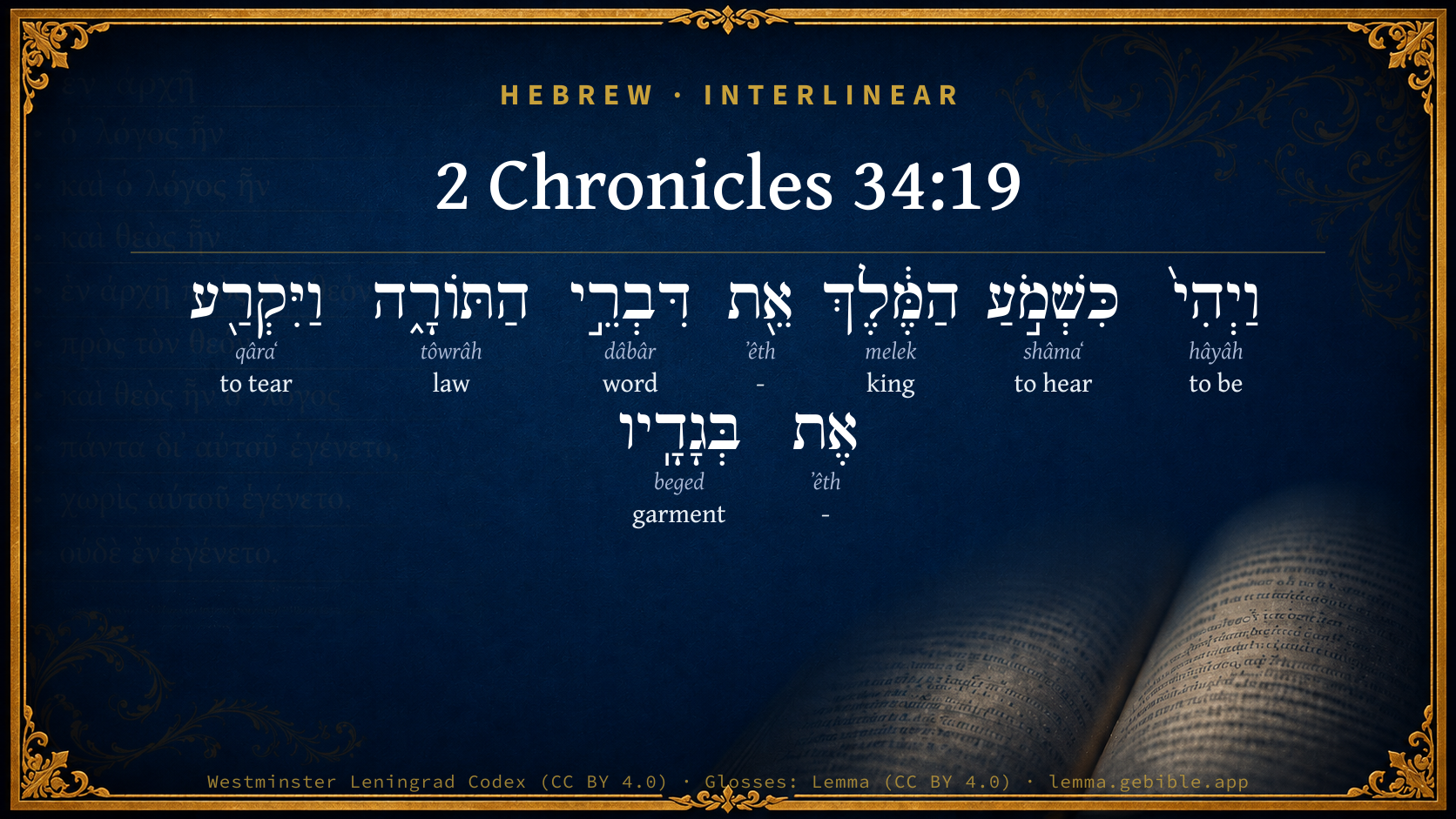
2 Chronicles 34:19

Hebrew (Westminster Leningrad Codex) 2 Chronicles 34:19 appears in the Hebrew Old Testament. The text above is from the Westminster Leningrad Codex. Each word links to its Strong’s number, a concise gloss, and parsing drawn from the Open Scriptures Hebrew Bible morphology. Click any word for its full Brown-Driver-Briggs (BDB) entry.
Download image
Cite this verse

2 Chronicles 34:19 (World English Bible). Public Domain. Lemma interlinear Bible study tool, https://lemma.gebible.app/v/2-chronicles/34/19.

Show BibTeX & RIS
BibTeX
RIS
English Translation
It happened, when the king had heard the words of the law, that he tore his clothes.
World English Bible · Public Domain
Download a study sheet

One document with this verse’s original text, its word-by-word gloss line, the meaning frame, cross-references with their text, attributed commentary, and full source and license credits — printable, and it pastes into notes with its structure intact.

This verse Autodidact and up

Study sheet (.html) Plain text (.txt)

A passage Seminary Student

Up to 50 verses in one chapter. A passage sheet keeps up to 6 commentary sources and 12 cross-references per verse, in the order this page ranks them, and says so on the sheet whenever that leaves anything out. Ask for a single verse and you get the Autodidact verse sheet above.

Everything on this page stays free to read, with no account — the sheet is a download of what is already on screen, not access to it.

Want to remove ads? Support Godless Engineer
Compare translations 3

The same verse in 3 English versions, stacked beneath the original-language interlinear above. Click any original word for its lexicon entry.

Each is an independent rendering of the whole verse — the interlinear is not word-aligned to these translations.

Highlighted words mark where these versions differ — a whole-verse word diff, not a word-by-word alignment.

  • World English Bible Public Domain
    It happened, when the king had heard the words of the law, that he tore his clothes.
  • King James Version Public Domain
    And it came to pass, when the king had heard the words of the law, that he rent his clothes.
  • unfoldingWord Literal Text CC BY-SA 4.0
    And it happened when the king heard the words of the law, and he tore his clothes.

unfoldingWord Literal Text — © unfoldingWord, licensed CC BY-SA 4.0. Word-aligned USFM3 via Door43 (git.door43.org/unfoldingWord/en_ult).

Versions to compare (up to 4)

3 of 4 selected

Show all 18 translations

Every available English version of this verse, each an independent rendering of the whole verse.

  • World English Bible Public Domain
    It happened, when the king had heard the words of the law, that he tore his clothes.
  • Berean Standard Bible Public Domain
    When the king heard the words of the Law, he tore his clothes
  • Majority Standard Bible Public Domain
    When the king heard the words of the Law, he tore his clothes
  • King James Version Public Domain
    And it came to pass, when the king had heard the words of the law, that he rent his clothes.
  • American Standard Version (1901) Public Domain
    And it came to pass, when the king had heard the words of the law, that he rent his clothes.
  • Revised Version (1885) Public Domain
    And it came to pass, when the king had heard the words of the law, that he rent his clothes.
  • Geneva Bible (1599) Public Domain
    And when the King had heard the wordes of the Lawe, he tare his clothes.
  • Douay-Rheims (1899) Public Domain
    And when he had heard the words of the law, he rent his garments:
  • Young's Literal Translation Public Domain
    And it cometh to pass, at the king's hearing the words of the law, that he rendeth his garments,
  • Literal Standard Version CC BY-SA 4.0
    And it comes to pass, at the king’s hearing the words of the Law, that he tears his garments,
  • Unlocked Literal Bible CC BY-SA 4.0
    It came about that when the king had heard the words of the law, he tore his clothes.
  • unfoldingWord Literal Text CC BY-SA 4.0
    And it happened when the king heard the words of the law, and he tore his clothes.
  • Darby Bible Public Domain
    And it came to pass when the king heard the words of the law, that he rent his garments.
  • World Messianic Bible Public Domain
    When the king had heard the words of the law, he tore his clothes.
  • Webster's Bible Public Domain
    And it came to pass, when the king had heard the words of the law, that he rent his clothes.
  • Free Bible Version CC BY-SA 4.0
    When the king heard what the Law said, he tore his clothes.
  • Bible in Basic English Public Domain
    And the king, hearing the words of the law, took his robe in his hands, violently parting it as a sign of his grief.
  • JPS Tanakh (1917) Public Domain
    And it came to pass, when the king had heard the words of the Law, that he rent his clothes.

Literal Standard Version (2020), Covenant Press — licensed CC BY-SA 4.0. Text via the HelloAO Bible API (eBible.org). Unlocked Literal Bible (unfoldingWord) — licensed CC BY-SA 4.0. Text via the HelloAO Bible API (eBible.org). unfoldingWord Literal Text — © unfoldingWord, licensed CC BY-SA 4.0. Word-aligned USFM3 via Door43 (git.door43.org/unfoldingWord/en_ult). Free Bible Version, Dr. Jonathan Gallagher — licensed CC BY-SA 4.0. Text via the HelloAO Bible API (eBible.org).

Word by word

More ways to search: Search by grammar → Find every occurrence → Compare this word →

Practice this passage: Drill this verse → Learn its vocabulary →

וַיִּקְרַ֖ע
qâraʻ
H7167
“and · to tear”
Conjunction + Verb, Qal, Sequential Imperfect, 3rd Person, Masculine, Singular
Part of Speech
Conjunction + Verb
Stem
Qal
Form
Sequential Imperfect
Person
3rd Person
Gender
Masculine
Number
Singular
Full BDB Definition

Origin: a primitive root

TWOT: 2074

to tear, tear in pieces - (Qal) - to tear, rend - to tear away or out - to tear, rend asunder - to make wide or large (of eyes) - to rend open (of heavens) - to tear, rend (of wild beasts) - (Niphal) to be rent, be split asunder
  1. וַיְהִי֙ hâyâh H1961 “and · to be” Conjunction + Verb, Qal, Sequential Imperfect, 3rd Person, Masculine, Singular
  2. כִּשְׁמֹ֣עַ shâmaʻ H8085 “like/as · to hear” Preposition + Verb, Qal, Infinitive Construct
  3. הַמֶּ֔לֶךְ melek H4428 “the · king” Particle, Definite Article + Noun, Common, Masculine, Singular, Absolute
  4. אֵ֖ת ʼêth H853 “-” Particle, Direct Object
  5. דִּבְרֵ֣י dâbâr H1697 “words of” Noun, Common, Masculine, Plural, Construct
  6. הַתּוֹרָ֑ה tôwrâh H8451 “the · law” Particle, Definite Article + Noun, Common, Feminine, Singular, Absolute
  7. אֶת ʼêth H853 “-” Particle, Direct Object
  8. בְּגָדָֽיו beged H899 “garments · his” Noun, Common, Masculine, Plural, Construct + Suffix, Personal, 3rd Person, Masculine, Singular

About this verse

These counts appear in no published source. They are computed here, from the morphology-tagged text and Lemma’s own curated glosses. What Lemma adds →

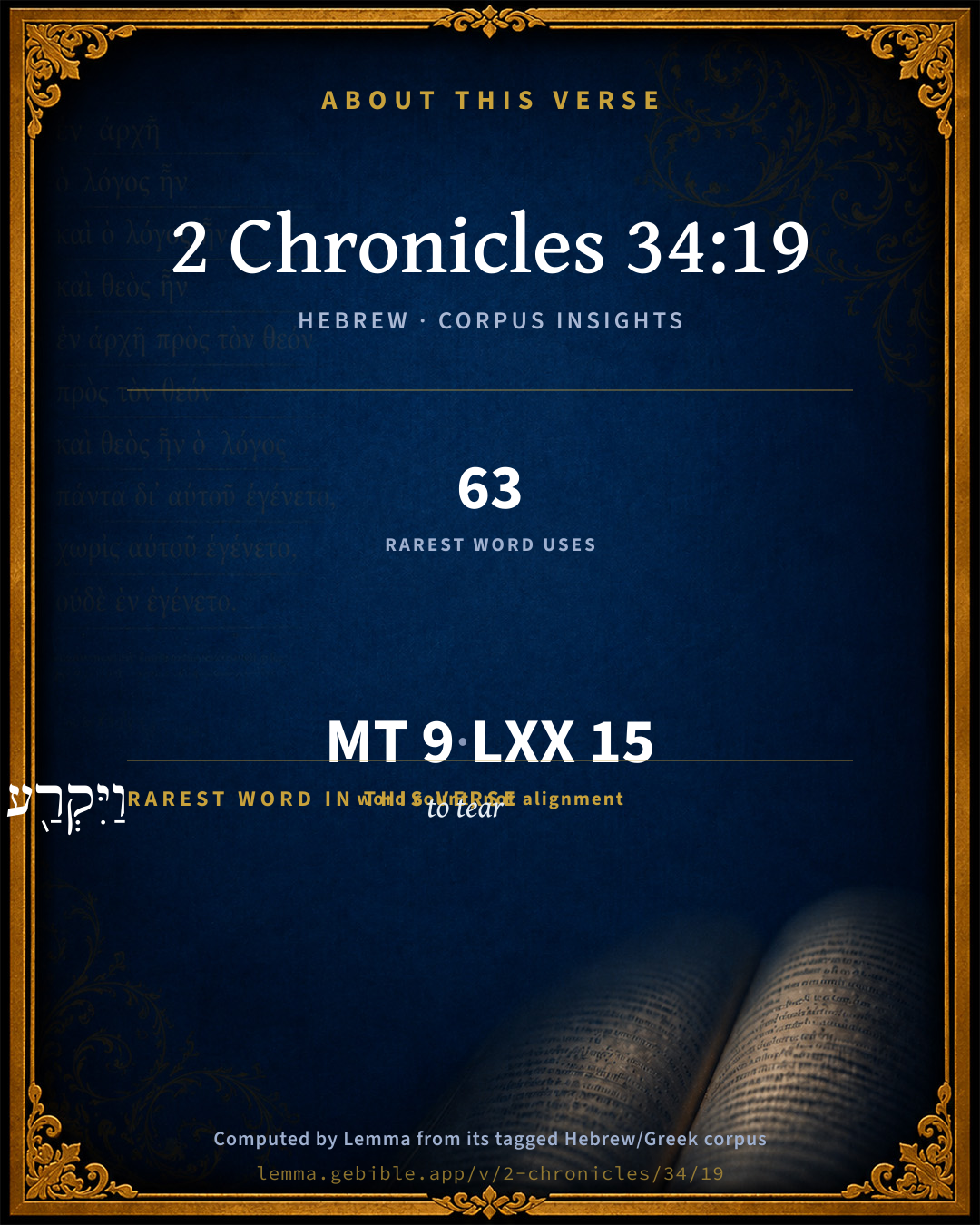
9
words
8
distinct lemmas
Historical
section

Grammatical profile

  • 3 verbs
  • 4 nouns
  • 2 particles

Verb forms

  • וַיְהִי֙ Qal · Sequential Imperfect
  • כִּשְׁמֹ֣עַ Qal · Infinitive Construct
  • וַיִּקְרַ֖ע Qal · Sequential Imperfect

Hebrew & Septuagint length

In English translation the verse runs 17 words from the Hebrew and 19 from the Septuagint (LXX English) — closely comparable.

A rough comparison of the two English renderings, which tokenize alike — not a word-level alignment.

Word counts can differ between the Hebrew and the Greek without any difference in meaning — e.g. the Hebrew direct-object marker אֵת has no separate Greek word, and Greek often adds the article ὁ.

In the original languages it is 9 Hebrew tokens and 15 Greek tokens — but the two are counted differently (Hebrew bundles its prefixes and suffixes into one token; the Greek is in lemma form), so that isn’t a like-for-like length.

Cross-references

11

Topical passages linked to 2 Chronicles 34:19 in the Treasury of Scripture Knowledge — connected by theme and wording, ordered by reader-vote popularity; previews shown in the World English Bible.

  • Joshua 7:6 Joshua tore his clothes, and fell to the earth on his face before the ark of Yahweh until the evening, he and the elders of Israel; and they put dust on their heads.
  • Deuteronomy 28:3–68 Blessed shall you be in the city, and blessed shall you be in the field.
  • 2 Kings 19:1 It happened, when king Hezekiah heard it, that he tore his clothes, and covered himself with sackcloth, and went into the house of Yahweh.
  • 2 Kings 22:11 It happened, when the king had heard the words of the book of the law, that he tore his clothes.
  • 2 Kings 22:19 because your heart was tender, and you did humble yourself before Yahweh, when you heard what I spoke against this place, and against the inhabitants of it, that they should become a desolation and a curse, and have torn your clothes, and wept before me; I also have heard you, says Yahweh.
  • Jeremiah 36:22–24 Now the king was sitting in the winter-house in the ninth month: and [there was a fire in] the brazier burning before him.
  • Joel 2:13 Tear your heart, and not your garments, And turn to Yahweh, your God; For he is gracious and merciful, Slow to anger, and abundant in loving kindness, And relents from sending calamity.
  • Romans 3:20 Because by the works of the law, no flesh will be justified in his sight. For through the law comes the knowledge of sin.
  • Romans 7:7–11 What shall we say then? Is the law sin? May it never be! However, I wouldn't have known sin, except through the law. For I wouldn't have known coveting, unless the law had said, "You shall not covet."
  • Galatians 2:19 For I, through the law, died to the law, that I might live to God.
  • Galatians 3:10–13 For as many as are of the works of the law are under a curse. For it is written, "Cursed is everyone who doesn't continue in all things that are written in the book of the law, to do them."

Cross-references courtesy of OpenBible.info (CC BY 4.0).

Hebrew and Greek witnesses Masoretic Hebrew ↔ Greek Septuagint

The same verse in the two great witnesses to the Old Testament, shown verse-for-verse.

These are two independent witnesses, not word-aligned to each other, and the Septuagint is shown in lemma (dictionary) form.

Hebrew 2 Chronicles 34:19 Masoretic · Westminster Leningrad Codex

וַיְהִי֙ כִּשְׁמֹ֣עַ הַמֶּ֔לֶךְ אֵ֖ת דִּבְרֵ֣י הַתּוֹרָ֑ה וַיִּקְרַ֖ע אֶת בְּגָדָֽיו

It happened, when the king had heard the words of the law, that he tore his clothes.

World English Bible · Public Domain

Greek LXX 2 Chronicles 34:19 Septuagint · lemma form

καί γίγνομαι ὡς ἀκούω ὁ βασιλεύς ὁ λόγος ὁ νόμος καί διαῥήγνυμι ὁ ἱμάτιον αὐτός

And it came to pass, when the king heard the words of the law, that he tore his garments.

LXX2012 (modern English Septuagint) · Public Domain

On this verse, Keil & Delitzsch discusses the Septuagint’s reading. Read the note in Commentary ↓

Hebrew: Westminster Leningrad Codex (CC BY 4.0). Greek: Septuagint (public domain); English from LXX2012 (modern English Septuagint) (Public Domain). How the Septuagint differs from the Hebrew →

Commentary

Notes on 2 Chronicles 34:19 from classic Christian and Jewish commentators (each source and its license shown beneath its notes). The classic Christian expositions comment on the surrounding passage and are grouped to its opening verse, so a note may address several verses; the Jewish commentaries on the Tanakh (Rashi and others) are per-verse, so they appear only where the commentator wrote on this verse.

Lemma curates 59 commentaries, every one of them public domain or Creative Commons licensed, each selected and text-cleaned for this edition rather than reprinted as found. About our sources →

Jamieson, Fausset & Brown

Robert Jamieson, A. R. Fausset & David Brown

AND, CAUSING THE LAW TO BE READ, RENEWS THE COVENANT BETWEEN GOD AND THE PEOPLE. (Ch2 34:19-33)

when the king had heard the words of the law, &c.--(See on Kg2 22:11-20; Kg2 23:1-3).

Next: 2 Chronicles Chapter 35

Jamieson, Fausset & Brown — Commentary Critical and Explanatory on the Whole Bible (1871) — public domain (CC PDM 1.0). Text via the HelloAO Bible API.

Joseph Benson's Commentary

2Ch 34:19. When the king had heard the words he rent his clothes — Were the things contained in Scripture new to us, as they were here to Josiah, surely they would make deeper impressions upon us than they commonly do. But they are not the less weighty, and therefore should not be the less regarded, because they are well known.

Joseph Benson's Commentary on the Old and New Testaments (1811–1818) — public domain. Text from a community e-Sword module.

Geneva Bible (1599)

Geneva Bible translators

For sorrow that the word of God had been so long suppressed and the people kept in ignorance, considering also the curses contained therein against the transgressors.

Geneva Bible (1599) marginal notes — public domain. Text via Bolls.life.

The Cambridge Bible for Schools and Colleges

gen. ed. J. J. S. Perowne

19. rent his clothes] A sign of grief. “Clothes” is in the plur. because both inner and outer garments are meant. See Ezr_9:3 (with Ryle’s note).

The Cambridge Bible for Schools and Colleges (gen. ed. J. J. S. Perowne; Cambridge University Press, 1878–1918) — public domain. Text from a community e-Sword module.

The Pulpit Commentary

With one insignificant exception (the omission here of the word rps), the words of this verse are identical with the parallel in its ver. 11. The same, to all purposes, may be said of our twelve succeedingverses, compared with the parallel in its ver. 12 2Ch_23:3. The king rent his clothes, in grief that the practice of his nation had diverged so terribly from their ever-to-be-venerated Law.

The Pulpit Commentary (1880–1919), ed. H.D.M. Spence-Jones & Joseph S. Exell — public domain. Text from a community e-Sword module.

John Wesley's Explanatory Notes

Rent his clothes - Were the things contained in scripture new to us, as they were here to Josiah, surely they would make deeper impressions upon us than they commonly do. But they are not the less weighty, and therefore should not be the less regarded, because they are well known.

John Wesley, Explanatory Notes Upon the Whole Bible (1754–1765) — public domain. Text via the GEBible commentary corpus.

Keil & Delitzsch

C. F. Keil & F. Delitzsch

The dismay of the king at the contents of the book which was read to him, and his inquiry of the prophetess Huldah as to the judgments threatened in the law. - Compare with this the parallel account in Kg2 22:11-20, with the commentary there given, as both accounts agree with the exception of some unimportant variations in expression. Instead of Abdon ben Micah (Ch2 34:20) we find in 2 Kings Achbor ben Micayahu, perhaps the correct reading. In Ch2 34:21, the expression, "and for those that are left in Israel and Judah," i.e., for the remainder of the people who were left in Israel after the destruction of the kingdom, and in Judah after the divine chastisements inflicted, mainly by the Assyrians under Hezekiah and Manasseh, is clearer and more significant than that in Kg2 22:13, "and for the people, and for all Judah." נתּכה, to pour itself forth (of anger), is quite as suitable as נצּתה, inflame, kindle itself, in Kg2 22:13. In Ch2 34:22, those sent with the high priest Hilkiah are briefly designated by the words המּלך ואשׁר, and whom the king, scil. had sent; in Kg2 22:14, on the contrary, the individual names are recorded (Ewald, Gramm. 292, b, would supply אמר, after the lxx). The names of the ancestors of the prophetess Huldah also are somewhat different. כּזאת, as the king had said to him, is omitted in 2 Kings. - In Ch2 34:24, כּל־האלות, all the curses, is more significant than כּל־דּברי, Kg2 22:16. ותּתּך (Ch2 34:25) is a statement of the result of the עזבוּני: Because they have forsaken me, my anger pours itself forth. In Ch2 34:27, the rhetorical expansion of the words which God had spoken of Jerusalem in the law, וגו לשׁמּה להיות, inserted in Kg2 22:19 as an elucidation, are omitted. After the preceding designation of these words as "the curses written in the law," any further elucidation was superfluous. On the contents of the saying of the prophetess Huldah, see the commentary on Kg2 22:16.

Keil & Delitzsch — Biblical Commentary on the Old Testament (1861–1891) — public domain (CC PDM 1.0). Text via the HelloAO Bible API. (Old Testament only.)

Rashi

Rabbi Shlomo Yitzchaki (Rashi)

that he rent his garments When he heard them reading (Deut. 28:36): “The Lord will lead you and the king, etc.,” he interpreted [the following words] as referring to himself: “whom you will appoint over yourself.” The people had made him king, and he was not a prince by the word [of God].

Rashi on the Tanakh — English translations: “The Judaica Press complete Tanach with Rashi, translated by A. J. Rosenberg” (CC BY 4.0); “Pentateuch with Rashi's commentary by M. Rosenbaum and A.M. Silbermann, 1929-1934” (public domain); “The Metsudah Tanach series, Lakewood, N.J” (CC BY 4.0); and “The Book of Joshua, Metsudah Publications, 1997” (CC BY 4.0). Text via Sefaria.

Lesson kit

Teaching starters — assembled from the data on this page, not authored interpretation. Every prompt links to the verse data it draws on. Edit before teaching.

2 Chronicles, in the Historical, opens this verse with 9 words (8 distinct Hebrew lemmas). Its most distinctive word is qâraʻ (“to tear”). A historical commentator’s framing appears above. Read the whole chapter for the surrounding context.

Discussion questions

  1. How does “to tear” (qâraʻ) shape what this verse is saying?
  2. How does Joshua 7:6, which shares this passage’s theme, read alongside this verse?
  3. These translations render this verse differently; the difference is in the English rendering, not the original. What questions does that raise?
  4. «וַיְהִי֙» is a Qal Sequential Imperfect verb. How does that grammatical form shape the action described?
  5. Compare how Jamieson, Fausset & Brown and Joseph Benson's Commentary read this verse. Where do they agree or differ?

Things to notice

Reading settings

Reading text

Shown beneath each verse's original-language words.

Old Testament
Old Testament edition

Read the OT as the Masoretic Hebrew (MT) or the Greek Septuagint (LXX).

English shown for the Greek Septuagint (in the Hebrew ↔ Greek comparison).

Comparing translations? Open the Compare panel on any verse page to stack up to four side by side.