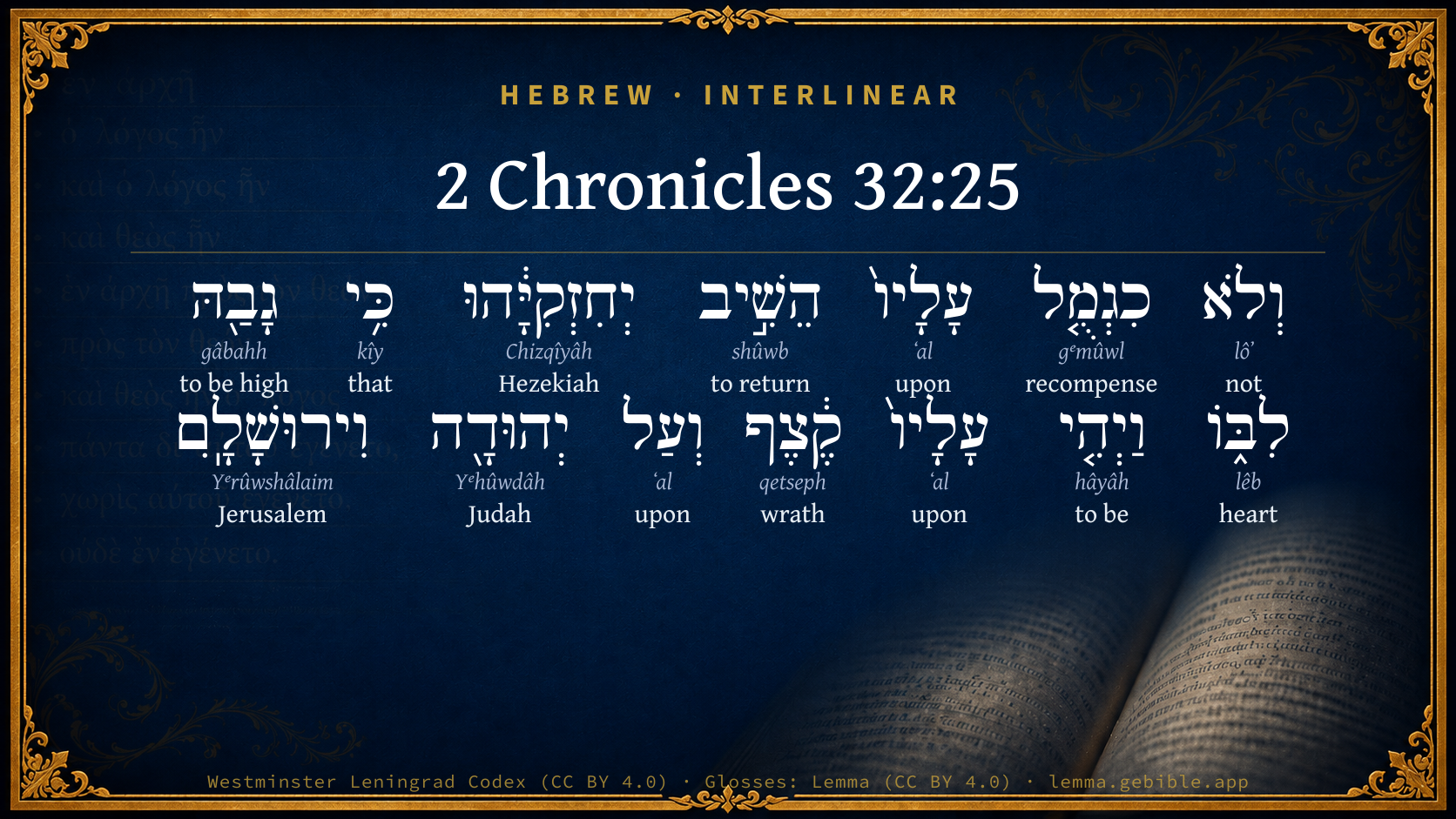
2 Chronicles 32:25

Hebrew (Westminster Leningrad Codex) 2 Chronicles 32:25 appears in the Hebrew Old Testament. The text above is from the Westminster Leningrad Codex. Each word links to its Strong’s number, a concise gloss, and parsing drawn from the Open Scriptures Hebrew Bible morphology. Click any word for its full Brown-Driver-Briggs (BDB) entry.
Download image
Cite this verse

2 Chronicles 32:25 (World English Bible). Public Domain. Lemma interlinear Bible study tool, https://lemma.gebible.app/v/2-chronicles/32/25.

Show BibTeX & RIS
BibTeX
RIS
English Translation
But Hezekiah didn't render again according to the benefit done to him; for his heart was lifted up: therefore there was wrath on him, and on Judah and Jerusalem.
World English Bible · Public Domain
Download a study sheet

One document with this verse’s original text, its word-by-word gloss line, the meaning frame, cross-references with their text, attributed commentary, and full source and license credits — printable, and it pastes into notes with its structure intact.

This verse Autodidact and up

Study sheet (.html) Plain text (.txt)

A passage Seminary Student

Up to 50 verses in one chapter. A passage sheet keeps up to 6 commentary sources and 12 cross-references per verse, in the order this page ranks them, and says so on the sheet whenever that leaves anything out. Ask for a single verse and you get the Autodidact verse sheet above.

Everything on this page stays free to read, with no account — the sheet is a download of what is already on screen, not access to it.

Want to remove ads? Support Godless Engineer
Compare translations 3

The same verse in 3 English versions, stacked beneath the original-language interlinear above. Click any original word for its lexicon entry.

Each is an independent rendering of the whole verse — the interlinear is not word-aligned to these translations.

Highlighted words mark where these versions differ — a whole-verse word diff, not a word-by-word alignment.

  • World English Bible Public Domain
    But Hezekiah didn't render again according to the benefit done to him; for his heart was lifted up: therefore there was wrath on him, and on Judah and Jerusalem.
  • King James Version Public Domain
    But Hezekiah rendered not again according to the benefit done unto him; for his heart was lifted up: therefore there was wrath upon him, and upon Judah and Jerusalem.
  • unfoldingWord Literal Text CC BY-SA 4.0
    But according to the benefit to him Hezekiah did not return, for his heart was high. And there was on him wrath and on Judah and Jerusalem.

unfoldingWord Literal Text — © unfoldingWord, licensed CC BY-SA 4.0. Word-aligned USFM3 via Door43 (git.door43.org/unfoldingWord/en_ult).

Versions to compare (up to 4)

3 of 4 selected

Show all 18 translations

Every available English version of this verse, each an independent rendering of the whole verse.

  • World English Bible Public Domain
    But Hezekiah didn't render again according to the benefit done to him; for his heart was lifted up: therefore there was wrath on him, and on Judah and Jerusalem.
  • Berean Standard Bible Public Domain
    But because his heart was proud, Hezekiah did not repay the favor shown to him. Therefore wrath came upon him and upon Judah and Jerusalem.
  • Majority Standard Bible Public Domain
    But because his heart was proud, Hezekiah did not repay the favor shown to him. Therefore wrath came upon him and upon Judah and Jerusalem.
  • King James Version Public Domain
    But Hezekiah rendered not again according to the benefit done unto him; for his heart was lifted up: therefore there was wrath upon him, and upon Judah and Jerusalem.
  • American Standard Version (1901) Public Domain
    But Hezekiah rendered not again according to the benefit done unto him; for his heart was lifted up: therefore there was wrath upon him, and upon Judah and Jerusalem.
  • Revised Version (1885) Public Domain
    But Hezekiah rendered not again according to the benefit done unto him; for his heart was lifted up: therefore there was wrath upon him, and upon Judah and Jerusalem.
  • Geneva Bible (1599) Public Domain
    But Hezekiah did not render according to the rewarde bestowed vpon him: for his heart was lift vp, and wrath came vpon him, and vpon Iudah and Ierusalem.
  • Douay-Rheims (1899) Public Domain
    But he did not render again according to the benefits which he had received, for his heart was lifted up: and wrath was enkindled against him, and against Juda and Jerusalem.
  • Young's Literal Translation Public Domain
    and Hezekiah hath not returned according to the deed `done' unto him, for his heart hath been lofty, and there is wrath upon him, and upon Judah and Jerusalem;
  • Literal Standard Version CC BY-SA 4.0
    and Hezekiah has not returned according to the deed [done] to him, for his heart has been lofty, and there is wrath on him and on Judah and Jerusalem;
  • Unlocked Literal Bible CC BY-SA 4.0
    But Hezekiah did not pay back Yahweh for the help given to him, for his heart was lifted up. So anger came on him, and on Judah and Jerusalem.
  • unfoldingWord Literal Text CC BY-SA 4.0
    But according to the benefit to him Hezekiah did not return, for his heart was high. And there was on him wrath and on Judah and Jerusalem.
  • Darby Bible Public Domain
    But Hezekiah rendered not again according to the benefit [done] to him, for his heart was lifted up; and there was wrath upon him, and upon Judah and Jerusalem.
  • World Messianic Bible Public Domain
    But Hezekiah didn’t reciprocate appropriate to the benefit done for him, because his heart was lifted up. Therefore there was wrath on him, Judah, and Jerusalem.
  • Webster's Bible Public Domain
    But Hezekiah rendered not again according to the benefit done to him; for his heart was lifted up: therefore there was wrath upon him, and upon Judah and Jerusalem.
  • Free Bible Version CC BY-SA 4.0
    But because he had become proud, Hezekiah did not acknowledge the gift he'd been given. So the Lord's anger fell on him, and on Judah and Jerusalem.
  • Bible in Basic English Public Domain
    But Hezekiah did not do as had been done to him; for his heart was lifted up in pride; and so wrath came on him and on Judah and Jerusalem.
  • JPS Tanakh (1917) Public Domain
    But Hezekiah rendered not according to the benefit done unto him; for his heart was lifted up; therefore there was wrath upon him, and upon Judah and Jerusalem.

Literal Standard Version (2020), Covenant Press — licensed CC BY-SA 4.0. Text via the HelloAO Bible API (eBible.org). Unlocked Literal Bible (unfoldingWord) — licensed CC BY-SA 4.0. Text via the HelloAO Bible API (eBible.org). unfoldingWord Literal Text — © unfoldingWord, licensed CC BY-SA 4.0. Word-aligned USFM3 via Door43 (git.door43.org/unfoldingWord/en_ult). Free Bible Version, Dr. Jonathan Gallagher — licensed CC BY-SA 4.0. Text via the HelloAO Bible API (eBible.org).

Word by word

More ways to search: Search by grammar → Find every occurrence → Compare this word →

Practice this passage: Drill this verse → Learn its vocabulary →

כִגְמֻ֤ל
gᵉmûwl
H1576
“like/as · recompense”
Preposition + Noun, Common, Masculine, Singular, Absolute
Part of Speech
Preposition + Noun
Type
Common
Gender
Masculine
Number
Singular
State
Absolute
Full BDB Definition

Origin: from H1580

TWOT: 360a

dealing, recompense, benefit - dealing (of one's hand) - recompense - benefit
  1. וְלֹא lôʼ H3808 “and · not” Conjunction + Particle, Negative
  2. עָלָיו֙ ʻal H5921 “upon · him” Preposition + Suffix, Personal, 3rd Person, Masculine, Singular
  3. הֵשִׁ֣יב shûwb H7725 “to return” Verb, Hiphil, Perfect, 3rd Person, Masculine, Singular
  4. יְחִזְקִיָּ֔הוּ Chizqîyâh H2396 “Hezekiah” Noun, Proper
  5. כִּ֥י kîy H3588 “that” Conjunction
  6. גָבַ֖הּ gâbahh H1361 “to be high” Verb, Qal, Perfect, 3rd Person, Masculine, Singular
  7. לִבּ֑וֹ lêb H3820 “heart · his” Noun, Common, Masculine, Singular, Construct + Suffix, Personal, 3rd Person, Masculine, Singular
  8. וַיְהִ֤י hâyâh H1961 “and · to be” Conjunction + Verb, Qal, Sequential Imperfect, 3rd Person, Masculine, Singular
  9. עָלָיו֙ ʻal H5921 “upon · him” Preposition + Suffix, Personal, 3rd Person, Masculine, Singular
  10. קֶ֔צֶף qetseph H7110 “wrath” Noun, Common, Masculine, Singular, Absolute
  11. וְעַל ʻal H5921 “and · upon” Conjunction + Preposition
  12. יְהוּדָ֖ה Yᵉhûwdâh H3063 “Judah” Noun, Proper
  13. וִירוּשָׁלִָֽם Yᵉrûwshâlaim H3389 “and · Jerusalem” Conjunction + Noun, Proper

About this verse

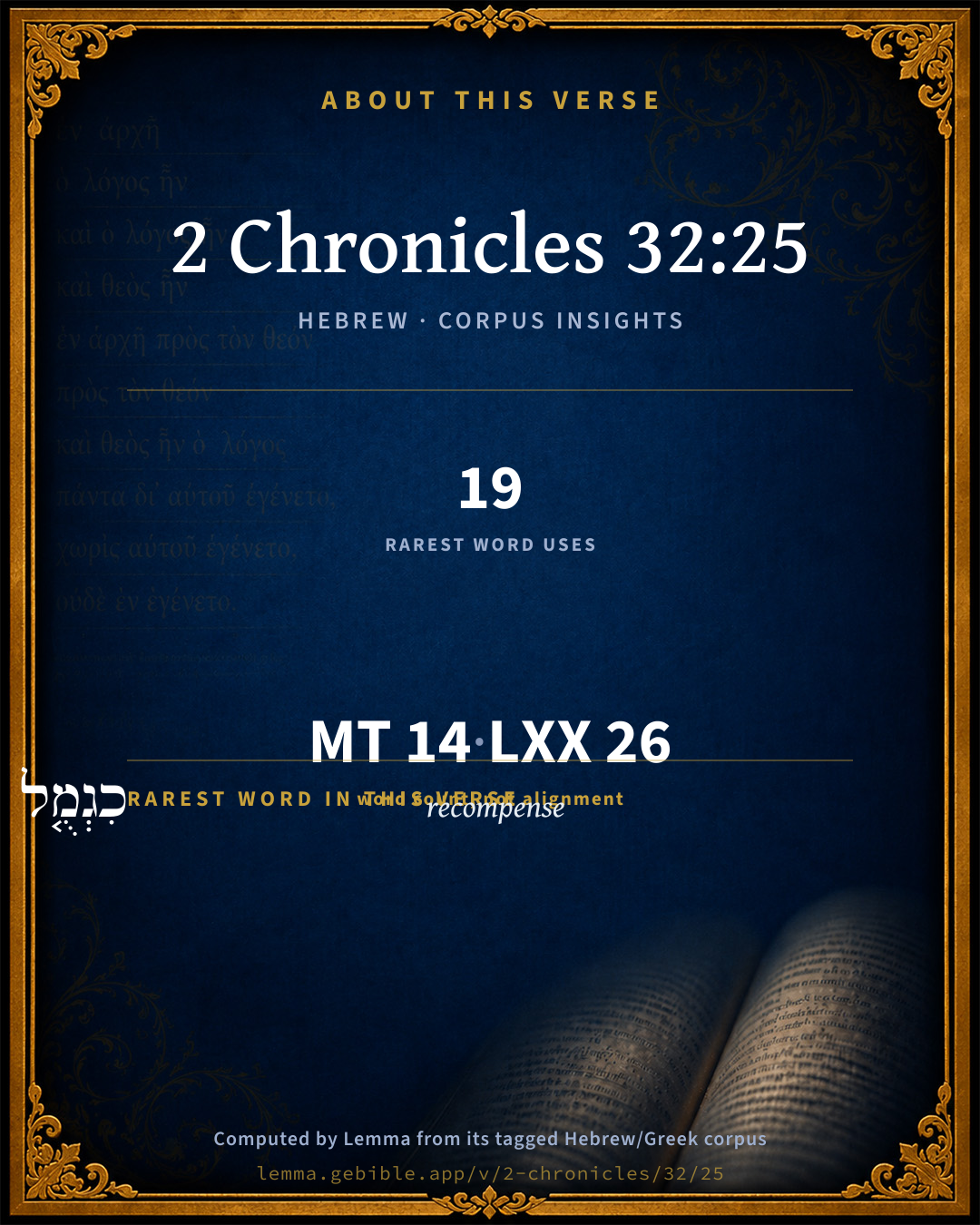
These counts appear in no published source. They are computed here, from the morphology-tagged text and Lemma’s own curated glosses. What Lemma adds →

14
words
12
distinct lemmas
Historical
section

Notable vocabulary

The rarest word here is כִגְמֻ֤ל recompense H1576 — appearing just 19 times in the whole Hebrew Bible.

Shared distinctive vocabulary

כִגְמֻ֤ל recompense H1576 occurs in 17 verses of the Hebrew Bible. Also found in:

Grammatical profile

  • 3 verbs
  • 6 nouns
  • 3 prepositions
  • 1 conjunction
  • 1 particle

Verb forms

  • הֵשִׁ֣יב Hiphil · Perfect
  • גָבַ֖הּ Qal · Perfect
  • וַיְהִ֤י Qal · Sequential Imperfect

Repetition

A word recurs within this verse — often emphatic in Hebrew:

  • עָלָיו֙ upon H5921 ×3

Hebrew & Septuagint length

In English translation the verse runs 29 words from the Hebrew and 31 from the Septuagint (LXX English) — closely comparable.

A rough comparison of the two English renderings, which tokenize alike — not a word-level alignment.

Word counts can differ between the Hebrew and the Greek without any difference in meaning — e.g. the Hebrew direct-object marker אֵת has no separate Greek word, and Greek often adds the article ὁ.

In the original languages it is 14 Hebrew tokens and 26 Greek tokens — but the two are counted differently (Hebrew bundles its prefixes and suffixes into one token; the Greek is in lemma form), so that isn’t a like-for-like length.

Cross-references

26

Topical passages linked to 2 Chronicles 32:25 in the Treasury of Scripture Knowledge — connected by theme and wording, ordered by reader-vote popularity; previews shown in the World English Bible.

  • 2 Chronicles 24:18 They forsook the house of Yahweh, the God of their fathers, and served the Asherim and the idols: and wrath came on Judah and Jerusalem for this their guiltiness.
  • 2 Chronicles 26:16 But when he was strong, his heart was lifted up, so that he did corruptly, and he trespassed against Yahweh his God; for he went into the temple of Yahweh to burn incense on the altar of incense.
  • 2 Samuel 24:1 Again the anger of Yahweh was kindled against Israel, and he moved David against them, saying, Go, number Israel and Judah.
  • 2 Chronicles 32:31 However in [the business of] the ambassadors of the princes of Babylon, who sent to him to inquire of the wonder that was done in the land, God left him, to try him, that he might know all that was in his heart.
  • Deuteronomy 8:17 and [lest] you say in your heart, My power and the might of my hand has gotten me this wealth.
  • 2 Kings 14:10 You have indeed struck Edom, and your heart has lifted you up: glory of it, and abide at home; for why should you meddle to [your] hurt, that you should fall, even you, and Judah with you?
  • 1 Chronicles 21:12–17 either three years of famine; or three months to be consumed before your foes, while the sword of your enemies overtakes you; or else three days the sword of Yahweh, even pestilence in the land, and the angel of Yahweh destroying throughout all the borders of Israel. Now therefore consider what answer I shall return to him who sent me.
  • Deuteronomy 8:12–14 lest, when you have eaten and are full, and have built goodly houses, and lived therein;
  • Deuteronomy 32:6 Do you thus requite Yahweh, Foolish people and unwise? Isn't he your father who has bought you? He has made you, and established you.
  • 2 Samuel 24:10–17 David's heart struck him after that he had numbered the people. David said to Yahweh, I have sinned greatly in that which I have done: but now, Yahweh, put away, I beg you, the iniquity of your servant; for I have done very foolishly.
  • 2 Kings 20:13 Hezekiah listened to them, and shown them all the house of his precious things, the silver, and the gold, and the spices, and the precious oil, and the house of his armor, and all that was found in his treasures: there was nothing in his house, nor in all his dominion, that Hezekiah didn't show them.
  • 1 Chronicles 21:1 Satan stood up against Israel, and moved David to number Israel.
  • 2 Chronicles 19:2 Jehu the son of Hanani the seer went out to meet him, and said to king Jehoshaphat, Should you help the wicked, and love those who hate Yahweh? for this thing wrath is on you from before Yahweh.
  • 2 Chronicles 25:19 You say, Behold, you have struck Edom; and your heart lifts you up to boast: abide now at home; why should you meddle to [your] hurt, that you should fall, even you, and Judah with you?
  • Psalms 116:12–13 What will I give to Yahweh for all his benefits toward me?
  • Ezekiel 28:2 Son of man, tell the prince of Tyre, Thus says the Lord Yahweh: Because your heart is lifted up, and you have said, I am a god, I sit in the seat of God, in the midst of the seas; yet you are man, and not God, though you did set your heart as the heart of God;-
  • Ezekiel 28:5 by your great wisdom [and] by your traffic have you increased your riches, and your heart is lifted up because of your riches;-
  • Ezekiel 28:17 Your heart was lifted up because of your beauty; you have corrupted your wisdom by reason of your brightness: I have cast you to the ground; I have laid you before kings, that they may see you.
  • Daniel 5:20 But when his heart was lifted up, and his spirit was hardened so that he dealt proudly, he was deposed from his kingly throne, and they took his glory from him:
  • Daniel 5:23 but have lifted up yourself against the Lord of heaven; and they have brought the vessels of his house before you, and you and your lords, your wives and your concubines, have drunk wine from them; and you have praised the gods of silver and gold, of brass, iron, wood, and stone, which don't see, nor hear, nor know; and the God in whose hand your breath is, and whose are all your ways, you have not glorified.
  • Hosea 14:2 Take words with you, and return to Yahweh. Tell him, "Forgive all our sins, And accept that which is good: So we offer like bulls our lips.
  • Habakkuk 2:4 Behold, his soul is puffed up. It is not upright in him, but the righteous will live by his faith.
  • Luke 17:17–18 Jesus answered, "Weren't the ten cleansed? But where are the nine?
  • 2 Corinthians 12:7 By reason of the exceeding greatness of the revelations, that I should not be exalted excessively, there was given to me a thorn in the flesh, a messenger of Satan to buffet me, that I should not be exalted excessively.
  • 1 Timothy 3:6 not a new convert, lest being puffed up he fall into the same condemnation as the devil.
  • 1 Peter 5:5–6 Likewise, you younger ones, be subject to the elder. Yes, all of you gird yourselves with humility, to subject yourselves to one another; for "God resists the proud, but gives grace to the humble."

Cross-references courtesy of OpenBible.info (CC BY 4.0).

Hebrew and Greek witnesses Masoretic Hebrew ↔ Greek Septuagint

The same verse in the two great witnesses to the Old Testament, shown verse-for-verse.

These are two independent witnesses, not word-aligned to each other, and the Septuagint is shown in lemma (dictionary) form.

Hebrew 2 Chronicles 32:25 Masoretic · Westminster Leningrad Codex

וְלֹא כִגְמֻ֤ל עָלָיו֙ הֵשִׁ֣יב יְחִזְקִיָּ֔הוּ כִּ֥י גָבַ֖הּ לִבּ֑וֹ וַיְהִ֤י עָלָיו֙ קֶ֔צֶף וְעַל יְהוּדָ֖ה וִירוּשָׁלִָֽם

But Hezekiah didn't render again according to the benefit done to him; for his heart was lifted up: therefore there was wrath on him, and on Judah and Jerusalem.

World English Bible · Public Domain

Greek LXX 2 Chronicles 32:25 Septuagint · lemma form

καί οὐ κατά ὁ ἀνταπόδομα ὅς δίδωμι αὐτός ἀντι ἀποδίδωμι εζεκιας ἀλλά ὑψόω ὁ καρδία αὐτός καί γίγνομαι ἐπί αὐτός ὀργή καί ἐπί ἰούδας καί ἰερουσαλήμ

But Ezekias did not recompense the Lord according to the return which he made him, but his heart was lifted up: and wrath came upon him, and upon Juda and Jerusalem.

LXX2012 (modern English Septuagint) · Public Domain

Hebrew: Westminster Leningrad Codex (CC BY 4.0). Greek: Septuagint (public domain); English from LXX2012 (modern English Septuagint) (Public Domain). How the Septuagint differs from the Hebrew →

Commentary

Notes on 2 Chronicles 32:25 from classic Christian and Jewish commentators (each source and its license shown beneath its notes). The classic Christian expositions comment on the surrounding passage and are grouped to its opening verse, so a note may address several verses; the Jewish commentaries on the Tanakh (Rashi and others) are per-verse, so they appear only where the commentator wrote on this verse.

Lemma curates 59 commentaries, every one of them public domain or Creative Commons licensed, each selected and text-cleaned for this edition rather than reprinted as found. About our sources →

Trapp's Complete Commentary

John Trapp

2Ch 32:25 But Hezekiah rendered not again according to the benefit [done] unto him; for his heart was lifted up: therefore there was wrath upon him, and upon Judah and Jerusalem.

Ver. 25. But Hezekiah rendered not again.] His returns were not answerable to his receipts. Plerique omnes sumus ingrati. The rain comes down from heaven in showers; it goes up but in mists: so do our praises return slowly and slenderly. We serve God, for most part as little children serve us, who, when they be come in to us from their play, and have got something of us they want, away they go, without reverence or respect of us; but if they know we will have duty, then they do it, but in such a fashion that we may see their hearts are on their game abroad more than on their duty.

For his heart was lifted up.] Not as good Jehoshaphat’s was, {2Ch 17:6} but worse, with pride and self-conceit, whilst he considered not his distance from God and dependence upon God, but acted as if he had been some petty god within himself. Such a blab Satan will easily blow up in the best hearts, if they watch not.

John Trapp, A Commentary or Exposition upon All the Books of the Old and New Testament (1647–1656) — public domain. Text from a community e-Sword module.

Joseph Benson's Commentary

2Ch 32:25. Hezekiah rendered not again according to the benefit done him — Was not humble, grateful, and devoted to God, as in reason and duty he ought to have been, considering God’s marvellous interpositions in his favour, and the great and extraordinary deliverances he had wrought out for him and his kingdom; but God’s favour to him became the food and fuel of his pride. For his heart was lifted up — On account of that prodigious victory over the Assyrians, his miraculous restoration from sickness, and the honour since done him by an embassy from the great king of Babylon. All which, probably, raised in him too great an opinion of himself, as if these things were done for his piety and virtues. And instead of walking humbly with God, and giving the glory of all to him, he took, in part at least, the honour to himself, and vainly showed his riches and precious treasures to the Babylonish ambassadors, 2Ki 20:12, &c. Therefore there was wrath upon him — For pride is a sin which God particularly hates, especially in his own people; and they that exalt themselves must expect to be abased, and put under humbling providences. Thus wrath came on David for his pride in numbering the people. And upon Judah and Jerusalem — Who were justly punished for Hezekiah’s sin, because they imitated him in it, as they confess in the next verse.

Joseph Benson's Commentary on the Old and New Testaments (1811–1818) — public domain. Text from a community e-Sword module.

Geneva Bible (1599)

Geneva Bible translators

He was lifted up with the pride of his victory and treasures, and showeth them for an ostentation to the ambassadors of Babylon.

Geneva Bible (1599) marginal notes — public domain. Text via Bolls.life.

Adam Clarke's Commentary

Verse 25. Hezekiah rendered not again] He got into a vain confidence, took pleasure in his riches, and vainly showed them to the messengers of the king of Babylon. See on 2Kg 20:12, &c.

Adam Clarke's Commentary on the Bible (1810–1826) — public domain. Text from a community e-Sword/MySword module.

Ellicott's Commentary for English Readers

(25) But Hezekiah.—For Hezekiah’s pride, see the account of his reception of the Babylonian embassy (2Ki_20:12-19; Isaiah 39).

According to the benefit done unto him.—In his illness he promised to walk humbly all his days (Isa_38:15); but when he had recovered, “his heart was lifted up.”

Therefore there was wrath upon him.—And wrath fell upon him. The token of this was seen in Isaiah’s prophetic rebuke, foretelling that the royal treasures would be carried away to Babylon, and that some of Hezekiah’s sons would be eunuchs in the palace there (2Ki_20:16-18; Isa_39:5-7).

And upon Judah and Jerusalem.—Which shared in the king’s guilty pride and confidence in the arm of flesh. (Comp. 1Ch_27:24; 2Ch_19:10.)

A Bible Commentary for English Readers, edited by Charles John Ellicott (1878–1897) — public domain. Text from a community e-Sword module.

The Cambridge Bible for Schools and Colleges

gen. ed. J. J. S. Perowne

25. his heart was lifted up] Cp. 2Ch_32:31; 2Ki_20:12-15.

wrath] Heb. qeçeph, a visitation of divine wrath; cp. 2Ch_19:2; 2Ch_19:10; 2Ch_24:18, 2Ch_29:8.

The Cambridge Bible for Schools and Colleges (gen. ed. J. J. S. Perowne; Cambridge University Press, 1878–1918) — public domain. Text from a community e-Sword module.

John Gill's Exposition

This same Hezekiah also stopped the upper water course of Gihon,.... Which Procopius Gazeus says was the same with Siloam, and which it seems had two streams, and this was the upper one; Mr. Maundrell says (c), the pool of Gihon"lies about two furlongs without Bethlehem gate westward; it is a stately pool, one hundred and six paces long, and sixty seven broad, and lined with wall and plaster, and was, when we were there, well stored with water:"

and brought it straight down to the west side of the city of David; through canals under the plain of the city of David; as the Targum, by a subterraneous passage; and Siloam, as Dr. Lightfoot (d) observes from Josephus, was behind the west wall, not far from the corner that pointed toward the southwest:

and Hezekiah prospered in all his works; natural, civil, and religious, Ch2 31:21.

(c) Journey from Aleppo, &c. p. 108. (d) Chorograph. in John, c. 5. sect. 2.

John Gill's Exposition of the Whole Bible (1746–1763) — public domain (CC PDM 1.0). Text via the HelloAO Bible API.

Albert Barnes' Notes on the Bible

His heart was lifted up - Compare the marginal reference. Hezekiah’s pride was shown in his unnecessarily exhibiting his treasures to the ambassadors from Babylon (see 2Ki 20:13).

There was wrath upon him - Compare 2Ki 20:17-18.

Albert Barnes' Notes on the Bible (1834–1885) — public domain. Text from a community e-Sword/MySword module.

Haydock's Catholic Bible Commentary

Up, by riches, and the splendid embassy from Babylon. C. --- Prosperity is more dangerous than adversity. W. --- Few are able to bear good fortune with moderation. H.

George Leo Haydock (1774–1849), Haydock's Catholic Family Bible and Commentary, 1859 edition — public domain. Excludes Psalms (Douay-Rheims chapter numbering differs from Protestant) and Deuterocanonical books (Catholic canon only).

Matthew Poole's English Annotations

His heart was lifted up, for that prodigious victory over the Assyrians, above, 2Ch 32:21, and for his miraculous restoration from sickness, and the confirmation of that work by a strange and supernatural motion of the sun, and by the honour since done him by an embassy from the great and potent king of Babylon; all which probably raised in him too great an opinion of himself, as if these things were done, if not by his power, yet, at least, for his piety and virtues. And instead of walking humbly with God, and giving the glory of all entirely to him, he took the honour to himself, and vain-gloriously showed his riches and precious treasures to the Babylonish ambassadors, 2Ki 20:12, &c.

Upon Judah and Jerusalem; who might justly be punished for Hezekiah’s sin, because they followed him in it, as they confess in the next verse.

Matthew Poole's English Annotations on the Holy Bible (1683–1685) — public domain. Text from a community e-Sword/MySword module.

The Pulpit Commentary

The parallel, 2Ki_20:12-19 and Isa 39, fully explain the circumstances here referred to, and we may conclude that Hezekiah"s sin consisted in the spirit in which he acted, displaying his treasures, so that it was in the fullest sense a sin of" the heart.

Vers. 25, 26.

Hezekiah"s fall and repentance.

I HEZEKIAH"S SIN.

1. Its character.

(1) Ingratitude. "He rendered not again according to the benefit done unto him." That benefit had been great deliverance from a more powerful assailant than the King of Assyria, even from the king of terrors (Job_18:14) and ought to have awakened undying thankfulness in Hezekiah"s besom, as, indeed, he promised it would. (Isa_38:20) But it did not. Ingratitude, a sin of which Uzziah (2Ch_26:16) and Rehoboam (2Ch_12:1) before him bad been guilty, with which men in general are often chargeable (Luk_17:17; Rom_1:21; 2Ti_3:2) and into which the best of men occasionally fall. (2Sa_12:7, 2Sa_12:8, 2Sa_12:9)

(2) Pride. "His heart was lifted up." Like other good men before and since, his vows upon his sick-bed were better than his performances when health was restored. He had engaged "to go softly all his years, because of the bitterness of his soul"; (Isa_38:15) but instead, his heart was lifted up, not as Jehoshaphat"s had been, "in the ways of the Lord", (2Ch_17:6) but as Uzziah"s (2Ch_26:16) and Amaziah"s (2Ch_25:19) had been, in self-sufficiency the allusion being to his behaviour in connection with the Babylonian envoys, who shortly after his recovery visited Jerusalem, and endeavoured to enlist him in a league against Assyria (see homily on ver. 31).

2. Its punishment. The wrath of Jehovah was threatened

(1) upon himself, the immediate offender, which was righteous (2Ch_19:2 2Ch_24:18; cf.; Rom_1:18) and

(2) upon Judah and Jerusalem, by the law of imputation, and in accordance with the solidarity of nations. The punishment of sin often falls on the innocent, because of their connection with the guilty. Children suffer for the evil-doing of their parents, and subjects for that of their rulers. "The fathers have eaten sour grapes, and the children"s teeth are set on edge" (Jer_31:29; Eze_18:2)

II HEZEKIAH"S REPENTANCE.

1. The self-abasement of the king. "He humbled himself for the pride of his heart." The wrath of Jehovah, pronounced against him and his people by Isaiah, was the Babylonish captivity. When Hezekiah heard the prophet"s threatening, he realized that he had sinned, and humbled himself before Jehovah, saying, "Good is the word of the Lord which thou hast spoken" (2Ki_20:14-19; Isa_38:3-8)

1. The concurrence of the people. "He and the inhabitants of Jerusalem." Probably they had not been unfavourable to a Babylonian alliance against Assyria, and were really "art and part" co-criminals with Hezekiah; if they had no share in Hezekiah"s action, they had still cause to humble themselves before God on account of Hezekiah their king.

2. The clemency of Jehovah. The judgment was to fall on Hezekiah"s sons rather than on himself, which Hezekiah recognized as a mercy, and acknowledged by adding, "Is it not so i.e. good if peace and truth shall be in my days?

LESSONS.

1. The possibility of spiritual declension.

2. The duty of repentance,

3. The obligation of gratitude.

4. The sin of pride. W.

The Pulpit Commentary (1880–1919), ed. H.D.M. Spence-Jones & Joseph S. Exell — public domain. Text from a community e-Sword module.

John Wesley's Explanatory Notes

Lifted up - For that prodigious victory over the Assyrians, for his miraculous restoration from sickness, and for the honour since done him by an embassy from the great king of Babylon. All which probably raised in him too great an opinion of himself, as if these things were done for his piety and virtues.

John Wesley, Explanatory Notes Upon the Whole Bible (1754–1765) — public domain. Text via the GEBible commentary corpus.

Rashi

Rabbi Shlomo Yitzchaki (Rashi)

But...did not repay Him according to that which He had bestowed upon him Hezekiah did not repay the Holy One, blessed be He in accordance with that which He had bestowed upon him by healing him.

for his heart became haughty as it is written (ibid. 20:13): “and he showed them his entire treasure-house...and in all his kingdom.”

and there was wrath upon him and upon Judah and Jerusalem because of this, and the author of this Book abridged it here because it is described in II Kings (20) and in Isaiah (39).

Rashi on the Tanakh — English translations: “The Judaica Press complete Tanach with Rashi, translated by A. J. Rosenberg” (CC BY 4.0); “Pentateuch with Rashi's commentary by M. Rosenbaum and A.M. Silbermann, 1929-1934” (public domain); “The Metsudah Tanach series, Lakewood, N.J” (CC BY 4.0); and “The Book of Joshua, Metsudah Publications, 1997” (CC BY 4.0). Text via Sefaria.

Lesson kit

Teaching starters — assembled from the data on this page, not authored interpretation. Every prompt links to the verse data it draws on. Edit before teaching.

2 Chronicles, in the Historical, opens this verse with 14 words (12 distinct Hebrew lemmas). Its most distinctive word is gᵉmûwl (“recompense”). A historical commentator’s framing appears above. Read the whole chapter for the surrounding context.

Discussion questions

  1. The word gᵉmûwl carries the sense “recompense.” How does it shape the verse?
  2. Judges 9:16 shares the word «recompense» with this verse. How do the two illuminate each other?
  3. “upon” occurs 3× in this one verse. What is the effect of the repetition?
  4. The translations on this page render this verse differently — a whole-verse word diff, not a word-by-word alignment. What might account for the different wordings?
  5. The verb «הֵשִׁ֣יב» is Hiphil Perfect. How does its form color the action?
  6. Reading how Trapp's Complete Commentary and Joseph Benson's Commentary read this verse, where do the two commentators agree and where do they part?

Things to notice

Reading settings

Reading text

Shown beneath each verse's original-language words.

Old Testament
Old Testament edition

Read the OT as the Masoretic Hebrew (MT) or the Greek Septuagint (LXX).

English shown for the Greek Septuagint (in the Hebrew ↔ Greek comparison).

Comparing translations? Open the Compare panel on any verse page to stack up to four side by side.