

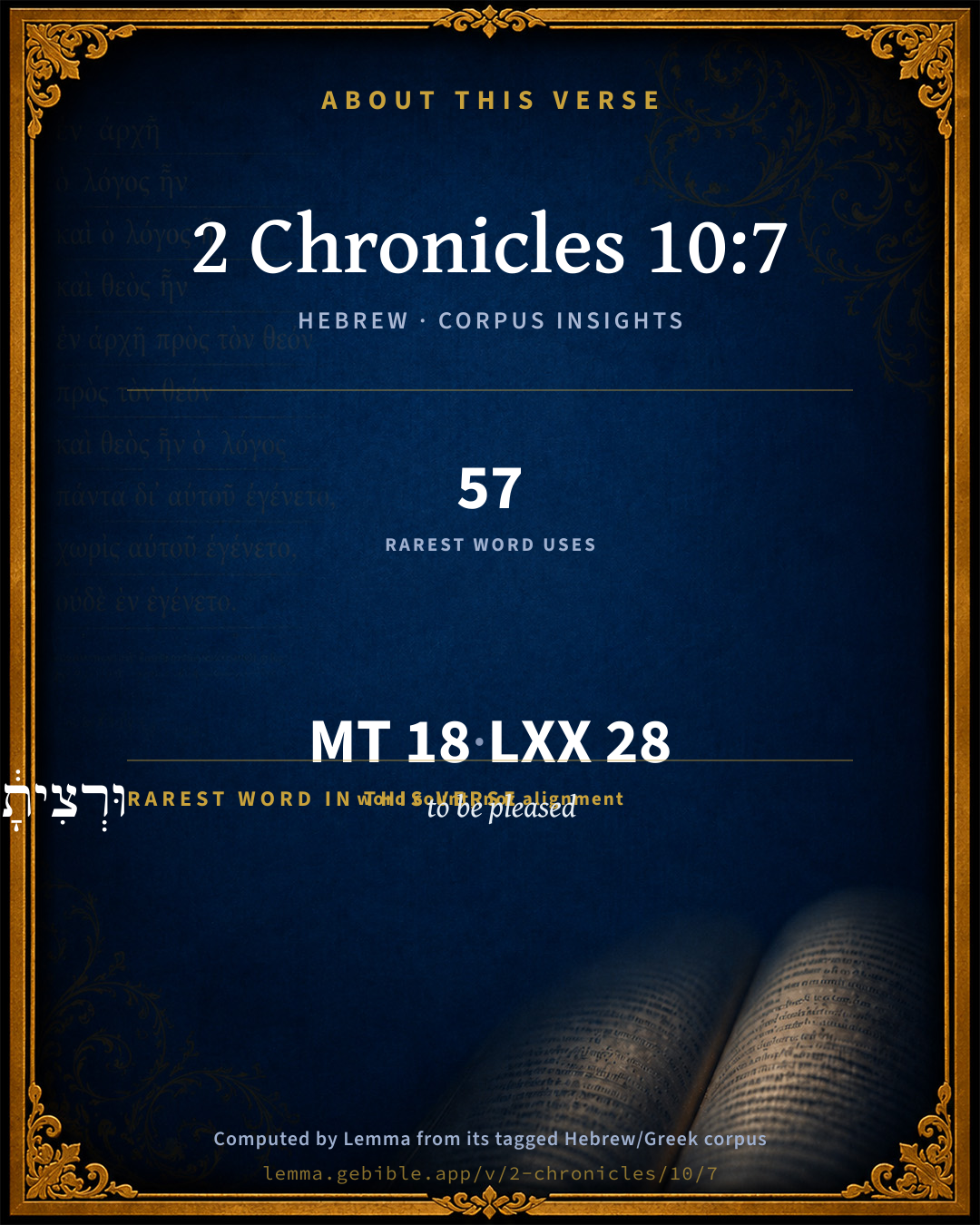
2 Chronicles 10:7

Hebrew (Westminster Leningrad Codex) 2 Chronicles 10:7 appears in the Hebrew Old Testament. The text above is from the Westminster Leningrad Codex. Each word links to its Strong’s number, a concise gloss, and parsing drawn from the Open Scriptures Hebrew Bible morphology. Click any word for its full Brown-Driver-Briggs (BDB) entry.
Download image
Cite this verse

2 Chronicles 10:7 (World English Bible). Public Domain. Lemma interlinear Bible study tool, https://lemma.gebible.app/v/2-chronicles/10/7.

Show BibTeX & RIS
BibTeX
RIS
English Translation
They spoke to him, saying, If you are kind to this people, and please them, and speak good words to them, then they will be your servants forever.
World English Bible · Public Domain
Download a study sheet

One document with this verse’s original text, its word-by-word gloss line, the meaning frame, cross-references with their text, attributed commentary, and full source and license credits — printable, and it pastes into notes with its structure intact.

This verse Autodidact and up

Study sheet (.html) Plain text (.txt)

A passage Seminary Student

Up to 50 verses in one chapter. A passage sheet keeps up to 6 commentary sources and 12 cross-references per verse, in the order this page ranks them, and says so on the sheet whenever that leaves anything out. Ask for a single verse and you get the Autodidact verse sheet above.

Everything on this page stays free to read, with no account — the sheet is a download of what is already on screen, not access to it.

Want to remove ads? Support Godless Engineer
Compare translations 3

The same verse in 3 English versions, stacked beneath the original-language interlinear above. Click any original word for its lexicon entry.

Each is an independent rendering of the whole verse — the interlinear is not word-aligned to these translations.

Highlighted words mark where these versions differ — a whole-verse word diff, not a word-by-word alignment.

  • World English Bible Public Domain
    They spoke to him, saying, If you are kind to this people, and please them, and speak good words to them, then they will be your servants forever.
  • King James Version Public Domain
    And they spake unto him, saying, If thou be kind to this people, and please them, and speak good words to them, they will be thy servants for ever.
  • unfoldingWord Literal Text CC BY-SA 4.0
    And they spoke to him, saying, “If you are good to this people and are favorable to them, and speak to them good words, then they will be for you servants all the days.”

unfoldingWord Literal Text — © unfoldingWord, licensed CC BY-SA 4.0. Word-aligned USFM3 via Door43 (git.door43.org/unfoldingWord/en_ult).

Versions to compare (up to 4)

3 of 4 selected

Show all 18 translations

Every available English version of this verse, each an independent rendering of the whole verse.

  • World English Bible Public Domain
    They spoke to him, saying, If you are kind to this people, and please them, and speak good words to them, then they will be your servants forever.
  • Berean Standard Bible Public Domain
    They replied, “If you will be kind to these people and please them by speaking kind words to them, they will be your servants forever.”
  • Majority Standard Bible Public Domain
    They replied, “If you will be kind to these people and please them by speaking kind words to them, they will be your servants forever.”
  • King James Version Public Domain
    And they spake unto him, saying, If thou be kind to this people, and please them, and speak good words to them, they will be thy servants for ever.
  • American Standard Version (1901) Public Domain
    And they spake unto him, saying, If thou be kind to this people, and please them, and speak good words to them, then they will be thy servants for ever.
  • Revised Version (1885) Public Domain
    And they spake unto him, saying, If thou be kind to this people, and please them, and speak good words to them, then they will be thy servants forever.
  • Geneva Bible (1599) Public Domain
    And they spake vnto him, saying, If thou be kinde to this people, and please them, and speake louing words to them, they will be thy seruants for euer.
  • Douay-Rheims (1899) Public Domain
    And they said to him: If thou please this people, and soothe them with kind words, they will be thy servants for ever.
  • Young's Literal Translation Public Domain
    And they speak unto him, saying, `If thou dost become good to this people, and hast been pleased with them, and spoken unto them good words, then they have been to thee servants all the days.'
  • Literal Standard Version CC BY-SA 4.0
    And they speak to him, saying, “If you become good to this people, and have been pleased with them, and spoken to them good words, then they have been servants to you [for] all the days.”
  • Unlocked Literal Bible CC BY-SA 4.0
    They spoke to him and said, “If you are good to this people and please them, and say good words to them, then they will always be your servants.”
  • unfoldingWord Literal Text CC BY-SA 4.0
    And they spoke to him, saying, “If you are good to this people and are favorable to them, and speak to them good words, then they will be for you servants all the days.”
  • Darby Bible Public Domain
    And they spoke to him saying, If thou be kind to this people, and please them, and speak good words to them, they will be thy servants for ever.
  • World Messianic Bible Public Domain
    They spoke to him, saying, “If you are kind to these people, please them, and speak good words to them, then they will be your servants forever.”
  • Webster's Bible Public Domain
    And they spoke to him, saying, If thou wilt be kind to this people, and please them, and speak good words to them, they will be thy servants for ever.
  • Free Bible Version CC BY-SA 4.0
    They replied, “If you treat these people well, and please them by speaking kindly to them, they will always serve you.”
  • Bible in Basic English Public Domain
    And they said to him, If you are kind to this people, pleasing them and saying good words to them, then they will be your servants for ever.
  • JPS Tanakh (1917) Public Domain
    And they spoke unto him, saying: 'If thou be kind to this people, and please them, and speak good words to them, then they will be thy servants for ever.'

Literal Standard Version (2020), Covenant Press — licensed CC BY-SA 4.0. Text via the HelloAO Bible API (eBible.org). Unlocked Literal Bible (unfoldingWord) — licensed CC BY-SA 4.0. Text via the HelloAO Bible API (eBible.org). unfoldingWord Literal Text — © unfoldingWord, licensed CC BY-SA 4.0. Word-aligned USFM3 via Door43 (git.door43.org/unfoldingWord/en_ult). Free Bible Version, Dr. Jonathan Gallagher — licensed CC BY-SA 4.0. Text via the HelloAO Bible API (eBible.org).

Word by word

More ways to search: Search by grammar → Find every occurrence → Compare this word →

Practice this passage: Drill this verse → Learn its vocabulary →

וּרְצִיתָ֔ם
râtsâh
H7521
“and · to be pleased · them”
Conjunction + Verb, Qal, Sequential Perfect, 2nd Person, Masculine, Singular + Suffix, Personal, 3rd Person, Masculine, Plural
Part of Speech
Conjunction + Verb
Stem
Qal
Form
Sequential Perfect
Person
2nd Person
Gender
Masculine
Number
Singular
Full BDB Definition

Origin: a primitive root

TWOT: 2207

to be pleased with, be favourable to, accept favourably - (Qal) - to be pleased with, be favourable to - to accept - to be pleased, be determined - to make acceptable, satisfy - to please - (Niphal) to be accepted, be pleased with - (Piel) to seek favour of - (Hiphil) to please, pay off - (Hithpael) to make oneself acceptable or pleasing
  1. וַיְדַבְּר֨וּ dâbar H1696 “and · to speak” Conjunction + Verb, Piel, Sequential Imperfect, 3rd Person, Masculine, Plural
  2. אֵלָ֜יו ʼêl H413 “to · him” Preposition + Suffix, Personal, 3rd Person, Masculine, Singular
  3. לֵאמֹ֗ר ʼâmar H559 “to say” Preposition + Verb, Qal, Infinitive Construct
  4. אִם ʼim H518 “if” Conjunction
  5. תִּֽהְיֶ֨ה hâyâh H1961 “to be” Verb, Qal, Imperfect, 2nd Person, Masculine, Singular
  6. לְט֜וֹב ṭôwb H2896 “to/for · good” Preposition + Adjective, Adjective, Masculine, Singular, Absolute
  7. לְהָעָ֤ם ʻam H5971 “to/for · the · people” Preposition + Particle, Definite Article + Noun, Common, Masculine, Singular, Absolute
  8. הַזֶּה֙ zeh H2088 “the · this” Particle, Definite Article + Pronoun, Demonstrative, Masculine, Singular
  9. וְדִבַּרְתָּ֥ dâbar H1696 “and · to speak” Conjunction + Verb, Piel, Sequential Perfect, 2nd Person, Masculine, Singular
  10. אֲלֵהֶ֖ם ʼêl H413 “to · them” Preposition + Suffix, Personal, 3rd Person, Masculine, Plural
  11. דְּבָרִ֣ים dâbâr H1697 “words” Noun, Common, Masculine, Plural, Absolute
  12. טוֹבִ֑ים ṭôwb H2896 “good” Adjective, Adjective, Masculine, Plural, Absolute
  13. וְהָי֥וּ hâyâh H1961 “and · to be” Conjunction + Verb, Qal, Sequential Perfect, 3rd Person, Common, Plural
  14. עֲבָדִ֖ים ʻebed H5650 “servants” Noun, Common, Masculine, Plural, Absolute
  15. כָּל kôl H3605 “all of” Noun, Common, Masculine, Singular, Construct
  16. הַיָּמִֽים yôwm H3117 “the · days” Particle, Definite Article + Noun, Common, Masculine, Plural, Absolute

About this verse

These counts appear in no published source. They are computed here, from the morphology-tagged text and Lemma’s own curated glosses. What Lemma adds →

18
words
13
distinct lemmas
Historical
section

Shared distinctive vocabulary

וּרְצִיתָ֔ם to be pleased H7521 occurs in 55 verses of the Hebrew Bible. Also found in:

Grammatical profile

  • 6 verbs
  • 5 nouns
  • 2 adjectives
  • 1 pronoun
  • 3 prepositions
  • 1 conjunction

Verb forms

  • וַיְדַבְּר֨וּ Piel · Sequential Imperfect
  • לֵאמֹ֗ר Qal · Infinitive Construct
  • תִּֽהְיֶ֨ה Qal · Imperfect
  • וּרְצִיתָ֔ם Qal · Sequential Perfect
  • וְדִבַּרְתָּ֥ Piel · Sequential Perfect
  • וְהָי֥וּ Qal · Sequential Perfect

Repetition

Words recur within this verse — often emphatic in Hebrew:

  • וַיְדַבְּר֨וּ to speak H1696 ×2
  • תִּֽהְיֶ֨ה to be H1961 ×2
  • לְט֜וֹב good H2896 ×2
  • אֵלָ֜יו to H413 ×2

Hebrew & Septuagint length

In English translation the verse runs 28 words from the Hebrew and 33 from the Septuagint (LXX English) — closely comparable.

A rough comparison of the two English renderings, which tokenize alike — not a word-level alignment.

Word counts can differ between the Hebrew and the Greek without any difference in meaning — e.g. the Hebrew direct-object marker אֵת has no separate Greek word, and Greek often adds the article ὁ.

In the original languages it is 18 Hebrew tokens and 28 Greek tokens — but the two are counted differently (Hebrew bundles its prefixes and suffixes into one token; the Greek is in lemma form), so that isn’t a like-for-like length.

Cross-references

4

Topical passages linked to 2 Chronicles 10:7 in the Treasury of Scripture Knowledge — connected by theme and wording, ordered by reader-vote popularity; previews shown in the World English Bible.

  • Proverbs 15:1 A gentle answer turns away wrath, But a harsh word stirs up anger.
  • Genesis 49:21 "Naphtali is a doe set free, Who bears beautiful fawns.
  • 1 Kings 12:7 They spoke to him, saying, If you will be a servant to this people this day, and will serve them, and answer them, and speak good words to them, then they will be your servants forever.
  • 2 Samuel 15:2–6 Absalom rose up early, and stood beside the way of the gate: and it was so, that when any man had a suit which should come to the king for judgment, then Absalom called to him, and said, Of what city are you? He said, Your servant is of one of the tribes of Israel.

Cross-references courtesy of OpenBible.info (CC BY 4.0).

Hebrew and Greek witnesses Masoretic Hebrew ↔ Greek Septuagint

The same verse in the two great witnesses to the Old Testament, shown verse-for-verse.

These are two independent witnesses, not word-aligned to each other, and the Septuagint is shown in lemma (dictionary) form.

Hebrew 2 Chronicles 10:7 Masoretic · Westminster Leningrad Codex

וַיְדַבְּר֨וּ אֵלָ֜יו לֵאמֹ֗ר אִם תִּֽהְיֶ֨ה לְט֜וֹב לְהָעָ֤ם הַזֶּה֙ וּרְצִיתָ֔ם וְדִבַּרְתָּ֥ אֲלֵהֶ֖ם דְּבָרִ֣ים טוֹבִ֑ים וְהָי֥וּ לְךָ֛ עֲבָדִ֖ים כָּל הַיָּמִֽים

They spoke to him, saying, If you are kind to this people, and please them, and speak good words to them, then they will be your servants forever.

World English Bible · Public Domain

Greek LXX 2 Chronicles 10:7 Septuagint · lemma form

καί λαλέω αὐτός λέγω ἐάν ἐν ὁ σήμερον γίγνομαι εἰς ἀγαθός ὁ λαός οὗτος καί εὐδοκέω καί λαλέω αὐτός λόγος ἀγαθός καί εἰμί σύ παῖς πᾶς ὁ ἡμέρα

And they spoke to him, saying, If you would this day befriend this people, and be kind to them, and speak to them good words, then will they be your servants for ever.

LXX2012 (modern English Septuagint) · Public Domain

Hebrew: Westminster Leningrad Codex (CC BY 4.0). Greek: Septuagint (public domain); English from LXX2012 (modern English Septuagint) (Public Domain). How the Septuagint differs from the Hebrew →

Commentary

Notes on 2 Chronicles 10:7 from classic Christian and Jewish commentators (each source and its license shown beneath its notes). The classic Christian expositions comment on the surrounding passage and are grouped to its opening verse, so a note may address several verses; the Jewish commentaries on the Tanakh (Rashi and others) are per-verse, so they appear only where the commentator wrote on this verse.

Lemma curates 59 commentaries, every one of them public domain or Creative Commons licensed, each selected and text-cleaned for this edition rather than reprinted as found. About our sources →

Trapp's Complete Commentary

John Trapp

2Ch 10:7 And they spake unto him, saying, If thou be kind to this people, and please them, and speak good words to them, they will be thy servants for ever.

Ver. 7. If thou be kind to this people.] "If thou wilt be a servant unto this people this day, and wilt serve them." {1Ki 12:7} {See Trapp on "1Ki 12:7"}

John Trapp, A Commentary or Exposition upon All the Books of the Old and New Testament (1647–1656) — public domain. Text from a community e-Sword module.

Jamieson, Fausset & Brown

Robert Jamieson, A. R. Fausset & David Brown

If thou be kind to this people, and please them, and speak good words to them--In the Book of Kings [Kg1 12:7], the words are, "If thou wilt be a servant unto this people, and wilt serve them." The meaning in both is the same, namely, If thou wilt make some reasonable concessions, redress their grievances, and restore their abridged liberties, thou wilt secure their strong and lasting attachment to thy person and government.

Jamieson, Fausset & Brown — Commentary Critical and Explanatory on the Whole Bible (1871) — public domain (CC PDM 1.0). Text via the HelloAO Bible API.

Ellicott's Commentary for English Readers

(7) If thou be kind to this people.—A free paraphrase of, “If to-day thou become a servant to this people and serve them” (Kings)—words which may have seemed inappropriate to the redactor, in connection with the king, but which form a pointed antithesis to the last clause of the verse, “they will be thy servants for ever.”

And please them.—Be propitious to them, receive them graciously (raçah). (Gen_33:10.) Kings, “answer them.”

A Bible Commentary for English Readers, edited by Charles John Ellicott (1878–1897) — public domain. Text from a community e-Sword module.

The Cambridge Bible for Schools and Colleges

gen. ed. J. J. S. Perowne

7. if thou be kind to this people, and please them] The Chronicler has softened the forcible words of the parallel passage (1Ki_12:7), “If thou wilt be a servant unto this people this day, and wilt serve them.” The words which were too blunt for Rehoboam were also too blunt for the Chronicler.

The Cambridge Bible for Schools and Colleges (gen. ed. J. J. S. Perowne; Cambridge University Press, 1878–1918) — public domain. Text from a community e-Sword module.

Haydock's Catholic Bible Commentary

Please. 3 Kings xii., "serve." By a little condescension, thou mayst establish thy throne. (Calmet) --- The people did not complain, till they saw the riches of the nation wasted on wicked women (Tirinus) and idols. (Du Hamel)

George Leo Haydock (1774–1849), Haydock's Catholic Family Bible and Commentary, 1859 edition — public domain. Excludes Psalms (Douay-Rheims chapter numbering differs from Protestant) and Deuterocanonical books (Catholic canon only).

The Pulpit Commentary

Vers. 7, 8. Rehoboam was now (1Ki_14:21; 2Ch_12:13; but cf. 2Ch_13:7) forty-one years of age; he was just too old to find any excuse for inability to gauge either the experience, and value of it, of the "old," or the inexperience, and foolishness of it, of the immature human heart. According to the modern phrase, he was just ripe to have known and bethought himself of this. But all rashly Rehoboam casts the die. The sound judgment, real knowledge, opportune and practical advice of the "old men," uttered evidently off so kind a tongue, should have been indeed now "as good as an inheritance; yea, better too". (Ecc_7:11, margin) The reading of the parallel is well worthy to be noted, (1Ki_11:7) with its manifestly pleasantly and skilfully worded antithesis, "If thou this day will be a servant to this people then they will be thy servants for ever. " Our words, however, have their own exquisite beauty about them, If thou wilt be kind to this people, and please them, and speak good words to them. One might fancy that Saul, and David, and Solomon, and angels themselves bended over the scene, and looked and listened and longed for wisdom and love and right to prevail. The young men that had grown up with him. While this expression throws light as above on that which speaks of Rehoboam"s old men counsellors, it wakens the question how men of forty-one years of age can be called "young," as Rehoboam was not living in patriarchal aged times. And the question is emphasized by the language applied to Rehoboam in 2Ch_13:7, where he is described as "young and tenderhearted," and unable, for want of strength of character and of knowledge, to "withstand vain men" (as he surely shows too clearly now) It has been suggested ("Speaker"s Commentary," 2:562, Note C) that ak (21) should be read for am (41) in the two passages quoted above (1Ki_14:21; 2Ch_12:13) The suggestion seems good, and it is certainly reasonable for the requirements of both matter and manner.

The Pulpit Commentary (1880–1919), ed. H.D.M. Spence-Jones & Joseph S. Exell — public domain. Text from a community e-Sword module.

John Wesley's Explanatory Notes

If thou be kind, &c. - Moderate counsels are generally best. Gentleness will do what violence will not do. Good words cost nothing but a little self-denial, and yet they purchase great things.

John Wesley, Explanatory Notes Upon the Whole Bible (1754–1765) — public domain. Text via the GEBible commentary corpus.

Lesson kit

Teaching starters — assembled from the data on this page, not authored interpretation. Every prompt links to the verse data it draws on. Edit before teaching.

2 Chronicles, in the Historical, opens this verse with 18 words (13 distinct Hebrew lemmas). Its most distinctive word is râtsâh (“to be pleased”). A historical commentator’s framing appears above. Read the whole chapter for the surrounding context.

Discussion questions

  1. What does “to be pleased” (râtsâh) contribute to the verse as a whole?
  2. Genesis 33:10 shares the word «to be pleased» with this verse. How do the two illuminate each other?
  3. “to speak” occurs 2× in this one verse. What is the effect of the repetition?
  4. These translations render this verse differently. What is at stake in choosing one wording over another?
  5. The verb «וַיְדַבְּר֨וּ» is Piel Sequential Imperfect. How does its form color the action?
  6. Reading how Trapp's Complete Commentary and Jamieson, Fausset & Brown read this verse, where do the two commentators agree and where do they part?

Things to notice

Reading settings

Reading text

Shown beneath each verse's original-language words.

Old Testament
Old Testament edition

Read the OT as the Masoretic Hebrew (MT) or the Greek Septuagint (LXX).

English shown for the Greek Septuagint (in the Hebrew ↔ Greek comparison).

Comparing translations? Open the Compare panel on any verse page to stack up to four side by side.