
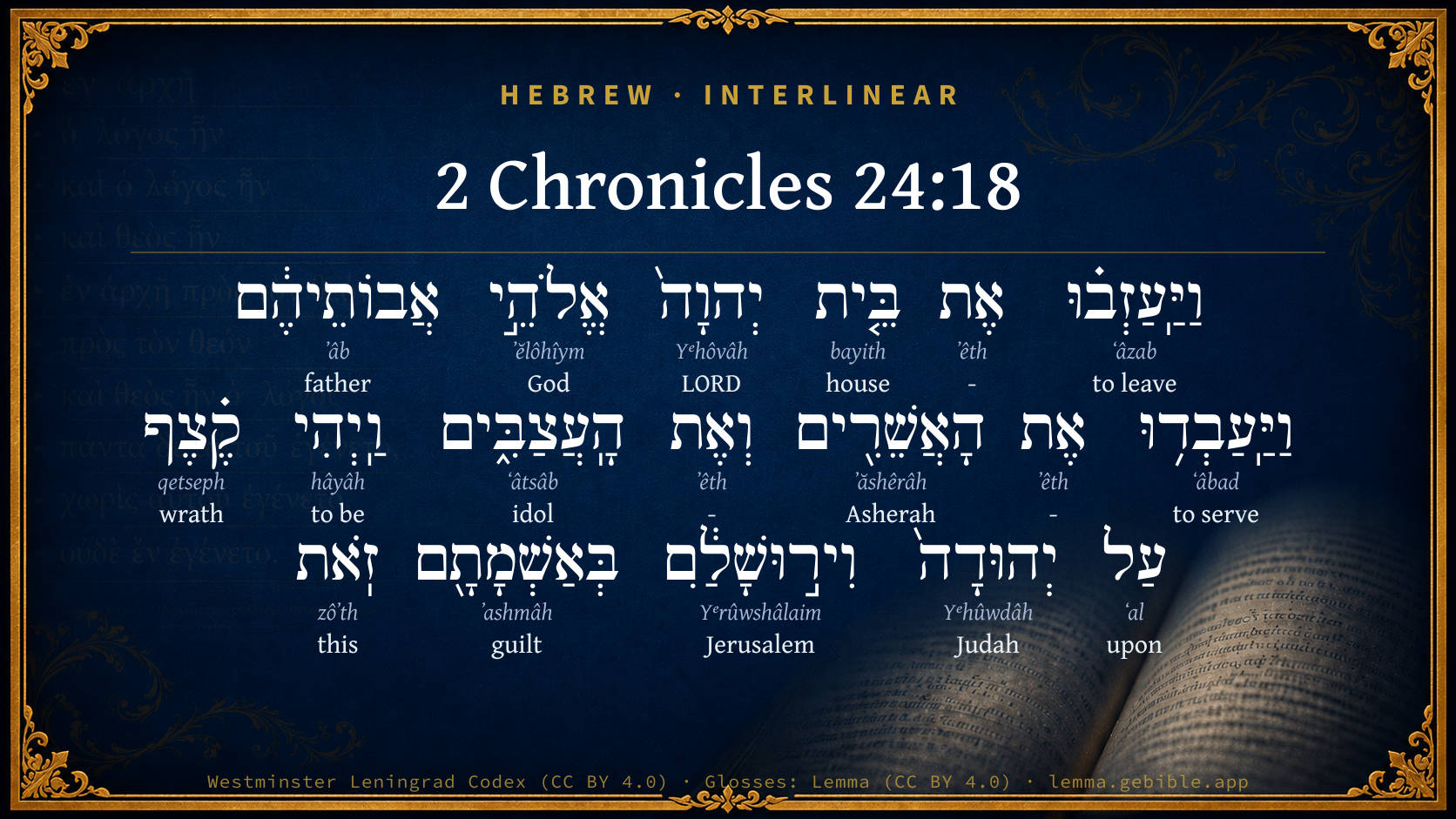
2 Chronicles 24:18

Hebrew (Westminster Leningrad Codex) 2 Chronicles 24:18 appears in the Hebrew Old Testament. The text above is from the Westminster Leningrad Codex. Each word links to its Strong’s number, a concise gloss, and parsing drawn from the Open Scriptures Hebrew Bible morphology. Click any word for its full Brown-Driver-Briggs (BDB) entry.
Download image
Cite this verse

2 Chronicles 24:18 (World English Bible). Public Domain. Lemma interlinear Bible study tool, https://lemma.gebible.app/v/2-chronicles/24/18.

Show BibTeX & RIS
BibTeX
RIS
English Translation
They forsook the house of Yahweh, the God of their fathers, and served the Asherim and the idols: and wrath came on Judah and Jerusalem for this their guiltiness.
World English Bible · Public Domain
Download a study sheet

One document with this verse’s original text, its word-by-word gloss line, the meaning frame, cross-references with their text, attributed commentary, and full source and license credits — printable, and it pastes into notes with its structure intact.

This verse Autodidact and up

Study sheet (.html) Plain text (.txt)

A passage Seminary Student

Up to 50 verses in one chapter. A passage sheet keeps up to 6 commentary sources and 12 cross-references per verse, in the order this page ranks them, and says so on the sheet whenever that leaves anything out. Ask for a single verse and you get the Autodidact verse sheet above.

Everything on this page stays free to read, with no account — the sheet is a download of what is already on screen, not access to it.

Want to remove ads? Support Godless Engineer
Compare translations 3

The same verse in 3 English versions, stacked beneath the original-language interlinear above. Click any original word for its lexicon entry.

Each is an independent rendering of the whole verse — the interlinear is not word-aligned to these translations.

Highlighted words mark where these versions differ — a whole-verse word diff, not a word-by-word alignment.

  • World English Bible Public Domain
    They forsook the house of Yahweh, the God of their fathers, and served the Asherim and the idols: and wrath came on Judah and Jerusalem for this their guiltiness.
  • King James Version Public Domain
    And they left the house of the LORD God of their fathers, and served groves and idols: and wrath came upon Judah and Jerusalem for this their trespass.
  • unfoldingWord Literal Text CC BY-SA 4.0
    And they abandoned the house of Yahweh, the God of their fathers, and they served the Asherim and the idols. And there was wrath on Judah and Jerusalem on account of this, their guilt.

unfoldingWord Literal Text — © unfoldingWord, licensed CC BY-SA 4.0. Word-aligned USFM3 via Door43 (git.door43.org/unfoldingWord/en_ult).

Versions to compare (up to 4)

3 of 4 selected

Show all 18 translations

Every available English version of this verse, each an independent rendering of the whole verse.

  • World English Bible Public Domain
    They forsook the house of Yahweh, the God of their fathers, and served the Asherim and the idols: and wrath came on Judah and Jerusalem for this their guiltiness.
  • Berean Standard Bible Public Domain
    They abandoned the house of the LORD, the God of their fathers, and served the Asherah poles and idols. So wrath came upon Judah and Jerusalem for this guilt of theirs.
  • Majority Standard Bible Public Domain
    They abandoned the house of the LORD, the God of their fathers, and served the Asherah poles and idols. So wrath came upon Judah and Jerusalem for this guilt of theirs.
  • King James Version Public Domain
    And they left the house of the LORD God of their fathers, and served groves and idols: and wrath came upon Judah and Jerusalem for this their trespass.
  • American Standard Version (1901) Public Domain
    And they forsook the house of Jehovah, the God of their fathers, and served the Asherim and the idols: and wrath came upon Judah and Jerusalem for this their guiltiness.
  • Revised Version (1885) Public Domain
    And they forsook the house of the LORD, the God of their fathers, and served the Asherim and the idols: and wrath came upon Judah and Jerusalem for this their guiltiness.
  • Geneva Bible (1599) Public Domain
    And they left the house of the Lord God of their fathers, and serued groues and idoles: and wrath came vpon Iudah and Ierusalem, because of this their trespasse.
  • Douay-Rheims (1899) Public Domain
    And they forsook the temple of the Lord the God of their fathers, and served groves and idols, and wrath came upon Juda and Jerusalem for this sin.
  • Young's Literal Translation Public Domain
    and they forsake the house of Jehovah, God of their fathers, and serve the shrines and the idols, and there is wrath upon Judah and Jerusalem for this their guilt.
  • Literal Standard Version CC BY-SA 4.0
    and they forsake the house of YHWH, God of their fathers, and serve the Asherim and the idols, and there is wrath on Judah and Jerusalem for this guilt of theirs.
  • Unlocked Literal Bible CC BY-SA 4.0
    They forsook the house of Yahweh, the God of their ancestors, and worshiped the Asherah gods and the idols. God's anger came on Judah and Jerusalem for this wrongdoing of theirs.
  • unfoldingWord Literal Text CC BY-SA 4.0
    And they abandoned the house of Yahweh, the God of their fathers, and they served the Asherim and the idols. And there was wrath on Judah and Jerusalem on account of this, their guilt.
  • Darby Bible Public Domain
    And they forsook the house of Jehovah the God of their fathers, and served the Asherahs and idols; and wrath came upon Judah and Jerusalem for this their trespass.
  • World Messianic Bible Public Domain
    They abandoned the house of the LORD, the God of their fathers, and served the Asherah poles and the idols, so wrath came on Judah and Jerusalem for this their guiltiness.
  • Webster's Bible Public Domain
    And they left the house of the LORD God of their fathers, and served groves and idols: and wrath came upon Judah and Jerusalem for this their trespass.
  • Free Bible Version CC BY-SA 4.0
    They abandoned the Temple of the Lord, the God of their forefathers, and worshiped Asherah poles and idols. Judah and Jerusalem were punished because of their sin.
  • Bible in Basic English Public Domain
    And they gave up the house of the Lord God of their fathers, and became worshippers of pillars of wood and of the images; and because of this sin of theirs, wrath came on Judah and Jerusalem.
  • JPS Tanakh (1917) Public Domain
    And they forsook the house of the LORD, the God of their fathers, and served the Asherim and the idols; and wrath came upon Judah and Jerusalem for this their guiltiness.

Literal Standard Version (2020), Covenant Press — licensed CC BY-SA 4.0. Text via the HelloAO Bible API (eBible.org). Unlocked Literal Bible (unfoldingWord) — licensed CC BY-SA 4.0. Text via the HelloAO Bible API (eBible.org). unfoldingWord Literal Text — © unfoldingWord, licensed CC BY-SA 4.0. Word-aligned USFM3 via Door43 (git.door43.org/unfoldingWord/en_ult). Free Bible Version, Dr. Jonathan Gallagher — licensed CC BY-SA 4.0. Text via the HelloAO Bible API (eBible.org).

Word by word

More ways to search: Search by grammar → Find every occurrence → Compare this word →

Practice this passage: Drill this verse → Learn its vocabulary →

הָֽעֲצַבִּ֑ים
ʻâtsâb
H6091
“the · idols”
Particle, Definite Article + Noun, Common, Masculine, Plural, Absolute
Part of Speech
Particle + Noun
Type
Common
Gender
Masculine
Number
Plural
State
Absolute
Full BDB Definition

Origin: from H6087

TWOT: 1667c

idol, image
  1. וַיַּֽעַזְב֗וּ ʻâzab H5800 “and · to leave” Conjunction + Verb, Qal, Sequential Imperfect, 3rd Person, Masculine, Plural
  2. אֶת ʼêth H853 “-” Particle, Direct Object
  3. בֵּ֤ית bayith H1004 “house of” Noun, Common, Masculine, Singular, Construct
  4. יְהוָה֙ Yᵉhôvâh H3068 “LORD” Noun, Proper
  5. אֱלֹהֵ֣י ʼĕlôhîym H430 “God(s) of” Noun, Common, Masculine, Plural, Construct
  6. אֲבוֹתֵיהֶ֔ם ʼâb H1 “fathers · their” Noun, Common, Masculine, Plural, Construct + Suffix, Personal, 3rd Person, Masculine, Plural
  7. וַיַּֽעַבְד֥וּ ʻâbad H5647 “and · to serve” Conjunction + Verb, Qal, Sequential Imperfect, 3rd Person, Masculine, Plural
  8. אֶת ʼêth H853 “-” Particle, Direct Object
  9. הָאֲשֵׁרִ֖ים ʼăshêrâh H842 “the · Asherah” Particle, Definite Article + Noun, Proper
  10. וְאֶת ʼêth H853 “and · -” Conjunction + Particle, Direct Object
  11. וַֽיְהִי hâyâh H1961 “and · to be” Conjunction + Verb, Qal, Sequential Imperfect, 3rd Person, Masculine, Singular
  12. קֶ֗צֶף qetseph H7110 “wrath” Noun, Common, Masculine, Singular, Absolute
  13. עַל ʻal H5921 “upon” Preposition
  14. יְהוּדָה֙ Yᵉhûwdâh H3063 “Judah” Noun, Proper
  15. וִיר֣וּשָׁלִַ֔ם Yᵉrûwshâlaim H3389 “and · Jerusalem” Conjunction + Noun, Proper
  16. בְּאַשְׁמָתָ֖ם ʼashmâh H819 “in/at · guilt · their” Preposition + Noun, Common, Feminine, Singular, Construct + Suffix, Personal, 3rd Person, Masculine, Plural
  17. זֹֽאת zôʼth H2063 “this” Pronoun, Demonstrative, Feminine, Singular

About this verse

These counts appear in no published source. They are computed here, from the morphology-tagged text and Lemma’s own curated glosses. What Lemma adds →

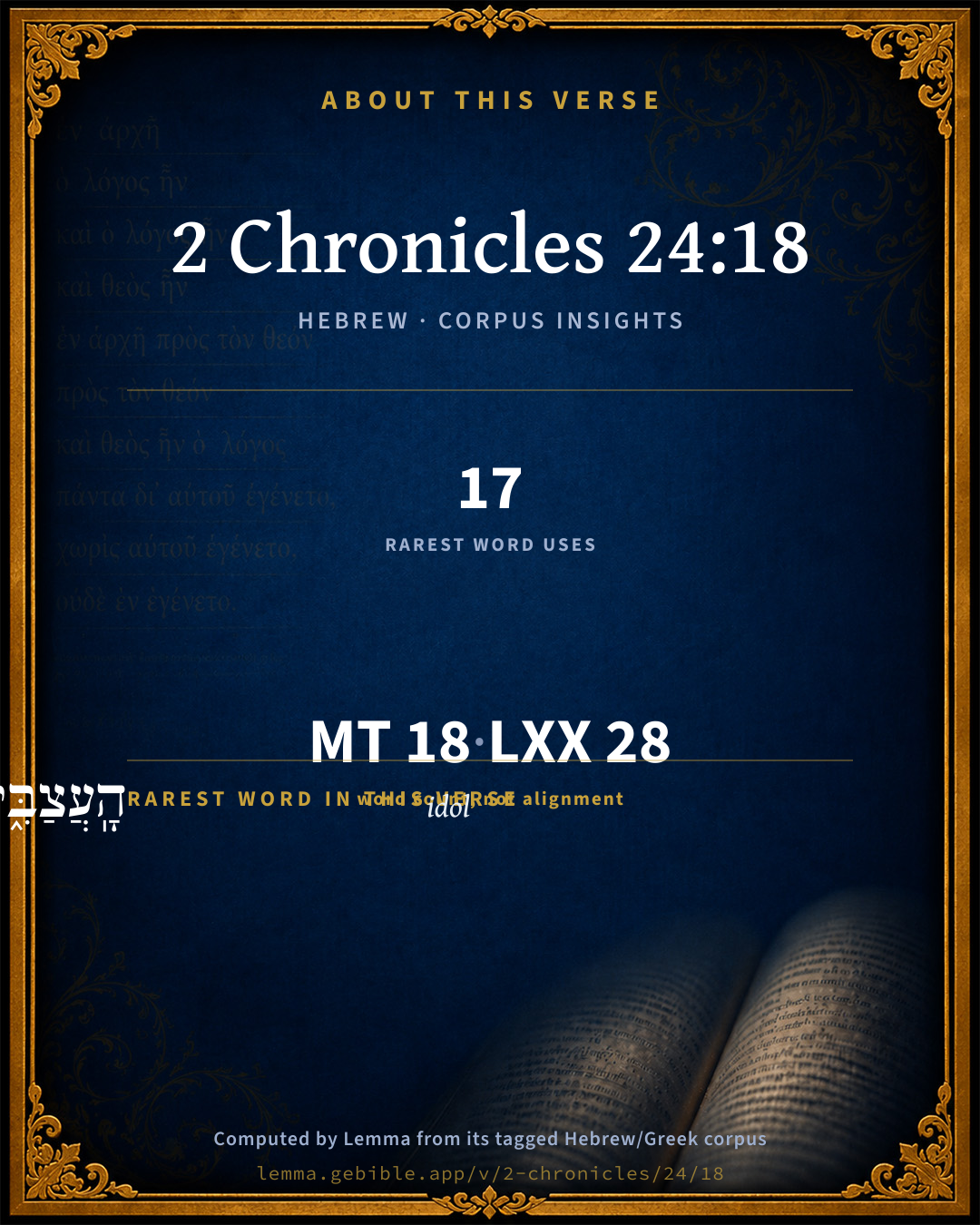
18
words
16
distinct lemmas
Historical
section

Notable vocabulary

The rarest word here is הָֽעֲצַבִּ֑ים idol H6091 — appearing just 17 times in the whole Hebrew Bible.

Shared distinctive vocabulary

הָֽעֲצַבִּ֑ים idol H6091 occurs in 17 verses of the Hebrew Bible. Also found in:

Grammatical profile

  • 3 verbs
  • 10 nouns
  • 1 pronoun
  • 1 preposition
  • 3 particles

Verb forms

  • וַיַּֽעַזְב֗וּ Qal · Sequential Imperfect
  • וַיַּֽעַבְד֥וּ Qal · Sequential Imperfect
  • וַֽיְהִי Qal · Sequential Imperfect

Hebrew & Septuagint length

In English translation the verse runs 29 words from the Hebrew and 29 from the Septuagint (LXX English) — the same length.

A rough comparison of the two English renderings, which tokenize alike — not a word-level alignment.

Word counts can differ between the Hebrew and the Greek without any difference in meaning — e.g. the Hebrew direct-object marker אֵת has no separate Greek word, and Greek often adds the article ὁ.

In the original languages it is 18 Hebrew tokens and 28 Greek tokens — but the two are counted differently (Hebrew bundles its prefixes and suffixes into one token; the Greek is in lemma form), so that isn’t a like-for-like length.

Cross-references

19

Topical passages linked to 2 Chronicles 24:18 in the Treasury of Scripture Knowledge — connected by theme and wording, ordered by reader-vote popularity; previews shown in the World English Bible.

  • Joshua 22:20 Didn't Achan the son of Zerah commit a trespass in the devoted thing, and wrath fell on all the congregation of Israel? and that man didn't perish alone in his iniquity.
  • 2 Chronicles 19:2 Jehu the son of Hanani the seer went out to meet him, and said to king Jehoshaphat, Should you help the wicked, and love those who hate Yahweh? for this thing wrath is on you from before Yahweh.
  • 2 Chronicles 24:4 It happened after this, that Joash was minded to restore the house of Yahweh.
  • Ephesians 5:6 Let no one deceive you with empty words. For because of these things, the wrath of God comes on the children of disobedience.
  • 1 Kings 14:23 For they also built them high places, and pillars, and Asherim, on every high hill, and under every green tree;
  • 2 Chronicles 28:13 and said to them, You shall not bring in the captives here: for you purpose that which will bring on us a trespass against Yahweh, to add to our sins and to our trespass; for our trespass is great, and there is fierce wrath against Israel.
  • 2 Chronicles 32:25 But Hezekiah didn't render again according to the benefit done to him; for his heart was lifted up: therefore there was wrath on him, and on Judah and Jerusalem.
  • Hosea 5:10–11 The princes of Judah are like those who remove a landmark. I will pour out my wrath on them like water.
  • Exodus 34:13 but you shall break down their altars, and dash in pieces their pillars, and you shall cut down their Asherim;
  • Judges 5:8 They chose new gods; Then was war in the gates: Was there a shield or spear seen Among forty thousand in Israel?
  • 2 Samuel 24:1 Again the anger of Yahweh was kindled against Israel, and he moved David against them, saying, Go, number Israel and Judah.
  • 1 Kings 11:4–5 For it happened, when Solomon was old, that his wives turned away his heart after other gods; and his heart was not perfect with Yahweh his God, as was the heart of David his father.
  • 1 Kings 14:9 but have done evil above all who were before you, and have gone and made you other gods, and molten images, to provoke me to anger, and have cast me behind your back:
  • 2 Chronicles 21:13 but have walked in the way of the kings of Israel, and have made Judah and the inhabitants of Jerusalem to play the prostitute, like as the house of Ahab did, and also have slain your brothers of your father's house, who were better than yourself:
  • 2 Chronicles 29:8 Therefore the wrath of Yahweh was on Judah and Jerusalem, and he has delivered them to be tossed back and forth, to be an astonishment, and a hissing, as you see with your eyes.
  • 2 Chronicles 33:3–7 For he built again the high places which Hezekiah his father had broken down; and he reared up altars for the Baals, and made Asheroth, and worshiped all the host of the sky, and served them.
  • 2 Chronicles 36:14–16 Moreover all the chiefs of the priests, and the people, trespassed very greatly after all the abominations of the nations; and they polluted the house of Yahweh which he had made holy in Jerusalem.
  • Hosea 5:14 For I will be to Ephraim like a lion, And like a young lion to the house of Judah. I myself will tear in pieces and go away. I will carry off, and there will be no one to deliver.
  • Zephaniah 1:4–6 I will stretch out my hand against Judah, and against all the inhabitants of Jerusalem. I will cut off the remnant of Baal from this place: the name of the idolatrous and pagan priests,

Cross-references courtesy of OpenBible.info (CC BY 4.0).

Hebrew and Greek witnesses Masoretic Hebrew ↔ Greek Septuagint

The same verse in the two great witnesses to the Old Testament, shown verse-for-verse.

These are two independent witnesses, not word-aligned to each other, and the Septuagint is shown in lemma (dictionary) form.

Hebrew 2 Chronicles 24:18 Masoretic · Westminster Leningrad Codex

וַיַּֽעַזְב֗וּ אֶת בֵּ֤ית יְהוָה֙ אֱלֹהֵ֣י אֲבוֹתֵיהֶ֔ם וַיַּֽעַבְד֥וּ אֶת הָאֲשֵׁרִ֖ים וְאֶת הָֽעֲצַבִּ֑ים וַֽיְהִי קֶ֗צֶף עַל יְהוּדָה֙ וִיר֣וּשָׁלִַ֔ם בְּאַשְׁמָתָ֖ם זֹֽאת

They forsook the house of Yahweh, the God of their fathers, and served the Asherim and the idols: and wrath came on Judah and Jerusalem for this their guiltiness.

World English Bible · Public Domain

Greek LXX 2 Chronicles 24:18 Septuagint · lemma form

καί ἐν καταλείπω ὁ κύριος θεός ὁ πατήρ αὐτός καί δουλεύω ὁ ἀστάρτα καί ὁ εἴδωλον καί γίγνομαι ὀργή ἐπί ἰούδας καί ἐπί ἰερουσαλήμ ἐν ὁ ἡμέρα οὗτος

And they forsook the house of the Lord God of their fathers, and served the Astartes and idols: and there was wrath upon Juda and Jerusalem in that day.

LXX2012 (modern English Septuagint) · Public Domain

Hebrew: Westminster Leningrad Codex (CC BY 4.0). Greek: Septuagint (public domain); English from LXX2012 (modern English Septuagint) (Public Domain). How the Septuagint differs from the Hebrew →

Commentary

Notes on 2 Chronicles 24:18 from classic Christian and Jewish commentators (each source and its license shown beneath its notes). The classic Christian expositions comment on the surrounding passage and are grouped to its opening verse, so a note may address several verses; the Jewish commentaries on the Tanakh (Rashi and others) are per-verse, so they appear only where the commentator wrote on this verse.

Lemma curates 59 commentaries, every one of them public domain or Creative Commons licensed, each selected and text-cleaned for this edition rather than reprinted as found. About our sources →

Trapp's Complete Commentary

John Trapp

2Ch 24:18 And they left the house of the LORD God of their fathers, and served groves and idols: and wrath came upon Judah and Jerusalem for this their trespass.

Ver. 18. And wrath came upon Judah.] Let our church forsakers chew on this: let them see what good patriots they are.

John Trapp, A Commentary or Exposition upon All the Books of the Old and New Testament (1647–1656) — public domain. Text from a community e-Sword module.

Joseph Benson's Commentary

2Ch 24:18. And they left the house of the Lord God — The king and princes, who a while ago so zealously repaired the temple, now forsook the temple! So inconstant a thing is man! So little confidence is to be put in him! It is probable that these great men at first only worshipped in the groves and on the high places themselves; yet they had their emissaries, who persuaded the people to join with them. So that the house of God was soon deserted by them, and they proceeded to worship idols. And wrath came upon Judah and Jerusalem — They were soon punished by the hand of Hazael, king of Syria.

Joseph Benson's Commentary on the Old and New Testaments (1811–1818) — public domain. Text from a community e-Sword module.

Jamieson, Fausset & Brown

Robert Jamieson, A. R. Fausset & David Brown

wrath came upon Judah and Jerusalem--The particular mention of Jerusalem as involved in the sin implies that the neglect of the temple and the consequent idolatry received not only the king's toleration, but his sanction; and it naturally occurs to ask how, at his mature age, such a total abandonment of a place with which all his early recollections were associated can be accounted for. It has been suggested that what he had witnessed of the conduct of many of the priests in the careless performance of the worship, and especially their unwillingness to collect the money, as well as apply a portion of their revenues for the repairs of the temple, had alienated and disgusted him [LE CLERC].

Jamieson, Fausset & Brown — Commentary Critical and Explanatory on the Whole Bible (1871) — public domain (CC PDM 1.0). Text via the HelloAO Bible API.

Ellicott's Commentary for English Readers

(18) And they left the house of the Lord.—They, viz., the apostate princes and their following, ceased to attend the legal worship of the Temple.

And served groves and idols.—Rather, the Ashçrim and the idols. (See Note on 2Ch_14:3.)

And wrath came.—2Ch_19:2; 2Ch_19:10; 1Ch_27:24. In this case the Divine wrath (Num_1:53) manifested itself in a Syrian invasion (2Ch_24:23, seq.).

Upon Judah and Jerusalem.—The sin of the nobles, allowed and perhaps imitated by the king, involved the nation in its penal consequences (Comp. 1 Chronicles 21)

A Bible Commentary for English Readers, edited by Charles John Ellicott (1878–1897) — public domain. Text from a community e-Sword module.

The Cambridge Bible for Schools and Colleges

gen. ed. J. J. S. Perowne

18. they left the house of the Lord] Cp. 2Ch_29:6, “[they] have turned away their faces from the habitation of the Lord.” These phrases are a kind of euphemism meaning “to commit apostasy.”

served groves and idols] R.V. served the Asherim and the idols; cp. 2Ch_14:3 (note).

wrath] Heb. qeçeph; cp. 2Ch_19:2 (note).

wrath came] Cp. 2Ch_24:25-26.

their trespass] R.V. their guiltiness; cp. 2Ch_19:10 (A.V. and R.V.).

The Cambridge Bible for Schools and Colleges (gen. ed. J. J. S. Perowne; Cambridge University Press, 1878–1918) — public domain. Text from a community e-Sword module.

John Gill's Exposition

And the Spirit of the Lord came upon Zechariah the son of Jehoiada the priest,.... The spirit of prophecy, as the Targum; he was moved and influenced by it to speak what is after related:

which stood above the people; in a desk, or sort of pulpit, in which the priests stood when they taught the people, that they might be the better heard, like that which Ezra used, Neh 8:4.

and said unto them, thus saith God; being moved and directed by his Spirit, he spake in his name:

why transgress ye the command of the Lord, that ye cannot prosper? by committing idolatry, than which nothing could more hinder prosperity, both in things spiritual and temporal, in soul and body:

because ye have forsaken the Lord, he hath also forsaken you; because they had forsaken the worship of God, as the Targum, God had forsaken them, and was about to give them up into the hand of their enemies.

John Gill's Exposition of the Whole Bible (1746–1763) — public domain (CC PDM 1.0). Text via the HelloAO Bible API.

Haydock's Catholic Bible Commentary

Idols. Heb. "sorrows." Sept. "the Astartes and idols." C.

George Leo Haydock (1774–1849), Haydock's Catholic Family Bible and Commentary, 1859 edition — public domain. Excludes Psalms (Douay-Rheims chapter numbering differs from Protestant) and Deuterocanonical books (Catholic canon only).

Matthew Poole's English Annotations

By Hazael of Syria; of which see 2Ki 12:17,18

Matthew Poole's English Annotations on the Holy Bible (1683–1685) — public domain. Text from a community e-Sword/MySword module.

Whedon's Commentary on the Bible

Daniel D. Whedon

18. They left — King and princes left, and multitudes of the people soon followed them.

Left the house of the Lord — Forsook the temple service.

Groves and idols — The Asherah worship involved idolatry. See note on 1Ki_14:15.

Daniel D. Whedon (gen. ed.), Commentary on the Old and New Testaments (1874–1909) — public domain. Text from a community e-Sword module.

The Pulpit Commentary

Served groves; Revised Version, the Asherim, correctly. (see 2Ch_14:3) For this their trespass. Comparing the emphatic language of ver. 23," destroyed all the princes of the people from among the people," we may conclude that stress is to be laid on the pronoun "their" in the present verse. The worship of the true God was not left by the whole people, and we are not told it was by the king; but (very probably through want of moral courage) he incurred the severest sort of blame, and was without even the excuse of strong personal temptation.

The Pulpit Commentary (1880–1919), ed. H.D.M. Spence-Jones & Joseph S. Exell — public domain. Text from a community e-Sword module.

John Wesley's Explanatory Notes

Left, &c. - The king and princes that awhile ago so zealously repaired the temple, now forsook the temple! So inconstant a thing is man! So little confidence is to be put in him!

John Wesley, Explanatory Notes Upon the Whole Bible (1754–1765) — public domain. Text via the GEBible commentary corpus.

Scofield Reference Notes

C. I. Scofield

groves (See Scofield "Deu 16:21"). See Scofield "Jdg 3:7".

The Scofield Reference Bible (1917 edition), notes by C. I. Scofield — public domain. Text from a community e-Sword module.

Lesson kit

Teaching starters — assembled from the data on this page, not authored interpretation. Every prompt links to the verse data it draws on. Edit before teaching.

2 Chronicles, in the Historical, opens this verse with 18 words (16 distinct Hebrew lemmas). Its most distinctive word is ʻâtsâb (“idol”). A historical commentator’s framing appears above. Read the whole chapter for the surrounding context.

Discussion questions

  1. What does “idol” (ʻâtsâb) contribute to the verse as a whole?
  2. How does 1 Samuel 31:9, which shares the word «idol», read alongside this verse?
  3. These translations render this verse differently. What is at stake in choosing one wording over another?
  4. «וַיַּֽעַזְב֗וּ» is a Qal Sequential Imperfect verb. How does that grammatical form shape the action described?
  5. Compare how Trapp's Complete Commentary and Joseph Benson's Commentary read this verse. Where do they agree or differ?

Things to notice

Reading settings

Reading text

Shown beneath each verse's original-language words.

Old Testament
Old Testament edition

Read the OT as the Masoretic Hebrew (MT) or the Greek Septuagint (LXX).

English shown for the Greek Septuagint (in the Hebrew ↔ Greek comparison).

Comparing translations? Open the Compare panel on any verse page to stack up to four side by side.