
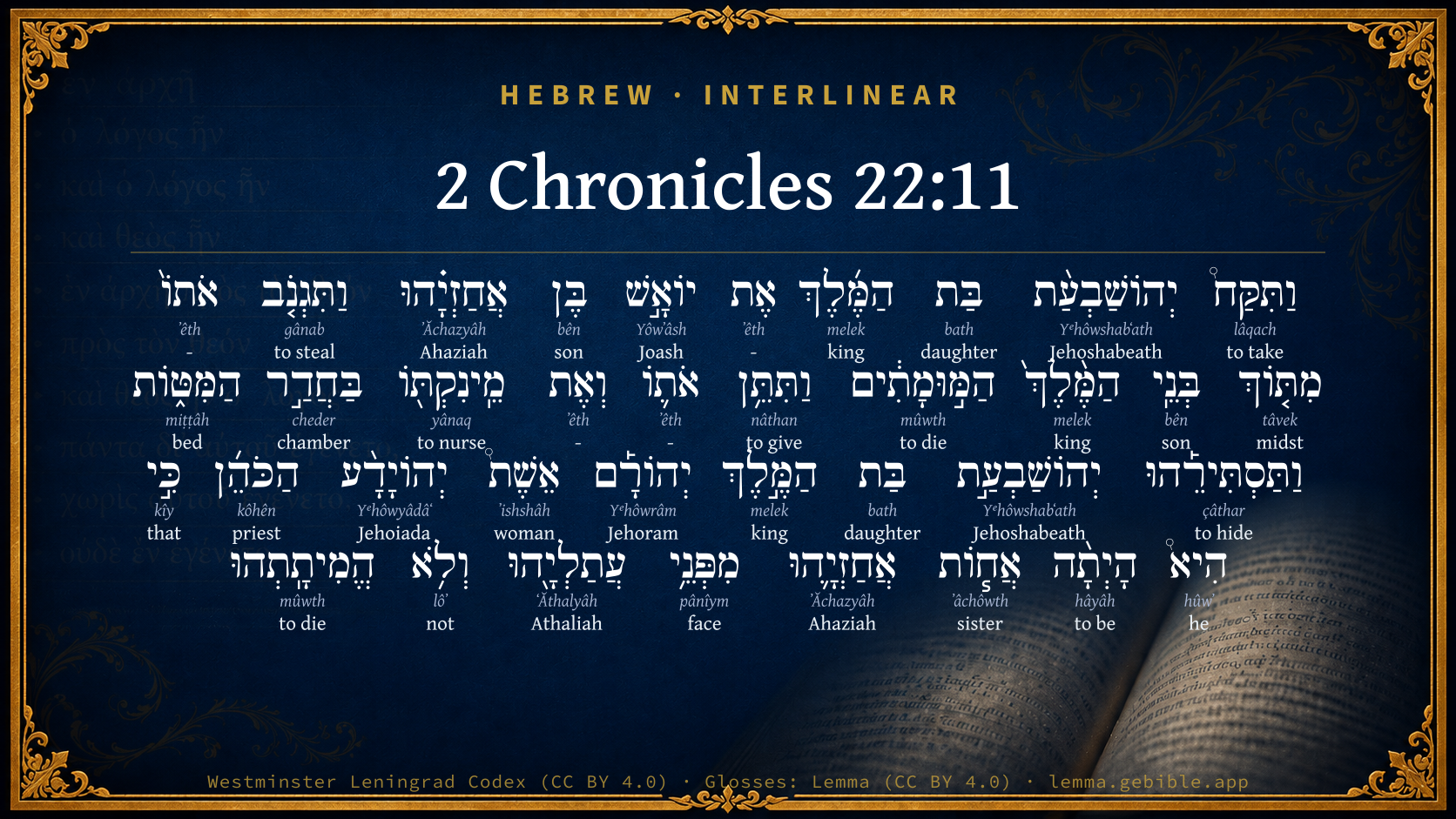
2 Chronicles 22:11

Hebrew (Westminster Leningrad Codex) 2 Chronicles 22:11 appears in the Hebrew Old Testament. The text above is from the Westminster Leningrad Codex. Each word links to its Strong’s number, a concise gloss, and parsing drawn from the Open Scriptures Hebrew Bible morphology. Click any word for its full Brown-Driver-Briggs (BDB) entry.
Download image
Cite this verse

2 Chronicles 22:11 (World English Bible). Public Domain. Lemma interlinear Bible study tool, https://lemma.gebible.app/v/2-chronicles/22/11.

Show BibTeX & RIS
BibTeX
RIS
English Translation
But Jehoshabeath, the daughter of the king, took Joash the son of Ahaziah, and stole him away from among the king's sons who were slain, and put him and his nurse in the bedchamber. So Jehoshabeath, the daughter of king Jehoram, the wife of Jehoiada the priest (for she was the sister of Ahaziah), hid him from Athaliah, so that she didn't kill him.
World English Bible · Public Domain
Highlights
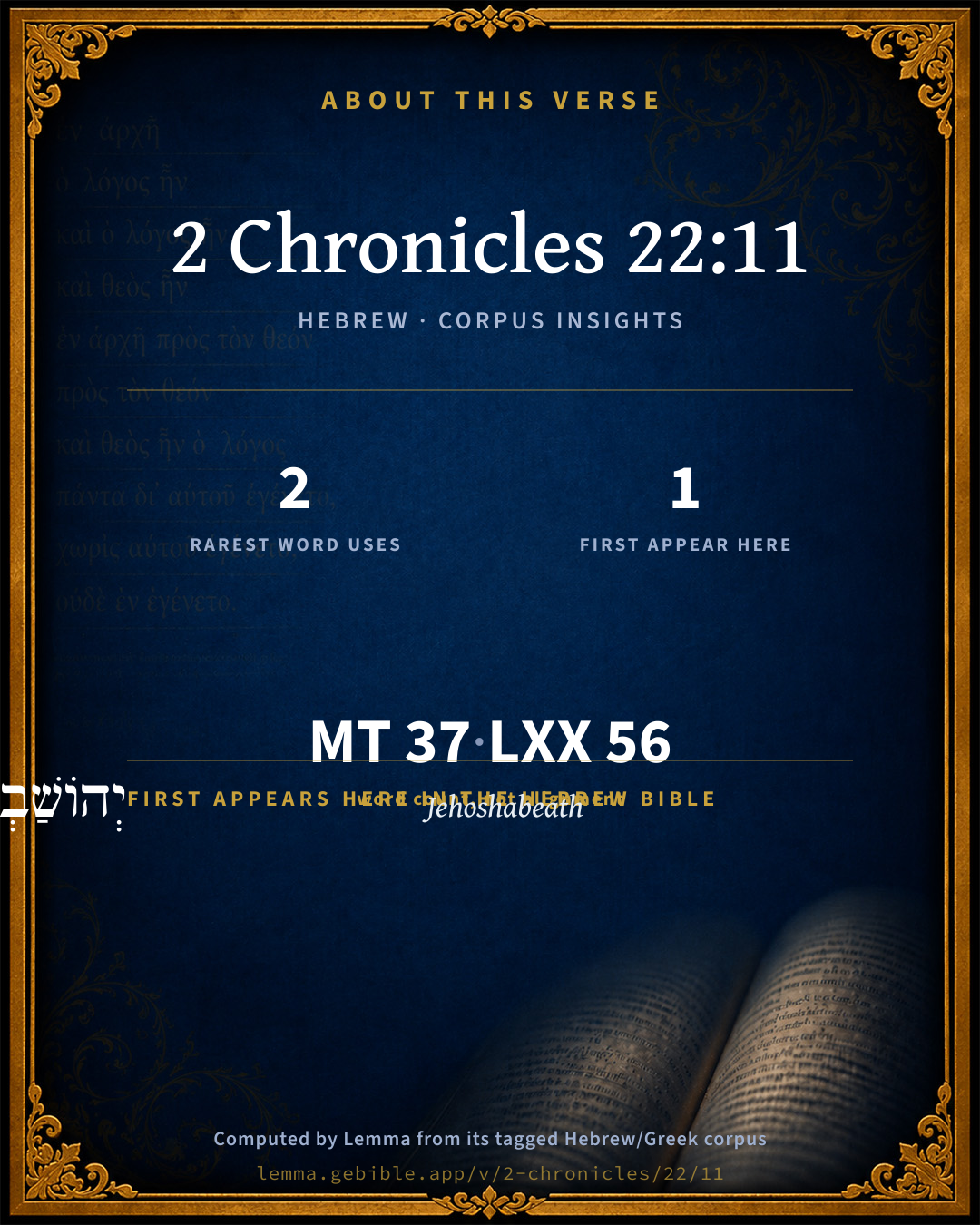
  • 1 first appearance in the Hebrew Bible
Full analysis ↓
Download a study sheet

One document with this verse’s original text, its word-by-word gloss line, the meaning frame, cross-references with their text, attributed commentary, and full source and license credits — printable, and it pastes into notes with its structure intact.

This verse Autodidact and up

Study sheet (.html) Plain text (.txt)

A passage Seminary Student

Up to 50 verses in one chapter. A passage sheet keeps up to 6 commentary sources and 12 cross-references per verse, in the order this page ranks them, and says so on the sheet whenever that leaves anything out. Ask for a single verse and you get the Autodidact verse sheet above.

Everything on this page stays free to read, with no account — the sheet is a download of what is already on screen, not access to it.

Want to remove ads? Support Godless Engineer
Compare translations 3

The same verse in 3 English versions, stacked beneath the original-language interlinear above. Click any original word for its lexicon entry.

Each is an independent rendering of the whole verse — the interlinear is not word-aligned to these translations.

Highlighted words mark where these versions differ — a whole-verse word diff, not a word-by-word alignment.

  • World English Bible Public Domain
    But Jehoshabeath, the daughter of the king, took Joash the son of Ahaziah, and stole him away from among the king's sons who were slain, and put him and his nurse in the bedchamber. So Jehoshabeath, the daughter of king Jehoram, the wife of Jehoiada the priest (for she was the sister of Ahaziah), hid him from Athaliah, so that she didn't kill him.
  • King James Version Public Domain
    But Jehoshabeath, the daughter of the king, took Joash the son of Ahaziah, and stole him from among the king's sons that were slain, and put him and his nurse in a bedchamber. So Jehoshabeath, the daughter of king Jehoram, the wife of Jehoiada the priest, (for she was the sister of Ahaziah,) hid him from Athaliah, so that she slew him not.
  • unfoldingWord Literal Text CC BY-SA 4.0
    But Jehoshabeath, the daughter of the king, took Joash the son of Ahaziah, and she stole him from the midst of the sons of the king who were being killed, and she placed him and his nurse in the room of beds. And Jehoshabeath the daughter of the king Jehoram, the wife of Jehoida the priest (for she was the sister of Ahaziah) hid him from the face of Athaliah, and she did not kill him.

unfoldingWord Literal Text — © unfoldingWord, licensed CC BY-SA 4.0. Word-aligned USFM3 via Door43 (git.door43.org/unfoldingWord/en_ult).

Versions to compare (up to 4)

3 of 4 selected

Show all 18 translations

Every available English version of this verse, each an independent rendering of the whole verse.

  • World English Bible Public Domain
    But Jehoshabeath, the daughter of the king, took Joash the son of Ahaziah, and stole him away from among the king's sons who were slain, and put him and his nurse in the bedchamber. So Jehoshabeath, the daughter of king Jehoram, the wife of Jehoiada the priest (for she was the sister of Ahaziah), hid him from Athaliah, so that she didn't kill him.
  • Berean Standard Bible Public Domain
    But Jehoshabeath daughter of King Jehoram took Joash son of Ahaziah and stole him away from among the sons of the king who were being murdered, and she put him and his nurse in a bedroom. Because Jehoshabeath, the daughter of King Jehoram and the wife of Jehoiada the priest, was Ahaziah’s sister, she hid Joash from Athaliah so that she could not kill him.
  • Majority Standard Bible Public Domain
    But Jehoshabeath daughter of King Jehoram took Joash son of Ahaziah and stole him away from among the sons of the king who were being murdered, and she put him and his nurse in a bedroom. Because Jehoshabeath, the daughter of King Jehoram and the wife of Jehoiada the priest, was Ahaziah’s sister, she hid Joash from Athaliah so that she could not kill him.
  • King James Version Public Domain
    But Jehoshabeath, the daughter of the king, took Joash the son of Ahaziah, and stole him from among the king's sons that were slain, and put him and his nurse in a bedchamber. So Jehoshabeath, the daughter of king Jehoram, the wife of Jehoiada the priest, (for she was the sister of Ahaziah,) hid him from Athaliah, so that she slew him not.
  • American Standard Version (1901) Public Domain
    But Jehoshabeath, the daughter of the king, took Joash the son of Ahaziah, and stole him away from among the king's sons that were slain, and put him and his nurse in the bedchamber. So Jehoshabeath, the daughter of king Jehoram, the wife of Jehoiada the priest (for she was the sister of Ahaziah), hid him from Athaliah, so that she slew him not.
  • Revised Version (1885) Public Domain
    But Jehoshabeath, the daughter of the king, took Joash the son of Ahaziah, and stole him away from among the king’s sons that were slain, and put him and his nurse in the bedchamber. So Jehoshabeath, the daughter of king Jehoram, the wife of Jehoiada the priest, (for she was the sister of Ahaziah,) hid him from Athaliah, so that she slew him not.
  • Geneva Bible (1599) Public Domain
    But Iehoshabeath the daughter of ye King, tooke Ioash the sonne of Ahaziah, and stale him from among the Kings sonnes, that shoulde be slayne, and put him and his nource in the bed chamber: so Iehoshabeath the daughter of King Iehoram the wife of Iehoiada the Priest (for shee was the sister of Ahaziah) hid him from Athaliah: so she slew him not.
  • Douay-Rheims (1899) Public Domain
    But Josabeth the king's daughter took Joas the son of Ochozias, and stole him from among the king's sons that were slain. And she hid him with his nurse in a bedchamber: now Josabeth that hid him, was daughter of king Joram, wife of Joiada the high priest, and sister of Ochozias, and therefore Athalia did not kill him.
  • Young's Literal Translation Public Domain
    And Jehoshabeath daughter of the king taketh Joash son of Ahaziah, and stealeth him from the midst of the sons of the king who are put to death, and putteth him and his nurse into the inner part of the bed-chambers, and Jehoshabeath daughter of king Jehoram, wife of Jehoiada the priest, because she hath been sister of Ahaziah, hideth him from the face of Athaliah, and she hath not put him to death.
  • Literal Standard Version CC BY-SA 4.0
    And Jehoshabeath daughter of the king takes Joash son of Ahaziah, and steals him from the midst of the sons of the king who are put to death, and puts him and his nurse into the inner part of the bed-chambers, and Jehoshabeath daughter of King Jehoram, wife of Jehoiada the priest, because she has been sister of Ahaziah, hides him from the face of Athaliah, and she has not put him to death.
  • Unlocked Literal Bible CC BY-SA 4.0
    But Jehosheba, a daughter of the king, secretly took Joash son of Ahaziah away from the king's sons who were about to be killed. She put him and his nurse into a bedroom. So Jehosheba, a daughter of King Jehoram, the wife of Jehoiada the priest (for she was the sister of Ahaziah), hid him from Athaliah, so that Athaliah did not kill him.
  • unfoldingWord Literal Text CC BY-SA 4.0
    But Jehoshabeath, the daughter of the king, took Joash the son of Ahaziah, and she stole him from the midst of the sons of the king who were being killed, and she placed him and his nurse in the room of beds. And Jehoshabeath the daughter of the king Jehoram, the wife of Jehoida the priest (for she was the sister of Ahaziah) hid him from the face of Athaliah, and she did not kill him.
  • Darby Bible Public Domain
    But Jehoshabeath the daughter of the king took Joash the son of Ahaziah and stole him from among the king's sons that were slain, and put him and his nurse in the bedchamber. So Jehoshabeath, the daughter of king Jehoram, the wife of Jehoiada the priest (for she was the sister of Ahaziah), hid him from Athaliah, so that she did not slay him;
  • World Messianic Bible Public Domain
    But Jehoshabeath, the king’s daughter, took Joash the son of Ahaziah, and stealthily rescued him from among the king’s sons who were slain, and put him and his nurse in the bedroom. So Jehoshabeath, the daughter of King Jehoram, the wife of Jehoiada the priest (for she was the sister of Ahaziah), hid him from Athaliah, so that she didn’t kill him.
  • Webster's Bible Public Domain
    But Jehoshabeath, the daughter of the king, took Joash the son of Ahaziah, and stole him from among the king's sons that were slain, and put him and his nurse in a bed chamber. So Jehoshabeath, the daughter of king Jehoram, the wife of Jehoiada the priest, (for she was the sister of Ahaziah,) hid him from Athaliah, so that she slew him not.
  • Free Bible Version CC BY-SA 4.0
    But Jehoshabeath, daughter of King Jehoram, grabbed Joash, son of Ahaziah, and took him from the sons of the king who were about to be killed, and she placed him and his nurse in a bedroom. Because Jehoshabeath, the daughter of King Jehoram and the wife of Jehoiada the priest, was Ahaziah's sister, she hid Joash from Athaliah so she couldn't kill him.
  • Bible in Basic English Public Domain
    But Jehoshabeath, the daughter of the king, secretly took Joash, the son of Ahaziah, away from among the king's sons who were put to death, and put him and the woman who took care of him in a bedroom. So Jehoshabeath, the daughter of King Jehoram, the wife of Jehoiada the priest and sister of Ahaziah, kept him safe from Athaliah, so that she did not put him to death.
  • JPS Tanakh (1917) Public Domain
    But Jehoshabeath, the daughter of the king, took Joash the son of Ahaziah, and stole him away from among the king's sons that were slain, and put him and his nurse in the bed-chamber. So Jehoshabeath, the daughter of king Jehoram, the wife of Jehoiada the priest — for she was the sister of Ahaziah — hid him from Athaliah, so that she slew him not.

Literal Standard Version (2020), Covenant Press — licensed CC BY-SA 4.0. Text via the HelloAO Bible API (eBible.org). Unlocked Literal Bible (unfoldingWord) — licensed CC BY-SA 4.0. Text via the HelloAO Bible API (eBible.org). unfoldingWord Literal Text — © unfoldingWord, licensed CC BY-SA 4.0. Word-aligned USFM3 via Door43 (git.door43.org/unfoldingWord/en_ult). Free Bible Version, Dr. Jonathan Gallagher — licensed CC BY-SA 4.0. Text via the HelloAO Bible API (eBible.org).

Word by word

More ways to search: Search by grammar → Find every occurrence → Compare this word →

Practice this passage: Drill this verse → Learn its vocabulary →

יְהוֹשַׁבְעַ֨ת
Yᵉhôwshabʻath
H3090
“Jehoshabeath”
Noun, Proper
Part of Speech
Noun
Type
Proper
Full BDB Definition

Origin: a form of H3089

TWOT: None

Jehoshabeath = "Jehovah is an oath" - daughter of king Joram of Judah and wife of the high priest Jehoiada
  1. וַתִּקַּח֩ lâqach H3947 “and · to take” Conjunction + Verb, Qal, Sequential Imperfect, 3rd Person, Feminine, Singular
  2. בַּת bath H1323 “daughter of” Noun, Common, Feminine, Singular, Construct
  3. הַמֶּ֜לֶךְ melek H4428 “the · king” Particle, Definite Article + Noun, Common, Masculine, Singular, Absolute
  4. אֶת ʼêth H853 “-” Particle, Direct Object
  5. יוֹאָ֣שׁ Yôwʼâsh H3101 “Joash” Noun, Proper
  6. בֶּן bên H1121 “son of” Noun, Common, Masculine, Singular, Construct
  7. אֲחַזְיָ֗הוּ ʼĂchazyâh H274 “Ahaziah” Noun, Proper
  8. וַתִּגְנֹ֤ב gânab H1589 “and · to steal” Conjunction + Verb, Qal, Sequential Imperfect, 3rd Person, Feminine, Singular
  9. אֹתוֹ֙ ʼêth H853 “- · him” Particle, Direct Object + Suffix, Personal, 3rd Person, Masculine, Singular
  10. מִתּ֤וֹךְ tâvek H8432 “from · midst of” Preposition + Noun, Common, Masculine, Singular, Construct
  11. בְּנֵֽי bên H1121 “sons of” Noun, Common, Masculine, Plural, Construct
  12. הַמֶּ֨לֶךְ֙ melek H4428 “the · king” Particle, Definite Article + Noun, Common, Masculine, Singular, Absolute
  13. הַמּ֣וּמָתִ֔ים mûwth H4191 “the · died” Particle, Definite Article + Verb, Hophal, Participle Passive, Masculine, Plural, Absolute
  14. וַתִּתֵּ֥ן nâthan H5414 “and · to give” Conjunction + Verb, Qal, Sequential Imperfect, 3rd Person, Feminine, Singular
  15. אֹת֛וֹ ʼêth H853 “- · him” Particle, Direct Object + Suffix, Personal, 3rd Person, Masculine, Singular
  16. וְאֶת ʼêth H853 “and · -” Conjunction + Particle, Direct Object
  17. מֵֽינִקְתּ֖וֹ yânaq H3243 “nurse · his” Noun, Common, Feminine, Singular, Construct + Suffix, Personal, 3rd Person, Masculine, Singular
  18. בַּחֲדַ֣ר cheder H2315 “in/at · chamber of” Preposition + Noun, Common, Masculine, Singular, Construct
  19. הַמִּטּ֑וֹת miṭṭâh H4296 “the · beds” Particle, Definite Article + Noun, Common, Feminine, Plural, Absolute
  20. וַתַּסְתִּירֵ֡הוּ çâthar H5641 “and · to hide · him” Conjunction + Verb, Hiphil, Sequential Imperfect, 3rd Person, Feminine, Singular + Suffix, Personal, 3rd Person, Masculine, Singular
  21. יְהוֹשַׁבְעַ֣ת Yᵉhôwshabʻath H3090 “Jehoshabeath” Noun, Proper
  22. בַּת bath H1323 “daughter of” Noun, Common, Feminine, Singular, Construct
  23. הַמֶּ֣לֶךְ melek H4428 “the · king” Particle, Definite Article + Noun, Common, Masculine, Singular, Absolute
  24. יְהוֹרָ֡ם Yᵉhôwrâm H3088 “Jehoram” Noun, Proper
  25. אֵשֶׁת֩ ʼishshâh H802 “woman of” Noun, Common, Feminine, Singular, Construct
  26. יְהוֹיָדָ֨ע Yᵉhôwyâdâʻ H3077 “Jehoiada” Noun, Proper
  27. הַכֹּהֵ֜ן kôhên H3548 “the · priest” Particle, Definite Article + Noun, Common, Masculine, Singular, Absolute
  28. כִּ֣י kîy H3588 “that” Conjunction
  29. הִיא֩ hûwʼ H1931 “he” Pronoun, Personal, 3rd Person, Feminine, Singular
  30. הָיְתָ֨ה hâyâh H1961 “to be” Verb, Qal, Perfect, 3rd Person, Feminine, Singular
  31. אֲח֧וֹת ʼâchôwth H269 “sister of” Noun, Common, Feminine, Singular, Construct
  32. אֲחַזְיָ֛הוּ ʼĂchazyâh H274 “Ahaziah” Noun, Proper
  33. מִפְּנֵ֥י pânîym H6440 “from · face(s) of” Preposition + Noun, Common, Both, Plural, Construct
  34. עֲתַלְיָ֖הוּ ʻĂthalyâh H6271 “Athaliah” Noun, Proper
  35. וְלֹ֥א lôʼ H3808 “and · not” Conjunction + Particle, Negative
  36. הֱמִיתָֽתְהוּ mûwth H4191 “to die · him” Verb, Hiphil, Perfect, 3rd Person, Feminine, Singular + Suffix, Personal, 3rd Person, Masculine, Singular

About this verse

These counts appear in no published source. They are computed here, from the morphology-tagged text and Lemma’s own curated glosses. What Lemma adds →

37
words
27
distinct lemmas
Historical
section

Notable vocabulary

The rarest word here is יְהוֹשַׁבְעַ֨ת Jehoshabeath H3090 — appearing just 2 times in the whole Hebrew Bible.

First appearance in Scripture

This word makes its first canonical appearance in the Hebrew Bible here:

  • יְהוֹשַׁבְעַ֨ת Jehoshabeath H3090

Grammatical profile

  • 7 verbs
  • 23 nouns
  • 1 pronoun
  • 1 conjunction
  • 5 particles

Verb forms

  • וַתִּקַּח֩ Qal · Sequential Imperfect
  • וַתִּגְנֹ֤ב Qal · Sequential Imperfect
  • הַמּ֣וּמָתִ֔ים Hophal · Participle Passive
  • וַתִּתֵּ֥ן Qal · Sequential Imperfect
  • וַתַּסְתִּירֵ֡הוּ Hiphil · Sequential Imperfect
  • הָיְתָ֨ה Qal · Perfect
  • הֱמִיתָֽתְהוּ Hiphil · Perfect

Repetition

Words recur within this verse — often emphatic in Hebrew:

  • הַמֶּ֜לֶךְ king H4428 ×3
  • יְהוֹשַׁבְעַ֨ת Jehoshabeath H3090 ×2
  • בַּת daughter H1323 ×2
  • בֶּן son H1121 ×2
  • אֲחַזְיָ֗הוּ Ahaziah H274 ×2
  • הַמּ֣וּמָתִ֔ים to die H4191 ×2

Hebrew & Septuagint length

In English translation the verse runs 64 words from the Hebrew and 71 from the Septuagint (LXX English) — closely comparable.

A rough comparison of the two English renderings, which tokenize alike — not a word-level alignment.

Word counts can differ between the Hebrew and the Greek without any difference in meaning — e.g. the Hebrew direct-object marker אֵת has no separate Greek word, and Greek often adds the article ὁ.

In the original languages it is 37 Hebrew tokens and 56 Greek tokens — but the two are counted differently (Hebrew bundles its prefixes and suffixes into one token; the Greek is in lemma form), so that isn’t a like-for-like length.

Cross-references

11

Topical passages linked to 2 Chronicles 22:11 in the Treasury of Scripture Knowledge — connected by theme and wording, ordered by reader-vote popularity; previews shown in the World English Bible.

  • 2 Samuel 7:13 He shall build a house for my name, and I will establish the throne of his kingdom forever.
  • 1 Kings 15:4 Nevertheless for David's sake did Yahweh his God give him a lamp in Jerusalem, to set up his son after him, and to establish Jerusalem;
  • 2 Kings 11:2 But Jehosheba, the daughter of king Joram, sister of Ahaziah, took Joash the son of Ahaziah, and stole him away from among the king's sons who were slain, even him and his nurse, [and put them] in the bedchamber; and they hid him from Athaliah, so that he was not slain;
  • 2 Chronicles 21:7 However Yahweh would not destroy the house of David, because of the covenant that he had made with David, and as he promised to give a lamp to him and to his children always.
  • 2 Chronicles 23:1 In the seventh year Jehoiada strengthened himself, and took the captains of hundreds, Azariah the son of Jeroham, and Ishmael the son of Jehohanan, and Azariah the son of Obed, and Maaseiah the son of Adaiah, and Elishaphat the son of Zichri, into covenant with him.
  • Psalms 33:10 Yahweh brings the counsel of the nations to nothing. He makes the thoughts of the peoples to be of no effect.
  • Psalms 76:10 Surely the wrath of man praises you. The survivors of your wrath are restrained.
  • Proverbs 21:30 There is no wisdom nor understanding Nor counsel against Yahweh.
  • Isaiah 65:8 Thus says Yahweh, As the new wine is found in the cluster, and one says, Don't destroy it, for a blessing is in it: so will I do for my servants' sake, that I may not destroy them all.
  • Ezekiel 40:45–46 He said to me, This chamber, whose prospect is toward the south, is for the priests, the keepers of the charge of the house;
  • Acts 4:28 to do whatever your hand and your council foreordained to happen.

Cross-references courtesy of OpenBible.info (CC BY 4.0).

Hebrew and Greek witnesses Masoretic Hebrew ↔ Greek Septuagint

The same verse in the two great witnesses to the Old Testament, shown verse-for-verse.

These are two independent witnesses, not word-aligned to each other, and the Septuagint is shown in lemma (dictionary) form.

Hebrew 2 Chronicles 22:11 Masoretic · Westminster Leningrad Codex

וַתִּקַּח֩ יְהוֹשַׁבְעַ֨ת בַּת הַמֶּ֜לֶךְ אֶת יוֹאָ֣שׁ בֶּן אֲחַזְיָ֗הוּ וַתִּגְנֹ֤ב אֹתוֹ֙ מִתּ֤וֹךְ בְּנֵֽי הַמֶּ֨לֶךְ֙ הַמּ֣וּמָתִ֔ים וַתִּתֵּ֥ן אֹת֛וֹ וְאֶת מֵֽינִקְתּ֖וֹ בַּחֲדַ֣ר הַמִּטּ֑וֹת וַתַּסְתִּירֵ֡הוּ יְהוֹשַׁבְעַ֣ת בַּת הַמֶּ֣לֶךְ יְהוֹרָ֡ם אֵשֶׁת֩ יְהוֹיָדָ֨ע הַכֹּהֵ֜ן כִּ֣י הִיא֩ הָיְתָ֨ה אֲח֧וֹת אֲחַזְיָ֛הוּ מִפְּנֵ֥י עֲתַלְיָ֖הוּ וְלֹ֥א הֱמִיתָֽתְהוּ

But Jehoshabeath, the daughter of the king, took Joash the son of Ahaziah, and stole him away from among the king's sons who were slain, and put him and his nurse in the bedchamber. So Jehoshabeath, the daughter of king Jehoram, the wife of Jehoiada the priest (for she was the sister of Ahaziah), hid him from Athaliah, so that she didn't kill him.

World English Bible · Public Domain

Greek LXX 2 Chronicles 22:11 Septuagint · lemma form

καί λαμβάνω ιωσαβεθ ὁ θυγάτηρ ὁ βασιλεύς ὁ ιωας υἱός οχοζια καί κλέπτω αὐτός ἐκ μέσος υἱός ὁ βασιλεύς ὁ θανατόω καί δίδωμι αὐτός καί ὁ τροφός αὐτός εἰς ταμιεῖον ὁ κλίνη καί κρύπτω αὐτός ιωσαβεθ θυγάτηρ ὁ βασιλεύς ιωραμ ἀδελφή οχοζιας γυνή ιωδαε ὁ ἱερεύς καί κρύπτω αὐτός ἀπό πρόσωπον γοθολια καί οὐ ἀποκτείνω αὐτός

But Josabeeth, the daughter of the king, took Joas the son of Ochozias and rescued him secretly out of the midst of the sons of the king that were put to death, and she placed him and his nurse in a bedchamber. So Josabeeth daughter of king Joram, sister of Ochozias, wife of Jodae the priest, hid him, and she even hid him from Gotholia, and she did not kill him.

LXX2012 (modern English Septuagint) · Public Domain

On this verse, Ellicott's Commentary for English Readers discusses the Septuagint’s reading. Read the note in Commentary ↓

Hebrew: Westminster Leningrad Codex (CC BY 4.0). Greek: Septuagint (public domain); English from LXX2012 (modern English Septuagint) (Public Domain). How the Septuagint differs from the Hebrew →

Commentary

Notes on 2 Chronicles 22:11 from classic Christian and Jewish commentators (each source and its license shown beneath its notes). The classic Christian expositions comment on the surrounding passage and are grouped to its opening verse, so a note may address several verses; the Jewish commentaries on the Tanakh (Rashi and others) are per-verse, so they appear only where the commentator wrote on this verse.

Lemma curates 59 commentaries, every one of them public domain or Creative Commons licensed, each selected and text-cleaned for this edition rather than reprinted as found. About our sources →

Trapp's Complete Commentary

John Trapp

2Ch 22:11 But Jehoshabeath, the daughter of the king, took Joash the son of Ahaziah, and stole him from among the king’s sons that were slain, and put him and his nurse in a bedchamber. So Jehoshabeath, the daughter of king Jehoram, the wife of Jehoiada the priest, (for she was the sister of Ahaziah,) hid him from Athaliah, so that she slew him not.

2Ch 22:12 And he was with them hid in the house of God six years: and Athaliah reigned over the land.

Ver. 11, 12. {See Trapp on "2Ki 11:2"} {See Trapp on "2Ki 11:3"} {See Trapp on "2Ki 11:4"}

John Trapp, A Commentary or Exposition upon All the Books of the Old and New Testament (1647–1656) — public domain. Text from a community e-Sword module.

Ellicott's Commentary for English Readers

(11) Jehoshabeath.—Kings, “Jehosheba.” (Comp. “Elisheba,” Exo_6:23; and Ἐλισάβετ (LXX.), Luk_1:7.)

The daughter of the king.—Kings adds “Joram,” and “sister of Ahaziah.”

That were slain.—That were to be put to death.

In a bedchamber.—Literally, in the chamber of beds, i.e., where the bedding was kept. (See Note on 2Ki_11:2.)

The wife of Jehoiada the priest.—So Josephus. Thenius questions the fact, on the supposed grounds—(1) that the high priest did not live in the Temple; but the passage he alleges (Neh_3:20-21) does not prove this for Jehoiada; and (2) that the chronicler contradicts himself in asserting that the priest’s wife also lived within the sacred precinct; but again his reference (2Ch_8:11) is irrelevant. Ewald calls the statement in question “genuinely historical;” and there is not the smallest reason to doubt it.

A Bible Commentary for English Readers, edited by Charles John Ellicott (1878–1897) — public domain. Text from a community e-Sword module.

The Cambridge Bible for Schools and Colleges

gen. ed. J. J. S. Perowne

11. Jehoshabeath] In Kings “Jehosheba.” The two are forms of the same name; cp. “Elisabeth” (Luk_1:7) and “Elisheba” (Exo_6:23), a similar pair.

in a bedchamber] R.V. mg., in the chamber for the beds, i.e. in a store room in which bed furniture was kept.

the wife of Jehoiada the priest] Cp. 2Ch_23:1. This relationship is not given in Kings.

The Cambridge Bible for Schools and Colleges (gen. ed. J. J. S. Perowne; Cambridge University Press, 1878–1918) — public domain. Text from a community e-Sword module.

Haydock's Catholic Bible Commentary

High is not expressed in Heb. or Sept., but he is supposed to have been the pontiff. H.

George Leo Haydock (1774–1849), Haydock's Catholic Family Bible and Commentary, 1859 edition — public domain. Excludes Psalms (Douay-Rheims chapter numbering differs from Protestant) and Deuterocanonical books (Catholic canon only).

The Pulpit Commentary

After of the king, the parallel conveniently certifies the name, Joram, and adds, "sister of Ahaziah" (very possibly half-sister, though), and afterwards particularizes the hiding, as from Athaliah, as in the latter part of this verse. We are here told, what is not mentioned in the parallel, that Jehosheba was "wife of Jehoiada the priest," probably the high priest. Nor is this negatived by the fact that the name is not found (1Ch 6) in the line from Aaron to Jozadak; for this is only the line of Jozadaks ancestors, all of whom were not high priests. Joash is to be heard of again (2Ki_11:21; 2Ch_24:1)

Vers. 11, 12.

The rescue of Joash.

I THE DANGER FROM WHICH HE WAS DELIVERED.

1. An early death. He was an infant at the breast, since he had a wet-nurse: "not above a year old" (Josephus). More than one-half of the human race die in infancy. Scripture examples of the deaths of children: the firstborn of Pharaoh; (Exo_12:29, Exo_12:30) the child of David, (2Sa_12:14-23) of Jeroboam, (1Ki_14:13) of the widow of Zarephath, (1Ki_17:17) of the Shunammite. (2Ki_4:19, 2Ki_4:20) Many exposed to the danger of dying in infancy who nevertheless escape, like Moses, (Exo_2:3) the child of the harlot, (1Ki_3:25) Jesus, (Mat_2:8) the centurion"s son. (Joh_4:49)

1. A violent death. He was in danger of being cut off by the sword. To die a natural death in infancy is sad enough; to be cut off by a supernatural stroke like the Egyptian children, or the Bethlehem innocents, or by an accidental stroke like the Shunammite"s boy, much more by a violent stroke like Samaria"s children, (Hos_10:14) excites the imagination as a hard fate indeed.

2. An unnatural death. He was in danger of being killed by his own grandmother. Only one fate could have been worse to have been slain by his own mother, like the son of the woman in Samaria; (2Ki_6:29) or by his own father, like the King of Moab"s eldest son. (2Ki_3:27)

II THE PERSON BY WHOM HE WAS DELIVERED.

1. A kinswoman. Jehoshabeath, or Jehosheba, "Jehovah is the oath," was the aunt of Joash, the sister of his father (see preceding homily).

2. A good woman. A plausible inference from the fact that she was marriedto Jehoiada the high priest. "Even princesses did not then scorn the bed of those that served at God"s altar "( Hall). Most likely she and her husband disapproved of the state religion and state policy of the day, inspired and controlled as these were by Athaliah.

3. A brave woman. Scarcely without peril to herself could she have carried out her humane design of rescuing her infant nephew.

4. A clever woman. Without immense tact she could never have evaded the vigilant eyes of Athaliah. Of the substitution of some other child in Joash"s room (Hall) Scripture is silent.

III THE MODE IN WHICH HE WAS DELIVERED.

1. By secret concealment in the palace. Along with his nurse he was hid in a bedchamber, or chamber for the beds; neither the dormitory of the priests and Levites in the temple-courts (Vatablus), nor the sleeping-apartments of the royal princes in the palace (Clericus), but a room in the latter, where, according to Eastern custom, the beds, i.e. mattresses and coverlets, were kept (Keil). In this recess, usually uninhabited, a temporary refuge was obtained from Athaliah"s rage.

2. By private upbringing in the temple. Not in the holy of holies (Targum), to which Athaliah had no access, but in one of the buildings on the outer wall, in which the high priest resided with his wife. Fetched at the first convenient opportunity from their dangerous proximity to Athaliah in the palace, the young child and his nurse were for six years lodged in the priest"s house. Here his training must have been both carefully and successfully attended to, as his after-career showed. (Pro_22:6) From the priest"s lips he would receive instruction in the Law of God; (Mal_2:7) from his aunt, learn to love and practise the religion of his great and good ancestors, Jehoshaphat and Asa.

Learn:

1. The ease with which God can defeat the projects of the wicked.

2. The tender care God takes of children, especially of such as belong tothe covenant.

3. The blessing of possessing pious parents and kinsmen.

4. The value of early instruction in the doctrines and duties of religion.

5. The safety of those whom God keeps.

6. The advantage of spending one"s early years in the house of God. W.

The Pulpit Commentary (1880–1919), ed. H.D.M. Spence-Jones & Joseph S. Exell — public domain. Text from a community e-Sword module.

Rashi

Rabbi Shlomo Yitzchaki (Rashi)

in the bed chamber The Targum [Jonathan to II Kings 11:2] renders: in the chamber of the beds, i.e., in the forecourt, in the room where the priests sleep, but Rabbi Solomon of blessed memory (Rashi ad loc) explained it as the attic of the Holy of Holies, as it is written in Kings (verse 3): “And he hid with her in the House of the Lord, etc.,” and concerning him, David said, (Ps. 27:5): “For He will hide me in His Tabernacle, etc.” He calls it the bed chamber based on (Song 1:13): “between my breasts he will lie,” and that is what the Kallir, Rabbi Eliezer Kara composed (in Zichronoth for the first day of Rosh Hashanah in the section devoted to the letter “nun”): If He said to cause them to totter, the smashing of the bed-chamber He will remember for an atonement. The destruction of the Temple will atone for them.

Rashi on the Tanakh — English translations: “The Judaica Press complete Tanach with Rashi, translated by A. J. Rosenberg” (CC BY 4.0); “Pentateuch with Rashi's commentary by M. Rosenbaum and A.M. Silbermann, 1929-1934” (public domain); “The Metsudah Tanach series, Lakewood, N.J” (CC BY 4.0); and “The Book of Joshua, Metsudah Publications, 1997” (CC BY 4.0). Text via Sefaria.

Lesson kit

Teaching starters — assembled from the data on this page, not authored interpretation. Every prompt links to the verse data it draws on. Edit before teaching.

2 Chronicles, in the Historical, opens this verse with 37 words (27 distinct Hebrew lemmas). Its most distinctive word is Yᵉhôwshabʻath (“Jehoshabeath”). A historical commentator’s framing appears above. Read the whole chapter for the surrounding context.

Discussion questions

  1. What does “Jehoshabeath” (Yᵉhôwshabʻath) contribute to the verse as a whole?
  2. The word “Jehoshabeath” first appears here in Scripture. What is being introduced at this debut?
  3. 2 Samuel 7:13 shares this passage’s theme. How do the two illuminate each other?
  4. “king” occurs 3× in this one verse. What is the effect of the repetition?
  5. The translations on this page render this verse differently — a whole-verse word diff, not a word-by-word alignment. What might account for the different wordings?
  6. The verb «וַתִּקַּח֩» is Qal Sequential Imperfect. How does its form color the action?
  7. Reading how Trapp's Complete Commentary and Ellicott's Commentary for English Readers read this verse, where do the two commentators agree and where do they part?

Things to notice

Reading settings

Reading text

Shown beneath each verse's original-language words.

Old Testament
Old Testament edition

Read the OT as the Masoretic Hebrew (MT) or the Greek Septuagint (LXX).

English shown for the Greek Septuagint (in the Hebrew ↔ Greek comparison).

Comparing translations? Open the Compare panel on any verse page to stack up to four side by side.