2 Chronicles 7:16

Hebrew (Westminster Leningrad Codex) 2 Chronicles 7:16 appears in the Hebrew Old Testament. The text above is from the Westminster Leningrad Codex. Each word links to its Strong’s number, a concise gloss, and parsing drawn from the Open Scriptures Hebrew Bible morphology. Click any word for its full Brown-Driver-Briggs (BDB) entry.
Download image
Cite this verse

2 Chronicles 7:16 (World English Bible). Public Domain. Lemma interlinear Bible study tool, https://lemma.gebible.app/v/2-chronicles/7/16.

Show BibTeX & RIS
BibTeX
RIS
English Translation
For now have I chosen and made this house holy, that my name may be there forever; and my eyes and my heart shall be there perpetually.
World English Bible · Public Domain
Download a study sheet

One document with this verse’s original text, its word-by-word gloss line, the meaning frame, cross-references with their text, attributed commentary, and full source and license credits — printable, and it pastes into notes with its structure intact.

This verse Autodidact and up

Study sheet (.html) Plain text (.txt)

A passage Seminary Student

Up to 50 verses in one chapter. A passage sheet keeps up to 6 commentary sources and 12 cross-references per verse, in the order this page ranks them, and says so on the sheet whenever that leaves anything out. Ask for a single verse and you get the Autodidact verse sheet above.

Everything on this page stays free to read, with no account — the sheet is a download of what is already on screen, not access to it.

Want to remove ads? Support Godless Engineer
Compare translations 3

The same verse in 3 English versions, stacked beneath the original-language interlinear above. Click any original word for its lexicon entry.

Each is an independent rendering of the whole verse — the interlinear is not word-aligned to these translations.

Highlighted words mark where these versions differ — a whole-verse word diff, not a word-by-word alignment.

  • World English Bible Public Domain
    For now have I chosen and made this house holy, that my name may be there forever; and my eyes and my heart shall be there perpetually.
  • King James Version Public Domain
    For now have I chosen and sanctified this house, that my name may be there for ever: and mine eyes and mine heart shall be there perpetually.
  • unfoldingWord Literal Text CC BY-SA 4.0
    And now I have chosen and I have consecrated this house for my name to be there until forever. And my eyes and my heart will be there all the days.

unfoldingWord Literal Text — © unfoldingWord, licensed CC BY-SA 4.0. Word-aligned USFM3 via Door43 (git.door43.org/unfoldingWord/en_ult).

Versions to compare (up to 4)

3 of 4 selected

Show all 18 translations

Every available English version of this verse, each an independent rendering of the whole verse.

  • World English Bible Public Domain
    For now have I chosen and made this house holy, that my name may be there forever; and my eyes and my heart shall be there perpetually.
  • Berean Standard Bible Public Domain
    For I have now chosen and consecrated this temple so that My Name may be there forever. My eyes and My heart will be there for all time.
  • Majority Standard Bible Public Domain
    For I have now chosen and consecrated this temple so that My Name may be there forever. My eyes and My heart will be there for all time.
  • King James Version Public Domain
    For now have I chosen and sanctified this house, that my name may be there for ever: and mine eyes and mine heart shall be there perpetually.
  • American Standard Version (1901) Public Domain
    For now have I chosen and hallowed this house, that my name may be there for ever; and mine eyes and my heart shall be there perpetually.
  • Revised Version (1885) Public Domain
    For now have I chosen and hallowed this house, that my name may be there for ever: and mine eyes and mine heart shall be there perpetually.
  • Geneva Bible (1599) Public Domain
    For I haue nowe chosen and sanctified this house, that my Name may be there for euer: and mine eyes and mine heart shalbe there perpetually.
  • Douay-Rheims (1899) Public Domain
    For I have chosen, and have sanctified this place, that my name may be there for ever, and my eyes and my heart may remain there perpetually.
  • Young's Literal Translation Public Domain
    and now, I have chosen and sanctified this house for My name being there unto the age; yea, Mine eyes and My heart have been there all the days.
  • Literal Standard Version CC BY-SA 4.0
    and now, I have chosen and sanctified this house for My Name being there for all time; indeed, My eyes and My heart have been there [for] all the days.
  • Unlocked Literal Bible CC BY-SA 4.0
    For I have now chosen and set apart this house that my name may be there forever. My eyes and my heart will be there every day.
  • unfoldingWord Literal Text CC BY-SA 4.0
    And now I have chosen and I have consecrated this house for my name to be there until forever. And my eyes and my heart will be there all the days.
  • Darby Bible Public Domain
    for I have now chosen and hallowed this house, that my name may be there for ever; and mine eyes and my heart shall be there perpetually.
  • World Messianic Bible Public Domain
    For now I have chosen and made this house holy, that my name may be there forever; and my eyes and my heart will be there perpetually.
  • Webster's Bible Public Domain
    For now have I chosen and sanctified this house, that my name may be there for ever: and my eyes and my heart shall be there perpetually.
  • Free Bible Version CC BY-SA 4.0
    for I have chosen and consecrated this Temple so that I may be honored there forever. I will always watch over it and take care of it for it really matters to me.
  • Bible in Basic English Public Domain
    For I have taken this house for myself and made it holy, so that my name may be there for ever; and my eyes and my heart will be there at all times.
  • JPS Tanakh (1917) Public Domain
    For now have I chosen and hallowed this house, that My name may be there for ever; and Mine eyes and My heart shall be there perpetually.

Literal Standard Version (2020), Covenant Press — licensed CC BY-SA 4.0. Text via the HelloAO Bible API (eBible.org). Unlocked Literal Bible (unfoldingWord) — licensed CC BY-SA 4.0. Text via the HelloAO Bible API (eBible.org). unfoldingWord Literal Text — © unfoldingWord, licensed CC BY-SA 4.0. Word-aligned USFM3 via Door43 (git.door43.org/unfoldingWord/en_ult). Free Bible Version, Dr. Jonathan Gallagher — licensed CC BY-SA 4.0. Text via the HelloAO Bible API (eBible.org).

Word by word

More ways to search: Search by grammar → Find every occurrence → Compare this word →

Practice this passage: Drill this verse → Learn its vocabulary →

בָּחַ֤רְתִּי
bâchar
H977
“to choose”
Verb, Qal, Perfect, 1st Person, Common, Singular
Part of Speech
Verb
Stem
Qal
Form
Perfect
Person
1st Person
Gender
Common
Number
Singular
Full BDB Definition

Origin: a primitive root

TWOT: 231

to choose, elect, decide for - (Qal) to choose - (Niphal) to be chosen - (Pual) to be chosen, selected
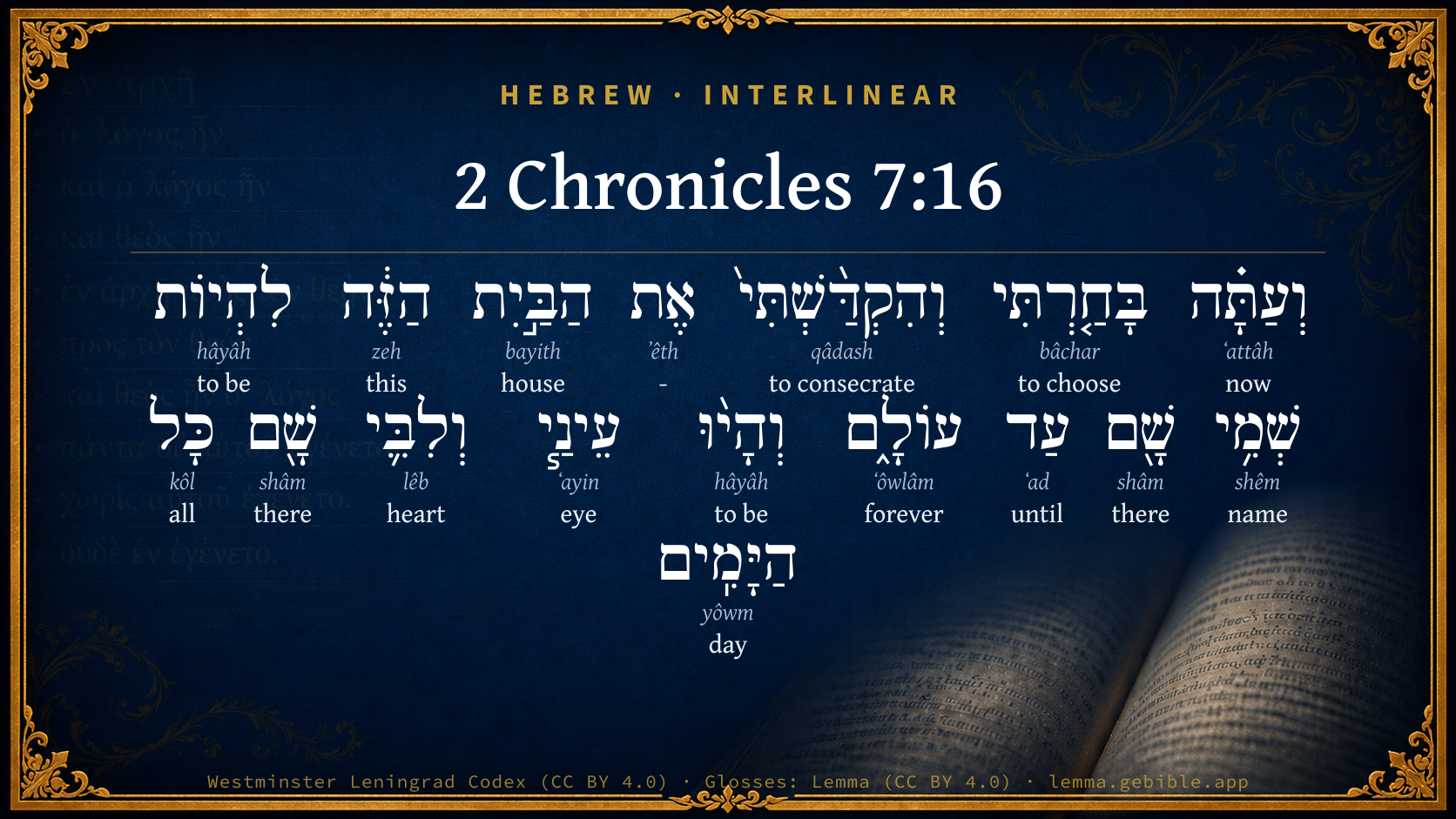
  1. וְעַתָּ֗ה ʻattâh H6258 “and · now” Conjunction + Adverb
  2. וְהִקְדַּ֨שְׁתִּי֙ qâdash H6942 “and · to consecrate” Conjunction + Verb, Hiphil, Sequential Perfect, 1st Person, Common, Singular
  3. אֶת ʼêth H853 “-” Particle, Direct Object
  4. הַבַּ֣יִת bayith H1004 “the · house” Particle, Definite Article + Noun, Common, Masculine, Singular, Absolute
  5. הַזֶּ֔ה zeh H2088 “the · this” Particle, Definite Article + Pronoun, Demonstrative, Masculine, Singular
  6. לִהְיוֹת hâyâh H1961 “to be” Preposition + Verb, Qal, Infinitive Construct
  7. שְׁמִ֥י shêm H8034 “name · my” Noun, Common, Masculine, Singular, Construct + Suffix, Personal, 1st Person, Common, Singular
  8. שָׁ֖ם shâm H8033 “there” Adverb
  9. עַד ʻad H5704 “until” Preposition
  10. עוֹלָ֑ם ʻôwlâm H5769 “forever” Noun, Common, Masculine, Singular, Absolute
  11. וְהָי֨וּ hâyâh H1961 “and · to be” Conjunction + Verb, Qal, Sequential Perfect, 3rd Person, Common, Plural
  12. עֵינַ֧י ʻayin H5869 “eyes · my” Noun, Common, Both, Dual, Construct + Suffix, Personal, 1st Person, Common, Singular
  13. וְלִבִּ֛י lêb H3820 “and · heart · my” Conjunction + Noun, Common, Masculine, Singular, Construct + Suffix, Personal, 1st Person, Common, Singular
  14. שָׁ֖ם shâm H8033 “there” Adverb
  15. כָּל kôl H3605 “all of” Noun, Common, Masculine, Singular, Construct
  16. הַיָּמִֽים yôwm H3117 “the · days” Particle, Definite Article + Noun, Common, Masculine, Plural, Absolute

About this verse

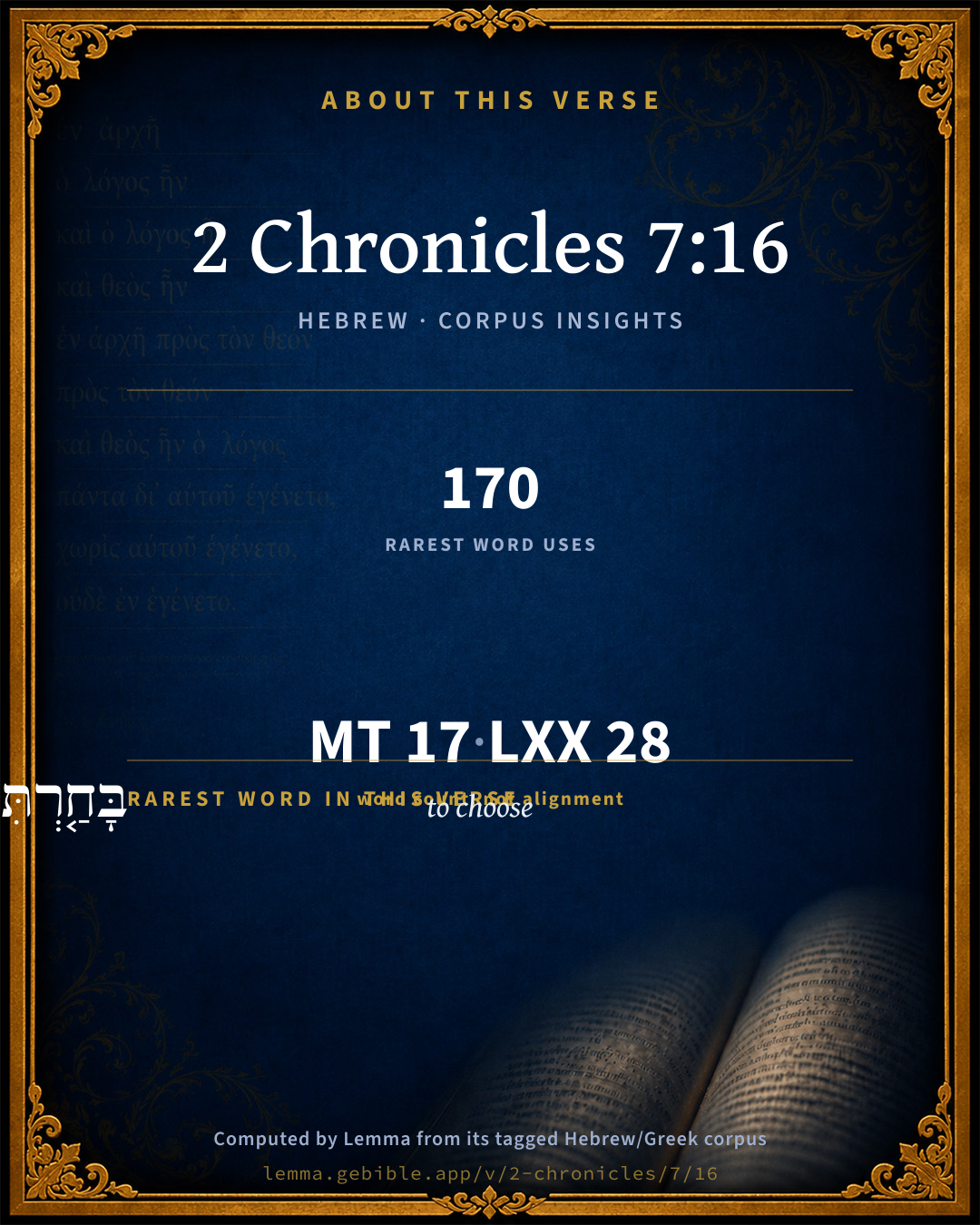
These counts appear in no published source. They are computed here, from the morphology-tagged text and Lemma’s own curated glosses. What Lemma adds →

17
words
15
distinct lemmas
Historical
section

Grammatical profile

  • 4 verbs
  • 7 nouns
  • 1 pronoun
  • 1 preposition
  • 3 adverbs
  • 1 particle

Verb forms

  • בָּחַ֤רְתִּי Qal · Perfect
  • וְהִקְדַּ֨שְׁתִּי֙ Hiphil · Sequential Perfect
  • לִהְיוֹת Qal · Infinitive Construct
  • וְהָי֨וּ Qal · Sequential Perfect

Repetition

Words recur within this verse — often emphatic in Hebrew:

  • לִהְיוֹת to be H1961 ×2
  • שָׁ֖ם there H8033 ×2

Hebrew & Septuagint length

In English translation the verse runs 27 words from the Hebrew and 27 from the Septuagint (LXX English) — the same length.

A rough comparison of the two English renderings, which tokenize alike — not a word-level alignment.

Word counts can differ between the Hebrew and the Greek without any difference in meaning — e.g. the Hebrew direct-object marker אֵת has no separate Greek word, and Greek often adds the article ὁ.

In the original languages it is 17 Hebrew tokens and 28 Greek tokens — but the two are counted differently (Hebrew bundles its prefixes and suffixes into one token; the Greek is in lemma form), so that isn’t a like-for-like length.

Cross-references

19

Topical passages linked to 2 Chronicles 7:16 in the Treasury of Scripture Knowledge — connected by theme and wording, ordered by reader-vote popularity; previews shown in the World English Bible.

  • 2 Chronicles 7:15 Now my eyes shall be open, and my ears attentive, to the prayer that is made in this place.
  • 2 Chronicles 7:12 Yahweh appeared to Solomon by night, and said to him, I have heard your prayer, and have chosen this place to myself for a house of sacrifice.
  • 2 Chronicles 6:5–6 Since the day that I brought forth my people out of the land of Egypt, I chose no city out of all the tribes of Israel to build a house in, that my name might be there; neither chose I any man to be prince over my people Israel:
  • 1 Kings 9:3 Yahweh said to him, I have heard your prayer and your supplication, that you have made before me: I have made this house holy, which you have built, to put my name there forever; and my eyes and my heart shall be there perpetually.
  • 2 Chronicles 6:20 that your eyes may be open toward this house day and night, even toward the place where you have said that you would put your name there; to listen to the prayer which your servant shall pray toward this place.
  • John 2:19–21 Jesus answered them, "Destroy this temple, and in three days I will raise it up."
  • Colossians 2:9 For in him all the fullness of the Godhead dwells bodily,
  • 2 Chronicles 33:4–7 He built altars in the house of Yahweh, of which Yahweh said, In Jerusalem shall my name be forever.
  • Psalms 132:14 "This is my resting place forever. Here I will live, for I have desired it.
  • Zechariah 3:2 Yahweh said to Satan, "Yahweh rebuke you, Satan! Yes, Yahweh who has chosen Jerusalem rebuke you! Isn't this a burning stick plucked out of the fire?"
  • Deuteronomy 12:21 If the place which Yahweh your God shall choose, to put his name there, be too far from you, then you shall kill of your herd and of your flock, which Yahweh has given you, as I have commanded you; and you may eat within your gates, after all the desire of your soul.
  • Deuteronomy 16:11 and you shall rejoice before Yahweh your God, you, and your son, and your daughter, and your man-servant, and your maid-servant, and the Levite who is within your gates, and the foreigner, and the fatherless, and the widow, who are in the midst of you, in the place which Yahweh your God shall choose, to cause his name to dwell there.
  • 1 Kings 8:16 Since the day that I brought forth my people Israel out of Egypt, I chose no city out of all the tribes of Israel to build a house, that my name might be there; but I chose David to be over my people Israel.
  • 1 Kings 8:35 When the sky is shut up, and there is no rain, because they have sinned against you; if they pray toward this place, and confess your name, and turn from their sin, when you do afflict them:
  • 1 Kings 8:44 If your people go out to battle against their enemy, by whatever way you shall send them, and they pray to Yahweh toward the city which you have chosen, and toward the house which I have built for your name;
  • 1 Kings 8:48 if they return to you with all their heart and with all their soul in the land of their enemies, who carried them captive, and pray to you toward their land, which you gave to their fathers, the city which you have chosen, and the house which I have built for your name:
  • 2 Kings 21:7–8 He set the engraved image of Asherah, that he had made, in the house of which Yahweh said to David and to Solomon his son, In this house, and in Jerusalem, which I have chosen out of all the tribes of Israel, will I put my name forever;
  • Matthew 3:17 Behold, a voice out of the heavens said, "This is my beloved Son, with whom I am well pleased."
  • 2 Kings 21:4 He built altars in the house of Yahweh, of which Yahweh said, In Jerusalem will I put my name.

Cross-references courtesy of OpenBible.info (CC BY 4.0).

Hebrew and Greek witnesses Masoretic Hebrew ↔ Greek Septuagint

The same verse in the two great witnesses to the Old Testament, shown verse-for-verse.

These are two independent witnesses, not word-aligned to each other, and the Septuagint is shown in lemma (dictionary) form.

Hebrew 2 Chronicles 7:16 Masoretic · Westminster Leningrad Codex

וְעַתָּ֗ה בָּחַ֤רְתִּי וְהִקְדַּ֨שְׁתִּי֙ אֶת הַבַּ֣יִת הַזֶּ֔ה לִהְיוֹת שְׁמִ֥י שָׁ֖ם עַד עוֹלָ֑ם וְהָי֨וּ עֵינַ֧י וְלִבִּ֛י שָׁ֖ם כָּל הַיָּמִֽים

For now have I chosen and made this house holy, that my name may be there forever; and my eyes and my heart shall be there perpetually.

World English Bible · Public Domain

Greek LXX 2 Chronicles 7:16 Septuagint · lemma form

καί νῦν ἐκλέγω καί ἁγιάζω ὁ οἶκος οὗτος ὁ εἰμί ὄνομα ἐγώ ἐκεῖ ἕως αἰών καί εἰμί ὁ ὀφθαλμός ἐγώ καί ὁ καρδία ἐγώ ἐκεῖ πᾶς ὁ ἡμέρα

And now I have chosen and sanctified this house, that my name should be there for ever: and my eyes and my heart shall be there always.

LXX2012 (modern English Septuagint) · Public Domain

Hebrew: Westminster Leningrad Codex (CC BY 4.0). Greek: Septuagint (public domain); English from LXX2012 (modern English Septuagint) (Public Domain). How the Septuagint differs from the Hebrew →

Commentary

Notes on 2 Chronicles 7:16 from classic Christian and Jewish commentators (each source and its license shown beneath its notes). The classic Christian expositions comment on the surrounding passage and are grouped to its opening verse, so a note may address several verses; the Jewish commentaries on the Tanakh (Rashi and others) are per-verse, so they appear only where the commentator wrote on this verse.

Lemma curates 59 commentaries, every one of them public domain or Creative Commons licensed, each selected and text-cleaned for this edition rather than reprinted as found. About our sources →

Ellicott's Commentary for English Readers

(16) Have I chosen.—2Ch_6:6, and 2Ch_7:12, supr.

Sanctified this house.—1Ki_9:3. The two accounts are again parallel.

Perpetually.—All the days.

A Bible Commentary for English Readers, edited by Charles John Ellicott (1878–1897) — public domain. Text from a community e-Sword module.

The Cambridge Bible for Schools and Colleges

gen. ed. J. J. S. Perowne

16. sanctified] R.V. hallowed (as 1Ki_9:3). for ever] Cp. 2Ch_30:8.

The Cambridge Bible for Schools and Colleges (gen. ed. J. J. S. Perowne; Cambridge University Press, 1878–1918) — public domain. Text from a community e-Sword module.

Matthew Poole's English Annotations

Of this verse and the rest of this chapter, See Poole "1Ki 9:3", &c.

Matthew Poole's English Annotations on the Holy Bible (1683–1685) — public domain. Text from a community e-Sword/MySword module.

The Pulpit Commentary

This verse glances, as an answer to the contents, or spirit of the contents, of the second petition at 2Ch_6:18-21. The beautiful touching condescension in the wording of the last clause, Mine eyes and mine heart shall be there perpetually, will not escape notice.

The temple, the Temple, and the temples of the Lord.

We are reminded in these words of successive manifestations of the Divine to the children of men. We have first

I THE TEMPLE AT JERUSALEM. This was for many generations and for many centuries the chosen place and method of Divine manifestation. It was:

1. The sacred place, "chosen and sanctified" of God, the recognized spot where Cod was to be approached, where his presence was markedly and peculiarly felt, where sacrifice and prayer were to be offered to him, and where pardon and grace were to be gained from him.

2. The place of revelation, where the nature and the character of the Supreme was to be known, and whence it was to be made known. God"s "Name was to be there forever." There he was to be known as the one Divine Spirit, as the Holy One, the Just One, the Merciful One; there he revealed himself in such wise that his worshippers "knew the Lord;" knew him so that they could truly honour him, obediently and acceptably serve him, attain towards his own character and spirit.

3. The place where God manifested himself in peculiar kindness. "Mine eyes and mine heart shall be there perpetually." Not, indeed, that this is not applicable, in a very true sense, everywhere. For "the eyes of the Lord are in every place," and there are none of his children or of his creatures in whom he is not interested. But upon his people worshipping him in his house he would look down with peculiar kindness; and towards them, as they reverently and obediently poured forth their praises or brought their grateful offerings, his heart of love would lean.

II THE ONE GREATER THAN THE TEMPLE, who yet was the Temple of the Lord in his day. For Jesus Christ was he in whom and through whom God manifested himself to mankind, in whom he dwelt and from whom his glory shone.

1. Whoso approached him drew nigh to God and stood in the Divinepresence.

2. He made known "the Name" of God, for he revealed the Father unto the human race; has caused us all to know and to feel that God is, above everything else, the Divine Father, who cares for all his children, and who, whatever their wanderings may be, earnestly remembers them still and is seeking their return.

3. He was the One toward whom "the eyes and the heart" of God werepeculiarly directed, the "beloved Son in whom he was well pleased," and for whose sake his eye of pity and his heart of love are directed to mankind. Not the magnificent Herodian structure on Zion, but that Son of man who often walked about its courts, was the Object in which, in whom, God was to be sought and found.

III OURSELVES THE TEMPLES OF THE LORD. "Know ye not that ye are the temple of God?". (1Co_3:16) What Christ was when he was in the world, that we are to be now. He was the Light of the world, and he said to us, "We are the light of the world;" so he was the temple of God, the One in whom God dwelt, and through whom his Name (his character and his purpose) was made known; and now he charges us to be the "temples of the Holy Ghost;" as men regard us and our life they should be reminded of the Divine, of the truth and the spirit and the character that are of God. We should be living to make God known to all whom we can anywise reach and teach. Upon us his eyes are fixed, and toward us his heart is going in all Divine tenderness and love. We do not fulfil the end of our Christian life except it be true of us that we are the temples of the living God. Not to any sacred place or any consecrated building need men go to find the truth and the Spirit of God; it is (or it should be) enough that they approach the nearest Christian man; they will find what they seek in his words, his bearing, his character, his life. C.

The Pulpit Commentary (1880–1919), ed. H.D.M. Spence-Jones & Joseph S. Exell — public domain. Text from a community e-Sword module.

John Wesley's Explanatory Notes

This house - There will I make myself known, and there will I be called upon.

John Wesley, Explanatory Notes Upon the Whole Bible (1754–1765) — public domain. Text via the GEBible commentary corpus.

unfoldingWord translationNotes

Door43 World Missions Community

that my name may be there forever

Possible meanings are 1) God's name represents himself. AT: "that I may be there forever" or 2) God's name represents Yahweh's reputation, and his name being there represents people worshiping him there. AT: "for people to worship me there forever" (See: Metonymy)

My eyes and my heart will be there every day

Here "My eyes" represents God's careful attention, and "my heart" represents his love. These being at his temple implies that he will protect his temple. AT: "I will watch and protect it forever" (See: Metonymy and Assumed Knowledge and Implicit Information)

As for you

Here "you" refers to King Solomon.

if you walk before me as David your father walked

Here walking is a metaphor for living. Walking before God represents living in obedience to him. AT: "If you obey me as David your father did" (See: Metaphor)

David your father

Solomon was one of David's sons.

keeping my statutes and my decrees

"obeying my statutes and my decrees"

I will establish the throne of your kingdom

Here the throne represents ruling. Establishing the throne of Solomon's kingdom represents causing Solomon to have descendants who will rule over Israel. AT: "I will make descendants of yours rule over your kingdom" (See: Metonymy)

A descendant of yours will never fail to be ruler in Israel

This can be stated positively. AT: "One of your descendants will always be ruler in Israel" or "Descendants of yours will always rule in Israel"

translationWords

set apart

eternity

command

statute

decree

kingdom

covenant

descend

unfoldingWord translationNotes — © Distant Shores Media and the Door43 World Missions Community, licensed CC BY-SA 4.0. Source: git.door43.org/Door43/en_tn.

Rashi

Rabbi Shlomo Yitzchaki (Rashi)

and My eyes and heart will be Jonathan renders (I Kings 9:3): “and My presence will rest there if My will is performed there at all times.” My eyes will be there if My heart and My will are there.

Rashi on the Tanakh — English translations: “The Judaica Press complete Tanach with Rashi, translated by A. J. Rosenberg” (CC BY 4.0); “Pentateuch with Rashi's commentary by M. Rosenbaum and A.M. Silbermann, 1929-1934” (public domain); “The Metsudah Tanach series, Lakewood, N.J” (CC BY 4.0); and “The Book of Joshua, Metsudah Publications, 1997” (CC BY 4.0). Text via Sefaria.

Lesson kit

Teaching starters — assembled from the data on this page, not authored interpretation. Every prompt links to the verse data it draws on. Edit before teaching.

2 Chronicles, in the Historical, opens this verse with 17 words (15 distinct Hebrew lemmas). Its most distinctive word is bâchar (“to choose”). A historical commentator’s framing appears above. Read the whole chapter for the surrounding context.

Discussion questions

  1. The word bâchar carries the sense “to choose.” How does it shape the verse?
  2. 2 Chronicles 7:15 shares this passage’s theme. How do the two illuminate each other?
  3. “to be” occurs 2× in this one verse. What is the effect of the repetition?
  4. These translations render this verse differently; the difference is in the English rendering, not the original. What questions does that raise?
  5. The verb «בָּחַ֤רְתִּי» is Qal Perfect. How does its form color the action?
  6. Reading how Ellicott's Commentary for English Readers and The Cambridge Bible for Schools and Colleges read this verse, where do the two commentators agree and where do they part?

Things to notice

Reading settings

Reading text

Shown beneath each verse's original-language words.

Old Testament
Old Testament edition

Read the OT as the Masoretic Hebrew (MT) or the Greek Septuagint (LXX).

English shown for the Greek Septuagint (in the Hebrew ↔ Greek comparison).

Comparing translations? Open the Compare panel on any verse page to stack up to four side by side.