Exodus 11:6

Hebrew (Westminster Leningrad Codex) Exodus 11:6 appears in the Hebrew Old Testament. The text above is from the Westminster Leningrad Codex. Each word links to its Strong’s number, a concise gloss, and parsing drawn from the Open Scriptures Hebrew Bible morphology. Click any word for its full Brown-Driver-Briggs (BDB) entry.
Download image
Cite this verse

Exodus 11:6 (World English Bible). Public Domain. Lemma interlinear Bible study tool, https://lemma.gebible.app/v/exodus/11/6.

Show BibTeX & RIS
BibTeX
RIS
English Translation
There shall be a great cry throughout all the land of Egypt, such as there has not been, nor shall be any more.
World English Bible · Public Domain
Download a study sheet

One document with this verse’s original text, its word-by-word gloss line, the meaning frame, cross-references with their text, attributed commentary, and full source and license credits — printable, and it pastes into notes with its structure intact.

This verse Autodidact and up

Study sheet (.html) Plain text (.txt)

A passage Seminary Student

Up to 50 verses in one chapter. A passage sheet keeps up to 6 commentary sources and 12 cross-references per verse, in the order this page ranks them, and says so on the sheet whenever that leaves anything out. Ask for a single verse and you get the Autodidact verse sheet above.

Everything on this page stays free to read, with no account — the sheet is a download of what is already on screen, not access to it.

Want to remove ads? Support Godless Engineer
Compare translations 3

The same verse in 3 English versions, stacked beneath the original-language interlinear above. Click any original word for its lexicon entry.

Each is an independent rendering of the whole verse — the interlinear is not word-aligned to these translations.

Highlighted words mark where these versions differ — a whole-verse word diff, not a word-by-word alignment.

  • World English Bible Public Domain
    There shall be a great cry throughout all the land of Egypt, such as there has not been, nor shall be any more.
  • King James Version Public Domain
    And there shall be a great cry throughout all the land of Egypt, such as there was none like it, nor shall be like it any more.
  • unfoldingWord Literal Text CC BY-SA 4.0
    And there will be a great cry in all the land of Egypt, which nothing like it has ever happened, and nothing like it will happen again.

unfoldingWord Literal Text — © unfoldingWord, licensed CC BY-SA 4.0. Word-aligned USFM3 via Door43 (git.door43.org/unfoldingWord/en_ult).

Versions to compare (up to 4)

3 of 4 selected

Show all 18 translations

Every available English version of this verse, each an independent rendering of the whole verse.

  • World English Bible Public Domain
    There shall be a great cry throughout all the land of Egypt, such as there has not been, nor shall be any more.
  • Berean Standard Bible Public Domain
    Then a great cry will go out over all the land of Egypt. Such an outcry has never been heard before and will never be heard again.
  • Majority Standard Bible Public Domain
    Then a great cry will go out over all the land of Egypt. Such an outcry has never been heard before and will never be heard again.
  • King James Version Public Domain
    And there shall be a great cry throughout all the land of Egypt, such as there was none like it, nor shall be like it any more.
  • American Standard Version (1901) Public Domain
    And there shall be a great cry throughout all the land of Egypt, such as there hath not been, nor shall be any more.
  • Revised Version (1885) Public Domain
    And there shall be a great cry throughout all the land of Egypt, such as there hath been none like it, nor shall be like it any more.
  • Geneva Bible (1599) Public Domain
    Then there shalbe a great crie throughout all the land of Egypt, such as was neuer none like, nor shalbe.
  • Douay-Rheims (1899) Public Domain
    And there shall be a great cry in all the land of Egypt, such as neither hath been before, nor shall be hereafter.
  • Young's Literal Translation Public Domain
    and there hath been a great cry in all the land of Egypt, such as there hath not been, and such as there is not again.
  • Literal Standard Version CC BY-SA 4.0
    and there has been a great cry in all the land of Egypt, such as there has not been, and such as there is not again;
  • Unlocked Literal Bible CC BY-SA 4.0
    Then there will be a great wailing throughout all the land of Egypt, such as has never been nor ever will be again.
  • unfoldingWord Literal Text CC BY-SA 4.0
    And there will be a great cry in all the land of Egypt, which nothing like it has ever happened, and nothing like it will happen again.
  • Darby Bible Public Domain
    And there shall be a great cry throughout the land of Egypt, such as there hath been none like it, nor shall be like it any more.
  • World Messianic Bible Public Domain
    There will be a great cry throughout all the land of Egypt, such as there has not been, nor will be any more.
  • Webster's Bible Public Domain
    And there shall be a great cry throughout all the land of Egypt, such as there hath been none like it, nor shall be like it any more.
  • Free Bible Version CC BY-SA 4.0
    There will be loud cries of mourning all over Egypt, such as have never been before, and will never be again.
  • Bible in Basic English Public Domain
    And there will be a great cry through all the land of Egypt, such as never has been or will be again.
  • JPS Tanakh (1917) Public Domain
    And there shall be a great cry throughout all the land of Egypt, such as there hath been none like it, nor shall be like it any more.

Literal Standard Version (2020), Covenant Press — licensed CC BY-SA 4.0. Text via the HelloAO Bible API (eBible.org). Unlocked Literal Bible (unfoldingWord) — licensed CC BY-SA 4.0. Text via the HelloAO Bible API (eBible.org). unfoldingWord Literal Text — © unfoldingWord, licensed CC BY-SA 4.0. Word-aligned USFM3 via Door43 (git.door43.org/unfoldingWord/en_ult). Free Bible Version, Dr. Jonathan Gallagher — licensed CC BY-SA 4.0. Text via the HelloAO Bible API (eBible.org).

Word by word

More ways to search: Search by grammar → Find every occurrence → Compare this word →

Practice this passage: Drill this verse → Learn its vocabulary →

צְעָקָ֥ה
tsaʻăqâh
H6818
“cry”
Noun, Common, Feminine, Singular, Absolute
Part of Speech
Noun
Type
Common
Gender
Feminine
Number
Singular
State
Absolute
Full BDB Definition

Origin: from H6817

TWOT: 1947a

cry, outcry - outcry (against) - cry of distress (especially as heard by God)
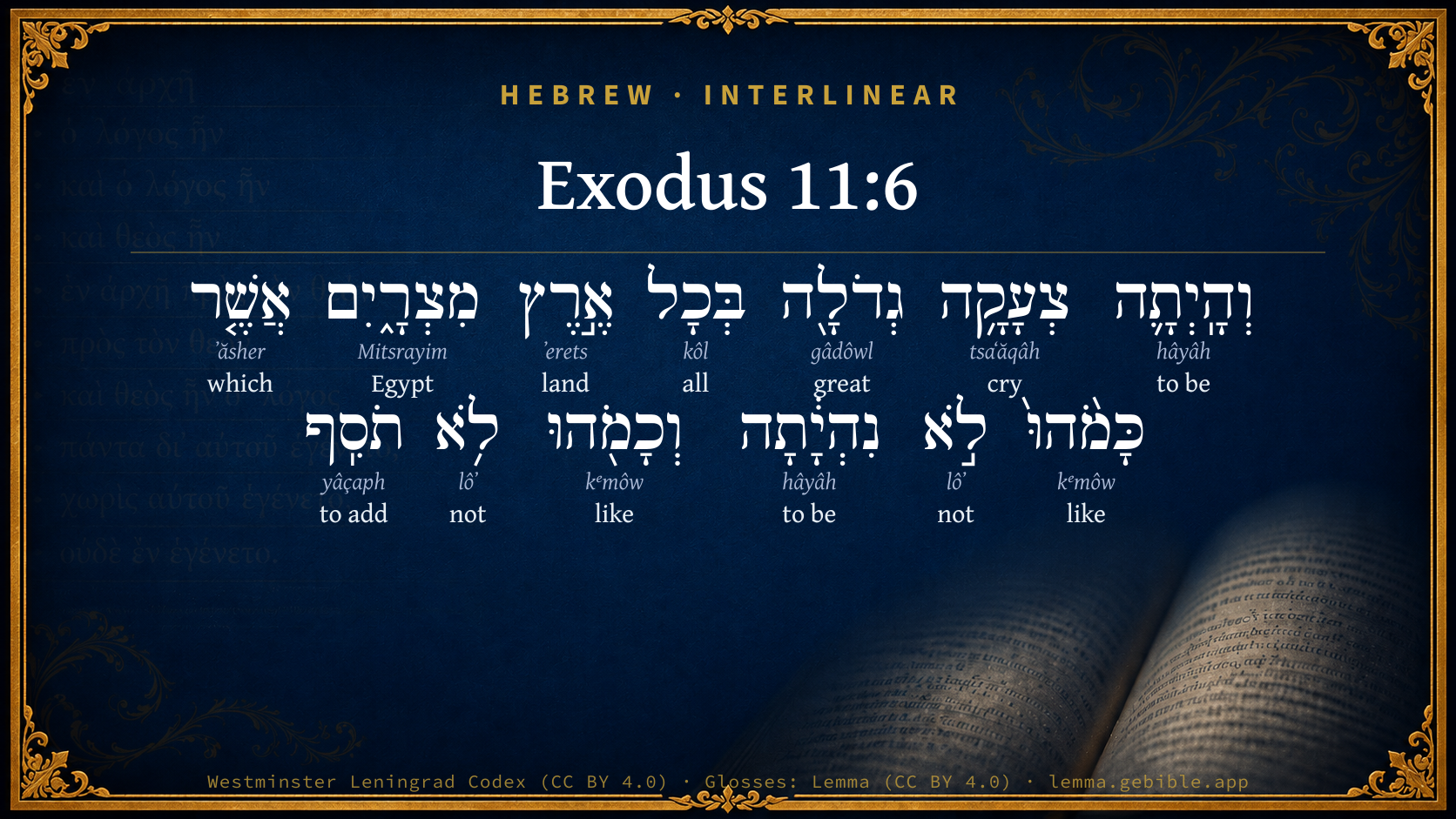
  1. וְהָֽיְתָ֛ה hâyâh H1961 “and · to be” Conjunction + Verb, Qal, Sequential Perfect, 3rd Person, Feminine, Singular
  2. גְדֹלָ֖ה gâdôwl H1419 “great” Adjective, Adjective, Feminine, Singular, Absolute
  3. בְּכָל kôl H3605 “in/at · all of” Preposition + Noun, Common, Masculine, Singular, Construct
  4. אֶ֣רֶץ ʼerets H776 “land of” Noun, Common, Both, Singular, Construct
  5. מִצְרָ֑יִם Mitsrayim H4714 “Egypt” Noun, Proper
  6. אֲשֶׁ֤ר ʼăsher H834 “which” Particle, Relative
  7. כָּמֹ֨הוּ֙ kᵉmôw H3644 “like · him” Preposition + Suffix, Personal, 3rd Person, Masculine, Singular
  8. לֹ֣א lôʼ H3808 “not” Particle, Negative
  9. נִהְיָ֔תָה hâyâh H1961 “to be” Verb, Niphal, Perfect, 3rd Person, Feminine, Singular
  10. וְכָמֹ֖הוּ kᵉmôw H3644 “and · like · him” Conjunction + Preposition + Suffix, Personal, 3rd Person, Masculine, Singular
  11. לֹ֥א lôʼ H3808 “not” Particle, Negative
  12. תֹסִֽף yâçaph H3254 “to add” Verb, Hiphil, Imperfect, 3rd Person, Feminine, Singular

About this verse

These counts appear in no published source. They are computed here, from the morphology-tagged text and Lemma’s own curated glosses. What Lemma adds →

13
words
10
distinct lemmas
Pentateuch
section

Notable vocabulary

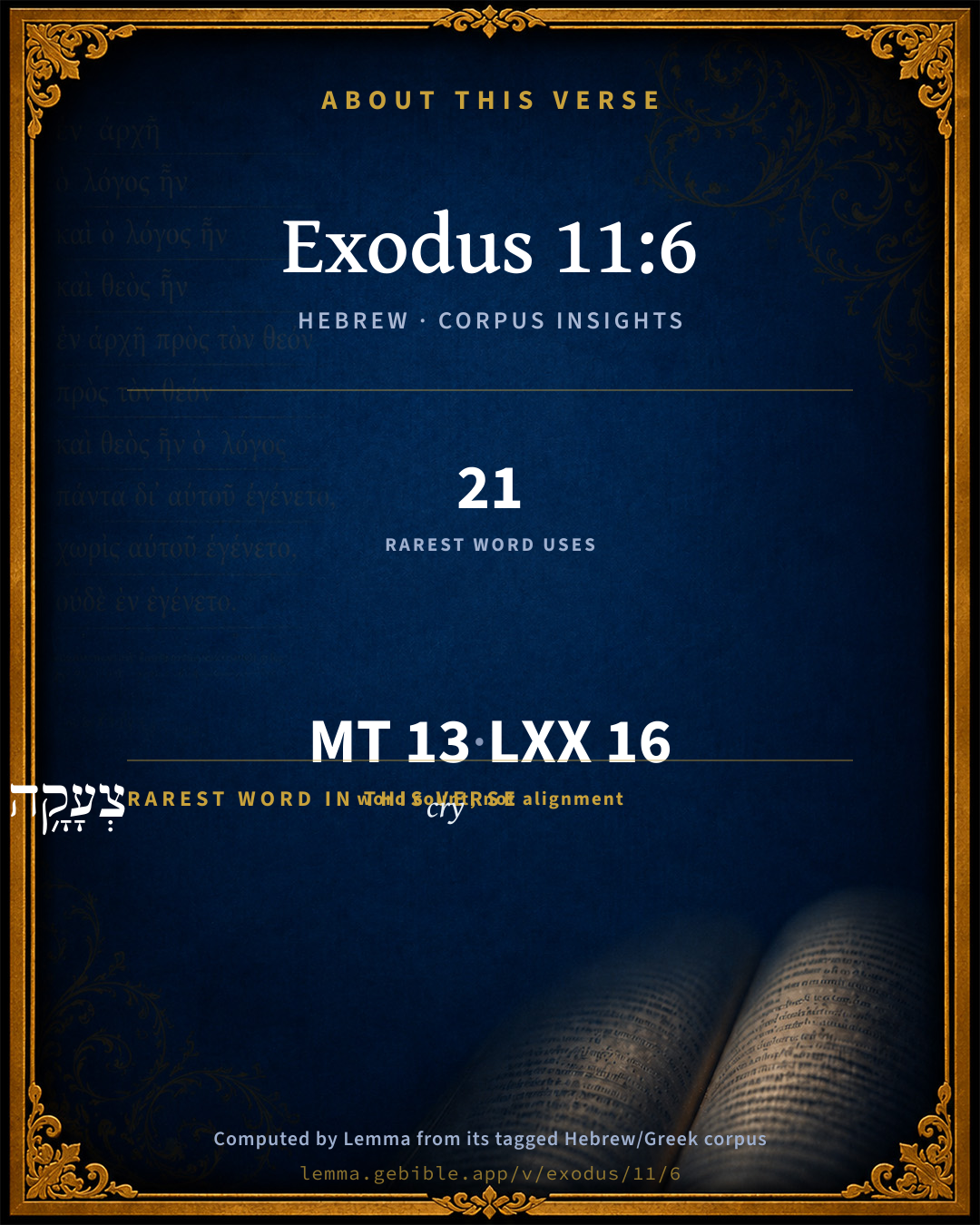
The rarest word here is צְעָקָ֥ה cry H6818 — appearing just 21 times in the whole Hebrew Bible.

Shared distinctive vocabulary

צְעָקָ֥ה cry H6818 occurs in 20 verses of the Hebrew Bible. Also found in:

Grammatical profile

  • 3 verbs
  • 4 nouns
  • 1 adjective
  • 2 prepositions
  • 3 particles

Verb forms

  • וְהָֽיְתָ֛ה Qal · Sequential Perfect
  • נִהְיָ֔תָה Niphal · Perfect
  • תֹסִֽף Hiphil · Imperfect

Repetition

Words recur within this verse — often emphatic in Hebrew:

  • וְהָֽיְתָ֛ה to be H1961 ×2
  • כָּמֹ֨הוּ֙ like H3644 ×2
  • לֹ֣א not H3808 ×2

Hebrew & Septuagint length

In English translation the verse runs 23 words from the Hebrew and 26 from the Septuagint (LXX English) — closely comparable.

A rough comparison of the two English renderings, which tokenize alike — not a word-level alignment.

Word counts can differ between the Hebrew and the Greek without any difference in meaning — e.g. the Hebrew direct-object marker אֵת has no separate Greek word, and Greek often adds the article ὁ.

In the original languages it is 13 Hebrew tokens and 16 Greek tokens — but the two are counted differently (Hebrew bundles its prefixes and suffixes into one token; the Greek is in lemma form), so that isn’t a like-for-like length.

Cross-references

12

Topical passages linked to Exodus 11:6 in the Treasury of Scripture Knowledge — connected by theme and wording, ordered by reader-vote popularity; previews shown in the World English Bible.

  • Exodus 12:30 Pharaoh rose up in the night, he, and all his servants, and all the Egyptians; and there was a great cry in Egypt, for there was not a house where there was not one dead.
  • Amos 5:17 In all vineyards there will be wailing; For I will pass through the midst of you," says Yahweh.
  • Exodus 3:7 Yahweh said, "I have surely seen the affliction of my people who are in Egypt, and have heard their cry because of their taskmasters, for I know their sorrows.
  • Proverbs 21:13 Whoever stops his ears at the cry of the poor, He will also cry out, but shall not be heard.
  • Isaiah 15:4–5 Heshbon cries out, and Elealeh; their voice is heard even to Jahaz: therefore the armed men of Moab cry aloud; his soul trembles within him.
  • Isaiah 15:8 For the cry is gone round about the borders of Moab; the wailing of it to Eglaim, and the wailing of it to Beer-elim.
  • Jeremiah 31:15 Thus says Yahweh: A voice is heard in Ramah, lamentation, and bitter weeping, Rachel weeping for her children; she refuses to be comforted for her children, because they are no more.
  • Lamentations 3:8 Yes, when I cry, and call for help, he shuts out my prayer.
  • Zephaniah 1:10 In that day, says Yahweh, there will be the noise of a cry from the fish gate, a wailing from the second quarter, and a great crashing from the hills.
  • Luke 13:28 There will be weeping and gnashing of teeth, when you see Abraham, Isaac, Jacob, and all the prophets, in the Kingdom of God, and yourselves being thrown outside.
  • Revelation 6:16–17 They told the mountains and the rocks, "Fall on us, and hide us from the face of him who sits on the throne, and from the wrath of the Lamb,
  • Revelation 18:18–19 and cried out as they looked at the smoke of her burning, saying, 'What is like the great city?'

Cross-references courtesy of OpenBible.info (CC BY 4.0).

Hebrew and Greek witnesses Masoretic Hebrew ↔ Greek Septuagint

The same verse in the two great witnesses to the Old Testament, shown verse-for-verse.

These are two independent witnesses, not word-aligned to each other, and the Septuagint is shown in lemma (dictionary) form.

Hebrew Exodus 11:6 Masoretic · Westminster Leningrad Codex

וְהָֽיְתָ֛ה צְעָקָ֥ה גְדֹלָ֖ה בְּכָל אֶ֣רֶץ מִצְרָ֑יִם אֲשֶׁ֤ר כָּמֹ֨הוּ֙ לֹ֣א נִהְיָ֔תָה וְכָמֹ֖הוּ לֹ֥א תֹסִֽף

There shall be a great cry throughout all the land of Egypt, such as there has not been, nor shall be any more.

World English Bible · Public Domain

Greek LXX Exodus 11:6 Septuagint · lemma form

καί εἰμί κραυγή μέγας κατά πᾶς γῆ αἴγυπτος ὅστις τοιοῦτος οὐ γίγνομαι καί τοιοῦτος οὐκέτι προςτίθημι

And there shall be a great cry through all the land of Egypt, such as has not been, and such shall not be repeated any more.

LXX2012 (modern English Septuagint) · Public Domain

Hebrew: Westminster Leningrad Codex (CC BY 4.0). Greek: Septuagint (public domain); English from LXX2012 (modern English Septuagint) (Public Domain). How the Septuagint differs from the Hebrew →

Targum (Aramaic paraphrase)

2

The Targum is the ancient Jewish Aramaic paraphrase of the Hebrew Scriptures — an interpretive translation, not the Hebrew text itself. Onkelos (literal) and Pseudo-Jonathan (expansive) render the Torah, and Jonathan the Prophets. Coverage is partial: where no permissively-licensed English translation exists for a verse, only the Aramaic is shown. This is verse-level text, not a word-by-word alignment to the Hebrew.

  1. Targum Onkelos Torah (Genesis–Deuteronomy)
    וּתְהֵי צְוַחְתָּא רַבָּא בְּכָל אַרְעָא דְמִצְרָיִם דִכְוָתֵהּ לָא הֲוַת וְדִכְוָתֵהּ לָא תוֹסֵף:

    (no public-domain English translation for this verse)

    Targum Onkelos — Aramaic: “Onkelos Genesis” (public domain); “Onkelos Exodus” (public domain); “Onkelos Leviticus” (public domain); “Onkelos Numbers” (public domain); “Onkelos Deuteronomy” (public domain). English: “Sefaria Community Translation” (CC0 1.0 (public-domain dedication)); “J.W. Etheridge. The Targums of Onkelos and Jonathan Ben Uzziel on the Pentateuch. London: Longmans, Green, 1862” (public domain). Text via Sefaria.

  2. Targum Pseudo-Jonathan Torah (Genesis–Deuteronomy)
    וּתְהֵי צְוַוחְתָּא רַבְּתָא בְּכָל אַרְעָא דְמִצְרַיִם דְּדִכְוָותֵיהּ לֵילְיָא לָא הֲוָת בֵּיהּ מַחְתָּא כְּדָא וְדִכְוָותֵיהּ לֵילְיָא לָא תוֹסֵיף לְמֶהֱוֵי מַחְתָּא כְּדָא

    And there will be a great cry in all the land of Mizraim, because like the plague of this night there hath not been, and like the plague of this night there never will be one.

    Targum Pseudo-Jonathan — Aramaic: “Targum Jonathan on Genesis” (public domain); “Targum Jonathan on Exodus” (public domain); “Targum Jonathan on Leviticus” (public domain); “Targum Jonathan on Numbers” (public domain); “Targum Jonathan on Deuteronomy” (public domain). English: “The Targum of Jonathan ben Uzziel, trans. J. W. Etheridge, London, 1862” (public domain). Text via Sefaria.

Commentary

Notes on Exodus 11:6 from classic Christian and Jewish commentators (each source and its license shown beneath its notes). The classic Christian expositions comment on the surrounding passage and are grouped to its opening verse, so a note may address several verses; the Jewish commentaries on the Tanakh (Rashi and others) are per-verse, so they appear only where the commentator wrote on this verse.

Lemma curates 59 commentaries, every one of them public domain or Creative Commons licensed, each selected and text-cleaned for this edition rather than reprinted as found. About our sources →

Trapp's Complete Commentary

John Trapp

Exo 11:6 And there shall be a great cry throughout all the land of Egypt, such as there was none like it, nor shall be like it any more.

Ver. 6. A great cry.] Because in every house there shall be a dead corpse, and so a Conclamatum est. They had made Israel cry: and God usually retaliates spoil to spoil, {Eze 39:10} number to number, {Isa 65:11-12} choice to choice, {Isa 66:3-4} cry to cry, {Jas 5:1; Jas 5:4} &c.

John Trapp, A Commentary or Exposition upon All the Books of the Old and New Testament (1647–1656) — public domain. Text from a community e-Sword module.

Jamieson, Fausset & Brown

Robert Jamieson, A. R. Fausset & David Brown

shall be a great cry throughout all the land--In the case of a death, people in the East set up loud wailings, and imagination may conceive what "a great cry" would be raised when death would invade every family in the kingdom.

Jamieson, Fausset & Brown — Commentary Critical and Explanatory on the Whole Bible (1871) — public domain (CC PDM 1.0). Text via the HelloAO Bible API.

Adam Clarke's Commentary

Verse 6. There shall be a great cry] Of the dying and for the dead. See more on this subject, Ex 12:30.

Adam Clarke's Commentary on the Bible (1810–1826) — public domain. Text from a community e-Sword/MySword module.

Ellicott's Commentary for English Readers

(6) There shall be a great cry.—The shrill cries uttered by mourners in the East are well known to travellers. Mr. Stuart Poole heard those of the Egyptian women at Cairo, in the great cholera of 1848, at a distance of two miles (Smith’s Dictionary of the Bible, vol. ii., p. 888). Herodotus, describing the lamentations of the Persian soldiers at the funeral of Masistius, says that “all Bœotia resounded with their clamour” (Exo_9:24). The Egyptian monuments represent mourners as tearing their hair, putting dust upon their heads, and beating their breasts (Wilkinson, in Rawlinson’s Herodotus, vol. ii., p. 138).

A Bible Commentary for English Readers, edited by Charles John Ellicott (1878–1897) — public domain. Text from a community e-Sword module.

The Cambridge Bible for Schools and Colleges

gen. ed. J. J. S. Perowne

6. such as, &c.] cf. Exo_9:18 b, 24b, Exo_10:6 b, 14b; and p. 56.

The Cambridge Bible for Schools and Colleges (gen. ed. J. J. S. Perowne; Cambridge University Press, 1878–1918) — public domain. Text from a community e-Sword module.

John Gill's Exposition

And there shall be a great cry throughout all the land of Egypt,.... Of parents for the loss of their firstborn sons, their heirs, the support and glory of their families; children for the loss of their elder brethren; and servants for the loss of the prime and principal in their masters' houses; and all in a dreadful fright, expecting instantly death themselves:

such as there was none like it, nor shall be like it any more; for though the later destruction of Pharaoh and his host in the Red sea might be a greater loss, yet not occasion greater mourning; since that was only a loss of military persons, and did not affect at least so many families as this; and though their king was lost also, it might not give them so much concern, since through his ill conduct, his hardness and obstinacy, he had been the means of so many plagues inflicted on them.

John Gill's Exposition of the Whole Bible (1746–1763) — public domain (CC PDM 1.0). Text via the HelloAO Bible API.

Whedon's Commentary on the Bible

Daniel D. Whedon

6. A great cry — Awfully typical of that midnight cry which shall sound through all the earth: “Behold, the Bridegroom cometh!”

Daniel D. Whedon (gen. ed.), Commentary on the Old and New Testaments (1874–1909) — public domain. Text from a community e-Sword module.

The Pulpit Commentary

There shall be a great cry. The violence of Oriental emotions, and the freedom with which they are vented are well known. Herodotus relates that the Egyptians stript themselves and beat their breasts at funerals (2:85) No doubt they also uttered shrill lamentations, as did the Greeks (Lucian, De Luetu, and the Persians (Heb_9:24). With bitter mourning in every house, the "cry" might well be one, such as there had been none like before, neither would there be any like again.

The Pulpit Commentary (1880–1919), ed. H.D.M. Spence-Jones & Joseph S. Exell — public domain. Text from a community e-Sword module.

unfoldingWord translationNotes

Door43 World Missions Community

After that I will go out

This means that Moses and the people of Israel will leave Egypt. AT: "After that I will leave here" or "After that I will go out from Egypt" (See: Assumed Knowledge and Implicit Information)

translationWords

Israel

beast

bow

anger

unfoldingWord translationNotes — © Distant Shores Media and the Door43 World Missions Community, licensed CC BY-SA 4.0. Source: git.door43.org/Door43/en_tn.

Lesson kit

Teaching starters — assembled from the data on this page, not authored interpretation. Every prompt links to the verse data it draws on. Edit before teaching.

Exodus, in the Pentateuch, opens this verse with 13 words (10 distinct Hebrew lemmas). Its most distinctive word is tsaʻăqâh (“cry”). A historical commentator’s framing appears above. Read the whole chapter for the surrounding context.

Discussion questions

  1. How does “cry” (tsaʻăqâh) shape what this verse is saying?
  2. Genesis 18:21 shares the word «cry» with this verse. How do the two illuminate each other?
  3. “to be” occurs 2× in this one verse. What is the effect of the repetition?
  4. These translations render this verse differently; the difference is in the English rendering, not the original. What questions does that raise?
  5. The verb «וְהָֽיְתָ֛ה» is Qal Sequential Perfect. How does its form color the action?
  6. Reading how Trapp's Complete Commentary and Jamieson, Fausset & Brown read this verse, where do the two commentators agree and where do they part?

Things to notice

Reading settings

Reading text

Shown beneath each verse's original-language words.

Old Testament
Old Testament edition

Read the OT as the Masoretic Hebrew (MT) or the Greek Septuagint (LXX).

English shown for the Greek Septuagint (in the Hebrew ↔ Greek comparison).

Comparing translations? Open the Compare panel on any verse page to stack up to four side by side.