1 Chronicles 25:7

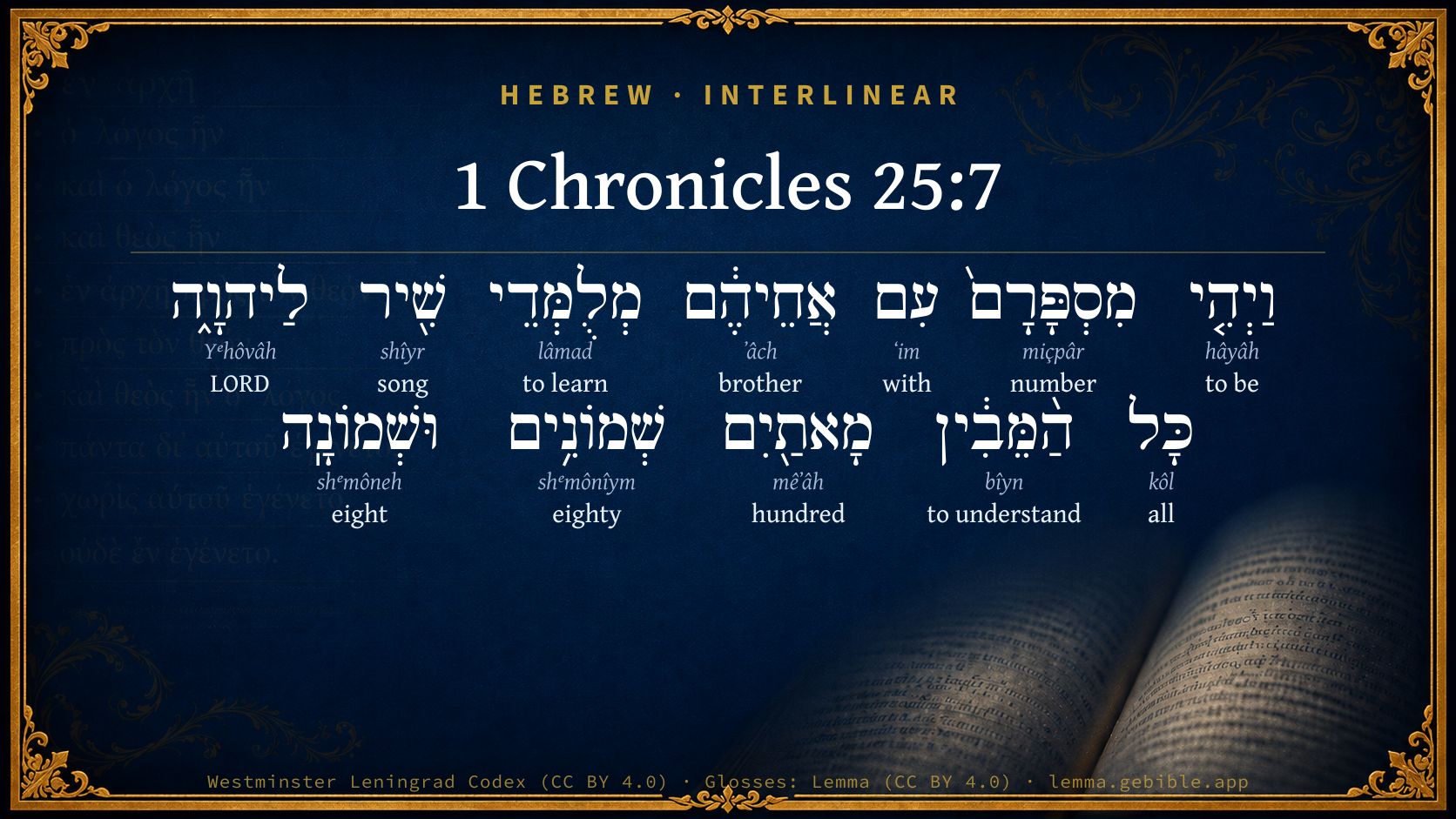
Hebrew (Westminster Leningrad Codex) 1 Chronicles 25:7 appears in the Hebrew Old Testament. The text above is from the Westminster Leningrad Codex. Each word links to its Strong’s number, a concise gloss, and parsing drawn from the Open Scriptures Hebrew Bible morphology. Click any word for its full Brown-Driver-Briggs (BDB) entry.
Download image
Cite this verse

1 Chronicles 25:7 (World English Bible). Public Domain. Lemma interlinear Bible study tool, https://lemma.gebible.app/v/1-chronicles/25/7.

Show BibTeX & RIS
BibTeX
RIS
English Translation
The number of them, with their brothers who were instructed in singing to Yahweh, even all who were skillful, was two hundred eighty-eight.
World English Bible · Public Domain
Download a study sheet

One document with this verse’s original text, its word-by-word gloss line, the meaning frame, cross-references with their text, attributed commentary, and full source and license credits — printable, and it pastes into notes with its structure intact.

This verse Autodidact and up

Study sheet (.html) Plain text (.txt)

A passage Seminary Student

Up to 50 verses in one chapter. A passage sheet keeps up to 6 commentary sources and 12 cross-references per verse, in the order this page ranks them, and says so on the sheet whenever that leaves anything out. Ask for a single verse and you get the Autodidact verse sheet above.

Everything on this page stays free to read, with no account — the sheet is a download of what is already on screen, not access to it.

Want to remove ads? Support Godless Engineer
Compare translations 3

The same verse in 3 English versions, stacked beneath the original-language interlinear above. Click any original word for its lexicon entry.

Each is an independent rendering of the whole verse — the interlinear is not word-aligned to these translations.

Highlighted words mark where these versions differ — a whole-verse word diff, not a word-by-word alignment.

  • World English Bible Public Domain
    The number of them, with their brothers who were instructed in singing to Yahweh, even all who were skillful, was two hundred eighty-eight.
  • King James Version Public Domain
    So the number of them, with their brethren that were instructed in the songs of the LORD, even all that were cunning, was two hundred fourscore and eight.
  • unfoldingWord Literal Text CC BY-SA 4.0
    And their number, with their brothers having been taught the song of Yahweh, all of the ones understanding, was 288.

unfoldingWord Literal Text — © unfoldingWord, licensed CC BY-SA 4.0. Word-aligned USFM3 via Door43 (git.door43.org/unfoldingWord/en_ult).

Versions to compare (up to 4)

3 of 4 selected

Show all 18 translations

Every available English version of this verse, each an independent rendering of the whole verse.

  • World English Bible Public Domain
    The number of them, with their brothers who were instructed in singing to Yahweh, even all who were skillful, was two hundred eighty-eight.
  • Berean Standard Bible Public Domain
    Together with their relatives, who were all trained and skillful in the songs of the LORD, they numbered 288.
  • Majority Standard Bible Public Domain
    Together with their relatives, who were all trained and skillful in the songs of the LORD, they numbered 288.
  • King James Version Public Domain
    So the number of them, with their brethren that were instructed in the songs of the LORD, even all that were cunning, was two hundred fourscore and eight.
  • American Standard Version (1901) Public Domain
    And the number of them, with their brethren that were instructed in singing unto Jehovah, even all that were skilful, was two hundred fourscore and eight.
  • Revised Version (1885) Public Domain
    And the number of them, with their brethren that were instructed in singing unto the LORD, even all that were skilful, was two hundred fourscore and eight.
  • Geneva Bible (1599) Public Domain
    So was their nomber with their brethre that were instruct in ye songs of the Lord, euen of al that were cunning, two hundreth foure score and eight.
  • Douay-Rheims (1899) Public Domain
    And the number of them with their brethren, that taught the song of the Lord, all the teachers, were two hundred and eighty-eight,
  • Young's Literal Translation Public Domain
    And their number, with their brethren -- taught in the song of Jehovah, all who are intelligent -- is two hundred, eighty and eight.
  • Literal Standard Version CC BY-SA 4.0
    And their number, with their brothers taught in the song of YHWH—all who are intelligent—[is] two hundred and eighty-eight.
  • Unlocked Literal Bible CC BY-SA 4.0
    They and their brothers who were skilled and trained to make music to Yahweh numbered 288.
  • unfoldingWord Literal Text CC BY-SA 4.0
    And their number, with their brothers having been taught the song of Yahweh, all of the ones understanding, was 288.
  • Darby Bible Public Domain
    And the number of them, with their brethren that were instructed in the songs of Jehovah, all of them skilful, was two hundred and eighty-eight.
  • World Messianic Bible Public Domain
    The number of them, with their brothers who were instructed in singing to the LORD, even all who were skillful, was two hundred eighty-eight.
  • Webster's Bible Public Domain
    So the number of them, with their brethren that were instructed in the songs of the LORD, even all that were skillful, was two hundred and eighty eight.
  • Free Bible Version CC BY-SA 4.0
    Along with their relatives, all of them trained and skilled in singing to the Lord, they totaled 288.
  • Bible in Basic English Public Domain
    And the number of them, with their brothers who were trained and expert in making melody to the Lord, was two hundred and eighty-eight.
  • JPS Tanakh (1917) Public Domain
    And the number of them, with their brethren that were instructed in singing unto the LORD, even all that were skilful, was two hundred fourscore and eight.

Literal Standard Version (2020), Covenant Press — licensed CC BY-SA 4.0. Text via the HelloAO Bible API (eBible.org). Unlocked Literal Bible (unfoldingWord) — licensed CC BY-SA 4.0. Text via the HelloAO Bible API (eBible.org). unfoldingWord Literal Text — © unfoldingWord, licensed CC BY-SA 4.0. Word-aligned USFM3 via Door43 (git.door43.org/unfoldingWord/en_ult). Free Bible Version, Dr. Jonathan Gallagher — licensed CC BY-SA 4.0. Text via the HelloAO Bible API (eBible.org).

Word by word

More ways to search: Search by grammar → Find every occurrence → Compare this word →

Practice this passage: Drill this verse → Learn its vocabulary →

שְׁמוֹנִ֥ים
shᵉmônîym
H8084
“eighty”
Adjective, Cardinal number, Both, Plural, Absolute
Part of Speech
Adjective
Type
Cardinal number
Gender
Both
Number
Plural
State
Absolute
Full BDB Definition

Origin: mult from H8083

TWOT: 2411b

eighty, fourscore - eighty (as cardinal number) - eightieth (as ordinal number) - in combination with other numbers
  1. וַיְהִ֤י hâyâh H1961 “and · to be” Conjunction + Verb, Qal, Sequential Imperfect, 3rd Person, Masculine, Singular
  2. מִסְפָּרָם֙ miçpâr H4557 “number · their” Noun, Common, Masculine, Singular, Construct + Suffix, Personal, 3rd Person, Masculine, Plural
  3. עִם ʻim H5973 “with” Preposition
  4. אֲחֵיהֶ֔ם ʼâch H251 “brothers · their” Noun, Common, Masculine, Plural, Construct + Suffix, Personal, 3rd Person, Masculine, Plural
  5. מְלֻמְּדֵי lâmad H3925 “learned” Verb, Pual, Participle Passive, Masculine, Plural, Construct
  6. שִׁ֖יר shîyr H7892 “song” Noun, Common, Both, Singular, Absolute
  7. לַיהוָ֑ה Yᵉhôvâh H3068 “to/for · LORD” Preposition + Noun, Proper
  8. כָּל kôl H3605 “all of” Noun, Common, Masculine, Singular, Construct
  9. הַ֨מֵּבִ֔ין bîyn H995 “the · understanding” Particle, Definite Article + Verb, Hiphil, Participle Active, Masculine, Singular, Absolute
  10. מָאתַ֖יִם mêʼâh H3967 “hundred” Adjective, Cardinal number, Both, Dual, Absolute
  11. וּשְׁמוֹנָֽה shᵉmôneh H8083 “and · eight” Conjunction + Adjective, Cardinal number, Masculine, Singular, Absolute

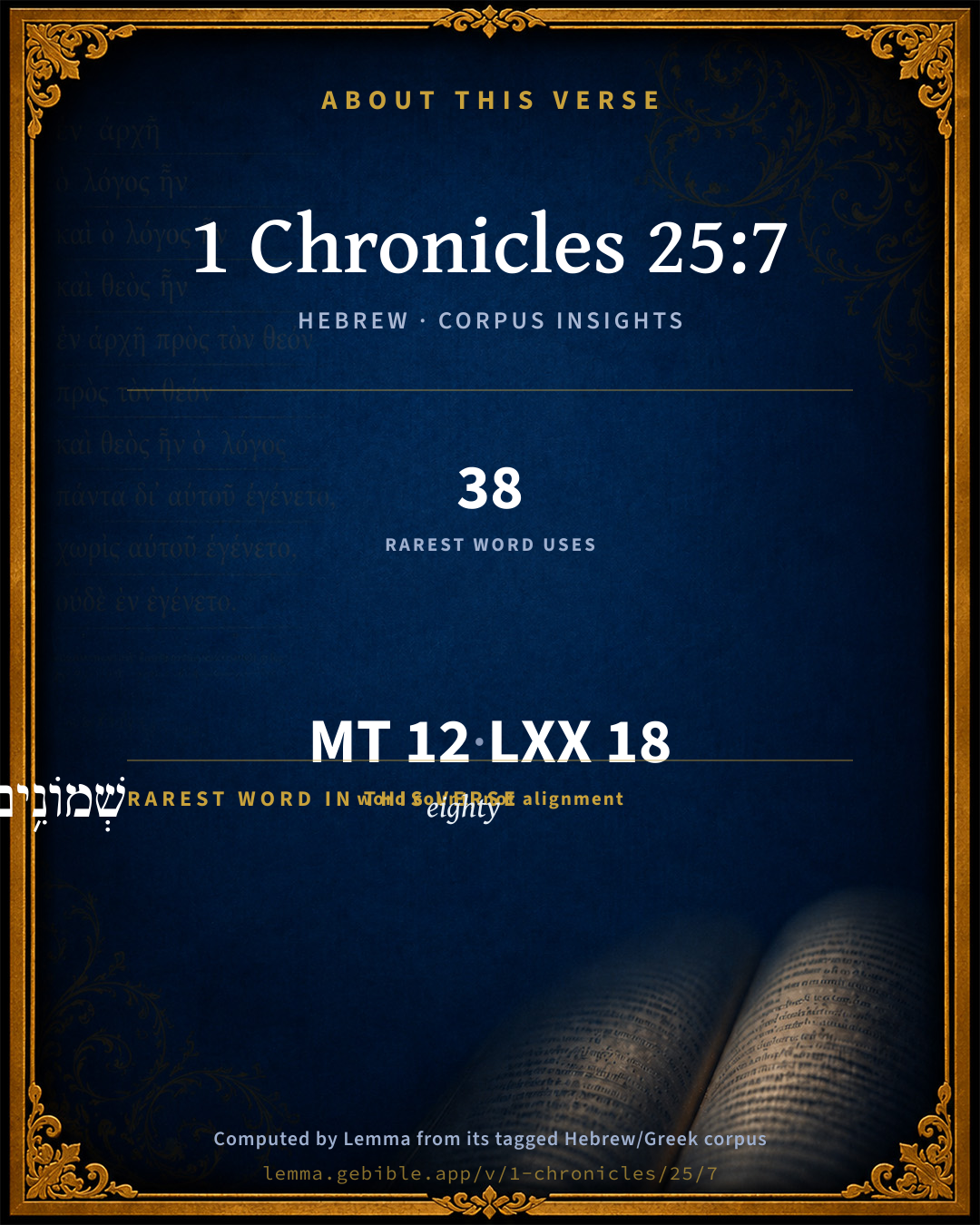
About this verse

These counts appear in no published source. They are computed here, from the morphology-tagged text and Lemma’s own curated glosses. What Lemma adds →

12
words
12
distinct lemmas
Historical
section

Shared distinctive vocabulary

שְׁמוֹנִ֥ים eighty H8084 occurs in 37 verses of the Hebrew Bible. Also found in:

Grammatical profile

  • 3 verbs
  • 5 nouns
  • 3 adjectives
  • 1 preposition

Verb forms

  • וַיְהִ֤י Qal · Sequential Imperfect
  • מְלֻמְּדֵי Pual · Participle Passive
  • הַ֨מֵּבִ֔ין Hiphil · Participle Active

Hebrew & Septuagint length

In English translation the verse runs 23 words from the Hebrew and 24 from the Septuagint (LXX English) — closely comparable.

A rough comparison of the two English renderings, which tokenize alike — not a word-level alignment.

Word counts can differ between the Hebrew and the Greek without any difference in meaning — e.g. the Hebrew direct-object marker אֵת has no separate Greek word, and Greek often adds the article ὁ.

In the original languages it is 12 Hebrew tokens and 18 Greek tokens — but the two are counted differently (Hebrew bundles its prefixes and suffixes into one token; the Greek is in lemma form), so that isn’t a like-for-like length.

Cross-references

1

Topical passages linked to 1 Chronicles 25:7 in the Treasury of Scripture Knowledge — connected by theme and wording, ordered by reader-vote popularity; previews shown in the World English Bible.

  • 1 Chronicles 23:5 and four thousand were doorkeepers; and four thousand praised Yahweh with the instruments which I made, [said David], for giving praise.

Cross-references courtesy of OpenBible.info (CC BY 4.0).

Hebrew and Greek witnesses Masoretic Hebrew ↔ Greek Septuagint

The same verse in the two great witnesses to the Old Testament, shown verse-for-verse.

These are two independent witnesses, not word-aligned to each other, and the Septuagint is shown in lemma (dictionary) form.

Hebrew 1 Chronicles 25:7 Masoretic · Westminster Leningrad Codex

וַיְהִ֤י מִסְפָּרָם֙ עִם אֲחֵיהֶ֔ם מְלֻמְּדֵי שִׁ֖יר לַיהוָ֑ה כָּל הַ֨מֵּבִ֔ין מָאתַ֖יִם שְׁמוֹנִ֥ים וּשְׁמוֹנָֽה

The number of them, with their brothers who were instructed in singing to Yahweh, even all who were skillful, was two hundred eighty-eight.

World English Bible · Public Domain

Greek LXX 1 Chronicles 25:7 Septuagint · lemma form

καί γίγνομαι ὁ ἀριθμός αὐτός μετά ὁ ἀδελφός αὐτός διδάσκω ᾄδω κύριος πᾶς συνἵημι διακόσιοι ὀγδοήκοντα καί ὀκτώ

And the number of them after their brethren, those instructed to sing to God, every one that understood singing was two hundred and eighty-eight.

LXX2012 (modern English Septuagint) · Public Domain

Hebrew: Westminster Leningrad Codex (CC BY 4.0). Greek: Septuagint (public domain); English from LXX2012 (modern English Septuagint) (Public Domain). How the Septuagint differs from the Hebrew →

Commentary

Notes on 1 Chronicles 25:7 from classic Christian and Jewish commentators (each source and its license shown beneath its notes). The classic Christian expositions comment on the surrounding passage and are grouped to its opening verse, so a note may address several verses; the Jewish commentaries on the Tanakh (Rashi and others) are per-verse, so they appear only where the commentator wrote on this verse.

Lemma curates 59 commentaries, every one of them public domain or Creative Commons licensed, each selected and text-cleaned for this edition rather than reprinted as found. About our sources →

Trapp's Complete Commentary

John Trapp

1Ch 25:7 So the number of them, with their brethren that were instructed in the songs of the LORD, [even] all that were cunning, was two hundred fourscore and eight.

Ver. 7. Were two hundred fourscore and eight.] That served in the temple; the rest of the four thousand {1Ch 23:5} were employed, some think, in the synagogues.

John Trapp, A Commentary or Exposition upon All the Books of the Old and New Testament (1647–1656) — public domain. Text from a community e-Sword module.

The Biblical Illustrator

Joseph S. Exell

1Ch_25:7

That were instructed in the songs of the Lord.

Music and worship

In the services of the Jewish temple all is devout, exalted, appropriate, devotional, impressive, and soul-subduing, because the musicians themselves are close to the heart of the great Jehovah; the worshipping congregation hears His voice with awe, as the sound of many waters, and the priests of the temple lift their reverent thoughts to the great I Am, with every cloud of incense that floats above the altar.

I. The moral purpose of music. All other aspects of music in religious service, that merely show off voices, and entertain the jaded senses of the crowd, without a devotional spirit and moral purpose behind them, may be theatrical and imposing, and to a certain extent moving, but they do not rise higher than the altitude of a passing mood. Musical effect is one thing--musical sincerity another. Words may be eloquent; they are useless when they do not touch the soul. Church music may be charming; it is but an idle breath when no message of spiritual power goes from the singer to him who listens. The Puritans and Spartans were both agreed that luxury of sound was sometimes mischievous. The Puritan said, Sweet music at first delighteth the ears, but afterward corrupteth and depraveth the mind. Timotheus, the Milesian, added a twelfth string to his harp, for which he was severely punished by the Spartans. They feared this luxury of sound would effeminate the people. Music is not only closely related to mind, but to morals as well; and, Church-wise, this moral quality makes its swift appeal to the emotional sense; the exact relation of music to the emotions and the effect of melody upon the listener are truly and eloquently described by Mr. Haweis: Like the sound of bells at night breaking the silence, only to lead the spirit into deeper peace; like a leaden cloud at morn, rising in grey twilight, to hang as a golden mist before the furnace of the sun; like the dull, deep pain of one who sits in an empty room watching the shadows of the firelight full of memories; like the plaint of souls that are wasted with sighing; like paeans of exalted praise; like sudden songs from the open gates of paradise--is music. Like one who stands in the midst of hot and terrible battle, drunk with the fiery smoke and hearing the roar of cannon in a trance; like one who finds himself in a long cathedral aisle, and hears the pealing organ, and sees a kneeling crowd smitten with fringes of coloured light; like one who, from a precipice, leaps out upon the warm midsummer air, toward the peaceful valleys below, and feeling himself buoyed up with wings that suddenly fail him, wakens in great despair from his wild dream--so is he who can listen and understand. Such is the mission of music, which George Eliot characterises as love in search of a word.

II. There can be no sort of question that the religious bodies which give the people most to do in the service, and exact from the choir music of the most devotional type, are gaining the largest number of worshippers. In the first particular the Roman Catholic Church is seriously defective; but in the second particular it must be conceded that Protestants have absolutely nothing approaching the grandeur of the Roman Catholic masses, where we have a mind like that of Mozart or Beethoven steadily working out, in strains of incomparable depth and pathos, a great connected series of thoughts, embodying all the varied phases of religious emotion. What man, capable of profoundest feeling, has not been thrilled to his hearts depth by the great cathedral music of the Romish Church? Presbyterian and Congregational churches have been absolutely forced into warmer, more varied, and more worshipful forms of service by the hunger of the people and by the pressure of competition from without. On this point allow me to quote the strong language of Professor Waldo S. Pratt, of Hartford Theological Seminary, one of the most rigid and orthodox of Congregational institutions. He writes: American Dissenting churches have begun to see that in their protest against the Episcopacy of the eighteenth century they went to the extreme in many matters. They have not only fallen into bald and irregular habits of worship, but in their exaltation of the teaching office of the pulpit they have almost forgotten the worshipping office of the pew. Accordingly, throughout the land arises a cry for the enrichment of public worship. Hence the growing use of responsive reading, of formulae of prayer and confession, of singing in which all the people may join, Barren worship is productive of no such blessed inspirations and emotions as follow what is truly congregational worship.

III. I am ready to grant the existence of certain dangers.

1. One is, that the music may be simply an entertainment. When Archbishop Stephens, of New York, was dying, he took the hand of a friend and whispered, almost with his last breath, Come to the funeral. The music will be splendid.

2. Another danger is that the service, largely ritualistic, may be emptied of all feeling of true devotion. Dr. Lyman Abbott notes a great absence of seriousness in the cathedral services of Antwerp, Cologne, and Paris. And upon this phase of the subject I will only remark that three principles must be duly observed in the construction of a satisfactory ritual--

(1) The sentiment of reverence must be increased, and not diminished. All tendencies toward trivialness in the treatment of the great realities symbolised by worship must be sternly reproved.

(2) There should be entire fitness of parts. Music, responses, prayers, must not be permitted to overweight each other. Proportion is as necessary in service as it is in architecture.

(3) Concentration of effects. The aim of all worship should be to bring God nearer, and to lift the soul in adoration. Whatever contributes to these results--though it be an innovation--ought at least to receive a respectful hearing in the court of reason. (F. Stanley Root, M. A.)

The Biblical Illustrator, edited by Joseph S. Exell (c. 1880s–1900s) — public domain. Text from a community e-Sword module.

Joseph Benson's Commentary

1Ch 25:7. All that were cunning — Who were so skilful that they were able to teach others; and, together with their scholars, made up the four thousand mentioned 1Ch 23:5.

Joseph Benson's Commentary on the Old and New Testaments (1811–1818) — public domain. Text from a community e-Sword module.

Adam Clarke's Commentary

Verse 7. Two hundred fourscore and eight.] That it twelve classes of twenty-four Levites each; for two hundred and eighty-eight divided by twelve quotes twenty-four.

Adam Clarke's Commentary on the Bible (1810–1826) — public domain. Text from a community e-Sword/MySword module.

Ellicott's Commentary for English Readers

(7) So the number of them, with their brethren . . . was two hundred fourscore and eight.—This total of two hundred and eighty-eight skilled musicians (24 × 12) shows that each of the twenty-four leading minstrels, called in 1Ch_25:2-4 the “sons” of Asaph, Jeduthun, and Heman, was associated with a company of eleven “brethren,” who were experts in the chanting of the sanctuary. The twenty-four leaders accompanied the singing of their choirs with instrumental music.

A Bible Commentary for English Readers, edited by Charles John Ellicott (1878–1897) — public domain. Text from a community e-Sword module.

The Cambridge Bible for Schools and Colleges

gen. ed. J. J. S. Perowne

7. in the songs of the Lord] R.V. in singing unto the LORD.

cunning] R.V. skilful; as 1Ch_15:22, where the same Heb. word is used.

two hundred fourscore and eight] The number corresponds with the twenty-four courses of twelve members each about to be enumerated.

The Cambridge Bible for Schools and Colleges (gen. ed. J. J. S. Perowne; Cambridge University Press, 1878–1918) — public domain. Text from a community e-Sword module.

John Gill's Exposition

So the number of them, with their brethren,.... Who each of them had twelve with them, as after reckoned:

that were instructed in the songs of the Lord; taught how to sing them:

even all that were cunning; expert and well skilled in the science of singing:

was two hundred and eighty eight; for there being twenty four classes answerable to those of the priests, and twelve in each class, twelve times twenty four makes two hundred and eighty eight.

John Gill's Exposition of the Whole Bible (1746–1763) — public domain (CC PDM 1.0). Text via the HelloAO Bible API.

Albert Barnes' Notes on the Bible

With their brethren - i. e., “with others of the tribe of Levi.” Each son of Asaph, Jeduthun, and Heman, was at the head of a band of twelve skilled musicians, consisting partly of his own sons, partly of Levites belonging to other families 1 Chr. 25:9-31. The 24 band-leaders, together with their bands, formed a body of 288 persons (24 x 12 =288) Besides these, we hear of there being above 3,700 singers, who were probably divided, like the trained musicians, into 24 courses, which must have contained about 155 each 1Ch 23:5.

Albert Barnes' Notes on the Bible (1834–1885) — public domain. Text from a community e-Sword/MySword module.

Haydock's Catholic Bible Commentary

Eight, comprising the twenty-four princes, and the eleven secondary masters of each of the bands, or twelve times twenty-four, ver. 1.

George Leo Haydock (1774–1849), Haydock's Catholic Family Bible and Commentary, 1859 edition — public domain. Excludes Psalms (Douay-Rheims chapter numbering differs from Protestant) and Deuterocanonical books (Catholic canon only).

Matthew Poole's English Annotations

All that were cunning; who were so skilful that they were able to teach others.

Two hundred fourscore and eight; which, together with their scholars, make up the four thousand mentioned 1Ch 23:5.

Matthew Poole's English Annotations on the Holy Bible (1683–1685) — public domain. Text from a community e-Sword/MySword module.

Whedon's Commentary on the Bible

Daniel D. Whedon

7. All that were cunning — All that were skilled or disciplined in the service of song.

Daniel D. Whedon (gen. ed.), Commentary on the Old and New Testaments (1874–1909) — public domain. Text from a community e-Sword module.

The Pulpit Commentary

This verse introduces a large additional number of those called for the present brethren of the foregoing twenty-four. These brethren (partly composed of their sons, as appears from vers. 9-31) were to aid in the songs of the Lord, and were apparently under instruction for that purpose. Each one of the twenty-four had eleven associated subordinates with him, and for whose instruction and service he was probably answerable. These would, of course, multiply up to the two hundred four score and eight mentioned in the verse. This verse appears (contrary to the interpretation of Keil, Bertheau, and others) with sufficient precision to mark two classes ryviAydeMlum, and yBiMeh the latter not embracing the former, but the two together making up the two hundred and eighty-eight spoken of. These two classes will surely satisfy the "teacher and the scholar" classification of the following verse; the classes are denoted by the same Hebrew roots. In ver. 7 the passive Pual participle of the instructed and the Hiphil participle of the cunning, or skilled, correspond exactly with the "scholar" (dymilt) and the "teacher" (ybiMe) of ver. 8. The contents of vers. 9-31 point to the same, being as they are without an allusion to any other outsiders to any but the already introduced names of "sons" and "brethren." The supposing, therefore, of any allusion here to the "four thousand" of 1Ch_23:5 seems unnecessary and unnatural in whatever way they were distributed and probably enough it was in an analogous manner no distinct reference is made to them here.

HOMILIES BY J.R. THOMSON Ver. 7.

Instruction in songs.

It was according to the king"s order that schools of psalmody were appointed in connection with Levitical ministrations. He was himself fitted by temperament, by genius, by piety, by proficiency in art, to found such schools, and to give them an impulse and inspiration. In the skill and system with which he gave himself to this work, he showed his far-sighted wisdom. For out of his labour and care sprang, directly, all Hebrew minstrelsy of later times, and, indirectly, in no small measure, all Christian psalmody.

I THE SPIRITUAL SUBSTANCE OF PSALMODY. If the singing of hymns, the chanting of psalms, the vocal rendering of carols, canticles, and anthems, be mere musical exercise and enjoyment, it is no psalmody in God"s ear. In acceptable praise the heart is the all-essential element. David felt this when he exclaimed, "Sing ye praises with understanding;" and Paul when he admonished Christians to "make melody with their heart unto the Lord.

II THE METRICAL AND MUSICAL FORM OF PSALMODY. The utterance of praise may be spontaneous. But if it is to be social, such as many may join in, it must be prepared. Thanksgiving, when it assumes a permanent shape and finds a social utterance, must come under the control of the rules of art. Metrical language and melody and harmony thus became the body of which adoration and gratitude, confidence and love, are the soul. We see an illustration of these principles in the sacred minstrelsy of David. He composed devout and spiritual odes, and directed that these should be sung by trained choirs to the accompaniment of instrumental music. However different may be the language and the music of our social praise, we cannot dispense with art. The choice in psalmody does not lie between spontaneity and art, but between bad art and good. Hence the perpetual importance of what is called in the text "instruction in the songs of the Lord." There must be teaching and teachers, labour and skill, adaptation to persons and seasons all alike penetrated by the spirit of true devotion.

CONCLUSION

1. The importance of a due attention to "the service of song in the house ofthe Lord.

2. The danger, on the one hand, of carelessness and slovenliness, whichspring from and conduce to irreverence; and, on the other hand, of losing the spirit in exaggerating the importance of the form.

3. The desirableness of cultivating a devout and grateful spirit towards him who "inhabiteth the praises of Israel," and who receives the unceasing adoration of the heavenly hosts. T. Consecrated song.

in the songs of the Lord, even all that were cunning." The general subject of the consecration of song to the Lord"s service has been dealt with in previous homilies. Here two points gain prominence. Men who serve with song must be

(1) men with a gift; and

(2) men with the gift cultured.

I MEN WITH A GIFT. "Cunning," clever, skilled, having this as a natural endowment. Dwell on the importance of fully recognizing the Divine distribution of gifts in our times, as truly as in the age of the apostles; and then the practical importance of looking out the men and women among us who have a Divine endowment. Each one of us should be anxious to find his or her own gift, and each one should be quick to observe his brother"s gift. The thing which lifts a man above commonplace is his gift, and in honouring it we honour God in him.

II MEN WITH THE GIFT CULTURED. In this matter our responsibility comes to view. In our service to God we are bound to see to it that the men and women of gifts among us have their chance of due instruction and culture. Worldly men are keen to discover talent, and train it. But this needs to be more fully done within Christ"s Church, and in respect especially of the gifts of preaching, music, and song.

Dealing with the song-gift, it may be shown how dependent it is upon culture; how it responds to instruction and practice, and what a power it exerts on men, as hymn-power, anthem-power, chorus-power, song-power. The ancient legend of Eurydice did but declare the wondrous spell that ever goes with beauteous song

Perchance at last, Zeus willing, this dumb lyre and whispered voice Shall wake, by love inspired, to such clear note As soars above the stars, and swelling, lifts Our souls to highest heaven.

R.T.

The Pulpit Commentary (1880–1919), ed. H.D.M. Spence-Jones & Joseph S. Exell — public domain. Text from a community e-Sword module.

John Wesley's Explanatory Notes

Cunning - Who were so skilful that they were able to teach others; and together with their scholars, made up the four thousand mentioned chap. xxiii, 5.

John Wesley, Explanatory Notes Upon the Whole Bible (1754–1765) — public domain. Text via the GEBible commentary corpus.

Keil & Delitzsch

C. F. Keil & F. Delitzsch

So the number of them, with their brethren,.... Who each of them had twelve with them, as after reckoned:

that were instructed in the songs of the Lord; taught how to sing them:

even all that were cunning; expert and well skilled in the science of singing:

was two hundred and eighty eight; for there being twenty four classes answerable to those of the priests, and twelve in each class, twelve times twenty four makes two hundred and eighty eight.

Keil & Delitzsch — Biblical Commentary on the Old Testament (1861–1891) — public domain (CC PDM 1.0). Text via the HelloAO Bible API. (Old Testament only.)

Rashi

Rabbi Shlomo Yitzchaki (Rashi)

every expert - Heb. הַמֵּבִין. In regard to song, the expression is appropriate, for it is written: (below verse 8): “expert (מֵבִין) with pupil.” [Also] (15:22): “And Chenaniah, the leader of the Levites in song; he would chastise in song because he was an expert (מֵבִין).”

Rashi on the Tanakh — English translations: “The Judaica Press complete Tanach with Rashi, translated by A. J. Rosenberg” (CC BY 4.0); “Pentateuch with Rashi's commentary by M. Rosenbaum and A.M. Silbermann, 1929-1934” (public domain); “The Metsudah Tanach series, Lakewood, N.J” (CC BY 4.0); and “The Book of Joshua, Metsudah Publications, 1997” (CC BY 4.0). Text via Sefaria.

Lesson kit

Teaching starters — assembled from the data on this page, not authored interpretation. Every prompt links to the verse data it draws on. Edit before teaching.

1 Chronicles, in the Historical, opens this verse with 12 words (12 distinct Hebrew lemmas). Its most distinctive word is shᵉmônîym (“eighty”). A historical commentator’s framing appears above. Read the whole chapter for the surrounding context.

Discussion questions

  1. How does “eighty” (shᵉmônîym) shape what this verse is saying?
  2. How does Genesis 5:25, which shares the word «eighty», read alongside this verse?
  3. These translations render this verse differently. What is at stake in choosing one wording over another?
  4. «וַיְהִ֤י» is a Qal Sequential Imperfect verb. How does that grammatical form shape the action described?
  5. Compare how Trapp's Complete Commentary and The Biblical Illustrator read this verse. Where do they agree or differ?

Things to notice

Reading settings

Reading text

Shown beneath each verse's original-language words.

Old Testament
Old Testament edition

Read the OT as the Masoretic Hebrew (MT) or the Greek Septuagint (LXX).

English shown for the Greek Septuagint (in the Hebrew ↔ Greek comparison).

Comparing translations? Open the Compare panel on any verse page to stack up to four side by side.