
Genesis 11:3

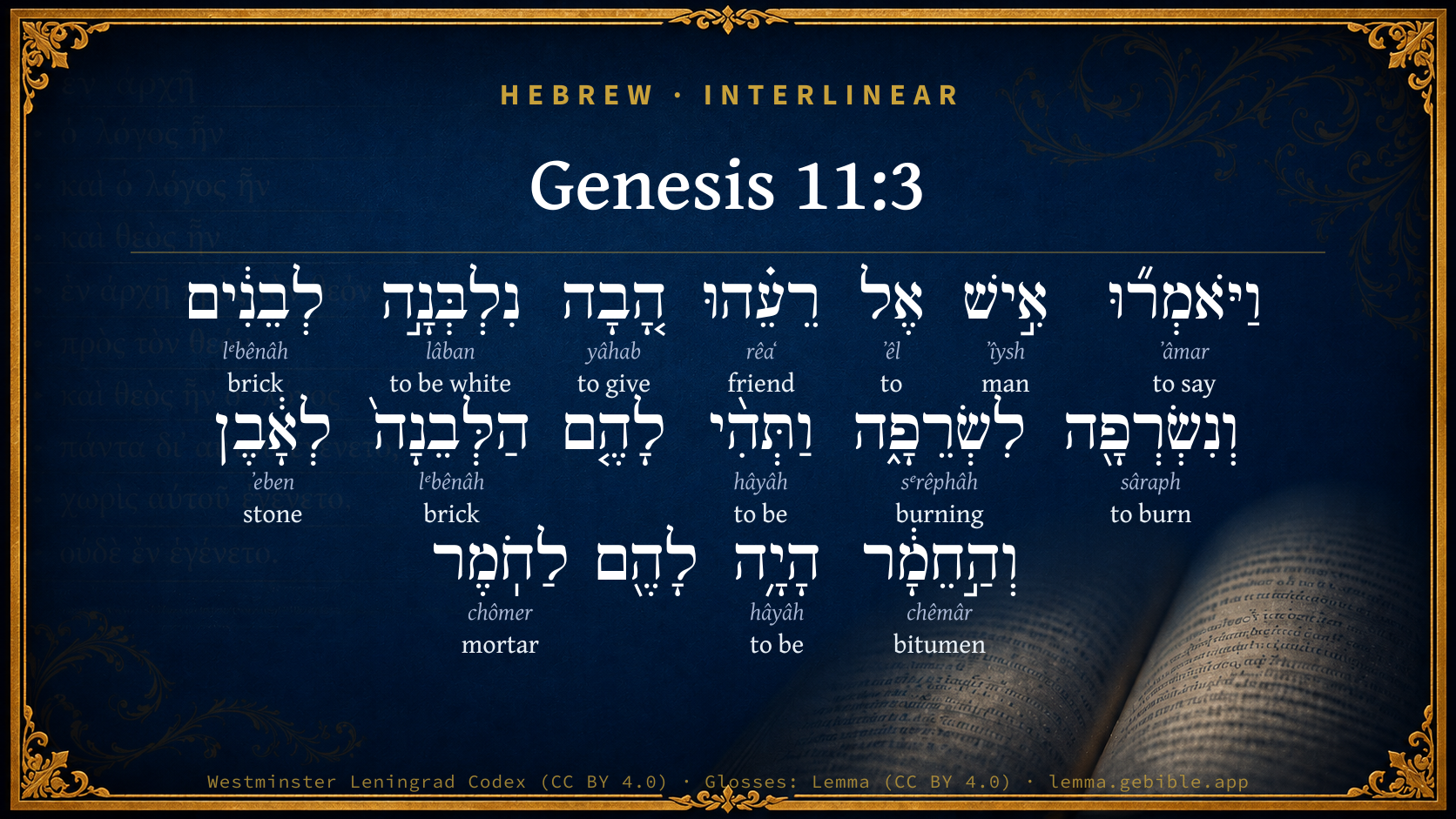
Hebrew (Westminster Leningrad Codex) Genesis 11:3 appears in the Hebrew Old Testament. The text above is from the Westminster Leningrad Codex. Each word links to its Strong’s number, a concise gloss, and parsing drawn from the Open Scriptures Hebrew Bible morphology. Click any word for its full Brown-Driver-Briggs (BDB) entry.
Download image
Cite this verse

Genesis 11:3 (World English Bible). Public Domain. Lemma interlinear Bible study tool, https://lemma.gebible.app/v/genesis/11/3.

Show BibTeX & RIS
BibTeX
RIS
English Translation
They said one to another, "Come, let's make brick, and burn them thoroughly." They had brick for stone, and they used tar for mortar.
World English Bible · Public Domain
Highlights
  • 8 first appearances in the Hebrew Bible
Full analysis ↓
Download a study sheet

One document with this verse’s original text, its word-by-word gloss line, the meaning frame, cross-references with their text, attributed commentary, and full source and license credits — printable, and it pastes into notes with its structure intact.

This verse Autodidact and up

Study sheet (.html) Plain text (.txt)

A passage Seminary Student

Up to 50 verses in one chapter. A passage sheet keeps up to 6 commentary sources and 12 cross-references per verse, in the order this page ranks them, and says so on the sheet whenever that leaves anything out. Ask for a single verse and you get the Autodidact verse sheet above.

Everything on this page stays free to read, with no account — the sheet is a download of what is already on screen, not access to it.

Want to remove ads? Support Godless Engineer
Compare translations 3

The same verse in 3 English versions, stacked beneath the original-language interlinear above. Click any original word for its lexicon entry.

Each is an independent rendering of the whole verse — the interlinear is not word-aligned to these translations.

Highlighted words mark where these versions differ — a whole-verse word diff, not a word-by-word alignment.

  • World English Bible Public Domain
    They said one to another, "Come, let's make brick, and burn them thoroughly." They had brick for stone, and they used tar for mortar.
  • King James Version Public Domain
    And they said one to another, Go to, let us make brick, and burn them thoroughly. And they had brick for stone, and slime had they for mortar.
  • unfoldingWord Literal Text CC BY-SA 4.0
    Then they said to each other, “Come, let us make bricks and bake them with fire.” And they had bricks for stones, and they had tar for mortar.

unfoldingWord Literal Text — © unfoldingWord, licensed CC BY-SA 4.0. Word-aligned USFM3 via Door43 (git.door43.org/unfoldingWord/en_ult).

Versions to compare (up to 4)

3 of 4 selected

Show all 18 translations

Every available English version of this verse, each an independent rendering of the whole verse.

  • World English Bible Public Domain
    They said one to another, "Come, let's make brick, and burn them thoroughly." They had brick for stone, and they used tar for mortar.
  • Berean Standard Bible Public Domain
    And they said to one another, “Come, let us make bricks and bake them thoroughly.” So they used brick instead of stone, and tar instead of mortar.
  • Majority Standard Bible Public Domain
    And they said to one another, “Come, let us make bricks and bake them thoroughly.” So they used brick instead of stone, and tar instead of mortar.
  • King James Version Public Domain
    And they said one to another, Go to, let us make brick, and burn them thoroughly. And they had brick for stone, and slime had they for mortar.
  • American Standard Version (1901) Public Domain
    And they said one to another, Come, let us make brick, and burn them thoroughly. And they had brick for stone, and slime had they for mortar.
  • Revised Version (1885) Public Domain
    And they said one to another, Go to, let us make brick, and burn them throughly. And they had brick for stone, and slime had they for mortar.
  • Geneva Bible (1599) Public Domain
    And they said one to another, Come, let vs make bricke, and burne it in the fire. So they had bricke for stone, and slime had they in steade of morter.
  • Douay-Rheims (1899) Public Domain
    And each one said to his neighbour: Come, let us make brick, and bake them of stones, and slime instead of mortar.
  • Young's Literal Translation Public Domain
    and they say each one to his neighbour, `Give help, let us make bricks, and burn `them' thoroughly:' and the brick is to them for stone, and the bitumen hath been to them for mortar.
  • Literal Standard Version CC BY-SA 4.0
    and they each say to his neighbor, “Give help, let us make bricks, and burn [them] thoroughly”: and the brick is to them for stone, and the bitumen has been to them for mortar.
  • Unlocked Literal Bible CC BY-SA 4.0
    They said to one another, “Come, let us make bricks and bake them thoroughly.” They had brick instead of stone and tar as mortar.
  • unfoldingWord Literal Text CC BY-SA 4.0
    Then they said to each other, “Come, let us make bricks and bake them with fire.” And they had bricks for stones, and they had tar for mortar.
  • Darby Bible Public Domain
    And they said one to another, Come on, let us make bricks, and burn [them] thoroughly. And they had brick for stone, and they had asphalt for mortar.
  • World Messianic Bible Public Domain
    They said to one another, “Come, let’s make bricks, and burn them thoroughly.” They had brick for stone, and they used tar for mortar.
  • Webster's Bible Public Domain
    And they said one to another, come, let us make brick, and burn them thoroughly. And they had brick for stone, and slime had they for mortar.
  • Free Bible Version CC BY-SA 4.0
    They said to one another, “Come on, let's make some bricks and bake them with fire.” (They used brick instead of stone, and tar instead of cement).
  • Bible in Basic English Public Domain
    And they said one to another, Come, let us make bricks, burning them well. And they had bricks for stone, putting them together with sticky earth.
  • JPS Tanakh (1917) Public Domain
    And they said one to another: 'Come, let us make brick, and burn them thoroughly.' And they had brick for stone, and slime had they for mortar.

Literal Standard Version (2020), Covenant Press — licensed CC BY-SA 4.0. Text via the HelloAO Bible API (eBible.org). Unlocked Literal Bible (unfoldingWord) — licensed CC BY-SA 4.0. Text via the HelloAO Bible API (eBible.org). unfoldingWord Literal Text — © unfoldingWord, licensed CC BY-SA 4.0. Word-aligned USFM3 via Door43 (git.door43.org/unfoldingWord/en_ult). Free Bible Version, Dr. Jonathan Gallagher — licensed CC BY-SA 4.0. Text via the HelloAO Bible API (eBible.org).

Word by word

More ways to search: Search by grammar → Find every occurrence → Compare this word →

Practice this passage: Drill this verse → Learn its vocabulary →

וְהַ֣חֵמָ֔ר
chêmâr
H2564
“and · the · bitumen”
Conjunction + Particle, Definite Article + Noun, Common, Masculine, Singular, Absolute
Part of Speech
Conjunction + Particle + Noun
Type
Common
Gender
Masculine
Number
Singular
State
Absolute
Full BDB Definition

Origin: from H2560

TWOT: TWOT- 683b

slime, pitch, asphalt, bitumen
  1. וַיֹּאמְר֞וּ ʼâmar H559 “and · to say” Conjunction + Verb, Qal, Sequential Imperfect, 3rd Person, Masculine, Plural
  2. אִ֣ישׁ ʼîysh H376 “man” Noun, Common, Masculine, Singular, Absolute
  3. אֶל ʼêl H413 “to” Preposition
  4. רֵעֵ֗הוּ rêaʻ H7453 “friend · his” Noun, Common, Masculine, Singular, Construct + Suffix, Personal, 3rd Person, Masculine, Singular
  5. הָ֚בָה yâhab H3051 “give” Verb, Qal, Imperative, 2nd Person, Masculine, Singular + Suffix, h
  6. נִלְבְּנָ֣ה lâban H3835 “to be white” Verb, Qal, Cohortative, 1st Person, Common, Plural
  7. לְבֵנִ֔ים lᵉbênâh H3843 “bricks” Noun, Common, Feminine, Plural, Absolute
  8. וְנִשְׂרְפָ֖ה sâraph H8313 “and · to burn” Conjunction + Verb, Qal, Cohortative, 1st Person, Common, Plural
  9. לִשְׂרֵפָ֑ה sᵉrêphâh H8316 “to/for · burning” Preposition + Noun, Common, Feminine, Singular, Absolute
  10. וַתְּהִ֨י hâyâh H1961 “and · to be” Conjunction + Verb, Qal, Sequential Imperfect, 3rd Person, Feminine, Singular
  11. הַלְּבֵנָה֙ lᵉbênâh H3843 “the · brick” Particle, Definite Article + Noun, Common, Feminine, Singular, Absolute
  12. לְאָ֔בֶן ʼeben H68 “to/for · stone” Preposition + Noun, Common, Feminine, Singular, Absolute
  13. הָיָ֥ה hâyâh H1961 “to be” Verb, Qal, Perfect, 3rd Person, Masculine, Singular
  14. לַחֹֽמֶר chômer H2563 “to/for the · mortar” Preposition, Determined + Noun, Common, Masculine, Singular, Absolute

About this verse

These counts appear in no published source. They are computed here, from the morphology-tagged text and Lemma’s own curated glosses. What Lemma adds →

17
words
13
distinct lemmas
Pentateuch
section

Notable vocabulary

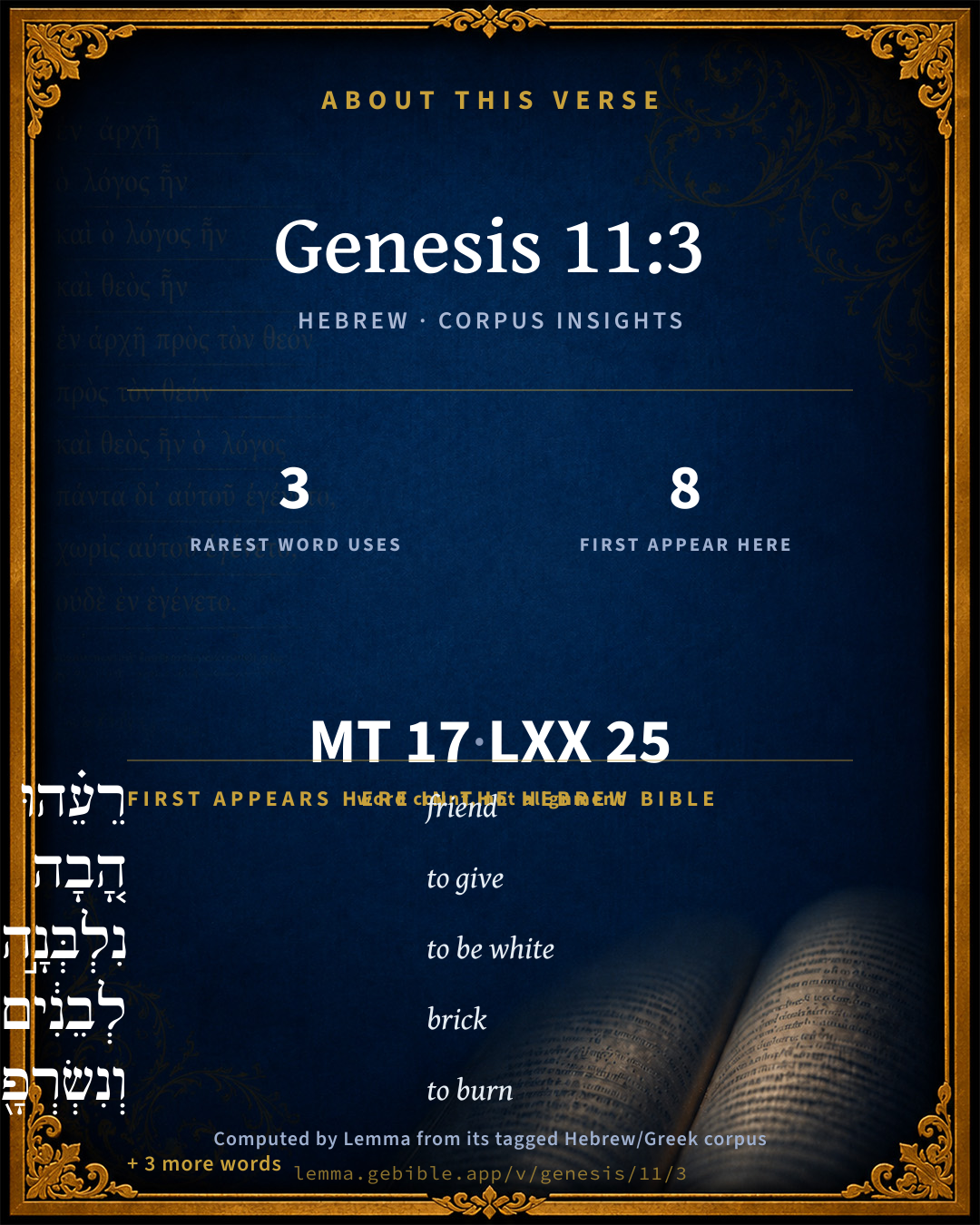
The rarest word here is וְהַ֣חֵמָ֔ר bitumen H2564 — appearing just 3 times in the whole Hebrew Bible.

First appearance in Scripture

These words make their first canonical appearance in the Hebrew Bible here:

  • רֵעֵ֗הוּ friend H7453
  • הָ֚בָה to give H3051
  • נִלְבְּנָ֣ה to be white H3835
  • לְבֵנִ֔ים brick H3843
  • וְנִשְׂרְפָ֖ה to burn H8313
  • לִשְׂרֵפָ֑ה burning H8316
  • וְהַ֣חֵמָ֔ר bitumen H2564
  • לַחֹֽמֶר mortar H2563

Shared distinctive vocabulary

וְהַ֣חֵמָ֔ר bitumen H2564 occurs in 3 verses of the Hebrew Bible. Also found in:

Grammatical profile

  • 6 verbs
  • 8 nouns
  • 3 prepositions

Verb forms

  • וַיֹּאמְר֞וּ Qal · Sequential Imperfect
  • הָ֚בָה Qal · Imperative
  • נִלְבְּנָ֣ה Qal · Cohortative
  • וְנִשְׂרְפָ֖ה Qal · Cohortative
  • וַתְּהִ֨י Qal · Sequential Imperfect
  • הָיָ֥ה Qal · Perfect

Repetition

Words recur within this verse — often emphatic in Hebrew:

  • לְבֵנִ֔ים brick H3843 ×2
  • וַתְּהִ֨י to be H1961 ×2

Hebrew & Septuagint length

In English translation the verse runs 24 words from the Hebrew and 30 from the Septuagint (LXX English) — closely comparable.

A rough comparison of the two English renderings, which tokenize alike — not a word-level alignment.

Word counts can differ between the Hebrew and the Greek without any difference in meaning — e.g. the Hebrew direct-object marker אֵת has no separate Greek word, and Greek often adds the article ὁ.

In the original languages it is 17 Hebrew tokens and 25 Greek tokens — but the two are counted differently (Hebrew bundles its prefixes and suffixes into one token; the Greek is in lemma form), so that isn’t a like-for-like length.

Cross-references

19

Topical passages linked to Genesis 11:3 in the Treasury of Scripture Knowledge — connected by theme and wording, ordered by reader-vote popularity; previews shown in the World English Bible.

  • Genesis 14:10 Now the valley of Siddim was full of tar pits; and the kings of Sodom and Gomorrah fled, and they fell there, and those who remained fled to the mountain.
  • Exodus 1:14 and they made their lives bitter with hard service, in mortar and in brick, and in all manner of service in the field, all their service, in which they ruthlessly made them serve.
  • Exodus 2:3 When she could no longer hide him, she took a papyrus basket for him, and coated it with tar and with pitch. She put the child in it, and laid it in the reeds by the river's bank.
  • Hebrews 10:24 Let us consider how to provoke one another to love and good works,
  • James 5:1 Come now, you rich, weep and howl for your miseries that are coming on you.
  • 2 Samuel 12:31 He brought forth the people who were therein, and put them under saws, and under harrows of iron, and under axes of iron, and made them pass through the brick kiln: and thus did he to all the cities of the children of Ammon. David and all the people returned to Jerusalem.
  • Isaiah 9:10 The bricks are fallen, but we will build with hewn stone; the sycamores are cut down, but we will put cedars in their place.
  • Isaiah 41:6–7 They help everyone his neighbor; and [every one] says to his brother, Be of good courage.
  • Hebrews 3:13 but exhort one another day by day, so long as it is called "today;" lest any one of you be hardened by the deceitfulness of sin.
  • Genesis 11:4 They said, "Come, let's build us a city, and a tower, whose top reaches to the sky, and let's make us a name; lest we be scattered abroad on the surface of the whole earth."
  • Genesis 11:7 Come, let's go down, and there confuse their language, that they may not understand one another's speech."
  • Exodus 5:7–18 "You shall no longer give the people straw to make brick, as before. Let them go and gather straw for themselves.
  • Psalms 64:5 They encourage themselves in evil plans. They talk about laying snares secretly. They say, "Who will see them?"
  • Proverbs 1:11 If they say, "Come with us, Let's lay in wait for blood; Let's lurk secretly for the innocent without cause;
  • Ecclesiastes 2:1 I said in my heart, "Come now, I will test you with mirth: therefore enjoy pleasure;" and, behold, this also was vanity.
  • Isaiah 5:5 Now I will tell you what I will do to my vineyard. I will take away its hedge, and it will be eaten up. I will break down its wall of it, and it will be trampled down.
  • Isaiah 65:3 a people who provoke me to my face continually, sacrificing in gardens, and burning incense on bricks;
  • Nahum 3:14 Draw water for the siege. Strengthen your fortresses. Go into the clay, and tread the mortar. Make the brick kiln strong.
  • James 4:13 Come now, you who say, "Today or tomorrow let's go into this city, and spend a year there, trade, and make a profit."

Cross-references courtesy of OpenBible.info (CC BY 4.0).

Hebrew and Greek witnesses Masoretic Hebrew ↔ Greek Septuagint

The same verse in the two great witnesses to the Old Testament, shown verse-for-verse.

These are two independent witnesses, not word-aligned to each other, and the Septuagint is shown in lemma (dictionary) form.

Hebrew Genesis 11:3 Masoretic · Westminster Leningrad Codex

וַיֹּאמְר֞וּ אִ֣ישׁ אֶל רֵעֵ֗הוּ הָ֚בָה נִלְבְּנָ֣ה לְבֵנִ֔ים וְנִשְׂרְפָ֖ה לִשְׂרֵפָ֑ה וַתְּהִ֨י לָהֶ֤ם הַלְּבֵנָה֙ לְאָ֔בֶן וְהַ֣חֵמָ֔ר הָיָ֥ה לָהֶ֖ם לַחֹֽמֶר

They said one to another, "Come, let's make brick, and burn them thoroughly." They had brick for stone, and they used tar for mortar.

World English Bible · Public Domain

Greek LXX Genesis 11:3 Septuagint · lemma form

καί εἶπον ἄνθρωπος ὁ πλησίον δεῦτε πλινθεύω πλίνθος καί ὀπτάω αὐτός πῦρ καί γίγνομαι αὐτός ὁ πλίνθος εἰς λίθος καί ἄσφαλτος εἰμί αὐτός ὁ πηλός

And a man said to his neighbor, Come, let us make bricks and bake them with fire. And the brick was to them for stone, and their mortar was bitumen.

LXX2012 (modern English Septuagint) · Public Domain

On this verse, Adam Clarke's Commentary discusses the Septuagint’s reading. Read the note in Commentary ↓

Hebrew: Westminster Leningrad Codex (CC BY 4.0). Greek: Septuagint (public domain); English from LXX2012 (modern English Septuagint) (Public Domain). How the Septuagint differs from the Hebrew →

Targum (Aramaic paraphrase)

2

The Targum is the ancient Jewish Aramaic paraphrase of the Hebrew Scriptures — an interpretive translation, not the Hebrew text itself. Onkelos (literal) and Pseudo-Jonathan (expansive) render the Torah, and Jonathan the Prophets. Coverage is partial: where no permissively-licensed English translation exists for a verse, only the Aramaic is shown. This is verse-level text, not a word-by-word alignment to the Hebrew.

  1. Targum Onkelos Torah (Genesis–Deuteronomy)
    וַאֲמָרוּ גְּבַר לְחַבְרֵהּ הָבוּ נִרְמֵי לִבְנִין וְנוֹקְדִינוּן בְּנוּרָא יוֹקַדְתָּא (נ''י בְּנוּרָא) וַהֲוַת לְהוֹן לְבִנְתָּא לְאַבְנָא וְחֵימָרָא הֲוָה לְהוֹן לְשִׁיעַ

    And they said, a man to his companion, Come, let us cast bricks and bake them in the fire. And they had brick for stone, and bitumen for mortar.

    Targum Onkelos — Aramaic: “Onkelos Genesis” (public domain); “Onkelos Exodus” (public domain); “Onkelos Leviticus” (public domain); “Onkelos Numbers” (public domain); “Onkelos Deuteronomy” (public domain). English: “Sefaria Community Translation” (CC0 1.0 (public-domain dedication)); “J.W. Etheridge. The Targums of Onkelos and Jonathan Ben Uzziel on the Pentateuch. London: Longmans, Green, 1862” (public domain). Text via Sefaria.

  2. Targum Pseudo-Jonathan Torah (Genesis–Deuteronomy)
    וַאֲמָרוּ גְבַר לְחַבְרֵיהּ הָבוּ נִרְמֵי לִיבְנִין וְנִשְׁוֵי יַתְהוֹן בְּאַתּוּנָא וַהֲוָה לְהוֹן לְבִינְתָּא לְאַבְנָא וְטִינָא הֲוַות לְהוֹם לְשִׁיעַ

    And they said, a man to his fellow, Come, we will cast bricks, and put them in the furnace. And they had brick for stone, and slime for cement.

    Targum Pseudo-Jonathan — Aramaic: “Targum Jonathan on Genesis” (public domain); “Targum Jonathan on Exodus” (public domain); “Targum Jonathan on Leviticus” (public domain); “Targum Jonathan on Numbers” (public domain); “Targum Jonathan on Deuteronomy” (public domain). English: “The Targum of Jonathan ben Uzziel, trans. J. W. Etheridge, London, 1862” (public domain). Text via Sefaria.

Commentary

Notes on Genesis 11:3 from classic Christian and Jewish commentators (each source and its license shown beneath its notes). The classic Christian expositions comment on the surrounding passage and are grouped to its opening verse, so a note may address several verses; the Jewish commentaries on the Tanakh (Rashi and others) are per-verse, so they appear only where the commentator wrote on this verse.

Lemma curates 59 commentaries, every one of them public domain or Creative Commons licensed, each selected and text-cleaned for this edition rather than reprinted as found. About our sources →

Trapp's Complete Commentary

John Trapp

Gen 11:3 And they said one to another, Go to, let us make brick, and burn them throughly. And they had brick for stone, and slime had they for morter.

Ver. 3. And they said one to another.] One broached this counsel, and the rest soon consented. Let us consider one another to whet on to love and good works. {Heb 10:24} One live coal may set a whole stack on fire. When Silas came, Paul "burned in spirit," {Act 18:5} {a} and preached lustily.

Let us make brick, &c.] Thus, wanting stones, they devised matter for their cursed building. {b} Good cause hath the Church to be as ingenious and sedulous in building staircases for heaven, as the devil and his imps in digging descents to hell.

And they had brick for stone, and slime for mortar.] And yet though the walls were high and huge, this city was taken first by Cyrus, afterwards by Alexander, and plundered at several times by many other enemies. Shusa in Persia was first built by Tithonus and his son Memnon, who was so exceeding prodigal, that, as Cassiodorus writes, he joined the stones together with gold; so rich it was that Aristagoras thus cheered up his soldiers that besieged it. This city if you can take, you may vie with Jove himself for wealth and riches. {c} Here Alexander found 50,000 talents of gold, besides silver. But what is all this to the heavenly Jerusalem, whose pavement is pure gold, and her walls garnished with all precious stones? {Rev 21:19} Why do we then labour in the fire, to "load ourselves with thick clay"? {Hab 2:6} Why doth not this "kingdom of heaven suffer violence by us, sith the violent take it by force," {Mat 11:12} or make a prey, a prize of it (so Hilany {d} rendereth it) as soldiers do of a city they have taken? Oh that we could say of heaven, as Sextus Ruffus doth of Cyprus, Cyprus famosa divitiis paupertatem populi Rom. ut occuparetur sollicitavit ! This island was anciently called Macaria: Heaven more truly.

{a} συνειχετο. Intus et apud se aestuabat praezeli ardore .

{b} Apud Babylone Traianus Imp. vidit lacum bituminis, ex quo moenia Babylonis aedificata fuerant, cuius tanta vis est, ut permixtum cum lateribus, quovis saxo sit aut ferro potentius . - Dio in Vita Trajan.

{c} Iam cum Iove de divitiis licet certetis . - Cassiod., lib. vii.; Var., epist. xv.

{d} Diripiunt metaph. a castris aut arce quapiam, quae irrumpentibus hostibus diripitur . - Hilar.

John Trapp, A Commentary or Exposition upon All the Books of the Old and New Testament (1647–1656) — public domain. Text from a community e-Sword module.

Joseph Benson's Commentary

Gen 11:3-4. Let us make brick, let us build a city — The country, being a plain, yielded neither stone nor mortar; yet this did not discourage them; but they made brick to serve instead of stone, and slime instead of mortar; a kind of clay or pitch called bitumen, which, as Pliny testifies, is liquid and glutinous, and fit to be used in brick buildings, as Strabo, Dion, and others observe. And that Babylon was built with this and with brick, as is here said, we have the joint testimony of Berosus, Etesius, Dion, Curtius, and many others. It has been thought that they intended hereby to secure themselves against the waters of another flood; but if they had, they would have chosen to build upon a mountain rather than upon a plain. But two things, it seems, they aimed at in building. 1st, To make them a name — A great name; out of pride and vain glory to erect a monument that should remain to all posterity: and, 2d, To prevent their dispersion; lest we be scattered abroad upon the face of the earth — It was done (saith Josephus) in disobedience to that command, Gen 9:1, Replenish the earth — That they might be united in one glorious empire, they resolve to build this city and tower, to be the metropolis of their kingdom, and the centre of their unity.

Joseph Benson's Commentary on the Old and New Testaments (1811–1818) — public domain. Text from a community e-Sword module.

Tyndale Open Study Notes

Tyndale Open Resources

11:3 Stone was plentiful in Canaan; in Mesopotamia, stone was scarce and brick technology was developed. • Tar was made from bitumen, a natural, cement-like, waterproof asphalt (see 6:14; Exod 2:3).

Tyndale Open Study Notes — © Tyndale Open Resources, licensed CC BY-SA 4.0. Text via the HelloAO Bible API.

Jamieson, Fausset & Brown

Robert Jamieson, A. R. Fausset & David Brown

brick--There being no stone in that quarter, brick is, and was, the only material used for building, as appears in the mass of ruins which at the Birs Nimroud may have been the very town formed by those ancient rebels. Some of these are sun-dried--others burnt in the kiln and of different colors.

slime--bitumen, a mineral pitch, which, when hardened, forms a strong cement, commonly used in Assyria to this day, and forming the mortar found on the burnt brick remains of antiquity.

Jamieson, Fausset & Brown — Commentary Critical and Explanatory on the Whole Bible (1871) — public domain (CC PDM 1.0). Text via the HelloAO Bible API.

Adam Clarke's Commentary

Verse 3. Let us make brick] It appears they were obliged to make use of brick, as there was an utter scarcity of stones in that district; and on the same account they were obliged to use slime, that is, bitumen, (Vulg.) ασφαλτος, (Septuagint) for mortar: so it appears they had neither common stone nor lime-stone; hence they had brick for stone, and asphaltus or bitumen instead of mortar.

Adam Clarke's Commentary on the Bible (1810–1826) — public domain. Text from a community e-Sword/MySword module.

John Calvin's Commentaries

3. And they said one to another That is, they mutually exhorted each other; and not only did every man earnestly put his own hand to the work, but impelled others also to the daring attempt.

Let us make brick. Moses intimates that they had not been induced to commence this work, on account of the ease with which it could be accomplished nor on account of any other advantages which presented themselves; he rather shows that they had contended with great and arduous difficulties; by which means their guilt became the more aggravated. For how is it that they harass and wear themselves out in vain on a difficult and labourious enterprise, unless that, like madmen, they rush impetuously against God? Difficulty often deters us from necessary works; but these men, when they had neither stones nor mortar, yet do not scruple to attempt the raising of an edifice which may transcend the clouds. We are taught therefore, by this example, to what length the lust of men will hurry them, when they indulge their ambition. Even a profane poet is not silent on this subject, —

“Man, rashly daring, full of pride, Most covets what is most denied.” And a little afterwards, — “Counts nothing arduous, and tries Insanely to possess the skies.”

John Calvin's Commentaries (1540-1563) — public domain. Text from the Calvin Translation Society English edition (1840s-50s) via the Christian Classics Ethereal Library (ccel.org). Calvin's coverage is partial (roughly two-thirds of the Bible); uncommented books and verses are honest gaps, never fabricated. The 19th-century editor's footnotes and remarks are omitted so the notes are faithfully Calvin's own voice.

Ellicott's Commentary for English Readers

(3) Let us make brick, and burn them throughly.—Heb., for a burning. Bricks in the East usually are simply dried in the sun, and this produces a sufficiently durable building material. It marks a great progress in the arts of civilisation that these nomads had learned that clay when burnt becomes insoluble; and their buildings with “slime,” or native pitch, for cement would be virtually indestructible. In fact, Mr. Layard says that at Birs-Nimroud it was scarcely possible to detach the bricks one from another, as the cement by which they were united was most tenacious (Nineveh and Babylon, p. 499).

A Bible Commentary for English Readers, edited by Charles John Ellicott (1878–1897) — public domain. Text from a community e-Sword module.

The Cambridge Bible for Schools and Colleges

gen. ed. J. J. S. Perowne

3. brick for stone, &c.] For a description of building with bricks held together with bitumen in Babylonia, see Herodotus, i. 179. The writer here is evidently more familiar with building in stone and mortar than in brick and bitumen: another indication that the story is Israelite in origin.

slime] That is, bitumen, LXX ἄσφαλτος, Lat. bitumen. The Hebrew word ḥêmar is found here and in Gen_14:10, Exo_2:3. The word for bitumen or pitch used in Gen_6:14 (kopher) resembles the Assyrian; and the fact that it is not used here tells for the Israelite character of the story.

The Cambridge Bible for Schools and Colleges (gen. ed. J. J. S. Perowne; Cambridge University Press, 1878–1918) — public domain. Text from a community e-Sword module.

John Gill's Exposition

And they said one to another, go to,.... Advising, exhorting, stirring up, and encouraging one another to the work proposed, of building a city and tower for their habitation and protection; saying:

let us make brick, and burn them thoroughly; they knew the nature of bricks, and how to make them before: according to Sanchoniatho (h), the brothers of Vulcan, or Tubalcain, before the flood, were the first inventors of them; for he relates, that"there are some that say that his brothers invented the way of making walls of bricks: he adds, that from the generation of Vulcan came two brothers, who invented the way of mixing straw or stubble with brick clay, and to dry them by the sun, and so found out tiling of houses.''Now in the plain of Shinar, though it afforded no stones, yet they could dig clay enough to make bricks, and which they proposed to burn thoroughly, that they might be fit for their purpose. According to an eastern tradition (i), they were three years employed in making and burning those bricks, each of which was thirteen cubits long, ten broad, and five thick, and were forty years in building:

and they had brick for stone, and slime had they for mortar: they could not get stone, which they would have chosen, as more durable; they got the best bricks they could make, and instead of mortar they used slime; or what the Septuagint version calls "asphaltos", a bitumen, or kind of pitch, of which there was great plenty in that neighbourhood. Herodotus (k) speaking of the building of Babylon, uses language very much like the Scripture;"digging a foss or ditch (says he), the earth which was cast up they formed into bricks, and drawing large ones, they burnt them in furnaces, using for lime or mortar hot asphaltos or bitumen.''And he observes, that"Eight days journey from Babylon was another city, called Is, where was a small river of the same name, which ran into the river Euphrates, and with its water were carried many lumps of bitumen, and from hence it was conveyed to the walls of Babylon.''This city is now called Ait, of which a traveller (l) of the last century gives the following account;"from the ruins of old Babylon we came to a town called Ait, inhabited only with Arabians, but very ruinous; near unto which town is a valley of pitch, very marvellous to behold, and a thing almost incredible wherein are many springs throwing out abundantly a kind of black substance, like unto tar and pitch, which serveth all the countries thereabout to make staunch their barks and boats; everyone of which springs makes a noise like a smith's forge, which never ceaseth night nor day, and the noise is heard a mile off, swallowing up all weighty things that come upon it; the Moors call it "the mouth of hell."''Curtius relates (m), that Alexander, in his march to Babylon, came to a city called Mennis, where was a cavern, from whence a fountain threw out a vast quantity of bitumen or pitch; so that, says he, it is plain, that the huge walls of Babylon were daubed with the bitumen of this fountain; and he afterwards speaks of the walls, towers, and houses, being built of brick, and cemented with it; and so Diodorus Siculus says (n) from Ctesias, that the walls of Babylon were built of bricks, cemented with bitumen; and not only these, but all Heathen authors that write of Babylon, confirm this; and not only historians, but poets, of which Bochart (o) has made a large collection; as well as Josephus (p) speaks of it, and this sort of pitch still remains. Rauwolff says (q) near the bridge over the Euphrates, where Babylon stood, are several heaps of Babylonian pitch, which is in some places grown so hard, that you may walk over it; but in others, that which hath been lately brought over thither is so soft, that you may see every step you make in it.

(h) Apud Euseb. Evangel. Praepar. l. 1. p. 35. (i) Elmacinus, p. 14. apud Hottinger. Smegma, p. 263, 264. (k) Clio sive, l. 1. c. 179. (l) Cartwright's Preacher's Travels, p. 105, 106. (m) Hist. l. 5. c. 1. (n) Bibliothec l. 2. p. 96. (o) Phaleg. l. 1. c. 11. (p) Antiqu. l. 1. c. 4. sect. 3. (q) Travels, par. 2. ch. 7. p. 138.

John Gill's Exposition of the Whole Bible (1746–1763) — public domain (CC PDM 1.0). Text via the HelloAO Bible API.

Haydock's Catholic Bible Commentary

Each one: not that every individual joined in this undertaking, considered, at least, as a rash and presumptuous attempt to save themselves from a second deluge. Some might innocently give in to it, meaning only to leave a monument to their common origin and friendship, before they separated into distant countries. Slime: literally bitumen. (Haydock) --- The Hebrew, chomer, means also slime, or mortar. Stone is very scarce in that country, but the earth is fat, and very proper to make brick; it also abounds in naphtha, bitumen, &c.: hence the ancients notice the brick walls of Babylon. (Calmet)

George Leo Haydock (1774–1849), Haydock's Catholic Family Bible and Commentary, 1859 edition — public domain. Excludes Psalms (Douay-Rheims chapter numbering differs from Protestant) and Deuterocanonical books (Catholic canon only).

Matthew Poole's English Annotations

Let us make brick, for in that low and fat soil they had no quarries of stones. The heathen writers agree that Babylon’s walls were made of brick.

The slime was a kind of clay called bitumen, which, as Pliny testifieth, is liquid and glutinous, and fit to be used in brick buildings, as Strabo, Dion, and others note. And that Babylon was built with this, as is here said, we have the joint and express testimony of Berosus, Ctesias, Dion, Curtius, and many others.

Matthew Poole's English Annotations on the Holy Bible (1683–1685) — public domain. Text from a community e-Sword/MySword module.

Whedon's Commentary on the Bible

Daniel D. Whedon

3. Said one to another — Hebrews, each man to his neighbour.

Go to — An obsolete English expression, equivalent to come on.

Burn them thoroughly — In distinction from the sun-dried bricks, so common in Babylonia, which yet are very hard and durable.

They had brick for stone — Stone being the building material with which the Hebrews were chiefly familiar in Egypt.

Slime — Bitumen; mineral pitch or asphalt. Although the Babylonian plain has no quarries in or near it, yet, being largely composed of fine sand and clay, it furnishes ample material for the most beautiful and durable bricks. All the splendid edifices of Babylon were built of burnt or sun-dried brick. The plain also abounds in bitumen; called naphtha, when it appears as a thin yellow fluid; petroleum, when thicker and darker; and asphaltum when solid. This substance furnishes an imperishable cement. It was used by Noah in the construction of the ark; by the mother of Moses in the manufacture of her little papyrus boat; by the Egyptians in fastening the cerements of mummies; and is now used by the natives of ancient Shinar in making the ferry boats of the Tigris, which are simply round baskets, daubed with bitumen. The asphalt springs of Is, or Hit, a small stream flowing into the Euphrates, are mentioned by Herodotus, and are thus quaintly described by an old traveller: “Near unto which town (Hit on the river Hit) is a valley of pitch, very marvellous to behold, and a thing almost incredible, wherein are many springs throwing out abundantly a kind of black substance like unto tar, or pitch, which serveth all the countries thereabouts to make staunch their barks and boats, every one of which springs maketh a noise like a smith’s forge, in puffing and blowing out the matter, which never ceaseth, night or day, and the noise is heard a mile off, swallowing up all weighty things that come upon it. The Moors call it the mouth of hell.” — Quoted in Rawlinson’s Herodotus, 1:316.

Daniel D. Whedon (gen. ed.), Commentary on the Old and New Testaments (1874–1909) — public domain. Text from a community e-Sword module.

The Pulpit Commentary

And they said one to another. Literally, a man to his neighbor; anqrwpov tw plhsion aujtou (LXX). Go to. A hortatory expletive come on (Anglice). Let us make brick. Nilbenah lebenim; literally, let us brick bricks; plinqeuswmen plinqouv (LXX); laterifecimus lateres (Calvin); lebenah (from laban, to be white), being so called from the white and chalky day of which bricks were made. And burn them thoroughly. Literally, burn them to a burning; venisrephah lisrephah, a second alliteration, which, however, the LXX fails to reproduce. Bricks were usually sun-dried; these, being designed to be more durable, were to be calcined through the agency of fire, a proof that the tower-builders were acquainted with the art of brick-making. And they had literally, and there was to themebrick for stone. Chiefly because of the necessities of the place, the alluvial plain of Babylon being void of stones and full of clay; a proof of the greatness of their crime, seeing they were induced to undertake the work non facilitate operis, nec aliis commodis, quae se ad manum offerrent (Calvin); scarcely because bricks would better endure fire than would stones, the second destruction of the world by fire rather than water being by this time a common expectation (Com a Lapide). Josephus, "Ant., lib. 1. cp. 4; Heroin, lib. 1. cp. 179; Justin, lib. 1. cp. 2; Ovid, " Metam.," 4:4; and Aristoph. in Avibus (periteucizein megalaiv plinqoiv ojptaiv wsper Babulwna), all attest that the walls of Babylon were built of brick. The mention of the circumstance that brick was used instead of stone "indicates a writer belonging to a country and an age in which stone buildings were familiar, and therefore not to Babylonia" (Murphy). And slime. Chemer, from chamar, to boil up; asfaltov (LXX); the bitumen which boils up from subterranean fountains like oil or hot pitch in the vicinity of Babylon, and also near the Dead Sea (lacus asphaltites). Tacitus, " Hist.," 5:6; Strabo, 1. p. 743; Herod., lib. h c. 179; Josephus, "Antiq.," lib. 1. c. 41 Pliny, lib. 2. 100. 15; Vitruvius, lib. 8. c. 3, are unanimous in declaring that the brick walls of Babylon were cemented with bitumen. Layard testifies that so firmly have the bricks been united that it is almost impossible to detach one from the mass ("Nineveh and Babylon," p. 499). Had they. Literally, was to them. For mortar. Chomer. The third instance of alliteration in the present verse; possibly designed by the writer to represent the enthusiasm of the builders.

Ancient brick makers.

I IN SHINAR. Examples of

(1) ingenuity,

(2) earnestness,

(3) perseverance,

(4) unity in sin.

II IN EGYPT. (Exo_5:7) Illustrations of

(1) the bondage,

(2) the degradation,

(3) the misery,

(4) hopelessness, of sin. W.

The Pulpit Commentary (1880–1919), ed. H.D.M. Spence-Jones & Joseph S. Exell — public domain. Text from a community e-Sword module.

John Wesley's Explanatory Notes

Go to, let us make brick, let us build us a city - The country being a plain, yielded neither stone nor morter, yet that did not discourage them, but they made brick to serve instead of stone, and slime, or pitch, instead of morter. Some think they intended hereby to secure themselves against the waters of another flood, but if they had, they would have chosen to build upon a mountain rather than upon a plain. But two things it seems they aimed at in building.

1. To make them a name: they would do something to be talked of by posterity. But they could not gain this point; for we do not find in any history the name of so much as one of these Babel - builders. Philo Judeus saith they engraved every one his name upon a brick; yet neither did that serve their purpose.

2. They did it to prevent their dispersion; lest we be scattered abroad upon the face of the earth - It was done (saith Josephus) in disobedience to that command, chap. ix, 1, replenish the earth. God orders them to scatter. No, say they, we will live and die together. In order hereunto they engage themselves and one another in this vast undertaking. That they might unite in one glorious empire, they resolve to build this city and tower, to be the metropolis of their kingdom, and the center of their unity.

John Wesley, Explanatory Notes Upon the Whole Bible (1754–1765) — public domain. Text via the GEBible commentary corpus.

unfoldingWord translationNotes

Door43 World Missions Community

Come

If your language has a way of urging or commanding people to begin work, like the English "Come on!" you might use it here.

bake them thoroughly

People make bricks out of clay and heat them in a very hot oven to make them hard and strong.

tar

a thick, sticky, black liquid that comes up from the ground

mortar

This is a thick substance made of lime powder, clay, sand, and water used to make stones or bricks stick together.

let us make a name for ourselves

"let us make our reputation great"

name

reputation

we will be scattered

This can be stated in active form. AT: "we will separate from each other and live in different places" (See: Active or Passive)

unfoldingWord translationNotes — © Distant Shores Media and the Door43 World Missions Community, licensed CC BY-SA 4.0. Source: git.door43.org/Door43/en_tn.

Rashi

Rabbi Shlomo Yitzchaki (Rashi)

איש אל רעהו ONE TO ANOTHER — One nation to the other: Mizraim to Cush, Cush to Put. and Put to Canaan (Genesis Rabbah 38:6).

הבה means, “Prepare yourselves”. Wherever the word הבה (come) occurs it has the meaning of “prepare”, meaning that they should get themselves ready and unite for some work or plan or burden (undertaking). “Come, get ready”: in old French appareiller; English to prepare.

לבנים BRICKS — For there is no stone in Babel which is a plain.

ונשרפה לשרפה AND BURN THEM THOROUGHLY — This is how bricks, which in old French are called Tuiles, English tiles, are made: they fire them in a furnace.

לחמר FOR MORTAR to plaster the walls.

Rashi on the Tanakh — English translations: “The Judaica Press complete Tanach with Rashi, translated by A. J. Rosenberg” (CC BY 4.0); “Pentateuch with Rashi's commentary by M. Rosenbaum and A.M. Silbermann, 1929-1934” (public domain); “The Metsudah Tanach series, Lakewood, N.J” (CC BY 4.0); and “The Book of Joshua, Metsudah Publications, 1997” (CC BY 4.0). Text via Sefaria.

Radak

Rabbi David Kimhi (Radak)

ויאמרו..הבה, this word הבה, is customarily used in connection with a plan forming. It describes more a firm suggestion than a definite order, command. This is one of the reasons this word is always found in the feminine mode, and followed by a plural mode.

נלבנה לבנים, the word נלבנה is a form of elaborating on something which had been said before, similar to Samuel II 12,16 ויצם דוד צום, “David fasted a fast.” If he fasted, he obviously observed a fast; the author wanted to lend extra emphasis to his words. So here too, the words נלבנה לבנים, though an obvious part of building a city, were repeated merely for emphasis. The words נשרפה לשרפה, inform us that the valley lacked stones for building houses, but that there was clay which could be kiln burned and produce rain proof bricks, making it possible to build permanent homes.

ותהי להם הלבנה לאבן, the zakef; tone sign has the vowel kametz underneath it instead of the vowel segol. We find a similar construction in Ruth 4,18 ואלה תולדות פרץ, where the letter פ (with the tone-sign zakef) has the vowel kametz, instead of the vowel segol. A third example with a similar construction occurs in Genesis 44,17 הוא יהיה לי עבד, where the kametz appears under the letter ע which has the tone-sign zakef establishing that the tone-sign zakef is a strong dividing tone-sign.

והחומר היה להם לחמר, the cheymor is the clay found in the earth of that region, and it was mixed into a dough with water. The product, after kiln drying the bricks formed by the dough, is called chomer. These bricks were used in lieu of stones that were not found in that valley.

Radak on the Tanakh — English translations: “Sefaria Community Translation” (CC0 1.0 (public-domain dedication)); “Eliyahu Munk, HaChut Hameshulash” (CC BY 4.0); “Rabbi Mike Feuer, Jerusalem Anthology” (CC BY 4.0); and “R. David Kimhi on the first book of Psalms, Translated by R.G. Finch, London, 1919” (public domain). Text via Sefaria.

Lesson kit

Teaching starters — assembled from the data on this page, not authored interpretation. Every prompt links to the verse data it draws on. Edit before teaching.

Genesis, in the Pentateuch, opens this verse with 17 words (13 distinct Hebrew lemmas). Its most distinctive word is chêmâr (“bitumen”). A historical commentator’s framing appears above. Read the whole chapter for the surrounding context.

Discussion questions

  1. What does “bitumen” (chêmâr) contribute to the verse as a whole?
  2. 8 words make their first appearance in Scripture here. What does this debut establish?
  3. How does Genesis 14:10, which shares the word «bitumen», read alongside this verse?
  4. What does the repetition of “brick” (2× in this one verse) do in this verse?
  5. These translations render this verse differently; the difference is in the English rendering, not the original. What questions does that raise?
  6. «וַיֹּאמְר֞וּ» is a Qal Sequential Imperfect verb. How does that grammatical form shape the action described?
  7. Compare how Trapp's Complete Commentary and Joseph Benson's Commentary read this verse. Where do they agree or differ?

Things to notice

Reading settings

Reading text

Shown beneath each verse's original-language words.

Old Testament
Old Testament edition

Read the OT as the Masoretic Hebrew (MT) or the Greek Septuagint (LXX).

English shown for the Greek Septuagint (in the Hebrew ↔ Greek comparison).

Comparing translations? Open the Compare panel on any verse page to stack up to four side by side.