
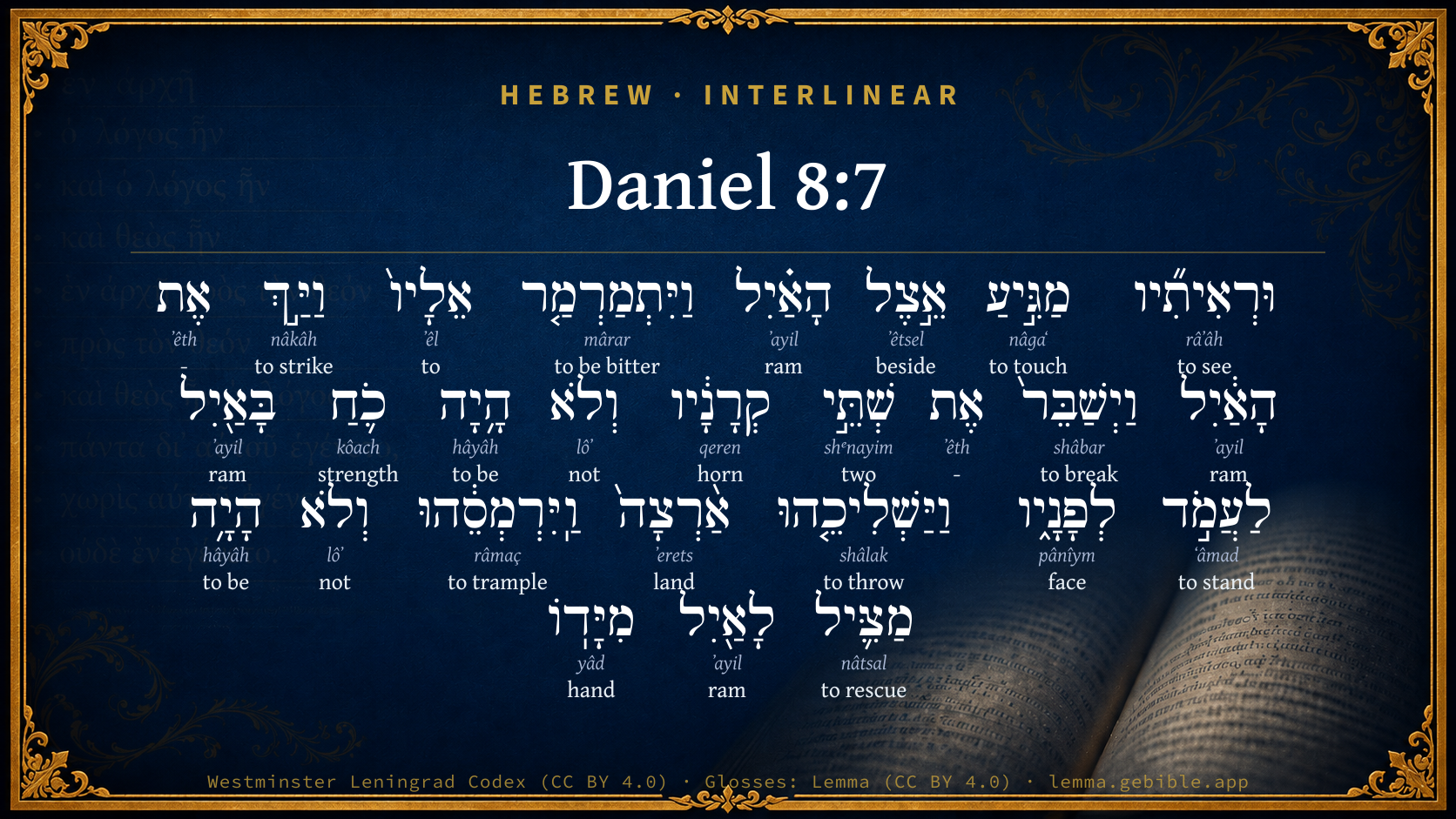
Daniel 8:7

Hebrew (Westminster Leningrad Codex) Daniel 8:7 appears in the Hebrew Old Testament. The text above is from the Westminster Leningrad Codex. Each word links to its Strong’s number, a concise gloss, and parsing drawn from the Open Scriptures Hebrew Bible morphology. Click any word for its full Brown-Driver-Briggs (BDB) entry.
Download image
Cite this verse

Daniel 8:7 (World English Bible). Public Domain. Lemma interlinear Bible study tool, https://lemma.gebible.app/v/daniel/8/7.

Show BibTeX & RIS
BibTeX
RIS
English Translation
I saw him come close to the ram, and he was moved with anger against him, and struck the ram, and broke his two horns; and there was no power in the ram to stand before him; but he cast him down to the ground, and trampled on him; and there was none who could deliver the ram out of his hand.
World English Bible · Public Domain
Download a study sheet

One document with this verse’s original text, its word-by-word gloss line, the meaning frame, cross-references with their text, attributed commentary, and full source and license credits — printable, and it pastes into notes with its structure intact.

This verse Autodidact and up

Study sheet (.html) Plain text (.txt)

A passage Seminary Student

Up to 50 verses in one chapter. A passage sheet keeps up to 6 commentary sources and 12 cross-references per verse, in the order this page ranks them, and says so on the sheet whenever that leaves anything out. Ask for a single verse and you get the Autodidact verse sheet above.

Everything on this page stays free to read, with no account — the sheet is a download of what is already on screen, not access to it.

Want to remove ads? Support Godless Engineer
Compare translations 3

The same verse in 3 English versions, stacked beneath the original-language interlinear above. Click any original word for its lexicon entry.

Each is an independent rendering of the whole verse — the interlinear is not word-aligned to these translations.

Highlighted words mark where these versions differ — a whole-verse word diff, not a word-by-word alignment.

  • World English Bible Public Domain
    I saw him come close to the ram, and he was moved with anger against him, and struck the ram, and broke his two horns; and there was no power in the ram to stand before him; but he cast him down to the ground, and trampled on him; and there was none who could deliver the ram out of his hand.
  • King James Version Public Domain
    And I saw him come close unto the ram, and he was moved with choler against him, and smote the ram, and brake his two horns: and there was no power in the ram to stand before him, but he cast him down to the ground, and stamped upon him: and there was none that could deliver the ram out of his hand.
  • unfoldingWord Literal Text CC BY-SA 4.0
    I saw him come beside the ram, and he was enraged at him, and he struck the ram and shattered his two horns. The ram had no strength to stand before him. So he cast him down to the ground and trampled on him. There was no one who could rescue the ram from his power.

unfoldingWord Literal Text — © unfoldingWord, licensed CC BY-SA 4.0. Word-aligned USFM3 via Door43 (git.door43.org/unfoldingWord/en_ult).

Versions to compare (up to 4)

3 of 4 selected

Show all 18 translations

Every available English version of this verse, each an independent rendering of the whole verse.

  • World English Bible Public Domain
    I saw him come close to the ram, and he was moved with anger against him, and struck the ram, and broke his two horns; and there was no power in the ram to stand before him; but he cast him down to the ground, and trampled on him; and there was none who could deliver the ram out of his hand.
  • Berean Standard Bible Public Domain
    I saw him approach the ram in a rage against him, and he struck the ram and shattered his two horns. The ram was powerless to stand against him, and the goat threw him to the ground and trampled him, and no one could deliver the ram from his power.
  • Majority Standard Bible Public Domain
    I saw him approach the ram in a rage against him, and he struck the ram and shattered his two horns. The ram was powerless to stand against him, and the goat threw him to the ground and trampled him, and no one could deliver the ram from his power.
  • King James Version Public Domain
    And I saw him come close unto the ram, and he was moved with choler against him, and smote the ram, and brake his two horns: and there was no power in the ram to stand before him, but he cast him down to the ground, and stamped upon him: and there was none that could deliver the ram out of his hand.
  • American Standard Version (1901) Public Domain
    And I saw him come close unto the ram, and he was moved with anger against him, and smote the ram, and brake his two horns; and there was no power in the ram to stand before him; but he cast him down to the ground, and trampled upon him; and there was none that could deliver the ram out of his hand.
  • Revised Version (1885) Public Domain
    And I saw him come close unto the ram, and he was moved with choler against him, and smote the ram, and brake his two horns; and there was no power in the ram to stand before him: but he cast him down to the ground, and trampled upon him; and there was none that could deliver the ram out of his hand.
  • Geneva Bible (1599) Public Domain
    And I saw him come vnto the ramme, and being moued against him, he smote the ramme, and brake his two hornes: and there was no power in the ramme to stand against him, but he cast him downe to the grounde, and stamped vpon him, and there was none that coulde deliuer the ramme out of his power.
  • Douay-Rheims (1899) Public Domain
    And when he was come near the ram, he was enraged against him, and struck the ram: and broke his two horns, and the ram could not withstand him: and when he had cast him down on the ground, he stamped upon him, and none could deliver the ram out of his hand.
  • Young's Literal Translation Public Domain
    And I have seen it coming near the ram, and it becometh embittered at it, and smiteth the ram, and breaketh its two horns, and there hath been no power in the ram to stand before it, and it casteth it to the earth, and trampleth it down, and there hath been no deliverer to the ram out of its power.
  • Literal Standard Version CC BY-SA 4.0
    And I have seen it coming near the ram, and it becomes embittered at it, and strikes the ram, and breaks its two horns, and there has been no power in the ram to stand before it, and it casts it to the earth, and tramples it down, and there has been no deliverer to the ram out of its power.
  • Unlocked Literal Bible CC BY-SA 4.0
    I saw the goat come close to the ram. He was very angry at the ram, and he hit the ram and broke off its two horns. The ram was powerless to stand before him. The goat knocked him down to the ground and trampled on him. There was no one who could rescue the ram from his power.
  • unfoldingWord Literal Text CC BY-SA 4.0
    I saw him come beside the ram, and he was enraged at him, and he struck the ram and shattered his two horns. The ram had no strength to stand before him. So he cast him down to the ground and trampled on him. There was no one who could rescue the ram from his power.
  • Darby Bible Public Domain
    And I saw him come close to the ram, and he was enraged with him, and smote the ram, and broke his two horns; and there was no power in the ram to stand before him; and he cast him down to the ground, and trampled upon him; and there was none that could deliver the ram out of his hand.
  • World Messianic Bible Public Domain
    I saw him come close to the ram, and he was moved with anger against him, and struck the ram, and broke his two horns. There was no power in the ram to stand before him; but he cast him down to the ground and trampled on him. There was no one who could deliver the ram out of his hand.
  • Webster's Bible Public Domain
    And I saw him come close to the ram, and he was moved with anger against him, and smote the ram, and broke his two horns: and there was no power in the ram to stand before him, but he cast him down to the ground, and stamped upon him: and there was none that could deliver the ram out of his hand.
  • Free Bible Version CC BY-SA 4.0
    I watched as the goat charged furiously at the ram, hitting it and breaking off its two horns. The ram did not have the strength to resist the goat's attack. The goat threw the ram to the ground, trampling on it, and there was no possibility of rescuing it from the goat's power.
  • Bible in Basic English Public Domain
    And I saw him come right up to the sheep, and he was moved with wrath against him, attacking the sheep so that his two horns were broken; and the sheep had not strength to keep his place before him, but was pushed down on the earth and crushed under his feet: and there was no one to get the sheep out of his power.
  • JPS Tanakh (1917) Public Domain
    And I saw him come close unto the ram, and he was moved with choler against him, and smote the ram, and broke his two horns; and there was no power in the ram to stand before him; but he cast him down to the ground, and trampled upon him; and there was none that could deliver the ram out of his hand.

Literal Standard Version (2020), Covenant Press — licensed CC BY-SA 4.0. Text via the HelloAO Bible API (eBible.org). Unlocked Literal Bible (unfoldingWord) — licensed CC BY-SA 4.0. Text via the HelloAO Bible API (eBible.org). unfoldingWord Literal Text — © unfoldingWord, licensed CC BY-SA 4.0. Word-aligned USFM3 via Door43 (git.door43.org/unfoldingWord/en_ult). Free Bible Version, Dr. Jonathan Gallagher — licensed CC BY-SA 4.0. Text via the HelloAO Bible API (eBible.org).

Word by word

More ways to search: Search by grammar → Find every occurrence → Compare this word →

Practice this passage: Drill this verse → Learn its vocabulary →

וַיִּתְמַרְמַ֤ר
mârar
H4843
“and · to be bitter”
Conjunction + Verb, Hithpalpel, Sequential Imperfect, 3rd Person, Masculine, Singular
Part of Speech
Conjunction + Verb
Stem
Hithpalpel
Form
Sequential Imperfect
Person
3rd Person
Gender
Masculine
Number
Singular
Full BDB Definition

Origin: a primitive root

TWOT: 1248

to be bitter - (Qal) to be bitter - (Piel) - to show bitterness - to make bitter - (Hiphil) to make bitter, embitter - (Hithpalpel) - to embitter oneself - to be enraged - (TWOT) to be strong, strengthen
  1. וּרְאִיתִ֞יו râʼâh H7200 “and · to see · him” Conjunction + Verb, Qal, Perfect, 1st Person, Common, Singular + Suffix, Personal, 3rd Person, Masculine, Singular
  2. מַגִּ֣יעַ nâgaʻ H5060 “touching” Verb, Hiphil, Participle Active, Masculine, Singular, Absolute
  3. אֵ֣צֶל ʼêtsel H681 “beside” Preposition
  4. הָאַ֗יִל ʼayil H352 “the · ram” Particle, Definite Article + Noun, Common, Masculine, Singular, Absolute
  5. אֵלָיו֙ ʼêl H413 “to · him” Preposition + Suffix, Personal, 3rd Person, Masculine, Singular
  6. וַיַּ֣ךְ nâkâh H5221 “and · to strike” Conjunction + Verb, Hiphil, Sequential Imperfect, 3rd Person, Masculine, Singular
  7. אֶת ʼêth H853 “-” Particle, Direct Object
  8. הָאַ֔יִל ʼayil H352 “the · ram” Particle, Definite Article + Noun, Common, Masculine, Singular, Absolute
  9. וַיְשַׁבֵּר֙ shâbar H7665 “and · to break” Conjunction + Verb, Piel, Sequential Imperfect, 3rd Person, Masculine, Singular
  10. אֶת ʼêth H853 “-” Particle, Direct Object
  11. שְׁתֵּ֣י shᵉnayim H8147 “two” Adjective, Cardinal number, Feminine, Dual, Construct
  12. קְרָנָ֔יו qeren H7161 “horns · his” Noun, Common, Both, Dual, Construct + Suffix, Personal, 3rd Person, Masculine, Singular
  13. וְלֹא lôʼ H3808 “and · not” Conjunction + Particle, Negative
  14. הָ֥יָה hâyâh H1961 “to be” Verb, Qal, Perfect, 3rd Person, Masculine, Singular
  15. כֹ֛חַ kôach H3581 “strength” Noun, Common, Masculine, Singular, Absolute
  16. בָּאַ֖יִל ʼayil H352 “in/at the · ram” Preposition, Determined + Noun, Common, Masculine, Singular, Absolute
  17. לַעֲמֹ֣ד ʻâmad H5975 “to stand” Preposition + Verb, Qal, Infinitive Construct
  18. לְפָנָ֑יו pânîym H6440 “to/for · face(s) · his” Preposition + Noun, Common, Both, Plural, Construct + Suffix, Personal, 3rd Person, Masculine, Singular
  19. וַיַּשְׁלִיכֵ֤הוּ shâlak H7993 “and · to throw · him” Conjunction + Verb, Hiphil, Sequential Imperfect, 3rd Person, Masculine, Singular + Suffix, Personal, 3rd Person, Masculine, Singular
  20. אַ֨רְצָה֙ ʼerets H776 “land · toward” Noun, Common, Both, Singular, Absolute + Suffix, Demonstrative
  21. וַֽיִּרְמְסֵ֔הוּ râmaç H7429 “and · to trample · him” Conjunction + Verb, Qal, Sequential Imperfect, 3rd Person, Masculine, Singular + Suffix, Personal, 3rd Person, Masculine, Singular
  22. וְלֹא lôʼ H3808 “and · not” Conjunction + Particle, Negative
  23. הָיָ֥ה hâyâh H1961 “to be” Verb, Qal, Perfect, 3rd Person, Masculine, Singular
  24. מַצִּ֛יל nâtsal H5337 “rescuing” Verb, Hiphil, Participle Active, Masculine, Singular, Absolute
  25. לָאַ֖יִל ʼayil H352 “to/for the · ram” Preposition, Determined + Noun, Common, Masculine, Singular, Absolute
  26. מִיָּדֽוֹ yâd H3027 “from · hand · his” Preposition + Noun, Common, Both, Singular, Construct + Suffix, Personal, 3rd Person, Masculine, Singular

About this verse

These counts appear in no published source. They are computed here, from the morphology-tagged text and Lemma’s own curated glosses. What Lemma adds →

27
words
21
distinct lemmas
Prophets
section

Notable vocabulary

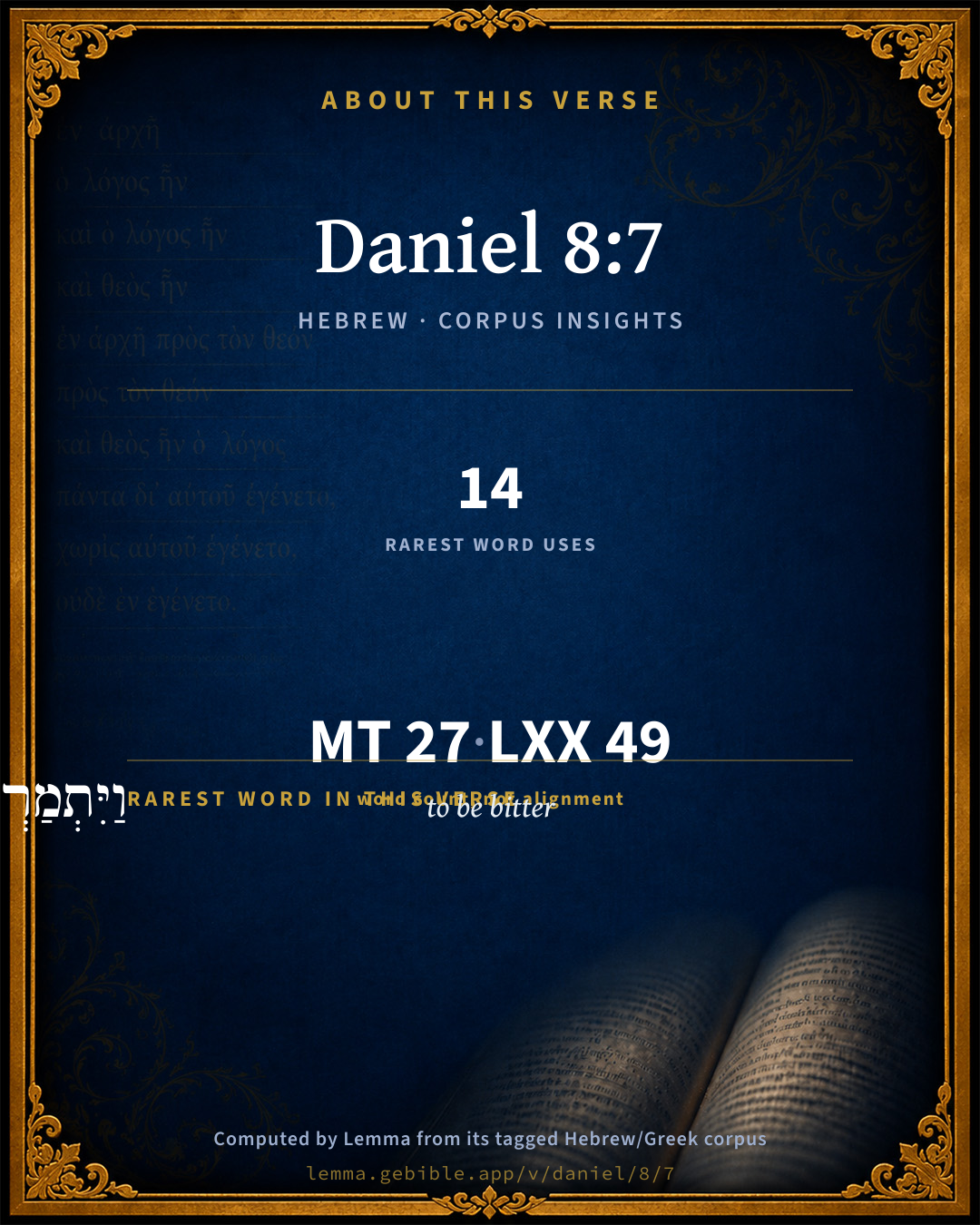
The rarest word here is וַיִּתְמַרְמַ֤ר to be bitter H4843 — appearing just 14 times in the whole Hebrew Bible.

Shared distinctive vocabulary

וַיִּתְמַרְמַ֤ר to be bitter H4843 occurs in 13 verses of the Hebrew Bible. Also found in:

Grammatical profile

  • 11 verbs
  • 9 nouns
  • 1 adjective
  • 2 prepositions
  • 4 particles

Verb forms

  • וּרְאִיתִ֞יו Qal · Perfect
  • מַגִּ֣יעַ Hiphil · Participle Active
  • וַיִּתְמַרְמַ֤ר Hithpalpel · Sequential Imperfect
  • וַיַּ֣ךְ Hiphil · Sequential Imperfect
  • וַיְשַׁבֵּר֙ Piel · Sequential Imperfect
  • הָ֥יָה Qal · Perfect
  • לַעֲמֹ֣ד Qal · Infinitive Construct
  • וַיַּשְׁלִיכֵ֤הוּ Hiphil · Sequential Imperfect
  • וַֽיִּרְמְסֵ֔הוּ Qal · Sequential Imperfect
  • הָיָ֥ה Qal · Perfect
  • מַצִּ֛יל Hiphil · Participle Active

Repetition

Words recur within this verse — often emphatic in Hebrew:

  • הָאַ֗יִל ram H352 ×4
  • הָ֥יָה to be H1961 ×2
  • וְלֹא not H3808 ×2

Hebrew & Septuagint length

In English translation the verse runs 62 words from the Hebrew and 63 from the Septuagint (LXX English) — closely comparable.

A rough comparison of the two English renderings, which tokenize alike — not a word-level alignment.

Word counts can differ between the Hebrew and the Greek without any difference in meaning — e.g. the Hebrew direct-object marker אֵת has no separate Greek word, and Greek often adds the article ὁ.

In the original languages it is 27 Hebrew tokens and 49 Greek tokens — but the two are counted differently (Hebrew bundles its prefixes and suffixes into one token; the Greek is in lemma form), so that isn’t a like-for-like length.

Cross-references

4

Topical passages linked to Daniel 8:7 in the Treasury of Scripture Knowledge — connected by theme and wording, ordered by reader-vote popularity; previews shown in the World English Bible.

  • Daniel 7:7 After this I saw in the night-visions, and, behold, a fourth animal, awesome and powerful, and strong exceedingly; and it had great iron teeth; it devoured and broke in pieces, and stamped the residue with its feet: and it was diverse from all the animals that were before it; and it had ten horns.
  • Daniel 11:11 The king of the south shall be moved with anger, and shall come forth and fight with him, even with the king of the north; and he shall set forth a great multitude, and the multitude shall be given into his hand.
  • Joshua 8:20 When the men of Ai looked behind them, they saw, and, behold, the smoke of the city ascended up to heaven, and they had no power to flee this way or that way: and the people who fled to the wilderness turned back on the pursuers.
  • Leviticus 26:37 They will stumble over one another, as it were before the sword, when no one pursues: and you will have no power to stand before your enemies.

Cross-references courtesy of OpenBible.info (CC BY 4.0).

Hebrew and Greek witnesses Masoretic Hebrew ↔ Greek Septuagint

The same verse in the two great witnesses to the Old Testament, shown verse-for-verse.

These are two independent witnesses, not word-aligned to each other, and the Septuagint is shown in lemma (dictionary) form.

Hebrew Daniel 8:7 Masoretic · Westminster Leningrad Codex

וּרְאִיתִ֞יו מַגִּ֣יעַ אֵ֣צֶל הָאַ֗יִל וַיִּתְמַרְמַ֤ר אֵלָיו֙ וַיַּ֣ךְ אֶת הָאַ֔יִל וַיְשַׁבֵּר֙ אֶת שְׁתֵּ֣י קְרָנָ֔יו וְלֹא הָ֥יָה כֹ֛חַ בָּאַ֖יִל לַעֲמֹ֣ד לְפָנָ֑יו וַיַּשְׁלִיכֵ֤הוּ אַ֨רְצָה֙ וַֽיִּרְמְסֵ֔הוּ וְלֹא הָיָ֥ה מַצִּ֛יל לָאַ֖יִל מִיָּדֽוֹ

I saw him come close to the ram, and he was moved with anger against him, and struck the ram, and broke his two horns; and there was no power in the ram to stand before him; but he cast him down to the ground, and trampled on him; and there was none who could deliver the ram out of his hand.

World English Bible · Public Domain

Greek LXX Daniel 8:7 Septuagint · lemma form

καί ὁράω αὐτός προςἄγω πρός ὁ κριός καί θυμόω ἐπί αὐτός καί πατάσσω καί συντρίβω ὁ δύο κέρας αὐτός καί οὐκέτι εἰμί ἰσχύς ἐν ὁ κριός ἵστημι κατέναντι ὁ τράγος καί σπαράσσω αὐτός ἐπί ὁ γῆ καί συντρίβω αὐτός καί οὐ εἰμί ὁ ῥύομαι ὁ κριός ἀπό ὁ τράγος

And I saw him coming up close to the ram, and he was furiously enraged against him, and he struck the ram, and broke both his horns: and there was no strength in the ram to stand before him, but he cast him on the ground, and trampled on him; and there was none that could deliver the ram out of his hand.

LXX2012 (modern English Septuagint) · Public Domain

Hebrew: Westminster Leningrad Codex (CC BY 4.0). Greek: Septuagint (public domain); English from LXX2012 (modern English Septuagint) (Public Domain). How the Septuagint differs from the Hebrew →

Commentary

Notes on Daniel 8:7 from classic Christian and Jewish commentators (each source and its license shown beneath its notes). The classic Christian expositions comment on the surrounding passage and are grouped to its opening verse, so a note may address several verses; the Jewish commentaries on the Tanakh (Rashi and others) are per-verse, so they appear only where the commentator wrote on this verse.

Lemma curates 59 commentaries, every one of them public domain or Creative Commons licensed, each selected and text-cleaned for this edition rather than reprinted as found. About our sources →

Trapp's Complete Commentary

John Trapp

Dan 8:7 And I saw him come close unto the ram, and he was moved with choler against him, and smote the ram, and brake his two horns: and there was no power in the ram to stand before him, but he cast him down to the ground, and stamped upon him: and there was none that could deliver the ram out of his hand.

Ver. 7. And I saw him come close unto the ram.] Who stood for a while in his stoutness, and brought several huge armies into the field - not less than fifteen hundred thousand - but all would not do; the fairest states are subject to change in their greatest flourish. {Eze 31:18}

“ In se magna ruunt.; laetis hunc numina rebus

Crescendi posuere modum. ” - Lucan.

And he was moved with choler against him.] Neither would he be pacified with promise of great gifts, and of part of the kingdom, and the marriage of his daughter.

And smote the ram.] By overthrowing the Persian armies in three main battles - at Granicum, at Issus, and at Arbela, not far from which is the mountain Nicatorium, {a} so called by Alexander, as a constant trophy of that famous victory.

And there was no power in the ram to stand before him.] In that last battle at Arbela, the whole power of Persia was overturned, and Darius Codomannus was slain by Bessus, one of his own captains. It is observed that great kingdoms often fall and are destroyed under such kings as are of the same name with the founders thereof. Darius here, for instance; so Philip of Macedon, and Philip the father of Perseus, the last king of that country; so Constantine the Great, and Constantine Palaeologus; Augustus and Augustulus, &c.

And stamped upon him,] i.e., After full conquest, he crowed, insulted, triumphed; at the instance of his concubine Thais, he caused the most goodly palace in the world at Persepolis to be set on fire.

{a} Nικατοριον ορος. - Strabo.

John Trapp, A Commentary or Exposition upon All the Books of the Old and New Testament (1647–1656) — public domain. Text from a community e-Sword module.

Geneva Bible (1599)

Geneva Bible translators

Alexander overcame Darius in two sundry battles, and so had the two kingdoms of the Medes and Persians.

Geneva Bible (1599) marginal notes — public domain. Text via Bolls.life.

Jamieson, Fausset & Brown

Robert Jamieson, A. R. Fausset & David Brown

moved with choler--Alexander represented the concentrated wrath of Greece against Persia for the Persian invasions of Greece; also for the Persian cruelties to Greeks, and Darius' attempts to seduce Alexander's soldiers to treachery [NEWTON].

stamped upon him--In 331 B.C. he defeated Darius Codomanus, and in 330 burned Persepolis and completed the conquest of Persia.

none . . . could deliver--Not the immense hosts of Persia could save it from the small army of Alexander (Psa 33:16).

Jamieson, Fausset & Brown — Commentary Critical and Explanatory on the Whole Bible (1871) — public domain (CC PDM 1.0). Text via the HelloAO Bible API.

Adam Clarke's Commentary

Verse 7. And brake his two horns] Subdued Persia and Media; sacked and burnt the royal city of Persepolis, the capital of the Persian empire, and, even in its ruins, one of the wonders of the world to the present day. This he did because "he was moved with choler" against Darius, who had endeavoured to draw off his captains with bribes, and had laboured to induce some of his friends to assassinate him. Alexander, finding this, would listen to no proposals of peace; and was determined never to rest till he had destroyed Darius and his whole empire. In Media, Darius was seized and made prisoner by some of his own treacherous subjects, and afterwards basely murdered.

There was no power in the ram to stand before him] Alexander's victories over the Persians were as easy as they were rapid and decisive.

He cast him down to the ground, and stamped upon him] Totally destroyed the family, and overturned the whole monarchy.

Adam Clarke's Commentary on the Bible (1810–1826) — public domain. Text from a community e-Sword/MySword module.

John Calvin's Commentaries

Here God shews to his Prophet the victory of Alexander, by which he subdued almost the whole east. Although he encountered many nations in battle, and especially the Indians, yet the name of the Persian empire was so celebrated in the world, that the dignity of others never approached it. Alexander, therefore, by conquering Darius, acquired nearly the whole east. God showed his Prophet the easiness of his victory under this figure. I looked, says he, when he approached the land Darius was fortified by both the distance of his stations and the strength of his fortifications; for many of his cities were impregnable, according to the common opinion of mankind. It was incredible, then, that the he-goat should approach the ram, surrounded as he was on all sides by such strong and such powerful garrisons. But the Prophet says he; approached the ram, and then, he exasperated himself against him This applies to Alexander’s furious assaults. We are well acquainted with the keenness of his talents and the superiority of his valor; yet, such was his unbridled audacity, that his promptness approached rather to rashness than to regal bravery. For he often threw himself with a blind impulse against his foes, and it was not his fault if the Macedonian name was not destroyed ten times over. As, then, he rushed on with such violent fury, we are not surprised when the Prophet says he was exasperated of his own accord. And he struck the ram, says he. He conquered Darius in two battles, when the power of the Persian sway throughout Asia Minor was completely ruined. We are all familiar with the results of these hazardous battles, shewing the whole stress of the war to have rested on that engagement in which Darius was first conquered; for when he says, The ram had no strength to stand; and although he had collected an immense multitude, yet that preparation was available for nothing but: empty pomp. For Darius was resplendent with gold, and silver, and gems, and he rather made a show of these, luxuries in warfare, than displayed manly and vigorous strength. The ram, then, had no power to stand before the he goat. Hence, he threw him prostrate on the earth, and trod him down; and no one was able to deliver out of his hand. Darius, indeed, was slain by his attendants, but Alexander trod down all his glory, and the dignity of the Persian Empire, under which all the people of the east trembled. We are aware also of the pride with which he abused his victory, until under the influence of harlots and debauchees, as some report, he tumultuously set fire to that most celebrated citadel of Susa in the drunken fit. As he so indignantly trampled under foot the glory of the Persian monarchy, we see how aptly the events fulfilled the prophecy, in the manner recorded by all profane historians.

John Calvin's Commentaries (1540-1563) — public domain. Text from the Calvin Translation Society English edition (1840s-50s) via the Christian Classics Ethereal Library (ccel.org). Calvin's coverage is partial (roughly two-thirds of the Bible); uncommented books and verses are honest gaps, never fabricated. The 19th-century editor's footnotes and remarks are omitted so the notes are faithfully Calvin's own voice.

The Cambridge Bible for Schools and Colleges

gen. ed. J. J. S. Perowne

7. The collapse of the Persian power before Alexander, especially in the two great defeats of Issus and Arbela.

was moved with choler] an effective rendering: so Dan_11:11. The Heb. is lit. embitter himself, or be embittered, i.e. be maddened, enraged: cf. in Syriac, Euseb. v. 1, 50 for ἠγριώθη, and elsewhere for μαινόμενος (Payne Smit[322] col. 2200).

[322] yne Smith R. Payne Smith, Thesaurus Syriacus.

stamped] trampled (R.V.), viz. in contempt: so Dan_8:10. Cf. Isa_26:6; Isa_63:3. Not the word used in Dan_7:7; Dan_7:19.

and there was none, &c.] The ‘ram’ was now as defenceless before the ‘he-goat,’ as others had once (Dan_8:4) been before it.

The Cambridge Bible for Schools and Colleges (gen. ed. J. J. S. Perowne; Cambridge University Press, 1878–1918) — public domain. Text from a community e-Sword module.

John Gill's Exposition

And I saw him come close unto the ram,.... Though the distance between Greece and Persia was very great, and many rivers and mountains in the way, which seemed impassable; Alexander got over them all, and came up to Darius, and fought several battles with him, and entirely defeated him, though greatly inferior in number to him, as follows:

and he was moved with choler against him; exceedingly embittered against him; exasperated and provoked to the last degree, by the proud and scornful message he sent him; calling himself king of kings, and akin to the gods, and Alexander his servant; ordering his nobles to take Philip's madding stripling, as he called him in contempt, and whip him with children's rods, and clothe him in purple, and deliver him bound to him; then sink his ships with the mariners, and transport all his soldiers to the further part of the Red sea (d):

and smote the ram; in three battles, in each of which the Persians were smitten and routed by the Grecians: first at the river Granicus, where Alexander with thirty thousand foot, and five thousand horse, met the Persians, though more than five times his number, being, as Justin (e) says, six hundred thousand, and got the victory over them; here twenty thousand of the Persian footmen, and two hundred and fifty of their horse, were slain, and not more than thirty nine of the Macedonians killed (f): Plutarch (g) says, it was reported that the Persians lost twenty thousand footmen, and two thousand five hundred horse; and from Aristobulus he says, that the Macedonians lost only thirty four men, of which twelve were footmen: and Diodorus Siculus (h) relates that the Persians lost more than ten thousand footmen, and not less than two thousand horse, and more than twenty thousand were taken: according to Justin (i), of Alexander's army there only fell nine footmen, and a hundred and twenty horsemen: others say, that, of the Macedonians, twenty five men of Alexander's own troop fell in the first attack, about sixty other of the horsemen were killed, and thirty of the footmen (k); so different are the accounts of the slain in this battle; however, the victory appears to be very great, whereby Sardis, with all Darius's rich furniture, fell into the hands of Alexander, and all the provinces of the lesser Asia submitted to him. The next battle was fought at Issus its Cilicia, where Darius had an army, according to Plutarch (l), consisting of six hundred thousand men; according to Justin (m), four hundred thousand footmen, and a hundred thousand horsemen, which was routed by Alexander; when a hundred thousand of the Persian footmen, and ten thousand of their horsemen, were slain; and only, on Alexander's side, five hundred and four of the footmen wounded, thirty two wanting, and a hundred and fifty of the horsemen killed (n): here also the accounts vary; Plutarch (o) says above a hundred and ten thousand of the Persians were slain: according to Diodorus Siculus (p), there fell of them a hundred and twenty thousand footmen, and not less than ten thousand horsemen; and of the Macedonians three hundred footmen, and about a hundred and fifty horsemen: according to Arrian (q), the Persians lost ten thousand horsemen, and ninety thousand footmen: according to Justin (r), sixty one thousand footmen, and ten thousand horsemen, were slain, and forty thousand taken; and of the Macedonians there fell one hundred and thirty footmen, and one hundred and fifty horsemen; but, be it as it will, the victory was exceeding great, whereby the camp of Darius, his mother, wife, and children, and all his riches at Damascus, fell into the hands of Alexander, with all Syria. The third and last battle was fought near Arbela, or rather at Gaugamela in Assyria, when Alexander with fifty thousand men beat Darius with an army of eleven hundred thousand men; Plutarch (s) says ten hundred thousand; forty thousand of which were slain, and of the Macedonians only three hundred or less were wanting (t); according to Arrian (u) thirty thousand were slain; but Diodorus Siculus (w) says ninety thousand: this was the decisive battle; after this Babylon and Persepolis were taken by Alexander, and he became master of the whole empire, which is intended in the next clause:

and brake his two horns; conquered the Medes and Persians, the two kingdoms united in one monarchy, but now destroyed; another monarchy, the Grecian, took its place:

and there was no power in the ram to stand before him there was no strength in tim whole empire sufficient to resist, oppose, and stop him; though vast armies were collected together, these were soon broken and routed, and Darius at the head of them was forced to fly and make his escape in the best manner he could;

but he cast him down to the ground, and stamped upon him: not Darius personally, for he was slain by Bessus, one of his own captains; but the Persian empire, it ceased to be, and was no longer in the hands of the Persians, but was taken from them by Alexander; and all the glory and majesty of it were defaced and despised; the famous city and palace of Persepolis were burnt in a drunken fit, at the instigation of Thais the harlot:

and there was none that could deliver the ram out of his hand; not his armies, nor his generals, nor his allies, nor his offers to Alexander of his daughter in marriage, and part of his kingdom; all were in vain, and to no purpose; he and his whole empire fell into the conqueror's hands, and there was no remedy against it. Josephus (x) says, that when Alexander was in his way to Jerusalem, Jaddus, the high priest, met and accompanied him into the city and temple, and showed him this prophecy of Daniel, that some one of the Grecians should abolish the empire of the Persians; and, thinking himself to be intended, was greatly pleased. Gorionides (y) says the high priest, whom he calls Ananias, said to Alexander, on showing him the prophecy, thou art this he goat, and Darius is the ram; and thou shall trample him to the ground, and take the kingdom out of his hand; and he greatly strengthened the heart of the king.

(d) Supplem. in Curt. l. 2. p. 27. (e) Trogo, l. 11. c. 6. (f) Supplem. in Curt. l. 2. p. 28. (g) In Vit. Alexandri. (h) Bibliothec. l. 17. p. 503. (i) E Trogo, l. 11. c. 6. (k) Universal History, vol. 5. p. 297. (l) In Vit. Alexandri. (m) E Trogo, l. 11. c. 9. (n) Curtius, l. 3. c. 11. (o) In Vita Alexandri. (p) Bibliothec l. 17. p. 515. (q) Exped. Alex. l. 2. (r) E. Trogo, l. 11. c. 9. (s) Vit. Alexandri. (t) Curtius, l. 4. c. 16. (u) Ut supra, ( Exped. Alex.) l. 3. (w) Biblioth. l. 17. p. 536. (x) Antiqu. l. 11. c. 8. sect. 5. (y) Heb. Hist. l. 2. c. 7. p. 88.

John Gill's Exposition of the Whole Bible (1746–1763) — public domain (CC PDM 1.0). Text via the HelloAO Bible API.

Albert Barnes' Notes on the Bible

And I saw him, come close unto the ram - The ram standing on the banks of the Ulai, and in the very heart of the empire. This representation is designed undoubtedly to denote that the Grecian power would attack the Persian in its own dominions. Perhaps the vision was represented at the place which would be the capital of the empire in order to denote this.

And he was moved with choler against him - (i. e., the ram).” With wrath or anger. That is, he acted as if he were furiously enraged. This is not an improper representation. Alexander, though spurred on by ambition as his ruling motive, yet might be supposed without impropriety to represent the concentrated wrath of all Greece on account of the repeated Persian invasions. It is true the Persians had been defeated at Leuctra, at Marathon, and at Salamis, that their hosts had been held in check at Thermopylae, that they had never succeeded in subduing Greece, and that the Grecians in defending their country had covered themselves with glory. But it is true, also, that the wrongs inflicted or attempted on the Greeks had never been forgotten, and it cannot be doubted that the remembrance of these wrongs was a motive that influenced many a Greek at the battle of the Granicus and Issus, and at Arbela. It would be one of most powerful motives to which Alexander could appeal in stimulating his army.

And brake his two horns - Completely prostrated his power - as Alexander did when he overthrew Darius Codemenus, and subjugated to himself the Medo-Persian empire. That empire ceased at that time, and was merged in that of the son of Philp.

And there was no power in the ram to stand before him - To resist him.

But he cast him down to the ground, and stamped upon him - An act strikingly expressive of the conduct of Alexander. The empire was crushed beneath his power, and, as it were, trampled to the earth.

And there was none that could deliver the ram out of his hand - No auxiliaries that the Persian empire could call to its aid that could save it from the Grecian conqueror.

Albert Barnes' Notes on the Bible (1834–1885) — public domain. Text from a community e-Sword/MySword module.

Haydock's Catholic Bible Commentary

Hand. He routed all the forces of his enemy (Haydock) at the Granicus, at Issus; and at Gaugamela, (Calmet) or Arbela, Darius escaped, but was slain by his own servants. (Haydock) --- The clemency of the conqueror towards the fallen royal family is not here specified. (Calmet)

George Leo Haydock (1774–1849), Haydock's Catholic Family Bible and Commentary, 1859 edition — public domain. Excludes Psalms (Douay-Rheims chapter numbering differs from Protestant) and Deuterocanonical books (Catholic canon only).

Matthew Poole's English Annotations

Brake his two horns: Artaxerxes Mnemon, by aiding Cyrus against him and then Darius Codomanus; these are the two horns, or the Medes and Persians.

Cast him down to the ground, and stamped upon him; he overthrew him utterly, that he could never rise again. This was at the Granicus, Issus, and Arbela.

Matthew Poole's English Annotations on the Holy Bible (1683–1685) — public domain. Text from a community e-Sword/MySword module.

The Pulpit Commentary

And I saw him come close unto the ram, and he was moved with choler against him, and smote the ram, and brake his two horns: and there was no power in the ram to stand before him, but he cast him down to the ground, and stamped upon him: and there was none that could deliver the ram out of his hand. The two Greek versions, though differing very much in the Greek words chosen as equivalent to the Hebrew, yet both represent a text practically identical with that of the Massoretes. The Peshitta omits the introductory "behold," but otherwise can scarcely be said to differ essentially from the received text, though there are some peculiarities due to mistaken reading, but unimportant. The word yithmormar, "he was emhittered," is a word that occurs here and in the eleventh chapter. The root, however, as might be guessed from its meaning, is not uncommon, being found in Genesis Exodus, Samuel, Kings, Isaiah, Ruth, Job, and Zechariah. How Professor Bevan can class this with "words or roots which occur nowhere else in the Old Testament" it is difficult to see. If this part of the verb occurs in later Jewish literature, it is singular that neither Buxtorf nor Levy chronicles the fact. It does not occur in Western Aramaic, but does in Eastern (comp. Peshitta 2Sa_18:33; Act_17:16) It is quite such a word as a man writing among those who spoke Eastern Aramaic might use. Alexander advanced always against Darius; he would not even speak of treating with him. After the passage of the Granicus, he pushed on to Cilicia, overthrew Darius at Issus, B.C.. 333; then, after the conquest of Egypt, advanced against him again at Arbela, and once more inflicted on him an overwhelming defeat. When Darius fled from the field, Alexander pursued him to the shores of the Caspian and into Bactria and Sogdiana, till Darius fell a victim to the treachery of Bessus. Certainly relentlessness was the most marked character of Alexander"s pursuit of Darius. The horns of the Persian power were broken, thrown to the earth, and trodden underfoot.

The Pulpit Commentary (1880–1919), ed. H.D.M. Spence-Jones & Joseph S. Exell — public domain. Text from a community e-Sword module.

unfoldingWord translationNotes

Door43 World Missions Community

trampled

to crush something by stepping on it

the ram from his power

"the ram from the goat because of his power"

the goat became very large

"the goat became very large and strong"

the large horn was broken

This can be stated in active form. AT: "something broke off the large horn" (See: Active or Passive)

toward the four winds of the heavens

Here "the four winds of heaven" is an idiom that refers to the four main directions (north, east, south, west) from which the winds blow. AT: "in four different directions" (See: Idiom)

translationWords

goat

power

heaven

unfoldingWord translationNotes — © Distant Shores Media and the Door43 World Missions Community, licensed CC BY-SA 4.0. Source: git.door43.org/Door43/en_tn.

Rashi

Rabbi Shlomo Yitzchaki (Rashi)

and it fought with it Heb. וַיִתְמַרְמַר אֵלָיו, and it fought with it. That is an expression of bitter (מַר) anger.

Rashi on the Tanakh — English translations: “The Judaica Press complete Tanach with Rashi, translated by A. J. Rosenberg” (CC BY 4.0); “Pentateuch with Rashi's commentary by M. Rosenbaum and A.M. Silbermann, 1929-1934” (public domain); “The Metsudah Tanach series, Lakewood, N.J” (CC BY 4.0); and “The Book of Joshua, Metsudah Publications, 1997” (CC BY 4.0). Text via Sefaria.

Lesson kit

Teaching starters — assembled from the data on this page, not authored interpretation. Every prompt links to the verse data it draws on. Edit before teaching.

Daniel, in the Prophets, opens this verse with 27 words (21 distinct Hebrew lemmas). Its most distinctive word is mârar (“to be bitter”). A historical commentator’s framing appears above. Read the whole chapter for the surrounding context.

Discussion questions

  1. The word mârar carries the sense “to be bitter.” How does it shape the verse?
  2. Genesis 49:23 shares the word «to be bitter» with this verse. How do the two illuminate each other?
  3. “ram” occurs 4× in this one verse. What is the effect of the repetition?
  4. These translations render this verse differently. What is at stake in choosing one wording over another?
  5. The verb «וּרְאִיתִ֞יו» is Qal Perfect. How does its form color the action?
  6. Reading how Trapp's Complete Commentary and Geneva Bible (1599) read this verse, where do the two commentators agree and where do they part?

Things to notice

Reading settings

Reading text

Shown beneath each verse's original-language words.

Old Testament
Old Testament edition

Read the OT as the Masoretic Hebrew (MT) or the Greek Septuagint (LXX).

English shown for the Greek Septuagint (in the Hebrew ↔ Greek comparison).

Comparing translations? Open the Compare panel on any verse page to stack up to four side by side.