Deuteronomy 15:16

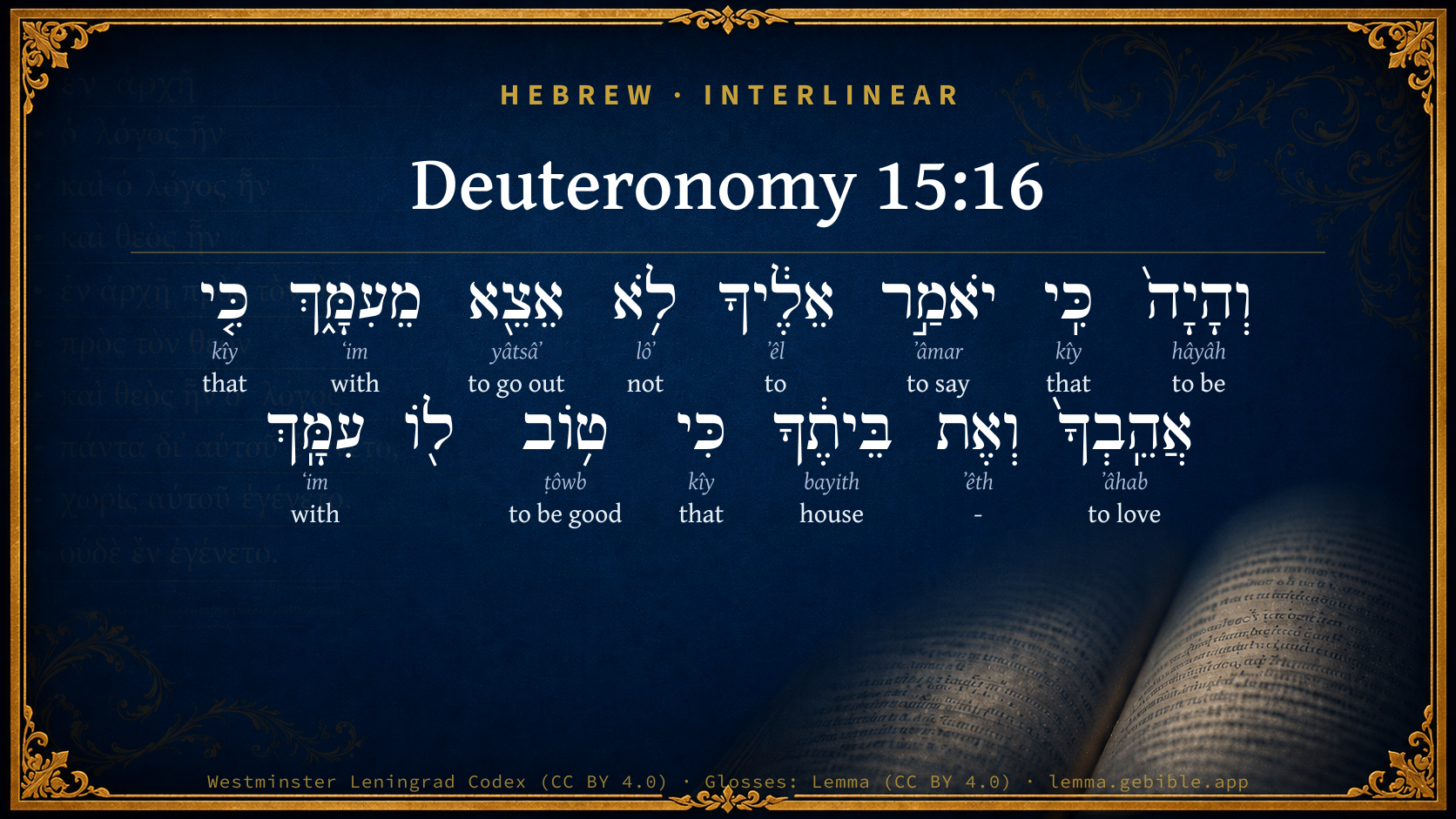
Hebrew (Westminster Leningrad Codex) Deuteronomy 15:16 appears in the Hebrew Old Testament. The text above is from the Westminster Leningrad Codex. Each word links to its Strong’s number, a concise gloss, and parsing drawn from the Open Scriptures Hebrew Bible morphology. Click any word for its full Brown-Driver-Briggs (BDB) entry.
Download image
Cite this verse

Deuteronomy 15:16 (World English Bible). Public Domain. Lemma interlinear Bible study tool, https://lemma.gebible.app/v/deuteronomy/15/16.

Show BibTeX & RIS
BibTeX
RIS
English Translation
It shall be, if he tell you, I will not go out from you; because he loves you and your house, because he is well with you;
World English Bible · Public Domain
Download a study sheet

One document with this verse’s original text, its word-by-word gloss line, the meaning frame, cross-references with their text, attributed commentary, and full source and license credits — printable, and it pastes into notes with its structure intact.

This verse Autodidact and up

Study sheet (.html) Plain text (.txt)

A passage Seminary Student

Up to 50 verses in one chapter. A passage sheet keeps up to 6 commentary sources and 12 cross-references per verse, in the order this page ranks them, and says so on the sheet whenever that leaves anything out. Ask for a single verse and you get the Autodidact verse sheet above.

Everything on this page stays free to read, with no account — the sheet is a download of what is already on screen, not access to it.

Want to remove ads? Support Godless Engineer
Compare translations 3

The same verse in 3 English versions, stacked beneath the original-language interlinear above. Click any original word for its lexicon entry.

Each is an independent rendering of the whole verse — the interlinear is not word-aligned to these translations.

Highlighted words mark where these versions differ — a whole-verse word diff, not a word-by-word alignment.

  • World English Bible Public Domain
    It shall be, if he tell you, I will not go out from you; because he loves you and your house, because he is well with you;
  • King James Version Public Domain
    And it shall be, if he say unto thee, I will not go away from thee; because he loveth thee and thine house, because he is well with thee;
  • unfoldingWord Literal Text CC BY-SA 4.0
    And it will be, if he says to you, ‘I will not go from you,’ because he loves you and your house, because good for him with you,

unfoldingWord Literal Text — © unfoldingWord, licensed CC BY-SA 4.0. Word-aligned USFM3 via Door43 (git.door43.org/unfoldingWord/en_ult).

Versions to compare (up to 4)

3 of 4 selected

Show all 18 translations

Every available English version of this verse, each an independent rendering of the whole verse.

  • World English Bible Public Domain
    It shall be, if he tell you, I will not go out from you; because he loves you and your house, because he is well with you;
  • Berean Standard Bible Public Domain
    But if your servant says to you, ‘I do not want to leave you,’ because he loves you and your household and is well off with you,
  • Majority Standard Bible Public Domain
    But if your servant says to you, ‘I do not want to leave you,’ because he loves you and your household and is well off with you,
  • King James Version Public Domain
    And it shall be, if he say unto thee, I will not go away from thee; because he loveth thee and thine house, because he is well with thee;
  • American Standard Version (1901) Public Domain
    And it shall be, if he say unto thee, I will not go out from thee; because he loveth thee and thy house, because he is well with thee;
  • Revised Version (1885) Public Domain
    And it shall be, if he say unto thee, I will not go out from thee; because he loveth thee and thine house, because he is well with thee;
  • Geneva Bible (1599) Public Domain
    And if he say vnto thee, I will not go away from thee, because he loueth thee and thine house, and because he is well with thee,
  • Douay-Rheims (1899) Public Domain
    But if he say: I will not depart: because he loveth thee, and thy house, and findeth that he is well with thee:
  • Young's Literal Translation Public Domain
    `And it hath been, when he saith unto thee, I go not out from thee -- because he hath loved thee, and thy house, because `it is' good for him with thee --
  • Literal Standard Version CC BY-SA 4.0
    And it has been, when he says to you, I do not go out from you, because he has loved you and your house, because [it is] good for him with you,
  • Unlocked Literal Bible CC BY-SA 4.0
    It will happen that if he says to you, 'I will not go away from you,' because he loves you and your house, and because he is well off with you,
  • unfoldingWord Literal Text CC BY-SA 4.0
    And it will be, if he says to you, ‘I will not go from you,’ because he loves you and your house, because good for him with you,
  • Darby Bible Public Domain
    And it shall be, if he say unto thee, I will not go away from thee, -- because he loveth thee and thy house, because he is well with thee, --
  • World Messianic Bible Public Domain
    It shall be, if he tells you, “I will not go out from you,” because he loves you and your house, because he is well with you,
  • Webster's Bible Public Domain
    And it shall be, if he shall say to thee, I will not leave thee; because he loveth thee and thy house, because he is well with thee;
  • Free Bible Version CC BY-SA 4.0
    However, if your male slave tells you, “I don't want to leave you,” because he loves you and your family and is better off staying with you,
  • Bible in Basic English Public Domain
    But if he says to you, I have no desire to go away from you; because you and your family are dear to him and he is happy with you;
  • JPS Tanakh (1917) Public Domain
    And it shall be, if he say unto thee: 'I will not go out from thee'; because he loveth thee and thy house, because he fareth well with thee;

Literal Standard Version (2020), Covenant Press — licensed CC BY-SA 4.0. Text via the HelloAO Bible API (eBible.org). Unlocked Literal Bible (unfoldingWord) — licensed CC BY-SA 4.0. Text via the HelloAO Bible API (eBible.org). unfoldingWord Literal Text — © unfoldingWord, licensed CC BY-SA 4.0. Word-aligned USFM3 via Door43 (git.door43.org/unfoldingWord/en_ult). Free Bible Version, Dr. Jonathan Gallagher — licensed CC BY-SA 4.0. Text via the HelloAO Bible API (eBible.org).

Word by word

More ways to search: Search by grammar → Find every occurrence → Compare this word →

Practice this passage: Drill this verse → Learn its vocabulary →

ט֥וֹב
ṭôwb
H2895
“to be good”
Verb, Qal, Perfect, 3rd Person, Masculine, Singular
Part of Speech
Verb
Stem
Qal
Form
Perfect
Person
3rd Person
Gender
Masculine
Number
Singular
Full BDB Definition

Origin: a primitive root

TWOT: 793

to be good, be pleasing, be joyful, be beneficial, be pleasant, be favourable, be happy, be right - (Qal) - to be pleasant, be delightful - to be glad, be joyful - to be better - to be well with, be good for - to be pleasing - (Hiphil) to do well, do good, act right, act rightly
  1. וְהָיָה֙ hâyâh H1961 “and · to be” Conjunction + Verb, Qal, Sequential Perfect, 3rd Person, Masculine, Singular
  2. כִּֽי kîy H3588 “that” Conjunction
  3. יֹאמַ֣ר ʼâmar H559 “to say” Verb, Qal, Imperfect, 3rd Person, Masculine, Singular
  4. אֵלֶ֔יךָ ʼêl H413 “to · you” Preposition + Suffix, Personal, 2nd Person, Masculine, Singular
  5. לֹ֥א lôʼ H3808 “not” Particle, Negative
  6. אֵצֵ֖א yâtsâʼ H3318 “to go out” Verb, Qal, Imperfect, 1st Person, Common, Singular
  7. מֵעִמָּ֑ךְ ʻim H5973 “from · with · you” Preposition + Preposition + Suffix, Personal, 2nd Person, Feminine, Singular
  8. כִּ֤י kîy H3588 “that” Conjunction
  9. אֲהֵֽבְךָ֙ ʼâhab H157 “to love · you” Verb, Qal, Perfect, 3rd Person, Masculine, Singular + Suffix, Personal, 2nd Person, Masculine, Singular
  10. וְאֶת ʼêth H853 “and · -” Conjunction + Particle, Direct Object
  11. בֵּיתֶ֔ךָ bayith H1004 “house · your” Noun, Common, Masculine, Singular, Construct + Suffix, Personal, 2nd Person, Masculine, Singular
  12. כִּי kîy H3588 “that” Conjunction
  13. עִמָּֽךְ ʻim H5973 “with · you” Preposition + Suffix, Personal, 2nd Person, Feminine, Singular

About this verse

These counts appear in no published source. They are computed here, from the morphology-tagged text and Lemma’s own curated glosses. What Lemma adds →

15
words
11
distinct lemmas
Pentateuch
section

Notable vocabulary

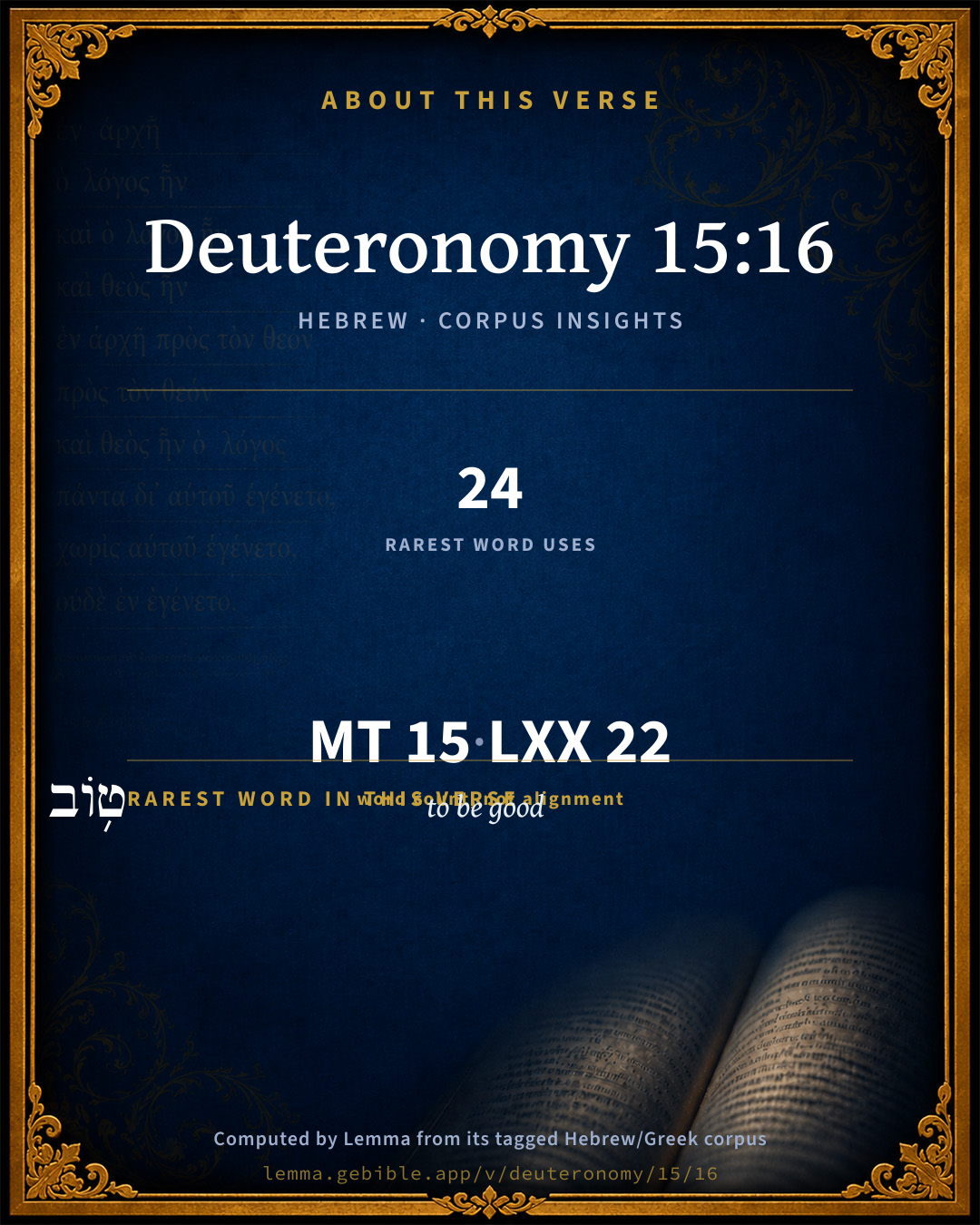
The rarest word here is ט֥וֹב to be good H2895 — appearing just 24 times in the whole Hebrew Bible.

Shared distinctive vocabulary

ט֥וֹב to be good H2895 occurs in 24 verses of the Hebrew Bible. Also found in:

Grammatical profile

  • 5 verbs
  • 1 noun
  • 4 prepositions
  • 3 conjunctions
  • 2 particles

Verb forms

  • וְהָיָה֙ Qal · Sequential Perfect
  • יֹאמַ֣ר Qal · Imperfect
  • אֵצֵ֖א Qal · Imperfect
  • אֲהֵֽבְךָ֙ Qal · Perfect
  • ט֥וֹב Qal · Perfect

Repetition

Words recur within this verse — often emphatic in Hebrew:

  • כִּֽי that H3588 ×3
  • מֵעִמָּ֑ךְ with H5973 ×2

Hebrew & Septuagint length

In English translation the verse runs 27 words from the Hebrew and 29 from the Septuagint (LXX English) — closely comparable.

A rough comparison of the two English renderings, which tokenize alike — not a word-level alignment.

Word counts can differ between the Hebrew and the Greek without any difference in meaning — e.g. the Hebrew direct-object marker אֵת has no separate Greek word, and Greek often adds the article ὁ.

In the original languages it is 15 Hebrew tokens and 22 Greek tokens — but the two are counted differently (Hebrew bundles its prefixes and suffixes into one token; the Greek is in lemma form), so that isn’t a like-for-like length.

Cross-references

3

Topical passages linked to Deuteronomy 15:16 in the Treasury of Scripture Knowledge — connected by theme and wording, ordered by reader-vote popularity; previews shown in the World English Bible.

  • Exodus 21:5–6 But if the servant shall plainly say, 'I love my master, my wife, and my children. I will not go out free;'
  • Psalms 40:8 I delight to do your will, my God. Yes, your law is within my heart."
  • Psalms 40:6 Sacrifice and offering you didn't desire. You have opened my ears: Burnt offering and sin offering you have not required.

Cross-references courtesy of OpenBible.info (CC BY 4.0).

Hebrew and Greek witnesses Masoretic Hebrew ↔ Greek Septuagint

The same verse in the two great witnesses to the Old Testament, shown verse-for-verse.

These are two independent witnesses, not word-aligned to each other, and the Septuagint is shown in lemma (dictionary) form.

Hebrew Deuteronomy 15:16 Masoretic · Westminster Leningrad Codex

וְהָיָה֙ כִּֽי יֹאמַ֣ר אֵלֶ֔יךָ לֹ֥א אֵצֵ֖א מֵעִמָּ֑ךְ כִּ֤י אֲהֵֽבְךָ֙ וְאֶת בֵּיתֶ֔ךָ כִּי ט֥וֹב ל֖וֹ עִמָּֽךְ

It shall be, if he tell you, I will not go out from you; because he loves you and your house, because he is well with you;

World English Bible · Public Domain

Greek LXX Deuteronomy 15:16 Septuagint · lemma form

ἐάν δέ λέγω πρός σύ οὐ ἐκἔρχομαι ἀπό σύ ὅτι ἀγαπάω σύ καί ὁ οἰκία σύ ὅτι εὖ αὐτός εἰμί παρά σύ

And if he should say to you, I will not go out from you, because he continues to love you and your house, because he is well with you;

LXX2012 (modern English Septuagint) · Public Domain

Hebrew: Westminster Leningrad Codex (CC BY 4.0). Greek: Septuagint (public domain); English from LXX2012 (modern English Septuagint) (Public Domain). How the Septuagint differs from the Hebrew →

Targum (Aramaic paraphrase)

2

The Targum is the ancient Jewish Aramaic paraphrase of the Hebrew Scriptures — an interpretive translation, not the Hebrew text itself. Onkelos (literal) and Pseudo-Jonathan (expansive) render the Torah, and Jonathan the Prophets. Coverage is partial: where no permissively-licensed English translation exists for a verse, only the Aramaic is shown. This is verse-level text, not a word-by-word alignment to the Hebrew.

  1. Targum Onkelos Torah (Genesis–Deuteronomy)
    וִיהֵי אֲרֵי יֵימַר לָךְ לָא אֶפוֹק מֵעִמָךְ אֲרֵי רָחֲמָךְ וְיָת אֱנַשׁ בֵּיתָךְ אֲרֵי טַב לֵהּ עִמָךְ

    (no public-domain English translation for this verse)

    Targum Onkelos — Aramaic: “Onkelos Genesis” (public domain); “Onkelos Exodus” (public domain); “Onkelos Leviticus” (public domain); “Onkelos Numbers” (public domain); “Onkelos Deuteronomy” (public domain). English: “Sefaria Community Translation” (CC0 1.0 (public-domain dedication)); “J.W. Etheridge. The Targums of Onkelos and Jonathan Ben Uzziel on the Pentateuch. London: Longmans, Green, 1862” (public domain). Text via Sefaria.

  2. Targum Pseudo-Jonathan Torah (Genesis–Deuteronomy)
    וִיהֵי אֲרוּם יֵימַר לָךְ לָא אֶפּוֹק מִן גַּבָּךְ אֲרוּם רַחֲמָךְ וְיַת אֵינַשׁ בֵּיתָךְ אֲרוּם טַב לֵיהּ דְּמִתְהָנֵי עִמָךְ

    But if he say to thee, I will not go out from thee, because I love thee and the men of thy house, and because it hath been good for him to be with thee,

    Targum Pseudo-Jonathan — Aramaic: “Targum Jonathan on Genesis” (public domain); “Targum Jonathan on Exodus” (public domain); “Targum Jonathan on Leviticus” (public domain); “Targum Jonathan on Numbers” (public domain); “Targum Jonathan on Deuteronomy” (public domain). English: “The Targum of Jonathan ben Uzziel, trans. J. W. Etheridge, London, 1862” (public domain). Text via Sefaria.

Commentary

Notes on Deuteronomy 15:16 from classic Christian and Jewish commentators (each source and its license shown beneath its notes). The classic Christian expositions comment on the surrounding passage and are grouped to its opening verse, so a note may address several verses; the Jewish commentaries on the Tanakh (Rashi and others) are per-verse, so they appear only where the commentator wrote on this verse.

Lemma curates 59 commentaries, every one of them public domain or Creative Commons licensed, each selected and text-cleaned for this edition rather than reprinted as found. About our sources →

Trapp's Complete Commentary

John Trapp

Deu 15:16 And it shall be, if he say unto thee, I will not go away from thee; because he loveth thee and thine house, because he is well with thee;

Ver. 16. Then thou shalt take an awl.] Ut si non horreret servitudinem, horreret saltem ignominiam publicam: If we can bear reproach for Christ, it is an argument we mean to stick to him, as this bored servant to his master.

John Trapp, A Commentary or Exposition upon All the Books of the Old and New Testament (1647–1656) — public domain. Text from a community e-Sword module.

Tyndale Open Study Notes

Tyndale Open Resources

15:16 he loves you: In the context of a covenant, this phrase speaks of a binding relationship with both legal and emotional overtones.

Tyndale Open Study Notes — © Tyndale Open Resources, licensed CC BY-SA 4.0. Text via the HelloAO Bible API.

Jamieson, Fausset & Brown

Robert Jamieson, A. R. Fausset & David Brown

if he say unto thee, I will not go away from thee--If they declined to avail themselves of the privilege of release and chose to remain with their master, then by a peculiar form of ceremony they became a party to the transaction, voluntarily sold themselves to their employer, and continued in his service till death.

Jamieson, Fausset & Brown — Commentary Critical and Explanatory on the Whole Bible (1871) — public domain (CC PDM 1.0). Text via the HelloAO Bible API.

The Cambridge Bible for Schools and Colleges

gen. ed. J. J. S. Perowne

16. And it shall be, if he say unto thee] E, Exo_21:5, more simply And if the slave say.

I will not go out from thee] E, I will not go out free. On go out, cp. Deu_13:13.

because he loveth thee and thine house] On the treatment of slaves see introd. note.

The Cambridge Bible for Schools and Colleges (gen. ed. J. J. S. Perowne; Cambridge University Press, 1878–1918) — public domain. Text from a community e-Sword module.

John Gill's Exposition

And it shall be, if he say unto thee, I will not go away from thee,.... Out of his house, nor quit his service:

because he loveth thee and thine house; his master and his family, and so loath to leave them, but chooses rather to stay with them than have his liberty; hence the Jews say (k), if his master has not a wife and children, his ear is not to be bored:

because he is well with thee; lives well with him, is well used by him, wants for nothing, and enjoys peace and quietness, and has everything to make him happy as such a state will admit of, and with the which he is well contented, and highly pleased. This is an emblem of the cheerful and constant obedience of the people of Christ to him their master, flowing from love to him; whom they love above all persons and things, with all their heart and soul, and his house also, the place of his worship, his ordinances, truths, ministers and children; and therefore choose to be where they are, finding that they are there well used, fare well, having bread enough and to spare, spiritual provisions in plenty; are well clothed with the righteousness of Christ, have the good company of the saints and excellent in the earth, in whom is all their delight; and, above all, the presence of their Lord and master, and the smiles of his countenance.

(k) Maimon. in Misn. Kiddushin, c. 1. sect. 2.

John Gill's Exposition of the Whole Bible (1746–1763) — public domain (CC PDM 1.0). Text via the HelloAO Bible API.

Matthew Poole's English Annotations

Because he is sensible that he fares well with thee. Or, because it is good, i.e. acceptable in his eyes, or pleasing to him, to be

with thee.

Matthew Poole's English Annotations on the Holy Bible (1683–1685) — public domain. Text from a community e-Sword/MySword module.

Whedon's Commentary on the Bible

Daniel D. Whedon

16. I will not go — If the manservant or the maidservant did not wish to leave for freedom — did not wish to leave the master — they were not obliged to go, but in that case were to be bound to a lifelong bondage.

Daniel D. Whedon (gen. ed.), Commentary on the Old and New Testaments (1874–1909) — public domain. Text from a community e-Sword module.

The Pulpit Commentary

Vers. 16, 17. It might happen, however, that the slave chose rather to remain with his master than to be manumitted, and in that case he was not to be forced to go free, which would be a hardship to him, but was to be, by a formal process of nailing his ear to the door of his master"s house, constituted his slave for life. (cf. Exo_21:5) This was not a painful operation, especially as the servant"s ear was probably already pierced for a ring; nor does any infamy appear to have been attached to the bearing of this badge of perpetual servitude. There is no mention here, as in Exodus, of the matter being referred to the judges; and this has led some to suppose that, by the time this later prescription was given, the earlier usage had passed away; but it is more natural to suppose that this usage was so regular and well known that it was needless formally to announce it.

The Pulpit Commentary (1880–1919), ed. H.D.M. Spence-Jones & Joseph S. Exell — public domain. Text from a community e-Sword module.

Keil & Delitzsch

C. F. Keil & F. Delitzsch

But if the man-servant and the maid-servant should not wish for liberty in the sixth year, because it was well with them in the house of their master, they were not to be compelled to go, but were to be bound to eternal, i.e., lifelong bondage, in the manner prescribed in Exo 21:5-6.

(Note: Knobel's assertion, that the judicial process enjoined in Exo 21:6 does not seem to have been usual in the author's own time, is a worthless argumentum e silentio.)

This is repeated from Ex 21, to guard against such an application of the law as might be really cruelty under the circumstances rather than love. Manumission was only an act of love, when the person to be set free had some hope of success and of getting a living for himself; and where there was no such prospect, compelling him to accept of freedom might be equivalent to thrusting him away.

Keil & Delitzsch — Biblical Commentary on the Old Testament (1861–1891) — public domain (CC PDM 1.0). Text via the HelloAO Bible API. (Old Testament only.)

Lesson kit

Teaching starters — assembled from the data on this page, not authored interpretation. Every prompt links to the verse data it draws on. Edit before teaching.

Deuteronomy, in the Pentateuch, opens this verse with 15 words (11 distinct Hebrew lemmas). Its most distinctive word is ṭôwb (“to be good”). A historical commentator’s framing appears above. Read the whole chapter for the surrounding context.

Discussion questions

  1. How does “to be good” (ṭôwb) shape what this verse is saying?
  2. Numbers 11:18 shares the word «to be good» with this verse. How do the two illuminate each other?
  3. “that” occurs 3× in this one verse. What is the effect of the repetition?
  4. These translations render this verse differently; the difference is in the English rendering, not the original. What questions does that raise?
  5. The verb «וְהָיָה֙» is Qal Sequential Perfect. How does its form color the action?
  6. Reading how Trapp's Complete Commentary and Tyndale Open Study Notes read this verse, where do the two commentators agree and where do they part?

Things to notice

Reading settings

Reading text

Shown beneath each verse's original-language words.

Old Testament
Old Testament edition

Read the OT as the Masoretic Hebrew (MT) or the Greek Septuagint (LXX).

English shown for the Greek Septuagint (in the Hebrew ↔ Greek comparison).

Comparing translations? Open the Compare panel on any verse page to stack up to four side by side.