
2 Chronicles 1:3

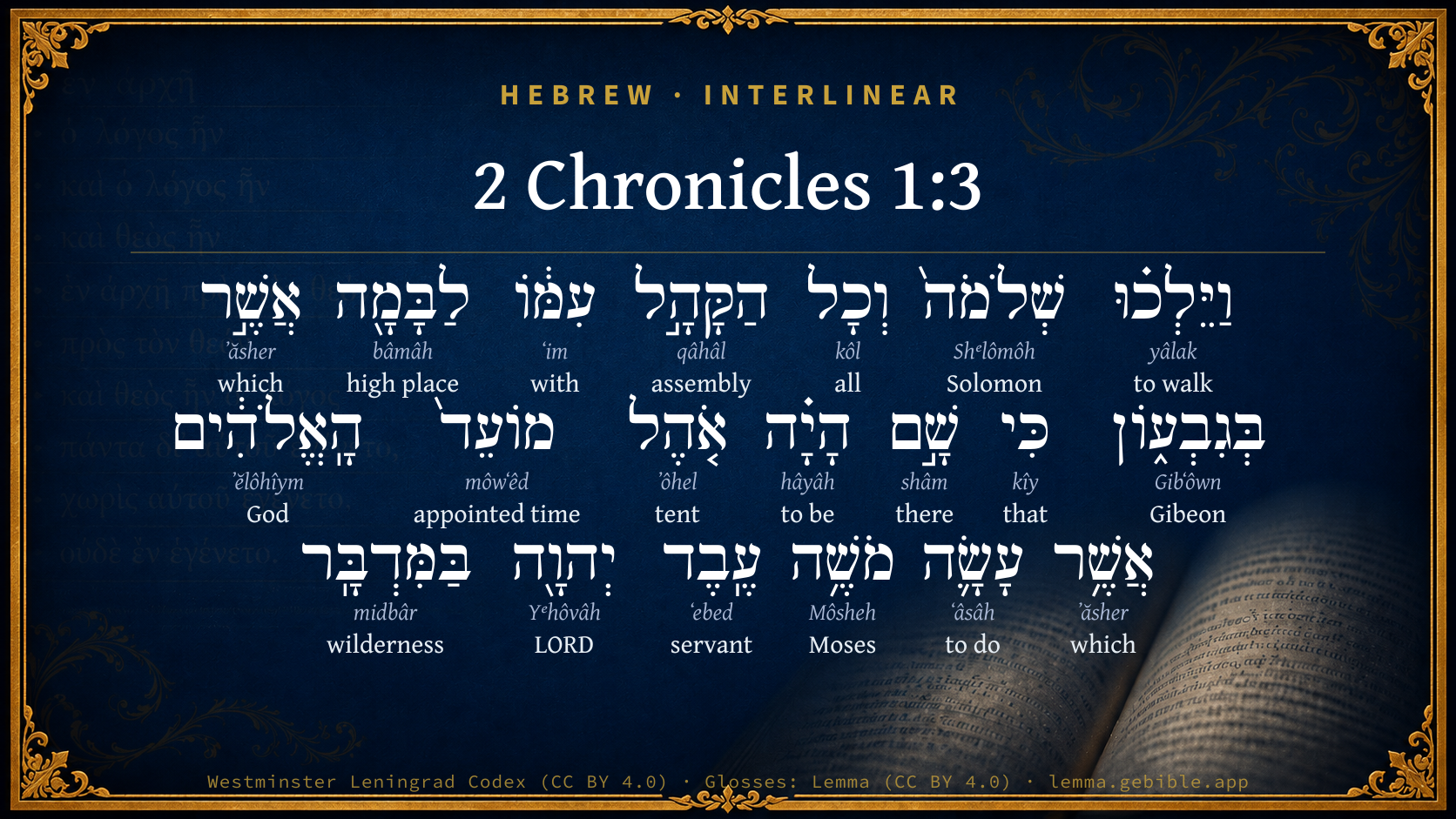
Hebrew (Westminster Leningrad Codex) 2 Chronicles 1:3 appears in the Hebrew Old Testament. The text above is from the Westminster Leningrad Codex. Each word links to its Strong’s number, a concise gloss, and parsing drawn from the Open Scriptures Hebrew Bible morphology. Click any word for its full Brown-Driver-Briggs (BDB) entry.
Download image
Cite this verse

2 Chronicles 1:3 (World English Bible). Public Domain. Lemma interlinear Bible study tool, https://lemma.gebible.app/v/2-chronicles/1/3.

Show BibTeX & RIS
BibTeX
RIS
English Translation
So Solomon, and all the assembly with him, went to the high place that was at Gibeon; for there was the tent of meeting of God, which Moses the servant of Yahweh had made in the wilderness.
World English Bible · Public Domain
Download a study sheet

One document with this verse’s original text, its word-by-word gloss line, the meaning frame, cross-references with their text, attributed commentary, and full source and license credits — printable, and it pastes into notes with its structure intact.

This verse Autodidact and up

Study sheet (.html) Plain text (.txt)

A passage Seminary Student

Up to 50 verses in one chapter. A passage sheet keeps up to 6 commentary sources and 12 cross-references per verse, in the order this page ranks them, and says so on the sheet whenever that leaves anything out. Ask for a single verse and you get the Autodidact verse sheet above.

Everything on this page stays free to read, with no account — the sheet is a download of what is already on screen, not access to it.

Want to remove ads? Support Godless Engineer
Compare translations 3

The same verse in 3 English versions, stacked beneath the original-language interlinear above. Click any original word for its lexicon entry.

Each is an independent rendering of the whole verse — the interlinear is not word-aligned to these translations.

Highlighted words mark where these versions differ — a whole-verse word diff, not a word-by-word alignment.

  • World English Bible Public Domain
    So Solomon, and all the assembly with him, went to the high place that was at Gibeon; for there was the tent of meeting of God, which Moses the servant of Yahweh had made in the wilderness.
  • King James Version Public Domain
    So Solomon, and all the congregation with him, went to the high place that was at Gibeon; for there was the tabernacle of the congregation of God, which Moses the servant of the LORD had made in the wilderness.
  • unfoldingWord Literal Text CC BY-SA 4.0
    And Solomon went and all the assembly with him to the high place that was at Gibeon, for there was the tent of meeting of God, which Moses the servant of Yahweh, had made in the wilderness.

unfoldingWord Literal Text — © unfoldingWord, licensed CC BY-SA 4.0. Word-aligned USFM3 via Door43 (git.door43.org/unfoldingWord/en_ult).

Versions to compare (up to 4)

3 of 4 selected

Show all 18 translations

Every available English version of this verse, each an independent rendering of the whole verse.

  • World English Bible Public Domain
    So Solomon, and all the assembly with him, went to the high place that was at Gibeon; for there was the tent of meeting of God, which Moses the servant of Yahweh had made in the wilderness.
  • Berean Standard Bible Public Domain
    And Solomon and the whole assembly went to the high place at Gibeon because it was the location of God’s Tent of Meeting, which Moses the servant of the LORD had made in the wilderness.
  • Majority Standard Bible Public Domain
    And Solomon and the whole assembly went to the high place at Gibeon because it was the location of God’s Tent of Meeting, which Moses the servant of the LORD had made in the wilderness.
  • King James Version Public Domain
    So Solomon, and all the congregation with him, went to the high place that was at Gibeon; for there was the tabernacle of the congregation of God, which Moses the servant of the LORD had made in the wilderness.
  • American Standard Version (1901) Public Domain
    So Solomon, and all the assembly with him, went to the high place that was at Gibeon; for there was the tent of meeting of God, which Moses the servant of Jehovah had made in the wilderness.
  • Revised Version (1885) Public Domain
    So Solomon, and all the congregation with him, went to the high place that was at Gibeon; for there was the tent of meeting of God, which Moses the servant of the LORD had made in the wilderness.
  • Geneva Bible (1599) Public Domain
    So Salomon and all the Congregation with him went to the hie place that was at Gibeon: for there was the Tabernacle of the Congregation of God which Moses the seruant of the Lord had made in the wildernesse.
  • Douay-Rheims (1899) Public Domain
    And he went with all the multitude to the high place of Gabaon, where was the tabernacle of the covenant of the Lord, which Moses the servant of God made, in the wilderness.
  • Young's Literal Translation Public Domain
    and they go -- Solomon, and all the assembly with him -- to the high place that `is' in Gibeon, for there hath been God's tent of meeting, that Moses, servant of Jehovah, made in the wilderness,
  • Literal Standard Version CC BY-SA 4.0
    and they go—Solomon, and all the assembly with him—to the high place that [is] in Gibeon, for God’s Tent of Meeting has been there, that Moses, servant of YHWH, made in the wilderness,
  • Unlocked Literal Bible CC BY-SA 4.0
    So Solomon and all the assembly with him went to the high place that was at Gibeon, for there was the tent of meeting of God, which Moses the servant of Yahweh, had made in the wilderness.
  • unfoldingWord Literal Text CC BY-SA 4.0
    And Solomon went and all the assembly with him to the high place that was at Gibeon, for there was the tent of meeting of God, which Moses the servant of Yahweh, had made in the wilderness.
  • Darby Bible Public Domain
    and Solomon, and all the congregation with him, went to the high place at Gibeon; for there was God's tent of meeting which Moses the servant of Jehovah had made in the wilderness.
  • World Messianic Bible Public Domain
    Then Solomon, and all the assembly with him, went to the high place that was at Gibeon; for God’s Tent of Meeting was there, which the LORD’s servant Moses had made in the wilderness.
  • Webster's Bible Public Domain
    So Solomon, and all the congregation with him, went to the high place that was at Gibeon: for there was the tabernacle of the congregation of God, which Moses the servant of the LORD had made in the wilderness.
  • Free Bible Version CC BY-SA 4.0
    Solomon went with the whole assembly to the high place at Gibeon, for this was the site of God's Tent of Meeting that Moses, the Lord's servant, had made in the wilderness.
  • Bible in Basic English Public Domain
    Then Solomon, and all the men of Israel with him, went to the high place at Gibeon, because the Tent of meeting of God, which Moses, the servant of the Lord, had made in the waste land, was there.
  • JPS Tanakh (1917) Public Domain
    So Solomon, and all the congregation with him, went to the high place that was at Gibeon; for there was the tent of meeting of God, which Moses the servant of the LORD had made in the wilderness.

Literal Standard Version (2020), Covenant Press — licensed CC BY-SA 4.0. Text via the HelloAO Bible API (eBible.org). Unlocked Literal Bible (unfoldingWord) — licensed CC BY-SA 4.0. Text via the HelloAO Bible API (eBible.org). unfoldingWord Literal Text — © unfoldingWord, licensed CC BY-SA 4.0. Word-aligned USFM3 via Door43 (git.door43.org/unfoldingWord/en_ult). Free Bible Version, Dr. Jonathan Gallagher — licensed CC BY-SA 4.0. Text via the HelloAO Bible API (eBible.org).

Word by word

More ways to search: Search by grammar → Find every occurrence → Compare this word →

Practice this passage: Drill this verse → Learn its vocabulary →

בְּגִבְע֑וֹן
Gibʻôwn
H1391
“in/at · Gibeon”
Preposition + Noun, Proper
Part of Speech
Preposition + Noun
Type
Proper
Full BDB Definition

Origin: from the same as H1387

TWOT: None

Gibeon = "hill city" - a Levitical city of Benjamin, modern 'el-Jib', which lies 5 miles or 8 kilometers from Jerusalem
  1. וַיֵּלְכ֗וּ yâlak H3212 “and · to walk” Conjunction + Verb, Qal, Sequential Imperfect, 3rd Person, Masculine, Plural
  2. שְׁלֹמֹה֙ Shᵉlômôh H8010 “Solomon” Noun, Proper
  3. וְכָל kôl H3605 “and · all of” Conjunction + Noun, Common, Masculine, Singular, Construct
  4. הַקָּהָ֣ל qâhâl H6951 “the · assembly” Particle, Definite Article + Noun, Common, Masculine, Singular, Absolute
  5. עִמּ֔וֹ ʻim H5973 “with · him” Preposition + Suffix, Personal, 3rd Person, Masculine, Singular
  6. לַבָּמָ֖ה bâmâh H1116 “to/for the · high place” Preposition, Determined + Noun, Common, Feminine, Singular, Absolute
  7. אֲשֶׁ֣ר ʼăsher H834 “which” Particle, Relative
  8. כִּי kîy H3588 “that” Conjunction
  9. שָׁ֣ם shâm H8033 “there” Adverb
  10. הָיָ֗ה hâyâh H1961 “to be” Verb, Qal, Perfect, 3rd Person, Masculine, Singular
  11. אֹ֤הֶל ʼôhel H168 “tent of” Noun, Common, Masculine, Singular, Construct
  12. מוֹעֵד֙ môwʻêd H4150 “appointed time of” Noun, Common, Masculine, Singular, Construct
  13. הָֽאֱלֹהִ֔ים ʼĕlôhîym H430 “the · God(s)” Particle, Definite Article + Noun, Common, Masculine, Plural, Absolute
  14. אֲשֶׁ֥ר ʼăsher H834 “which” Particle, Relative
  15. עָשָׂ֛ה ʻâsâh H6213 “to do” Verb, Qal, Perfect, 3rd Person, Masculine, Singular
  16. מֹשֶׁ֥ה Môsheh H4872 “Moses” Noun, Proper
  17. עֶֽבֶד ʻebed H5650 “servant of” Noun, Common, Masculine, Singular, Construct
  18. יְהוָ֖ה Yᵉhôvâh H3068 “LORD” Noun, Proper
  19. בַּמִּדְבָּֽר midbâr H4057 “in/at the · wilderness” Preposition, Determined + Noun, Common, Masculine, Singular, Absolute

About this verse

These counts appear in no published source. They are computed here, from the morphology-tagged text and Lemma’s own curated glosses. What Lemma adds →

20
words
19
distinct lemmas
Historical
section

Shared distinctive vocabulary

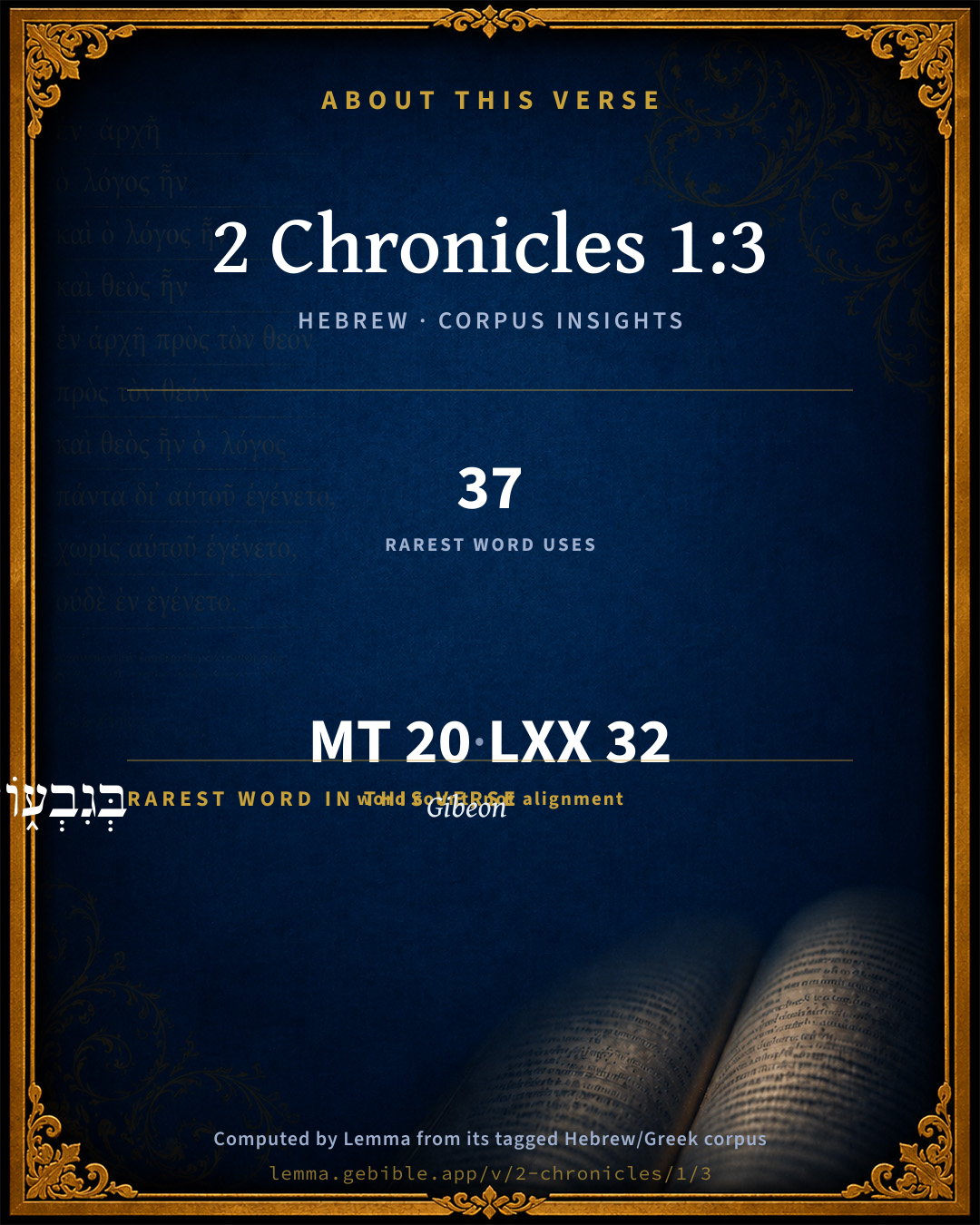
בְּגִבְע֑וֹן Gibeon H1391 occurs in 35 verses of the Hebrew Bible. Also found in:

Grammatical profile

  • 3 verbs
  • 12 nouns
  • 1 preposition
  • 1 conjunction
  • 1 adverb
  • 2 particles

Verb forms

  • וַיֵּלְכ֗וּ Qal · Sequential Imperfect
  • הָיָ֗ה Qal · Perfect
  • עָשָׂ֛ה Qal · Perfect

Repetition

A word recurs within this verse — often emphatic in Hebrew:

  • אֲשֶׁ֣ר which H834 ×2

Hebrew & Septuagint length

In English translation the verse runs 37 words from the Hebrew and 32 from the Septuagint (LXX English) — closely comparable.

A rough comparison of the two English renderings, which tokenize alike — not a word-level alignment.

Word counts can differ between the Hebrew and the Greek without any difference in meaning — e.g. the Hebrew direct-object marker אֵת has no separate Greek word, and Greek often adds the article ὁ.

In the original languages it is 20 Hebrew tokens and 32 Greek tokens — but the two are counted differently (Hebrew bundles its prefixes and suffixes into one token; the Greek is in lemma form), so that isn’t a like-for-like length.

Cross-references

9

Topical passages linked to 2 Chronicles 1:3 in the Treasury of Scripture Knowledge — connected by theme and wording, ordered by reader-vote popularity; previews shown in the World English Bible.

  • 1 Chronicles 16:39 and Zadok the priest, and his brothers the priests, before the tent of Yahweh in the high place that was at Gibeon,
  • 1 Chronicles 21:29 For the tent of Yahweh, which Moses made in the wilderness, and the altar of burnt offering, were at that time in the high place at Gibeon.
  • Exodus 26:1–37 "Moreover you shall make the tent with ten curtains; of fine twined linen, and blue, and purple, and scarlet, with cherubim. The work of the skillful workman you shall make them.
  • Exodus 36:8 All the wise-hearted men among those who did the work made the tent with ten curtains; of fine twined linen, blue, purple, and scarlet, with cherubim, the work of the skillful workman, they made them.
  • Exodus 40:2 "On the first day of the first month you shall raise up the tent of the Tent of Meeting.
  • Exodus 40:34 Then the cloud covered the tent of meeting, and the glory of Yahweh filled the tent.
  • Leviticus 1:1 Yahweh called to Moses, and spoke to him out of the Tent of Meeting, saying,
  • Deuteronomy 34:5 So Moses the servant of Yahweh died there in the land of Moab, according to the word of Yahweh.
  • 1 Kings 3:4–15 The king went to Gibeon to sacrifice there; for that was the great high place: a thousand burnt offerings did Solomon offer on that altar.

Cross-references courtesy of OpenBible.info (CC BY 4.0).

Hebrew and Greek witnesses Masoretic Hebrew ↔ Greek Septuagint

The same verse in the two great witnesses to the Old Testament, shown verse-for-verse.

These are two independent witnesses, not word-aligned to each other, and the Septuagint is shown in lemma (dictionary) form.

Hebrew 2 Chronicles 1:3 Masoretic · Westminster Leningrad Codex

וַיֵּלְכ֗וּ שְׁלֹמֹה֙ וְכָל הַקָּהָ֣ל עִמּ֔וֹ לַבָּמָ֖ה אֲשֶׁ֣ר בְּגִבְע֑וֹן כִּי שָׁ֣ם הָיָ֗ה אֹ֤הֶל מוֹעֵד֙ הָֽאֱלֹהִ֔ים אֲשֶׁ֥ר עָשָׂ֛ה מֹשֶׁ֥ה עֶֽבֶד יְהוָ֖ה בַּמִּדְבָּֽר

So Solomon, and all the assembly with him, went to the high place that was at Gibeon; for there was the tent of meeting of God, which Moses the servant of Yahweh had made in the wilderness.

World English Bible · Public Domain

Greek LXX 2 Chronicles 1:3 Septuagint · lemma form

καί πορεύομαι σαλωμών καί πᾶς ὁ ἐκκλησία μετά αὐτός εἰς ὁ ὑψηλός ὁ ἐν γαβαων ὅς ἐκεῖ εἰμί ὁ σκηνή ὁ μαρτύριον ὁ θεός ὅς ποιέω μωυσῆς παῖς κύριος ἐν ὁ ἐρῆμος

and Solomon and all the congregation went to the high place that was in Gabaon, where was God's tabernacle of witness, which Moses the servant of the Lord made in the wilderness.

LXX2012 (modern English Septuagint) · Public Domain

Hebrew: Westminster Leningrad Codex (CC BY 4.0). Greek: Septuagint (public domain); English from LXX2012 (modern English Septuagint) (Public Domain). How the Septuagint differs from the Hebrew →

Commentary

Notes on 2 Chronicles 1:3 from classic Christian and Jewish commentators (each source and its license shown beneath its notes). The classic Christian expositions comment on the surrounding passage and are grouped to its opening verse, so a note may address several verses; the Jewish commentaries on the Tanakh (Rashi and others) are per-verse, so they appear only where the commentator wrote on this verse.

Lemma curates 59 commentaries, every one of them public domain or Creative Commons licensed, each selected and text-cleaned for this edition rather than reprinted as found. About our sources →

Trapp's Complete Commentary

John Trapp

2Ch 1:3 So Solomon, and all the congregation with him, went to the high place that [was] at Gibeon; for there was the tabernacle of the congregation of God, which Moses the servant of the LORD had made in the wilderness.

Ver. 3. Went to the high place.] This word is usually taken in an ill sense: but here in a good. {a} See on 1Ki 3:4.

{a} Vatab.

John Trapp, A Commentary or Exposition upon All the Books of the Old and New Testament (1647–1656) — public domain. Text from a community e-Sword module.

Joseph Benson's Commentary

2Ch 1:3-4. Solomon, &c., went to the high place at Gibeon — Upon which the tabernacle was placed; whence it is called the great high place, 1Ki 3:4. But the ark, &c. — David had separated the ark from the tabernacle, and brought it to Jerusalem, because there he intended to build a far more noble and lasting habitation for it.

Joseph Benson's Commentary on the Old and New Testaments (1811–1818) — public domain. Text from a community e-Sword module.

Tyndale Open Study Notes

Tyndale Open Resources

1:3 Tabernacle: See study note on Exod 27:21.

Tyndale Open Study Notes — © Tyndale Open Resources, licensed CC BY-SA 4.0. Text via the HelloAO Bible API.

Geneva Bible (1599)

Geneva Bible translators

Read 1 Kings 3:4.

So called, because that God thereby showed certain signs to the congregation of his presence.

Geneva Bible (1599) marginal notes — public domain. Text via Bolls.life.

Ellicott's Commentary for English Readers

(3) The tabernacle of the congregation of God.—Rather, God’s tent of meeting; viz., with man (Exo_25:22; Exo_27:21; Num_17:4). Solomon repaired to Gibeon because “that was the great high place” (1Ki_3:4). We learn from our text why Gibeon stood pre-eminent above the other high places. (Comp. 1Ch_6:31 sqq.; 1Ch_16:39 sqq.)

A Bible Commentary for English Readers, edited by Charles John Ellicott (1878–1897) — public domain. Text from a community e-Sword module.

The Cambridge Bible for Schools and Colleges

gen. ed. J. J. S. Perowne

3. and all the congregation] The attendance of the chief representatives of the people at the great sacrifice with which Solomon seems to have inaugurated his reign is probable in itself, but it is passed over in the brief notice in 1Ki_3:4.

at Gibeon] Cp. 1Ch_16:39; 1Ch_21:29; 1Ki_3:4. It was a city of Benjamin. The Chronicler defends this instance of high-place worship by his explanation that the Tabernacle was on the high place.

the tabernacle of the congregation] R.V. the tent of meeting (cp. R.V. Preface, p. vi.). So 2Ch_1:5.

in the wilderness] See Exo_25:1 ff; Exo_35:4 ff.

The Cambridge Bible for Schools and Colleges (gen. ed. J. J. S. Perowne; Cambridge University Press, 1878–1918) — public domain. Text from a community e-Sword module.

John Gill's Exposition

So Solomon, and all the congregation with him, went to the high place that was at Gibeon,.... They agreed to his motion, and went with him thither, see Kg1 3:4.

for there was the tabernacle of the congregation of God, which Moses the servant of the Lord had made in the wilderness: by the Lord's direction; where was also the altar of the Lord, and so most proper to offer sacrifice on, which was what Solomon went thither to do; see Ch1 21:29.

John Gill's Exposition of the Whole Bible (1746–1763) — public domain (CC PDM 1.0). Text via the HelloAO Bible API.

Matthew Poole's English Annotations

To the high place; upon which the tabernacle was placed; whence it is called the great high place, 1Ki 3:4.

Matthew Poole's English Annotations on the Holy Bible (1683–1685) — public domain. Text from a community e-Sword/MySword module.

The Pulpit Commentary

All the congregation; i.e. in the persons of their captains, judges, princes, and family representatives. The high place at Gibeon. It may readily be allowed that even nature and instinct would suggest a certain fitness in selecting high places, and the impressive grandeur of groves, for the worship of the High and Lofty One and for the offerings of sacrifice to him. It was not otherwise historically. (Gen_12:7, 8 22:3, 4 31:54) However, first, it was part of the education of a nation (situated in the heart of the young world) in the unity of the one God, that its worship should be offered in one place, and the smoke of its sacrifices ascend from one altar; and secondly, it was not difficult to foresee that the very force that lay in the associations, which dictated the choice of some places (not least, certainly, "the grove"), would constitute their weakness and snare. The prohibitions, therefore, of the Mosaic Law, (Deu_12:5, Deu_12:11, Deu_12:14, Deu_12:19, Deu_12:21, Deu_12:26) witnessed to by such corroborations as are found in commands to obliterate certain Canaanitish traces, that looked long time a different way (Lev_17:8 Lev_26:30; Num_33:52; Deu_33:29; Jos_22:29; 1Ki_20:23) approve themselves as in thorough harmony with what all would feel to be the genius of the religious education of Israel, and, through Israel, of the nations of the world. The wonder that impresses us is rather that means were not found to abide by the "letter" of the Law to a far greater degree during all the generations that elapsed before the people were settled in their land, and were gathered in their temple so typical. Is it not possible to regard this as an impressive instance of how, even in a system that sought to be of the closest and most exclusive, the spirit," by force of circumstances, resented the tyrannous bondage of the "letter"? Anyway, for ages from the time of that prohibition, the nation had the moral principle as their guide rather than any possibility of keeping safe within a commandment"s "letter" (so see Jud_1:6:25, 26 13:17-24; 1Sa_7:10 1Sa_13:9 1Sa_16:5 1Sa_10:5; 1Ch_21:26; 1Ki_18:30) Even now, accordingly, the prohibited is still the observed, and by Solomon, too, in the steps of David, even if it be necessary to describe it as the "winked at." And to the "high place" at Gibeon Solomon and all the representatives, the congregation of Israel, have to repair in order to do sacrifice. The tabernacle was now at Gibeon, whither it had come from 1Ch_16:39, 1Ch_16:40; 1Sa_21:1, 1Sa_21:6; from which latter reference, speaking of the "shew-bread," it comes that we know the tabernacle to have resided at Nob awhile; for the circumstance is not positively narrated in any passage of the history (but see also. (1Sa_22:9, 1Sa_22:11) Gibeon was one of the four Hivite cities, the other three being Beeroth, Chephirah, and Kirjath-jearim. It had its first fame from its "wiliness". (Jos_9:3, Jos_9:4, etc.) By the directest road, it was five miles distant from Jerusalem, in the direction of the sea. It was further noted for the encounter between Joab and Abner. (2Sa_2:12-17) Again, for the slaying of Amasa by Joab, (2Sa_20:6-10) and for the death of Joab himself at the hand of Benalak, at the very horns of the altar. (1Ki_2:28-34) Although the exact date of the lodging of the tabernacle at Gibeon is not told us, nor even the person who was answerable for briging it there, yet there can be no reasonable doubt that it was David, as we read (1Ch_16:40) of his appointing the priests to offer "the daily sacrifices" there, on the brazen altar of Moses, when Zadok was at their head, and Heman and Jeduthun were their resident musicians. In what particular part of Gibeon or of its immediate neighbourhood the tabernacle was stationed cannot be said with any certainty. Amid a considerable choice of likely places, one forming part of Gibeon itself, and just south of El-Tib, seems the likeliest, and to be preferred to the suggestion of Stanley ("Sinai and Palestine," p. 216), of Neby-Samuil, which is a mile distant. The present imposing occasion is the last of any importance on which Gibeon is brought before us (see also 1Ki_8:3; 1Ch_9:35) There was the tabernacle. The removal of the tabernacle to Gibeon no doubt followed immediately on the destruction of Nob by Saul. (1Ch_16:39, 1Ch_16:40, compared with 37; 21:28, 29) Moses made in the wilderness. (see Ex 25 Ex 26 Ex 27 Exo_33:7-10)

Vers. 3-5.

The ark and the altar; obedience and sacrifice.

How came it to pass that the ark was in one place, and the tabernacle and the brazen altar in another? How did it happen that the ark was in Jerusalem, and the altar of sacrifice at Gibeon? Surely they should have been together. So it was originally ordained; so it was at the beginning; and that was the final disposition. There was something irregular and not according to the commandment in the arrangement described in the text. It is difficult to understand how such a departure from the Divine plan could exist in a dispensation in which careful and even minute conformity to detail was accounted a virtue. The connection and the disconnection of these two institutions may suggest to us

I OUR TWOFOLD OBLIGATION AS SYMBOLIZED BY THE ARK AND THE ALTAR.

1. Of these one is worship or sacrifice. Men approached the altar of Jehovah with their gifts or sacrifices, and they then came consciously into his presence; they brought their oblations to him; they made a direct appeal to him for his mercy and his blessing. This forms one part., and a large part, of the obligation under which we rest toward God. Jew or Gentile, under any dispensation whether old or new, we are sacredly bound to draw near to God in reverent worship, to bring to him our pure and our costly offerings, to entreat of him his Divine favour, to pay unto him our vows.

2. The other is obedience. The ark contained the sacred tables of the Law on which were written by the hand of Moses the ten commandments. This was the great treasure of the ark, and it was always associated with these two tables; it was, therefore, the symbol of obedience. Both Jew and Gentile are under the very strongest bonds to "obey the voice of the Lord," "to keep his commandments," to do that which is right in his sight, and to shun all those things which he has condemned.

II OUR TEMPTATION. We are often tempted to do in life and in fact what was pictured here to put a distance between the altar and the ark, between worship and obedience. Too often there is a very wide gap, even a deep gulf, between the two. One man makes everything of forms of devotion, and nothing of purity and excellence of conduct. Another makes everything of behaviour, and nothing of worship. We are led, either by the current of the time or by the inclination of our own individual temperament, to go off in one direction and to leave the highway of Divine wisdom; to exaggerate one aspect of truth and to depreciate another; to put asunder what God has joined together and meant to go together. And this exaggeration, this separation, ends in error, in faultiness, in serious departure from the mind and the will of God.

III OUR WISDOM. As, later on, the ark and the altar were reunited, as they both stood within the precincts of the temple, and spoke of the vital connection between sacrifice and obedience, so should we see to it that, if there has been any separation of these two elements of piety in our experience, there should be a reunion and, in future, the closest association.

1. The habit of obedience should include the act of worship; for worship isone of those things which God has enjoined.

2. Each act of obedience should spring from the impulse which worshipfosters a desire to please and honour the present and observant Lord.

3. Worship should lead up to and end in obedience; for "to obey is betterthan sacrifice, and to hearken than the fat of rams" The devotion that ends in service, in purity, in truthfulness, in fidelity, in self-forgetting kindness, is after the mind of Jesus Christ. Let the ark never be far from the altar, but worship and obedience be always in close companionship. C.

The Pulpit Commentary (1880–1919), ed. H.D.M. Spence-Jones & Joseph S. Exell — public domain. Text from a community e-Sword module.

Scofield Reference Notes

C. I. Scofield

there was

(See Scofield "1Ch 16:37").

The Scofield Reference Bible (1917 edition), notes by C. I. Scofield — public domain. Text from a community e-Sword module.

Rashi

Rabbi Shlomo Yitzchaki (Rashi)

And Solomon and the entire assembly with him, etc. It is customary for Scripture to abbreviate, [as we find:] (Jonah 2:11): “And the Lord said to the fish, and it spewed Jonah onto the dry land,” and similarly (I Chron. 21:27): “And the Lord said to the angel, and his sword was returned to its sheath.”

Rashi on the Tanakh — English translations: “The Judaica Press complete Tanach with Rashi, translated by A. J. Rosenberg” (CC BY 4.0); “Pentateuch with Rashi's commentary by M. Rosenbaum and A.M. Silbermann, 1929-1934” (public domain); “The Metsudah Tanach series, Lakewood, N.J” (CC BY 4.0); and “The Book of Joshua, Metsudah Publications, 1997” (CC BY 4.0). Text via Sefaria.

Lesson kit

Teaching starters — assembled from the data on this page, not authored interpretation. Every prompt links to the verse data it draws on. Edit before teaching.

2 Chronicles, in the Historical, opens this verse with 20 words (19 distinct Hebrew lemmas). Its most distinctive word is Gibʻôwn (“Gibeon”). A historical commentator’s framing appears above. Read the whole chapter for the surrounding context.

Discussion questions

  1. The word Gibʻôwn carries the sense “Gibeon.” How does it shape the verse?
  2. Joshua 9:3 shares the word «Gibeon» with this verse. How do the two illuminate each other?
  3. “which” occurs 2× in this one verse. What is the effect of the repetition?
  4. These translations render this verse differently; the difference is in the English rendering, not the original. What questions does that raise?
  5. The verb «וַיֵּלְכ֗וּ» is Qal Sequential Imperfect. How does its form color the action?
  6. Reading how Trapp's Complete Commentary and Joseph Benson's Commentary read this verse, where do the two commentators agree and where do they part?

Things to notice

Reading settings

Reading text

Shown beneath each verse's original-language words.

Old Testament
Old Testament edition

Read the OT as the Masoretic Hebrew (MT) or the Greek Septuagint (LXX).

English shown for the Greek Septuagint (in the Hebrew ↔ Greek comparison).

Comparing translations? Open the Compare panel on any verse page to stack up to four side by side.