
Ezekiel 34:2

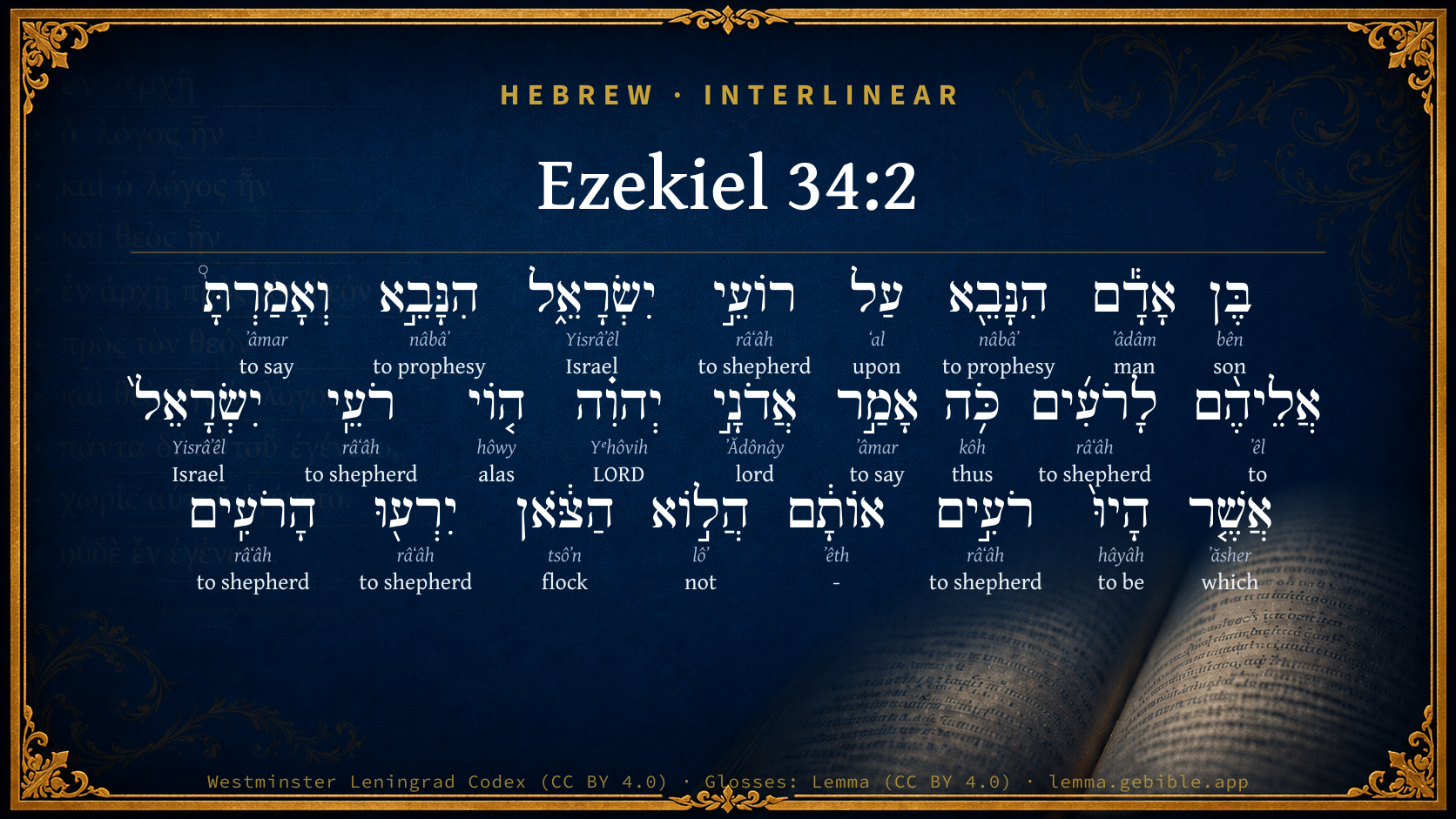
Hebrew (Westminster Leningrad Codex) Ezekiel 34:2 appears in the Hebrew Old Testament. The text above is from the Westminster Leningrad Codex. Each word links to its Strong’s number, a concise gloss, and parsing drawn from the Open Scriptures Hebrew Bible morphology. Click any word for its full Brown-Driver-Briggs (BDB) entry.
Download image
Cite this verse

Ezekiel 34:2 (World English Bible). Public Domain. Lemma interlinear Bible study tool, https://lemma.gebible.app/v/ezekiel/34/2.

Show BibTeX & RIS
BibTeX
RIS
English Translation
Son of man, prophesy against the shepherds of Israel, prophesy, and tell them, even to the shepherds, Thus says the Lord Yahweh: Woe to the shepherds of Israel who feed themselves! Shouldn't the shepherds feed the sheep?
World English Bible · Public Domain
Download a study sheet

One document with this verse’s original text, its word-by-word gloss line, the meaning frame, cross-references with their text, attributed commentary, and full source and license credits — printable, and it pastes into notes with its structure intact.

This verse Autodidact and up

Study sheet (.html) Plain text (.txt)

A passage Seminary Student

Up to 50 verses in one chapter. A passage sheet keeps up to 6 commentary sources and 12 cross-references per verse, in the order this page ranks them, and says so on the sheet whenever that leaves anything out. Ask for a single verse and you get the Autodidact verse sheet above.

Everything on this page stays free to read, with no account — the sheet is a download of what is already on screen, not access to it.

Want to remove ads? Support Godless Engineer
Compare translations 3

The same verse in 3 English versions, stacked beneath the original-language interlinear above. Click any original word for its lexicon entry.

Each is an independent rendering of the whole verse — the interlinear is not word-aligned to these translations.

Highlighted words mark where these versions differ — a whole-verse word diff, not a word-by-word alignment.

  • World English Bible Public Domain
    Son of man, prophesy against the shepherds of Israel, prophesy, and tell them, even to the shepherds, Thus says the Lord Yahweh: Woe to the shepherds of Israel who feed themselves! Shouldn't the shepherds feed the sheep?
  • King James Version Public Domain
    Son of man, prophesy against the shepherds of Israel, prophesy, and say unto them, Thus saith the Lord GOD unto the shepherds; Woe be to the shepherds of Israel that do feed themselves! should not the shepherds feed the flocks?
  • unfoldingWord Literal Text CC BY-SA 4.0
    “Son of man, prophesy against the shepherds of Israel. Prophesy and say to them, ‘The Lord Yahweh says this to the shepherds: Woe to the shepherds of Israel who are shepherding themselves. Should not shepherds guard the flock?

unfoldingWord Literal Text — © unfoldingWord, licensed CC BY-SA 4.0. Word-aligned USFM3 via Door43 (git.door43.org/unfoldingWord/en_ult).

Versions to compare (up to 4)

3 of 4 selected

Show all 18 translations

Every available English version of this verse, each an independent rendering of the whole verse.

  • World English Bible Public Domain
    Son of man, prophesy against the shepherds of Israel, prophesy, and tell them, even to the shepherds, Thus says the Lord Yahweh: Woe to the shepherds of Israel who feed themselves! Shouldn't the shepherds feed the sheep?
  • Berean Standard Bible Public Domain
    “Son of man, prophesy against the shepherds of Israel. Prophesy and tell them that this is what the Lord GOD says: ‘Woe to the shepherds of Israel, who only feed themselves! Should not the shepherds feed their flock?
  • Majority Standard Bible Public Domain
    “Son of man, prophesy against the shepherds of Israel. Prophesy and tell them that this is what the Lord GOD says: ‘Woe to the shepherds of Israel, who only feed themselves! Should not the shepherds feed their flock?
  • King James Version Public Domain
    Son of man, prophesy against the shepherds of Israel, prophesy, and say unto them, Thus saith the Lord GOD unto the shepherds; Woe be to the shepherds of Israel that do feed themselves! should not the shepherds feed the flocks?
  • American Standard Version (1901) Public Domain
    Son of man, prophesy against the shepherds of Israel, prophesy, and say unto them, even to the shepherds, Thus saith the Lord Jehovah: Woe unto the shepherds of Israel that do feed themselves! should not the shepherds feed the sheep?
  • Revised Version (1885) Public Domain
    Son of man, prophesy against the shepherds of Israel, prophesy, and say unto them, even to the shepherds, Thus saith the Lord GOD: Woe unto the shepherds of Israel that do feed themselves! should not the shepherds feed the sheep?
  • Geneva Bible (1599) Public Domain
    Sonne of man, prophesie against the shepherdes of Israel, prophesie and say vnto them, Thus saieth the Lord God vnto the shepherds, Wo be vnto the shepherds of Israel, that feede them selues: should not the shepherds feede the flockes?
  • Douay-Rheims (1899) Public Domain
    Son of man, prophesy concerning the shepherds of Israel: prophesy, and say to the shepherds: Thus saith the Lord God: Woe to the shepherds of Israel, that fed themselves: should not the hocks be fed by the shepherds?
  • Young's Literal Translation Public Domain
    `Son of man, prophesy concerning shepherds of Israel, prophesy, and thou hast said unto them: To the shepherds, thus said the Lord Jehovah: Wo `to' the shepherds of Israel, Who have been feeding themselves! The flock do not the shepherds feed?
  • Literal Standard Version CC BY-SA 4.0
    “Son of man, prophesy concerning shepherds of Israel, prophesy, and you have said to them, Thus said Lord YHWH to the shepherds: Woe [to] the shepherds of Israel, || Who have been feeding themselves! Do the shepherds not feed the flock?
  • Unlocked Literal Bible CC BY-SA 4.0
    “Son of man, prophesy against the shepherds of Israel. Prophesy and say to them, 'The Lord Yahweh says this to the shepherds: Woe to the shepherds of Israel who are shepherding themselves. Should not shepherds guard the flock?
  • unfoldingWord Literal Text CC BY-SA 4.0
    “Son of man, prophesy against the shepherds of Israel. Prophesy and say to them, ‘The Lord Yahweh says this to the shepherds: Woe to the shepherds of Israel who are shepherding themselves. Should not shepherds guard the flock?
  • Darby Bible Public Domain
    Son of man, prophesy against the shepherds of Israel, prophesy; and say unto them, unto the shepherds, Thus saith the Lord Jehovah: Woe to the shepherds of Israel that feed themselves! Should not the shepherds feed the flock?
  • World Messianic Bible Public Domain
    “Son of man, prophesy against the shepherds of Israel. Prophesy, and tell them, even the shepherds, ‘The Lord GOD says: “Woe to the shepherds of Israel who feed themselves! Shouldn’t the shepherds feed the sheep?
  • Webster's Bible Public Domain
    Son of man, prophesy against the shepherds of Israel, prophesy, and say to them, Thus saith the Lord GOD to the shepherds; Woe be to the shepherds of Israel that do feed themselves! should not the shepherds feed the flocks?
  • Free Bible Version CC BY-SA 4.0
    “Son of man, prophesy against the shepherds who lead Israel. Prophesy and tell them that this is what the Lord God says: Disaster is coming to the shepherds of Israel, who only look after themselves, and not the sheep! Shouldn't shepherds make sure their flock is fed?
  • Bible in Basic English Public Domain
    Son of man, be a prophet against the keepers of the flock of Israel, and say to them, O keepers of the sheep! this is the word of the Lord: A curse is on the keepers of the flock of Israel who take the food for themselves! is it not right for the keepers to give the food to the sheep?
  • JPS Tanakh (1917) Public Domain
    'Son of man, prophesy against the shepherds of Israel, prophesy, and say unto them, even to the shepherds: Thus saith the Lord GOD: Woe unto the shepherds of Israel that have fed themselves! should not the shepherds feed the sheep?

Literal Standard Version (2020), Covenant Press — licensed CC BY-SA 4.0. Text via the HelloAO Bible API (eBible.org). Unlocked Literal Bible (unfoldingWord) — licensed CC BY-SA 4.0. Text via the HelloAO Bible API (eBible.org). unfoldingWord Literal Text — © unfoldingWord, licensed CC BY-SA 4.0. Word-aligned USFM3 via Door43 (git.door43.org/unfoldingWord/en_ult). Free Bible Version, Dr. Jonathan Gallagher — licensed CC BY-SA 4.0. Text via the HelloAO Bible API (eBible.org).

Word by word

More ways to search: Search by grammar → Find every occurrence → Compare this word →

Practice this passage: Drill this verse → Learn its vocabulary →

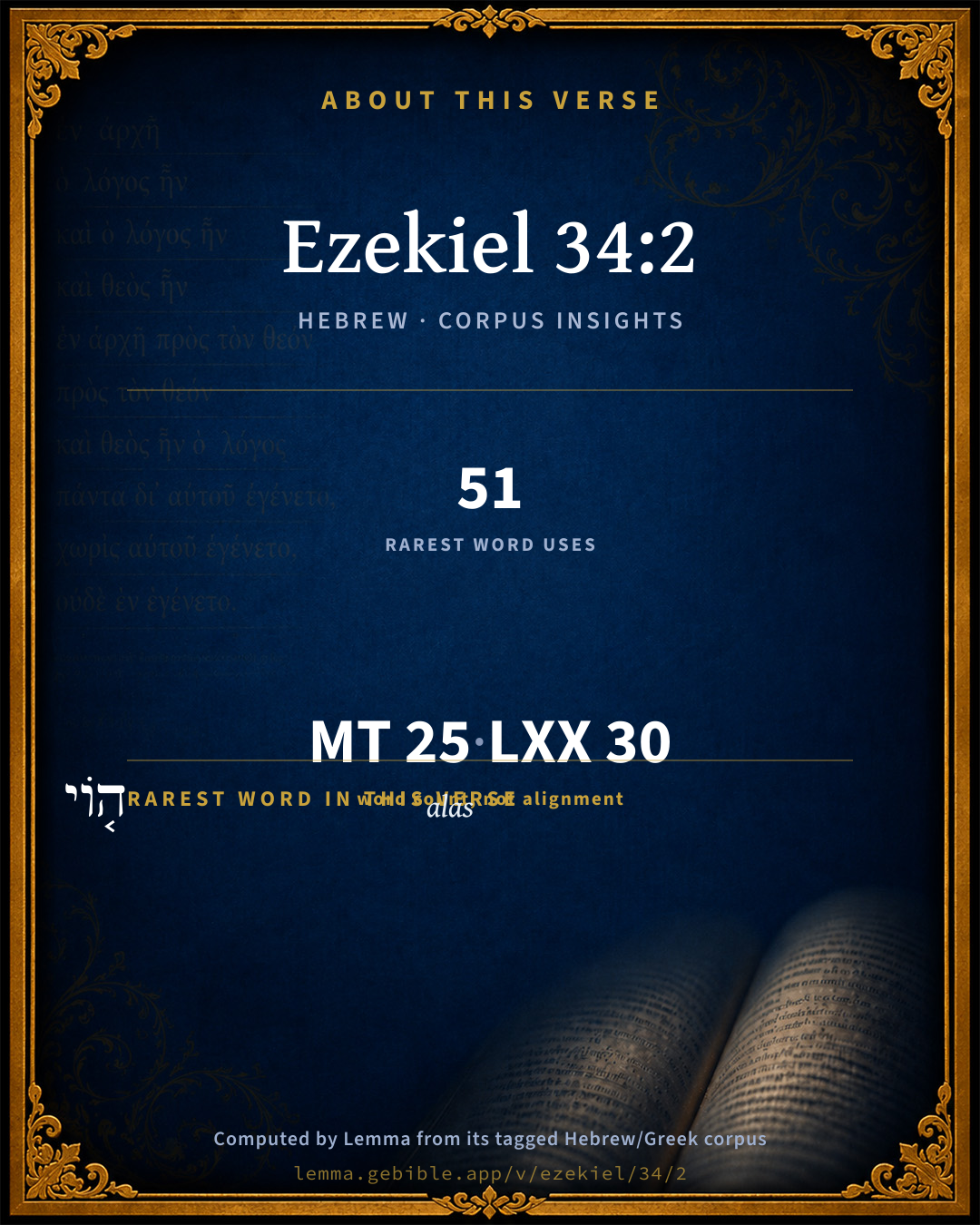
ה֤וֹי
hôwy
H1945
“alas”
Particle, Interjection
Part of Speech
Particle
Type
Interjection
Full BDB Definition

Origin: a prolonged form of H1930 [akin to H188 ]

TWOT: 485

ah!, alas!, ha!, ho!, O!, woe!
  1. בֶּן bên H1121 “son of” Noun, Common, Masculine, Singular, Construct
  2. אָדָ֕ם ʼâdâm H120 “man” Noun, Common, Masculine, Singular, Absolute
  3. הִנָּבֵ֖א nâbâʼ H5012 “prophesy” Verb, Niphal, Imperative, 2nd Person, Masculine, Singular
  4. עַל ʻal H5921 “upon” Preposition
  5. רוֹעֵ֣י râʻâh H7462 “shepherding” Verb, Qal, Participle Active, Masculine, Plural, Construct
  6. יִשְׂרָאֵ֑ל Yisrâʼêl H3478 “Israel” Noun, Proper
  7. הִנָּבֵ֣א nâbâʼ H5012 “prophesy” Verb, Niphal, Imperative, 2nd Person, Masculine, Singular
  8. וְאָמַרְתָּ֩ ʼâmar H559 “and · to say” Conjunction + Verb, Qal, Sequential Perfect, 2nd Person, Masculine, Singular
  9. אֲלֵיהֶ֨ם ʼêl H413 “to · them” Preposition + Suffix, Personal, 3rd Person, Masculine, Plural
  10. לָרֹעִ֜ים râʻâh H7462 “to/for the · shepherding” Preposition, Determined + Verb, Qal, Participle Active, Masculine, Plural, Absolute
  11. כֹּ֥ה kôh H3541 “thus” Adverb
  12. אָמַ֣ר ʼâmar H559 “to say” Verb, Qal, Perfect, 3rd Person, Masculine, Singular
  13. אֲדֹנָ֣י ʼĂdônây H136 “Lord · my” Noun, Common, Masculine, Plural, Construct + Suffix, Personal, 1st Person, Common, Singular
  14. יְהוִ֗ה Yᵉhôvih H3069 “LORD” Noun, Proper
  15. רֹעֵֽי râʻâh H7462 “shepherding” Verb, Qal, Participle Active, Masculine, Plural, Construct
  16. יִשְׂרָאֵל֙ Yisrâʼêl H3478 “Israel” Noun, Proper
  17. אֲשֶׁ֤ר ʼăsher H834 “which” Particle, Relative
  18. הָיוּ֙ hâyâh H1961 “to be” Verb, Qal, Perfect, 3rd Person, Common, Plural
  19. רֹעִ֣ים râʻâh H7462 “shepherding” Verb, Qal, Participle Active, Masculine, Plural, Absolute
  20. אוֹתָ֔ם ʼêth H853 “- · them” Particle, Direct Object + Suffix, Personal, 3rd Person, Masculine, Plural
  21. הֲל֣וֹא lôʼ H3808 “not” Particle, Interrogative + Particle, Negative
  22. הַצֹּ֔אן tsôʼn H6629 “the · flock” Particle, Definite Article + Noun, Common, Both, Singular, Absolute
  23. יִרְע֖וּ râʻâh H7462 “to shepherd” Verb, Qal, Imperfect, 3rd Person, Masculine, Plural
  24. הָרֹעִֽים râʻâh H7462 “the · shepherding” Particle, Definite Article + Verb, Qal, Participle Active, Masculine, Plural, Absolute

About this verse

These counts appear in no published source. They are computed here, from the morphology-tagged text and Lemma’s own curated glosses. What Lemma adds →

25
words
17
distinct lemmas
Prophets
section

Shared distinctive vocabulary

ה֤וֹי alas H1945 occurs in 47 verses of the Hebrew Bible. Also found in:

Grammatical profile

  • 11 verbs
  • 7 nouns
  • 2 prepositions
  • 1 adverb
  • 4 particles

Verb forms

  • הִנָּבֵ֖א Niphal · Imperative
  • רוֹעֵ֣י Qal · Participle Active
  • הִנָּבֵ֣א Niphal · Imperative
  • וְאָמַרְתָּ֩ Qal · Sequential Perfect
  • לָרֹעִ֜ים Qal · Participle Active
  • אָמַ֣ר Qal · Perfect
  • רֹעֵֽי Qal · Participle Active
  • הָיוּ֙ Qal · Perfect
  • רֹעִ֣ים Qal · Participle Active
  • יִרְע֖וּ Qal · Imperfect
  • הָרֹעִֽים Qal · Participle Active

Repetition

Words recur within this verse — often emphatic in Hebrew:

  • רוֹעֵ֣י to shepherd H7462 ×6
  • הִנָּבֵ֖א to prophesy H5012 ×2
  • יִשְׂרָאֵ֑ל Israel H3478 ×2
  • וְאָמַרְתָּ֩ to say H559 ×2

Hebrew & Septuagint length

In English translation the verse runs 37 words from the Hebrew and 35 from the Septuagint (LXX English) — closely comparable.

A rough comparison of the two English renderings, which tokenize alike — not a word-level alignment.

Word counts can differ between the Hebrew and the Greek without any difference in meaning — e.g. the Hebrew direct-object marker אֵת has no separate Greek word, and Greek often adds the article ὁ.

In the original languages it is 25 Hebrew tokens and 30 Greek tokens — but the two are counted differently (Hebrew bundles its prefixes and suffixes into one token; the Greek is in lemma form), so that isn’t a like-for-like length.

Cross-references

26

Topical passages linked to Ezekiel 34:2 in the Treasury of Scripture Knowledge — connected by theme and wording, ordered by reader-vote popularity; previews shown in the World English Bible.

  • Jeremiah 23:1 Woe to the shepherds who destroy and scatter the sheep of my pasture! says Yahweh.
  • Jeremiah 3:15 and I will give you shepherds according to my heart, who shall feed you with knowledge and understanding.
  • Isaiah 40:11 He will feed his flock like a shepherd, he will gather the lambs in his arm, and carry them in his bosom, [and] will gently lead those who have their young.
  • Ezekiel 34:8–10 As I live, says the Lord Yahweh, surely because my sheep became a prey, and my sheep became food to all the animals of the field, because there was no shepherd, neither did my shepherds search for my sheep, but the shepherds fed themselves, and didn't feed my sheep;
  • Luke 20:46–47 "Beware of the scribes, who like to walk in long robes, and love greetings in the marketplaces, the best seats in the synagogues, and the best places at feasts;
  • Jeremiah 10:21 For the shepherds are become brutish, and have not inquired of Yahweh: therefore they have not prospered, and all their flocks are scattered.
  • 2 Peter 2:3 In covetousness they will exploit you with deceptive words: whose sentence now from of old doesn't linger, and their destruction will not slumber.
  • Psalms 78:71–72 From following the ewes that have their young, He brought him to be the shepherd of Jacob, his people, And Israel, his inheritance.
  • Romans 16:18 For those who are such don't serve our Lord, Jesus Christ, but their own belly; and by their smooth and flattering speech, they deceive the hearts of the innocent.
  • Ezekiel 13:19 You have profaned me among my people for handfuls of barley and for pieces of bread, to kill the souls who should not die, and to save the souls alive who should not live, by your lying to my people who listen to lies.
  • Zechariah 11:17 Woe to the worthless shepherd who leaves the flock! The sword will be on his arm, and on his right eye. His arm will be completely withered, and his right eye will be totally blinded!"
  • John 21:15–17 So when they had eaten their breakfast, Jesus said to Simon Peter, "Simon, son of Jonah, do you love me more than these?" He said to him, "Yes, Lord; you know that I have affection for you." He said to him, "Feed my lambs."
  • Acts 20:29 For I know that after my departure, vicious wolves will enter in among you, not sparing the flock.
  • Jeremiah 2:8 The priests didn't say, Where is Yahweh? and those who handle the law didn't know me: the rulers also transgressed against me, and the prophets prophesied by Baal, and walked after things that do not profit.
  • Jeremiah 12:10 Many shepherds have destroyed my vineyard, they have trodden my portion under foot, they have made my pleasant portion a desolate wilderness.
  • Micah 3:11–12 Her leaders judge for bribes, And her priests teach for a price, And her prophets of it tell forturnes for money: Yet they lean on Yahweh, and say, Isn't Yahweh in the midst of us? No disaster will come on us.
  • Acts 20:26 Therefore I testify to you this day that I am clean from the blood of all men,
  • 1 Peter 5:2–4 Shepherd the flock of God which is among you, exercising the oversight, not under compulsion, but voluntarily, not for dishonest gain, but willingly;
  • Zephaniah 3:3–4 Her princes in the midst of her are roaring lions. Her judges are evening wolves. They leave nothing until the next day.
  • John 10:11–12 I am the good shepherd. The good shepherd lays down his life for the sheep.
  • Matthew 24:48–51 But if that evil servant should say in his heart, 'My lord is delaying his coming,'
  • Luke 12:42–46 The Lord said, "Who then is the faithful and wise steward, whom his lord will set over his household, to give them their portion of food at the right times?
  • John 10:1–2 "Most assuredly, I tell you, one who doesn't enter by the door into the sheep fold, but climbs up some other way, the same is a thief and a robber.
  • 2 Samuel 5:2 In times past, when Saul was king over us, it was you who led out and brought in Israel: and Yahweh said to you, You shall be shepherd of my people Israel, and you shall be prince over Israel.
  • Ezekiel 33:24 Son of man, they who inhabit those waste places in the land of Israel speak, saying, Abraham was one, and he inherited the land: but we are many; the land is given us for inheritance.
  • Micah 3:1–3 I said, "Please listen, you heads of Jacob, And rulers of the house of Israel: Isn't it for you to know justice?

Cross-references courtesy of OpenBible.info (CC BY 4.0).

Hebrew and Greek witnesses Masoretic Hebrew ↔ Greek Septuagint

The same verse in the two great witnesses to the Old Testament, shown verse-for-verse.

These are two independent witnesses, not word-aligned to each other, and the Septuagint is shown in lemma (dictionary) form.

Hebrew Ezekiel 34:2 Masoretic · Westminster Leningrad Codex

בֶּן אָדָ֕ם הִנָּבֵ֖א עַל רוֹעֵ֣י יִשְׂרָאֵ֑ל הִנָּבֵ֣א וְאָמַרְתָּ֩ אֲלֵיהֶ֨ם לָרֹעִ֜ים כֹּ֥ה אָמַ֣ר אֲדֹנָ֣י יְהוִ֗ה ה֤וֹי רֹעֵֽי יִשְׂרָאֵל֙ אֲשֶׁ֤ר הָיוּ֙ רֹעִ֣ים אוֹתָ֔ם הֲל֣וֹא הַצֹּ֔אן יִרְע֖וּ הָרֹעִֽים

Son of man, prophesy against the shepherds of Israel, prophesy, and tell them, even to the shepherds, Thus says the Lord Yahweh: Woe to the shepherds of Israel who feed themselves! Shouldn't the shepherds feed the sheep?

World English Bible · Public Domain

Greek LXX Ezekiel 34:2 Septuagint · lemma form

υἱός ἄνθρωπος προφητεύω ἐπί ὁ ποιμήν ὁ ἰσραήλ προφητεύω καί εἶπον ὁ ποιμήν ὅδε λέγω κύριος κύριος ὦ ποιμήν ἰσραήλ μή βόσκω ποιμήν ἑαυτοῦ οὐ ὁ πρόβατον βόσκω ὁ ποιμήν

Son of man, prophesy against the shepherds of Israel, prophesy, and say to the shepherds, Thus says the Lord God; O shepherds of Israel, do shepherds feed themselves? do not the shepherds feed the sheep?

LXX2012 (modern English Septuagint) · Public Domain

Hebrew: Westminster Leningrad Codex (CC BY 4.0). Greek: Septuagint (public domain); English from LXX2012 (modern English Septuagint) (Public Domain). How the Septuagint differs from the Hebrew →

Targum (Aramaic paraphrase)

1

The Targum is the ancient Jewish Aramaic paraphrase of the Hebrew Scriptures — an interpretive translation, not the Hebrew text itself. Onkelos (literal) and Pseudo-Jonathan (expansive) render the Torah, and Jonathan the Prophets. Coverage is partial: where no permissively-licensed English translation exists for a verse, only the Aramaic is shown. This is verse-level text, not a word-by-word alignment to the Hebrew.

  1. Targum Jonathan Prophets (Joshua–Malachi)
    בַּר אָדָם אִתְנַבֵּי עַל פַּרְנָסֵי יִשְׂרָאֵל אִתְנַבֵּי וְתֵימַר לְהוֹן לְפַרְנְסַיָא כִּדְנַן אֲמַר יְיָ אֱלֹהִים וַי עַל פַּרְנְסַיָא דְיִשְׂרָאֵל דַהֲווֹ מְפַרְנְסִין נַפְשֵׁיהוֹן הֲלָא לְפַרְנָסָא עַמָא אִתְמְנִיאוּ פַּרְנָסַיָא:

    (no public-domain English translation for this verse)

    Targum Jonathan — Aramaic: “Mikraot Gedolot” (public domain). English: “Sefaria Community Translation” (CC0 1.0 (public-domain dedication)); “London "Chaldee Paraphrase," 1871” (public domain). Text via Sefaria.

Commentary

Notes on Ezekiel 34:2 from classic Christian and Jewish commentators (each source and its license shown beneath its notes). The classic Christian expositions comment on the surrounding passage and are grouped to its opening verse, so a note may address several verses; the Jewish commentaries on the Tanakh (Rashi and others) are per-verse, so they appear only where the commentator wrote on this verse.

Lemma curates 59 commentaries, every one of them public domain or Creative Commons licensed, each selected and text-cleaned for this edition rather than reprinted as found. About our sources →

Trapp's Complete Commentary

John Trapp

Eze 34:2 Son of man, prophesy against the shepherds of Israel, prophesy, and say unto them, Thus saith the Lord GOD unto the shepherds; Woe [be] to the shepherds of Israel that do feed themselves! should not the shepherds feed the flocks?

Ver. 2. Prophesy against the shepherds.] Good shepherds they should have been, but they were naught, {Jer 23:1-4} and naught would come of them, for their maladministration.

Woe be to the shepherds of Israel.] Both to princes and priests, by whose evil government the people were so bad, as in the former chapter is fully set forth. Qualis rex, talis grex; the sheep will follow the shepherd; the common people are like a flock of cranes - as the first fly, all follow.

Should not the shepherds feed the flocks?] Such flocks especially as have golden fleeces, precious souls. Oh feed, feed, feed, saith our Saviour to Peter! {Joh 21:15} feed them for my sake, as the Syriac there hath it, rule them well, teach them well, go before them in good example, do all the offices of a faithful shepherd to them, and be instant, or stand close to the work; {2Ti 4:2} Dominus prope, the Arch-shepherd is at hand.

John Trapp, A Commentary or Exposition upon All the Books of the Old and New Testament (1647–1656) — public domain. Text from a community e-Sword module.

Joseph Benson's Commentary

Eze 34:2. Prophesy against the shepherds of Israel — The word shepherd, in the prophetical writings, comprehends both civil and ecclesiastical governors. See notes on Isa 56:11; Jer 2:8. Other writers also use the same expression; princes being called shepherds of their people, as well as those who have the immediate care of their souls: see Psa 78:71-72. Thus Homer calls Agamemnon, Ποιμεναλαων, the shepherd of the people. And as the threatenings here denounced extend to all sorts of governors, so the several sins of the princes, priests, and prophets are reproved, Eze 22:25, &c. Wo to the shepherds of Israel that feed themselves — That regard their own profit and advantage, not the good of the people committed to their charge. The beauty of the original, רעי אשׂר היו רעים אותם, may be expressed in Latin or Greek, though not in English: — pastoribus qui pascunt semet ipsos: τοις ποιμεσιν οι ποιμαινουσιν σαυτους. Plato, in the first book of his Commonwealth, describing the office of a magistrate, saith, “He should look upon himself as sustaining the office of a shepherd, that makes it his chief business to take care of his flock; not as if he were going to a feast to fill himself and satiate his appetite, or to a market to make what gain he can to himself.” Eusebius, in his twelfth book De Preparatione Evangelica, chap. 44., hath transcribed the whole passage, as an exact parallel to this place of Ezekiel. See Lowth.

Joseph Benson's Commentary on the Old and New Testaments (1811–1818) — public domain. Text from a community e-Sword module.

Tyndale Open Study Notes

Tyndale Open Resources

34:2-6 What sorrow awaits you shepherds: Israel’s leaders had not taken care of the weak or gone looking for those who had wandered away and were lost. They had pursued their own interests, feeding themselves at their flock’s expense. They ruled the sheep with harshness and cruelty, recalling how the Egyptians treated the Israelites in Moses’ time (Exod 1:13-14). The neglect and abuse of these cruel shepherds had scattered the Lord’s flock across the face of the earth.

Tyndale Open Study Notes — © Tyndale Open Resources, licensed CC BY-SA 4.0. Text via the HelloAO Bible API.

Geneva Bible (1599)

Geneva Bible translators

By the shepherds he meaneth the king, the Magistrates, Priests, and Prophets.

Geneva Bible (1599) marginal notes — public domain. Text via Bolls.life.

Adam Clarke's Commentary

Verse 2. Prophesy against the shepherds of Israel] The shepherds include, first, the priests and Levites; secondly, the kings, princes, and magistrates. The flock means the whole of the people. The fat and the wool, the tithes and offerings, the taxes and imposts. The reprehensible feeding and clothing with these, as to the priests and Levites, the using these tithes and offerings, not to enable them the better to fulfil the work of the ministry, but to pamper their own bodies, and support them in an idle voluptuous life; and in reference to the state, the employing the taxes and imposts, not for the support and administration of justice and good government, but to subsidize heathen powers, and maintain their own luxury and idolatrous prodigality.

Adam Clarke's Commentary on the Bible (1810–1826) — public domain. Text from a community e-Sword/MySword module.

Ellicott's Commentary for English Readers

(2) Shepherds of Israel.—This is a common Scriptural expression for rulers, and the whole context shows that these are the persons here intended. In the passage in Jeremiah 23 they are treated under this name separately from the prophets and priests, and also in Jer_2:8 they are distinguished from prophets and priests. The name itself is a peculiarly appropriate one, and seems to have been in use throughout the East, but especially in Israel, from the time when David was taken from the care of the flocks to feed the Lord’s people. (Comp. 2Sa_5:2; Psa_78:70-71.)

That do feed themselves.—This selfishness is characteristic of the unfaithful shepherd (comp. Joh_10:1-17), and is enlarged upon in Eze_34:3-4. The history shows that for a long time it had been eminently true of the rulers, and especially of the kings of Israel.

A Bible Commentary for English Readers, edited by Charles John Ellicott (1878–1897) — public domain. Text from a community e-Sword module.

The Cambridge Bible for Schools and Colleges

gen. ed. J. J. S. Perowne

2. the shepherds] i.e. the rulers. The term is chiefly used in later writings (Jer_2:8; Jer_3:15); it occurs, however, in Zechariah 9-11, the date of which is disputed. On Zedekiah cf. ch. 17, and on his immediate predecessors, Jer_22:10-30. In general, Jeremiah 23, Jer_25:32 seq.

unto the shepherds] Possibly this is a marginal heading which has crept into the text, cf. Jer_23:9, and the reading may be, thus saith the Lord God, Woe be to … For flocks, flock.

The Cambridge Bible for Schools and Colleges (gen. ed. J. J. S. Perowne; Cambridge University Press, 1878–1918) — public domain. Text from a community e-Sword module.

John Gill's Exposition

Son of man, prophesy against the shepherds of Israel,.... Or, "concerning" (p) them; the governors of them, as the Targum and Jarchi; their political governors, their kings, princes, and civil magistrates of every order and degree; so Kimchi interprets it of kings; and it was common with the eastern nations, and with the Greeks, to call kings shepherds; and one and the same word; in the Greek language, signifies to feed sheep, and to govern people; see Psa 78:72, also their ecclesiastical governors are intended, prophets, priests, Levites, scribes, and Pharisees; these were bad shepherds, or they would not have been prophesied against; and though they were shepherds of Israel, this must be done:

prophesy, and say unto them, thus saith the Lord God unto the shepherds: that the message to them might be the more regarded, it is ordered to be delivered in the name of the Lord; otherwise they would have been apt to have despised it, and charged the prophet with impertinence and rudeness:

woe be to the shepherds of Israel, that do feed themselves! that is, themselves only, and not the flock: had they fed the flock, as well as themselves, they would not have been blamed; but they took no care of the people over whom they were set only minded their own affairs, to get riches and honour, but neglected the good of the people, yea, cruelly oppressed them:

should not the shepherds feed the flocks? undoubtedly they should; it is their duty, the business of their office, so to do; kings to rule over their subjects, defend their persons and property, and secure their privileges and liberties to them; and ecclesiastical rulers, ministers of the word, should feed the flock or church of God committed to them with knowledge and understanding; see Jer 3:15.

(p) "de pastoribus", V. L. Grotius; "super pastores", Pagninus, Montanus.

John Gill's Exposition of the Whole Bible (1746–1763) — public domain (CC PDM 1.0). Text via the HelloAO Bible API.

Albert Barnes' Notes on the Bible

Shepherds - Not priests or prophets, but rulers and kings (see the Jer 2:8 note). The most ancient title for “ruler” is a monogram which occurs on the oldest monuments discovered in the cuneiform character. In the Assyrian language it became riu (compare Hebrew רעה râ‛âh =shepherd). In the traditions of Berosus we find that Alorus, the first king in the world, received from the Divinity the title of Shepherd. The title, as well as the monogram, was preserved to the latest times of the Assyrian monarchy. While the distress and misery of the people daily in creased, the last kings of Judah exacted more and more from their subjects and lavished more and more on personal luxury and show.

Albert Barnes' Notes on the Bible (1834–1885) — public domain. Text from a community e-Sword/MySword module.

Haydock's Catholic Bible Commentary

Shepherds. That is, princes, magistrates, chief priests, and scribes. (Challoner) --- Shepherds may lawfully take milk, (1 Corinthians ix. 7.) but the sheep and its wool belong to the master. (Worthington) --- Excellent instructions are here given for all in authority. (Calmet)

George Leo Haydock (1774–1849), Haydock's Catholic Family Bible and Commentary, 1859 edition — public domain. Excludes Psalms (Douay-Rheims chapter numbering differs from Protestant) and Deuterocanonical books (Catholic canon only).

Matthew Poole's English Annotations

The shepherds; the rulers of the people, both political, as kings, magicians, and princes, and also ecclesiastical, priests and prophets.

Israel; the two tribes, and the few that out of the ten did adhere to the house of David.

Prophesy; the command is repeated to encourage and engage the prophet to his work.

Thus saith the Lord God: Ezekiel speaks, but these rulers must know it is God that speaks by him.

Woe be to the shepherds! they have been principal causes of many sins, and exemplary actors in other sins, for which many woes were threatened; many already are come, and the rest will come, in which woes these rulers shall have more than ordinary share.

Feed themselves; contrive their own ease, advantage, honour, and ambitious projects. Let the consciences of these rulers, ecclesiastical and political, speak, ought they not, as shepherds, to take care of the sheep committed to their care?

The flocks; the sheep, both whole flocks and the single sheep, whole societies and particular members of them.

Matthew Poole's English Annotations on the Holy Bible (1683–1685) — public domain. Text from a community e-Sword/MySword module.

The Pulpit Commentary

Prophesy against the shepherds of Israel, etc. Our modern associations with the words, our use of terms like" the pastoral office," "the pastoral Epistles," lead us to think of the priests and prophets, the spiritual guides of the people, as being those whom the prophet has in view. In the language of the Old Testament, however, as in that of Homer ("Iliad," 1:1. 263; 2:1. 85, etc.), the shepherds of the people are always its kings and other civil rulers (1Ki_22:17; Psa_77:20 Psa_78:71; Jer_23:1-6) and those whom Ezekiel had in his thoughts were the tyrannous rulers of the house of David, like Jehoiakim and Zedekiah and their satellites. Our Christian thoughts of the word are the outcome of the leading of Joh_10:1-16 Joh_21:15-17; 1Pe_5:2-4; Act_20:28; but it is probably true that even there the original thought is still dominant. Christ is the "good Shepherd," because he is the true King. His ministers are shepherds as being officers in his kingdom. Should not the shepherds feed the flocks? The question is an appeal to the universal conscience of Israel and of mankind. No shepherd was worthy of his name who did not do that which the very name implied. He that neglects that duty is simply as a hireling or a robber. (Joh_10:10, Joh_10:12)

The Pulpit Commentary (1880–1919), ed. H.D.M. Spence-Jones & Joseph S. Exell — public domain. Text from a community e-Sword module.

John Wesley's Explanatory Notes

The shepherds - The rulers of the people kings, magistrates, and princes; as also priests, and prophets. Of Israel - The two tribes, and the few out of the ten that adhere to the house of David. That feed - Contrive their own ease, advantage, and honour.

John Wesley, Explanatory Notes Upon the Whole Bible (1754–1765) — public domain. Text via the GEBible commentary corpus.

Rashi

Rabbi Shlomo Yitzchaki (Rashi)

concerning the shepherds of Israel concerning the leaders of Israel.

who were shepherding themselves [Heb. אוֹתָם,] them. They enjoyed themselves with the money of their fellows who were under them.

Do not the shepherds shepherd the flocks It is not the custom of shepherds to shepherd the flocks and not to shepherd themselves?

Rashi on the Tanakh — English translations: “The Judaica Press complete Tanach with Rashi, translated by A. J. Rosenberg” (CC BY 4.0); “Pentateuch with Rashi's commentary by M. Rosenbaum and A.M. Silbermann, 1929-1934” (public domain); “The Metsudah Tanach series, Lakewood, N.J” (CC BY 4.0); and “The Book of Joshua, Metsudah Publications, 1997” (CC BY 4.0). Text via Sefaria.

Lesson kit

Teaching starters — assembled from the data on this page, not authored interpretation. Every prompt links to the verse data it draws on. Edit before teaching.

Ezekiel, in the Prophets, opens this verse with 25 words (17 distinct Hebrew lemmas). Its most distinctive word is hôwy (“alas”). A historical commentator’s framing appears above. Read the whole chapter for the surrounding context.

Discussion questions

  1. How does “alas” (hôwy) shape what this verse is saying?
  2. 1 Kings 13:30 shares the word «alas» with this verse. How do the two illuminate each other?
  3. “to shepherd” occurs 6× in this one verse. What is the effect of the repetition?
  4. The translations on this page render this verse differently — a whole-verse word diff, not a word-by-word alignment. What might account for the different wordings?
  5. The verb «הִנָּבֵ֖א» is Niphal Imperative. How does its form color the action?
  6. Reading how Trapp's Complete Commentary and Joseph Benson's Commentary read this verse, where do the two commentators agree and where do they part?

Things to notice

Reading settings

Reading text

Shown beneath each verse's original-language words.

Old Testament
Old Testament edition

Read the OT as the Masoretic Hebrew (MT) or the Greek Septuagint (LXX).

English shown for the Greek Septuagint (in the Hebrew ↔ Greek comparison).

Comparing translations? Open the Compare panel on any verse page to stack up to four side by side.