
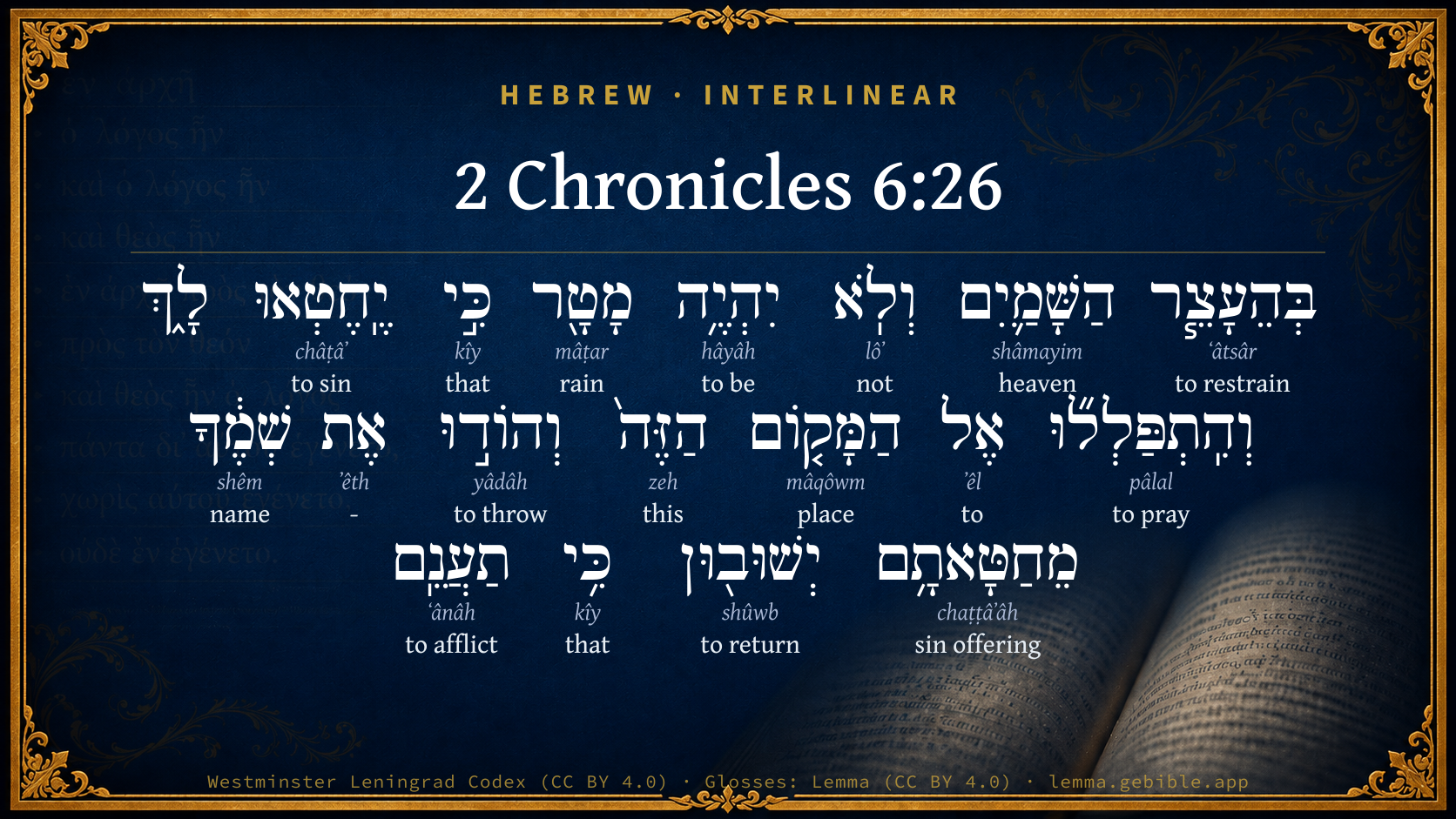
2 Chronicles 6:26

Hebrew (Westminster Leningrad Codex) 2 Chronicles 6:26 appears in the Hebrew Old Testament. The text above is from the Westminster Leningrad Codex. Each word links to its Strong’s number, a concise gloss, and parsing drawn from the Open Scriptures Hebrew Bible morphology. Click any word for its full Brown-Driver-Briggs (BDB) entry.
Download image
Cite this verse

2 Chronicles 6:26 (World English Bible). Public Domain. Lemma interlinear Bible study tool, https://lemma.gebible.app/v/2-chronicles/6/26.

Show BibTeX & RIS
BibTeX
RIS
English Translation
When the sky is shut up, and there is no rain, because they have sinned against you; if they pray toward this place, and confess your name, and turn from their sin, when you do afflict them:
World English Bible · Public Domain
Download a study sheet

One document with this verse’s original text, its word-by-word gloss line, the meaning frame, cross-references with their text, attributed commentary, and full source and license credits — printable, and it pastes into notes with its structure intact.

This verse Autodidact and up

Study sheet (.html) Plain text (.txt)

A passage Seminary Student

Up to 50 verses in one chapter. A passage sheet keeps up to 6 commentary sources and 12 cross-references per verse, in the order this page ranks them, and says so on the sheet whenever that leaves anything out. Ask for a single verse and you get the Autodidact verse sheet above.

Everything on this page stays free to read, with no account — the sheet is a download of what is already on screen, not access to it.

Want to remove ads? Support Godless Engineer
Compare translations 3

The same verse in 3 English versions, stacked beneath the original-language interlinear above. Click any original word for its lexicon entry.

Each is an independent rendering of the whole verse — the interlinear is not word-aligned to these translations.

Highlighted words mark where these versions differ — a whole-verse word diff, not a word-by-word alignment.

  • World English Bible Public Domain
    When the sky is shut up, and there is no rain, because they have sinned against you; if they pray toward this place, and confess your name, and turn from their sin, when you do afflict them:
  • King James Version Public Domain
    When the heaven is shut up, and there is no rain, because they have sinned against thee; yet if they pray toward this place, and confess thy name, and turn from their sin, when thou dost afflict them;
  • unfoldingWord Literal Text CC BY-SA 4.0
    When the heavens are restrained and there is no rain because they have sinned against you, and they pray toward this place, and they confess your name, from their sin they turn for you afflict them,

unfoldingWord Literal Text — © unfoldingWord, licensed CC BY-SA 4.0. Word-aligned USFM3 via Door43 (git.door43.org/unfoldingWord/en_ult).

Versions to compare (up to 4)

3 of 4 selected

Show all 18 translations

Every available English version of this verse, each an independent rendering of the whole verse.

  • World English Bible Public Domain
    When the sky is shut up, and there is no rain, because they have sinned against you; if they pray toward this place, and confess your name, and turn from their sin, when you do afflict them:
  • Berean Standard Bible Public Domain
    When the skies are shut and there is no rain because Your people have sinned against You, and they pray toward this place and confess Your name, and they turn from their sins because You have afflicted them,
  • Majority Standard Bible Public Domain
    When the skies are shut and there is no rain because Your people have sinned against You, and they pray toward this place and confess Your name, and they turn from their sins because You have afflicted them,
  • King James Version Public Domain
    When the heaven is shut up, and there is no rain, because they have sinned against thee; yet if they pray toward this place, and confess thy name, and turn from their sin, when thou dost afflict them;
  • American Standard Version (1901) Public Domain
    When the heavens are shut up, and there is no rain, because they have sinned against thee; if they pray toward this place, and confess thy name, and turn from their sin, when thou dost afflict them:
  • Revised Version (1885) Public Domain
    When the heaven is shut up, and there is no rain, because they have sinned against thee; if they pray toward this place, and confess thy name, and turn from their sin, when thou dost afflict them:
  • Geneva Bible (1599) Public Domain
    When heauen shall be shut vp, and there shalbe no rayne, because they haue sinned against thee, and shall pray in this place, and confesse thy Name, and turne from their sinne, when thou doest afflict them,
  • Douay-Rheims (1899) Public Domain
    If the heavens be shut up, and there fall no rain by reason of the sine of the people, and they shall pray to thee in this place, and confess to thy name, and be converted from their sins, when thou dost afflict them,
  • Young's Literal Translation Public Domain
    `In the heavens being restrained, and there is no rain, because they sin against Thee, and they have prayed towards this place, and confessed Thy name -- from their sin they turn back because Thou dost afflict them --
  • Literal Standard Version CC BY-SA 4.0
    In the heavens being restrained and there is no rain because they sin against You, and they have prayed toward this place and confessed Your Name, [and] they turn back from their sin because You afflict them—
  • Unlocked Literal Bible CC BY-SA 4.0
    When the skies are shut up and there is no rain because the people have sinned against you—if they pray toward this place, confess your name, and turn from their sin when you have afflicted them—
  • unfoldingWord Literal Text CC BY-SA 4.0
    When the heavens are restrained and there is no rain because they have sinned against you, and they pray toward this place, and they confess your name, from their sin they turn for you afflict them,
  • Darby Bible Public Domain
    When the heavens are shut up, and there is no rain, because they have sinned against thee; if they pray toward this place, and confess thy name, and turn from their sin, because thou hast afflicted them;
  • World Messianic Bible Public Domain
    “When the sky is shut up and there is no rain because they have sinned against you, if they pray toward this place and confess your name, and turn from their sin when you afflict them,
  • Webster's Bible Public Domain
    When the heaven is shut, and there is no rain, because they have sinned against thee; yet if they pray towards this place, and confess thy name, and turn from their sin, when thou dost afflict them;
  • Free Bible Version CC BY-SA 4.0
    If the skies are closed shut and there is no rain because your people have sinned against you, if they pray toward this place and if they come back in repentance to you, turning away from their sin because you have punished them,
  • Bible in Basic English Public Domain
    When heaven is shut up and there is no rain, because of their sin against you: if they make prayers with their faces turned to this place, honouring your name and turning away from their sin when you send trouble on them:
  • JPS Tanakh (1917) Public Domain
    When the heaven is shut up, and there is no rain, when they sin against Thee; if they pray toward this place, and confess Thy name, turning from their sin, when Thou dost afflict them;

Literal Standard Version (2020), Covenant Press — licensed CC BY-SA 4.0. Text via the HelloAO Bible API (eBible.org). Unlocked Literal Bible (unfoldingWord) — licensed CC BY-SA 4.0. Text via the HelloAO Bible API (eBible.org). unfoldingWord Literal Text — © unfoldingWord, licensed CC BY-SA 4.0. Word-aligned USFM3 via Door43 (git.door43.org/unfoldingWord/en_ult). Free Bible Version, Dr. Jonathan Gallagher — licensed CC BY-SA 4.0. Text via the HelloAO Bible API (eBible.org).

Word by word

More ways to search: Search by grammar → Find every occurrence → Compare this word →

Practice this passage: Drill this verse → Learn its vocabulary →

מָטָ֖ר
mâṭar
H4306
“rain”
Noun, Common, Masculine, Singular, Absolute
Part of Speech
Noun
Type
Common
Gender
Masculine
Number
Singular
State
Absolute
Full BDB Definition

Origin: from H4305

TWOT: 1187a

rain
  1. בְּהֵעָצֵ֧ר ʻâtsâr H6113 “in/at · to restrain” Preposition + Verb, Niphal, Infinitive Construct
  2. הַשָּׁמַ֛יִם shâmayim H8064 “the · heaven(s)” Particle, Definite Article + Noun, Common, Masculine, Plural, Absolute
  3. וְלֹֽא lôʼ H3808 “and · not” Conjunction + Particle, Negative
  4. יִהְיֶ֥ה hâyâh H1961 “to be” Verb, Qal, Imperfect, 3rd Person, Masculine, Singular
  5. כִּ֣י kîy H3588 “that” Conjunction
  6. יֶֽחֶטְאוּ châṭâʼ H2398 “to sin” Verb, Qal, Imperfect, 3rd Person, Masculine, Plural
  7. וְהִֽתְפַּלְל֞וּ pâlal H6419 “and · to pray” Conjunction + Verb, Hithpael, Sequential Perfect, 3rd Person, Common, Plural
  8. אֶל ʼêl H413 “to” Preposition
  9. הַמָּק֤וֹם mâqôwm H4725 “the · place” Particle, Definite Article + Noun, Common, Masculine, Singular, Absolute
  10. הַזֶּה֙ zeh H2088 “the · this” Particle, Definite Article + Pronoun, Demonstrative, Masculine, Singular
  11. וְהוֹד֣וּ yâdâh H3034 “and · to throw” Conjunction + Verb, Hiphil, Sequential Perfect, 3rd Person, Common, Plural
  12. אֶת ʼêth H853 “-” Particle, Direct Object
  13. שְׁמֶ֔ךָ shêm H8034 “name · your” Noun, Common, Masculine, Singular, Construct + Suffix, Personal, 2nd Person, Masculine, Singular
  14. מֵחַטָּאתָ֥ם chaṭṭâʼâh H2403 “from · sin offering · their” Preposition + Noun, Common, Feminine, Singular, Construct + Suffix, Personal, 3rd Person, Masculine, Plural
  15. יְשׁוּב֖וּן shûwb H7725 “to return” Verb, Qal, Imperfect, 3rd Person, Masculine, Plural + Suffix, n
  16. כִּ֥י kîy H3588 “that” Conjunction
  17. תַעֲנֵֽם ʻânâh H6031 “to afflict · them” Verb, Hiphil, Imperfect, 2nd Person, Masculine, Singular + Suffix, Personal, 3rd Person, Masculine, Plural

About this verse

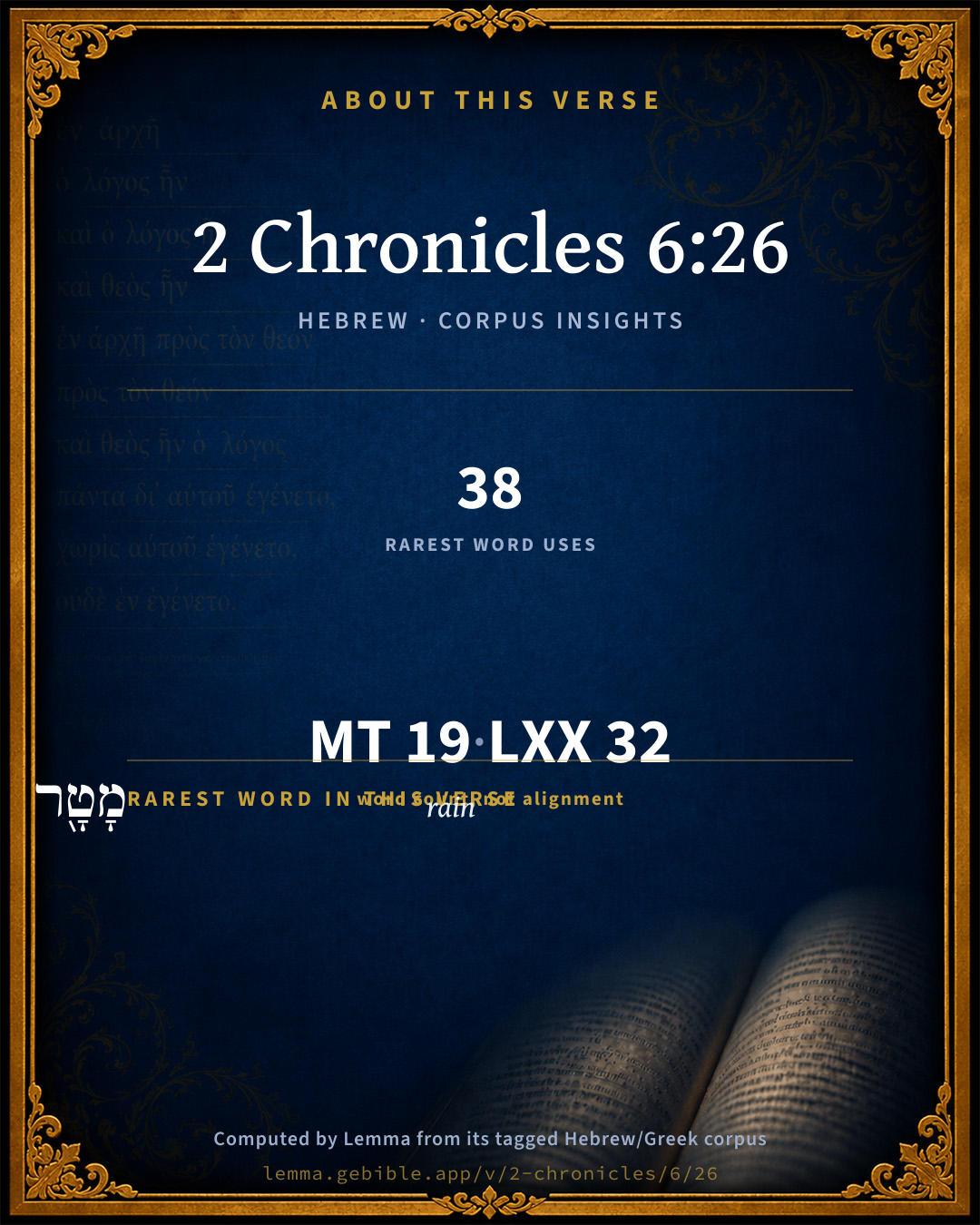
These counts appear in no published source. They are computed here, from the morphology-tagged text and Lemma’s own curated glosses. What Lemma adds →

19
words
17
distinct lemmas
Historical
section

Shared distinctive vocabulary

מָטָ֖ר rain H4306 occurs in 36 verses of the Hebrew Bible. Also found in:

Grammatical profile

  • 7 verbs
  • 5 nouns
  • 1 pronoun
  • 2 prepositions
  • 2 conjunctions
  • 2 particles

Verb forms

  • בְּהֵעָצֵ֧ר Niphal · Infinitive Construct
  • יִהְיֶ֥ה Qal · Imperfect
  • יֶֽחֶטְאוּ Qal · Imperfect
  • וְהִֽתְפַּלְל֞וּ Hithpael · Sequential Perfect
  • וְהוֹד֣וּ Hiphil · Sequential Perfect
  • יְשׁוּב֖וּן Qal · Imperfect
  • תַעֲנֵֽם Hiphil · Imperfect

Repetition

A word recurs within this verse — often emphatic in Hebrew:

  • כִּ֣י that H3588 ×2

Hebrew & Septuagint length

In English translation the verse runs 37 words from the Hebrew and 39 from the Septuagint (LXX English) — closely comparable.

A rough comparison of the two English renderings, which tokenize alike — not a word-level alignment.

Word counts can differ between the Hebrew and the Greek without any difference in meaning — e.g. the Hebrew direct-object marker אֵת has no separate Greek word, and Greek often adds the article ὁ.

In the original languages it is 19 Hebrew tokens and 32 Greek tokens — but the two are counted differently (Hebrew bundles its prefixes and suffixes into one token; the Greek is in lemma form), so that isn’t a like-for-like length.

Cross-references

17

Topical passages linked to 2 Chronicles 6:26 in the Treasury of Scripture Knowledge — connected by theme and wording, ordered by reader-vote popularity; previews shown in the World English Bible.

  • Leviticus 26:19 I will break the pride of your power, and I will make your sky like iron, and your soil like brass;
  • Deuteronomy 11:17 and the anger of Yahweh be kindled against you, and he shut up the sky, so that there shall be no rain, and the land shall not yield its fruit; and you perish quickly from off the good land which Yahweh gives you.
  • Deuteronomy 28:23 Your sky that is over your head shall be brass, and the earth that is under you shall be iron.
  • 1 Kings 17:1–18 Elijah the Tishbite, who was of the foreigners of Gilead, said to Ahab, As Yahweh, the God of Israel, lives, before whom I stand, there shall not be dew nor rain these years, but according to my word.
  • 2 Chronicles 33:12–13 When he was in distress, he begged Yahweh his God, and humbled himself greatly before the God of his fathers.
  • Proverbs 28:13 He who conceals his sins doesn't prosper, But whoever confesses and renounces them finds mercy.
  • Isaiah 5:6 I will lay it a wasteland. It won't be pruned nor hoed, But it will grow briers and thorns. I will also command the clouds that they rain no rain on it."
  • Isaiah 50:1–2 Thus says Yahweh, Where is the bill of your mother's divorce, with which I have put her away? or which of my creditors is it to whom I have sold you? Behold, for your iniquities were you sold, and for your transgressions was your mother put away.
  • Jeremiah 14:1–9 The word of Yahweh that came to Jeremiah concerning the drought.
  • Ezekiel 14:13 Son of man, when a land sins against me by committing a trespass, and I stretch out my hand on it, and break the staff of the bread of it, and send famine on it, and cut off from it man and animal;
  • Ezekiel 18:27–32 Again, when the wicked man turns away from his wickedness that he has committed, and does that which is lawful and right, he shall save his soul alive.
  • Hosea 5:15–6:1 I will go and return to my place, until they acknowledge their offense, And seek my face. In their affliction they will seek me earnestly."
  • Joel 1:13–20 Put on sackcloth and mourn, you priests! Wail, you ministers of the altar. Come, lie all night in sackcloth, you ministers of my God, For the meal offering and the drink offering are withheld from your God's house.
  • Joel 2:15–17 Blow the trumpet in Zion! Sanctify a fast. Call a solemn assembly.
  • Amos 4:4–9 "Go to Bethel, and sin; To Gilgal, and sin more. Bring your sacrifices every morning, Your tithes every three days,
  • Revelation 11:6 These have the power to shut up the sky, that it may not rain during the days of their prophecy. They have power over the waters, to turn them into blood, and to strike the earth with every plague, as often as they desire.
  • Luke 4:25 But truly I tell you, there were many widows in Israel in the days of Elijah, when the sky was shut up three years and six months, when a great famine came over all the land.

Cross-references courtesy of OpenBible.info (CC BY 4.0).

Hebrew and Greek witnesses Masoretic Hebrew ↔ Greek Septuagint

The same verse in the two great witnesses to the Old Testament, shown verse-for-verse.

These are two independent witnesses, not word-aligned to each other, and the Septuagint is shown in lemma (dictionary) form.

Hebrew 2 Chronicles 6:26 Masoretic · Westminster Leningrad Codex

בְּהֵעָצֵ֧ר הַשָּׁמַ֛יִם וְלֹֽא יִהְיֶ֥ה מָטָ֖ר כִּ֣י יֶֽחֶטְאוּ לָ֑ךְ וְהִֽתְפַּלְל֞וּ אֶל הַמָּק֤וֹם הַזֶּה֙ וְהוֹד֣וּ אֶת שְׁמֶ֔ךָ מֵחַטָּאתָ֥ם יְשׁוּב֖וּן כִּ֥י תַעֲנֵֽם

When the sky is shut up, and there is no rain, because they have sinned against you; if they pray toward this place, and confess your name, and turn from their sin, when you do afflict them:

World English Bible · Public Domain

Greek LXX 2 Chronicles 6:26 Septuagint · lemma form

ἐν ὁ συνἔχω ὁ οὐρανός καί μή γίγνομαι ὑετός ὅτι ἁμαρτάνω σύ καί προςεὔχομαι εἰς ὁ τόπος οὗτος καί αἰνέω ὁ ὄνομα σύ καί ἀπό ὁ ἁμαρτία αὐτός ἐπιστρέφω ὅτι ταπεινόω αὐτός

When heaven is restrained, and there is no rain, because they shall have sinned against you, and when they shall pray towards this place, and praise your name, and shall turn from their sins, because you shall afflict them;

LXX2012 (modern English Septuagint) · Public Domain

Hebrew: Westminster Leningrad Codex (CC BY 4.0). Greek: Septuagint (public domain); English from LXX2012 (modern English Septuagint) (Public Domain). How the Septuagint differs from the Hebrew →

Commentary

Notes on 2 Chronicles 6:26 from classic Christian and Jewish commentators (each source and its license shown beneath its notes). The classic Christian expositions comment on the surrounding passage and are grouped to its opening verse, so a note may address several verses; the Jewish commentaries on the Tanakh (Rashi and others) are per-verse, so they appear only where the commentator wrote on this verse.

Lemma curates 59 commentaries, every one of them public domain or Creative Commons licensed, each selected and text-cleaned for this edition rather than reprinted as found. About our sources →

The Biblical Illustrator

Joseph S. Exell

2Ch_6:26-31

When the heaven is shut up, and there is no rain.

Perils to agriculture

I. A rebuke to rationalism in natural evils. All meteorological phenomena are under Gods control. In all afflictive events God speaks to cities and nations.

II. A moral design in the infliction of natural evils.

1. To requite justice.

2. To lead to God.

III. A place for prayer in the removing natural evils. This denied by many. Prayer may be necessary for mans highest culture. We do not classify with powers in physical nature. It is not a natural but a moral power. The ordination of God leaves room for prayer. Prayer may be one of the laws of the universe as certain in its sphere as the laws of heat or of gravitation in their peculiar realms. Neither history, Scripture, nor experience forbid us to pray in times of national distress. (J. Wolfendale.)

Pardon and punishment

(2Ch_6:27, with 2Sa_7:14 and 1Co_11:32):--I take these passages in a group because they all set forth a similar view of a great subject. They all take a natural and what we may can an untechnical view of the subject of Divine forgiveness. The prophet Nathan and Solomon and the apostle Paul all saw that sin produced its natural consequences of pain and penalty in good men and bad men alike, and though all believed in the reality and triumph of mercy, and were quite sure of Gods readiness to forgive, yet they perceived that Divine forgiveness did not remove those consequences, at least in this life. Pardon does not mean immunity from punishment.

I. What is punishment?

1. Behold, says the apostle Paul, the goodness and severity of God. That there is an element of righteous indignation in God the whole frame of Nature testifies; the Scriptures frequently declare; and our own moral sense demands that it should be so. We cannot conceive of a perfect Being without the capacity of such indignation. The very methods of the Divine rule absolutely involve pain. But there are things in the world more to be dreaded than pain. There are evils so great--so great in themselves--that it is worth while enduring all the pain we can conceive in order to get rid of them. Righteousness is the one ruling principle of all life. In the interests of righteousness the universe is governed. Character, now and always, owes all its moral worth to the acknowledgment of the supreme majesty of the law of righteousness.

2. Now perhaps we can understand something of the meaning of punishment. It is--

(1) The expression of the indignation of a perfectly holy God. It is not an act of vengeance, nor anger which is excited by the thwarting of the Divine will. To God there is nothing so dear as justice, truth, love; and when men, from selfish love of pleasure, or equally selfish wilfulness, violate these, and become cruel, unjust, false, the holy indignation of the holiest of all beings springs forth in punishment, and God becomes a consuming fire.

(2) Punishment is the very guardian of life. If a man takes poison, or if he thrusts his hand into the fire, he suffers pain. Pain is not the evil to be feared, but the effect of the act upon the whole frame. The poison saps the life--the pain is the mere symptom of the fact. The fire is destroying the tissues of the body--the pain is the evidence of it. Pain is like the beacon which warns the mariner of the dangerous reef or the sunken rock.

(3) Punishment and pain are the means of healing. To any one ignorant of medical science, a surgeon performing an operation would seem cruel and unfeeling. But he cuts down into the living flesh with his keen knife and inflicts the sharpest pain because he knows that in no other way can the life be saved. In the hands of a benevolent God suffering is surgical.

II. When we have sought pardon and found mercy we may still have to suffer the consequences of past sin. Pardon consists of two parts--

1. The cessation of resentment.

2. The removal of consequences. These two parts are not always united in time. I may cease from anger, cease to feel resentment against my erring, disobedient child when he repents, and yet may allow him to suffer the natural consequences of his wrong doing. My love may be so deep and tender that I suffer in his suffering, and even more poignantly than he, but I let it go on. And God does so. Our duty is to bow submissively, to recognise Divine love, and to endure patiently the chastisement that seeks to cure us of our faults. (Philip W. Darnton, B.A.)

The Biblical Illustrator, edited by Joseph S. Exell (c. 1880s–1900s) — public domain. Text from a community e-Sword module.

Tyndale Open Study Notes

Tyndale Open Resources

6:26-27 Petition 3: Solomon asked that God would guide his people to follow the right path so that sin would not prevent God’s blessing of rain for the land.

Tyndale Open Study Notes — © Tyndale Open Resources, licensed CC BY-SA 4.0. Text via the HelloAO Bible API.

Geneva Bible (1599)

Geneva Bible translators

Or, toward this place.

Geneva Bible (1599) marginal notes — public domain. Text via Bolls.life.

The Cambridge Bible for Schools and Colleges

gen. ed. J. J. S. Perowne

26. when thou dost afflict them] Render (with R.V. mg. and Peshitta), because thou answerest them. Israel “confesses God’s name” because God answers the prayer of penitence.

The Cambridge Bible for Schools and Colleges (gen. ed. J. J. S. Perowne; Cambridge University Press, 1878–1918) — public domain. Text from a community e-Sword module.

The Pulpit Commentary

No rain (see 1Ki_17:1; Lev_26:19; Deu_11:17 Deu_28:23)

The Pulpit Commentary (1880–1919), ed. H.D.M. Spence-Jones & Joseph S. Exell — public domain. Text from a community e-Sword module.

unfoldingWord translationNotes

Door43 World Missions Community

When the skies are shut up and there is no rain

The sky is spoken of as if it were a building in which God stores the rain, and when God does not want it to rain he closes the door to the building. AT: "When you do not allow rain to fall from the skies" (See: Metaphor)

confess your name

Possible meanings are 1) "confess that they have sinned against you" or 2) "praise you" or 3) "say that they will obey you from now on."

turn from their sin

Here "turn from" is a metaphor for stopping doing it. AT: "stop committing their sins" or "stop acting sinfully" (See: Metaphor)

the good way in which they should walk

The way a person lives is spoken of as if that person were walking on a path. AT: "the good way that they should live" (See: Metaphor)

your land, which you have given to your people as an inheritance

The land is spoken of as if it were an inheritance because God wanted them to possess it forever. AT: "your land, which you have given to your people to own forever" (See: Metaphor)

translationWords

confess

afflicted

walk

send

inherit

unfoldingWord translationNotes — © Distant Shores Media and the Door43 World Missions Community, licensed CC BY-SA 4.0. Source: git.door43.org/Door43/en_tn.

Rashi

Rabbi Shlomo Yitzchaki (Rashi)

When heaven is shut up as it is written (Deut. 11:17): “and He will shut up the heaven, and there will be no rain.”

Rashi on the Tanakh — English translations: “The Judaica Press complete Tanach with Rashi, translated by A. J. Rosenberg” (CC BY 4.0); “Pentateuch with Rashi's commentary by M. Rosenbaum and A.M. Silbermann, 1929-1934” (public domain); “The Metsudah Tanach series, Lakewood, N.J” (CC BY 4.0); and “The Book of Joshua, Metsudah Publications, 1997” (CC BY 4.0). Text via Sefaria.

Lesson kit

Teaching starters — assembled from the data on this page, not authored interpretation. Every prompt links to the verse data it draws on. Edit before teaching.

2 Chronicles, in the Historical, opens this verse with 19 words (17 distinct Hebrew lemmas). Its most distinctive word is mâṭar (“rain”). A historical commentator’s framing appears above. Read the whole chapter for the surrounding context.

Discussion questions

  1. What does “rain” (mâṭar) contribute to the verse as a whole?
  2. Exodus 9:33 shares the word «rain» with this verse. How do the two illuminate each other?
  3. “that” occurs 2× in this one verse. What is the effect of the repetition?
  4. These translations render this verse differently; the difference is in the English rendering, not the original. What questions does that raise?
  5. The verb «בְּהֵעָצֵ֧ר» is Niphal Infinitive Construct. How does its form color the action?
  6. Reading how The Biblical Illustrator and Tyndale Open Study Notes read this verse, where do the two commentators agree and where do they part?

Things to notice

Reading settings

Reading text

Shown beneath each verse's original-language words.

Old Testament
Old Testament edition

Read the OT as the Masoretic Hebrew (MT) or the Greek Septuagint (LXX).

English shown for the Greek Septuagint (in the Hebrew ↔ Greek comparison).

Comparing translations? Open the Compare panel on any verse page to stack up to four side by side.