
2 Chronicles 25:16

Hebrew (Westminster Leningrad Codex) 2 Chronicles 25:16 appears in the Hebrew Old Testament. The text above is from the Westminster Leningrad Codex. Each word links to its Strong’s number, a concise gloss, and parsing drawn from the Open Scriptures Hebrew Bible morphology. Click any word for its full Brown-Driver-Briggs (BDB) entry.
Download image
Cite this verse

2 Chronicles 25:16 (World English Bible). Public Domain. Lemma interlinear Bible study tool, https://lemma.gebible.app/v/2-chronicles/25/16.

Show BibTeX & RIS
BibTeX
RIS
English Translation
It happened, as he talked with him, that [the king] said to him, Have we made you of the king's counsel? Stop! Why should you be struck down? Then the prophet stopped, and said, I know that God has determined to destroy you, because you have done this, and have not listened to my counsel.
World English Bible · Public Domain
Download a study sheet

One document with this verse’s original text, its word-by-word gloss line, the meaning frame, cross-references with their text, attributed commentary, and full source and license credits — printable, and it pastes into notes with its structure intact.

This verse Autodidact and up

Study sheet (.html) Plain text (.txt)

A passage Seminary Student

Up to 50 verses in one chapter. A passage sheet keeps up to 6 commentary sources and 12 cross-references per verse, in the order this page ranks them, and says so on the sheet whenever that leaves anything out. Ask for a single verse and you get the Autodidact verse sheet above.

Everything on this page stays free to read, with no account — the sheet is a download of what is already on screen, not access to it.

Want to remove ads? Support Godless Engineer
Compare translations 3

The same verse in 3 English versions, stacked beneath the original-language interlinear above. Click any original word for its lexicon entry.

Each is an independent rendering of the whole verse — the interlinear is not word-aligned to these translations.

Highlighted words mark where these versions differ — a whole-verse word diff, not a word-by-word alignment.

  • World English Bible Public Domain
    It happened, as he talked with him, that [the king] said to him, Have we made you of the king's counsel? Stop! Why should you be struck down? Then the prophet stopped, and said, I know that God has determined to destroy you, because you have done this, and have not listened to my counsel.
  • King James Version Public Domain
    And it came to pass, as he talked with him, that the king said unto him, Art thou made of the king's counsel? forbear; why shouldest thou be smitten? Then the prophet forbare, and said, I know that God hath determined to destroy thee, because thou hast done this, and hast not hearkened unto my counsel.
  • unfoldingWord Literal Text CC BY-SA 4.0
    And it happened when he was speaking with him, and he said to him, “For a counselor to the king have we placed you? Stop yourself! Why should they strike you down?” And the prophet stopped. And he said, “I know that God has counselled to destroy you because you have done this and you did not listen to my counsel.”

unfoldingWord Literal Text — © unfoldingWord, licensed CC BY-SA 4.0. Word-aligned USFM3 via Door43 (git.door43.org/unfoldingWord/en_ult).

Versions to compare (up to 4)

3 of 4 selected

Show all 18 translations

Every available English version of this verse, each an independent rendering of the whole verse.

  • World English Bible Public Domain
    It happened, as he talked with him, that [the king] said to him, Have we made you of the king's counsel? Stop! Why should you be struck down? Then the prophet stopped, and said, I know that God has determined to destroy you, because you have done this, and have not listened to my counsel.
  • Berean Standard Bible Public Domain
    While he was still speaking, the king asked, “Have we made you the counselor to the king? Stop! Why be struck down?” So the prophet stopped, but he said, “I know that God has determined to destroy you, because you have done this and have not heeded my advice.”
  • Majority Standard Bible Public Domain
    While he was still speaking, the king asked, “Have we made you the counselor to the king? Stop! Why be struck down?” So the prophet stopped, but he said, “I know that God has determined to destroy you, because you have done this and have not heeded my advice.”
  • King James Version Public Domain
    And it came to pass, as he talked with him, that the king said unto him, Art thou made of the king's counsel? forbear; why shouldest thou be smitten? Then the prophet forbare, and said, I know that God hath determined to destroy thee, because thou hast done this, and hast not hearkened unto my counsel.
  • American Standard Version (1901) Public Domain
    And it came to pass, as he talked with him, that `the king' said unto him, Have we made thee of the king's counsel? forbear; why shouldest thou be smitten? Then the prophet forbare, and said, I know that God hath determined to destroy thee, because thou hast done this, and hast not hearkened unto my counsel.
  • Revised Version (1885) Public Domain
    And it came to pass, as he talked with him, that the king said unto him, Have we made thee of the king’s counsel? forbear; why shouldest thou be smitten? Then the prophet forbare, and said, I know that God hath determined to destroy thee, because thou hast done this, and hast not hearkened unto my counsel.
  • Geneva Bible (1599) Public Domain
    And as he talked with him, he said vnto him, Haue they made thee the Kings counseler? cease thou: why should they smite thee? And the Prophet ceased, but said, I knowe that God hath determined to destroy thee, because thou hast done this, and hast not obeyed my counsell.
  • Douay-Rheims (1899) Public Domain
    And when he spoke these things, he answered him: Art thou the king's counsellor? be quiet, lest I kill thee. And the prophet departing, said: I know that God is minded to kill thee, because thou hast done this evil, and moreover hast not hearkened to my counsel.
  • Young's Literal Translation Public Domain
    And it cometh to pass, in his speaking unto him, that he saith to him, `For a counsellor to the king have we appointed thee? cease for thee; why do they smite thee?' And the prophet ceaseth, and saith, `I have known that God hath counselled to destroy thee, because thou hast done this, and hast not hearkened to my counsel.'
  • Literal Standard Version CC BY-SA 4.0
    And it comes to pass, in his speaking to him, that he says to him, “Have we appointed you for a counselor to the king? For you [must] cease; why do they strike you?” And the prophet ceases and says, “I have known that God has counseled to destroy you, because you have done this and have not listened to my counsel.”
  • Unlocked Literal Bible CC BY-SA 4.0
    It came about that as the prophet was speaking with him, the king said to him, “Have we made you an advisor to the king? Stop! Why should you be killed?” Then the prophet stopped and said, “I know that God has decided to destroy you because you have done this deed and have not listened to my advice.”
  • unfoldingWord Literal Text CC BY-SA 4.0
    And it happened when he was speaking with him, and he said to him, “For a counselor to the king have we placed you? Stop yourself! Why should they strike you down?” And the prophet stopped. And he said, “I know that God has counselled to destroy you because you have done this and you did not listen to my counsel.”
  • Darby Bible Public Domain
    And it came to pass as he talked with him, that [Amaziah] said to him, Hast thou been made the king's counsellor? Forbear; why shouldest thou be smitten? Then the prophet forbore, and said, I know that God has determined to destroy thee, because thou hast done this, and hast not hearkened to my counsel.
  • World Messianic Bible Public Domain
    As he talked with him, the king said to him, “Have we made you one of the king’s counselors? Stop! Why should you be struck down?” Then the prophet stopped, and said, “I know that God has determined to destroy you, because you have done this and have not listened to my counsel.”
  • Webster's Bible Public Domain
    And it came to pass, as he talked with him, that the king said to him, Art thou made of the king's council? forbear? why shouldst thou be smitten? Then the prophet forbore, and said, I know that God hath determined to destroy thee, because thou hast done this, and hast not hearkened to my counsel.
  • Free Bible Version CC BY-SA 4.0
    But while he was still speaking, the king said to him, “Have we made you a counselor to the king? Stop right now! Do you want to be struck down?” So the prophet stopped, but said, “I know that God has decided to destroy you, because you have acted like this and have refused to listen to my advice.”
  • Bible in Basic English Public Domain
    But while he was talking to him the king said to him, Have we made you one of the king's government? say no more, or it will be the cause of your death. Then the prophet gave up protesting, and said, It is clear to me that God's purpose is your destruction, because you have done this and have not given ear to my words.
  • JPS Tanakh (1917) Public Domain
    And it came to pass, as he talked with him, that the king said unto him: 'Have we made thee of the king's counsel? forbear; why shouldest thou be smitten?' Then the prophet forbore, and said: 'I know that God hath determined to destroy thee, because thou hast done this, and hast not hearkened unto my counsel.'

Literal Standard Version (2020), Covenant Press — licensed CC BY-SA 4.0. Text via the HelloAO Bible API (eBible.org). Unlocked Literal Bible (unfoldingWord) — licensed CC BY-SA 4.0. Text via the HelloAO Bible API (eBible.org). unfoldingWord Literal Text — © unfoldingWord, licensed CC BY-SA 4.0. Word-aligned USFM3 via Door43 (git.door43.org/unfoldingWord/en_ult). Free Bible Version, Dr. Jonathan Gallagher — licensed CC BY-SA 4.0. Text via the HelloAO Bible API (eBible.org).

Word by word

More ways to search: Search by grammar → Find every occurrence → Compare this word →

Practice this passage: Drill this verse → Learn its vocabulary →

חֲדַל
châdal
H2308
“cease”
Verb, Qal, Imperative, 2nd Person, Masculine, Singular
Part of Speech
Verb
Stem
Qal
Form
Imperative
Person
2nd Person
Gender
Masculine
Number
Singular
Full BDB Definition

Origin: a primitive root

TWOT: 609

to stop, cease, desist, forego, cease to be, leave undone, forbear - (Qal) - to cease, come to an end - to cease, leave off
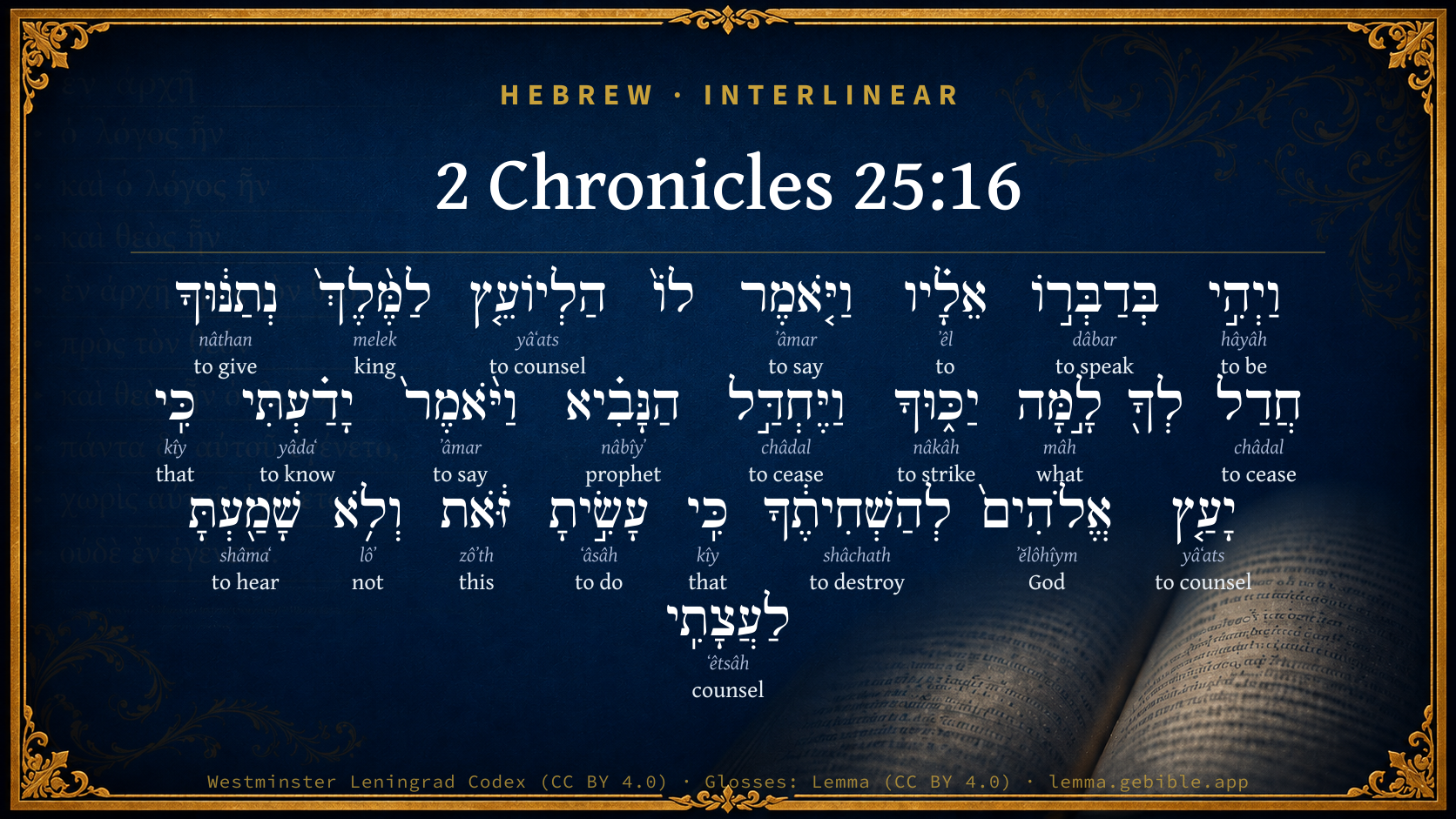
  1. וַיְהִ֣י hâyâh H1961 “and · to be” Conjunction + Verb, Qal, Sequential Imperfect, 3rd Person, Masculine, Singular
  2. בְּדַבְּר֣וֹ dâbar H1696 “in/at · to speak · him” Preposition + Verb, Piel, Infinitive Construct + Suffix, Personal, 3rd Person, Masculine, Singular
  3. אֵלָ֗יו ʼêl H413 “to · him” Preposition + Suffix, Personal, 3rd Person, Masculine, Singular
  4. וַיֹּ֤אמֶר ʼâmar H559 “and · to say” Conjunction + Verb, Qal, Sequential Imperfect, 3rd Person, Masculine, Singular
  5. הַלְיוֹעֵ֤ץ yâʻats H3289 “to/for · counseling” Particle, Interrogative + Preposition + Verb, Qal, Participle Active, Masculine, Singular, Absolute
  6. לַמֶּ֨לֶךְ֙ melek H4428 “to/for the · king” Preposition, Determined + Noun, Common, Masculine, Singular, Absolute
  7. נְתַנּ֔וּךָ nâthan H5414 “to give · you” Verb, Qal, Perfect, 1st Person, Common, Plural + Suffix, Personal, 2nd Person, Masculine, Singular
  8. לָ֣מָּה mâh H4100 “to/for · what” Preposition + Particle, Interrogative
  9. יַכּ֑וּךָ nâkâh H5221 “to strike · you” Verb, Hiphil, Imperfect, 3rd Person, Masculine, Plural + Suffix, Personal, 2nd Person, Masculine, Singular
  10. וַיֶּחְדַּ֣ל châdal H2308 “and · to cease” Conjunction + Verb, Qal, Sequential Imperfect, 3rd Person, Masculine, Singular
  11. הַנָּבִ֗יא nâbîyʼ H5030 “the · prophet” Particle, Definite Article + Noun, Common, Masculine, Singular, Absolute
  12. וַיֹּ֨אמֶר֙ ʼâmar H559 “and · to say” Conjunction + Verb, Qal, Sequential Imperfect, 3rd Person, Masculine, Singular
  13. יָדַ֗עְתִּי yâdaʻ H3045 “to know” Verb, Qal, Perfect, 1st Person, Common, Singular
  14. כִּֽי kîy H3588 “that” Conjunction
  15. יָעַ֤ץ yâʻats H3289 “to counsel” Verb, Qal, Perfect, 3rd Person, Masculine, Singular
  16. אֱלֹהִים֙ ʼĕlôhîym H430 “God(s)” Noun, Common, Masculine, Plural, Absolute
  17. לְהַשְׁחִיתֶ֔ךָ shâchath H7843 “to destroy · you” Preposition + Verb, Hiphil, Infinitive Construct + Suffix, Personal, 2nd Person, Masculine, Singular
  18. כִּֽי kîy H3588 “that” Conjunction
  19. עָשִׂ֣יתָ ʻâsâh H6213 “to do” Verb, Qal, Perfect, 2nd Person, Masculine, Singular
  20. זֹּ֔את zôʼth H2063 “this” Pronoun, Demonstrative, Feminine, Singular
  21. וְלֹ֥א lôʼ H3808 “and · not” Conjunction + Particle, Negative
  22. שָׁמַ֖עְתָּ shâmaʻ H8085 “to hear” Verb, Qal, Perfect, 2nd Person, Masculine, Singular
  23. לַעֲצָתִֽי ʻêtsâh H6098 “to/for · counsel · my” Preposition + Noun, Common, Feminine, Singular, Construct + Suffix, Personal, 1st Person, Common, Singular

About this verse

These counts appear in no published source. They are computed here, from the morphology-tagged text and Lemma’s own curated glosses. What Lemma adds →

26
words
20
distinct lemmas
Historical
section

Shared distinctive vocabulary

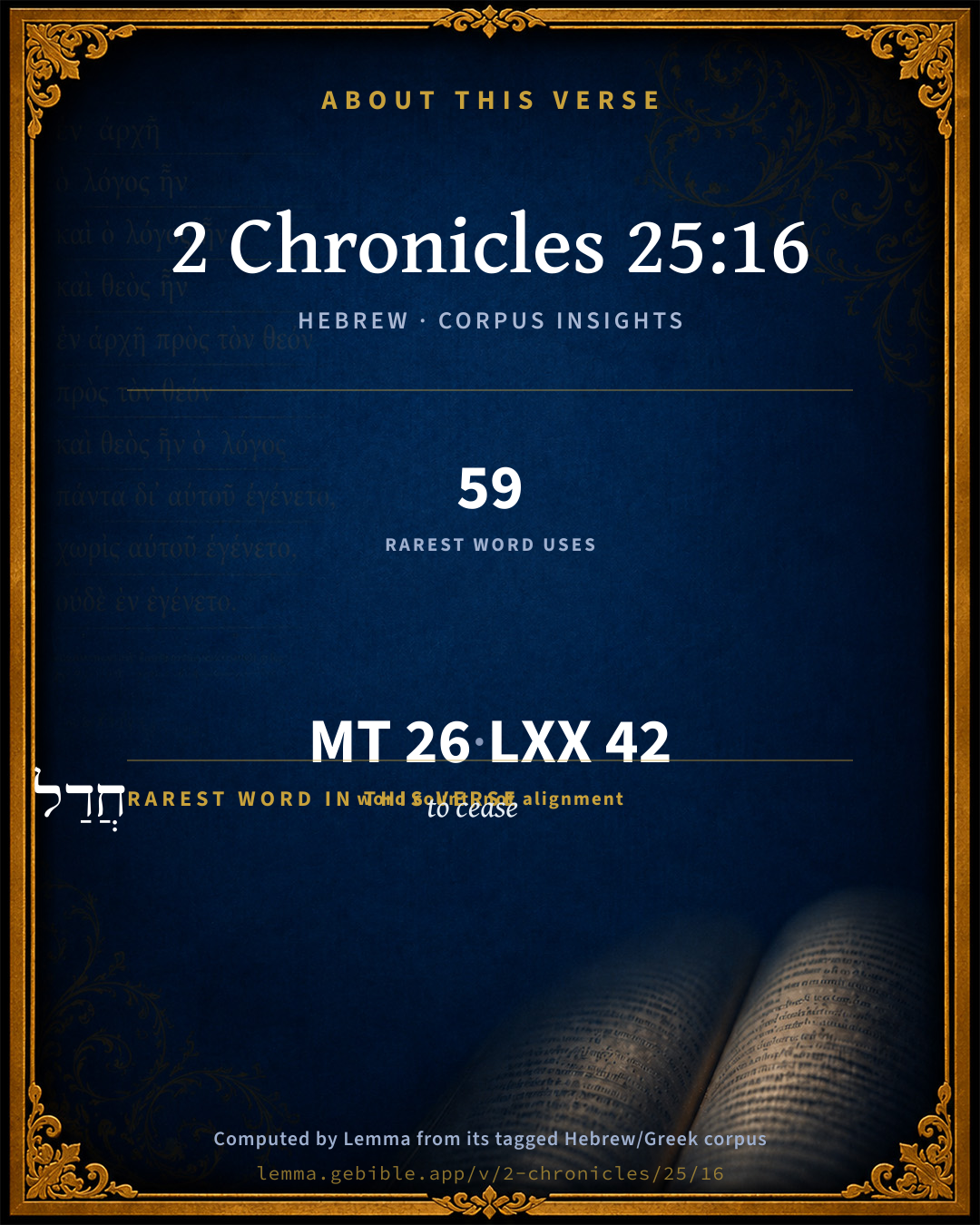
חֲדַל to cease H2308 occurs in 56 verses of the Hebrew Bible. Also found in:

Grammatical profile

  • 14 verbs
  • 4 nouns
  • 1 pronoun
  • 3 prepositions
  • 2 conjunctions
  • 2 particles

Verb forms

  • וַיְהִ֣י Qal · Sequential Imperfect
  • בְּדַבְּר֣וֹ Piel · Infinitive Construct
  • וַיֹּ֤אמֶר Qal · Sequential Imperfect
  • הַלְיוֹעֵ֤ץ Qal · Participle Active
  • נְתַנּ֔וּךָ Qal · Perfect
  • חֲדַל Qal · Imperative
  • יַכּ֑וּךָ Hiphil · Imperfect
  • וַיֶּחְדַּ֣ל Qal · Sequential Imperfect
  • וַיֹּ֨אמֶר֙ Qal · Sequential Imperfect
  • יָדַ֗עְתִּי Qal · Perfect
  • יָעַ֤ץ Qal · Perfect
  • לְהַשְׁחִיתֶ֔ךָ Hiphil · Infinitive Construct
  • עָשִׂ֣יתָ Qal · Perfect
  • שָׁמַ֖עְתָּ Qal · Perfect

Repetition

Words recur within this verse — often emphatic in Hebrew:

  • וַיֹּ֤אמֶר to say H559 ×2
  • הַלְיוֹעֵ֤ץ to counsel H3289 ×2
  • חֲדַל to cease H2308 ×2
  • כִּֽי that H3588 ×2

Hebrew & Septuagint length

In English translation the verse runs 55 words from the Hebrew and 59 from the Septuagint (LXX English) — closely comparable.

A rough comparison of the two English renderings, which tokenize alike — not a word-level alignment.

Word counts can differ between the Hebrew and the Greek without any difference in meaning — e.g. the Hebrew direct-object marker אֵת has no separate Greek word, and Greek often adds the article ὁ.

In the original languages it is 26 Hebrew tokens and 42 Greek tokens — but the two are counted differently (Hebrew bundles its prefixes and suffixes into one token; the Greek is in lemma form), so that isn’t a like-for-like length.

Cross-references

18

Topical passages linked to 2 Chronicles 25:16 in the Treasury of Scripture Knowledge — connected by theme and wording, ordered by reader-vote popularity; previews shown in the World English Bible.

  • Exodus 9:16 but indeed for this cause I have made you stand: to show you my power, and that my name may be declared throughout all the earth;
  • Deuteronomy 2:30 But Sihon king of Heshbon would not let us pass by him; for Yahweh your God hardened his spirit, and made his heart obstinate, that he might deliver him into your hand, as at this day.
  • 1 Samuel 2:25 If one man sin against another, God shall judge him; but if a man sin against Yahweh, who shall entreat for him? Notwithstanding, they didn't listen to the voice of their father, because Yahweh was minded to kill them.
  • 2 Chronicles 16:10 Then Asa was angry with the seer, and put him in the prison-house; for he was in a rage with him because of this thing. Asa oppressed some of the people at the same time.
  • 2 Chronicles 18:20–21 There came forth a spirit, and stood before Yahweh, and said, I will entice him. Yahweh said to him, 'How?'
  • 2 Chronicles 18:25 The king of Israel said, Take Micaiah, and carry him back to Amon the governor of the city, and to Joash the king's son;
  • 2 Chronicles 24:21 They conspired against him, and stoned him with stones at the commandment of the king in the court of the house of Yahweh.
  • Proverbs 9:7–8 He who corrects a mocker invites insult. He who reproves a wicked man invites abuse.
  • Isaiah 30:10–11 who tell the seers, "Don't see;" and to the prophets, "Don't prophesy to us right things, speak to us smooth things, prophesy deceits,
  • Isaiah 46:10 declaring the end from the beginning, and from ancient times things that are not [yet] done; saying, My counsel shall stand, and I will do all my pleasure;
  • Jeremiah 29:26 Yahweh has made you priest in the place of Jehoiada the priest, that there may be officers in the house of Yahweh, for every man who is mad, and makes himself a prophet, that you should put him in the stocks and in shackles.
  • Amos 7:10–13 Then Amaziah the priest of Beth El sent to Jeroboam king of Israel, saying, "Amos has conspired against you in the midst of the house of Israel. The land is not able to bear all his words.
  • Matthew 21:23 When he had come into the temple, the chief priests and the elders of the people came to him as he was teaching, and said, "By what authority do you do these things? Who gave you this authority?"
  • Acts 4:28 to do whatever your hand and your council foreordained to happen.
  • Romans 9:22 What if God, willing to show his wrath, and to make his power known, endured with much patience vessels of wrath made for destruction,
  • Ephesians 1:11 in whom also we were assigned an inheritance, having been foreordained according to the purpose of him who works all things after the counsel of his will;
  • 2 Timothy 4:3 For the time will come when they will not listen to the sound doctrine, but, having itching ears, will heap up for themselves teachers after their own lusts;
  • Revelation 11:10 Those who dwell on the earth rejoice over them, and they will be glad. They will give gifts to one another, because these two prophets tormented those who dwell on the earth.

Cross-references courtesy of OpenBible.info (CC BY 4.0).

Hebrew and Greek witnesses Masoretic Hebrew ↔ Greek Septuagint

The same verse in the two great witnesses to the Old Testament, shown verse-for-verse.

These are two independent witnesses, not word-aligned to each other, and the Septuagint is shown in lemma (dictionary) form.

Hebrew 2 Chronicles 25:16 Masoretic · Westminster Leningrad Codex

וַיְהִ֣י בְּדַבְּר֣וֹ אֵלָ֗יו וַיֹּ֤אמֶר לוֹ֙ הַלְיוֹעֵ֤ץ לַמֶּ֨לֶךְ֙ נְתַנּ֔וּךָ חֲדַל לְךָ֖ לָ֣מָּה יַכּ֑וּךָ וַיֶּחְדַּ֣ל הַנָּבִ֗יא וַיֹּ֨אמֶר֙ יָדַ֗עְתִּי כִּֽי יָעַ֤ץ אֱלֹהִים֙ לְהַשְׁחִיתֶ֔ךָ כִּֽי עָשִׂ֣יתָ זֹּ֔את וְלֹ֥א שָׁמַ֖עְתָּ לַעֲצָתִֽי

It happened, as he talked with him, that [the king] said to him, Have we made you of the king's counsel? Stop! Why should you be struck down? Then the prophet stopped, and said, I know that God has determined to destroy you, because you have done this, and have not listened to my counsel.

World English Bible · Public Domain

Greek LXX 2 Chronicles 25:16 Septuagint · lemma form

καί γίγνομαι ἐν ὁ λαλέω αὐτός καί εἶπον αὐτός μή σύμβουλος ὁ βασιλεύς δίδωμι σύ προςἔχω μή μαστιγόω καί σιωπάω ὁ προφήτης καί εἶπον ὅτι γιγνώσκω ὅτι βούλομαι ἐπί σύ ὁ καταφθείρω σύ ὅτι ποιέω οὗτος καί οὐ ἐπιἀκούω ὁ συμβουλία ἐγώ

And it came to pass when the prophet was speaking to him, that he said to him, have I made you king's counsellor? take heed lest you be scourged: and the prophet forebore, and said, I know that God is disposed against you to destroy you, because you have done this thing, and have not listened to my counsel.

LXX2012 (modern English Septuagint) · Public Domain

Hebrew: Westminster Leningrad Codex (CC BY 4.0). Greek: Septuagint (public domain); English from LXX2012 (modern English Septuagint) (Public Domain). How the Septuagint differs from the Hebrew →

Commentary

Notes on 2 Chronicles 25:16 from classic Christian and Jewish commentators (each source and its license shown beneath its notes). The classic Christian expositions comment on the surrounding passage and are grouped to its opening verse, so a note may address several verses; the Jewish commentaries on the Tanakh (Rashi and others) are per-verse, so they appear only where the commentator wrote on this verse.

Lemma curates 59 commentaries, every one of them public domain or Creative Commons licensed, each selected and text-cleaned for this edition rather than reprinted as found. About our sources →

Trapp's Complete Commentary

John Trapp

2Ch 25:16 And it came to pass, as he talked with him, that [the king] said unto him, Art thou made of the king’s counsel? forbear; why shouldest thou be smitten? Then the prophet forbare, and said, I know that God hath determined to destroy thee, because thou hast done this, and hast not hearkened unto my counsel.

Ver. 16. Forbear; why shouldest thou be smitten?] Desine, vel dabis poenas ;

“ An expectas ut Quintilianus ametur? ”

I Know that God hath determined.] Heb., Counselled. Uncounsellable people have God’s marks upon them.

John Trapp, A Commentary or Exposition upon All the Books of the Old and New Testament (1647–1656) — public domain. Text from a community e-Sword module.

Joseph Benson's Commentary

2Ch 25:16. The king said, Art thou made of the king’s counsel? — Who art thou, that presumest to direct my affairs without my commission? Forbear; why shouldest thou be smitten? — Provoke me no further, lest I cause thee to be killed for thy impudence. The prophet’s reproof was too just to be answered, and the king could say nothing in excuse for his own folly; but he fell into a passion with the reprover. To the prophet who directed him to send back the army of Israel, he hearkened, though that prophet both contradicted his politics, and lost him a hundred talents of silver: but with this prophet, who only dissuaded him from worshipping the gods of the Edomites, he had no patience, but instantly fell upon him with an unaccountable rage; which must be attributed to the witchcraft of idolatry. Then the prophet forbare — He ceased to advise or reprove him any further, but only denounced the divine sentence passed upon him, for this contempt of God’s message to him, and his other sins, which came to pass, 2Ch 25:20-27. The secure sinner, perhaps, values himself on his having silenced his reprovers and monitors. But what comes of it? I know that God has determined to destroy thee — It is a plain indication that thou art marked for ruin; because thou hast done this, and hast not hearkened to the divine counsel — They that are deaf to reproof, are ripening apace for destruction.

Joseph Benson's Commentary on the Old and New Testaments (1811–1818) — public domain. Text from a community e-Sword module.

Geneva Bible (1599)

Geneva Bible translators

So hard it is, for the carnal man to be admonished of his fault, that he contemneth, mocketh, and threateneth him that warneth him: yea, imprisoneth him and putteth him to death, 2 Chron. 16:10 and 18:26 and 24:21.

Meaning, the King.

Geneva Bible (1599) marginal notes — public domain. Text via Bolls.life.

Jamieson, Fausset & Brown

Robert Jamieson, A. R. Fausset & David Brown

as he talked with him, &c.--Those who were invested with the prophetic character were entitled to counsel kings. Amaziah, had he not been offended by unwelcome truths, would have admitted the claim of this prophet, who was probably the same that had given him counsel previous to the war with Edom. But victory had elated and blinded him.

Jamieson, Fausset & Brown — Commentary Critical and Explanatory on the Whole Bible (1871) — public domain (CC PDM 1.0). Text via the HelloAO Bible API.

Adam Clarke's Commentary

Verse 16. Art thou made of the king's counsel?] How darest thou give advice to, or reprove, a king?

Adam Clarke's Commentary on the Bible (1810–1826) — public domain. Text from a community e-Sword/MySword module.

Ellicott's Commentary for English Readers

(16) As he talked with him.—When he spake unto him.

Art thou made of the king’s counsel?—Literally, A counsellor to the king have we appointed thee?

Why shouldest thou be smitten?—Wherefore should they smite thee?

Hath determined.—Hath counselled. The prophet appropriates the king’s own word, and implies his participation in Divine, if not in royal, counsels.

Because.—The conduct of Amaziah was proof that God had “counselled to destroy him.”

Thou hast done this.—Spurned my warning. Others say: because thou hast adopted the Edomite gods.

Unto my counsel.—Again repeating the king’s expression.

A Bible Commentary for English Readers, edited by Charles John Ellicott (1878–1897) — public domain. Text from a community e-Sword module.

The Cambridge Bible for Schools and Colleges

gen. ed. J. J. S. Perowne

16. Art thou made] R.V. Have we made thee.

of the king’s counsel] Lit., “counsellor to the king.”

hath determined] Lit., “hath counselled” (with a play on the king’s word).

The Cambridge Bible for Schools and Colleges (gen. ed. J. J. S. Perowne; Cambridge University Press, 1878–1918) — public domain. Text from a community e-Sword module.

John Gill's Exposition

Then Amaziah king of Judah took advice,.... Not of God, nor of his prophets, but of some of his nobles like himself:

and sent to Joash--king of Israel; of his message to him here, and his answer in the two following verses, see the following notes: See Gill on Kg2 14:8. See Gill on Kg2 14:9. See Gill on Kg2 14:10.

John Gill's Exposition of the Whole Bible (1746–1763) — public domain (CC PDM 1.0). Text via the HelloAO Bible API.

Albert Barnes' Notes on the Bible

Art thou made of the king’s counsel? - A subtle irony: “Have I made thee one of my council? If not what entitles thee to offer thy advice?”

For the fulfillment of the prophecy, see 2Ch 25:22-24, 2Ch 25:27.

Albert Barnes' Notes on the Bible (1834–1885) — public domain. Text from a community e-Sword/MySword module.

Haydock's Catholic Bible Commentary

Art thou. Heb. adds, "appointed." H. --- The very character of prophet, authorized him to give counsel even to kings. Amasias had perhaps obeyed this prophet, (v. 7) but now his heart was puffed up with victory. --- Kill thee, sixteen years hence.

George Leo Haydock (1774–1849), Haydock's Catholic Family Bible and Commentary, 1859 edition — public domain. Excludes Psalms (Douay-Rheims chapter numbering differs from Protestant) and Deuterocanonical books (Catholic canon only).

Matthew Poole's English Annotations

Art thou made of the king’s counsel? who art thou that presumest to direct and govern my affairs, without my commission?

Why shouldest thou be smitten? provoke me no further, lest I cause thee to be killed for thy sauciness.

I know that God hath determined to destroy thee: this he might know, either by the plain and positive rules of God’s word, as Pro 29:1, or by the suggestion of God’s Spirit.

Matthew Poole's English Annotations on the Holy Bible (1683–1685) — public domain. Text from a community e-Sword/MySword module.

The Pulpit Commentary

The chapter well keeps up in this verse its graphic character, though the culminating instances of it are yet to come. Forbear. The faithful prophet is "wise as the serpent, harmless as the dove." He does forbear, but not till the application of his speech, and all that was needful is most outspokenly (more so than before he had heard the usual coward fashion of the tyrant"s threat) pronounced. His forbearing, therefore, is open to no charge of moral cowardice and unprophet-like infidelity.

The Pulpit Commentary (1880–1919), ed. H.D.M. Spence-Jones & Joseph S. Exell — public domain. Text from a community e-Sword module.

John Wesley's Explanatory Notes

Art thou, &c. - Who art thou that presumest to direct my affairs, without my commission? The secure sinner perhaps values himself on having silenced his reprovers and monitors. But what comes of it? It is a plain indication he is marked out for ruin. They that are deaf to reproof, are ripening apace for destruction.

John Wesley, Explanatory Notes Upon the Whole Bible (1754–1765) — public domain. Text via the GEBible commentary corpus.

unfoldingWord translationNotes

Door43 World Missions Community

It came about that

This phrase is used here to mark the next important event in the story. If your language has a way for doing this, you could consider using it here.

Have we made you an advisor to the king? Stop! Why should you be killed?

The king used these rhetorical questions to rebuke the prophet for speaking against him. The questions can be translated as statements. AT: "We certainly did not appoint you to be one of my advisors. So stop talking! If you say anything more, I will tell my soldiers to kill you!" (See: Rhetorical Question)

you have done this deed

This refers back to Amaziah worshiping the gods of the Edomites in 2 Chronicles 25:14.

translationWords

works

unfoldingWord translationNotes — © Distant Shores Media and the Door43 World Missions Community, licensed CC BY-SA 4.0. Source: git.door43.org/Door43/en_tn.

Rashi

Rabbi Shlomo Yitzchaki (Rashi)

that God has given counsel to destroy you i.e., If you do not hearken to My advice to follow the straight path, you should know, O king, that the Lord has given counsel to destroy you because you have done this, and have not hearkened to the counsel. Now what is the counsel? That he enticed you to provoke the king of Israel and to fall before him, as it is written: “And Amaziah the king of Judah took counsel, and he sent to Joash, etc.”

Rashi on the Tanakh — English translations: “The Judaica Press complete Tanach with Rashi, translated by A. J. Rosenberg” (CC BY 4.0); “Pentateuch with Rashi's commentary by M. Rosenbaum and A.M. Silbermann, 1929-1934” (public domain); “The Metsudah Tanach series, Lakewood, N.J” (CC BY 4.0); and “The Book of Joshua, Metsudah Publications, 1997” (CC BY 4.0). Text via Sefaria.

Lesson kit

Teaching starters — assembled from the data on this page, not authored interpretation. Every prompt links to the verse data it draws on. Edit before teaching.

2 Chronicles, in the Historical, opens this verse with 26 words (20 distinct Hebrew lemmas). Its most distinctive word is châdal (“to cease”). A historical commentator’s framing appears above. Read the whole chapter for the surrounding context.

Discussion questions

  1. What does “to cease” (châdal) contribute to the verse as a whole?
  2. Genesis 11:8 shares the word «to cease» with this verse. How do the two illuminate each other?
  3. “to say” occurs 2× in this one verse. What is the effect of the repetition?
  4. These translations render this verse differently; the difference is in the English rendering, not the original. What questions does that raise?
  5. The verb «וַיְהִ֣י» is Qal Sequential Imperfect. How does its form color the action?
  6. Reading how Trapp's Complete Commentary and Joseph Benson's Commentary read this verse, where do the two commentators agree and where do they part?

Things to notice

Reading settings

Reading text

Shown beneath each verse's original-language words.

Old Testament
Old Testament edition

Read the OT as the Masoretic Hebrew (MT) or the Greek Septuagint (LXX).

English shown for the Greek Septuagint (in the Hebrew ↔ Greek comparison).

Comparing translations? Open the Compare panel on any verse page to stack up to four side by side.