
2 Chronicles 9:4

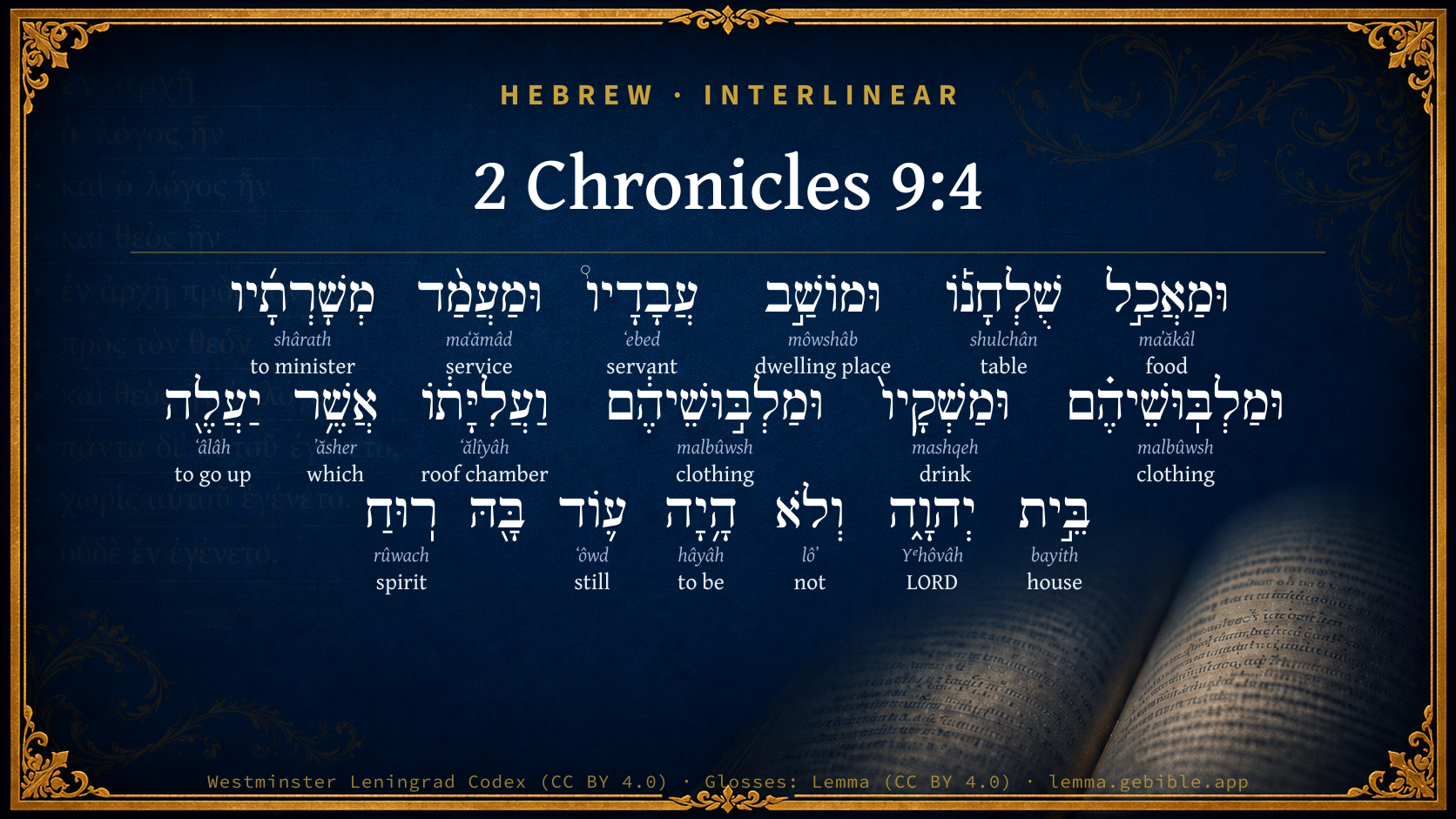
Hebrew (Westminster Leningrad Codex) 2 Chronicles 9:4 appears in the Hebrew Old Testament. The text above is from the Westminster Leningrad Codex. Each word links to its Strong’s number, a concise gloss, and parsing drawn from the Open Scriptures Hebrew Bible morphology. Click any word for its full Brown-Driver-Briggs (BDB) entry.
Download image
Cite this verse

2 Chronicles 9:4 (World English Bible). Public Domain. Lemma interlinear Bible study tool, https://lemma.gebible.app/v/2-chronicles/9/4.

Show BibTeX & RIS
BibTeX
RIS
English Translation
and the food of his table, and the sitting of his servants, and the attendance of his ministers, and their clothing, his cup bearers also, and their clothing, and his ascent by which he went up to the house of Yahweh; there was no more spirit in her.
World English Bible · Public Domain
Download a study sheet

One document with this verse’s original text, its word-by-word gloss line, the meaning frame, cross-references with their text, attributed commentary, and full source and license credits — printable, and it pastes into notes with its structure intact.

This verse Autodidact and up

Study sheet (.html) Plain text (.txt)

A passage Seminary Student

Up to 50 verses in one chapter. A passage sheet keeps up to 6 commentary sources and 12 cross-references per verse, in the order this page ranks them, and says so on the sheet whenever that leaves anything out. Ask for a single verse and you get the Autodidact verse sheet above.

Everything on this page stays free to read, with no account — the sheet is a download of what is already on screen, not access to it.

Want to remove ads? Support Godless Engineer
Compare translations 3

The same verse in 3 English versions, stacked beneath the original-language interlinear above. Click any original word for its lexicon entry.

Each is an independent rendering of the whole verse — the interlinear is not word-aligned to these translations.

Highlighted words mark where these versions differ — a whole-verse word diff, not a word-by-word alignment.

  • World English Bible Public Domain
    and the food of his table, and the sitting of his servants, and the attendance of his ministers, and their clothing, his cup bearers also, and their clothing, and his ascent by which he went up to the house of Yahweh; there was no more spirit in her.
  • King James Version Public Domain
    And the meat of his table, and the sitting of his servants, and the attendance of his ministers, and their apparel; his cupbearers also, and their apparel; and his ascent by which he went up into the house of the LORD; there was no more spirit in her.
  • unfoldingWord Literal Text CC BY-SA 4.0
    and the food of his table, and the seating of his servants, and the standing of his ministers and their attire, and his cupbearers and their attire, and his burnt offering that he brought up to the house of Yahweh, and there was not still breath in her.

unfoldingWord Literal Text — © unfoldingWord, licensed CC BY-SA 4.0. Word-aligned USFM3 via Door43 (git.door43.org/unfoldingWord/en_ult).

Versions to compare (up to 4)

3 of 4 selected

Show all 18 translations

Every available English version of this verse, each an independent rendering of the whole verse.

  • World English Bible Public Domain
    and the food of his table, and the sitting of his servants, and the attendance of his ministers, and their clothing, his cup bearers also, and their clothing, and his ascent by which he went up to the house of Yahweh; there was no more spirit in her.
  • Berean Standard Bible Public Domain
    the food at his table, the seating of his servants, the service and attire of his attendants and cupbearers, and the burnt offerings he presented at the house of the LORD, it took her breath away.
  • Majority Standard Bible Public Domain
    the food at his table, the seating of his servants, the service and attire of his attendants, the attire of his cupbearers, and the burnt offerings he presented at the house of the LORD, it took her breath away.
  • King James Version Public Domain
    And the meat of his table, and the sitting of his servants, and the attendance of his ministers, and their apparel; his cupbearers also, and their apparel; and his ascent by which he went up into the house of the LORD; there was no more spirit in her.
  • American Standard Version (1901) Public Domain
    and the food of his table, and the sitting of his servants, and the attendance of his ministers, and their apparel, his cupbearers also, and their apparel, and his ascent by which he went up unto the house of Jehovah; there was no more spirit in her.
  • Revised Version (1885) Public Domain
    and the meat of his table, and the sitting of his servants; and the attendance of his ministers, and their apparel; his cupbearers also, and their apparel; and his ascent by which he went up unto the house of the LORD; there was no more spirit in her.
  • Geneva Bible (1599) Public Domain
    And the meate of his table, and the sitting of his seruants, and the order of his wayters, and their apparel, and his butlers, and their apparel, and his burnt offrings which he offred in the house of the Lord, and she was greatly astonied.
  • Douay-Rheims (1899) Public Domain
    And the meats of his table, and the dwelling places of his servants, and the attendance of his officers, and their apparel, his cupbearers also, and their garments, and the victims which he offered in the house of the Lord: there was no more spirit in her, she was so astonished.
  • Young's Literal Translation Public Domain
    and the food of his table, and the sitting of his servants, and the standing of his ministers, and their clothing, and his stewards, and their clothing, an his burnt-offering that he offered up in the house of Jehovah, and there hath not been any more spirit in her.
  • Literal Standard Version CC BY-SA 4.0
    and the food of his table, and the sitting of his servants, and the standing of his ministers, and their clothing, and his stewards, and their clothing, and his burnt-offering that he offered up in the house of YHWH, and there has not been anymore spirit in her.
  • Unlocked Literal Bible CC BY-SA 4.0
    the food on his table, the seating of his servants, the work of his servants and their clothing, also his cupbearers and their clothing, and the burnt offerings he made at the house of Yahweh, and there was no more breath in her.
  • unfoldingWord Literal Text CC BY-SA 4.0
    and the food of his table, and the seating of his servants, and the standing of his ministers and their attire, and his cupbearers and their attire, and his burnt offering that he brought up to the house of Yahweh, and there was not still breath in her.
  • Darby Bible Public Domain
    and the food of his table, and the deportment of his servants, and the order of service of his attendants and their apparel, and his cupbearers and their apparel, and his ascent by which he went up to the house of Jehovah, there was no more spirit in her.
  • World Messianic Bible Public Domain
    the food of his table, the seating of his servants, the attendance of his ministers, their clothing, his cup bearers and their clothing, and his ascent by which he went up to the LORD’s house, there was no more spirit in her.
  • Webster's Bible Public Domain
    And the provisions of his table, and the sitting of his servants, and the attendance of his ministers, and their apparel; his cup-bearers also, and their apparel; and his ascent by which he went up into the house of the LORD; there was no more spirit in her.
  • Free Bible Version CC BY-SA 4.0
    the food on the table, how his officials lived, how his servants operated and how they were dressed, the clothes of the waiters, and the burnt offerings he presented at the Lord's Temple, she was so astonished she could hardly breathe.
  • Bible in Basic English Public Domain
    And the food at his table, and all his servants seated there, and those who were waiting on him in their places, and their robes, and his wine-servants and their robes, and the burned offerings which he made in the house of the Lord, there was no more spirit in her.
  • JPS Tanakh (1917) Public Domain
    and the food of his table, and the sitting of his servants, and the attendance of his ministers, and their apparel; his cupbearers also, and their apparel; and his ascent by which he went up into the house of the LORD; there was no more spirit in her.

Literal Standard Version (2020), Covenant Press — licensed CC BY-SA 4.0. Text via the HelloAO Bible API (eBible.org). Unlocked Literal Bible (unfoldingWord) — licensed CC BY-SA 4.0. Text via the HelloAO Bible API (eBible.org). unfoldingWord Literal Text — © unfoldingWord, licensed CC BY-SA 4.0. Word-aligned USFM3 via Door43 (git.door43.org/unfoldingWord/en_ult). Free Bible Version, Dr. Jonathan Gallagher — licensed CC BY-SA 4.0. Text via the HelloAO Bible API (eBible.org).

Word by word

More ways to search: Search by grammar → Find every occurrence → Compare this word →

Practice this passage: Drill this verse → Learn its vocabulary →

וּמַעֲמַ֨ד
maʻămâd
H4612
“and · service of”
Conjunction + Noun, Common, Masculine, Singular, Construct
Part of Speech
Conjunction + Noun
Type
Common
Gender
Masculine
Number
Singular
State
Construct
Full BDB Definition

Origin: from H5975

TWOT: 1637d

attendance, office, function, service - station, office, post - office, function - service
  1. וּמַאֲכַ֣ל maʼăkâl H3978 “and · food of” Conjunction + Noun, Common, Masculine, Singular, Construct
  2. שֻׁלְחָנ֡וֹ shulchân H7979 “table · his” Noun, Common, Masculine, Singular, Construct + Suffix, Personal, 3rd Person, Masculine, Singular
  3. וּמוֹשַׁ֣ב môwshâb H4186 “and · dwelling place of” Conjunction + Noun, Common, Masculine, Singular, Construct
  4. עֲבָדָיו֩ ʻebed H5650 “servants · his” Noun, Common, Masculine, Plural, Construct + Suffix, Personal, 3rd Person, Masculine, Singular
  5. מְשָׁרְתָ֜יו shârath H8334 “ministering · him” Verb, Piel, Participle Active, Masculine, Plural, Construct + Suffix, Personal, 3rd Person, Masculine, Singular
  6. וּמַלְבּֽוּשֵׁיהֶ֗ם malbûwsh H4403 “and · clothing · their” Conjunction + Noun, Common, Masculine, Plural, Construct + Suffix, Personal, 3rd Person, Masculine, Plural
  7. וּמַשְׁקָיו֙ mashqeh H4945 “and · drinks · his” Conjunction + Noun, Common, Masculine, Plural, Construct + Suffix, Personal, 3rd Person, Masculine, Singular
  8. וּמַלְבּ֣וּשֵׁיהֶ֔ם malbûwsh H4403 “and · clothing · their” Conjunction + Noun, Common, Masculine, Plural, Construct + Suffix, Personal, 3rd Person, Masculine, Plural
  9. וַעֲלִיָּת֔וֹ ʻălîyâh H5944 “and · roof chamber · his” Conjunction + Noun, Common, Feminine, Singular, Construct + Suffix, Personal, 3rd Person, Masculine, Singular
  10. אֲשֶׁ֥ר ʼăsher H834 “which” Particle, Relative
  11. יַעֲלֶ֖ה ʻâlâh H5927 “to go up” Verb, Qal, Imperfect, 3rd Person, Masculine, Singular
  12. בֵּ֣ית bayith H1004 “house of” Noun, Common, Masculine, Singular, Construct
  13. יְהוָ֑ה Yᵉhôvâh H3068 “LORD” Noun, Proper
  14. וְלֹא lôʼ H3808 “and · not” Conjunction + Particle, Negative
  15. הָ֥יָה hâyâh H1961 “to be” Verb, Qal, Perfect, 3rd Person, Masculine, Singular
  16. ע֛וֹד ʻôwd H5750 “still” Adverb
  17. רֽוּחַ rûwach H7307 “spirit” Noun, Common, Both, Singular, Absolute

About this verse

These counts appear in no published source. They are computed here, from the morphology-tagged text and Lemma’s own curated glosses. What Lemma adds →

19
words
17
distinct lemmas
Historical
section

Notable vocabulary

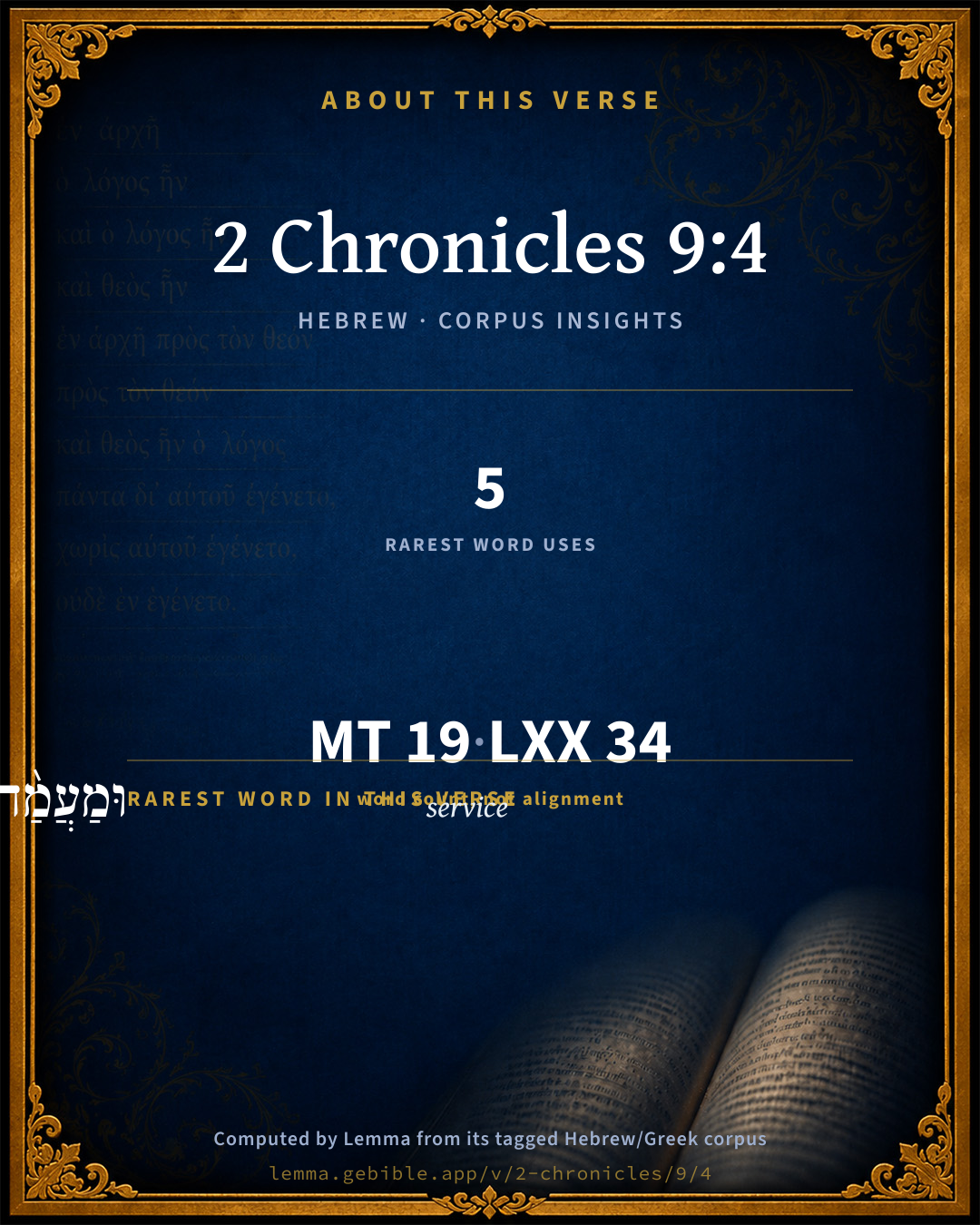
The rarest word here is וּמַעֲמַ֨ד service H4612 — appearing just 5 times in the whole Hebrew Bible.

Shared distinctive vocabulary

וּמַעֲמַ֨ד service H4612 occurs in 5 verses of the Hebrew Bible. Also found in:

Grammatical profile

  • 3 verbs
  • 12 nouns
  • 1 preposition
  • 1 adverb
  • 2 particles

Verb forms

  • מְשָׁרְתָ֜יו Piel · Participle Active
  • יַעֲלֶ֖ה Qal · Imperfect
  • הָ֥יָה Qal · Perfect

Repetition

A word recurs within this verse — often emphatic in Hebrew:

  • וּמַלְבּֽוּשֵׁיהֶ֗ם clothing H4403 ×2

Hebrew & Septuagint length

In English translation the verse runs 48 words from the Hebrew and 47 from the Septuagint (LXX English) — closely comparable.

A rough comparison of the two English renderings, which tokenize alike — not a word-level alignment.

Word counts can differ between the Hebrew and the Greek without any difference in meaning — e.g. the Hebrew direct-object marker אֵת has no separate Greek word, and Greek often adds the article ὁ.

In the original languages it is 19 Hebrew tokens and 34 Greek tokens — but the two are counted differently (Hebrew bundles its prefixes and suffixes into one token; the Greek is in lemma form), so that isn’t a like-for-like length.

Cross-references

17

Topical passages linked to 2 Chronicles 9:4 in the Treasury of Scripture Knowledge — connected by theme and wording, ordered by reader-vote popularity; previews shown in the World English Bible.

  • 1 Kings 4:22–23 Solomon's provision for one day was thirty measures of fine flour, and sixty measures of meal,
  • 1 Kings 10:5 and the food of his table, and the sitting of his servants, and the attendance of his ministers, and their clothing, and his cup bearers, and his ascent by which he went up to the house of Yahweh; there was no more spirit in her.
  • 2 Kings 16:18 The covered way for the Sabbath that they had built in the house, and the king's entry outside, turned he to the house of Yahweh, because of the king of Assyria.
  • 1 Chronicles 9:18 who hitherto [waited] in the king's gate eastward: they were the porters for the camp of the children of Levi.
  • 2 Chronicles 23:13 and she looked, and, behold, the king stood by his pillar at the entrance, and the captains and the trumpets by the king; and all the people of the land rejoiced, and blew trumpets; the singers also [played] on instruments of music, and led the singing of praise. Then Athaliah tore her clothes, and said, Treason! treason!
  • Nehemiah 1:11 Lord, I beg you, let now your ear be attentive to the prayer of your servant, and to the prayer of your servants, who delight to fear your name; and please prosper your servant this day, and grant him mercy in the sight of this man. Now I was cup bearer to the king.
  • Psalms 119:81 My soul faints for your salvation. I hope in your word.
  • Psalms 143:7 Hurry to answer me, Yahweh. My spirit fails. Don't hide your face from me, So that I don't become like those who go down into the pit.
  • Proverbs 9:5 "Come, eat some of my bread, Drink some of the wine which I have mixed!
  • Song of Solomon 5:8 I adjure you, daughters of Jerusalem, If you find my beloved, That you tell him that I am faint with love. Friends
  • Ezekiel 44:3 As for the prince, he shall sit therein as prince to eat bread before Yahweh; he shall enter by the way of the porch of the gate, and shall go out by the way of the same.
  • Ezekiel 46:2 The prince shall enter by the way of the porch of the gate outside, and shall stand by the post of the gate; and the priests shall prepare his burnt-offering and his peace-offerings, and he shall worship at the threshold of the gate: then he shall go forth; but the gate shall not be shut until the evening.
  • Daniel 10:17 For how can the servant of this my lord talk with this my lord? for as for me, immediately there remained no strength in me, neither was there breath left in me.
  • Luke 12:37 Blessed are those servants, whom the lord will find watching when he comes. Most assuredly I tell you, that he will dress himself, and make them recline, and will come and serve them.
  • John 6:53–57 Jesus therefore said to them, "Most assuredly I tell you, unless you eat the flesh of the Son of Man and drink his blood, you don't have life in yourselves.
  • Revelation 1:17 When I saw him, I fell at his feet like a dead man. He laid his right hand on me, saying, "Don't be afraid. I am the first and the last,
  • Revelation 3:20 Behold, I stand at the door and knock. If anyone hears my voice and opens the door, then I will come in to him, and will dine with him, and he with me.

Cross-references courtesy of OpenBible.info (CC BY 4.0).

Hebrew and Greek witnesses Masoretic Hebrew ↔ Greek Septuagint

The same verse in the two great witnesses to the Old Testament, shown verse-for-verse.

These are two independent witnesses, not word-aligned to each other, and the Septuagint is shown in lemma (dictionary) form.

Hebrew 2 Chronicles 9:4 Masoretic · Westminster Leningrad Codex

וּמַאֲכַ֣ל שֻׁלְחָנ֡וֹ וּמוֹשַׁ֣ב עֲבָדָיו֩ וּמַעֲמַ֨ד מְשָׁרְתָ֜יו וּמַלְבּֽוּשֵׁיהֶ֗ם וּמַשְׁקָיו֙ וּמַלְבּ֣וּשֵׁיהֶ֔ם וַעֲלִיָּת֔וֹ אֲשֶׁ֥ר יַעֲלֶ֖ה בֵּ֣ית יְהוָ֑ה וְלֹא הָ֥יָה ע֛וֹד בָּ֖הּ רֽוּחַ

and the food of his table, and the sitting of his servants, and the attendance of his ministers, and their clothing, his cup bearers also, and their clothing, and his ascent by which he went up to the house of Yahweh; there was no more spirit in her.

World English Bible · Public Domain

Greek LXX 2 Chronicles 9:4 Septuagint · lemma form

καί ὁ βρῶμα ὁ τράπεζα καί καθέδρα παῖς αὐτός καί στάσις λειτουργός αὐτός καί ἱματισμός αὐτός καί οἰνοχόος αὐτός καί στολισμός αὐτός καί ὁ ὁλοκαύτωμα ὅς ἀναφέρω ἐν οἶκος κύριος καί ἐκ ἑαυτοῦ γίγνομαι

and the meat of the tables, and the sitting of his servants, and the standing of his ministers, and their raiment; and his cupbearers, and their apparel; and the whole burnt offerings which he offered up in the house of the Lord; then she was in ecstasy.

LXX2012 (modern English Septuagint) · Public Domain

On this verse, Ellicott's Commentary for English Readers discusses the Septuagint’s reading. Read the note in Commentary ↓

Hebrew: Westminster Leningrad Codex (CC BY 4.0). Greek: Septuagint (public domain); English from LXX2012 (modern English Septuagint) (Public Domain). How the Septuagint differs from the Hebrew →

Commentary

Notes on 2 Chronicles 9:4 from classic Christian and Jewish commentators (each source and its license shown beneath its notes). The classic Christian expositions comment on the surrounding passage and are grouped to its opening verse, so a note may address several verses; the Jewish commentaries on the Tanakh (Rashi and others) are per-verse, so they appear only where the commentator wrote on this verse.

Lemma curates 59 commentaries, every one of them public domain or Creative Commons licensed, each selected and text-cleaned for this edition rather than reprinted as found. About our sources →

Trapp's Complete Commentary

John Trapp

2Ch 9:4 And the meat of his table, and the sitting of his servants, and the attendance of his ministers, and their apparel; his cupbearers also, and their apparel; and his ascent by which he went up into the house of the LORD; there was no more spirit in her.

Ver. 4. And their apparel] 1Ki 10:5.

John Trapp, A Commentary or Exposition upon All the Books of the Old and New Testament (1647–1656) — public domain. Text from a community e-Sword module.

Geneva Bible (1599)

Geneva Bible translators

Or, galleries whereby he went up.

Hebrew, there was no spirit in her.

Geneva Bible (1599) marginal notes — public domain. Text via Bolls.life.

Ellicott's Commentary for English Readers

(4) And his ascent by which he went up into the house of the Lord.—Kings, “And his burnt offering which he offered in the house of the Lord.” The LXX., Syr., and Vulg. here agree with Kings; and the Arab. reads, “the altar on which he offered.” In all other passages, the word used in our text (‘alîyâh) means not ascent, but upper chamber; it is likely, therefore, that in the present instance it is merely an error of transcription for the term occurring in Kings (‘ôlâh, “burnt-offering”).

A Bible Commentary for English Readers, edited by Charles John Ellicott (1878–1897) — public domain. Text from a community e-Sword module.

The Cambridge Bible for Schools and Colleges

gen. ed. J. J. S. Perowne

4. and their apparel] The phrase is repeated probably through an error of transcription; it occurs once only in the parallel place in 1 Kin.

his ascent by which he went up] Render (if the text be sound), his manner of going up, i.e. the pomp with which he went up (so Targ.); but LXX. and Pesh. give, the burnt-offerings which he used to offer, a rendering which is right in 1Ki_10:5 (cp. R.V. mg.). The difference of reading between Chron. and 1 Kin. in the Heb. is slight.

The Cambridge Bible for Schools and Colleges (gen. ed. J. J. S. Perowne; Cambridge University Press, 1878–1918) — public domain. Text from a community e-Sword module.

The Pulpit Commentary

The meat of his table. (see 1Ki_4:22, 1Ki_4:23) Translating our thoughts rather violently into modern language, we might picture the queen inspecting the kitchens of the palace, and remember that the kitchens of an Oriental court did the work, not of an individual "table," but of those of a very large domestic and official retinue; much more these of Solomon now. Keil and Bertheau, however, with others, refer this expression to the set-out of one meal-table (as e.g. that of a modern banquet, wedding breakfast, or the like), where both the abounding lading of the table and the ample variety of the courses, and the rich foreign or home fruits, in season or out of season, and the furnishing and decorating of the table, all come in to add their contribution of effect; and they quote not inaptly our ver. 20, elucidated by 1Ki_10:21. This was a daily glory with Solomon"s palace-establishment. The immediate connection and the contents of this verse, though difficult, favour this direction of explanation, as will be seen in the succeeding clauses. The sitting of his servants. The word here used (bvwOm) occurs forty-three times, and is rendered in the Authorized Version thirty-two of these times as "habitation" or "dwelling." Of the remaining eleven times, one or other of those words would be almost the synonym of the word used, and in every ease the rendering "dwelling," if kept to the general idea of a dwelling or resting-place more or less temporary, would not be inappropriate or inconsistent with the evident drift of the connection; only here and in the parallel is the inconvenient rendering "sitting" adopted by the Authorized Version. Hence we disagree with Professor Dr. Murphy"s explanation, the sitting, i.e. "in council of his chief officers." What the nature of the location (to use a term least specific) of the servants pointed to here is, nevertheless, still not quite clear. It is evidently placed in some antithesis with the standing (i.e. the standing-place) here rendered "inadequately or incorrectly, the attendance of his ministers. The attendance, i.e. "the station (dm) (see the four other occurrences of this word:" 1Ki_10:5; 1Ch_23:28; 2Ch_35:15; Isa_22:19) Of his ministers; Hebrew, wytrvm, participle of a piel verb, trev; This word, in an amazing majority of the hundred occurrences of it, expresses ministry of sacred service of some kind. It may, indeed, be said that the present passage, with only one or two others, are doubtful in this meaning or character of explanation. To our next clause, referring to their apparel, we find in the parallel mention, as here, of the cupbearers, though the matter of their apparel is not included as it is here. Part of the difficulty of the verse arises from the consideration that up to this point the contents of the successive clauses of it may compose possibly enough a sharp graphic description of the daily banquet scene. An apt reference to similar description of Arabian banquets is given in the "Speaker"s Commentary" as to be found in vol. it. pp. 213-215 of "Ancient Monarchies." Our next clause, however, brings us back into difficulty by its reference to Solomon"s ascent by which he went up into the house of the Lord, (1Ch_26:16 with our Exposition, "Pulpit Commentary apparently so unseasonably; nor are we much helped by reading, with the Septuagint, "the burnt offerings which he offered at the house of the Lord." The obscurity and lack of coherence are not formidable, indeed, and perhaps may be with moderate satisfaction set down again to the account of the occasionally careless selection of the compilers from the material of the older work. Possibly the allusion in our ver. 11 to the terraces, or stairs, or highways (see margin) to "the house of the Lord," and to the kings palace, may hold some clue to the ascent being adverted to here. Vers. 4-6.

The unimaginable.

The Queen of Sheba was completely overwhelmed by what she saw at the court of Jerusalem. When she had seen and heard everything there was to see and hear, "there was no more spirit in her." She was "astonished with a great astonishment." She had not credited what she had been told (ver. 6); but she found that there was a great deal more to find than anything that had been described. What she realized altogether surpassed her anticipation. Her experience was very remarkable of its kind, but in this particular it was by no means exceptional. We have much to do with the unimaginable. It meets us or awaits us in

I THE MATERIAL CREATION. What wholly unanticipated wonders have been disclosed by the advance of human science! The men of remote generations had not the faintest notion of the powers we have discovered to reside in the material universe. And what still undiscovered forces await our inquiry and investigation as we patiently plod on in the paths of knowledge! Surely one-half hath not been told us or imagined by us.

II OUR HUMAN EXPERIENCE. We have our expectation concerning the life that is before us; but it is very little like the reality, as experience will prove. Many things we may picture to ourselves which will find no fulfilment; but many other things there are, of which we have no discernment, that will find their place on the page of our biography. Of these some are unexpected sorrows losses, disappointments, separations, struggles of which we can form no idea; others are unanticipated blessings-comforts, relationships, joys, triumphs exceeding and excelling our hopes. We do not anticipate, for good or evil, one-half of the bright or dark reality.

III THE GOSPEL OF THE GRACE OF GOD. "Eye had not seen, nor ear heard, nor had it entered into man"s heart to conceive" one-half of "what God had prepared for them that love him." No man could or did imagine that such wealth of grace and goodness as that which the gospel of Christ contains would be brought to us by the Anointed of God, would be purchased for us by a Saviour"s sacrifice, would be pressed upon us by a heavenly Father"s urgent and persistent love.

IV THE GLORY WHICH IS TO BE REVEALED. In that "land of great distances" we are one day to traverse, in that home of love in which we are soon to dwell, what unimaginable good is in reserve! What joy and what glory; what rest and what activity; what realization and what hope; what knowledge of God and what pursuit of that knowledge; what royalty and what service; what purity and what progress; what unanticipated and inconceivable blessedness to satisfy but not satiate the soul! C.

The Pulpit Commentary (1880–1919), ed. H.D.M. Spence-Jones & Joseph S. Exell — public domain. Text from a community e-Sword module.

Rashi

Rabbi Shlomo Yitzchaki (Rashi)

And the food of his table fowl (I Kings 5:3) and kinds of delicacies that were served on his table in abundance.

and the seating of his servants That each one recognized his place when they were seated at the table, and of those who constantly saw the king’s face, no one was allowed to sit in his neighbor’s place all the days of his life.

and the station of his attendants Each one would retain his station and his position, and he would not change it the next day.

and their attire The attire that they would wear tomorrow was not the same as, the attire that they wore today.

and his cupbearers most of his cupbearers.

and his ascent the stairway by which he ascended from his palace to the Temple.

and she was breathless because she thought that there was no wisdom in any of the kingdoms but in her own country and like that of her wise men, because her country was in the east; they were wise because they were stargazers, as is stated in the first chapter of Tractate Rosh Hashanah, for Eretz Israel is west of Babylon, and that is what is written (I Kings 5:10): “And Solomon’s wisdom was greater than the wisdom of all the children of the east,” for they were in the east, as it is written (Gen. 11: 2): “And it came to pass as they migrated from the east.” (I Kings 5:10) “And all the wisdom of Egypt,” for they were sorcerers, necromancers, and astrologers, and he was wise in divination (טַיִיר). So it is written in Pesikta (d’Rav Kahana p. 33b). The word (טַיִיר) is Arabic, and in Leviticus Rabbah (32:2), in the chapter dealing with the son of the Egyptian (24:10): (Eccl. 10:20): “for a bird of the air shall carry the voice.” This is the raven and refers to the art of bird divination (טוּיאַרִי).

Rashi on the Tanakh — English translations: “The Judaica Press complete Tanach with Rashi, translated by A. J. Rosenberg” (CC BY 4.0); “Pentateuch with Rashi's commentary by M. Rosenbaum and A.M. Silbermann, 1929-1934” (public domain); “The Metsudah Tanach series, Lakewood, N.J” (CC BY 4.0); and “The Book of Joshua, Metsudah Publications, 1997” (CC BY 4.0). Text via Sefaria.

Lesson kit

Teaching starters — assembled from the data on this page, not authored interpretation. Every prompt links to the verse data it draws on. Edit before teaching.

2 Chronicles, in the Historical, opens this verse with 19 words (17 distinct Hebrew lemmas). Its most distinctive word is maʻămâd (“service”). A historical commentator’s framing appears above. Read the whole chapter for the surrounding context.

Discussion questions

  1. The word maʻămâd carries the sense “service.” How does it shape the verse?
  2. How does 1 Kings 10:5, which shares the word «service», read alongside this verse?
  3. What does the repetition of “clothing” (2× in this one verse) do in this verse?
  4. These translations render this verse differently. What is at stake in choosing one wording over another?
  5. «מְשָׁרְתָ֜יו» is a Piel Participle Active verb. How does that grammatical form shape the action described?
  6. Compare how Trapp's Complete Commentary and Geneva Bible (1599) read this verse. Where do they agree or differ?

Things to notice

Reading settings

Reading text

Shown beneath each verse's original-language words.

Old Testament
Old Testament edition

Read the OT as the Masoretic Hebrew (MT) or the Greek Septuagint (LXX).

English shown for the Greek Septuagint (in the Hebrew ↔ Greek comparison).

Comparing translations? Open the Compare panel on any verse page to stack up to four side by side.