2 Chronicles 36:20

Hebrew (Westminster Leningrad Codex) 2 Chronicles 36:20 appears in the Hebrew Old Testament. The text above is from the Westminster Leningrad Codex. Each word links to its Strong’s number, a concise gloss, and parsing drawn from the Open Scriptures Hebrew Bible morphology. Click any word for its full Brown-Driver-Briggs (BDB) entry.
Download image
Cite this verse

2 Chronicles 36:20 (World English Bible). Public Domain. Lemma interlinear Bible study tool, https://lemma.gebible.app/v/2-chronicles/36/20.

Show BibTeX & RIS
BibTeX
RIS
English Translation
Those who had escaped from the sword carried he away to Babylon; and they were servants to him and his sons until the reign of the kingdom of Persia:
World English Bible · Public Domain
Highlights
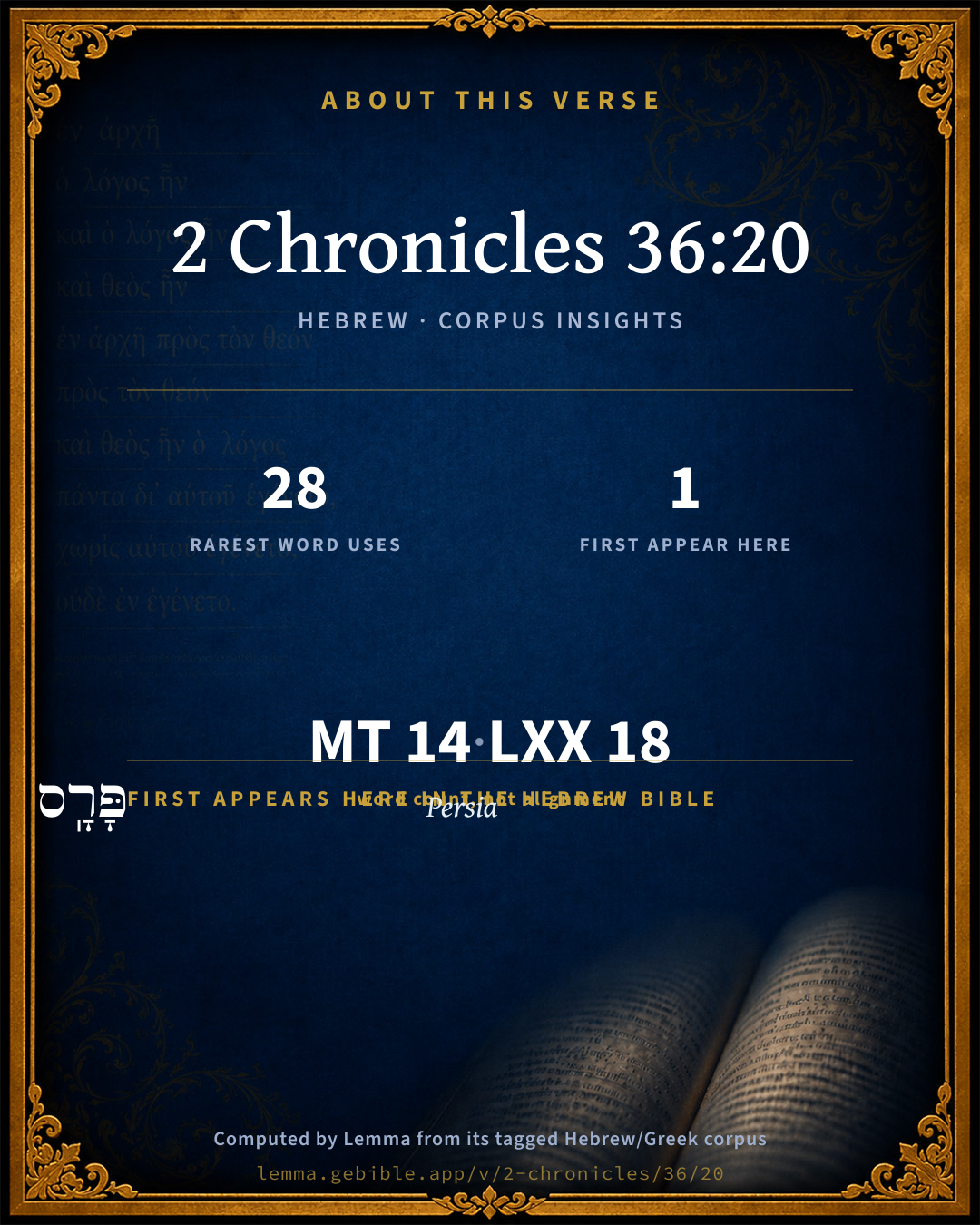
  • 1 first appearance in the Hebrew Bible
Full analysis ↓
Download a study sheet

One document with this verse’s original text, its word-by-word gloss line, the meaning frame, cross-references with their text, attributed commentary, and full source and license credits — printable, and it pastes into notes with its structure intact.

This verse Autodidact and up

Study sheet (.html) Plain text (.txt)

A passage Seminary Student

Up to 50 verses in one chapter. A passage sheet keeps up to 6 commentary sources and 12 cross-references per verse, in the order this page ranks them, and says so on the sheet whenever that leaves anything out. Ask for a single verse and you get the Autodidact verse sheet above.

Everything on this page stays free to read, with no account — the sheet is a download of what is already on screen, not access to it.

Want to remove ads? Support Godless Engineer
Compare translations 3

The same verse in 3 English versions, stacked beneath the original-language interlinear above. Click any original word for its lexicon entry.

Each is an independent rendering of the whole verse — the interlinear is not word-aligned to these translations.

Highlighted words mark where these versions differ — a whole-verse word diff, not a word-by-word alignment.

  • World English Bible Public Domain
    Those who had escaped from the sword carried he away to Babylon; and they were servants to him and his sons until the reign of the kingdom of Persia:
  • King James Version Public Domain
    And them that had escaped from the sword carried he away to Babylon; where they were servants to him and his sons until the reign of the kingdom of Persia:
  • unfoldingWord Literal Text CC BY-SA 4.0
    And the remaining from the sword he led into exile to Babylon, and they became to him and to his sons servants until the reign of the kingdom of Persia

unfoldingWord Literal Text — © unfoldingWord, licensed CC BY-SA 4.0. Word-aligned USFM3 via Door43 (git.door43.org/unfoldingWord/en_ult).

Versions to compare (up to 4)

3 of 4 selected

Show all 18 translations

Every available English version of this verse, each an independent rendering of the whole verse.

  • World English Bible Public Domain
    Those who had escaped from the sword carried he away to Babylon; and they were servants to him and his sons until the reign of the kingdom of Persia:
  • Berean Standard Bible Public Domain
    Those who escaped the sword were carried by Nebuchadnezzar into exile in Babylon, and they became servants to him and his sons until the kingdom of Persia came to power.
  • Majority Standard Bible Public Domain
    Those who escaped the sword were carried by Nebuchadnezzar into exile in Babylon, and they became servants to him and his sons until the kingdom of Persia came to power.
  • King James Version Public Domain
    And them that had escaped from the sword carried he away to Babylon; where they were servants to him and his sons until the reign of the kingdom of Persia:
  • American Standard Version (1901) Public Domain
    And them that had escaped from the sword carried he away to Babylon; and they were servants to him and his sons until the reign of the kingdom of Persia:
  • Revised Version (1885) Public Domain
    And them that had escaped from the sword carried he away to Babylon; and they were servants to him and his sons until the reign of the kingdom of Persia:
  • Geneva Bible (1599) Public Domain
    And they that were left by the sworde, caryed he away to Babel, and they were seruants to him and to his sonnes, vntill the kingdome of the Persians had rule,
  • Douay-Rheims (1899) Public Domain
    Whosoever escaped the sword, was led into Babylon, and there served the king and his sons till the reign of the king of Persia.
  • Young's Literal Translation Public Domain
    And he removeth those left of the sword unto Babylon, and they are to him and to his sons for servants, till the reigning of the kingdom of Persia,
  • Literal Standard Version CC BY-SA 4.0
    And he removes those left of the sword to Babylon, and they are to him and to his sons for servants, until the reigning of the kingdom of Persia,
  • Unlocked Literal Bible CC BY-SA 4.0
    The king carried away to Babylon those who had escaped the sword. They became servants for him and his sons until the rule of the kingdom of Persia.
  • unfoldingWord Literal Text CC BY-SA 4.0
    And the remaining from the sword he led into exile to Babylon, and they became to him and to his sons servants until the reign of the kingdom of Persia
  • Darby Bible Public Domain
    And them that had escaped from the sword he carried away to Babylon; and they became servants to him and his sons, until the reign of the kingdom of Persia;
  • World Messianic Bible Public Domain
    He carried those who had escaped from the sword away to Babylon, and they were servants to him and his sons until the reign of the kingdom of Persia,
  • Webster's Bible Public Domain
    And them that had escaped from the sword he carried away to Babylon; where they were servants to him and his sons until the reign of the kingdom of Persia.
  • Free Bible Version CC BY-SA 4.0
    Nebuchadnezzar took into exile in Babylon those who had not been killed. They were slaves for himself and his sons, until the kingdom of Persia took over.
  • Bible in Basic English Public Domain
    And all who had not come to death by the sword he took away prisoners to Babylon; and they became servants to him and to his sons till the kingdom of Persia came to power:
  • JPS Tanakh (1917) Public Domain
    And them that had escaped from the sword carried he away to Babylon; and they were servants to him and his sons until the reign of the kingdom of Persia;

Literal Standard Version (2020), Covenant Press — licensed CC BY-SA 4.0. Text via the HelloAO Bible API (eBible.org). Unlocked Literal Bible (unfoldingWord) — licensed CC BY-SA 4.0. Text via the HelloAO Bible API (eBible.org). unfoldingWord Literal Text — © unfoldingWord, licensed CC BY-SA 4.0. Word-aligned USFM3 via Door43 (git.door43.org/unfoldingWord/en_ult). Free Bible Version, Dr. Jonathan Gallagher — licensed CC BY-SA 4.0. Text via the HelloAO Bible API (eBible.org).

Word by word

More ways to search: Search by grammar → Find every occurrence → Compare this word →

Practice this passage: Drill this verse → Learn its vocabulary →

פָּרָֽס
Pâraç
H6539
“Persia”
Noun, Proper
Part of Speech
Noun
Type
Proper
Full BDB Definition

Origin: of foreign origin

TWOT: 1820

Persian = see Persia " pure" or " splendid" - the empire Persia; encompassed the territory from India on the east to Egypt and Thrace on the west, and included, besides portions of Europe and Africa, the whole of western Asia between the Black Sea, the Caucasus, the Caspian and the Jaxartes on the north, the Arabian desert, the Persian Gulf and the Indian Ocean on the south - Persia proper was bounded on the west by Susiana or Elam, on the north by Media, on the south by the Persian Gulf and on the east by Carmania - the people of the Persian empire
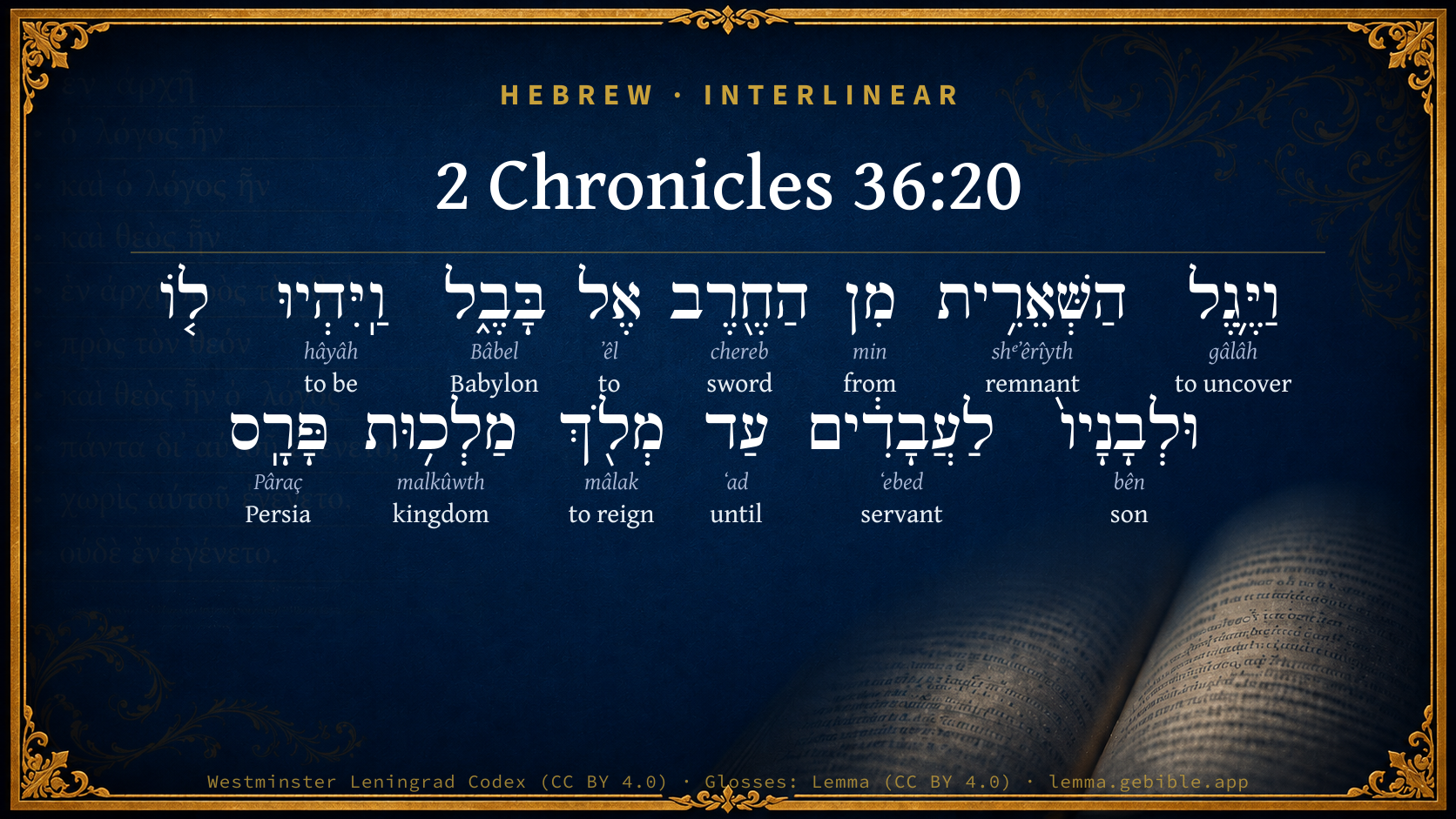
  1. וַיֶּ֛גֶל gâlâh H1540 “and · to uncover” Conjunction + Verb, Hiphil, Sequential Imperfect, 3rd Person, Masculine, Singular
  2. הַשְּׁאֵרִ֥ית shᵉʼêrîyth H7611 “the · remnant” Particle, Definite Article + Noun, Common, Feminine, Singular, Absolute
  3. מִן min H4480 “from” Preposition
  4. הַחֶ֖רֶב chereb H2719 “the · sword” Particle, Definite Article + Noun, Common, Feminine, Singular, Absolute
  5. אֶל ʼêl H413 “to” Preposition
  6. בָּבֶ֑ל Bâbel H894 “Babylon” Noun, Proper
  7. וַֽיִּהְיוּ hâyâh H1961 “and · to be” Conjunction + Verb, Qal, Sequential Imperfect, 3rd Person, Masculine, Plural
  8. וּלְבָנָיו֙ bên H1121 “and · to/for · sons · his” Conjunction + Preposition + Noun, Common, Masculine, Plural, Construct + Suffix, Personal, 3rd Person, Masculine, Singular
  9. לַעֲבָדִ֔ים ʻebed H5650 “to/for · servants” Preposition + Noun, Common, Masculine, Plural, Absolute
  10. עַד ʻad H5704 “until” Preposition
  11. מְלֹ֖ךְ mâlak H4427 “to reign” Verb, Qal, Infinitive Construct
  12. מַלְכ֥וּת malkûwth H4438 “kingdom of” Noun, Common, Feminine, Singular, Construct

About this verse

These counts appear in no published source. They are computed here, from the morphology-tagged text and Lemma’s own curated glosses. What Lemma adds →

14
words
13
distinct lemmas
Historical
section

First appearance in Scripture

This word makes its first canonical appearance in the Hebrew Bible here:

  • פָּרָֽס Persia H6539

Shared distinctive vocabulary

פָּרָֽס Persia H6539 occurs in 24 verses of the Hebrew Bible. Also found in:

Grammatical profile

  • 3 verbs
  • 7 nouns
  • 4 prepositions

Verb forms

  • וַיֶּ֛גֶל Hiphil · Sequential Imperfect
  • וַֽיִּהְיוּ Qal · Sequential Imperfect
  • מְלֹ֖ךְ Qal · Infinitive Construct

Hebrew & Septuagint length

In English translation the verse runs 29 words from the Hebrew and 27 from the Septuagint (LXX English) — closely comparable.

A rough comparison of the two English renderings, which tokenize alike — not a word-level alignment.

Word counts can differ between the Hebrew and the Greek without any difference in meaning — e.g. the Hebrew direct-object marker אֵת has no separate Greek word, and Greek often adds the article ὁ.

In the original languages it is 14 Hebrew tokens and 18 Greek tokens — but the two are counted differently (Hebrew bundles its prefixes and suffixes into one token; the Greek is in lemma form), so that isn’t a like-for-like length.

Cross-references

5

Topical passages linked to 2 Chronicles 36:20 in the Treasury of Scripture Knowledge — connected by theme and wording, ordered by reader-vote popularity; previews shown in the World English Bible.

  • Jeremiah 27:7 All the nations shall serve him, and his son, and his son's son, until the time of his own land come: and then many nations and great kings shall make him their bondservant.
  • Ezra 1:1–11 Now in the first year of Cyrus king of Persia, that the word of Yahweh by the mouth of Jeremiah might be accomplished, Yahweh stirred up the spirit of Cyrus king of Persia, so that he made a proclamation throughout all his kingdom, and [put it] also in writing, saying,
  • Deuteronomy 28:47–48 Because you didn't serve Yahweh your God with joyfulness, and with gladness of heart, by reason of the abundance of all things;
  • 2 Kings 25:11 The residue of the people who were left in the city, and those who fell away, who fell to the king of Babylon, and the residue of the multitude, did Nebuzaradan the captain of the guard carry away captive.
  • 2 Chronicles 36:22 Now in the first year of Cyrus king of Persia, that the word of Yahweh by the mouth of Jeremiah might be accomplished, Yahweh stirred up the spirit of Cyrus king of Persia, so that he made a proclamation throughout all his kingdom, and [put it] also in writing, saying,

Cross-references courtesy of OpenBible.info (CC BY 4.0).

Hebrew and Greek witnesses Masoretic Hebrew ↔ Greek Septuagint

The same verse in the two great witnesses to the Old Testament, shown verse-for-verse.

These are two independent witnesses, not word-aligned to each other, and the Septuagint is shown in lemma (dictionary) form.

Hebrew 2 Chronicles 36:20 Masoretic · Westminster Leningrad Codex

וַיֶּ֛גֶל הַשְּׁאֵרִ֥ית מִן הַחֶ֖רֶב אֶל בָּבֶ֑ל וַֽיִּהְיוּ ל֤וֹ וּלְבָנָיו֙ לַעֲבָדִ֔ים עַד מְלֹ֖ךְ מַלְכ֥וּת פָּרָֽס

Those who had escaped from the sword carried he away to Babylon; and they were servants to him and his sons until the reign of the kingdom of Persia:

World English Bible · Public Domain

Greek LXX 2 Chronicles 36:20 Septuagint · lemma form

καί ἀποοἰκίζω ὁ κατάλοιπος εἰς βαβυλών καί εἰμί αὐτός καί ὁ υἱός αὐτός εἰς δοῦλος ἕως βασιλεία μήδων

And he carried away the remnant to Babylon; and they were servants to him and to his sons until the establishment of the kingdom of the Medes.

LXX2012 (modern English Septuagint) · Public Domain

Hebrew: Westminster Leningrad Codex (CC BY 4.0). Greek: Septuagint (public domain); English from LXX2012 (modern English Septuagint) (Public Domain). How the Septuagint differs from the Hebrew →

Commentary

Notes on 2 Chronicles 36:20 from classic Christian and Jewish commentators (each source and its license shown beneath its notes). The classic Christian expositions comment on the surrounding passage and are grouped to its opening verse, so a note may address several verses; the Jewish commentaries on the Tanakh (Rashi and others) are per-verse, so they appear only where the commentator wrote on this verse.

Lemma curates 59 commentaries, every one of them public domain or Creative Commons licensed, each selected and text-cleaned for this edition rather than reprinted as found. About our sources →

Trapp's Complete Commentary

John Trapp

2Ch 36:20 And them that had escaped from the sword carried he away to Babylon; where they were servants to him and his sons until the reign of the kingdom of Persia:

Ver. 20. Carried he away to Babylon.] See 2Ki 25:11.

Where they were servants to him and his sons,] viz., To Nebuchadnezzar, Evilmerodach, and Belshazzar, according as had been foretold. {Jer 27:6-7}

John Trapp, A Commentary or Exposition upon All the Books of the Old and New Testament (1647–1656) — public domain. Text from a community e-Sword module.

Joseph Benson's Commentary

2Ch 36:20. Where they were servants to him and his sons — They do not seem to have been made captives to private persons, but to have been taken in one body, and made the servants of the king; that is, to have been employed by him, in one way or other, to his private advantage, which we are not now acquainted with. Until the reign of the kingdom of Persia — Until the reign of the king of Persia, Houb. Respecting the proclamation of Cyrus, see the beginning of the next book. From these words, we may conclude that this book was written after the return from captivity.

Joseph Benson's Commentary on the Old and New Testaments (1811–1818) — public domain. Text from a community e-Sword module.

Keil & Delitzsch

C. F. Keil & F. Delitzsch

He who remained from the sword, i.e., who had not been slain by the sword, had not fallen and died in war, Nebuchadnezzar carried away to Babylon into captivity; so that they became servants to him and to his sons, as Jeremiah (Jer 27:7) prophesied, until the rise of the kingdom of the Persians. These last words also are an historical interpretation of the prophecy, Jer 27:7. All this was done (Ch2 36:21) to fulfil (מלּאת instead of מלּא, as in Ch1 29:5), that the word of the Lord by the mouth of Jeremiah might be fulfilled, he having prophesied (Jer 25:11., Ch2 29:10) the seventy years' duration of Judah's desolation and the Babylonian captivity, while the king and people had not regarded his words (Ch2 36:12). This period, which according to Ch2 36:20 came to an end with the rise of the kingdom of the Persians, is characterized by the clause וגו רצתה עד as a time of expiation of the wrong which had been done the land by the non-observance of the sabbath-years, upon the basis of the threatening (Lev 26:34), in which the wasting of the land during the dispersion of the unrepentant people among the heathen was represented as a compensation for the neglected sabbaths. From this passage in the law the words are taken, to show how the Lord had inflicted the punishment with which the disobedient people had been threatened as early as in the time of Moses. רצתה עד is not to be translated, "until the land had made up its years of rest;" that signification רצה has not; but, "until the land had enjoyed its sabbath-years," i.e., until it had enjoyed the rest of which it had been deprived by the non-observance of the sabbaths and the sabbath-years, contrary to the will of its Creator; see on Lev 26:34. That this is the thought is placed beyond doubt by the succeeding circumstantial clause, taken word for word from Lev 26:34 : "all days (i.e., the whole time) of its desolation did it hold it" (שׁבתה, it kept sabbath). "To make full the seventy years;" which Jeremiah, ll. cc., had prophesied.

This connecting of Jeremiah's prophecy with the declaration in Lev 26:34 does not justify us in supposing that the celebration of the sabbath-year had been neglected seventy times, or that for a period of 490 years the sabbath-year had not been observed. Bertheau, holding this view, fixes upon 1000 b.c., i.e., the time of Solomon, or, as we cannot expect any very great chronological exactitude, the beginning of the kingly government in Israel, as the period after which the rest-years ceased to be regarded. He is further of opinion that Ch2 35:18 harmonizes with this view; according to which passage the passover was not celebrated in accordance with the prescription of the law until the end of the period of the judges. According to this chronological calculation, the beginning of this neglect of the observance of the sabbath-year would fall in the beginning of the judgeship of Samuel.

(Note: The seventy years' exile began in the fourth year of Jehoiakim, i.e., in the year 606 b.c., or 369 years after the division of the kingdom; see the Chronol. Tables at 1 Kings 12 (ii. 3, S. 141), to which the eighty years of the reigns of David and Solomon, and the time of Saul and Samuel, must be added to make up the 490 years (see the comment. on Judges).)

But this is itself unlikely; and still more unlikely is it, that in the time of the judges the sabbath-year had been regularly observed until Samuel; and that during the reigns of the kings David, Solomon, Jehoshaphat, Hezekiah, and Josiah, this celebration remained wholly in abeyance. But even apart from that, the words, that the land, to make full the seventy years prophesied by Jeremiah, kept the whole time of the desolation holy, or enjoyed a sabbath rest such as Moses had proclaimed in Lev 26:34, do not necessarily involve that the land had been deprived of its sabbath rest seventy times in succession, or during a period of 490 years, by the sin of the people. The connection between the prophecy of Jeremiah and the provision of the law is to be understood theologically, and does not purport to be calculated chronologically. The thought is this: By the infliction of the punishment threatened against the transgressors of the law by the carrying of the people away captive into Babylon, the land will obtain the rest which the sinful people had deprived it of by their neglect of the sabbath observance commanded them. By causing it to remain uncultivated for seventy years, God gave to the land a time of rest and refreshment, which its inhabitants, so long as they possessed it, had not given it. But that does not mean that the time for which this rest was granted corresponded to the number of the sabbath-years which had not been observed. From these theological reflections we cannot calculate how often in the course of the centuries, from the time of Joshua onwards till the exile, the sabbath-year had not been observed; and still less the time after which the observation of the sabbath-year was continuously neglected. The passage Ch2 35:8 has no bearing on this question, because it neither states that the passover had been held according to the precepts of the law till towards the end of the time of the judges, nor that it was no longer celebrated in accordance with the precept from that time until Josiah; it only contains the thought that such a passover as that in Josiah's reign had not been held since the time of the judges: see on the passage.

Keil & Delitzsch — Biblical Commentary on the Old Testament (1861–1891) — public domain (CC PDM 1.0). Text via the HelloAO Bible API. (Old Testament only.)

Geneva Bible (1599)

Geneva Bible translators

When Cyrus King of Persia had made the Babylonians subject.

Geneva Bible (1599) marginal notes — public domain. Text via Bolls.life.

The Cambridge Bible for Schools and Colleges

gen. ed. J. J. S. Perowne

20, 21 (= 1Es_1:57-58). The Captivity

20. to him and his sons] Cp. Jer_27:7. There were three kings of Babylon after Nebuchadnezzar before Cyrus established Persian rule, viz. Evil-Merodach (Amil-Marduk) (2Ki_25:27), Neriglissar (Nergalšar-uṣur), and Nabonidus (Nabu-na’id). The last two kings were usurpers. Neriglissar was (it seems) son-in-law to Nebuchadnezzar (Hommel, Babylonia in Hastings’ Bible Dict., i. 229a). Whether Nabonidus was connected with the royal house is not known.

The Cambridge Bible for Schools and Colleges (gen. ed. J. J. S. Perowne; Cambridge University Press, 1878–1918) — public domain. Text from a community e-Sword module.

John Gill's Exposition

Now in the first year of Cyrus king of Persia,.... These two verses are the same with which the next book, the book of Ezra, begins, where they will be explained; and these two books, the one ending and the other beginning with the same words, is a strong presumption, that one and the same person, Ezra, is the writer of them both; or rather, as a learned (e) writer conjectures, these two verses are added by some transcriber, who, having finished the book of Chronicles at verse twenty one went on with the book of Ezra, without any stop; but, perceiving his mistake, broke off abruptly; for so it is plain these verses conclude; however, this shows, as the same writer observes, that the book of Ezra followed that of the Chronicles, in the Hebrew copies, though it now does not.

(e) Dr. Kennicott's Dissert. 1. p. 492, &c.

Next: Ezra Introduction

John Gill's Exposition of the Whole Bible (1746–1763) — public domain (CC PDM 1.0). Text via the HelloAO Bible API.

Albert Barnes' Notes on the Bible

Servants - Or, “slaves.” They were probably employed by Nebuchadnezzar in the forced labor which his great works necessitated.

His sons - The word probably includes all Nebuchadnezzars successors in the independent sovereignty of Babylon.

Albert Barnes' Notes on the Bible (1834–1885) — public domain. Text from a community e-Sword/MySword module.

Haydock's Catholic Bible Commentary

Sons; Evilmerodac and Baltassar. --- Persia; Cyrus, who subdued the country.

George Leo Haydock (1774–1849), Haydock's Catholic Family Bible and Commentary, 1859 edition — public domain. Excludes Psalms (Douay-Rheims chapter numbering differs from Protestant) and Deuterocanonical books (Catholic canon only).

The Pulpit Commentary

Exile.

them carded he away to Babylon; where they were servants slaves to him and his sons." The captivity of the Jews in Babylon may be regarded in three light.

I As A PENALTY. It undoubtedly was that; nothing can be clearer than that they were permitted to be "the prey to the teeth" of the enemy because of their sins. The very next verse (21) intimates that it was disobedience to the Law of God that resulted in the denudation of the land. And the truth that national calamity is the consequence of national transgression is "writ large" and plain on every page of this Book of Chronicles. He may run that reads it. Sin entails penalty. The truth is written on the pages of national and individual history as well as on those of the Word of God. Every nation and every man may make up its (his) mind that, sooner or later, sin will entail defeat, humiliation, bondage. The penalty may take various forms, but penalty will most surely come. It may be obviously physical, or it may be principally spiritual; it will almost certainly be both the one and the other. But no man can harden himself against the Holy One and prosper. Whoso sinneth against him "wrongeth his own soul;" he deprives himself of inestimable good, and he makes himself the victim of deep and lasting evil. The children of Judah in Babylon had often occasion to say, "We suffer because we sinned against the Lord." This is the explanation of the tribulation and distress, of the darkness and the death, of the human world.

II AS A PURGATION. God meant that Babylonian captivity to be a fiery trial which should burn up the large measure of "wood, hay, and stubble" in the character of the Jews that needed to be consumed. Strange it may seem to us that they should learn purity of creed among the heathen; that, away from the city and the temple of God, they should acquire a taste and a love for his service and worship shown for many generations in their synagogues; that in the midst of many superstitions they should come to hate all idolatrous forms and tendencies with the utmost abhorrence. But so it was. In the land of the stranger they lost their inclination to apostatize from God; they were purged of their old folly and guilt. And what early instruction, what fuller privileges, what later experiences will not do, that Divine chastisement may accomplish. God passes us through the fiery trial to purge us of our dross, to consume our earthliness, our selfishness, our grossness, our unbelief. And in some "strange land," in some place of spiritual solitude, in conditions under which we are compelled to feel as we never felt before, to learn what we never knew before, to lay to heart what we never realized before, we leave many things behind us which are weights and hindrances, we move on to that which is before us.

III AS A PICTURE. Of what is that exile a picture? Is it not of our spiritual distance from God? To be living in sin, in a state in which we are not reconciled unto God, is not this the exile of the soul? For what does it mean?

1. It is distance.from God. It is to be a long way, an increasing distance, from him, from his favour, from his likeness, from the desire to hold communion with him, and therefore from his felt presence.

2. It is captivity. It is to be in the hands of the enemy; it is to be where silken cords at first, and at last iron chains, of unholy habit hold us fast in a cruel and degrading bondage; where we are held fast to covetousness, or to vanity, or to procrastination, or even to some dishonouring vice.

3. It is unsatisfiedness or even misery of soul. In that "strange land" these exiles could not sing "the Lord"s song;" they "wept when they remembered Zion" Spiritual exile is joylessness of soul; unreconciled to him, there can be no "joy and rejoicing in him" or in his holy service. But let us bless God that away in this saddest exile we have not to wait until an appointed term is fulfilled, or until some Cyrus issues a proclamation (ver. 22); we may hear, if we will listen, the voice of One who does indeed rule over "all the kingdoms of the earth" (ver. 23), who is ever saying to us, "Return unto me, and I will return unto you." We may hear the blessed words of him who never ceases to address the generations of men, saying, "Come unto me, and I will give you rest." We may earn of that Divine Teacher that whoever comes back from the "far country" of sin, and seeks the heavenly Father"s mercy, shall find the most cordial welcome he could hope to meet, and be taken back at once to all the love and to all the freedom of the Father"s home. C.

The Pulpit Commentary (1880–1919), ed. H.D.M. Spence-Jones & Joseph S. Exell — public domain. Text from a community e-Sword module.

unfoldingWord translationNotes

Door43 World Missions Community

The king carried away to Babylon

Here "the king" refers to his soldiers whom he ordered to do the work. The phrase "carried away" is an idiom that means to forcefully bring them to Babylon. AT: "The king had his army forcefully take to Babylon" (See: Metonymy and Idiom)

until the rule of the kingdom of Persia

"until the kingdom of Persia came to power"

the word of Yahweh by the mouth of Jeremiah

Here the noun "word" can be translated with the verb "spoke." The word "mouth" represents Jeremiah. AT: "what Yahweh spoke through Jeremiah" or "the word from Yahweh that Jeremiah spoke" (See: Synecdoche)

until the land should have enjoyed its Sabbath rests

The people were supposed to obey the Sabbath law by not farming the land every seventh year. This phrase speaks about this as if the land were a person that would obey the Sabbath law and rest. AT: "until the land had rested according to the Sabbath law" or "until, as required by the Sabbath law, no one had farmed the land" (See: Personification)

It observed its Sabbath for as long as it lay abandoned

The word "it" refers to the land. The land is spoken of as if it were a person who observed the Sabbath. AT: "The requirements of the Sabbath law were fulfilled as long as the land lay abandoned" (See: Personification)

in order to pass seventy years in this way

"so that 70 years passed while the land lay abandoned" (See: Numbers)

translationWords

king

kingdom

Persia

fulfill

word of God

Jeremiah

Sabbath

rest

unfoldingWord translationNotes — © Distant Shores Media and the Door43 World Missions Community, licensed CC BY-SA 4.0. Source: git.door43.org/Door43/en_tn.

Rashi

Rabbi Shlomo Yitzchaki (Rashi)

and they became vassals to him and to his sons until the reign of the kingdom of Persia And why until the kingdom of Persia? Because until that time, the land was not appeased for its Sabbaths, as it is written (Lev. 26:35): “As long as it is desolate, it will rest.”

Rashi on the Tanakh — English translations: “The Judaica Press complete Tanach with Rashi, translated by A. J. Rosenberg” (CC BY 4.0); “Pentateuch with Rashi's commentary by M. Rosenbaum and A.M. Silbermann, 1929-1934” (public domain); “The Metsudah Tanach series, Lakewood, N.J” (CC BY 4.0); and “The Book of Joshua, Metsudah Publications, 1997” (CC BY 4.0). Text via Sefaria.

Lesson kit

Teaching starters — assembled from the data on this page, not authored interpretation. Every prompt links to the verse data it draws on. Edit before teaching.

2 Chronicles, in the Historical, opens this verse with 14 words (13 distinct Hebrew lemmas). Its most distinctive word is Pâraç (“Persia”). A historical commentator’s framing appears above. Read the whole chapter for the surrounding context.

Discussion questions

  1. How does “Persia” (Pâraç) shape what this verse is saying?
  2. This is the first place “Persia” appears in Scripture (first appears here). What does its debut here establish?
  3. How does 2 Chronicles 36:22, which shares the word «Persia», read alongside this verse?
  4. These translations render this verse differently. What is at stake in choosing one wording over another?
  5. «וַיֶּ֛גֶל» is a Hiphil Sequential Imperfect verb. How does that grammatical form shape the action described?
  6. Compare how Trapp's Complete Commentary and Joseph Benson's Commentary read this verse. Where do they agree or differ?

Things to notice

Reading settings

Reading text

Shown beneath each verse's original-language words.

Old Testament
Old Testament edition

Read the OT as the Masoretic Hebrew (MT) or the Greek Septuagint (LXX).

English shown for the Greek Septuagint (in the Hebrew ↔ Greek comparison).

Comparing translations? Open the Compare panel on any verse page to stack up to four side by side.