
Nehemiah 13:19

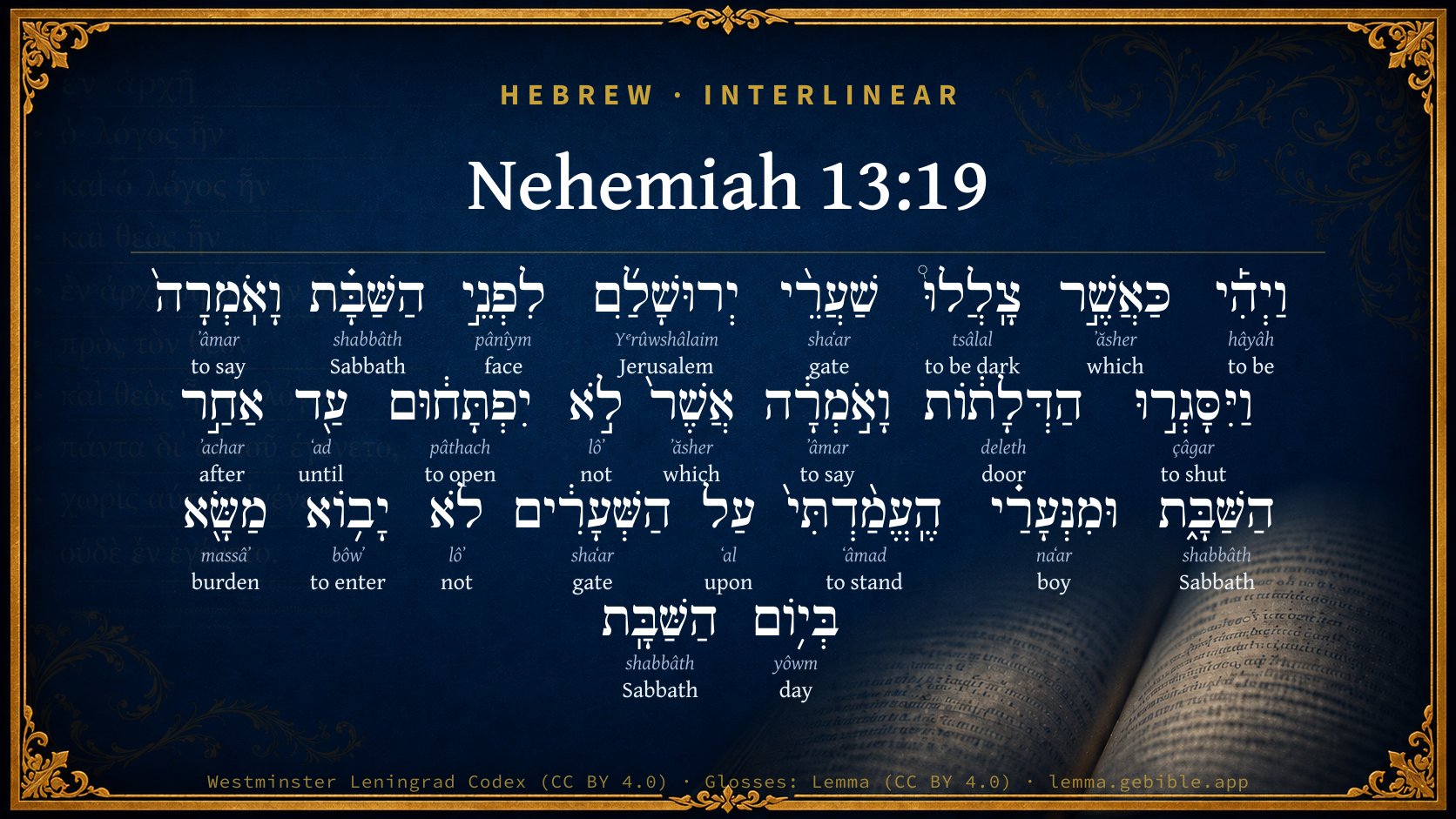
Hebrew (Westminster Leningrad Codex) Nehemiah 13:19 appears in the Hebrew Old Testament. The text above is from the Westminster Leningrad Codex. Each word links to its Strong’s number, a concise gloss, and parsing drawn from the Open Scriptures Hebrew Bible morphology. Click any word for its full Brown-Driver-Briggs (BDB) entry.
Download image
Cite this verse

Nehemiah 13:19 (World English Bible). Public Domain. Lemma interlinear Bible study tool, https://lemma.gebible.app/v/nehemiah/13/19.

Show BibTeX & RIS
BibTeX
RIS
English Translation
It came to pass that, when the gates of Jerusalem began to be dark before the Sabbath, I commanded that the doors should be shut, and commanded that they should not be opened until after the Sabbath: and some of my servants set I over the gates, that there should no burden be brought in on the Sabbath day.
World English Bible · Public Domain
Highlights
  • 1 first appearance in the Hebrew Bible
Full analysis ↓
Download a study sheet

One document with this verse’s original text, its word-by-word gloss line, the meaning frame, cross-references with their text, attributed commentary, and full source and license credits — printable, and it pastes into notes with its structure intact.

This verse Autodidact and up

Study sheet (.html) Plain text (.txt)

A passage Seminary Student

Up to 50 verses in one chapter. A passage sheet keeps up to 6 commentary sources and 12 cross-references per verse, in the order this page ranks them, and says so on the sheet whenever that leaves anything out. Ask for a single verse and you get the Autodidact verse sheet above.

Everything on this page stays free to read, with no account — the sheet is a download of what is already on screen, not access to it.

Want to remove ads? Support Godless Engineer
Compare translations 3

The same verse in 3 English versions, stacked beneath the original-language interlinear above. Click any original word for its lexicon entry.

Each is an independent rendering of the whole verse — the interlinear is not word-aligned to these translations.

Highlighted words mark where these versions differ — a whole-verse word diff, not a word-by-word alignment.

  • World English Bible Public Domain
    It came to pass that, when the gates of Jerusalem began to be dark before the Sabbath, I commanded that the doors should be shut, and commanded that they should not be opened until after the Sabbath: and some of my servants set I over the gates, that there should no burden be brought in on the Sabbath day.
  • King James Version Public Domain
    And it came to pass, that when the gates of Jerusalem began to be dark before the sabbath, I commanded that the gates should be shut, and charged that they should not be opened till after the sabbath: and some of my servants set I at the gates, that there should no burden be brought in on the sabbath day.
  • unfoldingWord Literal Text CC BY-SA 4.0
    And it happened that, when the gates of Jerusalem grew dark before the face of the sabbath, I spoke, and the doors were shut, and I said that they should not open them until after the sabbath. And I caused some from my young men to stand at the gates; a load could not enter on the day of the sabbath.

unfoldingWord Literal Text — © unfoldingWord, licensed CC BY-SA 4.0. Word-aligned USFM3 via Door43 (git.door43.org/unfoldingWord/en_ult).

Versions to compare (up to 4)

3 of 4 selected

Show all 18 translations

Every available English version of this verse, each an independent rendering of the whole verse.

  • World English Bible Public Domain
    It came to pass that, when the gates of Jerusalem began to be dark before the Sabbath, I commanded that the doors should be shut, and commanded that they should not be opened until after the Sabbath: and some of my servants set I over the gates, that there should no burden be brought in on the Sabbath day.
  • Berean Standard Bible Public Domain
    When the evening shadows began to fall on the gates of Jerusalem, just before the Sabbath, I ordered that the gates be shut and not opened until after the Sabbath. I posted some of my servants at the gates so that no load could enter on the Sabbath day.
  • Majority Standard Bible Public Domain
    When the evening shadows began to fall on the gates of Jerusalem, just before the Sabbath, I ordered that the gates be shut and not opened until after the Sabbath. I posted some of my servants at the gates so that no load could enter on the Sabbath day.
  • King James Version Public Domain
    And it came to pass, that when the gates of Jerusalem began to be dark before the sabbath, I commanded that the gates should be shut, and charged that they should not be opened till after the sabbath: and some of my servants set I at the gates, that there should no burden be brought in on the sabbath day.
  • American Standard Version (1901) Public Domain
    And it came to pass that, when the gates of Jerusalem began to be dark before the sabbath, I commanded that the doors should be shut, and commanded that they should not be opened till after the sabbath: and some of my servants set I over the gates, that there should no burden be brought in on the sabbath day.
  • Revised Version (1885) Public Domain
    And it came to pass that, when the gates of Jerusalem began to be dark before the sabbath, I commanded that the doors should be shut, and commanded that they should not be opened till after the sabbath: and some of my servants set I over the gates, that there should no burden be brought in on the sabbath day.
  • Geneva Bible (1599) Public Domain
    And when the gates of Ierusalem beganne to be darke before the Sabbath, I commaded to shut the gates, and charged, that they should not be opened til after the Sabbath, and some of my seruants set I at the gates, that there shoulde no burden be brought in on the Sabbath day.
  • Douay-Rheims (1899) Public Domain
    And it came to pass, that when the gates of Jerusalem were at rest on the sabbath day, I spoke: and they shut the gates, and I commanded that they should not open them till after the sabbath: and I set some of my servants at the gates, that none should bring in burthens on the sabbath day.
  • Young's Literal Translation Public Domain
    And it cometh to pass, when the gates of Jerusalem have been dark before the sabbath, that I speak, and the doors are shut, and I say, that they do not open them till after the sabbath; and of my servants I have stationed at the gates; there doth not come in a burden on the sabbath-day.
  • Literal Standard Version CC BY-SA 4.0
    And it comes to pass, when the gates of Jerusalem have been dark before the Sabbath, that I command, and the doors are shut, and I command that they do not open them until after the Sabbath; and of my servants I have stationed at the gates; there does not come in a burden on the Sabbath day.
  • Unlocked Literal Bible CC BY-SA 4.0
    As soon as it became dark at the gates of Jerusalem before the Sabbath, I commanded that the doors be shut and that they should not be opened until after the Sabbath. I stationed some of my servants at the gates so no load could be brought in on the Sabbath day.
  • unfoldingWord Literal Text CC BY-SA 4.0
    And it happened that, when the gates of Jerusalem grew dark before the face of the sabbath, I spoke, and the doors were shut, and I said that they should not open them until after the sabbath. And I caused some from my young men to stand at the gates; a load could not enter on the day of the sabbath.
  • Darby Bible Public Domain
    And it came to pass, that when it began to be dark in the gates of Jerusalem before the sabbath, I commanded that the gates should be shut; and I commanded that they should not be opened till after the sabbath. And I set [some] of my servants at the gates, so that no burden should be brought in on the sabbath day.
  • World Messianic Bible Public Domain
    It came to pass that when the gates of Jerusalem began to be dark before the Sabbath, I commanded that the doors should be shut, and commanded that they should not be opened until after the Sabbath. I set some of my servants over the gates, so that no burden should be brought in on the Sabbath day.
  • Webster's Bible Public Domain
    And it came to pass, that, when the gates of Jerusalem began to be dark before the sabbath, I commanded that the gates should be shut, and charged that they should not be opened till after the sabbath: and I set some of my servants at the gates, that there should no burden be brought in on the sabbath day.
  • Free Bible Version CC BY-SA 4.0
    So I ordered Jerusalem's gates to be shut at sunset on the day before the Sabbath, and that were not to be opened until after the Sabbath had ended. I assigned some of my men to guard the gates to make sure no goods would be brought in on the Sabbath day.
  • Bible in Basic English Public Domain
    And so, when the streets of Jerusalem were getting dark before the Sabbath, I gave orders for the doors to be shut and not to be open again till after the Sabbath: and I put some of my servants by the door so that nothing might be taken in on the Sabbath day.
  • JPS Tanakh (1917) Public Domain
    And it came to pass that, when the gates of Jerusalem began to be dark before the sabbath, I commanded that the doors should be shut, and commanded that they should not be opened till after the sabbath; and some of my servants set I over the gates, that there should no burden be brought in on the sabbath day.

Literal Standard Version (2020), Covenant Press — licensed CC BY-SA 4.0. Text via the HelloAO Bible API (eBible.org). Unlocked Literal Bible (unfoldingWord) — licensed CC BY-SA 4.0. Text via the HelloAO Bible API (eBible.org). unfoldingWord Literal Text — © unfoldingWord, licensed CC BY-SA 4.0. Word-aligned USFM3 via Door43 (git.door43.org/unfoldingWord/en_ult). Free Bible Version, Dr. Jonathan Gallagher — licensed CC BY-SA 4.0. Text via the HelloAO Bible API (eBible.org).

Word by word

More ways to search: Search by grammar → Find every occurrence → Compare this word →

Practice this passage: Drill this verse → Learn its vocabulary →

צָֽלֲלוּ֩
tsâlal
H6751
“to be dark”
Verb, Qal, Perfect, 3rd Person, Common, Plural
Part of Speech
Verb
Stem
Qal
Form
Perfect
Person
3rd Person
Gender
Common
Number
Plural
Full BDB Definition

Origin: a primitive root [identical with H6749 through the idea of hovering over (compare H6754 )]

TWOT: 1921

to be or become or grow dark - (Qal) to become or grow dark - (Hiphil) to shadow
  1. וַיְהִ֡י hâyâh H1961 “and · to be” Conjunction + Verb, Qal, Sequential Imperfect, 3rd Person, Masculine, Singular
  2. כַּאֲשֶׁ֣ר ʼăsher H834 “like/as · which” Preposition + Particle, Relative
  3. שַׁעֲרֵ֨י shaʻar H8179 “gates of” Noun, Common, Masculine, Plural, Construct
  4. יְרוּשָׁלִַ֜ם Yᵉrûwshâlaim H3389 “Jerusalem” Noun, Proper
  5. לִפְנֵ֣י pânîym H6440 “to/for · face(s) of” Preposition + Noun, Common, Both, Plural, Construct
  6. הַשַּׁבָּ֗ת shabbâth H7676 “the · Sabbath” Particle, Definite Article + Noun, Common, Both, Singular, Absolute
  7. וָאֹֽמְרָה֙ ʼâmar H559 “and · to say” Conjunction + Verb, Qal, Sequential Imperfect, 1st Person, Common, Singular + Suffix, h
  8. וַיִּסָּגְר֣וּ çâgar H5462 “and · to shut” Conjunction + Verb, Niphal, Sequential Imperfect, 3rd Person, Masculine, Plural
  9. הַדְּלָת֔וֹת deleth H1817 “the · doors” Particle, Definite Article + Noun, Common, Feminine, Plural, Absolute
  10. וָאֹ֣מְרָ֔ה ʼâmar H559 “and · to say” Conjunction + Verb, Qal, Sequential Imperfect, 1st Person, Common, Singular + Suffix, h
  11. אֲשֶׁר֙ ʼăsher H834 “which” Particle, Relative
  12. לֹ֣א lôʼ H3808 “not” Particle, Negative
  13. יִפְתָּח֔וּם pâthach H6605 “to open · them” Verb, Qal, Imperfect, 3rd Person, Masculine, Plural + Suffix, Personal, 3rd Person, Masculine, Plural
  14. עַ֖ד ʻad H5704 “until” Preposition
  15. אַחַ֣ר ʼachar H310 “after” Preposition
  16. הַשַּׁבָּ֑ת shabbâth H7676 “the · Sabbath” Particle, Definite Article + Noun, Common, Both, Singular, Absolute
  17. וּמִנְּעָרַ֗י naʻar H5288 “and · from · boys · my” Conjunction + Preposition + Noun, Common, Masculine, Plural, Construct + Suffix, Personal, 1st Person, Common, Singular
  18. הֶֽעֱמַ֨דְתִּי֙ ʻâmad H5975 “to stand” Verb, Hiphil, Perfect, 1st Person, Common, Singular
  19. עַל ʻal H5921 “upon” Preposition
  20. הַשְּׁעָרִ֔ים shaʻar H8179 “the · gates” Particle, Definite Article + Noun, Common, Masculine, Plural, Absolute
  21. לֹא lôʼ H3808 “not” Particle, Negative
  22. יָב֥וֹא bôwʼ H935 “to enter” Verb, Qal, Imperfect, 3rd Person, Masculine, Singular
  23. מַשָּׂ֖א massâʼ H4853 “burden” Noun, Common, Masculine, Singular, Absolute
  24. בְּי֥וֹם yôwm H3117 “in/at · day of” Preposition + Noun, Common, Masculine, Singular, Construct
  25. הַשַּׁבָּֽת shabbâth H7676 “the · Sabbath” Particle, Definite Article + Noun, Common, Both, Singular, Absolute

About this verse

These counts appear in no published source. They are computed here, from the morphology-tagged text and Lemma’s own curated glosses. What Lemma adds →

26
words
20
distinct lemmas
Historical
section

Notable vocabulary

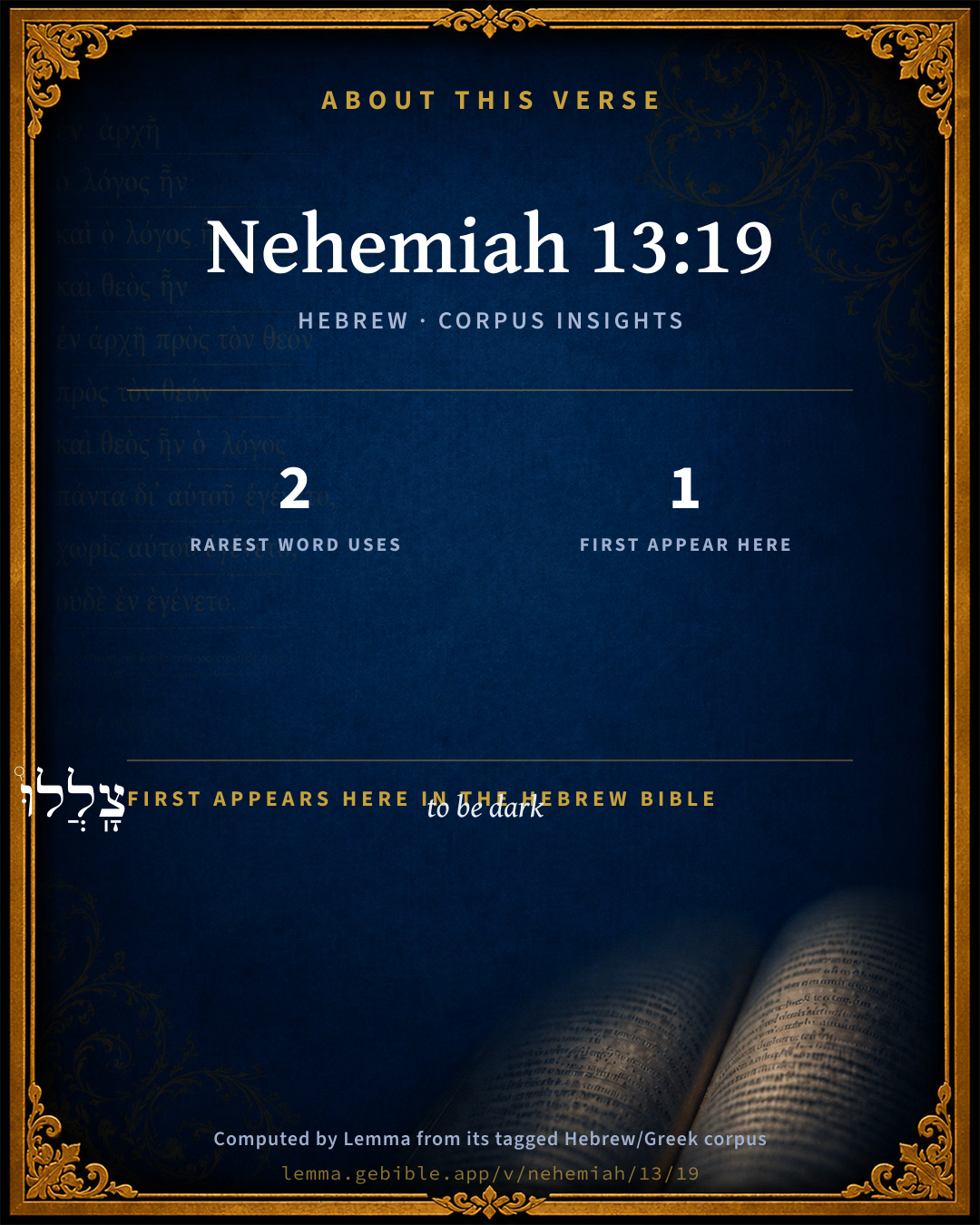
The rarest word here is צָֽלֲלוּ֩ to be dark H6751 — appearing just 2 times in the whole Hebrew Bible.

First appearance in Scripture

This word makes its first canonical appearance in the Hebrew Bible here:

  • צָֽלֲלוּ֩ to be dark H6751

Shared distinctive vocabulary

צָֽלֲלוּ֩ to be dark H6751 occurs in 2 verses of the Hebrew Bible. Also found in:

Grammatical profile

  • 8 verbs
  • 11 nouns
  • 3 prepositions
  • 4 particles

Verb forms

  • וַיְהִ֡י Qal · Sequential Imperfect
  • צָֽלֲלוּ֩ Qal · Perfect
  • וָאֹֽמְרָה֙ Qal · Sequential Imperfect
  • וַיִּסָּגְר֣וּ Niphal · Sequential Imperfect
  • וָאֹ֣מְרָ֔ה Qal · Sequential Imperfect
  • יִפְתָּח֔וּם Qal · Imperfect
  • הֶֽעֱמַ֨דְתִּי֙ Hiphil · Perfect
  • יָב֥וֹא Qal · Imperfect

Repetition

Words recur within this verse — often emphatic in Hebrew:

  • הַשַּׁבָּ֗ת Sabbath H7676 ×3
  • שַׁעֲרֵ֨י gate H8179 ×2
  • וָאֹֽמְרָה֙ to say H559 ×2
  • כַּאֲשֶׁ֣ר which H834 ×2
  • לֹ֣א not H3808 ×2

Cross-references

3

Topical passages linked to Nehemiah 13:19 in the Treasury of Scripture Knowledge — connected by theme and wording, ordered by reader-vote popularity; previews shown in the World English Bible.

  • Leviticus 23:32 It shall be a Sabbath of solemn rest for you, and you shall deny yourselves. In the ninth day of the month at evening, from evening to evening, you shall keep your Sabbath."
  • Exodus 31:14–17 You shall keep the Sabbath therefore; for it is holy to you. Everyone who profanes it shall surely be put to death; for whoever does any work therein, that soul shall be cut off from among his people.
  • Jeremiah 17:19–22 Thus said Yahweh to me: Go, and stand in the gate of the children of the people, through which the kings of Judah come in, and by which they go out, and in all the gates of Jerusalem;

Cross-references courtesy of OpenBible.info (CC BY 4.0).

Hebrew and Greek witnesses Masoretic Hebrew ↔ Greek Septuagint

The same verse in the two great witnesses to the Old Testament, shown verse-for-verse.

These are two independent witnesses, not word-aligned to each other, and the Septuagint is shown in lemma (dictionary) form.

Hebrew Nehemiah 13:19 Masoretic · Westminster Leningrad Codex

וַיְהִ֡י כַּאֲשֶׁ֣ר צָֽלֲלוּ֩ שַׁעֲרֵ֨י יְרוּשָׁלִַ֜ם לִפְנֵ֣י הַשַּׁבָּ֗ת וָאֹֽמְרָה֙ וַיִּסָּגְר֣וּ הַדְּלָת֔וֹת וָאֹ֣מְרָ֔ה אֲשֶׁר֙ לֹ֣א יִפְתָּח֔וּם עַ֖ד אַחַ֣ר הַשַּׁבָּ֑ת וּמִנְּעָרַ֗י הֶֽעֱמַ֨דְתִּי֙ עַל הַשְּׁעָרִ֔ים לֹא יָב֥וֹא מַשָּׂ֖א בְּי֥וֹם הַשַּׁבָּֽת

It came to pass that, when the gates of Jerusalem began to be dark before the Sabbath, I commanded that the doors should be shut, and commanded that they should not be opened until after the Sabbath: and some of my servants set I over the gates, that there should no burden be brought in on the Sabbath day.

World English Bible · Public Domain

Greek LXX Structure differs

The Septuagint has no separate book of Nehemiah. Its Greek text is the second half of Esdras B (2 Esdras), chapters 11–23; Ezra is the first half (1–10).

A verse-for-verse comparison isn’t shown here because the chapters and verses don’t line up. Switch to the LXX edition with the MT / LXX toggle above to read the Greek directly.

On this verse, The Cambridge Bible for Schools and Colleges discusses the Septuagint’s reading. Read the note in Commentary ↓

Hebrew: Westminster Leningrad Codex (CC BY 4.0). Greek: Septuagint (public domain); English from a public-domain English Septuagint. How the Septuagint differs from the Hebrew →

Commentary

Notes on Nehemiah 13:19 from classic Christian and Jewish commentators (each source and its license shown beneath its notes). The classic Christian expositions comment on the surrounding passage and are grouped to its opening verse, so a note may address several verses; the Jewish commentaries on the Tanakh (Rashi and others) are per-verse, so they appear only where the commentator wrote on this verse.

Lemma curates 59 commentaries, every one of them public domain or Creative Commons licensed, each selected and text-cleaned for this edition rather than reprinted as found. About our sources →

Trapp's Complete Commentary

John Trapp

Neh 13:19 And it came to pass, that when the gates of Jerusalem began to be dark before the sabbath, I commanded that the gates should be shut, and charged that they should not be opened till after the sabbath: and [some] of my servants set I at the gates, [that] there should no burden be brought in on the sabbath day.

Ver. 19. When the gates of Jerusalem began to be dark] As it did early, because the mountains were around Jerusalem, Psa 125:2.

Before the sabbath] That there might be a due preparation without interruption. At this day, in many cities where the Jews reside there is one goes about and proclaims the approaching of the Sabbath about half-an-hour before sunset the day before, that they may set all aside to sanctify it.

I commanded that the gates should be shut] And thereby all such occasions of profaning shut out.

And charged that they should not be opened till after the sabbath] So King Edgar ordained that Sunday should be solemnized from Saturday, nine of the clock, till Monday morning here in this land, that God might surely have his due. The Jews of Tiberias began the Sabbath sooner than others. Those at Tsepphore continued it longer, adding de profane ad sacrum. of common to sacred time. Hence R. Jose wished that his portion might be with those of Tiberius, and ended it with those of Tsepphore (Buxtorf).

And some of my servants set I at the gates] To keep them carefully, and to prevent profanations. How the Athenians amerced those that came not to the assemblies on holy days, hurdling up all the streets, except them that led to the ecclesia, taking away all their saleable wares, &c., see Rous’s Archaeolog. Attic. p. 103.

John Trapp, A Commentary or Exposition upon All the Books of the Old and New Testament (1647–1656) — public domain. Text from a community e-Sword module.

Tyndale Open Study Notes

Tyndale Open Resources

13:19 The Sabbath began at sunset on Friday evening and lasted until sunset on Saturday evening.

Tyndale Open Study Notes — © Tyndale Open Resources, licensed CC BY-SA 4.0. Text via the HelloAO Bible API.

Geneva Bible (1599)

Geneva Bible translators

About the time that the Sun went down: for the Sabbath lasted from the Sun going down of the one day, to the Sun setting of the other.

Geneva Bible (1599) marginal notes — public domain. Text via Bolls.life.

Adam Clarke's Commentary

Verse 19. When the gates - began to be dark] After sunset on Friday evening he caused the gates to be shut, and kept them shut all the Sabbath; and, as he could not trust the ordinary officers, he set some of his own servants to watch the gates, that no person might enter for the purpose of traffic.

Adam Clarke's Commentary on the Bible (1810–1826) — public domain. Text from a community e-Sword/MySword module.

Ellicott's Commentary for English Readers

(19) Some of my servants.—These are several times mentioned as employed in public duty. Here they are used provisionally, to keep out traffickers until the formal appointment of the Levitical guard (Neh_13:22), after which they would be relieved.

A Bible Commentary for English Readers, edited by Charles John Ellicott (1878–1897) — public domain. Text from a community e-Sword module.

The Cambridge Bible for Schools and Colleges

gen. ed. J. J. S. Perowne

19. the gates of Jerusalem began to be dark] The rare word for ‘began to be dark’ gives rise to the renderings LXX. ἡνίκα κατέστησαν πύλαι, Vulg. ‘cum quievissent portæ.’ Another suggested rendering is ‘had their bells rung,’ is very ludicrous, deriving the word from the same root as the word for ‘cymbals.’

before the sabbath] From this we should gather that the Sabbath began as soon as it was dark; not absolutely at sunset, but at the termination of the brief twilight.

gates] R.V. doors.

charged] R.V. commanded. Same word as in the previous clause.

servants] Literally ‘youths,’ παῖδες, i.e. personal attendants, cf. Neh_4:10.

at the gates] R.V. over the gates, i.e. to superintend the watch.

that there should no burden, &c.] The object of the watch was not to bar the free passage in and out, but only to prevent the introduction of merchandise on that day.

The Cambridge Bible for Schools and Colleges (gen. ed. J. J. S. Perowne; Cambridge University Press, 1878–1918) — public domain. Text from a community e-Sword module.

John Gill's Exposition

And I commanded the Levites that they should cleanse themselves,.... From all ceremonial uncleanness, that they might be fit in a ceremonial sense to perform the duties of the office on the sabbath day:

and that they should come and keep the gates, to sanctify the sabbath day; not the gates of the city, his servants were placed there, nor was this the work of the Levites, and much less did this require a particular purification to fit for it; but the gates of the temple, that no impure person might enter there; and on that day it required the greater diligence, because of the number of people that came to worship:

remember me, O my God, concerning this also; with respect to his care to have the sabbath kept holy, as well as his concern for the honour of the house of God, and the maintenance of his ministers, Neh 13:14,

and spare me according to the greatness of thy mercy; he desired to be dealt with, not according to any merits of his own, but according to the abundant mercy of God; that he would kindly and graciously vouchsafe to accept any good that he had done for his mercy sake, and forgive whatever was amiss in him.

John Gill's Exposition of the Whole Bible (1746–1763) — public domain (CC PDM 1.0). Text via the HelloAO Bible API.

Albert Barnes' Notes on the Bible

The gates were closed at the sunset of the day before the Sabbath; since the Sabbath was regarded as commencing on the previous evening.

Albert Barnes' Notes on the Bible (1834–1885) — public domain. Text from a community e-Sword/MySword module.

Haydock's Catholic Bible Commentary

At rest. People travelling no longer. (Calmet) --- Hebrew, "shaded, or in the dark." Before Friday night on, the sabbath commenced, and then the gates were shut. (Haydock) --- On the. Hebrew, "before the sabbath." (Menochius)

George Leo Haydock (1774–1849), Haydock's Catholic Family Bible and Commentary, 1859 edition — public domain. Excludes Psalms (Douay-Rheims chapter numbering differs from Protestant) and Deuterocanonical books (Catholic canon only).

Matthew Poole's English Annotations

When the gates of Jerusalem began to be dark; which was about sun-setting, by reason of the mountains which were round about and near Jerusalem, Psa 125:2.

Some of my servants set I at the gates, out of a diffidence in those to whom the keeping of the gates was committed.

Matthew Poole's English Annotations on the Holy Bible (1683–1685) — public domain. Text from a community e-Sword/MySword module.

The Pulpit Commentary

When the gates of Jerusalem began to be dark before the sabbath. The Jews have always reckoned their days from sunset to sunset, grounding their practice on the account of the Creation given in the first chapter of Genesis, where "the evening and the morning" arc said to constitute each of the six days. There was also a special command that the "sabbath" of the great day of atonement should be kept "from even to even". (Lev_23:32) I commanded that the gates should be shut. The gates would as a matter of course have been shut at sunset. Nehemiah required that the closing should take place some half-hour earlier, when the shadows were lengthening, and the day was drawing towards a close. He regarded it as a sort of desecration of the sabbath to carry on secular work to the last allowable moment. Some of my servants. Compare Neh_4:16 Neh_5:16. That there should be no burthen brought in. Foot passengers were no doubt allowed to enter and leave the city on the sabbath, Nehemiah"s servants being set to see that under no pretence should merchandise be allowed to enter.

The Pulpit Commentary (1880–1919), ed. H.D.M. Spence-Jones & Joseph S. Exell — public domain. Text from a community e-Sword module.

John Wesley's Explanatory Notes

At the gates - Out of a diffidence in those, to whom the keeping of the gates was committed.

John Wesley, Explanatory Notes Upon the Whole Bible (1754–1765) — public domain. Text via the GEBible commentary corpus.

unfoldingWord translationNotes

Door43 World Missions Community

As soon as it became dark ... before the Sabbath

"When the sun went down ... and it was time for the Sabbath to begin"

that the doors be shut and that they should not be opened until

This can be translated in active form. AT: "that the guards shut the doors and not open them until" (See: Active or Passive)

no load could be brought in

This can be translated in active form. AT: "no one could bring in things they wanted to sell" (See: Active or Passive)

sellers of all kinds of wares

"people who had brought many different things they wanted to sell"

translationWords

gate

Jerusalem

Sabbath

command

servant

unfoldingWord translationNotes — © Distant Shores Media and the Door43 World Missions Community, licensed CC BY-SA 4.0. Source: git.door43.org/Door43/en_tn.

Rashi

Rabbi Shlomo Yitzchaki (Rashi)

Now it came to pass when the gates of Jerusalem cast shadows When the shadows of the Sabbath eve fell on the gates, I ordered the doors of the city to be closed and not re-opened until after the Sabbath so that the traffickers would not enter the city to sell their merchandise and cause Israel to profane the Sabbath.

Rashi on the Tanakh — English translations: “The Judaica Press complete Tanach with Rashi, translated by A. J. Rosenberg” (CC BY 4.0); “Pentateuch with Rashi's commentary by M. Rosenbaum and A.M. Silbermann, 1929-1934” (public domain); “The Metsudah Tanach series, Lakewood, N.J” (CC BY 4.0); and “The Book of Joshua, Metsudah Publications, 1997” (CC BY 4.0). Text via Sefaria.

Lesson kit

Teaching starters — assembled from the data on this page, not authored interpretation. Every prompt links to the verse data it draws on. Edit before teaching.

Nehemiah, in the Historical, opens this verse with 26 words (20 distinct Hebrew lemmas). Its most distinctive word is tsâlal (“to be dark”). A historical commentator’s framing appears above. Read the whole chapter for the surrounding context.

Discussion questions

  1. What does “to be dark” (tsâlal) contribute to the verse as a whole?
  2. This is the first place “to be dark” appears in Scripture (first appears here). What does its debut here establish?
  3. How does Ezekiel 31:3, which shares the word «to be dark», read alongside this verse?
  4. What does the repetition of “Sabbath” (3× in this one verse) do in this verse?
  5. These translations render this verse differently. What is at stake in choosing one wording over another?
  6. «וַיְהִ֡י» is a Qal Sequential Imperfect verb. How does that grammatical form shape the action described?
  7. Compare how Trapp's Complete Commentary and Tyndale Open Study Notes read this verse. Where do they agree or differ?

Things to notice

  • 1 word makes its first canonical appearance in Scripture here.
  • These translations choose different wording for 28 words in this verse.
  • “Sabbath” occurs 3× in this single verse.
  • 20 distinct Hebrew lemmas span 26 words in this verse.

Reading settings

Reading text

Shown beneath each verse's original-language words.

Old Testament
Old Testament edition

Read the OT as the Masoretic Hebrew (MT) or the Greek Septuagint (LXX).

English shown for the Greek Septuagint (in the Hebrew ↔ Greek comparison).

Comparing translations? Open the Compare panel on any verse page to stack up to four side by side.