
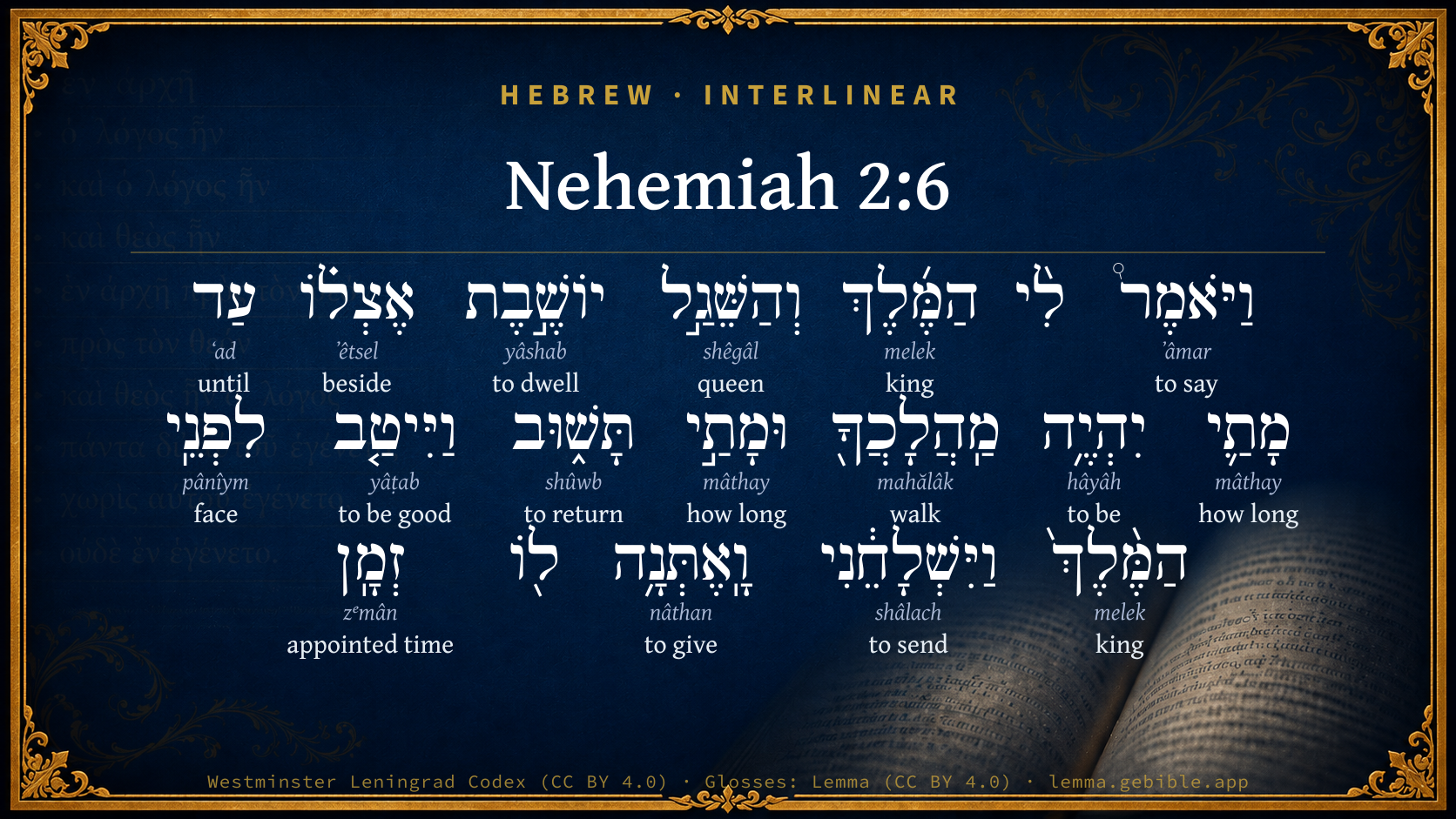
Nehemiah 2:6

Hebrew (Westminster Leningrad Codex) Nehemiah 2:6 appears in the Hebrew Old Testament. The text above is from the Westminster Leningrad Codex. Each word links to its Strong’s number, a concise gloss, and parsing drawn from the Open Scriptures Hebrew Bible morphology. Click any word for its full Brown-Driver-Briggs (BDB) entry.
Download image
Cite this verse

Nehemiah 2:6 (World English Bible). Public Domain. Lemma interlinear Bible study tool, https://lemma.gebible.app/v/nehemiah/2/6.

Show BibTeX & RIS
BibTeX
RIS
English Translation
The king said to me (the queen also sitting by him), For how long shall your journey be? and when will you return? So it pleased the king to send me; and I set him a time.
World English Bible · Public Domain
Highlights
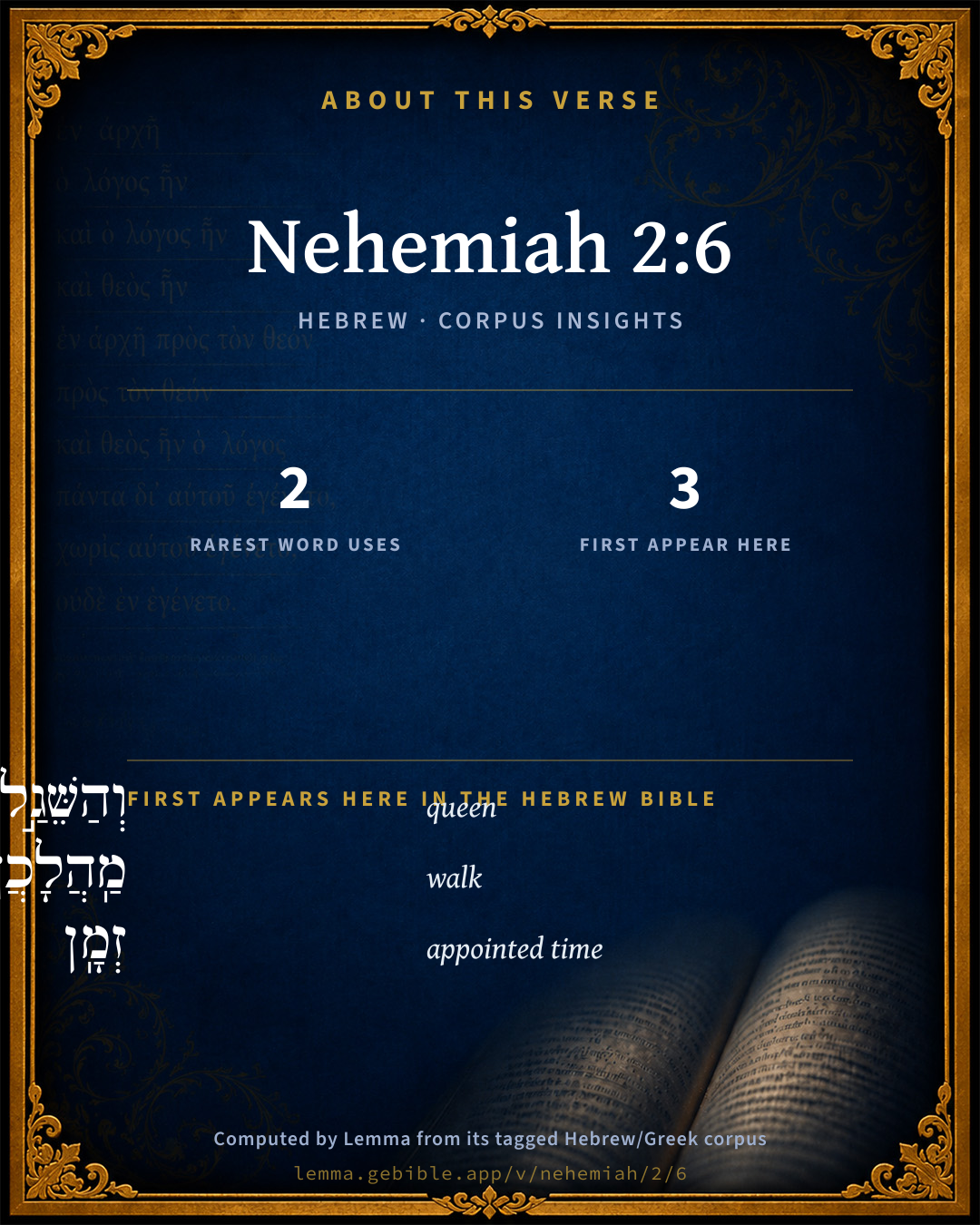
  • 3 first appearances in the Hebrew Bible
Full analysis ↓
Download a study sheet

One document with this verse’s original text, its word-by-word gloss line, the meaning frame, cross-references with their text, attributed commentary, and full source and license credits — printable, and it pastes into notes with its structure intact.

This verse Autodidact and up

Study sheet (.html) Plain text (.txt)

A passage Seminary Student

Up to 50 verses in one chapter. A passage sheet keeps up to 6 commentary sources and 12 cross-references per verse, in the order this page ranks them, and says so on the sheet whenever that leaves anything out. Ask for a single verse and you get the Autodidact verse sheet above.

Everything on this page stays free to read, with no account — the sheet is a download of what is already on screen, not access to it.

Want to remove ads? Support Godless Engineer
Compare translations 3

The same verse in 3 English versions, stacked beneath the original-language interlinear above. Click any original word for its lexicon entry.

Each is an independent rendering of the whole verse — the interlinear is not word-aligned to these translations.

Highlighted words mark where these versions differ — a whole-verse word diff, not a word-by-word alignment.

  • World English Bible Public Domain
    The king said to me (the queen also sitting by him), For how long shall your journey be? and when will you return? So it pleased the king to send me; and I set him a time.
  • King James Version Public Domain
    And the king said unto me, (the queen also sitting by him,) For how long shall thy journey be? and when wilt thou return? So it pleased the king to send me; and I set him a time.
  • unfoldingWord Literal Text CC BY-SA 4.0
    And the king said to me, with the queen sitting beside him, “Until when will be your journey? And when will you return?” And it was good before the face of the king, and he sent me, and I gave to him a time.

unfoldingWord Literal Text — © unfoldingWord, licensed CC BY-SA 4.0. Word-aligned USFM3 via Door43 (git.door43.org/unfoldingWord/en_ult).

Versions to compare (up to 4)

3 of 4 selected

Show all 18 translations

Every available English version of this verse, each an independent rendering of the whole verse.

  • World English Bible Public Domain
    The king said to me (the queen also sitting by him), For how long shall your journey be? and when will you return? So it pleased the king to send me; and I set him a time.
  • Berean Standard Bible Public Domain
    Then the king, with the queen seated beside him, asked me, “How long will your journey take, and when will you return?” So it pleased the king to send me, and I set a time.
  • Majority Standard Bible Public Domain
    Then the king, with the queen seated beside him, asked me, “How long will your journey take, and when will you return?” So it pleased the king to send me, and I set a time.
  • King James Version Public Domain
    And the king said unto me, (the queen also sitting by him,) For how long shall thy journey be? and when wilt thou return? So it pleased the king to send me; and I set him a time.
  • American Standard Version (1901) Public Domain
    And the king said unto me (the queen also sitting by him,) For how long shall thy journey be? and when wilt thou return? So it pleased the king to send me; and I set him a time.
  • Revised Version (1885) Public Domain
    And the king said unto me, (the queen also sitting by him,) For how long shall thy journey be? and when wilt thou return? So it pleased the king to send me; and I set him a time.
  • Geneva Bible (1599) Public Domain
    And the King sayd vnto me, (the Queene also sitting by him) How long shall thy iourney be? and when wilt thou come againe? So it pleased the King, and he sent me, and I set him a time.
  • Douay-Rheims (1899) Public Domain
    And the king said to me, and the queen that sat by him: For how long shall thy journey be, and when wilt thou return? And it pleased the king, and he sent me: and I fixed him a time.
  • Young's Literal Translation Public Domain
    And the king saith to me (and the queen is sitting near him), `How long is thy journey? and when dost thou return?' and it is good before the king, and he sendeth me away, and I set to him a time.
  • Literal Standard Version CC BY-SA 4.0
    And the king says to me (and the queen is sitting near him), “How long is your journey? And when do you return?” And it is good before the king, and he sends me away, and I set to him a time.
  • Unlocked Literal Bible CC BY-SA 4.0
    The king replied to me (and the queen was also sitting beside him), “How long shall you be away and when will you return?” The king was glad to send me when I gave him the dates.
  • unfoldingWord Literal Text CC BY-SA 4.0
    And the king said to me, with the queen sitting beside him, “Until when will be your journey? And when will you return?” And it was good before the face of the king, and he sent me, and I gave to him a time.
  • Darby Bible Public Domain
    And the king said to me -- the queen also sitting by him, -- For how long shall thy journey be, and when wilt thou return? And it pleased the king to send me; and I set him a time.
  • World Messianic Bible Public Domain
    The king said to me (the queen was also sitting by him), “How long will your journey be? When will you return?” So it pleased the king to send me, and I set a time for him.
  • Webster's Bible Public Domain
    And the king said to me, (the queen also sitting by him,) For how long shall thy journey be? and when wilt thou return? So it pleased the king to send me; and I set him a time.
  • Free Bible Version CC BY-SA 4.0
    The king, with the queen sitting beside him, asked me, “How long will your journey take, and when will you come back?” The king agreed to send me, and I told him how long I would be gone.
  • Bible in Basic English Public Domain
    And the king said to me (the queen being seated by his side), How long will your journey take, and when will you come back? So the king was pleased to send me, and I gave him a fixed time.
  • JPS Tanakh (1917) Public Domain
    And the king said unto me, the queen also sitting by him: 'For how long shall thy journey be? and when wilt thou return?' So it pleased the king to send me; and I set him a time.

Literal Standard Version (2020), Covenant Press — licensed CC BY-SA 4.0. Text via the HelloAO Bible API (eBible.org). Unlocked Literal Bible (unfoldingWord) — licensed CC BY-SA 4.0. Text via the HelloAO Bible API (eBible.org). unfoldingWord Literal Text — © unfoldingWord, licensed CC BY-SA 4.0. Word-aligned USFM3 via Door43 (git.door43.org/unfoldingWord/en_ult). Free Bible Version, Dr. Jonathan Gallagher — licensed CC BY-SA 4.0. Text via the HelloAO Bible API (eBible.org).

Word by word

More ways to search: Search by grammar → Find every occurrence → Compare this word →

Practice this passage: Drill this verse → Learn its vocabulary →

וְהַשֵּׁגַ֣ל
shêgâl
H7694
“and · the · queen”
Conjunction + Particle, Definite Article + Noun, Common, Feminine, Singular, Absolute
Part of Speech
Conjunction + Particle + Noun
Type
Common
Gender
Feminine
Number
Singular
State
Absolute
Full BDB Definition

Origin: from H7693

TWOT: 2327a

consort, queen, (queen-)consort
  1. וַיֹּאמֶר֩ ʼâmar H559 “and · to say” Conjunction + Verb, Qal, Sequential Imperfect, 3rd Person, Masculine, Singular
  2. הַמֶּ֜לֶךְ melek H4428 “the · king” Particle, Definite Article + Noun, Common, Masculine, Singular, Absolute
  3. יוֹשֶׁ֣בֶת yâshab H3427 “dwelling” Verb, Qal, Participle Active, Feminine, Singular, Absolute
  4. אֶצְל֗וֹ ʼêtsel H681 “beside · him” Preposition + Suffix, Personal, 3rd Person, Masculine, Singular
  5. עַד ʻad H5704 “until” Preposition
  6. מָתַ֛י mâthay H4970 “how long” Particle, Interrogative
  7. יִהְיֶ֥ה hâyâh H1961 “to be” Verb, Qal, Imperfect, 3rd Person, Masculine, Singular
  8. מַֽהֲלָכֲךָ֖ mahălâk H4109 “walk · your” Noun, Common, Masculine, Singular, Construct + Suffix, Personal, 2nd Person, Masculine, Singular
  9. וּמָתַ֣י mâthay H4970 “and · how long” Conjunction + Particle, Interrogative
  10. תָּשׁ֑וּב shûwb H7725 “to return” Verb, Qal, Imperfect, 2nd Person, Masculine, Singular
  11. וַיִּיטַ֤ב yâṭab H3190 “and · to be good” Conjunction + Verb, Qal, Sequential Imperfect, 3rd Person, Masculine, Singular
  12. לִפְנֵֽי pânîym H6440 “to/for · face(s) of” Preposition + Noun, Common, Both, Plural, Construct
  13. הַמֶּ֨לֶךְ֙ melek H4428 “the · king” Particle, Definite Article + Noun, Common, Masculine, Singular, Absolute
  14. וַיִּשְׁלָחֵ֔נִי shâlach H7971 “and · to send · me” Conjunction + Verb, Qal, Sequential Imperfect, 3rd Person, Masculine, Singular + Suffix, Personal, 1st Person, Common, Singular
  15. וָֽאֶתְּנָ֥ה nâthan H5414 “and · to give” Conjunction + Verb, Qal, Sequential Imperfect, 1st Person, Common, Singular + Suffix, h
  16. זְמָֽן zᵉmân H2165 “appointed time” Noun, Common, Masculine, Singular, Absolute

About this verse

These counts appear in no published source. They are computed here, from the morphology-tagged text and Lemma’s own curated glosses. What Lemma adds →

19
words
15
distinct lemmas
Historical
section

Notable vocabulary

The rarest word here is וְהַשֵּׁגַ֣ל queen H7694 — appearing just 2 times in the whole Hebrew Bible.

First appearance in Scripture

These words make their first canonical appearance in the Hebrew Bible here:

  • וְהַשֵּׁגַ֣ל queen H7694
  • מַֽהֲלָכֲךָ֖ walk H4109
  • זְמָֽן appointed time H2165

Shared distinctive vocabulary

וְהַשֵּׁגַ֣ל queen H7694 occurs in 2 verses of the Hebrew Bible. Also found in:

Grammatical profile

  • 7 verbs
  • 6 nouns
  • 4 prepositions
  • 2 particles

Verb forms

  • וַיֹּאמֶר֩ Qal · Sequential Imperfect
  • יוֹשֶׁ֣בֶת Qal · Participle Active
  • יִהְיֶ֥ה Qal · Imperfect
  • תָּשׁ֑וּב Qal · Imperfect
  • וַיִּיטַ֤ב Qal · Sequential Imperfect
  • וַיִּשְׁלָחֵ֔נִי Qal · Sequential Imperfect
  • וָֽאֶתְּנָ֥ה Qal · Sequential Imperfect

Repetition

Words recur within this verse — often emphatic in Hebrew:

  • הַמֶּ֜לֶךְ king H4428 ×2
  • מָתַ֛י how long H4970 ×2

Cross-references

7

Topical passages linked to Nehemiah 2:6 in the Treasury of Scripture Knowledge — connected by theme and wording, ordered by reader-vote popularity; previews shown in the World English Bible.

  • Nehemiah 13:6 But in all this [time] I was not at Jerusalem; for in the two and thirtieth year of Artaxerxes king of Babylon I went to the king: and after certain days asked I leave of the king,
  • Nehemiah 5:14 Moreover from the time that I was appointed to be their governor in the land of Judah, from the twentieth year even to the two and thirtieth year of Artaxerxes the king, [that is], twelve years, I and my brothers have not eaten the bread of the governor.
  • Isaiah 65:24 It shall happen that, before they call, I will answer; and while they are yet speaking, I will hear.
  • Nehemiah 2:4 Then the king said to me, For what do you make request? So I prayed to the God of heaven.
  • Isaiah 58:12 Those who shall be of you shall build the old waste places; you shall raise up the foundations of many generations; and you shall be called The repairer of the breach, The restorer of paths to dwell in.
  • Nehemiah 1:11 Lord, I beg you, let now your ear be attentive to the prayer of your servant, and to the prayer of your servants, who delight to fear your name; and please prosper your servant this day, and grant him mercy in the sight of this man. Now I was cup bearer to the king.
  • Isaiah 61:4 They shall build the old wastes, they shall raise up the former desolations, and they shall repair the waste cities, the desolations of many generations.

Cross-references courtesy of OpenBible.info (CC BY 4.0).

Hebrew and Greek witnesses Masoretic Hebrew ↔ Greek Septuagint

The same verse in the two great witnesses to the Old Testament, shown verse-for-verse.

These are two independent witnesses, not word-aligned to each other, and the Septuagint is shown in lemma (dictionary) form.

Hebrew Nehemiah 2:6 Masoretic · Westminster Leningrad Codex

וַיֹּאמֶר֩ לִ֨י הַמֶּ֜לֶךְ וְהַשֵּׁגַ֣ל יוֹשֶׁ֣בֶת אֶצְל֗וֹ עַד מָתַ֛י יִהְיֶ֥ה מַֽהֲלָכֲךָ֖ וּמָתַ֣י תָּשׁ֑וּב וַיִּיטַ֤ב לִפְנֵֽי הַמֶּ֨לֶךְ֙ וַיִּשְׁלָחֵ֔נִי וָֽאֶתְּנָ֥ה ל֖וֹ זְמָֽן

The king said to me (the queen also sitting by him), For how long shall your journey be? and when will you return? So it pleased the king to send me; and I set him a time.

World English Bible · Public Domain

Greek LXX Structure differs

The Septuagint has no separate book of Nehemiah. Its Greek text is the second half of Esdras B (2 Esdras), chapters 11–23; Ezra is the first half (1–10).

A verse-for-verse comparison isn’t shown here because the chapters and verses don’t line up. Switch to the LXX edition with the MT / LXX toggle above to read the Greek directly.

On this verse, Adam Clarke's Commentary discusses the Septuagint’s reading. Read the note in Commentary ↓

Hebrew: Westminster Leningrad Codex (CC BY 4.0). Greek: Septuagint (public domain); English from a public-domain English Septuagint. How the Septuagint differs from the Hebrew →

Commentary

Notes on Nehemiah 2:6 from classic Christian and Jewish commentators (each source and its license shown beneath its notes). The classic Christian expositions comment on the surrounding passage and are grouped to its opening verse, so a note may address several verses; the Jewish commentaries on the Tanakh (Rashi and others) are per-verse, so they appear only where the commentator wrote on this verse.

Lemma curates 59 commentaries, every one of them public domain or Creative Commons licensed, each selected and text-cleaned for this edition rather than reprinted as found. About our sources →

Trapp's Complete Commentary

John Trapp

Neh 2:6 And the king said unto me, (the queen also sitting by him,) For how long shall thy journey be? and when wilt thou return? So it pleased the king to send me; and I set him a time.

Ver. 6. And the king said unto me] He yields for the thing, only indents for the time; as being loth to deny Nehemiah his suit, and yet as loth to forego so faithful a servant. Ipse aspectus viri boni delectat (Seneca).

The queen also sitting by him] And assisting his cause likely. Some think this was Esther, the queen mother. But the Hebrew word here is, wife: now the kings of Persia were noted for uxorious.

For how long, &c.] The departure of a dear friend is so grievous, that death itself is called by that name.

So it pleased the king to send me] As a governor, Neh 5:14. This was the fruit of prayer, and, therefore, so much the sweeter.

And I set him a time] sc. Twelve years, Neh 5:14. But more probably a shorter time at first.

John Trapp, A Commentary or Exposition upon All the Books of the Old and New Testament (1647–1656) — public domain. Text from a community e-Sword module.

Joseph Benson's Commentary

Neh 2:6. The queen also sitting by him — Which is here noted as an unusual thing, for commonly the kings of Persia dined alone; and perhaps because the queen expressed some kindness to him, and promoted his request. How long shall thy journey be? — This question showed the king’s affection for him, and that he was not willing to want his attendance longer than was necessary. So it pleased the king to send me — Having told the king how long he desired to be absent from his office, the king permitted him to go. How long that was, is not certain. But it is not likely it was for twelve years, mentioned Neh 5:14; Neh 13:6, but rather, he asked leave for a year, or perhaps for half that time: which made him so quick in despatching the building of the wall, which he finished in fifty-two days, chap. Neh 6:15. After which, it is likely, he returned to Shushan, according to his appointment, and that the king sent him back as his governor for twelve years; his presence being very serviceable, or perhaps necessary there, for the better ordering of that province to the king’s satisfaction.

Joseph Benson's Commentary on the Old and New Testaments (1811–1818) — public domain. Text from a community e-Sword module.

Tyndale Open Study Notes

Tyndale Open Resources

2:6 How long will you be gone? (see 5:14): Nehemiah probably requested a short period of time initially, later asking for an extension.

Tyndale Open Study Notes — © Tyndale Open Resources, licensed CC BY-SA 4.0. Text via the HelloAO Bible API.

Jamieson, Fausset & Brown

Robert Jamieson, A. R. Fausset & David Brown

the queen also sitting by him--As the Persian monarchs did not admit their wives to be present at their state festivals, this must have been a private occasion. The queen referred to was probably Esther, whose presence would tend greatly to embolden Nehemiah in stating his request; and through her influence, powerfully exerted it may be supposed, also by her sympathy with the patriotic design, his petition was granted, to go as deputy governor of Judea, accompanied by a military guard, and invested with full powers to obtain materials for the building in Jerusalem, as well as to get all requisite aid in promoting his enterprise.

I set him a time--Considering the great despatch made in raising the walls, it is probable that this leave of absence was limited at first to a year or six months, after which he returned to his duties in Shushan. The circumstance of fixing a set time for his return, as well as entrusting so important a work as the refortification of Jerusalem to his care, proves the high favor and confidence Nehemiah enjoyed at the Persian court, and the great estimation in which his services were held. At a later period he received a new commission for the better settlement of the affairs of Judea and remained governor of that province for twelve years (Neh 5:14).

Jamieson, Fausset & Brown — Commentary Critical and Explanatory on the Whole Bible (1871) — public domain (CC PDM 1.0). Text via the HelloAO Bible API.

Adam Clarke's Commentary

Verse 6. The queen also sitting by him] Who probably forwarded his suit. This was not Esther, as Dean Prideaux supposes, nor perhaps the same Artaxerxes who had taken her to be queen; nor does שגל shegal signify queen, but rather harlot or concubine, she who was chief favourite. The Septuagint translate it παλλακη, harlot; and properly too. See the introduction.

I set him a time.] How long this time was we are not told; it is by no means likely that it was long, probably no more than six months or a year; after which he either returned, or had his leave of absence lengthened; for in the same year we find he was made governor of the Jews, in which office he continued twelve years, viz., from the twentieth to the thirty-second year of Artaxerxes, Ne 5:14. He then returned to Susa; and after staying a short time, had leave to return to rectify some abuses that Tobiah the Ammonite had introduced into the temple, Ne 13:6-7, and several others of which the people themselves were guilty. After having performed this service, it is likely he returned to the Persian king, and died in his office of cup-bearer; but of this latter circumstance we have no mention in the text.

Adam Clarke's Commentary on the Bible (1810–1826) — public domain. Text from a community e-Sword/MySword module.

Ellicott's Commentary for English Readers

(6) The queen also sitting by him.—Probably Damaspia, the one legitimate queen: Shegal, as in Ps. 14:13, where, however, she stands as in the presenco of her Divine-human Lord. This was not a public feast, as in that case the queen would not be present (Est_1:9-12).

I set him a time.—Whatever that was, circumstances afterwards prolonged it.

A Bible Commentary for English Readers, edited by Charles John Ellicott (1878–1897) — public domain. Text from a community e-Sword module.

The Cambridge Bible for Schools and Colleges

gen. ed. J. J. S. Perowne

6. The account is very condensed. Nehemiah’s request is favourably received, but only the general results of the conversation are related. The king seems at once to have appointed Nehemiah to be ‘governor’ at Jerusalem (cf. Neh_5:14), and to have approved the policy of restoring the walls.

the queen] The royal consort (cf. Psa_45:10; Dan_5:2-3; Dan_5:23) the head of the Harem. She may possibly have been Damaspia, who is mentioned by the historian Ctesias as the consort of Artaxerxes.

sitting by him] It was clearly not a public banquet (cf. Esther 1). The position of the queen sitting by or before the king corresponds with representations in the monuments. Compare especially the representation of Assurbanipal reclining at a banquet, his queen being seated on a chair at the foot of his couch (Brit. Mus.).

and I set him a time] The duration of this period is not stated. And the length of Nehemiah’s first residence in Jerusalem has been much disputed, some holding that he returned to the king’s court immediately after the completion of the walls, others saying that he remained as governor (cf. Neh_5:14) for twelve years, having obtained an extension of the time of absence originally agreed upon.

The Cambridge Bible for Schools and Colleges (gen. ed. J. J. S. Perowne; Cambridge University Press, 1878–1918) — public domain. Text from a community e-Sword module.

John Gill's Exposition

And the king said unto me, the queen also sitting by him,.... Which it seems was not very common for the queens of Persia to dine with the kings their husbands; though this may be observed, not so much for the singularity of it, as for the providence of God in it, that so it should be, she having a good respect for Nehemiah, and the Jewish nation, and forwarded the king in his grant to him: if this king was Darius Hystaspis, this his queen was Atossa, daughter of Cyrus (q), who might be the more friendly to the Jews, on account of her father's great regard unto them:

for how long shall thy journey be? and when wilt thou return? what time would he ask to do this business in? this shows the king had a great respect for him, and was loath to part with him, at least for any great length of time:

so it pleased the king to send me, when he promised to return unto him, not in twelve years, which was the time of his government in Judea, but in a lesser space, perhaps a year at most, since in less than two months the wall of Jerusalem was finished; and it may be that he then returned to the king of Persia, who sent him again under the character of a governor, finding it was for his interest to have such a man in those parts.

(q) Herodot. Polymnia, sive l. 7. c. 1.

John Gill's Exposition of the Whole Bible (1746–1763) — public domain (CC PDM 1.0). Text via the HelloAO Bible API.

Albert Barnes' Notes on the Bible

The queen - Though the Persian kings practiced polygamy, they always had one chief wife, who alone was recognized as “queen.” The chief wife of Longimanus was Damaspia.

I set him a time - Nehemiah appears to have stayed at Jerusalem twelve years from his first arrival Neh 5:14; but he can scarcely have mentioned so long a term to the king. Probably his leave of absence was prolonged from time to time.

Albert Barnes' Notes on the Bible (1834–1885) — public domain. Text from a community e-Sword/MySword module.

Haydock's Catholic Bible Commentary

And, &c. In private the queen might dine with her husband, but not in public, Esther i. (Calmet) --- Queen; probably Esther, if she were married to this king. (Menochius) --- But this is uncertain. (Haydock) --- Usher thinks it was Damaspia, mentioned by Ctesias. (Calmet) --- Time, when I should return. Some king eight or ten years, and returned into Judea towards the end of the reign of Artaxerxes, chap. xiii. 6. (Calmet) --- He perhaps asked permission to visit Jerusalem for only a short period, at first, but his presence being deemed necessary, he was permitted to continue there as governor full twelve years. (Menochius)

George Leo Haydock (1774–1849), Haydock's Catholic Family Bible and Commentary, 1859 edition — public domain. Excludes Psalms (Douay-Rheims chapter numbering differs from Protestant) and Deuterocanonical books (Catholic canon only).

Matthew Poole's English Annotations

The queen also sitting by him; which is here noted, partly as an unusual thing; for commonly the kings of Persia dined alone, and their queens seldom dined with them, as historians note; and peradventure because the queen expressed some kindness to him, and promoted his request with the king.

When wilt thou return? this question showed the king’s respect and affection to him, and that he was not willing to want his attendance longer than was necessary.

I set him a time; either that twelve years mentioned Neh 5:14; 13:6, or rather a far shorter time; for which cause, among others, he built the walls with such despatch, even in fifty-two days, Neh 6:15; and probably not very long after that returned to the king, by whom he was sent a second time with more ample commission, and for the king’s service, and the government of that part of his dominions.

Matthew Poole's English Annotations on the Holy Bible (1683–1685) — public domain. Text from a community e-Sword/MySword module.

Whedon's Commentary on the Bible

Daniel D. Whedon

6. The queen also sitting by him — Probably the queen consort, the principal wife, is meant; not one of his concubines, or a mistress, as the Septuagint translates it. The influence of a wife over a Persian monarch is shown in the Book of Esther.

How long — The king did not wish to lose this noble officer of his court for a great length of time.

I set him a time — This may have been altered afterwards, and Nehemiah’s leave of absence extended. This would necessarily follow from his being appointed governor, which appointment was made that same year. Nehemiah filled that office for the twelve succeeding years. Neh_5:14.

Daniel D. Whedon (gen. ed.), Commentary on the Old and New Testaments (1874–1909) — public domain. Text from a community e-Sword module.

The Pulpit Commentary

The queen. It appears from Ctesias ("Exc. Pers.," that Artaxerxes Longimanus had but one legitimate wife a certain Damaspia. Nothing more is known of her besides this mention, and the fact that she died on the same day as her husband. (The Septuagint rendering of hashegal by h pallakh is wrong.) Sitting by him. Not an unusual circumstance. Though, when the monarch entertained guests, the queen remained in her private apartments, (Est_1:9-12) yet on other occasions she frequently took her meals with him ("Ancient Monarchies," vol. 3. p. 214). I set him a time. Nehemiah probably mentioned some such time as a year, or two years such a space as would suffice for the double journey, and the restoration of the fortifications. He stayed away, however, as he tells us, (Neh_5:14) twelve years, obtaining no doubt from time to time an extension of his leave (Bertheau).

The Pulpit Commentary (1880–1919), ed. H.D.M. Spence-Jones & Joseph S. Exell — public domain. Text from a community e-Sword module.

John Wesley's Explanatory Notes

The queen - Which is here noted, as an unusual thing; for commonly the kings of Persia dined alone, and perhaps because the queen expressed some kindness to him, and promoted his request. How long - This question shewed the king's affection to him, and that he was not willing to want his attendance longer than was necessary. A time - He built the walls in fifty two days, chap. vi, 15, and probably not long after returned to the king, by whom he was sent a second time with a more ample commission.

John Wesley, Explanatory Notes Upon the Whole Bible (1754–1765) — public domain. Text via the GEBible commentary corpus.

Keil & Delitzsch

C. F. Keil & F. Delitzsch

The king and the queen, who was sitting near him (שׁגל, Psa 45:10), grant him permission to depart after he has, in answer to their inquiry, fixed the period of his absence. Nehemiah makes the result of the conversation, "And it pleased the king," etc., follow immediately upon the question of the king and queen: For how long shall thy journey be, and when wilt thou return? before telling us what was his answer to this question, which is not brought in till afterwards, so that זמן לו ואתּנה must be understood as expressing: since I had determined the time.

Keil & Delitzsch — Biblical Commentary on the Old Testament (1861–1891) — public domain (CC PDM 1.0). Text via the HelloAO Bible API. (Old Testament only.)

Rashi

Rabbi Shlomo Yitzchaki (Rashi)

And the king said to me At the time the king spoke to me, his wife, the queen, was sitting beside him.

and the queen Heb. וְהַשֵּׁגָל, his wife the queen, as it is stated (Dan. 5:2): “...his queen (שֵּׁגְלָתֵהּ) and his concubine,” for it is customary for Scripture to write “the queen,” next to “the concubine”; his wives and his concubines, like (Song 6:9): “מְלָכוֹת וּפִּילַגְשִּׁים, queens and concubines. “

How long will your trip take When is it your intention to return?

and when will you return? When is it your intention to return?

and he sent me He gave me permission to go.

and I gave him a time I gave him a time of return.

Rashi on the Tanakh — English translations: “The Judaica Press complete Tanach with Rashi, translated by A. J. Rosenberg” (CC BY 4.0); “Pentateuch with Rashi's commentary by M. Rosenbaum and A.M. Silbermann, 1929-1934” (public domain); “The Metsudah Tanach series, Lakewood, N.J” (CC BY 4.0); and “The Book of Joshua, Metsudah Publications, 1997” (CC BY 4.0). Text via Sefaria.

Lesson kit

Teaching starters — assembled from the data on this page, not authored interpretation. Every prompt links to the verse data it draws on. Edit before teaching.

Nehemiah, in the Historical, opens this verse with 19 words (15 distinct Hebrew lemmas). Its most distinctive word is shêgâl (“queen”). A historical commentator’s framing appears above. Read the whole chapter for the surrounding context.

Discussion questions

  1. The word shêgâl carries the sense “queen.” How does it shape the verse?
  2. 3 words make their first appearance in Scripture here. What does this debut establish?
  3. How does Psalms 45:9, which shares the word «queen», read alongside this verse?
  4. What does the repetition of “king” (2× in this one verse) do in this verse?
  5. These translations render this verse differently. What is at stake in choosing one wording over another?
  6. «וַיֹּאמֶר֩» is a Qal Sequential Imperfect verb. How does that grammatical form shape the action described?
  7. Compare how Trapp's Complete Commentary and Joseph Benson's Commentary read this verse. Where do they agree or differ?

Things to notice

  • 3 words make their first canonical appearance in Scripture here.
  • These translations choose different wording for 17 words in this verse.
  • “king” occurs 2× in this single verse.
  • 15 distinct Hebrew lemmas span 19 words in this verse.

Reading settings

Reading text

Shown beneath each verse's original-language words.

Old Testament
Old Testament edition

Read the OT as the Masoretic Hebrew (MT) or the Greek Septuagint (LXX).

English shown for the Greek Septuagint (in the Hebrew ↔ Greek comparison).

Comparing translations? Open the Compare panel on any verse page to stack up to four side by side.