
Numbers 1:4

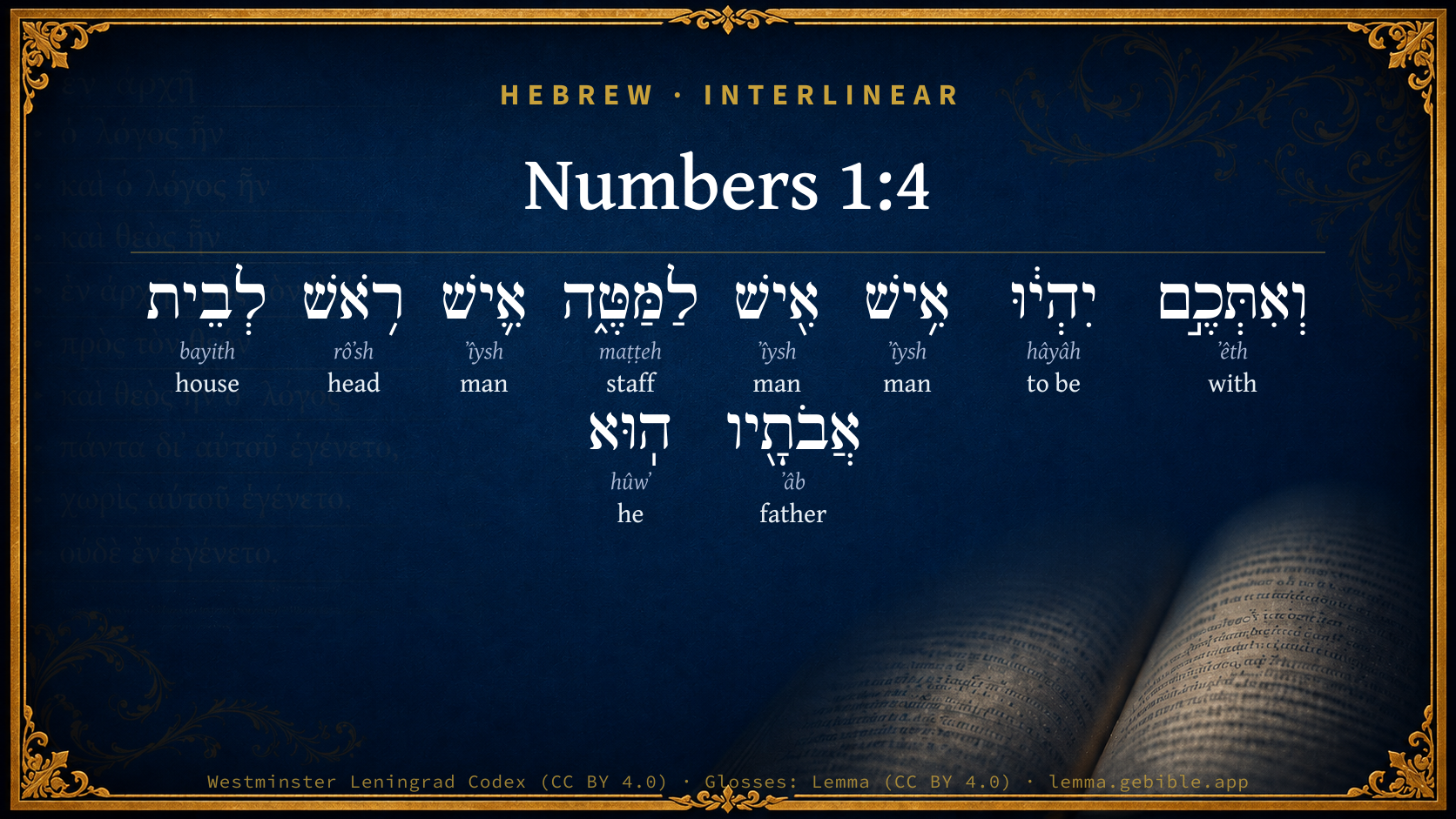
Hebrew (Westminster Leningrad Codex) Numbers 1:4 appears in the Hebrew Old Testament. The text above is from the Westminster Leningrad Codex. Each word links to its Strong’s number, a concise gloss, and parsing drawn from the Open Scriptures Hebrew Bible morphology. Click any word for its full Brown-Driver-Briggs (BDB) entry.
Download image
Cite this verse

Numbers 1:4 (World English Bible). Public Domain. Lemma interlinear Bible study tool, https://lemma.gebible.app/v/numbers/1/4.

Show BibTeX & RIS
BibTeX
RIS
English Translation
With you there shall be a man of every tribe; everyone head of his fathers' house.
World English Bible · Public Domain
Download a study sheet

One document with this verse’s original text, its word-by-word gloss line, the meaning frame, cross-references with their text, attributed commentary, and full source and license credits — printable, and it pastes into notes with its structure intact.

This verse Autodidact and up

Study sheet (.html) Plain text (.txt)

A passage Seminary Student

Up to 50 verses in one chapter. A passage sheet keeps up to 6 commentary sources and 12 cross-references per verse, in the order this page ranks them, and says so on the sheet whenever that leaves anything out. Ask for a single verse and you get the Autodidact verse sheet above.

Everything on this page stays free to read, with no account — the sheet is a download of what is already on screen, not access to it.

Want to remove ads? Support Godless Engineer
Compare translations 3

The same verse in 3 English versions, stacked beneath the original-language interlinear above. Click any original word for its lexicon entry.

Each is an independent rendering of the whole verse — the interlinear is not word-aligned to these translations.

Highlighted words mark where these versions differ — a whole-verse word diff, not a word-by-word alignment.

  • World English Bible Public Domain
    With you there shall be a man of every tribe; everyone head of his fathers' house.
  • King James Version Public Domain
    And with you there shall be a man of every tribe; every one head of the house of his fathers.
  • unfoldingWord Literal Text CC BY-SA 4.0
    And with you will be a man, a man of the tribe. He the head man of the house of his fathers.

unfoldingWord Literal Text — © unfoldingWord, licensed CC BY-SA 4.0. Word-aligned USFM3 via Door43 (git.door43.org/unfoldingWord/en_ult).

Versions to compare (up to 4)

3 of 4 selected

Show all 18 translations

Every available English version of this verse, each an independent rendering of the whole verse.

  • World English Bible Public Domain
    With you there shall be a man of every tribe; everyone head of his fathers' house.
  • Berean Standard Bible Public Domain
    And one man from each tribe, the head of each family, must be there with you.
  • Majority Standard Bible Public Domain
    And one man from each tribe, the head of each family, must be there with you.
  • King James Version Public Domain
    And with you there shall be a man of every tribe; every one head of the house of his fathers.
  • American Standard Version (1901) Public Domain
    And with you there shall be a man of every tribe; every one head of his fathers' house.
  • Revised Version (1885) Public Domain
    And with you there shall be a man of every tribe; every one head of his fathers’ house.
  • Geneva Bible (1599) Public Domain
    And with you shalbe men of euery tribe, such as are the heads of the house of their fathers.
  • Douay-Rheims (1899) Public Domain
    And there shall be with you the princes of the tribes, and of the houses in their kindreds,
  • Young's Literal Translation Public Domain
    and with you there is a man for a tribe, each is a head to the house of his fathers.
  • Literal Standard Version CC BY-SA 4.0
    and with you there is a man for a tribe, each is a head of the house of his fathers.
  • Unlocked Literal Bible CC BY-SA 4.0
    A man from each tribe, a clan head, must serve with you as his tribe's leader. Each leader must lead the men who will fight for his tribe.
  • unfoldingWord Literal Text CC BY-SA 4.0
    And with you will be a man, a man of the tribe. He the head man of the house of his fathers.
  • Darby Bible Public Domain
    And with you there shall be a man for every tribe, a man who is the head of his father's house.
  • World Messianic Bible Public Domain
    With you there shall be a man of every tribe, each one head of his fathers’ house.
  • Webster's Bible Public Domain
    And with you there shall be a man of every tribe; every one head of the house of his fathers.
  • Free Bible Version CC BY-SA 4.0
    A representative from each tribe, the head of a family, must be there with you.
  • Bible in Basic English Public Domain
    And to give you help, take one man from every tribe, the head of his father's house.
  • JPS Tanakh (1917) Public Domain
    And with you there shall be a man of every tribe, every one head of his fathers' house.

Literal Standard Version (2020), Covenant Press — licensed CC BY-SA 4.0. Text via the HelloAO Bible API (eBible.org). Unlocked Literal Bible (unfoldingWord) — licensed CC BY-SA 4.0. Text via the HelloAO Bible API (eBible.org). unfoldingWord Literal Text — © unfoldingWord, licensed CC BY-SA 4.0. Word-aligned USFM3 via Door43 (git.door43.org/unfoldingWord/en_ult). Free Bible Version, Dr. Jonathan Gallagher — licensed CC BY-SA 4.0. Text via the HelloAO Bible API (eBible.org).

Word by word

More ways to search: Search by grammar → Find every occurrence → Compare this word →

Practice this passage: Drill this verse → Learn its vocabulary →

לַמַּטֶּ֑ה
maṭṭeh
H4294
“to/for the · staff”
Preposition, Determined + Noun, Common, Masculine, Singular, Absolute
Part of Speech
Preposition + Noun
Type
Common
Gender
Masculine
Number
Singular
State
Absolute
Full BDB Definition

Origin: from H5186

TWOT: 1352b

staff, branch, tribe - staff, rod, shaft - branch (of vine) - tribe - company led by chief with staff (originally)
  1. וְאִתְּכֶ֣ם ʼêth H854 “and · with · you” Conjunction + Preposition + Suffix, Personal, 2nd Person, Masculine, Plural
  2. יִהְי֔וּ hâyâh H1961 “to be” Verb, Qal, Imperfect, 3rd Person, Masculine, Plural
  3. אִ֥ישׁ ʼîysh H376 “man” Noun, Common, Masculine, Singular, Absolute
  4. אִ֖ישׁ ʼîysh H376 “man” Noun, Common, Masculine, Singular, Absolute
  5. אִ֛ישׁ ʼîysh H376 “man” Noun, Common, Masculine, Singular, Absolute
  6. רֹ֥אשׁ rôʼsh H7218 “head” Noun, Common, Masculine, Singular, Absolute
  7. לְבֵית bayith H1004 “to/for · house of” Preposition + Noun, Common, Masculine, Singular, Construct
  8. אֲבֹתָ֖יו ʼâb H1 “fathers · his” Noun, Common, Masculine, Plural, Construct + Suffix, Personal, 3rd Person, Masculine, Singular
  9. הֽוּא hûwʼ H1931 “he” Pronoun, Personal, 3rd Person, Masculine, Singular

About this verse

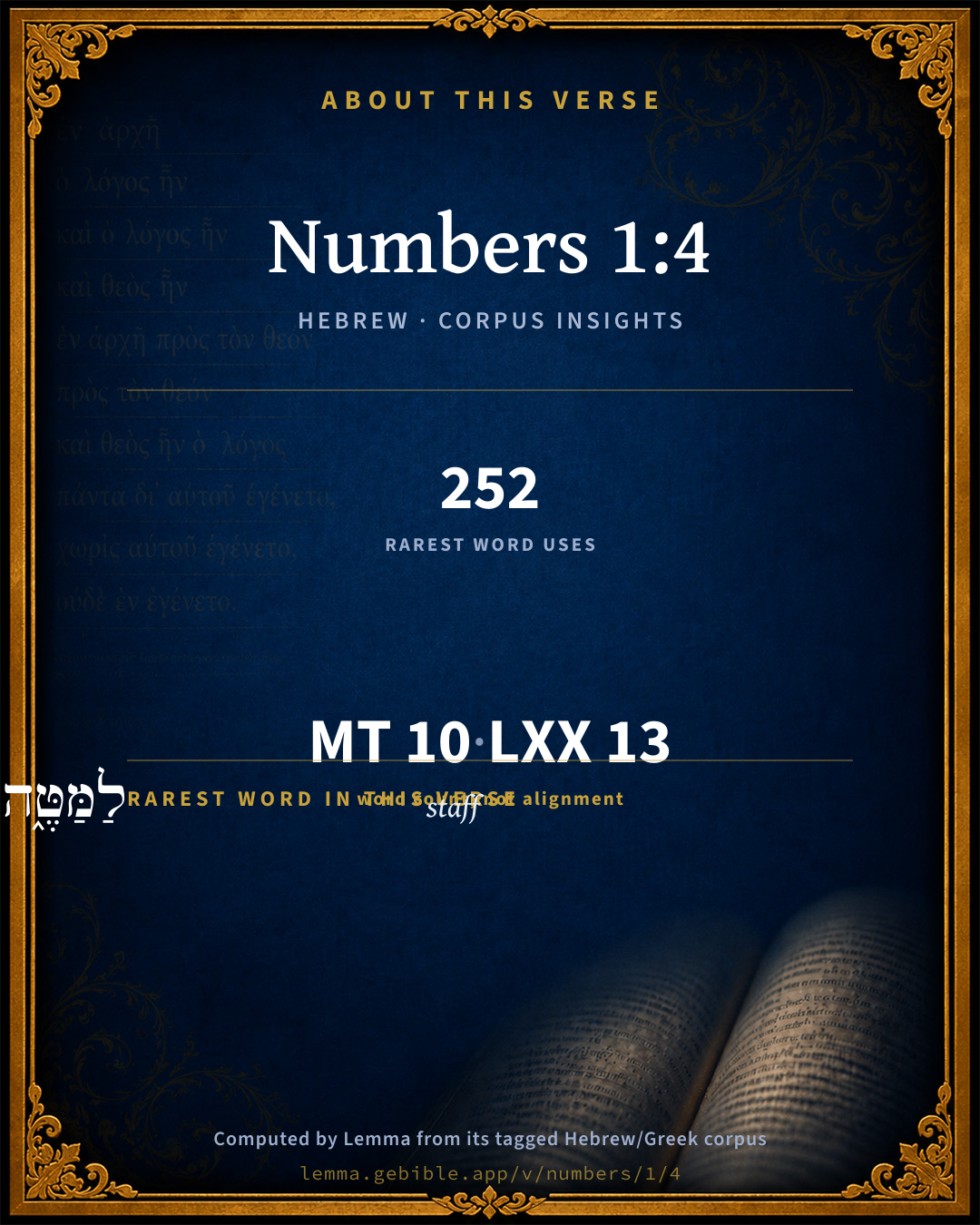
These counts appear in no published source. They are computed here, from the morphology-tagged text and Lemma’s own curated glosses. What Lemma adds →

10
words
8
distinct lemmas
Pentateuch
section

Grammatical profile

  • 1 verb
  • 7 nouns
  • 1 pronoun
  • 1 preposition

Verb forms

  • יִהְי֔וּ Qal · Imperfect

Repetition

A word recurs within this verse — often emphatic in Hebrew:

  • אִ֥ישׁ man H376 ×3

Hebrew & Septuagint length

In English translation the verse runs 16 words from the Hebrew and 27 from the Septuagint (LXX English) — the Septuagint runs noticeably longer here. See the side-by-side →

A rough comparison of the two English renderings, which tokenize alike — not a word-level alignment.

Word counts can differ between the Hebrew and the Greek without any difference in meaning — e.g. the Hebrew direct-object marker אֵת has no separate Greek word, and Greek often adds the article ὁ.

In the original languages it is 10 Hebrew tokens and 13 Greek tokens — but the two are counted differently (Hebrew bundles its prefixes and suffixes into one token; the Greek is in lemma form), so that isn’t a like-for-like length.

Cross-references

14

Topical passages linked to Numbers 1:4 in the Treasury of Scripture Knowledge — connected by theme and wording, ordered by reader-vote popularity; previews shown in the World English Bible.

  • Numbers 1:16 These are those who were called of the congregation, the princes of the tribes of their fathers; they were the heads of the thousands of Israel.
  • Exodus 18:25 Moses chose able men out of all Israel, and made them heads over the people, rulers of thousands, rulers of hundreds, rulers of fifties, and rulers of tens.
  • Exodus 18:21 Moreover you shall provide out of all the people able men, such as fear God: men of truth, hating unjust gain; and place such over them, to be rulers of thousands, rulers of hundreds, rulers of fifties, and rulers of tens.
  • Numbers 2:3–31 Those who encamp on the east side toward the sunrise shall be of the standard of the camp of Judah, according to their divisions: and the prince of the children of Judah shall be Nahshon the son of Amminadab.
  • Numbers 7:10–83 The princes gave offerings for the dedication of the altar in the day that it was anointed, even the princes gave their offerings before the altar.
  • Numbers 10:14–27 In the first [place] the standard of the camp of the children of Judah set forward according to their hosts: and over his host was Nahshon the son of Amminadab.
  • Numbers 13:2–15 Send you men, that they may spy out the land of Canaan, which I give to the children of Israel: of every tribe of their fathers shall you send a man, everyone a prince among them.
  • Numbers 17:3 You shall write Aaron's name on the rod of Levi; for there shall be one rod for each head of their fathers' houses.
  • Numbers 25:4 Yahweh said to Moses, Take all the chiefs of the people, and hang them up to Yahweh before the sun, that the fierce anger of Yahweh may turn away from Israel.
  • Numbers 25:14 Now the name of the man of Israel that was slain, who was slain with the Midianite woman, was Zimri, the son of Salu, a prince of a fathers' house among the Simeonites.
  • Numbers 34:18–28 You shall take one prince of every tribe, to divide the land for inheritance.
  • Deuteronomy 1:15 So I took the heads of your tribes, wise men, and known, and made them heads over you, captains of thousands, and captains of hundreds, and captains of fifties, and captains of tens, and officers, according to your tribes.
  • Joshua 22:14 and with him ten princes, one prince of a fathers' house for each of the tribes of Israel; and they were everyone of them head of their fathers' houses among the thousands of Israel.
  • 1 Chronicles 27:1–22 Now the children of Israel after their number, the heads of fathers' [houses] and the captains of thousands and of hundreds, and their officers who served the king, in any matter of the divisions which came in and went out month by month throughout all the months of the year--of every division were twenty-four thousand.

Cross-references courtesy of OpenBible.info (CC BY 4.0).

Hebrew and Greek witnesses Masoretic Hebrew ↔ Greek Septuagint

The same verse in the two great witnesses to the Old Testament, shown verse-for-verse.

Here the Septuagint runs noticeably longer than the Hebrew — LXX2012 (modern English Septuagint) 27 words vs World English Bible 16. A rough length comparison of the two English translations, not a word-level alignment — read both below.

These are two independent witnesses, not word-aligned to each other, and the Septuagint is shown in lemma (dictionary) form.

Hebrew Numbers 1:4 Masoretic · Westminster Leningrad Codex

וְאִתְּכֶ֣ם יִהְי֔וּ אִ֥ישׁ אִ֖ישׁ לַמַּטֶּ֑ה אִ֛ישׁ רֹ֥אשׁ לְבֵית אֲבֹתָ֖יו הֽוּא

With you there shall be a man of every tribe; everyone head of his fathers' house.

World English Bible · Public Domain

Greek LXX Numbers 1:4 Septuagint · lemma form

καί μετά σύ εἰμί ἕκαστος κατά φυλή ἕκαστος ἄρχων κατά οἶκος πατριά εἰμί

And with you there shall be each one of the rulers according to the tribe of each: they shall be according to the houses of their families.

LXX2012 (modern English Septuagint) · Public Domain

Hebrew: Westminster Leningrad Codex (CC BY 4.0). Greek: Septuagint (public domain); English from LXX2012 (modern English Septuagint) (Public Domain). How the Septuagint differs from the Hebrew →

Targum (Aramaic paraphrase)

2

The Targum is the ancient Jewish Aramaic paraphrase of the Hebrew Scriptures — an interpretive translation, not the Hebrew text itself. Onkelos (literal) and Pseudo-Jonathan (expansive) render the Torah, and Jonathan the Prophets. Coverage is partial: where no permissively-licensed English translation exists for a verse, only the Aramaic is shown. This is verse-level text, not a word-by-word alignment to the Hebrew.

  1. Targum Onkelos Torah (Genesis–Deuteronomy)
    וְעִמְכוֹן יְהוֹן גַבְרָא גַבְרָא לְשִׁבְטָא גְבַר רֵישׁ לְבֵית אֲבָהָתוֹהִי הוּא

    (no public-domain English translation for this verse)

    Targum Onkelos — Aramaic: “Onkelos Genesis” (public domain); “Onkelos Exodus” (public domain); “Onkelos Leviticus” (public domain); “Onkelos Numbers” (public domain); “Onkelos Deuteronomy” (public domain). English: “Sefaria Community Translation” (CC0 1.0 (public-domain dedication)); “J.W. Etheridge. The Targums of Onkelos and Jonathan Ben Uzziel on the Pentateuch. London: Longmans, Green, 1862” (public domain). Text via Sefaria.

  2. Targum Pseudo-Jonathan Torah (Genesis–Deuteronomy)
    וְעִמְכוֹן יְהוֹן גְבַר גְבַר לְשִׁבְטָא גְבַר רֵישׁ לְבֵית אַבְהָתוֹי הוּא

    And let there be with you a man of each tribe, a chief of his father's house.

    Targum Pseudo-Jonathan — Aramaic: “Targum Jonathan on Genesis” (public domain); “Targum Jonathan on Exodus” (public domain); “Targum Jonathan on Leviticus” (public domain); “Targum Jonathan on Numbers” (public domain); “Targum Jonathan on Deuteronomy” (public domain). English: “The Targum of Jonathan ben Uzziel, trans. J. W. Etheridge, London, 1862” (public domain). Text via Sefaria.

Commentary

Notes on Numbers 1:4 from classic Christian and Jewish commentators (each source and its license shown beneath its notes). The classic Christian expositions comment on the surrounding passage and are grouped to its opening verse, so a note may address several verses; the Jewish commentaries on the Tanakh (Rashi and others) are per-verse, so they appear only where the commentator wrote on this verse.

Lemma curates 59 commentaries, every one of them public domain or Creative Commons licensed, each selected and text-cleaned for this edition rather than reprinted as found. About our sources →

Trapp's Complete Commentary

John Trapp

Num 1:4 And with you there shall be a man of every tribe; every one head of the house of his fathers.

Ver. 4. A man of every tribe.] These were men of renown. {Num 1:16} To "do worthily in Ephrata," is the way to be "famous in Bethlehem." {Rth 4:11} It is said of a great statesman, in Queen Elizabeth’s days, that he was in the number of those few that both lived and died with glory. {a}

{a} Camden’s Elisab.

John Trapp, A Commentary or Exposition upon All the Books of the Old and New Testament (1647–1656) — public domain. Text from a community e-Sword module.

The Biblical Illustrator

Joseph S. Exell

Num_1:4-16

A man of every tribe: every one head of the house of his fathers.

Bank and service

I. Co-operation in divine service.

1. The toil of Moses and Aaron would be lessened.

2. The accomplishment of the task would be facilitated.

3. The envy of the princes would be prevented. Grumblers are seldom found among the workers of the Church.

II. Societys need of leaders.

1. Because they are at present indispensable to social order and progress. Certain objects of utmost importance to society cannot possibly be attained without cohesion of purpose and effort on the part of a large number of men, and such cohesion is impossible without leaders. Amongst the masses, says Guizot, even in revolutions, aristocracy must ever exist; destroy it in nobility, and it becomes centred in the rich and powerful Houses of the Commons. Pull them down, and it still survives in the master and foreman of the workshop.

2. Because of the differences in the faculties of men. These men were princes from, the nobility of their birth: and they were probably men distinguished also for their abilities. We must have kings, says Emerson, we must have nobles; nature is always providing such in every society; only let us have the real instead of the titular. In every society, some are born to rule, and some to advise. The chief is the chief all the world over, only not his cap and plume. It is only this dislike of the pretender which makes men sometimes unjust to the true and finished man.

III. The grand characteristic of true leaders. They are pre-eminent in service. (W Jones.)

These are the names of the men.--

The Lord knows the number and the names of all who belong to Him

As this book of Moses beareth the title of Numbers, so a great part of it is spent in numbering of the people, to assure us that God hath numbered those that are His, and none escape His knowledge or sight. The Lord knoweth perfectly who they are that are His, both what their numbers and what their names are (1Ki_19:10; 1Ki_19:18; Rom_11:3-4; Psa_147:5; Isa_40:26). The reasons are not hard to be gathered.

1. The knowledge of God is so exact and perfect that most secret things are known and the smallest are regarded of Him.

2. Christ Jesus setteth forth Himself as the true Shepherd of His sheep. A shepherd knoweth his own sheep.

3. All His people are evermore present with Him, wheresoever they be; yea, albeit they be absent from Him.

Uses:

1. This giveth singular comfort to all Gods children, if anything else be able to minister them comfort. If an earthly prince should vouchsafe to look upon us, and single us out from the rest, and call us by our names, how would we rejoice, and how much would we esteem that the king would stoop so low as to know us? Do we live as contemptible persons to the men of this world? and will they not once vouchsafe to know us? Let not this trouble us, we cannot sink down in destruction; but rather let us lift up our heads, assuring ourselves that albeit they turn themselves from us, yet God looketh upon us: and though they seek to root out our names from the earth, yet He will know us and call us by our names.

2. We may gather from hence the wretched state of all the ungodly. For as it is a great part of the comfort of all Gods children that He will know them; who, as they have a regard to know God in this life, to know Him in His word and other means appointed for their salvation, so shall they be known of God in His kingdom, and acknowledged before the angels in heaven: so this is not the least of the misery belonging unto all that work iniquity, that God will not know them. Though He know them by the general knowledge of His power and providence, yet He will not see them with the eye of His pity, nor touch them with the hand of His favour, nor hear them with the ear of His bounty, nor speak unto them with the mouth of His goodness, nor compass them with the arm of His protection, nor come unto them with the feet of His presence, nor behold them with the face and countenance of His lovingkindness. Can there be a more miserable condition described and felt than this is?

3. Seeing all that are Gods are numbered of Him, and have their names written in His book, this serveth to seal up the assurance of our salvation and election to eternal life (2Ti_2:19).

4. Seeing the Lord knoweth us, it is our duty also to seek to know Him in all love and obedience. We must all of us begin to know Him here in this life, that we may know Him perfectly in the life to come. Here we must see Him as it were through a glass darkly, that hereafter we may see Him face to face fully. If we do not know Him in His word and sacraments, we shall never know Him in His kingdom. This knowledge of God necessarily required of us consisteth in these points following--

(1) We must confess Him to be the Sovereign and Highest Good, in comparison of whom all things are reputed as nothing, being as dross and nothing to be desired with Him.

(2) It behoveth us to depend upon Him, and to put our whole trust in Him alone, not in any man or angel: for then we make flesh our strength, and so lean upon a broken staff that cannot stay us, but will deceive us.

(3) We must draw near unto Him in time of need, as to the fountain of all goodness, with all reverence and humility craving all things of Him by hearty and fervent prayer. If we call upon Him, He hath promised to reveal Himself unto us.

(4) We must give Him thanks for all blessings received from Him, not only in prosperity, but in adversity.

(5) We must seek the knowledge of His ways and word, and increase in the knowledge thereof, which bringeth us to eternal life. As we grow forward in knowledge, so we grow forward unto life: and when our knowledge shall be perfected, then our life shall be perfected in the next world. Lastly, we must yield obedience unto Him and His word. (W. Attersoll.)

Gods knowledge of His people

I. The great truth here implied. God knows His people individually and altogether.

1. This is philosophical. If God is infinite, He must know all things. Nothing can be so great as to surpass His comprehension; nothing so small as to escape His notice.

2. This is Scriptural. (1Ki_19:14-18; Psa_1:6; Psa_56:8; Psa_147:3-4; Isa_40:26-31; Mal_3:16-17; Mat_6:25-34; Mat_10:29-30; Joh_10:3; Joh_10:14; Joh_10:27; Php_4:3; 2Ti_2:19; Rev_3:5; Rev_21:27).

II. The practical bearings of this great truth.

1. To restrain from sin.

2. To promote sincerity of life.

3. To promote humility.

4. To quicken reverence towards God.

5. To comfort the godly under reverses. (W. Jones.)

They declared their pedigrees.--

The pedigree declared

Can I declare my pedigree? It is greatly to be feared there are hundreds, if not thousands, of professing Christians who are wholly incompetent to do so. They cannot say with clearness and decision, Now are we the sons of God (1Jn_3:2). Ye are all the children of God, &c. And if ye are Christs, then are ye Abrahams seed, &c. (Gal_3:26; Gal_3:29). For as many as are led by the Spirit of God, they are the sons of God, &c. (Rom_8:14; Rom_8:16). This is the Christians pedigree, and it is his privilege to be able to declare it (cf. Joh_3:5; Jam_1:18; 1Pe_1:23; Eph_5:26). The believer traces his pedigree directly up to a risen Christ in glory. His genealogical tree strikes its roots into the soil of the new creation. Death can never break the line, inasmuch as it is formed in resurrection. We can easily see, from this chapter, how essential it was that every member of the congregation of Israel should be able to declare his pedigree. Uncertainty on this point would have proved disastrous; it would have produced hopeless confusion. We can hardly imagine an Israelite, when called to declare his pedigree, expressing himself in the doubtful manner adopted by many Christians nowadays. We cannot conceive his saying, Well, I am not quite sure. Sometimes I cherish the hope that I am of the stock of Israel; but at other times I am full of fear that I do not belong to the congregation of the Lord at all. I am all in uncertainty and darkness. Much less could we imagine any one maintaining the monstrous notion that no one could possibly be sure as to whether he was a true Israelite or not until the day of judgment. Now, may we not legitimately ask, If a Jew could be certain as to his pedigree, why may not a Christian be certain as to his? We would urge this point at the outset. It is impossible for any one to recognise and rally round the proper standard unless he can declare his pedigree. Progress in wilderness life--success in spiritual warfare, is out of the question if there be any uncertainty as to the spiritual pedigree. We must be able to say, We know that we have passed from death unto life, We believe and are sure, ere there can be any real advance in the life and walk of a Christian. We do not mean to say you cannot be saved without this. God forbid we should say any such thing. But we ask, Are such able to go forth to war? They cannot even know what true conflict is; on the contrary, persons of this class mistake their doubts and fears, their dark and cloudy seasons, for true Christian conflict. It is when we stand in the clear daylight of Gods full salvation--salvation in a risen Christ--that we really enter upon the warfare proper to us as Christians. (C. H. Mackintosh.)

An honest pedigree:

Dr. Livingstone, the famous explorer, was descended from the Highlanders, and he said that one of his ancestors, one of the Highlanders, one day called his family around him. The Highlander was dying; he had his children around his death-bed. He said, Now, my lads, I have looked all through our history as far back as I can find it, and I have never found a dishonest man in all the line, and I want you to understand you inherit good blood. You have no excuse for doing wrong. My lads, be honest.

The Biblical Illustrator, edited by Joseph S. Exell (c. 1880s–1900s) — public domain. Text from a community e-Sword module.

Keil & Delitzsch

C. F. Keil & F. Delitzsch

Moses and Aaron, who were commanded to number, or rather to muster, the people, were to have with them "a man of every tribe, who was head-man of his fathers' houses," i.e., a tribe-prince, viz., to help them to carry out the mustering. Beth aboth ("fathers' houses"), in Num 1:2, is a technical expression for the subdivisions in which the mishpachoth, or families of the tribes, were arranged, and is applied in Num 1:4 according to its original usage, based upon the natural division of the tribes into mishpachoth and families, to the fathers' houses which every tribe possessed in the family of its first-born. In Num 1:5-15, these heads of tribes were mentioned by name, as in Num 2:3., Num 7:12., Num 10:14. In Num 1:16 they are designated as "called men of the congregation," because they were called to diets of the congregation, as representatives of the tribes, to regulate the affairs of the nation; also "princes of the tribes of their fathers," and "heads of the thousands of Israel:" "prince," from the nobility of their birth; and "heads," as chiefs of the alaphim composing the tribes. Alaphim is equivalent to mishpachoth (cf. Num 10:4; Jos 22:14); because the number of heads of families in the mishpachoth of a tribe might easily amount to a thousand (see at Exo 18:25). In a similar manner, the term "hundred" in the old German came to be used in several different senses (see Grimm, deutsche Rechts-alterthmer, p. 532).

Keil & Delitzsch — Biblical Commentary on the Old Testament (1861–1891) — public domain (CC PDM 1.0). Text via the HelloAO Bible API. (Old Testament only.)

Geneva Bible (1599)

Geneva Bible translators

That is, the chiefest man of every tribe.

Geneva Bible (1599) marginal notes — public domain. Text via Bolls.life.

Jamieson, Fausset & Brown

Robert Jamieson, A. R. Fausset & David Brown

with you there shall be a man of every tribe, &c.--The social condition of the Israelites in the wilderness bore a close resemblance to that of the nomad tribes of the East in the present day. The head of the tribe was a hereditary dignity, vested in the oldest son or some other to whom the right of primogeniture was transferred, and under whom were other inferior heads, also hereditary, among the different branches of the tribe. The Israelites being divided into twelve tribes, there were twelve chiefs appointed to assist in taking the census of the people.

Jamieson, Fausset & Brown — Commentary Critical and Explanatory on the Whole Bible (1871) — public domain (CC PDM 1.0). Text via the HelloAO Bible API.

Ellicott's Commentary for English Readers

(4) Of every tribe.—Or, for every tribe.

Every one head . . . —The words may be rendered every one a head . . . There were many heads of fathers’ houses in each tribe; but it appears from Num_1:16 (Num_7:10-11) that in each case the tribal prince was selected to preside over the census.

A Bible Commentary for English Readers, edited by Charles John Ellicott (1878–1897) — public domain. Text from a community e-Sword module.

John Gill's Exposition

And with you there shall be a man of every tribe,.... Excepting Levi, of which Moses and Aaron were, to assist in taking the account, and to see that it was an exact and perfect one:

everyone head of the house of his fathers; and prince of the tribe he belonged to, as appears from Num 1:16 and Num 7:2, where an account is given of the same persons as princes of the tribes that offered at the dedication of the altar, who here assisted in the taking this account; the Targum of Jonathan calls them each a prince, as Prince Elizur, &c.

John Gill's Exposition of the Whole Bible (1746–1763) — public domain (CC PDM 1.0). Text via the HelloAO Bible API.

Matthew Poole's English Annotations

To inspect the work, that it might be faithfully and impartially done.

Matthew Poole's English Annotations on the Holy Bible (1683–1685) — public domain. Text from a community e-Sword/MySword module.

The Pulpit Commentary

A man of every tribe. The former census, which was for religious purposes only, was made with the assistance of the Levites. This, which was rather for political and military purposes, was supervised by the lay heads of the people.

The Pulpit Commentary (1880–1919), ed. H.D.M. Spence-Jones & Joseph S. Exell — public domain. Text from a community e-Sword module.

unfoldingWord translationNotes

Door43 World Missions Community

a clan head

"a leader of a clan"

serve with you

"help you"

Elizur ... Shedeur ... Shelumiel ... Zurishaddai

These are names of men. (See: How to Translate Names)

translationWords

tribe

head

servant

Reuben

son

Simeon

unfoldingWord translationNotes — © Distant Shores Media and the Door43 World Missions Community, licensed CC BY-SA 4.0. Source: git.door43.org/Door43/en_tn.

Rashi

Rabbi Shlomo Yitzchaki (Rashi)

ואתכם יהיו AND WITH YOU THERE SHALL BE [A MAN OF EVERY TRIBE] — when you number them there shall be with you the princes of each tribe.

Rashi on the Tanakh — English translations: “The Judaica Press complete Tanach with Rashi, translated by A. J. Rosenberg” (CC BY 4.0); “Pentateuch with Rashi's commentary by M. Rosenbaum and A.M. Silbermann, 1929-1934” (public domain); “The Metsudah Tanach series, Lakewood, N.J” (CC BY 4.0); and “The Book of Joshua, Metsudah Publications, 1997” (CC BY 4.0). Text via Sefaria.

Lesson kit

Teaching starters — assembled from the data on this page, not authored interpretation. Every prompt links to the verse data it draws on. Edit before teaching.

Numbers, in the Pentateuch, opens this verse with 10 words (8 distinct Hebrew lemmas). Its most distinctive word is maṭṭeh (“staff”). The Greek Septuagint runs longer here. A historical commentator’s framing appears above. Read the whole chapter for the surrounding context.

Discussion questions

  1. How does “staff” (maṭṭeh) shape what this verse is saying?
  2. How does Numbers 1:16, which shares this passage’s theme, read alongside this verse?
  3. What does the repetition of “man” (3× in this one verse) do in this verse?
  4. The Septuagint runs longer here than the Hebrew. What might account for the difference?
  5. The translations on this page render this verse differently — a whole-verse word diff, not a word-by-word alignment. What might account for the different wordings?
  6. «יִהְי֔וּ» is a Qal Imperfect verb. How does that grammatical form shape the action described?
  7. Compare how Trapp's Complete Commentary and The Biblical Illustrator read this verse. Where do they agree or differ?

Things to notice

Reading settings

Reading text

Shown beneath each verse's original-language words.

Old Testament
Old Testament edition

Read the OT as the Masoretic Hebrew (MT) or the Greek Septuagint (LXX).

English shown for the Greek Septuagint (in the Hebrew ↔ Greek comparison).

Comparing translations? Open the Compare panel on any verse page to stack up to four side by side.