
Nehemiah 4:16

Hebrew (Westminster Leningrad Codex) Nehemiah 4:16 appears in the Hebrew Old Testament. The text above is from the Westminster Leningrad Codex. Each word links to its Strong’s number, a concise gloss, and parsing drawn from the Open Scriptures Hebrew Bible morphology. Click any word for its full Brown-Driver-Briggs (BDB) entry.
Download image
Cite this verse

Nehemiah 4:16 (World English Bible). Public Domain. Lemma interlinear Bible study tool, https://lemma.gebible.app/v/nehemiah/4/16.

Show BibTeX & RIS
BibTeX
RIS
English Translation
It happened from that time forth, that half of my servants worked in the work, and half of them held the spears, the shields, and the bows, and the coats of mail; and the rulers were behind all the house of Judah.
World English Bible · Public Domain
Download a study sheet

One document with this verse’s original text, its word-by-word gloss line, the meaning frame, cross-references with their text, attributed commentary, and full source and license credits — printable, and it pastes into notes with its structure intact.

This verse Autodidact and up

Study sheet (.html) Plain text (.txt)

A passage Seminary Student

Up to 50 verses in one chapter. A passage sheet keeps up to 6 commentary sources and 12 cross-references per verse, in the order this page ranks them, and says so on the sheet whenever that leaves anything out. Ask for a single verse and you get the Autodidact verse sheet above.

Everything on this page stays free to read, with no account — the sheet is a download of what is already on screen, not access to it.

Want to remove ads? Support Godless Engineer
Compare translations 3

The same verse in 3 English versions, stacked beneath the original-language interlinear above. Click any original word for its lexicon entry.

Each is an independent rendering of the whole verse — the interlinear is not word-aligned to these translations.

Highlighted words mark where these versions differ — a whole-verse word diff, not a word-by-word alignment.

  • World English Bible Public Domain
    It happened from that time forth, that half of my servants worked in the work, and half of them held the spears, the shields, and the bows, and the coats of mail; and the rulers were behind all the house of Judah.
  • King James Version Public Domain
    And it came to pass from that time forth, that the half of my servants wrought in the work, and the other half of them held both the spears, the shields, and the bows, and the habergeons; and the rulers were behind all the house of Judah.
  • unfoldingWord Literal Text CC BY-SA 4.0
    And it happened that, from that day, half of my young men were doing the work, and half of them were grasping, even the spears, the shields, and the bows, and the breastplates. And the officials were behind all the house of Judah.

unfoldingWord Literal Text — © unfoldingWord, licensed CC BY-SA 4.0. Word-aligned USFM3 via Door43 (git.door43.org/unfoldingWord/en_ult).

Versions to compare (up to 4)

3 of 4 selected

Show all 18 translations

Every available English version of this verse, each an independent rendering of the whole verse.

  • World English Bible Public Domain
    It happened from that time forth, that half of my servants worked in the work, and half of them held the spears, the shields, and the bows, and the coats of mail; and the rulers were behind all the house of Judah.
  • Berean Standard Bible Public Domain
    And from that day on, half of my servants did the work while the other half held spears, shields, bows, and armor. The officers stationed themselves behind all the people of Judah
  • Majority Standard Bible Public Domain
    And from that day on, half of my servants did the work while the other half held spears, shields, bows, and armor. The officers stationed themselves behind all the people of Judah
  • King James Version Public Domain
    And it came to pass from that time forth, that the half of my servants wrought in the work, and the other half of them held both the spears, the shields, and the bows, and the habergeons; and the rulers were behind all the house of Judah.
  • American Standard Version (1901) Public Domain
    And it came to pass from that time forth, that half of my servants wrought in the work, and half of them held the spears, the shields, and the bows, and the coats of mail; and the rulers were behind all the house of Judah.
  • Revised Version (1885) Public Domain
    And it came to pass from that time forth, that half of my servants wrought in the work, and half of them held the spears, the shields, and the bows, and the coats of mail; and the rulers were behind all the house of Judah.
  • Geneva Bible (1599) Public Domain
    And from that day, halfe of the yong men did the labour, and the other halfe part of them helde the speares, and shieldes, and bowes, and habergins: and the rulers stoode behinde all the house of Iudah.
  • Douay-Rheims (1899) Public Domain
    And it came to pass from that day forward, that half of their young men did the work, and half were ready for to fight, with spears, and shields, and bows, and coats of mail, and the rulers were behind them in all the house of Juda.
  • Young's Literal Translation Public Domain
    yea, it cometh to pass, from that day, half of my servants are working in the business, and half of them are keeping hold of both the spears, the shields, and the bows, and the coats of mail; and the heads `are' behind all the house of Judah.
  • Literal Standard Version CC BY-SA 4.0
    indeed, it comes to pass, from that day, half of my servants are working in the business, and half of them are keeping hold of both the spears, the shields, and the bows, and the coats of mail; and the heads [are] behind all the house of Judah.
  • Unlocked Literal Bible CC BY-SA 4.0
    So from that time half of my servants worked only on rebuilding the wall, and half of them held spears, shields, bows, and wore armor, while the leaders stood behind all the people of Judah.
  • unfoldingWord Literal Text CC BY-SA 4.0
    And it happened that, from that day, half of my young men were doing the work, and half of them were grasping, even the spears, the shields, and the bows, and the breastplates. And the officials were behind all the house of Judah.
  • Darby Bible Public Domain
    And from that time forth the half of my servants wrought in the work, and the other half of them held the spears, and the shields, and the bows, and the corslets; and the captains were behind all the house of Judah.
  • World Messianic Bible Public Domain
    From that time forth, half of my servants did the work, and half of them held the spears, the shields, the bows, and the coats of mail; and the rulers were behind all the house of Judah.
  • Webster's Bible Public Domain
    And it came to pass, from that time forth, that the half of my servants wrought in the work, and the other half of them held both the spears, the shields, and the bows, and the habergeons; and the rulers were behind all the house of Judah.
  • Free Bible Version CC BY-SA 4.0
    From then on, half of my men were doing the work while the other half were ready to fight, holding their spears, shields, bows, and armor. The leaders stood behind all the people of Judah
  • Bible in Basic English Public Domain
    And from that time, half of my servants were doing their part of the work, and half kept the spears and body-covers and the bows and the metal war-dresses; and the chiefs were at the back of the men of Judah.
  • JPS Tanakh (1917) Public Domain
    (4-10) And it came to pass from that time forth, that half of my servants wrought in the work, and half of them held the spears, the shields, and the bows, and the coats of mail; and the rulers were behind all the house of Judah.

Literal Standard Version (2020), Covenant Press — licensed CC BY-SA 4.0. Text via the HelloAO Bible API (eBible.org). Unlocked Literal Bible (unfoldingWord) — licensed CC BY-SA 4.0. Text via the HelloAO Bible API (eBible.org). unfoldingWord Literal Text — © unfoldingWord, licensed CC BY-SA 4.0. Word-aligned USFM3 via Door43 (git.door43.org/unfoldingWord/en_ult). Free Bible Version, Dr. Jonathan Gallagher — licensed CC BY-SA 4.0. Text via the HelloAO Bible API (eBible.org).

Word by word

More ways to search: Search by grammar → Find every occurrence → Compare this word →

Practice this passage: Drill this verse → Learn its vocabulary →

וְהַשִּׁרְיֹנִ֑ים
shiryôwn
H8302
“and · the · body armor”
Conjunction + Particle, Definite Article + Noun, Common, Both, Plural, Absolute
Part of Speech
Conjunction + Particle + Noun
Type
Common
Gender
Both
Number
Plural
State
Absolute
Full BDB Definition

Origin: from H8281 in the original sense of turning

TWOT: 2466a , 2465a

body armour - a weapon - perhaps a lance, javelin
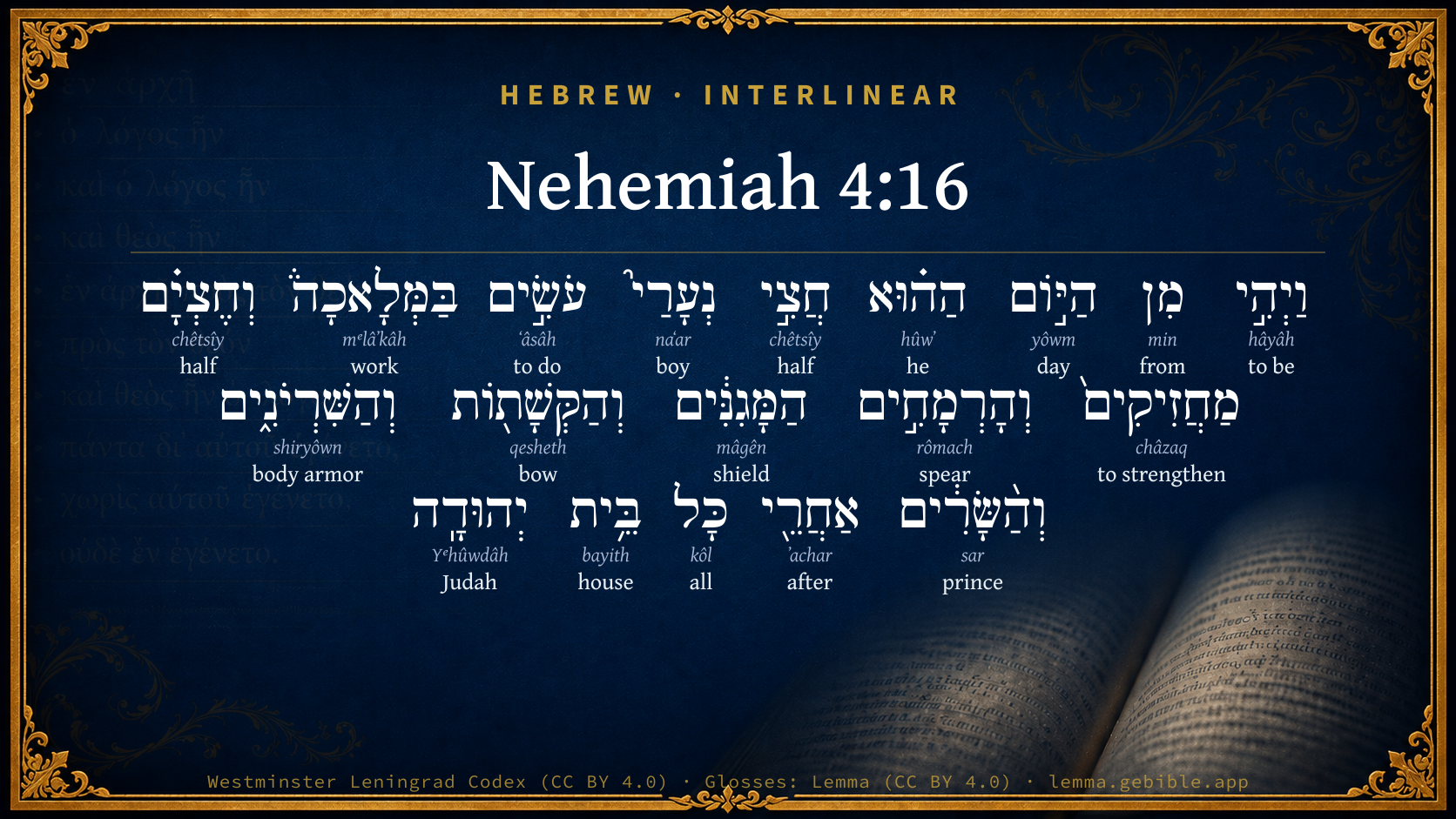
  1. וַיְהִ֣י hâyâh H1961 “and · to be” Conjunction + Verb, Qal, Sequential Imperfect, 3rd Person, Masculine, Singular
  2. מִן min H4480 “from” Preposition
  3. הַיּ֣וֹם yôwm H3117 “the · day” Particle, Definite Article + Noun, Common, Masculine, Singular, Absolute
  4. הַה֗וּא hûwʼ H1931 “the · he” Particle, Definite Article + Pronoun, Personal, 3rd Person, Masculine, Singular
  5. חֲצִ֣י chêtsîy H2677 “half of” Noun, Common, Masculine, Singular, Construct
  6. נְעָרַי֮ naʻar H5288 “boys · my” Noun, Common, Masculine, Plural, Construct + Suffix, Personal, 1st Person, Common, Singular
  7. עֹשִׂ֣ים ʻâsâh H6213 “doing” Verb, Qal, Participle Active, Masculine, Plural, Absolute
  8. בַּמְּלָאכָה֒ mᵉlâʼkâh H4399 “in/at the · work” Preposition, Determined + Noun, Common, Feminine, Singular, Absolute
  9. וְחֶצְיָ֗ם chêtsîy H2677 “and · half · their” Conjunction + Noun, Common, Masculine, Singular, Construct + Suffix, Personal, 3rd Person, Masculine, Plural
  10. מַחֲזִיקִים֙ châzaq H2388 “strengthening” Verb, Hiphil, Participle Active, Masculine, Plural, Absolute
  11. וְהָרְמָחִ֣ים rômach H7420 “and · the · spears” Conjunction + Particle, Definite Article + Noun, Common, Masculine, Plural, Absolute
  12. הַמָּגִנִּ֔ים mâgên H4043 “the · shields” Particle, Definite Article + Noun, Common, Both, Plural, Absolute
  13. וְהַקְּשָׁת֖וֹת qesheth H7198 “and · the · bows” Conjunction + Particle, Definite Article + Noun, Common, Feminine, Plural, Absolute
  14. וְהַ֨שָּׂרִ֔ים sar H8269 “and · the · princes” Conjunction + Particle, Definite Article + Noun, Common, Masculine, Plural, Absolute
  15. אַחֲרֵ֖י ʼachar H310 “after” Preposition
  16. כָּל kôl H3605 “all of” Noun, Common, Masculine, Singular, Construct
  17. בֵּ֥ית bayith H1004 “house of” Noun, Common, Masculine, Singular, Construct
  18. יְהוּדָֽה Yᵉhûwdâh H3063 “Judah” Noun, Proper

About this verse

These counts appear in no published source. They are computed here, from the morphology-tagged text and Lemma’s own curated glosses. What Lemma adds →

19
words
18
distinct lemmas
Historical
section

Notable vocabulary

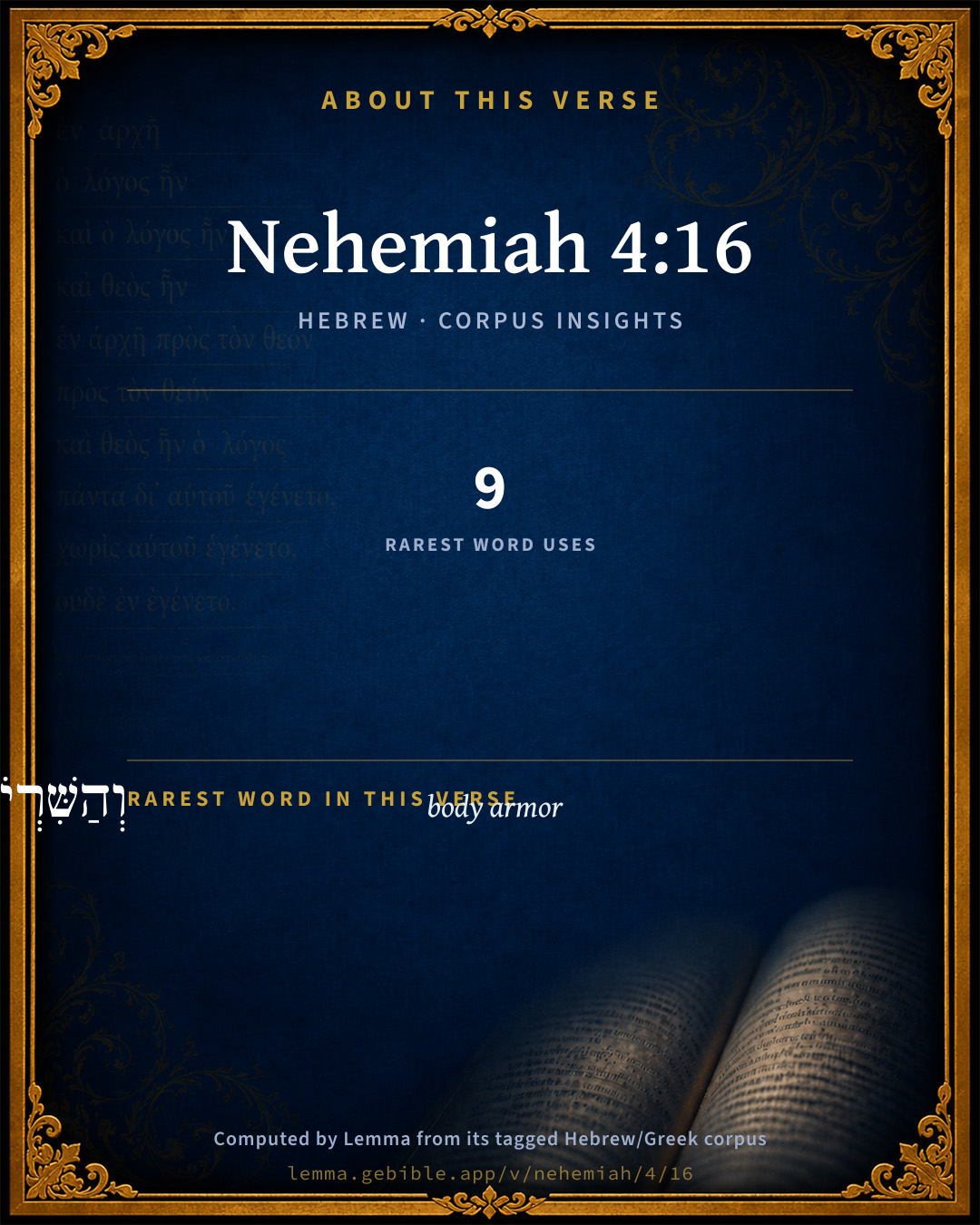
The rarest word here is וְהַשִּׁרְיֹנִ֑ים body armor H8302 — appearing just 9 times in the whole Hebrew Bible.

Shared distinctive vocabulary

וְהַשִּׁרְיֹנִ֑ים body armor H8302 occurs in 8 verses of the Hebrew Bible. Also found in:

Grammatical profile

  • 3 verbs
  • 13 nouns
  • 1 pronoun
  • 2 prepositions

Verb forms

  • וַיְהִ֣י Qal · Sequential Imperfect
  • עֹשִׂ֣ים Qal · Participle Active
  • מַחֲזִיקִים֙ Hiphil · Participle Active

Repetition

A word recurs within this verse — often emphatic in Hebrew:

  • חֲצִ֣י half H2677 ×2

Cross-references

3

Topical passages linked to Nehemiah 4:16 in the Treasury of Scripture Knowledge — connected by theme and wording, ordered by reader-vote popularity; previews shown in the World English Bible.

  • Nehemiah 4:23 So neither I, nor my brothers, nor my servants, nor the men of the guard who followed me, none of us put off our clothes, everyone [went with] his weapon [to] the water.
  • Nehemiah 5:15–16 But the former governors who were before me were chargeable to the people, and took of them bread and wine, besides forty shekels of silver; yes, even their servants bore rule over the people: but I didn't do so, because of the fear of God.
  • Psalms 101:6 My eyes will be on the faithful of the land, That they may dwell with me. He who walks in a perfect way, He will serve me.

Cross-references courtesy of OpenBible.info (CC BY 4.0).

Hebrew and Greek witnesses Masoretic Hebrew ↔ Greek Septuagint

The same verse in the two great witnesses to the Old Testament, shown verse-for-verse.

These are two independent witnesses, not word-aligned to each other, and the Septuagint is shown in lemma (dictionary) form.

Hebrew Nehemiah 4:16 Masoretic · Westminster Leningrad Codex

וַיְהִ֣י מִן הַיּ֣וֹם הַה֗וּא חֲצִ֣י נְעָרַי֮ עֹשִׂ֣ים בַּמְּלָאכָה֒ וְחֶצְיָ֗ם מַחֲזִיקִים֙ וְהָרְמָחִ֣ים הַמָּגִנִּ֔ים וְהַקְּשָׁת֖וֹת וְהַשִּׁרְיֹנִ֑ים וְהַ֨שָּׂרִ֔ים אַחֲרֵ֖י כָּל בֵּ֥ית יְהוּדָֽה

It happened from that time forth, that half of my servants worked in the work, and half of them held the spears, the shields, and the bows, and the coats of mail; and the rulers were behind all the house of Judah.

World English Bible · Public Domain

Greek LXX Structure differs

The Septuagint has no separate book of Nehemiah. Its Greek text is the second half of Esdras B (2 Esdras), chapters 11–23; Ezra is the first half (1–10).

A verse-for-verse comparison isn’t shown here because the chapters and verses don’t line up. Switch to the LXX edition with the MT / LXX toggle above to read the Greek directly.

On this verse, The Cambridge Bible for Schools and Colleges discusses the Septuagint’s reading. Read the note in Commentary ↓

Hebrew: Westminster Leningrad Codex (CC BY 4.0). Greek: Septuagint (public domain); English from a public-domain English Septuagint. How the Septuagint differs from the Hebrew →

Commentary

Notes on Nehemiah 4:16 from classic Christian and Jewish commentators (each source and its license shown beneath its notes). The classic Christian expositions comment on the surrounding passage and are grouped to its opening verse, so a note may address several verses; the Jewish commentaries on the Tanakh (Rashi and others) are per-verse, so they appear only where the commentator wrote on this verse.

Lemma curates 59 commentaries, every one of them public domain or Creative Commons licensed, each selected and text-cleaned for this edition rather than reprinted as found. About our sources →

Matthew Henry's Commentary

When the builders had so far reason to think the design of the enemies broken as to return to their work, yet they were not so secure as to lay down their arms, knowing how restless and unwearied they were in their attempts, and that, if one design failed, they would be hatching another. Thus must we watch always against our spiritual enemies, and not expect that our warfare will be accomplished till our work is. See what course Nehemiah took, that the people might hold themselves in a readiness, in case there should be an attack. 1. While one half were at work, the other half were under their arms, holding spears, and shields, and bows, not only for themselves but for the labourers too, who would immediately quit their work, and betake themselves to their weapons, upon the first alarm, Neh 4:16. It is probable that they changed services at stated hours, which would relieve the fatigue of both, and particularly would be an ease to the bearers of burdens, whose strength had decayed (Neh 4:10); while they held the weapons, they were eased and yet not idle. Thus dividing their time between the trowels and the spears, they are said to work with one hand and hold their weapons with the other (Neh 4:17), which cannot be understood literally, for the work would require both hands; but it intimates that they were equally employed in both. Thus must we work out our salvation with the weapons of our warfare in our hand; for in every duty we must expect to meet with opposition from our spiritual enemies, against whom we must still be fighting the good fight of faith. 2. Every builder had a sword by his side (Neh 4:18), which he could carry without hindering his labour. The word of God is the sword of the Spirit, which we ought to have always at hand and never to seek, both in our labours and in our conflicts as Christians. 3. Care was taken both to get and give early notice of the approach of the enemy, in case they should endeavour to surprise them. Nehemiah kept a trumpeter always by him to sound an alarm, upon the first intimation of danger. The work was large, and the builders were dispersed; for in all parts of the wall they were labouring at the same time. Nehemiah continually walked round to oversee the work and encourage the workmen, and so would have speedy intelligence if the enemy made an attack, of which, by sound of trumpet, he would soon give notice to all, and they must immediately repair to him with a full assurance that their God would fight for them, Neh 4:18-20. When they acted as workmen, it was requisite they should be dispersed wherever there was work to do; but when as soldiers it was requisite they should come into close order, and be found in a body. Thus should the labourers in Christ's building be ready to unite against a common foe. 4. The inhabitants of the villages were ordered to lodge within Jerusalem, with their servants, not only that they might be the nearer to their work in the morning, but that they might be ready to help in case of an attack in the night, Neh 4:22. The strength of a city lies more in its hands than in its walls; secure them, and God's blessing upon them, and be secure. 5. Nehemiah himself, and all his men, kept closely to their business. The spears were held up, with the sight of them to terrify the enemy, not only from sun to sun, but from twilight to twilight every day, Neh 4:21. Thus ought we to be always upon our guard against our spiritual enemies, not only (as here) while it is light, but when it is dark, for they are the rulers of the darkness of this world. Nay, so very intent was Nehemiah upon his work, and so fast did he hold his servants to it, that while the heat of the business lasted neither he himself nor his attendants went into bed, but every night lay and slept in their clothes (Neh 4:23), except that they shifted them now and then, either for cleanliness or in a case of ceremonial pollution. It was a sign that their heart was upon their work when they could not find time to dress and undress, but resolved they would be at all times ready for service. Good work is likely to go on successfully when those that labour in it thus make a business of it.

Matthew Henry's Commentary on the Whole Bible (1708–1710) — public domain (CC PDM 1.0). Text via the HelloAO Bible API.

Trapp's Complete Commentary

John Trapp

Neh 4:16 And it came to pass from that time forth, [that] the half of my servants wrought in the work, and the other half of them held both the spears, the shields, and the bows, and the habergeons; and the rulers [were] behind all the house of Judah.

Ver. 16. And it came to pass from that time forth] As it is told of that peerless Queen Elizabeth, that in times of greatest peace she ever made preparation for war; so did this incomparable Nehemiah; still fearing some new practice, and not knowing what those restless cads were even now a hammering.

That the half of my servants wrought in the work] No servants they were for Nehemiah, if they would not work. He was an active man himself, trading every talent; and those about him must all be active. One would wonder how this courtier should become on the sudden so cunning a soldier, and should marshal his men so skilfully, setting the younger before to bear the brunt of the battle, and the elders behind to direct and encourage, according to that of the poet,

Eογα νεων, βουλαι τ ανδρων, ευχαι τε γεροντων.

But it was his God that instructed him to this discretion, and taught him, Isa 28:26, and he might well break out and sing, with David, "Blessed be the Lord, my strength, which teacheth my hands to war and my fingers to fight," Psa 144:1. Quando Christus Magister, quam cito dicitur quod docetur? saith Austin. God’s scholars must needs be exact in a short space.

And the habergeons] These were armour for back and breast. In the Christian armour there is no mention of armour for the back, though there is for the breast, because a Christian soldier should never flee, but be like Androclid, whom, when one derided, because, being lame, he went into the war, he answered merrily, that he came thither to fight, not to run away.

John Trapp, A Commentary or Exposition upon All the Books of the Old and New Testament (1647–1656) — public domain. Text from a community e-Sword module.

Joseph Benson's Commentary

Neh 4:16. It came to pass from that time forth — Lest our enemies should repeat their enterprise; that the half of my servants wrought in the work — Of my domestic servants, and of my guards, who should have attended upon my own person. And the other half held the spears, the shields, &c. — That is, all their weapons: they stood in their arms, prepared for battle. And the rulers were behind all — Partly to encourage them in their work, sometimes assisting them with their own hands; and partly to direct and command them in case of an assault.

Joseph Benson's Commentary on the Old and New Testaments (1811–1818) — public domain. Text from a community e-Sword module.

Geneva Bible (1599)

Geneva Bible translators

To oversee them and to encourage them to their work.

Geneva Bible (1599) marginal notes — public domain. Text via Bolls.life.

Adam Clarke's Commentary

Verse 16. Half-wrought in the work] This is no unusual thing, even in the present day, in Palestine: people sowing their seed are often attended by an armed man, to prevent the Arabs from robbing them of their seed, which they will not fail to do if not protected.

Habergeons] In the Franco-Gallic, hautbergon signifies a coat of mall; but as in Teutonic [Teutonic] signifies the neck, and [Teutonic], to cover or defend; it may be considered rather as signifying a breastplate, or armour for the breast.

Adam Clarke's Commentary on the Bible (1810–1826) — public domain. Text from a community e-Sword/MySword module.

Ellicott's Commentary for English Readers

(16) My servants.—The building was resumed with special precautions, very minutely described. “Nehemiah’s own servants” are distinguished from “all the house of Judah.” The former were divided into two parties, one of which wrought on the work still unfinished and the other held their weapons.

Habergeons are coats of mail or corselets, thin plates of metal sewn upon leather.

The rulers were behind—Ready to lead the defence, if necessary.

A Bible Commentary for English Readers, edited by Charles John Ellicott (1878–1897) — public domain. Text from a community e-Sword module.

The Cambridge Bible for Schools and Colleges

gen. ed. J. J. S. Perowne

16. the half of my servants wrought in the work] R.V. half of, &c. Literally ‘half of my young men.’ The LXX. by a strange error τῶν ἐκτετιναγμένων. These were probably the bodyguard attached to the person of Nehemiah as the governor. They are mentioned again in Neh_4:23; Neh_5:10; Neh_5:16. We gather that only in the case of these his personal attendants did Nehemiah still insist upon arms being held in readiness, while the work of building went on. The rest of the Jews were exempted. Nehemiah’s servants were kept prepared for any emergency. One half of them worked on the wall: the other half were stationed under arms at various points holding the weapons of their comrades.

and the other half of them held both the spears, &c.] R.V. and half of them held the spears. In the original the copula ‘and’ stands before ‘the spears.’ It has been suggested that this implies the falling out of a word, e.g. ‘the swords’ after which the copula would be natural, i.e. ‘the swords and the spears, &c.’ The interpretation which, accepting the introduction of the word ‘swords,’ begins a new sentence with ‘and the spears, &c.’ is harsh and improbable. But it is best to suppose that the copula has been accidentally inserted from the neighbouring words. The wearing of a sword was not incompatible with the manual work. The weapons held by the non-working detachment are just those which would have rendered work on the wall impossible. Cf. Neh_4:18.

the spears] The ‘spear’ (romakh) mentioned here and in Neh_4:13; Neh_4:21 seems to have been the principal thrusting weapon. We do not find it anywhere spoken of as a ‘javelin’ to be hurled. It must have been more of the Greek phalanx spear than the ‘pilum’ of the Roman soldier. It is mentioned in 2Ch_11:12; 2Ch_14:8; 2Ch_25:5; 2Ch_26:14, in connexion with the armies of the Southern kingdom, in Jer_46:4, with the forces of Pharaoh-Necho, in Eze_39:9, with the armies of Gog. The same word is used of the weapons with which the prophets of Baal mutilated themselves as they offered sacrifice on Mount Carmel (1Ki_18:28).

the shields, and the bows] There were two kinds of shields in the armies of the East, the one small and round (‘the buckler’), the other large and oblong. They are mentioned together in 2Ch_23:9; cf. 1Ki_10:16-17. Representations of the two kinds may be seen in the Assyrian sculptures. Here the shields are of the smaller kind (magen), and would be used by those who carried spears.

and the bows] In the Assyrian bas-reliefs we constantly find ‘bowmen’ attacking a city protected by shield-bearers, and discharging their arrows behind large oblong shields. Here however shooting from behind a rampart, the large shields would not be required.

and the habergeons] R.V. and the coats of mail. Cp. also 2Ch_26:14, where the R.V. makes the same alteration. It is unlikely that the common soldiers mentioned in these two passages would have worn heavy and elaborate ‘coats of mail’ such as Saul is described as offering to David (1Sa_17:38) or Ahab seems to have worn at Ramoth-Gilead (1Ki_22:34; 2Ch_18:33). The wearing of ‘scale’ or ‘link’ armour was probably confined to the officers of an army; and it may be doubted whether the soldiers of a provincial governor would have been so fully and expensively equipped.

We should probably understand the defensive armour here mentioned to consist of suits of tough leather doublets, ‘jerkins,’ protecting the body down to the knees and leaving the arms bare. The hard specially prepared hides, of which they were made, were almost impenetrable to the arrow. In some cases no doubt thin ‘scales’ of metal were sewn into the leather, and Nehemiah’s bodyguard would be better armed than the ordinary Jewish citizens. For ‘habergeon’ = a little coat-of-mail covering the head and shoulders, compare (see Bible Word-Book) Latimer, Serm., p. 29, ‘And be ye apparalled or clothed,’ saith Paul, ‘with the habergeon or coat armour of justice.’ The word is used by the A.V. in Exo_28:32; Exo_39:23; 2Ch_26:14; Job_41:26 It is derived from the French ‘haubergeon’ = neck covering.

and the rulers were behind all the house of Judah] so R.V. text; R.V marg., ‘all the house of Judah that builded the wall. And they that &c.’

The meaning of this clause seems to be that ‘the rulers’ or princes took up their position to the rear of those engaged in working at the wall, so that at any moment, when the alarm should sound, they could issue their commands and take the necessary measures to repel the attack.

The Cambridge Bible for Schools and Colleges (gen. ed. J. J. S. Perowne; Cambridge University Press, 1878–1918) — public domain. Text from a community e-Sword module.

John Gill's Exposition

And it came to pass from that time forth,.... That they were thus alarmed of danger from their enemies:

that the half of my servants wrought in the work; of building the wall; his domestic servants, his guards, or mighty men, as Jarchi, men of war, the soldiers:

and the other half of them held both the spears, the shields, and the bows; some offensive, others defensive weapons; some to fight with at a distance, others near at hand:

and the habergeons; coats of mail, which they took and clothed themselves with:

and the rulers were behind all the house of Judah; the Jews that were working at the wall, to animate and encourage them, protect and defend them.

John Gill's Exposition of the Whole Bible (1746–1763) — public domain (CC PDM 1.0). Text via the HelloAO Bible API.

Albert Barnes' Notes on the Bible

Habergeons - Or, “coats of mail.” Coats of mail were common in Assyria from the ninth century B.C., and in Egypt even earlier. They were made of thin laminae of bronze or iron, sewn upon leather or linen, and overlapping one another.

Albert Barnes' Notes on the Bible (1834–1885) — public domain. Text from a community e-Sword/MySword module.

Haydock's Catholic Bible Commentary

Their. Hebrew, "my servants," (Menochius) half of whom only wrought, while the rest stood guard. If we adhere to the Vulgate, we must suppose that Nehemias altered his first plan, and ordered almost all to be ready to fight or to labour, as occasion might require, ver. 17. (Calmet) --- In. "Over, (Haydock) or behind all the family of Juda," (Vatable) encouraging the people by word, and sometimes by example. (Tirinus) (Menochius)

George Leo Haydock (1774–1849), Haydock's Catholic Family Bible and Commentary, 1859 edition — public domain. Excludes Psalms (Douay-Rheims chapter numbering differs from Protestant) and Deuterocanonical books (Catholic canon only).

Matthew Poole's English Annotations

From that time forth, lest our enemies should repeat their enterprise.

The half of my servants; of my domestic servants, and of my guards, who should have attended upon my own person.

The spears, the shields, and the bows, and the habergeons, i.e. all their weapons; they stood in their arms prepared for battle.

The rulers were behind all; partly to encourage them in their work, and sometimes to assist with their own hands; and partly to direct and command them in case of an assault.

The house of Judah, i.e. the Jews who were upon the wall.

Matthew Poole's English Annotations on the Holy Bible (1683–1685) — public domain. Text from a community e-Sword/MySword module.

Whedon's Commentary on the Bible

Daniel D. Whedon

16. The half of my servants — Nehemiah may, as governor of the people and superintendent of the work, speak here of all the people who laboured on the wall as his servants; but Neh_4:23 shows that he had also his own proper servants engaged in the work. As the king of Persia had provided him with captains and horsemen, (Neh_2:9,) so also had he, probably, furnished him with servants. From that time forth one half stood guard while the other half wrought in the work.

The other half of them held… the spears — There is, at first sight, some confusion here. According to Neh_4:17, every labourer held a missile weapon in one hand and worked with the other; and according to Neh_4:18, every one had also his sword girded by his side; but according to this verse one half of the people held the weapons while the other half worked on the wall. We think that Neh_4:17 is to be explained (in view of the more controlling statements of this verse and Neh_4:21) as a figurative or proverbial representation of the anxious watchfulness and care of all the people to prevent surprise by the enemy.

Habergeons — Corselets, or coats of mail. See note on 1Sa_17:5.

The rulers were behind — That is, in the rear of the people, who were stationed at different places along the wall. They would naturally take this position the better to oversee and direct both the watch and the work. All the house of Judah is here used for the whole body of the people, who were composed principally of members of the tribe of Judah.

Daniel D. Whedon (gen. ed.), Commentary on the Old and New Testaments (1874–1909) — public domain. Text from a community e-Sword module.

The Pulpit Commentary

The half of my servants wrought in the work. Nehemiah divided his "servants" or slaves into two bodies, one of which laboured at the wall, while the other kept guard, fully armed, and held the spears, bows and arrows, shields, and corselets of their fellows. The rulers were behind. The "rulers" or "princes" did not labour, but stood behind the labourers, directing them, and ready to lead them on if the enemy ventured to come to blows.

Vers. 16-23. Armed workers.

The enemies of the Jews, who meditated an attack upon them, finding that they were aware of their design and well prepared to receive them, withdrew their forces, and the work of restoring the wall went on again. Nehemiah, however, thought it necessary that the people should be prepared for resistance at any moment. He therefore kept half his own retinue always on guard, well armed, while the other half worked; he appointed that every labourer should work armed; those whose work permitted, holding a weapon in one hand while labouring with the other; the masons, whose work required both hands, having a sword by their side; he placed the rulers behind the people, to direct the work and, if need were, to lead the fight. He himself was everywhere, overlooking the workmen, and on the alert for the enemy; having a trumpeter by his side to summon all the people together to resist any assault that might be made. As an additional precaution, he ordered those of the people whose dwellings were elsewhere to lodge by night in the city; while he, his relatives, slaves, and other attendants, though compelled to sleep, never put off their clothes (unless the last very obscure words of the chapter state an exception) until all danger had passed.

The lessons from this paragraph for any Christian Church or society, and indeed for any community, are, the importance of

1. Diligence in work, combined with readiness for contest. It is work that secures prosperity, but conflict may be necessary for the work"s sake.

2. Thorough union.

3. Division of duties. Each taking what he is best fitted for, or is thought to be by those in authority.

4. Good organisation.

5. Good rulers.

6. Obedience to them.

7. Self-denial. In all those highest in authority the most careful to practise it.

The Pulpit Commentary (1880–1919), ed. H.D.M. Spence-Jones & Joseph S. Exell — public domain. Text from a community e-Sword module.

John Wesley's Explanatory Notes

From that time forth - Lest our enemies should repeat their enterprize. My servants - Of my domestick servants, and of my guards. Held, &c. - All their weapons: they stood in their arms prepared for battle. Were behind - To encourage them in their work, sometimes to assist with their own hands: and to direct and command them in case of an assault. Judah - The Jews who were upon the wall.

John Wesley, Explanatory Notes Upon the Whole Bible (1754–1765) — public domain. Text via the GEBible commentary corpus.

Rashi

Rabbi Shlomo Yitzchaki (Rashi)

Let each man and his youth each of the builders and a youth with him.

lodge in the midst of Jerusalem And the night was for their watch, and [during] the day they were doing work. The result was that they did not sleep at all.

Rashi on the Tanakh — English translations: “The Judaica Press complete Tanach with Rashi, translated by A. J. Rosenberg” (CC BY 4.0); “Pentateuch with Rashi's commentary by M. Rosenbaum and A.M. Silbermann, 1929-1934” (public domain); “The Metsudah Tanach series, Lakewood, N.J” (CC BY 4.0); and “The Book of Joshua, Metsudah Publications, 1997” (CC BY 4.0). Text via Sefaria.

Lesson kit

Teaching starters — assembled from the data on this page, not authored interpretation. Every prompt links to the verse data it draws on. Edit before teaching.

Nehemiah, in the Historical, opens this verse with 19 words (18 distinct Hebrew lemmas). Its most distinctive word is shiryôwn (“body armor”). A historical commentator’s framing appears above. Read the whole chapter for the surrounding context.

Discussion questions

  1. The word shiryôwn carries the sense “body armor.” How does it shape the verse?
  2. 1 Samuel 17:5 shares the word «body armor» with this verse. How do the two illuminate each other?
  3. “half” occurs 2× in this one verse. What is the effect of the repetition?
  4. These translations render this verse differently; the difference is in the English rendering, not the original. What questions does that raise?
  5. The verb «וַיְהִ֣י» is Qal Sequential Imperfect. How does its form color the action?
  6. Reading how Matthew Henry's Commentary and Trapp's Complete Commentary read this verse, where do the two commentators agree and where do they part?

Things to notice

Reading settings

Reading text

Shown beneath each verse's original-language words.

Old Testament
Old Testament edition

Read the OT as the Masoretic Hebrew (MT) or the Greek Septuagint (LXX).

English shown for the Greek Septuagint (in the Hebrew ↔ Greek comparison).

Comparing translations? Open the Compare panel on any verse page to stack up to four side by side.