
Ezra 1:3

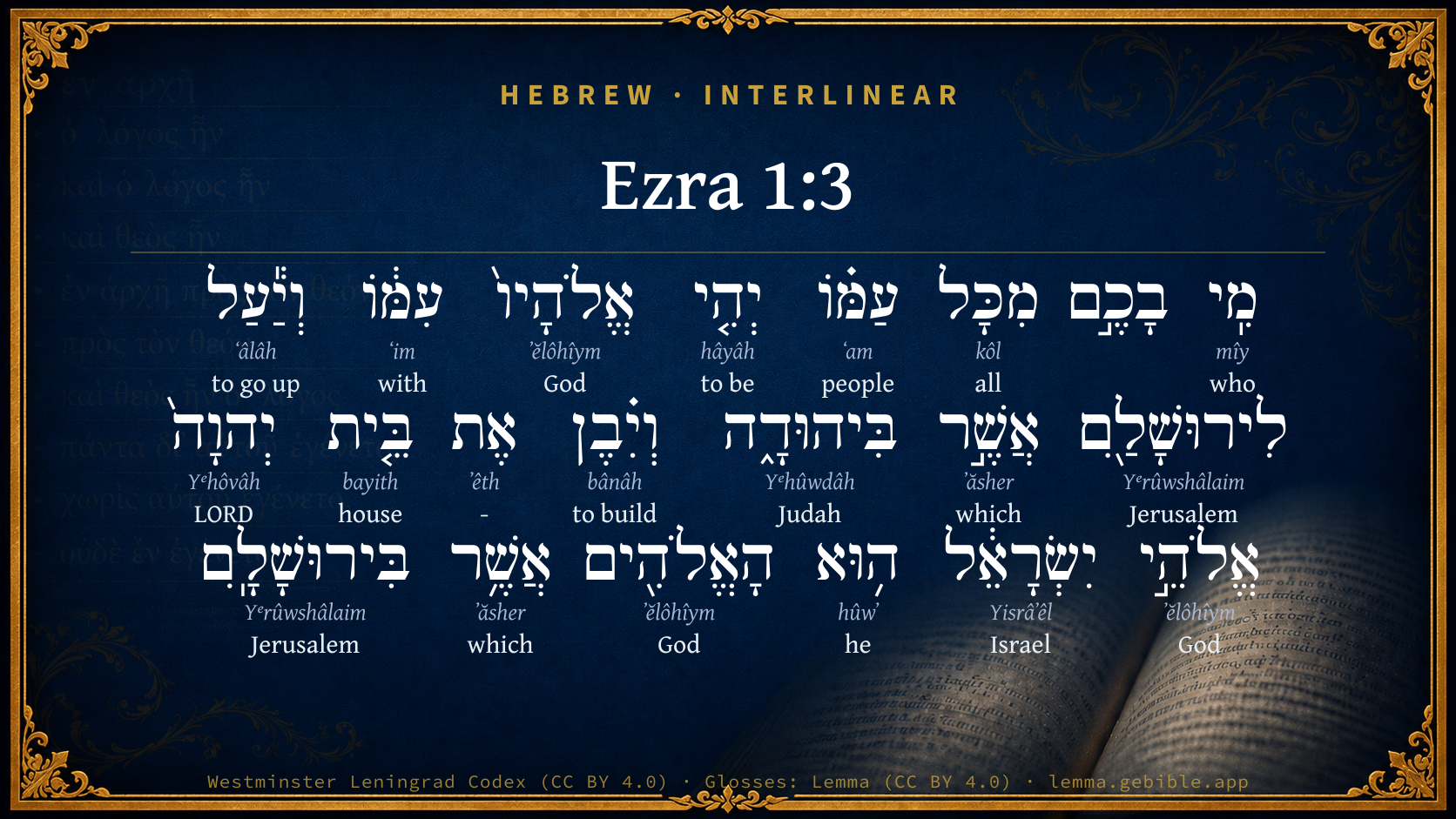
Hebrew (Westminster Leningrad Codex) Ezra 1:3 appears in the Hebrew Old Testament. The text above is from the Westminster Leningrad Codex. Each word links to its Strong’s number, a concise gloss, and parsing drawn from the Open Scriptures Hebrew Bible morphology. Click any word for its full Brown-Driver-Briggs (BDB) entry.
Download image
Cite this verse

Ezra 1:3 (World English Bible). Public Domain. Lemma interlinear Bible study tool, https://lemma.gebible.app/v/ezra/1/3.

Show BibTeX & RIS
BibTeX
RIS
English Translation
Whoever there is among you of all his people, his God be with him, and let him go up to Jerusalem, which is in Judah, and build the house of Yahweh, the God of Israel (he is God), which is in Jerusalem.
World English Bible · Public Domain
Download a study sheet

One document with this verse’s original text, its word-by-word gloss line, the meaning frame, cross-references with their text, attributed commentary, and full source and license credits — printable, and it pastes into notes with its structure intact.

This verse Autodidact and up

Study sheet (.html) Plain text (.txt)

A passage Seminary Student

Up to 50 verses in one chapter. A passage sheet keeps up to 6 commentary sources and 12 cross-references per verse, in the order this page ranks them, and says so on the sheet whenever that leaves anything out. Ask for a single verse and you get the Autodidact verse sheet above.

Everything on this page stays free to read, with no account — the sheet is a download of what is already on screen, not access to it.

Want to remove ads? Support Godless Engineer
Compare translations 3

The same verse in 3 English versions, stacked beneath the original-language interlinear above. Click any original word for its lexicon entry.

Each is an independent rendering of the whole verse — the interlinear is not word-aligned to these translations.

Highlighted words mark where these versions differ — a whole-verse word diff, not a word-by-word alignment.

  • World English Bible Public Domain
    Whoever there is among you of all his people, his God be with him, and let him go up to Jerusalem, which is in Judah, and build the house of Yahweh, the God of Israel (he is God), which is in Jerusalem.
  • King James Version Public Domain
    Who is there among you of all his people? his God be with him, and let him go up to Jerusalem, which is in Judah, and build the house of the LORD God of Israel, (he is the God,) which is in Jerusalem.
  • unfoldingWord Literal Text CC BY-SA 4.0
    Whoever among you is from all his people, may his God be with him, and may he go up to Jerusalem, which is in Judah, and may he build the house of Yahweh, the God of Israel. He is the God who is in Jerusalem.

unfoldingWord Literal Text — © unfoldingWord, licensed CC BY-SA 4.0. Word-aligned USFM3 via Door43 (git.door43.org/unfoldingWord/en_ult).

Versions to compare (up to 4)

3 of 4 selected

Show all 18 translations

Every available English version of this verse, each an independent rendering of the whole verse.

  • World English Bible Public Domain
    Whoever there is among you of all his people, his God be with him, and let him go up to Jerusalem, which is in Judah, and build the house of Yahweh, the God of Israel (he is God), which is in Jerusalem.
  • Berean Standard Bible Public Domain
    Whoever among you belongs to His people, may his God be with him, and may he go to Jerusalem in Judah and build the house of the LORD, the God of Israel; He is the God who is in Jerusalem.
  • Majority Standard Bible Public Domain
    Whoever among you belongs to His people, may his God be with him, and may he go to Jerusalem in Judah and build the house of the LORD, the God of Israel; He is the God who is in Jerusalem.
  • King James Version Public Domain
    Who is there among you of all his people? his God be with him, and let him go up to Jerusalem, which is in Judah, and build the house of the LORD God of Israel, (he is the God,) which is in Jerusalem.
  • American Standard Version (1901) Public Domain
    Whosoever there is among you of all his people, his God be with him, and let him go up to Jerusalem, which is in Judah, and build the house of Jehovah, the God of Israel (he is God), which is in Jerusalem.
  • Revised Version (1885) Public Domain
    Whosoever there is among you of all his people, his God be with him, and let him go up to Jerusalem, which is in Judah, and build the house of the LORD, the God of Israel, (he is God,) which is in Jerusalem.
  • Geneva Bible (1599) Public Domain
    Who is he among you of all his people with whome his God is? let him goe vp to Ierusalem which is in Iudah, and buylde the house of the Lord God of Israel: he is the God, which is in Ierusalem.
  • Douay-Rheims (1899) Public Domain
    Who is there among you of all his people? His God be with him. Let him go up to Jerusalem, which is in Jndert, and build the house of the Lord the God of Israel: he is the God that is in Jerusalem.
  • Young's Literal Translation Public Domain
    who `is' among you of all His people? His God is with him, and he doth go up to Jerusalem, that `is' in Judah, and build the house of Jehovah, God of Israel -- He `is' God -- that `is' in Jerusalem.
  • Literal Standard Version CC BY-SA 4.0
    who [is] among you of all His people? His God is with him, and he goes up to Jerusalem, that [is] in Judah, and builds the house of YHWH, God of Israel (He [alone is] God), that [is] in Jerusalem.
  • Unlocked Literal Bible CC BY-SA 4.0
    Whoever is from his people (may his God be with him) may go up to Jerusalem and build a house for Yahweh, the God of Israel, the God who is in Jerusalem.
  • unfoldingWord Literal Text CC BY-SA 4.0
    Whoever among you is from all his people, may his God be with him, and may he go up to Jerusalem, which is in Judah, and may he build the house of Yahweh, the God of Israel. He is the God who is in Jerusalem.
  • Darby Bible Public Domain
    Whosoever there is among you of all his people, his God be with him, and let him go up to Jerusalem, which is in Judah, and build the house of Jehovah the God of Israel -- he is God -- which is at Jerusalem.
  • World Messianic Bible Public Domain
    Whoever there is among you of all his people, may his God be with him, and let him go up to Jerusalem, which is in Judah, and build the house of the LORD, the God of Israel (he is God), which is in Jerusalem.
  • Webster's Bible Public Domain
    Who is there among you of all his people? his God be with him, and let him go up to Jerusalem, which is in Judah, and build the house of the LORD God of Israel, (he is the God,) who is in Jerusalem.
  • Free Bible Version CC BY-SA 4.0
    Anyone among you who belongs to his people can go to Jerusalem in Judah to rebuild this Temple of the Lord, the God of Israel, who lives in Jerusalem. May your God be with you.
  • Bible in Basic English Public Domain
    Whoever there is among you of his people, may his God be with him, and let him go up to Jerusalem, which is in Judah, and take in hand the building of the house of the Lord, the God of Israel; he is the God who is in Jerusalem.
  • JPS Tanakh (1917) Public Domain
    Whosoever there is among you of all His people — his God be with him — let him go up to Jerusalem, which is in Judah, and build the house of the LORD, the God of Israel, He is the God who is in Jerusalem.

Literal Standard Version (2020), Covenant Press — licensed CC BY-SA 4.0. Text via the HelloAO Bible API (eBible.org). Unlocked Literal Bible (unfoldingWord) — licensed CC BY-SA 4.0. Text via the HelloAO Bible API (eBible.org). unfoldingWord Literal Text — © unfoldingWord, licensed CC BY-SA 4.0. Word-aligned USFM3 via Door43 (git.door43.org/unfoldingWord/en_ult). Free Bible Version, Dr. Jonathan Gallagher — licensed CC BY-SA 4.0. Text via the HelloAO Bible API (eBible.org).

Word by word

More ways to search: Search by grammar → Find every occurrence → Compare this word →

Practice this passage: Drill this verse → Learn its vocabulary →

וְיִ֗בֶן
bânâh
H1129
“and · to build”
Conjunction + Verb, Qal, Jussive, 3rd Person, Masculine, Singular
Part of Speech
Conjunction + Verb
Stem
Qal
Form
Jussive
Person
3rd Person
Gender
Masculine
Number
Singular
Full BDB Definition

Origin: a primitive root

TWOT: 255

to build, rebuild, establish, cause to continue - (Qal) - to build, rebuild - to build a house (i.e., establish a family) - (Niphal) - to be built - to be rebuilt - established (of restored exiles) (figuratively) - established (made permanent) - to be built up (of childless wife becoming the mother of a family through the children of a concubine)
  1. מִֽי mîy H4310 “who” Particle, Interrogative
  2. מִכָּל kôl H3605 “from · all of” Preposition + Noun, Common, Masculine, Singular, Construct
  3. עַמּ֗וֹ ʻam H5971 “people · his” Noun, Common, Masculine, Singular, Construct + Suffix, Personal, 3rd Person, Masculine, Singular
  4. יְהִ֤י hâyâh H1961 “to be” Verb, Qal, Jussive, 3rd Person, Masculine, Singular
  5. אֱלֹהָיו֙ ʼĕlôhîym H430 “God(s) · his” Noun, Common, Masculine, Plural, Construct + Suffix, Personal, 3rd Person, Masculine, Singular
  6. עִמּ֔וֹ ʻim H5973 “with · him” Preposition + Suffix, Personal, 3rd Person, Masculine, Singular
  7. וְיַ֕עַל ʻâlâh H5927 “and · to go up” Conjunction + Verb, Qal, Jussive, 3rd Person, Masculine, Singular
  8. לִירוּשָׁלִַ֖ם Yᵉrûwshâlaim H3389 “to/for · Jerusalem” Preposition + Noun, Proper
  9. אֲשֶׁ֣ר ʼăsher H834 “which” Particle, Relative
  10. בִּיהוּדָ֑ה Yᵉhûwdâh H3063 “in/at · Judah” Preposition + Noun, Proper
  11. אֶת ʼêth H853 “-” Particle, Direct Object
  12. בֵּ֤ית bayith H1004 “house of” Noun, Common, Masculine, Singular, Construct
  13. יְהוָה֙ Yᵉhôvâh H3068 “LORD” Noun, Proper
  14. אֱלֹהֵ֣י ʼĕlôhîym H430 “God(s) of” Noun, Common, Masculine, Plural, Construct
  15. יִשְׂרָאֵ֔ל Yisrâʼêl H3478 “Israel” Noun, Proper
  16. ה֥וּא hûwʼ H1931 “he” Pronoun, Personal, 3rd Person, Masculine, Singular
  17. הָאֱלֹהִ֖ים ʼĕlôhîym H430 “the · God(s)” Particle, Definite Article + Noun, Common, Masculine, Plural, Absolute
  18. אֲשֶׁ֥ר ʼăsher H834 “which” Particle, Relative
  19. בִּירוּשָׁלִָֽם Yᵉrûwshâlaim H3389 “in/at · Jerusalem” Preposition + Noun, Proper

About this verse

These counts appear in no published source. They are computed here, from the morphology-tagged text and Lemma’s own curated glosses. What Lemma adds →

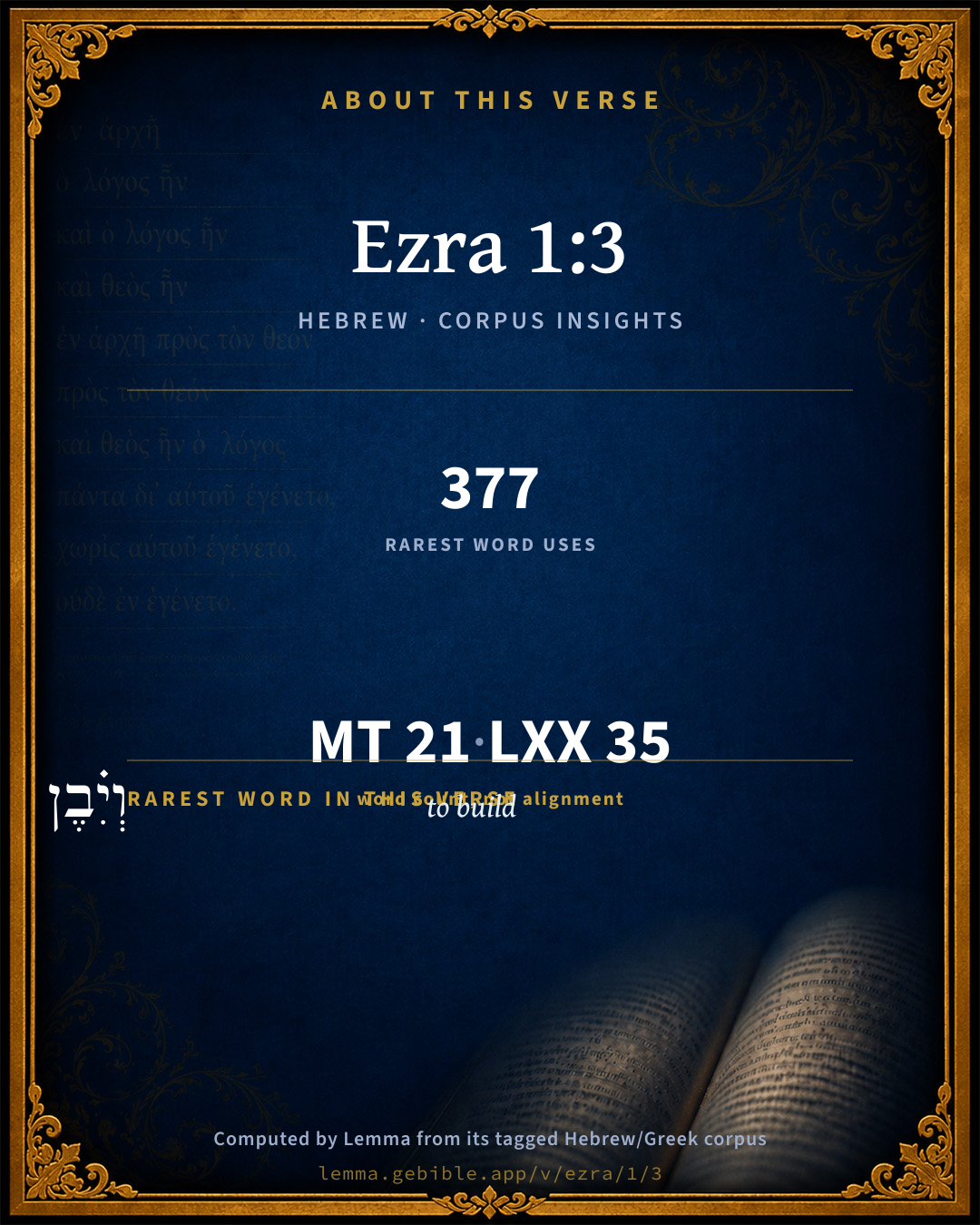
21
words
16
distinct lemmas
Historical
section

Grammatical profile

  • 3 verbs
  • 11 nouns
  • 1 pronoun
  • 2 prepositions
  • 4 particles

Verb forms

  • יְהִ֤י Qal · Jussive
  • וְיַ֕עַל Qal · Jussive
  • וְיִ֗בֶן Qal · Jussive

Repetition

Words recur within this verse — often emphatic in Hebrew:

  • אֱלֹהָיו֙ God H430 ×3
  • לִירוּשָׁלִַ֖ם Jerusalem H3389 ×2
  • אֲשֶׁ֣ר which H834 ×2

Hebrew & Septuagint length

In English translation the verse runs 42 words from the Hebrew and 46 from the Septuagint (LXX English) — closely comparable.

A rough comparison of the two English renderings, which tokenize alike — not a word-level alignment.

Word counts can differ between the Hebrew and the Greek without any difference in meaning — e.g. the Hebrew direct-object marker אֵת has no separate Greek word, and Greek often adds the article ὁ.

In the original languages it is 21 Hebrew tokens and 35 Greek tokens — but the two are counted differently (Hebrew bundles its prefixes and suffixes into one token; the Greek is in lemma form), so that isn’t a like-for-like length.

Cross-references

10

Topical passages linked to Ezra 1:3 in the Treasury of Scripture Knowledge — connected by theme and wording, ordered by reader-vote popularity; previews shown in the World English Bible.

  • Daniel 6:26 I make a decree, that in all the dominion of my kingdom men tremble and fear before the God of Daniel; for he is the living God, and steadfast forever, His kingdom that which shall not be destroyed; and his dominion shall be even to the end.
  • Jeremiah 10:10 But Yahweh is the true God; he is the living God, and an everlasting King: at his wrath the earth trembles, and the nations are not able to abide his indignation.
  • Isaiah 45:5 I am Yahweh, and there is none else; besides me there is no God. I will gird you, though you have not known me;
  • Joshua 1:9 Haven't I commanded you? Be strong and of good courage; don't be afraid, neither be dismayed: for Yahweh your God is with you wherever you go.
  • Matthew 28:20 teaching them to observe all things that I commanded you. Behold, I am with you always, even to the end of the age." Amen.
  • Acts 10:36 The word which he sent to the children of Israel, preaching good news of peace by Jesus Christ--he is Lord of all--
  • Deuteronomy 32:31 For their rock is not as our Rock, Even our enemies themselves being judges.
  • 1 Chronicles 28:20 David said to Solomon his son, Be strong and of good courage, and do it: don't be afraid, nor be dismayed; for Yahweh God, even my God, is with you; he will not fail you, nor forsake you, until all the work for the service of the house of Yahweh is finished.
  • Psalms 83:18 That they may know that you alone, whose name is Yahweh, Are the Most High over all the earth.
  • Daniel 2:47 The king answered to Daniel, and said, Of a truth your God is the God of gods, and the Lord of kings, and a revealer of secrets, seeing you have been able to reveal this secret.

Cross-references courtesy of OpenBible.info (CC BY 4.0).

Hebrew and Greek witnesses Masoretic Hebrew ↔ Greek Septuagint

The same verse in the two great witnesses to the Old Testament, shown verse-for-verse.

These are two independent witnesses, not word-aligned to each other, and the Septuagint is shown in lemma (dictionary) form.

Hebrew Ezra 1:3 Masoretic · Westminster Leningrad Codex

מִֽי בָכֶ֣ם מִכָּל עַמּ֗וֹ יְהִ֤י אֱלֹהָיו֙ עִמּ֔וֹ וְיַ֕עַל לִירוּשָׁלִַ֖ם אֲשֶׁ֣ר בִּיהוּדָ֑ה וְיִ֗בֶן אֶת בֵּ֤ית יְהוָה֙ אֱלֹהֵ֣י יִשְׂרָאֵ֔ל ה֥וּא הָאֱלֹהִ֖ים אֲשֶׁ֥ר בִּירוּשָׁלִָֽם

Whoever there is among you of all his people, his God be with him, and let him go up to Jerusalem, which is in Judah, and build the house of Yahweh, the God of Israel (he is God), which is in Jerusalem.

World English Bible · Public Domain

Greek LXX Ezra 1:3 Septuagint · lemma form

τίς ἐν σύ ἀπό πᾶς ὁ λαός αὐτός καί εἰμί ὁ θεός αὐτός μετά αὐτός καί ἀναβαίνω εἰς ἰερουσαλήμ ὁ ἐν ὁ ἰουδαία καί οἰκοδομέω ὁ οἶκος θεός ἰσραήλ αὐτός ὁ θεός ὁ ἐν ἰερουσαλήμ

Who is there among you of all his people? for his God shall be with him, and he shall go up to Jerusalem that is in Judea, and let him build the house of the God of Israel: he is the God that is in Jerusalem.

LXX2012 (modern English Septuagint) · Public Domain

In the Septuagint this is one book — Esdras B (2 Esdras): Ezra is chapters 1–10, Nehemiah 11–23.

On this verse, The Cambridge Bible for Schools and Colleges discusses the Septuagint’s reading. Read the note in Commentary ↓

Hebrew: Westminster Leningrad Codex (CC BY 4.0). Greek: Septuagint (public domain); English from LXX2012 (modern English Septuagint) (Public Domain). How the Septuagint differs from the Hebrew →

Commentary

Notes on Ezra 1:3 from classic Christian and Jewish commentators (each source and its license shown beneath its notes). The classic Christian expositions comment on the surrounding passage and are grouped to its opening verse, so a note may address several verses; the Jewish commentaries on the Tanakh (Rashi and others) are per-verse, so they appear only where the commentator wrote on this verse.

Lemma curates 59 commentaries, every one of them public domain or Creative Commons licensed, each selected and text-cleaned for this edition rather than reprinted as found. About our sources →

Trapp's Complete Commentary

John Trapp

Ezr 1:3 Who [is there] among you of all his people? his God be with him, and let him go up to Jerusalem, which [is] in Judah, and build the house of the LORD God of Israel, (he [is] the God,) which [is] in Jerusalem.

Ver. 3. Who is there among you of all his people?] Many there were among them that affirmed deeply of being the people of God, who yet ( tanquam monstra marina) passed by this proclamation with a deaf ear; and preferring haram domesticam arae dominicae, a swine sty before a sanctuary, chose rather to abide in Babylon, and there to dwell amongst plants and hedges, 1Ch 4:23, making pots for the king’s garden, than to go up to Jerusalem. So that, besides this O yes, by the king, God was fain to cry, "Ho, ho, come forth, and flee from the land of the north." "Deliver thyself, O Zion, that dwellest with the daughter of Babylon," Zec 2:6-7. "Arise ye, and depart; for this is not your rest: because it is polluted, it shall destroy you, even with a sore destruction," Mic 2:10. Look how the eagle hath much ado to get her young ones out of the nest, pricking and beating them with her wings and talons; so was it here: and neither so could the Lord prevail with the most of them, being as loth to depart as Lot was out of Sodom, vel canis ab uncto corio, or a dog from a fat morsel.

His God be with him] And then he needs no better company, no greater happiness; for he is sure of a confluence of all comforts, of all that heart can wish or need require. Tua praesentia, Domine, Laurentio ipsam craticulam fecit dulcem, saith an ancient, Thy presence sweeteneth all our occurrences (Aug.). This was, therefore, a good wish of King Cyrus; neither did he therein any disservice to himself; for God hath promised to bless those that bless any of his, Gen 12:3, and not to let a good wish to such go unrewarded, 2Co 13:9.

Let him go up and build, &c.] As God had charged him, Ezr 1:2, so doth he them. And it is as if he should have said with that father (Bernard), Unless I stir up your hearts, as the Lord hath done mine, unless I lay God’s charge upon you to set strenuously upon this service of his, Vobis erit damnosum, mihi periculosum. Timeo itaque damnum vestrum, timeo damnationem meam, si tacuero. If now you go not up upon so great encouragement, God will surely meet with you.

He is the God] The only true God, Joh 17:3, none like him, Mic 7:18. "The Lord your God is God of gods, and Lord of lords, a great God, a mighty and a terrible," Deu 10:17. Is it not fit, therefore, that he have a temple, a place of Divine worship, which the heathens deny not to their dunghill deities?

Which is in Jerusalem] The city of the great King, where he kept his court, and afforded his special presence, not of grace only in his ordinances, but of glory also sometimes in his holy temple, 2Ch 5:14, as in another heaven.

John Trapp, A Commentary or Exposition upon All the Books of the Old and New Testament (1647–1656) — public domain. Text from a community e-Sword module.

The Biblical Illustrator

Joseph S. Exell

Ezr_1:3

Let him go up to Jerusalem.

The release of the Jews from Babylon an illustration of the redemption of man from sin

We discover an analogy in these two things as regards--

I. The subjects. The Jews were exiles and captives in Babylon. Whosoever committeth sin is the slave of sin (Joh_8:34). In his sinful state man is an exile from his true condition and place, and the bondsman of evil powers.

II. The agents. Cyrus and Jesus Christ. The analogy between them is st least twofold.

1. Both were called of God to this work. Ages before his birth Cyrus was prenominated for this work (Isa_44:24; Isa_14:6). And Jesus Christ is pre-eminently the Servant, the Anointed, the Sent of God (Isa_13:1; Isa_61:1-3; Luk_4:18-19; Joh_3:16-17; Gal_4:4-5; 1Jn_4:9).

2. Both effected this work by battling with and overcoming the oppressors. Cyrus had to conquer the Babylonian Empire before he could release the captive Jews. And our Lord and Saviour, as the Son of Man, encountered sin and mastered it.

III. The source. In both cases the blessing flowed from the free and unmerited grace of God. The Jews had no claim upon Him against whom they had so Persistently rebelled. God commendeth His love toward us, in that while we were yet sinners Christ died for us.

IV. The extent.

1. It is offered to all.

2. It is accepted only by some. Great numbers preferred to remain in Babylon.

(1) Many did not feel any deprivation or degradation in their exile and subjection.

(2) Many had attachments and interests in Babylon which they could not or would not leave.

V. Go up to build the house of the Lord which is in Jerusalem. A striking illustration of the grand end of redemption. (W. Jones.)

Our choice of the true life

I. Cyrus presented these exiled Jews with the chance of a free choice. Cyrus did not compel. These Jews might, or they might not, go to Jerusalem. It was for each one of them to choose. So Christ, in His call to the true life and heaven, puts before men the chance of an utterly free choice. Ye will not come unto Me that ye might have life.

II. This choice which Cyrus presented to these exiled Jews was a choice of exclusions. If they chose to go to Palestine they must yield what things would keep them in Babylon. They might carry with them many things (Ezr_1:7-11). But their houses and lands, every detaining thing, must be surrendered. So this choice which Christ presents to men is necessarily a choice of exclusions. Christianity is not narrowness. Read the charter of a Christian liberty in 1Co_3:21-23. But Christ comes to save a man from sin. What Babylonish and preventing sins you cleave to must be yielded.

III. It was a choice toward nobleness which Cyrus gave these exiled Jews. Surely it was better, nobler to go to Jerusalem and rebuild Gods temple than to dwell in exiled ease in Babylon.

IV. This choice which Cyrus opened for these exiled Jews was a choice necessitating faith. Between Babylon and Palestine stretched vast wide sandy plains. But for the heartening of the Jews choosing the nobler destiny there was the Divine promise. So for the Christian, the man who accepts Christs call to the nobler life, there are Divine promises,

V. This necessity of choice. For every one of us, in high spiritual way, this choice confronts Babylon or Jerusalem. (Homiletic Review.)

His God be with him.--

God with us

Notice--

I. THE DEVOUT WISH EXPRESSED: His God be with him. It is equivalent to our goodbye, which is an abbreviation of God be with you. The wish comprises two things.

1. Personal relation to God: His God. This expression may be viewed in two aspects.

(1) His God, as opposed to the gods of the heathen.

(2) His God, as engaged to him in covenant relation. Thus our Lord speaks, My Father, and your Father: My God, and your God (Joh_20:17). Martin Luther said that the sweetness of the gospel consisted chiefly in its pronouns, such as me, thou, thy, etc. My Lord and my God (Joh_20:28). Who loved me and gave Himself for me (Gal_2:20). Christ Jesus my Lord (Php_3:8).

2. Realisation of the presence of God: His God be with him. His presence is a guarantee of all the help and blessing which we need. But in uttering this wish in respect to the Jews, Cyrus probably had an eye to two things which the presence of God would secure to them:

(1) Guidance and guardianship on their long journey.

(2) Success in their great undertaking.

II. The kind expression of this wish. The expression of this wish indicates on the part of Cyrus--

1. Reverence towards God. He does not utter these words thoughtlessly, but seriously.

2. Kindness towards the captives. He wished them well, and proved the sincerity of his wishes by practically helping them in their best interests.

Conclusion:

1. Do we sustain this personal relation to God?

2. Do we realise the blessed presence of God?

3. Do we desire that others also may realise His gracious presence? (William Jones.)

Our God

As He is not a God without infinite wisdom, and infinite power, and infinite goodness, and infinite blessedness, etc., so He passes over in this covenant all that which presents Him as the most adorable Being to His creatures. He will be to them as great, as wise, as powerful, as good as He is in Himself; and the assuring us in this covenant to be our God imports also that He will do as much for us, as we would do for ourselves were we furnished with the same goodness, power, and wisdom. In being our God He testifies that it is all one, as if we had the same perfections in our own power to employ for our use; for He being possessed with them, it is as much as if we ourselves were possessed with them for our own advantage, according to the rules of wisdom and the several conditions we pass through for His glory. (Stephen Charnocke, B. D.)

The Biblical Illustrator, edited by Joseph S. Exell (c. 1880s–1900s) — public domain. Text from a community e-Sword module.

Joseph Benson's Commentary

Ezr 1:3. Who is there among you of all his people? — Not of the tribe of Judah only, but of Israel also, who were under his government, the Assyrians and Medes, among whom they were scattered, being his subjects. Accordingly Josephus says, that Zerubbabel sent the edict of Cyrus into Media to the rest of the tribes. His God be with him — Let his God help him, as I also shall; and let him go up to Jerusalem — Thus he not only makes a proclamation to them of liberty to go to their own country, but desires them to go, and prays God to be with them, and prosper them in building his house, saying, He is the God, and thereby evidently acknowledging him to be the true, if not also the only God.

Joseph Benson's Commentary on the Old and New Testaments (1811–1818) — public domain. Text from a community e-Sword module.

Tyndale Open Study Notes

Tyndale Open Resources

1:3 Any of you who are his people may go: The Assyrians and Babylonians had ruled their empires by deporting people and spreading them out in cities throughout their empires. The Persians, by contrast, returned exiled people to their homelands, expecting the returned people to be thankful, obey the Persians, and pay their taxes.

Tyndale Open Study Notes — © Tyndale Open Resources, licensed CC BY-SA 4.0. Text via the HelloAO Bible API.

Jamieson, Fausset & Brown

Robert Jamieson, A. R. Fausset & David Brown

Who is there among you of all his people--The purport of the edict was to grant full permission to those Jewish exiles, in every part of his kingdom, who chose, to return to their own country, as well as to recommend those of their countrymen who remained to aid the poor and feeble on their way, and contribute liberally towards the rebuilding of the temple.

Jamieson, Fausset & Brown — Commentary Critical and Explanatory on the Whole Bible (1871) — public domain (CC PDM 1.0). Text via the HelloAO Bible API.

The Cambridge Bible for Schools and Colleges

gen. ed. J. J. S. Perowne

3. Who is there among you of all his people? his God, &c.] R.V. Whosoever there is among you of all his people, his God, &c., rightly translating by the indefinite relative instead of by the interrogative pronoun.

among you] The decree is addressed to the inhabitants of the many kingdoms which the Persian Empire included.

of all his people] From the context, in which Judah and Jerusalem alone are mentioned, it is clear that the edict referred only to the Southern kingdom whose inhabitants had been ‘deported’ by Nebuchadnezzar. It is not likely that Cyrus would have been acquainted with the circumstances of the ‘deportation’ of the Northern kingdom by Sargon the Assyrian, so many years previously (721 b.c.), even if (which is most unlikely) the identity of the Ten Tribes had been preserved. At the same time there is good reason to suppose that some captives from the Northern tribes, who had preserved their lineage and their national religion, availed themselves of the opportunity which the decree of Cyrus offered them. See on Ezr_2:2. Cf. 1Ch_9:3.

his God be with him] The parallel passage in 2Ch_36:23 reads ‘the Lord (Jahveh) his God be with him’. As it is more probable that the sacred Name should have been inserted than omitted by the Jewish copyists, the text as it stands in our verse is preferable; it is also supported by the LXX. and by 1Es_2:5. The word in the original for ‘be’ (y‘hî), containing the first two consonants of ‘Jahveh’, may possibly have been mistaken for it and have given rise to the variation. The words are a common form of blessing. Cf. English ‘Good-bye’ (God be with you). After the blessing comes the substance of the decree, (1) the Return, (2) the Building of the Temple.

and let him go up] Change of subject, “His God be with him and let such an one ‘go up’ ”. The journey to the land of Judah is treated as an ascent. Cf. “The Songs of Ascents”, Psalms 120-134.

and build] i.e. rebuild.

the Lord God of Israel] R.V. the Lord, the God of Israel, in the original ‘Jahveh the God of Israel’; ‘the God of Israel’, the old national title used freely without room for misconception after the destruction of the Northern kingdom (cf. in Ezr_4:1; Ezr_4:3; Ezr_5:1; Ezr_6:14; Ezr_6:21-22; Ezr_7:6; Ezr_7:15; Ezr_8:35; Ezr_9:4; Ezr_9:15). The discipline of the Captivity had revived the conception of the true Israel (see Isa_41:17; Jer_30:2; Eze_8:4).

(he is the God,) which is in Jerusalem] So R.V. text, but R.V. margin ‘he is the God which is in Jerusalem’, gives an alternative rendering.

(a) If the words ‘he is the God’ be taken parenthetically as in A.V. and R.V. text, then ‘which is in Jerusalem’ refers to ‘the house of Jahveh’. It gives an additional piece of information necessary to those who did not associate the temples of gods with any one place. Temples of heathen gods, e.g. of Nebo, might be erected in any number of towns. Why not therefore of Jahveh? Cyrus’ decree explicitly localizes the cult.

(b) Otherwise the words, ‘which is in Jerusalem’, are taken closely with ‘He is the God’, as in the margin of the R.V. This is the rendering of the LXX. (αὐτὸς ὁ θεὸς ὁ ἐν Ἱερονσαλήμ) and the Vulgate (Ipse est Deus qui est in Ierusalem). It is also supported by the Jewish tradition preserved by the Hebrew accents. Accepting this collocation of the words, the student must be careful to attach the proper emphasis to the words ‘the God’. For the clause is not simply geographically explanatory of the foregoing words, ‘the Lord the God of Israel’, stating that ‘he is the God who is in Jerusalem’ in order to distinguish him from the gods of other localities. But the name, ‘the God’, is used emphatically (hâ-Elohim, not Elohim) and absolutely, as in Ezr_1:4-5. Compare ‘The Lord He is the God’ in 1Ki_18:39. The sense then is ‘He is The God, the Almighty, and He has made choice of Jerusalem as His dwelling-place’.

Reasons for preferring the former translation (i.e. that of the A.V. and R.V. Text) are the following

(1) The phrase ‘which is in Jerusalem’ is almost invariably in this book applied to the Temple or Temple service (cf. Ezr_1:4-5, Ezr_2:68, Ezr_5:2; Ezr_5:14-16, Ezr_6:5; Ezr_6:12 (9, 18), Ezr_7:15-17; Ezr_7:27). (2) It is not a natural phrase—whether part of the original edict or added by Jewish translator—by which to designate One who has already been termed ‘the God of Israel’. (3) The objection to the separation (in the A.V. and R.V.) of the clause, “which is in J.”, from the word to which it should be attached, has occasioned the rendering of the LXX., Vulg., and R.V. marg. (4) But a parenthetical ‘He is the God’ bears the impress of a thoroughly Jewish insertion after the mention of the sacred Name. (5) The supposed significance of the alternative rendering disappears with the discovery that Cyrus was no monotheist. For Cyrus would not have said ‘He is the (i.e. the true) God who is at Jerusalem’—while a post-captivity Jewish editor would not have introduced so unusual and restrictive a localization for his God.

We conclude therefore that the words ‘He is the God’ are a Jewish parenthesis inserted by the compiler reverently but awkwardly, in such a way as to break up the sentence ‘the house of the Lord, the God of Israel—which is at Jerusalem’.

The Cambridge Bible for Schools and Colleges (gen. ed. J. J. S. Perowne; Cambridge University Press, 1878–1918) — public domain. Text from a community e-Sword module.

John Gill's Exposition

Who is there among you of all his people?.... The people of God, the Israelites, as well of the ten tribes, as of the two of Judah and Benjamin; for this edict was published throughout all his dominions, where were the one as well as the other:

his God be with him; to incline his heart to go, to protect him in his journey, and succeed and prosper him in what he goes about:

and let him go up to Jerusalem, which is in Judah, and build the house of the Lord God of Israel, he is the God; the one only living and true God:

which is in Jerusalem; who has been in former times, and is to be worshipped there; though Aben Ezra says, this is to be connected with "the house of the Lord"; as if the sense was, to build the house, that was in Jerusalem, or to be built there; and so our version connects them, putting those words into a parenthesis, "he is God"; but this is contrary to the accents.

John Gill's Exposition of the Whole Bible (1746–1763) — public domain (CC PDM 1.0). Text via the HelloAO Bible API.

Haydock's Catholic Bible Commentary

He is the God, is placed within a parenthesis, by the Protestants. But the pagans might suppose that God was attached to this city, like their idols; and the temple was not yet begun. (Haydock)

George Leo Haydock (1774–1849), Haydock's Catholic Family Bible and Commentary, 1859 edition — public domain. Excludes Psalms (Douay-Rheims chapter numbering differs from Protestant) and Deuterocanonical books (Catholic canon only).

Matthew Poole's English Annotations

Of all his people, to wit, of Israel. A material clause; by virtue of which they justly refused the help of those aliens who pretended to join with them in the building, Ezr 4:2,3.

His God be with him; let his God help him, as I also shall do.

Which is in Jerusalem, or only

in Jerusalem, as it is in the Hebrew. So it notes the place where he allows and requires them to build it.

Matthew Poole's English Annotations on the Holy Bible (1683–1685) — public domain. Text from a community e-Sword/MySword module.

Whedon's Commentary on the Bible

Daniel D. Whedon

3. All his people — No distinction of Judah and Israel is recognized in this proclamation, but the whole Israelitish population throughout the land is addressed. It was natural, however, that “Judah and Benjamin,” the last in exile, in whose hearts the memory of Jerusalem and the fatherland was freshest, were the first and chief ones to respond. Ezr_1:5.

His God be with him… Lord God of Israel, he is the God — See notes on Ezr_1:2 concerning Persian monotheism and reverence for the Supreme God.

Daniel D. Whedon (gen. ed.), Commentary on the Old and New Testaments (1874–1909) — public domain. Text from a community e-Sword module.

The Pulpit Commentary

Who (is there) among you of all his people? Cyrus does not limit his address to the Jews, or even to Judah and Benjamin, but extends it to the whole people of Jehovah, i.e. to all the tribes equally. Gozan and Media, to which the ten tribes had been transported by the Assyrian monarchs, were within his dominions no less than Babylonia. That many non-Jewish Israelites did return appears from 1Ch_9:3. His God be with him. A pious wish, almost a blessing, indicative of the deep religious feeling and great goodness of heart which characterized Cyrus alone of Persian monarchs. Among the Greeks, Aeschylus, who first speaks of him, calls him kindly" or "gracious" (eu) Herodotus says he ruled his subjects like a father; Xenophon makes him a model prince; Plutarch observes that "in wisdom and virtue and greatness of soul he excelled all other kings;" Diodorus ascribes to him a remarkable power of self-command, together with good feeling and gentleness. The Latin writers, Cicero and others, add their meed of praise; and altogether it may be said that, so far as the evidence reaches, no nobler character appears in ancient history. The Scriptural notices, whether in this book or in Isaiah, are in remarkable accord. Let him go up. Jerusalem was on a much higher level than Babylon, and the travellers would consequently have to ascend considerably. And build the house. The "charge" to Cyrus did not require him to take a personal share in the building. He was simply to "say to Jerusalem, Thou shalt be built; and to the temple, Thy foundation shall be. (Isa_44:28) He is therefore content to assign the actual workto others. He is the God . The Septuagint and the Vulgate attach the last clause of the verse to these words, and render "He is the God who is in Jerusalem," which greatly weakens the force of the expression. According to this punctuation, Cyrus makes Jehovah a mere local Deity; according to the far preferable arrangement of the A. V, he declares emphatically that Jehovah is the one true God, beside whom there is no other. Compare the very similar confession of Nebuchadnezzar. (Dan_6:26)

The Pulpit Commentary (1880–1919), ed. H.D.M. Spence-Jones & Joseph S. Exell — public domain. Text from a community e-Sword module.

unfoldingWord translationNotes

Door43 World Missions Community

his people

the people who belong to Yahweh.

survivors of that land ... should provide them

Those Israelites who choose to stay where they are should help those who choose to go to Jerusalem physically and financially.

translationWords

God

Jerusalem

house of God

Yahweh

Israel

kingdom

silver

gold

possess

freewill offering

unfoldingWord translationNotes — © Distant Shores Media and the Door43 World Missions Community, licensed CC BY-SA 4.0. Source: git.door43.org/Door43/en_tn.

Rashi

Rabbi Shlomo Yitzchaki (Rashi)

Who is among you So did he announce and write to all the kingdoms, “Who is among you of all His people,” [i.e., of the people] of the Holy One, blessed be He, may the Holy One, blessed be He, be at his assistance, and let him ascend to build His house that is in Jerusalem.

Rashi on the Tanakh — English translations: “The Judaica Press complete Tanach with Rashi, translated by A. J. Rosenberg” (CC BY 4.0); “Pentateuch with Rashi's commentary by M. Rosenbaum and A.M. Silbermann, 1929-1934” (public domain); “The Metsudah Tanach series, Lakewood, N.J” (CC BY 4.0); and “The Book of Joshua, Metsudah Publications, 1997” (CC BY 4.0). Text via Sefaria.

Lesson kit

Teaching starters — assembled from the data on this page, not authored interpretation. Every prompt links to the verse data it draws on. Edit before teaching.

Ezra, in the Historical, opens this verse with 21 words (16 distinct Hebrew lemmas). Its most distinctive word is bânâh (“to build”). A historical commentator’s framing appears above. Read the whole chapter for the surrounding context.

Discussion questions

  1. The word bânâh carries the sense “to build.” How does it shape the verse?
  2. Daniel 6:26 shares this passage’s theme. How do the two illuminate each other?
  3. “God” occurs 3× in this one verse. What is the effect of the repetition?
  4. These translations render this verse differently; the difference is in the English rendering, not the original. What questions does that raise?
  5. The verb «יְהִ֤י» is Qal Jussive. How does its form color the action?
  6. Reading how Trapp's Complete Commentary and The Biblical Illustrator read this verse, where do the two commentators agree and where do they part?

Things to notice

Reading settings

Reading text

Shown beneath each verse's original-language words.

Old Testament
Old Testament edition

Read the OT as the Masoretic Hebrew (MT) or the Greek Septuagint (LXX).

English shown for the Greek Septuagint (in the Hebrew ↔ Greek comparison).

Comparing translations? Open the Compare panel on any verse page to stack up to four side by side.