
2 Chronicles 13:7

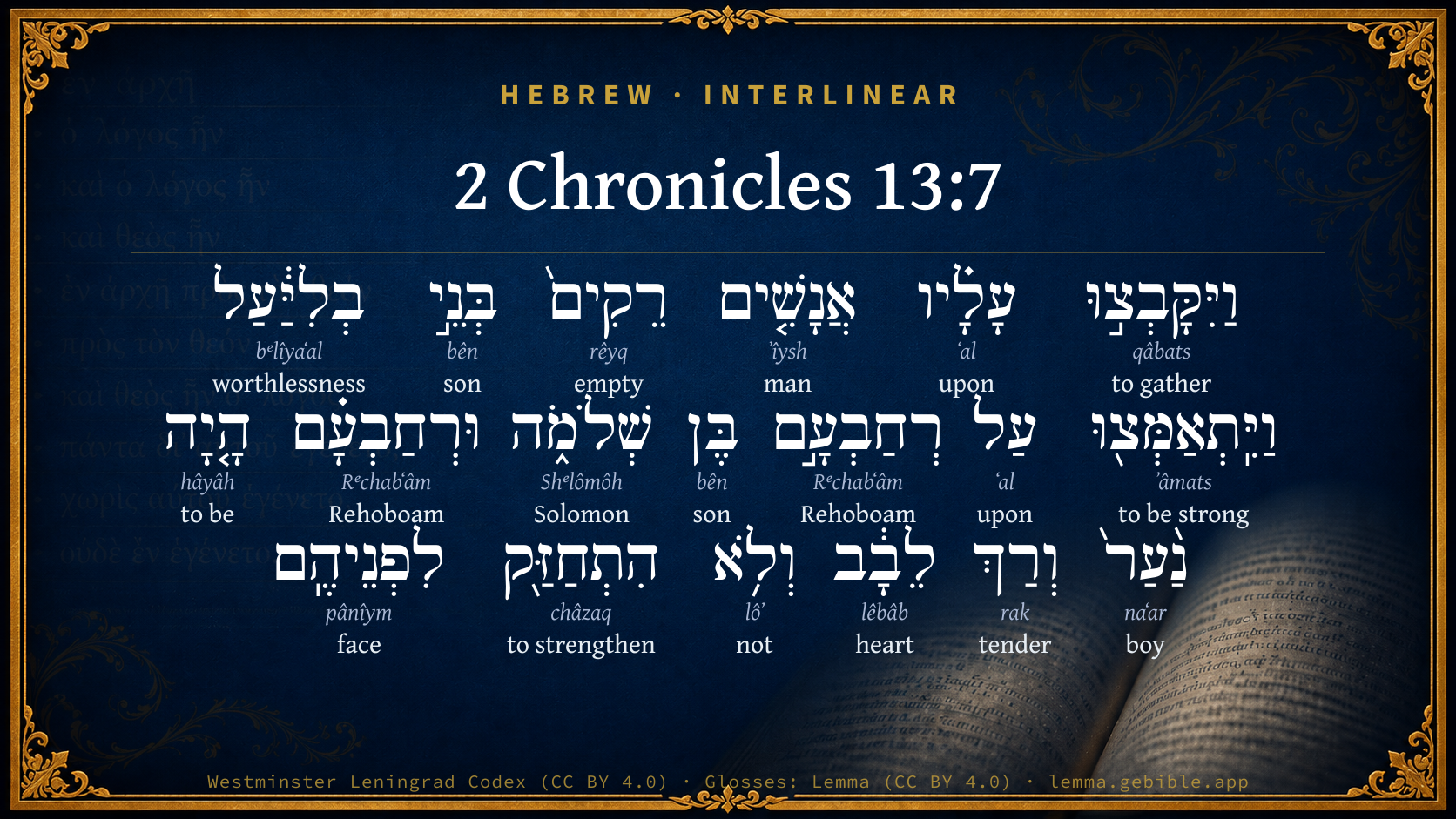
Hebrew (Westminster Leningrad Codex) 2 Chronicles 13:7 appears in the Hebrew Old Testament. The text above is from the Westminster Leningrad Codex. Each word links to its Strong’s number, a concise gloss, and parsing drawn from the Open Scriptures Hebrew Bible morphology. Click any word for its full Brown-Driver-Briggs (BDB) entry.
Download image
Cite this verse

2 Chronicles 13:7 (World English Bible). Public Domain. Lemma interlinear Bible study tool, https://lemma.gebible.app/v/2-chronicles/13/7.

Show BibTeX & RIS
BibTeX
RIS
English Translation
There were gathered to him worthless men, base fellows, who strengthened themselves against Rehoboam the son of Solomon, when Rehoboam was young and tender-hearted, and could not withstand them.
World English Bible · Public Domain
Download a study sheet

One document with this verse’s original text, its word-by-word gloss line, the meaning frame, cross-references with their text, attributed commentary, and full source and license credits — printable, and it pastes into notes with its structure intact.

This verse Autodidact and up

Study sheet (.html) Plain text (.txt)

A passage Seminary Student

Up to 50 verses in one chapter. A passage sheet keeps up to 6 commentary sources and 12 cross-references per verse, in the order this page ranks them, and says so on the sheet whenever that leaves anything out. Ask for a single verse and you get the Autodidact verse sheet above.

Everything on this page stays free to read, with no account — the sheet is a download of what is already on screen, not access to it.

Want to remove ads? Support Godless Engineer
Compare translations 3

The same verse in 3 English versions, stacked beneath the original-language interlinear above. Click any original word for its lexicon entry.

Each is an independent rendering of the whole verse — the interlinear is not word-aligned to these translations.

Highlighted words mark where these versions differ — a whole-verse word diff, not a word-by-word alignment.

  • World English Bible Public Domain
    There were gathered to him worthless men, base fellows, who strengthened themselves against Rehoboam the son of Solomon, when Rehoboam was young and tender-hearted, and could not withstand them.
  • King James Version Public Domain
    And there are gathered unto him vain men, the children of Belial, and have strengthened themselves against Rehoboam the son of Solomon, when Rehoboam was young and tenderhearted, and could not withstand them.
  • unfoldingWord Literal Text CC BY-SA 4.0
    And empty men, sons of wickedness, assembled about him, and they strengthened themselves over Rehoboam, the son of Solomon. And Rehoboam was young and tender of heart, and he did not strengthen himself before them.

unfoldingWord Literal Text — © unfoldingWord, licensed CC BY-SA 4.0. Word-aligned USFM3 via Door43 (git.door43.org/unfoldingWord/en_ult).

Versions to compare (up to 4)

3 of 4 selected

Show all 18 translations

Every available English version of this verse, each an independent rendering of the whole verse.

  • World English Bible Public Domain
    There were gathered to him worthless men, base fellows, who strengthened themselves against Rehoboam the son of Solomon, when Rehoboam was young and tender-hearted, and could not withstand them.
  • Berean Standard Bible Public Domain
    Then worthless and wicked men gathered around him to resist Rehoboam son of Solomon when he was young, inexperienced, and unable to resist them.
  • Majority Standard Bible Public Domain
    Then worthless and wicked men gathered around him to resist Rehoboam son of Solomon when he was young, inexperienced, and unable to resist them.
  • King James Version Public Domain
    And there are gathered unto him vain men, the children of Belial, and have strengthened themselves against Rehoboam the son of Solomon, when Rehoboam was young and tenderhearted, and could not withstand them.
  • American Standard Version (1901) Public Domain
    And there were gathered unto him worthless men, base fellows, that strengthened themselves against Rehoboam the son of Solomon, when Rehoboam was young and tender-hearted, and could not withstand them.
  • Revised Version (1885) Public Domain
    And there were gathered unto him vain men, sons of Belial, which strengthened themselves against Rehoboam the son of Solomon, when Rehoboam was young and tender-hearted, and could not withstand them.
  • Geneva Bible (1599) Public Domain
    And there are gathered to him vayne men and wicked, and made themselues strong against Rehoboam the sonne of Salomon: for Rehoboam was but a childe and tender hearted, and coulde not resist them.
  • Douay-Rheims (1899) Public Domain
    And there were gathered to him vain men, and children of Belial: and they prevailed against Roboam the son of Solomon: for Roboam was unexperienced, and of a fearful heart, and could not resist them.
  • Young's Literal Translation Public Domain
    `And there are gathered unto him vain men, sons of worthlessness, and they strengthen themselves against Rehoboam son of Solomon, and Rehoboam was a youth, and tender of heart, and hath not strengthened himself against them.
  • Literal Standard Version CC BY-SA 4.0
    And vain men are gathered to him, sons of worthlessness, and they strengthen themselves against Rehoboam son of Solomon, and Rehoboam was a youth, and tender of heart, and has not strengthened himself against them.
  • Unlocked Literal Bible CC BY-SA 4.0
    Worthless men, base fellows, gathered to him. They came against Rehoboam son of Solomon, when Rehoboam was young and inexperienced and could not withstand them.
  • unfoldingWord Literal Text CC BY-SA 4.0
    And empty men, sons of wickedness, assembled about him, and they strengthened themselves over Rehoboam, the son of Solomon. And Rehoboam was young and tender of heart, and he did not strengthen himself before them.
  • Darby Bible Public Domain
    And vain men, sons of Belial, gathered to him and strengthened themselves against Rehoboam the son of Solomon, and Rehoboam was young and faint-hearted, and did not shew himself strong against them.
  • World Messianic Bible Public Domain
    Worthless men were gathered to him, wicked fellows who strengthened themselves against Rehoboam the son of Solomon, when Rehoboam was young and tender hearted, and could not withstand them.
  • Webster's Bible Public Domain
    And there are gathered to him vain men, the children of Belial, and they have strengthened themselves against Rehoboam the son of Solomon, when Rehoboam was young and tender-hearted, and could not withstand them.
  • Free Bible Version CC BY-SA 4.0
    Then some good-for-nothing evil men gathered round him and defied Rehoboam, son of Solomon, when he was young and inexperienced, and couldn't confront them.
  • Bible in Basic English Public Domain
    And certain foolish and good-for-nothing men were joined with him, and made themselves strong against Rehoboam, the son of Solomon, when he was young and untested and not able to keep them back.
  • JPS Tanakh (1917) Public Domain
    And there were gathered unto him vain men, base fellows that strengthened themselves against Rehoboam the son of Solomon, when Rehoboam was young and faint-hearted, and could not withstand them.

Literal Standard Version (2020), Covenant Press — licensed CC BY-SA 4.0. Text via the HelloAO Bible API (eBible.org). Unlocked Literal Bible (unfoldingWord) — licensed CC BY-SA 4.0. Text via the HelloAO Bible API (eBible.org). unfoldingWord Literal Text — © unfoldingWord, licensed CC BY-SA 4.0. Word-aligned USFM3 via Door43 (git.door43.org/unfoldingWord/en_ult). Free Bible Version, Dr. Jonathan Gallagher — licensed CC BY-SA 4.0. Text via the HelloAO Bible API (eBible.org).

Word by word

More ways to search: Search by grammar → Find every occurrence → Compare this word →

Practice this passage: Drill this verse → Learn its vocabulary →

רֵקִים֙
rêyq
H7386
“empty”
Adjective, Adjective, Masculine, Plural, Absolute
Part of Speech
Adjective
Type
Adjective
Gender
Masculine
Number
Plural
State
Absolute
Full BDB Definition

Origin: from H7324

TWOT: 2161a

empty, vain - empty (of vessels) - empty, idle, worthless (ethically)
  1. וַיִּקָּבְצ֣וּ qâbats H6908 “and · to gather” Conjunction + Verb, Niphal, Sequential Imperfect, 3rd Person, Masculine, Plural
  2. עָלָ֗יו ʻal H5921 “upon · him” Preposition + Suffix, Personal, 3rd Person, Masculine, Singular
  3. אֲנָשִׁ֤ים ʼîysh H376 “men” Noun, Common, Masculine, Plural, Absolute
  4. בְּנֵ֣י bên H1121 “sons of” Noun, Common, Masculine, Plural, Construct
  5. בְלִיַּ֔עַל bᵉlîyaʻal H1100 “worthlessness” Noun, Common, Masculine, Singular, Absolute
  6. וַיִּֽתְאַמְּצ֖וּ ʼâmats H553 “and · to be strong” Conjunction + Verb, Hithpael, Sequential Imperfect, 3rd Person, Masculine, Plural
  7. עַל ʻal H5921 “upon” Preposition
  8. רְחַבְעָ֣ם Rᵉchabʻâm H7346 “Rehoboam” Noun, Proper
  9. בֶּן bên H1121 “son of” Noun, Common, Masculine, Singular, Construct
  10. שְׁלֹמֹ֑ה Shᵉlômôh H8010 “Solomon” Noun, Proper
  11. וּרְחַבְעָ֗ם Rᵉchabʻâm H7346 “and · Rehoboam” Conjunction + Noun, Proper
  12. הָ֤יָה hâyâh H1961 “to be” Verb, Qal, Perfect, 3rd Person, Masculine, Singular
  13. נַ֨עַר֙ naʻar H5288 “boy” Noun, Common, Masculine, Singular, Absolute
  14. וְרַךְ rak H7390 “and · tender of” Conjunction + Adjective, Adjective, Masculine, Singular, Construct
  15. לֵבָ֔ב lêbâb H3824 “heart” Noun, Common, Masculine, Singular, Absolute
  16. וְלֹ֥א lôʼ H3808 “and · not” Conjunction + Particle, Negative
  17. הִתְחַזַּ֖ק châzaq H2388 “to strengthen” Verb, Hithpael, Perfect, 3rd Person, Masculine, Singular
  18. לִפְנֵיהֶֽם pânîym H6440 “to/for · face(s) · their” Preposition + Noun, Common, Both, Plural, Construct + Suffix, Personal, 3rd Person, Masculine, Plural

About this verse

These counts appear in no published source. They are computed here, from the morphology-tagged text and Lemma’s own curated glosses. What Lemma adds →

19
words
16
distinct lemmas
Historical
section

Notable vocabulary

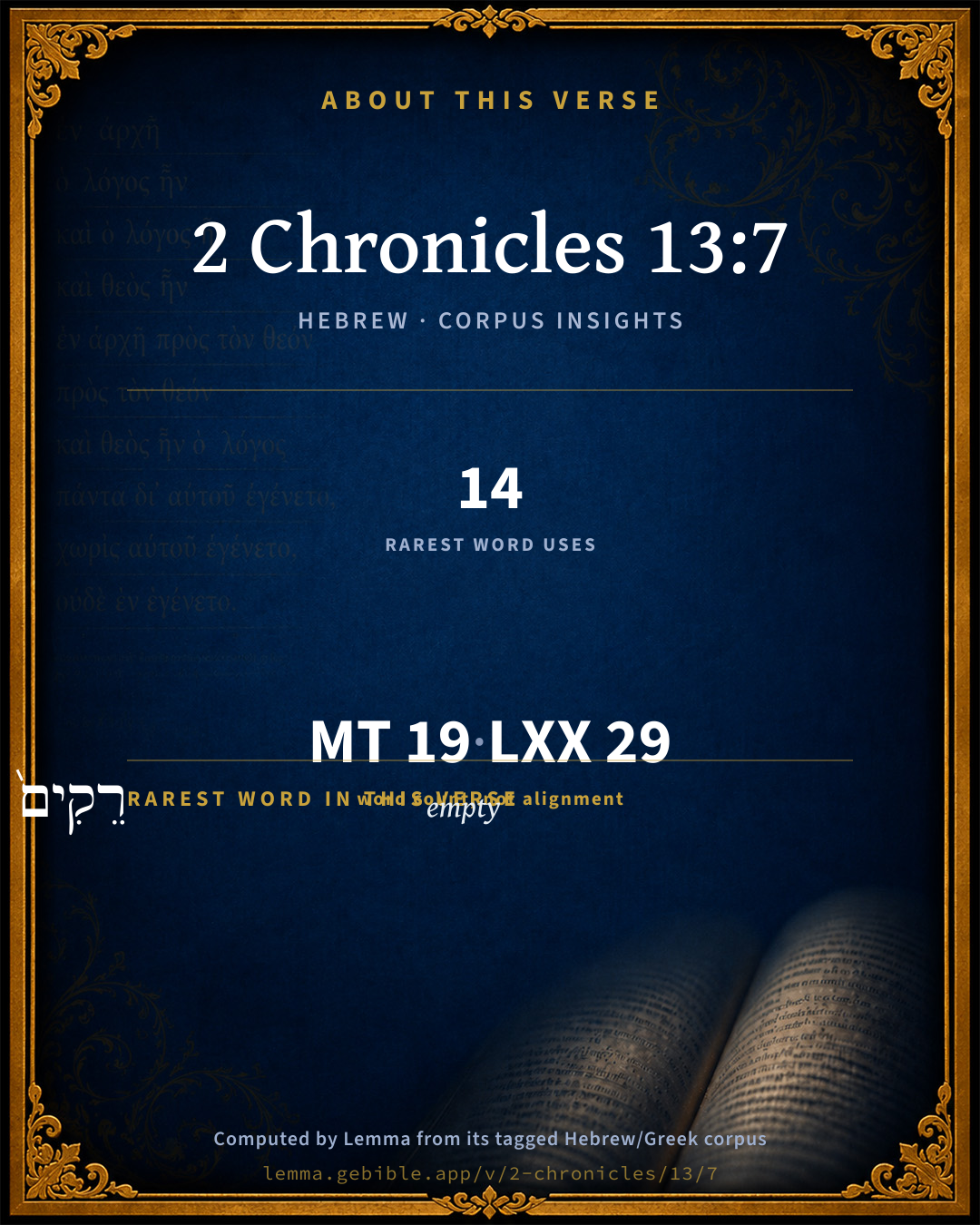
The rarest word here is רֵקִים֙ empty H7386 — appearing just 14 times in the whole Hebrew Bible.

Shared distinctive vocabulary

רֵקִים֙ empty H7386 occurs in 14 verses of the Hebrew Bible. Also found in:

Grammatical profile

  • 4 verbs
  • 10 nouns
  • 2 adjectives
  • 2 prepositions
  • 1 particle

Verb forms

  • וַיִּקָּבְצ֣וּ Niphal · Sequential Imperfect
  • וַיִּֽתְאַמְּצ֖וּ Hithpael · Sequential Imperfect
  • הָ֤יָה Qal · Perfect
  • הִתְחַזַּ֖ק Hithpael · Perfect

Repetition

Words recur within this verse — often emphatic in Hebrew:

  • עָלָ֗יו upon H5921 ×2
  • בְּנֵ֣י son H1121 ×2
  • רְחַבְעָ֣ם Rehoboam H7346 ×2

Hebrew & Septuagint length

In English translation the verse runs 29 words from the Hebrew and 33 from the Septuagint (LXX English) — closely comparable.

A rough comparison of the two English renderings, which tokenize alike — not a word-level alignment.

Word counts can differ between the Hebrew and the Greek without any difference in meaning — e.g. the Hebrew direct-object marker אֵת has no separate Greek word, and Greek often adds the article ὁ.

In the original languages it is 19 Hebrew tokens and 29 Greek tokens — but the two are counted differently (Hebrew bundles its prefixes and suffixes into one token; the Greek is in lemma form), so that isn’t a like-for-like length.

Cross-references

19

Topical passages linked to 2 Chronicles 13:7 in the Treasury of Scripture Knowledge — connected by theme and wording, ordered by reader-vote popularity; previews shown in the World English Bible.

  • Judges 9:4 They gave him seventy [pieces] of silver out of the house of Baal Berith, with which Abimelech hired vain and light fellows, who followed him.
  • 2 Chronicles 12:13 So king Rehoboam strengthened himself in Jerusalem, and reigned: for Rehoboam was forty-one years old when he began to reign, and he reigned seventeen years in Jerusalem, the city which Yahweh had chosen out of all the tribes of Israel, to put his name there: and his mother's name was Naamah the Ammonitess.
  • Deuteronomy 13:13 Certain base fellows are gone out from the midst of you, and have drawn away the inhabitants of their city, saying, Let us go and serve other gods, which you have not known;
  • Judges 11:3 Then Jephthah fled from his brothers, and lived in the land of Tob: and there were gathered vain fellows to Jephthah, and they went out with him.
  • 1 Samuel 22:2 Everyone who was in distress, and everyone who was in debt, and everyone who was discontented, gathered themselves to him; and he became captain over them: and there were with him about four hundred men.
  • 1 Kings 21:10 and set two men, base fellows, before him, and let them testify against him, saying, You did curse God and the king. Then carry him out, and stone him to death.
  • 1 Kings 21:13 The two men, the base fellows, came in and sat before him: and the base fellows bore witness against him, even against Naboth, in the presence of the people, saying, Naboth did curse God and the king. Then they carried him forth out of the city, and stoned him to death with stones.
  • 2 Chronicles 10:16 When all Israel saw that the king didn't listen to them, the people answered the king, saying, What portion have we in David? neither have we inheritance in the son of Jesse: every man to your tents, Israel: now see to your own house, David. So all Israel departed to their tents.
  • 2 Chronicles 11:1–4 When Rehoboam was come to Jerusalem, he assembled the house of Judah and Benjamin, one hundred eighty thousand chosen men, who were warriors, to fight against Israel, to bring the kingdom again to Rehoboam.
  • Job 30:8 They are children of fools, yes, children of base men. They were flogged out of the land.
  • Psalms 26:4 I have not sat with deceitful men, Neither will I go in with hypocrites.
  • Proverbs 12:11 He who tills his land shall have plenty of bread, But he who chases fantasies is void of understanding.
  • Proverbs 28:19 One who works his land will have an abundance of food; But one who chases fantasies will have his fill of poverty.
  • Ecclesiastes 10:16 Woe to you, land, when your king is a child, And your princes eat in the morning!
  • Isaiah 3:4 I will give boys to be their princes, And children shall rule over them.
  • Acts 17:5 But the unpersuaded Jews took along some wicked men from the marketplace, and gathering a crowd, set the city in an uproar. Assaulting the house of Jason, they sought to bring them out to the people.
  • 1 Corinthians 14:20 Brothers, don't be children in thoughts, yet in malice be babies, but in thoughts be mature.
  • Titus 1:10 For there are also many unruly men, vain talkers and deceivers, especially those of the circumcision,
  • Hebrews 5:12 For when by reason of the time you ought to be teachers, you again need to have someone teach you the rudiments of the first principles of the oracles of God. You have come to need milk, and not solid food.

Cross-references courtesy of OpenBible.info (CC BY 4.0).

Hebrew and Greek witnesses Masoretic Hebrew ↔ Greek Septuagint

The same verse in the two great witnesses to the Old Testament, shown verse-for-verse.

These are two independent witnesses, not word-aligned to each other, and the Septuagint is shown in lemma (dictionary) form.

Hebrew 2 Chronicles 13:7 Masoretic · Westminster Leningrad Codex

וַיִּקָּבְצ֣וּ עָלָ֗יו אֲנָשִׁ֤ים רֵקִים֙ בְּנֵ֣י בְלִיַּ֔עַל וַיִּֽתְאַמְּצ֖וּ עַל רְחַבְעָ֣ם בֶּן שְׁלֹמֹ֑ה וּרְחַבְעָ֗ם הָ֤יָה נַ֨עַר֙ וְרַךְ לֵבָ֔ב וְלֹ֥א הִתְחַזַּ֖ק לִפְנֵיהֶֽם

There were gathered to him worthless men, base fellows, who strengthened themselves against Rehoboam the son of Solomon, when Rehoboam was young and tender-hearted, and could not withstand them.

World English Bible · Public Domain

Greek LXX 2 Chronicles 13:7 Septuagint · lemma form

καί συνἄγω πρός αὐτός ἀνήρ λοιμός υἱός παράνομος καί ἀντιἵστημι πρός ροβοαμ ὁ ὁ σαλωμών καί ροβοαμ εἰμί νέος καί δειλός ὁ καρδία καί οὐ ἀντιἵστημι κατά πρόσωπον αὐτός

and there are gathered to him pestilent men, transgressors, and he has risen up against Roboam the son of Solomon, while Roboam was young and fearful in heart, and he withstood him not.

LXX2012 (modern English Septuagint) · Public Domain

On this verse, Haydock's Catholic Bible Commentary discusses the Septuagint’s reading. Read the note in Commentary ↓

Hebrew: Westminster Leningrad Codex (CC BY 4.0). Greek: Septuagint (public domain); English from LXX2012 (modern English Septuagint) (Public Domain). How the Septuagint differs from the Hebrew →

Commentary

Notes on 2 Chronicles 13:7 from classic Christian and Jewish commentators (each source and its license shown beneath its notes). The classic Christian expositions comment on the surrounding passage and are grouped to its opening verse, so a note may address several verses; the Jewish commentaries on the Tanakh (Rashi and others) are per-verse, so they appear only where the commentator wrote on this verse.

Lemma curates 59 commentaries, every one of them public domain or Creative Commons licensed, each selected and text-cleaned for this edition rather than reprinted as found. About our sources →

Trapp's Complete Commentary

John Trapp

2Ch 13:7 And there are gathered unto him vain men, the children of Belial, and have strengthened themselves against Rehoboam the son of Solomon, when Rehoboam was young and tenderhearted, and could not withstand them.

Ver. 7. And there are gathered unto him vain men.] Rachas brainless fellows, light and empty; yokeless also and masterless; men of no piety or common honesty. Such also were Catiline’s comrades among the Romans.

When Rehoboam was young.] Not in age, but in experience, policy, and valour; he was imbellis et metculosus, hen-hearted, as we say, and - as a young plant, not yet rooted - easily shaken and swayed by the insolencies of his rebellious subjects.

And could not withstand them.] Thus he layeth the fault - like a good child - wholly upon his father; with whom, it is like, he was displeased for obeying the prophet Shemaiah, {2Ch 11:4} and not reducing his rebels at first, as he might have done, but for his folly and faint-heartedness, saith Abijah.

John Trapp, A Commentary or Exposition upon All the Books of the Old and New Testament (1647–1656) — public domain. Text from a community e-Sword module.

Joseph Benson's Commentary

2Ch 13:7. Vain men, children of Belial — Such as have cast off the yoke and the obedience which they owed both to God and to their king. When Rehoboam was young — Not in age, for he was then forty-one years old, but in his kingdom, which he had but newly obtained, and in experience in politics, and especially in military affairs, to which he was, indeed, wholly a stranger, having been born and brought up in a time of great peace and security.

Joseph Benson's Commentary on the Old and New Testaments (1811–1818) — public domain. Text from a community e-Sword module.

Geneva Bible (1599)

Geneva Bible translators

This word in the Chaldean tongue is Raca, which our Savior useth, Matt. 5:22.

Hebrew, children of Belial.

Meaning, in heart and courage.

Or, faint hearted.

Geneva Bible (1599) marginal notes — public domain. Text via Bolls.life.

Adam Clarke's Commentary

Verse 7. When Rehoboam was young and tender-hearted] Therefore he could not be forty-one when he came to the throne; 2Ch 13:3. Children of Belial here signifies men of the most abandoned principles and characters; or men without consideration, education, or brains.

Adam Clarke's Commentary on the Bible (1810–1826) — public domain. Text from a community e-Sword/MySword module.

Ellicott's Commentary for English Readers

(7) And there are gathered.—Omit are.

Vain men (rĕqîm, Jdg_9:4; Jdg_11:3).—Said of the followers of Abimelech and the freebooter Jephthah. Neither this nor the following phrase, “the children of Belial” (literally, sons of worthlessness, i.e., men of low character and estimation) occurs again in the Chronicles. (See Jdg_19:22; Jdg_20:13; 1Ki_21:10; 1Ki_21:13, for the latter.)

Have strengthened.—Omit have.

Young and tender-hearted.—Rather, a youth and soft of heart, faint-hearted. A similar phrase occurred 1Ch_29:1. The expression is somewhat inexact, as Rehoboam was forty-one when he ascended the throne (2Ch_12:13). But Abijah is naturally anxious to put the case as strongly as possible against Jeroboam, and to avoid all blame of his own father. In 2 Chronicles 10 Rehoboam appears as haughty and imperious, rather than timid and soft-hearted.

Could not withstand them.—Did not show himself strong or firm (2Ch_12:13).

Against them.—Before them. (Comp. 1Ch_12:17; a usage of the chronicler’s.)

A Bible Commentary for English Readers, edited by Charles John Ellicott (1878–1897) — public domain. Text from a community e-Sword module.

The Cambridge Bible for Schools and Colleges

gen. ed. J. J. S. Perowne

7. are gathered] R.V. were gathered.

children of Belial] R.V. sons of Belial (mg. sons of worthlessness). The general sense “worthless persons” is clear, but the precise meaning of Belial, and whether the word be a proper name or a common noun, cannot be decided at present.

young] Lit. a child. If this word is to be literally understood, the statement made is erroneous, for Rehoboam was forty-one years old when he began to reign (2Ch_12:13). It is probable, however, that the word is used metaphorically to describe one who was young (as indeed his conduct shewed) in experience of government; so Solomon (1Ki_3:7) calls himself a little child, by which he simply meant to express his consciousness of the smallness of his own ability when compared with the greatness of the task which lay before him. Cp. 1Ch_29:1.

tender hearted] i.e., according to Heb. phraseology, weak in understanding, the heart being considered to be the seat of the mind. Or we may translate the Heb. phrase as in Deu_20:8, fainthearted.

The Cambridge Bible for Schools and Colleges (gen. ed. J. J. S. Perowne; Cambridge University Press, 1878–1918) — public domain. Text from a community e-Sword module.

John Gill's Exposition

And now ye think to withstand the kingdom of the Lord in the hand of the sons of David,.... To oppose them, prevail over them, and get it out of their hands, which is delivered to them by the Lord, as the Targum:

and ye be a great multitude; of which they boasted, and in which they trusted, being ten tribes to two, and in this army two to one:

and there are with you golden calves which Jeroboam made you for gods; or, "but (r) there are with you", &c. which Abijah suggests would be so far from helping them, that they would be their ruin, they having, by the worship of them, provoked the Lord against them.

(r) So Grotious, Schnidt, and others.

John Gill's Exposition of the Whole Bible (1746–1763) — public domain (CC PDM 1.0). Text via the HelloAO Bible API.

Haydock's Catholic Bible Commentary

Vain. The saem term is used as in Matthew v. 22. (Calmet) --- Rekim, "stupid men." (Haydock) --- Septuagint, "pestiferous." Syriac, "impious." --- Heart. Protestants, "young and tender-hearted." (Haydock) --- But Roboam was not very young; (3 Kings xiv. 21.) and we may adhere to the Vulgate. (Calmet) --- Septuagint, "he was a youth, and timid." (Haydock) --- Abia speaks of his father with little respect, and seems to have forgotten that he had laid down his arms in obedience to God’s order. (Calmet)

George Leo Haydock (1774–1849), Haydock's Catholic Family Bible and Commentary, 1859 edition — public domain. Excludes Psalms (Douay-Rheims chapter numbering differs from Protestant) and Deuterocanonical books (Catholic canon only).

Matthew Poole's English Annotations

The children of Belial; such as have cast off the yoke and obedience which they owed both to God and to their king.

When Rehoboam was young; not in age, for he was then forty-one years old, but in his kingdom, which he had but newly obtained, and in experience in politic, and especially in military, affairs, to which he was wholly a stranger, as having been born and bred up in a time of great peace and security.

Tender-hearted, i.e. cowardly and fearful, who durst not adventure to chastise the rebels as he should have done. But therein Abijah forgets his duty, both to his father, whom he falsely traduceth; and to God, by whose express command Rehoboam was restrained from the war against Israel, which otherwise he had both courage and resolution to prosecute, as appears from the history, 1Ki 12:21.

Matthew Poole's English Annotations on the Holy Bible (1683–1685) — public domain. Text from a community e-Sword/MySword module.

The Pulpit Commentary

Are gathered have strengthened themselves. The aorist tense is needed for the rendering in both these cases; e.g. "And vain men gathered to him, and strengthened themselves against him." Vain men; Hebrew, This word, and one very slightly different in form, and their adverb, occur in all forty-one times; rendered in the Authorized Version "empty" nineteen times, "vain" eighteen times, and "without cause," "to no purpose," and "void" the remaining four times. It is the word that is used of the "empty" pit of Joseph; (Gen_37:24) of the "empty ears" of corn; (Gen_41:27) of "empty" pitchers and other vessels (Jud_1:7:16; 2Ki_4:3; Jer_14:3 Jer_51:34; Eze_24:11) And in all the other cases expresses metaphorically the emptiness of head, of heart, or of reason, with the same simple force of language appropriate, it appears, then as now. Children of Belial ; Hebrew, lYlib. This word is found twenty-seven times, and, including seven marginal options, is rendered in the Authorized Version "Belial" twenty-three times; the four exceptions being "wicked" three times, and "naughty" once. The derivation of it marks the one expressive meaning of "without profit." Young and tender-hearted. Hard as it is to put these objections to the credit of a man forty-one years of age (see our note, (2Ch_10:8 2Ch_12:13) at all, yet, if so, they can only be explained as some do explain them, of a blamable ignorance, inexperience, and instability.

The Pulpit Commentary (1880–1919), ed. H.D.M. Spence-Jones & Joseph S. Exell — public domain. Text from a community e-Sword module.

Rashi

Rabbi Shlomo Yitzchaki (Rashi)

And there gathered to him worthless wicked.

and they overwhelmed Rehoboam the son of Solomon and Rehoboam was young and soft-hearted and since they found in him humility and soft- heartedness, they overwhelmed him.

young - Heb. נַעַר. Although he was forty-one years old when he reigned, he is called a youth (נַעַר), as I explained above (I Chron. 22:5) in regards to Solomon.

Rashi on the Tanakh — English translations: “The Judaica Press complete Tanach with Rashi, translated by A. J. Rosenberg” (CC BY 4.0); “Pentateuch with Rashi's commentary by M. Rosenbaum and A.M. Silbermann, 1929-1934” (public domain); “The Metsudah Tanach series, Lakewood, N.J” (CC BY 4.0); and “The Book of Joshua, Metsudah Publications, 1997” (CC BY 4.0). Text via Sefaria.

Lesson kit

Teaching starters — assembled from the data on this page, not authored interpretation. Every prompt links to the verse data it draws on. Edit before teaching.

2 Chronicles, in the Historical, opens this verse with 19 words (16 distinct Hebrew lemmas). Its most distinctive word is rêyq (“empty”). A historical commentator’s framing appears above. Read the whole chapter for the surrounding context.

Discussion questions

  1. The word rêyq carries the sense “empty.” How does it shape the verse?
  2. How does Genesis 37:24, which shares the word «empty», read alongside this verse?
  3. What does the repetition of “upon” (2× in this one verse) do in this verse?
  4. These translations render this verse differently. What is at stake in choosing one wording over another?
  5. «וַיִּקָּבְצ֣וּ» is a Niphal Sequential Imperfect verb. How does that grammatical form shape the action described?
  6. Compare how Trapp's Complete Commentary and Joseph Benson's Commentary read this verse. Where do they agree or differ?

Things to notice

Reading settings

Reading text

Shown beneath each verse's original-language words.

Old Testament
Old Testament edition

Read the OT as the Masoretic Hebrew (MT) or the Greek Septuagint (LXX).

English shown for the Greek Septuagint (in the Hebrew ↔ Greek comparison).

Comparing translations? Open the Compare panel on any verse page to stack up to four side by side.