
2 Chronicles 25:14

Hebrew (Westminster Leningrad Codex) 2 Chronicles 25:14 appears in the Hebrew Old Testament. The text above is from the Westminster Leningrad Codex. Each word links to its Strong’s number, a concise gloss, and parsing drawn from the Open Scriptures Hebrew Bible morphology. Click any word for its full Brown-Driver-Briggs (BDB) entry.
Download image
Cite this verse

2 Chronicles 25:14 (World English Bible). Public Domain. Lemma interlinear Bible study tool, https://lemma.gebible.app/v/2-chronicles/25/14.

Show BibTeX & RIS
BibTeX
RIS
English Translation
Now it happened, after that Amaziah was come from the slaughter of the Edomites, that he brought the gods of the children of Seir, and set them up to be his gods, and bowed down himself before them, and burned incense to them.
World English Bible · Public Domain
Download a study sheet

One document with this verse’s original text, its word-by-word gloss line, the meaning frame, cross-references with their text, attributed commentary, and full source and license credits — printable, and it pastes into notes with its structure intact.

This verse Autodidact and up

Study sheet (.html) Plain text (.txt)

A passage Seminary Student

Up to 50 verses in one chapter. A passage sheet keeps up to 6 commentary sources and 12 cross-references per verse, in the order this page ranks them, and says so on the sheet whenever that leaves anything out. Ask for a single verse and you get the Autodidact verse sheet above.

Everything on this page stays free to read, with no account — the sheet is a download of what is already on screen, not access to it.

Want to remove ads? Support Godless Engineer
Compare translations 3

The same verse in 3 English versions, stacked beneath the original-language interlinear above. Click any original word for its lexicon entry.

Each is an independent rendering of the whole verse — the interlinear is not word-aligned to these translations.

Highlighted words mark where these versions differ — a whole-verse word diff, not a word-by-word alignment.

  • World English Bible Public Domain
    Now it happened, after that Amaziah was come from the slaughter of the Edomites, that he brought the gods of the children of Seir, and set them up to be his gods, and bowed down himself before them, and burned incense to them.
  • King James Version Public Domain
    Now it came to pass, after that Amaziah was come from the slaughter of the Edomites, that he brought the gods of the children of Seir, and set them up to be his gods, and bowed down himself before them, and burned incense unto them.
  • unfoldingWord Literal Text CC BY-SA 4.0
    And it happened after Amaziah had come from striking the Edomites, and he brought the gods of the sons of Seir, and set them up for himself to be gods. And before them he bowed down and to them he made sacrifices.

unfoldingWord Literal Text — © unfoldingWord, licensed CC BY-SA 4.0. Word-aligned USFM3 via Door43 (git.door43.org/unfoldingWord/en_ult).

Versions to compare (up to 4)

3 of 4 selected

Show all 18 translations

Every available English version of this verse, each an independent rendering of the whole verse.

  • World English Bible Public Domain
    Now it happened, after that Amaziah was come from the slaughter of the Edomites, that he brought the gods of the children of Seir, and set them up to be his gods, and bowed down himself before them, and burned incense to them.
  • Berean Standard Bible Public Domain
    When Amaziah returned from the slaughter of the Edomites, he brought back the gods of the Seirites, set them up as his own gods, bowed before them, and burned sacrifices to them.
  • Majority Standard Bible Public Domain
    When Amaziah returned from the slaughter of the Edomites, he brought back the gods of the Seirites, set them up as his own gods, bowed before them, and burned sacrifices to them.
  • King James Version Public Domain
    Now it came to pass, after that Amaziah was come from the slaughter of the Edomites, that he brought the gods of the children of Seir, and set them up to be his gods, and bowed down himself before them, and burned incense unto them.
  • American Standard Version (1901) Public Domain
    Now it came to pass, after that Amaziah was come from the slaughter of the Edomites, that he brought the gods of the children of Seir, and set them up to be his gods, and bowed down himself before them, and burned incense unto them.
  • Revised Version (1885) Public Domain
    Now it came to pass, after that Amaziah was come from the slaughter of the Edomites, that he brought the gods of the children of Seir, and set them up to be his gods, and bowed down himself before them, and burned incense unto them.
  • Geneva Bible (1599) Public Domain
    Now after that Amaziah was come from the slaughter of the Edomites, he brought the gods of the children of Seir, and set them vp to be his gods, and worshipped them, and burned incense vnto them.
  • Douay-Rheims (1899) Public Domain
    But Amasias after he had slain the Edomites, set up the gods of the children of Seir, which he had brought thence, to be his gods, and adored them, and burnt incense to them.
  • Young's Literal Translation Public Domain
    And it cometh to pass, after the coming in of Amaziah from smiting the Edomites, that he bringeth in the gods of the sons of Seir, and establisheth them to him for gods, and before them doth bow himself, and to them he maketh perfume.
  • Literal Standard Version CC BY-SA 4.0
    And it comes to pass after the coming in of Amaziah from striking the Edomites, that he brings in the gods of the sons of Seir, and establishes them for gods for himself, and bows himself before them, and he makes incense to them.
  • Unlocked Literal Bible CC BY-SA 4.0
    Now it came about, after that Amaziah had returned from the slaughter of the Edomites, that he brought the gods of the people of Seir, and set them up to be his own gods. He bowed down before them and burned incense to them.
  • unfoldingWord Literal Text CC BY-SA 4.0
    And it happened after Amaziah had come from striking the Edomites, and he brought the gods of the sons of Seir, and set them up for himself to be gods. And before them he bowed down and to them he made sacrifices.
  • Darby Bible Public Domain
    And it came to pass after Amaziah was come from the slaughter of the Edomites, that he brought the gods of the children of Seir, and set them up to be his gods, and bowed himself down before them, and burned incense to them.
  • World Messianic Bible Public Domain
    Now after Amaziah had come from the slaughter of the Edomites, he brought the gods of the children of Seir, and set them up to be his gods, and bowed down himself before them and burned incense to them.
  • Webster's Bible Public Domain
    Now it came to pass, after that Amaziah had come from the slaughter of the Edomites, that he brought the gods of the children of Seir, and set them up to be his gods, and bowed himself before them, and burned incense to them.
  • Free Bible Version CC BY-SA 4.0
    When Amaziah returned from killing the Edomites, he brought back the gods of the people of Seir and set them up as his own gods, worshiped them, and offered sacrifices to them.
  • Bible in Basic English Public Domain
    Now when Amaziah came back from the destruction of the Edomites, he took the gods of the children of Seir and made them his gods, worshipping them and burning offerings before them.
  • JPS Tanakh (1917) Public Domain
    Now it came to pass, after that Amaziah was come from the slaughter of the Edomites, that he brought the gods of the children of Seir, and set them up to be his gods, and prostrated himself before them, and offered unto them.

Literal Standard Version (2020), Covenant Press — licensed CC BY-SA 4.0. Text via the HelloAO Bible API (eBible.org). Unlocked Literal Bible (unfoldingWord) — licensed CC BY-SA 4.0. Text via the HelloAO Bible API (eBible.org). unfoldingWord Literal Text — © unfoldingWord, licensed CC BY-SA 4.0. Word-aligned USFM3 via Door43 (git.door43.org/unfoldingWord/en_ult). Free Bible Version, Dr. Jonathan Gallagher — licensed CC BY-SA 4.0. Text via the HelloAO Bible API (eBible.org).

Word by word

More ways to search: Search by grammar → Find every occurrence → Compare this word →

Practice this passage: Drill this verse → Learn its vocabulary →

אֲדוֹמִ֔ים
ʼĔdômîy
H130
“Edomites”
Noun, Gentilic, Masculine, Plural, Absolute
Part of Speech
Noun
Type
Gentilic
Gender
Masculine
Number
Plural
State
Absolute
Full BDB Definition

Origin: patronymic from H123

TWOT: None

Edomite
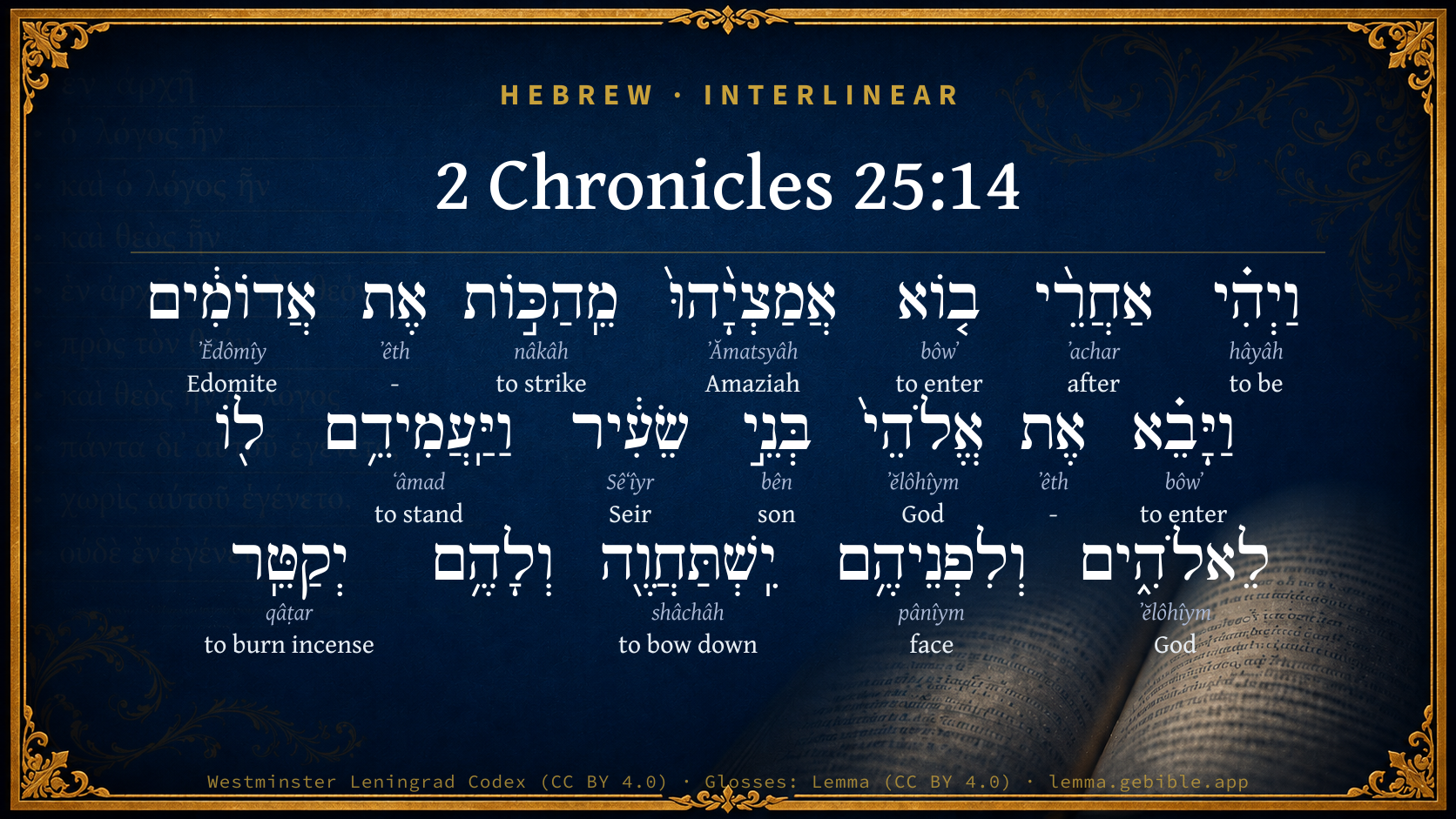
  1. וַיְהִ֗י hâyâh H1961 “and · to be” Conjunction + Verb, Qal, Sequential Imperfect, 3rd Person, Masculine, Singular
  2. אַחֲרֵ֨י ʼachar H310 “after” Preposition
  3. ב֤וֹא bôwʼ H935 “to enter” Verb, Qal, Infinitive Construct
  4. אֲמַצְיָ֨הוּ֙ ʼĂmatsyâh H558 “Amaziah” Noun, Proper
  5. מֵֽהַכּ֣וֹת nâkâh H5221 “from · to strike” Preposition + Verb, Hiphil, Infinitive Construct
  6. אֶת ʼêth H853 “-” Particle, Direct Object
  7. וַיָּבֵ֗א bôwʼ H935 “and · to enter” Conjunction + Verb, Hiphil, Sequential Imperfect, 3rd Person, Masculine, Singular
  8. אֶת ʼêth H853 “-” Particle, Direct Object
  9. אֱלֹהֵי֙ ʼĕlôhîym H430 “God(s) of” Noun, Common, Masculine, Plural, Construct
  10. בְּנֵ֣י bên H1121 “sons of” Noun, Common, Masculine, Plural, Construct
  11. שֵׂעִ֔יר Sêʻîyr H8165 “Seir” Noun, Proper
  12. וַיַּֽעֲמִידֵ֥ם ʻâmad H5975 “and · to stand · them” Conjunction + Verb, Hiphil, Sequential Imperfect, 3rd Person, Masculine, Singular + Suffix, Personal, 3rd Person, Masculine, Plural
  13. לֵאלֹהִ֑ים ʼĕlôhîym H430 “to/for · God(s)” Preposition + Noun, Common, Masculine, Plural, Absolute
  14. וְלִפְנֵיהֶ֥ם pânîym H6440 “and · to/for · face(s) · their” Conjunction + Preposition + Noun, Common, Both, Plural, Construct + Suffix, Personal, 3rd Person, Masculine, Plural
  15. יִֽשְׁתַּחֲוֶ֖ה shâchâh H7812 “to bow down” Verb, Hishtaphel, Imperfect, 3rd Person, Masculine, Singular
  16. יְקַטֵּֽר qâṭar H6999 “to burn incense” Verb, Piel, Imperfect, 3rd Person, Masculine, Singular

About this verse

These counts appear in no published source. They are computed here, from the morphology-tagged text and Lemma’s own curated glosses. What Lemma adds →

19
words
14
distinct lemmas
Historical
section

Notable vocabulary

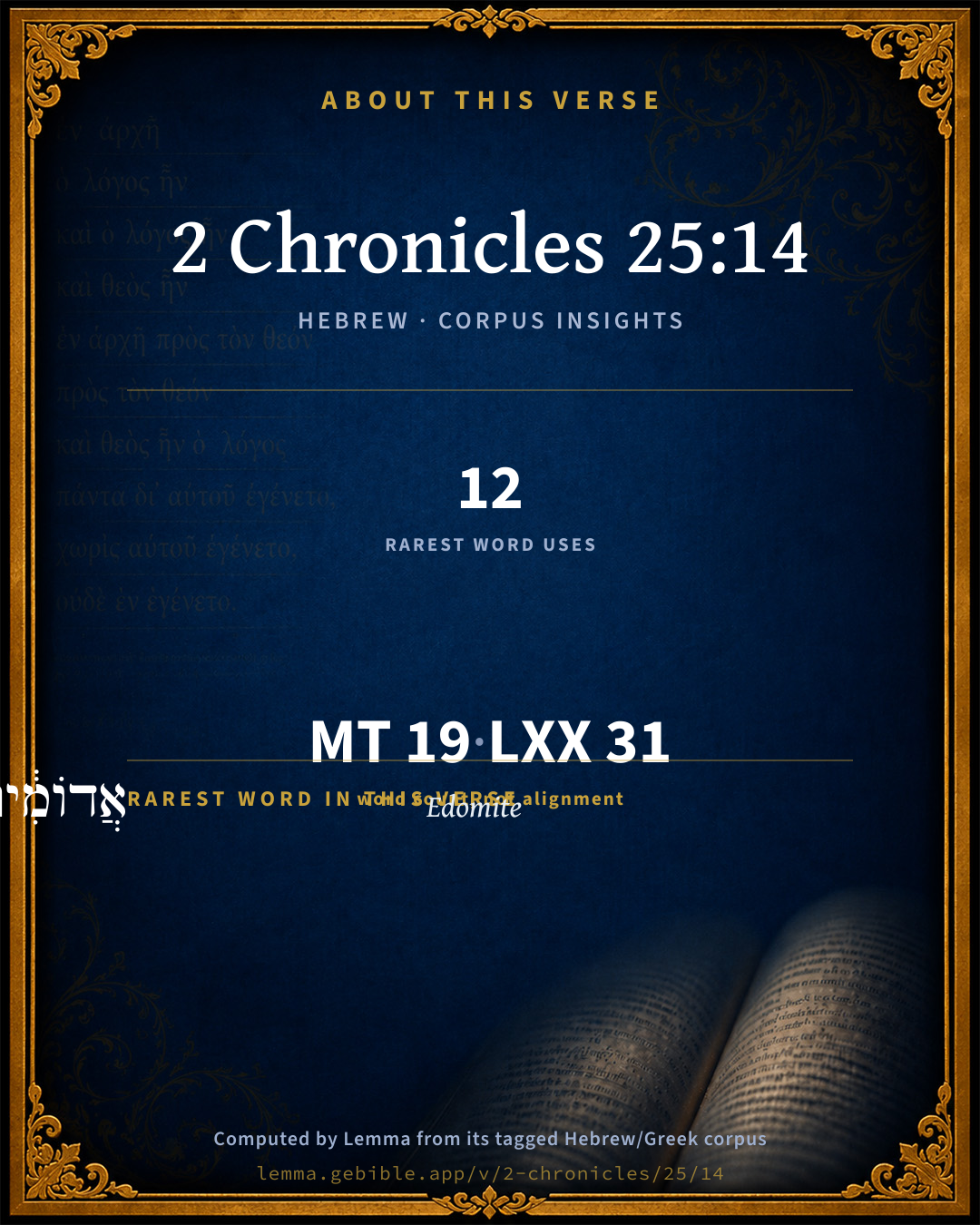
The rarest word here is אֲדוֹמִ֔ים Edomite H130 — appearing just 12 times in the whole Hebrew Bible.

Shared distinctive vocabulary

אֲדוֹמִ֔ים Edomite H130 occurs in 12 verses of the Hebrew Bible. Also found in:

Grammatical profile

  • 7 verbs
  • 7 nouns
  • 3 prepositions
  • 2 particles

Verb forms

  • וַיְהִ֗י Qal · Sequential Imperfect
  • ב֤וֹא Qal · Infinitive Construct
  • מֵֽהַכּ֣וֹת Hiphil · Infinitive Construct
  • וַיָּבֵ֗א Hiphil · Sequential Imperfect
  • וַיַּֽעֲמִידֵ֥ם Hiphil · Sequential Imperfect
  • יִֽשְׁתַּחֲוֶ֖ה Hishtaphel · Imperfect
  • יְקַטֵּֽר Piel · Imperfect

Repetition

Words recur within this verse — often emphatic in Hebrew:

  • ב֤וֹא to enter H935 ×2
  • אֱלֹהֵי֙ God H430 ×2

Hebrew & Septuagint length

In English translation the verse runs 43 words from the Hebrew and 41 from the Septuagint (LXX English) — closely comparable.

A rough comparison of the two English renderings, which tokenize alike — not a word-level alignment.

Word counts can differ between the Hebrew and the Greek without any difference in meaning — e.g. the Hebrew direct-object marker אֵת has no separate Greek word, and Greek often adds the article ὁ.

In the original languages it is 19 Hebrew tokens and 31 Greek tokens — but the two are counted differently (Hebrew bundles its prefixes and suffixes into one token; the Greek is in lemma form), so that isn’t a like-for-like length.

Cross-references

6

Topical passages linked to 2 Chronicles 25:14 in the Treasury of Scripture Knowledge — connected by theme and wording, ordered by reader-vote popularity; previews shown in the World English Bible.

  • 2 Chronicles 28:23 For he sacrificed to the gods of Damascus, which struck him; and he said, Because the gods of the kings of Syria helped them, [therefore] will I sacrifice to them, that they may help me. But they were the ruin of him, and of all Israel.
  • Exodus 20:3–5 You shall have no other gods before me.
  • Deuteronomy 7:5 But thus shall you deal with them: you shall break down their altars, and dash in pieces their pillars, and hew down their Asherim, and burn their engraved images with fire.
  • Deuteronomy 7:25 The engraved images of their gods shall you burn with fire: you shall not covet the silver or the gold that is on them, nor take it to you, lest you be snared therein; for it is an abomination to Yahweh your God.
  • 2 Samuel 5:21 They left their images there; and David and his men took them away.
  • Isaiah 44:19 None calls to mind, neither is there knowledge nor understanding to say, I have burned part of it in the fire; yes, also I have baked bread on the coals of it; I have roasted flesh and eaten it: and shall I make the residue of it an abomination? shall I fall down to the stock of a tree?

Cross-references courtesy of OpenBible.info (CC BY 4.0).

Hebrew and Greek witnesses Masoretic Hebrew ↔ Greek Septuagint

The same verse in the two great witnesses to the Old Testament, shown verse-for-verse.

These are two independent witnesses, not word-aligned to each other, and the Septuagint is shown in lemma (dictionary) form.

Hebrew 2 Chronicles 25:14 Masoretic · Westminster Leningrad Codex

וַיְהִ֗י אַחֲרֵ֨י ב֤וֹא אֲמַצְיָ֨הוּ֙ מֵֽהַכּ֣וֹת אֶת אֲדוֹמִ֔ים וַיָּבֵ֗א אֶת אֱלֹהֵי֙ בְּנֵ֣י שֵׂעִ֔יר וַיַּֽעֲמִידֵ֥ם ל֖וֹ לֵאלֹהִ֑ים וְלִפְנֵיהֶ֥ם יִֽשְׁתַּחֲוֶ֖ה וְלָהֶ֥ם יְקַטֵּֽר

Now it happened, after that Amaziah was come from the slaughter of the Edomites, that he brought the gods of the children of Seir, and set them up to be his gods, and bowed down himself before them, and burned incense to them.

World English Bible · Public Domain

Greek LXX 2 Chronicles 25:14 Septuagint · lemma form

καί γίγνομαι μετά ὁ ἔρχομαι αμασιας πατάσσω ὁ ιδουμαία καί φέρω πρός αὐτός ὁ θεός υἱός σηιρ καί ἵστημι αὐτός ἑαυτοῦ εἰς θεός καί ἐναντίον αὐτός προςκυνέω καί αὐτός αὐτός θύω

And it came to pass, after Amasias had returned from striking Idumea, that he brought home the gods of the children of Seir, and set them up for himself as gods, and bowed down before them, and he sacrificed to them.

LXX2012 (modern English Septuagint) · Public Domain

Hebrew: Westminster Leningrad Codex (CC BY 4.0). Greek: Septuagint (public domain); English from LXX2012 (modern English Septuagint) (Public Domain). How the Septuagint differs from the Hebrew →

Commentary

Notes on 2 Chronicles 25:14 from classic Christian and Jewish commentators (each source and its license shown beneath its notes). The classic Christian expositions comment on the surrounding passage and are grouped to its opening verse, so a note may address several verses; the Jewish commentaries on the Tanakh (Rashi and others) are per-verse, so they appear only where the commentator wrote on this verse.

Lemma curates 59 commentaries, every one of them public domain or Creative Commons licensed, each selected and text-cleaned for this edition rather than reprinted as found. About our sources →

Matthew Henry's Commentary

Here is, I. The revolt of Amaziah from the God of Israel to the gods of the Edomites. Egregious folly! Ahaz worshipped the gods of those that had conquered him, for which he had some little colour, Ch2 28:23. But to worship the gods of those whom he had conquered, who could not protect their own worshippers, was the greatest absurdity that could be. What did he see in the gods of the children of Seir that could tempt him to set them up for his gods and bow himself down before them? Ch2 25:14. If he had cast the idols down from the rock and broken them to pieces, instead of the prisoners, he would have manifested more of the piety as well as more of the pity of an Israelite; but perhaps for that barbarous inhumanity he was given up to this ridiculous idolatry.

II. The reproof which God sent to him, by a prophet, for this sin. The anger of the Lord was kindled against him, and justly; yet, before he sent to destroy him, he sent to convince and reclaim him, and so to prevent his destruction. The prophet reasoned with him very fairly and very mildly: Why hast thou sought the favour of those gods which could not deliver their own people? Ch2 25:15. If men would but duly consider the inability of all those things to help them to which they have recourse when they forsake God, they would not be such enemies to themselves.

III. The check he gave to the reprover, Ch2 25:16. He could say nothing in excuse of his own folly; the reproof was too just to be answered. But he fell into a passion with the reprover. 1. He taunted him as saucy and impertinent, and meddling with that which did not belong to him: Art thou made of the king's counsel? Could not a man speak reasonably to him, but he must be upbraided as usurping the place of a privy-counsellor? But, as a prophet, he really was made of the king's counsel by the King of kings, in duty to whom the king was bound not only to hear, but to ask and take his counsel. 2. He silenced him, bade him forbear and say not a word more to him. He said to the seer, See not, Isa 30:10. Men would gladly have their prophets thus under their girdles, as we say, to speak just when and what they would have them speak, and not otherwise. 3. He threatened him: "Why shouldst thou be smitten? It is at thy peril if thou sayest a word more of this matter." He seems to remind him of Zechariah's fate in the last reign, who was put to death for making bold with the king; and bids him take warning by him. Thus he justifies the killing of that prophet by menacing this, and so, in effect, makes himself guilty of the blood of both. He had hearkened to the prophet who ordered him to send back the army of Israel, and was ruled by him, though he contradicted his politics and lost him 100 talents, Ch2 25:10. But this prophet, who dissuaded him from worshipping the gods of the Edomites, he ran upon with an unaccountable rage, which must be attributed to the witchcraft of idolatry. He was easily persuaded to part with his talents of silver, but by no means with his gods of silver.

IV. The doom which the prophet passed upon him for this. He had more to say to him by way of instruction and advice; but, finding him obstinate in his iniquity, he forbore. He is joined to idols; let him alone, Hos 4:17. Miserable is the condition of that man with whom the blessed Spirit, by ministers and conscience, forbears to strive, Gen 6:3. And both the reprovers in the gate and that in the bosom, if long brow-beaten and baffled, will at length forbear. So I gave them up to their own hearts' lusts. The secure sinner perhaps values himself upon it as a noble and happy achievement to have silenced his reprovers and monitors, and to get clear of them; but what comes of it? "I know that God has determined to destroy thee; it is a plain indication that thou art marked for ruin that thou hast done this, and hast not hearkened to my counsel." Those that are deaf to reproof are ripening apace for destruction, Pro 29:1.

Matthew Henry's Commentary on the Whole Bible (1708–1710) — public domain (CC PDM 1.0). Text via the HelloAO Bible API.

Ellicott's Commentary for English Readers

AMAZIAH ADOPTS THE EDOMITE FORM OF WORSHIP, AND SPURNS A PROPHETIC WARNING (2Ch_25:14-16).

(14) From the slaughter.—From smiting.

Brought the gods.—The Assyrian inscriptions often refer to this custom of carrying off the idols of conquered countries. Esarhaddon states that he restored the gods of Hazael, king of Arabia, at that prince’s entreaty, after engraving on them “the might of Asshur” and his own name. Assurbanipal recovered an image of Nana, which an Elamite sovereign had carried off one thousand six hundred and thirty-five years previously.

The children of Seir.—Bnê Seir, the tribal designation of the Edomites (1Ch_1:38).

Set them up to be his gods.—Not necessarily abandoning the worship of Jehovah. (Comp. the conduct of Ahaz, 2Ch_28:23; 2Ki_16:10, et seq.; also 2Ki_17:27-33.) Thenius says this contradicts 2Ki_14:3; and it may be allowed that the chronicler portrays Amaziah in a darker light than the older account. This only proves independence of judgment and the possession of additional information. Thenius and Bertheau further suppose that the chronicler, from his theocratic standpoint, merely inferred the idolatry of Amaziah from his ill success against Israel. It is more likely that it was mentioned in one of the histories which the compiler had before him.

Bowed down himself.—Literally, And before them would he bow himself, and to them would he offer incense; relating his habitual practice.

A Bible Commentary for English Readers, edited by Charles John Ellicott (1878–1897) — public domain. Text from a community e-Sword module.

Trapp's Complete Commentary

John Trapp

2Ch 25:14 Now it came to pass, after that Amaziah was come from the slaughter of the Edomites, that he brought the gods of the children of Seir, and set them up [to be] his gods, and bowed down himself before them, and burned incense unto them.

Ver. 14. He brought the gods of the children of Seir.] The old Romans, having subdued any nation, set up their gods to themselves also, to win their favour; Amaziah might do this haply for the like reason. The Jews fable that when those ten thousand Edomites were cast down from the rock, a voice from the idols was heard, This cometh upon you because ye have neglected to worship us; and that Amaziah, hearing this, did as he did. The truth is, he was given up of God unto this sin of idolatry, for a just punishment of his pride and hypocrisy; as were also the Turks to the Mohammedan superstition, which they received together with the kingdom of Persia, won by Tangrolipix, sultan of the Turks, A.D. 1030. So that hard it is to say, saith the historian, which nation lost more, - the Saracens and Persians by the loss of so great a kingdom, or the Turks by embracing so great a vanity. {a}

{a} Turk. Hist.

John Trapp, A Commentary or Exposition upon All the Books of the Old and New Testament (1647–1656) — public domain. Text from a community e-Sword module.

The Biblical Illustrator

Joseph S. Exell

2Ch_25:14

Now it came to pass, after that Amaziah was come from the slaughter of the Edomites, that he brought the gods of the children of Seir.

Amaziahs apostacy

To act like Amaziah--to go out to battle in the name of Jehovah, directed and encouraged by His prophet, to conquer by the grace of the God of Israel, and then to desert Jehovah of hosts, the giver of victory, for the paltry and discredited idols of the conquered Edomites--this was sheer madness. And yet as Greece enslaved her Roman conquerors, so the victor has often been won to the faith of the vanquished. The Church subdued the barbarians who had overwhelmed the empire, and the heathen Saxons adopted at last the religion of the conquered Britons. (W. H. Bennett, M.A.)

The Biblical Illustrator, edited by Joseph S. Exell (c. 1880s–1900s) — public domain. Text from a community e-Sword module.

Joseph Benson's Commentary

2Ch 25:14. He brought the gods of Seir, and set them up for his gods — Egregious folly! When Ahaz worshipped the gods of those that had conquered him, (2Ch 28:23,) he had some little colour for it, as he hoped, probably, thus to prevail upon them to assist him too. But for Amaziah to worship the gods of those he had conquered, was surely most unreasonable. What did he see in the gods of the children of Seir, that could tempt him to set them up for his gods, and bow down himself before them? If he had cast the idols down from the rock, and broken them to pieces, instead of the prisoners, he would have discovered more of the piety, as well as more of the pity, of an Israelite. But, perhaps, as a punishment for that barbarous inhumanity, he was given up to this ridiculous idolatry.

Joseph Benson's Commentary on the Old and New Testaments (1811–1818) — public domain. Text from a community e-Sword module.

Tyndale Open Study Notes

Tyndale Open Resources

25:14-15 Conquerors sometimes worshiped the gods of a vanquished nation, wrongly believing that the gods of the defeated people had helped them to victory. Amaziah held this pagan mindset; he did not believe that the Lord is the only true God (see Isa 40:18-28; 42:8; Jer 10:1-16).

Tyndale Open Study Notes — © Tyndale Open Resources, licensed CC BY-SA 4.0. Text via the HelloAO Bible API.

Geneva Bible (1599)

Geneva Bible translators

Thus where he should have given the praise to God for his benefits and great victory, he fell from God, and did most vilely dishonor him.

Geneva Bible (1599) marginal notes — public domain. Text via Bolls.life.

Jamieson, Fausset & Brown

Robert Jamieson, A. R. Fausset & David Brown

Amaziah . . . brought the gods of the children of Seir--The Edomites worshipped the sun under different forms and with various rites. But burning incense upon altars was a principal act of worship, and this was the very thing Amaziah is described as having with strange infatuation performed. Whether he had been captivated with the beauty of the images, or hoped by honoring the gods to disarm their spite at him for his conquest and harsh treatment of their votaries, his conduct in establishing these objects of religious homage in Jerusalem was foolish, ignorant, and highly offensive to God, who commissioned a prophet to rebuke him for his apostasy, and threaten him with the calamity that soon after befell him.

Jamieson, Fausset & Brown — Commentary Critical and Explanatory on the Whole Bible (1871) — public domain (CC PDM 1.0). Text via the HelloAO Bible API.

Adam Clarke's Commentary

Verse 14. The gods of the children of Seir] "The idols of the children of Gebal." - Targum.

Adam Clarke's Commentary on the Bible (1810–1826) — public domain. Text from a community e-Sword/MySword module.

The Cambridge Bible for Schools and Colleges

gen. ed. J. J. S. Perowne

14–16 (not in Kings). Amaziah’s Idolatry and the Prophet’s Rebuke

14. bowed down … and burned] The tenses in the Heb. are imperfect and imply that this became Amaziah’s practice. The act was according to a policy frequently pursued in ancient times. Solomon affords an instance of it (1Ki_11:7).

The Cambridge Bible for Schools and Colleges (gen. ed. J. J. S. Perowne; Cambridge University Press, 1878–1918) — public domain. Text from a community e-Sword module.

John Gill's Exposition

Wherefore the anger of the Lord was kindled against Amaziah,.... Idolatry being always highly displeasing to the Lord; and this was a most provoking instance of it, that when the Lord had given him victory over his enemies, that he should forsake him, and worship their gods:

and he sent unto him a prophet; whether the same as before, is not certain:

which said unto him, why hast thou sought after the gods of the people which could not deliver their own people out of thine hand? and therefore it was madness in him to seek after them, and worship them.

John Gill's Exposition of the Whole Bible (1746–1763) — public domain (CC PDM 1.0). Text via the HelloAO Bible API.

Albert Barnes' Notes on the Bible

The practice of carrying off the images of the gods from a conquered country, or city, as trophies of victory, was common among the nations of the East. Sometimes as with the Romans, the object was worship, especially when the gods were previously among those of the conquering country, and the images had the reputation of special sanctity.

Albert Barnes' Notes on the Bible (1834–1885) — public domain. Text from a community e-Sword/MySword module.

The Pulpit Commentary

Brought the gods of the children of Seir to be his gods. Amaziah"s devout gratitude to God, and acknowledgment of him in the name Joktheel, was soon gone, and at the very last, grown confident, he loses all, and realizes the fulfilment of the "man of God"s" prophetic denunciations.

Vers. 14-16.

The declension of Amaziah.

I THE NATURE OF IT. A subsidence into idolatry. On returning from the slaughter of the Edomites he brought with him the gods of the children of Seir, and, setting them up to be his gods, bowed down him- self before them and burned incense unto them (ver. 14). That the Seirites were idolaters is confirmed by Moses, who gives Baal-hanan, "Baal is gracious," as one of their kings; (Gen_36:38) by Josephus, who mentions that the Idumaeans had a god named Kotze ("Ant.," 15:7. 9); and by the Assyrian inscriptions, which show that one of their sovereigns bore the designation Kaus-malaka, i.e. "Kaus or Kotze is king" (Schrader, "Keilinschriften," p. 150).

II THE MOTIVE OF IT. Probably political, to enable him to complete the subjugation of the Seirites, which, as he imagined, could be best done by winning over their gods to his side (Keil). Compare the conduct of Ahaz in sacrificing to the gods of Damascus in order to obtain their assistance, (2Ch_28:23) and of Cyrus in asking the Babylonian divinities to intercede with Bel and Nebo on his behalf (Sayce, "Fresh Light," etc., p. 175). At the same time, Amaziah"s idolatry just as likely had its roots in inherent depravity. If Joash fell away to Baal, (2Ch_24:18) it is hardly surprising that Amaziah his son should have followed his example. The fallen heart gravitates towards polytheism, as the history of mankind of Jews, Egyptians, Assyrians, Phoenicians & Ntilde; shows. Almost all nations in their infancy were monotheists.

III THE CRIMINALITY OF IT. Arising from the time when this declension took place. To have lapsed into idolatry at any time would have been wicked contrary to the express commandment of Jehovah; (Exo_20:3, Exo_20:4) to do so immediately after having enjoyed such a signal display of Jehovah"s kindness in granting him a splendid victory over his enemies to select that moment for his apostasy was surely adding insult to injury; to say the least, was to be guilty of monstrous ingratitude as well as open sin.

1. THE FOLLY OF IT. Seen in the impotence of the idols to whom he bowed. The Edomite gods had not been able to save their devotees, the Seirites: where was the guarantee they could assist Amaziah? One wonders that idolaters do not see the absurdity of praying to divinities that cannot. (Isa_45:20) The utter helplessness of idols and thesenselessness of such as trust in them are themes of frequent illustration in Scripture (Psa_115:4-8; Isa_46:1-6; Jer_2:28 Jer_10:5; 1Co_8:4)

2. THE DANGER OF IT.

1. It aroused against the king Jehovahs anger. The one living and true God can tolerate no rival claimant of man"s homage. The worship of two gods, besides being impossible (Mat_6:24; 1Co_6:16) is provocative of wrath (Lev_26:30; Deu_27:15; Psa_16:4 Psa_79:6; Isa_42:17)

2. It drew down upon him a prophets rebuke. The man of God said unto him, "Why hast thou sought after the gods of the people," etc.? The censures of the good may be profitable, but are rarely pleasant. Their judgments, besides, when calmly given, are an index to God"s mind concerning man"s conduct.

3. It excited the kings own evil disposition. Had Amaziah not been a backslider, he would not have answered the prophet so churlishly as he did, practically telling him that nobody asked his opinion, and that if he valued his own skin he had better hold his peace. It was easy, but neither valiant nor right, for a king thus to insult or silence Jehovah"s messenger; he would, by-and-by, find it harder to deal in such fashion with Jehovah himself. "Reprove not a scorner, lest he hate thee: reprove a wise man, and he will love thee". (Pro_9:8) Amaziah"s conduct showed he was a (Pro_13:1) one of those that "hate him who reproveth in the gate". (Amo_5:10)

4. It foreshadowed his ultimate fall. It revealed to the prophet that God had determined to destroy him more especially when it was followed by obstinate refusal of the Divine warning. It is a bad sign when faithful admonition is followed by the hardening rather than the softening of the admonished when it confirms in sin rather than leads to repentance. Quem deus vult perdere prius dementat. "He, that being often reproved hardeneth his neck, shall suddenly be destroyed, and that without remedy". (Pro_29:1)

Learn:

1. The danger of prosperity in turning away the heart from God.

2. The need of constantly guarding against temptation.

3. The complete absurdity of idolatry.

4. The certainty that idol-worshippers and idol-worship shall perish. W.

The Pulpit Commentary (1880–1919), ed. H.D.M. Spence-Jones & Joseph S. Exell — public domain. Text from a community e-Sword module.

Kretzmann's Popular Commentary

Paul E. Kretzmann

Amaziah’s Idolatry and Defeat by Israel

v. 14. Now it came to pass, after that Amaziah was come from the slaughter of the Edomites, which, however, gave him no lasting advantages, 2Ch 21:10, that he brought the gods of the children of Seir, the idols of the conquered army, to which he had taken a liking for some reason, and set them up to be his gods, and bowed down himself before them, and burned incense unto them, for they were, at least in part, images of the sun, and the burning of incense was one of the principal acts of worship in their honor. v 15. Wherefore the anger of the Lord was kindled against Amaziah, and He sent unto him a prophet, perhaps the very man whose counsel the king had formerly heeded, which said unto him, Why hast thou sought after the gods of the people which could not deliver their own people out of thine hand? The very foolishness of his action should have struck Amaziah.

v. 16. And it came to pass, as he talked with him, that the king said unto him, Art thou made of the king’s counsel? literally, "Have we made thee counselor to the king?" He who would at another time have welcomed the advice of Jehovah’s servant was now so puffed up by; his recent success that he resented every form of interference. Forbear; why shouldest thou be smitten? He was so far gone in his blindness that he threatened to harm the prophet of Jehovah if he persisted in his advice. Then the prophet forbare, and said, I know that God hath determined to destroy thee because thou hast done this and hast not hearkened unto my counsel. Since Amaziah willfully hardened his heart and blinded his eyes, therefore the Lord would use this state of mind for his own destruction, punishing him with his own sins.

v. 17. Then Amaziah, king of Judah, took advice, he accepted counsel from another quarter, and sent to Joaz, the son of Jehoahaz, the son of Jehu, king of Israel, saying, Come, let us see one another in the face, a challenge to measure the strength of their respective armies in battle.

v. 18. And Joash, king of Israel, sent to Amaziah, king of Judah, saying, The thistle, a low, shrubby thornbush, that was in Lebanon sent to the cedar that was in Lebanon, saying, Give thy daughter to my son to wife, an unheard-of assumption; and there passed by a wild beast that was in Lebanon and trode down the thistle, trampled it under foot for the worthless and insignificant weed that it was. The meaning of the parable is clear. The thorn-bush represented Amaziah, a petty prince, the cedar, the powerful sovereign of Israel, and the wild beast that trampled under foot the thistle, the overwhelming army with which Israel would subdue and exterminate Judah.

v. 19. Thou sayest, Lo, thou hast smitten the Edomites; and thine heart lifteth thee up to boast. Abide now at home; why shouldest thou meddle to thine hurt, deliberately inviting disaster by this unprovoked attack upon Israel, that thou shouldest fall, even thou, and Judah with thee?

v. 20. But Amaziah would not hear, since he was in a state of deliberate blindness; for it came of God, that He might deliver them into the hand of their enemies, because they sought after the gods of Edom.

v. 21. So Joash, the king of Israel, went up, he determined upon a surprise attack before Amaziah had completed his military preparations; and they saw one another in the face, they measured their strength in battle, both he and Amaziah, king of Judah, at Beth-shemesh, which belongeth to Judah, on the southern border of Dan, northwest of Jerusalem.

v. 22. And Judah was put to the worse before Israel, utterly routed in battle, and they fled every man to his tent.

v. 23. And Joash, the king of Israel, took Amaziah, king of Judah, the son of Joash, the son of Jehoahaz, at Beth-shemesh, and brought him to Jerusalem, a captive in his own capital, and brake down the wall of Jerusalem from the gate of Ephraim to the corner gate, four hundred cubits, to signify that he could at any time march into the city.

v. 24. And he took all the gold and the silver and all the vessels that were found in the house of God with Obed-edom, who had charge of these treasures, and the treasures of the king’s house, the hostages also, which would insure him against a repetition of the attacks on the part of Amaziah, and returned to Samaria.

v. 25. And Amaziah, the son of Joash, king of Judah, lived after the death of Joash, son of Jehoahaz, king of Israel, fifteen years.

v. 26. Now, the rest of the acts of Amaziah, first and last, behold, are they not written in the Book of the Kings of Judah and Israel? Cf 2 Kings 14.

v. 27. Now, after the time that Amaziah did turn away from following the Lord, when he abandoned himself to idolatry, they made a conspiracy against him in Jerusalem; and he fled to Lachish, on the border; of Philistia; but they sent to Lachish after him and slew him there.

v. 28. And they brought him upon horses, and buried him with his fathers in the city of Judah, that is, in the City of David, 2Ki 14:20. Conspiracy and rebellion are scourges with which God has punished many a proud tyrant.

Paul E. Kretzmann, Popular Commentary of the Bible (1921–1924) — public domain. Text from a community e-Sword module.

unfoldingWord translationNotes

Door43 World Missions Community

Now it came about

This phrase is used here to mark the beginning of a new part of the story. If your language has a way for doing this, you could consider using it here.

the slaughter of the Edomites

"slaughtering the Edomites" or "killing the Edomites"

the gods of the people of Seir

"the gods that the people of Seir worshiped"

bowed down ... burned incense

These are symbolic acts of worship. (See: Symbolic Action)

Yahweh's anger was kindled against Amaziah

Here the increase in Yahweh's anger is spoken of as if it were a growing fire. AT: "Yahweh's anger grew like a fire against Amaziah" (See: Metaphor)

Why have you sought after the gods of a people who did not even save their own people from your hand?

The prophet uses this rhetorical question to rebuke Amaziah for worshiping the powerless gods of the people he had defeated. Here the word "hand" is a metonym for power. The question can be translated as a statement. AT: "You have worshiped the gods of a people that did not even save their own people from your power, King Amaziah." (See: Rhetorical Question and Metonymy)

the gods ... who did not even save their own people

This expresses the popular opinion of the day that the gods determined who won battles.

translationWords

slaughter

Edom

false god

bow

incense

prophet

unfoldingWord translationNotes — © Distant Shores Media and the Door43 World Missions Community, licensed CC BY-SA 4.0. Source: git.door43.org/Door43/en_tn.

Lesson kit

Teaching starters — assembled from the data on this page, not authored interpretation. Every prompt links to the verse data it draws on. Edit before teaching.

2 Chronicles, in the Historical, opens this verse with 19 words (14 distinct Hebrew lemmas). Its most distinctive word is ʼĔdômîy (“Edomite”). A historical commentator’s framing appears above. Read the whole chapter for the surrounding context.

Discussion questions

  1. How does “Edomite” (ʼĔdômîy) shape what this verse is saying?
  2. Deuteronomy 23:7 shares the word «Edomite» with this verse. How do the two illuminate each other?
  3. “to enter” occurs 2× in this one verse. What is the effect of the repetition?
  4. These translations render this verse differently; the difference is in the English rendering, not the original. What questions does that raise?
  5. The verb «וַיְהִ֗י» is Qal Sequential Imperfect. How does its form color the action?
  6. Reading how Matthew Henry's Commentary and Ellicott's Commentary for English Readers read this verse, where do the two commentators agree and where do they part?

Things to notice

Reading settings

Reading text

Shown beneath each verse's original-language words.

Old Testament
Old Testament edition

Read the OT as the Masoretic Hebrew (MT) or the Greek Septuagint (LXX).

English shown for the Greek Septuagint (in the Hebrew ↔ Greek comparison).

Comparing translations? Open the Compare panel on any verse page to stack up to four side by side.