
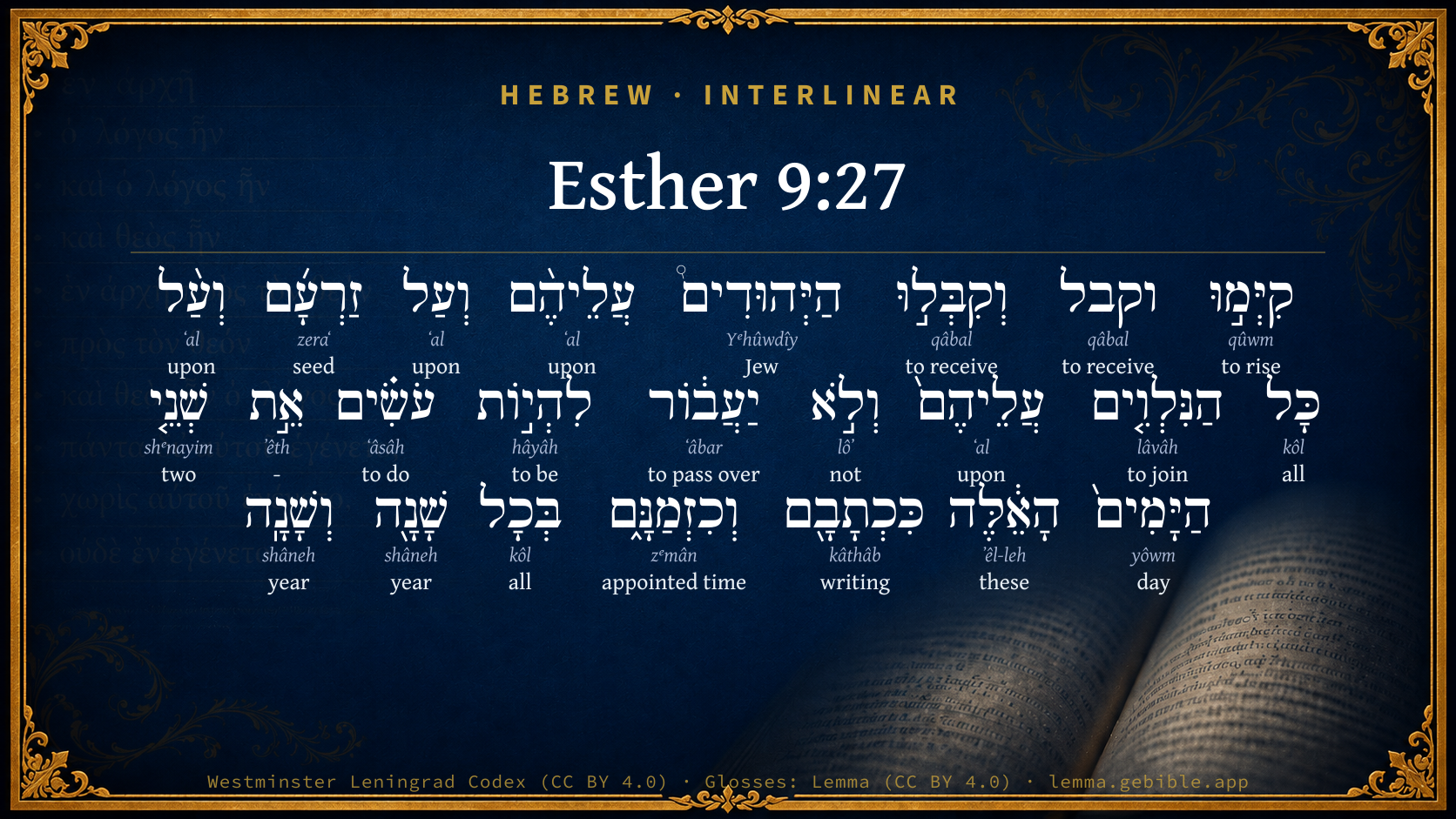
Esther 9:27

Hebrew (Westminster Leningrad Codex) Esther 9:27 appears in the Hebrew Old Testament. The text above is from the Westminster Leningrad Codex. Each word links to its Strong’s number, a concise gloss, and parsing drawn from the Open Scriptures Hebrew Bible morphology. Click any word for its full Brown-Driver-Briggs (BDB) entry.
Download image
Cite this verse

Esther 9:27 (World English Bible). Public Domain. Lemma interlinear Bible study tool, https://lemma.gebible.app/v/esther/9/27.

Show BibTeX & RIS
BibTeX
RIS
English Translation
the Jews ordained, and took on them, and on their seed, and on all such as joined themselves to them, so that it should not fail, that they would keep these two days according to the writing of it, and according to the appointed time of it, every year;
World English Bible · Public Domain
Download a study sheet

One document with this verse’s original text, its word-by-word gloss line, the meaning frame, cross-references with their text, attributed commentary, and full source and license credits — printable, and it pastes into notes with its structure intact.

This verse Autodidact and up

Study sheet (.html) Plain text (.txt)

A passage Seminary Student

Up to 50 verses in one chapter. A passage sheet keeps up to 6 commentary sources and 12 cross-references per verse, in the order this page ranks them, and says so on the sheet whenever that leaves anything out. Ask for a single verse and you get the Autodidact verse sheet above.

Everything on this page stays free to read, with no account — the sheet is a download of what is already on screen, not access to it.

Want to remove ads? Support Godless Engineer
Compare translations 3

The same verse in 3 English versions, stacked beneath the original-language interlinear above. Click any original word for its lexicon entry.

Each is an independent rendering of the whole verse — the interlinear is not word-aligned to these translations.

Highlighted words mark where these versions differ — a whole-verse word diff, not a word-by-word alignment.

  • World English Bible Public Domain
    the Jews ordained, and took on them, and on their seed, and on all such as joined themselves to them, so that it should not fail, that they would keep these two days according to the writing of it, and according to the appointed time of it, every year;
  • King James Version Public Domain
    The Jews ordained, and took upon them, and upon their seed, and upon all such as joined themselves unto them, so as it should not fail, that they would keep these two days according to their writing, and according to their appointed time every year;
  • unfoldingWord Literal Text CC BY-SA 4.0
    the Jews set up and accepted for themselves and for their seed and for all those who unite themselves to them (and it will not pass away) to be making these two days according to their writing and according to their appointed time every year by year.

unfoldingWord Literal Text — © unfoldingWord, licensed CC BY-SA 4.0. Word-aligned USFM3 via Door43 (git.door43.org/unfoldingWord/en_ult).

Versions to compare (up to 4)

3 of 4 selected

Show all 18 translations

Every available English version of this verse, each an independent rendering of the whole verse.

  • World English Bible Public Domain
    the Jews ordained, and took on them, and on their seed, and on all such as joined themselves to them, so that it should not fail, that they would keep these two days according to the writing of it, and according to the appointed time of it, every year;
  • Berean Standard Bible Public Domain
    the Jews bound themselves to establish the custom that they and their descendants and all who join them should not fail to celebrate these two days at the appointed time each and every year, according to their regulation.
  • Majority Standard Bible Public Domain
    the Jews bound themselves to establish the custom that they and their descendants and all who join them should not fail to celebrate these two days at the appointed time each and every year, according to their regulation.
  • King James Version Public Domain
    The Jews ordained, and took upon them, and upon their seed, and upon all such as joined themselves unto them, so as it should not fail, that they would keep these two days according to their writing, and according to their appointed time every year;
  • American Standard Version (1901) Public Domain
    the Jews ordained, and took upon them, and upon their seed, and upon all such as joined themselves unto them, so that it should not fail, that they would keep these two days according to the writing thereof, and according to the appointed time thereof, every year;
  • Revised Version (1885) Public Domain
    the Jews ordained, and took upon them, and upon their seed, and upon all such as joined themselves unto them, so as it should not fail, that they would keep these two days according to the writing thereof, and according to the appointed time thereof, every year;
  • Geneva Bible (1599) Public Domain
    The Iewes also ordeined, and promised for them and for their seede, and for all that ioyned vnto them, that they would not faile to obserue those two dayes euery yeere, according to their writing, and according to their season,
  • Douay-Rheims (1899) Public Domain
    And the things that they suffered, and that were afterwards changed, the Jews took upon themselves and their seed, and upon all that had a mind to be joined to their religion, so that it should be lawful for none to pass these days without solemnity: which the writing testifieth, and certain times require, as the years continually succeed one another.
  • Young's Literal Translation Public Domain
    the Jews have established and received upon them, and upon their seed, and upon all those joined unto them, and it doth not pass away, to be keeping these two days according to their writing, and according to their season, in every year and year;
  • Literal Standard Version CC BY-SA 4.0
    the Jews have established and received on them, and on their seed, and on all those joined to them, and it does not pass away, to be keeping these two days according to their writing, and according to their season, in every year and year;
  • Unlocked Literal Bible CC BY-SA 4.0
    the Jews accepted a new custom and duty. This custom would be for themselves, their descendants, and everyone who joined them. It would be that they would celebrate these two days every year. They would celebrate them in a certain way and at the same time each year.
  • unfoldingWord Literal Text CC BY-SA 4.0
    the Jews set up and accepted for themselves and for their seed and for all those who unite themselves to them (and it will not pass away) to be making these two days according to their writing and according to their appointed time every year by year.
  • Darby Bible Public Domain
    the Jews ordained and took upon them, and upon their seed, and upon all such as joined themselves to them, so that it should not fail, that they would observe these two days according to their writing and according to their fixed time, every year;
  • World Messianic Bible Public Domain
    the Jews established and imposed on themselves, on their descendants, and on all those who joined themselves to them, so that it should not fail that they would keep these two days according to what was written and according to its appointed time every year;
  • Webster's Bible Public Domain
    The Jews ordained, and took upon them, and upon their seed, and upon all such as joined themselves to them, so as it should not fail, that they would keep these two days according to their writing, and according to their appointed time every year;
  • Free Bible Version CC BY-SA 4.0
    the Jews committed themselves to adopt the practice that they and their descendants and all who join them should not forget to celebrate these two days as set down, and at the right time every year.
  • Bible in Basic English Public Domain
    The Jews made a rule and gave an undertaking, causing their seed and all those who were joined to them to do the same, so that it might be in force for ever, that they would keep those two days, as ordered in the letter, at the fixed time every year;
  • JPS Tanakh (1917) Public Domain
    the Jews ordained, and took upon them, and upon their seed, and upon all such as joined themselves unto them, so as it should not fail, that they would keep these two days according to the writing thereof, and according to the appointed time thereof, every year;

Literal Standard Version (2020), Covenant Press — licensed CC BY-SA 4.0. Text via the HelloAO Bible API (eBible.org). Unlocked Literal Bible (unfoldingWord) — licensed CC BY-SA 4.0. Text via the HelloAO Bible API (eBible.org). unfoldingWord Literal Text — © unfoldingWord, licensed CC BY-SA 4.0. Word-aligned USFM3 via Door43 (git.door43.org/unfoldingWord/en_ult). Free Bible Version, Dr. Jonathan Gallagher — licensed CC BY-SA 4.0. Text via the HelloAO Bible API (eBible.org).

Word by word

More ways to search: Search by grammar → Find every occurrence → Compare this word →

Practice this passage: Drill this verse → Learn its vocabulary →

וְכִזְמַנָּ֑ם
zᵉmân
H2165
“and · like/as · appointed time · their”
Conjunction + Preposition + Noun, Common, Masculine, Singular, Construct + Suffix, Personal, 3rd Person, Masculine, Plural
Part of Speech
Conjunction + Preposition + Noun
Type
Common
Gender
Masculine
Number
Singular
State
Construct
Full BDB Definition

Origin: from H2163

TWOT: 557a

a set time, appointed time, time
  1. קִיְּמ֣וּ qûwm H6965 “to rise” Verb, Piel, Perfect, 3rd Person, Common, Plural
  2. וקבל qâbal H6901 “and · to receive” Conjunction + Verb, Piel, Perfect, 3rd Person, Masculine, Singular
  3. וְקִבְּל֣וּ qâbal H6901 “and · to receive” Conjunction + Verb, Piel, Perfect, 3rd Person, Common, Plural
  4. הַיְּהוּדִים֩ Yᵉhûwdîy H3064 “the · Jews” Particle, Definite Article + Noun, Gentilic, Masculine, Plural, Absolute
  5. עֲלֵיהֶ֨ם ʻal H5921 “upon · them” Preposition + Suffix, Personal, 3rd Person, Masculine, Plural
  6. וְעַל ʻal H5921 “and · upon” Conjunction + Preposition
  7. זַרְעָ֜ם zeraʻ H2233 “seed · their” Noun, Common, Masculine, Singular, Construct + Suffix, Personal, 3rd Person, Masculine, Plural
  8. וְעַ֨ל ʻal H5921 “and · upon” Conjunction + Preposition
  9. כָּל kôl H3605 “all of” Noun, Common, Masculine, Singular, Construct
  10. הַנִּלְוִ֤ים lâvâh H3867 “the · joining” Particle, Definite Article + Verb, Niphal, Participle Active, Masculine, Plural, Absolute
  11. עֲלֵיהֶם֙ ʻal H5921 “upon · them” Preposition + Suffix, Personal, 3rd Person, Masculine, Plural
  12. וְלֹ֣א lôʼ H3808 “and · not” Conjunction + Particle, Negative
  13. יַעֲב֔וֹר ʻâbar H5674 “to pass over” Verb, Qal, Imperfect, 3rd Person, Masculine, Singular
  14. לִהְי֣וֹת hâyâh H1961 “to be” Preposition + Verb, Qal, Infinitive Construct
  15. עֹשִׂ֗ים ʻâsâh H6213 “doing” Verb, Qal, Participle Active, Masculine, Plural, Absolute
  16. אֵ֣ת ʼêth H853 “-” Particle, Direct Object
  17. שְׁנֵ֤י shᵉnayim H8147 “two” Adjective, Cardinal number, Masculine, Dual, Construct
  18. הַיָּמִים֙ yôwm H3117 “the · days” Particle, Definite Article + Noun, Common, Masculine, Plural, Absolute
  19. הָאֵ֔לֶּה ʼêl-leh H428 “the · these” Particle, Definite Article + Pronoun, Demonstrative, Common, Plural
  20. כִּכְתָבָ֖ם kâthâb H3791 “like/as · writing · their” Preposition + Noun, Common, Masculine, Singular, Construct + Suffix, Personal, 3rd Person, Masculine, Plural
  21. בְּכָל kôl H3605 “in/at · all of” Preposition + Noun, Common, Masculine, Singular, Construct
  22. שָׁנָ֖ה shâneh H8141 “year” Noun, Common, Feminine, Singular, Absolute
  23. וְשָׁנָֽה shâneh H8141 “and · year” Conjunction + Noun, Common, Feminine, Singular, Absolute

About this verse

These counts appear in no published source. They are computed here, from the morphology-tagged text and Lemma’s own curated glosses. What Lemma adds →

24
words
18
distinct lemmas
Historical
section

Notable vocabulary

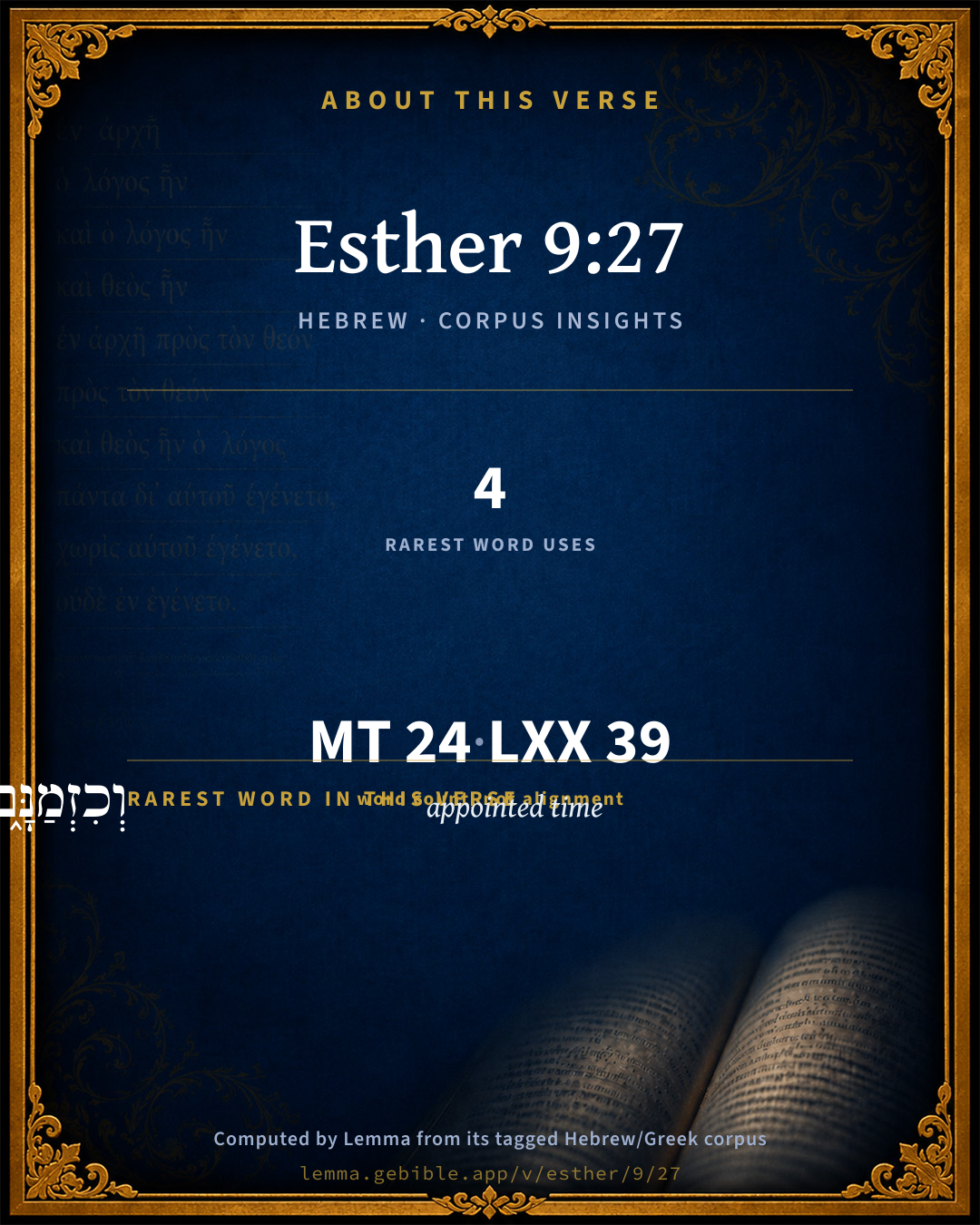
The rarest word here is וְכִזְמַנָּ֑ם appointed time H2165 — appearing just 4 times in the whole Hebrew Bible.

Shared distinctive vocabulary

וְכִזְמַנָּ֑ם appointed time H2165 occurs in 4 verses of the Hebrew Bible. Also found in:

Grammatical profile

  • 7 verbs
  • 9 nouns
  • 1 adjective
  • 1 pronoun
  • 4 prepositions
  • 2 particles

Verb forms

  • קִיְּמ֣וּ Piel · Perfect
  • וקבל Piel · Perfect
  • וְקִבְּל֣וּ Piel · Perfect
  • הַנִּלְוִ֤ים Niphal · Participle Active
  • יַעֲב֔וֹר Qal · Imperfect
  • לִהְי֣וֹת Qal · Infinitive Construct
  • עֹשִׂ֗ים Qal · Participle Active

Repetition

Words recur within this verse — often emphatic in Hebrew:

  • עֲלֵיהֶ֨ם upon H5921 ×4
  • וקבל to receive H6901 ×2
  • כָּל all H3605 ×2
  • שָׁנָ֖ה year H8141 ×2

Hebrew & Septuagint length

In English translation the verse runs 49 words from the Hebrew and 51 from the Septuagint (LXX English) — closely comparable.

A rough comparison of the two English renderings, which tokenize alike — not a word-level alignment.

Word counts can differ between the Hebrew and the Greek without any difference in meaning — e.g. the Hebrew direct-object marker אֵת has no separate Greek word, and Greek often adds the article ὁ.

In the original languages it is 24 Hebrew tokens and 39 Greek tokens — but the two are counted differently (Hebrew bundles its prefixes and suffixes into one token; the Greek is in lemma form), so that isn’t a like-for-like length.

Cross-references

11

Topical passages linked to Esther 9:27 in the Treasury of Scripture Knowledge — connected by theme and wording, ordered by reader-vote popularity; previews shown in the World English Bible.

  • Isaiah 56:6 Also the foreigners who join themselves to Yahweh, to minister to him, and to love the name of Yahweh, to be his servants, everyone who keeps the Sabbath from profaning it, and holds fast my covenant;
  • Zechariah 2:11 Many nations shall join themselves to Yahweh in that day, and shall be my people; and I will dwell in the midst of you, and you shall know that Yahweh of Hosts has sent me to you.
  • Esther 8:17 In every province, and in every city, wherever the king's commandment and his decree came, the Jews had gladness and joy, a feast and a good day. Many from among the peoples of the land became Jews; for the fear of the Jews was fallen on them.
  • Isaiah 56:3 Neither let the foreigner, who has joined himself to Yahweh, speak, saying, Yahweh will surely separate me from his people; neither let the eunuch say, Behold, I am a dry tree.
  • Deuteronomy 5:3 Yahweh didn't make this covenant with our fathers, but with us, even us, who are all of us here alive this day.
  • Deuteronomy 29:14–15 Neither with you only do I make this covenant and this oath,
  • Joshua 9:15 Joshua made peace with them, and made a covenant with them, to let them live: and the princes of the congregation swore to them.
  • 1 Samuel 30:25 It was so from that day forward, that he made it a statute and an ordinance for Israel to this day.
  • 2 Samuel 21:1–2 There was a famine in the days of David three years, year after year; and David sought the face of Yahweh. Yahweh said, It is for Saul, and for his bloody house, because he put to death the Gibeonites.
  • Esther 9:21 to enjoin those who they should keep the fourteenth day of the month Adar, and the fifteenth day of the same, yearly,
  • Zechariah 8:23 Thus says Yahweh of Hosts: "In those days, ten men will take hold, out of all the languages of the nations, they will take hold of the skirt of him who is a Jew, saying, 'We will go with you, for we have heard that God is with you.'"

Cross-references courtesy of OpenBible.info (CC BY 4.0).

Hebrew and Greek witnesses Masoretic Hebrew ↔ Greek Septuagint

The same verse in the two great witnesses to the Old Testament, shown verse-for-verse.

These are two independent witnesses, not word-aligned to each other, and the Septuagint is shown in lemma (dictionary) form.

Hebrew Esther 9:27 Masoretic · Westminster Leningrad Codex

קִיְּמ֣וּ וקבל וְקִבְּל֣וּ הַיְּהוּדִים֩ עֲלֵיהֶ֨ם וְעַל זַרְעָ֜ם וְעַ֨ל כָּל הַנִּלְוִ֤ים עֲלֵיהֶם֙ וְלֹ֣א יַעֲב֔וֹר לִהְי֣וֹת עֹשִׂ֗ים אֵ֣ת שְׁנֵ֤י הַיָּמִים֙ הָאֵ֔לֶּה כִּכְתָבָ֖ם וְכִזְמַנָּ֑ם בְּכָל שָׁנָ֖ה וְשָׁנָֽה

the Jews ordained, and took on them, and on their seed, and on all such as joined themselves to them, so that it should not fail, that they would keep these two days according to the writing of it, and according to the appointed time of it, every year;

World English Bible · Public Domain

Greek LXX Esther 9:27 Septuagint · lemma form

καί ἵστημι καί προςδέχομαι ὁ ἰουδαῖος ἐπί ἑαυτοῦ καί ἐπί ὁ σπέρμα αὐτός καί ἐπί ὁ προςτίθημι ἐπί αὐτός οὐδέ μήν ἄλλως χράω ὁ δέ ἡμέρα ἑαυτοῦ μνημόσυνον ἐπιτελέω κατά γενεά καί γενεά καί πόλις καί πατριά καί χώρα

And Mardochaeus established it, and the Jews took upon themselves, and upon their seed, and upon those that were joined to them to observe it, neither would they on any account behave differently: but these days were to be a memorial kept in every generation, and city, and family, and province.

LXX2012 (modern English Septuagint) · Public Domain

Hebrew: Westminster Leningrad Codex (CC BY 4.0). Greek: Septuagint (public domain); English from LXX2012 (modern English Septuagint) (Public Domain). How the Septuagint differs from the Hebrew →

Commentary

Notes on Esther 9:27 from classic Christian and Jewish commentators (each source and its license shown beneath its notes). The classic Christian expositions comment on the surrounding passage and are grouped to its opening verse, so a note may address several verses; the Jewish commentaries on the Tanakh (Rashi and others) are per-verse, so they appear only where the commentator wrote on this verse.

Lemma curates 59 commentaries, every one of them public domain or Creative Commons licensed, each selected and text-cleaned for this edition rather than reprinted as found. About our sources →

Trapp's Complete Commentary

John Trapp

Est 9:27 The Jews ordained, and took upon them, and upon their seed, and upon all such as joined themselves unto them, so as it should not fail, that they would keep these two days according to their writing, and according to their [appointed] time every year;

Ver. 27. The Jews ordained, and took upon them, and upon their seed] See Est 9:23. Here we have a repetition of what was before recited, and this is usual in Holy Scripture, as Gen 2:1 Exo 15:19, that things of moment may take the deeper impression. That of Austin is here to be remembered, Verba toties inculcata viva sunt, vera sunt, plana sunt, sana sunt. The words are driven home so many times afresh, are true, are plain, are sound. Let preachers do thus, and hearers be content to have it so. Nunquam satis dicitur, quod nunquam satis discitur. Never spoken enough because never learned enough. "To write to you the same things to me is not grievous, and for you it is safe," saith that great apostle, Php 3:1.

And upon all such as should join themselves unto them] Those proselytes, Est 8:17, or whatever hangs-on.

So as it should not fail] But stand as a law inviolable. And yet that Octogesimus octavus mirabilis annus, the 88th year of the marvelous, and that never-to-be-forgotten fifth of November, are with us almost antiquated; little would one think that God had ever done anything for us, either by land or by sea, against either fireworks or waterworks, Vae corpori nostro. Alas our body.

That they would keep these two days] Keep them as before, by consecrating a rest, and feasting before the Lord; not by gormandizing and profane sports, nor by running up and down from house to house, as whiffiers and wassailers, as at this day the Jews’ manner is; witness Antonius Margarita, a baptized Jew (L. de Cerem. Jud.).

According to their writing] i.e. Mordecai’s order, by themselves subscribed and ratified.

John Trapp, A Commentary or Exposition upon All the Books of the Old and New Testament (1647–1656) — public domain. Text from a community e-Sword module.

Joseph Benson's Commentary

Est 9:27. The Jews took upon them and upon their seed — To the latest generations; and upon all such as joined themselves unto them — That is, the Gentile proselytes, who were obliged to submit to other of the Jewish laws, and therefore to this also; the rather, because they enjoyed the benefit of this day’s deliverance, without which the Jewish nation and religion had been in a great measure, if not wholly, extinct in the world. That they would keep these two days according to their writing — According to that writing which was drawn up by Mordecai with Esther’s consent, (Est 9:23; Est 9:29,) and afterward confirmed by the consent of all the Jews in the several places. So that the observation of this feast was to be both universal and perpetual: even the proselytes were to observe it, in token of their sincere affection to the Jewish nation, and their having interests twisted with theirs. A concurrence in joys and praises is one branch of the communion of saints.

Joseph Benson's Commentary on the Old and New Testaments (1811–1818) — public domain. Text from a community e-Sword module.

Geneva Bible (1599)

Geneva Bible translators

Or, transgress.

Meaning, the fourteenth and fifteenth day of the month of Adar.

Geneva Bible (1599) marginal notes — public domain. Text via Bolls.life.

The Cambridge Bible for Schools and Colleges

gen. ed. J. J. S. Perowne

27. upon all such as joined themselves unto them] i.e. proselytes.

The Cambridge Bible for Schools and Colleges (gen. ed. J. J. S. Perowne; Cambridge University Press, 1878–1918) — public domain. Text from a community e-Sword module.

John Gill's Exposition

Then Esther the queen, the daughter of Abihail, and Mordecai the Jew, wrote with all authority,.... Strongly pressing the observance of this festival; before, Mordecai only recommended it, but now the queen gave a sanction to it, and laid her obligation on the Jews to observe it; perhaps some of the Jews were backward to it, or neglected to observe it, and therefore Esther and Mordecai joined in a letter to them, to press them to it; the Jewish chronologer (x) says, this was written the year following; the former Targum is, they wrote this whole volume, and the strength of the miracle, or set the miraculous deliverance in the strongest light, with this view:

to confirm this second letter of Purim; that it might have its weight and influence upon them, to engage them to keep it, as the latter Targum adds; that when it was an intercalary year, they might not read the Megillah (or book of Esther) in the first Adar, but in the second Adar.

(x) Seder Olam Rabba, c. 29. p. 87.

John Gill's Exposition of the Whole Bible (1746–1763) — public domain (CC PDM 1.0). Text via the HelloAO Bible API.

Matthew Poole's English Annotations

All such as joined themselves unto them, i.e. Gentile proselytes; who were obliged to submit to other of the Jewish laws, and therefore to this also; the rather, because they enjoyed the benefit of this day’s deliverance; without which the Jewish nation and religion had been in a great measure, if not wholly, extinct in the world.

According to their writing, i.e. according to that writing which was drawn up by Mordecai with Esther’s consent, Est 9:23,29, and afterwards confirmed by the consent of all the Jews in the several places.

Matthew Poole's English Annotations on the Holy Bible (1683–1685) — public domain. Text from a community e-Sword/MySword module.

Whedon's Commentary on the Bible

Daniel D. Whedon

27. According to their writing — That is, according to the writing or letters which Mordecai had addressed to them. In his letter Mordecai had probably suggested some form for observing the days.

Daniel D. Whedon (gen. ed.), Commentary on the Old and New Testaments (1874–1909) — public domain. Text from a community e-Sword module.

The Pulpit Commentary

All such as joined themselves to them. i.e. "all who should become proselytes to their faith". (see above, Est_8:17) According to their writing. According to the writing concerning the days which they had received from Mordecai (ver. 20).

Vers. 27, 28.

A memorial feast.

the Jews ordained and took upon them that these days should be remembered.

I The memorial feast was in recognition of a great DELIVERANCE. The deliverance effected by Mordecai and Esther for the Jews, hints at that effected for us by Jesus. There are points of great similarity. The Lord"s Supper is not only a feast of love, but in memory of our great deliverance from sin and death.

II The memorial was ordained READILY. Gratitude led to this. A further object was a desire to stimulate to similar faith in God in further circumstances of trial.

III The memorial was to be PERPETUAL. How faithfully have the Jews of every age kept that which was "ordained." We should keep that which Jesus instituted. Parents may lay upon their children certain moral obligations, but not now ceremonial burdens. That which they enjoin should be first observed by "themselves. H.

The Pulpit Commentary (1880–1919), ed. H.D.M. Spence-Jones & Joseph S. Exell — public domain. Text from a community e-Sword module.

John Wesley's Explanatory Notes

As joined - Gentile Proselytes; who were obliged to submit to other of the Jewish laws, and therefore to this also; the rather because they enjoyed the benefit of this day's deliverance; without which the Jewish nation and religion had been in a great measure, if not wholly, extinct. According - According to that writing which was drawn up by Mordecai, and afterwards confirmed by the consent of the Jews.

John Wesley, Explanatory Notes Upon the Whole Bible (1754–1765) — public domain. Text via the GEBible commentary corpus.

Rashi

Rabbi Shlomo Yitzchaki (Rashi)

who join them proselytes who were destined to convert.

according to their script that the Scroll [of Esther] should be written in the Ashuri script.

Rashi on the Tanakh — English translations: “The Judaica Press complete Tanach with Rashi, translated by A. J. Rosenberg” (CC BY 4.0); “Pentateuch with Rashi's commentary by M. Rosenbaum and A.M. Silbermann, 1929-1934” (public domain); “The Metsudah Tanach series, Lakewood, N.J” (CC BY 4.0); and “The Book of Joshua, Metsudah Publications, 1997” (CC BY 4.0). Text via Sefaria.

Lesson kit

Teaching starters — assembled from the data on this page, not authored interpretation. Every prompt links to the verse data it draws on. Edit before teaching.

Esther, in the Historical, opens this verse with 24 words (18 distinct Hebrew lemmas). Its most distinctive word is zᵉmân (“appointed time”). A historical commentator’s framing appears above. Read the whole chapter for the surrounding context.

Discussion questions

  1. What does “appointed time” (zᵉmân) contribute to the verse as a whole?
  2. How does Nehemiah 2:6, which shares the word «appointed time», read alongside this verse?
  3. What does the repetition of “upon” (4× in this one verse) do in this verse?
  4. These translations render this verse differently; the difference is in the English rendering, not the original. What questions does that raise?
  5. «קִיְּמ֣וּ» is a Piel Perfect verb. How does that grammatical form shape the action described?
  6. Compare how Trapp's Complete Commentary and Joseph Benson's Commentary read this verse. Where do they agree or differ?

Things to notice

Reading settings

Reading text

Shown beneath each verse's original-language words.

Old Testament
Old Testament edition

Read the OT as the Masoretic Hebrew (MT) or the Greek Septuagint (LXX).

English shown for the Greek Septuagint (in the Hebrew ↔ Greek comparison).

Comparing translations? Open the Compare panel on any verse page to stack up to four side by side.