
1 Kings 1:2

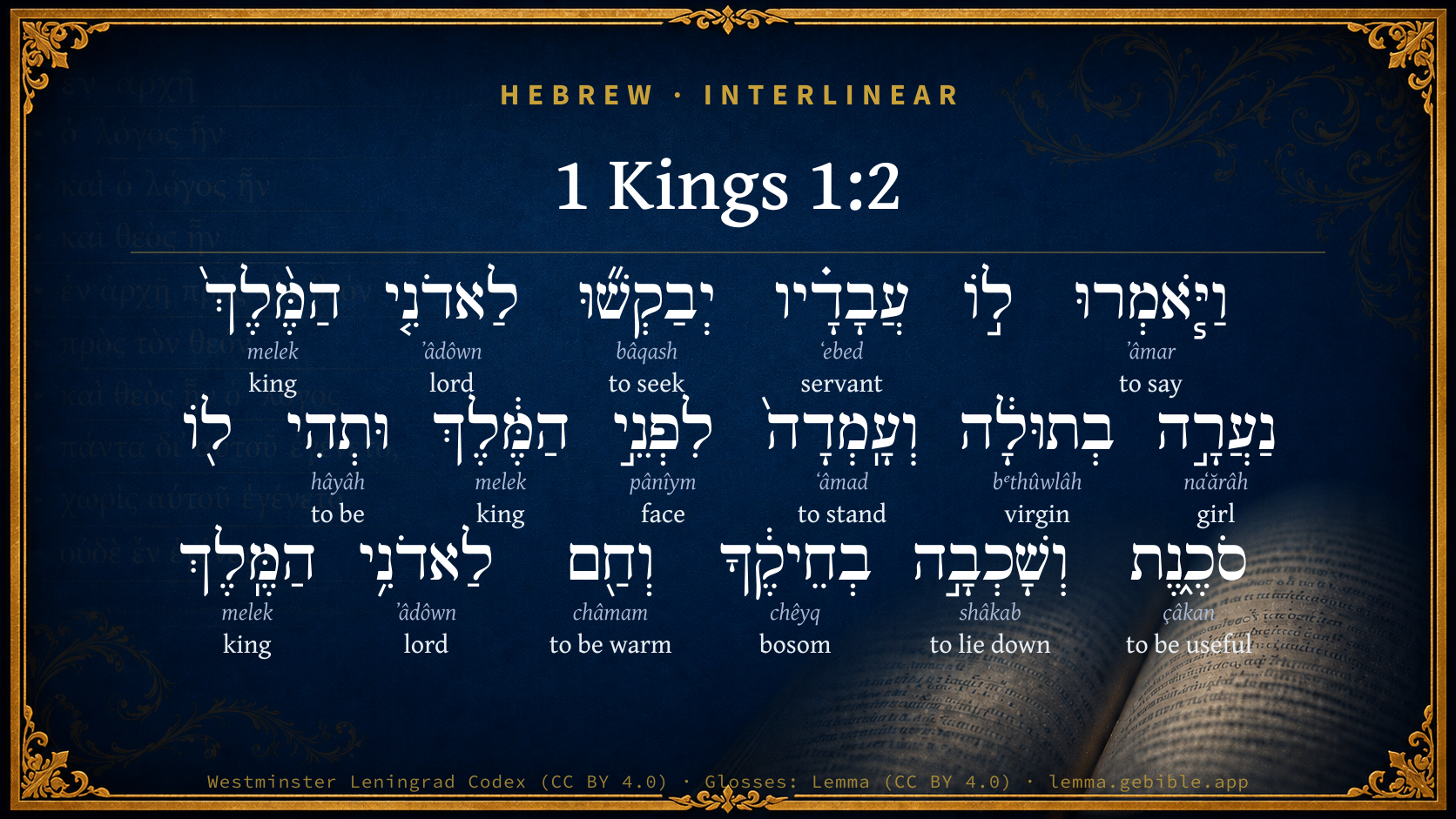
Hebrew (Westminster Leningrad Codex) 1 Kings 1:2 appears in the Hebrew Old Testament. The text above is from the Westminster Leningrad Codex. Each word links to its Strong’s number, a concise gloss, and parsing drawn from the Open Scriptures Hebrew Bible morphology. Click any word for its full Brown-Driver-Briggs (BDB) entry.
Download image
Cite this verse

1 Kings 1:2 (World English Bible). Public Domain. Lemma interlinear Bible study tool, https://lemma.gebible.app/v/1-kings/1/2.

Show BibTeX & RIS
BibTeX
RIS
English Translation
Therefore his servants said to him, Let there be sought for my lord the king a young virgin: and let her stand before the king, and cherish him; and let her lie in your bosom, that my lord the king may keep warm.
World English Bible · Public Domain
Download a study sheet

One document with this verse’s original text, its word-by-word gloss line, the meaning frame, cross-references with their text, attributed commentary, and full source and license credits — printable, and it pastes into notes with its structure intact.

This verse Autodidact and up

Study sheet (.html) Plain text (.txt)

A passage Seminary Student

Up to 50 verses in one chapter. A passage sheet keeps up to 6 commentary sources and 12 cross-references per verse, in the order this page ranks them, and says so on the sheet whenever that leaves anything out. Ask for a single verse and you get the Autodidact verse sheet above.

Everything on this page stays free to read, with no account — the sheet is a download of what is already on screen, not access to it.

Want to remove ads? Support Godless Engineer
Compare translations 3

The same verse in 3 English versions, stacked beneath the original-language interlinear above. Click any original word for its lexicon entry.

Each is an independent rendering of the whole verse — the interlinear is not word-aligned to these translations.

Highlighted words mark where these versions differ — a whole-verse word diff, not a word-by-word alignment.

  • World English Bible Public Domain
    Therefore his servants said to him, Let there be sought for my lord the king a young virgin: and let her stand before the king, and cherish him; and let her lie in your bosom, that my lord the king may keep warm.
  • King James Version Public Domain
    Wherefore his servants said unto him, Let there be sought for my lord the king a young virgin: and let her stand before the king, and let her cherish him, and let her lie in thy bosom, that my lord the king may get heat.
  • unfoldingWord Literal Text CC BY-SA 4.0
    And his servants said to him, “Let them seek for my lord the king a young woman, a virgin, and let her stand to the face of the king, and let her be caring for him, and let her lie in your bosom, that it may be warm for my lord the king.”

unfoldingWord Literal Text — © unfoldingWord, licensed CC BY-SA 4.0. Word-aligned USFM3 via Door43 (git.door43.org/unfoldingWord/en_ult).

Versions to compare (up to 4)

3 of 4 selected

Show all 18 translations

Every available English version of this verse, each an independent rendering of the whole verse.

  • World English Bible Public Domain
    Therefore his servants said to him, Let there be sought for my lord the king a young virgin: and let her stand before the king, and cherish him; and let her lie in your bosom, that my lord the king may keep warm.
  • Berean Standard Bible Public Domain
    So his servants said to him, “Let us search for a young virgin for our lord the king, to attend to him and care for him and lie by his side to keep him warm.”
  • Majority Standard Bible Public Domain
    So his servants said to him, “Let us search for a young virgin for our lord the king, to attend to him and care for him and lie by his side to keep him warm.”
  • King James Version Public Domain
    Wherefore his servants said unto him, Let there be sought for my lord the king a young virgin: and let her stand before the king, and let her cherish him, and let her lie in thy bosom, that my lord the king may get heat.
  • American Standard Version (1901) Public Domain
    Wherefore his servants said unto him, Let there be sought for my lord the king a young virgin: and let her stand before the king, and cherish him; and let her lie in thy bosom, that my lord the king may get heat.
  • Revised Version (1885) Public Domain
    Wherefore his servants said unto him, Let there be sought for my lord the king a young virgin: and let her stand before the king, and cherish him; and let her lie in thy bosom, that my lord the king may get heat.
  • Geneva Bible (1599) Public Domain
    Wherefore his seruants saide vnto him, Let there be sought for my lord ye King a yong virgin, and let her stand before the king, and cherish him: and let her lie in thy bosome, that my lord the King may get heate.
  • Douay-Rheims (1899) Public Domain
    His servants therefore said to him: Let us seek for our lord the king, a young virgin, and let her stand before the king, and cherish him, and sleep in his bosom, and warm our lord the king.
  • Young's Literal Translation Public Domain
    and his servants say to him, `Let them seek for my lord the king a young woman, a virgin, and she hath stood before the king, and is to him a companion, and hath lain in thy bosom, and my lord the king hath heat.'
  • Literal Standard Version CC BY-SA 4.0
    and his servants say to him, “Let them seek [for] a young woman, a virgin, for my lord the king, and she has stood before the king, and is a companion to him, and has lain in your bosom, and my lord the king has heat.”
  • Unlocked Literal Bible CC BY-SA 4.0
    So his servants said to him, “Let us look for a young virgin for our master the king. Let her serve the king and take care of him. Let her lie in his arms so that our master the king may keep warm.”
  • unfoldingWord Literal Text CC BY-SA 4.0
    And his servants said to him, “Let them seek for my lord the king a young woman, a virgin, and let her stand to the face of the king, and let her be caring for him, and let her lie in your bosom, that it may be warm for my lord the king.”
  • Darby Bible Public Domain
    And his servants said to him, Let there be found for my lord the king a young virgin; and let her stand before the king, and let her cherish him, and let her lie in thy bosom, that my lord the king may get warm.
  • World Messianic Bible Public Domain
    Therefore his servants said to him, “Let a young virgin be sought for my lord the king. Let her stand before the king, and cherish him; and let her lie in your bosom, that my lord the king may keep warm.”
  • Webster's Bible Public Domain
    Wherefore his servants said to him, Let there be sought for my lord the king a young virgin: and let her stand before the king, and let her cherish him, and let her lie in thy bosom, that my lord the king may get heat.
  • Free Bible Version CC BY-SA 4.0
    So his officials suggested, “Let a search be made on behalf of Your Majesty for a young virgin to serve you and look after you. She can lie next to you and keep you warm.”
  • Bible in Basic English Public Domain
    So his servants said to him, Let search be made for a young virgin for my lord the king, to take care of him and be waiting on him; and you may take her in your arms, and so my lord the king will be warm.
  • JPS Tanakh (1917) Public Domain
    Wherefore his servants said unto him: 'Let there be sought for my lord the king a young virgin; and let her stand before the king, and be a companion unto him; and let her lie in thy bosom, that my lord the king may get heat.'

Literal Standard Version (2020), Covenant Press — licensed CC BY-SA 4.0. Text via the HelloAO Bible API (eBible.org). Unlocked Literal Bible (unfoldingWord) — licensed CC BY-SA 4.0. Text via the HelloAO Bible API (eBible.org). unfoldingWord Literal Text — © unfoldingWord, licensed CC BY-SA 4.0. Word-aligned USFM3 via Door43 (git.door43.org/unfoldingWord/en_ult). Free Bible Version, Dr. Jonathan Gallagher — licensed CC BY-SA 4.0. Text via the HelloAO Bible API (eBible.org).

Word by word

More ways to search: Search by grammar → Find every occurrence → Compare this word →

Practice this passage: Drill this verse → Learn its vocabulary →

סֹכֶ֑נֶת
çâkan
H5532
“being useful”
Verb, Qal, Participle Active, Feminine, Singular, Absolute
Part of Speech
Verb
Stem
Qal
Form
Participle Active
Gender
Feminine
Number
Singular
State
Absolute
Full BDB Definition

Origin: a primitive root

TWOT: 1494

to be of use or service or profit or benefit - (Qal) - to be of use or service - servitor, steward (participle) - to benefit, profit - (Hiphil) to be used, be wont, exhibit use or habit, show harmony
  1. וַיֹּ֧אמְרוּ ʼâmar H559 “and · to say” Conjunction + Verb, Qal, Sequential Imperfect, 3rd Person, Masculine, Plural
  2. עֲבָדָ֗יו ʻebed H5650 “servants · his” Noun, Common, Masculine, Plural, Construct + Suffix, Personal, 3rd Person, Masculine, Singular
  3. יְבַקְשׁ֞וּ bâqash H1245 “to seek” Verb, Piel, Imperfect, 3rd Person, Masculine, Plural
  4. לַאדֹנִ֤י ʼâdôwn H113 “to/for · lord · my” Preposition + Noun, Common, Masculine, Singular, Construct + Suffix, Personal, 1st Person, Common, Singular
  5. הַמֶּ֨לֶךְ֙ melek H4428 “the · king” Particle, Definite Article + Noun, Common, Masculine, Singular, Absolute
  6. נַעֲרָ֣ה naʻărâh H5291 “girl” Noun, Common, Feminine, Singular, Absolute
  7. בְתוּלָ֔ה bᵉthûwlâh H1330 “virgin” Noun, Common, Feminine, Singular, Absolute
  8. וְעָֽמְדָה֙ ʻâmad H5975 “and · to stand” Conjunction + Verb, Qal, Sequential Perfect, 3rd Person, Feminine, Singular
  9. לִפְנֵ֣י pânîym H6440 “to/for · face(s) of” Preposition + Noun, Common, Both, Plural, Construct
  10. הַמֶּ֔לֶךְ melek H4428 “the · king” Particle, Definite Article + Noun, Common, Masculine, Singular, Absolute
  11. וּתְהִי hâyâh H1961 “and · to be” Conjunction + Verb, Qal, Jussive, 3rd Person, Feminine, Singular
  12. וְשָׁכְבָ֣ה shâkab H7901 “and · to lie down” Conjunction + Verb, Qal, Sequential Perfect, 3rd Person, Feminine, Singular
  13. בְחֵיקֶ֔ךָ chêyq H2436 “in/at · bosom · your” Preposition + Noun, Common, Masculine, Singular, Construct + Suffix, Personal, 2nd Person, Masculine, Singular
  14. וְחַ֖ם châmam H2552 “and · to be warm” Conjunction + Verb, Qal, Sequential Perfect, 3rd Person, Masculine, Singular
  15. לַאדֹנִ֥י ʼâdôwn H113 “to/for · lord · my” Preposition + Noun, Common, Masculine, Singular, Construct + Suffix, Personal, 1st Person, Common, Singular
  16. הַמֶּֽלֶךְ melek H4428 “the · king” Particle, Definite Article + Noun, Common, Masculine, Singular, Absolute

About this verse

These counts appear in no published source. They are computed here, from the morphology-tagged text and Lemma’s own curated glosses. What Lemma adds →

19
words
14
distinct lemmas
Historical
section

Notable vocabulary

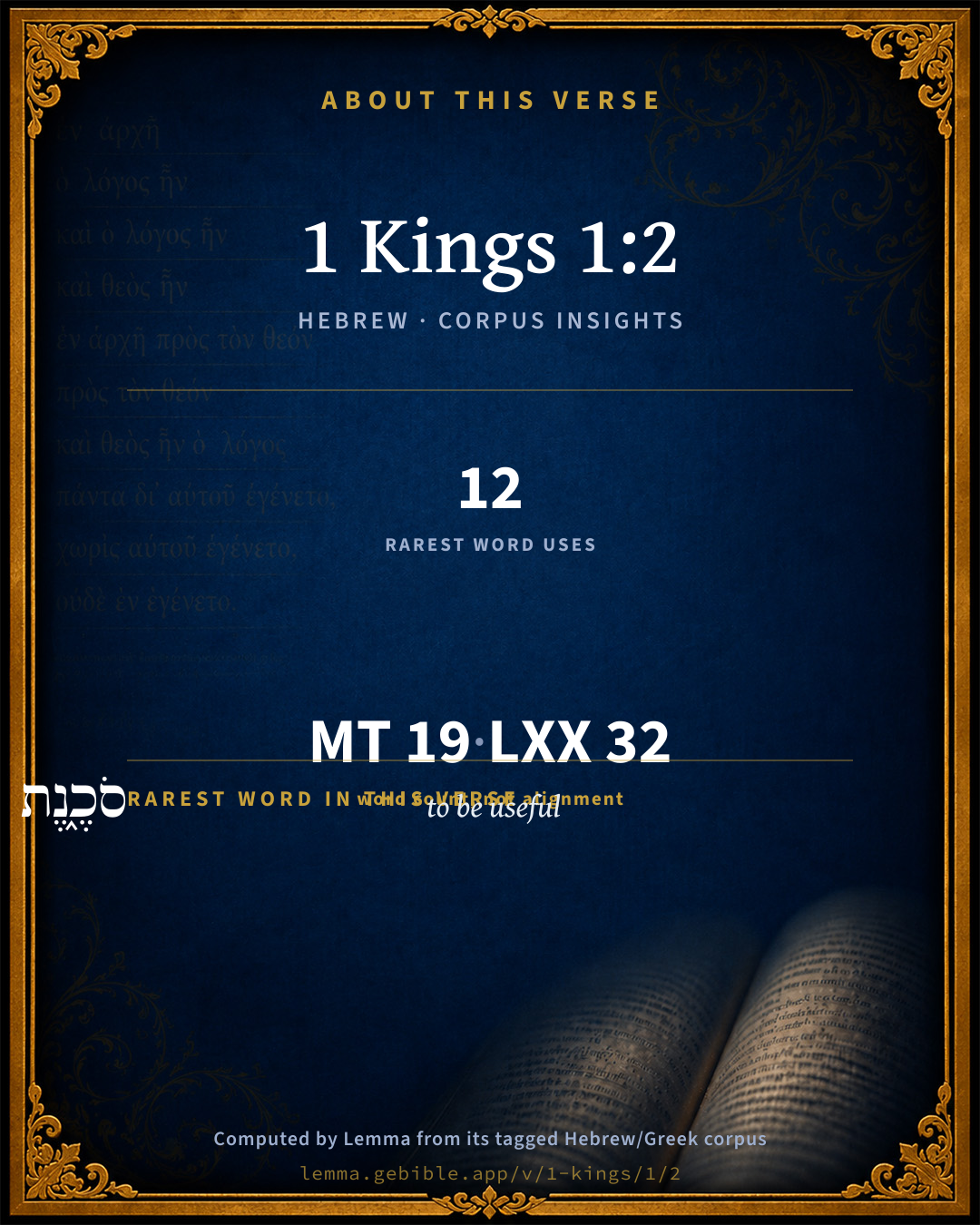
The rarest word here is סֹכֶ֑נֶת to be useful H5532 — appearing just 12 times in the whole Hebrew Bible.

Shared distinctive vocabulary

סֹכֶ֑נֶת to be useful H5532 occurs in 10 verses of the Hebrew Bible. Also found in:

Grammatical profile

  • 7 verbs
  • 10 nouns
  • 2 prepositions

Verb forms

  • וַיֹּ֧אמְרוּ Qal · Sequential Imperfect
  • יְבַקְשׁ֞וּ Piel · Imperfect
  • וְעָֽמְדָה֙ Qal · Sequential Perfect
  • וּתְהִי Qal · Jussive
  • סֹכֶ֑נֶת Qal · Participle Active
  • וְשָׁכְבָ֣ה Qal · Sequential Perfect
  • וְחַ֖ם Qal · Sequential Perfect

Repetition

Words recur within this verse — often emphatic in Hebrew:

  • הַמֶּ֨לֶךְ֙ king H4428 ×3
  • לַאדֹנִ֤י lord H113 ×2

Hebrew & Septuagint length

In English translation the verse runs 43 words from the Hebrew and 35 from the Septuagint (LXX English) — closely comparable.

A rough comparison of the two English renderings, which tokenize alike — not a word-level alignment.

Word counts can differ between the Hebrew and the Greek without any difference in meaning — e.g. the Hebrew direct-object marker אֵת has no separate Greek word, and Greek often adds the article ὁ.

In the original languages it is 19 Hebrew tokens and 32 Greek tokens — but the two are counted differently (Hebrew bundles its prefixes and suffixes into one token; the Greek is in lemma form), so that isn’t a like-for-like length.

Cross-references

8

Topical passages linked to 1 Kings 1:2 in the Treasury of Scripture Knowledge — connected by theme and wording, ordered by reader-vote popularity; previews shown in the World English Bible.

  • Ecclesiastes 4:11 Again, if two lie together, then they have warmth; but how can one keep warm alone?
  • Genesis 16:5 Sarai said to Abram, "This wrong is your fault. I gave my handmaid into your bosom, and when she saw that she had conceived, I was despised in her eyes. Yahweh judge between me and you."
  • Micah 7:5 Don't trust in a neighbor. Don't put confidence in a friend. With the woman lying in your embrace, Be careful of the words of your mouth!
  • 1 Samuel 16:21–22 David came to Saul, and stood before him: and he loved him greatly; and he became his armor bearer.
  • Deuteronomy 10:8 At that time Yahweh set apart the tribe of Levi, to bear the ark of the covenant of Yahweh, to stand before Yahweh to minister to him, and to bless in his name, to this day.
  • Deuteronomy 13:6 If your brother, the son of your mother, or your son, or your daughter, or the wife of your bosom, or your friend, who is as your own soul, entice you secretly, saying, Let us go and serve other gods, which you have not known, you, nor your fathers;
  • 2 Samuel 12:3 but the poor man had nothing, except one little ewe lamb, which he had bought and raised. It grew up together with him, and with his children. It ate of his own food, drank of his own cup, and lay in his bosom, and was to him like a daughter.
  • 2 Chronicles 29:11 My sons, don't be negligent now; for Yahweh has chosen you to stand before him, to minister to him, and that you should be his ministers, and burn incense.

Cross-references courtesy of OpenBible.info (CC BY 4.0).

Hebrew and Greek witnesses Masoretic Hebrew ↔ Greek Septuagint

The same verse in the two great witnesses to the Old Testament, shown verse-for-verse.

These are two independent witnesses, not word-aligned to each other, and the Septuagint is shown in lemma (dictionary) form.

Hebrew 1 Kings 1:2 Masoretic · Westminster Leningrad Codex

וַיֹּ֧אמְרוּ ל֣וֹ עֲבָדָ֗יו יְבַקְשׁ֞וּ לַאדֹנִ֤י הַמֶּ֨לֶךְ֙ נַעֲרָ֣ה בְתוּלָ֔ה וְעָֽמְדָה֙ לִפְנֵ֣י הַמֶּ֔לֶךְ וּתְהִי ל֖וֹ סֹכֶ֑נֶת וְשָׁכְבָ֣ה בְחֵיקֶ֔ךָ וְחַ֖ם לַאדֹנִ֥י הַמֶּֽלֶךְ

Therefore his servants said to him, Let there be sought for my lord the king a young virgin: and let her stand before the king, and cherish him; and let her lie in your bosom, that my lord the king may keep warm.

World English Bible · Public Domain

Greek LXX 1 Kings 1:2 Septuagint · lemma form

καί εἶπον ὁ παῖς αὐτός ζητέω ὁ κύριος ἐγώ ὁ βασιλεύς παρθένος νεᾶνις καί παραἵστημι ὁ βασιλεύς καί εἰμί αὐτός θάλπω καί κοιμάω μετά αὐτός καί θερμαίνω ὁ κύριος ἐγώ ὁ βασιλεύς

And his servants said, Let them seek for the king a young virgin, and she shall wait on the king, and cherish him, and lie with him, and my lord the king shall be warmed.

LXX2012 (modern English Septuagint) · Public Domain

On this verse, The Pulpit Commentary discusses the Septuagint’s reading. Read the note in Commentary ↓

Hebrew: Westminster Leningrad Codex (CC BY 4.0). Greek: Septuagint (public domain); English from LXX2012 (modern English Septuagint) (Public Domain). How the Septuagint differs from the Hebrew →

Targum (Aramaic paraphrase)

1

The Targum is the ancient Jewish Aramaic paraphrase of the Hebrew Scriptures — an interpretive translation, not the Hebrew text itself. Onkelos (literal) and Pseudo-Jonathan (expansive) render the Torah, and Jonathan the Prophets. Coverage is partial: where no permissively-licensed English translation exists for a verse, only the Aramaic is shown. This is verse-level text, not a word-by-word alignment to the Hebrew.

  1. Targum Jonathan Prophets (Joshua–Malachi)
    וַאֲמַרוּ לֵיהּ עַבְדוֹהִי יִבְעוּן לְרִבּוֹנִי מַלְכָּא עוּלֵמְתָּא בְּתוּלְתָּא וּתְשַׁמֵישׁ קֳדָם מַלְכָּא וּתְהֵי לֵיהּ קָרִיבָא וְתִשְׁכּוּב לְוָתָךְ וְתִשְׁחַן לְרִבּוֹנִי מַלְכָּא:

    (no public-domain English translation for this verse)

    Targum Jonathan — Aramaic: “Mikraot Gedolot” (public domain). English: “Sefaria Community Translation” (CC0 1.0 (public-domain dedication)); “London "Chaldee Paraphrase," 1871” (public domain). Text via Sefaria.

Commentary

Notes on 1 Kings 1:2 from classic Christian and Jewish commentators (each source and its license shown beneath its notes). The classic Christian expositions comment on the surrounding passage and are grouped to its opening verse, so a note may address several verses; the Jewish commentaries on the Tanakh (Rashi and others) are per-verse, so they appear only where the commentator wrote on this verse.

Lemma curates 59 commentaries, every one of them public domain or Creative Commons licensed, each selected and text-cleaned for this edition rather than reprinted as found. About our sources →

The Cambridge Bible for Schools and Colleges

gen. ed. J. J. S. Perowne

2. his servants] The word, though primarily applied to those who were occupied in servile work, had come by this time to be used regularly of those who were about a royal person, and in such a position as to venture on giving him counsel. Josephus (Ant. vii. 15.3) says they were the king’s physicians. (Cf. Gen_1:2.)

Let there be sought] Literally ‘Let them seek.’ This kind of variation is frequent in the A.V. for the sake of the English; as also the personal form of a sentence, put where the Hebrew verb is impersonal. Thus the last clause in 1Ki_1:1 is literally ‘and it grew not warm to him.’ As such literal renderings are very often noticed on the margin, no special mention will hereafter be made of them.

a young virgin] This device, whereby it was thought to communicate vital heat from a young frame to an old one, was adopted by the advice of physicians long after David’s time. See Bacon, Hist. Vitœ et Mortis, Medicamina ad longævitatem 1Ki_9:25.

and let her stand before the king] This phrase is used of those who serve or minister to another. Thus Deu_1:38, Joshua the minister of Moses is said to ‘stand before him.’ It seems clear from the language of Solomon (1Ki_2:22) that Abishag was to be counted as one of the wives of David. Polygamy was not at this time confined to kings like David and Solomon, but was practised by other Israelites, as is shewn by the history of Elkanah (1Sa_1:2).

The Cambridge Bible for Schools and Colleges (gen. ed. J. J. S. Perowne; Cambridge University Press, 1878–1918) — public domain. Text from a community e-Sword module.

Trapp's Complete Commentary

John Trapp

1Ki 1:2 Wherefore his servants said unto him, Let there be sought for my lord the king a young virgin: and let her stand before the king, and let her cherish him, and let her lie in thy bosom, that my lord the king may get heat.

Ver. 2. Wherefore his servants said unto him,] i.e., His physicians, his Yεραποντες θεραπευοντες.

And let her lie in thy bosom.] In a medicinal way, to work heat in thy cold body, whilst she lieth with thee as a wife or concubine: for else they would never have advised it, nor David have taken their counsel.

John Trapp, A Commentary or Exposition upon All the Books of the Old and New Testament (1647–1656) — public domain. Text from a community e-Sword module.

Joseph Benson's Commentary

1Ki 1:2. Wherefore his servants — His physicians; said, Let there be sought for the king a young virgin — Whose natural heat is fresh and wholesome, and not impaired with bearing or breeding children. The same counsel is given by Galen for the cure of some cold and dry distempers. Let her stand before the king — That is, minister unto him, or wait upon him in his sickness, as occasion requires. And let her lie in his bosom — As his wife; for that she was so, may appear by divers arguments. 1st, Otherwise this had been a wicked course; which, therefore, neither his servants would have dared to prescribe, nor would David have used, especially being now in a dying condition. 2d, It appears from this phrase of lying in his bosom, which is everywhere in Scripture mentioned as the privilege of a wife. 3d, This made Adonijah’s crime, in desiring her to wife, so heinous in Solomon’s account, because he saw, that by marrying the king’s wife, he designed to revive his pretence to the kingdom.

Joseph Benson's Commentary on the Old and New Testaments (1811–1818) — public domain. Text from a community e-Sword module.

Geneva Bible (1599)

Geneva Bible translators

Or, serve him.

Geneva Bible (1599) marginal notes — public domain. Text via Bolls.life.

Adam Clarke's Commentary

Verse 2. Let there be sought - a young virgin] This was the best remedy which in his state could be prescribed. His nearly exhausted frame would infallibly absorb from her young and healthy body an additional portion of animal heat, and consequently trim and revive the flame of animal life. This is properly, as I have elsewhere expressed it, Friar Bacon's secret for the cure of old age.

Adam Clarke's Commentary on the Bible (1810–1826) — public domain. Text from a community e-Sword/MySword module.

John Gill's Exposition

Wherefore his servants said unto him,.... His physicians; so Joseph's physicians are called his servants, Gen 50:2;

let there be sought for my lord the king a young virgin; not only a young woman, but a virgin, that has more natural heat than women that have bore children have, which is abated thereby:

and let her stand before the king: minister to him, serve him with whatsoever he should want to eat or drink; and so by being in his presence, and taking things at her hand, she might be the more ingratiated into his affections:

and let her cherish him; as the husband the wife, so she her husband, as doubtless David was; and that by giving him cordials to cheer his spirits, and everything that was convenient for him, and particularly by lying with him. Kimchi interprets the word of her being profitable to him, in which sense the word is used, Job 22:2; that is, by warming him; Ben Gersom understands it of her being made mistress of his treasures, according to the sense of the word in Isa 22:15; that she might have the command of his purse, and provide anything proper for him, without being taken notice of or obstructed; but the Targum is better,

"and let her be near him,''

lie close unto him, and even in his bosom, as in the next clause:

and let her lie in his bosom; which shows that it was proposed that he should marry her, at least that she should become his concubine wife, since this phrase is descriptive of a wife, Mic 7:5; nor can it be thought his physicians would advise, or he agree to have a young woman admitted to his bed, without marriage; and if this had not been the case, it would not have answered the design of Adonijah in requesting her in marriage after his father's death, which was to make way to ascend the throne when opportunity should offer; nor would his request have been so much resented by Solomon as it was, Kg1 2:17;

that my lord the king may get heat: and somewhat similar to this, Galen, that great physician, prescribed in like cases (d).

(d) Vid. Poli Synopsin in loc.

John Gill's Exposition of the Whole Bible (1746–1763) — public domain (CC PDM 1.0). Text via the HelloAO Bible API.

Albert Barnes' Notes on the Bible

Since the Jewish law allowed polygamy, David’s conduct in following - what has been said to have been - physician’s advice, was blameless.

Albert Barnes' Notes on the Bible (1834–1885) — public domain. Text from a community e-Sword/MySword module.

Haydock's Catholic Bible Commentary

Servants. Physicians. (Josephus, [Antiquities?] vii. 14.) --- People of the faculty still adopt the same sentiments; and when fire and clothes will not procure heat, they advise the application of living creatures. (Bartholin ix.; Galen vii.; Vales. Philos. c. 19.)

George Leo Haydock (1774–1849), Haydock's Catholic Family Bible and Commentary, 1859 edition — public domain. Excludes Psalms (Douay-Rheims chapter numbering differs from Protestant) and Deuterocanonical books (Catholic canon only).

Matthew Poole's English Annotations

His servants; his physicians.

A young virgin; whose natural heat is fresh and wholesome, and not impaired with bearing or breeding of children. The same counsel doth Galen give for the cure of some cold and dry distempers.

Let her stand before the king, i.e. minister unto him, or wait upon him, (as this phrase is oft used,) in his sickness, as occasion requires. Let her lie in thy bosom, as his wife or concubine; for that she was so may appear by divers arguments. First, Otherwise this had been a wicked counsel and course; which therefore neither his servants durst have prescribed, nor would David have used, especially being now in a dying condition. And seeing this was easily prevented by his taking her for his concubine, which then was esteemed allowable, it is absurd to think that he would not choose the safer way. Secondly, That passage, 1Ki 1:4,

but the king knew her not, implies that the king might have had carnal knowledge of her without sin or scandal. Thirdly, it appears from this phrase of

lying in his bosom, which is every where in Scripture mentioned as the privilege of a wife and concubine, as Gen 16:5; Deu 13:6; 2Sa 12:8; Mic 7:5. Fourthly, This made Adonijah’s crime, in desiring her to wife, so heinous in Solomon’s account, because he wisely saw, that by marrying the king’s wife he designed to revive his pretence to the kingdom, at least in case of Solomon’s death; which pretence had been ridiculous, if she had been only the king’s handmaid.

Matthew Poole's English Annotations on the Holy Bible (1683–1685) — public domain. Text from a community e-Sword/MySword module.

Whedon's Commentary on the Bible

Daniel D. Whedon

2. His servants — Josephus calls them his physicians.

Let her cherish him — Literally, let her be to him a female nurse. It was one part of her service to attend to his private wants, to perform the various little items of nursing expected of a familiar attendant. All this is comprehended in the word סכנת, a female attendant. Another part of her service was to lie in the king’s bosom, that is, sleep with him, and thus communicate to him animal heat and vigour. This method of recruiting the wasted vigour of age is natural and well known; but while it benefits the old, it must needs take away from the strength of the young. The too common practice of young persons sleeping with aged aunts, uncles, or grandparents is the ruin of many a naturally vigorous and healthy constitution.

Daniel D. Whedon (gen. ed.), Commentary on the Old and New Testaments (1874–1909) — public domain. Text from a community e-Sword module.

The Pulpit Commentary

Wherefore Heb. and his servants according to Josephus (Antiq. 7:14, 3), his physicians said unto him, Let there be sought lit. as marg., let them seek" for my lord the king the singular pronoun is used as representing the servant who was spokesman for the rest a young virgin marg., a damsel, a virgin. " She must be young, to impart heat, and a virgin, as befitted a king. Though she was recommended as a nurse, they would naturally suppose she might be taken as a concubine and let her stand before the king i.e., as servant (Ver. 4). Cf. 1Ki_12:6, Gen_41:46; Dan_1:5; Deu_1:38 with Jos_1:1 1Ki_10:8. In the East, servants still stand and wait their masters" pleasure. Cf., 2Ki_5:25 and let her cherish him So also the LXX, kai estai aujtolpousa. But Gesenius, al, "be a companion to him" and let her lie in thy or "his," LXX autou, Vulg. sue bosom the expression is generally, but not invariably (see 1 Kings Rth_4:16) used de complexu venereo that my lord the king may get heat. This close embrace of youth was an obvious way of imparting animal heat to age ("Color a corpore juvenili ac sane maxime prodest senibus." Grotius), and was the more favoured because other and internal remedies were not then known. It is recognized by Galen, and is said to have been prescribed by a Jewish physician to the Emperor Frederick Bar-baressa (Bahr). It is stated by Roberts that it is still largely followed in the East.

Only The word perhaps signifies "that there was one exception to the flourishing condition of things which the writer has been describing" (Rawlinson), though the people are nowhere blamed for sacrificing on the high places, and Solomon"s sacrifice at "the great high place "was full of blessing. The idea rather is that just as he was obliged to bring his Egyptian wife into the city of David, because his palace was not yet finished, so the people were compelled to sacrifice on the high places, because the temple was not yet built (Keil), and "the place" where God would put His name had only just been chosen (1Ch_22:1) the people sacrificed Heb. were sacrificing, i.e., habitually, constantly in high places All nations have chosen hill tops for acts of worship, perhaps as being nearer heaven. "Even Abraham built an altar to the Lord on a mountain near Bethel." (Gen_12:7, Gen_12:8; cf. 22:2, 9; 31:54) And the use of high places for this purpose was not distinctly condemned in the Law. It is true the Hebrews were commanded to have but one place of sacrifice (Leviticus Deu_12:5, Deu_12:11, Deu_12:13, Deu_12:26, Deu_12:27; cf., Jos_22:29) and this no doubt was, if not an indirect prohibition, a discouragement of such sanctuaries. It has been held, however, that this command was purely prospective, and it is certainly remarkable that even when the Israelites were settled in the promised land, and the tabernacle was set up, (Jos_18:1) altars were constantly built and sacrifices offered on high places, and sometimes, as in the case of Gideon, (Jud_1:6:26) and Manoah, (Jud_1:13:19, 20) by express Divine command. Later on we find Samuel, (1Sa_7:9, 10 11:15 16:5) Saul (13:9; 14:35), David, (1Ch_21:26) Solomon and Elijah, (1Ki_18:30) offering sacrifices in various places, which they could not possibly have done had it seemed to them that this was condemned beforehand by the Law. It is highly probable, therefore, that though the contemporaries of Joshua took a different view (as, Jos_22:15-31 proves) the men of a later age excused themselves on the ground stated in the text, that "there was no house built unto the name of the Lord." It has been held by some that "had they not sacrificed and burnt incense on high places, they could not have sacrificed or burnt incense at all" (Bp. Horsley); but this seems to overlook the fact that there was one place provided for sacrifices the door of the tabernacle and that for some reason or other they sacrificed elsewhere. And the reason, no doubt, was the one assigned by the historian. It should be added that this term "high place" (hm; B;) came to be used of all places of worship, not only on heights, but even those in valleys (2 Kings. Jer_7:31 Jer_32:35) The Bamah sometimes consisted of an altar only, but as a rule, there was a shrine or sanctuary, erected hard by (1Ki_13:32; 2Ki_17:29 2Ki_23:19) the Beth-Bamah, for which the word Bamah is sometimes loosely employed (1Ki_11:7 1Ki_14:23 2Ki_21:3) because there was no house built unto the name of the Lord until those days.

The Pulpit Commentary (1880–1919), ed. H.D.M. Spence-Jones & Joseph S. Exell — public domain. Text from a community e-Sword module.

John Wesley's Explanatory Notes

Servants - His physicians. Virgin - Whose natural heat is fresh and wholesome, and not impaired with bearing or breeding of children. The same counsel doth Galen give for the cure of some cold and dry distempers. Stand - That is, minister unto him, or wait upon him, in his sickness, as occasion requires. Lie in his bosom - As his wife: for that she was so, may appear by divers arguments. First, otherwise this had been a wicked course; which therefore neither his servants durst have prescribed, nor would David have used, especially being now in a dying condition. Secondly, it appears from this phrase of lying in his bosom, which is everywhere in scripture mentioned as the privilege of a wife. Thirdly, this made Adonijah's crime in desiring her to wife, so heinous in Solomon's account, because he saw, that by marrying the king's wife he designed to revive his pretense to the kingdom.

John Wesley, Explanatory Notes Upon the Whole Bible (1754–1765) — public domain. Text via the GEBible commentary corpus.

Rashi

Rabbi Shlomo Yitzchaki (Rashi)

Virgin girl. Her virginity warms her flesh.

A warmer. “A warmer,” and similarly, “and he who chops wood will be warmed [יסכן] by them.”

Rashi on the Tanakh — English translations: “The Judaica Press complete Tanach with Rashi, translated by A. J. Rosenberg” (CC BY 4.0); “Pentateuch with Rashi's commentary by M. Rosenbaum and A.M. Silbermann, 1929-1934” (public domain); “The Metsudah Tanach series, Lakewood, N.J” (CC BY 4.0); and “The Book of Joshua, Metsudah Publications, 1997” (CC BY 4.0). Text via Sefaria.

Lesson kit

Teaching starters — assembled from the data on this page, not authored interpretation. Every prompt links to the verse data it draws on. Edit before teaching.

1 Kings, in the Historical, opens this verse with 19 words (14 distinct Hebrew lemmas). Its most distinctive word is çâkan (“to be useful”). A historical commentator’s framing appears above. Read the whole chapter for the surrounding context.

Discussion questions

  1. What does “to be useful” (çâkan) contribute to the verse as a whole?
  2. Numbers 22:30 shares the word «to be useful» with this verse. How do the two illuminate each other?
  3. “king” occurs 3× in this one verse. What is the effect of the repetition?
  4. These translations render this verse differently. What is at stake in choosing one wording over another?
  5. The verb «וַיֹּ֧אמְרוּ» is Qal Sequential Imperfect. How does its form color the action?
  6. Reading how The Cambridge Bible for Schools and Colleges and Trapp's Complete Commentary read this verse, where do the two commentators agree and where do they part?

Things to notice

Reading settings

Reading text

Shown beneath each verse's original-language words.

Old Testament
Old Testament edition

Read the OT as the Masoretic Hebrew (MT) or the Greek Septuagint (LXX).

English shown for the Greek Septuagint (in the Hebrew ↔ Greek comparison).

Comparing translations? Open the Compare panel on any verse page to stack up to four side by side.