Nehemiah 8:5

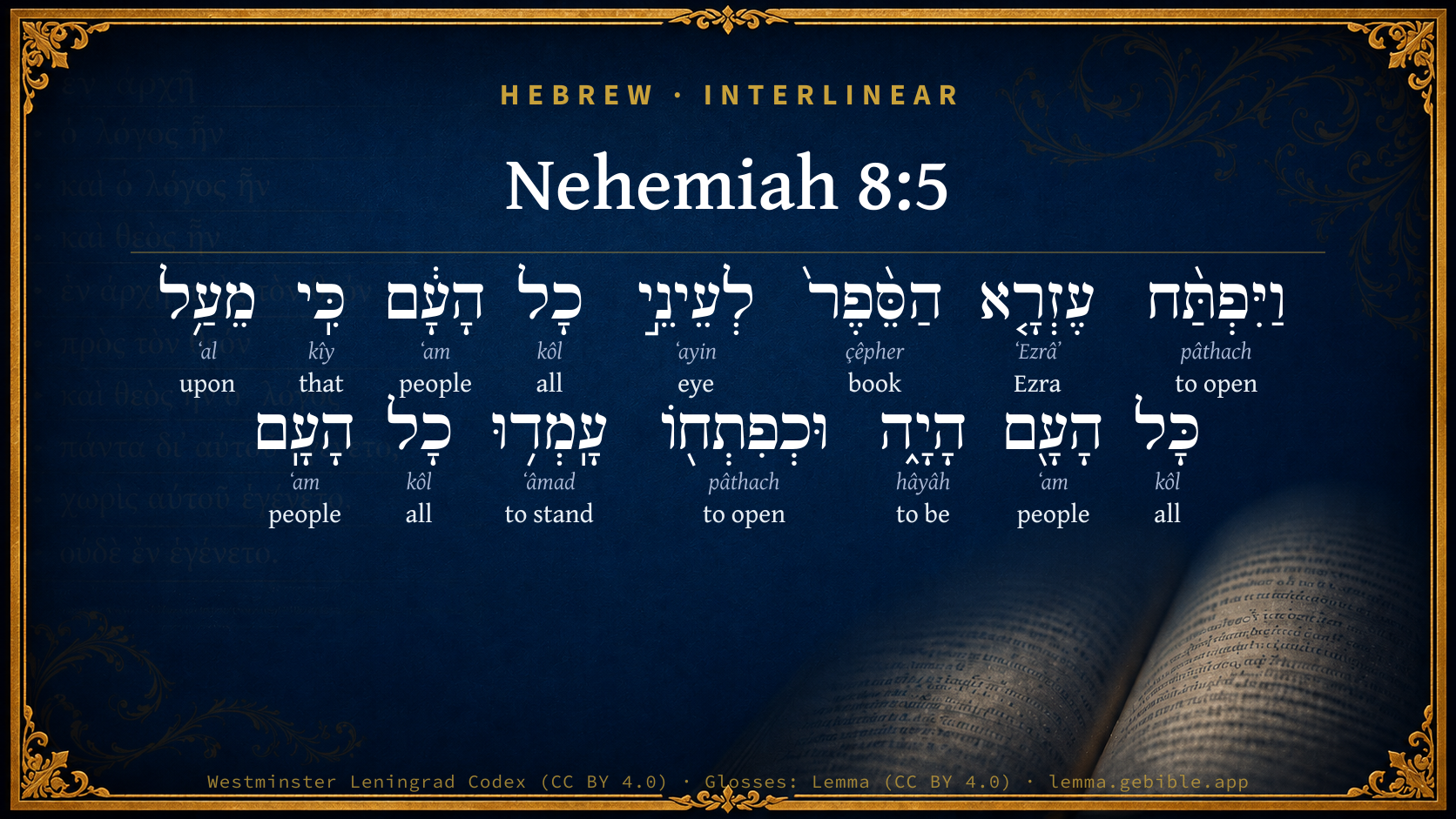
Hebrew (Westminster Leningrad Codex) Nehemiah 8:5 appears in the Hebrew Old Testament. The text above is from the Westminster Leningrad Codex. Each word links to its Strong’s number, a concise gloss, and parsing drawn from the Open Scriptures Hebrew Bible morphology. Click any word for its full Brown-Driver-Briggs (BDB) entry.
Download image
Cite this verse

Nehemiah 8:5 (World English Bible). Public Domain. Lemma interlinear Bible study tool, https://lemma.gebible.app/v/nehemiah/8/5.

Show BibTeX & RIS
BibTeX
RIS
English Translation
Ezra opened the book in the sight of all the people; (for he was above all the people;) and when he opened it, all the people stood up:
World English Bible · Public Domain
Download a study sheet

One document with this verse’s original text, its word-by-word gloss line, the meaning frame, cross-references with their text, attributed commentary, and full source and license credits — printable, and it pastes into notes with its structure intact.

This verse Autodidact and up

Study sheet (.html) Plain text (.txt)

A passage Seminary Student

Up to 50 verses in one chapter. A passage sheet keeps up to 6 commentary sources and 12 cross-references per verse, in the order this page ranks them, and says so on the sheet whenever that leaves anything out. Ask for a single verse and you get the Autodidact verse sheet above.

Everything on this page stays free to read, with no account — the sheet is a download of what is already on screen, not access to it.

Want to remove ads? Support Godless Engineer
Compare translations 3

The same verse in 3 English versions, stacked beneath the original-language interlinear above. Click any original word for its lexicon entry.

Each is an independent rendering of the whole verse — the interlinear is not word-aligned to these translations.

Highlighted words mark where these versions differ — a whole-verse word diff, not a word-by-word alignment.

  • World English Bible Public Domain
    Ezra opened the book in the sight of all the people; (for he was above all the people;) and when he opened it, all the people stood up:
  • King James Version Public Domain
    And Ezra opened the book in the sight of all the people; (for he was above all the people;) and when he opened it, all the people stood up:
  • unfoldingWord Literal Text CC BY-SA 4.0
    And Ezra opened the book before the eyes of all the people, for he was higher than all the people. And as soon as he opened it, all the people stood.

unfoldingWord Literal Text — © unfoldingWord, licensed CC BY-SA 4.0. Word-aligned USFM3 via Door43 (git.door43.org/unfoldingWord/en_ult).

Versions to compare (up to 4)

3 of 4 selected

Show all 18 translations

Every available English version of this verse, each an independent rendering of the whole verse.

  • World English Bible Public Domain
    Ezra opened the book in the sight of all the people; (for he was above all the people;) and when he opened it, all the people stood up:
  • Berean Standard Bible Public Domain
    Ezra opened the book in full view of all the people, since he was standing above them all, and as he opened it, all the people stood up.
  • Majority Standard Bible Public Domain
    Ezra opened the book in full view of all the people, since he was standing above them all, and as he opened it, all the people stood up.
  • King James Version Public Domain
    And Ezra opened the book in the sight of all the people; (for he was above all the people;) and when he opened it, all the people stood up:
  • American Standard Version (1901) Public Domain
    And Ezra opened the book in the sight of all the people; (for he was above all the people;) and when he opened it, all the people stood up:
  • Revised Version (1885) Public Domain
    And Ezra opened the book in the sight of all the people; (for he was above all the people;) and when he opened it, all the people stood up:
  • Geneva Bible (1599) Public Domain
    And Ezra opened the booke before all the people: for hee was aboue all the people: and when he opened it, all the people stoode vp.
  • Douay-Rheims (1899) Public Domain
    And Esdras opened the book before all the people: for he was above all the people: and when he had opened it, all the people stood.
  • Young's Literal Translation Public Domain
    And Ezra openeth the book before the eyes of all the people -- for above all the people he hath been -- and at his opening `it' all the people have stood up,
  • Literal Standard Version CC BY-SA 4.0
    And Ezra opens the scroll before the eyes of all the people—for he has been above all the people—and at his opening [it] all the people have stood up,
  • Unlocked Literal Bible CC BY-SA 4.0
    Ezra opened the book in the sight of all the people, for he was standing above the people, and when he opened it all the people stood up.
  • unfoldingWord Literal Text CC BY-SA 4.0
    And Ezra opened the book before the eyes of all the people, for he was higher than all the people. And as soon as he opened it, all the people stood.
  • Darby Bible Public Domain
    And Ezra opened the book in the sight of all the people, for he was above all the people; and when he opened it, all the people stood up.
  • World Messianic Bible Public Domain
    Ezra opened the book in the sight of all the people (for he was above all the people), and when he opened it, all the people stood up.
  • Webster's Bible Public Domain
    And Ezra opened the book in the sight of all the people; (for he was above all the people;) and when he opened it, all the people stood up:
  • Free Bible Version CC BY-SA 4.0
    Ezra opened the book while they were all watching because the whole crowd could see him. When he opened it they all stood up.
  • Bible in Basic English Public Domain
    And Ezra took the book, opening it before the eyes of all the people (for he was higher than the people); and when it was open, all the people got to their feet:
  • JPS Tanakh (1917) Public Domain
    And Ezra opened the book in the sight of all the people — for he was above all the people — and when he opened it, all the people stood up.

Literal Standard Version (2020), Covenant Press — licensed CC BY-SA 4.0. Text via the HelloAO Bible API (eBible.org). Unlocked Literal Bible (unfoldingWord) — licensed CC BY-SA 4.0. Text via the HelloAO Bible API (eBible.org). unfoldingWord Literal Text — © unfoldingWord, licensed CC BY-SA 4.0. Word-aligned USFM3 via Door43 (git.door43.org/unfoldingWord/en_ult). Free Bible Version, Dr. Jonathan Gallagher — licensed CC BY-SA 4.0. Text via the HelloAO Bible API (eBible.org).

Word by word

More ways to search: Search by grammar → Find every occurrence → Compare this word →

Practice this passage: Drill this verse → Learn its vocabulary →

עֶזְרָ֤א
ʻEzrâʼ
H5830
“Ezra”
Noun, Proper
Part of Speech
Noun
Type
Proper
Full BDB Definition

Origin: a variation of H5833

TWOT: None

Ezra = "help" - the priest and scribe who led the reforms of the returned exiles in Jerusalem; co-worker with Nehemiah - a priest with Zerubbabel - another post-exilic Jew
  1. וַיִּפְתַּ֨ח pâthach H6605 “and · to open” Conjunction + Verb, Qal, Sequential Imperfect, 3rd Person, Masculine, Singular
  2. הַסֵּ֨פֶר֙ çêpher H5612 “the · book” Particle, Definite Article + Noun, Common, Masculine, Singular, Absolute
  3. לְעֵינֵ֣י ʻayin H5869 “to/for · eyes of” Preposition + Noun, Common, Both, Dual, Construct
  4. כָל kôl H3605 “all of” Noun, Common, Masculine, Singular, Construct
  5. הָעָ֔ם ʻam H5971 “the · people” Particle, Definite Article + Noun, Common, Masculine, Singular, Absolute
  6. כִּֽי kîy H3588 “that” Conjunction
  7. מֵעַ֥ל ʻal H5921 “from · upon” Preposition + Preposition
  8. כָּל kôl H3605 “all of” Noun, Common, Masculine, Singular, Construct
  9. הָעָ֖ם ʻam H5971 “the · people” Particle, Definite Article + Noun, Common, Masculine, Singular, Absolute
  10. הָיָ֑ה hâyâh H1961 “to be” Verb, Qal, Perfect, 3rd Person, Masculine, Singular
  11. וּכְפִתְח֖וֹ pâthach H6605 “and · like/as · to open · him” Conjunction + Preposition + Verb, Qal, Infinitive Construct + Suffix, Personal, 3rd Person, Masculine, Singular
  12. עָֽמְד֥וּ ʻâmad H5975 “to stand” Verb, Qal, Perfect, 3rd Person, Common, Plural
  13. כָל kôl H3605 “all of” Noun, Common, Masculine, Singular, Construct
  14. הָעָֽם ʻam H5971 “the · people” Particle, Definite Article + Noun, Common, Masculine, Singular, Absolute

About this verse

These counts appear in no published source. They are computed here, from the morphology-tagged text and Lemma’s own curated glosses. What Lemma adds →

15
words
10
distinct lemmas
Historical
section

Notable vocabulary

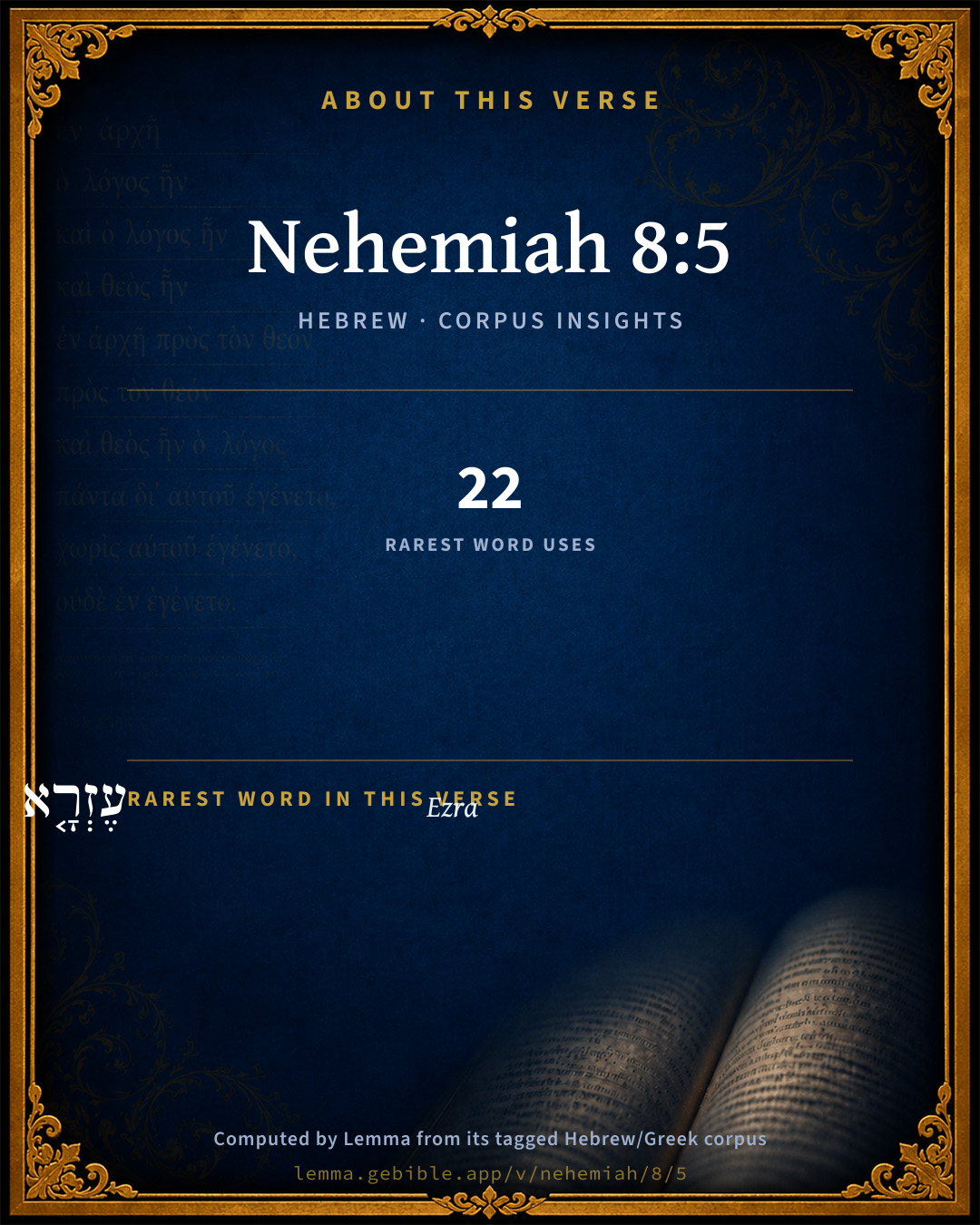
The rarest word here is עֶזְרָ֤א Ezra H5830 — appearing just 22 times in the whole Hebrew Bible.

Shared distinctive vocabulary

עֶזְרָ֤א Ezra H5830 occurs in 22 verses of the Hebrew Bible. Also found in:

Grammatical profile

  • 4 verbs
  • 9 nouns
  • 1 preposition
  • 1 conjunction

Verb forms

  • וַיִּפְתַּ֨ח Qal · Sequential Imperfect
  • הָיָ֑ה Qal · Perfect
  • וּכְפִתְח֖וֹ Qal · Infinitive Construct
  • עָֽמְד֥וּ Qal · Perfect

Repetition

Words recur within this verse — often emphatic in Hebrew:

  • כָל all H3605 ×3
  • הָעָ֔ם people H5971 ×3
  • וַיִּפְתַּ֨ח to open H6605 ×2

Cross-references

3

Topical passages linked to Nehemiah 8:5 in the Treasury of Scripture Knowledge — connected by theme and wording, ordered by reader-vote popularity; previews shown in the World English Bible.

  • Judges 3:20 Ehud came to him; and he was sitting by himself alone in the cool upper room. Ehud said, I have a message from God to you. He arose out of his seat.
  • 1 Kings 8:14 The king turned his face about, and blessed all the assembly of Israel: and all the assembly of Israel stood.
  • Luke 4:16–17 He came to Nazareth, where he had been brought up. He entered, as was his custom, into the synagogue on the Sabbath day, and stood up to read.

Cross-references courtesy of OpenBible.info (CC BY 4.0).

Hebrew and Greek witnesses Masoretic Hebrew ↔ Greek Septuagint

The same verse in the two great witnesses to the Old Testament, shown verse-for-verse.

These are two independent witnesses, not word-aligned to each other, and the Septuagint is shown in lemma (dictionary) form.

Hebrew Nehemiah 8:5 Masoretic · Westminster Leningrad Codex

וַיִּפְתַּ֨ח עֶזְרָ֤א הַסֵּ֨פֶר֙ לְעֵינֵ֣י כָל הָעָ֔ם כִּֽי מֵעַ֥ל כָּל הָעָ֖ם הָיָ֑ה וּכְפִתְח֖וֹ עָֽמְד֥וּ כָל הָעָֽם

Ezra opened the book in the sight of all the people; (for he was above all the people;) and when he opened it, all the people stood up:

World English Bible · Public Domain

Greek LXX Structure differs

The Septuagint has no separate book of Nehemiah. Its Greek text is the second half of Esdras B (2 Esdras), chapters 11–23; Ezra is the first half (1–10).

A verse-for-verse comparison isn’t shown here because the chapters and verses don’t line up. Switch to the LXX edition with the MT / LXX toggle above to read the Greek directly.

Hebrew: Westminster Leningrad Codex (CC BY 4.0). Greek: Septuagint (public domain); English from a public-domain English Septuagint. How the Septuagint differs from the Hebrew →

Commentary

Notes on Nehemiah 8:5 from classic Christian and Jewish commentators (each source and its license shown beneath its notes). The classic Christian expositions comment on the surrounding passage and are grouped to its opening verse, so a note may address several verses; the Jewish commentaries on the Tanakh (Rashi and others) are per-verse, so they appear only where the commentator wrote on this verse.

Lemma curates 59 commentaries, every one of them public domain or Creative Commons licensed, each selected and text-cleaned for this edition rather than reprinted as found. About our sources →

Trapp's Complete Commentary

John Trapp

Neh 8:5 And Ezra opened the book in the sight of all the people; (for he was above all the people;) and when he opened it, all the people stood up:

Ver. 5. And Ezra opened the book] God’s Book; not Aristotle’s Ethics, as Melancthon saith he heard some Popish priests preaching upon texts thence taken. And Carolostadius was eight years a doctor before he first opened the Bible; and yet at the taking of his degree he had been pronounced Sufficientissimus Most adequate.

For he was above all the people] Both in place and office; as representing the person of God, and bearing his name unto his people.

All the people stood up] For reverence’ sake. So did Eglon, that fat king of Moab, when he heard of a message from God, Jdg 3:20. Balaam, being to utter his parable, bids Balak arise up and hear him. Our Saviour stood up to read his text, Luk 4:16. Constantine the Great and our King Edward VI would not hear a sermon but standing. The modern Jews show their reverence to their law by a like gesture; and their adoration is by bowing forward with their bodies; for kneeling they use none, neither stir they their bonnets in their synagogues, but remain still covered.

John Trapp, A Commentary or Exposition upon All the Books of the Old and New Testament (1647–1656) — public domain. Text from a community e-Sword module.

Joseph Benson's Commentary

Neh 8:5-6. When he opened it, all the people stood up — Either in reverence to God’s word, or that they might hear his words more distinctly. And Ezra blessed the Lord, the great God — He blessed him as the great God, superior to all other powers whatsoever; and gave honour to him by praising his perfections, and praying for his favour. And all the people answered, Amen! Amen! — In token of their concurrence with him, both in the praises and prayers. With lifting up their hands — In token that their desire was toward God, and all their expectation from him. And they bowed their heads — In token of their reverence for him, and subjection to him. Thus must we adore and address ourselves to God, when we are going to read or hear his word, as those that see him in his word very great and very good.

Joseph Benson's Commentary on the Old and New Testaments (1811–1818) — public domain. Text from a community e-Sword module.

Tyndale Open Study Notes

Tyndale Open Resources

8:5 The people all rose to their feet out of respect for God’s word (Job 29:8). Apparently, they stood the whole time Ezra was reading.

Tyndale Open Study Notes — © Tyndale Open Resources, licensed CC BY-SA 4.0. Text via the HelloAO Bible API.

Geneva Bible (1599)

Geneva Bible translators

To the intent that his voice might be the better heard.

Geneva Bible (1599) marginal notes — public domain. Text via Bolls.life.

Jamieson, Fausset & Brown

Robert Jamieson, A. R. Fausset & David Brown

when he opened it, all the people stood up--This attitude they assumed either from respect to God's word, or, rather, because the reading was prefaced by a solemn prayer, which was concluded by a general expression of "Amen, Amen."

Jamieson, Fausset & Brown — Commentary Critical and Explanatory on the Whole Bible (1871) — public domain (CC PDM 1.0). Text via the HelloAO Bible API.

Adam Clarke's Commentary

Verse 5. All the people stood up] This was out of respect to the sacred word: in imitation of this, when the gospel for the day is read in our churches, all the people stand up.

Adam Clarke's Commentary on the Bible (1810–1826) — public domain. Text from a community e-Sword/MySword module.

The Cambridge Bible for Schools and Colleges

gen. ed. J. J. S. Perowne

5. opened] i.e. unrolled, cf. Luk_4:17.

above all the people] i.e. raised above them in his pulpit.

all the people stood up] We need not conclude from these words that they stood during the whole time that the reading went on. Rather ‘they rose to their feet,’ signifying by this gesture their reverence for ‘the law’ that was to be read. After Ezra’s blessing and the response (Neh_8:6), they probably resumed their seats. ‘Standing’ was sometimes the posture of prayer denoting humility, cf. 1Sa_1:26; 1Ki_8:22; Luk_18:11; Luk_18:13. In later times it was the attitude adopted during the reading of ‘the Law’ in the service of the Synagogue.

The Cambridge Bible for Schools and Colleges (gen. ed. J. J. S. Perowne; Cambridge University Press, 1878–1918) — public domain. Text from a community e-Sword module.

John Gill's Exposition

And Ezra opened the book in the sight of all the people (for he was above all the people),.... So plainly seen by them, and what he did, and the more easily heard, for which purpose the pulpit was made for him to stand in:

and, when he opened it, all the people stood up; that they might the better hear the law read, as well as in honour and reverence of it; the Jews say (m), that from the times of Moses to Rabban Gamaliel, they learned the law only standing; but after his death a disease came into the world, and they learned it sitting; and now it is a canon with them, that it is not necessary to stand at the reading of the law (n).

(m) T. Bab. Megillah, fol. 21. 1. (n) Schulchan Aruch, par. 1. Orach Chayim, c. 146. sect. 4.

John Gill's Exposition of the Whole Bible (1746–1763) — public domain (CC PDM 1.0). Text via the HelloAO Bible API.

Albert Barnes' Notes on the Bible

Stood up - The attitude of attention and respect. Compare the existing practice of the Christian Church at the reading of the Gospel for the day.

Albert Barnes' Notes on the Bible (1834–1885) — public domain. Text from a community e-Sword/MySword module.

Haydock's Catholic Bible Commentary

Stood, out of respect, as we do while the gospel is read. See Numbers xxiii. 18. (Calmet)

George Leo Haydock (1774–1849), Haydock's Catholic Family Bible and Commentary, 1859 edition — public domain. Excludes Psalms (Douay-Rheims chapter numbering differs from Protestant) and Deuterocanonical books (Catholic canon only).

Matthew Poole's English Annotations

Either in reverence to God’s word, of which see Num 11:32; Jdg 3:20; or that they might hear his words the more distinctly: or rather, because they observed that Ezra composed himself to prayer or thanksgiving; which is here generally declared, but doubtless was more particularly and largely expressed in that assembly, as appears by their answering

Amen, Amen, to his prayer.

Matthew Poole's English Annotations on the Holy Bible (1683–1685) — public domain. Text from a community e-Sword/MySword module.

Whedon's Commentary on the Bible

Daniel D. Whedon

5. Opened the book — That is, unrolled it, as a scroll.

He was above all the people — Because he occupied the elevated pulpit or platform mentioned in the previous verse.

The people stood up — Out of respect for the sacred book and the solemn service about to commence.

Daniel D. Whedon (gen. ed.), Commentary on the Old and New Testaments (1874–1909) — public domain. Text from a community e-Sword module.

The Pulpit Commentary

All the people stood up. The Jews commonly sat to hear and stood up to pray; but in hearing they occasionally stood up, to do greater honour to the person or the occasion. (see Jud_1:3:20) It is not to be supposed that they stood during the whole of the six hours that Ezra"s reading lasted.

The Pulpit Commentary (1880–1919), ed. H.D.M. Spence-Jones & Joseph S. Exell — public domain. Text from a community e-Sword module.

Rashi

Rabbi Shlomo Yitzchaki (Rashi)

for he was above all the people Therefore, they all saw him.

and when he opened it, all the people stood And when he opened it to read, all the people stood silent.

stood Heb. עָמְדוּ, an expression of silence (they stood silent), like (Job 32:16): “...for they remained silent (עָמְדוּ); they no longer answered.”

Rashi on the Tanakh — English translations: “The Judaica Press complete Tanach with Rashi, translated by A. J. Rosenberg” (CC BY 4.0); “Pentateuch with Rashi's commentary by M. Rosenbaum and A.M. Silbermann, 1929-1934” (public domain); “The Metsudah Tanach series, Lakewood, N.J” (CC BY 4.0); and “The Book of Joshua, Metsudah Publications, 1997” (CC BY 4.0). Text via Sefaria.

Lesson kit

Teaching starters — assembled from the data on this page, not authored interpretation. Every prompt links to the verse data it draws on. Edit before teaching.

Nehemiah, in the Historical, opens this verse with 15 words (10 distinct Hebrew lemmas). Its most distinctive word is ʻEzrâʼ (“Ezra”). A historical commentator’s framing appears above. Read the whole chapter for the surrounding context.

Discussion questions

  1. The word ʻEzrâʼ carries the sense “Ezra.” How does it shape the verse?
  2. Ezra 7:1 shares the word «Ezra» with this verse. How do the two illuminate each other?
  3. “all” occurs 3× in this one verse. What is the effect of the repetition?
  4. These translations render this verse differently. What is at stake in choosing one wording over another?
  5. The verb «וַיִּפְתַּ֨ח» is Qal Sequential Imperfect. How does its form color the action?
  6. Reading how Trapp's Complete Commentary and Joseph Benson's Commentary read this verse, where do the two commentators agree and where do they part?

Things to notice

Reading settings

Reading text

Shown beneath each verse's original-language words.

Old Testament
Old Testament edition

Read the OT as the Masoretic Hebrew (MT) or the Greek Septuagint (LXX).

English shown for the Greek Septuagint (in the Hebrew ↔ Greek comparison).

Comparing translations? Open the Compare panel on any verse page to stack up to four side by side.