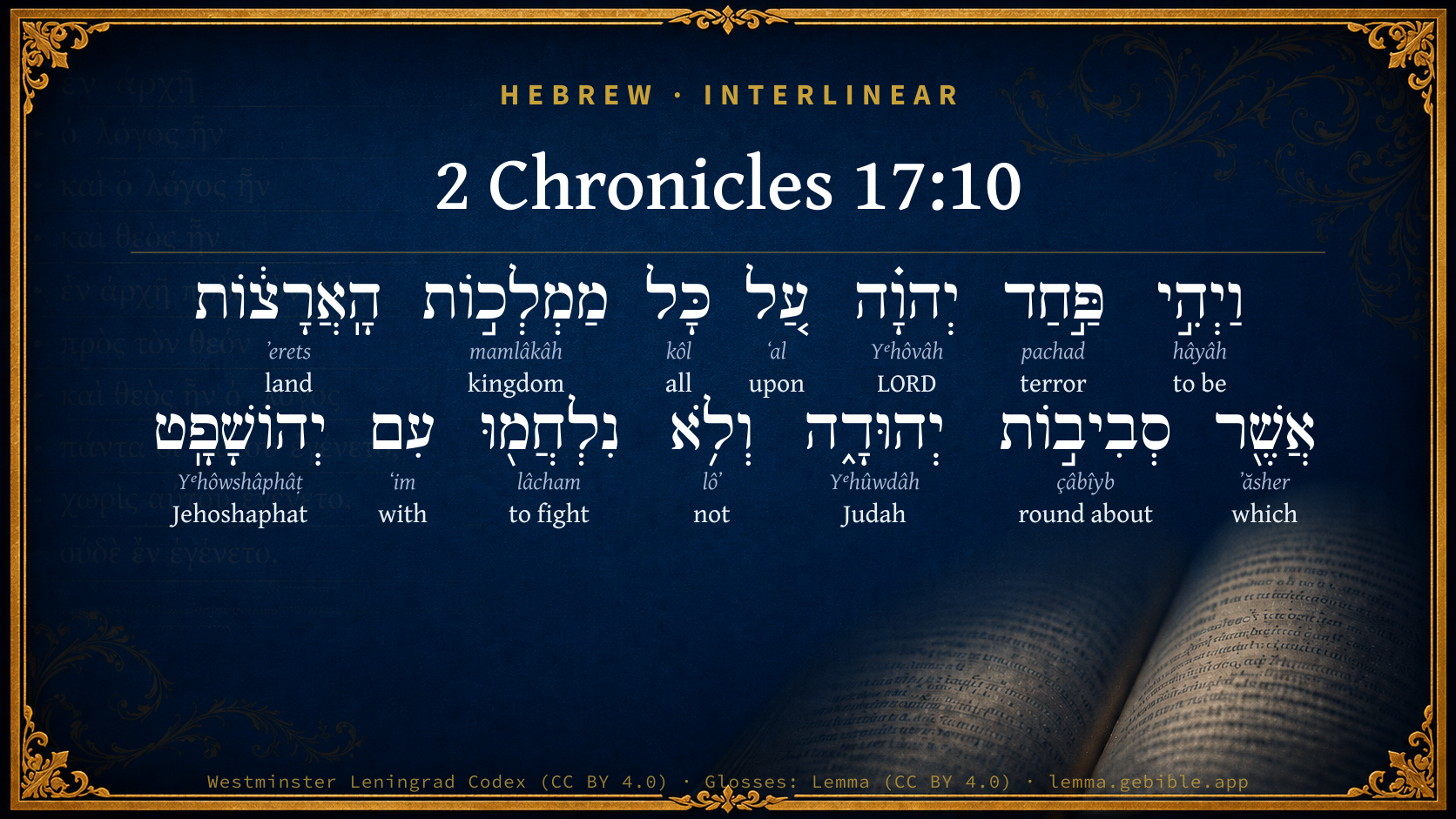
2 Chronicles 17:10

Hebrew (Westminster Leningrad Codex) 2 Chronicles 17:10 appears in the Hebrew Old Testament. The text above is from the Westminster Leningrad Codex. Each word links to its Strong’s number, a concise gloss, and parsing drawn from the Open Scriptures Hebrew Bible morphology. Click any word for its full Brown-Driver-Briggs (BDB) entry.
Download image
Cite this verse

2 Chronicles 17:10 (World English Bible). Public Domain. Lemma interlinear Bible study tool, https://lemma.gebible.app/v/2-chronicles/17/10.

Show BibTeX & RIS
BibTeX
RIS
English Translation
The fear of Yahweh fell on all the kingdoms of the lands that were round about Judah, so that they made no war against Jehoshaphat.
World English Bible · Public Domain
Download a study sheet

One document with this verse’s original text, its word-by-word gloss line, the meaning frame, cross-references with their text, attributed commentary, and full source and license credits — printable, and it pastes into notes with its structure intact.

This verse Autodidact and up

Study sheet (.html) Plain text (.txt)

A passage Seminary Student

Up to 50 verses in one chapter. A passage sheet keeps up to 6 commentary sources and 12 cross-references per verse, in the order this page ranks them, and says so on the sheet whenever that leaves anything out. Ask for a single verse and you get the Autodidact verse sheet above.

Everything on this page stays free to read, with no account — the sheet is a download of what is already on screen, not access to it.

Want to remove ads? Support Godless Engineer
Compare translations 3

The same verse in 3 English versions, stacked beneath the original-language interlinear above. Click any original word for its lexicon entry.

Each is an independent rendering of the whole verse — the interlinear is not word-aligned to these translations.

Highlighted words mark where these versions differ — a whole-verse word diff, not a word-by-word alignment.

  • World English Bible Public Domain
    The fear of Yahweh fell on all the kingdoms of the lands that were round about Judah, so that they made no war against Jehoshaphat.
  • King James Version Public Domain
    And the fear of the LORD fell upon all the kingdoms of the lands that were round about Judah, so that they made no war against Jehoshaphat.
  • unfoldingWord Literal Text CC BY-SA 4.0
    And the dread of Yahweh was on all the kingdoms of the lands that were around Judah, and they did not fight with Jehoshaphat.

unfoldingWord Literal Text — © unfoldingWord, licensed CC BY-SA 4.0. Word-aligned USFM3 via Door43 (git.door43.org/unfoldingWord/en_ult).

Versions to compare (up to 4)

3 of 4 selected

Show all 18 translations

Every available English version of this verse, each an independent rendering of the whole verse.

  • World English Bible Public Domain
    The fear of Yahweh fell on all the kingdoms of the lands that were round about Judah, so that they made no war against Jehoshaphat.
  • Berean Standard Bible Public Domain
    And the dread of the LORD fell upon all the kingdoms of the lands that surrounded Judah, so that they did not make war against Jehoshaphat.
  • Majority Standard Bible Public Domain
    And the dread of the LORD fell upon all the kingdoms of the lands that surrounded Judah, so that they did not make war against Jehoshaphat.
  • King James Version Public Domain
    And the fear of the LORD fell upon all the kingdoms of the lands that were round about Judah, so that they made no war against Jehoshaphat.
  • American Standard Version (1901) Public Domain
    And the fear of Jehovah fell upon all the kingdoms of the lands that were round about Judah, so that they made no war against Jehoshaphat.
  • Revised Version (1885) Public Domain
    And the fear of the LORD fell upon all the kingdoms of the lands that were round about Judah, so that they made no war against Jehoshaphat.
  • Geneva Bible (1599) Public Domain
    And the feare of the Lord fell vpon all the kingdomes of ye lands that were round about Iudah, and they fought not against Iehoshaphat.
  • Douay-Rheims (1899) Public Domain
    And the fear of the Lord came upon all the kingdoms of the lands that were round about Juda, and they durst not make war against Josaphat.
  • Young's Literal Translation Public Domain
    And here is a fear of Jehovah on all kingdoms of the lands that `are' round about Judah, and they have not fought with Jehoshaphat;
  • Literal Standard Version CC BY-SA 4.0
    And there is a fear of YHWH on all kingdoms of the lands that [are] around Judah, and they have not fought with Jehoshaphat;
  • Unlocked Literal Bible CC BY-SA 4.0
    Terror of Yahweh fell on all the kingdoms of the lands that were around Judah, so that they made no war against Jehoshaphat.
  • unfoldingWord Literal Text CC BY-SA 4.0
    And the dread of Yahweh was on all the kingdoms of the lands that were around Judah, and they did not fight with Jehoshaphat.
  • Darby Bible Public Domain
    And the terror of Jehovah was upon all the kingdoms of the lands that were round about Judah, and they made no war against Jehoshaphat.
  • World Messianic Bible Public Domain
    The fear of the LORD fell on all the kingdoms of the lands that were around Judah, so that they made no war against Jehoshaphat.
  • Webster's Bible Public Domain
    And the fear of the LORD fell upon all the kingdoms of the lands that were around Judah, so that they made no war against Jehoshaphat.
  • Free Bible Version CC BY-SA 4.0
    All the surrounding kingdoms were in awe of the Lord, so that they did not attack Jehoshaphat.
  • Bible in Basic English Public Domain
    And the fear of the Lord was on all the kingdoms of the lands round Judah, so that they made no wars against Jehoshaphat.
  • JPS Tanakh (1917) Public Domain
    And a terror from the LORD fell upon all the kingdoms of the lands that were round about Judah, so that they made no war against Jehoshaphat.

Literal Standard Version (2020), Covenant Press — licensed CC BY-SA 4.0. Text via the HelloAO Bible API (eBible.org). Unlocked Literal Bible (unfoldingWord) — licensed CC BY-SA 4.0. Text via the HelloAO Bible API (eBible.org). unfoldingWord Literal Text — © unfoldingWord, licensed CC BY-SA 4.0. Word-aligned USFM3 via Door43 (git.door43.org/unfoldingWord/en_ult). Free Bible Version, Dr. Jonathan Gallagher — licensed CC BY-SA 4.0. Text via the HelloAO Bible API (eBible.org).

Word by word

More ways to search: Search by grammar → Find every occurrence → Compare this word →

Practice this passage: Drill this verse → Learn its vocabulary →

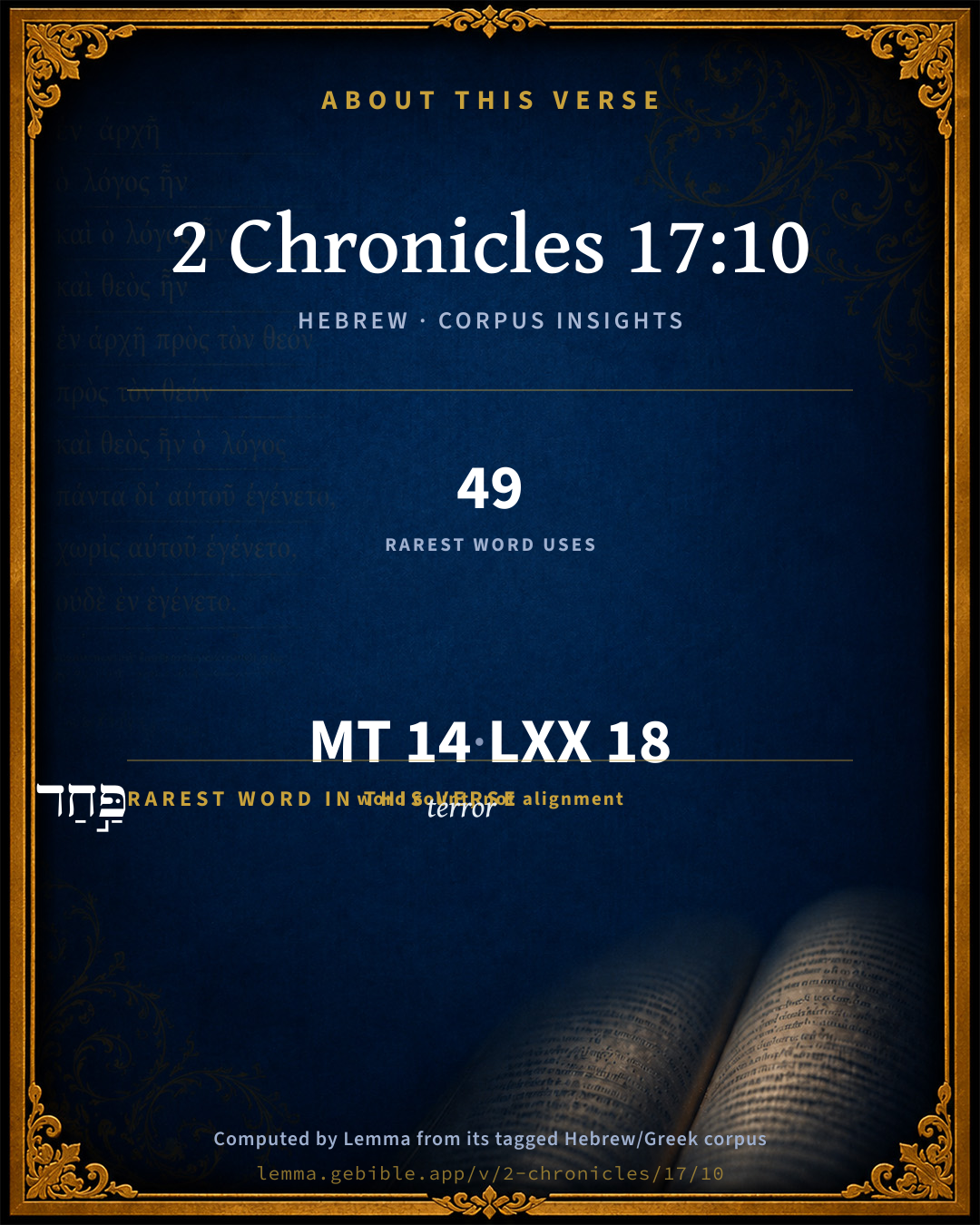
פַּ֣חַד
pachad
H6343
“terror of”
Noun, Common, Masculine, Singular, Construct
Part of Speech
Noun
Type
Common
Gender
Masculine
Number
Singular
State
Construct
Full BDB Definition

Origin: from H6342

TWOT: 1756a

terror, dread - dread - object of dread
  1. וַיְהִ֣י hâyâh H1961 “and · to be” Conjunction + Verb, Qal, Sequential Imperfect, 3rd Person, Masculine, Singular
  2. יְהוָ֗ה Yᵉhôvâh H3068 “LORD” Noun, Proper
  3. עַ֚ל ʻal H5921 “upon” Preposition
  4. כָּל kôl H3605 “all of” Noun, Common, Masculine, Singular, Construct
  5. מַמְלְכ֣וֹת mamlâkâh H4467 “kingdoms of” Noun, Common, Feminine, Plural, Construct
  6. הָֽאֲרָצ֔וֹת ʼerets H776 “the · lands” Particle, Definite Article + Noun, Common, Both, Plural, Absolute
  7. אֲשֶׁ֖ר ʼăsher H834 “which” Particle, Relative
  8. סְבִיב֣וֹת çâbîyb H5439 “surroundings” Noun, Common, Both, Plural, Absolute
  9. יְהוּדָ֑ה Yᵉhûwdâh H3063 “Judah” Noun, Proper
  10. וְלֹ֥א lôʼ H3808 “and · not” Conjunction + Particle, Negative
  11. נִלְחֲמ֖וּ lâcham H3898 “to fight” Verb, Niphal, Perfect, 3rd Person, Common, Plural
  12. עִם ʻim H5973 “with” Preposition
  13. יְהוֹשָׁפָֽט Yᵉhôwshâphâṭ H3092 “Jehoshaphat” Noun, Proper

About this verse

These counts appear in no published source. They are computed here, from the morphology-tagged text and Lemma’s own curated glosses. What Lemma adds →

14
words
14
distinct lemmas
Historical
section

Shared distinctive vocabulary

פַּ֣חַד terror H6343 occurs in 48 verses of the Hebrew Bible. Also found in:

Grammatical profile

  • 2 verbs
  • 8 nouns
  • 2 prepositions
  • 2 particles

Verb forms

  • וַיְהִ֣י Qal · Sequential Imperfect
  • נִלְחֲמ֖וּ Niphal · Perfect

Hebrew & Septuagint length

In English translation the verse runs 25 words from the Hebrew and 24 from the Septuagint (LXX English) — closely comparable.

A rough comparison of the two English renderings, which tokenize alike — not a word-level alignment.

Word counts can differ between the Hebrew and the Greek without any difference in meaning — e.g. the Hebrew direct-object marker אֵת has no separate Greek word, and Greek often adds the article ὁ.

In the original languages it is 14 Hebrew tokens and 18 Greek tokens — but the two are counted differently (Hebrew bundles its prefixes and suffixes into one token; the Greek is in lemma form), so that isn’t a like-for-like length.

Cross-references

7

Topical passages linked to 2 Chronicles 17:10 in the Treasury of Scripture Knowledge — connected by theme and wording, ordered by reader-vote popularity; previews shown in the World English Bible.

  • 2 Chronicles 14:14 They struck all the cities round about Gerar; for the fear of Yahweh came on them: and they despoiled all the cities; for there was much spoil in them.
  • Exodus 15:14–16 The peoples have heard. They tremble. Pangs have taken hold on the inhabitants of Philistia.
  • Exodus 34:24 For I will drive out nations before you and enlarge your borders; neither shall any man desire your land when you go up to appear before Yahweh, your God, three times in the year.
  • 2 Chronicles 16:9 For the eyes of Yahweh run back and forth throughout the whole earth, to show himself strong in the behalf of them whose heart is perfect toward him. Herein you have done foolishly; for from henceforth you shall have wars.
  • Proverbs 16:7 When a man's ways please Yahweh, He makes even his enemies to be at peace with him.
  • Genesis 35:5 They traveled: and a terror of God was on the cities that were round about them, and they didn't pursue the sons of Jacob.
  • Joshua 2:9–11 and she said to the men, I know that Yahweh has given you the land, and that the fear of you is fallen on us, and that all the inhabitants of the land melt away before you.

Cross-references courtesy of OpenBible.info (CC BY 4.0).

Hebrew and Greek witnesses Masoretic Hebrew ↔ Greek Septuagint

The same verse in the two great witnesses to the Old Testament, shown verse-for-verse.

These are two independent witnesses, not word-aligned to each other, and the Septuagint is shown in lemma (dictionary) form.

Hebrew 2 Chronicles 17:10 Masoretic · Westminster Leningrad Codex

וַיְהִ֣י פַּ֣חַד יְהוָ֗ה עַ֚ל כָּל מַמְלְכ֣וֹת הָֽאֲרָצ֔וֹת אֲשֶׁ֖ר סְבִיב֣וֹת יְהוּדָ֑ה וְלֹ֥א נִלְחֲמ֖וּ עִם יְהוֹשָׁפָֽט

The fear of Yahweh fell on all the kingdoms of the lands that were round about Judah, so that they made no war against Jehoshaphat.

World English Bible · Public Domain

Greek LXX 2 Chronicles 17:10 Septuagint · lemma form

καί γίγνομαι ἔκστασις κύριος ἐπί πᾶς ὁ βασιλεία ὁ γῆ ὁ κύκλος ἰουδά καί οὐ πολεμέω πρός ιωσαφατ

And a terror of the Lord was upon all the kingdoms of the land round about Juda, and they made no war against Josaphat.

LXX2012 (modern English Septuagint) · Public Domain

Hebrew: Westminster Leningrad Codex (CC BY 4.0). Greek: Septuagint (public domain); English from LXX2012 (modern English Septuagint) (Public Domain). How the Septuagint differs from the Hebrew →

Commentary

Notes on 2 Chronicles 17:10 from classic Christian and Jewish commentators (each source and its license shown beneath its notes). The classic Christian expositions comment on the surrounding passage and are grouped to its opening verse, so a note may address several verses; the Jewish commentaries on the Tanakh (Rashi and others) are per-verse, so they appear only where the commentator wrote on this verse.

Lemma curates 59 commentaries, every one of them public domain or Creative Commons licensed, each selected and text-cleaned for this edition rather than reprinted as found. About our sources →

Matthew Henry's Commentary

We have here a further account of Jehoshaphat's great prosperity and the flourishing state of his kingdom.

I. He had good interest in the neighbouring princes and nations. Though he was not perhaps so great a soldier as David (which might have made him their terror), nor so great a scholar as Solomon (which might have made him their oracle), yet the fear of the Lord fell so upon them (that is, God so influenced and governed their spirits) that they had all a reverence for him, Ch2 17:10. And, 1. None of them made war against him. God's good providence so ordered it that, while the princes and priests were instructing and reforming the country, none of his neighbours gave him any molestations, to take him off from that good work. Thus when Jacob and his sons were going to worship at Bethel the terror of God was upon the neighbouring cities, that they did not pursue after them, Gen 35:5, and see Exo 34:24. 2. Many of them brought presents to him (Ch2 17:11), to secure his friendship. Perhaps these were a tribute imposed upon them by Asa, who made himself master of the cities of the Philistines, and the tents of the Arabians, Ch2 14:14, Ch2 14:15. With the 7700 rams, and the same number of he-goats, which the Arabians brought, there was probably a proportionable number of ewes and lambs, she-goats and kids.

II. He had a very considerable stores laid up in the cities of Judah. He pulled down his barns, and built larger (Ch2 17:12), castles and cities of store, for arms and victuals. He was a man of business, and aimed at the public good in all his undertakings, either to preserve the peace or prepare for war.

III. He had the militia in good order. It was never in better since David modelled it. Five lord-lieutenants (if I may so call them) are here named, with the numbers of those under their command (the serviceable men, that were fit for war in their respective districts), three in Judah, and two in Benjamin. It is said of one of these great commanders, Amasiah, that he willingly offered himself unto the Lord (Ch2 17:16), not only to the king, to serve him in this post, but to the Lord, to glorify him in it. He was the most eminent among them for religion, he accepted the place, not for the honour, or power, or profit of it, but for conscience' sake towards God, that he might serve his country,. It was usual for great generals then to offer of their spoils to the Lord, Ch1 26:26. But this good man offered himself first to the Lord, and then his dedicated things. The number of the soldiers under these five generals amounts to 1,160,000 men, a vast number for so small a compass of ground as Judah's and Benjamin's lot to furnish out and maintain. Abijah could bring into the field but 400,000 (Ch2 13:3), Asa not 600,000 (Ch2 14:8), yet Jehoshaphat has at command almost 1,200,000. But it must be considered, 1. That God had promised to make the seed of Abraham like the sand of the sea for number. 2. There had now been a long peace. 3. We may suppose that the city of Jerusalem was very much enlarged. 4. Many had come over to them from the kingdom of Israel (Ch2 15:19), which would increase the numbers of the people. 5. Jehoshaphat was under a special blessing of God, which made his affairs to prosper greatly. The armies, we may suppose, were dispersed all the country over, and each man resided for the most part on his own estate; but they appeared often, to be mustered and trained, and were ready at call whenever there was occasion. The commanders waited on the king (Ch2 17:19) as officers of his court, privy-counsellors, and ministers of state.

But, lastly, observe, It was not this formidable army that struck a terror upon the neighbouring nations, that restrained them from attempting any thing against Israel, or obliged them to pay tribute, but the fear of God which fell upon them when Jehoshaphat reformed his country and set up a preaching ministry in it, Ch2 17:10. The ordinances of God are more the strength and safety of a kingdom than its military force - its men of God more than its men of war.

Matthew Henry's Commentary on the Whole Bible (1708–1710) — public domain (CC PDM 1.0). Text via the HelloAO Bible API.

Trapp's Complete Commentary

John Trapp

2Ch 17:10 And the fear of the LORD fell upon all the kingdoms of the lands that [were] round about Judah, so that they made no war against Jehoshaphat.

Ver. 10. And the fear of the Lord fell upon all the kingdoms.] It is said {2Ch 17:2} Jehoshaphat placed forces in all the fenced cities; yet it is not said thereupon that "the fear of the Lord fell upon the neighbour nations." But when he had established a preaching ministry in all the cities, then his enemies had a fear, and made no war.

John Trapp, A Commentary or Exposition upon All the Books of the Old and New Testament (1647–1656) — public domain. Text from a community e-Sword module.

Joseph Benson's Commentary

2Ch 17:10. The fear of the Lord fell upon all the kingdoms, &c. — Justly concluding, from his singular piety, that God would eminently appear for him; for even the heathen could not but observe, that the kings of Judah were either prosperous or unhappy, according as they served God or forsook him. So that they made no war against Jehoshaphat — God’s good providence so ordered it, that while the princes and priests were instructing and endeavouring to reform the country, none of his neighbours gave him any molestation, to take him off from that good work.

Joseph Benson's Commentary on the Old and New Testaments (1811–1818) — public domain. Text from a community e-Sword module.

Tyndale Open Study Notes

Tyndale Open Resources

17:10-11 The fear of the Lord among the surrounding kingdoms resulted in tribute to Jehoshaphat, an action that was intended to buy peace. Peace is one indicator of divine favor (cp. 14:2-6). • The Arabs were probably the desert tribes living south of Judah in territory next to the Philistines.

Tyndale Open Study Notes — © Tyndale Open Resources, licensed CC BY-SA 4.0. Text via the HelloAO Bible API.

Geneva Bible (1599)

Geneva Bible translators

Thus God prospereth all such that with a pure heart seek his glory, and keepeth their enemies in fear, that they cannot be able to execute their rage against them.

Geneva Bible (1599) marginal notes — public domain. Text via Bolls.life.

Ellicott's Commentary for English Readers

JEHOS APHAT BECOMES A POWERFUL SOVEREIGN.

(10) The fear of the Lord.—A dread of Jehovah (pachad), aps. 14:13, 20:29. (Comp. Exo_15:16; 1Sa_11:7; Isa_2:10. ) This phrase is not peculiar to the chronicler, as Keil and Bertheau assert. “The kingdoms of the lands” is so (2Ch_12:8; 1Ch_29:30).

They made no war.—The reward of Jehosha-phat’s piety (1Ch_22:9; Pro_16:7): “When a man’s ways please the Lord, he maketh even his enemies to be at peace with him.” (Comp. also Gen_35:5)

A Bible Commentary for English Readers, edited by Charles John Ellicott (1878–1897) — public domain. Text from a community e-Sword module.

The Cambridge Bible for Schools and Colleges

gen. ed. J. J. S. Perowne

10–13 (no parallel in 1 Kin.). The Greatness of Jehoshaphat

10. the fear of the Lord] Cp. Gen_35:5.

The Cambridge Bible for Schools and Colleges (gen. ed. J. J. S. Perowne; Cambridge University Press, 1878–1918) — public domain. Text from a community e-Sword module.

John Gill's Exposition

And the fear of the Lord fell upon all the kingdoms of the lands that were round about Judah,.... Upon the ten tribes, and on foreign nations about them, as Moabites, Edomites, Syrians, Egyptians, Arabs, and Philistines; this fear, as it came from the Lord, so might be raised and increased by observing, that religion was revived in them; for they might perceive, by former observations made, that the more religious these people were, the more prosperous and formidable they were:

so that they made no war against Jehoshaphat; to interrupt him in the work of reformation he was so intent upon.

John Gill's Exposition of the Whole Bible (1746–1763) — public domain (CC PDM 1.0). Text via the HelloAO Bible API.

Haydock's Catholic Bible Commentary

War. They had witnessed the fruitless attempt of Zara, C. xiv. 15. H.

George Leo Haydock (1774–1849), Haydock's Catholic Family Bible and Commentary, 1859 edition — public domain. Excludes Psalms (Douay-Rheims chapter numbering differs from Protestant) and Deuterocanonical books (Catholic canon only).

Matthew Poole's English Annotations

Justly concluding from this singular piety that God would eminently appear for him, and against all those who had ill will to him, which was their case. For even the heathens could not but observe that the kings of Judah were either prosperous or unhappy, accordingly as they served God or forsook him.

Matthew Poole's English Annotations on the Holy Bible (1683–1685) — public domain. Text from a community e-Sword/MySword module.

The Pulpit Commentary

The moral effect of this peaceful war of Jehoshaphat is manifestly great.

Vers. 10-19.

The greatness of Jehoshaphat.

I JEHOSHAPHAT"S NEIGHBOURS.

1. Afraid of his greatness. As on the cities round Jacob and his sons when they fled from Shecham, (Gen_35:5) the terror of Jehovah was on Jehoshaphat"s neighbours. Regarding Jehoshaphat as under the protection of Heaven, they hesitated to try conclusions with him on the field of war.

2. Solicitous of his favor. This some sought by means of gifts. The Philistines brought presents and silver of tribute, or "silver a burden," i.e. a great quantity (Bertheau, Keil); the Arabians offered flocks 7700 he-goats, and 7700 rams.

II JEHOSHAPHAT"S BUILDINGS.

1. Castles, or palaces. Oriental kings commonly attested their magnificence by temple and palace building; e.g. Solomon. (2Ch_8:1, etc. )

2. Store-cities. Arsenals or magazines for supplying the garrisons. In them Jehoshaphat had much property (Keil).

III JEHOSHAPHAT"S WARRIORS.

1. Those who served in Jerusalem.

(1) Their battalions, five three belonging to Judah, two to Benjamin.

(2) Their captains. Of Judah"s divisions, Adnah the chief, Jehohanan, and Amasiah the son of Zichri, "who had willingly given or offered himself to the Lord," perhaps in the performance of some mighty deed. Of Benjamin, "Eliada a mighty man of valour," and Jehozabad.

(3) Their numbers. Of Judah, under Adnah, 300, 000; under Jehohanan, 280, 000; under Amasiah, 200, 000; in all, 780, 000 men. Of Benjamin, 200, 000 with Eliada, and 180, 000 with Jehozahad; in all, 380, 000. For the kingdom 1, 160, 000, upwards of one million and a half of able-bodied soldiers a huge incubus for so small a kingdom.

(4) Their duties. They waited on the king, i.e. were disposable forces at his command, ready to take the field when he should give the word.

2. Those who served in Judah. The officers and companies distributed throughout the different garrisons in the land.

Learn:

1. The influence of true religion even on the wicked.

2. The superior glory of good character, as compared with greatcondition.

3. The dignity implied in being a soldier of Jesus Christ. W.

The Pulpit Commentary (1880–1919), ed. H.D.M. Spence-Jones & Joseph S. Exell — public domain. Text from a community e-Sword module.

John Wesley's Explanatory Notes

Fear fell - Justly concluding from his singular piety that God would eminently appear for him, for even the Heathens could not but observe, that the kings of Judah were either prosperous or unhappy, according as they served God or forsook him.

John Wesley, Explanatory Notes Upon the Whole Bible (1754–1765) — public domain. Text via the GEBible commentary corpus.

Kretzmann's Popular Commentary

Paul E. Kretzmann

Jehoshaphat’s Riches, Valor, and Mighty Men

v. 10. And the fear of the Lord fell upon all the kingdoms of the lands that were round about Judah, so that they made no war against Jehoshaphat, namely, while these reformatory measures were being carried out.

v. 11. Also some of the Philistines brought Jehoshaphat presents, voluntarily placing themselves under his jurisdiction as tributaries, and tribute silver; and the Arabians, the nomad tribes to the south and southeast of the Dead Sea, brought him flocks, seven thousand and seven hundred rams and seven thousand and seven hundred he-goats, apparently the tale of so many herds of cattle.

v. 12. And Jehoshaphat waxed great exceedingly, he became ever greater in riches and power; and he built in Judah castles, single fortified palaces, and cities of store, where food was stored against the event of a war.

v. 13. And he had much business in the cities of Judah, great stores of food and material; and the men of war, mighty men of valor, were in Jerusalem.

v. 14. And these are the numbers of them according to the house of their fathers, the divisions known as father-houses: of Judah, the captains of thousands: Adnah the chief, and with him mighty men of valor, three hundred thousand.

v. 15. And next to him, next in rank, was Jehohanan, the captain, and with him two hundred and fourscore thousand.

v. 16. And next him was Amasiah, the son of Zichri, who willingly offered himself unto the Lord; and with him two hundred thousand mighty men of valor, the total number of men in Judah available for purposes of war being 780,000.

v. 17. And of Benjamin: Eliada, a mighty man of valor, and with him armed men with bow and shield, the Benjamites having always been famed as archers, two hundred thousand.

v. 18. And next him was Jehozabad, and with him an hundred and fourscore thousand, ready prepared for the war, the total number from Benjamin being 380,000.

v. 19. These waited on the king, they were at his disposal, beside those whom the king put in the fenced cities throughout all Judah, the garrisons of all the fortresses. No monarch, after the time of Solomon, equaled Jehoshaphat in the greatness of his revenue, in the strength of his forts, and in the number of his troops. Note: Whenever people returned to the Word of God in all its purity and readily learned and followed it, conditions became better, and God’s blessings rested upon the entire country.

Paul E. Kretzmann, Popular Commentary of the Bible (1921–1924) — public domain. Text from a community e-Sword module.

unfoldingWord translationNotes

Door43 World Missions Community

Terror of Yahweh fell on all the kingdoms of the lands

The word "terror" can be expressed with the adjective "afraid." Also, this speaks of the people becoming afraid as if the terror were something that fell upon them. AT: "The people in all the kingdoms surrounding Judah became very afraid of what Yahweh might do to punish them" (See: Abstract Nouns and Metaphor)

against Jehoshaphat

Here Jehoshaphat represents his army. AT: "against Jehoshaphat's army" (See: Synecdoche)

7,700 rams, and 7,700 goats

The number can also be written as seven thousand seven hundred. This is a description of the flocks that the Arabians brought Jehoshaphat. (See: Numbers)

translationWords

Philistines

silver

tribute

Arabia

flocks

ewe

goat

unfoldingWord translationNotes — © Distant Shores Media and the Door43 World Missions Community, licensed CC BY-SA 4.0. Source: git.door43.org/Door43/en_tn.

Rashi

Rabbi Shlomo Yitzchaki (Rashi)

And the fear of the Lord was upon all the kingdoms of the lands in the merit of having studied Torah.

Rashi on the Tanakh — English translations: “The Judaica Press complete Tanach with Rashi, translated by A. J. Rosenberg” (CC BY 4.0); “Pentateuch with Rashi's commentary by M. Rosenbaum and A.M. Silbermann, 1929-1934” (public domain); “The Metsudah Tanach series, Lakewood, N.J” (CC BY 4.0); and “The Book of Joshua, Metsudah Publications, 1997” (CC BY 4.0). Text via Sefaria.

Lesson kit

Teaching starters — assembled from the data on this page, not authored interpretation. Every prompt links to the verse data it draws on. Edit before teaching.

2 Chronicles, in the Historical, opens this verse with 14 words (14 distinct Hebrew lemmas). Its most distinctive word is pachad (“terror”). A historical commentator’s framing appears above. Read the whole chapter for the surrounding context.

Discussion questions

  1. The word pachad carries the sense “terror.” How does it shape the verse?
  2. How does Genesis 31:42, which shares the word «terror», read alongside this verse?
  3. The translations on this page render this verse differently — a whole-verse word diff, not a word-by-word alignment. What might account for the different wordings?
  4. «וַיְהִ֣י» is a Qal Sequential Imperfect verb. How does that grammatical form shape the action described?
  5. Compare how Matthew Henry's Commentary and Trapp's Complete Commentary read this verse. Where do they agree or differ?

Things to notice

Reading settings

Reading text

Shown beneath each verse's original-language words.

Old Testament
Old Testament edition

Read the OT as the Masoretic Hebrew (MT) or the Greek Septuagint (LXX).

English shown for the Greek Septuagint (in the Hebrew ↔ Greek comparison).

Comparing translations? Open the Compare panel on any verse page to stack up to four side by side.