Ecclesiastes 1:10

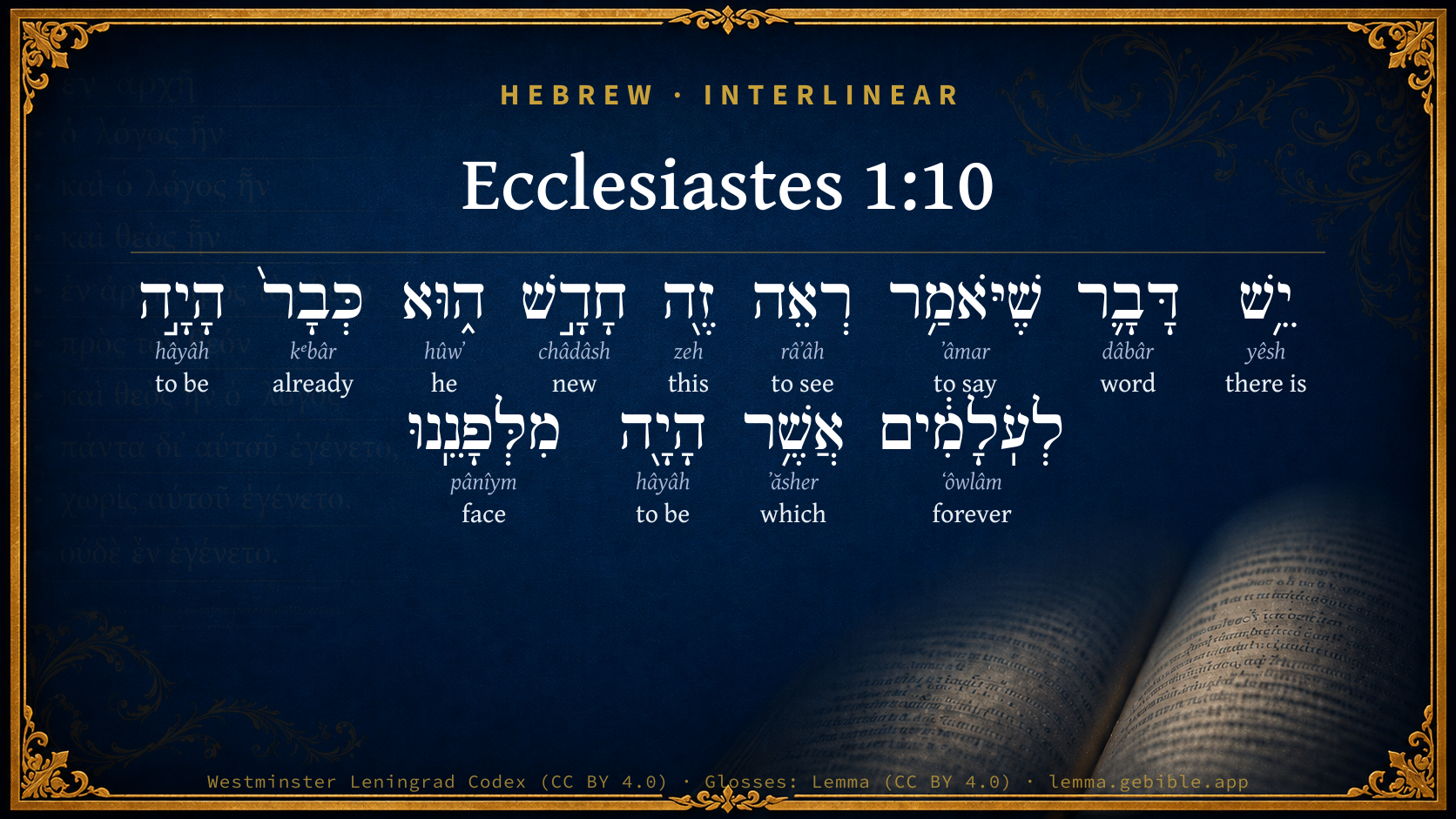
Hebrew (Westminster Leningrad Codex) Ecclesiastes 1:10 appears in the Hebrew Old Testament. The text above is from the Westminster Leningrad Codex. Each word links to its Strong’s number, a concise gloss, and parsing drawn from the Open Scriptures Hebrew Bible morphology. Click any word for its full Brown-Driver-Briggs (BDB) entry.
Download image
Cite this verse

Ecclesiastes 1:10 (World English Bible). Public Domain. Lemma interlinear Bible study tool, https://lemma.gebible.app/v/ecclesiastes/1/10.

Show BibTeX & RIS
BibTeX
RIS
English Translation
Is there a thing of which it may be said, "Behold, this is new?" It has been long ago, in the ages which were before us.
World English Bible · Public Domain
Highlights
  • 1 first appearance in the Hebrew Bible
Full analysis ↓
Download a study sheet

One document with this verse’s original text, its word-by-word gloss line, the meaning frame, cross-references with their text, attributed commentary, and full source and license credits — printable, and it pastes into notes with its structure intact.

This verse Autodidact and up

Study sheet (.html) Plain text (.txt)

A passage Seminary Student

Up to 50 verses in one chapter. A passage sheet keeps up to 6 commentary sources and 12 cross-references per verse, in the order this page ranks them, and says so on the sheet whenever that leaves anything out. Ask for a single verse and you get the Autodidact verse sheet above.

Everything on this page stays free to read, with no account — the sheet is a download of what is already on screen, not access to it.

Want to remove ads? Support Godless Engineer
Compare translations 3

The same verse in 3 English versions, stacked beneath the original-language interlinear above. Click any original word for its lexicon entry.

Each is an independent rendering of the whole verse — the interlinear is not word-aligned to these translations.

Highlighted words mark where these versions differ — a whole-verse word diff, not a word-by-word alignment.

  • World English Bible Public Domain
    Is there a thing of which it may be said, "Behold, this is new?" It has been long ago, in the ages which were before us.
  • King James Version Public Domain
    Is there any thing whereof it may be said, See, this is new? it hath been already of old time, which was before us.
  • unfoldingWord Literal Text CC BY-SA 4.0
    there a thing about which one says, “See this, it new?” It already existed in ages that were from before our faces.

unfoldingWord Literal Text — © unfoldingWord, licensed CC BY-SA 4.0. Word-aligned USFM3 via Door43 (git.door43.org/unfoldingWord/en_ult).

Versions to compare (up to 4)

3 of 4 selected

Show all 18 translations

Every available English version of this verse, each an independent rendering of the whole verse.

  • World English Bible Public Domain
    Is there a thing of which it may be said, "Behold, this is new?" It has been long ago, in the ages which were before us.
  • Berean Standard Bible Public Domain
    Is there a case where one can say, “Look, this is new”? It has already existed in the ages before us.
  • Majority Standard Bible Public Domain
    Is there a case where one can say, “Look, this is new”? It has already existed in the ages before us.
  • King James Version Public Domain
    Is there any thing whereof it may be said, See, this is new? it hath been already of old time, which was before us.
  • American Standard Version (1901) Public Domain
    Is there a thing whereof it may be said, See, this is new? it hath been long ago, in the ages which were before us.
  • Revised Version (1885) Public Domain
    Is there a thing whereof men say, See, this is new? it hath been already, in the ages which were before us.
  • Geneva Bible (1599) Public Domain
    Is there any thing, whereof one may say, Beholde this, it is newe? it hath bene already in the olde time that was before vs.
  • Douay-Rheims (1899) Public Domain
    Nothing under the sun is new, neither is any man able to say: Behold this is new: for it hath already gone before in the ages that were before us.
  • Young's Literal Translation Public Domain
    There is a thing of which `one' saith: `See this, it `is' new!' already it hath been in the ages that were before us!
  • Literal Standard Version CC BY-SA 4.0
    There is a thing of which [one] says: “See this, it [is] new!” Already it has been in the ages that were before us!
  • Unlocked Literal Bible CC BY-SA 4.0
    Is there anything about which it may be said, 'Look, this is new'? Whatever exists has already existed for a long time, during ages which came long before us.
  • unfoldingWord Literal Text CC BY-SA 4.0
    there a thing about which one says, “See this, it new?” It already existed in ages that were from before our faces.
  • Darby Bible Public Domain
    Is there a thing whereof it may be said, See, this is new? It hath been already in the ages which were before us.
  • World Messianic Bible Public Domain
    Is there a thing of which it may be said, “Behold, this is new”? It has been long ago, in the ages which were before us.
  • Webster's Bible Public Domain
    Is there any thing of which it may be said, See, this is new? it hath been already of old time, which was before us.
  • Free Bible Version CC BY-SA 4.0
    There's nothing anyone can point to and say, “Look! Here's something new.” In fact it's been around for ages, long before our time.
  • Bible in Basic English Public Domain
    Is there anything of which men say, See, this is new? It has been in the old time which was before us.
  • JPS Tanakh (1917) Public Domain
    Is there a thing whereof it is said: 'See, this is new'? — it hath been already, in the ages which were before us.

Literal Standard Version (2020), Covenant Press — licensed CC BY-SA 4.0. Text via the HelloAO Bible API (eBible.org). Unlocked Literal Bible (unfoldingWord) — licensed CC BY-SA 4.0. Text via the HelloAO Bible API (eBible.org). unfoldingWord Literal Text — © unfoldingWord, licensed CC BY-SA 4.0. Word-aligned USFM3 via Door43 (git.door43.org/unfoldingWord/en_ult). Free Bible Version, Dr. Jonathan Gallagher — licensed CC BY-SA 4.0. Text via the HelloAO Bible API (eBible.org).

Word by word

More ways to search: Search by grammar → Find every occurrence → Compare this word →

Practice this passage: Drill this verse → Learn its vocabulary →

כְּבָר֙
kᵉbâr
H3528
“already”
Adverb
Part of Speech
Adverb
Full BDB Definition

Origin: from H3527

TWOT: 947c

already, long ago, a great while
  1. יֵ֥שׁ yêsh H3426 “there is” Particle, Demonstrative
  2. דָּבָ֛ר dâbâr H1697 “word” Noun, Common, Masculine, Singular, Absolute
  3. שֶׁיֹּאמַ֥ר ʼâmar H559 “who/which · to say” Particle, Relative + Verb, Qal, Imperfect, 3rd Person, Masculine, Singular
  4. רְאֵה râʼâh H7200 “see” Verb, Qal, Imperative, 2nd Person, Masculine, Singular
  5. זֶ֖ה zeh H2088 “this” Pronoun, Demonstrative, Masculine, Singular
  6. חָדָ֣שׁ châdâsh H2319 “new” Adjective, Adjective, Masculine, Singular, Absolute
  7. ה֑וּא hûwʼ H1931 “he” Pronoun, Personal, 3rd Person, Masculine, Singular
  8. הָיָ֣ה hâyâh H1961 “to be” Verb, Qal, Perfect, 3rd Person, Masculine, Singular
  9. לְעֹֽלָמִ֔ים ʻôwlâm H5769 “to/for · ages” Preposition + Noun, Common, Masculine, Plural, Absolute
  10. אֲשֶׁ֥ר ʼăsher H834 “which” Particle, Relative
  11. הָיָ֖ה hâyâh H1961 “to be” Verb, Qal, Perfect, 3rd Person, Masculine, Singular
  12. מִלְּפָנֵֽנוּ pânîym H6440 “from · to/for · face(s) · our” Preposition + Preposition + Noun, Common, Both, Plural, Construct + Suffix, Personal, 1st Person, Common, Plural

About this verse

These counts appear in no published source. They are computed here, from the morphology-tagged text and Lemma’s own curated glosses. What Lemma adds →

13
words
12
distinct lemmas
Wisdom
section

Notable vocabulary

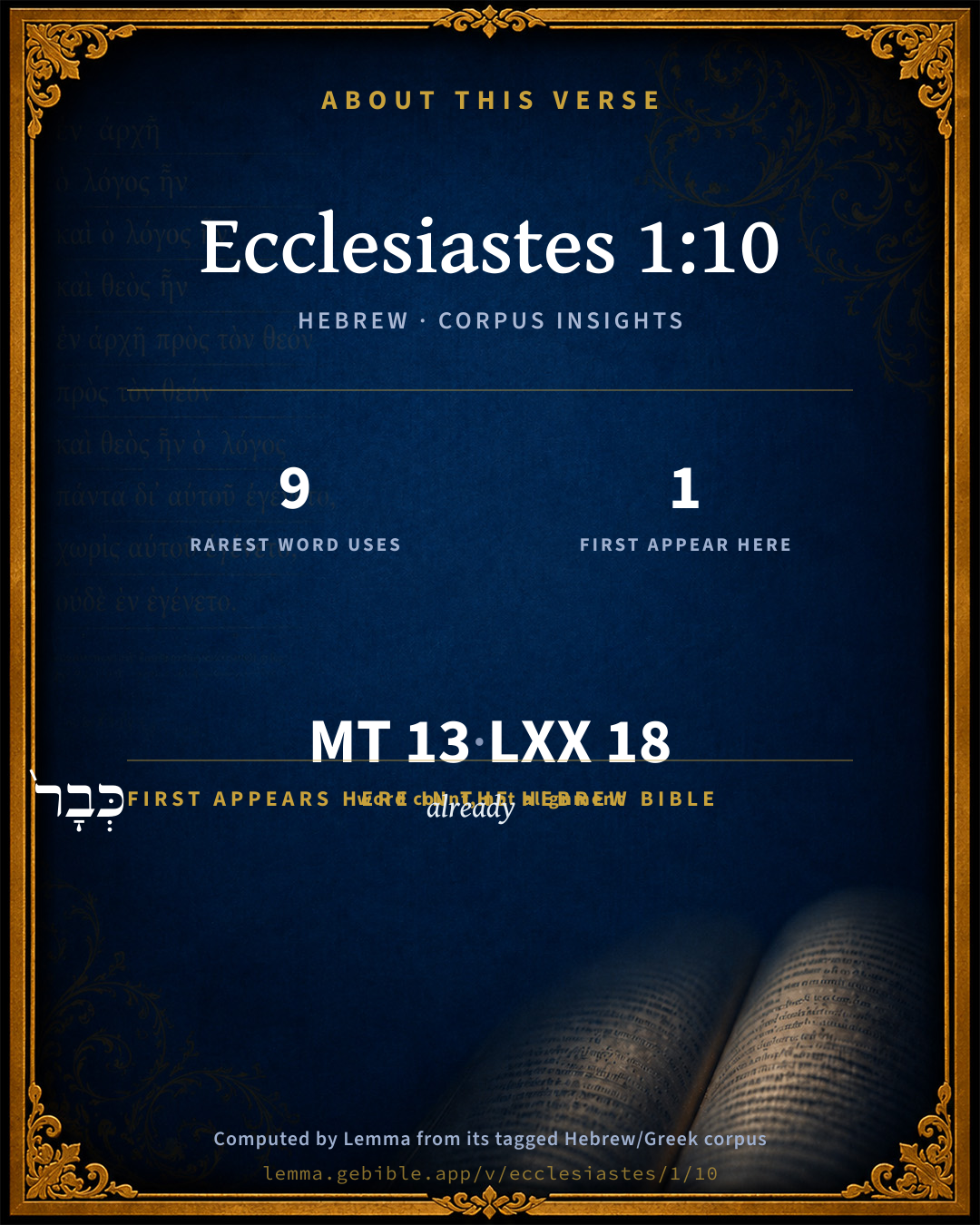
The rarest word here is כְּבָר֙ already H3528 — appearing just 9 times in the whole Hebrew Bible.

First appearance in Scripture

This word makes its first canonical appearance in the Hebrew Bible here:

  • כְּבָר֙ already H3528

Shared distinctive vocabulary

כְּבָר֙ already H3528 occurs in 8 verses of the Hebrew Bible. Also found in:

Grammatical profile

  • 4 verbs
  • 3 nouns
  • 1 adjective
  • 2 pronouns
  • 1 adverb
  • 2 particles

Verb forms

  • שֶׁיֹּאמַ֥ר Qal · Imperfect
  • רְאֵה Qal · Imperative
  • הָיָ֣ה Qal · Perfect
  • הָיָ֖ה Qal · Perfect

Repetition

A word recurs within this verse — often emphatic in Hebrew:

  • הָיָ֣ה to be H1961 ×2

Hebrew & Septuagint length

In English translation the verse runs 26 words from the Hebrew and 24 from the Septuagint (LXX English) — closely comparable.

A rough comparison of the two English renderings, which tokenize alike — not a word-level alignment.

Word counts can differ between the Hebrew and the Greek without any difference in meaning — e.g. the Hebrew direct-object marker אֵת has no separate Greek word, and Greek often adds the article ὁ.

In the original languages it is 13 Hebrew tokens and 18 Greek tokens — but the two are counted differently (Hebrew bundles its prefixes and suffixes into one token; the Greek is in lemma form), so that isn’t a like-for-like length.

Cross-references

5

Topical passages linked to Ecclesiastes 1:10 in the Treasury of Scripture Knowledge — connected by theme and wording, ordered by reader-vote popularity; previews shown in the World English Bible.

  • Acts 7:51 "You stiff-necked and uncircumcised in heart and ears, you always resist the Holy Spirit! As your fathers did, so you do.
  • Matthew 23:30–32 and say, 'If we had lived in the days of our fathers, we wouldn't have been partakers with them in the blood of the prophets.'
  • Luke 17:26–30 As it happened in the days of Noah, even so will it be also in the days of the Son of Man.
  • Matthew 5:12 Rejoice, and be exceedingly glad, for great is your reward in heaven. For that is how they persecuted the prophets who were before you.
  • 2 Timothy 3:8 Even as Jannes and Jambres opposed Moses, so do these also oppose the truth; men corrupted in mind, reprobate concerning the faith.

Cross-references courtesy of OpenBible.info (CC BY 4.0).

Hebrew and Greek witnesses Masoretic Hebrew ↔ Greek Septuagint

The same verse in the two great witnesses to the Old Testament, shown verse-for-verse.

These are two independent witnesses, not word-aligned to each other, and the Septuagint is shown in lemma (dictionary) form.

Hebrew Ecclesiastes 1:10 Masoretic · Westminster Leningrad Codex

יֵ֥שׁ דָּבָ֛ר שֶׁיֹּאמַ֥ר רְאֵה זֶ֖ה חָדָ֣שׁ ה֑וּא כְּבָר֙ הָיָ֣ה לְעֹֽלָמִ֔ים אֲשֶׁ֥ר הָיָ֖ה מִלְּפָנֵֽנוּ

Is there a thing of which it may be said, "Behold, this is new?" It has been long ago, in the ages which were before us.

World English Bible · Public Domain

Greek LXX Ecclesiastes 1:10 Septuagint · lemma form

ὅς λαλέω καί εἶπον ὁράω οὗτος καινός εἰμί ἤδη γίγνομαι ἐν ὁ αἰών ὁ γίγνομαι ἀπό ἔμπροσθεν ἐγώ

Who is he that shall speak and say, Behold, this is new? it has already been in the ages that have passed before us.

LXX2012 (modern English Septuagint) · Public Domain

On this verse, Keil & Delitzsch discusses the Septuagint’s reading. Read the note in Commentary ↓

Hebrew: Westminster Leningrad Codex (CC BY 4.0). Greek: Septuagint (public domain); English from LXX2012 (modern English Septuagint) (Public Domain). How the Septuagint differs from the Hebrew →

Commentary

Notes on Ecclesiastes 1:10 from classic Christian and Jewish commentators (each source and its license shown beneath its notes). The classic Christian expositions comment on the surrounding passage and are grouped to its opening verse, so a note may address several verses; the Jewish commentaries on the Tanakh (Rashi and others) are per-verse, so they appear only where the commentator wrote on this verse.

Lemma curates 59 commentaries, every one of them public domain or Creative Commons licensed, each selected and text-cleaned for this edition rather than reprinted as found. About our sources →

Trapp's Complete Commentary

John Trapp

Ecc 1:10 Is there [any] thing whereof it may be said, See, this [is] new? it hath been already of old time, which was before us.

Ver. 10. Is there anything whereof it may be said, See, this is new?] Hoc ego primus vidi, saith Zabarel. But how could he tell that? Many men have been so befooled. We look upon guns and printing as new inventions; the former found out by Birchtoldin the monk, A.D. 1380, the other by friar Faustus, A.D. 1446. But the Chinese are said to have had the use of both these long before. Should we then so eagerly hunt after novelties, those mere new nothings, till we lose ourselves in the chase? Nil admirari prope res est una Numici. Get spiritual eyes rather to behold the beauty of the new creature (all other things are but nine days’ wonderment), the bravery of the new Jerusalem. Yea, get this natural itch after novelties killed by the practice of mortification, and get into Christ, that thou mayest be a new creature. So shalt thou have a new name upon thee; {Isa 62:2} a new spirit within thee; {Eze 36:27} new alliance; {Eph 2:14} new attendants; {Psa 91:11} new wages, new work; {Isa 62:11} a new commandment; {1Jn 2:8} a new covenant; {Jer 31:33} a new way to heaven; {Heb 10:20} and a new mansion in heaven. {Joh 14:2 2Co 5:8}

John Trapp, A Commentary or Exposition upon All the Books of the Old and New Testament (1647–1656) — public domain. Text from a community e-Sword module.

The Biblical Illustrator

Joseph S. Exell

Ecc_1:10

Is there anything whereof it may be said, See, this is new?

Something new

You remember that when Paul visited Athens his attention seems to have been especially attracted by two things: that the city was so full of idols; that the people who dwelt there were so given to change and novelty. For all the Athenians and strangers which were there spent their time in nothing else but either to tell or to hear some new thing. When we read these words we are ready at first to exclaim, What a remarkable people these ancient Athenians must have been! Surely we have in them mans desire for novelty exemplified in a strangely exaggerated and quite exceptional form. But who can read these words without feeling that they describe the prevailing habit and attitude of the human mind? Go to those places where men and women mostly congregate--where they meet or work, or walk in friendly intercourse, and wheat do we see? Why, the same spectacle which engaged the attention of Paul at Athens--some telling, others hearing, some new thing. Human nature is unchanged by the lapse of centuries; it cherishes the same desires. Anything new, while the charm of novelty remains, will awaken a degree of interest which is quite out of proportion to the intrinsic worth of the thing itself.

I. Mans hopeless inquiry, Is there anything whereof it may be said, See, this is new? This is evidently the inquiry of some one who has long been engaged in a fruitless and unsatisfactory search after some new thing. Of course, there is very much which is circumstantially new--relatively new--new in form--new in use. We have new machinery, new modes of locomotion, new houses, Hew furniture, new methods of preparing food; indeed, in one sense, the world seems filled with novelties. But all this does not seem to touch upon, or noticeably to lessen, what some one has called the miserable monotony of human life. There is something very wonderful and very solemn in the sameness of human life, in the fact that there is nothing new; that there is, with all superficial differences, a substantial uniformity and monotony in human character and experience. If we look upon the family of man, in its present condition or in its past history, we are at first almost bewildered by the endless diversity of appearances. We find age differ from age, country from country, race from race, class from class, individual from individual. And yet, if we disregard the accidents of human life, its mere circumstances, and confine our attention to its essentials--to life itself, what do we find? We can distinguish through successive generations, not only the same leading types, but also the minute varieties of human character. The same feelings, motives, desires, principles of action, are operating now as powerfully and distinctly as before the flood; then and now might we see the glow of love, the elation of hope, the outpouring of gratitude. And we find that the ambition, the avarice, the pride, the sensuality of the nineteenth century after Christ, correspond in character and action with those same evil principles as they were displayed in the nineteenth century before Christ. All the cardinal sins are existing as veritably now as in any previous age. There is very little originality in sin. We are called to contend with, and, if may be, vanquish old foes with new faces. It is because we are men of like passion with those that have preceded us, that the history of the past is intelligible. We find that the sins which called down the curses of Heaven ages and generations ago are still being perpetrated in our midst. Do you think that Elis were the only disobedient children, who have brought their parents to grief? I might easily enlarge on this subject. I will confine myself to one illustration--Mans vain and fruitless inquiry after some new thing, an inquiry, the prosecution of which, in some form or another, has distinguished man in every age of the world. Take the case of Solomon. In this quest he spent a considerable portion of his life; and he left off with a sigh of disappointment, and with an inquiry expressive of utter hopelessness. Instead of dwelling on the mere fact, I would point out its significance. I would remind you that the fact of your inquiring, with all this feverish anxiety after something new, reveals to us in a very clear, though sad and humiliating manner, the hollow, monotonous, unsatisfying nature of your past lives. What is the secret of your desire for something new in the future? Is it not, to a great extent, your dissatisfaction with the pasty Now, without knowing anything about your lives individually, I am able to say something concerning them, the truth of which you will all readily admit--that they do not present to you at this moment a very satisfactory appearance. Let us take the most favourable example we can find. We Speak of youth as a season of happiness. But are we correct in our estimate? There is a certain exemption from the cares of maturity--there is a certain buoyancy and elation of spirit, which we do not, to the full extent, retain. But, my young friends, tell me, Has the world made you happy? The old man is so dissatisfied, that he believes that he must have been more happy in some previous period of life than he is now. The young man, not less dissatisfied, believes that a hitherto undiscovered happiness is waiting for him in the future. What, then, is the fact which demands our attention? It is this. You have always been going on from point to point, inquiring after something new: and your inquiry for the new is a confession as to the insufficiency of the old. As you pressed on in your way you have seen fruit hanging in the richest and most tempting clusters. You have plucked and tasted, and they have been as the apples of Sodom. What a spectacle does our world at this moment present! You see men everywhere seeking for happiness and rest, and finding them not. But this unceasing search after something new, not merely reveals the unsatisfactory nature of the past,--it ought also to suggest an important caution as to the future. Is it not reasonable that you should pause in your pursuit, and inquire if it is likely that you will find, in the direction in which you have hitherto gone, anything which will really satisfy you? Is it reasonable for a man to go grovelling along, hugging a delusion like this? As long as you continue to indulge the hope of finding happiness and satisfaction in this world, you will never look above or beyond this world for them. Let us admit that in the future everything will turn out as you propose--as you desire. What then? Why, that the future will be as the past. You are seeking happiness, you are seeking contentment in the wrong way; your faces are set in the wrong direction. We see, then, where the mistake is. We want some new thing, but it is within, and not without ourselves.

II. Gods gracious and satisfactory reply. To all these dissatisfied searchers after novelty, we can hear God say, If any man be in Christ he is a new creature; old things are passed away, behold all things are become new. Yes, this is our great necessity, to become new creatures in Christ Jesus; then shall we find old things pass away, and all things become new. Do you want a new experience? You may have it in communion and fellowship with Christ. Do you, wearied with the familiar and unsatisfying objects of the world, want new sources of enjoyment and new objects of contemplation and pursuit? All these you will realize in a life in Christ. (T. M. Morris.)

Life in the light of Christ

Since Ecclesiastes meditated on the problems of human life, one really new thing has been seen. The Sun of Righteousness has risen upon the world with healing in His wings. The Word of God took flesh, and dwelt among men. The Only-begotten Son has revealed the Eternal Father, and has brought life and immortality to light through the Gospel. This new manifestation of God--this new and fuller revelation of His redeeming purpose for mankind--has entered as a modifying factor into human experience. The cardinal features of life remain as before; but they take on a new aspect when they are seen in the light of our Fathers love, and of that glorious immortality for which He is seeking to train us. What may be as vanity, when it is considered as an end, may be anything but vain when it is considered as a means. A scaffolding may be a poor affair; but what if a beautiful and substantial temple is being reared within it? A schoolroom, with its appropriate furniture, might not be a Satisfying home; nevertheless it may well fulfil the purposes of education and discipline. The perishable may minister to the everlasting. The unprofitable may lead to higher gains. The unsatisfying may awaken a craving for that which will truly fill the soul. From this point of view the essential sameness of life through the ages bears its testimony to the persistent purpose of God and the constant needs of humanity. Why should not the schoolroom remain the same, if it has been adapted by Infinite Wisdom for the training and discipline of immortal souls? Human life, viewed in itself, as a brief span of existence bounded by death, may be as vanity: but human life viewed in the light of Christ and immortality, is an arena of education by probation--a sphere for the formation of spiritual and enduring character, and for the service of a living and loving Father. (T. C. Finlayson.)

The Biblical Illustrator, edited by Joseph S. Exell (c. 1880s–1900s) — public domain. Text from a community e-Sword module.

Keil & Delitzsch

C. F. Keil & F. Delitzsch

"Is there anything whereof it may be said: See, this is new? - it was long ago through the ages (aeons) which have been before us." The Semit. substantive verb ישׁ (Assyr. isu) has here the force of a hypothetical antecedent: supposing that there is a thing of which one might say, etc. The זה, with Makkeph, belongs as subject, as at Ecc 7:27, Ecc 7:29 as object, to that which follows. כּבר (vid., List, p. 193) properly denotes length or greatness of time (as כּברה, length of way). The ל of לע is that of measure: this "long ago" measured (Hitz.) after infinitely long periods of time. מלּ, ante nos, follows the usage of מלּף, Isa 41:26, and lpaa', Jdg 1:10, etc.; the past time is spoken of as that which was before, for it is thought of as the beginning of the succession of time (vid., Orelli, Synon. der Zeit u. Ewigkeit, p. 14f.). The singular היה may also be viewed as pred. of a plur. inhumanus in order; but in connection, Ecc 2:7, Ecc 2:9 (Gesen. 147, An. 2), it is more probable that it is taken as a neut. verb. That which newly appears has already been, but had been forgotten; for generations come and generations go, and the one forgets the other.

Ecclesiastes 1:11

ecc 1:11

"There is no remembrance of ancestors; and also of the later ones who shall come into existence, there will be no remembrance for them with those who shall come into existence after them." With זכּרון (with Kametz) there is also זכרון, the more common form by our author, in accordance with the usage of his age; Gesen., Elst., and others regard it here and at Ecc 2:16 as constr., and thus לרא as virtually object-gen. (Jerome, non est priorum memoria); but such refinements of the old syntaxis ornata are not to be expected in our author: he changes (according to the traditional punctuation) here the initial sound, as at Ecc 1:17 the final sound, to oth and uth. אין ל is the contrast of היה ל: to attribute to one, to become partaker of. The use of the expression, "for them," gives emphasis to the statement. "With those who shall come after," points from the generation that is future to a remoter future, cf. Gen 33:2. The Kametz of the prep. is that of the recompens. art.; cf. Num 2:31, where it denotes "the last" among the four hosts; for there הא is meant of the last in order, as here it is meant of the remotely future time.

Ecclesiastes 1:12

ecc 1:12

"I, Koheleth, have been king over Israel in Jerusalem." That of the two possible interpretations of הייתי, "I have become" and "I have been," not the former (Grtz), but the latter, is to be here adopted, has been already shown. We translate better by "I have been" - for the verb here used is a pure perfect - than by "I was" (Ew., Elst., Hengst., Zck.), with which Bullock (Speaker's Comm., vol. IV, 1873) compares the expression Quand j'tois roi ! which was often used by Louis XIV towards the end of his life. But here the expression is not a cry of complaint, like the "fuimus Troes," but a simple historical statement, by which the Preacher of the vanity of all earthly things here introduces himself, - it is Solomon, resuscitated by the author of the book, who here looks back on his life as king. "Israel" is the whole of Israel, and points to a period before the division of the kingdom; a king over Judah alone would not so describe himself. Instead of "king על (over) Israel," the old form of the language uses frequently simply "king of Israel," although also the former expression is sometimes found; cf. Sa1 15:26; Sa2 19:23; Kg1 11:37. He has been king, - king over a great, peaceful, united people; king in Jerusalem, the celebrated, populous, highly-cultivated city, - and thus placed on an elevation having the widest survey, and having at his disposal whatever can make a man happy; endowed, in particular, with all the means of gaining knowledge, which accorded with the disposition of his heart searching after wisdom (cf. Kg1 3:9-11; Kg1 5:9).

But in his search after worldly knowledge he found no satisfaction.

Ecclesiastes 1:13

ecc 1:13

"And I gave my heart to seek and to hold survey with wisdom over all that is done under the sun: a sore trouble it is which God has given to the children of men to be exercised therewith." The synonyms דּרשׁ(to seek) and תּוּר (to hold survey over) do not represent a lower and a higher degree of search (Zck.), but two kinds of searching: one penetrating in depth, the other going out in extent; for the former of these verbs (from the root-idea of grinding, testing) signifies to investigate an object which one already has in hand, to penetrate into it, to search into it thoroughly; and the latter verb (from the root-idea of moving round about)

(Note: Vid., the investigation of these roots (Assyr. utîr, he brought back) in Eth's Schlafgemach der Phantasie, pp. 86-89.)

signifies to hold a survey, - look round in order to bring that which is unknown, or not comprehensively known, within the sphere of knowledge, and thus has the meaning of bǎkkēsh, one going the rounds. It is the usual word for the exploring of a country, i.e., the acquiring personal knowledge of its as yet unknown condition; the passing over to an intellectual search is peculiar to the Book of Koheleth, as it has the phrase ל לב נתן, animum advertere, or applicare ad aliquid, in common only with Dan 10:12. The beth of bahhochemah is that of the instrument; wisdom must be the means (organon) of knowledge in this searching and inquiry. With על is introduced the sphere into which it extends. Grotius paraphrases: Historiam animalium et satorum diligentissime inquisivi. But נעשׂה does not refer to the world of nature, but to the world of men; only within this can anything be said of actions, only this has a proper history. But that which offers itself for research and observation there, brings neither joy nor contentment. Hitzig refers הוּא to human activity; but it relates to the research which has this activity as its object, and is here, on that account, called "a sore trouble," because the attainment and result gained by the laborious effort are of so unsatisfactory a nature. Regarding ענין, which here goes back to ענה ב, to fatigue oneself, to trouble oneself with anything, and then to be engaged with it. The words ענין רע would mean trouble of an evil nature (vid., at Psa 78:49; Pro 6:24); but better attested is the reading ענין רע "a sore trouble." הוּא is the subj., as at Ecc 2:1 and elsewhere; the author uses it also in expressions where it is pred. And as frequently as he uses asher and שׁ, so also, when form and matter commend it, he uses the scheme of the attributive clause (elliptical relative clause), as here (cf. Ecc 3:16), where certainly, in conformity with the old style, נתנו was to be used.

Ecclesiastes 1:14

ecc 1:14

He adduces proof of the wearisomeness of this work of research: "I saw all the works that are done under the sun; and, behold, all is vanity and striving after the wind." The point of the sentence lies in והנּה = וארא וה, so that thus rathi is the expression of the parallel fact (circumst. perfect). The result of his seeing, and that, as he has said Ecc 1:13, of a by no means superficial and limited seeing, was a discovery of the fleeting, unsubstantial, fruitless nature of all human actions and endeavours. They had, as hevel expresses, not reality in them; and also, as denoted by reuth ruahh (the lxx render well by προαίρεσις πνεύματος), they had no actual consequences, no real issue. Hos 12:1 also says: "Ephraim feedeth on wind," i.e., follows after, as the result of effort obtains, the wind, roěh ruahh; but only in the Book of Koheleth is this sentence transformed into an abstract terminus technicus (vid., under Reth).

Ecclesiastes 1:15

ecc 1:15

The judgment contained in the words, "vanity and a striving after the wind," is confirmed: "That which is crooked cannot become straight; and a deficit cannot be numerable," i.e., cannot be taken into account (thus Theod., after the Syro-Hex.), as if as much were present as is actually wanting; for, according to the proverb, "Where there is nothing, nothing further is to be counted." Hitzig thinks, by that which is crooked and wanting, according to Ecc 7:13, of the divine order of the world: that which is unjust in it, man cannot alter; its wants he cannot complete. But the preceding statement refers only to labour under the sun, and to philosophical research and observation directed thereto. This places before the eyes of the observer irregularities and wants, brings such irregularities and wants to his consciousness, - which are certainly partly brought about and destined by God, but for the most part are due to the transgressions of man himself, - and what avails the observer the discovery and investigation? - he has only lamentation over it, for with all his wisdom he can bring no help. Instead of לתקן (vid., under תקן), לתקן was to be expected. However, the old language also formed intransitive infinitives with transitive modification of the final vowels, e.g., יבשׁ, etc. (cf. ישׁון, Ecc 5:11).

Having now gained such a result in his investigation and research by means of wisdom, he reaches the conclusion that wisdom itself is nothing.

Ecclesiastes 1:16

ecc 1:16

"I have communed with mine own heart, saying: Lo, I have gained great and always greater wisdom above all who were before me over Jerusalem; and my heart hath seen wisdom and knowledge in fulness. And I gave my heart to know what was in wisdom and knowledge, madness and folly - I have perceived that this also is a grasping after the wind." The evidence in which he bears witness to himself that striving after wisdom and knowledge brings with it no true satisfaction, reaches down to the close of Ecc 1:17; ידעתּי is the conclusion which is aimed at. The manner of expression is certainly so far involved, as he speaks of his heart to his heart what it had experienced, and to what he had purposely directed it. The אני leads us to think that a king speaks, for whom it is appropriate to write a capital I, or to multiply it into we; vid., regarding this "I," more pleonastic than emphatic, subordinated to its verb.

It is a question whether עם־לבּי, after the phrase (את) עם דּבּר, is meant of speaking with any one, colloqui, or of the place of speaking, as in "thou shalt consider in thine heart," Deu 8:5, it is used of the place of consciousness; cf. Job 15:9, (עמּדי) עמּי היה = σύνοιδα ἐμαυτῷ, and what is said in my Psychol. p. 134, regarding συνείδησις, consciousness, and συμμαρτυρεῖν. בּלבּי, interchanging with עם־לבּי, Ecc 2:1, Ecc 2:15, commends the latter meaning: in my heart (lxx, Targ., Jerome, Luther); but the cogn. expressions, medabběrěth ǎl-libbah, Sa1 1:13, and ledabbēr ěl-libbi, Gen 24:45, suggest as more natural the former rendering, viz., as of a dialogue, which is expressed by the Gr. Venet. (more distinctly than by Aquila, Symm., and Syr.): διείλεγμαι ἐγὼ ξὺν τῇ καρδίᾳ μου. Also לאמר, occurring only here in the Book of Koheleth, brings it near that the following oratio directa is directed to the heart, as it also directly assumes the form of an address, Ecc 2:1, after בלבי. The expression, הג הך, "to make one's wisdom great," i.e., "to gain great wisdom," is without a parallel; for the words, הג תו, Isa 28:29, quoted by Hitzig, signify to show and attest truly useful (beneficial) knowledge in a noble way. The annexed והו refers to the continued increase made to the great treasure already possessed (cf. Ecc 2:9 and Kg1 10:7). The al connected therewith signifies, "above" (Gen 49:26) all those who were over Jerusalem before me. This is like the sarrâni âlik maḥrija, "the kings who were my predecessors," which was frequently used by the Assyrian kings. The Targumist seeks to accommodate the words to the actual Solomon by thus distorting them: "above all the wise men who have been in Jerusalem before me," as if the word in the text were בירושלם,

(Note: In F. the following note is added: "Several Codd. have, erroneously, birushalam instead of al-jerushalam." Kennicott counts about 60 such Codd. It stands thus also in J; and at first it thus stood in H, but was afterwards corrected to al-yerushalam. Cf. Elias Levita's Masoreth hamasoreth, II 8, at the end.)

as it is indeed found in several Codd., and according to which also the lxx, Syr., Jerome, and the Venet. translate. Rather than think of the wise (הכּימיּא), we are led to think of all those who from of old stood at the head of the Israelitish community. But there must have been well-known great men with whom Solomon measures himself, and these could not be such dissimilarly great men as the Canaanitish kings to the time of Melchizedek; and since the Jebusites, even under Saul, were in possession of Zion, and Jerusalem was for the first time completely subdued by David (Sa2 5:7, cf. Jos 15:63), it is evident that only one predecessor of Solomon in the office of ruler over Jerusalem can be spoken of, and that here an anachronism lies before us, occasioned by the circumstance that the Salomo revivivus, who has behind him the long list of kings whom in truth he had before him, here speaks.

Regarding היה אשׁר, qu'il y uet, for היו אשׁר, qui furent, vid., at Ecc 1:10. The seeing here ascribed to the heart (here = νοῦς, Psychol. p. 249) is meant of intellectual observation and apprehension; for "all perception, whether it be mediated by the organs of sense or not (as prophetic observing and contemplating), comprehends all, from mental discernment down to suffering, which veils itself in unconsciousness, and the Scripture designates it as a seeing" (Psychol. 234); the Book of Koheleth also uses the word ראה of every kind of human experience, bodily or mental, Ecc 2:24; Ecc 5:17; Ecc 6:6; Ecc 9:9. It is commonly translated: "My heart saw much wisdom and knowledge" (thus e.g., Ewald); but that is contrary to the gram. structure of the sentence (Ew. 287c). The adject. harbēh

(Note: Regarding the form הרבה, which occurs once (Jer 42:2), vid., Ew. 240c.)

is always, and by Koheleth also, Ecc 2:7; Ecc 5:6, Ecc 5:16; Ecc 6:11; Ecc 9:18; Ecc 11:8; Ecc 12:9, Ecc 12:12, placed after its subst.; thus it is here adv., as at Ecc 5:19; Ecc 7:16. Rightly the Venet.: ἡ καρδία μου τεθέαται κατὰ πολὺ σοφίαν καί γνῶσιν Chokma signifies, properly, solidity, compactness; and then, like πυκνότης, mental ability, secular wisdom; and, generally, solid knowledge of the true and the right. Dǎǎth is connected with chokma here and at Isa 33:6, as at Rom 11:33, γνῶσις is with σοφία. Baumggarten-Crusius there remarks that σοφία refers to the general ordering of things, γνῶσις to the determination of individual things; and Harless, that σοφία is knowledge which proposes the right aim, and γνῶσις that which finds the right means thereto. In general, we may say that chokma is the fact of a powerful knowledge of the true and the right, and the property which arises out of this intellectual possession; but dǎǎth is knowledge penetrating into the depth of the essence of things, by which wisdom is acquired and in which wisdom establishes itself.

Ecc 1:17

By the consecutive modus ואתּנה (aor. with ah, like Gen 32:6; Gen 41:11, and particularly in more modern writings; vid., p. 198, regarding the rare occurrence of the aorist form in the Book of Koheleth) he bears evidence to himself as to the end which, thus equipped with wisdom and knowledge, he gave his heart to attain unto (cf. 13a), i.e., toward which he directed the concentration of his intellectual strength. He wished to be clear regarding the real worth of wisdom and knowledge in their contrasts; he wished to become conscious of this, and to have joy in knowing what he had in wisdom and knowledge as distinguished from madness and folly. After the statement of the object lādǎǎth, stands vedaath, briefly for ולדעת. Ginsburg wishes to get rid of the words holēloth vesikluth, or at least would read in their stead תּבוּנית ושׂכלוּת (rendering them "intelligence and prudence"); Grtz, after the lxx παραβολὰς καὶ ἐπιστήμην, reads משׁלות ושׂכלות. But the text can remain as it is: the object of Koheleth is, on the one hand, to become acquainted with wisdom and knowledge; and, on the other, with their contraries, and to hold these opposite to each other in their operations and consequences. The lxx, Targ., Venet., and Luther err when they render sikluth here by ἐπιστήμη, etc. As sikluth, insight, intelligence, is in the Aram. written with the letter samek (instead of sin), so here, according to the Masora סכלות, madness is for once written with ס, being everywhere else in the book written with שׂ; the word is an ἐναντιόφωνον,

(Note: Vid., Th. M. Redslob's Die Arab. Wrter, u.s.w. (1873).)

and has, whether written in the one way or in the other, a verb, sakal (שׂכל, סכל), which signifies "to twist together," as its root, and is referred partly to a complication and partly to a confusion of ideas. הללות, from הלל, in the sense of "to cry out," "to rage," always in this book terminates in th, and only at Ecc 10:13 in th; the termination th is that of the abstr. sing.; but th, as we think we have shown at Pro 1:20, is that of a fem. plur., meant intensively, like bogdoth, Zep 2:4; binoth, chokmoth, cf. bogdim, Pro 23:28; hhovlim, Zac 11:7, Zac 11:14; toqim, Pro 11:15 (Bttch. 700g E). Twice vesikluth presents what, speaking to his own heart, he bears testimony to before himself. By yādǎ'ti, which is connected with dibbarti (Ecc 1:16) in the same rank, he shows the facit. זה refers to the striving to become conscious of the superiority of secular wisdom and science to the love of pleasure and to ignorance. He perceived that this striving also was a grasping after the wind; with רעוּת, 14b, is here interchanged רעיון. He proves to himself that nothing showed itself to be real, i.e., firm and enduring, unimpeachable and imperishable. And why not?

Ecc 1:18

"For in much wisdom is much grief; and he that increaseth knowledge increaseth sorrow." The German proverb: "Much wisdom causeth headache," is compared, Ecc 12:12, but not here, where כּעס and מכאוב express not merely bodily suffering, but also mental grief. Spinoza hits one side of the matter in his Ethics, IV 17, where he remarks: "Veram boni et mali cognitionem saepe non satis valere ad cupiditates coercendas, quo facto homo imbecillitatem suam animadvertens cogitur exclamare: Video meliora proboque, deteriora sequor." In every reference, not merely in that which is moral, there is connected with knowledge the shadow of a sorrowful consciousness, in spite of every effort to drive it away. The wise man gains an insight into the thousand-fold woes of the natural world, and of the world of human beings, and this reflects itself in him without his being able to change it; hence the more numerous the observed forms of evil, suffering, and discord, so much greater the sadness (כּעס, R. כס, cogn. הס, perstringere) and the heart-sorrow (מכאוב, crve-cour) which the inutility of knowledge occasions. The form of 18a is like Ecc 5:6, and that of 18b like e.g., Pro 18:22. We change the clause veyosiph daath into an antecedent, but in reality the two clauses stand together as the two members of a comparison: if one increaseth knowledge, he increaseth (at the same time) sorrow. "יוסיף, Isa 29:14; Isa 38:5; Ecc 2:18," says Ewald, 169a, "stands alone as a part. act., from the stem reverting from Hiph. to Kal with י instead of ." But this is not unparalleled; in הן יוסיף the verb יוסף is fin., in the same manner as יסּד, Isa 28:16; תּומיך, Psa 16:5, is Hiph., in the sense of amplificas, from ימך; יפיח, Pro 6:19 (vid., l.c.), is an attribut. clause, qui efflat, used as an adj.; and, at least, we need to suppose in the passage before us the confusion that the ē of kātēl (from kātil, originally kātal), which is only long, has somehow passed over into î. Bttcher's remark to the contrary, "An impersonal fiens thus repeated is elsewhere altogether without a parallel," is set aside by the proverb formed exactly thus: "He that breathes the love of truth says what is right," Pro 12:17.

Next: Ecclesiastes Chapter 2

Keil & Delitzsch — Biblical Commentary on the Old Testament (1861–1891) — public domain (CC PDM 1.0). Text via the HelloAO Bible API. (Old Testament only.)

Jamieson, Fausset & Brown

Robert Jamieson, A. R. Fausset & David Brown

old time--Hebrew, "ages."

which was--The Hebrew plural cannot be joined to the verb singular. Therefore translate: "It hath been in the ages before; certainly it hath been before us" [HOLDEN]. Or, as MAURER: "That which has been (done) before us (in our presence, Ch1 16:33), has been (done) already in the old times."

Jamieson, Fausset & Brown — Commentary Critical and Explanatory on the Whole Bible (1871) — public domain (CC PDM 1.0). Text via the HelloAO Bible API.

Adam Clarke's Commentary

Verse 10. Is there any thing, c.] The original is beautiful. "Is there any thing which will say, See this! it is new?" Men may say this of their discoveries, &c. but universal nature says, It is not new. It has been, and it will be.

Adam Clarke's Commentary on the Bible (1810–1826) — public domain. Text from a community e-Sword/MySword module.

Ellicott's Commentary for English Readers

(10) Of old time.—The Hebrew word here is peculiar to Ecclesiastes, where it occurs eight times (Ecc_2:12; Ecc_2:16; Ecc_3:15; Ecc_4:2; Ecc_6:10; Ecc_9:6-7), but is common in later Hebrew.

A Bible Commentary for English Readers, edited by Charles John Ellicott (1878–1897) — public domain. Text from a community e-Sword module.

The Cambridge Bible for Schools and Colleges

gen. ed. J. J. S. Perowne

10. Is there any thing] A man may challenge, the writer seems to say, the sweeping assertion just uttered. He may point to some new phenomenon, some new empire, some invention of art, or discovery of science. It is all to no purpose. It has been before in the vast æons (the Hebrew word for “of old time” is the plural of that commonly translated “age” or “eternity”) of the recorded or unrecorded past. It is but an oblivion of what has been that makes us look to that which is to be as introducing a new element in the world’s history. The thought was a favourite one with the Stoics. For a full account of their doctrine on this point see Zeller’s Stoics and Epicureans, ch. 7. Aurelius does but sum up the teaching of the school, where he says, almost in the very words of Ecclesiastes, that “they that come after us will see nothing new, and that they who went before us saw nothing more than we have seen” (Meditt. xi. 1). “There is nothing new” (Ibid. vii. 1). “All things that come to pass now have come to pass before and will come to pass hereafter” (Ibid. vii. 26). So Seneca (Ep. xxiv.), “Omnia transeunt ut revertantur; Nil novi video, nil novi facio.” (“All things pass away that they may return again; I see nothing new, I do nothing new.”)

The Cambridge Bible for Schools and Colleges (gen. ed. J. J. S. Perowne; Cambridge University Press, 1878–1918) — public domain. Text from a community e-Sword module.

John Gill's Exposition

Is there any thing whereof it may be said, see, this is new?.... This is an appeal to all men for the truth of the above observation, and carries in it a strong denial that there is anything new under the sun; and is an address to men to inquire into the truth of it, and thoroughly examine it, and see if they can produce any material objection to it; look into the natural world, and the same natural causes will be seen producing the same effects; or into the moral world, and there are the same virtues, and their contrary; or into the political world, and the same schemes are forming and pursuing, and which issue in the same things, peace or war; or into the learned world, and the same languages, arts, and sciences, are taught and learned; and the same things said over again (i): or into the mechanic world, and the same trades and businesses are carrying on: or the words may be considered as a concession, and carry in them the form of an objection, "there is a thing (k) whereof it may be said", or a man may say, "see, this is new"; so the Targum; there were some things in Solomon's time it is allowed that might be objected, as there are in ours, to which the answer is,

it hath been already of old time which was before us; what things are reckoned new are not so; they were known and in use in ages past, long before we had a being. R. Alshech takes the words to be an assertion, and not an interrogation, and interprets it of a spiritual temple in time to come, which yet was created before the world was.

(i) "Nullum est jam dictum, quod non dictum sit prius", Terent Prolog. Eunuch. v. 41. (k) "est quidpiam", Pagninus, Mercerus, Gejerus; "est res", Drusius, Cocceius, Rambachius.

John Gill's Exposition of the Whole Bible (1746–1763) — public domain (CC PDM 1.0). Text via the HelloAO Bible API.

Haydock's Catholic Bible Commentary

New. Such vicissitudes have occurred before, though we must not infer that the world is eternal; or that there have been many others before this, as Origen would suppose. (Prin. iii. 5., &c.) (Calmet) --- Men’s souls, which are created daily, are nevertheless of the same sort as Adam’s was; and creatures proceed from others of the same species, which have been from the beginning. (St. Thomas Aquinas, [Summa Theologiae] p. 1. q. 73.) (Worthington) --- Natural and moral things continue much the same. (Menochius)

George Leo Haydock (1774–1849), Haydock's Catholic Family Bible and Commentary, 1859 edition — public domain. Excludes Psalms (Douay-Rheims chapter numbering differs from Protestant) and Deuterocanonical books (Catholic canon only).

Matthew Poole's English Annotations

For the proof hereof I appeal to the consciences and experiences of all men. It hath been already of old thee; the same things have been said and done before, though possibly we did not know it.

Matthew Poole's English Annotations on the Holy Bible (1683–1685) — public domain. Text from a community e-Sword/MySword module.

Whedon's Commentary on the Bible

Daniel D. Whedon

10. This idea is now carried to less frequent phenomena, as eclipses, earthquakes, etc.

Is there any thing — Hebrew, be there any thing; this is not a question but a supposition, “if there be any thing.” Geologists are of opinion that most, if not all, of the processes of nature now observed, have in previous periods taken place, though perhaps with far greater energy than now. Such is the permanence of the constitution and course of nature!

Daniel D. Whedon (gen. ed.), Commentary on the Old and New Testaments (1874–1909) — public domain. Text from a community e-Sword module.

The Pulpit Commentary

Is there any thing whereof it may be said, See, this is new? The writer conceives that objection may be taken to his statement at the end of the preceding verse, so he proceeds to reiterate it in stronger terms. "Thing" is dabar (see on ver. 8). Septuagint, "He who shall speak and say, Behold, this is new," seil. Where is he? Vulgate, "Nothing is new under the sun, nor is any one able to say, Lo! this is fresh." The apparent exceptions to the rule are mistaken inferences. It hath been already of old time, which was before us. In the vast aeons of the past, recorded or unrecorded, the seeming novelty has already been known. The discoveries of earlier time are forgotten, and seem quite new when revived; but closer investigation proves their previous existence.

The Pulpit Commentary (1880–1919), ed. H.D.M. Spence-Jones & Joseph S. Exell — public domain. Text from a community e-Sword module.

Rashi

Rabbi Shlomo Yitzchaki (Rashi)

There is a thing that comes to your hand under the sun about which the speaker will say, “See, this is a new thing!” But it is not new, for it has already been so for ages that have passed before us, but “there is no remembrance of former [generations].” Therefore, it seems to be new.

Rashi on the Tanakh — English translations: “The Judaica Press complete Tanach with Rashi, translated by A. J. Rosenberg” (CC BY 4.0); “Pentateuch with Rashi's commentary by M. Rosenbaum and A.M. Silbermann, 1929-1934” (public domain); “The Metsudah Tanach series, Lakewood, N.J” (CC BY 4.0); and “The Book of Joshua, Metsudah Publications, 1997” (CC BY 4.0). Text via Sefaria.

Lesson kit

Teaching starters — assembled from the data on this page, not authored interpretation. Every prompt links to the verse data it draws on. Edit before teaching.

Ecclesiastes, in the Wisdom, opens this verse with 13 words (12 distinct Hebrew lemmas). Its most distinctive word is kᵉbâr (“already”). A historical commentator’s framing appears above. Read the whole chapter for the surrounding context.

Discussion questions

  1. What does “already” (kᵉbâr) contribute to the verse as a whole?
  2. The word “already” first appears here in Scripture. What is being introduced at this debut?
  3. Ecclesiastes 2:12 shares the word «already» with this verse. How do the two illuminate each other?
  4. “to be” occurs 2× in this one verse. What is the effect of the repetition?
  5. These translations render this verse differently. What is at stake in choosing one wording over another?
  6. The verb «שֶׁיֹּאמַ֥ר» is Qal Imperfect. How does its form color the action?
  7. Reading how Trapp's Complete Commentary and The Biblical Illustrator read this verse, where do the two commentators agree and where do they part?

Things to notice

Reading settings

Reading text

Shown beneath each verse's original-language words.

Old Testament
Old Testament edition

Read the OT as the Masoretic Hebrew (MT) or the Greek Septuagint (LXX).

English shown for the Greek Septuagint (in the Hebrew ↔ Greek comparison).

Comparing translations? Open the Compare panel on any verse page to stack up to four side by side.