
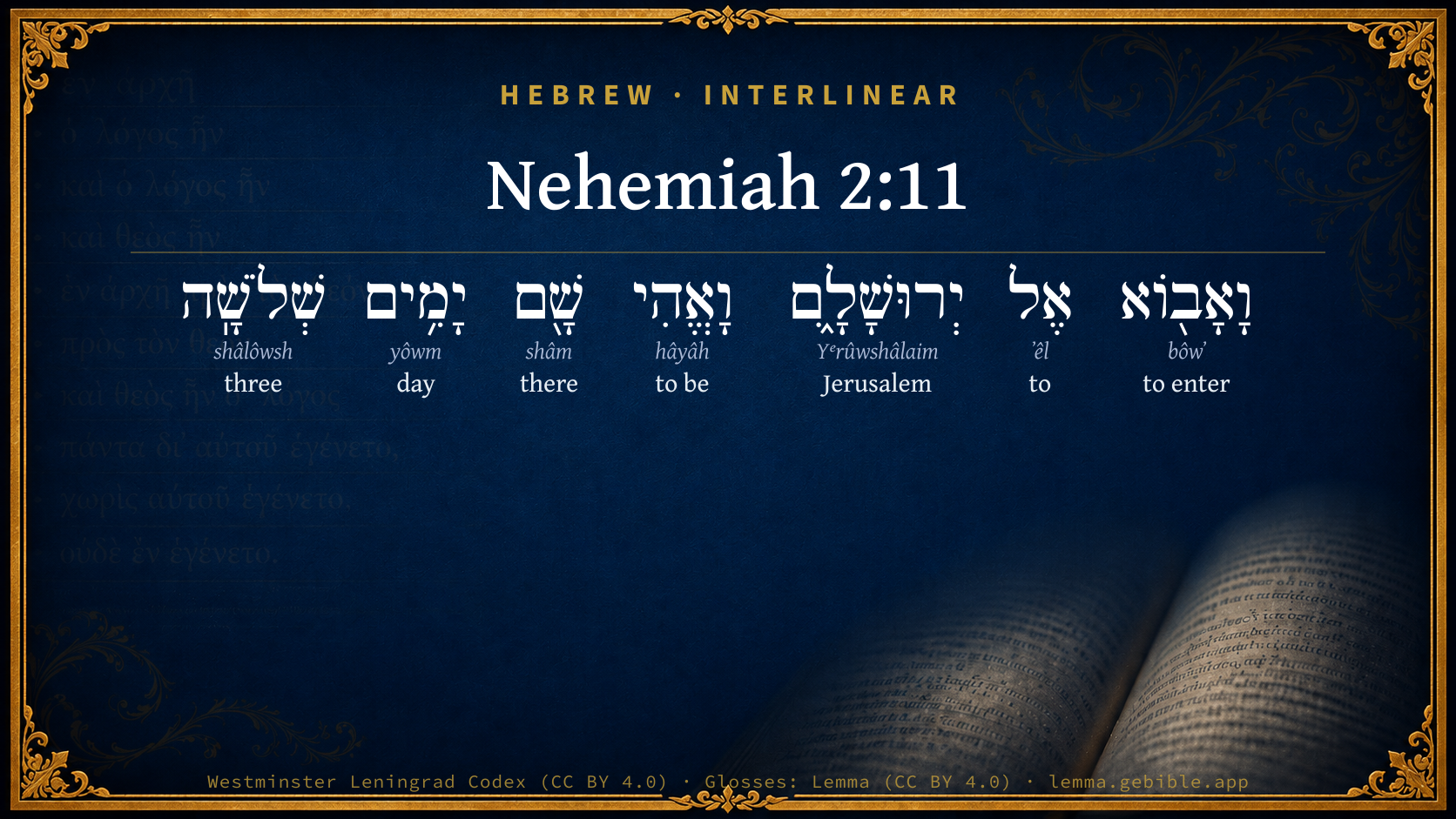
Nehemiah 2:11

Hebrew (Westminster Leningrad Codex) Nehemiah 2:11 appears in the Hebrew Old Testament. The text above is from the Westminster Leningrad Codex. Each word links to its Strong’s number, a concise gloss, and parsing drawn from the Open Scriptures Hebrew Bible morphology. Click any word for its full Brown-Driver-Briggs (BDB) entry.
Download image
Cite this verse

Nehemiah 2:11 (World English Bible). Public Domain. Lemma interlinear Bible study tool, https://lemma.gebible.app/v/nehemiah/2/11.

Show BibTeX & RIS
BibTeX
RIS
English Translation
So I came to Jerusalem, and was there three days.
World English Bible · Public Domain
Download a study sheet

One document with this verse’s original text, its word-by-word gloss line, the meaning frame, cross-references with their text, attributed commentary, and full source and license credits — printable, and it pastes into notes with its structure intact.

This verse Autodidact and up

Study sheet (.html) Plain text (.txt)

A passage Seminary Student

Up to 50 verses in one chapter. A passage sheet keeps up to 6 commentary sources and 12 cross-references per verse, in the order this page ranks them, and says so on the sheet whenever that leaves anything out. Ask for a single verse and you get the Autodidact verse sheet above.

Everything on this page stays free to read, with no account — the sheet is a download of what is already on screen, not access to it.

Want to remove ads? Support Godless Engineer
Compare translations 3

The same verse in 3 English versions, stacked beneath the original-language interlinear above. Click any original word for its lexicon entry.

Each is an independent rendering of the whole verse — the interlinear is not word-aligned to these translations.

Highlighted words mark where these versions differ — a whole-verse word diff, not a word-by-word alignment.

  • World English Bible Public Domain
    So I came to Jerusalem, and was there three days.
  • King James Version Public Domain
    So I came to Jerusalem, and was there three days.
  • unfoldingWord Literal Text CC BY-SA 4.0
    And I came to Jerusalem, and I was there three days.

unfoldingWord Literal Text — © unfoldingWord, licensed CC BY-SA 4.0. Word-aligned USFM3 via Door43 (git.door43.org/unfoldingWord/en_ult).

Versions to compare (up to 4)

3 of 4 selected

Show all 18 translations

Every available English version of this verse, each an independent rendering of the whole verse.

  • World English Bible Public Domain
    So I came to Jerusalem, and was there three days.
  • Berean Standard Bible Public Domain
    After I had arrived in Jerusalem and had been there three days,
  • Majority Standard Bible Public Domain
    After I had arrived in Jerusalem and had been there three days,
  • King James Version Public Domain
    So I came to Jerusalem, and was there three days.
  • American Standard Version (1901) Public Domain
    So I came to Jerusalem, and was there three days.
  • Revised Version (1885) Public Domain
    So I came to Jerusalem, and was there three days.
  • Geneva Bible (1599) Public Domain
    So I came to Ierusalem, and was there three dayes.
  • Douay-Rheims (1899) Public Domain
    And I came to Jerusalem, and was there three days.
  • Young's Literal Translation Public Domain
    And I come in unto Jerusalem, and I am there three days,
  • Literal Standard Version CC BY-SA 4.0
    And I come to Jerusalem, and I am there three days,
  • Unlocked Literal Bible CC BY-SA 4.0
    So I came to Jerusalem and was there three days.
  • unfoldingWord Literal Text CC BY-SA 4.0
    And I came to Jerusalem, and I was there three days.
  • Darby Bible Public Domain
    And I came to Jerusalem, and was there three days.
  • World Messianic Bible Public Domain
    So I came to Jerusalem, and was there three days.
  • Webster's Bible Public Domain
    So I came to Jerusalem, and was there three days.
  • Free Bible Version CC BY-SA 4.0
    I arrived in Jerusalem and rested for three days.
  • Bible in Basic English Public Domain
    So I came to Jerusalem and was there three days.
  • JPS Tanakh (1917) Public Domain
    So I came to Jerusalem, and was there three days.

Literal Standard Version (2020), Covenant Press — licensed CC BY-SA 4.0. Text via the HelloAO Bible API (eBible.org). Unlocked Literal Bible (unfoldingWord) — licensed CC BY-SA 4.0. Text via the HelloAO Bible API (eBible.org). unfoldingWord Literal Text — © unfoldingWord, licensed CC BY-SA 4.0. Word-aligned USFM3 via Door43 (git.door43.org/unfoldingWord/en_ult). Free Bible Version, Dr. Jonathan Gallagher — licensed CC BY-SA 4.0. Text via the HelloAO Bible API (eBible.org).

Word by word

More ways to search: Search by grammar → Find every occurrence → Compare this word →

Practice this passage: Drill this verse → Learn its vocabulary →

About this verse

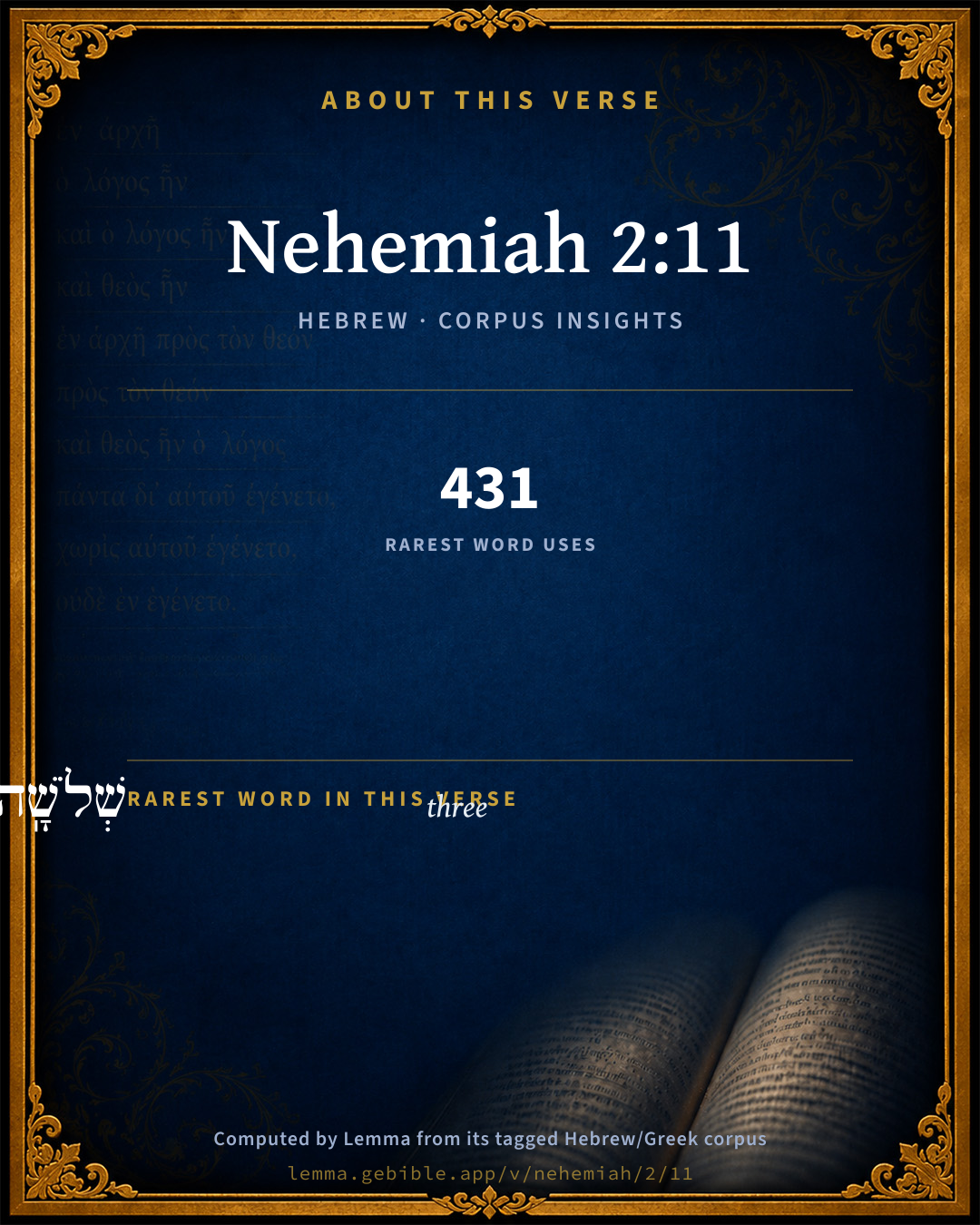
These counts appear in no published source. They are computed here, from the morphology-tagged text and Lemma’s own curated glosses. What Lemma adds →

7
words
7
distinct lemmas
Historical
section

Grammatical profile

  • 2 verbs
  • 2 nouns
  • 1 adjective
  • 1 preposition
  • 1 adverb

Verb forms

  • וָאָב֖וֹא Qal · Sequential Imperfect
  • וָאֱהִי Qal · Sequential Imperfect

Cross-references

1

Topical passages linked to Nehemiah 2:11 in the Treasury of Scripture Knowledge — connected by theme and wording, ordered by reader-vote popularity; previews shown in the World English Bible.

  • Ezra 8:32 We came to Jerusalem, and abode there three days.

Cross-references courtesy of OpenBible.info (CC BY 4.0).

Hebrew and Greek witnesses Masoretic Hebrew ↔ Greek Septuagint

The same verse in the two great witnesses to the Old Testament, shown verse-for-verse.

These are two independent witnesses, not word-aligned to each other, and the Septuagint is shown in lemma (dictionary) form.

Hebrew Nehemiah 2:11 Masoretic · Westminster Leningrad Codex

וָאָב֖וֹא אֶל יְרוּשָׁלִָ֑ם וָאֱהִי שָׁ֖ם יָמִ֥ים שְׁלֹשָֽׁה

So I came to Jerusalem, and was there three days.

World English Bible · Public Domain

Greek LXX Structure differs

The Septuagint has no separate book of Nehemiah. Its Greek text is the second half of Esdras B (2 Esdras), chapters 11–23; Ezra is the first half (1–10).

A verse-for-verse comparison isn’t shown here because the chapters and verses don’t line up. Switch to the LXX edition with the MT / LXX toggle above to read the Greek directly.

Hebrew: Westminster Leningrad Codex (CC BY 4.0). Greek: Septuagint (public domain); English from a public-domain English Septuagint. How the Septuagint differs from the Hebrew →

Commentary

Notes on Nehemiah 2:11 from classic Christian and Jewish commentators (each source and its license shown beneath its notes). The classic Christian expositions comment on the surrounding passage and are grouped to its opening verse, so a note may address several verses; the Jewish commentaries on the Tanakh (Rashi and others) are per-verse, so they appear only where the commentator wrote on this verse.

Lemma curates 59 commentaries, every one of them public domain or Creative Commons licensed, each selected and text-cleaned for this edition rather than reprinted as found. About our sources →

The Cambridge Bible for Schools and Colleges

gen. ed. J. J. S. Perowne

11. After his arrival at Jerusalem, Nehemiah waited three days before taking any steps. Ezra had done the same (Ezr_8:32). It was necessary to rest after the journey, and to interchange the formalities of Eastern courtesy with the principal people of the city.

Neh_2:11 to Neh_7:5. The Commission performed

Neh_2:11-20. The Work undertaken

The incidents of this passage may be grouped as follows:

(a) 11. Nehemiah’s arrival: (b) 12–15, His preliminary investigation: (c) 16–18, the resolution to undertake the work: (d) 19, 20, Nehemiah and his opponents.

The Cambridge Bible for Schools and Colleges (gen. ed. J. J. S. Perowne; Cambridge University Press, 1878–1918) — public domain. Text from a community e-Sword module.

Trapp's Complete Commentary

John Trapp

Neh 2:11 So I came to Jerusalem, and was there three days.

Ver. 11. So I came to Jerusalem] Thither God brought him, as on eagles’ wings, maugre the malice of his enemies. The Jews had great reason to rejoice, and to welcome him with great solemnity; which yet they did not, for aught we read; but that he taketh not for any discouragement; his reward was with God. He was of another spirit than his countrymen, who were all for their own ends and interests, and little cared for the public.

And was there three days] Resting his body, Quod caret alterna requie (Ovid). {See Trapp on "Ezr 8:32"} but casting about in his mind how best to effcct that he came for, and to persuade with others to join with him. And now he found that he was come from the court to the cart, from a pleasant life to a careful and cumbersome.

John Trapp, A Commentary or Exposition upon All the Books of the Old and New Testament (1647–1656) — public domain. Text from a community e-Sword module.

The Biblical Illustrator

Joseph S. Exell

Neh_2:11

So I came to Jerusalem, and was there three days.

Days of quiet

Some workers of the present day would have sent round the bellman and summoned the leading inhabitants to a preliminary convention within half an hour of their arrival; but there was no such unbelieving hurry-scurry with Nehemiah, and therefore three days were allowed to elapse. It was necessary to recover from the fatigue of the journey. He who is the God of our bodies as well as of our souls knows full well the limit of our powers, and would not have us outrage physical laws, even in seeking to do Him honour. These three days may have been needful also for further prayer and waiting upon God. It may have been also that God would not have him begin work under mere natural impulse or human excitement. Hence the need of three days of quiet. Men under excitement can do wonderful things, whether in storming a redoubt or in conducting what in modem times is called a mission; but God does not want His work done under excitement. Calm and quiet of soul are more favourable to that true reliance upon Him which gives Him all the glory and seeks none for ourselves. (W. P. Lockhart.)

The wisdom of waiting

This interval would no doubt be occupied in reflecting on the difficulties of his enterprise--in maturing his course of procedure. Besides, he was probably in doubt how to proceed, till God revealed to him His will; and for this he needed to make his requests known to Him in prayer. This is ever the discipline of a religious life. A pious writer remarks, I need just as much patience to wait as the lamp needs oil, till the day break, and the shadows flee away. (W. Ritchie.)

Preparatory retirement

Gods servants frequently thus retired for deliberation before entering upon arduous tasks. Moses, Paul, Christ Himself. Nehemiahs retirement--

I. Gave him time to look round.

II. Gave him time to look forward.

III. Gave him time to look within.

IV. Gave him time to look upward. (Homiletic Commentary.)

The Biblical Illustrator, edited by Joseph S. Exell (c. 1880s–1900s) — public domain. Text from a community e-Sword module.

Keil & Delitzsch

C. F. Keil & F. Delitzsch

Nehemiah's arrival at Jerusalem. He surveys the wall, and resolves to restore it. - Neh 2:11 Having arrived at Jerusalem and rested three days (as Ezra had also done, Ezr 8:32), he arose in the night, and some few men with him, to ride round the wall of the city, and get a notion of its condition. His reason for taking but few men with him is given in the following sentence: "I had told no man what my God had put in my heart to do for Jerusalem." Although he had come to Jerusalem with the resolution of fortifying the city by restoring its circumvallation, he spoke of this to no one until he had ascertained, by an inspection of the wall, the magnitude and extent of the work to be accomplished. For, being aware of the hostility of Sanballat and Tobiah, he desired to keep his intention secret until he felt certain of the possibility of carrying it into execution. Hence he made his survey of the wall by night, and took but few men with him, and those on foot, for the sake of not exciting attention. The beast on which he rode was either a horse or a mule.

Keil & Delitzsch — Biblical Commentary on the Old Testament (1861–1891) — public domain (CC PDM 1.0). Text via the HelloAO Bible API. (Old Testament only.)

Jamieson, Fausset & Brown

Robert Jamieson, A. R. Fausset & David Brown

So I came to Jerusalem, and was there three days--Deeply affected with the desolations of Jerusalem, and uncertain what course to follow, he remained three days before informing any one of the object of his mission [Neh 2:17-18]. At the end of the third day, accompanied with a few attendants, he made, under covert of night, a secret survey of the walls and gates [Neh 2:13-15].

Jamieson, Fausset & Brown — Commentary Critical and Explanatory on the Whole Bible (1871) — public domain (CC PDM 1.0). Text via the HelloAO Bible API.

Ellicott's Commentary for English Readers

(11) Three days.—For rest and devotion, after the example of Ezra.

A Bible Commentary for English Readers, edited by Charles John Ellicott (1878–1897) — public domain. Text from a community e-Sword module.

John Gill's Exposition

So I came to Jerusalem, and was there three days. Before he entered on any business, resting himself from the fatigue of the journey, and receiving the visits of his friends, as Ezra before him did, Ezr 8:32.

.

Nehemiah 2:12

neh 2:12

neh 2:12

neh 2:12And I arose in the might, I and some few men with me,.... Both the season of the night, and the small number of men to accompany him, were chosen for greater secrecy, that the business he came upon might not as yet be known, and so no schemes formed to obstruct or discourage:

neither told I any man what God had put in my heart to do at Jerusalem; he was satisfied that what he had in view was from the Lord, who had stirred him up to it, but thought it prudent for the present to conceal it, until things were prepared to put it in execution:

neither was there any beast with me, save the beast that I rode upon; he only rode perhaps on a mule, being not yet recovered quite from the fatigue of his journey, and for the sake of honour; the rest went on foot, that there might be no noise made, and so pass on unheard and unobserved.

John Gill's Exposition of the Whole Bible (1746–1763) — public domain (CC PDM 1.0). Text via the HelloAO Bible API.

Haydock's Catholic Bible Commentary

CHAPTER II.

George Leo Haydock (1774–1849), Haydock's Catholic Family Bible and Commentary, 1859 edition — public domain. Excludes Psalms (Douay-Rheims chapter numbering differs from Protestant) and Deuterocanonical books (Catholic canon only).

Matthew Poole's English Annotations

Resting myself after my long journey, and inquiring into the state of the city.

Matthew Poole's English Annotations on the Holy Bible (1683–1685) — public domain. Text from a community e-Sword/MySword module.

Whedon's Commentary on the Bible

Daniel D. Whedon

11. Three days — See note on Ezr_8:32.

Daniel D. Whedon (gen. ed.), Commentary on the Old and New Testaments (1874–1909) — public domain. Text from a community e-Sword module.

The Pulpit Commentary

I...was there three days. Compare Ezr_8:32. After the long journey, three days of rest were necessary.

STEPS TAKEN BY NEHEMIAH PRELIMINARY TO HIS BUILDING OF THE WALL, AND FIRST APPEARANCE OF OPPOSITION. (Neh_2:12-20) Hitherto Nehemiah had communicated his purpose to no one but the king and queen of Persia. He expected opposition, and resolved to baffle his opponents, as long as possible, by concealing his exact designs. Even when further concealment was on the point of becoming impossible, he made his survey of the wall by night, that it might escape observation. At last, the time for action being come, he was obliged to lay the matter before the head men of the city (ver. 17), whom he easily persuaded when he assured them of Artaxerxes" consent and goodwill Preparations then began to be made; and immediately murmurs of opposition arose. Three opponents are now spoken of Sanballat, Tobiah, and an Arabian, Geshem or Gashmu, not previously mentioned. These persons appear to have sent a formal message to the authorities of Jerualem (ver. 19), taxing them with an intention to rebel Nehemiah made no direct reply to this charge, but boldly stated his resolve to "arise and build," and denied Sanballat"s right to interfere with him (ver. 20).

HOMILIES BY W. CLARKSON Vers. 11-20. Wise procedure in presence of a great work.

Nehemiah before Jerusalem, the earnest patriot prophet before the city of God, lying waste and exposed, suggests to us

I THE PRESENCE OF A GREAT WORK AWAITING US. "So I came to Jerusalem" (ver. 11). There are to-day many Churches, societies, interests, more or less dear to God, which are "in distress" (ver. 17), urgently needing restoration and defence, that they be not open to attack, and that they may" be no more a reproach" (ver. 17) to the people of God. Our work, like that of Nehemiah before Jerusalem, may be great, inasmuch as

(1) it will be costly, demanding time and treasure;

(2) it will be delicate and difficult, requiring the co-operation of men of many minds and various interests;

(3) it will have large issues, the end being either a sad and humiliating collapse or a noble and useful triumph. The steps which Nehemiah took to carry out his great project suggest points in a

II WISE PROCEDURE IN OUR WORK. The first and very essential point is

1. Full consideration, in private before making proposals in public. Nehemiah "was there three days (ver. 11) before taking action. Instead of illustrating the maxim, "More haste, worse speed," he acted on another and better one, "Quickly enough if well enough;" indeed, on another and better still, "He that believeth shall not make haste". (Isa_28:16) After waiting three days at Jerusalem, he made a very careful inspection of the city, going all round and examining it thoroughly (vers. 12-15). He "went out by night" (ver. 13), in order that he might be the more unobserved, and he took care that "the rulers knew not whither he went, or what he did" (ver. 16); nor did he tell any one, priest, ruler, noble, or workman (ver. 16), what he was about. First he took, as we should, "counsel with himself;" he examined searchingly, considered fully, went into and went round the matter in his own mind. A little time spent in earnest, devout meditation beforehand will often save an age of care," and a "world of trouble" afterwards. Then Nehemiah spake.

2. Free consultation before other action. "Then said I unto them," etc. (ver. 17). Evidently he made a full statement to them "in public meeting assembled." He called them together, no doubt using the king"s commission. He took counsel with the leaders (those specified in ver. 16). Consultation is wise, just, with a view to co-operation. It

(a) conciliates those whose goodwill we need. Men do not like to be treated as if their judgment were worthless and their consent unnecessary.

(b) Brings out valuable suggestions. The wisest man overlooks some things, and they who devote all their powers to particular industries, obtain a knowledge and can furnish help in council in matters relating to their own department which others cannot contribute.

3. Forcible presentation of motives. Nehemiah laid the whole case before them, and appealed to

(a) The urgency of their need: the distress they were in; Jerusalem waste; the gates burnt (ver. 17).

(b) The sign of God"s favour resting upon them. "The hand of my God which was good upon me" (ver. 18).

(c) The encouragement they had from man as well as God. "The king"s words" (ver. 18).

(d) The need there was to regain the honour they had lost among the nations. "That we be no more a reproach.

(1) Necessity,

(2) God"s manifest presence,

(3) available human help,

(4) our reputation (and therein the repute of God"s work), will often be leading motives with us.

We should omit none that can be brought, for all are helpful, and one will avail with one man, and another with another.

1. Energetic resolution. "They said, Let us arise and build. So they strengthened their hands for this good work" (ver. 18). Zest at the commencement is not everything, but it is much. It is vastly better than contention or cold-heartedness. Let us gird ourselves to the fight with energy of soul, and the battle is half won already.

2. Disregard of ridicule (vers. 19, 20). Zeal is deaf to sarcasm; it brushes aside the spears of scorn; it turns the idlers out of the field. C.

The Pulpit Commentary (1880–1919), ed. H.D.M. Spence-Jones & Joseph S. Exell — public domain. Text from a community e-Sword module.

unfoldingWord translationNotes

Door43 World Missions Community

had put into my heart

Here Nehemiah's "heart" refers to his thoughts and will. AT: "had inspired me" or "had led me" (See: Metonymy)

There was no animal with me

"There were no animals with me"

translationWords

Jerusalem

raise

God

heart

unfoldingWord translationNotes — © Distant Shores Media and the Door43 World Missions Community, licensed CC BY-SA 4.0. Source: git.door43.org/Door43/en_tn.

Rashi

Rabbi Shlomo Yitzchaki (Rashi)

and I was there for three days I was in Jerusalem for three days, and at the end of three days, I and a few men with me arose at night, and I did not tell any person what the Holy One, blessed be He, had put into my heart.

Rashi on the Tanakh — English translations: “The Judaica Press complete Tanach with Rashi, translated by A. J. Rosenberg” (CC BY 4.0); “Pentateuch with Rashi's commentary by M. Rosenbaum and A.M. Silbermann, 1929-1934” (public domain); “The Metsudah Tanach series, Lakewood, N.J” (CC BY 4.0); and “The Book of Joshua, Metsudah Publications, 1997” (CC BY 4.0). Text via Sefaria.

Lesson kit

Teaching starters — assembled from the data on this page, not authored interpretation. Every prompt links to the verse data it draws on. Edit before teaching.

Nehemiah, in the Historical, opens this verse with 7 words (7 distinct Hebrew lemmas). Its most distinctive word is shâlôwsh (“three”). A historical commentator’s framing appears above. Read the whole chapter for the surrounding context.

Discussion questions

  1. The word shâlôwsh carries the sense “three.” How does it shape the verse?
  2. How does Ezra 8:32, which shares this passage’s theme, read alongside this verse?
  3. «וָאָב֖וֹא» is a Qal Sequential Imperfect verb. How does that grammatical form shape the action described?
  4. Compare how The Cambridge Bible for Schools and Colleges and Trapp's Complete Commentary read this verse. Where do they agree or differ?

Reading settings

Reading text

Shown beneath each verse's original-language words.

Old Testament
Old Testament edition

Read the OT as the Masoretic Hebrew (MT) or the Greek Septuagint (LXX).

English shown for the Greek Septuagint (in the Hebrew ↔ Greek comparison).

Comparing translations? Open the Compare panel on any verse page to stack up to four side by side.