
2 Chronicles 29:11

Hebrew (Westminster Leningrad Codex) 2 Chronicles 29:11 appears in the Hebrew Old Testament. The text above is from the Westminster Leningrad Codex. Each word links to its Strong’s number, a concise gloss, and parsing drawn from the Open Scriptures Hebrew Bible morphology. Click any word for its full Brown-Driver-Briggs (BDB) entry.
Download image
Cite this verse

2 Chronicles 29:11 (World English Bible). Public Domain. Lemma interlinear Bible study tool, https://lemma.gebible.app/v/2-chronicles/29/11.

Show BibTeX & RIS
BibTeX
RIS
English Translation
My sons, don't be negligent now; for Yahweh has chosen you to stand before him, to minister to him, and that you should be his ministers, and burn incense.
World English Bible · Public Domain
Download a study sheet

One document with this verse’s original text, its word-by-word gloss line, the meaning frame, cross-references with their text, attributed commentary, and full source and license credits — printable, and it pastes into notes with its structure intact.

This verse Autodidact and up

Study sheet (.html) Plain text (.txt)

A passage Seminary Student

Up to 50 verses in one chapter. A passage sheet keeps up to 6 commentary sources and 12 cross-references per verse, in the order this page ranks them, and says so on the sheet whenever that leaves anything out. Ask for a single verse and you get the Autodidact verse sheet above.

Everything on this page stays free to read, with no account — the sheet is a download of what is already on screen, not access to it.

Want to remove ads? Support Godless Engineer
Compare translations 3

The same verse in 3 English versions, stacked beneath the original-language interlinear above. Click any original word for its lexicon entry.

Each is an independent rendering of the whole verse — the interlinear is not word-aligned to these translations.

Highlighted words mark where these versions differ — a whole-verse word diff, not a word-by-word alignment.

  • World English Bible Public Domain
    My sons, don't be negligent now; for Yahweh has chosen you to stand before him, to minister to him, and that you should be his ministers, and burn incense.
  • King James Version Public Domain
    My sons, be not now negligent: for the LORD hath chosen you to stand before him, to serve him, and that ye should minister unto him, and burn incense.
  • unfoldingWord Literal Text CC BY-SA 4.0
    My sons, now, do not be negligent for you all Yahweh has chosen to stand before him, to minister to him, and to be to him ones ministering and ones offering sacrifices.”

unfoldingWord Literal Text — © unfoldingWord, licensed CC BY-SA 4.0. Word-aligned USFM3 via Door43 (git.door43.org/unfoldingWord/en_ult).

Versions to compare (up to 4)

3 of 4 selected

Show all 18 translations

Every available English version of this verse, each an independent rendering of the whole verse.

  • World English Bible Public Domain
    My sons, don't be negligent now; for Yahweh has chosen you to stand before him, to minister to him, and that you should be his ministers, and burn incense.
  • Berean Standard Bible Public Domain
    Now, my sons, do not be negligent, for the LORD has chosen you to stand before Him, to serve Him, to minister before Him, and to burn incense.”
  • Majority Standard Bible Public Domain
    Now, my sons, do not be negligent, for the LORD has chosen you to stand before Him, to serve Him, to minister before Him, and to burn incense.”
  • King James Version Public Domain
    My sons, be not now negligent: for the LORD hath chosen you to stand before him, to serve him, and that ye should minister unto him, and burn incense.
  • American Standard Version (1901) Public Domain
    My sons, be not now negligent; for Jehovah hath chosen you to stand before him, to minister unto him, and that ye should be his ministers, and burn incense.
  • Revised Version (1885) Public Domain
    My sons, be not now negligent: for the LORD hath chosen you to stand before him, to minister unto him, and that ye should be his ministers, and burn incense.
  • Geneva Bible (1599) Public Domain
    Now my sonnes, be not deceiued: for the Lord hath chosen you to stand before him, to serue him, and to be his ministers, and to burne incense.
  • Douay-Rheims (1899) Public Domain
    My sons, be not negligent: the Lord hath chosen you to stand before him, and to minister to him, and to worship him, and to burn incense to him.
  • Young's Literal Translation Public Domain
    My sons, be not now at rest, for on you hath Jehovah fixed to stand before Him, to serve Him, and to be to Him ministering and making perfume.'
  • Literal Standard Version CC BY-SA 4.0
    My sons, do not be at rest now, for YHWH has fixed on you to stand before Him, to serve Him, and to be ministering and making incense to Him.”
  • Unlocked Literal Bible CC BY-SA 4.0
    My sons, do not be lazy now, for Yahweh has chosen you to stand before him, to worship him, and that you should be his servants and burn incense.”
  • unfoldingWord Literal Text CC BY-SA 4.0
    My sons, now, do not be negligent for you all Yahweh has chosen to stand before him, to minister to him, and to be to him ones ministering and ones offering sacrifices.”
  • Darby Bible Public Domain
    My sons, be not now negligent; for Jehovah has chosen you to stand before him, to do service unto him, and to be his ministers and incense-burners.
  • World Messianic Bible Public Domain
    My sons, don’t be negligent now; for the LORD has chosen you to stand before him, to minister to him, and that you should be his ministers and burn incense.”
  • Webster's Bible Public Domain
    My sons, be not now negligent: for the LORD hath chosen you to stand before him, to serve him, and that ye should minister to him, and burn incense.
  • Free Bible Version CC BY-SA 4.0
    My sons, don't neglect your responsibilities, for the Lord has chosen you to stand in his presence to serve him, and to be his ministers presenting burnt offerings.”
  • Bible in Basic English Public Domain
    My sons, take care now: for you have been marked out by the Lord to come before him and to be his servants, burning offerings to him.
  • JPS Tanakh (1917) Public Domain
    My sons, be not now negligent; for the LORD hath chosen you to stand before Him, to minister unto Him, and that ye should be His ministers, and offer unto Him.'

Literal Standard Version (2020), Covenant Press — licensed CC BY-SA 4.0. Text via the HelloAO Bible API (eBible.org). Unlocked Literal Bible (unfoldingWord) — licensed CC BY-SA 4.0. Text via the HelloAO Bible API (eBible.org). unfoldingWord Literal Text — © unfoldingWord, licensed CC BY-SA 4.0. Word-aligned USFM3 via Door43 (git.door43.org/unfoldingWord/en_ult). Free Bible Version, Dr. Jonathan Gallagher — licensed CC BY-SA 4.0. Text via the HelloAO Bible API (eBible.org).

Word by word

More ways to search: Search by grammar → Find every occurrence → Compare this word →

Practice this passage: Drill this verse → Learn its vocabulary →

תִּשָּׁל֑וּ
shâlâh
H7952
“to mislead”
Verb, Niphal, Jussive, 2nd Person, Masculine, Plural
Part of Speech
Verb
Stem
Niphal
Form
Jussive
Person
2nd Person
Gender
Masculine
Number
Plural
Full BDB Definition

Origin: a primitive root [probably identical with H7953 through the idea of educing]

TWOT: None

(Niphal) to be negligent - (Hiphil) to mislead
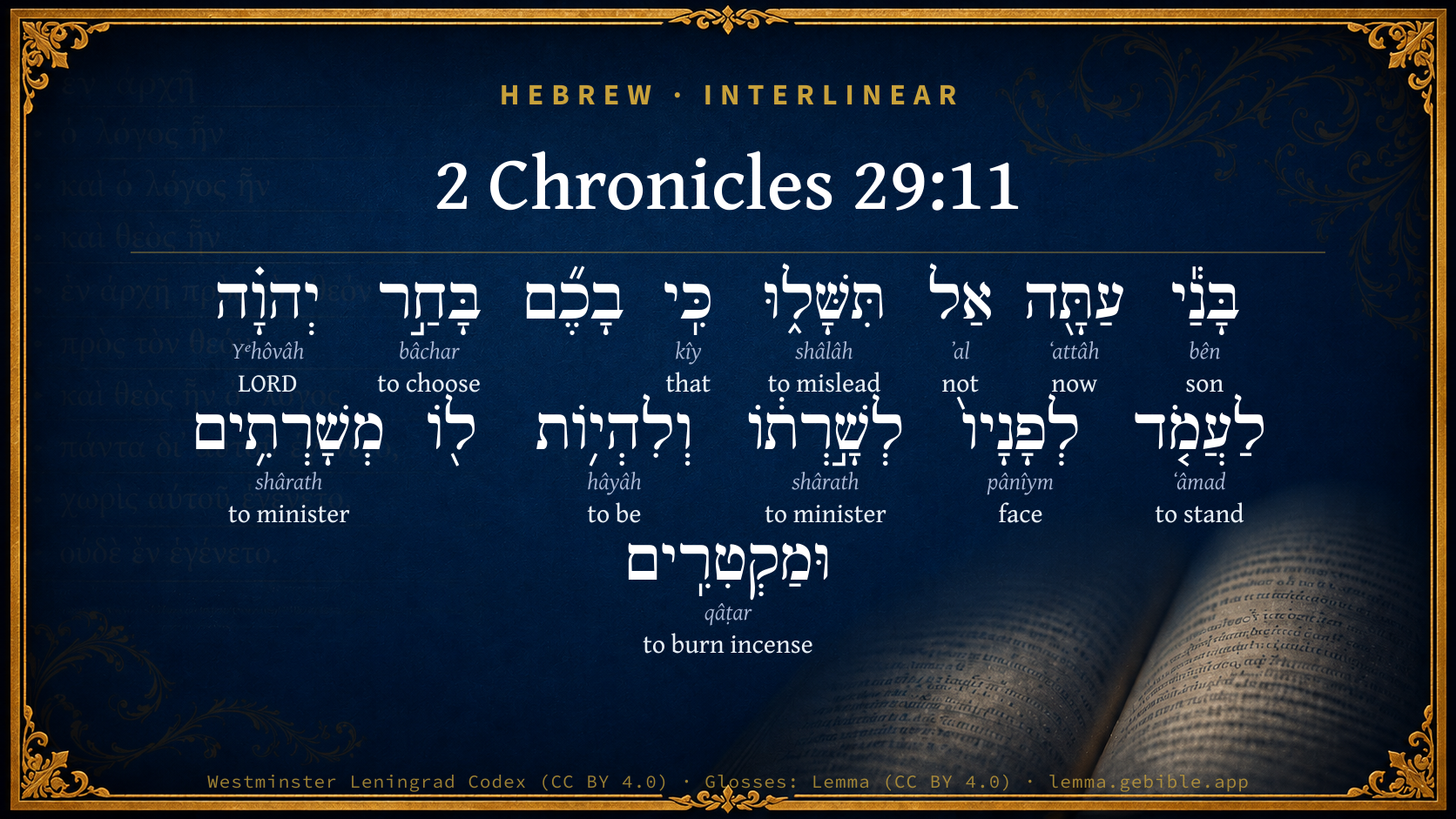
  1. בָּנַ֕י bên H1121 “sons · my” Noun, Common, Masculine, Plural, Construct + Suffix, Personal, 1st Person, Common, Singular
  2. עַתָּ֖ה ʻattâh H6258 “now” Adverb
  3. אַל ʼal H408 “not” Particle, Negative
  4. כִּֽי kîy H3588 “that” Conjunction
  5. בָּחַ֣ר bâchar H977 “to choose” Verb, Qal, Perfect, 3rd Person, Masculine, Singular
  6. יְהוָ֗ה Yᵉhôvâh H3068 “LORD” Noun, Proper
  7. לַעֲמֹ֤ד ʻâmad H5975 “to stand” Preposition + Verb, Qal, Infinitive Construct
  8. לְפָנָיו֙ pânîym H6440 “to/for · face(s) · his” Preposition + Noun, Common, Both, Plural, Construct + Suffix, Personal, 3rd Person, Masculine, Singular
  9. לְשָׁ֣רְת֔וֹ shârath H8334 “to minister · him” Preposition + Verb, Piel, Infinitive Construct + Suffix, Personal, 3rd Person, Masculine, Singular
  10. וְלִהְי֥וֹת hâyâh H1961 “and · to be” Conjunction + Preposition + Verb, Qal, Infinitive Construct
  11. מְשָׁרְתִ֥ים shârath H8334 “ministering” Verb, Piel, Participle Active, Masculine, Plural, Absolute
  12. וּמַקְטִרִֽים qâṭar H6999 “and · burning incense” Conjunction + Verb, Hiphil, Participle Active, Masculine, Plural, Absolute

About this verse

These counts appear in no published source. They are computed here, from the morphology-tagged text and Lemma’s own curated glosses. What Lemma adds →

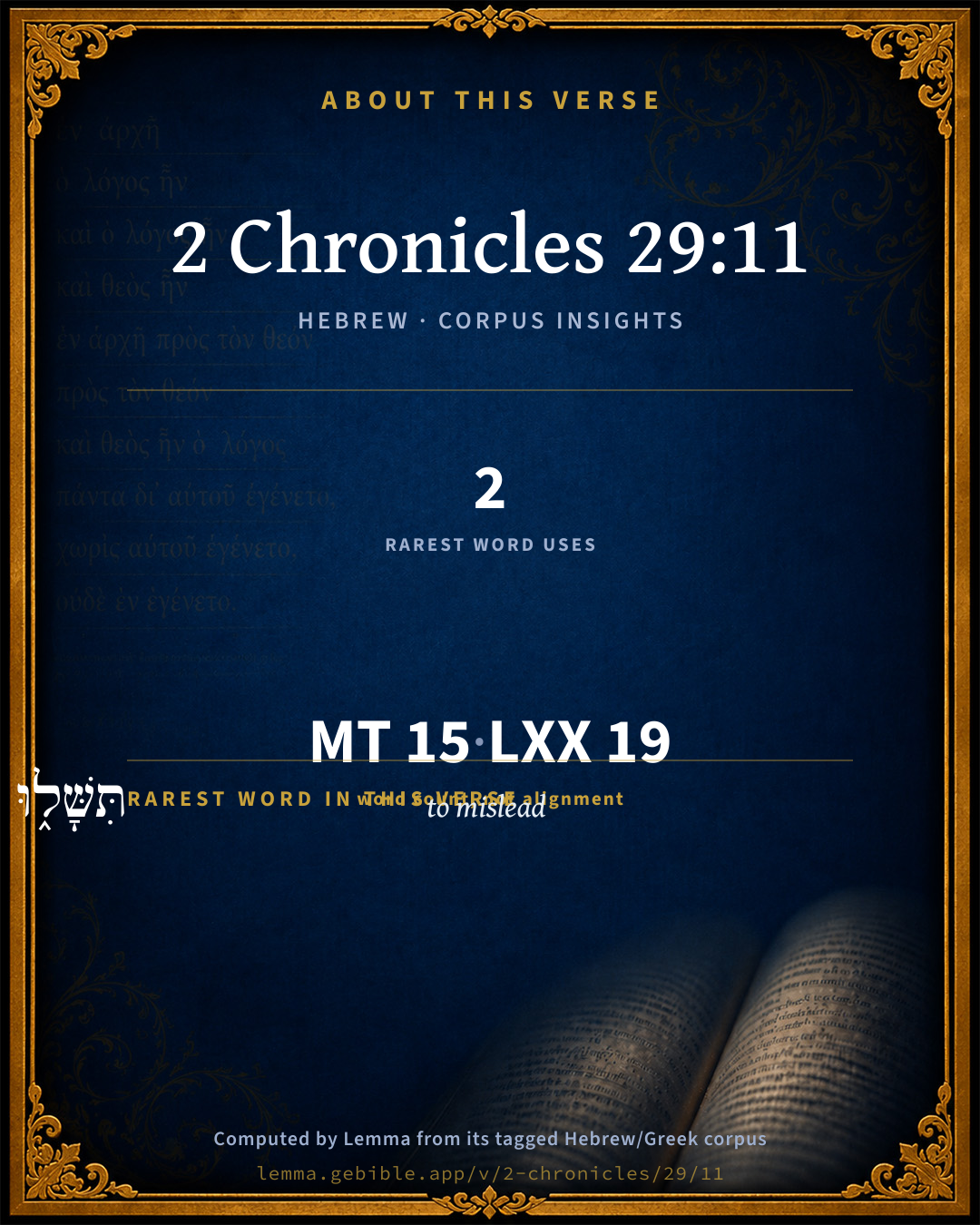
15
words
12
distinct lemmas
Historical
section

Notable vocabulary

The rarest word here is תִּשָּׁל֑וּ to mislead H7952 — appearing just 2 times in the whole Hebrew Bible.

Shared distinctive vocabulary

תִּשָּׁל֑וּ to mislead H7952 occurs in 2 verses of the Hebrew Bible. Also found in:

Grammatical profile

  • 7 verbs
  • 3 nouns
  • 2 prepositions
  • 1 conjunction
  • 1 adverb
  • 1 particle

Verb forms

  • תִּשָּׁל֑וּ Niphal · Jussive
  • בָּחַ֣ר Qal · Perfect
  • לַעֲמֹ֤ד Qal · Infinitive Construct
  • לְשָׁ֣רְת֔וֹ Piel · Infinitive Construct
  • וְלִהְי֥וֹת Qal · Infinitive Construct
  • מְשָׁרְתִ֥ים Piel · Participle Active
  • וּמַקְטִרִֽים Hiphil · Participle Active

Repetition

A word recurs within this verse — often emphatic in Hebrew:

  • לְשָׁ֣רְת֔וֹ to minister H8334 ×2

Hebrew & Septuagint length

In English translation the verse runs 29 words from the Hebrew and 30 from the Septuagint (LXX English) — closely comparable.

A rough comparison of the two English renderings, which tokenize alike — not a word-level alignment.

Word counts can differ between the Hebrew and the Greek without any difference in meaning — e.g. the Hebrew direct-object marker אֵת has no separate Greek word, and Greek often adds the article ὁ.

In the original languages it is 15 Hebrew tokens and 19 Greek tokens — but the two are counted differently (Hebrew bundles its prefixes and suffixes into one token; the Greek is in lemma form), so that isn’t a like-for-like length.

Cross-references

6

Topical passages linked to 2 Chronicles 29:11 in the Treasury of Scripture Knowledge — connected by theme and wording, ordered by reader-vote popularity; previews shown in the World English Bible.

  • Deuteronomy 10:8 At that time Yahweh set apart the tribe of Levi, to bear the ark of the covenant of Yahweh, to stand before Yahweh to minister to him, and to bless in his name, to this day.
  • Numbers 8:6–14 "Take the Levites from among the children of Israel, and cleanse them.
  • Galatians 6:7–8 Don't be deceived. God is not mocked, for whatever a man sows, that will he also reap.
  • Numbers 3:6–9 "Bring the tribe of Levi near, and set them before Aaron the priest, that they may minister to him.
  • Numbers 16:35–40 Fire came forth from Yahweh, and devoured the two hundred fifty men who offered the incense.
  • Numbers 18:2–7 Your brothers also, the tribe of Levi, the tribe of your father, bring you near with you, that they may be joined to you, and minister to you: but you and your sons with you shall be before the tent of the testimony.

Cross-references courtesy of OpenBible.info (CC BY 4.0).

Hebrew and Greek witnesses Masoretic Hebrew ↔ Greek Septuagint

The same verse in the two great witnesses to the Old Testament, shown verse-for-verse.

These are two independent witnesses, not word-aligned to each other, and the Septuagint is shown in lemma (dictionary) form.

Hebrew 2 Chronicles 29:11 Masoretic · Westminster Leningrad Codex

בָּנַ֕י עַתָּ֖ה אַל תִּשָּׁל֑וּ כִּֽי בָכֶ֞ם בָּחַ֣ר יְהוָ֗ה לַעֲמֹ֤ד לְפָנָיו֙ לְשָׁ֣רְת֔וֹ וְלִהְי֥וֹת ל֖וֹ מְשָׁרְתִ֥ים וּמַקְטִרִֽים

My sons, don't be negligent now; for Yahweh has chosen you to stand before him, to minister to him, and that you should be his ministers, and burn incense.

World English Bible · Public Domain

Greek LXX 2 Chronicles 29:11 Septuagint · lemma form

καί νῦν μή διαλείπω ὅτι ἐν σύ αἰρετίζω κύριος ἵστημι ἐναντίον αὐτός λειτουργέω καί εἰμί αὐτός λειτουργέω καί θυμιάω

And now be not lacking to your duty, for the Lord has chosen you to stand before him to minister, and to be ministers and burners of incense to him.

LXX2012 (modern English Septuagint) · Public Domain

Hebrew: Westminster Leningrad Codex (CC BY 4.0). Greek: Septuagint (public domain); English from LXX2012 (modern English Septuagint) (Public Domain). How the Septuagint differs from the Hebrew →

Commentary

Notes on 2 Chronicles 29:11 from classic Christian and Jewish commentators (each source and its license shown beneath its notes). The classic Christian expositions comment on the surrounding passage and are grouped to its opening verse, so a note may address several verses; the Jewish commentaries on the Tanakh (Rashi and others) are per-verse, so they appear only where the commentator wrote on this verse.

Lemma curates 59 commentaries, every one of them public domain or Creative Commons licensed, each selected and text-cleaned for this edition rather than reprinted as found. About our sources →

Trapp's Complete Commentary

John Trapp

2Ch 29:11 My sons, be not now negligent: for the LORD hath chosen you to stand before him, to serve him, and that ye should minister unto him, and burn incense.

Ver. 11. Be not now negligent.] Or, Be not deceived: a good memento for ministers, who must be both intelligent and diligent. Hezekiah found, it seemeth, some slackness and backwardness in the priests and Levites to the work of reformation: he therefore - as after him Aemilius Paulus the consul, when nobody else dared, did himself run with the hatchet into the temple of Serapis, the demolishing whereof the senate had decreed - began first himself, and awaketh those sluggards with these words, Ne sitis socordes, Be not slack, my sons; God hath chosen you, &c. Up and be doing.

John Trapp, A Commentary or Exposition upon All the Books of the Old and New Testament (1647–1656) — public domain. Text from a community e-Sword module.

The Biblical Illustrator

Joseph S. Exell

2Ch_29:11

For the Lord hath chosen you to stand before Him, to serve Him.

Divine service

I. Some persons may ask, why should we serve God? He doesnt seem as if He troubled about us? We admit that so far as outward appearances go, it seems as if this great universe was something like a well-regulated machine with God as the invisible engineer. When a human being, man, woman, or child, goes against the laws of this great machine, God does not stop it, as a human mechanic would his engine. The Christian believer sometimes wonders why God does not in some critical emergency interfere; but shall we that are but as the creatures of a day express any doubt of the wisdom of God?

II. Permit me to say a few words to those who are now serving God.

1. Be cheerful in your service.

2. Let your service be pure and unselfish. One man who had been helping in a good work for a few months, with a cry of discontent said, I shall not come any more because nobody ever thanks me. Does the violet, or the rose, or the sun need thanks for giving forth beauty, and perfume, and light? The beat reward of good service is in the heart of the server. A man who engages in the Divine service from selfish motives is like a fettered bird. The bird could wing itself into the vault of yonder blue sky; but it has a stone tied to its leg. Your selfishness is a stone which fetters your usefulness.

3. Let your service be continual.

III. Let me speak to those who have no hope of ever becoming the servants of God. God knows and cares for you. (W. Birch.)

Diligence and exertion in the Chistian ministry

Let us endeavour--

I. To explain the counsel or Hezekiah to the priests and Levites: be not now negligent. This is sometimes rendered: be not now deceived. This conveys the idea that we are never more apt to impose upon ourselves than when we are remiss in duty, for we vainly imagine that God will not be strict to mark against us what is so natural and so pleasing to the depraved heart of man. It implies a former deficiency in the performance of duty. This counsel was--

1. Most necessary.

2. Highly important and useful

3. Peculiarly reasonable.

II. To consider some motives to its enforcement.

1. If we would act in accordance with the design of God in the appointment of the sacred office of the ministry, we will use the utmost diligence in His service.

2. The number, the variety, the difficulty and importance of the duties connected with the office of the ministry, require diligence.

5. Consistency with your professed character.

4. The shortness and uncertainty of the time allotted.

5. The sense of responsibility. Ye serve the Lord Christ. (W. Schaw.)

The Christian ministry

I. While all Gods children are called to serve Him, there is a special sense in which the minister of God is chosen to serve Him

1. He is outwardly chosen and called to this work by men who have public authority given unto them in the church.

2. He is inwardly brought to it; for he declares that he thinks in his heart that he is truly called.

II. The object of the ministerial office is the glory of God in the salvation of sinners.

III. The means whereby this result is to be effected are--

1. The preaching of the Gospel.

(1) Faithfully.

(2) Boldly.

(3) Affectionately.

2. The right discharge of his regular official duties, baptism, marriage, etc.

3. Personal intercourse with his flock.

4. The ministers consistency of life.

IV. The attitude of the minister is one of peculiar dignity; it is to stand before the Lord. Exhortation; be not now negligent.

1. In Prayer.

2. In study, It is said of the Venerable Bede, that he never knew what it was to do nothing, and always found it sweet to be either learning, teaching, or writing.

3. In labour.

4. In conduct. (F. B. Ashley.)

The complex idea of worship

We make mistakes if we suppose that worship is a mere cloud, a foam of sentiment; it is work of all kinds, door-opening and lamp-lighting and floor-sweeping, cleansing, preparing, ventilating, expecting the people and welcoming them with joy; and then incense-burning, and cross-uplifting, and cry of thunderous and mute eloquence, and hymn, sweet, gentle, tender, and prayer that beats against heaven like artillery--all these things and many more ere included in the complex idea of worship. Let each man, therefore, do what he can in this matter, knowing that no one man works the whole ministry of worship, but that it is an act of co-operation and combination, one part playing with another part, and each interrelating itself with each other, so as to constitute a sum total significant of unity, adaptation, music, and homage. (J. Parker, D.D.)

The Biblical Illustrator, edited by Joseph S. Exell (c. 1880s–1900s) — public domain. Text from a community e-Sword module.

Ellicott's Commentary for English Readers

(11) My sons.—A condescending term from the king; just as my father was a term of respect (2Ki_2:12; 2Ki_5:13; 2Ki_13:14).

Be not now negligent.—The Niphal form of the verb shalah (“to be at ease”) occurs nowhere else. The margin is incorrect.

The Lord hath chosen you.—You hath the Lord chosen. The pronoun is emphatic. (Comp. the similar words: 1Ch_23:13; Deu_10:8.)

To stand before him, (in order) to serve him, is the construction.

And that ye should minister.—Literally, And to become to him ministers and thurifers.

The thoughts and the style of the royal address make it evident enough that it is a free composition, in the well-known manner of ancient historians.

A Bible Commentary for English Readers, edited by Charles John Ellicott (1878–1897) — public domain. Text from a community e-Sword module.

The Cambridge Bible for Schools and Colleges

gen. ed. J. J. S. Perowne

11. to stand before him] Deu_10:8.

to serve him, and that you should minister unto him] R.V. to minister unto him, and that ye should be his ministers.

The Cambridge Bible for Schools and Colleges (gen. ed. J. J. S. Perowne; Cambridge University Press, 1878–1918) — public domain. Text from a community e-Sword module.

John Gill's Exposition

Then the Levites arose,.... Whose names are mentioned; of the Kohathites two, Mahath the son of Amashai, and Joel the son of Azariah; of the Merarites two, Kish the son of Abdi, and Azariah the son of Jehalelel; of the Gershonites two, Joah the son of Zimmah, and Eden the son of Joah; and of the family of Elizaphan, a Kohathite, two, Shimri and Jehiel; and of the family of Asaph, one of the chief singers in the times of David, two, Zechariah and Mattaniah; and of the family of Heman, another principal singer in the same times, two, Jehiel and Shimei; and of the family of Jeduthun, the third principal singer, the same with Ethan, two, Shemaiah and Uzziel, in all fourteen.

Then the Levites arose,.... Whose names are mentioned; of the Kohathites two, Mahath the son of Amashai, and Joel the son of Azariah; of the Merarites two, Kish the son of Abdi, and Azariah the son of Jehalelel; of the Gershonites two, Joah the son of Zimmah, and Eden the son of Joah; and of the family of Elizaphan, a Kohathite, two, Shimri and Jehiel; and of the family of Asaph, one of the chief singers in the times of David, two, Zechariah and Mattaniah; and of the family of Heman, another principal singer in the same times, two, Jehiel and Shimei; and of the family of Jeduthun, the third principal singer, the same with Ethan, two, Shemaiah and Uzziel, in all fourteen.

2 Chronicles 29:15

ch2 29:15

ch2 29:15

ch2 29:15And they gathered their brethren, and sanctified themselves,.... As they were bid, see Ch2 29:5,

and came, according to the commandment of the king, by the word of the Lord, to cleanse the house of the Lord; for this, which the king commanded, was by the Lord, and they came to do this work, in obedience to both.

John Gill's Exposition of the Whole Bible (1746–1763) — public domain (CC PDM 1.0). Text via the HelloAO Bible API.

Haydock's Catholic Bible Commentary

Negligent. Heb. adds, "now," when every thing tends to open your eyes. H.

George Leo Haydock (1774–1849), Haydock's Catholic Family Bible and Commentary, 1859 edition — public domain. Excludes Psalms (Douay-Rheims chapter numbering differs from Protestant) and Deuterocanonical books (Catholic canon only).

Matthew Poole's English Annotations

My sons; so he calls them indifferently, though many of them were elder than himself, because he was by his tender love and affection, as he was by his office obliged to be, a nursing-father to them. See Isa 49:23.

Be not now negligent, in sanctifying yourselves and the temple, 2Ch 29:5, and in quickening and preparing yourselves and the people to God’s service.

Matthew Poole's English Annotations on the Holy Bible (1683–1685) — public domain. Text from a community e-Sword/MySword module.

Whedon's Commentary on the Bible

Daniel D. Whedon

11. My sons — The king speaks kindly, as the father of all the people whom he rules.

Be not negligent — Literally, do not go astray.

Daniel D. Whedon (gen. ed.), Commentary on the Old and New Testaments (1874–1909) — public domain. Text from a community e-Sword module.

The Pulpit Commentary

Be not now negligent; Hebrew, WlCTiAla. This verb in kal (supposing it the same verb) occurs but five times (Job_3:26 Job_12:6; Psa_122:6; Jer_12:1; Lam_1:5) the radical idea of it being the safety of ease or security rather than any absolute safety. In niph. it is found only in this place and in 2Ki_4:28, where the rendering of the Authorized Version, "Do not deceive me," will easily yield the same essential idea. The derivative adjective (wlev) occurs eight times, and always has the same flavour about it (1Ch_4:40; Job_16:12 Job_20:20 Job_21:23; Psa_73:12; Jer_49:31 Eze_23:42; Zec_7:7) And the derivative nouns (wlv and hwlv) occur nine times, and, at any rate, in almost every instance evidently carrying the same fundamental idea (Psa_30:6 Psa_122:7; Pro_1:32 Pro_17:1; Jer_22:21; Eze_16:49; Dan_8:25 Dan_11:21, Dan_11:24) Our Authorized Version, therefore, sufficiently reproduces the thought of Hezekiah, though perhaps this would more exactly come out of the rendering, "Be not now at ease," i.e. sacrifice ease and self-indulgence, etc. To serve him that ye should minister. The same verb is used in both these places; so Revised Version, To minister unto him, and that ye should be his ministers.

The Pulpit Commentary (1880–1919), ed. H.D.M. Spence-Jones & Joseph S. Exell — public domain. Text from a community e-Sword module.

John Wesley's Explanatory Notes

Sons - So he calls them, though many of them were elder than himself, because he was by his tender love and affection, as he was by his office obliged to be, a nursing father to them. Negligent - In sanctifying yourselves and the temple, ver. 5, and in quickening and preparing yourselves and the people for God's service.

John Wesley, Explanatory Notes Upon the Whole Bible (1754–1765) — public domain. Text via the GEBible commentary corpus.

Rashi

Rabbi Shlomo Yitzchaki (Rashi)

do not forget - Heb. תִּשָּׁלוּ, an expression denoting lack of intention.

Rashi on the Tanakh — English translations: “The Judaica Press complete Tanach with Rashi, translated by A. J. Rosenberg” (CC BY 4.0); “Pentateuch with Rashi's commentary by M. Rosenbaum and A.M. Silbermann, 1929-1934” (public domain); “The Metsudah Tanach series, Lakewood, N.J” (CC BY 4.0); and “The Book of Joshua, Metsudah Publications, 1997” (CC BY 4.0). Text via Sefaria.

Lesson kit

Teaching starters — assembled from the data on this page, not authored interpretation. Every prompt links to the verse data it draws on. Edit before teaching.

2 Chronicles, in the Historical, opens this verse with 15 words (12 distinct Hebrew lemmas). Its most distinctive word is shâlâh (“to mislead”). A historical commentator’s framing appears above. Read the whole chapter for the surrounding context.

Discussion questions

  1. The word shâlâh carries the sense “to mislead.” How does it shape the verse?
  2. How does 2 Kings 4:28, which shares the word «to mislead», read alongside this verse?
  3. What does the repetition of “to minister” (2× in this one verse) do in this verse?
  4. These translations render this verse differently. What is at stake in choosing one wording over another?
  5. «תִּשָּׁל֑וּ» is a Niphal Jussive verb. How does that grammatical form shape the action described?
  6. Compare how Trapp's Complete Commentary and The Biblical Illustrator read this verse. Where do they agree or differ?

Things to notice

Reading settings

Reading text

Shown beneath each verse's original-language words.

Old Testament
Old Testament edition

Read the OT as the Masoretic Hebrew (MT) or the Greek Septuagint (LXX).

English shown for the Greek Septuagint (in the Hebrew ↔ Greek comparison).

Comparing translations? Open the Compare panel on any verse page to stack up to four side by side.