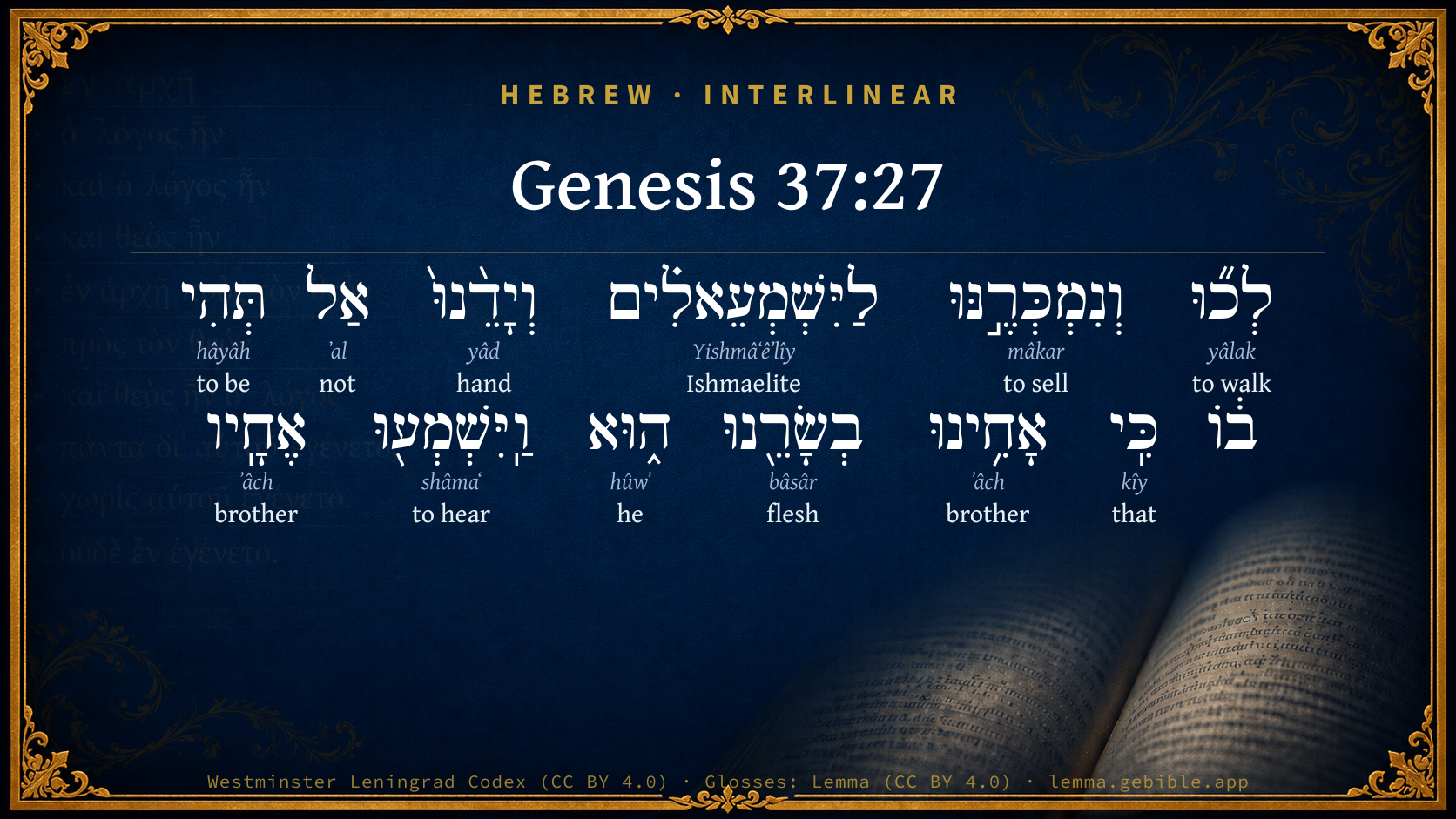
Genesis 37:27

Hebrew (Westminster Leningrad Codex) Genesis 37:27 appears in the Hebrew Old Testament. The text above is from the Westminster Leningrad Codex. Each word links to its Strong’s number, a concise gloss, and parsing drawn from the Open Scriptures Hebrew Bible morphology. Click any word for its full Brown-Driver-Briggs (BDB) entry.
Download image
Cite this verse

Genesis 37:27 (World English Bible). Public Domain. Lemma interlinear Bible study tool, https://lemma.gebible.app/v/genesis/37/27.

Show BibTeX & RIS
BibTeX
RIS
English Translation
Come, and let's sell him to the Ishmaelites, and not let our hand be on him; for he is our brother, our flesh." His brothers listened to him.
World English Bible · Public Domain
Download a study sheet

One document with this verse’s original text, its word-by-word gloss line, the meaning frame, cross-references with their text, attributed commentary, and full source and license credits — printable, and it pastes into notes with its structure intact.

This verse Autodidact and up

Study sheet (.html) Plain text (.txt)

A passage Seminary Student

Up to 50 verses in one chapter. A passage sheet keeps up to 6 commentary sources and 12 cross-references per verse, in the order this page ranks them, and says so on the sheet whenever that leaves anything out. Ask for a single verse and you get the Autodidact verse sheet above.

Everything on this page stays free to read, with no account — the sheet is a download of what is already on screen, not access to it.

Want to remove ads? Support Godless Engineer
Compare translations 3

The same verse in 3 English versions, stacked beneath the original-language interlinear above. Click any original word for its lexicon entry.

Each is an independent rendering of the whole verse — the interlinear is not word-aligned to these translations.

Highlighted words mark where these versions differ — a whole-verse word diff, not a word-by-word alignment.

  • World English Bible Public Domain
    Come, and let's sell him to the Ishmaelites, and not let our hand be on him; for he is our brother, our flesh." His brothers listened to him.
  • King James Version Public Domain
    Come, and let us sell him to the Ishmaelites, and let not our hand be upon him; for he is our brother and our flesh. And his brethren were content.
  • unfoldingWord Literal Text CC BY-SA 4.0
    Come and let us sell him to the Ishmaelites so that our hand will not be on him. For he our brother, our flesh.” And his brothers listened.

unfoldingWord Literal Text — © unfoldingWord, licensed CC BY-SA 4.0. Word-aligned USFM3 via Door43 (git.door43.org/unfoldingWord/en_ult).

Versions to compare (up to 4)

3 of 4 selected

Show all 18 translations

Every available English version of this verse, each an independent rendering of the whole verse.

  • World English Bible Public Domain
    Come, and let's sell him to the Ishmaelites, and not let our hand be on him; for he is our brother, our flesh." His brothers listened to him.
  • Berean Standard Bible Public Domain
    Come, let us sell him to the Ishmaelites and not lay a hand on him; for he is our brother, our own flesh.” And they agreed.
  • Majority Standard Bible Public Domain
    Come, let us sell him to the Ishmaelites and not lay a hand on him; for he is our brother, our own flesh.” And they agreed.
  • King James Version Public Domain
    Come, and let us sell him to the Ishmaelites, and let not our hand be upon him; for he is our brother and our flesh. And his brethren were content.
  • American Standard Version (1901) Public Domain
    Come, and let us sell him to the Ishmaelites, and let not our hand be upon him; for he is our brother, our flesh. And his brethren hearkened unto him.
  • Revised Version (1885) Public Domain
    Come, and let us sell him to the Ishmaelites, and let not our hand be upon him; for he is our brother, our flesh. And his brethren hearkened unto him.
  • Geneva Bible (1599) Public Domain
    Come and let vs sell him to the Ishmeelites, and let not our handes be vpon him: for he is our brother and our flesh: and his brethren obeyed.
  • Douay-Rheims (1899) Public Domain
    It is better that he be sold to the Ismaelites, and that our hands be not defiled: for he is our brother and our flesh. His brethren agreed to his words.
  • Young's Literal Translation Public Domain
    Come, and we sell him to the Ishmaelites, and our hands are not on him, for he `is' our brother -- our flesh;' and his brethren hearken.
  • Literal Standard Version CC BY-SA 4.0
    Come, and we sell him to the Ishmaelites, and our hands are not on him, for he [is] our brother—our flesh”; and his brothers listen.
  • Unlocked Literal Bible CC BY-SA 4.0
    Come, and let us sell him to the Ishmaelites and not lay our hands upon him. For he is our brother, our flesh.” His brothers listened to him.
  • unfoldingWord Literal Text CC BY-SA 4.0
    Come and let us sell him to the Ishmaelites so that our hand will not be on him. For he our brother, our flesh.” And his brothers listened.
  • Darby Bible Public Domain
    Come and let us sell him to the Ishmaelites; but let not our hand be upon him; for he is our brother, our flesh. And his brethren hearkened [to him].
  • World Messianic Bible Public Domain
    Come, and let’s sell him to the Ishmaelites, and not let our hand be on him; for he is our brother, our flesh.” His brothers listened to him.
  • Webster's Bible Public Domain
    Come, and let us sell him to the Ishmaelites, and let not our hand be upon him; for he is our brother, our flesh: and his brethren were content.
  • Free Bible Version CC BY-SA 4.0
    Instead, why don't we sell him to these Ishmaelites? We don't have to kill him. After all he's our brother, our own flesh and blood.” His brothers agreed.
  • Bible in Basic English Public Domain
    Let us give him to these Ishmaelites for a price, and let us not put violent hands on him, for he is our brother, our flesh. And his brothers gave ear to him.
  • JPS Tanakh (1917) Public Domain
    Come, and let us sell him to the Ishmaelites, and let not our hand be upon him; for he is our brother, our flesh.' And his brethren hearkened unto him.

Literal Standard Version (2020), Covenant Press — licensed CC BY-SA 4.0. Text via the HelloAO Bible API (eBible.org). Unlocked Literal Bible (unfoldingWord) — licensed CC BY-SA 4.0. Text via the HelloAO Bible API (eBible.org). unfoldingWord Literal Text — © unfoldingWord, licensed CC BY-SA 4.0. Word-aligned USFM3 via Door43 (git.door43.org/unfoldingWord/en_ult). Free Bible Version, Dr. Jonathan Gallagher — licensed CC BY-SA 4.0. Text via the HelloAO Bible API (eBible.org).

Word by word

More ways to search: Search by grammar → Find every occurrence → Compare this word →

Practice this passage: Drill this verse → Learn its vocabulary →

לַיִּשְׁמְעֵאלִ֗ים
Yishmâʻêʼlîy
H3459
“to/for the · Ishmaelites”
Preposition, Determined + Noun, Gentilic, Masculine, Plural, Absolute
Part of Speech
Preposition + Noun
Type
Gentilic
Gender
Masculine
Number
Plural
State
Absolute
Full BDB Definition

Origin: patronymically from H3458

TWOT: None

Ishmaelite = see Ishmael " God will hear" - a descendant of Ishmael
  1. לְכ֞וּ yâlak H3212 “walk” Verb, Qal, Imperative, 2nd Person, Masculine, Plural
  2. וְנִמְכְּרֶ֣נּוּ mâkar H4376 “and · to sell · him” Conjunction + Verb, Qal, Cohortative, 1st Person, Common, Plural + Suffix, Personal, 3rd Person, Masculine, Singular
  3. וְיָדֵ֨נוּ֙ yâd H3027 “and · hand · our” Conjunction + Noun, Common, Both, Singular, Construct + Suffix, Personal, 1st Person, Common, Plural
  4. אַל ʼal H408 “not” Particle, Negative
  5. תְּהִי hâyâh H1961 “to be” Verb, Qal, Jussive, 3rd Person, Feminine, Singular
  6. כִּֽי kîy H3588 “that” Conjunction
  7. אָחִ֥ינוּ ʼâch H251 “brother · our” Noun, Common, Masculine, Singular, Construct + Suffix, Personal, 1st Person, Common, Plural
  8. בְשָׂרֵ֖נוּ bâsâr H1320 “flesh · our” Noun, Common, Masculine, Singular, Construct + Suffix, Personal, 1st Person, Common, Plural
  9. ה֑וּא hûwʼ H1931 “he” Pronoun, Personal, 3rd Person, Masculine, Singular
  10. וַֽיִּשְׁמְע֖וּ shâmaʻ H8085 “and · to hear” Conjunction + Verb, Qal, Sequential Imperfect, 3rd Person, Masculine, Plural
  11. אֶחָֽיו ʼâch H251 “brothers · his” Noun, Common, Masculine, Plural, Construct + Suffix, Personal, 3rd Person, Masculine, Singular

About this verse

These counts appear in no published source. They are computed here, from the morphology-tagged text and Lemma’s own curated glosses. What Lemma adds →

13
words
11
distinct lemmas
Pentateuch
section

Notable vocabulary

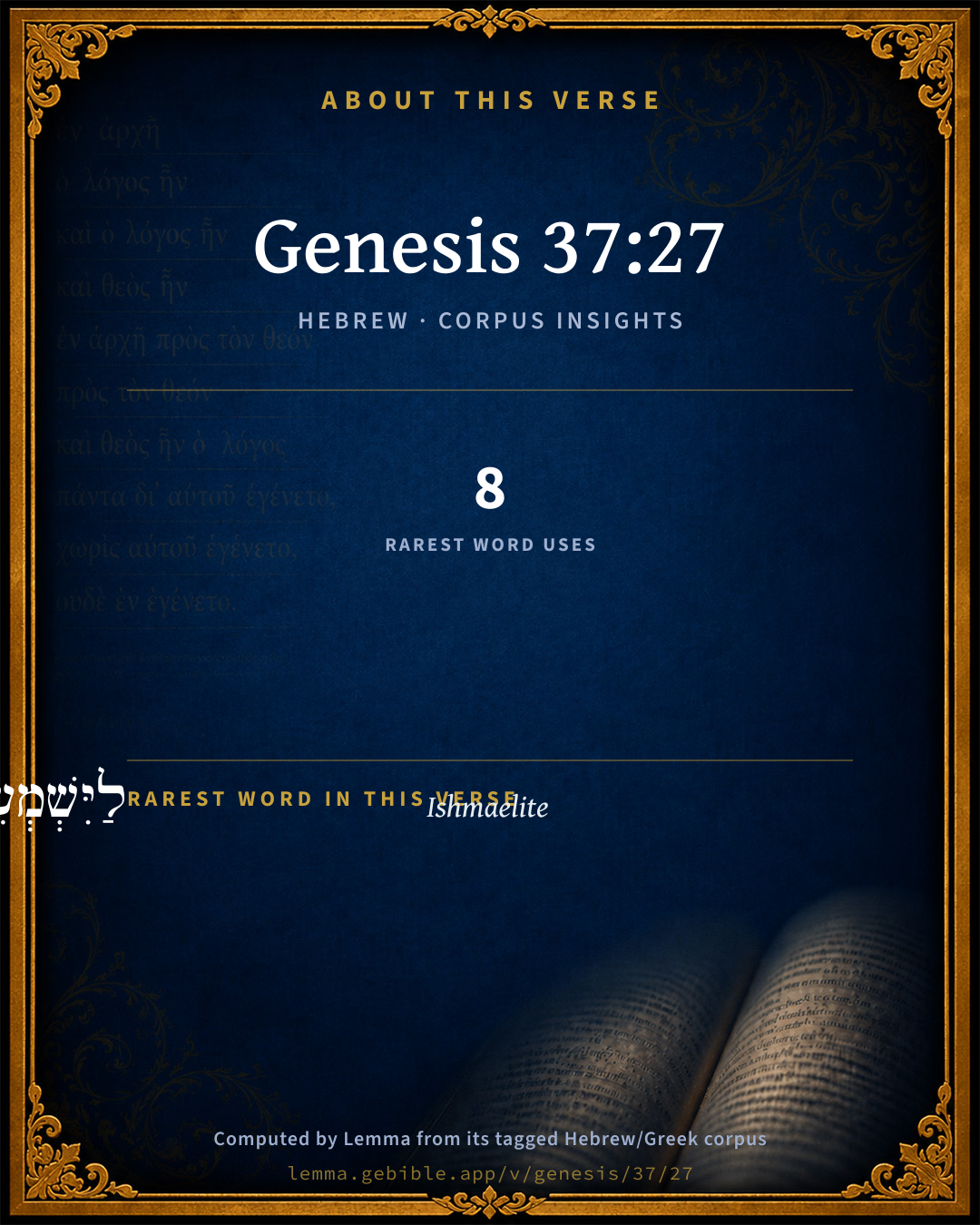
The rarest word here is לַיִּשְׁמְעֵאלִ֗ים Ishmaelite H3459 — appearing just 8 times in the whole Hebrew Bible.

Shared distinctive vocabulary

לַיִּשְׁמְעֵאלִ֗ים Ishmaelite H3459 occurs in 8 verses of the Hebrew Bible. Also found in:

Grammatical profile

  • 4 verbs
  • 5 nouns
  • 1 pronoun
  • 1 preposition
  • 1 conjunction
  • 1 particle

Verb forms

  • לְכ֞וּ Qal · Imperative
  • וְנִמְכְּרֶ֣נּוּ Qal · Cohortative
  • תְּהִי Qal · Jussive
  • וַֽיִּשְׁמְע֖וּ Qal · Sequential Imperfect

Repetition

A word recurs within this verse — often emphatic in Hebrew:

  • אָחִ֥ינוּ brother H251 ×2

Hebrew & Septuagint length

In English translation the verse runs 28 words from the Hebrew and 28 from the Septuagint (LXX English) — the same length.

A rough comparison of the two English renderings, which tokenize alike — not a word-level alignment.

Word counts can differ between the Hebrew and the Greek without any difference in meaning — e.g. the Hebrew direct-object marker אֵת has no separate Greek word, and Greek often adds the article ὁ.

Cross-references

13

Topical passages linked to Genesis 37:27 in the Treasury of Scripture Knowledge — connected by theme and wording, ordered by reader-vote popularity; previews shown in the World English Bible.

  • Genesis 42:21 They said one to another, "We are most assuredly guilty concerning our brother, in that we saw the distress of his soul, when he begged us, and we wouldn't listen. Therefore this distress has come on us."
  • Matthew 16:26 For what will it profit a man, if he gains the whole world, and forfeits his life? Or what will a man give in exchange for his life?
  • 1 Samuel 18:17 Saul said to David, Behold, my elder daughter Merab, her will I give you as wife: only be valiant for me, and fight Yahweh's battles. For Saul said, Don't let my hand be on him, but let the hand of the Philistines be on him.
  • Genesis 29:14 Laban said to him, Surely you are my bone and my flesh. He lived with him for a month.
  • Genesis 37:22 Reuben said to them, "Shed no blood. Throw him into this pit that is in the wilderness, but lay no hand on him"-- that he might deliver him out of their hand, to restore him to his father.
  • Exodus 21:16 "Anyone who kidnaps someone and sells him, or if he is found in his hand, he shall surely be put to death.
  • Exodus 21:21 Notwithstanding, if he gets up after a day or two, he shall not be punished, for he is his property.
  • 2 Samuel 11:14–17 It happened in the morning, that David wrote a letter to Joab, and sent it by the hand of Uriah.
  • 2 Samuel 12:9 Why have you despised the word of Yahweh, to do that which is evil in his sight? You have struck Uriah the Hittite with the sword, and have taken his wife to be your wife, and have slain him with the sword of the children of Ammon.
  • Nehemiah 5:8 I said to them, We after our ability have redeemed our brothers the Jews, that were sold to the nations; and would you even sell your brothers, and should they be sold to us? Then held they their peace, and found never a word.
  • Matthew 26:15 and said, "What are you willing to give me, that I should deliver him to you?" They weighed out for him thirty pieces of silver.
  • 1 Timothy 1:10 for the sexually immoral, for homosexuals, for slave-traders, for liars, for perjurers, and for any other thing contrary to the sound doctrine;
  • Revelation 18:13 and cinnamon, incense, perfume, frankincense, wine, olive oil, fine flour, wheat, sheep, horses, chariots, bodies, and people's souls.

Cross-references courtesy of OpenBible.info (CC BY 4.0).

Hebrew and Greek witnesses Masoretic Hebrew ↔ Greek Septuagint

The same verse in the two great witnesses to the Old Testament, shown verse-for-verse.

These are two independent witnesses, not word-aligned to each other, and the Septuagint is shown in lemma (dictionary) form.

Hebrew Genesis 37:27 Masoretic · Westminster Leningrad Codex

לְכ֞וּ וְנִמְכְּרֶ֣נּוּ לַיִּשְׁמְעֵאלִ֗ים וְיָדֵ֨נוּ֙ אַל תְּהִי ב֔וֹ כִּֽי אָחִ֥ינוּ בְשָׂרֵ֖נוּ ה֑וּא וַֽיִּשְׁמְע֖וּ אֶחָֽיו

Come, and let's sell him to the Ishmaelites, and not let our hand be on him; for he is our brother, our flesh." His brothers listened to him.

World English Bible · Public Domain

Greek LXX Genesis 37:27 Septuagint · lemma form

δεῦτε ἀποδίδωμι αὐτός ὁ ισμαηλίτης οὗτος ὁ δέ χείρ ἐγώ μή εἰμί ἐπί αὐτός ὅτι ἀδελφός ἐγώ καί σάρξ ἐγώ εἰμί ἀκούω δέ ὁ ἀδελφός αὐτός

Come, let us sell him to these Ismaelites, but let not our hands be upon him, because he is our brother and our flesh; and his brethren listened.

LXX2012 (modern English Septuagint) · Public Domain

Hebrew: Westminster Leningrad Codex (CC BY 4.0). Greek: Septuagint (public domain); English from LXX2012 (modern English Septuagint) (Public Domain). How the Septuagint differs from the Hebrew →

Targum (Aramaic paraphrase)

2

The Targum is the ancient Jewish Aramaic paraphrase of the Hebrew Scriptures — an interpretive translation, not the Hebrew text itself. Onkelos (literal) and Pseudo-Jonathan (expansive) render the Torah, and Jonathan the Prophets. Coverage is partial: where no permissively-licensed English translation exists for a verse, only the Aramaic is shown. This is verse-level text, not a word-by-word alignment to the Hebrew.

  1. Targum Onkelos Torah (Genesis–Deuteronomy)
    אֱתוּ וּנְזַבְּנִנֵּהּ לַעֲרָבָאֵי וִידָנָא לָא תְהֵי בֵהּ אֲרֵי אֲחוּנָא בִסְרָנָא הוּא וְקַבִּילוּ מִנֵּהּ אֲחוֹהִי

    (no public-domain English translation for this verse)

    Targum Onkelos — Aramaic: “Onkelos Genesis” (public domain); “Onkelos Exodus” (public domain); “Onkelos Leviticus” (public domain); “Onkelos Numbers” (public domain); “Onkelos Deuteronomy” (public domain). English: “Sefaria Community Translation” (CC0 1.0 (public-domain dedication)); “J.W. Etheridge. The Targums of Onkelos and Jonathan Ben Uzziel on the Pentateuch. London: Longmans, Green, 1862” (public domain). Text via Sefaria.

  2. Targum Pseudo-Jonathan Torah (Genesis–Deuteronomy)
    אִיתוּי וּנְזַבְּנִינֵיהּ לַעֲרָבָאִין וִידָנָא לָא תְהִי בֵיהּ לְמִקְטְלֵיהּ אֲרוּם אָחוּנָא בִּשְרָנָא הוּא וְקַבִּילוּ אָחוֹי

    Come, let us sell him to the Arabians, and our hands shall not be upon him to kill him; for our brother is our own flesh. And his brethren agreed.

    Targum Pseudo-Jonathan — Aramaic: “Targum Jonathan on Genesis” (public domain); “Targum Jonathan on Exodus” (public domain); “Targum Jonathan on Leviticus” (public domain); “Targum Jonathan on Numbers” (public domain); “Targum Jonathan on Deuteronomy” (public domain). English: “The Targum of Jonathan ben Uzziel, trans. J. W. Etheridge, London, 1862” (public domain). Text via Sefaria.

Commentary

Notes on Genesis 37:27 from classic Christian and Jewish commentators (each source and its license shown beneath its notes). The classic Christian expositions comment on the surrounding passage and are grouped to its opening verse, so a note may address several verses; the Jewish commentaries on the Tanakh (Rashi and others) are per-verse, so they appear only where the commentator wrote on this verse.

Lemma curates 59 commentaries, every one of them public domain or Creative Commons licensed, each selected and text-cleaned for this edition rather than reprinted as found. About our sources →

Trapp's Complete Commentary

John Trapp

Gen 37:27 Come, and let us sell him to the Ishmeelites, and let not our hand be upon him; for he [is] our brother [and] our flesh. And his brethren were content.

Ver. 27. For he is our brother, and our flesh.] This consideration should be, as the angel’s call to Abraham, to stay our hand from striking another; (1.) That he is our brother, in respect of God; for "have we not all one father? hath not one God created us?" {Mal 2:10} (2.) That he is "our flesh," in regard of our first parents. {Act 17:26 Isa 58:7}

John Trapp, A Commentary or Exposition upon All the Books of the Old and New Testament (1647–1656) — public domain. Text from a community e-Sword module.

The Cambridge Bible for Schools and Colleges

gen. ed. J. J. S. Perowne

27. let us sell him] Judah proposes to sell Joseph, in order to save his life. Judah takes the lead in J’s version, as Reuben in E’s. See Gen_43:3 ff., Gen_44:18 ff.

The Cambridge Bible for Schools and Colleges (gen. ed. J. J. S. Perowne; Cambridge University Press, 1878–1918) — public domain. Text from a community e-Sword module.

John Gill's Exposition

Then there passed by Midianites, merchantmen,.... The same with the Ishmaelites before mentioned, as appears from the latter part of this verse; for as these were near neighbours, so they might join together in merchandise, and travel in company for greater safety, and are sometimes called the one, and sometimes the other, as well as they might mix together in their habitations and marriages; and are hence called Arabians by the Targums, as before observed, and so by Josephus, which signifies a mixed people:

and they drew and lifted up Joseph out of the pit: not the Midianites, but his brethren:

and sold Joseph to the Ishmaelites for twenty pieces of silver; for twenty shekels, which amounted to twenty five shillings of our money. The Jews (z) say, they each took two shekels apiece, and bought with them a pair of shoes, according to Amo 8:6; but there were but nine of them, Reuben was absent:

and they brought Joseph into Egypt; some think these Midianites were different from the Ishmaelites, and that Joseph was sold many times, first to the Midianites, and then by them to the Ishmaelites, and by the latter to Potiphar. Justin (a), an Heathen writer, gives an account of this affair in some agreement with this history;"Joseph (he says) was the youngest of his brethren, whose excellent genius they feared, and took him secretly, and sold him to "foreign merchants", by whom he was carried into Egypt.''

(z) Pirke Eliezer, c. 38. (a) E. Trogo, l. 36. c. 2.

John Gill's Exposition of the Whole Bible (1746–1763) — public domain (CC PDM 1.0). Text via the HelloAO Bible API.

unfoldingWord translationNotes

Door43 World Missions Community

to the Ishmaelites

"to these men who are descendants of Ishmael"

not lay our hands upon him

This means not to harm or injure him. AT: "not hurt him" (See: Idiom)

he is our brother, our flesh

The word "flesh" is a metonym that stands for a relative. AT: "he is our blood relative" (See: Metonymy)

His brothers listened to him

"Judah's brothers listened to him" or "Judah's brothers agreed with him"

Midianite ... Ishmaelites

Both names refer to the same group of traders that Joseph's brothers meet.

for twenty pieces of silver

"for the price of 20 pieces of silver" (See: Numbers)

carried Joseph into Egypt

"took Joseph to Egypt"

translationWords

Ishmael

hand

flesh

Midian

Joseph (OT)

silver

Egypt

unfoldingWord translationNotes — © Distant Shores Media and the Door43 World Missions Community, licensed CC BY-SA 4.0. Source: git.door43.org/Door43/en_tn.

Rashi

Rabbi Shlomo Yitzchaki (Rashi)

וישמעו AND THEY HEARKENED — The Targum renders this by “and they accepted it from him” (i.e., they agreed with him). Wherever the verb שמע means agreeing with a person’s statement — obeying — as here, and as (28:7) “and Jacob had hearkened (וישמע) to his father”, and (Exodus 24:7) “We will do and we will obey (ונשמע)” it is translated in the Targum by קבל “accepting”, but wherever it merely means hearing with the ear, as e. g. (3:8) “And they heard (וישמעו) the voice of the Lord God walking in the garden”, and (27:5) “and Rebecca heard (שומעת;”, and (31:1) “And Israel heard (וישמע)”, and (Exodus 16:12) “I have heard (שמעתי) the murmurings of the children of Israel”, — all such cases are rendered by various forms of ושמעו: שמע “and they heard“, ושמעת “and she heard”, ושמע “and he heard”,שמיע,קדמי “there is heard before Me” (I have heard).

Rashi on the Tanakh — English translations: “The Judaica Press complete Tanach with Rashi, translated by A. J. Rosenberg” (CC BY 4.0); “Pentateuch with Rashi's commentary by M. Rosenbaum and A.M. Silbermann, 1929-1934” (public domain); “The Metsudah Tanach series, Lakewood, N.J” (CC BY 4.0); and “The Book of Joshua, Metsudah Publications, 1997” (CC BY 4.0). Text via Sefaria.

Radak

Rabbi David Kimhi (Radak)

לכו, we already explained this expression on verse 20.

אל תהי בו, to be the indirect cause of his death. If we are going to sell him he will not die.

Radak on the Tanakh — English translations: “Sefaria Community Translation” (CC0 1.0 (public-domain dedication)); “Eliyahu Munk, HaChut Hameshulash” (CC BY 4.0); “Rabbi Mike Feuer, Jerusalem Anthology” (CC BY 4.0); and “R. David Kimhi on the first book of Psalms, Translated by R.G. Finch, London, 1919” (public domain). Text via Sefaria.

Lesson kit

Teaching starters — assembled from the data on this page, not authored interpretation. Every prompt links to the verse data it draws on. Edit before teaching.

Genesis, in the Pentateuch, opens this verse with 13 words (11 distinct Hebrew lemmas). Its most distinctive word is Yishmâʻêʼlîy (“Ishmaelite”). A historical commentator’s framing appears above. Read the whole chapter for the surrounding context.

Discussion questions

  1. How does “Ishmaelite” (Yishmâʻêʼlîy) shape what this verse is saying?
  2. How does Genesis 37:25, which shares the word «Ishmaelite», read alongside this verse?
  3. What does the repetition of “brother” (2× in this one verse) do in this verse?
  4. The translations on this page render this verse differently — a whole-verse word diff, not a word-by-word alignment. What might account for the different wordings?
  5. «לְכ֞וּ» is a Qal Imperative verb. How does that grammatical form shape the action described?
  6. Compare how Trapp's Complete Commentary and The Cambridge Bible for Schools and Colleges read this verse. Where do they agree or differ?

Things to notice

Reading settings

Reading text

Shown beneath each verse's original-language words.

Old Testament
Old Testament edition

Read the OT as the Masoretic Hebrew (MT) or the Greek Septuagint (LXX).

English shown for the Greek Septuagint (in the Hebrew ↔ Greek comparison).

Comparing translations? Open the Compare panel on any verse page to stack up to four side by side.