
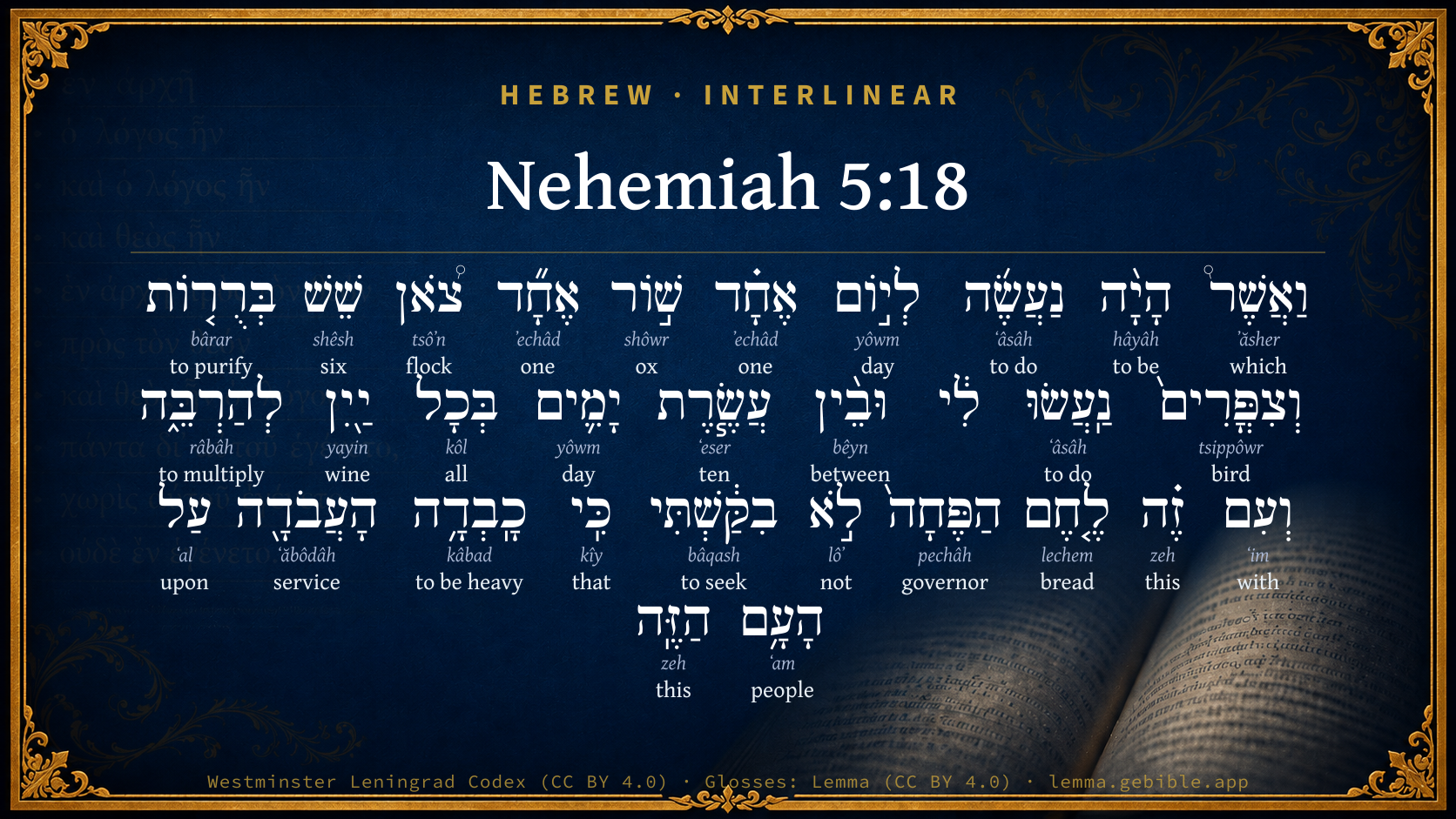
Nehemiah 5:18

Hebrew (Westminster Leningrad Codex) Nehemiah 5:18 appears in the Hebrew Old Testament. The text above is from the Westminster Leningrad Codex. Each word links to its Strong’s number, a concise gloss, and parsing drawn from the Open Scriptures Hebrew Bible morphology. Click any word for its full Brown-Driver-Briggs (BDB) entry.
Download image
Cite this verse

Nehemiah 5:18 (World English Bible). Public Domain. Lemma interlinear Bible study tool, https://lemma.gebible.app/v/nehemiah/5/18.

Show BibTeX & RIS
BibTeX
RIS
English Translation
Now that which was prepared for one day was one ox and six choice sheep; also fowls were prepared for me, and once in ten days store of all sorts of wine: yet for all this I didn't demand the bread of the governor, because the bondage was heavy on this people.
World English Bible · Public Domain
Download a study sheet

One document with this verse’s original text, its word-by-word gloss line, the meaning frame, cross-references with their text, attributed commentary, and full source and license credits — printable, and it pastes into notes with its structure intact.

This verse Autodidact and up

Study sheet (.html) Plain text (.txt)

A passage Seminary Student

Up to 50 verses in one chapter. A passage sheet keeps up to 6 commentary sources and 12 cross-references per verse, in the order this page ranks them, and says so on the sheet whenever that leaves anything out. Ask for a single verse and you get the Autodidact verse sheet above.

Everything on this page stays free to read, with no account — the sheet is a download of what is already on screen, not access to it.

Want to remove ads? Support Godless Engineer
Compare translations 3

The same verse in 3 English versions, stacked beneath the original-language interlinear above. Click any original word for its lexicon entry.

Each is an independent rendering of the whole verse — the interlinear is not word-aligned to these translations.

Highlighted words mark where these versions differ — a whole-verse word diff, not a word-by-word alignment.

  • World English Bible Public Domain
    Now that which was prepared for one day was one ox and six choice sheep; also fowls were prepared for me, and once in ten days store of all sorts of wine: yet for all this I didn't demand the bread of the governor, because the bondage was heavy on this people.
  • King James Version Public Domain
    Now that which was prepared for me daily was one ox and six choice sheep; also fowls were prepared for me, and once in ten days store of all sorts of wine: yet for all this required not I the bread of the governor, because the bondage was heavy upon this people.
  • unfoldingWord Literal Text CC BY-SA 4.0
    And what was made for one day was one bull, six choice sheep, and birds were made for me, and between ten days all kinds of wine in abundance. So with this I did not seek the bread of the governor, because the bondage was heavy on this people.

unfoldingWord Literal Text — © unfoldingWord, licensed CC BY-SA 4.0. Word-aligned USFM3 via Door43 (git.door43.org/unfoldingWord/en_ult).

Versions to compare (up to 4)

3 of 4 selected

Show all 18 translations

Every available English version of this verse, each an independent rendering of the whole verse.

  • World English Bible Public Domain
    Now that which was prepared for one day was one ox and six choice sheep; also fowls were prepared for me, and once in ten days store of all sorts of wine: yet for all this I didn't demand the bread of the governor, because the bondage was heavy on this people.
  • Berean Standard Bible Public Domain
    Each day one ox, six choice sheep, and some fowl were prepared for me, and once every ten days an abundance of all kinds of wine was provided. But I did not demand the food allotted to the governor, because the burden on the people was so heavy.
  • Majority Standard Bible Public Domain
    Each day one ox, six choice sheep, and some fowl were prepared for me, and once every ten days an abundance of all kinds of wine was provided. But I did not demand the food allotted to the governor, because the burden on the people was so heavy.
  • King James Version Public Domain
    Now that which was prepared for me daily was one ox and six choice sheep; also fowls were prepared for me, and once in ten days store of all sorts of wine: yet for all this required not I the bread of the governor, because the bondage was heavy upon this people.
  • American Standard Version (1901) Public Domain
    Now that which was prepared for one day was one ox and six choice sheep; also fowls were prepared for me, and once in ten days store of all sorts of wine: yet for all this I demanded not the bread of the governor, because the bondage was heavy upon this people.
  • Revised Version (1885) Public Domain
    Now that which was prepared for one day was one ox and six choice sheep; also fowls were prepared for me, and once in ten days store of all sorts of wine: yet for all this I demanded not the bread of the governor, because the bondage was heavy upon this people.
  • Geneva Bible (1599) Public Domain
    And there was prepared daily an oxe, and sixe chosen sheepe, and birdes were prepared for me, and within ten dayes wine for all in abundance. Yet for all this I required not the bread of the gouernour: for the bondage was grieuous vnto this people.
  • Douay-Rheims (1899) Public Domain
    And there was prepared for me day by day one ox, and six choice rams, be- sides fowls, and once in ten days I gave store of divers wines, and many other things: yet I did not require my yearly allowance as governor: for the people were very much impoverished.
  • Young's Literal Translation Public Domain
    and that which hath been prepared for one day `is' one ox, six fat sheep, also fowls have been prepared for me, and once in ten days of all wines abundantly, and with this, the bread of the governor I have not sought, for heavy is the service on this people.
  • Literal Standard Version CC BY-SA 4.0
    and that which has been prepared for one day [is] one ox, six fat sheep, also birds have been prepared for me, and once in ten days of all wines abundantly, and with this, the bread of the governor I have not sought, for heavy is the service on this people.
  • Unlocked Literal Bible CC BY-SA 4.0
    Now what was prepared each day was one ox, six choice sheep, and also birds, and every ten days all kinds of wine in abundance, yet for all this I did not demand the food allowance of the governor, because the demands were too heavy on the people.
  • unfoldingWord Literal Text CC BY-SA 4.0
    And what was made for one day was one bull, six choice sheep, and birds were made for me, and between ten days all kinds of wine in abundance. So with this I did not seek the bread of the governor, because the bondage was heavy on this people.
  • Darby Bible Public Domain
    And that which was prepared daily was one ox [and] six choice sheep; also fowls were prepared for me, and once in ten days all sorts of wine in abundance. Yet for all this I demanded not the bread of the governor; for the service was heavy upon this people.
  • World Messianic Bible Public Domain
    Now that which was prepared for one day was one ox and six choice sheep. Also fowls were prepared for me, and once in ten days a store of all sorts of wine. Yet for all this, I didn’t demand the governor’s pay, because the bondage was heavy on this people.
  • Webster's Bible Public Domain
    Now that which was prepared for me daily was one ox and six choice sheep; also fowls were prepared for me, and once in ten days an abundance of all sorts of wine: yet for all this I required not the bread of the governor, because the bondage was heavy upon this people.
  • Free Bible Version CC BY-SA 4.0
    Every day I paid for one ox, six good sheep, and poultry. Every ten days I paid for a large supply of all kinds of wine. But I never demanded the governor's food allowance, because the people were already carrying a heavy burden.
  • Bible in Basic English Public Domain
    Now the food made ready for one day was one ox and six fat sheep, as well as fowls; and once in ten days a store of all sorts of wine: but all the same, I did not take the food to which the ruler had a right, because the people were crushed under a hard yoke.
  • JPS Tanakh (1917) Public Domain
    Now that which was prepared for one day was one ox and six choice sheep, also fowls were prepared for me; and once in ten days store of all sorts of wine; yet for all this I demanded not the bread of the governor, because the service was heavy upon this people.

Literal Standard Version (2020), Covenant Press — licensed CC BY-SA 4.0. Text via the HelloAO Bible API (eBible.org). Unlocked Literal Bible (unfoldingWord) — licensed CC BY-SA 4.0. Text via the HelloAO Bible API (eBible.org). unfoldingWord Literal Text — © unfoldingWord, licensed CC BY-SA 4.0. Word-aligned USFM3 via Door43 (git.door43.org/unfoldingWord/en_ult). Free Bible Version, Dr. Jonathan Gallagher — licensed CC BY-SA 4.0. Text via the HelloAO Bible API (eBible.org).

Word by word

More ways to search: Search by grammar → Find every occurrence → Compare this word →

Practice this passage: Drill this verse → Learn its vocabulary →

בְּרֻר֤וֹת
bârar
H1305
“purified”
Verb, Qal, Participle Passive, Feminine, Plural, Absolute
Part of Speech
Verb
Stem
Qal
Form
Participle Passive
Gender
Feminine
Number
Plural
State
Absolute
Full BDB Definition

Origin: a primitive root

TWOT: 288

to purify, select, polish, choose, purge, cleanse or make bright, test or prove - (Qal) - to purge, purge out, purify - to choose, select - to cleanse, make shining, polish - to test, prove - (Niphal) to purify oneself - (Piel) to purify - (Hiphil) - to purify - to polish arrows - (Hithpael) - to purify oneself - to show oneself pure, just, kind
  1. וַאֲשֶׁר֩ ʼăsher H834 “and · which” Conjunction + Particle, Relative
  2. הָיָ֨ה hâyâh H1961 “to be” Verb, Qal, Perfect, 3rd Person, Masculine, Singular
  3. נַעֲשֶׂ֜ה ʻâsâh H6213 “done” Verb, Niphal, Participle Passive, Masculine, Singular, Absolute
  4. לְי֣וֹם yôwm H3117 “to/for · day” Preposition + Noun, Common, Masculine, Singular, Absolute
  5. אֶחָ֗ד ʼechâd H259 “one” Adjective, Cardinal number, Masculine, Singular, Absolute
  6. שׁ֣וֹר shôwr H7794 “ox” Noun, Common, Masculine, Singular, Absolute
  7. אֶחָ֞ד ʼechâd H259 “one” Adjective, Cardinal number, Masculine, Singular, Absolute
  8. צֹ֠אן tsôʼn H6629 “flock” Noun, Common, Both, Singular, Absolute
  9. שֵׁשׁ shêsh H8337 “six” Adjective, Cardinal number, Feminine, Singular, Absolute
  10. וְצִפֳּרִים֙ tsippôwr H6833 “and · birds” Conjunction + Noun, Common, Both, Plural, Absolute
  11. נַֽעֲשׂוּ ʻâsâh H6213 “to do” Verb, Niphal, Perfect, 3rd Person, Common, Plural
  12. וּבֵ֨ין bêyn H996 “and · between” Conjunction + Preposition
  13. עֲשֶׂ֧רֶת ʻeser H6235 “ten” Adjective, Cardinal number, Masculine, Singular, Construct
  14. יָמִ֛ים yôwm H3117 “days” Noun, Common, Masculine, Plural, Absolute
  15. בְּכָל kôl H3605 “in/at · all of” Preposition + Noun, Common, Masculine, Singular, Construct
  16. יַ֖יִן yayin H3196 “wine” Noun, Common, Masculine, Singular, Absolute
  17. לְהַרְבֵּ֑ה râbâh H7235 “to/for · to multiply” Preposition + Verb, Hiphil, Infinitive Absolute
  18. וְעִם ʻim H5973 “and · with” Conjunction + Preposition
  19. זֶ֗ה zeh H2088 “this” Pronoun, Demonstrative, Masculine, Singular
  20. לֶ֤חֶם lechem H3899 “bread of” Noun, Common, Both, Singular, Construct
  21. הַפֶּחָה֙ pechâh H6346 “the · governor” Particle, Definite Article + Noun, Common, Masculine, Singular, Absolute
  22. לֹ֣א lôʼ H3808 “not” Particle, Negative
  23. בִקַּ֔שְׁתִּי bâqash H1245 “to seek” Verb, Piel, Perfect, 1st Person, Common, Singular
  24. כִּֽי kîy H3588 “that” Conjunction
  25. כָֽבְדָ֥ה kâbad H3513 “to be heavy” Verb, Qal, Perfect, 3rd Person, Feminine, Singular
  26. הָעֲבֹדָ֖ה ʻăbôdâh H5656 “the · service” Particle, Definite Article + Noun, Common, Feminine, Singular, Absolute
  27. עַל ʻal H5921 “upon” Preposition
  28. הָעָ֥ם ʻam H5971 “the · people” Particle, Definite Article + Noun, Common, Masculine, Singular, Absolute
  29. הַזֶּֽה zeh H2088 “the · this” Particle, Definite Article + Pronoun, Demonstrative, Masculine, Singular

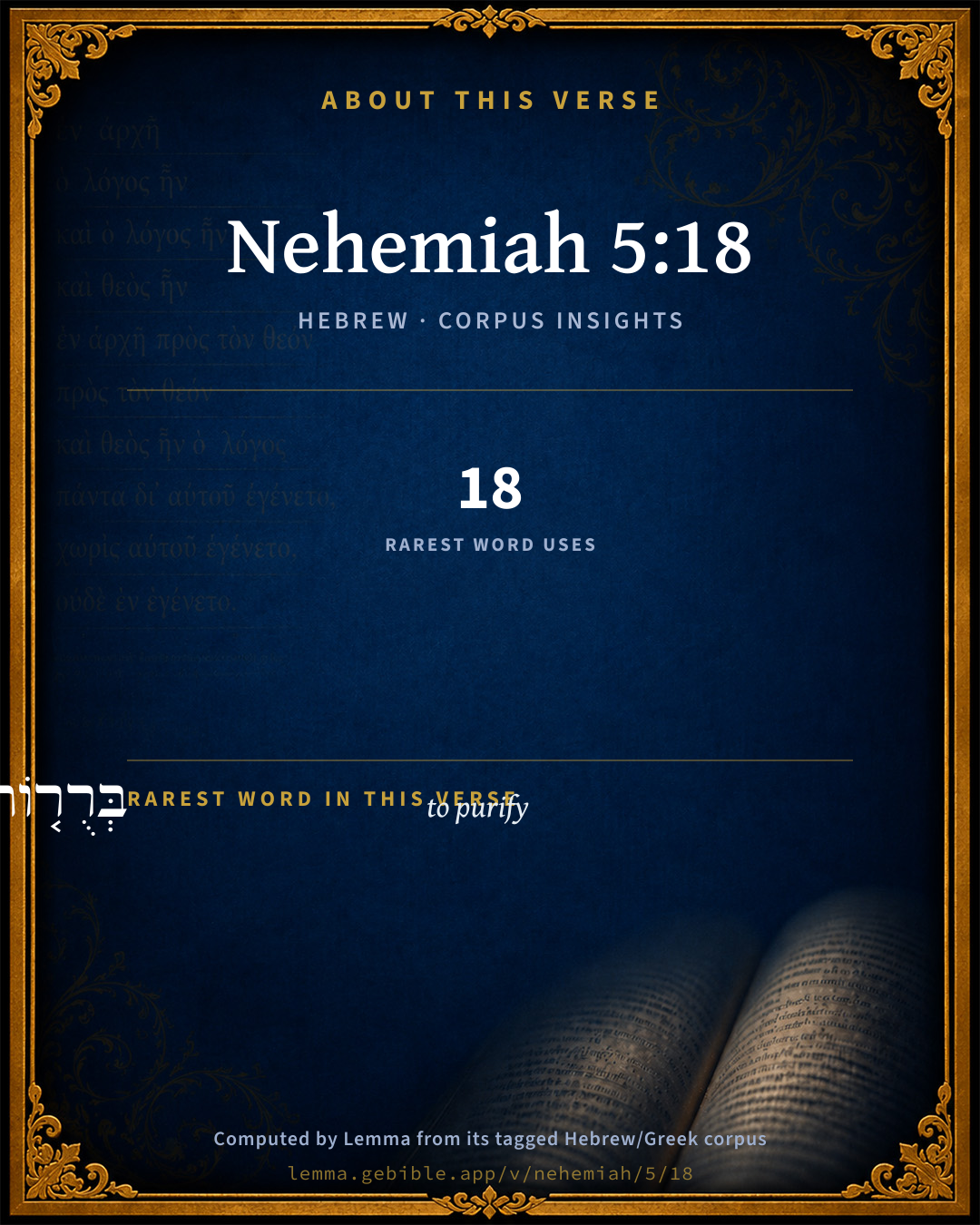
About this verse

These counts appear in no published source. They are computed here, from the morphology-tagged text and Lemma’s own curated glosses. What Lemma adds →

31
words
26
distinct lemmas
Historical
section

Notable vocabulary

The rarest word here is בְּרֻר֤וֹת to purify H1305 — appearing just 18 times in the whole Hebrew Bible.

Shared distinctive vocabulary

בְּרֻר֤וֹת to purify H1305 occurs in 16 verses of the Hebrew Bible. Also found in:

Grammatical profile

  • 7 verbs
  • 11 nouns
  • 4 adjectives
  • 2 pronouns
  • 4 prepositions
  • 1 conjunction
  • 2 particles

Verb forms

  • הָיָ֨ה Qal · Perfect
  • נַעֲשֶׂ֜ה Niphal · Participle Passive
  • בְּרֻר֤וֹת Qal · Participle Passive
  • נַֽעֲשׂוּ Niphal · Perfect
  • לְהַרְבֵּ֑ה Hiphil · Infinitive Absolute
  • בִקַּ֔שְׁתִּי Piel · Perfect
  • כָֽבְדָ֥ה Qal · Perfect

Repetition

Words recur within this verse — often emphatic in Hebrew:

  • נַעֲשֶׂ֜ה to do H6213 ×2
  • לְי֣וֹם day H3117 ×2
  • אֶחָ֗ד one H259 ×2
  • זֶ֗ה this H2088 ×2

Cross-references

4

Topical passages linked to Nehemiah 5:18 in the Treasury of Scripture Knowledge — connected by theme and wording, ordered by reader-vote popularity; previews shown in the World English Bible.

  • 1 Kings 4:22–23 Solomon's provision for one day was thirty measures of fine flour, and sixty measures of meal,
  • Psalms 37:21 The wicked borrow, and don't pay back, But the righteous give generously.
  • Psalms 37:26 All day long he deals graciously, and lends. His seed is blessed.
  • Nehemiah 5:14–15 Moreover from the time that I was appointed to be their governor in the land of Judah, from the twentieth year even to the two and thirtieth year of Artaxerxes the king, [that is], twelve years, I and my brothers have not eaten the bread of the governor.

Cross-references courtesy of OpenBible.info (CC BY 4.0).

Hebrew and Greek witnesses Masoretic Hebrew ↔ Greek Septuagint

The same verse in the two great witnesses to the Old Testament, shown verse-for-verse.

These are two independent witnesses, not word-aligned to each other, and the Septuagint is shown in lemma (dictionary) form.

Hebrew Nehemiah 5:18 Masoretic · Westminster Leningrad Codex

וַאֲשֶׁר֩ הָיָ֨ה נַעֲשֶׂ֜ה לְי֣וֹם אֶחָ֗ד שׁ֣וֹר אֶחָ֞ד צֹ֠אן שֵׁשׁ בְּרֻר֤וֹת וְצִפֳּרִים֙ נַֽעֲשׂוּ לִ֔י וּבֵ֨ין עֲשֶׂ֧רֶת יָמִ֛ים בְּכָל יַ֖יִן לְהַרְבֵּ֑ה וְעִם זֶ֗ה לֶ֤חֶם הַפֶּחָה֙ לֹ֣א בִקַּ֔שְׁתִּי כִּֽי כָֽבְדָ֥ה הָעֲבֹדָ֖ה עַל הָעָ֥ם הַזֶּֽה

Now that which was prepared for one day was one ox and six choice sheep; also fowls were prepared for me, and once in ten days store of all sorts of wine: yet for all this I didn't demand the bread of the governor, because the bondage was heavy on this people.

World English Bible · Public Domain

Greek LXX Structure differs

The Septuagint has no separate book of Nehemiah. Its Greek text is the second half of Esdras B (2 Esdras), chapters 11–23; Ezra is the first half (1–10).

A verse-for-verse comparison isn’t shown here because the chapters and verses don’t line up. Switch to the LXX edition with the MT / LXX toggle above to read the Greek directly.

On this verse, The Cambridge Bible for Schools and Colleges discusses the Septuagint’s reading. Read the note in Commentary ↓

Hebrew: Westminster Leningrad Codex (CC BY 4.0). Greek: Septuagint (public domain); English from a public-domain English Septuagint. How the Septuagint differs from the Hebrew →

Commentary

Notes on Nehemiah 5:18 from classic Christian and Jewish commentators (each source and its license shown beneath its notes). The classic Christian expositions comment on the surrounding passage and are grouped to its opening verse, so a note may address several verses; the Jewish commentaries on the Tanakh (Rashi and others) are per-verse, so they appear only where the commentator wrote on this verse.

Lemma curates 59 commentaries, every one of them public domain or Creative Commons licensed, each selected and text-cleaned for this edition rather than reprinted as found. About our sources →

Trapp's Complete Commentary

John Trapp

Neh 5:18 Now [that] which was prepared [for me] daily [was] one ox [and] six choice sheep; also fowls were prepared for me, and once in ten days store of all sorts of wine: yet for all this required not I the bread of the governor, because the bondage was heavy upon this people.

Ver. 18. Now that which was prepared for me daily] A very great table he kept, at his own charge all, yet nothing so great as Solomon, 1Ki 4:22-23, or as once Cardinal Wolsey here; who, besides all strangers that came, had four hundred of family, whereof one was an earl, nine barons, very many knights and esquires. But then he had more yearly revenue than all the bishops and deans in the land had, take them all together.

And once in ten days] Then he kept an extraordinary table, inviting guests, for whom he had store of the best wines. The Turkish bashaws feast foreign ambassadors with rice, and mutton, and fair water out of the river: wine is a forbidden ware with them; Mahomet, their prophet, having told them that in every grape there dwelt a devil.

Yet for all this I required not] This he did, and this he here recordeth; not for a name (as Crates, the philosopher, did, when he cast his goods into the sea merely to be talked of,) and is, therefore, worthily called by Jerome (Epist. ad Julian), gloriae animal, popularis aurae vile mancipium, a base slave to vain glory, but for better and higher ends. See Neh 5:16.

John Trapp, A Commentary or Exposition upon All the Books of the Old and New Testament (1647–1656) — public domain. Text from a community e-Sword module.

Joseph Benson's Commentary

Neh 5:18. Now that which was prepared for me daily, &c., was one ox, &c. — “It is evident,” says Dr. Dodd, “from the great and daily expenses of Nehemiah, here mentioned, that either he had large remittances from the Persian court, besides his own estate, to answer them; or that he did not continue at Jerusalem for the whole twelve years together; or that, if he did, he did not keep up this expensive way of living all the time, but only during the great and present exigencies of the Jews, which ceased in a good measure after the walls were built, the act against usury passed, and the people discharged to their ordinary course of maintaining themselves and families.”

Joseph Benson's Commentary on the Old and New Testaments (1811–1818) — public domain. Text from a community e-Sword module.

Geneva Bible (1599)

Geneva Bible translators

Whereas at other times they had by measure, at this time they had most liberally.

Or, once in ten days.

Geneva Bible (1599) marginal notes — public domain. Text via Bolls.life.

Adam Clarke's Commentary

Verse 18. One ox, and six choice sheep] This was food sufficient for more than two hundred men.

Once in ten days store of all sorts of wine] It is supposed that every tenth day they drank wine; at all other times they drank water; unless we suppose the meaning of the phrase to be, that his servants laid in a stock of wine every ten days. Though the Asiatics drank sparingly of wine, yet it is not very likely that, in a case such as that above, wine was tasted only thrice in each month.

Bishop Pococke mentions the manner in which the bey of Tunis lived. He had daily twelve sheep, with fish, fowls, soups, oranges, eggs, onions, boiled rice, c., c., His nobles dined with him after they had done, the servants sat down and, when they had finished, the poor took what was left. Here is no mention of a fat ox; but there were six sheep at the bey's table more than were at the table of Nehemiah: so the twelve sheep were equal to six sheep and one ox. Probably the mode of living between these two was nearly alike.

Adam Clarke's Commentary on the Bible (1810–1826) — public domain. Text from a community e-Sword/MySword module.

The Cambridge Bible for Schools and Colleges

gen. ed. J. J. S. Perowne

18. for me daily] R.V. for one day. Compare Solomon’s daily provision, 1Ki_4:22-23.

choice] i.e. picked or chosen for their fatness and good condition. The word in the Hebrew is used of men chosen for a purpose, 1Ch_7:40; 1Ch_9:22; 1Ch_16:41. In 1Sa_9:2 Saul is called a ‘choice’ (R.V. marg.) man.

once in ten days store of all sorts of wine] Literally ‘within the interval of ten days, of every wine in abundance.’ The construction is peculiar. The specification of 10 days and the preposition before ‘sorts of wine’ lead us to expect the mention of some particular quantity. The conjecture is possible that this was originally expressed by a word denoting a measure, unfamiliar to later copyists, who substituted a general expression for the word. According to the present text, fresh supplies of wine were furnished every ten days, i.e. thrice a month. LXX. ἐν πᾶσιν οἶνος τῷ πλήθει. Vulg. ‘Vina diversa et multa alia tribuebam.’

yet for all this] Lit. ‘with this,’ i.e. ‘in spite of this heavy outlay.’

required not I] R.V. I demanded not. The sense is ‘I did not demand my rights.’ At the time of the A.V. translation ‘to require’ was equivalent to ‘to ask,’ in which sense the A.V. employs it here; see Ezr_8:22; Psa_38:16 (P.B.V.) ‘I have required that they, even mine enemies, should not triumph over me.’ The usage of ‘require’ for ‘demanding by authority,’ ‘making requisition for’ (see Wright, Bible Word-Book) is more modern. But inasmuch as ‘I did not require’ could now be understood to mean ‘I did not need,’ the change to the less equivocal ‘demand’ is a gain in clearness and accuracy.

the bread of the governor] See Neh_5:14.

the bondage was heavy, &c.] i.e. the tribute exacted from the Jews by the Persian Imperial government. The word rendered ‘bondage’ occurs twice elsewhere in this book, Neh_3:5, ‘the work of their lord,’ Neh_10:37, ‘cities of our tillage.’ Used of oppressive ‘service’ it is familiar to us in Exodus (Exo_1:14, (Exo_2:23, Neh_5:9, &c.).

The Cambridge Bible for Schools and Colleges (gen. ed. J. J. S. Perowne; Cambridge University Press, 1878–1918) — public domain. Text from a community e-Sword module.

John Gill's Exposition

Think upon me, my God, for good, according to all that I have done for this people. He expected not any recompence from the people, but from the Lord; and from him not in a way of merit, but of grace and good will, who forgets not what is done for his name's sake, Heb 6:10.

Next: Nehemiah Chapter 6

John Gill's Exposition of the Whole Bible (1746–1763) — public domain (CC PDM 1.0). Text via the HelloAO Bible API.

Albert Barnes' Notes on the Bible

Compare the far grander provision for Solomon’s table (see the marginal reference).

Albert Barnes' Notes on the Bible (1834–1885) — public domain. Text from a community e-Sword/MySword module.

Haydock's Catholic Bible Commentary

Wines. This was only produced, in abundance, on extraordinary occasions; for the people of the East do not drink wine at every feast, Ecclesiasticus xxxi. 17. (Calmet) --- Yearly. Septuagint, "Moreover, loaves of extortion I did not seek, because a hard servitude lay upon this people." (Haydock)

George Leo Haydock (1774–1849), Haydock's Catholic Family Bible and Commentary, 1859 edition — public domain. Excludes Psalms (Douay-Rheims chapter numbering differs from Protestant) and Deuterocanonical books (Catholic canon only).

Matthew Poole's English Annotations

But bore it out of my own estate; which was very considerable, his office in the Persian court being a place of very great profit as well as honour, and that profit no doubt continued to him in this his absence from the king. From this great and daily expense, it seems more than probable that Nehemiah did not continue here for twelve years together, as some would think, or at least that he did not this all that time, but only during the great and present exigencies and distresses of the Jews, which ceased in good part after the walls were built, and the hearts of all the Jews revived, and their enemies dispirited thereby.

Matthew Poole's English Annotations on the Holy Bible (1683–1685) — public domain. Text from a community e-Sword/MySword module.

Whedon's Commentary on the Bible

Daniel D. Whedon

18. That which was prepared for me daily — To show what a burden he bore at his own expense, Nehemiah here mentions a few of the more important items that were daily required for his table. Yet to maintain all this he made no claim for official salary and expense, but met all himself through sympathy with the distressed populace and the cause of his God. Clarke here quotes Pococke’s description of “the manner in which the Bey of Tunis lived. He had daily twelve sheep, with fish, fowls, soups, oranges, onions, boiled rice, etc. His nobles dined with him; after they had done, the servants sat down, and when they had finished, the poor took what was left.”

Once in ten days… wine — Wine could be obtained in quantities, and kept for any length of time, but other provisions must be furnished every day.

Daniel D. Whedon (gen. ed.), Commentary on the Old and New Testaments (1874–1909) — public domain. Text from a community e-Sword module.

The Pulpit Commentary

Once in ten clays store of all sorts of wine. Literally, "all sorts of wine in abundance." Wine was probably drunk every day, but laid in every ten days. Yet for all this. Or, with all this notwithstanding this great expenditure, I took no allowance as governor. Because the bondage was heavy upon this people. The bondage intended must be that under the Persian crown, since neither the labour at the wall nor the oppression of the creditors lasted during the twelve years that Nehemiah was governor. It would seem that the tribute, already complained of in ver. 4, must have been felt as a heavy burthen at this period.

The Pulpit Commentary (1880–1919), ed. H.D.M. Spence-Jones & Joseph S. Exell — public domain. Text from a community e-Sword module.

John Wesley's Explanatory Notes

Required not - But bore it out of my own estate: which was very considerable, his office in the Persian court being a place of great profit.

John Wesley, Explanatory Notes Upon the Whole Bible (1754–1765) — public domain. Text via the GEBible commentary corpus.

unfoldingWord translationNotes

Door43 World Missions Community

Now what was prepared each day was

This can be stated in active form. AT: "Each day I told my servants to prepare" or "Each day I told my servants to serve us the meat from" (See: Active or Passive)

six choice ... ten days

"6 choice ... 10 days" (See: Numbers)

wine in abundance

"enough wine for everyone"

yet for all this I did not demand the food allowance of the governor

"yet I never asked for the governor's food allowance"

Call me to mind

This is an idiom. It is a request for God to think about him and remember him. AT: "Remember me" (See: Idiom)

for good

This idiom is a request for God to reward him with good things because of the good that he has done for the people. AT: "and reward me" or "cause good to happen to me" (See: Idiom)

translationWords

cow

ewe

wine

govern

call

mind

God

good

unfoldingWord translationNotes — © Distant Shores Media and the Door43 World Missions Community, licensed CC BY-SA 4.0. Source: git.door43.org/Door43/en_tn.

Rashi

Rabbi Shlomo Yitzchaki (Rashi)

And what was prepared And every day they ate at my table one ox, six sheep and many birds.

prepared Heb. בְּרֻרוֹת. Its interpretation is according to the context: six prepared sheep, like the matter that is stated (I Sam. 25:18): “...five prepared (עֲשׂוּיוֹת) sheep.”

were prepared for me Heb. נַעֲשּׂוּ, an expression of preparation, like (Gen. 18:8): “...and the calf that he had prepared (עָשָּׂה).”

and as much as ten days’ supply Heb. וּבֵין עֲשֶּׂרֶת יָמִים, lit. and between ten days. And every day they drank much wine, the amount that suffices for ten days.

and for this Heb. וְעִם זֶה; and this procedure, for which I used to make such big expenditures.

food of the tax, which is fit for the governor, I did not seek, and I did not request it of the people, for the work of the building of the wall was heavy and strong upon them.

Rashi on the Tanakh — English translations: “The Judaica Press complete Tanach with Rashi, translated by A. J. Rosenberg” (CC BY 4.0); “Pentateuch with Rashi's commentary by M. Rosenbaum and A.M. Silbermann, 1929-1934” (public domain); “The Metsudah Tanach series, Lakewood, N.J” (CC BY 4.0); and “The Book of Joshua, Metsudah Publications, 1997” (CC BY 4.0). Text via Sefaria.

Lesson kit

Teaching starters — assembled from the data on this page, not authored interpretation. Every prompt links to the verse data it draws on. Edit before teaching.

Nehemiah, in the Historical, opens this verse with 31 words (26 distinct Hebrew lemmas). Its most distinctive word is bârar (“to purify”). A historical commentator’s framing appears above. Read the whole chapter for the surrounding context.

Discussion questions

  1. The word bârar carries the sense “to purify.” How does it shape the verse?
  2. How does 2 Samuel 22:27, which shares the word «to purify», read alongside this verse?
  3. What does the repetition of “to do” (2× in this one verse) do in this verse?
  4. These translations render this verse differently; the difference is in the English rendering, not the original. What questions does that raise?
  5. «הָיָ֨ה» is a Qal Perfect verb. How does that grammatical form shape the action described?
  6. Compare how Trapp's Complete Commentary and Joseph Benson's Commentary read this verse. Where do they agree or differ?

Things to notice

Reading settings

Reading text

Shown beneath each verse's original-language words.

Old Testament
Old Testament edition

Read the OT as the Masoretic Hebrew (MT) or the Greek Septuagint (LXX).

English shown for the Greek Septuagint (in the Hebrew ↔ Greek comparison).

Comparing translations? Open the Compare panel on any verse page to stack up to four side by side.