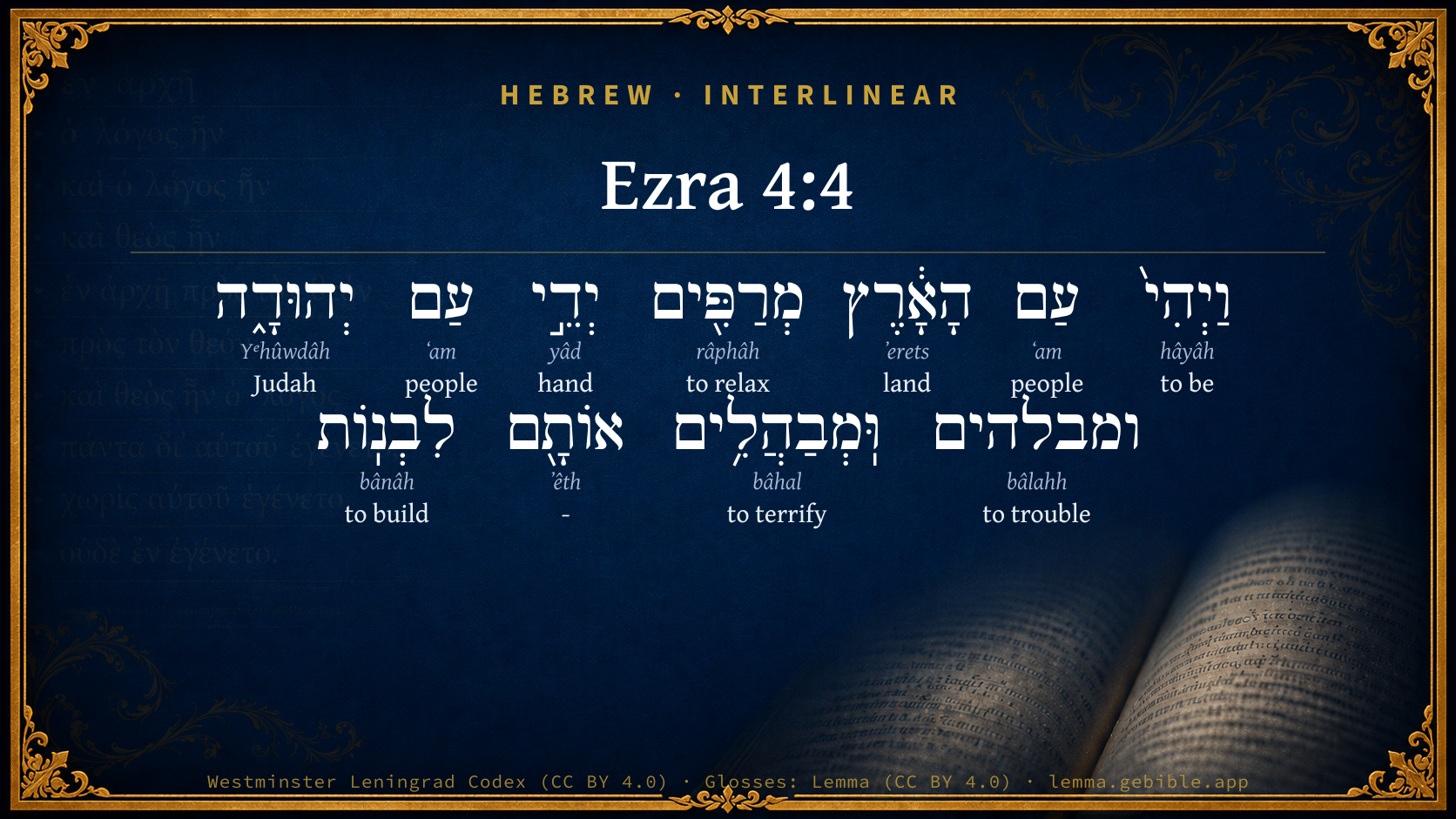
Ezra 4:4

Hebrew (Westminster Leningrad Codex) Ezra 4:4 appears in the Hebrew Old Testament. The text above is from the Westminster Leningrad Codex. Each word links to its Strong’s number, a concise gloss, and parsing drawn from the Open Scriptures Hebrew Bible morphology. Click any word for its full Brown-Driver-Briggs (BDB) entry.
Download image
Cite this verse

Ezra 4:4 (World English Bible). Public Domain. Lemma interlinear Bible study tool, https://lemma.gebible.app/v/ezra/4/4.

Show BibTeX & RIS
BibTeX
RIS
English Translation
Then the people of the land weakened the hands of the people of Judah, and troubled them in building,
World English Bible · Public Domain
Highlights
  • 1 hapax legomenon — only here in the Hebrew Bible
  • 1 first appearance in the Hebrew Bible
Full analysis ↓
Download a study sheet

One document with this verse’s original text, its word-by-word gloss line, the meaning frame, cross-references with their text, attributed commentary, and full source and license credits — printable, and it pastes into notes with its structure intact.

This verse Autodidact and up

Study sheet (.html) Plain text (.txt)

A passage Seminary Student

Up to 50 verses in one chapter. A passage sheet keeps up to 6 commentary sources and 12 cross-references per verse, in the order this page ranks them, and says so on the sheet whenever that leaves anything out. Ask for a single verse and you get the Autodidact verse sheet above.

Everything on this page stays free to read, with no account — the sheet is a download of what is already on screen, not access to it.

Want to remove ads? Support Godless Engineer
Compare translations 3

The same verse in 3 English versions, stacked beneath the original-language interlinear above. Click any original word for its lexicon entry.

Each is an independent rendering of the whole verse — the interlinear is not word-aligned to these translations.

Highlighted words mark where these versions differ — a whole-verse word diff, not a word-by-word alignment.

  • World English Bible Public Domain
    Then the people of the land weakened the hands of the people of Judah, and troubled them in building,
  • King James Version Public Domain
    Then the people of the land weakened the hands of the people of Judah, and troubled them in building,
  • unfoldingWord Literal Text CC BY-SA 4.0
    And it happened that the people of the land were making the hands of the people of Judah weak, and making them afraid to build,

unfoldingWord Literal Text — © unfoldingWord, licensed CC BY-SA 4.0. Word-aligned USFM3 via Door43 (git.door43.org/unfoldingWord/en_ult).

Versions to compare (up to 4)

3 of 4 selected

Show all 18 translations

Every available English version of this verse, each an independent rendering of the whole verse.

  • World English Bible Public Domain
    Then the people of the land weakened the hands of the people of Judah, and troubled them in building,
  • Berean Standard Bible Public Domain
    Then the people of the land set out to discourage the people of Judah and make them afraid to build.
  • Majority Standard Bible Public Domain
    Then the people of the land set out to discourage the people of Judah and make them afraid to build.
  • King James Version Public Domain
    Then the people of the land weakened the hands of the people of Judah, and troubled them in building,
  • American Standard Version (1901) Public Domain
    Then the people of the land weakened the hands of the people of Judah, and troubled them in building,
  • Revised Version (1885) Public Domain
    Then the people of the land weakened the hands of the people of Judah, and troubled them in building,
  • Geneva Bible (1599) Public Domain
    Wherefore the people of the land discouraged the people of Iudah, and troubled them in buylding,
  • Douay-Rheims (1899) Public Domain
    Then the people of the land hindered the hands of the people of Juda, and troubled them in building.
  • Young's Literal Translation Public Domain
    And it cometh to pass, the people of the land are making the hands of the people of Judah feeble, and troubling them in building,
  • Literal Standard Version CC BY-SA 4.0
    And it comes to pass, the people of the land are making the hands of the people of Judah feeble, and troubling them in building,
  • Unlocked Literal Bible CC BY-SA 4.0
    So the people of the land made the Judeans' hands weak; they made the Judeans afraid to build.
  • unfoldingWord Literal Text CC BY-SA 4.0
    And it happened that the people of the land were making the hands of the people of Judah weak, and making them afraid to build,
  • Darby Bible Public Domain
    And the people of the land weakened the hands of the people of Judah, and troubled them in building;
  • World Messianic Bible Public Domain
    Then the people of the land weakened the hands of the people of Judah, and troubled them in building.
  • Webster's Bible Public Domain
    Then the people of the land weakened the hands of the people of Judah, and troubled them in building,
  • Free Bible Version CC BY-SA 4.0
    Then the local people set out to intimidate the people of Judah and make them too scared to go on building.
  • Bible in Basic English Public Domain
    Then the people of the land made the hands of the people of Judah feeble, troubling them with fear in their building;
  • JPS Tanakh (1917) Public Domain
    Then the people of the land weakened the hands of the people of Judah, and harried them while they were building,

Literal Standard Version (2020), Covenant Press — licensed CC BY-SA 4.0. Text via the HelloAO Bible API (eBible.org). Unlocked Literal Bible (unfoldingWord) — licensed CC BY-SA 4.0. Text via the HelloAO Bible API (eBible.org). unfoldingWord Literal Text — © unfoldingWord, licensed CC BY-SA 4.0. Word-aligned USFM3 via Door43 (git.door43.org/unfoldingWord/en_ult). Free Bible Version, Dr. Jonathan Gallagher — licensed CC BY-SA 4.0. Text via the HelloAO Bible API (eBible.org).

Word by word

More ways to search: Search by grammar → Find every occurrence → Compare this word →

Practice this passage: Drill this verse → Learn its vocabulary →

ומבלהים
bâlahh
H1089
“and · troubling”
Conjunction + Verb, Piel, Participle Active, Masculine, Plural, Absolute
Part of Speech
Conjunction + Verb
Stem
Piel
Form
Participle Active
Gender
Masculine
Number
Plural
State
Absolute
Full BDB Definition

Origin: a primitive root [rather by transposition for H926 ]

TWOT: 247

(Piel) to trouble
  1. וַיְהִי֙ hâyâh H1961 “and · to be” Conjunction + Verb, Qal, Sequential Imperfect, 3rd Person, Masculine, Singular
  2. עַם ʻam H5971 “people of” Noun, Common, Masculine, Singular, Construct
  3. הָאָ֔רֶץ ʼerets H776 “the · land” Particle, Definite Article + Noun, Common, Both, Singular, Absolute
  4. מְרַפִּ֖ים râphâh H7503 “relaxing” Verb, Piel, Participle Active, Masculine, Plural, Absolute
  5. יְדֵ֣י yâd H3027 “hands of” Noun, Common, Both, Dual, Construct
  6. עַם ʻam H5971 “people of” Noun, Common, Masculine, Singular, Construct
  7. יְהוּדָ֑ה Yᵉhûwdâh H3063 “Judah” Noun, Proper
  8. וּֽמְבַהֲלִ֥ים bâhal H926 “and · terrifying” Conjunction + Verb, Piel, Participle Active, Masculine, Plural, Absolute
  9. אוֹתָ֖ם ʼêth H853 “- · them” Particle, Direct Object + Suffix, Personal, 3rd Person, Masculine, Plural
  10. לִבְנֽוֹת bânâh H1129 “to build” Preposition + Verb, Qal, Infinitive Construct

About this verse

These counts appear in no published source. They are computed here, from the morphology-tagged text and Lemma’s own curated glosses. What Lemma adds →

11
words
10
distinct lemmas
Historical
section

Notable vocabulary

1 hapax legomenon — a word that appears only here in the entire Hebrew Bible:

  • ומבלהים to trouble H1089

First appearance in Scripture

This word makes its first canonical appearance in the Hebrew Bible here:

  • ומבלהים to trouble H1089

Shared distinctive vocabulary

וּֽמְבַהֲלִ֥ים to terrify H926 occurs in 39 verses of the Hebrew Bible. Also found in:

Grammatical profile

  • 5 verbs
  • 5 nouns
  • 1 particle

Verb forms

  • וַיְהִי֙ Qal · Sequential Imperfect
  • מְרַפִּ֖ים Piel · Participle Active
  • ומבלהים Piel · Participle Active
  • וּֽמְבַהֲלִ֥ים Piel · Participle Active
  • לִבְנֽוֹת Qal · Infinitive Construct

Repetition

A word recurs within this verse — often emphatic in Hebrew:

  • עַם people H5971 ×2

Hebrew & Septuagint length

In English translation the verse runs 19 words from the Hebrew and 19 from the Septuagint (LXX English) — the same length.

A rough comparison of the two English renderings, which tokenize alike — not a word-level alignment.

Word counts can differ between the Hebrew and the Greek without any difference in meaning — e.g. the Hebrew direct-object marker אֵת has no separate Greek word, and Greek often adds the article ὁ.

In the original languages it is 11 Hebrew tokens and 17 Greek tokens — but the two are counted differently (Hebrew bundles its prefixes and suffixes into one token; the Greek is in lemma form), so that isn’t a like-for-like length.

Cross-references

6

Topical passages linked to Ezra 4:4 in the Treasury of Scripture Knowledge — connected by theme and wording, ordered by reader-vote popularity; previews shown in the World English Bible.

  • Ezra 3:3 They set the altar on its base; for fear was on them because of the peoples of the countries: and they offered burnt offerings thereon to Yahweh, even burnt offerings morning and evening.
  • Nehemiah 6:9 For they all would have made us afraid, saying, Their hands shall be weakened from the work, that it not be done. But now, [God], strengthen you my hands.
  • Jeremiah 38:4 Then the princes said to the king, Let this man, we pray you, be put to death; because he weakens the hands of the men of war who remain in this city, and the hands of all the people, in speaking such words to them: for this man doesn't seek the welfare of this people, but the hurt.
  • Nehemiah 4:11 Our adversaries said, They shall not know, neither see, until we come into the midst of them, and kill them, and cause the work to cease.
  • Isaiah 35:3–4 Strengthen you the weak hands, and confirm the feeble knees.
  • Nehemiah 4:7–8 But it happened that when Sanballat, Tobiah, the Arabians, the Ammonites, and the Ashdodites heard that the repairing of the walls of Jerusalem went forward, [and] that the breaches began to be stopped, then they were very angry;

Cross-references courtesy of OpenBible.info (CC BY 4.0).

Hebrew and Greek witnesses Masoretic Hebrew ↔ Greek Septuagint

The same verse in the two great witnesses to the Old Testament, shown verse-for-verse.

These are two independent witnesses, not word-aligned to each other, and the Septuagint is shown in lemma (dictionary) form.

Hebrew Ezra 4:4 Masoretic · Westminster Leningrad Codex

וַיְהִי֙ עַם הָאָ֔רֶץ מְרַפִּ֖ים יְדֵ֣י עַם יְהוּדָ֑ה ומבלהים וּֽמְבַהֲלִ֥ים אוֹתָ֖ם לִבְנֽוֹת

Then the people of the land weakened the hands of the people of Judah, and troubled them in building,

World English Bible · Public Domain

Greek LXX Ezra 4:4 Septuagint · lemma form

καί εἰμί ὁ λαός ὁ γῆ ἐκλύω ὁ χείρ ὁ λαός ἰουδά καί ἐνποδίζω αὐτός ὁ οἰκοδομέω

And the people of the land weakened the hands of the people of Juda, and hindered them in building,

LXX2012 (modern English Septuagint) · Public Domain

In the Septuagint this is one book — Esdras B (2 Esdras): Ezra is chapters 1–10, Nehemiah 11–23.

Hebrew: Westminster Leningrad Codex (CC BY 4.0). Greek: Septuagint (public domain); English from LXX2012 (modern English Septuagint) (Public Domain). How the Septuagint differs from the Hebrew →

Commentary

Notes on Ezra 4:4 from classic Christian and Jewish commentators (each source and its license shown beneath its notes). The classic Christian expositions comment on the surrounding passage and are grouped to its opening verse, so a note may address several verses; the Jewish commentaries on the Tanakh (Rashi and others) are per-verse, so they appear only where the commentator wrote on this verse.

Lemma curates 59 commentaries, every one of them public domain or Creative Commons licensed, each selected and text-cleaned for this edition rather than reprinted as found. About our sources →

Trapp's Complete Commentary

John Trapp

Ezr 4:4 Then the people of the land weakened the hands of the people of Judah, and troubled them in building,

Ver. 4. Then the people of the land] Who the nearer they came unto a conjunction with the Jews in matters of religion the deeper hatred they bare them. Thus at this day, a Jew hates a Christian worse than he doth a Pagan; so doth a Turk hate a Persian worse than he doth a Christian; a Papist, a Protestant worse than he doth a Turk; a formalist, a Puritan worse than he doth a Papist, Odia Theologica sunt acerbissima. Religious hatred is most shep.

Weakened the hands of the people of Judah] Discouraged them all they could, endeavouring to transfuse, as it were, a dead palsy into their fingers, that they might surcease, or, at least, slack their pains. Well might Solomon say, Wrath is cruel, and anger is outrageous: but who can stand before envy? surely the venom of all vices is found in this sharp fanged malignity.

And troubled them in building] Heb. Kept ado about them, and terrified them. This was to do the work of their father, the devil, that troubler of God’s Israel ( ad iniuriam inferendam totus comparatus, ο πονηρος), set upon it to vex such as begin but to build the tower of godliness, and to hinder them to the utmost.

John Trapp, A Commentary or Exposition upon All the Books of the Old and New Testament (1647–1656) — public domain. Text from a community e-Sword module.

The Biblical Illustrator

Joseph S. Exell

Ezr_4:4-24

Then the people of the land weakened the hands of the people of Judah.

The hostility of the Samaritans to the Jews

I. The tactics of the wicked. If they cannot bend the good to their wishes and aims by plausible pretences, they alter their tactics and betake themselves to unscrupulous opposition in various forms.

II. The venality of the wicked. The Samaritans hired counsellors against them, to frustrate their purposes. It is reasonable to infer that these counsellors were men of some skill and resource and power of persuasion who deliberately exercised their abilities in an evil cause for gain.

III. The temporary triumph of the wicked.

IV. The freedom allowed by God to the wicked. (William Jones.)

The antagonism of the world to the Church

This antagonism as here illustrated is--

I. Persistent.

II. Authoritative.

III. Combined.

IV. Unscrupulous.

V. Plausible.

1. In their profession of loyalty to the king.

2. In their presentation of proof of their assertions. (J. Parker, D. D)

.

The Biblical Illustrator, edited by Joseph S. Exell (c. 1880s–1900s) — public domain. Text from a community e-Sword module.

Joseph Benson's Commentary

Ezr 4:4. But the people of the land — Hebrew of that land; namely, the Samaritans, the present inhabitants of that province. Weakened the hands of the people of Judah — As they could not divert them from the work, they endeavoured to discourage them in it, by persuading them it was in vain to attempt it, and that they would never be able to finish what they had begun. And troubled them in building — Laying all the impediments they could in their way; by false reports and slanders; by threatenings; and by preventing materials or provisions from coming to them; or by enticing away their workmen, and other means described afterward.

Joseph Benson's Commentary on the Old and New Testaments (1811–1818) — public domain. Text from a community e-Sword module.

Tyndale Open Study Notes

Tyndale Open Resources

4:4 Realizing that they would have no way to influence an established Jewish community (4:1-3), the foreigners took hostile measures to neutralize the growing political power of the Israelites.

Tyndale Open Study Notes — © Tyndale Open Resources, licensed CC BY-SA 4.0. Text via the HelloAO Bible API.

Geneva Bible (1599)

Geneva Bible translators

Hebrew, made their hands weak.

Geneva Bible (1599) marginal notes — public domain. Text via Bolls.life.

Jamieson, Fausset & Brown

Robert Jamieson, A. R. Fausset & David Brown

Then the people of the land weakened the hands of the people of Judah, &c.--Exasperated by this repulse, the Samaritans endeavored by every means to molest the workmen as well as obstruct the progress of the building; and, though they could not alter the decree which Cyrus had issued regarding it, yet by bribes and clandestine arts indefatigably plied at court, they labored to frustrate the effects of the edict. Their success in those underhand dealings was great; for Cyrus, being frequently absent and much absorbed in his warlike expeditions, left the government in the hands of his son Cambyses, a wicked prince, and extremely hostile to the Jews and their religion. The same arts were assiduously practised during the reign of his successor, Smerdis, down to the time of Darius Hystaspes. In consequence of the difficulties and obstacles thus interposed, for a period of twenty years, the progress of the work was very slow.

Jamieson, Fausset & Brown — Commentary Critical and Explanatory on the Whole Bible (1871) — public domain (CC PDM 1.0). Text via the HelloAO Bible API.

Adam Clarke's Commentary

Verse 4. Weakened the hands] Discouraged and opposed them by every possible means.

Adam Clarke's Commentary on the Bible (1810–1826) — public domain. Text from a community e-Sword/MySword module.

The Cambridge Bible for Schools and Colleges

gen. ed. J. J. S. Perowne

4. Then the people of the land] i.e. the Samaritans, as opposed to ‘the people of Judah’. It is noteworthy that this expression ‘the people of the land’ (’am haâreç) became a synonym for ‘the ignorant’ or ‘the vulgar’ in contrast to ‘the wise’, with special reference to a knowledge of ‘the law’. Cf. Joh_7:49 ‘This people who knoweth not the law are cursed’. Buxtorf gives illustrations by the Jewish proverbs ‘Better is the bastard who is the disciple of the wise than the high-priest of the people of the land’ (i.e. who is ‘vulgar’) ‘The people of the land (i.e. the ‘vulgar’) have degrees of morals but none of intelligence’.

weakened the hands] The Hebrew construction gives the idea of a continuous policy of weakening, terrifying, and bribing. For the phrase itself compare Jer_38:4.

the people of Judah] ‘The children of the captivity’ are here given the name of the old southern kingdom. Cf. Ezr_4:12.

troubled] so R.V.: marg. Or ‘terrified’. There are two readings. The reading of the Hebrew text or K’thib gives a word that does not occur elsewhere in the O.T. but is connected with a substantive rendered ‘terror’ (R.V. Isa_17:14). The reading of the Hebrew tradition or K’ri, preserved with the text, gives an otherwise unused form of a common word meaning ‘to trouble’. In all probability the letters of the unused root were transposed by a scribe so as to give the familiar root; preference should be given to the harder rendering, ‘terrified them from building’.

The Cambridge Bible for Schools and Colleges (gen. ed. J. J. S. Perowne; Cambridge University Press, 1878–1918) — public domain. Text from a community e-Sword module.

John Gill's Exposition

Then the people of the land weakened the hands of the people of Judah, and troubled them in building. By threatening them, or by dissuading the workmen from going on, by endeavouring to hinder their having materials from the Tyrians and Zidonians, or money out of the king's revenues to bear the expenses as ordered; see Ezr 6:4.

.

Ezra 4:5

ezr 4:5

ezr 4:5

ezr 4:5And hired counsellors against them, to frustrate their purpose,.... Either to advise and persuade the king of Persia's officers in those parts not to supply them with money, or to influence the great men at his court to get the edict revoked: and this they did

all the days of Cyrus king of Persia; who, though the hearty friend and patron of the Jews, yet being engaged in wars abroad with the Lydians and Scythians, and leaving his son as viceroy in his absence, who was no friend unto them, the work went on but slowly, attended with interruptions and discouragements:

even until the reign of Darius king of Persia; who was Darius Hystaspis, between whom and Cyrus were Cambyses the son of Cyrus, and Smerdis the impostor, who pretended to be Smerdis, the brother of Cambyses; a space of about fifteen years.

John Gill's Exposition of the Whole Bible (1746–1763) — public domain (CC PDM 1.0). Text via the HelloAO Bible API.

Matthew Poole's English Annotations

The people of the land, Heb. of that land; the present inhabitants of that province, to wit, the Samaritans.

Troubled them in building; by false reports and threats, and other means, described afterwards.

Matthew Poole's English Annotations on the Holy Bible (1683–1685) — public domain. Text from a community e-Sword/MySword module.

Whedon's Commentary on the Bible

Daniel D. Whedon

4. Weakened the hands of the people — By throwing all possible difficulties in their way. We have no mention of the particular measures they took to weaken and trouble the Jews, except what is related in the sequel of their accusation against them before successive Persian kings.

Daniel D. Whedon (gen. ed.), Commentary on the Old and New Testaments (1874–1909) — public domain. Text from a community e-Sword module.

The Pulpit Commentary

Then the people of the land (i.e. the Samaritans) weakened the hands of the people of Judah. As aiding is called "strengthening the hands (infra, Ezr_6:22; Isa_35:3; Jer_23:14; Eze_16:49, etc.) so hindering is expressed by "weakening the hands", (Jer_38:4) though this latter phrase is, comparatively speaking, unusual. And troubled them in building. Probably as Sanballat and his followers troubled the builders of the wall in Nehemiah"s time. (Neh_4:1-12)

Vers. 4, 5.

The work checked.

The incidents related in the previous verses would happen some time after the second month of the second year of King Cyrus, that being about the date of laying the foundation-stone of the restored temple. (see Ezr_3:8, Ezr_3:10) Tidings of these incidents, and of the discouragement and intrigues which they led to, as described in the present passage, would probably reach the Persian court towards the end of that year. In the beginning of the next year so we find from Dan_10:1, etc. the aged prophet Daniel was still alive, but in a state of much sorrow and perplexity, near the river Hiddekel or Tigris. Also we find that his last recorded vision was given to him at that time. The two passages, therefore, seem sufficiently contemporaneous in character to be considered together; and may serve to give us thus a more complete conception of what was then coming to pass. We will first consider the human view, and then the superhuman view, of the scene.

I The HUMAN VIEW of the story. What was being done,

1. In the province. What were men doing now at Jerusalem, or, on that side the Euphrates, in connection with it? Were the Samaritans quiet after their recent rebuff? Were they likely to be, if like other men? The Jews did right, and did wisely, as we have seen, in rejecting their help; but who could expect things to end in that manner? Such a repulse, however justifiable, would be felt as an insult, a moral soufflet. The more justified, in fact, by the circumstances, the more galling it would seem, and the more insulting. The greater the truth, in this sense, the greater the libel (comp. Gen_19:9) We cannot wonder, therefore, that Samaritan feeling now took a different turn. If they cannot help on the terms they had offered, the virtually destructive terms they had offered, they will do the next best (in their view) they will thwart. The Jews are anxious to do all by themselves. Let us take care they do none. Such was their inward resolve. Their outward actions accorded. They contrived, e.g. , to "weaken the hands of the people of Judah." The "hands" of the people, figuratively speaking, may mean those persons on whose manual labour the work of building depended. Just so we often speak now of "factory hands." By weakening their hands, therefore, is not improbably meant causing those who laboured for them to retire from the work: whether those hired carpenters and masons, of whom we have read, on the spot; (Ezr_3:7) or those Tyrian labourers, of whom we have also read, on Mount Lebanon (ibid. ); or those seafaring men who would be necessary to convey to Jerusalem what was cut down at Lebanon. It would not be difficult for the Samaritans, as long-established Gentiles of superior wealth and influence, either by bribes or threats to draw or drive many of such men away from their work; and it would not be easy for the Jews to go on with it in that case. But, besides this, the Samaritans are said to have "troubled them in building." Besides depriving them of labourers, they deprived them, that is, of peace. Besides weakening the "hands," they distracted the heads; most probably by such measures as those we read of, many years afterwards, in the story of Nehemiah. (see Neh_4:2, Neh_4:3, Neh_4:7-9, 16-23 6) But, above all,

2. They seem to have directed their chief endeavours, with true military instinct, against the key of the position before them. To human eyes the chief Jewish reliance was on the assured favour of Cyrus. Hence the edict, and all its consequences. Hence this whole attempt of theirs to rebuild the temple, and their very presence there, on its ancient site. Deprive them of that imperial favour, and you deprive them of all. Moved, apparently, by such considerations, the Samaritans, as we said, delivered their chief assault at the great (human) centre of Jewish hope. They secured those (for they were able to do so) who could speak "against the Jews at the court of the king; they sought out the most fitting men (counsellors) to do this; they secured them by proper fees; they instructed them as to the object wished for; and they urged their point with a spirit of pertinacity which nothing seemed to wear out. What must have been the original vigour of that impetus which survived "all the days" described in ver. 4? And what, on the whole, therefore, the Jewish prospects, humanly speaking, when first it took place? How weak, how distracted the builders! How powerful, how united, how embittered, how skilful, how unsparing, how determined their opponents I The deadly Samaritan friendship had, no doubt, been escaped. But was not this furious Samaritan enmity almost as great a ground for despair? And was not the whole work, in short, if not dead already, at least ready to die?

II The SUPERHUMAN VIEW of the juncture. Just at this time, as we have seen, the prophet Daniel, who, of all the Israelites then alive, would be most concerned and confounded at this condition of things, (comp. Dan_9:16-19) was in great sorrow and deep perplexity. (Dan_10:2, Dan_10:3, Dan_10:12) Just at this time, also, a vision was sent him, having for its object to give him instruction respecting the destiny of his people ( ibid. 14). We believe, therefore, that we have in that vision a superhuman view of that time of trouble a light from heaven itself on that day of disappointment and fear. Here was the work for which he had prayed and laboured all his lifetime, and for which God had done so much, and which he had treated as so important, almost brought to a stand. What did it all mean? This the vision seems to explain. It meant,

1. so much we can see without going into any of the disputed features of this remarkable vision that the matter now perplexing him was one exceedingly deep. It had to do, e.g. , with that glorious Person before whom he fell as one dead (vers. 5-9), and so with that great and all-restoring kingdom which that Holy One was to set up upon earth (Dan_7:13, Dan_7:14; Act_3:21) Being so, it was a matter of great interest to angelic intelligences of all kinds (Mat_8:29; 1Pe_1:12) even leading in consequence (so we understand the passage) to long-continued contentions and struggles among them. (see Dan_10:13, Dan_10:20, Dan_10:21; and comp. Eph_5:11, Eph_5:12; 2Pe_2:11; Rev_12:7)

1. A purpose thus deep would naturally appear sometimes exceedingly deliberate in its rate of progress. Such great contending forces, such wide-embracing operations, such evidently intricate and far-seeing methods, could not do otherwise than take time. Hence the language of Dan_10:1, Dan_10:14, and the repeated reference to the future, and the "end" and the "time of the end," and the blessing pronounced on "waiting" in Dan_12:1, Dan_12:4, Dan_12:6, Dan_12:8, Dan_12:12, Dan_12:13. (comp. also 2Pe_3:9)

2. But if deliberate, it was also sure all the surer, in fact, on that ground. See again; Dan_10:21 about the "Scripture of truth" (a purpose, it would seem, "written" down in order that the exact terms of the purpose and the exact nature of its fulfilment might afterwards be compared) also Dan_11:2; also the solemn oath in Dan_12:7; also, as showing the effect left on Daniel"s mind when he began recording the vision, the opening declaration, "the thing was true," in Dan_10:1. Thus we see how the prophet was lifted up in order that he might see things from above. And thus, as it were, in his company, we are enabled to take a like view. We learn from it

1. How great is our natural ignorance. "There are more things" indeed "in heaven and earth than are dreamt of in our philosophy yes, in our philosophy, with all its talk. More things, by far, are concealed than are revealed, both by our sight and by our search.

2. How false the estimate of our senses. The assaults of earthly enemies, disputes of Jews and Samaritans, the doings of kings and counsellors, the delays of years and centuries, only seem great to us because we see them so close. Viewed from a proper distance, as the mount of prophecy enables us to view them, they almost shrink out of sight only important because of those larger issues of which they form part. At the same time, we also see

1. How great is Gods care for his people. Even in these smaller matters his eye is on them for good. Even in the darkest days he is shaping their path towards the light. The things of earth are not too petty, the things above earth are not too lofty, all together are not too intricate for his omnipotent care. (see Psa_97:11; Rom_8:28) What was said of Gad is true of all Israel (Gen_49:19) They "shall overcome at the last.

2. How great is God"s concern even for the comfort of those who fear him.

How affecting, on this view, at this crisis, is this seasonable vision to the afflicted prophet. How significant, also, that it should have been recorded and preserved to us as a kind of standing illustration to us of God"s ways on this matter. He is not only always caring for his people; he is always wishing them to know that he is. Never more so than when it seems to them, as it probably seemed to Daniel and the Jerusalem Jews in this day of rebuke and blasphemy, that he had "forsaken his people". (see Jud_1:6:13)

HOMILIES BY W. CLARKSON Vers. 4, 5.

Human hatred.

Whatever drops of neighbourly kindness there may have been in the cup of friendship offered by the Samaritans to "the children of the captivity," these, on the refusal of Zerubbabel to enter into alliance with them, turned into bitterest animosity. Thenceforward they "breathed threatening" and made opposition to those whom they had courted. We have illustration or suggestion here of the character and outworkings of human hatred.

I ITS BLINDNESS. Like all cruelty, and indeed like all sin, "it knew not what it did." It thought it was only indulging in a natural and proper resentment; in truth it was lifting up its hand against the people of God, and was doing its best (which was indeed its worst) to undermine and bring to nought the good work of God. Anger is always blind. It does not see its own hideousness; nor does it perceive the end of its doing. Its eye is darkened or discoloured, and its hand is a suicidal, a self-injuring hand.

II ITS DELIBERATENESS. These men deliberately set themselves to undo what their neighbours had begun. No mere outflash of indignation theirs, but deep, steady, well-cherished purpose to be avenged. Nothing was left undone, no stone unturned, that these new-comers might feel the full weight of their wrath. They found means to hinder them in their work, and they got up all the evidence they could collect of past excitements and disturbances in Jerusalem, and "hired counsellors" to represent them at the court of Babylon (ver. 5), that they might frustrate and overthrow the purpose of Israel. There is no more painful-sight in this world, and no more saddening evidence and consequence of sin, than the fact of men cherishing and nursing a rancorous hatred in their hearts against their fellows, and plotting and scheming, month after month, to do them injury, to break their schemes, to disappoint their hopes.

III THE MISCHIEF WHICH IT WORKS (ver. 4). These angry interferers had all too much success. They did weaken the hands of those whom they sought to hinder; "they troubled them in building;" they succeeded in gaining the ear and winning the support of Cyrus, and ultimately they caused the work of building the temple to cease. There is a prevalent belief that persecution defeats its own ends and this is true. We say that "the blood of the martyrs is the seed of the Church and often it is. The fires it lights are often, if not always, purifying, cleansing the gold of its dross, and making the vessels of the Lord more "meet for the Master"s use." Yet, on the other hand, it often works most serious mischief to the Church and the world, from which they painfully and only gradually recover. History shows that human rage against the truth and cause of God has done injury on a large scale, and doubtless it is continually making its evil power felt on a small one: it is "weakening the hands" (ver. 4) of the people of God; it is troubling them in building up his kingdom; it is causing "the work to cease; it is "hindering the gospel." This instance of unrighteous anger, like all other illustrations of it, reminds us of

IV ITS ESSENTIAL UNNATURALNESS. No doubt it seemed natural enough to these Samaritans to indulge in this bitter wrath and to take these vindictive measures. One of the greatest of the Romans, writing only a few years before Christ, declared that "war was the natural relation between neighbouring nations." But how really and essentially unnatural it is for one human heart, made to be the home of love and kindness and compassion, made to be the spring and source of beneficence and generosity, to be harbouring hatreds, to be finding pleasure in another"s pain, to be rejoicing in the humiliation and disappointment of another human heart! What blank contradiction to the will of our Creator! What a wretched departure from his design! How utterly unbeautiful, how infinitely repugnant to his eye! C.

HOMILIES BY J.S. EXELL Vers. 4-16.

The world"s opposition to the Church.

We observe, in reference to the world"s opposition to the Church

I THAT IT OFTEN SEEKS TO HINDER USEFUL ENTERPRISE, These Samaritans sought to "trouble them in building" (ver. 4). As Israel was employed in rebuilding the ruined temple, so the Church is engaged in erecting a great spiritual temple; this noble enterprise is hindered by the varied enmity of the world. The moral building is hindered as well by the pleasures as by the enmity of men: how sinful to hinder the work of God.

II THAT IT COMBINES A VARIED AGENCY.

1. Costly. "And hired counsellors against them" (ver. 5). The world often expends much time and money in its opposition to the work of God; it always has "counsellors" ready to take its unprofitable pay. The Church opposes with the unsearchable riches of Christ.

2. Numerous. The enemies of the Church are legion; but more are for it than all that can be against it.

3. Competent. The men here named were capable of the most effective method of obtaining their end; the enemies of the Church are often socially great and mentally gifted. Learning is sometimes arrayed against the Church. But God hath chosen the weak things of the earth to confound the mighty.

4. Influential. These men have influence with the king, and stay the work of Israel. But a faithful Israel has power with God, and shall prevail. Strange are the intellectual and social elements allied against the Church.

III THAT IT TAKES ADVANTAGE OF POLITICAL CHANGES. "And in the reign of Ahasuerus" (ver. 6). During the former reign the Samaritan enmity did not obtain much favour; but it is more successful with the new king. This opposition is

1. Persistent. Kings may die, but it continues.

2. Vigilant. It is ever on the outlook for new opportunity.

3. Flattering. Thus it seeks to win its way with the new monarch. The Church must remember that Jesus Christ is the same yesterday, to-day, and ever; his purpose standeth sure.

4. An appeal to self-interest. "En-damage the revenue of the kings" (ver. 13).

IV THAT IT MAKES A CUNNING USE OF MISREPRESENTATION. "They will not pay toll" (ver. 13). The worldly opposition represents the Church of God as injurious to the state.

1. Rebellious. "Building the rebellious" (ver. 12). That the Church will obey God rather than the king; true if their laws come into collision; but are not Christians the most law-abiding subjects?

2. Defrauding. "They will not pay toll." But does not the Church render unto God the things that are his, and to Caesar the things that are Caesar"s?

3. Hypocritical. They build not the walls of Jerusalem for God, but to shut out the king.

4. Wicked. They designate Jerusalem a "bad city." Thus the world maligns the Church; it spoke evil of Christ; it will undervalue his followers.

V THAT IT MAKES THE PRETENCE OF A DISINTERESTED MOTIVE. "It was not meet for us to see the king"s dishonour" (ver. 14). The world will not allow that its opposition is angry or jealous. The most wicked plans seek the aid of righteous pleas. This opposition appears

1. Disinterested. It does not seek its own, but the king"s welfare.

2. Loyal. They had "the king"s maintenance," and therefore inform the king of his peril.

3. Open. They will tell the king plainly of the matter, and he can decide. Thus would the world conceal its hatred to the Church.

VI THAT IT PUTS A FALSE INTERPRETATION UPON NATIONAL HISTORY. "That search may be made in the book of the records of thy fathers" (ver. 15).

1. The historical record. The history of the Church is blended with the history of the world; the Divine and human records move together.

2. The historical argument.

3. The historical perversion. History, rightly interpreted, is on the side of the Church.

4. The historical vindication. We justify Israel now and condemn the Samaritans; time will surely vindicate the Church. E.

The Pulpit Commentary (1880–1919), ed. H.D.M. Spence-Jones & Joseph S. Exell — public domain. Text from a community e-Sword module.

Keil & Delitzsch

C. F. Keil & F. Delitzsch

In consequence of this refusal, the adversaries of Judah sought to weaken the hands of the people, and to deter them from building. הארץ עם, the people of the land, i.e., the inhabitants of the country, the colonists dwelling in the land, the same who in Ezr 4:1 are called the adversaries of Judah and Benjamin. ויהי followed by the participle expresses the continuance of the inimical attempts. To weaken the hands of any one, means to deprive him of strength and courage for action; comp. Jer 38:4. יהוּדה עם are the inhabitants of the realm of Judah, who, including the Benjamites, had returned from captivity, Judah being now used to designate the whole territory of the new community, as before the captivity the entire southern kingdom; comp. Ezr 4:6. Instead of the Chethiv מבלּהים, the Keri offer מבהלים, from בהל, Piel, to terrify, to alarm, Ch2 32:18; Job 21:6, because the verb בלה nowhere else occurs; but the noun בּלּהה, fear, being not uncommon, and presupposing the existence of a verb בּלהּ, the correctness of the Chethiv cannot be impugned.

Keil & Delitzsch — Biblical Commentary on the Old Testament (1861–1891) — public domain (CC PDM 1.0). Text via the HelloAO Bible API. (Old Testament only.)

unfoldingWord translationNotes

Door43 World Missions Community

the people of the land

"the people who were living in the land at that time," which could include non-Jews and Jews whose families the Babylonians had not taken into exile

made the Judeans' hands weak

This speaks of the people of the land discouraging the Judeans as if they made their hands physically weak. AT: "discouraged the Judeans" (See: Metaphor)

Judeans

people who returned from Babylon and settled in the land of Judah

to frustrate their plans

"to make it so the Judeans could not build the temple as they had planned"

wrote an accusation against the inhabitants of Judah and Jerusalem

The abstract nouns "accusation" can be translated as a verb "accuse." You may need to make explicit what the enemies accused the Judeans of doing. AT: "wrote a letter in which they accused those who lived in Judah and Jerusalem of disobeying the king" (See: Abstract Nouns and Assumed Knowledge and Implicit Information)

translationWords

people group

advice

Cyrus

Darius

king

Ahasuerus

Judah

Jerusalem

unfoldingWord translationNotes — © Distant Shores Media and the Door43 World Missions Community, licensed CC BY-SA 4.0. Source: git.door43.org/Door43/en_tn.

Rashi

Rabbi Shlomo Yitzchaki (Rashi)

the people of the land They are the adversaries of Judah and Benjamin.

were hindering to disrupt them from their work.

from building Heb. לִבְנוֹת, lit. to build, and so (Gen. 41:49): “until one ceased to count (לִסְפֹּר).”

Rashi on the Tanakh — English translations: “The Judaica Press complete Tanach with Rashi, translated by A. J. Rosenberg” (CC BY 4.0); “Pentateuch with Rashi's commentary by M. Rosenbaum and A.M. Silbermann, 1929-1934” (public domain); “The Metsudah Tanach series, Lakewood, N.J” (CC BY 4.0); and “The Book of Joshua, Metsudah Publications, 1997” (CC BY 4.0). Text via Sefaria.

Lesson kit

Teaching starters — assembled from the data on this page, not authored interpretation. Every prompt links to the verse data it draws on. Edit before teaching.

Ezra, in the Historical, opens this verse with 11 words (10 distinct Hebrew lemmas). Its most distinctive word is bâlahh (“to trouble”). A historical commentator’s framing appears above. Read the whole chapter for the surrounding context.

Discussion questions

  1. How does “to trouble” (bâlahh) shape what this verse is saying?
  2. This verse holds 1 word here found nowhere else in the Hebrew Bible. What might the rare word draw attention to?
  3. The word “to trouble” first appears here in Scripture. What is being introduced at this debut?
  4. Genesis 45:3 shares the word «to terrify» with this verse. How do the two illuminate each other?
  5. “people” occurs 2× in this one verse. What is the effect of the repetition?
  6. These translations render this verse differently. What is at stake in choosing one wording over another?
  7. The verb «וַיְהִי֙» is Qal Sequential Imperfect. How does its form color the action?
  8. Reading how Trapp's Complete Commentary and The Biblical Illustrator read this verse, where do the two commentators agree and where do they part?

Things to notice

  • 1 word in this verse appears nowhere else in the Hebrew Bible.
  • 1 word makes its first canonical appearance in Scripture here.
  • This verse counts 11 Hebrew ↔ 17 Greek words.
  • These translations choose different wording for 8 words in this verse.
  • “people” occurs 2× in this single verse.

Reading settings

Reading text

Shown beneath each verse's original-language words.

Old Testament
Old Testament edition

Read the OT as the Masoretic Hebrew (MT) or the Greek Septuagint (LXX).

English shown for the Greek Septuagint (in the Hebrew ↔ Greek comparison).

Comparing translations? Open the Compare panel on any verse page to stack up to four side by side.