
2 Chronicles 11:2

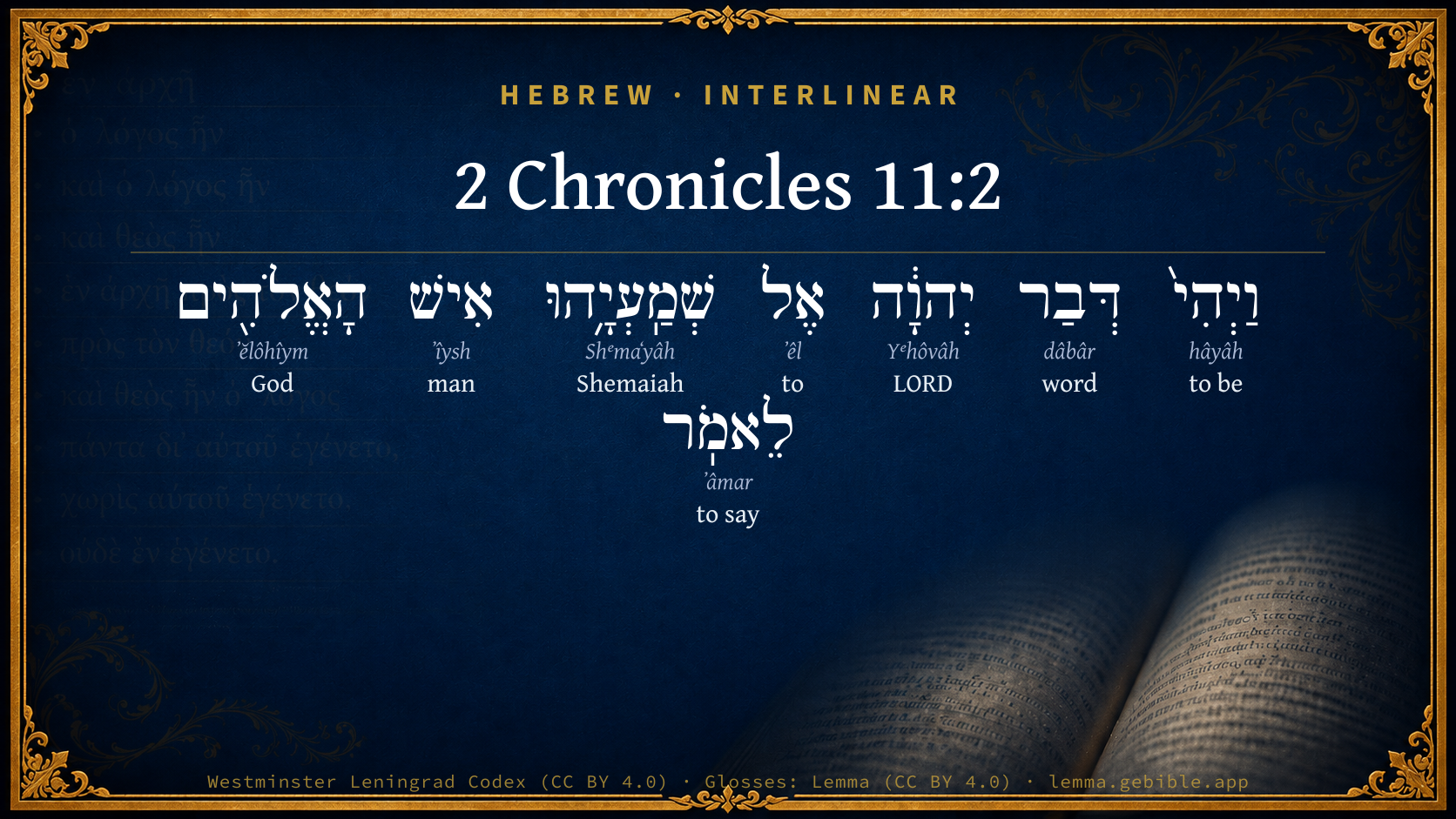
Hebrew (Westminster Leningrad Codex) 2 Chronicles 11:2 appears in the Hebrew Old Testament. The text above is from the Westminster Leningrad Codex. Each word links to its Strong’s number, a concise gloss, and parsing drawn from the Open Scriptures Hebrew Bible morphology. Click any word for its full Brown-Driver-Briggs (BDB) entry.
Download image
Cite this verse

2 Chronicles 11:2 (World English Bible). Public Domain. Lemma interlinear Bible study tool, https://lemma.gebible.app/v/2-chronicles/11/2.

Show BibTeX & RIS
BibTeX
RIS
English Translation
But the word of Yahweh came to Shemaiah the man of God, saying,
World English Bible · Public Domain
Download a study sheet

One document with this verse’s original text, its word-by-word gloss line, the meaning frame, cross-references with their text, attributed commentary, and full source and license credits — printable, and it pastes into notes with its structure intact.

This verse Autodidact and up

Study sheet (.html) Plain text (.txt)

A passage Seminary Student

Up to 50 verses in one chapter. A passage sheet keeps up to 6 commentary sources and 12 cross-references per verse, in the order this page ranks them, and says so on the sheet whenever that leaves anything out. Ask for a single verse and you get the Autodidact verse sheet above.

Everything on this page stays free to read, with no account — the sheet is a download of what is already on screen, not access to it.

Want to remove ads? Support Godless Engineer
Compare translations 3

The same verse in 3 English versions, stacked beneath the original-language interlinear above. Click any original word for its lexicon entry.

Each is an independent rendering of the whole verse — the interlinear is not word-aligned to these translations.

Highlighted words mark where these versions differ — a whole-verse word diff, not a word-by-word alignment.

  • World English Bible Public Domain
    But the word of Yahweh came to Shemaiah the man of God, saying,
  • King James Version Public Domain
    But the word of the LORD came to Shemaiah the man of God, saying,
  • unfoldingWord Literal Text CC BY-SA 4.0
    But the word of Yahweh was to Shemaiah the man of God, saying,

unfoldingWord Literal Text — © unfoldingWord, licensed CC BY-SA 4.0. Word-aligned USFM3 via Door43 (git.door43.org/unfoldingWord/en_ult).

Versions to compare (up to 4)

3 of 4 selected

Show all 18 translations

Every available English version of this verse, each an independent rendering of the whole verse.

  • World English Bible Public Domain
    But the word of Yahweh came to Shemaiah the man of God, saying,
  • Berean Standard Bible Public Domain
    But the word of the LORD came to Shemaiah the man of God:
  • Majority Standard Bible Public Domain
    But the word of the LORD came to Shemaiah the man of God:
  • King James Version Public Domain
    But the word of the LORD came to Shemaiah the man of God, saying,
  • American Standard Version (1901) Public Domain
    But the word of Jehovah came to Shemaiah the man of God, saying,
  • Revised Version (1885) Public Domain
    But the word of the LORD came to Shemaiah the man of God, saying,
  • Geneva Bible (1599) Public Domain
    But the worde of the Lord came to Shemaiah the man of God, saying,
  • Douay-Rheims (1899) Public Domain
    And the word of the Lord came to Semeias the man of God, saying:
  • Young's Literal Translation Public Domain
    And a word of Jehovah is unto Shemaiah, a man of God, saying,
  • Literal Standard Version CC BY-SA 4.0
    And a word of YHWH is to Shemaiah, a man of God, saying,
  • Unlocked Literal Bible CC BY-SA 4.0
    But the word of Yahweh came to Shemaiah the man of God, saying,
  • unfoldingWord Literal Text CC BY-SA 4.0
    But the word of Yahweh was to Shemaiah the man of God, saying,
  • Darby Bible Public Domain
    But the word of Jehovah came to Shemaiah the man of God, saying,
  • World Messianic Bible Public Domain
    But the LORD’s word came to Shemaiah the man of God, saying,
  • Webster's Bible Public Domain
    But the word of the LORD came to Shemaiah the man of God, saying,
  • Free Bible Version CC BY-SA 4.0
    But a message from the Lord came to Shemaiah the man of God that said,
  • Bible in Basic English Public Domain
    But the word of the Lord came to Shemaiah, the man of God, saying,
  • JPS Tanakh (1917) Public Domain
    But the word of the LORD came to Shemaiah the man of God, saying:

Literal Standard Version (2020), Covenant Press — licensed CC BY-SA 4.0. Text via the HelloAO Bible API (eBible.org). Unlocked Literal Bible (unfoldingWord) — licensed CC BY-SA 4.0. Text via the HelloAO Bible API (eBible.org). unfoldingWord Literal Text — © unfoldingWord, licensed CC BY-SA 4.0. Word-aligned USFM3 via Door43 (git.door43.org/unfoldingWord/en_ult). Free Bible Version, Dr. Jonathan Gallagher — licensed CC BY-SA 4.0. Text via the HelloAO Bible API (eBible.org).

Word by word

More ways to search: Search by grammar → Find every occurrence → Compare this word →

Practice this passage: Drill this verse → Learn its vocabulary →

שְׁמַֽעְיָ֥הוּ
Shᵉmaʻyâh
H8098
“Shemaiah”
Noun, Proper
Part of Speech
Noun
Type
Proper
Full BDB Definition

Origin: from H8085 and H3050

TWOT: None

Shemaiah = "heard by Jehovah" - a prophet of the Lord in the reign of king Rehoboam of Judah - the Nehelamite, a false prophet in the time of the prophet Jeremiah - father of Delaiah, one of the princes of Judah in the time of the prophet Jeremiah - an inhabitant of Kirjathjearim and father of Urijah, a prophet of the Lord in the time of the prophet Jeremiah - a Judaite, son of Shechaniah, father of Hattush, and descendant of Zerubbabel - a Simeonite, father of Shimri - a Reubenite, son of Joel and father of Gog - a Merarite Levite, son of Hasshub in the time of Nehemiah - a Levite, son of Galal and father of Obadiah - a Levite and head of the family of the sons of Elizaphan who were commissioned to bring the ark to Jerusalem in the time of David - a Levite and scribe, son of Nethaneel in the time of David - a Levite, 1st son of Obed-Edom in the time of David - a Levite, descendant of Jeduthun the singer in the time of king Hezekiah of Judah - a Levite, one of the messengers of Ezra to Iddo - a Levite in the time of king Jehoshaphat of Judah - a Levite, one of several in charge of distributing the free will offerings brought to God to their Levite brethren in the time of king Hezekiah of Judah - a Levite in the time of king Josiah of Judah - head of a family of exiles who returned with Ezra - a priest, of the sons of Harim who had a foreign wife in the time of Ezra - an Israelite of the sons of Harim who had a foreign wife in the time of Ezra - son of Delaiah, grandson of Mehetabeel, and a false prophet hired by Tobiah and Sanballat to give false guidance to Nehemiah - a priest who sealed the covenant with Nehemiah and participated in the dedication of the wall - a priest who returned from exile with Zerubbabel - a leader of the people at the dedication of the wall of Jerusalem in the time of Nehemiah - grandfather of the priest Zechariah who participated in the dedication of the wall in the time of Nehemiah - another of the priests who along with 25 took part in the dedication of the wall in the time of Nehemiah
  1. וַיְהִי֙ hâyâh H1961 “and · to be” Conjunction + Verb, Qal, Sequential Imperfect, 3rd Person, Masculine, Singular
  2. דְּבַר dâbâr H1697 “word of” Noun, Common, Masculine, Singular, Construct
  3. יְהוָ֔ה Yᵉhôvâh H3068 “LORD” Noun, Proper
  4. אֶל ʼêl H413 “to” Preposition
  5. אִישׁ ʼîysh H376 “man of” Noun, Common, Masculine, Singular, Construct
  6. הָאֱלֹהִ֖ים ʼĕlôhîym H430 “the · God(s)” Particle, Definite Article + Noun, Common, Masculine, Plural, Absolute
  7. לֵאמֹֽר ʼâmar H559 “to say” Preposition + Verb, Qal, Infinitive Construct

About this verse

These counts appear in no published source. They are computed here, from the morphology-tagged text and Lemma’s own curated glosses. What Lemma adds →

8
words
8
distinct lemmas
Historical
section

Shared distinctive vocabulary

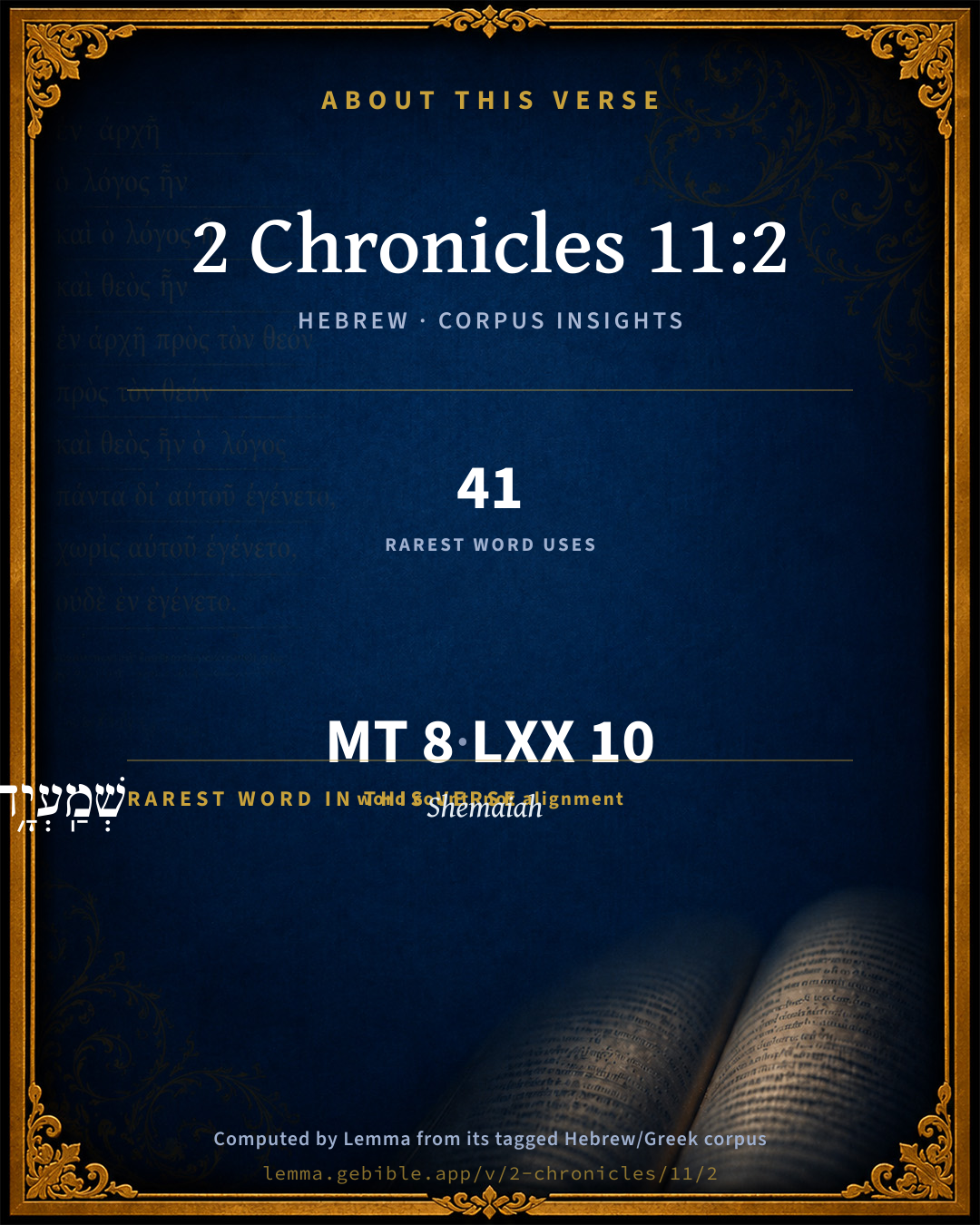
שְׁמַֽעְיָ֥הוּ Shemaiah H8098 occurs in 39 verses of the Hebrew Bible. Also found in:

Grammatical profile

  • 2 verbs
  • 5 nouns
  • 1 preposition

Verb forms

  • וַיְהִי֙ Qal · Sequential Imperfect
  • לֵאמֹֽר Qal · Infinitive Construct

Hebrew & Septuagint length

In English translation the verse runs 13 words from the Hebrew and 14 from the Septuagint (LXX English) — closely comparable.

A rough comparison of the two English renderings, which tokenize alike — not a word-level alignment.

Word counts can differ between the Hebrew and the Greek without any difference in meaning — e.g. the Hebrew direct-object marker אֵת has no separate Greek word, and Greek often adds the article ὁ.

In the original languages it is 8 Hebrew tokens and 10 Greek tokens — but the two are counted differently (Hebrew bundles its prefixes and suffixes into one token; the Greek is in lemma form), so that isn’t a like-for-like length.

Cross-references

7

Topical passages linked to 2 Chronicles 11:2 in the Treasury of Scripture Knowledge — connected by theme and wording, ordered by reader-vote popularity; previews shown in the World English Bible.

  • 2 Chronicles 12:15 Now the acts of Rehoboam, first and last, aren't they written in the histories of Shemaiah the prophet and of Iddo the seer, after the manner of genealogies? There were wars between Rehoboam and Jeroboam continually.
  • Deuteronomy 33:1 This is the blessing, with which Moses the man of God blessed the children of Israel before his death.
  • 1 Samuel 2:27 There came a man of God to Eli, and said to him, Thus says Yahweh, Did I reveal myself to the house of your father, when they were in Egypt [in bondage] to Pharaoh's house?
  • 1 Kings 12:22–24 But the word of God came to Shemaiah the man of God, saying,
  • 2 Chronicles 8:14 He appointed, according to the ordinance of David his father, the divisions of the priests to their service, and the Levites to their offices, to praise, and to minister before the priests, as the duty of every day required; the doorkeepers also by their divisions at every gate: for so had David the man of God commanded.
  • 2 Chronicles 12:5–7 Now Shemaiah the prophet came to Rehoboam, and to the princes of Judah, who were gathered together to Jerusalem because of Shishak, and said to them, Thus says Yahweh, You have forsaken me, therefore have I also left you in the hand of Shishak.
  • 1 Timothy 6:11 But you, man of God, flee these things, and follow after righteousness, godliness, faith, love, patience, and gentleness.

Cross-references courtesy of OpenBible.info (CC BY 4.0).

Hebrew and Greek witnesses Masoretic Hebrew ↔ Greek Septuagint

The same verse in the two great witnesses to the Old Testament, shown verse-for-verse.

These are two independent witnesses, not word-aligned to each other, and the Septuagint is shown in lemma (dictionary) form.

Hebrew 2 Chronicles 11:2 Masoretic · Westminster Leningrad Codex

וַיְהִי֙ דְּבַר יְהוָ֔ה אֶל שְׁמַֽעְיָ֥הוּ אִישׁ הָאֱלֹהִ֖ים לֵאמֹֽר

But the word of Yahweh came to Shemaiah the man of God, saying,

World English Bible · Public Domain

Greek LXX 2 Chronicles 11:2 Septuagint · lemma form

καί γίγνομαι λόγος κύριος πρός σαμαιας ἄνθρωπος ὁ θεός λέγω

And the Word of the Lord came to Samaias the man of God, saying,

LXX2012 (modern English Septuagint) · Public Domain

Hebrew: Westminster Leningrad Codex (CC BY 4.0). Greek: Septuagint (public domain); English from LXX2012 (modern English Septuagint) (Public Domain). How the Septuagint differs from the Hebrew →

Commentary

Notes on 2 Chronicles 11:2 from classic Christian and Jewish commentators (each source and its license shown beneath its notes). The classic Christian expositions comment on the surrounding passage and are grouped to its opening verse, so a note may address several verses; the Jewish commentaries on the Tanakh (Rashi and others) are per-verse, so they appear only where the commentator wrote on this verse.

Lemma curates 59 commentaries, every one of them public domain or Creative Commons licensed, each selected and text-cleaned for this edition rather than reprinted as found. About our sources →

Ellicott's Commentary for English Readers

(2) The Lord.—Kings has “God” twice. The chronicler does not always avoid the name Jehovah.

Shemaiah.—So Kings. The chronicler writes the longer form, Shemayâhu; and so Ahiyâhu in 2Ch_10:15.

A Bible Commentary for English Readers, edited by Charles John Ellicott (1878–1897) — public domain. Text from a community e-Sword module.

The Cambridge Bible for Schools and Colleges

gen. ed. J. J. S. Perowne

2. Shemaiah] See 2Ch_12:5; 2Ch_12:15.

The Cambridge Bible for Schools and Colleges (gen. ed. J. J. S. Perowne; Cambridge University Press, 1878–1918) — public domain. Text from a community e-Sword module.

The Pulpit Commentary

Shemaiah the man of God. This is the first historical mention (1Ki_12:22) of Shemaiah. The second is found in 2Ch_12:5, 2Ch_12:7, on occasion of the invasion of Judah and Jerusalem by Shishak King of Egypt; anti the third, in the same chapter, ver. 15, that he wrote a book respecting the acts of Rehoboam. The expression, "man of God," owns to a somewhat unexplained history. It is first found in the added part of Deuteronomy, (Deu_33:1) where it is applied to Moses. It occurs once in Joshua; (Jos_14:6) twice in Judges; (Jud_1:13:6, 8) four times in Samuel; (1Sa_2:27 1Sa_9:6-8) twenty-nine times in Kings; six times in Chronicles; once each in Ezra, Nehemiah and Jeremiah.

The Pulpit Commentary (1880–1919), ed. H.D.M. Spence-Jones & Joseph S. Exell — public domain. Text from a community e-Sword module.

unfoldingWord translationNotes

Door43 World Missions Community

the word of Yahweh came ... saying

This is an idiom that is used to introduce something that God told his prophets or his people. AT: "Yahweh spoke this message ... and he said" or "Yahweh spoke these words ... and he said" (See: Idiom)

Shemaiah

This is the name of a man. (See: How to Translate Names)

the man of God

The expression "man of God" is a respectful way of referring to a prophet of Yahweh. AT: "the man who belongs to God" or "the prophet of God"

all Israel in Judah and Benjamin

Here the word "Israel" refers to the Israelite people who live in the tribes of Judah and Benjamin. AT: "all of the Israelites in the tribes of Judah and Benjamin" (See: Metonymy)

your brothers

This is a reference to the ten northern tribes. By calling them "brothers," Yahweh emphasizes the family relationship between all of the tribes.

translationWords

word of God

God

Solomon

brother

Jeroboam

unfoldingWord translationNotes — © Distant Shores Media and the Door43 World Missions Community, licensed CC BY-SA 4.0. Source: git.door43.org/Door43/en_tn.

Lesson kit

Teaching starters — assembled from the data on this page, not authored interpretation. Every prompt links to the verse data it draws on. Edit before teaching.

2 Chronicles, in the Historical, opens this verse with 8 words (8 distinct Hebrew lemmas). Its most distinctive word is Shᵉmaʻyâh (“Shemaiah”). A historical commentator’s framing appears above. Read the whole chapter for the surrounding context.

Discussion questions

  1. The word Shᵉmaʻyâh carries the sense “Shemaiah.” How does it shape the verse?
  2. 1 Kings 12:22 shares the word «Shemaiah» with this verse. How do the two illuminate each other?
  3. These translations render this verse differently. What is at stake in choosing one wording over another?
  4. The verb «וַיְהִי֙» is Qal Sequential Imperfect. How does its form color the action?
  5. Reading how Ellicott's Commentary for English Readers and The Cambridge Bible for Schools and Colleges read this verse, where do the two commentators agree and where do they part?

Things to notice

Reading settings

Reading text

Shown beneath each verse's original-language words.

Old Testament
Old Testament edition

Read the OT as the Masoretic Hebrew (MT) or the Greek Septuagint (LXX).

English shown for the Greek Septuagint (in the Hebrew ↔ Greek comparison).

Comparing translations? Open the Compare panel on any verse page to stack up to four side by side.