
Exodus 12:48

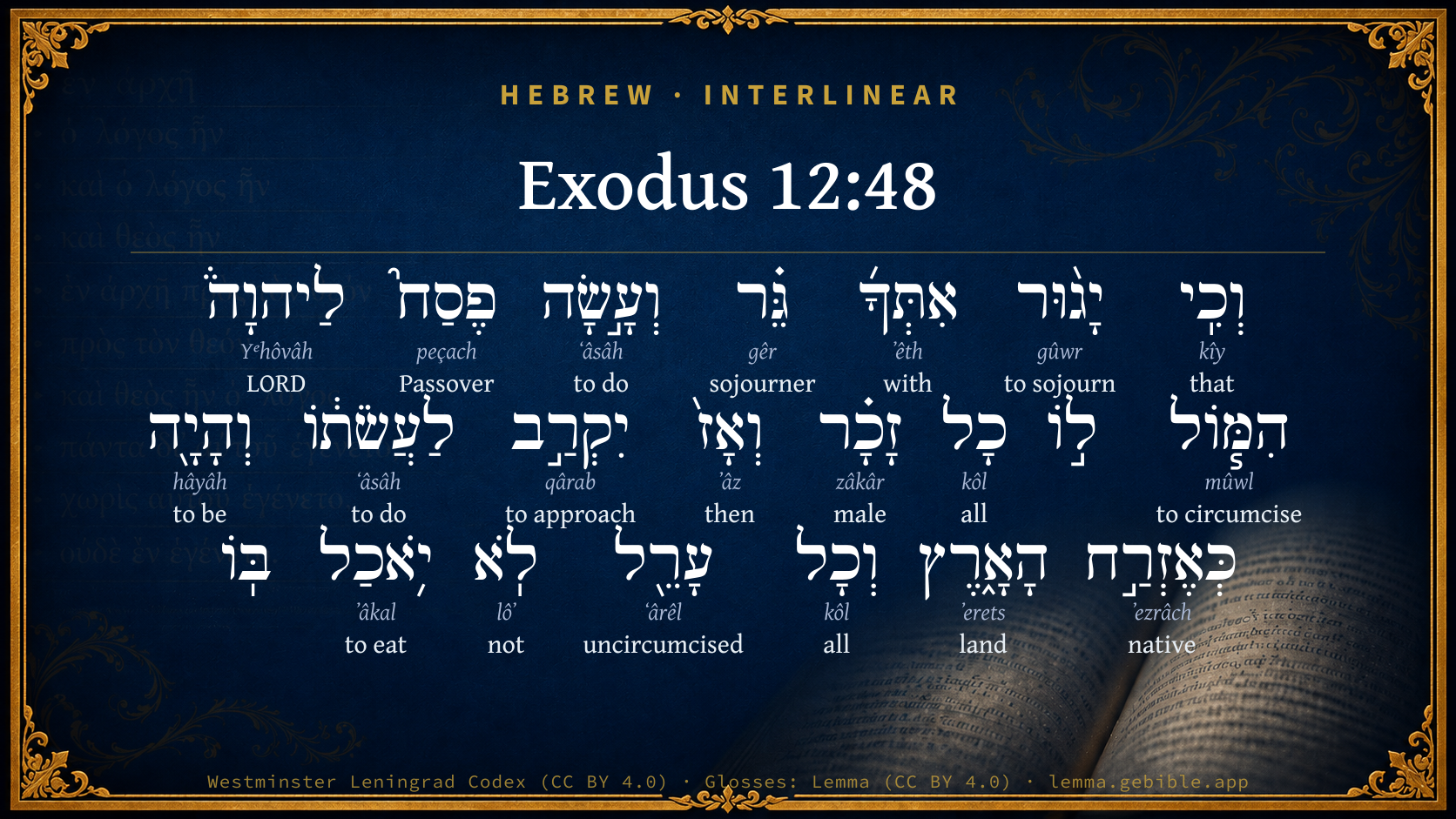
Hebrew (Westminster Leningrad Codex) Exodus 12:48 appears in the Hebrew Old Testament. The text above is from the Westminster Leningrad Codex. Each word links to its Strong’s number, a concise gloss, and parsing drawn from the Open Scriptures Hebrew Bible morphology. Click any word for its full Brown-Driver-Briggs (BDB) entry.
Download image
Cite this verse

Exodus 12:48 (World English Bible). Public Domain. Lemma interlinear Bible study tool, https://lemma.gebible.app/v/exodus/12/48.

Show BibTeX & RIS
BibTeX
RIS
English Translation
When a stranger shall live as a foreigner with you, and will keep the Passover to Yahweh, let all his males be circumcised, and then let him come near and keep it; and he shall be as one who is born in the land: but no uncircumcised person shall eat of it.
World English Bible · Public Domain
Download a study sheet

One document with this verse’s original text, its word-by-word gloss line, the meaning frame, cross-references with their text, attributed commentary, and full source and license credits — printable, and it pastes into notes with its structure intact.

This verse Autodidact and up

Study sheet (.html) Plain text (.txt)

A passage Seminary Student

Up to 50 verses in one chapter. A passage sheet keeps up to 6 commentary sources and 12 cross-references per verse, in the order this page ranks them, and says so on the sheet whenever that leaves anything out. Ask for a single verse and you get the Autodidact verse sheet above.

Everything on this page stays free to read, with no account — the sheet is a download of what is already on screen, not access to it.

Want to remove ads? Support Godless Engineer
Compare translations 3

The same verse in 3 English versions, stacked beneath the original-language interlinear above. Click any original word for its lexicon entry.

Each is an independent rendering of the whole verse — the interlinear is not word-aligned to these translations.

Highlighted words mark where these versions differ — a whole-verse word diff, not a word-by-word alignment.

  • World English Bible Public Domain
    When a stranger shall live as a foreigner with you, and will keep the Passover to Yahweh, let all his males be circumcised, and then let him come near and keep it; and he shall be as one who is born in the land: but no uncircumcised person shall eat of it.
  • King James Version Public Domain
    And when a stranger shall sojourn with thee, and will keep the passover to the LORD, let all his males be circumcised, and then let him come near and keep it; and he shall be as one that is born in the land: for no uncircumcised person shall eat thereof.
  • unfoldingWord Literal Text CC BY-SA 4.0
    And if a sojourner is sojourning with you, and keeps the Passover to Yahweh, all his males shall be circumcised. And then he may draw near to keep it, and he will become like a native of the land. And any uncircumcised person shall not eat it.

unfoldingWord Literal Text — © unfoldingWord, licensed CC BY-SA 4.0. Word-aligned USFM3 via Door43 (git.door43.org/unfoldingWord/en_ult).

Versions to compare (up to 4)

3 of 4 selected

Show all 18 translations

Every available English version of this verse, each an independent rendering of the whole verse.

  • World English Bible Public Domain
    When a stranger shall live as a foreigner with you, and will keep the Passover to Yahweh, let all his males be circumcised, and then let him come near and keep it; and he shall be as one who is born in the land: but no uncircumcised person shall eat of it.
  • Berean Standard Bible Public Domain
    If a foreigner resides with you and wants to celebrate the LORD’s Passover, all the males in the household must be circumcised; then he may come near to celebrate it, and he shall be like a native of the land. But no uncircumcised man may eat of it.
  • Majority Standard Bible Public Domain
    If a foreigner resides with you and wants to celebrate the LORD’s Passover, all the males in the household must be circumcised; then he may come near to celebrate it, and he shall be like a native of the land. But no uncircumcised man may eat of it.
  • King James Version Public Domain
    And when a stranger shall sojourn with thee, and will keep the passover to the LORD, let all his males be circumcised, and then let him come near and keep it; and he shall be as one that is born in the land: for no uncircumcised person shall eat thereof.
  • American Standard Version (1901) Public Domain
    And when a stranger shall sojourn with thee, and will keep the passover to Jehovah, let all his males be circumcised, and then let him come near and keep it; and he shall be as one that is born in the land: but no uncircumcised person shall eat thereof.
  • Revised Version (1885) Public Domain
    And when a stranger shall sojourn with thee, and will keep the passover to the LORD, let all his males be circumcised, and then let him come near and keep it; and he shall be as one that is born in the land: but no uncircumcised person shall eat thereof.
  • Geneva Bible (1599) Public Domain
    But if a stranger dwell with thee, and will obserue the Passeouer of the Lord, let him circumcise all the males, that belong vnto him, and then let him come and obserue it, and he shall be as one that is borne in the land: for none vncircumcised person shall eate thereof.
  • Douay-Rheims (1899) Public Domain
    And if any stranger be willing to dwell among you, and to keep the Phase of the Lord, all his males shall first be circumcised, and then shall he celebrate it according to the manner: and he shall be as he that is born in the land: but if any man be uncircumcised, he shall not eat thereof.
  • Young's Literal Translation Public Domain
    `And when a sojourner sojourneth with thee, and hath made a passover to Jehovah, every male of his `is' to be circumcised, and then he doth come near to keep it, and he hath been as a native of the land, but any uncircumcised one doth not eat of it;
  • Literal Standard Version CC BY-SA 4.0
    And when a sojourner sojourns with you, and has made a Passover to YHWH, every male of his [is] to be circumcised, and then he comes near to keep it, and he has been as a native of the land, but any uncircumcised one does not eat of it;
  • Unlocked Literal Bible CC BY-SA 4.0
    If a foreigner lives with you and wants to observe the Passover to Yahweh, all his male relatives must be circumcised. Then he may come and observe it. He will become like the people who were born in the land. However, no uncircumcised person may eat any of the food.
  • unfoldingWord Literal Text CC BY-SA 4.0
    And if a sojourner is sojourning with you, and keeps the Passover to Yahweh, all his males shall be circumcised. And then he may draw near to keep it, and he will become like a native of the land. And any uncircumcised person shall not eat it.
  • Darby Bible Public Domain
    And when a sojourner sojourneth with thee, and would hold the passover to Jehovah, let all his males be circumcised, and then let him come near and hold it; and he shall be as one that is born in the land; but no uncircumcised person shall eat thereof.
  • World Messianic Bible Public Domain
    When a stranger lives as a foreigner with you, and would like to keep the Passover to the LORD, let all his males be circumcised, and then let him come near and keep it. He shall be as one who is born in the land; but no uncircumcised person shall eat of it.
  • Webster's Bible Public Domain
    And when a stranger shall sojourn with thee, and will keep the passover to the LORD, let all his males be circumcised, and then let him come near and keep it; and he shall be as one that is born in the land: for no uncircumcised person shall eat of it.
  • Free Bible Version CC BY-SA 4.0
    If there's a foreigner who lives with you and wants to celebrate the Lord's Passover, all the males in their household have to be circumcised. Then he may come and celebrate it, and he shall be treated like a native of the land. But no man who is not circumcised may eat it.
  • Bible in Basic English Public Domain
    And if a man from another country is living with you, and has a desire to keep the Passover to the Lord, let all the males of his family undergo circumcision, and then let him come near and keep it; for he will then be as one of your people; but no one without circumcision may keep it.
  • JPS Tanakh (1917) Public Domain
    And when a stranger shall sojourn with thee, and will keep the passover to the LORD, let all his males be circumcised, and then let him come near and keep it; and he shall be as one that is born in the land; but no uncircumcised person shall eat thereof.

Literal Standard Version (2020), Covenant Press — licensed CC BY-SA 4.0. Text via the HelloAO Bible API (eBible.org). Unlocked Literal Bible (unfoldingWord) — licensed CC BY-SA 4.0. Text via the HelloAO Bible API (eBible.org). unfoldingWord Literal Text — © unfoldingWord, licensed CC BY-SA 4.0. Word-aligned USFM3 via Door43 (git.door43.org/unfoldingWord/en_ult). Free Bible Version, Dr. Jonathan Gallagher — licensed CC BY-SA 4.0. Text via the HelloAO Bible API (eBible.org).

Word by word

More ways to search: Search by grammar → Find every occurrence → Compare this word →

Practice this passage: Drill this verse → Learn its vocabulary →

כְּאֶזְרַ֣ח
ʼezrâch
H249
“like/as · native of”
Preposition + Noun, Common, Masculine, Singular, Construct
Part of Speech
Preposition + Noun
Type
Common
Gender
Masculine
Number
Singular
State
Construct
Full BDB Definition

Origin: from H2224 (in the sense of springing up)

TWOT: 580b

a native (one rising from the soil) - of man, native Israelites - of tree, native (to Israel)
  1. וְכִֽי kîy H3588 “and · that” Conjunction + Conjunction
  2. יָג֨וּר gûwr H1481 “to sojourn” Verb, Qal, Imperfect, 3rd Person, Masculine, Singular
  3. אִתְּךָ֜ ʼêth H854 “with · you” Preposition + Suffix, Personal, 2nd Person, Masculine, Singular
  4. גֵּ֗ר gêr H1616 “sojourner” Noun, Common, Masculine, Singular, Absolute
  5. וְעָ֣שָׂה ʻâsâh H6213 “and · to do” Conjunction + Verb, Qal, Sequential Perfect, 3rd Person, Masculine, Singular
  6. פֶסַח֮ peçach H6453 “Passover” Noun, Common, Masculine, Singular, Absolute
  7. לַיהוָה֒ Yᵉhôvâh H3068 “to/for · LORD” Preposition + Noun, Proper
  8. הִמּ֧וֹל mûwl H4135 “to circumcise” Verb, Niphal, Infinitive Absolute
  9. כָל kôl H3605 “all of” Noun, Common, Masculine, Singular, Construct
  10. זָכָ֗ר zâkâr H2145 “male” Adjective, Adjective, Masculine, Singular, Absolute
  11. וְאָז֙ ʼâz H227 “and · then” Conjunction + Adverb
  12. יִקְרַ֣ב qârab H7126 “to approach” Verb, Qal, Jussive, 3rd Person, Masculine, Singular
  13. לַעֲשֹׂת֔וֹ ʻâsâh H6213 “to do · him” Preposition + Verb, Qal, Infinitive Construct + Suffix, Personal, 3rd Person, Masculine, Singular
  14. וְהָיָ֖ה hâyâh H1961 “and · to be” Conjunction + Verb, Qal, Sequential Perfect, 3rd Person, Masculine, Singular
  15. הָאָ֑רֶץ ʼerets H776 “the · land” Particle, Definite Article + Noun, Common, Both, Singular, Absolute
  16. וְכָל kôl H3605 “and · all of” Conjunction + Noun, Common, Masculine, Singular, Construct
  17. עָרֵ֖ל ʻârêl H6189 “uncircumcised” Adjective, Adjective, Masculine, Singular, Absolute
  18. לֹֽא lôʼ H3808 “not” Particle, Negative
  19. יֹ֥אכַל ʼâkal H398 “to eat” Verb, Qal, Imperfect, 3rd Person, Masculine, Singular

About this verse

These counts appear in no published source. They are computed here, from the morphology-tagged text and Lemma’s own curated glosses. What Lemma adds →

22
words
18
distinct lemmas
Pentateuch
section

Notable vocabulary

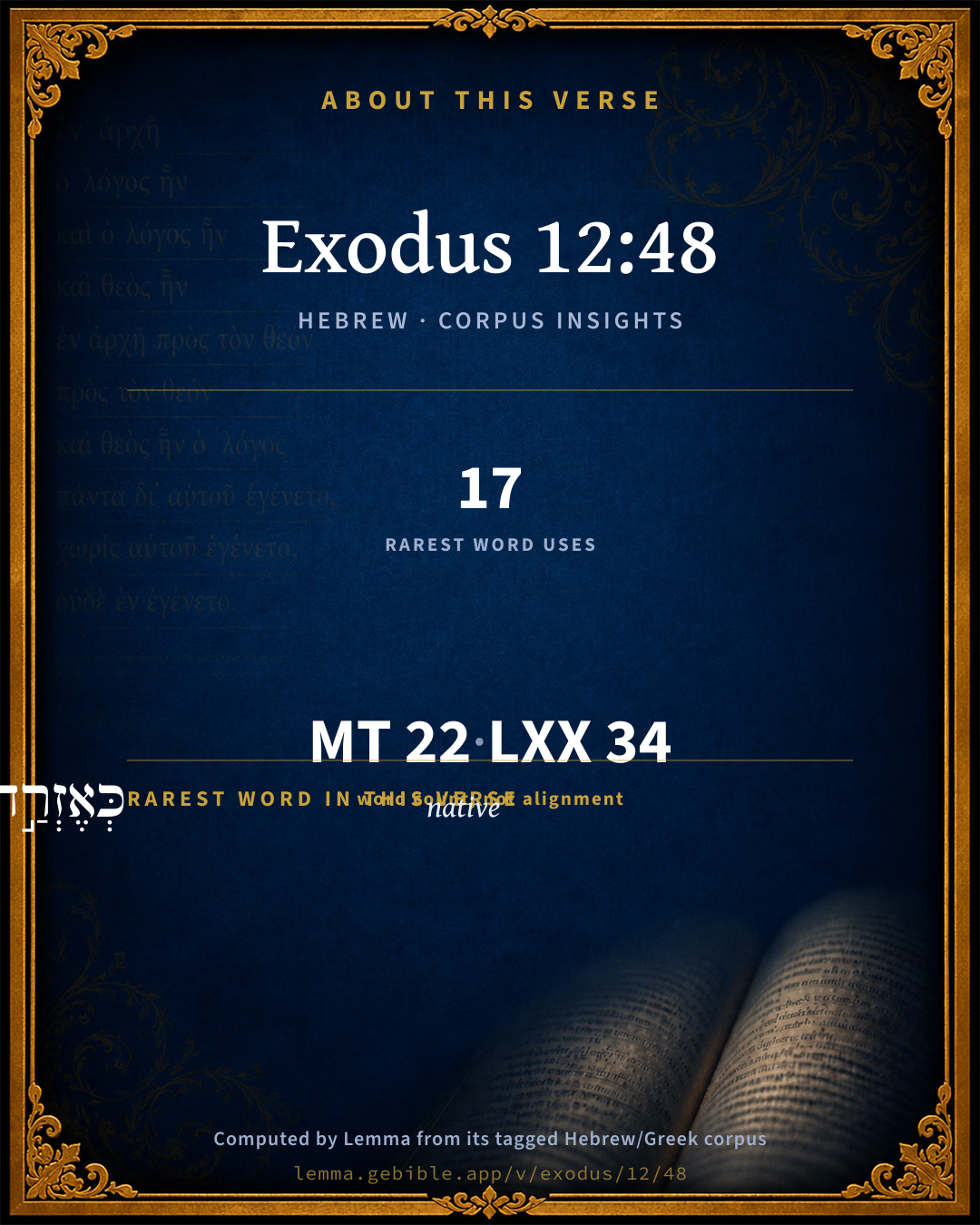
The rarest word here is כְּאֶזְרַ֣ח native H249 — appearing just 17 times in the whole Hebrew Bible.

Shared distinctive vocabulary

כְּאֶזְרַ֣ח native H249 occurs in 17 verses of the Hebrew Bible. Also found in:

Grammatical profile

  • 7 verbs
  • 7 nouns
  • 2 adjectives
  • 3 prepositions
  • 1 conjunction
  • 1 adverb
  • 1 particle

Verb forms

  • יָג֨וּר Qal · Imperfect
  • וְעָ֣שָׂה Qal · Sequential Perfect
  • הִמּ֧וֹל Niphal · Infinitive Absolute
  • יִקְרַ֣ב Qal · Jussive
  • לַעֲשֹׂת֔וֹ Qal · Infinitive Construct
  • וְהָיָ֖ה Qal · Sequential Perfect
  • יֹ֥אכַל Qal · Imperfect

Repetition

Words recur within this verse — often emphatic in Hebrew:

  • וְעָ֣שָׂה to do H6213 ×2
  • כָל all H3605 ×2

Hebrew & Septuagint length

In English translation the verse runs 52 words from the Hebrew and 49 from the Septuagint (LXX English) — closely comparable.

A rough comparison of the two English renderings, which tokenize alike — not a word-level alignment.

Word counts can differ between the Hebrew and the Greek without any difference in meaning — e.g. the Hebrew direct-object marker אֵת has no separate Greek word, and Greek often adds the article ὁ.

In the original languages it is 22 Hebrew tokens and 34 Greek tokens — but the two are counted differently (Hebrew bundles its prefixes and suffixes into one token; the Greek is in lemma form), so that isn’t a like-for-like length.

Cross-references

9

Topical passages linked to Exodus 12:48 in the Treasury of Scripture Knowledge — connected by theme and wording, ordered by reader-vote popularity; previews shown in the World English Bible.

  • Numbers 9:14 If a foreigner lives among you, and desires to keep the Passover to Yahweh; according to the statute of the Passover, and according to its ordinance, so shall he do. You shall have one statute, both for the foreigner, and for him who is born in the land.'"
  • Colossians 3:11 where there can't be Greek and Jew, circumcision and uncircumcision, barbarian, Scythian, bondservant, freeman; but Christ is all, and in all.
  • Galatians 3:28 There is neither Jew nor Greek, there is neither slave nor free man, there is neither male nor female; for you are all one in Christ Jesus.
  • Exodus 12:19 Seven days shall there be no yeast found in your houses, for whoever eats that which is leavened, that soul shall be cut off from the congregation of Israel, whether he be a foreigner, or one who is born in the land.
  • Exodus 12:43 Yahweh said to Moses and Aaron, "This is the ordinance of the Passover. There shall no foreigner eat of it,
  • Numbers 15:15–16 For the assembly, there shall be one statute for you, and for the stranger who lives as a foreigner [with you], a statute forever throughout your generations: as you are, so shall the foreigner be before Yahweh.
  • Ezekiel 47:22 It shall happen, that you shall divide it by lot for an inheritance to you and to the strangers who sojourn among you, who shall father children among you; and they shall be to you as the home-born among the children of Israel; they shall have inheritance with you among the tribes of Israel.
  • Genesis 17:12 He who is eight days old will be circumcised among you, every male throughout your generations, he who is born in the house, or bought with money of any foreigner who is not of your seed.
  • Ezekiel 44:9 Thus says the Lord Yahweh, No foreigner, uncircumcised in heart and uncircumcised in flesh, shall enter into my sanctuary, of any foreigners who are among the children of Israel.

Cross-references courtesy of OpenBible.info (CC BY 4.0).

Hebrew and Greek witnesses Masoretic Hebrew ↔ Greek Septuagint

The same verse in the two great witnesses to the Old Testament, shown verse-for-verse.

These are two independent witnesses, not word-aligned to each other, and the Septuagint is shown in lemma (dictionary) form.

Hebrew Exodus 12:48 Masoretic · Westminster Leningrad Codex

וְכִֽי יָג֨וּר אִתְּךָ֜ גֵּ֗ר וְעָ֣שָׂה פֶסַח֮ לַיהוָה֒ הִמּ֧וֹל ל֣וֹ כָל זָכָ֗ר וְאָז֙ יִקְרַ֣ב לַעֲשֹׂת֔וֹ וְהָיָ֖ה כְּאֶזְרַ֣ח הָאָ֑רֶץ וְכָל עָרֵ֖ל לֹֽא יֹ֥אכַל בּֽוֹ

When a stranger shall live as a foreigner with you, and will keep the Passover to Yahweh, let all his males be circumcised, and then let him come near and keep it; and he shall be as one who is born in the land: but no uncircumcised person shall eat of it.

World English Bible · Public Domain

Greek LXX Exodus 12:48 Septuagint · lemma form

ἐάν δέ τις προςἔρχομαι πρός σύ προσήλυτος ποιέω ὁ πασχα κύριος περιτέμνω αὐτός πᾶς ἀρσενικός καί τότε προςἔρχομαι ποιέω αὐτός καί εἰμί ὥσπερ καί ὁ αὐτόχθων ὁ γῆ πᾶς ἀπερίτμητος οὐ ἐσθίω ἀπό αὐτός

And if any proselyte shall come to you to keep the passover to the Lord, you shall circumcise every male of him, and then shall he approach to sacrifice it, and he shall be even as the original inhabitant of the land; no uncircumcised person shall eat of it.

LXX2012 (modern English Septuagint) · Public Domain

Hebrew: Westminster Leningrad Codex (CC BY 4.0). Greek: Septuagint (public domain); English from LXX2012 (modern English Septuagint) (Public Domain). How the Septuagint differs from the Hebrew →

Targum (Aramaic paraphrase)

2

The Targum is the ancient Jewish Aramaic paraphrase of the Hebrew Scriptures — an interpretive translation, not the Hebrew text itself. Onkelos (literal) and Pseudo-Jonathan (expansive) render the Torah, and Jonathan the Prophets. Coverage is partial: where no permissively-licensed English translation exists for a verse, only the Aramaic is shown. This is verse-level text, not a word-by-word alignment to the Hebrew.

  1. Targum Onkelos Torah (Genesis–Deuteronomy)
    וַאֲרֵי יִתְגַיַר עִמָךְ גִיוֹרָא וְיַעְבֵּד פִּסְחָא קֳדָם יְיָ מִגְזַר לֵהּ כָּל דְכוּרָא וּבְכֵן יִקְרַב לְמֶעְבְּדֵהּ וִיהֵי כְּיַצִיבָא דְאַרְעָא וְכָל עַרְלָא לָא יֵכוּל בֵּהּ:

    (no public-domain English translation for this verse)

    Targum Onkelos — Aramaic: “Onkelos Genesis” (public domain); “Onkelos Exodus” (public domain); “Onkelos Leviticus” (public domain); “Onkelos Numbers” (public domain); “Onkelos Deuteronomy” (public domain). English: “Sefaria Community Translation” (CC0 1.0 (public-domain dedication)); “J.W. Etheridge. The Targums of Onkelos and Jonathan Ben Uzziel on the Pentateuch. London: Longmans, Green, 1862” (public domain). Text via Sefaria.

  2. Targum Pseudo-Jonathan Torah (Genesis–Deuteronomy)
    וַאֲרוּם יִתְגַּיַּיר עִמְכוֹן גִּיּוֹרָא וְיַעֲבֵד פִּסְחָא קֳדָם יְיָ יִגְזוֹר לֵיהּ כָּל דְּכוּרָא וּבְכֵן יְהֵי כָּשֵׁר לְמֶעֱבְדֵיהּ וִיהֵי כְּיַצִיבָא דְאַרְעָא וְכָל עַרְלָאֵי בַּר יִשְרָאֵל לָא יֵיכוּל בֵּיהּ

    And if a proselyte sojourn with you, and would perform the pascha before the Lord, let every male belonging to him be circumcised, and so be made fit to perform it; and he shall be as the native of the land: but no uncircumcised one of the sons of Israel shall eat thereof.

    Targum Pseudo-Jonathan — Aramaic: “Targum Jonathan on Genesis” (public domain); “Targum Jonathan on Exodus” (public domain); “Targum Jonathan on Leviticus” (public domain); “Targum Jonathan on Numbers” (public domain); “Targum Jonathan on Deuteronomy” (public domain). English: “The Targum of Jonathan ben Uzziel, trans. J. W. Etheridge, London, 1862” (public domain). Text via Sefaria.

Commentary

Notes on Exodus 12:48 from classic Christian and Jewish commentators (each source and its license shown beneath its notes). The classic Christian expositions comment on the surrounding passage and are grouped to its opening verse, so a note may address several verses; the Jewish commentaries on the Tanakh (Rashi and others) are per-verse, so they appear only where the commentator wrote on this verse.

Lemma curates 59 commentaries, every one of them public domain or Creative Commons licensed, each selected and text-cleaned for this edition rather than reprinted as found. About our sources →

Trapp's Complete Commentary

John Trapp

Exo 12:48 And when a stranger shall sojourn with thee, and will keep the passover to the LORD, let all his males be circumcised, and then let him come near and keep it; and he shall be as one that is born in the land: for no uncircumcised person shall eat thereof.

Ver. 48. No uncircumcised person shall eat thereof.] The Chaldee hath it, No profane person. So God saith, "No stranger uncircumcised in heart, nor uncircumcised in flesh, shall enter into my sanctuary." {Eze 44:9}

John Trapp, A Commentary or Exposition upon All the Books of the Old and New Testament (1647–1656) — public domain. Text from a community e-Sword module.

Adam Clarke's Commentary

Verse 48. And when a stranger - will keep the passover, &c.] Let all who sojourn among you, and who desire to partake of this sacred ordinance, not only be circumcised themselves, but all the males of their families likewise, that they may all have an equal right to the blessings of the covenant.

Adam Clarke's Commentary on the Bible (1810–1826) — public domain. Text from a community e-Sword/MySword module.

The Cambridge Bible for Schools and Colleges

gen. ed. J. J. S. Perowne

48. The ‘stranger,’ or, better, sojourner, Heb. gêr, i.e. the protected foreigner, if he is circumcised, may keep the Passover. The gêr was like the Arab jâr, i.e. ‘a man of another tribe or district, who coming to sojourn in a place where he was not strengthened by the presence of his own kin, put himself under the protection of a clan or of a powerful chief’ (W.R. Smith, Relig. of the Semites, p. 75 f.; cf. his Kinship and Marriage in Early Arabia, pp. 41–43). ‘Stranger’ is the conventional rendering of gêr; but it is inadequate: a better word would be sojourner, which would also preserve the connexion with the corresponding verb in such passages as v. 49, Gen_12:10; Gen_19:9; Gen_47:4. In the legislation of JE and Deut. the gêr has no legal status in Israel, and is represented as liable to oppression (Exo_22:21; Exo_23:9, Deu_Exo_1:16, &c.): in P (cf. Eze_47:22) he is placed on practically the same footing as the native Israelite, he enjoys the same rights (Num_35:15 ‘for the sojourner and for the settler’ [above, on v. 45]; Lev_19:34 ‘thou shalt love him as thyself’), and is bound by the same laws (ch. Exo_12:19, Lev_16:29; Lev_17:8; Lev_17:10; Lev_17:12-13; Lev_17:15; Lev_18:26; Lev_20:2; Lev_22:18; Lev_24:16); the principle, ‘One law shall there be for the homeborn and for the gêr,’ is repeatedly affirmed (ch. Exo_12:49, Lev_24:22, Num_9:14; Num_15:15-16; Num_15:29). Indeed, in P the term is already on the way to assume the later technical sense of ‘proselyte,’ the foreigner who, being circumcised and observing the law generally, is in full religious communion with Israel.

come near] to take part in the sacred rite. So often in P, as Exo_40:32, Lev_9:5; Lev_9:7-8 (EVV. ‘draw near’), Exo_21:17 f. (‘approach’), Num_16:40.

one that is born in] lit. a native of; the word, when standing alone, is rendered homeborn (v. 49). It denotes the native Israelite, as distinct, especially, from the gêr, or foreigner settled in Israel; cf. v. 19, Lev_16:29; Lev_17:15; Lev_18:26; Lev_19:34; Lev_23:42; Lev_24:16; Lev_24:22, Num_9:14; Num_15:13; Num_15:29-30.

The Cambridge Bible for Schools and Colleges (gen. ed. J. J. S. Perowne; Cambridge University Press, 1878–1918) — public domain. Text from a community e-Sword module.

Haydock's Catholic Bible Commentary

Dwell, or become a proselyte, by circumcision, if a male; or by baptism, if a female; receiving a sort of new-birth, John iii. 10. The Jews would not suffer any to dwell among them, who would not observe the seven precepts given to Noe, Genesis ix. But the proselytes of justice embraced the Jewish religion. (Calmet)

George Leo Haydock (1774–1849), Haydock's Catholic Family Bible and Commentary, 1859 edition — public domain. Excludes Psalms (Douay-Rheims chapter numbering differs from Protestant) and Deuterocanonical books (Catholic canon only).

The Pulpit Commentary

Vers. 48, 49. And when a stranger, etc. Here we have the positive ordinance corresponding to the implied permission in ver. 19, and modifying in the most important and striking way the prohibitive enactment of ver. 43. The "stranger," even if he only "sojourned" in the land, was to be put on exactly the same spiritual footing as the Israelite ("One law shall be," etc.) if only he and his would be circumcised, and so enter into covenant,

The Pulpit Commentary (1880–1919), ed. H.D.M. Spence-Jones & Joseph S. Exell — public domain. Text from a community e-Sword module.

John Wesley's Explanatory Notes

No stranger that was uncircumcised might eat of it. Neither may any now approach the Lord's supper who have not first submitted to baptism; nor shall any partake of the benefit of Christ's sacrifice, who are not first circumcised in heart. Any stranger that was circumcised might eat of the passover, even servants. Here is an indication of favour to the poor Gentiles, that the stranger, if circumcised, stands upon the same level with the home-born Israelite; one law for both. This was a mortification to the Jews, and taught them that it was their dedication to God, not their descent from Abraham, that entitled them to their privileges.

John Wesley, Explanatory Notes Upon the Whole Bible (1754–1765) — public domain. Text via the GEBible commentary corpus.

Rashi

Rabbi Shlomo Yitzchaki (Rashi)

ועשה פסח AND HE WILL KEEP THE PASSOVER (the words may mean, then he shall keep the Passover) — One might think that this verse implies that any-one who becomes a proselyte (גר) must keep the Passover-offering rite immediately after his circumcision (even though this has not taken place just before Passover), therefore Scripture states והיה כאזרח הארץ “but he shall be as a native of the land”. How is it in the case of a native? He brings the offering on the fourteenth! So, too, a proselyte must bring it only on the fourteenth (Mekhilta).

וכל ערל לא יאכל בו AND NO UNCIRCUMCISED PERSON SHALL EAT THEREOF — This is stated in addition to the somewhat similar text in v. 43 in order to include in the prohibition of eating the Paschal offering any person whose brothers have died in consequence of circumcision (in which case the parents are exempted from circumcising any of their children born after the death of these), because such a one is not to be regarded as an apostate who of set purpose remains uncircumcised, and the law regarding such a one cannot be derived from the statement in v. 43, “no strange person shall eat thereof” (because Rashi has explained this to refer to an Israelite whose doings have estranged him from God).

Rashi on the Tanakh — English translations: “The Judaica Press complete Tanach with Rashi, translated by A. J. Rosenberg” (CC BY 4.0); “Pentateuch with Rashi's commentary by M. Rosenbaum and A.M. Silbermann, 1929-1934” (public domain); “The Metsudah Tanach series, Lakewood, N.J” (CC BY 4.0); and “The Book of Joshua, Metsudah Publications, 1997” (CC BY 4.0). Text via Sefaria.

Lesson kit

Teaching starters — assembled from the data on this page, not authored interpretation. Every prompt links to the verse data it draws on. Edit before teaching.

Exodus, in the Pentateuch, opens this verse with 22 words (18 distinct Hebrew lemmas). Its most distinctive word is ʼezrâch (“native”). A historical commentator’s framing appears above. Read the whole chapter for the surrounding context.

Discussion questions

  1. How does “native” (ʼezrâch) shape what this verse is saying?
  2. How does Exodus 12:19, which shares the word «native», read alongside this verse?
  3. What does the repetition of “to do” (2× in this one verse) do in this verse?
  4. These translations render this verse differently; the difference is in the English rendering, not the original. What questions does that raise?
  5. «יָג֨וּר» is a Qal Imperfect verb. How does that grammatical form shape the action described?
  6. Compare how Trapp's Complete Commentary and Adam Clarke's Commentary read this verse. Where do they agree or differ?

Things to notice

Reading settings

Reading text

Shown beneath each verse's original-language words.

Old Testament
Old Testament edition

Read the OT as the Masoretic Hebrew (MT) or the Greek Septuagint (LXX).

English shown for the Greek Septuagint (in the Hebrew ↔ Greek comparison).

Comparing translations? Open the Compare panel on any verse page to stack up to four side by side.