
2 Chronicles 21:19

Hebrew (Westminster Leningrad Codex) 2 Chronicles 21:19 appears in the Hebrew Old Testament. The text above is from the Westminster Leningrad Codex. Each word links to its Strong’s number, a concise gloss, and parsing drawn from the Open Scriptures Hebrew Bible morphology. Click any word for its full Brown-Driver-Briggs (BDB) entry.
Download image
Cite this verse

2 Chronicles 21:19 (World English Bible). Public Domain. Lemma interlinear Bible study tool, https://lemma.gebible.app/v/2-chronicles/21/19.

Show BibTeX & RIS
BibTeX
RIS
English Translation
It happened, in process of time, at the end of two years, that his bowels fell out by reason of his sickness, and he died of sore diseases. His people made no burning for him, like the burning of his fathers.
World English Bible · Public Domain
Download a study sheet

One document with this verse’s original text, its word-by-word gloss line, the meaning frame, cross-references with their text, attributed commentary, and full source and license credits — printable, and it pastes into notes with its structure intact.

This verse Autodidact and up

Study sheet (.html) Plain text (.txt)

A passage Seminary Student

Up to 50 verses in one chapter. A passage sheet keeps up to 6 commentary sources and 12 cross-references per verse, in the order this page ranks them, and says so on the sheet whenever that leaves anything out. Ask for a single verse and you get the Autodidact verse sheet above.

Everything on this page stays free to read, with no account — the sheet is a download of what is already on screen, not access to it.

Want to remove ads? Support Godless Engineer
Compare translations 3

The same verse in 3 English versions, stacked beneath the original-language interlinear above. Click any original word for its lexicon entry.

Each is an independent rendering of the whole verse — the interlinear is not word-aligned to these translations.

Highlighted words mark where these versions differ — a whole-verse word diff, not a word-by-word alignment.

  • World English Bible Public Domain
    It happened, in process of time, at the end of two years, that his bowels fell out by reason of his sickness, and he died of sore diseases. His people made no burning for him, like the burning of his fathers.
  • King James Version Public Domain
    And it came to pass, that in process of time, after the end of two years, his bowels fell out by reason of his sickness: so he died of sore diseases. And his people made no burning for him, like the burning of his fathers.
  • unfoldingWord Literal Text CC BY-SA 4.0
    And it happened from days to days, and at the time of the going out for the end of days, two, his intestines came out with his sickness, and he died with evil diseases. And his people did not make for him a burning like the burning of his fathers.

unfoldingWord Literal Text — © unfoldingWord, licensed CC BY-SA 4.0. Word-aligned USFM3 via Door43 (git.door43.org/unfoldingWord/en_ult).

Versions to compare (up to 4)

3 of 4 selected

Show all 18 translations

Every available English version of this verse, each an independent rendering of the whole verse.

  • World English Bible Public Domain
    It happened, in process of time, at the end of two years, that his bowels fell out by reason of his sickness, and he died of sore diseases. His people made no burning for him, like the burning of his fathers.
  • Berean Standard Bible Public Domain
    This continued day after day until two full years had passed. Finally, his intestines came out because of his disease, and he died in severe pain. And his people did not make a fire in his honor as they had done for his fathers.
  • Majority Standard Bible Public Domain
    This continued day after day until two full years had passed. Finally, his intestines came out because of his disease, and he died in severe pain. And his people did not make a fire in his honor as they had done for his fathers.
  • King James Version Public Domain
    And it came to pass, that in process of time, after the end of two years, his bowels fell out by reason of his sickness: so he died of sore diseases. And his people made no burning for him, like the burning of his fathers.
  • American Standard Version (1901) Public Domain
    And it came to pass, in process of time, at the end of two years, that his bowels fell out by reason of his sickness, and he died of sore diseases. And his people made no burning for him, like the burning of his fathers.
  • Revised Version (1885) Public Domain
    And it came to pass, in process of time, at the end of two years, that his bowels fell out by reason of his sickness, and he died of sore diseases. And his people made no burning for him, like the burning of his fathers.
  • Geneva Bible (1599) Public Domain
    And in processe of time, euen after the end of two yeeres, his guttes fell out with his disease: so he dyed of sore diseases: and his people made no burning for him like the burning of his fathers.
  • Douay-Rheims (1899) Public Domain
    And as day came after day, and time rolled on, two whole years passed: then after being wasted with a long consumption, so as to void his very bowels, his disease ended with his life. And he died of a most wretched illness, and the people did not make a funeral for him according to the manner of burning, as they had done for his ancestors.
  • Young's Literal Translation Public Domain
    and it cometh to pass, from days to days, and at the time of the going out of the end of two years, his bowels have gone out with his sickness, and he dieth of sore diseases, and his people have not made for him a burning like the burning of his fathers.
  • Literal Standard Version CC BY-SA 4.0
    and it comes to pass, from days to days, and at the time of the going out of the end of two years, his bowels have gone out with his sickness, and he dies of severe diseases, and his people have not made for him a burning like the burning of his fathers.
  • Unlocked Literal Bible CC BY-SA 4.0
    It came about in due time, at the end of two years, that his intestines fell out because of his sickness, and that he died of severe disease. His people made no fire in his honor as they had done for his ancestors.
  • unfoldingWord Literal Text CC BY-SA 4.0
    And it happened from days to days, and at the time of the going out for the end of days, two, his intestines came out with his sickness, and he died with evil diseases. And his people did not make for him a burning like the burning of his fathers.
  • Darby Bible Public Domain
    And it came to pass, from day to day, and at the time when the second year was drawing to a close, that his bowels fell out by reason of his sickness, and he died in cruel sufferings. And his people made no burning for him, like the burning of his fathers.
  • World Messianic Bible Public Domain
    In process of time, at the end of two years, his bowels fell out by reason of his sickness, and he died of severe diseases. His people made no burning for him, like the burning of his fathers.
  • Webster's Bible Public Domain
    And it came to pass, that in process of time, after the end of two years, his bowels fell out by reason of his sickness: so he died of severe diseases. And his people made no burning for him, like the burning of his fathers.
  • Free Bible Version CC BY-SA 4.0
    Day after day it grew worse, until after two full years passed his bowels came out because of his disease, and he died in agony. His people did not make a fire to honor him as they had done for his forefathers.
  • Bible in Basic English Public Domain
    And time went on, and after two years, his inside falling out because of the disease, he came to his death in cruel pain. And his people made no burning for him like the burning made for his fathers.
  • JPS Tanakh (1917) Public Domain
    And it came to pass, that in process of time, at the end of two years, his bowels fell out by reason of his sickness, and he died of sore diseases. And his people made no burning for him, like the burning of his fathers.

Literal Standard Version (2020), Covenant Press — licensed CC BY-SA 4.0. Text via the HelloAO Bible API (eBible.org). Unlocked Literal Bible (unfoldingWord) — licensed CC BY-SA 4.0. Text via the HelloAO Bible API (eBible.org). unfoldingWord Literal Text — © unfoldingWord, licensed CC BY-SA 4.0. Word-aligned USFM3 via Door43 (git.door43.org/unfoldingWord/en_ult). Free Bible Version, Dr. Jonathan Gallagher — licensed CC BY-SA 4.0. Text via the HelloAO Bible API (eBible.org).

Word by word

More ways to search: Search by grammar → Find every occurrence → Compare this word →

Practice this passage: Drill this verse → Learn its vocabulary →

בְּתַחֲלֻאִ֣ים
tachălûwʼ
H8463
“in/at · diseases”
Preposition + Noun, Common, Masculine, Plural, Absolute
Part of Speech
Preposition + Noun
Type
Common
Gender
Masculine
Number
Plural
State
Absolute
Full BDB Definition

Origin: from H2456

TWOT: 648a

diseases
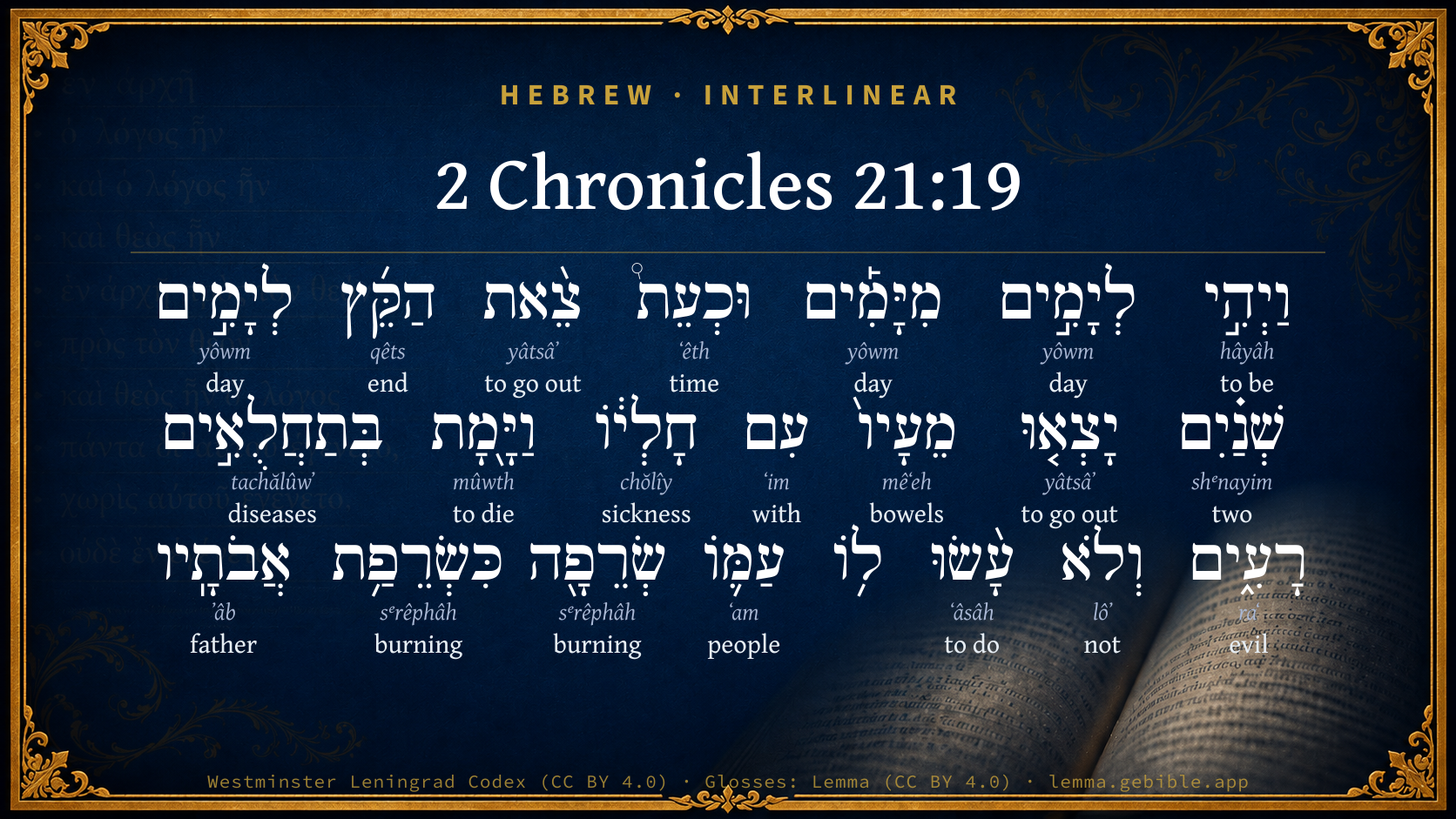
  1. וַיְהִ֣י hâyâh H1961 “and · to be” Conjunction + Verb, Qal, Sequential Imperfect, 3rd Person, Masculine, Singular
  2. לְיָמִ֣ים yôwm H3117 “to/for · days” Preposition + Noun, Common, Masculine, Plural, Absolute
  3. מִיָּמִ֡ים yôwm H3117 “from · days” Preposition + Noun, Common, Masculine, Plural, Absolute
  4. וּכְעֵת֩ ʻêth H6256 “and · like/as · time of” Conjunction + Preposition + Noun, Common, Both, Singular, Construct
  5. צֵ֨את yâtsâʼ H3318 “to go out” Verb, Qal, Infinitive Construct
  6. הַקֵּ֜ץ qêts H7093 “the · end” Particle, Definite Article + Noun, Common, Masculine, Singular, Absolute
  7. לְיָמִ֣ים yôwm H3117 “to/for · days” Preposition + Noun, Common, Masculine, Plural, Absolute
  8. שְׁנַ֗יִם shᵉnayim H8147 “two” Adjective, Cardinal number, Masculine, Dual, Absolute
  9. יָצְא֤וּ yâtsâʼ H3318 “to go out” Verb, Qal, Perfect, 3rd Person, Common, Plural
  10. מֵעָיו֙ mêʻeh H4578 “bowels · his” Noun, Common, Masculine, Plural, Construct + Suffix, Personal, 3rd Person, Masculine, Singular
  11. עִם ʻim H5973 “with” Preposition
  12. חָלְי֔וֹ chŏlîy H2483 “sickness · his” Noun, Common, Masculine, Singular, Construct + Suffix, Personal, 3rd Person, Masculine, Singular
  13. וַיָּ֖מָת mûwth H4191 “and · to die” Conjunction + Verb, Qal, Sequential Imperfect, 3rd Person, Masculine, Singular
  14. רָעִ֑ים raʻ H7451 “evil” Adjective, Adjective, Masculine, Plural, Absolute
  15. וְלֹא lôʼ H3808 “and · not” Conjunction + Particle, Negative
  16. עָ֨שׂוּ ʻâsâh H6213 “to do” Verb, Qal, Perfect, 3rd Person, Common, Plural
  17. עַמּ֛וֹ ʻam H5971 “people · his” Noun, Common, Masculine, Singular, Construct + Suffix, Personal, 3rd Person, Masculine, Singular
  18. שְׂרֵפָ֖ה sᵉrêphâh H8316 “burning” Noun, Common, Feminine, Singular, Absolute
  19. כִּשְׂרֵפַ֥ת sᵉrêphâh H8316 “like/as · burning of” Preposition + Noun, Common, Feminine, Singular, Construct
  20. אֲבֹתָֽיו ʼâb H1 “fathers · his” Noun, Common, Masculine, Plural, Construct + Suffix, Personal, 3rd Person, Masculine, Singular

About this verse

These counts appear in no published source. They are computed here, from the morphology-tagged text and Lemma’s own curated glosses. What Lemma adds →

22
words
17
distinct lemmas
Historical
section

Notable vocabulary

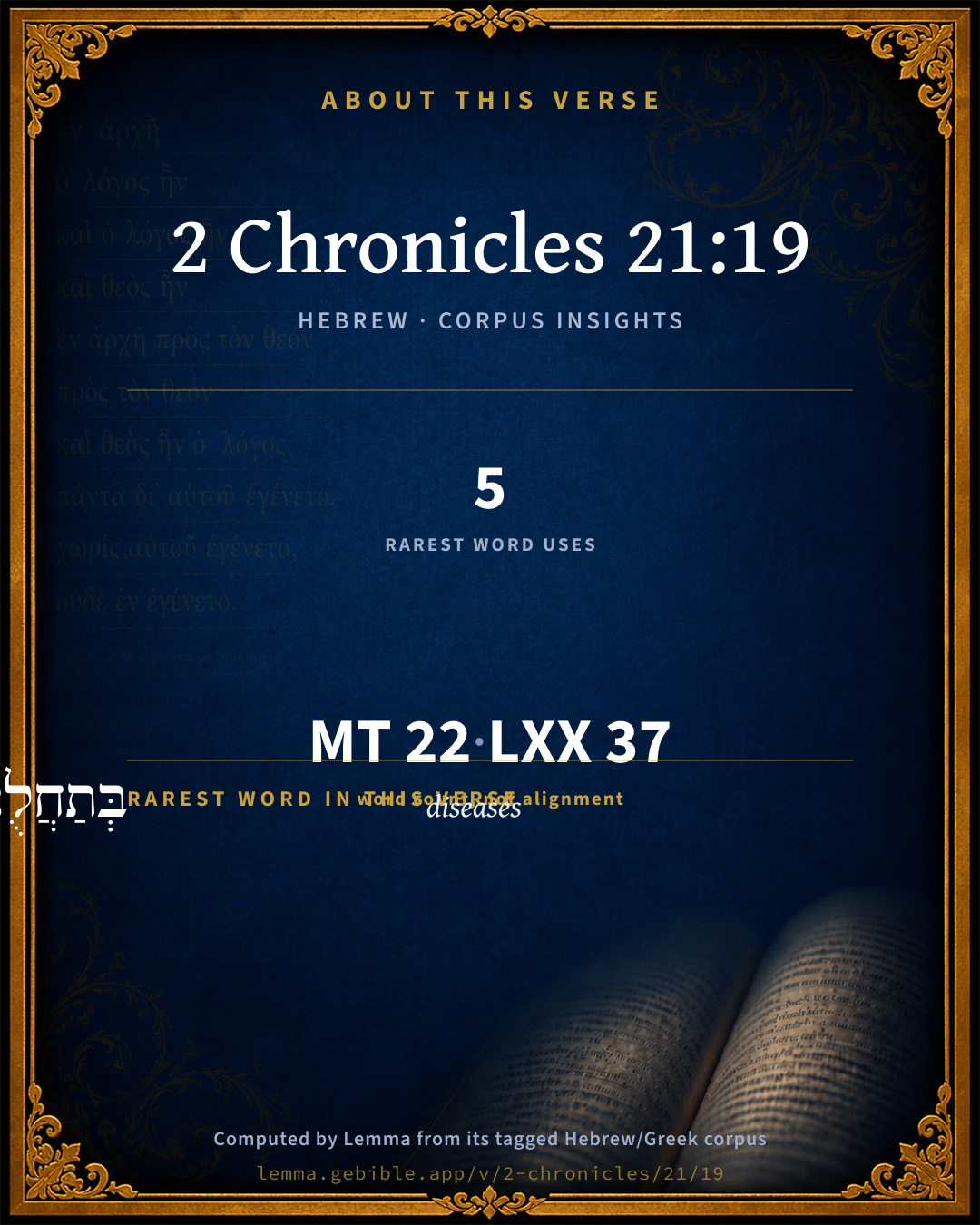
The rarest word here is בְּתַחֲלֻאִ֣ים diseases H8463 — appearing just 5 times in the whole Hebrew Bible.

Shared distinctive vocabulary

בְּתַחֲלֻאִ֣ים diseases H8463 occurs in 5 verses of the Hebrew Bible. Also found in:

Grammatical profile

  • 5 verbs
  • 12 nouns
  • 2 adjectives
  • 2 prepositions
  • 1 particle

Verb forms

  • וַיְהִ֣י Qal · Sequential Imperfect
  • צֵ֨את Qal · Infinitive Construct
  • יָצְא֤וּ Qal · Perfect
  • וַיָּ֖מָת Qal · Sequential Imperfect
  • עָ֨שׂוּ Qal · Perfect

Repetition

Words recur within this verse — often emphatic in Hebrew:

  • לְיָמִ֣ים day H3117 ×3
  • צֵ֨את to go out H3318 ×2
  • שְׂרֵפָ֖ה burning H8316 ×2

Hebrew & Septuagint length

In English translation the verse runs 41 words from the Hebrew and 44 from the Septuagint (LXX English) — closely comparable.

A rough comparison of the two English renderings, which tokenize alike — not a word-level alignment.

Word counts can differ between the Hebrew and the Greek without any difference in meaning — e.g. the Hebrew direct-object marker אֵת has no separate Greek word, and Greek often adds the article ὁ.

In the original languages it is 22 Hebrew tokens and 37 Greek tokens — but the two are counted differently (Hebrew bundles its prefixes and suffixes into one token; the Greek is in lemma form), so that isn’t a like-for-like length.

Cross-references

2

Topical passages linked to 2 Chronicles 21:19 in the Treasury of Scripture Knowledge — connected by theme and wording, ordered by reader-vote popularity; previews shown in the World English Bible.

  • 2 Chronicles 16:14 They buried him in his own tombs, which he had hewn out for himself in the city of David, and laid him in the bed which was filled with sweet odors and various kinds [of spices] prepared by the perfumers' are: and they made a very great burning for him.
  • Jeremiah 34:5 you shall die in peace; and with the burnings of your fathers, the former kings who were before you, so shall they make a burning for you; and they shall lament you, [saying], Ah Lord! for I have spoken the word, says Yahweh.

Cross-references courtesy of OpenBible.info (CC BY 4.0).

Hebrew and Greek witnesses Masoretic Hebrew ↔ Greek Septuagint

The same verse in the two great witnesses to the Old Testament, shown verse-for-verse.

These are two independent witnesses, not word-aligned to each other, and the Septuagint is shown in lemma (dictionary) form.

Hebrew 2 Chronicles 21:19 Masoretic · Westminster Leningrad Codex

וַיְהִ֣י לְיָמִ֣ים מִיָּמִ֡ים וּכְעֵת֩ צֵ֨את הַקֵּ֜ץ לְיָמִ֣ים שְׁנַ֗יִם יָצְא֤וּ מֵעָיו֙ עִם חָלְי֔וֹ וַיָּ֖מָת בְּתַחֲלֻאִ֣ים רָעִ֑ים וְלֹא עָ֨שׂוּ ל֥וֹ עַמּ֛וֹ שְׂרֵפָ֖ה כִּשְׂרֵפַ֥ת אֲבֹתָֽיו

It happened, in process of time, at the end of two years, that his bowels fell out by reason of his sickness, and he died of sore diseases. His people made no burning for him, like the burning of his fathers.

World English Bible · Public Domain

Greek LXX 2 Chronicles 21:19 Septuagint · lemma form

καί γίγνομαι ἐκ ἡμέρα εἰς ἡμέρα καί ὡς ἔρχομαι καιρός ὁ ἡμέρα ἡμέρα δύο ἐκἔρχομαι ὁ κοιλία αὐτός μετά ὁ νόσος καί ἀποθνήσκω ἐν μαλακία πονηρός καί οὐ ποιέω ὁ λαός αὐτός ἐκφορά καθώς ἐκφορά πατήρ αὐτός

And it continued from day to day: and when the time of the days came to two years, his bowels fell out with the disease, and he died by a grievous distemper: and his people performed no funeral, like the funeral of his fathers.

LXX2012 (modern English Septuagint) · Public Domain

On this verse, The Cambridge Bible for Schools and Colleges discusses the Septuagint’s reading. Read the note in Commentary ↓

Hebrew: Westminster Leningrad Codex (CC BY 4.0). Greek: Septuagint (public domain); English from LXX2012 (modern English Septuagint) (Public Domain). How the Septuagint differs from the Hebrew →

Commentary

Notes on 2 Chronicles 21:19 from classic Christian and Jewish commentators (each source and its license shown beneath its notes). The classic Christian expositions comment on the surrounding passage and are grouped to its opening verse, so a note may address several verses; the Jewish commentaries on the Tanakh (Rashi and others) are per-verse, so they appear only where the commentator wrote on this verse.

Lemma curates 59 commentaries, every one of them public domain or Creative Commons licensed, each selected and text-cleaned for this edition rather than reprinted as found. About our sources →

Trapp's Complete Commentary

John Trapp

2Ch 21:19 And it came to pass, that in process of time, after the end of two years, his bowels fell out by reason of his sickness: so he died of sore diseases. And his people made no burning for him, like the burning of his fathers.

Ver. 19. After the end of two years.] This was a long while to lie under so intolerable a disease; and yet all this was but a typical hell, a foretaste of eternal torments, unless he repented.

John Trapp, A Commentary or Exposition upon All the Books of the Old and New Testament (1647–1656) — public domain. Text from a community e-Sword module.

Joseph Benson's Commentary

2Ch 21:19. So he died of sore diseases — These words seem to import that he was afflicted with a complication of diseases, together with his dysentery; all which were very grievous, and a suitable punishment of his horrid wickedness. And his people made no burning for him — Paid him no extraordinary funeral honours.

Joseph Benson's Commentary on the Old and New Testaments (1811–1818) — public domain. Text from a community e-Sword module.

Adam Clarke's Commentary

Verse 19. After the end of two years, his bowels fell out] The Targum seems to intimate that he had a constipation and inflammation in his bowels; and that at last his bowels gushed out.

No burning] "His people made no burning of aromatic woods for him, as they had done for his forefathers." - Targum. See on 2Ch 16:14.

Adam Clarke's Commentary on the Bible (1810–1826) — public domain. Text from a community e-Sword/MySword module.

Ellicott's Commentary for English Readers

(19) In process of time.—Comp. 2Ch_21:15. Literally, at days from days, i.e., “a year after a year,” or “after two years.”

After the end of two years.—This clause more exactly defines the preceding. Literally, and about the time of the going forth of the end of two years, i.e., when two full years after the delivery of the prediction had expired. The time of the event exactly coincided with the time predicted. Vulg., well: “duorum annorum expletus est circulus;” Syriac, “When the prophet’s word was fulfilled touching two years.”

By reason of his sickness.—Literally, along with, i.e., in, during, his disease, which appears to have been a violent dysentery.

So he died of sore diseases.—And he died in sore pains (tachaluim, Deu_29:21).

And his people made no burning for him.—The usual honours of a sovereign were withheld in his case. (See on 2Ch_16:14; and comp. Jer_22:19.) So Syriac: “And his people did him no honour, as they did to his fathers.”

A Bible Commentary for English Readers, edited by Charles John Ellicott (1878–1897) — public domain. Text from a community e-Sword module.

The Cambridge Bible for Schools and Colleges

gen. ed. J. J. S. Perowne

18–20 (cp. 2Ki_8:24). Death and Burial of Jehoram

19. after the end] R.V. at the end.

by reason of his sickness] LXX. μετὰ τῆς νόσου, i.e. in the course of his sickness.

no burning] Cp. 2Ch_16:14 (note).

The Cambridge Bible for Schools and Colleges (gen. ed. J. J. S. Perowne; Cambridge University Press, 1878–1918) — public domain. Text from a community e-Sword module.

Haydock's Catholic Bible Commentary

And. Prot. "And it came to pass that, in the process of time, after the end of two years, his bowels fell out, by reason of his sickness: so he died of sore diseases: And his people made no burning for him," &c. (H.) not that the body was usually consumed, but no aromatical spices were burned near it, (Sanctius; T.) as in the funeral of Asa, C. xvi. 14. C. --- The point is controverted. M.

George Leo Haydock (1774–1849), Haydock's Catholic Family Bible and Commentary, 1859 edition — public domain. Excludes Psalms (Douay-Rheims chapter numbering differs from Protestant) and Deuterocanonical books (Catholic canon only).

Whedon's Commentary on the Bible

Daniel D. Whedon

19. His people made no burning for him — As they did for Asa his grandfather. 2Ch_16:14, note.

Daniel D. Whedon (gen. ed.), Commentary on the Old and New Testaments (1874–1909) — public domain. Text from a community e-Sword module.

The Pulpit Commentary

After the end of two years. That "two years space began at the end of nearly two years after his father"s death. Two years" warning and space for repentance subsequent Jehoram had turned to no account, and even affliction and suffering brought him no "amendment. No burning. (see our note on 2Ch_16:14)

Vers. 19 (latter part), 20.

The trouble that is worse than sorrow.

people made no burning for him;" he "departed without being desired." It is wise for us all not only to enjoy the present appreciation of our friends, which may be an expression of their desire to stand well with us, but also to consider what will be

I THE AFTER-ESTIMATE THAT WILL BE FORMED OF US. Jehoram probably comforted himself while he lived with the approval of many of his courtiers. There are always found men mean enough to compliment the man in power, however they may despise him. But probably he did not foresee that his body would hardly be cold before he would receive marks of general dishonour, and that not one week would elapse before it would be signified to all the land that he was held unworthy to sleep with his fathers. It is surely the mark of a very narrow and earthly mind not to care what men will think of us when we are departed because it will make no difference to us then. That is not quite certain; but if it were, it surely behoves us, as upright spiritual intelligences, to care much for our reputation when we have left these scenes. Shall we not desire to enjoy "the memory of the just"? Shall it not be a matter of moment to us that, when we are no longer here, those who remember us will think and speak kindly of us, as of men that played their part bravely and faithfully, as of men that loved and helped their kind? If this be so, since this is so, let us reflect that after a while our character will stand in its true colours; that all our pretences will disappear; that men will know us to have been just what we are; that after death disguises fail away, and the man himself stands forth in his virtue or in his guilt, in his manliness or in his meanness, in his large-mindedness or in his selfishness and smallness. We must be right if we would be so regarded when death takes off the veil from our character. But we see here another thing worthy of our consideration.

II THE TROUBLE THAT IS WORSE THAN SORROW.

1. It is sad enough when a good man dies and is regretted. When somegreat gap is left; when from the home, or from the Church, or from the state there is taken one who had loved and been beloved, who had served well and been highly honoured; when such a one is borne to his burial, amid the tears and lamentations of many hearts, we feel that a great affliction has befallen us, and we must bow in subjection to the Father of spirits.

2. But it is sadder far when a bad man dies unlamented; when, as withJehoram, no one cares to pay him funeral honours; when the Chronicler has to say about him that he "departed without being desired." For of what does it speak?

(1) Usually it speaks of the Divine condemnation. The indignation of a people, especially of a nation that has received instruction from God himself, is commonly a reflection of the judgment of Heaven; it signifies that "the departed" is a man whose life the Holy One has condemned.

(2) Always it speaks of the deliberate reprobation of man. For when a man dies, there is a disposition to be lenient in judgment, to overlook offences and to magnify service and virtue; when, therefore, the dead are distinctly dishonoured, when there is no one to pronounce an eulogium or even to feel a lament, it is clear that their contemporaries have decidedly and seriously condemned them.

(3) It speaks of a deplorable failure. Excepting in those comparatively rare cases of the very best and greatest men, who have been before their age in understanding and in action, and have therefore been misunderstood, when men die dishonoured and without regret it may be taken that their lives have been unworthy; that they have been marked by evil; that they have been fruitful of folly and of wrong. And what can he sadder than that? That God should give us our powers and our lives in order that we may spend them for his honour, to promote the real well-being of our fellow-men, and to cultivate in ourselves wisdom and worth that will fit us for higher spheres; and that we should degrade our priceless opportunity by scattering seeds of error, by diffusing unholy principles, by doing our utmost to injure the spirits and to lower the lives of men, thus starting influences for evil which will spread far and wide, and will go down from generation to generation; there is nothing we can conceive of which is more deplorable than this.

(4) It is a painful and pitiable thing in itself. To depart unregretted by any one! To go for ever and to be missed and mourned by none! To leave no hearts that will be saddened by our absence, that will wish to see us and speak to us again! To be borne away, not like the fair and noble tree, whose fruit has been a treasure, whose form has been a perpetual joy all the year round, whose shadow has been a kindly shelter to old and young, with a sincere if not affectionate regret; hut like an unsightly and cumbersome log, that has been an offence to the eye and an obstruction in the way, with a sense of relief and satisfaction; who of us would like to be so regarded when we die? Who of us would not infinitely rather be bathed in a pure and holy sorrow as we mourn some departed friend that has lived in love and died in honour, than leave in the grave one for whom no tear is shed, whose departure no soul regrets? Let us be such men and live such lives that if our survivors and successors do not "make a great burning for us," as was done for Jehoram"s grandfather, (2Ch_16:14) they will lose us with a genuine regret, and mourn for us with a sorrow that will hallow their own hearts, while it testifies to the worth that has found a home beneath other skies. C.

The Pulpit Commentary (1880–1919), ed. H.D.M. Spence-Jones & Joseph S. Exell — public domain. Text from a community e-Sword module.

Keil & Delitzsch

C. F. Keil & F. Delitzsch

And it came to pass in days after days (i.e., when a number of days had passed), and that at the time (וּכעת( emit eh) of the expiration of the end in two days, then his bowels went out during his sickness, and he died in sore pains (תּחלאים, phenomena of disease, i.e., pains). The words שׁנים לימים הקּץ צאת וּכעת are generally translated as if שׁנים לימים were a mere periphrasis of the stat. constr. Vatabl. and Cler., for example, translate: et secundum tempus egrediendi finis annorum duorum, i.e., postquam advenit finis a. d., or cum exacti essent duo anni; similarly Berth.: "at the time of the approach of the end of two times." But against this we have not only the circumstance that no satisfactory reason for the use of this periphrasis for the genitive can be perceived, and that no analogies can be found for the expression שׁנים לימים הקּץ, the end of two years, instead of שׁנים היּמים קץ; but also the more decisive linguistic reason that הקּץ צאת cannot denote the approach of the end, but only the expiry, the running out of the end; and finally, that the supposition that ימים here and in Ch2 21:15 denotes a year is without foundation. Schmidt and Rabm. have already given a better explanation: quumque esset tempus, quo exiit finis s. quum exiret ac compleretur terminus ille, in epistola Eliae Ch2 21:15 praefixus; but in this case also we should expect היּמים קץ, since שׁנים לימים should point back to ימים על ימים, and contain a more exact definition of the terms employed in Ch2 21:15, which are not definite enough. We therefore take הקּץ צאת by itself, and translate: At the time of the end, i.e., when the end, sc. of life or of the disease, had come about two days, i.e., about two days before the issue of the end of the disease, then the bowels went out of the body-they flowed out from the body as devoured by the disease. חליו עם, in, during the sickness, consequently before the decease (cf. for עם in this signification, Psa 72:5, Dan. 3:33). Trusen (Sitten, Gebr. und Krankh. der alten Hebrer, S. 212f.) holds this disease to have been a violent dysentery (diarrhoea), "being an inflammation of the nervous tissue (Nervenhaut) of the whole great intestine, which causes the overlying mucous membrane to decay and peel off, which then falls out often in tube-shape, so that the intestines appear to fall from the body." His people did not make a burning for him like the burning of his fathers, cf. Ch2 16:14; that is, denied him the honours usual at burial, because of their discontent with his evil reign.

Keil & Delitzsch — Biblical Commentary on the Old Testament (1861–1891) — public domain (CC PDM 1.0). Text via the HelloAO Bible API. (Old Testament only.)

Rashi

Rabbi Shlomo Yitzchaki (Rashi)

and at the end the end that the prophet had foretold him of.

and his people did not make him a burning even though he required that burning because he had been ailing with malignant illnesses, and his flesh reeked. The Holy One, blessed be He, did not wish to honor him by making a burning for him, and he was also not buried in the graves of the kings.

Rashi on the Tanakh — English translations: “The Judaica Press complete Tanach with Rashi, translated by A. J. Rosenberg” (CC BY 4.0); “Pentateuch with Rashi's commentary by M. Rosenbaum and A.M. Silbermann, 1929-1934” (public domain); “The Metsudah Tanach series, Lakewood, N.J” (CC BY 4.0); and “The Book of Joshua, Metsudah Publications, 1997” (CC BY 4.0). Text via Sefaria.

Lesson kit

Teaching starters — assembled from the data on this page, not authored interpretation. Every prompt links to the verse data it draws on. Edit before teaching.

2 Chronicles, in the Historical, opens this verse with 22 words (17 distinct Hebrew lemmas). Its most distinctive word is tachălûwʼ (“diseases”). A historical commentator’s framing appears above. Read the whole chapter for the surrounding context.

Discussion questions

  1. The word tachălûwʼ carries the sense “diseases.” How does it shape the verse?
  2. How does Deuteronomy 29:22, which shares the word «diseases», read alongside this verse?
  3. What does the repetition of “day” (3× in this one verse) do in this verse?
  4. The translations on this page render this verse differently — a whole-verse word diff, not a word-by-word alignment. What might account for the different wordings?
  5. «וַיְהִ֣י» is a Qal Sequential Imperfect verb. How does that grammatical form shape the action described?
  6. Compare how Trapp's Complete Commentary and Joseph Benson's Commentary read this verse. Where do they agree or differ?

Things to notice

Reading settings

Reading text

Shown beneath each verse's original-language words.

Old Testament
Old Testament edition

Read the OT as the Masoretic Hebrew (MT) or the Greek Septuagint (LXX).

English shown for the Greek Septuagint (in the Hebrew ↔ Greek comparison).

Comparing translations? Open the Compare panel on any verse page to stack up to four side by side.