
Nehemiah 13:26

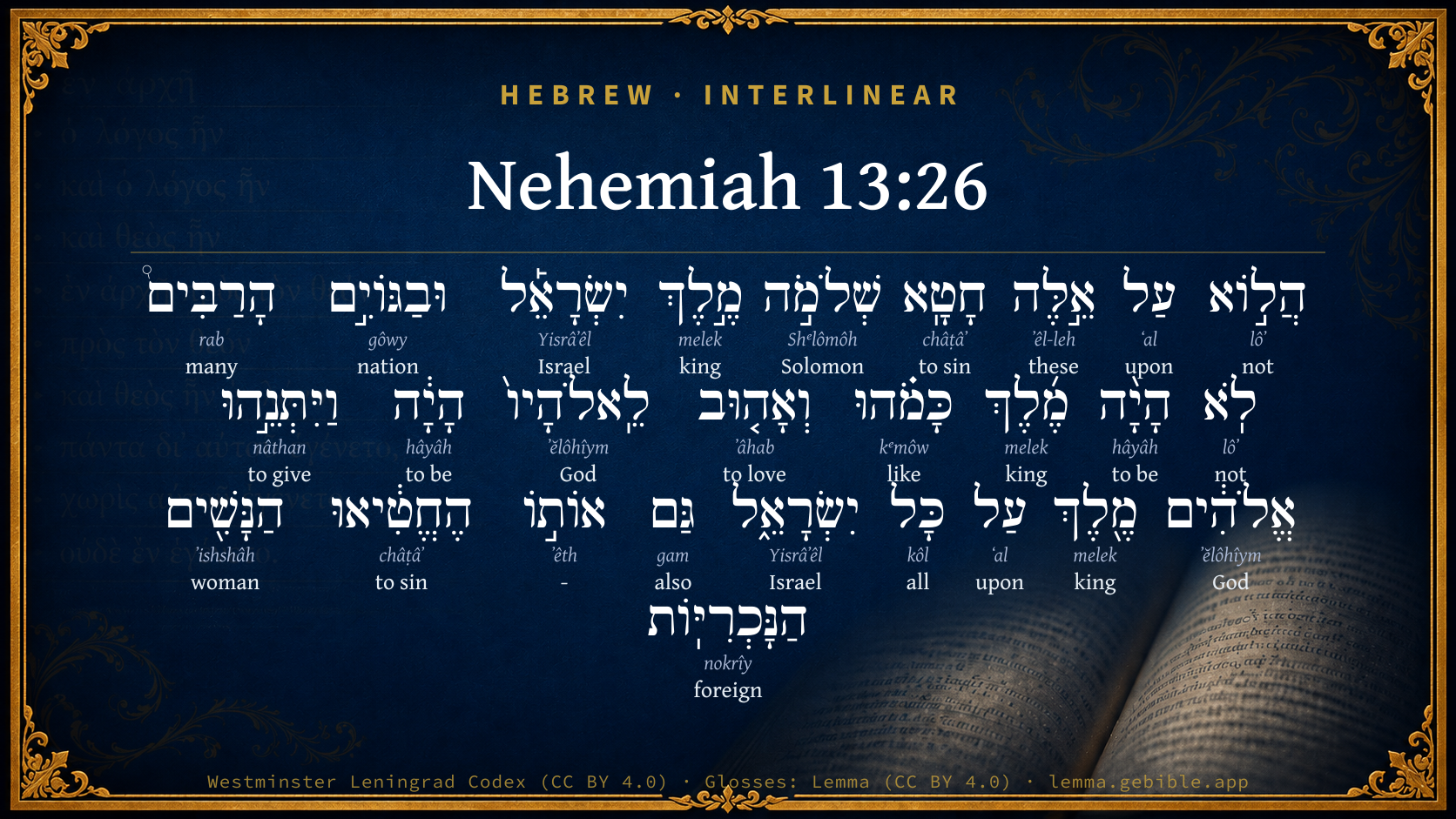
Hebrew (Westminster Leningrad Codex) Nehemiah 13:26 appears in the Hebrew Old Testament. The text above is from the Westminster Leningrad Codex. Each word links to its Strong’s number, a concise gloss, and parsing drawn from the Open Scriptures Hebrew Bible morphology. Click any word for its full Brown-Driver-Briggs (BDB) entry.
Download image
Cite this verse

Nehemiah 13:26 (World English Bible). Public Domain. Lemma interlinear Bible study tool, https://lemma.gebible.app/v/nehemiah/13/26.

Show BibTeX & RIS
BibTeX
RIS
English Translation
Did not Solomon king of Israel sin by these things? yet among many nations was there no king like him, and he was beloved of his God, and God made him king over all Israel: nevertheless even him did foreign women cause to sin.
World English Bible · Public Domain
Download a study sheet

One document with this verse’s original text, its word-by-word gloss line, the meaning frame, cross-references with their text, attributed commentary, and full source and license credits — printable, and it pastes into notes with its structure intact.

This verse Autodidact and up

Study sheet (.html) Plain text (.txt)

A passage Seminary Student

Up to 50 verses in one chapter. A passage sheet keeps up to 6 commentary sources and 12 cross-references per verse, in the order this page ranks them, and says so on the sheet whenever that leaves anything out. Ask for a single verse and you get the Autodidact verse sheet above.

Everything on this page stays free to read, with no account — the sheet is a download of what is already on screen, not access to it.

Want to remove ads? Support Godless Engineer
Compare translations 3

The same verse in 3 English versions, stacked beneath the original-language interlinear above. Click any original word for its lexicon entry.

Each is an independent rendering of the whole verse — the interlinear is not word-aligned to these translations.

Highlighted words mark where these versions differ — a whole-verse word diff, not a word-by-word alignment.

  • World English Bible Public Domain
    Did not Solomon king of Israel sin by these things? yet among many nations was there no king like him, and he was beloved of his God, and God made him king over all Israel: nevertheless even him did foreign women cause to sin.
  • King James Version Public Domain
    Did not Solomon king of Israel sin by these things? yet among many nations was there no king like him, who was beloved of his God, and God made him king over all Israel: nevertheless even him did outlandish women cause to sin.
  • unfoldingWord Literal Text CC BY-SA 4.0
    Did not Solomon, the king of Israel, sin concerning these things? Yet among many nations there was no king like him: and he was beloved by his God, and God gave him as king over all Israel. The foreign women caused even him to sin.

unfoldingWord Literal Text — © unfoldingWord, licensed CC BY-SA 4.0. Word-aligned USFM3 via Door43 (git.door43.org/unfoldingWord/en_ult).

Versions to compare (up to 4)

3 of 4 selected

Show all 18 translations

Every available English version of this verse, each an independent rendering of the whole verse.

  • World English Bible Public Domain
    Did not Solomon king of Israel sin by these things? yet among many nations was there no king like him, and he was beloved of his God, and God made him king over all Israel: nevertheless even him did foreign women cause to sin.
  • Berean Standard Bible Public Domain
    Did not King Solomon of Israel sin in matters like this? There was not a king like him among many nations, and he was loved by his God, who made him king over all Israel—yet foreign women drew him into sin.
  • Majority Standard Bible Public Domain
    Did not King Solomon of Israel sin in matters like this? There was not a king like him among many nations, and he was loved by his God, who made him king over all Israel—yet foreign women drew him into sin.
  • King James Version Public Domain
    Did not Solomon king of Israel sin by these things? yet among many nations was there no king like him, who was beloved of his God, and God made him king over all Israel: nevertheless even him did outlandish women cause to sin.
  • American Standard Version (1901) Public Domain
    Did not Solomon king of Israel sin by these things? yet among many nations was there no king like him, and he was beloved of his God, and God made him king over all Israel: nevertheless even him did foreign women cause to sin.
  • Revised Version (1885) Public Domain
    Did not Solomon king of Israel sin by these things? yet among many nations was there no king like him, and he was beloved of his God, and God made him king over all Israel: nevertheless even him did strange women cause to sin.
  • Geneva Bible (1599) Public Domain
    Did not Salomon the king of Israel sinne by these thinges? yet among many nations was there no King like him: for he was beloued of his God, and God had made him King ouer Israel: yet strange women caused him to sinne.
  • Douay-Rheims (1899) Public Domain
    Did not Solomon king of Israel sin in this kind of thing? and surely among many nations, there was not a king like him, and he was beloved of his God, and God made him king over all Israel: m and yet women of other countries brought even him to sin.
  • Young's Literal Translation Public Domain
    `By these did not Solomon king of Israel sin? and among the many nations there was no king like him, and beloved by his God he was, and God maketh him king over all Israel -- even him did the strange women cause to sin.
  • Literal Standard Version CC BY-SA 4.0
    By these did not Solomon king of Israel sin? And among the many nations there was no king like him, and he was beloved by his God, and God makes him king over all Israel—even him [whom] the strange women caused to sin.
  • Unlocked Literal Bible CC BY-SA 4.0
    Did not Solomon king of Israel sin on account of these women? Among many nations there was no king like him, and he was loved by his God, and God made him king over all Israel. Nevertheless, his foreign wives caused him to sin.
  • unfoldingWord Literal Text CC BY-SA 4.0
    Did not Solomon, the king of Israel, sin concerning these things? Yet among many nations there was no king like him: and he was beloved by his God, and God gave him as king over all Israel. The foreign women caused even him to sin.
  • Darby Bible Public Domain
    Did not Solomon king of Israel sin by these things? Yet among the many nations was there no king like him, who was beloved of his God, and God made him king over all Israel; but even him did foreign wives cause to sin.
  • World Messianic Bible Public Domain
    Didn’t Solomon king of Israel sin by these things? Yet among many nations there was no king like him, and he was loved by his God, and God made him king over all Israel. Nevertheless foreign women caused even him to sin.
  • Webster's Bible Public Domain
    Did not Solomon king of Israel sin by these things? yet among many nations was there no king like him, who was beloved by his God, and God made him king over all Israel: nevertheless even him did outlandish women cause to sin.
  • Free Bible Version CC BY-SA 4.0
    Wasn't it marriages like these that made King Solomon of Israel sin? There wasn't a king in any nation like him. God loved him, and God made him king over all Israel, but even he was made to sin by foreign women.
  • Bible in Basic English Public Domain
    Was it not in these things that Solomon, king of Israel, did wrong? among a number of nations there was no king like him, and he was dear to his God, and God made him king over all Israel: but even he was made to do evil by strange women.
  • JPS Tanakh (1917) Public Domain
    Did not Solomon king of Israel sin by these things? yet among many nations was there no king like him, and he was beloved of his God, and God made him king over all Israel; nevertheless even him did the foreign women cause to sin.

Literal Standard Version (2020), Covenant Press — licensed CC BY-SA 4.0. Text via the HelloAO Bible API (eBible.org). Unlocked Literal Bible (unfoldingWord) — licensed CC BY-SA 4.0. Text via the HelloAO Bible API (eBible.org). unfoldingWord Literal Text — © unfoldingWord, licensed CC BY-SA 4.0. Word-aligned USFM3 via Door43 (git.door43.org/unfoldingWord/en_ult). Free Bible Version, Dr. Jonathan Gallagher — licensed CC BY-SA 4.0. Text via the HelloAO Bible API (eBible.org).

Word by word

More ways to search: Search by grammar → Find every occurrence → Compare this word →

Practice this passage: Drill this verse → Learn its vocabulary →

הַנָּכְרִיּֽוֹת
nokrîy
H5237
“the · foreign”
Particle, Definite Article + Adjective, Adjective, Feminine, Plural, Absolute
Part of Speech
Particle + Adjective
Type
Adjective
Gender
Feminine
Number
Plural
State
Absolute
Full BDB Definition

Origin: from H5235 (second form)

TWOT: 1368c

foreign, alien - foreign - foreigner (substantive) - foreign woman, harlot - unknown, unfamiliar (figuratively)
  1. הֲל֣וֹא lôʼ H3808 “not” Particle, Interrogative + Particle, Negative
  2. עַל ʻal H5921 “upon” Preposition
  3. אֵ֣לֶּה ʼêl-leh H428 “these” Pronoun, Demonstrative, Common, Plural
  4. חָטָֽא châṭâʼ H2398 “to sin” Verb, Qal, Perfect, 3rd Person, Masculine, Singular
  5. שְׁלֹמֹ֣ה Shᵉlômôh H8010 “Solomon” Noun, Proper
  6. מֶ֣לֶךְ melek H4428 “king of” Noun, Common, Masculine, Singular, Construct
  7. יִשְׂרָאֵ֡ל Yisrâʼêl H3478 “Israel” Noun, Proper
  8. וּבַגּוֹיִ֣ם gôwy H1471 “and · in/at the · nations” Conjunction + Preposition, Determined + Noun, Common, Masculine, Plural, Absolute
  9. הָרַבִּים֩ rab H7227 “the · many” Particle, Definite Article + Adjective, Adjective, Masculine, Plural, Absolute
  10. לֹֽא lôʼ H3808 “not” Particle, Negative
  11. הָיָ֨ה hâyâh H1961 “to be” Verb, Qal, Perfect, 3rd Person, Masculine, Singular
  12. מֶ֜לֶךְ melek H4428 “king” Noun, Common, Masculine, Singular, Absolute
  13. כָּמֹ֗הוּ kᵉmôw H3644 “like · him” Preposition + Suffix, Personal, 3rd Person, Masculine, Singular
  14. וְאָה֤וּב ʼâhab H157 “and · loved” Conjunction + Verb, Qal, Participle Passive, Masculine, Singular, Absolute
  15. לֵֽאלֹהָיו֙ ʼĕlôhîym H430 “to/for · God(s) · his” Preposition + Noun, Common, Masculine, Plural, Construct + Suffix, Personal, 3rd Person, Masculine, Singular
  16. הָיָ֔ה hâyâh H1961 “to be” Verb, Qal, Perfect, 3rd Person, Masculine, Singular
  17. וַיִּתְּנֵ֣הוּ nâthan H5414 “and · to give · him” Conjunction + Verb, Qal, Sequential Imperfect, 3rd Person, Masculine, Singular + Suffix, Personal, 3rd Person, Masculine, Singular
  18. אֱלֹהִ֔ים ʼĕlôhîym H430 “God(s)” Noun, Common, Masculine, Plural, Absolute
  19. מֶ֖לֶךְ melek H4428 “king” Noun, Common, Masculine, Singular, Absolute
  20. עַל ʻal H5921 “upon” Preposition
  21. כָּל kôl H3605 “all of” Noun, Common, Masculine, Singular, Construct
  22. יִשְׂרָאֵ֑ל Yisrâʼêl H3478 “Israel” Noun, Proper
  23. גַּם gam H1571 “also” Particle, Accusative
  24. אוֹת֣וֹ ʼêth H853 “- · him” Particle, Direct Object + Suffix, Personal, 3rd Person, Masculine, Singular
  25. הֶחֱטִ֔יאוּ châṭâʼ H2398 “to sin” Verb, Hiphil, Perfect, 3rd Person, Common, Plural
  26. הַנָּשִׁ֖ים ʼishshâh H802 “the · women” Particle, Definite Article + Noun, Common, Feminine, Plural, Absolute

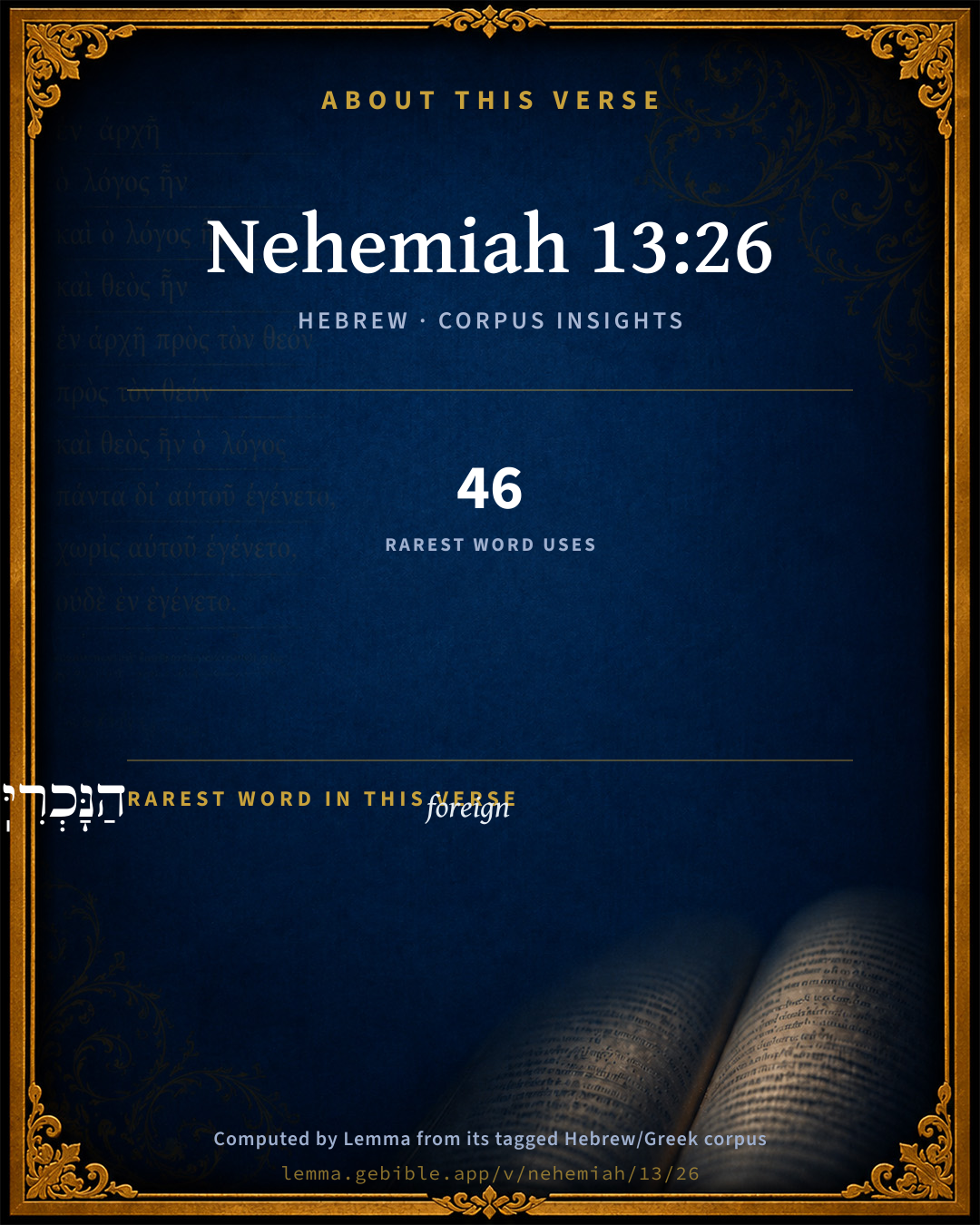
About this verse

These counts appear in no published source. They are computed here, from the morphology-tagged text and Lemma’s own curated glosses. What Lemma adds →

27
words
19
distinct lemmas
Historical
section

Shared distinctive vocabulary

הַנָּכְרִיּֽוֹת foreign H5237 occurs in 45 verses of the Hebrew Bible. Also found in:

Grammatical profile

  • 6 verbs
  • 11 nouns
  • 2 adjectives
  • 1 pronoun
  • 3 prepositions
  • 4 particles

Verb forms

  • חָטָֽא Qal · Perfect
  • הָיָ֨ה Qal · Perfect
  • וְאָה֤וּב Qal · Participle Passive
  • הָיָ֔ה Qal · Perfect
  • וַיִּתְּנֵ֣הוּ Qal · Sequential Imperfect
  • הֶחֱטִ֔יאוּ Hiphil · Perfect

Repetition

Words recur within this verse — often emphatic in Hebrew:

  • מֶ֣לֶךְ king H4428 ×3
  • עַל upon H5921 ×2
  • חָטָֽא to sin H2398 ×2
  • יִשְׂרָאֵ֡ל Israel H3478 ×2
  • הָיָ֨ה to be H1961 ×2
  • לֵֽאלֹהָיו֙ God H430 ×2
  • הֲל֣וֹא not H3808 ×2

Cross-references

6

Topical passages linked to Nehemiah 13:26 in the Treasury of Scripture Knowledge — connected by theme and wording, ordered by reader-vote popularity; previews shown in the World English Bible.

  • 1 Kings 11:1–8 Now king Solomon loved many foreign women, together with the daughter of Pharaoh, women of the Moabites, Ammonites, Edomites, Sidonians, and Hittites;
  • 1 Kings 3:13 I have also given you that which you have not asked, both riches and honor, so that there shall not be any among the kings like you, all your days.
  • Ecclesiastes 7:26 I find more bitter than death the woman whose heart is snares and traps, whose hands are chains. Whoever pleases God shall escape from her; but the sinner will be ensnared by her.
  • 2 Samuel 12:24–25 David comforted Bathsheba his wife, and went in to her, and lay with her: and she bore a son, and he called his name Solomon. Yahweh loved him;
  • 2 Chronicles 1:12 wisdom and knowledge is granted to you; and I will give you riches, and wealth, and honor, such as none of the kings have had who have been before you; neither shall there any after you have the like.
  • 2 Chronicles 9:22 So king Solomon exceeded all the kings of the earth in riches and wisdom.

Cross-references courtesy of OpenBible.info (CC BY 4.0).

Hebrew and Greek witnesses Masoretic Hebrew ↔ Greek Septuagint

The same verse in the two great witnesses to the Old Testament, shown verse-for-verse.

These are two independent witnesses, not word-aligned to each other, and the Septuagint is shown in lemma (dictionary) form.

Hebrew Nehemiah 13:26 Masoretic · Westminster Leningrad Codex

הֲל֣וֹא עַל אֵ֣לֶּה חָטָֽא שְׁלֹמֹ֣ה מֶ֣לֶךְ יִשְׂרָאֵ֡ל וּבַגּוֹיִ֣ם הָרַבִּים֩ לֹֽא הָיָ֨ה מֶ֜לֶךְ כָּמֹ֗הוּ וְאָה֤וּב לֵֽאלֹהָיו֙ הָיָ֔ה וַיִּתְּנֵ֣הוּ אֱלֹהִ֔ים מֶ֖לֶךְ עַל כָּל יִשְׂרָאֵ֑ל גַּם אוֹת֣וֹ הֶחֱטִ֔יאוּ הַנָּשִׁ֖ים הַנָּכְרִיּֽוֹת

Did not Solomon king of Israel sin by these things? yet among many nations was there no king like him, and he was beloved of his God, and God made him king over all Israel: nevertheless even him did foreign women cause to sin.

World English Bible · Public Domain

Greek LXX Structure differs

The Septuagint has no separate book of Nehemiah. Its Greek text is the second half of Esdras B (2 Esdras), chapters 11–23; Ezra is the first half (1–10).

A verse-for-verse comparison isn’t shown here because the chapters and verses don’t line up. Switch to the LXX edition with the MT / LXX toggle above to read the Greek directly.

Hebrew: Westminster Leningrad Codex (CC BY 4.0). Greek: Septuagint (public domain); English from a public-domain English Septuagint. How the Septuagint differs from the Hebrew →

Commentary

Notes on Nehemiah 13:26 from classic Christian and Jewish commentators (each source and its license shown beneath its notes). The classic Christian expositions comment on the surrounding passage and are grouped to its opening verse, so a note may address several verses; the Jewish commentaries on the Tanakh (Rashi and others) are per-verse, so they appear only where the commentator wrote on this verse.

Lemma curates 59 commentaries, every one of them public domain or Creative Commons licensed, each selected and text-cleaned for this edition rather than reprinted as found. About our sources →

Trapp's Complete Commentary

John Trapp

Neh 13:26 Did not Solomon king of Israel sin by these things? yet among many nations was there no king like him, who was beloved of his God, and God made him king over all Israel: nevertheless even him did outlandish women cause to sin.

Ver. 26. Did not Solomon, king of Israel, &c.] Did not he deviate and prevaricate in his old age, shamefully turning from the Lord, who had appeared unto him twice? Did not his strange wives draw him to strange practices; insomuch as some have doubted about his salvation, and Bellarmine reckoneth him (but wrongfully) amongst reprobates?

Yet among many nations was there no king like him] For honour, pleasure, wisdom, and wealth, &c., the abundance he had of these drew out his spirits, and dissolved him. See Mar 10:23-25 1Ti 6:9 Isa 39:1-2.

Who was beloved of his God] His corculum, his darling, his Jedidiah, 2Sa 12:25, but he did not reciprocate; his heart was disjointed and hung loose from the Lord, whom he grievously provoked by his sensuality and apostasy.

And God made him king over all Israel] Not by right of inheritance (for he was a younger brother), but by special designation. Yet he defied that throne whereunto God had so graciously advanced him; this was a great aggravation of his sin, 2Sa 12:7-8 Deu 32:12; Deu 32:19 Amo 2:9.

Nevertheless even him did outlandish women cause to sin] And that most shamefully. Never was there a wiser man than Solomon; and never any saint fell into more foolish lusts. Job, who had the greatest adversity that ever man felt, fell much; but Solomon, who had the greatest prosperity that ever man saw, fell more.

John Trapp, A Commentary or Exposition upon All the Books of the Old and New Testament (1647–1656) — public domain. Text from a community e-Sword module.

The Biblical Illustrator

Joseph S. Exell

Neh_13:26

Did not Solomon king of Israel sin by these things?

Solomon

1. It may appear remarkable that one who fell so grievously should contribute at all to the Book of God, nor is there any other instance of the kind; but his sad history adds a peculiar weight of warning to his words; nor are there any books more strongly marked by the finger of God.

2. Solomon was chosen of God, and afterwards rejected as Saul had been; he was full of wisdom and understanding, and what is far more, of holiness and goodness. There is perhaps no one of whom the early promise of good seemed so decisive.

3. It has been said, as by St. Augustine, that Solomon was more injured by prosperity than profited by wisdom. Yet we may observe that his falling away is not attributed in Scripture to his wealth, his power and honour.

4. We cannot conclude that Solomon himself did not at last repent, but this has always been considered by the Church as very doubtful, to say the least. All we know is that Scripture has fully made known to us his falling away from God, but has said nothing of his repentance. The very silence is awful and impressive.

5. What more melancholy than the fall of one so great--so wise! What words could have been spoken to him more powerful than his own! What eloquence could describe his fall with more feeling and beauty than his own words! What could more powerfully paint the loveliness of that holiness from which he fell? what the overpowering sweetness of that Divine love which he has consented to give up to feed on ashes! Who can describe the temptations to those very sins by which he was ensnared in a more searching manner than he has done? It is very awful to think how God may use men as instruments of good that His Spirit may teach them, and through them teach others, and guide them to the fountain of living waters, yet they themselves at last fail of the prize of their high calling. What a warning for fear! (Isaac Williams.)

Solomons restoration

I. The wanderings of an erring spirit. Did not Solomon king of Israel sin by these things?

1. That which lay at the bottom of all Solomons transgressions was his intimate partnership with foreigners. Did not Solomon sin by these things?--that is, if we look to the context, marriage with foreign wives. The history of the text is this--Nehemiah discovered that the nobles of Judah, during the captivity, when law and religious customs had been relaxed, had married wives of Ashdod, of Ammon, and of Moab; and then, in his passionate expostulation with them, he reminds them that it was this very transgression which led to the fall of the monarch who had been most distinguished for Gods favour. Exclusiveness was the principle on which Judaism was built. Everything was to be distinct--as distinct as Gods service and the worlds. And it was this principle which Solomon transgressed. The Jewish law, shadowed out an everlasting truth. Gods people are an exclusive nation; Gods Church is for ever separated from the world. This is her charter, Come out from among them, and be ye separate, etc. We are to be separate from the world. Mistake not the meaning of that word. The world changes its complexion in every age. Solomons world was the nations of idolatry lying round Israel. Our world is not that. The world is that collection of men in every age who live only according to the maxims of their time. The world may be a profligate world, or it may be a moral world. All that is a matter of accident. Our world is a moral world. The sons of our world are not idolaters, they are not profligate; they are, it may be, among the most fascinating of mankind. No marvel if a young and ardent heart feels the spell of the fascination. No wonder if it feels a relief in turning away from the dulness and the monotony of home life to the sparkling brilliancy of the worlds society. The brilliant, dazzling, accomplished world--what Christian with a mind polished like Solomons does not own its charms? And yet now, pause. Is it in wise Egypt that our highest blessedness lies? Is it in busy, restless Sidon? Is it in luxurious Moab? No. The Christian must leave the world alone. His blessedness lies in quiet work with the Israel of God.

2. The second step of Solomons wandering was the unrestrained pursuit of pleasure. And a men like Solomon cannot do anything by helves. No man ever more heartily and systematically gave himself up to the pursuit. There are some men who are prudent in their epicuresnism. They put gaiety aside when they begin to get palled with it, and then return to it moderately again. Mere like Solomon cannot do that. No earnest man can. No! if blessedness lies in pleasure, he will drink the cup to the dregs. But let us mark the wanderings of an immortal soul infinite in its vastness. There is a moral to be learnt from the wildest worldliness. When we look on the madness of life, and are marvelling at the terrible career of dissipation, let there be no contempt felt. It is an immortal spirit marring itself. It is an infinite soul, which nothing short of the Infinite can satisfy, plunging down to ruin and disappointment. That unquenched impetuosity within you might have led you up to God. You have chosen instead that your heart shall try to satisfy itself upon husks. There was another form of Solomons worldliness.

3. It was not worldliness in pleasure, but worldliness in occupation. He had entered deeply into commercial speculations. He had alternate fears and hopes about the return of his merchant ships on their perilous three-years voyage to India end to Spain. He had his mind occupied with plans for building. The architecture of the temple, his own palace, the forts and towns of his now magnificent empire, all this filled for a time his soul. He had begun a system of national debt end ruinous taxation. Much of this was not wrong; but all of it was dangerous. It is a strange thing how business dulls the sharpness of the spiritual affections. It is strange how the harass of perpetual occupation shuts God out. There are writers who have said that in this matter Solomon was in advance of his age enlightened beyond the narrowness of Judaism, and that this permission of idolatry was the earliest exhibition of that spirit which in modern times we call religious toleration. But Solomon went far beyond toleration. The truth seems to be, Solomon was getting indifferent about religion. He had got into light and worldly society, and the libertinism of his associations was beginning to make its impression upon him. He was beginning to ask, Is not one religion as good as another, so long as each man believes his own in earnest? There are few signs in a souls state more alarming than that of religious indifference; that is, the spirit of thinking ell religions equally true, the real meaning of which is, that all religions are equally false.

II. Gods loving guidance of Solomon in the midst of all his apostasy. In the darkest, wildest wanderings a man to whom God has shown His love in Christ is conscious still of the better way. In the very gloom of his remorse, there is an instinctive turning back to God. It is enumerated among the gifts that God bestowed upon Solomon that He granted to him largeness of heart. Now that largeness of heart which we call thoughtfulness and sensibility, generosity, high feeling, marks out for the man who has it a peculiar life. You look to the life of Solomon, and there are no outward reverses there to speak of. His reign was a type of a reign of the power of peace. No war, no national disaster, interrupted the even flow of the current of his days. No loss of a child, like Davids, pouring cold desolation into his soul--no pestilences nor famines. Prosperity and riches, and the internal development of the nations life--that was the reign of Solomon. And yet, with all this, was Solomon happy? Is there no way that God has of making the heart grey and old before its time without sending bereavement, or loss, or sickness? Has the Eternal Justice no mode of withering and drying up the inner springs of happiness while all is green, and wild, and fresh outwardly? We look to the history of Solomon for the answer. The first way in which his aberration from God treasured up for him chastisement was by that weariness of existence which breathes through the whole Book of Ecclesiastes. Another part of Solomons chastisement was doubt. Once more turn to the Book of Ecclesiastes. All things come alike to all: there is one event to the righteous, and to the wicked; to the good and to the clean, and to the unclean; to him that sacrificeth, and to him that sacrificeth not. In this you will observe the querulous complaint of a man who has ceased to feel that God is the ruler of this world. A blind chance, or a dark destiny, seems to rule all earthly things. And that is the penalty of leaving Gods narrow path for sins wider and more flowery one. But the love of God brought Solomon through all this to spiritual manhood. Let us hear the conclusion of the whole matter: Fear God, and keep His commandments: for this is the whole duty of man. In this we have the evidence of his victory. Doubt, and imprisonment, and worldliness have passed away, and clear activity, belief, freedom, have taken their place. It was terrible discipline, but God had made that discipline successful. I speak to those who know something about what the world is worth, who have tasted its fruits, and found them like the Dead Sea apples--hollowness and ashes. By those foretastes of coming misery which God has already given you, those lonely feelings of utter wretchedness and disappointment when you have returned home palled and satiated from the gaudy entertainment, and the truth has pressed itself icy cold upon your heart, Vanity of vanities--is this worth living for? By all that, be warned. Be true to your convictions. Be honest with yourselves. Learn from the very greatness of your souls, which have a capacity for infinite agony, that you m in this world for a grander destiny than that of frittering away life in usefulness. Lastly, let us learn from this subject the covenant love of God. There is such a thing as love which rebellion cannot weary, which ingratitude cannot cool (W. F. Robertson, M. A.)

The Biblical Illustrator, edited by Joseph S. Exell (c. 1880s–1900s) — public domain. Text from a community e-Sword module.

Joseph Benson's Commentary

Neh 13:26. Did not Solomon sin by these things? — He quotes a precedent to show the pernicious consequences of their conduct, which were such as rendered it necessary that their sin should be animadverted upon by the government. The falls of great and good men are therefore recorded, that we may take warning by them to shun the temptations by which they were overcome. Solomon was famous for wisdom; yet, when he married strange wives, his wisdom could not secure him from the snares of such connections: nay, it departed from him, and he acted very foolishly as well as wickedly. He was beloved of God, but his conduct, in that particular, threw him out of God’s favour, and went near entirely to extinguish the grace of God in his soul. He was king over Israel, but that lost his house ten of the twelve tribes. You plead that you can marry strange wives, and yet retain the purity of Israelites; but Solomon himself could not; even him did outlandish women cause to sin — Therefore let him that assuredly standeth, take heed lest he fall, when he runs upon such a precipice.

Joseph Benson's Commentary on the Old and New Testaments (1811–1818) — public domain. Text from a community e-Sword module.

Tyndale Open Study Notes

Tyndale Open Resources

13:26-27 King Solomon had led the nation into sin by his foreign wives (1 Kgs 11). If intermarriage with pagans was allowed to continue, the same apostasy would overtake the community. Nehemiah would not let that happen.

Tyndale Open Study Notes — © Tyndale Open Resources, licensed CC BY-SA 4.0. Text via the HelloAO Bible API.

Adam Clarke's Commentary

Verse 26. Did not Solomon] Have you not had an awful example before you? What a heavy curse did Solomon's conduct bring upon himself and upon the people, for a conduct such as yours?

Adam Clarke's Commentary on the Bible (1810–1826) — public domain. Text from a community e-Sword/MySword module.

Ellicott's Commentary for English Readers

(26) Did not Solomon . . .—Here it is implied that the language of Scripture concerning Solomon was familiar both to Nehemiah and to these transgressors. It is a remarkable instance of the faithful application of their own chronicles.

A Bible Commentary for English Readers, edited by Charles John Ellicott (1878–1897) — public domain. Text from a community e-Sword module.

The Cambridge Bible for Schools and Colleges

gen. ed. J. J. S. Perowne

26. Solomon king of Israel] An argument from the greater to the less. If Solomon, the beloved of God, fell through this snare, how much more likely to sin were these ignorant Jews?

by these things] i.e. on account of wives taken from idolatrous people.

among many nations] Cf. Mich. Neh_4:3, ‘he shall judge between many peoples.’

was there no king like him] Cf. 1Ki_3:12-13; 2Ch_1:12.

who (R.V. and he) was beloved of his God] Perhaps referring especially to the privilege of Solomon to receive the task of building the Temple and ordering the sacred worship; but the expression calls to mind 2Sa_12:25, ‘And the Lord loved him; … and he called his name Jedidiah for the Lord’s sake.’

outlandish women] R.V. strange women. See 1Ki_11:3 ff.

The Cambridge Bible for Schools and Colleges (gen. ed. J. J. S. Perowne; Cambridge University Press, 1878–1918) — public domain. Text from a community e-Sword module.

John Gill's Exposition

Remember them, O my God,.... The priests, and punish them: because they have defiled the priesthood; by marrying strange wives, and rendering themselves unfit to officiate in it:

and the covenant of the priesthood, and of the Levites; made with Levi, Aaron, and Phinehas, see Num 24:11, of the corruption of which, complaint is made, Mal 2:4.

John Gill's Exposition of the Whole Bible (1746–1763) — public domain (CC PDM 1.0). Text via the HelloAO Bible API.

Whedon's Commentary on the Bible

Daniel D. Whedon

26. Outlandish women — That is, foreign women. The word outlandish, from the Anglo-Saxon utlendisc, is now obsolete in the sense in which it is here used. The reference to Solomon was exceedingly appropriate. See 1Ki_11:1-9.

Daniel D. Whedon (gen. ed.), Commentary on the Old and New Testaments (1874–1909) — public domain. Text from a community e-Sword module.

The Pulpit Commentary

Did not Solomon... sin by these things? The example adduced was more apt than any other to move Jews. Israelites might have felt more deeply the case of Ahab. (1Ki_21:25) Solomon"s sin in "going after strange wives," and its punishment, are set forth very fully in 1Ki_11:1-40. Among many nations there was no king like him. The reference is not so much to particular texts (e.g. 1Ki_3:13 2Ch_1:12) as to the general description of Solomon, his glory, and his greatness, (1Ki 4-10 2Ch 1-9) which set him above all other earthly monarchs. Who was beloved of his God. See 2Sa_12:24. And God made him king over all Israel. See 1Ki_4:1.

The Pulpit Commentary (1880–1919), ed. H.D.M. Spence-Jones & Joseph S. Exell — public domain. Text from a community e-Sword module.

Rashi

Rabbi Shlomo Yitzchaki (Rashi)

caused him even to sin If he sinned, how much more so is it certain that you will sin through your heathen wives! As is written in the next verse, “Shall we hearken, etc.?” i.e., Solomon was found sinning through his heathen wives, and you have married foreign wives in order to sin?

Rashi on the Tanakh — English translations: “The Judaica Press complete Tanach with Rashi, translated by A. J. Rosenberg” (CC BY 4.0); “Pentateuch with Rashi's commentary by M. Rosenbaum and A.M. Silbermann, 1929-1934” (public domain); “The Metsudah Tanach series, Lakewood, N.J” (CC BY 4.0); and “The Book of Joshua, Metsudah Publications, 1997” (CC BY 4.0). Text via Sefaria.

Lesson kit

Teaching starters — assembled from the data on this page, not authored interpretation. Every prompt links to the verse data it draws on. Edit before teaching.

Nehemiah, in the Historical, opens this verse with 27 words (19 distinct Hebrew lemmas). Its most distinctive word is nokrîy (“foreign”). A historical commentator’s framing appears above. Read the whole chapter for the surrounding context.

Discussion questions

  1. What does “foreign” (nokrîy) contribute to the verse as a whole?
  2. How does Genesis 31:15, which shares the word «foreign», read alongside this verse?
  3. What does the repetition of “king” (3× in this one verse) do in this verse?
  4. The translations on this page render this verse differently — a whole-verse word diff, not a word-by-word alignment. What might account for the different wordings?
  5. «חָטָֽא» is a Qal Perfect verb. How does that grammatical form shape the action described?
  6. Compare how Trapp's Complete Commentary and The Biblical Illustrator read this verse. Where do they agree or differ?

Things to notice

Reading settings

Reading text

Shown beneath each verse's original-language words.

Old Testament
Old Testament edition

Read the OT as the Masoretic Hebrew (MT) or the Greek Septuagint (LXX).

English shown for the Greek Septuagint (in the Hebrew ↔ Greek comparison).

Comparing translations? Open the Compare panel on any verse page to stack up to four side by side.