
2 Chronicles 29:8

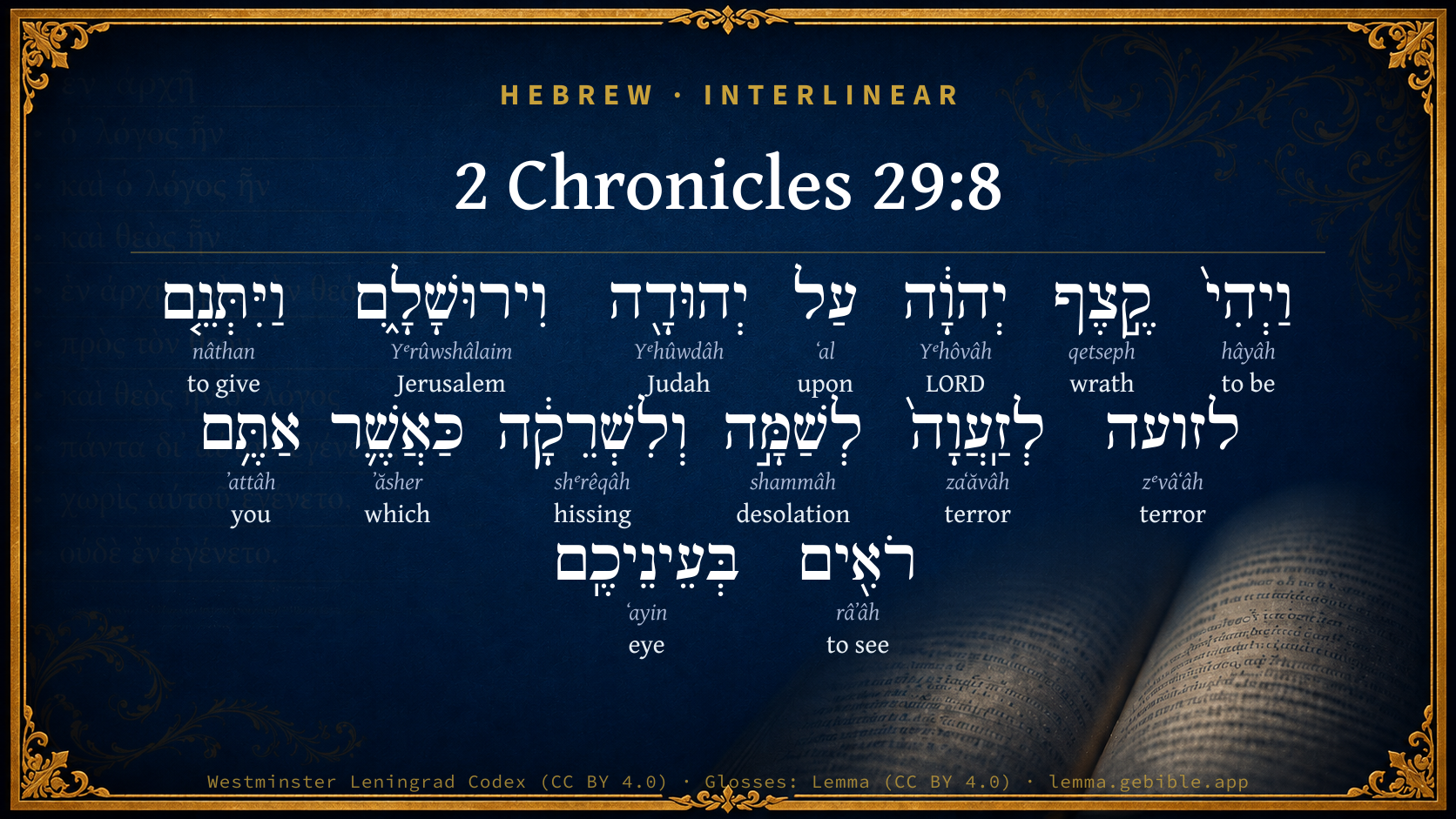
Hebrew (Westminster Leningrad Codex) 2 Chronicles 29:8 appears in the Hebrew Old Testament. The text above is from the Westminster Leningrad Codex. Each word links to its Strong’s number, a concise gloss, and parsing drawn from the Open Scriptures Hebrew Bible morphology. Click any word for its full Brown-Driver-Briggs (BDB) entry.
Download image
Cite this verse

2 Chronicles 29:8 (World English Bible). Public Domain. Lemma interlinear Bible study tool, https://lemma.gebible.app/v/2-chronicles/29/8.

Show BibTeX & RIS
BibTeX
RIS
English Translation
Therefore the wrath of Yahweh was on Judah and Jerusalem, and he has delivered them to be tossed back and forth, to be an astonishment, and a hissing, as you see with your eyes.
World English Bible · Public Domain
Highlights
  • 2 first appearances in the Hebrew Bible
Full analysis ↓
Download a study sheet

One document with this verse’s original text, its word-by-word gloss line, the meaning frame, cross-references with their text, attributed commentary, and full source and license credits — printable, and it pastes into notes with its structure intact.

This verse Autodidact and up

Study sheet (.html) Plain text (.txt)

A passage Seminary Student

Up to 50 verses in one chapter. A passage sheet keeps up to 6 commentary sources and 12 cross-references per verse, in the order this page ranks them, and says so on the sheet whenever that leaves anything out. Ask for a single verse and you get the Autodidact verse sheet above.

Everything on this page stays free to read, with no account — the sheet is a download of what is already on screen, not access to it.

Want to remove ads? Support Godless Engineer
Compare translations 3

The same verse in 3 English versions, stacked beneath the original-language interlinear above. Click any original word for its lexicon entry.

Each is an independent rendering of the whole verse — the interlinear is not word-aligned to these translations.

Highlighted words mark where these versions differ — a whole-verse word diff, not a word-by-word alignment.

  • World English Bible Public Domain
    Therefore the wrath of Yahweh was on Judah and Jerusalem, and he has delivered them to be tossed back and forth, to be an astonishment, and a hissing, as you see with your eyes.
  • King James Version Public Domain
    Wherefore the wrath of the LORD was upon Judah and Jerusalem, and he hath delivered them to trouble, to astonishment, and to hissing, as ye see with your eyes.
  • unfoldingWord Literal Text CC BY-SA 4.0
    And the wrath of Yahweh was on Judah and Jerusalem. And he gave them to be a terror, to be a horror, and to be a hissing, just as you all are seeing with your eyes.

unfoldingWord Literal Text — © unfoldingWord, licensed CC BY-SA 4.0. Word-aligned USFM3 via Door43 (git.door43.org/unfoldingWord/en_ult).

Versions to compare (up to 4)

3 of 4 selected

Show all 18 translations

Every available English version of this verse, each an independent rendering of the whole verse.

  • World English Bible Public Domain
    Therefore the wrath of Yahweh was on Judah and Jerusalem, and he has delivered them to be tossed back and forth, to be an astonishment, and a hissing, as you see with your eyes.
  • Berean Standard Bible Public Domain
    Therefore, the wrath of the LORD has fallen upon Judah and Jerusalem, and He has made them an object of terror, horror, and mockery, as you can see with your own eyes.
  • Majority Standard Bible Public Domain
    Therefore, the wrath of the LORD has fallen upon Judah and Jerusalem, and He has made them an object of terror, horror, and scorn, as you can see with your own eyes.
  • King James Version Public Domain
    Wherefore the wrath of the LORD was upon Judah and Jerusalem, and he hath delivered them to trouble, to astonishment, and to hissing, as ye see with your eyes.
  • American Standard Version (1901) Public Domain
    Wherefore the wrath of Jehovah was upon Judah and Jerusalem, and he hath delivered them to be tossed to and fro, to be an astonishment, and a hissing, as ye see with your eyes.
  • Revised Version (1885) Public Domain
    Wherefore the wrath of the LORD was upon Judah and Jerusalem, and he hath delivered them to be tossed to and fro, to be an astonishment, and an hissing, as ye see with your eyes.
  • Geneva Bible (1599) Public Domain
    Wherfore the wrath of the Lord hath bin on Iudah and Ierusalem: and he hath made them a scattering, a desolation, and an hissing, as ye see with your eyes.
  • Douay-Rheims (1899) Public Domain
    Therefore the wrath of the Lord hath been stirred up against Juda and Jerusalem, and he hath delivered them to trouble, and to destruction, and to be hissed at, as you see with your eyes.
  • Young's Literal Translation Public Domain
    and the wrath of Jehovah is on Judah and Jerusalem, and He giveth them for a trembling, for an astonishment, and for a hissing, as ye are seeing with your eyes.
  • Literal Standard Version CC BY-SA 4.0
    and the wrath of YHWH is on Judah and Jerusalem, and He gives them for a trembling, for an astonishment, and for a hissing, as you are seeing with your eyes.
  • Unlocked Literal Bible CC BY-SA 4.0
    Therefore the wrath of Yahweh had fallen on Judah and Jerusalem, and he has made them to be an object of terror, of horror, and of scorn, as you can see with your own eyes.
  • unfoldingWord Literal Text CC BY-SA 4.0
    And the wrath of Yahweh was on Judah and Jerusalem. And he gave them to be a terror, to be a horror, and to be a hissing, just as you all are seeing with your eyes.
  • Darby Bible Public Domain
    Therefore the wrath of Jehovah has been upon Judah and Jerusalem, and he has delivered them to vexation, to desolation, and to hissing, as ye see with your eyes.
  • World Messianic Bible Public Domain
    Therefore the LORD’s wrath was on Judah and Jerusalem, and he has delivered them to be tossed back and forth, to be an astonishment and a hissing, as you see with your eyes.
  • Webster's Bible Public Domain
    Wherefore the wrath of the LORD hath been upon Judah and Jerusalem, and he hath delivered them to trouble, to astonishment, and to hissing, as ye see with your eyes.
  • Free Bible Version CC BY-SA 4.0
    So the Lord's anger fell on Judah and Jerusalem, and he made them into something appalling, terrifying, and ridiculous, as you can see for yourselves.
  • Bible in Basic English Public Domain
    And so the wrath of the Lord has come on Judah and Jerusalem, and he has given them up to be a cause of fear and wonder and shame, as your eyes have seen.
  • JPS Tanakh (1917) Public Domain
    Wherefore the wrath of the LORD was upon Judah and Jerusalem, and He hath delivered them to be a horror, an astonishment, and a hissing, as ye see with your eyes.

Literal Standard Version (2020), Covenant Press — licensed CC BY-SA 4.0. Text via the HelloAO Bible API (eBible.org). Unlocked Literal Bible (unfoldingWord) — licensed CC BY-SA 4.0. Text via the HelloAO Bible API (eBible.org). unfoldingWord Literal Text — © unfoldingWord, licensed CC BY-SA 4.0. Word-aligned USFM3 via Door43 (git.door43.org/unfoldingWord/en_ult). Free Bible Version, Dr. Jonathan Gallagher — licensed CC BY-SA 4.0. Text via the HelloAO Bible API (eBible.org).

Word by word

More ways to search: Search by grammar → Find every occurrence → Compare this word →

Practice this passage: Drill this verse → Learn its vocabulary →

לְזַֽעֲוָה֙
zaʻăvâh
H2189
“to/for · terror”
Preposition + Noun, Common, Feminine, Singular, Absolute
Part of Speech
Preposition + Noun
Type
Common
Gender
Feminine
Number
Singular
State
Absolute
Full BDB Definition

Origin: by transposition for H2113

TWOT: 540a

a horror, trembling, object of terror or trembling
  1. וַיְהִי֙ hâyâh H1961 “and · to be” Conjunction + Verb, Qal, Sequential Imperfect, 3rd Person, Masculine, Singular
  2. קֶ֣צֶף qetseph H7110 “wrath of” Noun, Common, Masculine, Singular, Construct
  3. יְהוָ֔ה Yᵉhôvâh H3068 “LORD” Noun, Proper
  4. עַל ʻal H5921 “upon” Preposition
  5. יְהוּדָ֖ה Yᵉhûwdâh H3063 “Judah” Noun, Proper
  6. וִירוּשָׁלִָ֑ם Yᵉrûwshâlaim H3389 “and · Jerusalem” Conjunction + Noun, Proper
  7. וַיִּתְּנֵ֤ם nâthan H5414 “and · to give · them” Conjunction + Verb, Qal, Sequential Imperfect, 3rd Person, Masculine, Singular + Suffix, Personal, 3rd Person, Masculine, Plural
  8. לזועה zᵉvâʻâh H2113 “to/for · terror” Preposition + Noun, Common, Feminine, Singular, Absolute
  9. לְשַׁמָּ֣ה shammâh H8047 “to/for · desolation” Preposition + Noun, Common, Feminine, Singular, Absolute
  10. וְלִשְׁרֵקָ֔ה shᵉrêqâh H8322 “and · to/for · hissing” Conjunction + Preposition + Noun, Common, Feminine, Singular, Absolute
  11. כַּאֲשֶׁ֛ר ʼăsher H834 “like/as · which” Preposition + Particle, Relative
  12. אַתֶּ֥ם ʼattâh H859 “you” Pronoun, Personal, 2nd Person, Masculine, Plural
  13. רֹאִ֖ים râʼâh H7200 “seeing” Verb, Qal, Participle Active, Masculine, Plural, Absolute
  14. בְּעֵינֵיכֶֽם ʻayin H5869 “in/at · eyes · your” Preposition + Noun, Common, Both, Dual, Construct + Suffix, Personal, 2nd Person, Masculine, Plural

About this verse

These counts appear in no published source. They are computed here, from the morphology-tagged text and Lemma’s own curated glosses. What Lemma adds →

15
words
15
distinct lemmas
Historical
section

Notable vocabulary

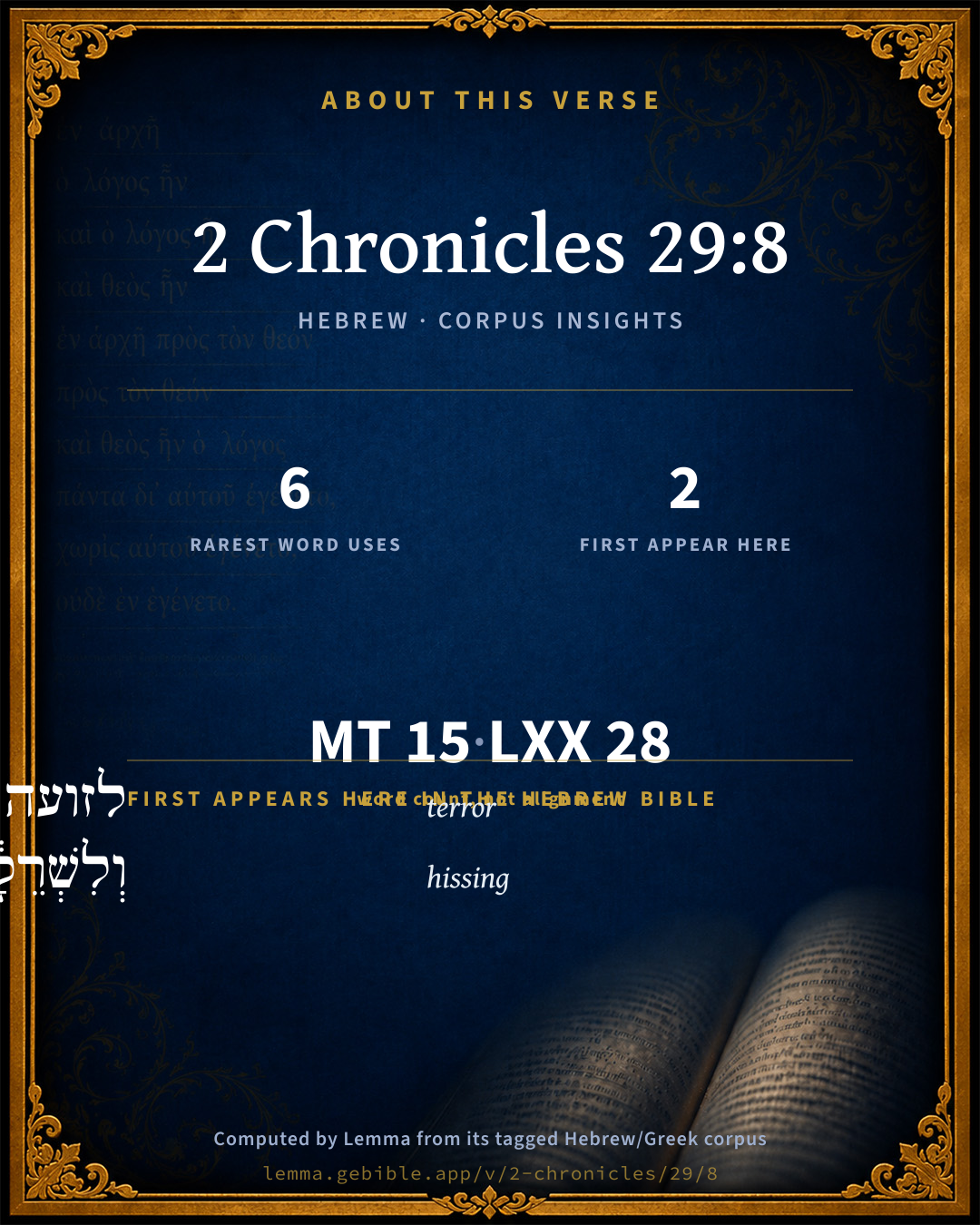
The rarest word here is לְזַֽעֲוָה֙ terror H2189 — appearing just 6 times in the whole Hebrew Bible.

First appearance in Scripture

These words make their first canonical appearance in the Hebrew Bible here:

  • לזועה terror H2113
  • וְלִשְׁרֵקָ֔ה hissing H8322

Shared distinctive vocabulary

לְזַֽעֲוָה֙ terror H2189 occurs in 6 verses of the Hebrew Bible. Also found in:

Grammatical profile

  • 3 verbs
  • 9 nouns
  • 1 pronoun
  • 1 preposition
  • 1 particle

Verb forms

  • וַיְהִי֙ Qal · Sequential Imperfect
  • וַיִּתְּנֵ֤ם Qal · Sequential Imperfect
  • רֹאִ֖ים Qal · Participle Active

Hebrew & Septuagint length

In English translation the verse runs 34 words from the Hebrew and 27 from the Septuagint (LXX English) — closely comparable.

A rough comparison of the two English renderings, which tokenize alike — not a word-level alignment.

Word counts can differ between the Hebrew and the Greek without any difference in meaning — e.g. the Hebrew direct-object marker אֵת has no separate Greek word, and Greek often adds the article ὁ.

In the original languages it is 15 Hebrew tokens and 28 Greek tokens — but the two are counted differently (Hebrew bundles its prefixes and suffixes into one token; the Greek is in lemma form), so that isn’t a like-for-like length.

Cross-references

13

Topical passages linked to 2 Chronicles 29:8 in the Treasury of Scripture Knowledge — connected by theme and wording, ordered by reader-vote popularity; previews shown in the World English Bible.

  • Jeremiah 25:9 behold, I will send and take all the families of the north, says Yahweh, and [I will send] to Nebuchadrezzar the king of Babylon, my servant, and will bring them against this land, and against the inhabitants of it, and against all these nations round about; and I will utterly destroy them, and make them an astonishment, and a hissing, and perpetual desolations.
  • Jeremiah 25:18 [to wit], Jerusalem, and the cities of Judah, and the kings of it, and the princes of it, to make them a desolation, an astonishment, a hissing, and a curse, as it is this day;
  • Deuteronomy 28:25 Yahweh will cause you to be struck before your enemies; you shall go out one way against them, and shall flee seven ways before them: and you shall be tossed back and forth among all the kingdoms of the earth.
  • 2 Chronicles 24:18 They forsook the house of Yahweh, the God of their fathers, and served the Asherim and the idols: and wrath came on Judah and Jerusalem for this their guiltiness.
  • Jeremiah 19:8 I will make this city an astonishment, and a hissing; everyone who passes thereby shall be astonished and hiss because of all the plagues of it.
  • Jeremiah 29:18 I will pursue after them with the sword, with the famine, and with the pestilence, and will deliver them to be tossed back and forth among all the kingdoms of the earth, to be an object of horror, and an astonishment, and a hissing, and a reproach, among all the nations where I have driven them;
  • Leviticus 26:32 I will bring the land into desolation; and your enemies that dwell therein will be astonished at it.
  • Deuteronomy 28:15–20 But it shall come to pass, if you will not listen to the voice of Yahweh your God, to observe to do all his commandments and his statutes which I command you this day, that all these curses shall come on you, and overtake you.
  • Deuteronomy 28:59 then Yahweh will make your plagues wonderful, and the plagues of your seed, even great plagues, and of long continuance, and sore sicknesses, and of long continuance.
  • 1 Kings 9:8 Though this house is so high, yet shall everyone who passes by it be astonished, and shall hiss; and they shall say, Why has Yahweh done thus to this land, and to this house?
  • 2 Chronicles 34:24–25 Thus says Yahweh, Behold, I will bring evil on this place, and on the inhabitants of it, even all the curses that are written in the book which they have read before the king of Judah.
  • 2 Chronicles 36:14–16 Moreover all the chiefs of the priests, and the people, trespassed very greatly after all the abominations of the nations; and they polluted the house of Yahweh which he had made holy in Jerusalem.
  • Jeremiah 18:15–16 For my people have forgotten me, they have burned incense to false [gods]; and they have been made to stumble in their ways, in the ancient paths, to walk in byways, in a way not built up;

Cross-references courtesy of OpenBible.info (CC BY 4.0).

Hebrew and Greek witnesses Masoretic Hebrew ↔ Greek Septuagint

The same verse in the two great witnesses to the Old Testament, shown verse-for-verse.

These are two independent witnesses, not word-aligned to each other, and the Septuagint is shown in lemma (dictionary) form.

Hebrew 2 Chronicles 29:8 Masoretic · Westminster Leningrad Codex

וַיְהִי֙ קֶ֣צֶף יְהוָ֔ה עַל יְהוּדָ֖ה וִירוּשָׁלִָ֑ם וַיִּתְּנֵ֤ם לזועה לְזַֽעֲוָה֙ לְשַׁמָּ֣ה וְלִשְׁרֵקָ֔ה כַּאֲשֶׁ֛ר אַתֶּ֥ם רֹאִ֖ים בְּעֵינֵיכֶֽם

Therefore the wrath of Yahweh was on Judah and Jerusalem, and he has delivered them to be tossed back and forth, to be an astonishment, and a hissing, as you see with your eyes.

World English Bible · Public Domain

Greek LXX 2 Chronicles 29:8 Septuagint · lemma form

καί ὀργίζω ὀργή κύριος ἐπί ὁ ἰούδας καί ἐπί ὁ ἰερουσαλήμ καί δίδωμι αὐτός εἰς ἔκστασις καί εἰς ἀφανισμός καί εἰς συρισμός ὡς σύ ὁράω ὁ ὀφθαλμός σύ

And the Lord was very angry with Juda and Jerusalem, and made them an astonishment, and a desolation, and a hissing, as you⌃ see with your eyes.

LXX2012 (modern English Septuagint) · Public Domain

Hebrew: Westminster Leningrad Codex (CC BY 4.0). Greek: Septuagint (public domain); English from LXX2012 (modern English Septuagint) (Public Domain). How the Septuagint differs from the Hebrew →

Commentary

Notes on 2 Chronicles 29:8 from classic Christian and Jewish commentators (each source and its license shown beneath its notes). The classic Christian expositions comment on the surrounding passage and are grouped to its opening verse, so a note may address several verses; the Jewish commentaries on the Tanakh (Rashi and others) are per-verse, so they appear only where the commentator wrote on this verse.

Lemma curates 59 commentaries, every one of them public domain or Creative Commons licensed, each selected and text-cleaned for this edition rather than reprinted as found. About our sources →

Trapp's Complete Commentary

John Trapp

2Ch 29:8 Wherefore the wrath of the LORD was upon Judah and Jerusalem, and he hath delivered them to trouble, to astonishment, and to hissing, as ye see with your eyes.

Ver. 8. And he hath delivered them to trouble.] Heb., To commotion, so that they are scattered hither and thither, ut fit incursionibus Turcicis, as it falleth out wherever the great Turk setteth his foot.

John Trapp, A Commentary or Exposition upon All the Books of the Old and New Testament (1647–1656) — public domain. Text from a community e-Sword module.

The Biblical Illustrator

Joseph S. Exell

2Ch_29:8

Wherefore . . . the Lord . . . hath delivered them to be tossed to and fro, to be an astonishment, and an hissing, as ye see with your eyes.

The results of sinning

It is easier to see than to foresee the results of sinning. If a young man wont foresee the results of an intemperate or a licentious life, those who observe him will, sooner or later, see with their eyes the worst that he was warned of. If a business man wont foresee the results of a dishonest course, others will see it, by and by, in his character and reputation. The future looks fair to most evil doers at the beginning of their career. It is s pity that they do not more commonly consider at the start what a tossing to and fro, what an astonishment, what a hissing, they are sure to be delivered to in the sight of those who watch them, if they go on in the path which now opens attractively before them. (H. Clay Trumbull.)

The Biblical Illustrator, edited by Joseph S. Exell (c. 1880s–1900s) — public domain. Text from a community e-Sword module.

Joseph Benson's Commentary

2Ch 29:8-9. He hath delivered them to trouble to astonishment, and to hissing — To such calamities as all that see and hear of them shall be astonished at, and hiss at those who, by their own sin and folly, have brought such miseries upon themselves. When we are under the rebukes of God’s providence, it is good for us to inquire whether we have not neglected God’s ordinances, and whether that be not the controversy he has with us. Our wives are in captivity — Though they were presently released, 2Ch 28:5; 2Ch 28:14-15.

Joseph Benson's Commentary on the Old and New Testaments (1811–1818) — public domain. Text from a community e-Sword module.

Geneva Bible (1599)

Geneva Bible translators

He showeth that the contempt of religion is the cause of all God’s plagues.

Or, a nodding of the head and mockery.

Geneva Bible (1599) marginal notes — public domain. Text via Bolls.life.

Jamieson, Fausset & Brown

Robert Jamieson, A. R. Fausset & David Brown

Wherefore the wrath of the Lord was upon Judah and Jerusalem--This pious king had the discernment to ascribe all the national calamities that had befallen the kingdom to the true cause, namely, apostasy from God. The country had been laid waste by successive wars of invasion, and its resources drained. Many families mourned members of their household still suffering the miseries of foreign captivity; all their former prosperity and glory had fled; and to what was this painful and humiliating state of affairs to be traced, but to the manifest judgment of God upon the kingdom for its sins?

Jamieson, Fausset & Brown — Commentary Critical and Explanatory on the Whole Bible (1871) — public domain (CC PDM 1.0). Text via the HelloAO Bible API.

Adam Clarke's Commentary

Verse 8. He hath delivered them to trouble, to astonishment] He probably refers here chiefly to that dreadful defeat by the Israelites in which a hundred and twenty thousand were slain, and two hundred thousand taken prisoners; see the preceding chapter, 2Ch 28:6; 2Ch 28:8.

Adam Clarke's Commentary on the Bible (1810–1826) — public domain. Text from a community e-Sword/MySword module.

Ellicott's Commentary for English Readers

(8) The wrath . . . was (i.e., fell) upon Judah.—The phrase of 2Ch_24:18. (Comp. 2Ch_19:2; 2Ch_19:10.)

Delivered them to trouble . . .—Rather, made them a horror, an astonishment, and a hissing. The language is Deuteronomic. (Comp. Deu_28:25; Deu_28:37 : “Thou shalt become a horror . . . an astonishment.” Jer_25:9; Jer_25:18 : “I will make them an astonishment and a hissing,” et al.)

As ye see with your (own) eyes.—For ye behold the disastrous results of the invasions of Aram and Israel, of Edom and the Philistines, and of the appeal to Assyria (2 Chronicles 28).

A Bible Commentary for English Readers, edited by Charles John Ellicott (1878–1897) — public domain. Text from a community e-Sword module.

The Cambridge Bible for Schools and Colleges

gen. ed. J. J. S. Perowne

8. to trouble, to astonishment, and to hissing] R.V. to be tossed to and fro, to be an astonishment, and an hissing.

to trouble] Better as R.V. mg., to be a terror (or “cause of trembling”). The judgement on Israel fills the surrounding nations with trembling for themselves. The rendering of R.V. text “tossed to and fro” is inferior because the Heb. word describes “trembling” and not “motion from place to place.”

The Cambridge Bible for Schools and Colleges (gen. ed. J. J. S. Perowne; Cambridge University Press, 1878–1918) — public domain. Text from a community e-Sword module.

John Gill's Exposition

For, lo, our fathers have fallen by the sword,.... Of the kings of Syria and Israel, even great numbers of them, Ch2 28:5.

and our sons and our daughters and our wives are in captivity for this; for this idolatry; or they were, though afterwards dismissed, Ch2 28:8 and some of them were still in captivity, perhaps such as were carried captive by the Edomites, Ch2 28:17.

John Gill's Exposition of the Whole Bible (1746–1763) — public domain (CC PDM 1.0). Text via the HelloAO Bible API.

Albert Barnes' Notes on the Bible

He hath delivered them to ... hissing - See 1Ki 9:8 note. It was an expression which Hezekiah might naturally use, for it had occurred in a prophecy of Micah Mic 6:16, his contemporary and monitor Jer 26:18-19, which was probably uttered toward the close of the reign of Ahaz. In Jeremiah the phrase becomes common (marginal references).

Albert Barnes' Notes on the Bible (1834–1885) — public domain. Text from a community e-Sword/MySword module.

Haydock's Catholic Bible Commentary

Trouble. Heb. zuae, (H.) is rendered vexation, Isaias xxviii. 19. Sept. "ecstasy." The Jews were frequently driven from their homes. M. --- There were at a loss what to do, confounded and despised. H.

George Leo Haydock (1774–1849), Haydock's Catholic Family Bible and Commentary, 1859 edition — public domain. Excludes Psalms (Douay-Rheims chapter numbering differs from Protestant) and Deuterocanonical books (Catholic canon only).

Matthew Poole's English Annotations

To astonishment and to hissing, i.e. to such calamities as all that see and hear of shall be astonished at, and hiss at those who by their own sin and folly have brought such miseries upon themselves. See Poole "1Ki 9:8".

Matthew Poole's English Annotations on the Holy Bible (1683–1685) — public domain. Text from a community e-Sword/MySword module.

Whedon's Commentary on the Bible

Daniel D. Whedon

8. The wrath of the Lord was upon Judah — The afflictions which are mentioned in this verse and the following were those which Judah suffered under the reign of Ahaz, and which are described in the previous chapter.

To astonishment — An object of such great ruin as to astonish beholders.

To hissing — An object of scornful derision.

Daniel D. Whedon (gen. ed.), Commentary on the Old and New Testaments (1874–1909) — public domain. Text from a community e-Sword module.

The Pulpit Commentary

Wherefore the wrath. As illustrated by the defeats and humiliations suffered at the hands of Pekah and Hazael, the Philistines and Edomites, and the Assyrians under Tiglath-Pileser. To trouble, to astonishment, and to hissing . Three words, carrying each a volume of meaning, and charged with the most powerful and painful of reminiscence Deu_28:25, Deu_28:28, 32 observe our ver. 9, 37, 46, 65, 66). The Hebrew word for "hissing" (hqrev) occurs, besides, five times in Jer_19:8; Jer_25:9, Jer_25:18; Jer_29:18; Jer_51:37, and once in the contemporary Prophet (Mic_6:16; comp. Jer_26:18)

The Pulpit Commentary (1880–1919), ed. H.D.M. Spence-Jones & Joseph S. Exell — public domain. Text from a community e-Sword module.

John Wesley's Explanatory Notes

Hissing - To such calamities as all that see and hear of, shall be astonished at, and hiss at those, who by their own sin and folly have brought such miseries upon themselves. When we are under the rebukes of God's providence, it is good for us to inquire, Whether we have not neglected God's ordinances, and whether that be not the controversy he has with us?

John Wesley, Explanatory Notes Upon the Whole Bible (1754–1765) — public domain. Text via the GEBible commentary corpus.

unfoldingWord translationNotes

Door43 World Missions Community

the wrath of Yahweh had fallen on Judah and Jerusalem

Here the words "Judah and Jerusalem" refer to the people who live there. Hezekiah speaks of Yahweh being angry with the people and punishing them as if his wrath were an object that fell upon them. AT: "because Yahweh was angry, he had punished the people of Judah and Jerusalem" (See: Metonymy and Metaphor)

an object of terror, of horror, and of scorn

This can be translated with verbal phrases. AT: "something that terrifies and horrifies people, and something that people scorn" (See: Abstract Nouns)

as you can see with your own eyes

The phrase "with your own eyes" emphasizes that the people can see this for themselves without others having to tell them about it. AT: "as you can see for yourselves"

our fathers have fallen by the sword

The idiom "fallen by the sword" means to die in battle. The word "sword" represents the soldiers, who used swords as their primary weapons. AT: "our fathers have died in battle" (See: Idiom and Metonymy)

translationWords

wrath

Judah

Jerusalem

sword

captive

unfoldingWord translationNotes — © Distant Shores Media and the Door43 World Missions Community, licensed CC BY-SA 4.0. Source: git.door43.org/Door43/en_tn.

Lesson kit

Teaching starters — assembled from the data on this page, not authored interpretation. Every prompt links to the verse data it draws on. Edit before teaching.

2 Chronicles, in the Historical, opens this verse with 15 words (15 distinct Hebrew lemmas). Its most distinctive word is zaʻăvâh (“terror”). A historical commentator’s framing appears above. Read the whole chapter for the surrounding context.

Discussion questions

  1. The word zaʻăvâh carries the sense “terror.” How does it shape the verse?
  2. 2 words make their first appearance in Scripture here. What does this debut establish?
  3. How does Deuteronomy 28:25, which shares the word «terror», read alongside this verse?
  4. These translations render this verse differently; the difference is in the English rendering, not the original. What questions does that raise?
  5. «וַיְהִי֙» is a Qal Sequential Imperfect verb. How does that grammatical form shape the action described?
  6. Compare how Trapp's Complete Commentary and The Biblical Illustrator read this verse. Where do they agree or differ?

Things to notice

Reading settings

Reading text

Shown beneath each verse's original-language words.

Old Testament
Old Testament edition

Read the OT as the Masoretic Hebrew (MT) or the Greek Septuagint (LXX).

English shown for the Greek Septuagint (in the Hebrew ↔ Greek comparison).

Comparing translations? Open the Compare panel on any verse page to stack up to four side by side.